

Introduction
The correct estimation of the mineral requirements of growing sheep needs an exact knowledge of mineral deposition in the body. There are few references to the trace element contents in the body of growing lambs in the literature (e.g. Suttle, Reference Suttle1979; Agricultural Research Council (ARC), 1980; Wilkinson et al., Reference Wilkinson, Hill and Phillips2003). Furthermore, most of these studies focus on the production of meat (e.g. Lin et al., Reference Lin, Cross, Johnson, Breidenstein, Randecker and Field1989; Hoffman et al., Reference Hoffman, Muller, Cloete and Schmidt2003). The emphasis on breeding for the lamb meat has led to a shift in the deposition of nutrients in tissues as can be seen for lambs of the most important German sheep breed: German Merino Landsheep (Bellof et al., Reference Bellof, Wolf, Schuster and Hollwich2003a).
A systematic investigation of important influences such as gender, final BW and feeding intensity on a genotype of a current breed is not available. Therefore, the influence of gender, final BW and feeding intensity on the accretion of the trace elements copper (Cu), iron (Fe), manganese (Mn) and zinc (Zn) in empty bodies was examined in an extensive study based on a growth experiment with lambs of the breed German Merino Landsheep.
Material and methods
The trial was carried out using a total of 108 lambs (50% female and 50% male) of the genotype German Merino Landsheep. The age of all animals was known as well as whether reared as singletons or twins. The animals were kept at the Agricultural Training and Research Station of the University of Applied Sciences Weihenstephan and fattened at different feeding levels. The diet was given at the feeding levels ‘low feeding intensity’, ‘medium feeding intensity’ and ‘high feeding intensity’ by varying proportions of concentrate (Table 1) and hay in the daily ration. The feeding level ‘high’ corresponded to a concentrate-intensive diet, whereas the level ‘low’ corresponded to slow growth diet. The content of nutrients and metabolisable energy (ME) in the concentrate and hay is given in Table 2. The ME concentration in the dietary dry matter (DM) of the ration varied between 11.5 (low) and 12.1 MJ ME per kg DM (high). Within the feeding levels, there was no difference in the feeding schedule for gender. By using special demand-feeding stations, it was possible to record exactly the daily feed intake of each animal despite keeping it in groups (separated according to gender). Four different final BWs (slaughter weights) were selected: 18, 30, 45 and 55 kg. There was no differentiation in the feeding intensity for the first weight level of 18 kg. A detailed description of the experimental design, as well as the results of fattening and slaughter performance, has been reported elsewhere (Bellof et al., Reference Bellof, Wolf, Naderer, Schuster and Hollwich2003b).
Composition of concentrate for lambs
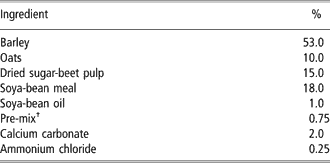
† Content per kg pre-mix: 160 g Ca, 50 g P, 75 g Na, 22 g Mg, 1200 mg Fe, 9 mg Cu, 2650 mg Zn, 1160 mg Mn, 10 mg Co, 37 mg Se, 30 mg I, 475 000 IU Vitamin A, 5800 IU Vitamin D3, 145 mg Vitamin E.
Content of crude protein, metabolisable energy (ME), ash and trace elements in concentrate and hay for lambs (mean ± s.d.)
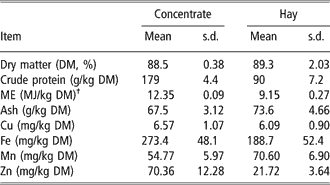
† Determined from the digestible crude nutrients using equations for estimation of ME (Society of Nutrition Physiology, 1995).
The slaughtering of the sheep was carried out at the experimental slaughterhouse of the Bavarian State Research Centre for Agriculture (LfL), Grub. After a cooling period of 26 h at 2°C, the cold carcass weight as well as the half carcass weight, was determined. The left half of the carcass was cut according to the pattern of the German Society of Agriculture (DLG) (Scheper and Scholz, Reference Scheper and Scholz1985). Each piece was then divided into muscle tissue, fat tissue and bones/sinews (Bellof et al., Reference Bellof, Wolf and Hollwich2003c). In total, the data from 101 carcasses (50 male and 51 female animals) were collected and analysed (seven animals did not reach the final stage). A detailed description of the dissection and composition of the carcass over the growing period was published earlier (Bellof et al., Reference Bellof, Wolf and Hollwich2003c; Bellof and Pallauf, Reference Bellof and Pallauf2004).
After the carcasses had been dissected, the samples were prepared. The minced and homogenised muscle, and fat tissues of the different pieces were blended to an aliquot sample. Part of the frozen samples was analysed for crude ash and minerals. In the same way, samples of the bone/sinew tissues and of the ‘residues’ (including empty digestive tract and bladder, the internal organs, hide, flesh taken from head and feet) of every slaughtered animal were used for analysis of the mineral matter. The samples of fat tissue of each animal were pooled for every subgroup (gender, BW and feeding level). For blood and wool, the analysis of minerals was confined to similarly pooled samples. All samples intended for mineral analysis were freeze-dried.
The feed used in the trial was analysed for its content of trace elements (Table 2). The feed samples were collected on a weekly basis during the trial and were pooled (monthly periods) before the samples were analysed. Based on the recorded feed intake of each animal, the mean daily intake of trace elements could be calculated for every animal (Table 3).
Mean daily intake of concentrate (g/day), hay (g/day) and trace elements (mg/day) of lambs in different fattening periods and different feeding levels (least-square mean ± s.e.)

a,b,c Different superscript letters indicate significant differences between final BW at the same feeding level (P ⩽ 0.05).
† Probability of error: ***P ⩽ 0.001.
The trace element analyses were carried out at the Institute of Animal Nutrition and Nutrition Physiology at the Justus Liebig University, Giessen. The samples were prepared as follows: about 3 g of each homogenised sample material (fat tissue, muscle tissue and bone tissue) were weighed exactly into quartz pans. In order to determine the remaining moisture, the samples were dried again (3 h at 105°C). The ashing was carried out in a muffle furnace at 450°C over a 12-h period. The ash was dissolved in 3 mol/l HNO3 suprapur and heated for 10 min in a water-bath. Afterwards, the ash solution was filtered into a measuring flask with hot bi-distilled water. The residue on the filter underwent further ashing (450°C) for another 12 h and was filtered again. The final acid concentration in the solution was 0.3 mol/l HNO3.
The trace elements were measured with ICP-AES by Unicam PU701 (now: Thermo Electron GmbH, Dreieich, Germany), power: 1000 W, plasma: radial observation, sprayer: Hildebrand-Grid, sprayer pressure: 34–40 p.s.i., argon-cooling gas: 11 l/min, flow of the sample: 1 ml/min, with the emission wavelength specific for each element.
The measurement of the Cu contents in the fat tissues led to results below the detection limit of 0.05 mg/l measure solvent. In the meat, bone and fat samples, the measurement of Mn led to results below the detection limit of 0.05 mg/l. Therefore, a re-measurement of Mn was carried out for the bone samples using an atomic absorption spectrometer (graphite furnace AAS by PerkinElmer (PE 5100 Z); details of the instrument: wave length: 279.5 nm; gap width: 0.2 nm; lamp current: 20 mA; base correction: Zeeman; cuvette: not coated; injection capacity: 20 μl; modifier: none; integration: area; drying: two-stage (90°C and 120°C); ashing: two-stage (500°C and 900°C); atomisation: 2200°C). The calibration took place at a concentration of 1–10 μg/l. Cu in bones was analysed by flame AAS (Unicam PU 9400 (now: Thermo Electron GmbH, Dreieich, Germany, measuring principle: flame: air–acetylene; wavelength: 324.8 nm; gap width: 0.5 nm). For quality control of the trace element analysis, certified bovine liver (NIST bovine liver 1577 b) was used. The recovery rate measured was 107% for Fe, 102% for Cu, 103% for Mn and 98% for Zn.
The total of Cu, Fe, Mn and Zn contents in the body tissues, muscle, fat and bone (Bellof et al., 2007) and in the residues, as well as in blood and wool, were calculated for each animal (‘empty body’ = slaughtered animal minus content of gastrointestinal tract and bladder).
The statistical analysis of the individual data was conducted using the GLM procedure of the statistical program SAS (Statistical Analysis Systems Institute, 1988).

where y represents trace elements (daily intake (mg/day), deposition in empty body (mg/kg) or daily retention (mg/day)); α the feeding level; β the sex; and γ the BW.
The data showed a normal distribution. Significance tests for fixed effects were carried out using the F-test. Differences between the subgroups were tested for significance using the t-test. Since no significant interactions were determined, results of three-factorial analysis of variance (feeding level, sex, BW) are shown in the tables.
On the basis of the deposition of the determined trace elements, the body composition during the course of growth was calculated with allometric estimated equations according to the ARC (1980):

where y is the deposition of trace elements [in empty body, (mg/kg)] and x the empty BW (kg).
Equation (2) was fitted to representative values for the mineral body composition of German Merino Landsheep of both genders.
Results
Increasing feeding intensity (low, medium, high) led to a marked daily increase in BW gain (BWG; 208, 253 and 305 g). At the same time there was a lowered energy intake per kg BWG (50.9, 47.9, 45.9 MJ ME per kg). Increasing BW (30, 45 and 55 kg) led to a decreased energy efficiency ratio (41.2, 50.0, 53.5 MJ ME per kg). The different feeding intensities and the fixed final fattening weights led to a considerable differentiation in the actual age. While ram lambs at feeding intensity ‘high’ were only 92 days old on reaching the final fattening weight of 30 kg, the males at feeding level ‘low’ reached the final live weight of 55 kg at an average age of 209 days. The female animals were 21 and 37 days older than males at these feeding intensities.
The analysed contents of ash and trace elements in the feedstuffs are listed in Table 2. The amounts of trace elements corresponded to the amounts in standard commercial concentrate mixtures.
The trace element intake during the different fattening periods is shown in Table 3. In accordance with the feeding plan, the average daily intake of the trace elements Fe, Zn and Cu increased significantly (P < 0.001) with increasing amount of concentrate. The intake of Fe, Zn, Cu and Mn also increased with higher BW (P < 0.001). As in the intake of concentrate and hay (Table 3), there were only minor differences in the intake of trace elements between male and female animals in the course of growth.
The estimated equations (2) derived for the deposition of trace elements in the empty body are shown in Table 4. The graphics derived from the equations are shown for both genders in Figures 1 (Fe and Zn) and 2 (Cu and Mn). While a continuous decrease during the growing period was detected for Fe, the Zn content increased moderately. Differences due to gender could be seen only for the content of Fe. With males, the values per kg empty BW decreased more sharply than with female lambs (Figure 1). The content of Cu was reduced in the growing period for both genders. As in the case of Fe the decrease was more marked for ram lambs than for females (Figure 2). The Mn content increased with higher empty BW for both genders.
Parameters for estimation† of the concentration of trace elements in the empty body of growing sheep of the genotype German Merino Landsheep
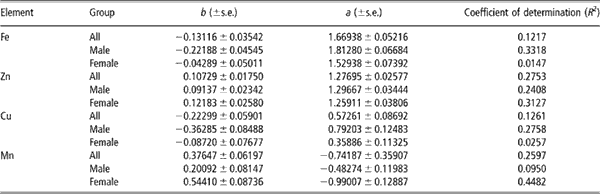
† log10y = a + b log10x.
Content of iron (Fe) and zinc (Zn) in the empty body of lambs of the genotype German Merino Landsheep.

Content of copper (Cu) and manganese (Mn) in the empty body of lambs of the genotype German Merino Landsheep.

The mean deposition of trace elements per kg gain of empty BW is given in Table 5. The feeding intensity had an influence on the deposition of Zn (P < 0.001) and Cu (P = 0.039). Lambs fed at the low level had higher Zn and lower Cu concentrations. A significant influence of gender could be proved only for the elements Fe and Zn. Male animals showed less Fe (P < 0.001) and Zn (P = 0.034) per kg empty BWG than females. The observed BW ranges influenced only the deposition of Zn (P < 0.001) and Mn (P < 0.001). Both elements increased with higher final BW.
Deposition of trace elements per kg empty body gain of lambs of the genotype German Merino Landsheep (least-square mean ± s.e. (mg/kg))

a,b Different superscript letters indicate significant differences between final BW at the same feeding level (P ⩽ 0.05).
† Probability of error: ***P ⩽ 0.001.
During the whole trial (18–55 kg BW), the lambs retained an average 26.1 mg Fe and 30.0 mg Zn per kg gain of empty BW. Females showed a higher deposition of Fe (+8.2 mg/kg; P < 0.001) and Zn (+1.3 mg/kg; P = 0.034) than ram lambs. With increasing feeding intensity the deposition of Zn diminished (P < 0.001).
The mean deposition of Cu (18–55 kg BW) amounted to 1.41 g/kg of empty BWG (Table 5). The animals at the low feeding level showed a lower deposition of Cu than those at medium level (P = 0.015) and also a tendency at high levels (P = 0.073).
In the BW range 18–55 kg, the lambs retained an average 1.04 mg Mn per kg of empty BWG. Female lambs tended to a slightly higher deposition of Mn (+0.21 mg/kg; P = 0.087).
The mean daily deposition of trace elements in the empty body is described in Table 6. As expected, the feeding intensity had an influence on the daily deposition of Fe (P < 0.001), Zn (P < 0.001), Cu (P < 0.001) and Mn (P = 0.003). With increased feeding intensity the daily retention of these elements increased. A significant influence of gender could be proved only for the deposition of Zn (P < 0.001). Male lambs showed a higher daily retention of Zn. The different BW ranges, however, influenced only the daily deposition of Zn (P < 0.001) and Mn (P = 0.002). The deposition of both elements increased with higher final BW.
Daily retention of trace elements of lambs of the genotype German Merino Landsheep (least-square mean ± s.e. (mg/day))

a,b,c Different superscript letters indicate significant differences between final BW at the same feeding level (P ⩽ 0.05).
† Probability of error: **P ⩽ 0.01; ***P ⩽ 0.001.
The mean daily deposition of Fe in lambs increased according to feeding intensity. Lambs with a ‘high’ energy supply showed a 50% higher (P < 0.001) daily deposition of Fe than animals with ‘low’ supply. Females had a tendency to a higher deposition of Fe than male lambs (5.7 mg/day v. 5.2 mg/day; P = 0.191).
The mean daily deposition of Zn in lambs amounted to 6.3 mg during the growing period (18–55 kg BW) and increased significantly with increased feeding intensity. Animals at feeding level ‘high’ showed 41% higher (P < 0.001) daily deposition of Zn than those on the ‘low’ level. Ram lambs had a 0.7 mg/day higher deposition of Zn than female lambs (P < 0.001).
The mean daily deposition of Cu amounted to 0.30 mg. With increasing feeding intensity, the deposition of Cu increased significantly. Lambs on the high feeding level showed a more than twice as high daily deposition of Cu than those on the low level (P < 0.001).
The mean daily deposition of Mn in lambs amounted to 0.21 mg/day. With higher feeding intensity the deposition of Mn increased significantly. Lambs on the high feeding level showed a 67% higher daily deposition than those on low (P < 0.001). No differences due to gender were detected for daily deposition of Mn.
The following retention (% of intake) of ingested trace elements in the empty body (both genders, feeding level ‘medium’) was calculated: Fe 2.0, Zn 8.9, Cu 5.5 and Mn 0.27.
Discussion
An adequate supply of the trace elements Fe, Zn, Cu and Mn was ensured for all feeding levels of the lambs as a comparison with the recommendations of the National Research Council (NRC, 1985) in mg/kg of diet DM (Fe 30–50, Zn 20–33, Cu 7–11, Mn 20–40) for sheep shows. An over-supply was present only for Fe. However, the upper limit of 500 mg Fe per kg DM (NRC, 1985) was not reached even in the high concentrate groups (273 mg/kg DM). The Cu intake reached the recommendations by the NRC (1985) at all feeding levels, but the recommendations given by the ARC (1980) with 1.8–5.1 mg/kg DM were slightly exceeded. According to the experimental design, there was no intended variation of trace element levels in the diet. Therefore, conclusions on the influence of varying trace element supply are not possible.
The trace element Fe in the empty body of lambs was found mainly in the bone tissue (40% of the total Fe, related to the empty BW (Bellof et al., 2007)). In addition, significant amounts of Fe could be determined in the residue (19%), as well as in muscle tissue and blood (15%, respectively). For Zn, the following average distribution in the empty body was detected: muscle tissue 42%, bone tissue 29%, residue 13% and wool 13%. More than 55% of the total Cu was found in the residue, mainly in the liver, while muscle tissue and wool were about equal, 17% and 16%. In the bone tissue, about 11% of the total Cu was discovered. The element Mn was found mainly in the wool (41%) and in the residue (40%), whereas the proportion in the bones was comparatively low (18%). Schwarz et al. Reference Schwarz, Heindl and Kirchgessner(1994) calculated a comparable distribution for the empty bodies of bulls (German Simmental). For the muscle tissue they found 16% Fe, 58% Zn and 12% Cu, similar to the present study. The elements Cu and Mn were also predominantly found in the animal residue.
In the present study, the amounts of the trace elements examined (Fe, Zn, Cu and Mn), as expected, increased significantly with higher BWs, empty BW as was also found for German Simmental bulls (200–650 kg BW) by Schwarz et al. Reference Schwarz, Heindl and Kirchgessner(1994). The deposition of Fe and Cu during the growing period (15–50 kg empty BW) diminished, respectively from 32.9 to 28.0 mg/kg and from 2.1 to 1.6 mg/kg. However, an increase in the concentration of Zn and Mn was revealed (from 25.3 to 28.8 mg/kg and from 0.51 to 0.79 mg/kg, respectively).
Related to 1000 g empty BWG, the following concentrations were found for the examined elements: Fe 26.1 mg, Zn 30.0 mg, Cu 1.41 mg and Mn 1.04 mg. For German Simmental bulls, Schwarz et al. Reference Schwarz, Heindl and Kirchgessner(1994) found higher concentrations (Fe 48 mg, Zn 40 mg, Cu 2.2 mg and Mn 1.3 mg/kg empty BWG). In the carcass of the lambs (20.8 kg, females), the following concentrations were found for the analysed elements: Fe 28.8 mg, Zn 34.8 mg, Cu 0.88 mg and Mn 0.16 mg (Bellof et al., 2007). For comparable lambs (20.8 kg, females) Suttle Reference Suttle(1979) detected in the carcass different concentrations (Fe 61.0 mg, Zn 25.4 mg, Cu 1.00 mg and Mn 0.96 mg/kg fresh weight carcass). Suttle Reference Suttle(1979) estimated the following retention (% intake) of ingested trace elements in lamb carcasses: Fe 1.0, Zn 5.1, Cu 1.7 and Mn 0.04. In the present trial, a higher retention in the empty body was calculated.
The ARC (1980) states for sheep an average Cu content of 1.15 mg/kg gain in the carcass. The daily deposition in the carcass ranges from 0.11 to 0.22 mg Cu per day. For wool, a retention of 0.05 mg/day is estimated, for the endogenous losses 4 μg/kg BW and day (ARC, 1980). Thus, the ARC (1980) defines the net requirement as 0.25–0.50 mg Cu per day for growing lambs (castrated, 20–40 kg BW). In the present study, a mean daily deposition of 0.30 mg Cu in the empty body was found with a direct feeding influence (‘low’ 0.20 mg/day, ‘high’ 0.44 mg/day). It has to be pointed out that a higher content of Cu in the wool of the Merino Landsheep was detected (11.6 mg/kg DM; DM content of the wool 90%). Phillips et al. Reference Phillips, Chiy and Omed(2004) found in the wool of Welsh Mountain ewes 4.8–9.1 mg Cu per kg DM. The ARC (1980) assumes for wool 5 mg Cu per kg DM.
The tissues of growing lambs and cattle contain 24 mg Zn per kg gain in BW according to the ARC (1980). For wool concentrations of 77–120 mg Zn per kg are reported in the literature and thus ARC (1980) assumes on average 115 mg/kg. The endogenous losses are assumed to be 76 μg Zn per kg BW and day. Therefore, the ARC (1980) estimates for growing lambs (castrated, 20–40 kg BW) a net requirement of 6.1–11.2 mg Zn per day. In our investigations, the average daily deposition of Zn was 6.3 mg. However, a daily variation of 4.9–6.9 mg/day was visible as the deposition of Zn was subject to the significant influence of feeding, BW range and gender. In the wool of the Merino Landsheep lambs, 131 mg Zn per kg DM were analysed.
With increasing feeding intensity, the Zn content per kg empty BWG diminished significantly whereas the concentration of Cu increased. Schwarz et al. Reference Schwarz, Heindl and Kirchgessner(1994) also found a decreased deposition of Zn per kg empty BWG at increased feeding intensity in growing bulls (from 200–350 kg but not from 350–650 kg BW), whereas for the trace elements Fe, Cu and Mn no direct tendency was seen. In the present trial, the concentration of Fe and Mn diminished in tendency. In the literature, no comparable data for the deposition of Fe and Mn could be found for growing lambs. In the recommendations of the ARC (1980) for the supply of lambs, no factorial estimation is derived for these two elements. According to Lassiter and Morton Reference Lassiter and Morton(1968), the concentration of Mn in the wool seems to be a useful indicator for the assessment of the state of Mn supply. They found a decline in the concentration of Mn in the wool from 19 to 6 mg/kg during a period of Mn shortage. In our investigations, an average content of 10.3 mg Mn per kg DM in the wool was analysed.
For growing lambs (castrated, 20 and 40 kg BW), the ARC (1980) assumes a true availability for Cu of 0.22 and 0.09. Proceeding from the net requirement mentioned above, a daily gross requirement of 1.1 and 5.6 mg Cu is derived. For lambs of the present trial (45 kg BW; deposition: 0.44 mg Cu per day; endogenous losses: 0.18 mg Cu per day), the analogous calculation results in a daily gross requirement of 6.9 mg Cu at high feeding intensity.
For Zn, the ARC (1980) assumes for growing lambs (castrated, 20 and 40 kg BW) a true availability of 0.30 and 0.20. Proceeding from the net requirement mentioned above, a daily gross requirement of 20 and 56 mg Zn can be derived. For lambs of the present study (45 kg BW), an analogous calculation (deposition: 6.9 mg Zn per day; endogenous losses: 3.42 mg Cu per day) results in a daily gross requirement of 51.6 mg Zn at high feeding intensity.
In conclusion, the impact of feeding intensity, gender and final BW on the accretion of the trace elements Cu, Fe, Mn and Zn in the empty body of lambs of the breed German Merino Landsheep can be summarised as follows. Feeding intensity affects the daily retention of Fe, Zn, Cu and Mn, as well as the deposition of Zn and Cu per kg empty BWG. Gender has an influence on the daily retention of Zn and the deposition of Zn and Fe per kg empty BWG. Final BW range affects both the daily retention of Zn and Mn and the deposition of Zn and Mn per kg empty BWG.



