




1. Introduction
The advent of computer-mediated communication has made available for corpus linguistics an increasingly growing and diverse body of written language for investigation. In this article, we investigate social media as a source for corpus linguistic research. Social media include a wide variety of online platforms and websites ‘that have been purpose-built to facilitate social interaction and that rely on user content to fill their pages’ (Rüdiger & Dayter Reference Rüdiger, Dayter, Rüdiger and Dayter2020:2).
We focus on Swedish social media corpora available from Språkbanken Text.Footnote 1 Blog mix, the oldest social media corpus at Språkbanken Text, first released in 2013, contains a collection of the most popular blogs in Sweden. Twitter is a corpus of Swedish microblogs from the platform Twitter, which was rebranded as X in 2023. Familjeliv and Flashback are corpora with posts from two Swedish discussion forums. All of these corpora have in common that they are very large (billions of words altogether) and contain data from the last twenty-five years (from the period 1998–2024).
Språkbanken’s social media corpora have been a popular source for corpus studies of contemporary Swedish (e.g. Ledin & Lyngfelt Reference Ledin and Lyngfelt2013, Olofsson Reference Olofsson2014, and Bylin Reference Bylin2016, to name only a few early examples). These studies describe the language of social media as being informal, spoken-like, unedited, non-standard, and innovative. These properties are not systematically and empirically assessed in these studies but are rather provided as part of a rationale for choosing social media as a source for investigation, often in contrast with or in addition to more traditional language sources. This article aims to provide an empirical underpinning of these properties in social media corpora. We do this by means of a quantitative corpus study of social media corpora in contrast with more traditional corpora of written language. This comparative perspective allows us to explore the differences and similarities between the language of social media and other types of written language in Swedish.
Our study is a follow-up to Wiktorsson (Reference Wiktorsson2018), a short communication published in this journal, which investigates some linguistic features of the Swedish Blog mix corpus. Since Wiktorsson’s article, more social media corpora have become readily available at Språkbanken Text. We are therefore in the position to explore the language of Swedish social media from a wider perspective. Our study not only covers more types of social media but also explores a wider range of properties at different linguistic levels. Wiktorsson’s focus is on examining whether blogs can be considered a hybrid of spoken and written language. Our focus is not only on the spoken-like properties of social media, but also on their informal, unedited, and non-standard nature.
The structure of our article is as follows. We first give an overview of properties discussed in previous corpus studies of Swedish social media (Section 2.1), followed by a literature review of international studies looking into register variation in computer-mediated communication and social media (Section 2.2). This literature overview forms the basis for selecting linguistic features that will be used to explore the language of social media in Swedish (Section 2.3). We then describe the corpora and method used in this study in more detail (Section 3). Section 4 presents a contrastive analysis of the linguistic features in our corpora. We close with a short conclusion in Section 5.
2. Background
2.1 Linguistic corpus studies of Swedish social media
The social media corpora of Språkbanken have been used in several corpus studies of Swedish. Many of these studies motivate their use of social media corpora, as an alternative or in addition to more traditional language sources, by highlighting some of their unique properties. We were able to identify five recurring properties of social media in a sample of 54 corpus studies.Footnote 2 Table 1 gives an overview of these properties, along with alternative terms used in the studies to describe them, and the corpus studies that make explicit mention of them.
Properties of social media in corpus studies of Swedish

Table 1 shows that the most mentioned property of social media is its informal character. Brandtler (Reference Brandtler2019), for instance, argues that the language of Flashback ‘tends to reflect a natural and informal style of speech’ which is assumed to be ‘representative of modern-day, informal Swedish’ (Brandtler Reference Brandtler2019:762). Bylin (Reference Bylin2016:81), in turn, takes Familjeliv to represent everyday private language in contrast to the public language of news texts.
Another frequently highlighted property of the language of social media is its spoken-like nature, the property in focus in Wiktorsson (Reference Wiktorsson2018). Blensenius & Rogström (Reference Blensenius and Rogström2020), more specifically, point out that social media language often has a ‘momentary and sometimes dialogical character’ (Blensenius & Rogström Reference Blensenius and Rogström2020:84). Caplan & Djärv (Reference Caplan and Djärv2019) focus on the discussion forum Flashback, stating that it ‘relates more closely to spoken dialogue compared with some of the other written material’ (Caplan & Djärv Reference Caplan and Djärv2019:13).
The unedited nature of social media is also often mentioned. Brandtler (Reference Brandtler2019) highlights the non-planned nature of the discussion forum Flashback, where linguistic choices are less likely to result ‘from deliberate attempts by the writer to achieve literary or rhetorical effects compared to more self-conscious genres, such as fiction and blogs’ (Brandtler Reference Brandtler2019:762). Malm (Reference Malm2016:16), similarly, contrasts the spontaneous language of Familjeliv with that of more heavily edited literary works or administrative texts.
Social media language is also considered to be less standard than other types of written language. Brandtler (Reference Brandtler2020:66), more specifically, expects the discussion forum Familjeliv to follow language norms to a lesser degree than the language of news and novels. The non-normative characteristics of social media language are often mentioned together with the unedited characteristics. Berdicevskis, Adesam & Coussé (Reference Berdicevskis, Adesam, Coussé, Elena Volodina, Berdicevskis, Forsberg and Virk2022) write, for instance, that the language of Flashback ‘is closer to everyday use and less edited than many other types of text, which may mean that non-normative language is more frequent or shows up earlier than in edited texts’ (Berdicevskis, Adesam & Coussé Reference Berdicevskis, Adesam, Coussé, Elena Volodina, Berdicevskis, Forsberg and Virk2022:6).
All of these linguistic properties are in turn connected to the innovativeness of social media. Berdicevskis, Adesam & Coussé (Reference Berdicevskis, Adesam, Coussé, Elena Volodina, Berdicevskis, Forsberg and Virk2022) and Adesam, Berdicevskis & Coussé (Reference Adesam, Berdicevskis and Coussé2024) state that social media incorporate innovation faster than, for instance, news texts. Other studies that focus on the quick spread of innovations in social media are Ledin & Lyngfelt (Reference Ledin and Lyngfelt2013:148), who suggest that the trendy and everyday language of blogs allows for fast incorporation of innovations like the new Swedish gender-neutral pronoun hen, and Blensenius & Rogström (Reference Blensenius and Rogström2020:85), who find fast changes in the grammatical structure of multi-word expressions in social media.
While the above corpus studies contribute to identifying relevant properties of social media in Swedish, they do not assess them empirically. It is our aim to substantiate the above properties by means of a quantitative corpus study of social media corpora in contrast with other more traditional linguistic corpora. This comparative perspective will enable us to uncover the differences and similarities between social media and other corpora of Swedish.
2.2 Register variation studies of computer-mediated communication
Our corpus-based contrastive study of social media draws on international research on computer-mediated communication from a text-linguistic point of view. Computer-mediated communication (CMC) comprises more types of digital texts than only social media, and is defined by Herring (Reference Herring1996) as ‘communication that takes place between human beings via the instrumentality of computers’ (Herring Reference Herring1996:1).
One of our major sources of inspiration is corpus linguistic studies contrasting the language of one form of computer-mediated communication with that of other spoken and written corpora (Yates Reference Yates and Herring1996, Radić-Bojanić Reference Radić-Bojanić2006, Jensen Reference Jensen2007, Ling & Baron Reference Ling and Baron2007, Tagliamonte & Denis Reference Tagliamonte and Denis2008, Wiktorsson Reference Wiktorsson2018). The classical CMC study of Yates (Reference Yates and Herring1996) investigates a few linguistic features in a sample of discussions taken from early computer referencing systems (predecessors of the contemporary discussion forums) in contrast to a corpus of spoken and written language. The study is framed in the early functional grammar of Halliday (Reference Halliday1978), differentiating between the textual, interpersonal, and ideational aspects of language use. This framework posits that language use is variable and may vary from one situation to another, thereby exhibiting register variation. Register is here defined as ‘the clustering of semantic features according to situation type’ (Halliday Reference Halliday1978:111). This particular theory of register, and its later developments (Halliday Reference Halliday1985), has played an influential role in the text-linguistic study of computer-mediated communication and also forms the overall theoretical background of our study.
Yates first explores textual metrics such as type/token ratio and lexical density. Lexical density gives an insight into the proportion of lexical versus functional words in a corpus. He finds that the lexical density of spoken language is lower than for written language, confirming previous research of Ure (Reference Ure1971) and Halliday (Reference Halliday1985), and that computer referencing is closer to written than spoken language in this regard. Yates also investigates the interpersonal aspect of language by comparing the frequency distribution of personal pronouns and modals. His study of pronouns draws on the work of Chafe (Reference Chafe and Tannen1982), who relates the use of first-person reference to the speaker’s involvement with his or her audience. Yates finds that the relative frequency of first-person pronouns is higher in spoken than in written language, confirming Chafe’s findings (Reference Chafe and Tannen1982), and that computer referencing is closer to spoken language in its use of first-person pronouns. Overall, Yates’ contrastive corpus study demonstrates that only a few linguistic features allow us to differentiate computer-mediated communication from other registers. It turns out that online language is more similar to spoken language with regard to some features and more similar to written language for other features.
Wiktorsson’s (Reference Wiktorsson2018) study of Swedish blogs can be placed in the tradition of Yates (Reference Yates and Herring1996) and subsequent contrastive corpus studies. Wiktorsson compares three frequency measures extracted from the Blog mix corpus with frequency data reported by Allwood (Reference Allwood1998) for a corpus of spoken and written Swedish. The lexical diversity of the blog data, as measured by type/token ratio, turns out to be in between the ratios reported for speech and writing by Allwood (Reference Allwood1998). The vocabulary variance of blogs, as measured by frequency-based rank, appears to be closer to writing than to speech. An investigation of the ten most frequent words shows that blog texts ‘are more like writing from a basic structural perspective, but perhaps display certain personal involvement features normally associated with interactive speech’ (Wiktorsson Reference Wiktorsson2018:375). Similarly to Yates (Reference Yates and Herring1996), Wiktorsson concludes that blogs take a unique position in relation to the other language varieties investigated: sometimes the blog data shares features with spoken language; at other times it is more like written language.
A more recent development in the quantitative corpus-based study of social media is the application of multidimensional analysis (MD) ‘to empirically analyze the ways in which linguistic features co-occur in texts and the ways in which registers vary with respect to those co-occurrence patterns’ (Biber Reference Biber, Berber Sardinha and Veirano Pinto2019:49). This approach originates in the seminal work of (Biber Reference Biber1988) on spoken and written registers of English and has developed into a well-established quantitative framework for the study of register variation. The focus on studying co-occurring linguistic features goes beyond the corpus studies described earlier, such as Yates (Reference Yates and Herring1996) and Wiktorsson (Reference Wiktorsson2018), which chart the distribution of linguistic features separately. The MD method has been applied on a large scale to online texts by Biber & Egbert (Reference Biber and Egbert2018) and to various types of social media by Berber Sardinha (Reference Berber Sardinha, Berber Sardinha and Veirano Pinto2014, Reference Berber Sardinha2018, Reference Berber Sardinha, O’Keeffe and McCarthy2022), Friginal, Waugh & Titak (Reference Friginal, Waugh, Titak and Friginal2018), Liimatta (Reference Liimatta2019, Reference Liimatta2023), Clarke (Reference Clarke2019, Reference Clarke2022), and Clarke & Grieve (Reference Clarke and Grieve2019).
The multidimensional analysis of social media is a powerful tool that allows the uncovering of situational dimensions that correspond to the major communicative functions of these texts. Berber Sardinha (Reference Berber Sardinha, O’Keeffe and McCarthy2022) identifies two situational dimensions for social media in English (Facebook, Instagram, Reddit, Telegram, Twitter, and YouTube). The first dimension ‘is packed with features that enable a formal type of posting that generally conveys planned, edited, highly informational and argumentative content’ (Berber Sardinha Reference Berber Sardinha, O’Keeffe and McCarthy2022:663). The set of features in the second dimension ‘indicate informality, speaker orientation, engagement, and interaction’ (Berber Sardinha Reference Berber Sardinha, O’Keeffe and McCarthy2022:668). What is interesting is that these dimensions go beyond the classical distinction between spoken and written language that has dominated register variation studies (see Biber Reference Biber2014 for an overview). Other properties are highlighted which have also been mentioned in the corpus studies of Swedish, such as the degree of formality or editing.
Multidimensional analysis has, to the best of our knowledge, not been applied to Swedish data (social media or other). Indeed, as Goulart & Wood’s (Reference Goulart and Wood2019:129) literature review indicates, the majority of MD register studies are based on English. We see a number of reasons why this might be the case. First, multidimensional analysis relies on frequency information on dozens of lexico-grammatical features that are known to be sensitive to register variation. While there is a long research tradition in English that offers such background information, this is not the case for Swedish. Second, the automatic annotation of these lexico-grammatical features requires a purpose-made tagger identifying a large number of word classes complemented with semantic information. Again, while such taggers are available for English – notably the Biber-tagger – they are not for Swedish. There are linguistic annotations available for the social media corpora in Språkbanken that could provide a good starting point for building such a tagger, but here we should keep in mind that these annotations are not as reliable for social media corpora as for corpora with standard language (see e.g. Adesam & Berdicevskis Reference Adesam, Berdicevskis, Dobnik and Øvrelid2021). In view of these obstacles, we refrain from performing a multidimensional analysis of our social media data, but rather explore a selection of linguistic features separately, building on the tradition set in early contrastive corpus studies of computer-mediated communication.
What differentiates our research from these pioneering studies is that we move beyond comparing two or three small data samples of a few ten thousand words to comparing half a dozen corpora consisting of millions of words (see Table 2). This trend towards ‘ever-growing corpora’ in the study of social media ‘became an extra stimulus for computational linguistics and statistical data processing’ (Vandekerckhove et al. Reference Vandekerckhove, Hilte, Fišer and Daelemans2019:158). Some of these computational linguistic studies of social media have been a direct inspiration for our study. Hu, Talamadupula & Kambhampati (Reference Hu, Talamadupula and Kambhampati2013) situate the language of Twitter in the spectrum of other written registers of English (SMS, Chat, Email, Blog, Online Magazines, and News) by exploring a few classical lexico-grammatical features. They find that ‘the language of Twitter is highly dynamic, and that depending on the measure that is used, it shows similarities to different media’ (Hu, Talamadupula & Kambhampati Reference Hu, Talamadupula and Kambhampati2013:244). This study demonstrates that social media can insightfully be contrasted with other types of written language, going beyond the classical dichotomy of spoken and written language. Berdicevskis (Reference Berdicevskis2013) compares fewer registers, notably Russian emails and chat messages, but extends the range of linguistic features from the traditional set of lexico-grammatical features to other features, such as the mean length of an utterance or the use of punctuation. These other features have the advantage that they are relatively easy to extract automatically from a large corpus, without relying on advanced annotations. Ortmann & Dipper (Reference Ortmann and Dipper2019) further contribute to expanding the set of ‘linguistic features that (i) are useful predictors of the conceptual orality of a given text and (ii) can be recognized fully automatically in texts of any length’ (Ortmann & Dipper Reference Ortmann and Dipper2019:66) in their research on German registers. The research of Berdicevskis (Reference Berdicevskis2013) and Ortmann & Dipper (Reference Ortmann and Dipper2019) has inspired us to broaden the set of linguistic features explored for Swedish. These studies also show that linguistic features proposed in the international literature can be successfully applied to languages other than English.
Basic statistics of corpora under investigation
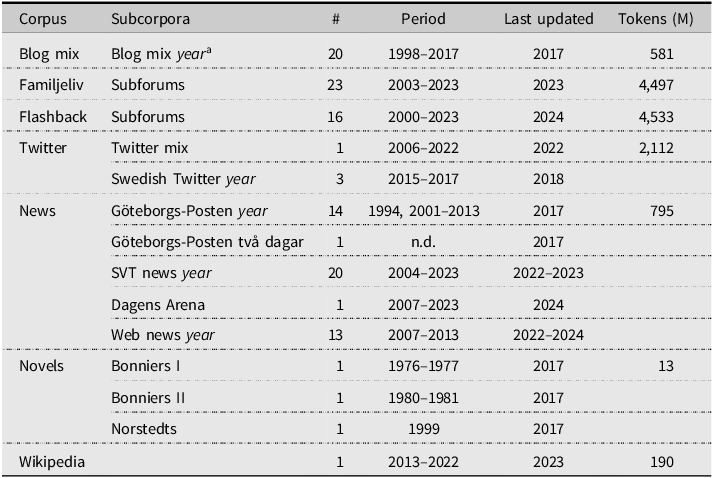
a Italicized year is used as a placeholder for the years listed in the column ‘Period’. The subcorpora listed for Blog mix should thus read as ‘Blog mix 1998’, ‘Blog mix 1999’, etc. until ‘Blog mix 2017’.
2.3 Selection of linguistic features
The literature review revealed that there are dozens of potential linguistic features that have not yet been explored for Swedish. We selected from the literature a handful of features guided by the following principles. First, we only selected linguistic features that could be extracted automatically from our corpora with good confidence, that is, frequency information based on counting particular word forms or parts of speech. Second, we chose a few features that are well-established in the early literature on computer-mediated communication and complemented these with some features suggested in more recent computational linguistic research. As such, we aimed to expand the range of linguistic features explored for Swedish. Third, we selected features for which we may assume that they are sensitive to one or more of the properties highlighted in the corpus studies of Swedish social media, that is, informal, spoken-like, unedited, and non-standard. Note that the link between linguistic features and the properties to which they may point is still tentative for Swedish. As we mentioned earlier, most of the literature on register variation has been focused on English, so it remains to be seen whether the features selected from the international literature are helpful in differentiating corpora in Swedish.
2.3.1 Personal pronouns
One of the classical features in register variation research is personal pronouns. Numerous corpus-based register studies have shown that the frequency and distribution of first-, second-, and third-person pronouns differ in spoken and written language (see e.g. Chafe Reference Chafe and Tannen1982, Biber Reference Biber1986, Reference Biber1988, Yates Reference Yates and Herring1996, and Tagliamonte & Denis Reference Tagliamonte and Denis2008 for English). These studies systematically reveal that first- and second-person pronouns are more frequent in spoken language, whereas third-person pronouns are predominant in written language. Chafe (Reference Chafe and Tannen1982) relates the use of first- and second-person pronouns to the speaker’s involvement with his or her audience. Biber (Reference Biber1988:225) similarly considers first-person pronouns as markers of ego-involvement and interpersonal focus. Some corpus studies compare the use of personal pronouns in computer-mediated language with that found in spoken and written language. Yates (Reference Yates and Herring1996), Radić-Bojanić (Reference Radić-Bojanić2006), and Tagliamonte & Denis (Reference Tagliamonte and Denis2008) find that the language of computer conferencing, chat, and instant messaging has a high relative usage of first- and second-person pronouns, which makes it similar to speech. Hu, Talamadupula & Kambhampati (Reference Hu, Talamadupula and Kambhampati2013) compare several types of computer-mediated language, finding a more diverse distribution of personal pronouns: for instance, a high use of first- and second-person pronouns on Twitter and in chats, and a high usage of third-person pronouns in blogs. The research overall suggests that personal pronouns have a good potential to separate our corpora with regard to their degree of involvement versus detachment.
2.3.2 Nominal style and lexical density
Two other well-known features in corpus-based register studies target the distribution of word classes. The first feature involves the relative proportion of verbs and nouns. Spoken language is reported to have a more verbal style with a higher proportion of verbs, whereas written language has a more nominal style with a higher number of nouns and nominalizations (Chafe Reference Chafe and Tannen1982, Ortmann & Dipper Reference Ortmann and Dipper2019). Chafe (Reference Chafe and Tannen1982) relates a high degree of nominalization in written language to integration, i.e. ‘the packing of more information into an idea unit than the rapid pace of spoken language would normally allow’ (Chafe Reference Chafe and Tannen1982:39). Ortmann & Dipper (Reference Ortmann and Dipper2019), similarly, interpret nominalizations as a sign of high complexity. Chafe (Reference Chafe and Tannen1982) further suggests that nominalization can function not only as an integrative device but also allows a statement to be presented in a more abstract, detached way. Radić-Bojanić (Reference Radić-Bojanić2006) finds that the discourse of electronic chat rooms contains very few nominalizations, and as such resembles spoken language more than written language.
The second feature is lexical density, that is, the proportion of lexical words versus function words. Speech is shown to have a lower lexical density than written language (Ure Reference Ure1971, Halliday Reference Halliday1985, Yates Reference Yates and Herring1996). Yates (Reference Yates and Herring1996) finds that the lexical density of computer conferencing is closer to that of written language than of speech. Hu, Talamadupula & Kambhampati (Reference Hu, Talamadupula and Kambhampati2013) report that, among several computer-mediated communication forms, SMS and chat have the lowest lexical density, blogs and news the highest, with Twitter taking an in-between position. They suggest that the length restriction on Twitter messages influences their lexical density. Initially, Twitter had a length restriction of 140 characters per post, which was then doubled to 280 characters in November 2017. On the basis of the above research, we assume that nominal style and lexical density have the potential to differentiate between our corpora.
2.3.3 Interjections
A feature that is less explored in corpus-based register studies is the use of interjections. A few studies have shown that they are more frequent in spoken than in written language (Allwood Reference Allwood1998 for Swedish, Ortmann & Dipper Reference Ortmann and Dipper2019 for German), which signals that they are sensitive to register variation. Interjections are of interest to us as they are reported to be associated with varying stylistic values in Swedish (Teleman et al. Reference Teleman, Hellberg, Andersson and Holm1999). They thus have the potential to offer insights into the degree of formality of our corpora.
We select a few frequent interjections specialized in answering with different stylistic values; more specifically, the answer interjections ja ‘yes’, jo ‘yes’ (to disagree with a negated statement), nej ‘no’, and nä ‘no’. The particles ja, jo, and nej are relatively neutral in style. The form nä, a frequent spelling variant of nej, has a casual, informal stylistic value, as Teleman et al. (Reference Teleman, Hellberg, Andersson and Holm1999:754) point out. Answer interjections are often used to react to the preceding utterance of the interlocutor (Teleman et al. Reference Teleman, Hellberg, Andersson and Holm1999:756–758). As such, they may be expected to be indicative of interactional language.
We also look into some emotional interjections, which express an emotional reaction on the part of the speaker, often to what has been said before. Teleman et al. (Reference Teleman, Hellberg, Andersson and Holm1999:748–750) suggest that they have an informal stylistic value and are rarely used in fact-based written language. Additionally, these emotional interjections may be expected to be indicative of an involved style, as they express the personal emotions of the speaker. We selected both the stylistically neutral interjections oj ‘oh, oops’ and usch ‘ugh, ew’ and the profanities helvete ‘damn’ (lit. ‘hell’), jävlar ‘damn’ (lit. ‘devils’), and herregud ‘oh my god’ (lit. ‘lord god’) with a lower stylistic value. Note that the profanities are so-called secondary interjections (Ameka Reference Ameka1992), which may also function as regular nouns.
2.3.4 Sentence punctuation
A feature that goes beyond the classical lexico-grammatical features is the use of sentence punctuation. Ortmann & Dipper (Reference Ortmann and Dipper2019:69) point out that there is more variation in sentence types in spoken than written language; more specifically, ‘questions and exclamations are more frequent in spoken than in written language’ (Ortmann & Dipper Reference Ortmann and Dipper2019:69). This finding suggests that sentence punctuation can contribute to differentiating our corpora. We particularly look into the use of the period, question mark, and exclamation mark to mark the end of sentences. We also report on the repeated use of punctuation marks in these contexts, which is considered a clear indicator of conceptual orality by Ortmann & Dipper (Reference Ortmann and Dipper2019). We hypothesize that it might also point to non-standard language use.
2.3.5 Sentence length
Our final feature targets the length of sentences. Ortmann & Dipper (Reference Ortmann and Dipper2019) find that spontaneous spoken communication and online chat, which they consider oral-oriented registers, have a systematically lower average sentence length than rehearsed TED talks, recited speeches, and newspaper articles, which are literate-oriented registers in their view. We will explore whether sentence length can help us differentiate between our corpora and uncover differences in their degree of orality.
3. Corpora and method
We now present the corpora under investigation in more detail. We use the four large social media corpora available at Språkbanken Text: Blog mix, Familjeliv, Flashback, and Twitter. We complement these corpora with three other corpora of written texts from the same corpus infrastructure: Novels, News, and Wikipedia.Footnote 3 Novels and news are well-established data sources in Swedish linguistics and are often taken to be representative of contemporary standard language in its written form (Allén Reference Allén1970, Ledin & Lyngfelt Reference Ledin and Lyngfelt2013). We also include Wikipedia, which is considered a type of social media by some (Lomborg Reference Lomborg2011, Deumert Reference Deumert and Allan2016, Aichner et al. Reference Aichner, Grünfelder, Maurer and Jegeni2021), but is not included in the list of social media corpora of Språkbanken. This corpus is generally overlooked in corpus studies of Swedish. The basic statistics of the seven corpora are presented in Table 2.
We have extracted frequency information on the linguistic features to be analyzed in Section 4 via the corpus search platform Korp (Borin, Forsberg & Roxendal Reference Borin, Forsberg and Roxendal2012), either through the APIFootnote 4 or through the word statistics filesFootnote 5 available for each corpus. Our extraction of the selected linguistic features relies as little as possible on the automatic annotations provided in Korp, which may be less reliable for our social media corpora, as noted earlier. Personal pronouns and interjections are therefore searched for on the basis of their word forms alone. Lexical density makes use of part-of-speech annotations, which may contain errors for individual words but are relatively reliable on the aggregate level. Sentence punctuation and sentence length rely most heavily on automatic annotations, more specifically, tokenization and sentence segmentation. We want to highlight that there may be segmentation errors, in particular in the social media corpora, as Korp’s annotation tools have difficulties handling the various smileys and other non-word elements typical of these corpora. While we have no way of checking these issues manually, considering the large amounts of text, we do want to acknowledge the limits of the annotations used, something that is otherwise rarely done in corpus studies of Swedish social media (but see Brandtler Reference Brandtler2019 for an exception).
4. Contrastive analysis of linguistic features
We explore a selection of linguistic features on the level of individual words, word classes, and sentences to empirically assess the differences and similarities between our corpora.
4.1 Personal pronouns
We begin by investigating the use of personal pronouns in our corpora. We searched for the frequent personal pronouns singular jag ‘I’, du ‘you’, han ‘he’, and hon ‘she’ in our seven corpora on the basis of their word form (case independent). Figure 1 presents their frequency per thousand words (tokens) so that we can compare their distribution among corpora of different sizes (see Table 2).
Personal pronouns.
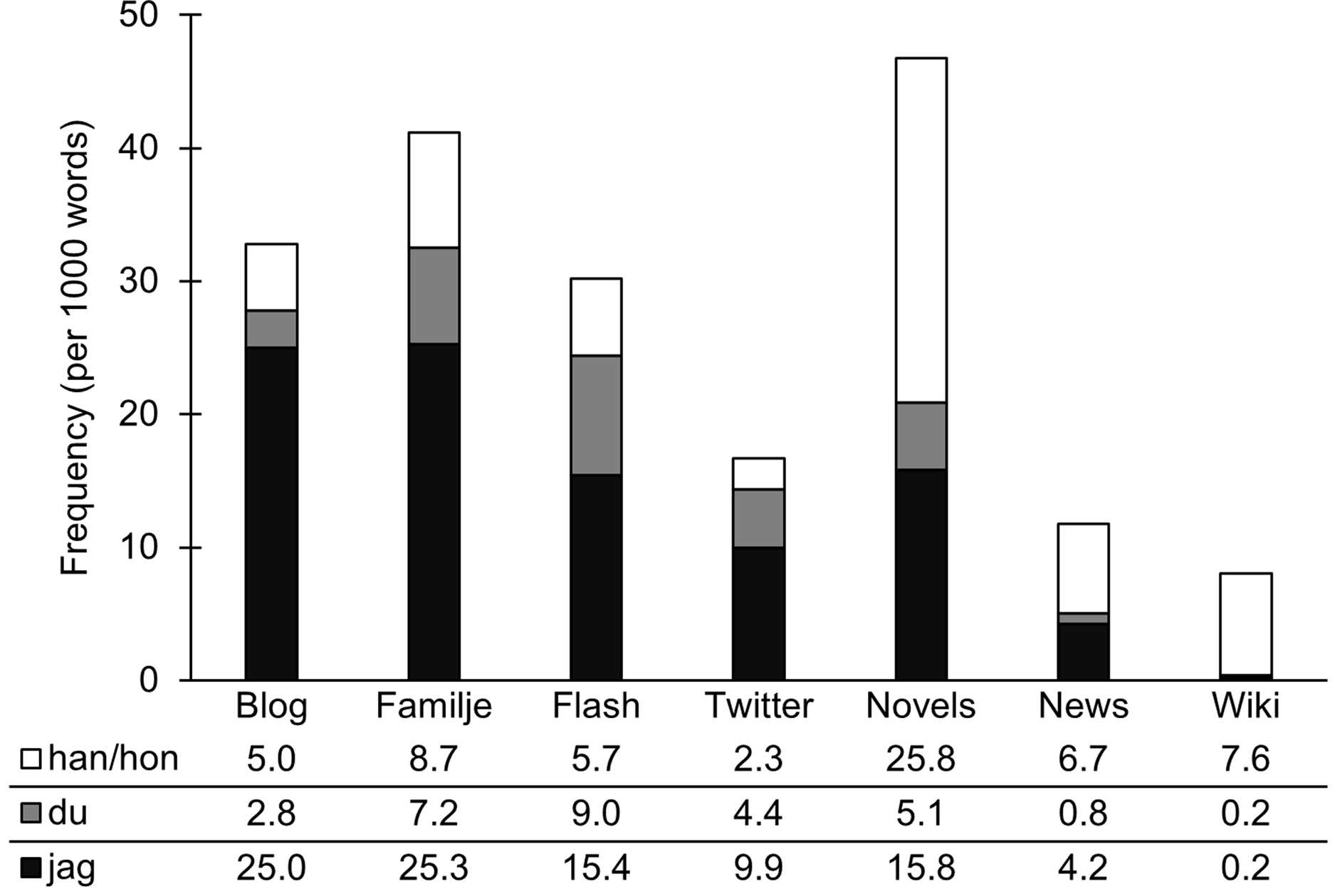
The most frequent pronoun in our social media corpora is the first-person pronoun jag ‘I’. The dominance of first-person pronouns is in line with Yates (Reference Yates and Herring1996), Radić-Bojanić (Reference Radić-Bojanić2006), and Tagliamonte & Denis (Reference Tagliamonte and Denis2008) for computer-mediated communication in English. It suggests that our social media corpora have a personal and involved style. This is illustrated in examples (1) and (2). Novels also have a relatively high number of first-person pronouns. This can be related to the first-person narration common in novels, or the rendering of direct speech, as in (3). News and especially Wikipedia make little use of jag ‘I’ – and pronouns in general – which relates to the detached style of these corpora, where writers do not refer to themselves but rather distance themselves from their utterances.
-
(1) I kväll fick jag panik för jag visste inte vad jag skulle göra. (Blog mix: Blog mix 1998)
‘Tonight, I panicked because I didn’t know what to do.’
-
(2) Jag har egentligen aldrig kännt [sic] att den biologiska biten är viktigast däremot känner jag en stor sorg i att jag så gärna skulle vilja följa mitt barn från första början. (Familjeliv: Adoption)
‘I have never really felt that the biological part is most important, but I feel a great sadness about the fact that I would so much like to follow my child from the beginning.’
-
(3) -- Förlåt om jag är ofin, men är fröken verkligen myndig? (Novels: Norstedts)
‘– Excuse me for being rude, but is Miss really of age?’
The second-person pronoun du ‘you’ is most frequent in Familjeliv, Flashback, and Twitter. This might be due to the interactional nature of these platforms, where speakers can react to earlier messages, as illustrated in (4) and (5). Note that the @ sign in (5) specifies the user the message is directed to (anonymized here as @user to protect privacy). Novels also make frequent use of second-person pronouns, particularly in passages with dialogue between characters, as in (6). News and especially Wikipedia have a very low number of second-person pronouns, which again may be related to their detached style, where writers report on facts without personal involvement.
-
(4) Vad du behöver göra är att plocka ut alla IC-kretsar och mala dem. (Flashback: Computer & IT)
‘What you need to do is pick out all the IC circuits and grind them.’
-
(5) @user Vet du ngt om vinet Roccolo Grassi valpolicella 2005, finns inte på bolaget. (Twitter: Twitter mix)
‘Do you know anything about the wine Roccolo Grassi valpolicella 2005, not available at Systembolaget.’
-
(6) “Du borde vara lite mer försiktig med vad du säger, Ed.” (Novels: Norstedts)
‘“You should be a bit more careful about what you say, Ed.”’
The third-person pronouns han ‘he’ and hon ‘she’ are most frequent in Novels. This might be related to the third-person narration of certain novels, as illustrated in (7). News and Wikipedia also use a relatively high proportion of third-person pronouns, illustrated in (8) and (9). This could be due to the tendency of these media to report about people.
-
(7) Hennes blick vek inte undan men hon rodnade. (Novels: Bonniers I)
‘Her eyes did not waver but she blushed.’
-
(8) Han tog juris kandidatexamen 1948 och blev attaché vid Utrikesdepartementet (UD) 1948. (Wikipedia)
‘He graduated with a Bachelor of Law degree in 1948 and became an attaché at the Ministry of Foreign Affairs (UD) in 1948.’
-
(9) Han fick en plastkasse med 250 000 tusen kronor i 500-lappar. (News: Dagens Arena)
‘He received a plastic bag with 250,000 thousand crowns in 500 notes.’
4.2 Nominal style and lexical density
We now move on to exploring nominal style and lexical density. Figure 2 presents the frequency of nouns (including proper nouns), verbs, other lexical words (adjectives, adverbs, participles), and function words (conjunction, determiner, infinitive marker, interjection, interrogative word, number, particle, possessive, preposition, pronoun, subjunction) based on the automatic part-of-speech annotation in the corpora. Foreign words and punctuation marks are excluded from the graph. The lexical density of each corpus is indicated by the thicker line in the bar.
Nominal style and lexical density.
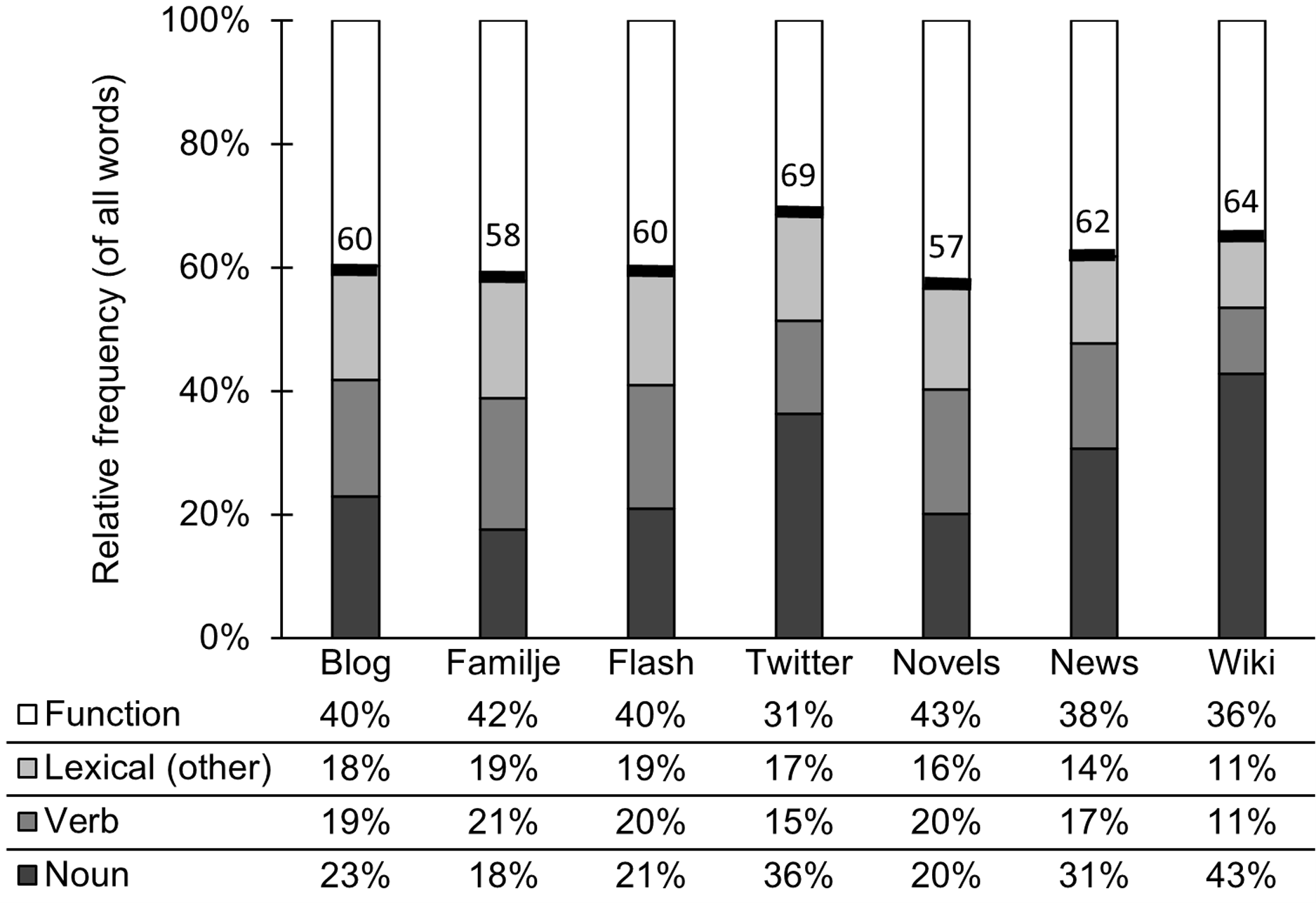
All corpora have a rather similar lexical density, ranging from 57% for Novels to 69% for Twitter. This suggests that social media have a very similar ratio of lexical words and function words to other written text types. Twitter stands out with its relatively high lexical density, which could be the result of the length restriction on messages, motivating language users to prioritize content-rich lexical words over function words. If we look into the relative proportion of verbs and nouns, we find that nouns are more frequent than verbs in Twitter, News, and Wikipedia, pointing to an overall nominal style in these corpora, whereas the proportion of verbs and nouns is more balanced in Blog, Familjeliv, Flashback, and Novels.
4.3 Interjections
We proceed to investigate the use of interjections in our corpora. We first present the use of the answer interjections ja ‘yes’, jo ‘yes’, nej ‘no’, and nä ‘no’ in Figure 3.
Answer interjections.
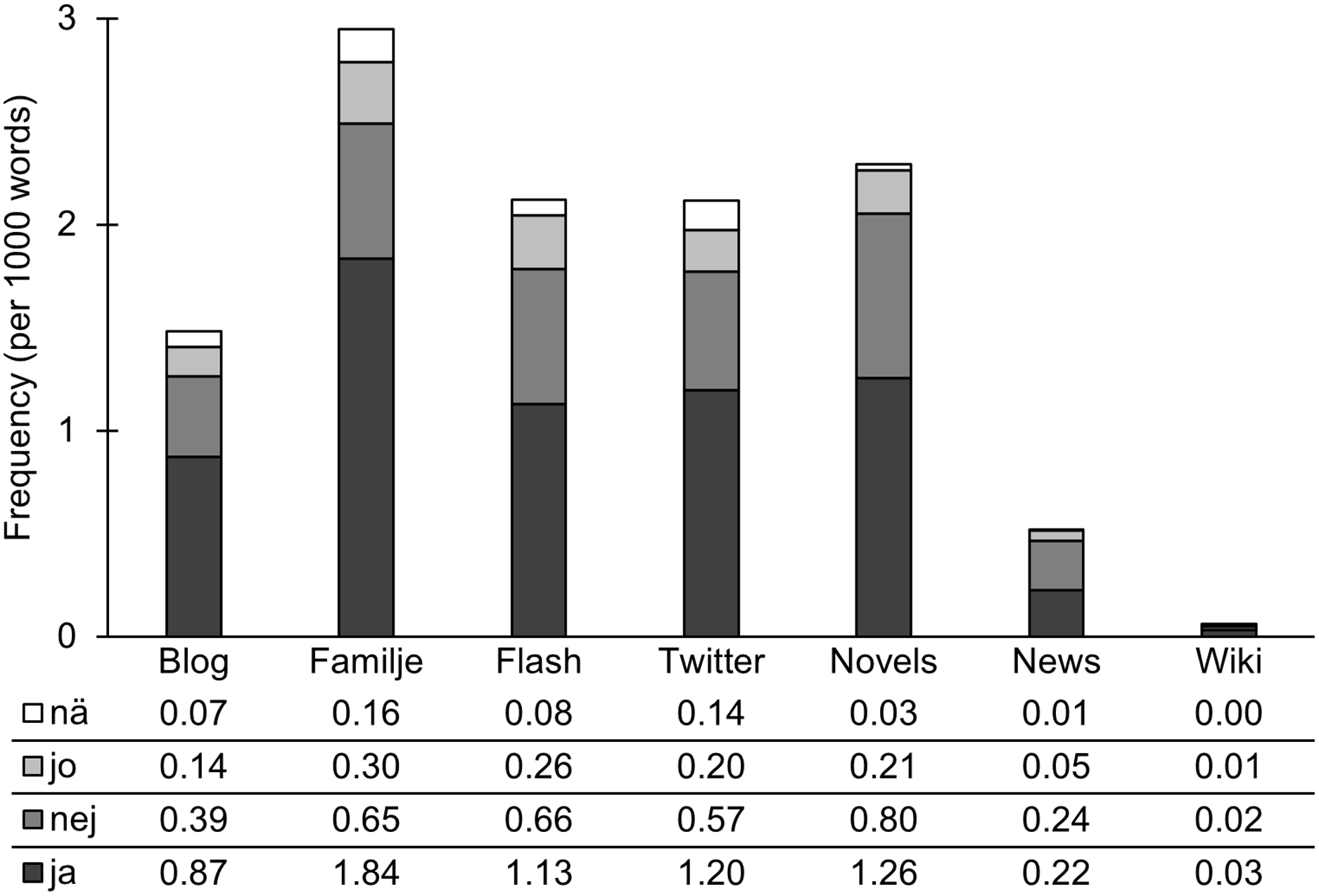
Answer interjections are most frequent in Familjeliv, Flashback, and Twitter – the social media in our study that are designed for interaction. We illustrate part of such an interaction in (10). Novels also have a high number of answer interjections, presumably as part of direct speech, as illustrated in (11) and (12). Answer words are infrequent in News and especially in Wikipedia.
-
(10) User a: Har jag fel eller?

User b: Nej du har rätt, att bära fönsterglas i sina bågar är inget nytt. (Flashback: Lifestyle)
‘Am I wrong or what? [neutral face emoji]’
‘No, you are right, wearing window glass in your frames is nothing new.’
-
(11) – Ja, varför inte, sa Benjamin och såg på Hanna. (Novels: Norstedts)
‘– Yes, why not, said Benjamin, looking at Hanna.’
-
(12) G. skrattar åt hennes misstänksamhet: Jo då, mamma har gjort en hel gryta kåldolmar för helgen. (Novels: Nordstedts)
‘G. laughs at her suspicion: Oh yes, mom has made a whole pot of cabbage rolls for the weekend.’

The informal spelling variant nä occurs predominantly in Familjeliv and Twitter. The form nä also occurs with a reduplication of the vowel in our social media data. Figure 4 shows the different lengths of nä for our corpora, given in three decimal places, given the low frequency of reduplications.
Answer interjection nä and spelling variants.
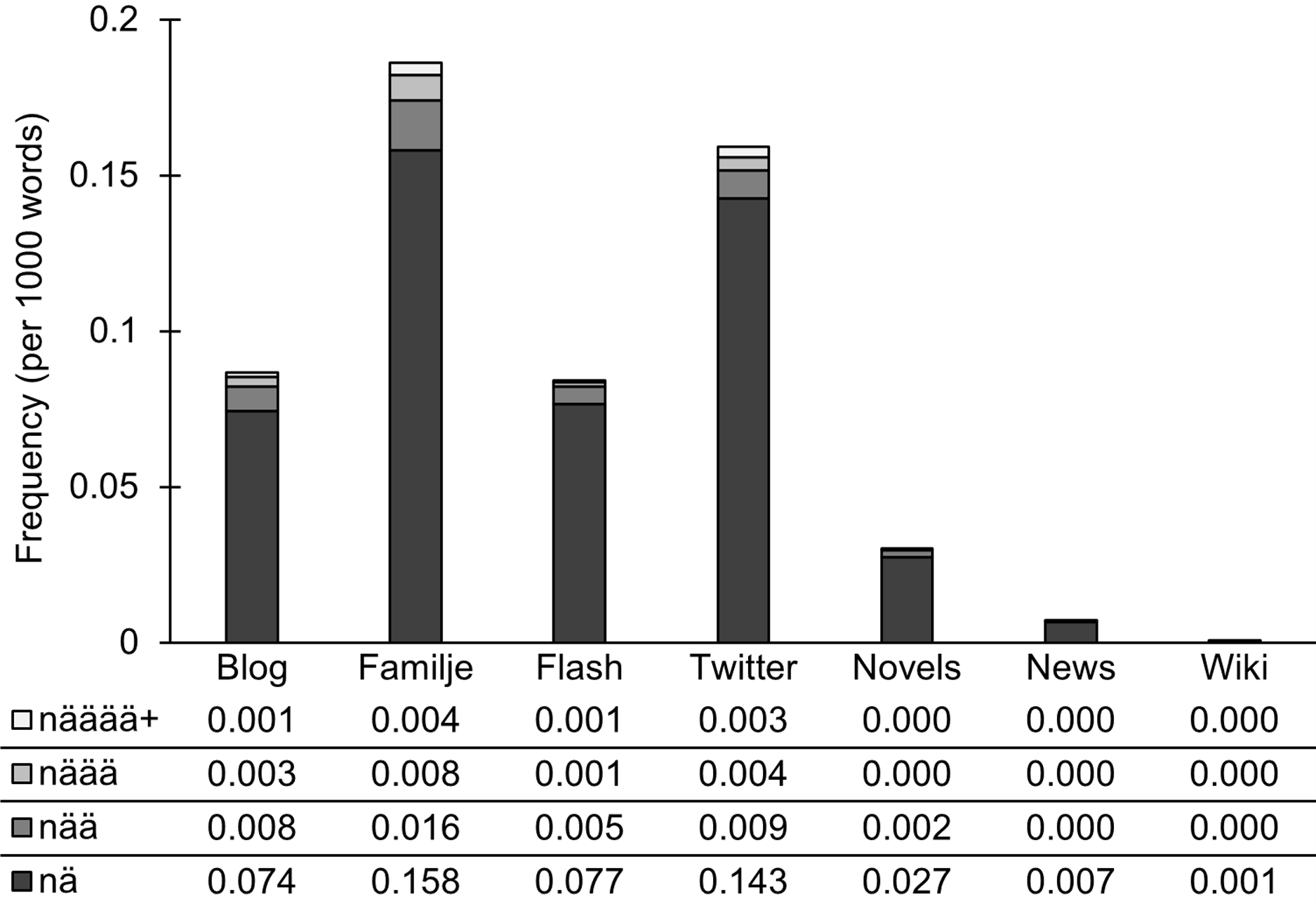
The variant nää is the standard spelling for emphatic, lengthened nä, found in all corpora to some extent, except for News and Wikipedia. This can be seen as an indication of informal language (Teleman et al. Reference Teleman, Hellberg, Andersson and Holm1999:754). The longer non-standard variants with three or more vowels are only found in our social media corpora. Ortmann & Dipper (Reference Ortmann and Dipper2019) see such a repetition of characters as a clear sign of conceptual orality. Example (13) and (14) show the informal, spoken-like quality of the messages with näää and longer variants.
-
(13) Det KAN vara snyggt på vissa killar att ha i ögonbrynet, men näää…! (Flashback: Lifestyle)
‘It CAN be nice on some guys to have in the eyebrow, but noooo…!’
-
(14) @user näääääääää … inte så. #rodnar (Twitter: Swedish Twitter 2017)
‘@user nooooooooo … not like that. #blushes’
We now turn to emotional interjections, as presented in Figure 5, both the stylistically neutral interjections oj ‘oh, oops’ and usch ‘ugh, ew’, and the profanities helvete ‘damn’, jävlar ‘damn’, and herregud ‘oh my god’, with a lower stylistic value.
Emotional interjections.
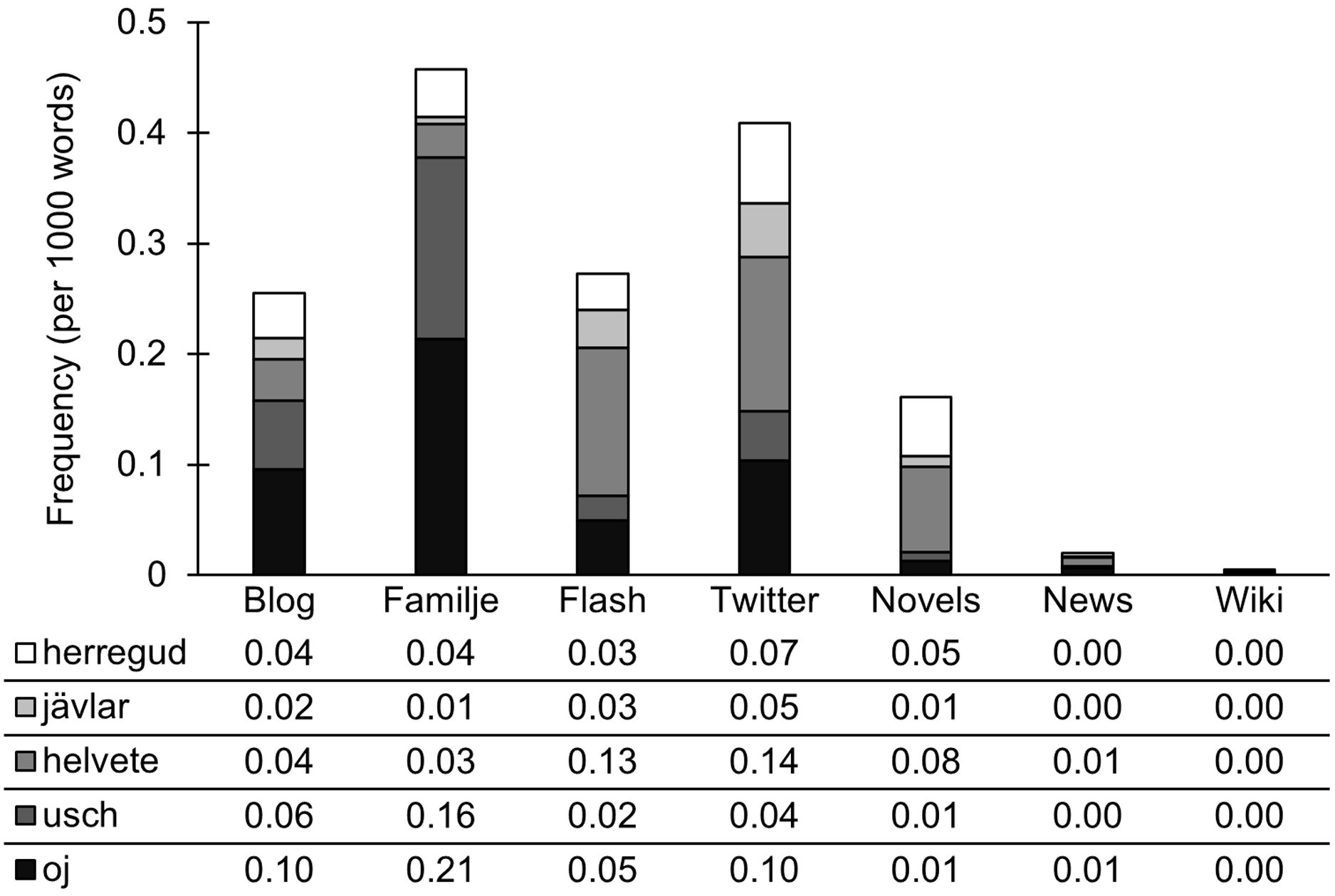
Emotional interjections are most frequent in our social media corpora and in our corpus of novels, which points to an overall involved and informal style. News and Wikipedia, conversely, show very little use of these interjections. The stylistically neutral interjections oj and usch dominate in Familjeliv. As example (15) illustrates, usch expresses negative feelings, here in solidarity with the interlocutor. This specific use contributes to managing social relations between forum users. The profanities jävlar, herregud, and especially helvete dominate on Flashback and Twitter, suggesting a rougher tone of the discussion, as illustrated in example (16). The blogs have a more balanced use of both stylistically neutral and stronger interjections. Novels have a relatively high use of profanities, possibly to help dialogues come alive, as in (17).
-
(15) Ta hand om dig <3 På nåt jäkla sätt klarar man ju allt på sikt <3 Men usch, tänker på dig. (Familjeliv: Family Planning)
‘Take care of yourself [heart emoticon] In some damn way you manage everything in the long run [heart emoticon] But ugh, thinking of you.’
-
(16) Det är ju för helvete ingen raketforskning, vad tror du? (Flashback: Economy)
‘It’s dammit not rocket science, what do you think?’
-
(17) “Javisst ja, herregud, vi har blivit distraherade --” Han såg på klockan på spiselhyllan. (Novels: Bonniers II)
‘“Oh yes, my God, we’ve been distracted –” He looked at the clock on the mantelpiece.’
4.4 Sentence punctuation
We now look into the relative frequency of the period, question mark, and exclamation mark used as sentence markers in Figure 6. In some of our corpora, repeated punctuation marks are common. We only report numbers for repeated periods, as the tokenization process only correctly identifies repeated periods as one token, but misses repeated question and exclamation marks, treating them as separate tokens.
Sentence punctuation.
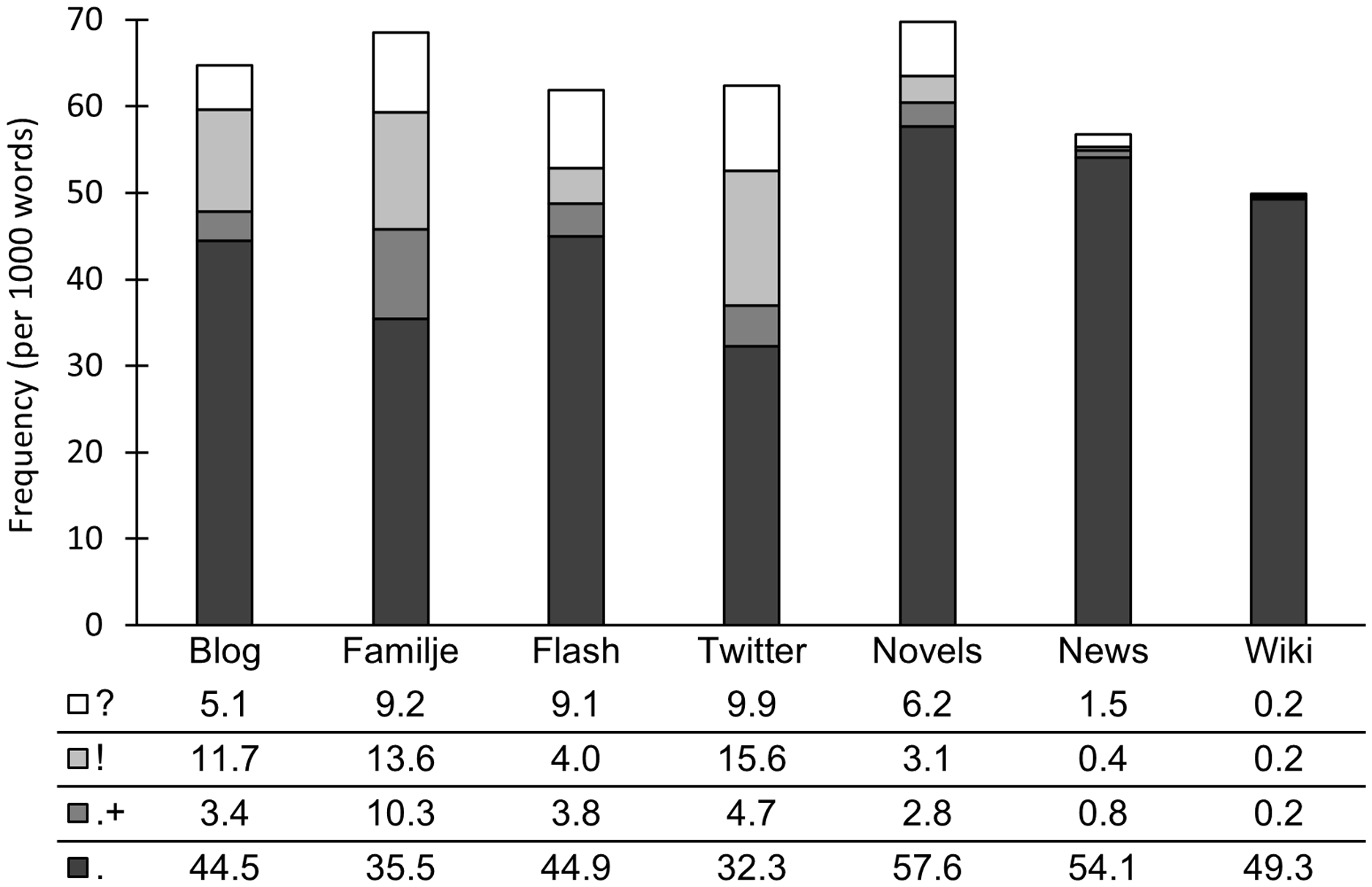
The period, marking the end of a declarative sentence, is the most frequent punctuation mark of those examined in all corpora.Footnote 6 It has a relative frequency of around 50 instances per thousand words in most corpora, except for Familjeliv and Twitter, which only exhibit around 35 instances per thousand words. This could be the result of non-standard alternatives used for marking the ends of declarative sentences. Example (18) illustrates the non-standard use of a comma to separate two declarative sentences (known as a ‘comma splice’) and the absence of punctuation marking in the final declarative sentence of the post.
-
(18) Min kompis dotter rymde från sitt familjehem i ungefär samma ålder, soc gav honom chansen att själv hämta henne (hon var hos kompisar) eller så vart det polisen (Familjeliv: Delicate Room)
‘My friend’s daughter ran away from her family home at about the same age, the social services gave him the chance to pick her up himself (she was with friends) or the police would.’
Question marks and exclamation marks are found predominantly in our corpora of social media and novels. This suggests that these corpora have a varied use of punctuation marks, and consequently sentence types, in contrast to News and Wikipedia. Repeated periods are also limited to our corpora of social media and novels. The most frequent repetition is that of three periods, corresponding to the standard punctuation mark known as ‘ellipsis’, illustrated in (19). Social media corpora also show longer strings of periods, sometimes up to dozens of them in a row, which is non-standard usage. Example (20) illustrates a string of 13 periods used to mark a topic shift in a post on Familjeliv.
-
(19) Moravia hade aldrig hört talas om vare sig Olle eller Sigge… (Novels: Bonniers II)
‘Moravia had never heard of either Olle or Sigge…’
-
(20) Och en fråga till ............. Finns det någon stor barnvagns-butik i Sverige som har ett stort sortiment med både färger och modeller? (Familjeliv: Pregnant)
‘And one more question ............. Is there any large stroller store in Sweden that has a large range of both colors and models?
4.5 Sentence length
We move on from sentence punctuation to the length of sentences, our final linguistic feature to be explored. Figure 7 presents the average sentence length, i.e. the average number of words per sentence, in our seven corpora. This metric relies on the automatic identification of sentence boundaries, based on sentence-final punctuation or line breaks (such as the end of a paragraph or message).
Average sentence length.
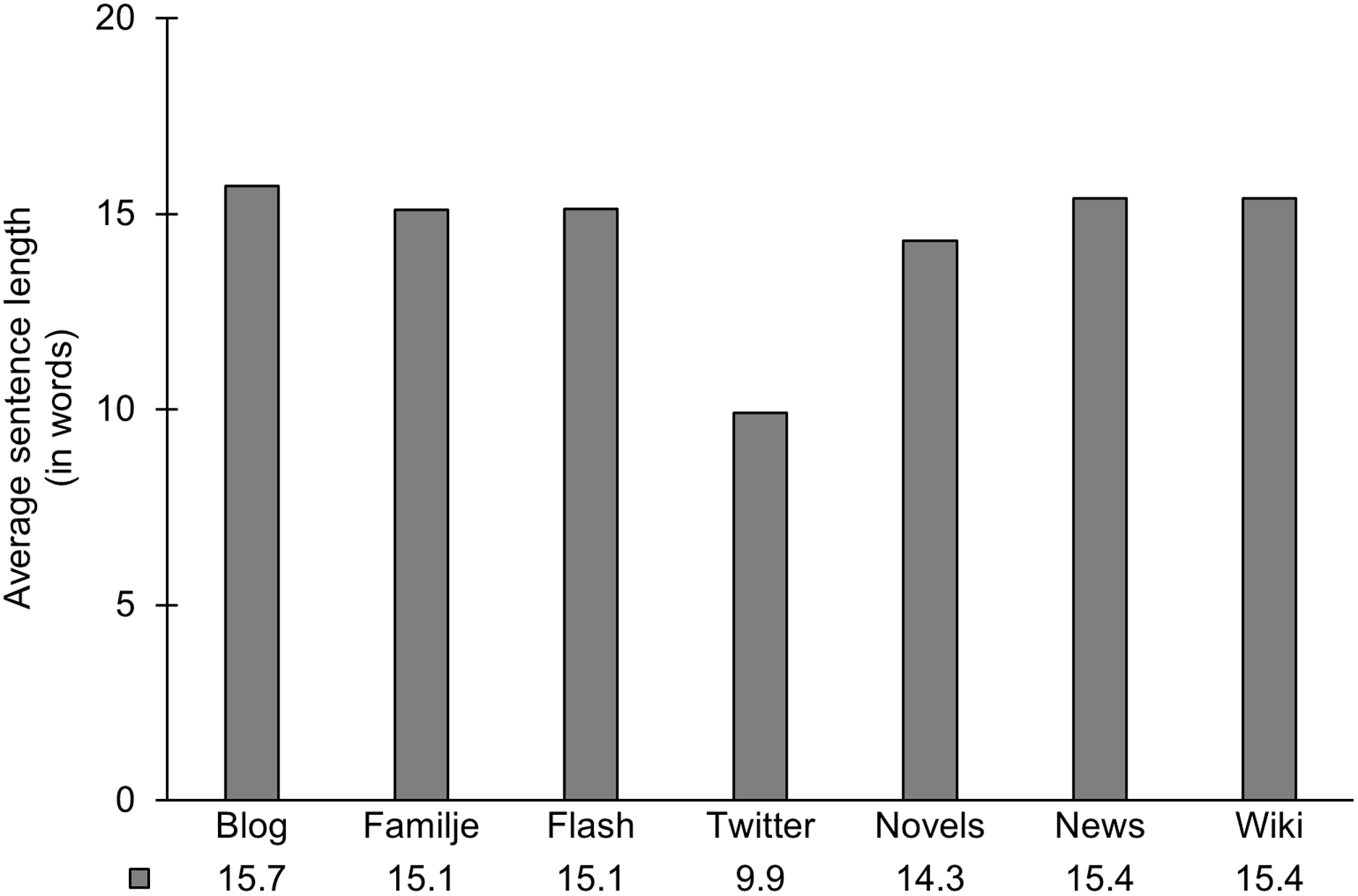
Figure 7 shows that the average sentence length for most of our corpora is very similar (between 14.3 and 15.7 words per sentence). Twitter is the odd one out with only 9.9 words per sentence. The tendency toward shorter sentences on Twitter most probably relates to the restriction on the number of characters per message. On the whole, average sentence length does not contribute to differentiating our corpora from each other (as opposed to earlier research by Berdicevskis Reference Berdicevskis2013 and Ortmann & Dipper Reference Ortmann and Dipper2019). We therefore explore the distribution of sentences of varying length in our corpora. Figure 8 plots the frequency of sentences ranging in length from one word to 50 words.
Distribution of sentence length.
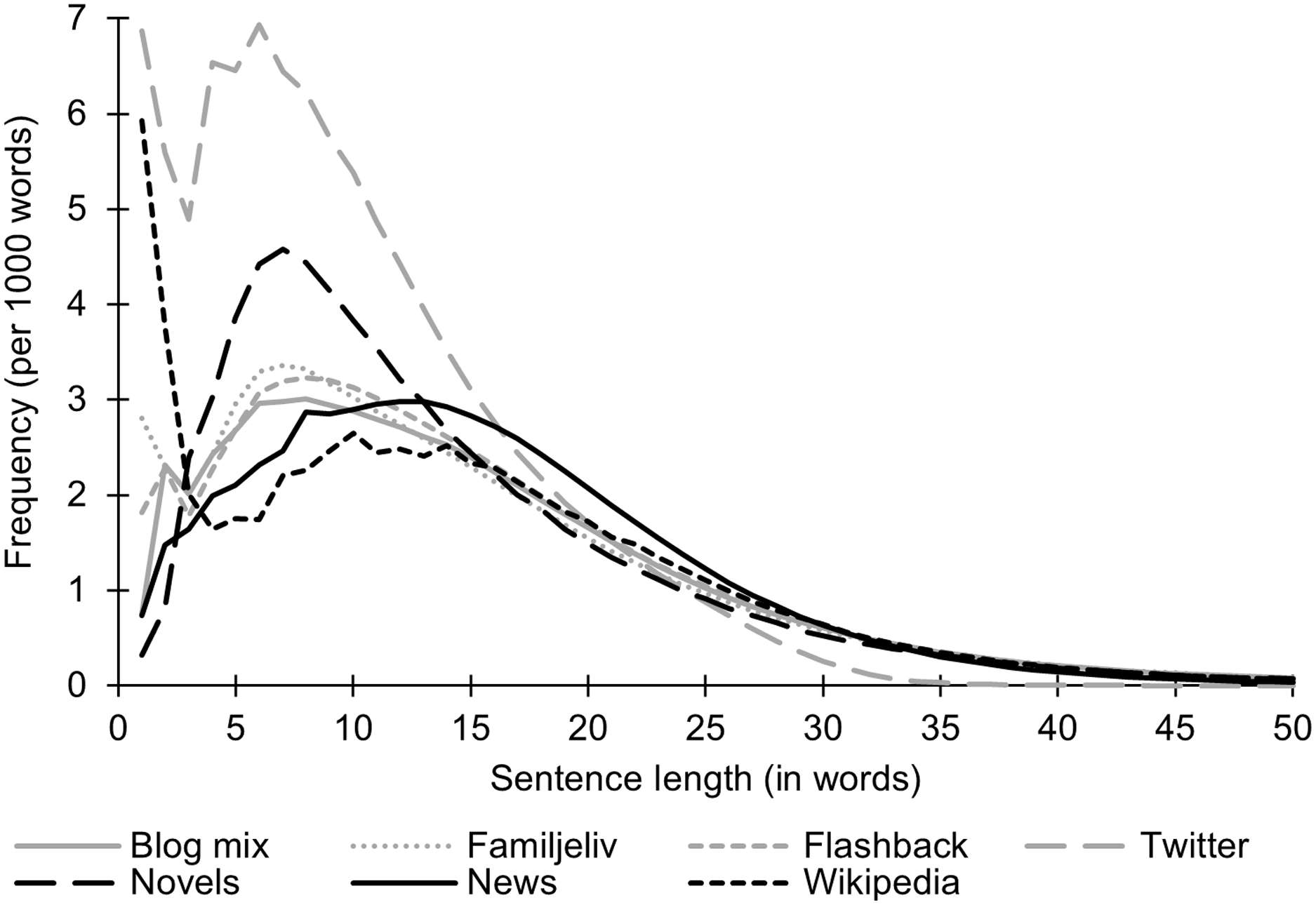
Figure 8 shows that the distribution of sentence length follows a similar pattern of rise and fall in all of our corpora if we disregard the very short lengths of one or two. The corpora differ, however, in the sentence length at which the highest frequency is reached. Our social media corpora (gray lines) show a frequency peak of around 6 to 8 words, as does the Novels corpus. The News and Wikipedia corpora peak at around 10 to 12 words. The corpora also differ in the range of sentence lengths found. Twitter stands out with the high number of short sentences ranging between 2 and 15 words. Longer sentences are increasingly infrequent, and we hardly find any sentences longer than 35 words. Again, this is probably a direct consequence of the character restraint on the platform. Novels also have a relatively high number of short sentences. This is something of a surprise, as literary language is typically thought to be intricate and complex. As opposed to Twitter, however, we do find long winding sentences in novels. The other corpora have a more even distribution of shorter and longer sentences. Regarding sentence lengths of one or two words, these are particularly frequent on Twitter, Wikipedia, and to a lesser extent Familjeliv. The ultra-short ‘sentences’ on Twitter and Familjeliv relate to the interactive nature of these social media, where short reactions to previous messages are common. On Familjeliv, we frequently find short responses in the form of a smiley, an exclamation mark, or an interjection. On Twitter, we also find short ‘sentences’ consisting only of a link, a hashtag, or a user call with the @ sign. The one- or two-word sentences in Wikipedia turn out to be headings, which are used in this corpus to summarize and structure the information-dense content of the pages into more manageable pieces.
5. Conclusion
We set out to explore the language of social media by taking a contrastive corpus linguistic approach. More specifically, we investigated a selection of linguistic features in four corpora of Swedish social media and three other large corpora of written Swedish, all available at Språkbanken Text.
Our analysis of linguistic features revealed that social media display traits of involved, informal, non-standard, and interactional language. All our corpora of social media made frequent use of first-person pronouns and emotional interjections, indicative of involved language. The emotional interjections investigated are also informal in nature, especially the profanities that were covered in the study, which have a particularly low stylistic value. We found evidence of non-standard language in the excessive repetition of letters and punctuation, and, more specifically, in the spellings of nä with three or more vowels and in strings of periods longer than three. The frequent use of second-person pronouns and answer interjections points towards the interactional nature of social media.
Although all corpora of social media show the above features, they differ in their relative use of them. Familjeliv stands out with its frequent use of answer interjections, the neutral emotional interjections oj and usch, as well as the non-standard spelling of nä with three or more vowels, and the use of strings of periods longer than three. Twitter, in turn, makes more use of profanities, and of short replies consisting of only one or two words. A relatively high use of profanities is also typical of Flashback. These small differences in frequency across the corpora of social media indicate that they all have their own stylistic preferences.
The linguistic features discussed are not exclusive to social media but also turn out to be frequent in novels. More specifically, the novels show the same traits of involved, informal, and interactional language as social media. This is surprising as many of the studies listed in Table 1 study social media in addition, and especially in contrast, to novels. Our results indicate that the language of social media and novels is more similar in some respects than one perhaps would imagine. This said, the language of novels does differ from social media, specifically in the relative absence of non-standard language.
News and Wikipedia, in contrast, do not show much evidence of involved, informal, and interactional language. These two corpora do not often make use of first- and second-person pronouns but rather prefer detached third-person pronouns. They refrain from using answer and emotional interjections and non-standard spellings, such as repeated letters or punctuation. All of these traits point to a detached, formal, standard, and non-interactional language. This is especially the case for Wikipedia. This suggests that Wikipedia, more than News, has a large potential for serving as a reference corpus of detached, fact-based prose in Swedish.
News and Wikipedia also score high on linguistic features that indicate complexity. These corpora use nouns more than verbs, pointing to a nominal style, and have a preference for long sentences. Interestingly, Twitter scores high on some of these features: the corpus shows a nominal style and has a markedly high lexical density. These features were explained by the length restriction on Twitter posts, giving rise to an informationally dense style. The character restraint may also lie behind the low average sentence length on Twitter and its preference for short sentences. These features make Twitter stand out as a rather hybrid genre, which shows traits of involvement, like the other social media corpora, but also signs of complex language, more like News and Wikipedia.
All in all, our analysis of linguistic features confirms previous corpus studies by empirically demonstrating the informal and non-standard nature of social media language use. Our results also nuance previous research, by revealing that traits of informal and non-standard language are distributed unevenly across the corpora of social media investigated, and are also present in other types of written texts, such as novels. We also complemented the state of the art by revealing that social media show traits of involved and interactional language, and vary in their degree of linguistic complexity. We did not explore the innovativeness of social media, as this would have required a diachronic perspective on the corpus data. This is something we would like to pursue in future research, along the lines of the pilot study in Adesam, Berdicevskis & Coussé (Reference Adesam, Berdicevskis and Coussé2024).
Acknowledgements
This work has been carried out within the Cassandra project (funded by the Marcus and Amalia Wallenberg Foundation, donation letter 2020.0060) and supported by the Swedish national research infrastructure Nationella språkbanken, funded jointly by the Swedish Research Council (2018–2024, contract 2017-00626) and the 10 participating partner institutions. We thank three anonymous reviewers for their constructive comments.


 Open access

