




Introduction
A trench was started at the north-east corner and walls of chambers with traces of coloured plaster soon began to appear. A little further down a large piece of decoration was exposed, showing water-lilies and papyrus and birds. (Newton Reference Newton1924: 294)
Animals and birds play a fundamental role in human societies and, as such, figure prominently in the visual record of both ancient and modern cultures (Alves & Barboza Reference Alves, Barboza, Alves and Albuquerque2018). Indeed, artistic preoccupation with animals, birds and the wider natural world has produced numerous remarkable works, including now-iconic visualisations such as the cave art of Lascaux and Chauvet (e.g. Jones & Elliot Reference Jones, Elliott, White, Culver and Pipan2019), the Minoan frescoes of Akrotiri and Knossos (e.g. Masseti Reference Masseti1997) and the immersive imagery of the Garden Room of the Villa of Livia Ad Gallinas Albas at Prima Porta (e.g. Cole Reference Cole2017). Ancient Egypt is, famously, no exception. Animals and birds were crucial in all aspects of daily practical and spiritual life (Evans Reference Evans2010: 1). Birds appear extensively in ancient Egyptian artwork and were of particular significance in religious contexts (Houlihan Reference Houlihan1986; Bailleul-LeSeur Reference Bailleul-LeSeur2012; Ikram Reference Ikram and Bailleul-LeSeur2012).
The North Palace of Akhenaten's late Eighteenth Dynasty capital at Amarna (1347–1332 BC) is an isolated building facing the river Nile, standing between the North Suburb and the North City (Figure 1). Originally excavated by the Egyptian Exploration Society over two seasons between 1923 and 1925, a later re-examination of key areas was undertaken between 1996 and 1999. These efforts revealed a self-contained royal residence, constructed predominantly of mud brick, which included domestic suites, formal reception halls, an open-air temple, gardens, and indications of a menagerie where animals and birds were kept (Newton Reference Newton1924; Whittemore Reference Whittemore1926; Spence Reference Spence1999; Kemp Reference Kemp2018: 338). Of the painted plaster panels that survived time and termites, those that adorned the walls of the so-called ‘Green Room’ in the North-East Court (Figure 1) were remarkable for their character and extent. As they were uncovered, the paintings were recognised as vitally important examples of “the school of Akhetaten” (Whittemore Reference Whittemore1926: 8), where the “innovations by which the era of Akhenaten is peculiarly marked attain something like a culmination” (Davies Reference Davies and Frankfort1929: 61). They have since come to be regarded as masterpieces of ancient Egyptian art (Houlihan Reference Houlihan1986: 103; Weatherhead Reference Weatherhead2007: 143). Featured in these paintings are some of the most skilfully rendered and naturalistic images of birds known from Dynastic Egypt.
Locations of the North Palace, the North-East Court and the Green Room, Amarna (original plans by B. Kemp).

The surviving art of the North Palace can be classified into two themes. In the North-East court, the most common theme is fowl-feeding scenes (Weatherhead Reference Weatherhead2007: 147). These depict human figures feeding ducks, cranes, storks and geese against an invariably yellow ground with large red pots and dotted with red grains and scattered white or grey feathers. The fowl-feeding scene from the south wall of room 7 includes “a most life-like representation” (Newton Reference Newton1924: 298), and possibly the only identified example, of a graylag goose (Anser anser) in ancient Egyptian art (Frankfort Reference Frankfort1929: pl. XI; Houlihan Reference Houlihan1986: 54) (Figure 2).
Top) detail from a reconstruction of the fowl-feeding scene from the south wall of room 7 of the North-East Court, North Palace, Amarna (B. Kemp); bottom) excerpt of the waterbank design from the west wall of the Green Room, Amarna, showing pied kingfisher (Ceryle rudis) and decorated niche (detail from N. de Garis Davies, Facsimile painting of the west wall from the “Green Room” in the North Palace at Amarna; Public Domain; The Metropolitan Museum of Art, New York: accession no. 30.4.136).
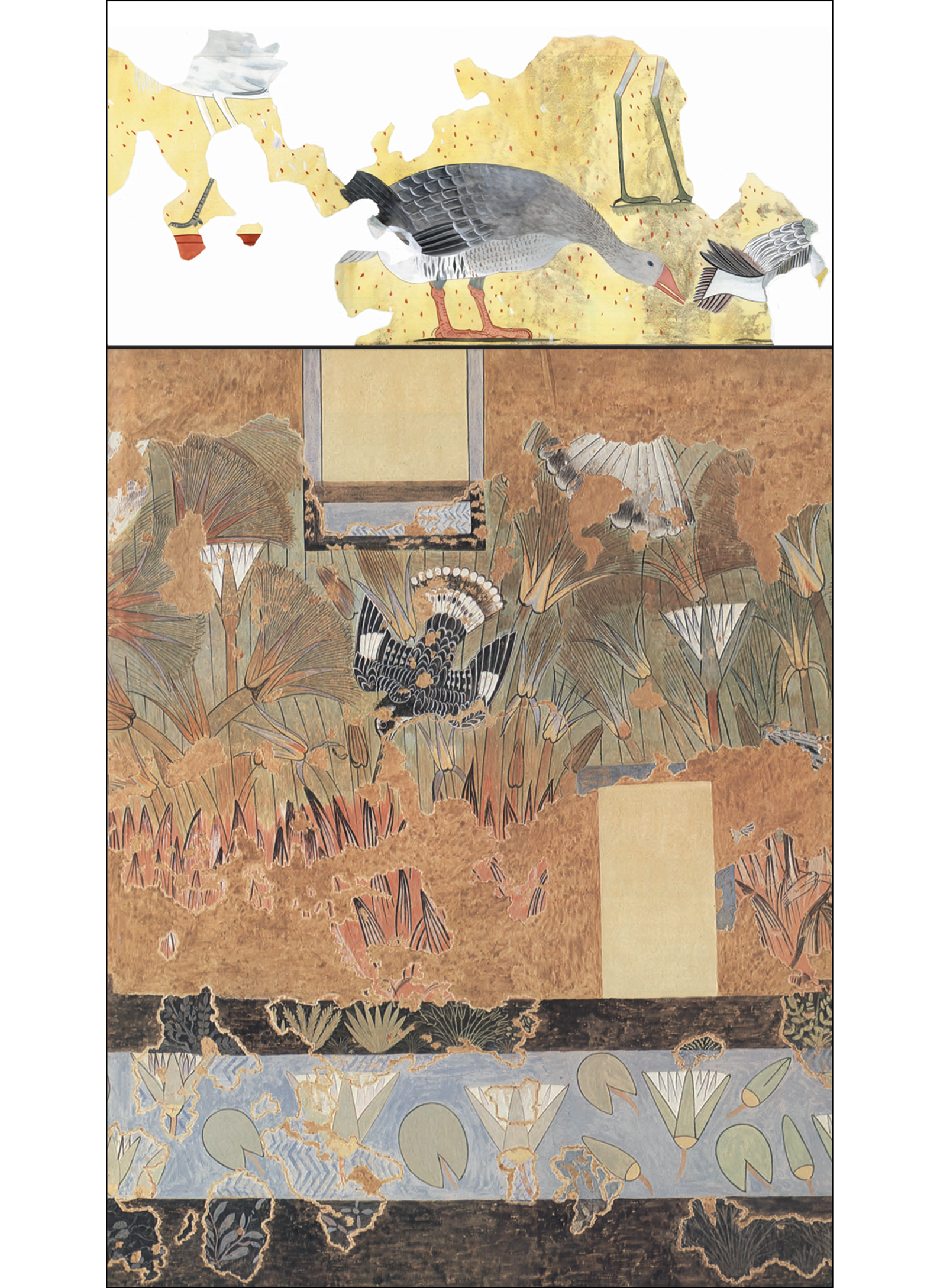
The second theme is the waterbank design (Weatherhead Reference Weatherhead2007: 147) (Figure 2), remnants of which were found throughout the North Palace. In contrast to the fowl-feeding scenes, which are presided over by humans, the waterbank design depicts birds amidst thickets of riverside plants, including lotus (Nymphaea caerulea) and papyrus (Cyperus papyrus), with a stylised river at the base. The Green Room (room 12)—one of two small, interconnected rooms (Figure 1)—was so named due to the dominant colour and extent of this theme (Davies Reference Davies and Frankfort1929: 58). The adjoining room (no. 11) was apparently an architectural duplicate, though no artwork survived. Both rooms are characterised by two rows of niches in the walls (Figure 1), the significance of which has been the subject of much speculation (e.g. Davies Reference Davies and Frankfort1929: 65–67). The niches were decorated to resemble small ponds (Figure 2) and it has been proposed that they may have held cut lotus and/or lily plants (Boyce in Weatherhead Reference Weatherhead2007: 166). The detailed, naturalistic execution of the waterbank design in the Green Room stood in marked contrast to the more standardised and formulaic renditions used in the palace and transformed the Green Room into an “idyllic landscape” (Weatherhead Reference Weatherhead2007: 157), where “the disturbing presence of man is infinitely remote” (Davies Reference Davies and Frankfort1929: 59).
The presence of “rock-pigeons”, “palm-doves”, “black and white kingfisher” and “pied shrike”, as well as “reddish-turtle dove (Turtur sharpii)”, “blue rock-pigeon (Columba livia)” and “shrikes (Lanius nubicus or Lanius collurio)” have been variously discussed in the context of the Green Room panels (Davies Reference Davies and Frankfort1929: 59–60 & 64), although it is not clear in all cases to which images these monikers refer.
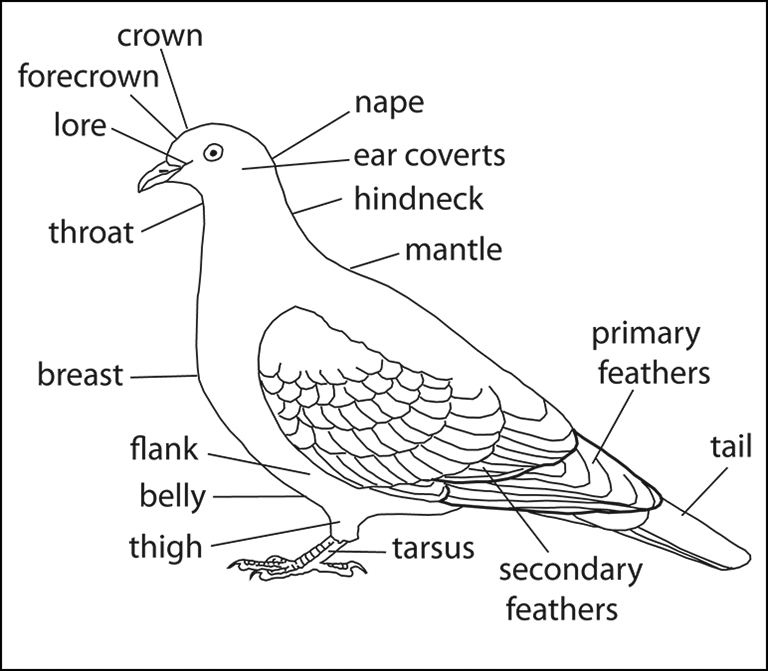
In this article, we revisit the birds of the Green Room. Mindful of previous works, taphonomic history and the influence of artistic licence, the identity of the surviving birds is considered through a qualitative assessment. Given the naturalistic execution of the artwork, a critical assumption is that the original artists worked from, and were striving faithfully to reproduce, real-life birds. Characteristics of the birds that are referred to in the following text are annotated in Figure 3. These have been checked against ornithological sources and specialist taxonomic works (Hollom et al. Reference Hollom, Porter, Christensen and Willis1988; Lefranc & Worfolk Reference Lefranc and Worfolk1997; Gibbs et al. Reference Gibbs, Barnes and Cox2001; Alström et al. Reference Alström, Mild and Zetterström2003; Porter & Aspinall Reference Porter and Aspinall2010) and the Birds of the World online portal (Billerman et al. Reference Billerman, Keeney, Rodewald and Schulenberg2022). While the principal aim of this study is to propose a scheme of identifications, we also consider long-standing questions of ecology and artistic style.
Stylised diagram of a pigeon, showing anatomical characteristics referred to in the text (adapted by the authors from Gibbs et al. Reference Gibbs, Barnes and Cox2001).
Taphonomy of the Green Room birds
The extent of the surviving painted plaster in the Green Room was unique, although only the lower portions of the walls and plaster panels remained. This preservation may be due to the ceiling and upper walls of the original building (which might have risen to a second storey) collapsing soon after abandonment, with the rubble protecting the paintwork on the lower walls. On discovery, the panels were in a poor state, although the colours of the paintings, while not uniformly bright across all the walls, were largely preserved. The right portion of the west wall “retained its colours in a state not far removed from the original, save for a certain culling and deepening of the greens” (Davies Reference Davies and Frankfort1929: 68). The plaster, however, lacked adhesion due to termite activity, and a portion of the left side of the west wall had been damaged by the presence of a campfire (Figure 1) and required washing to remove the soot (Davies Reference Davies and Frankfort1929: 68).
Ultimately, the panels were the subject of an accomplished facsimile in tempera by Nina de Garis Davies, whom, along with her husband Norman, had come from the Metropolitan Museum of Art in New York to assist in recording the paintings (Frankfort Reference Frankfort1929). The facsimile of the west wall is currently housed in the Metropolitan Museum of Art in New York (accession no. 30.4.136) and is the principal source of images for our reassessment. In 1926, a well-meaning attempt to conserve the original panels with consolidants discoloured and darkened the artwork. Fragments of the original painted plaster are today held in museum collections in Cairo, Oxford, London, Copenhagen, Cambridge, Liverpool and Leiden (Weatherhead Reference Weatherhead2007: 168).
Problems of artistic licence
While ancient illustrations can shed light on animal communities in the past (e.g. Guagnin et al. Reference Guagnin2016), the taxonomic identification of species in artwork is not a precise science (Kirwan et al. Reference Kirwan2022). A recent study of Fourth Dynasty depictions of geese from the Chapel of Itet at Meidum employed a quantitative taxonomic method and postulated the possible discovery of an unknown, extinct species (Romilio Reference Romilio2021). Kirwan and colleagues (Reference Kirwan2022), however, question the application of the technique and argue for intraspecific variation (variation among individuals of the same species) in the case of the red-breasted goose (Branta ruficollis). Citing a failure to take into account “problems of artistic license”, they question whether “it is possible or even advisable to diagnose species based on illustrations alone, especially unique depictions of artists of unknown credentials” (Kirwan et al. Reference Kirwan2022: 2).
While the artwork of the Green Room is an exemplar of naturalistic execution, it should not be regarded as a dedicated ornithological treatise. Given the spiritual, economic and recreational significance of papyrus marshes, pictures of birds in this specific setting are a common theme in the wall art of ancient Egyptian palaces (e.g. Davies Reference Davies and Frankfort1929: 61), though, unlike the Green Room, there is a tendency to illustrate hunting and fowling scenes. From an ornithological perspective, however, the Green Room panels present a number of commonalities with these works (see accounts in Houlihan Reference Houlihan1986; Wyatt Reference Wyatt and Bailleul-LeSeur2012).
First, ancient Egyptian wall art was enthusiastically two dimensional and “comparative size mattered little” in the depiction of birds (Wyatt Reference Wyatt and Bailleul-LeSeur2012: 84). Second, there are physical anomalies in the images. In the case of the Green Room's unmistakable rendition of the pied kingfisher (Ceryle rudis) (bird i in Figure 2), “except for the slightest point of error, it is completely faithful to the living bird” (Houlihan Reference Houlihan1986: 114). Houlihan points out that this error—the depiction of the head in profile rather than from above, as it would be in life—is to ensure that the viewer would “not miss its character” (Houlihan Reference Houlihan1986: 115). In this sense, however, the art of Amarna follows the wider, well-established aspective tradition in Dynastic Egypt (Brunner-Traut trans. Reference Brunner-Traut, Schäfer, Brunner-Traut and Baines1986), in which artistic license sacrifices realism to portray the elements of an animal or bird most useful for their identification. Indeed, when birds of the Green Room are shown in profile, the dorsal aspect of their tails is depicted throughout (Figure 4).
Proposed identifications of the birds of the west wall of the Green Room: a–f) rock pigeons (Columba livia); g) red-backed shrike (Lanius collurio); h) white wagtail (Motacilla alba); i) pied kingfisher (Ceryle rudis); j–l) unidentified (original image: N. de Garis Davies, Facsimile painting of the west wall from the “Green Room” in the North Palace at Amarna; Public Domain; The Metropolitan Museum of Art, New York: accession no. 30.4.136).

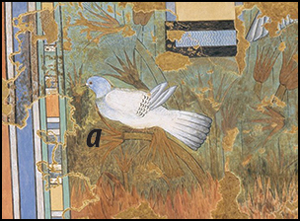
Third, birds are shown perched or even nesting atop papyrus umbels (Figure 4). As these umbels could not support the birds’ weight, this is most reasonably explained as a stylistic convenience. The Green Room examples do make some concession to physics and show stems bending under the weight of all but one of the perched birds; curiously, bird b seems to be suspended in mid-air (Houlihan Reference Houlihan1986: 101) (Figure 5), although this may reflect an attempt to depict the bird slightly deeper within the thicket of plants (cf. Evans Reference Evans2010: 43).
Birds a and b: rock pigeons (Columba livia) (detail from N. de Garis Davies, Facsimile painting of the west wall from the “Green Room” in the North Palace at Amarna (Public Domain; The Metropolitan Museum of Art, New York: accession no. 30.4.136).
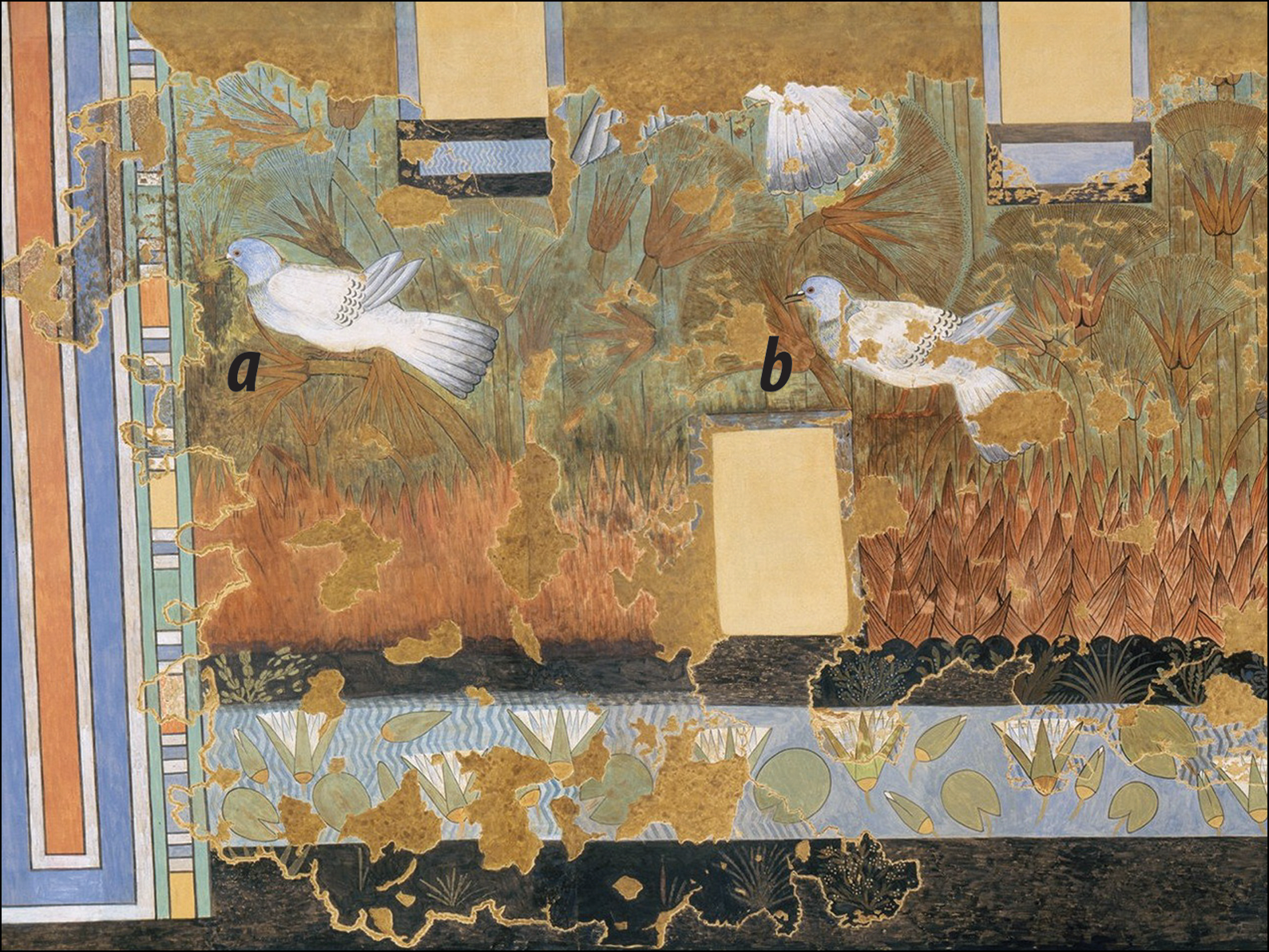
There are also anomalies that are unique to the art of Amarna. The folded primary feathers of the perched birds in the west wall panel all feature a peculiar bend at an angle of approximately 45° (Figure 4). This occurs irrespective of species and appears to have been a local convention: bent primary feathers are also portrayed in the fowl-feeding scene in room 7 (Figure 2). Davies (Reference Davies and Frankfort1929: 64) speculated that this could be a foreign stylistic influence, or that the birds used as models had their wings bound or feathers broken. The latter, however, had not previously been required in centuries of portraying birds in ancient Egyptian art, and it would also seem unnecessary to hobble or handicap a tame goose (and, arguably, commensals such as pigeons or doves) in the face of a ready supply of grain. The most likely intent of this convention was to reinforce that a bird was perched and/or stationary, and this local feature does not influence species identification. There are also anomalous marks on the tail feathers of two Green Room birds (birds g and h; Davies Reference Davies and Frankfort1929: 64). These markings are considered after the individual accounts below.
Birds of the Green Room
The remnants of 12 (possibly 13) depictions of birds survived on the west wall panel (Figure 4: birds a–l). Nine of these were reasonably well preserved; the remainder (birds j–l), including a small bird nesting amidst the papyrus (bird l), cannot be identified.
Pigeons (birds a–f)
Most of the surviving bird images depict a species of pigeon (Columba sp.). One image (bird b) has been the subject of detailed review by Houlihan (Reference Houlihan1986: 101–103). While depictions of pigeons per se in ancient Egyptian art are not unique to the Green Room, renditions of the rock pigeon (Columba livia) are rare. Bird b (Figure 5) is cited as a fine example of this species, and shows a remarkable attention to detail and an appreciation of plumage and morphology (Houlihan Reference Houlihan1986: 103). The characteristic stance—red tarsi (legs), broad wing bars across the secondary feathers, as well as eye, cere (base of the beak) and neck markings—permit a confident identification. There are at least six pigeons shown in the panel (a–f); the presence of characteristic wing bars (Gibbs et al. Reference Gibbs, Barnes and Cox2001: 176) on the three perching birds (a, b and e) are suggestive of this species (see below). The remaining three birds, which are in flight (c, d and f), are also likely to be rock pigeons, although they lack diagnostic characteristics.
Pied kingfisher (bird i)
The pied kingfisher (Ceryle rudis) is unmistakable (Houlihan Reference Houlihan1986: 114–16) and is arguably the most striking of the Green Room birds (Figure 2). Its conspicuous method of fishing—by hovering over water—was likely a familiar sight, and depictions of the species are common in ancient Egyptian art (El Menyawy Reference El Menyawy2020).
Bird g: reddish turtle dove or shrike?
The identity of the perching bird with red plumage (bird g) is confused (Figure 6). Davies (Reference Davies and Frankfort1929: 64) mentions the presence of a “reddish turtle dove”, whereas a caption to Plate V in Frankfort (Reference Frankfort1929) states “Pigeons and shrike, detail from Plate IV”.
Top) birds g and h, interpreted as red-backed shrike (Lanius collurio) and white wagtail (Motacilla alba), respectively (detail from N. de Garis Davies, Facsimile painting of the west wall from the “Green Room” in the North Palace at Amarna; Public Domain; The Metropolitan Museum of Art, New York: accession no. 30.4.136); bottom left) red-backed shrike (photograph: Lehava Kiryat Shmona Pikiwiki Israel; used under a CC-BY 2.5 licence: https://creativecommons.org/licenses/by/2.5/deed.en); bottom right) white wagtail (used under a CC0 1.0 licence: https://creativecommons.org/publicdomain/zero/1.0/deed.en).
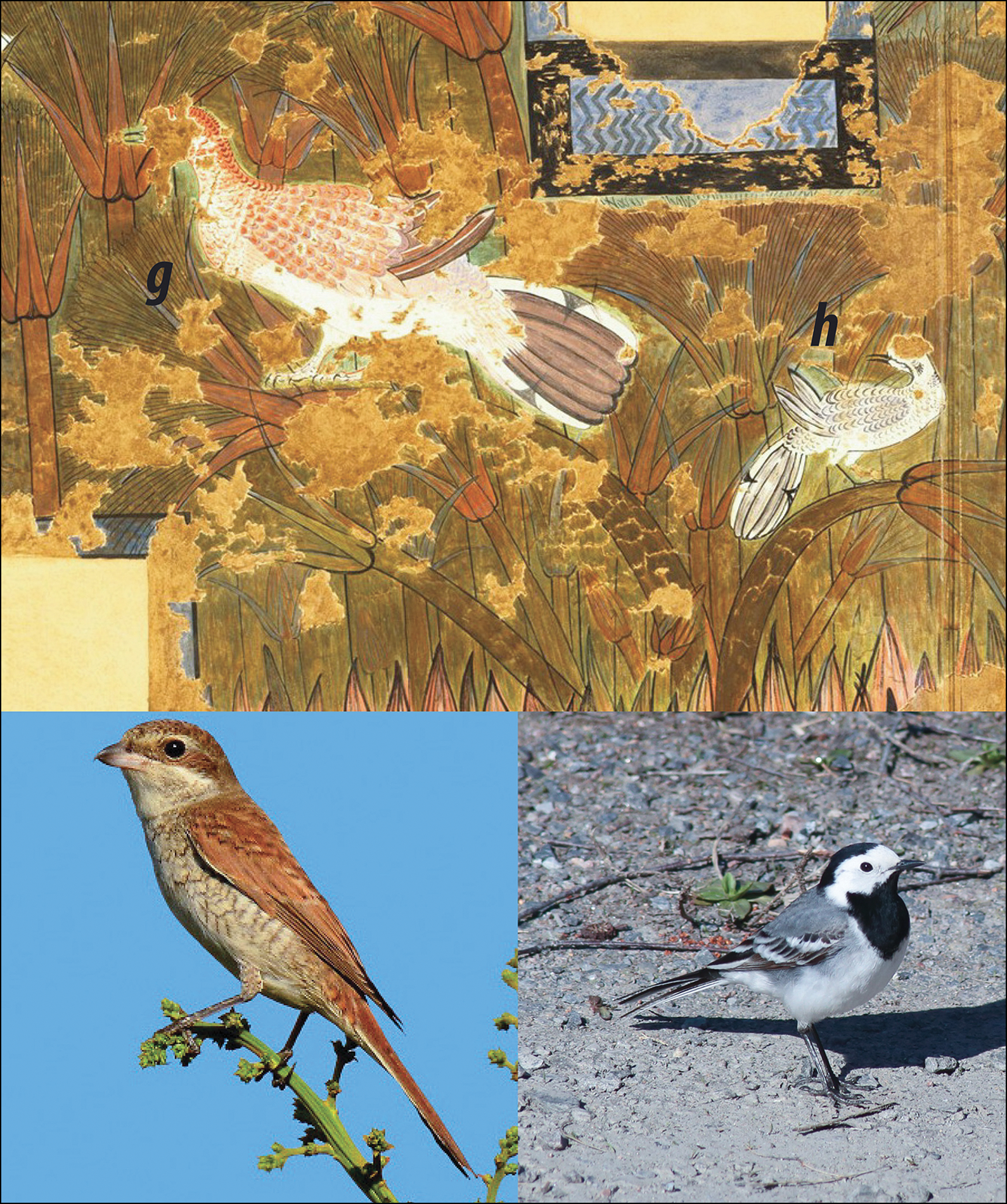
While bird g appears to have the general aspect and stance of the pigeons in the panel, its proportions differ: the neck is longer and slimmer, as is the body. Indeed, if bird g is a species of dove (Streptopelia spp.), then, in contrast to the rock pigeons and pied kingfisher, it is poorly observed. First, and most importantly, it lacks red tarsi, which are a defining characteristic (Gibbs et al. Reference Gibbs, Barnes and Cox2001); the legs instead appear pale grey. While portions of the left side of the west wall were smoke-damaged and required washing to remove soot, this was limited to the area left of bird g (Figure 1); bird b, a depiction of a rock pigeon that was affected by sooting, was nonetheless replete with red legs. While there is damage to the belly, thigh, flank and base of the tail, the scales on bird g's tarsus are reproduced in fine detail, as are the claws, which suggests that loss of colour had not occurred.
Bird g also lacks characteristic and diagnostic hindneck markings found on Streptopelia doves, and the less conspicuous, but still discrete, stippled patch on the throat of palm doves (Streptopelia senegalensis) (Gibbs et al. Reference Gibbs, Barnes and Cox2001). The white outer tail feathers of bird g are, however, a distinctive and common characteristic in doves; anomalous triangular marks are also present. Could the other omissions reflect a lack of reference material? Luff (Reference Luff2007) does not report dove bones in the bird bone assemblages from Amarna. A collection recovered by sieving from the spoil heaps from the house of Panehsy (Payne in Kemp Reference Kemp2006: 45–52), however, included relatively abundant bones of a small species of Streptopelia (Stimpson in Kemp Reference Kemp2016), which suggests that their presence or absence in the archaeological record varies as a function of recovery. Furthermore, while more recent ornithological records must not be applied uncritically, the turtle dove (Streptopelia turtur) is a common migrant breeder and the palm dove (S. senegalensis) is a common and familiar resident (Goodman & Meininger Reference Goodman and Meininger1989: 315). Both are commensal and common around human habitations and would likely have been a familiar sight; doves are frequently depicted in ancient Egyptian art (Houlihan Reference Houlihan1986) and appear in lists as funerary offerings, although direct physical evidence of their presence in burial chambers is rare (but see Hartley & Tristant Reference Hartley and Tristant2021). Houlihan (Reference Houlihan1986: 105) proposed that both species were likely to have been bred in captivity by ancient Egyptian aviculturists.
While there is damage to the head and facial features, on review, the alternative proposed by Davies—a shrike—is a more parsimonious identification. Notably, the original artist was clearly at pains to emphasise the scaly, vermiculated character of the rufous plumage of the nape, hindneck and mantle (Figure 6). There is also fine barring depicted on the undamaged portions of the breast. The claws of the bird appear to have been emphasised, perhaps to suggest a predatory habit. These characteristics, together with the white outer tail feathers and pale grey legs, are consistent with a particular species of shrike; specifically, the vermiculated plumage is characteristic of a female or juvenile red-backed shrike (Lanius collurio) (cf. Lefranc & Worfolk Reference Lefranc and Worfolk1997: 50). To our knowledge, the only other representation of a red-backed shrike is a Twelfth Dynasty image of a male bird from the tomb of Khnumhotep III at Beni Hasan (Houlihan Reference Houlihan1986: 126).
Bird h: shrike or wagtail?
The head and facial features of the smallest surviving bird are damaged, but its identification is aided by an almost identical counterpart from the east wall (Ashmolean Museum: accession no. 1927.4084), which is referred to as a shrike (Frankfort Reference Frankfort1929: pl. IX). Davies (Reference Davies and Frankfort1929: 64) considered the possibility that these images depicted masked (‘pied’) shrikes (Lanius nubicus).
Although the head is damaged (but apparently reconstructed later; see Frankfort Reference Frankfort1929: pl. VI), bird h is depicted as slight, displaying slim black tarsi and finely barred grey plumage on the mantle and breast, with contrasting white outer feathers on a dark grey (or degraded black) tail (Figure 6). These features are consistent with a juvenile masked shrike, but the remains of the black bill are rather slim and the characteristic wing patches of the species are not present (cf. Lefranc & Worfolk Reference Lefranc and Worfolk1997: 75). There also appears to be the remains of a dark triangular mark below, rather than through, the eye and a well-defined black lore (area between the eye and beak), which are not characteristic of masked shrikes (Figure 7).
Detail (A) from the facsimile painting of the east wall of the Green Room (N. de Garis Davies; Frankfort Reference Frankfort1929: pl. IX), with examples of head markings of white wagtail (Motacilla alba) (B: male, winter), African pied wagtail (M. aguimp) (C: winter) and masked shrike (Lanius nubicus) (D: male) (redrawn by the authors after Porter & Aspinall (Reference Porter and Aspinall2010), Hollom et al. (Reference Hollom, Porter, Christensen and Willis1988) and Lefranc & Worfolk (Reference Lefranc and Worfolk1997), respectively).

Its counterpart on the eastern wall is almost identical in stance and character but appears darker with less fine barring. A grey back is retained, with black markings on the head that frame the eye; the crown and nape are black, and the lore is less well-defined. The forecrown and ear coverts are white. The tail is black with contrasting white outer feathers. An anomalous triangular mark is also evident on the outer tail feather. There is a suggestion of a black hindneck and a well-defined black triangular patch under the eye. These features are not characteristic of the masked shrike and, critically, the distinctive eye stripe of this species is absent (see also Evans Reference Evans2011) (Figure 7).
On review, an alternative proposed by Davies is more parsimonious; the slimmer proportions and facial markings are more suggestive of a wagtail (Motacilla spp.). Wagtails with yellow markings (e.g. M. flava, M. citreola, M. cinerea) can be reasonably discounted, but plumage can vary considerably within the remaining possible candidates: white and African pied wagtails (M. alba and M. aguimp, respectively). Like the masked shrike, however, the African pied wagtail has a characteristic broad stripe running through and under the eye (Figure 7) and both sexes also display a uniformly black plumage. The grey mantle of bird h and its counterpart from the west wall, together with the triangular markings below the eye, are more consistent with the white wagtail (Alström et al. Reference Alström, Mild and Zetterström2003: 341), to which bird h is referred here. Wagtails are rarely identified in ancient Egyptian art; Houlihan (Reference Houlihan1986: 126) reports two unidentified instances of the genus: an Eighteenth Dynasty image (also in a papyrus swamp) from the tomb of Nebamun, Thebes, and one from the Fifth Dynasty mastaba of Ti at Saqqara.
Triangular tail marks
Birds g and h (and their counterparts on the eastern wall), interpreted here as red-backed shrike and white wagtail respectively, show anomalous triangular tail markings (Figure 6). These markings do not occur in nature and appear unique to the Green Room panels (Davies Reference Davies and Frankfort1929: 64). These marks do not appear in the fowl-feeding scenes and do not feature on the pied kingfisher (bird i) or any of the pigeons (birds a–f), despite the similar portrayal of the dorsal aspect of the tail. What, if any, was their significance?
These marks could simply reflect the whim of an artist, or perhaps even some form of cryptic signature. In terms of draughtsmanship and naturalism, the Green Room images are clearly more accomplished than surviving art from the wider Palace, although arguably this could reflect a ‘school’, rather than an individual. There are, however, no compelling grounds to suggest that multiple artists contributed to the Green Room panels, and it is strange that the marks are restricted to just two (surviving) depictions.
Davies (Reference Davies and Frankfort1929: 64) speculated that these marks might indicate tail binding to restrict the movement of the bird. But, as with the bent primary feathers discussed above, this would seem to be a strange practice. Tail binding alone would be insufficient to prevent flight, and it is unclear why this should have been a necessary practice for wagtails and shrikes, but not kingfishers and pigeons, if the birds were drawn from live ‘models’. Furthermore, the dorsal aspect of the tails of birds g and h are shown to be spread, as are the other birds in the panel. As such, any binding would seem to have been ineffective.
A possible alternative explanation may be a desire to emphasise seasonality. The kingfisher and the pigeons are resident and present year-round in Egypt and were presumably so in antiquity. Conversely, red-backed shrikes are common autumn migrants in Egypt between August and November; they are also rare visitors in spring, from February to May (Goodman & Meininger Reference Goodman and Meininger1989: 442). This species of shrike is not explicitly associated with papyrus marshes, but the habit of perching conspicuously while hunting would probably have made them a familiar site along the Nile Valley. The white wagtail is a common passage migrant from October to April, where it is a particularly abundant winter visitor in cultivated areas (Goodman & Meininger Reference Goodman and Meininger1989: 377–78).
It has been suggested that the Green Room scene “may have invoked religious ideas of Nilotic fecundity, or the primeval swamp” (Weatherhead Reference Weatherhead2007: 147). Perhaps these birds were so-marked as a token of their migrant status; their appearance may have been associated with the recession of the Nile floodwaters and the exposure of fertile black soil for sowing, as shown by the black borders of the river at the base of the panel.
Pigeons in the papyrus
In their wild state in Egypt, rock pigeons are associated with the rocky, arid uplands, roosting and nesting on cliffs, in caves and in wells. These birds are not known to frequent papyrus marshes or wetland habitats (Goodman & Meininger Reference Goodman and Meininger1989: 309; Gibbs et al. Reference Gibbs, Barnes and Cox2001: 177). Considering the careful observation that produced the Green Room images, the fact that a relative abundance of these birds is depicted out of habitat has been queried (Houlihan Reference Houlihan1986: 101). Is this just a fanciful anomaly or could there be an alternative explanation?
Goodman and Meininger (Reference Goodman and Meininger1989) mention a rare and ephemeral winter event. In the early twentieth century, another species of pigeon—the stock dove (Columba oenas)—would occasionally visit the Sinai and Nile Delta in “immense flocks” between early September and mid March (Goodman & Meininger Reference Goodman and Meininger1989: 311). Notably, a ceiling fragment from the Eighteenth Dynasty palace of Akhenaten's father at Malkata (The Metropolitan Museum of Art: accession no. 12.180.257) also depicts a dense group of pigeons in flight, although this image lacks a clear environmental context. Could these images commemorate the visits of ‘immense flocks’ in antiquity?
The care with which the rock pigeons are illustrated provides evidence against this and there are no grounds to query the identification; stock doves have a yellow bill and lack the characteristic wing bars of rock pigeons (Gibbs et al. Reference Gibbs, Barnes and Cox2001: 176). It could be argued that, given the ephemeral nature of the visits, it was necessary to use the resident species as a model. This theory is perhaps a too literal interpretation of the artwork. Furthermore, if the theory that the curious triangular tail marks denoted migrant rather than resident birds is followed, the expectation would be that the Green Room pigeons would also be similarly marked.
Alternatively, could rock pigeons have been attracted to the city in large numbers by supplementary feeding, perhaps representing the beginnings of a feral population? While pigeons are known as votive offerings and were depicted as such at Amarna (e.g. fragment 11.1 from the North Riverside Palace; Weatherhead Reference Weatherhead2007: pl. 15), this is not reflected in the bird bone assemblages. Pigeon bones are relatively rare, for which recovery bias can be discounted, given the recovery of bones of smaller taxa (Luff Reference Luff2007). As such, rock pigeons may simply not have been present in large numbers in and around Amarna, and certainly not in the riverside marshes.
While it is possible to speculate on spiritual explanations, the contrasting artistic themes of the North Palace provide context for a simpler interpretation. The fowl-feeding theme was one of captive birds dominated by people. Conversely, the waterbank design is apparently devoid of human influence. If rock pigeons in their wild state were associated with the natural landscape of the cliffs and removed from the city, then their presence may have been a simple motif to enhance a sense of a wilder, untamed nature, thus presenting another example of artistic licence sacrificing realism for emphasis.
Conclusion
While the identification of species depicted in ancient artwork should be approached with caution, the proposals presented here offer parsimonious interpretations of the available evidence. There is no need for the diagnosis of novel or undescribed species in the panels of the Green Room, and the interpretations are based on well-established characteristics of well-understood taxa. We make no claim that our hypotheses concerning the ecological and stylistic questions are definitive; the aim here is to stimulate further discussion and inquiry into this masterpiece of ancient Egyptian art.
But what of its wider context? There are no direct textual or visual references to the Green Room, and there is no definitive model for its role in the life of the North Palace. Inscriptions recovered during excavation, however, indicate that the North Palace was intended for Akhenaten and Nefertiti's eldest daughter, Meritaten, who became responsible for the running of the royal household; it was thus a separate dwelling for a major royal and her staff (Kemp Reference Kemp2018: 339).
From aesthetic and architectural standpoints, there are parallels between the surviving panels of the Green Room and those of the Garden Room of the Villa of Livia. Cole (Reference Cole2017) has considered the Garden Room images within the wider architectural context of the villa and makes a persuasive case that art and architecture conspire to blend the internal and external environment, producing an immersive and continuous experience of nature. Given its unique architecture, large garden window and lavish decoration, did the Green Room serve a similar role? Decorations from the rock tombs of Tutu and Ay at Amarna may be instructive here. Both tombs contain depictions of rooms where women relax, socialise and play musical instruments, more of which are stored therein. While there are no grounds to infer that they represent a room in the North Palace, they show what a similar environment to that of the Green Room might have looked like.
It is certainly possible that, given the spiritual connotations of birds in combination with other elements in the room, the significance of the Green Room panels went beyond decoration. This could be the subject of much speculation. There was, however, a well-established direct relationship between depictions of the colour green, papyrus and the natural environment in Dynastic Egypt (e.g. Weatherhead Reference Weatherhead2007: 157), and the proposal that the Green Room panels may have been a celebration of Nilotic fecundity is reasonable. It is also realistic to suggest that the calming effects of the natural environment were as important to the royal household then as it has increasingly been shown to be today. The unique architecture, naturalistic decoration and a large window overlooking the adjacent garden would have certainly lent this area of the North-East court to recreation and relaxation. Indeed, a room adorned with, by any measure, a masterpiece of naturalistic art, and filled with music and perfumed by cut plants, would have made for a remarkable sensory experience.
Acknowledgements
We express our thanks to the Amarna Trust and Oxford University Museum of Natural History and for the time and constructive comments of the two referees, which improved the manuscript.
Funding statement
This research received no specific grant from any funding agency or from commercial and not-for-profit sectors.


 Open access

