




Introduction
As part of an ongoing project for the restoration of the site of Hatra (Iraq) after Daesh (also known as the so-called Islamic State, ISIS) occupation, funded by Aliph (Geneva, Switzerland) and led by ISMEO (Rome, Italy), the authors carried out preliminary conservation of Temple B, hereafter the ‘Temple of Allat’ (Invernizzi Reference Invernizzi1989; Allara Reference Allara2000; Parapetti & Venco Ricciardi Reference Parapetti and Ricciardi2000: 117–18). The temple had been severely affected by decades of neglect and, between 2015 and 2017, intentional vandalism by religious extremists (Figure 1). The identification of the temple is “based on epigraphic evidence, part of which offered in turn evidence for the goddess's assimilation with Nemesis, the omnipresent Greek goddess of justice and vengeance” (Al-Saihi Reference Al-Salihi1998: 103).
General view of the Temple of Allat, Hatra (courtesy of the Aliph-ISMEO project at Hatra).

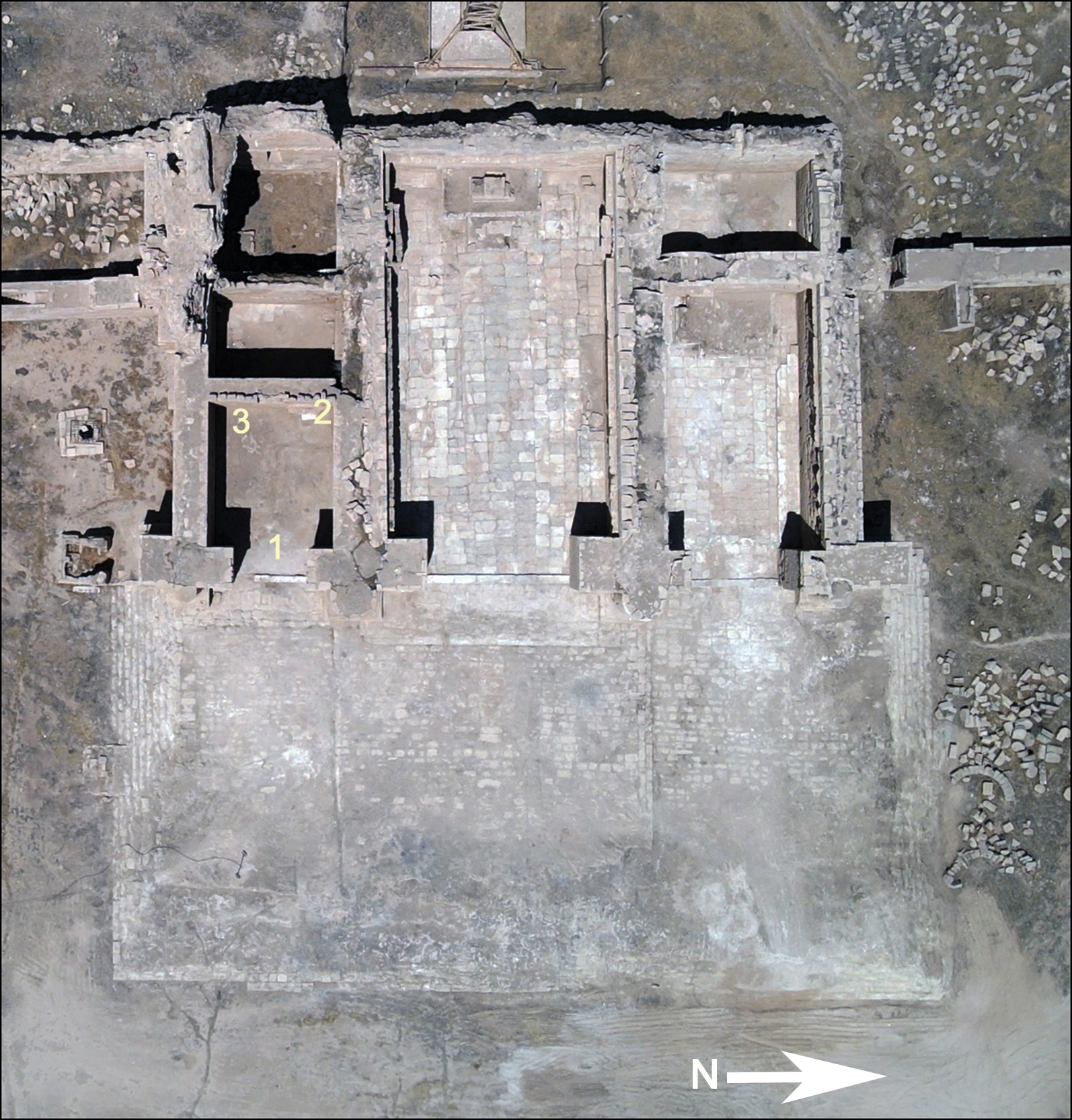
The Temple reflects the fundamental pattern of other contemporaneous urban temples—namely, three major flanked rooms or iwans, with walls separating the main monuments of the western part of the temenos (the traditional name of the stone enclosure of the inner sanctuary of Hatra) from its eastern open forecourt (Figure 2). Recent findings of the ongoing Aliph-ISMEO research project suggest that the Temple of Allat was built and modified in at least three, and possibly four, construction phases. Originally dedicated to an Arab deity, the temple was eventually modified by King Sanatruq I and his son, Crown Prince Abdsamiya, around AD 168 (Aggoula Reference Aggoula1994: 163). Their almost life-size statues and dedicatory inscriptions are still visible in the first hall of the southern iwan (Figure 2: 3). Important sculptures and friezes were recovered from the same space, two of which show the goddess Allat mounted side-saddle on dromedaries (Al Salihi Reference Al-Salihi1985, Reference Al-Salihi1998). Four high reliefs of dromedaries, the surfaces of which are now badly decayed, were placed at the sides of the entrance, one of which shows a female and a suckling calf. Kaizer (Reference Kaizer2000: 239) noted that “the apparent connection between Allât and the camel has been looked upon as supportive evidence for her «Arab» character, but it may be better to interpret the camel in more neutral terms as a «sacred animal» of the goddess.” The new focus on dromedaries in the subsequent phase of the Temple contrasts with contemporaneous sculptural decoration of the front of the central and northern iwans, which show mythological, composite sea creatures. This implies an important symbolic and perhaps cultural shift.
Aerial view of the Temple of Allat, Hatra: 1) entrance to the southern hall; 2) location of the door and lintel shown in Figures 3–5; 3) location of the statues of king Sanatruq I and his son (photograph courtesy of the Aliph-ISMEO project at Hatra).
Eight dromedaries, two hybrids
Recent inspections suggest that the southern iwan was divided, at some point, into two rooms by the present north–south wall, which bears the niche containing the royal statues and their dedicatory inscriptions. The door lintel figuration is the focus of this article (Figure 3). This depicts two rows of sitting camels, originally comprising five on each side. The camels converge towards a bearded individual wearing a crown and interpreted as a king, whose face is damaged on the left side (Dirven Reference Dirven and Alexander2020: fig. 18). While Al-Salihi (Reference Al-Salihi1998: 106) noticed that the two camels flanking the central figure were “Bactrian camels” (Figure 4), other scholars (e.g. Dirven Reference Dirven and Alexander2020: 211) have offered no further elaboration on this evidence.
Decoration of the inner door of the southern iwan, with detail of the lintel (photograph courtesy of the Aliph-ISMEO project at Hatra).
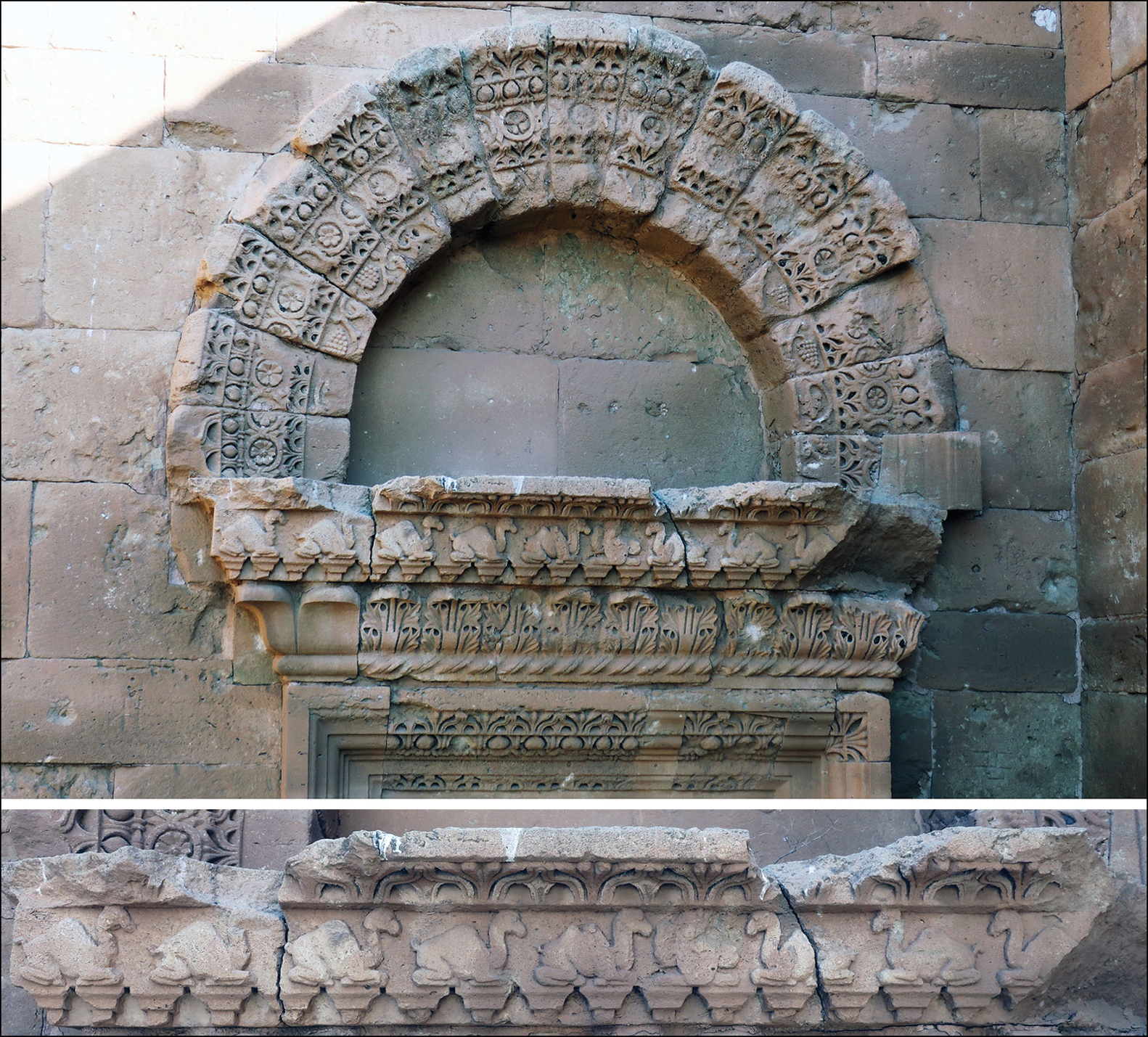
Two-humped camels flanking a royal portrait in the centre of the lintel (photograph courtesy of the Aliph-ISMEO project at Hatra).

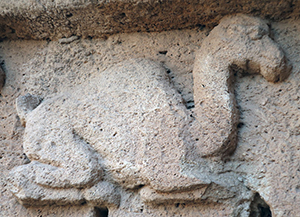
The two ‘Bactrian camels’ are well sculpted and represented somewhat realistically: both show one of the soft humps sagging and folded onto themselves—a common feature of Camelus bactrianus (Figure 5a–b). While the left camel bears continuous fur flocks along its neck and on its shoulder, the one on the right lacks the typical Bactrian body hair on the neck, forearms and head, resembling the nearby dromedaries (an example is shown in Figure 5c). Moreover, the humps of the camels in Figure 5a–b are separated by a limited indentation, which matches that of many modern hybrids (compare the striking similarity of Figure 4a to the Kazakh specimen in Figure 6).
Comparing the two-humped camels (a–b) with dromedaries (c) on the same lintel (photographs courtesy of the Aliph-ISMEO project at Hatra).

A Camelus bactrianus/dromedarius hybrid in Kazakhstan (reproduced, with permission, from Alhadrami & Faye Reference Alhadrami, Faye and Smithers2016: fig. 9).

Camel hybridisation in the ancient world was thoroughly discussed by Potts (Reference Potts2004):
While larger and stronger, hybrids resemble dromedaries in that they have one hump, although this is normally asymmetrical, often with a small indentation between 40mm and 0.12m deep. This indentation divides the rear portion of the hump, which is often 2–3 times as large as the front, from the front part. (Potts Reference Potts2004: 156)
Potts also notes the greater strength and load-bearing abilities of hybrid camels, which are able to carry 400–500kg—double that of a dromedary and more than double that of an ordinary Bactrian camel (Potts Reference Potts2004: 157). This explains the much greater commercial value of hybrids. In the vast geographic area of Middle Asia, shepherds who raised dromedaries also imported Bactrian females from Central Asia in order to breed stronger hybrids; the first direct (osteological) evidence of hybridisation appears in Roman–Parthian times (Potts Reference Potts2004: 158). The advantages of hybridisation are confirmed by recent surveys of contemporary crossbreeding schemes in Turkey and Kazakhstan, which produce
a camel breed with higher milk production capabilities than the Bactrian camel as well as the ability to survive the harsh climate of Central Asia essentially in a free-range situation … [in] hot summers and snowbound winters with severe subzero temperatures. (Dioli Reference Dioli2020: 16; for increased milk production in kazakh hybrids, see Alhadrami & Faye Reference Alhadrami, Faye and Smithers2016)
Conclusions
The Temple of Allat was one of the most impressive and elaborate cultic seats of Hatra. Set in the walls that enclosed the monumental core of the temenos, but open to the forecourt, the temple stood in open view to large groups of religious visitors and to trade caravans. It perhaps also hosted periodic central markets. Thus, the temple was also accessible to the non-resident ‘Arab’ nomadic population, who regularly and intensively interacted with Hatra (Niehoff Reference Niehoff2016). The late inclusion of Allat and her possible sacred animal—as proposed by Kaizer (Reference Kaizer2000)—was a deliberate move by Sanatruq I (if he is indeed the king represented in the lintel) to emphasise the political links of the royal house to this fundamental component of Hatrean society. At the same time, it is clear that the two converging lines of camels are led by Camelus bactrianus/dromedarius hybrids. If this is so, the king would have expressed, through the elegant images of the sculpted lintel, both his active support of the cult of the Arab goddess Allat and his personal involvement in the procurement of Bactrian camels from remote Central Asian regions. The religious imagery emphasised not only that the king had a vested interest in (perhaps even a monopoly on) the breeding of hybrid camels, but also in the management of the long-distance caravans of an ancient Silk Road that could expand the trade interests that made Hatra so rich. The camels of the king, after all, are always the best.
Acknowledgements
Our sincere thanks to all the colleagues of Iraqi SBAH who made, and continue to make, our work at Hatra possible.
Funding statement
These observations were made within the framework of First Aid Interventions to the World Heritage Site of Hatra after Daesh Occupation, a project supported by the Aliph Foundation, Geneva (Switzerland) and operated by ISMEO, Rome.


 Open access

