





Impact statement
This paper positions team formation as a critical yet under-theorised site of biodesign practice and demonstrates how structured diagnostic encounters can surface compatibility dimensions before collaboration begins. It offers the biodesign community an initial framework for navigating interdisciplinary partnerships beyond laboratory-based models.
Introduction
The field of biodesign is expanding. What began as a focus on material innovation, designing with living organisms to metabolise matter and turn it into materials and products for human use (Myers Reference Myers2012), is now broadening its ethical considerations. Living systems are engaged not only as productive agents but as entities with their own agencies, needs and relationships (Giaccardi and Redström Reference Giaccardi and Redström2020; Haraway Reference Haraway2016). Expanding towards designing for living organisms, supporting ecosystems, restoring habitats and creating conditions for non-human life to thrive, brings ecological spaces like the ocean into the designer’s field of intervention.
Ocean sustainability is fundamentally socio-ecological, and addressing its complexity requires multiple knowledge systems, disciplines and ways of knowing, a need explicitly recognised by the United Nations Decade of Ocean Science for Sustainable Development, which calls for transdisciplinary collaboration to produce the knowledge needed for ocean sustainability (Pendleton et al. Reference Pendleton, Alexandroff, Clausen, Schmidt and Browman2023; UNESCO-IOC 2021). Biodesign, a field that by nature navigates between scientific and humanistic ways of knowing, is well positioned to contribute to this agenda. Emerging work by scholars such as Weber’s (Reference Weber2024) sympoietic design for artificial reefs and Tarazi et al.’s (Reference Tarazi, Parnas, Lotan, Zoabi, Oren, Josef and Shashar2019) nature-centred design approach to coral reef restoration moves the location of design intervention out of the laboratory and into natural environments. As this shift towards in situ work grows, collaboration with field-based scientists becomes increasingly relevant.
Yet existing literature on biodesign–science collaboration has focused predominantly on laboratory-based contexts, leaving field-based marine science largely unexamined, and the conditions under which such collaborations are formed and initiated remain largely underexplored. Given the long-term commitment and significant learning investment that interdisciplinary biodesign collaboration requires (Crawford Reference Crawford2024; Pollini Reference Pollini2024; Sawa Reference Sawa2016), the possibility to assess compatibility among potential collaborators before committing these resources becomes critical.
This paper asks whether and how compatibility between prospective collaborators from different disciplines can be assessed during the formation phase of biodesign–science collaboration. Specifically, it examines what dimensions of compatibility become visible through structured encounters that informal conversations alone cannot reliably surface. In addressing these questions, the study also explores how field-based marine scientists articulate their work ecology, role expectations and imaginaries of design collaboration during the formation phase of an interdisciplinary encounter. These questions are addressed through an exploratory diagnostic workshop with nine early-career marine zoologists at the Università Politecnica delle Marche in Ancona, Italy, designed as a dedicated moment within an emerging interdisciplinary partnership to surface motivations, work ecologies and expectations before committing to deeper collaboration. Field-based marine zoology provides an instructive case study for this investigation, as it presents collaboration conditions that extend beyond the laboratory settings most discussed in existing biodesign literature, including restricted access to the research site and environmental unpredictability. The paper makes two contributions. First, it trials a structured diagnostic workshop format as a possible tool for surfacing compatibility dimensions during the formation phase, arguing that interdisciplinary compatibility is multi-dimensional, operating across epistemic expectations, role imaginaries, work-ecological constraints and capacities for mutual recognition. Second, it provides initial empirical insight into this specific research ecology – a perspective largely absent from existing biodesign collaboration literature. Together, these contributions position the formation phase as a critical yet under-theorised site of interdisciplinary biodesign practice, where early, structured assessment can provide an evidence-based basis for deciding whether the conditions for viable collaboration are present.
Literature
Interdisciplinary collaboration, the key to ocean health
Historically, the ocean has been dominated by natural science perspectives (Bennett Reference Bennett2019; Franke et al. Reference Franke, Peters, Hinkel, Hornidge, Schlüter, Zielinski, Wiltshire, Jacob, Krause and Hillebrand2022; McKinley et al. Reference McKinley, Acott and Yates2020), which reflects science’s positivist approach that privileges empirical observation and quantifiable data as the basis for rigorous knowledge claims (Stefanova Reference Stefanova and Chakrabarti2021). C.P. Snow’s “two cultures” diagnosis, which described the persistent intellectual divide between the natural sciences and the humanities, remains influential for understanding why disciplines struggle to recognise each other’s ways of knowing, resulting in practical and creative losses (Snow 1959, cited in de Melo-Martín Reference de Melo-Martín2010).
Yet ocean sustainability is fundamentally socio-ecological. Coastal communities and other stakeholders rely on and are embedded within marine systems, making the crises facing the ocean inseparable from human activity (Bennett Reference Bennett2019; Franke et al. Reference Franke, Peters, Hinkel, Hornidge, Schlüter, Zielinski, Wiltshire, Jacob, Krause and Hillebrand2022). The Ocean Decade explicitly calls for transdisciplinary collaboration (Pendleton et al. Reference Pendleton, Alexandroff, Clausen, Schmidt and Browman2023; UNESCO-IOC 2021), but implementation remains hindered by disciplinary mindsets, incentive structures and epistemological differences that complicate mutual understanding (Pendleton et al. Reference Pendleton, Alexandroff, Clausen, Schmidt and Browman2023). Design, with its tradition of bridging scientific and humanistic knowledge systems, may be particularly equipped to address these barriers. Yet this mediating potential often goes unrecognised, precisely because design is frequently mispositioned within institutional frameworks, either categorised under the arts, reduced to a communicative function, or misconceptualised as a service practice rather than a discipline of knowledge production.
Design as the third culture of knowledge
Due to this persistent mispositioning, design’s epistemic contribution is frequently misrecognised. Archer (Reference Archer1979) proposed design as a third area of knowledge, distinct from both science and the humanities, a position further elaborated by Cross (Reference Cross1982), who argued that design possesses its own things to know, ways of knowing and methods of investigation.
Despite this theoretical positioning, design is frequently conflated with the arts in research and funding contexts, particularly within “art and science” collaboration schemes such as PartArt4OW and TidalArts (PartArt4OW n.d.; TidalArts n.d.). Such framings risk overlooking the epistemic and methodological contributions of design as a distinct knowledge practice that draws on capacities associated with both arts and sciences while reducing to neither (Archer Reference Archer1979; Cross Reference Cross1982). Positioning design within the arts creates a false epistemological distance, obscuring the degree to which design shares analytical, methodological and problem-oriented capacities with scientific practice. This matters for collaboration: misunderstandings about what design is and does often precede collaboration itself, shaping role expectations and power dynamics already at the stage of initiating partnerships (Benony and Maudet Reference Benony and Maudet2020) and determining what scientists believe designers are able to contribute, at which stage of the process and with what degree of agency.
Biodesign: the bridge between design and science
Biodesign is an emerging field that brings design and biology together through integrated practice. First framed in the 2010s by scholars and practitioners such as William Myers (Reference Myers2012) and Carole Collet (2013, Reference Collet2021), it remains a relatively young discipline – one whose terminologies and boundaries continue to shift and evolve (Bandoni and Paoliello Reference Bandoni and Paoliello2025). Rather than a single method, biodesign represents a methodology with many possible approaches, connecting knowledge across disciplinary boundaries (Collet Reference Collet2021; Gough et al. Reference Gough, Pschetz, Ahmadpour, Hepburn, Cooper, Ramirez-Figueroa and Catts2021). The field encompasses a broad spectrum of practices – from mechanistic biofabrication approaches that treat organisms as productive agents, to holistic ecological approaches that emphasise relationships, agency and environmental embeddedness (Crawford Reference Crawford2022; Stefanova Reference Stefanova and Chakrabarti2021).
In the context of this paper, what matters most is a shift in approaches across that spectrum. Biodesign is moving beyond laboratory spaces towards in situ engagement with living systems and ecological restoration. Designers are no longer only cultivating organisms in controlled environments (designing with organisms), instead they are designing for organisms: ecosystems, habitats and multispecies relationships (Crawford Reference Crawford2022; Groutars et al. Reference Groutars, Kim and Karana2024; Weber Reference Weber2024). This shift draws on more-than-human and multispecies design frameworks that position non-human entities as active participants rather than passive materials (Giaccardi and Redström Reference Giaccardi and Redström2020; Haraway Reference Haraway2016). This makes collaboration with field-based scientists increasingly relevant and with that the unique collaboration conditions worth examining carefully.
Building on existing approaches, this paper positions biodesign as encompassing practices that work from, with and for nature: drawing knowledge from biological sciences, collaborating with living organisms and designing for biological diversity and ecosystem health. In the marine context, this may involve working in vitro with marine organisms such as algae to develop regenerative material innovations but also refers to interventions supporting marine ecosystem health and aquatic habitat restoration. Regardless of approach, these practices bring designers into collaboration with biologists, ecologists and other scientists, making it crucial to examine which biological sub-fields and work ecologies biodesign is actually collaborating with and which remain underrepresented in current collaboration models.
Navigating transdisciplinary collaboration in biodesign
The challenges faced by biodesign–science teams once collaborative work has begun – role asymmetry, time investment and language barriers – have received attention in the literature. The initial step of collaboration, however, remains mostly undiscussed: how do these collaborations form in the first place and how might their conditions be assessed before significant resources are committed?
Role asymmetry and power dynamics
Biodesign collaborations often exhibit asymmetric power dynamics. Across the phases of design–biology partnerships, designers successively act as visitors, apprentices, amateurs and lone makers, while biologists perform roles as guides, influencers, supervisors and librarians (Benony and Maudet Reference Benony and Maudet2020). Designers often treat biology as a material to design rather than engaging with it as a scientific discipline in its own right, while scientists frequently view designers as minor partners focused on communication or aesthetic refinement rather than steering research direction (Benony and Maudet Reference Benony and Maudet2020; Driver et al. Reference Driver, Peralta and Moultrie2011; Sawa Reference Sawa2016). Such misrecognition can result in one discipline being “tokenised,” creating a one-sided collaboration where interdisciplinary potential remains unrealised (Benony and Maudet Reference Benony and Maudet2020; Reich and Reich Reference Reich and Reich2006). Beyond being only a collaboration challenge, asymmetry is also a formation-phase problem. If role expectations are misaligned before collaboration begins, partners may commit to working together based on incompatible assumptions about each other’s roles and contributions.
Time investment and learning curve
Effective biodesign collaboration requires considerable time investment. Designers with pure design backgrounds need a lengthy period to absorb scientific information before participating productively (Pollini Reference Pollini2024). Crawford (Reference Crawford2024) emphasises that effective uptake of methods requires longer periods of immersion, while Sawa (Reference Sawa2016) notes that building mutual confidence requires tenacity, particularly when interdisciplinary outcomes do not fit neatly into collaborators’ fields. The stakes of entering a poorly matched collaboration are therefore not abstract – they are measured in months.
Language, translation and mutual understanding
The lack of shared language poses significant barriers to biodesign collaboration. Communication difficulties arise not only from specialist jargon but also from shared terminology carrying different meanings in different contexts (Agapakis Reference Agapakis2014; Välk et al. Reference Välk, Chen, Dieckmann and Mougenot2023). Yet the relationship between language and collaboration is paradoxical: misunderstandings can also generate productive tension and creative dialogue (Maudet et al. Reference Maudet, Asada and Pennington2020), but only when they surface at a moment in the process where they can be useful rather than destructive.
The lab-based bias in biodesign literature
Notably, existing biodesign collaboration literature focuses predominantly on lab-based contexts, a bias with significant consequences for fields where knowledge production happens elsewhere. In the settings most discussed in the literature, designers enter scientific laboratories to engage in hands-on experimental work (Benony and Maudet Reference Benony and Maudet2020; Pollini 2024; Sawa Reference Sawa2016; Stefanova Reference Stefanova and Chakrabarti2021), where shared material practice and boundary objects, specimens, equipment, experimental protocols, provide common ground for collaboration (Groth et al. Reference Groth, Pevere, Kääriäinen and Niinimäki2019; Välk et al. Reference Välk, Chen, Dieckmann and Mougenot2023).
Field-based biological research presents fundamentally different conditions: knowledge centres on organisms’ behaviour in natural environments instead of controlled conditions. The primary site of knowledge production is not easily shareable with designers – and in field-based marine contexts, accessing it requires months of specialised preparation, from diving certification to understanding safety protocols, creating a structural barrier that has no equivalent in laboratory collaboration. This gap is particularly relevant for marine biodesign, where in situ engagement with organisms and ecosystems is increasingly central to practice, yet the specific collaboration conditions this requires remain largely unexamined.
Start-ups and design studios such as Reef Design Lab (Reef Design Lab n.d.), Resting Reef (Resting Reef, n.d.) and Reefcircular (Reefcircular n.d.) are exemplary of designers entering the marine ecosystem context, alongside a small body of academic work produced in this space (Tarazi et al. Reference Tarazi, Parnas, Lotan, Zoabi, Oren, Josef and Shashar2019; Weber Reference Weber2024), highlighting that the field is forming faster than it is being theorised. As marine restoration increasingly involves designing habitats, ecosystems and the conditions for non-human life to thrive, it intersects with capacities that design as a discipline already brings to comparable challenges on land. The implications extend beyond marine biodesign: as the discipline more broadly turns towards in situ practice, the conditions under which designers can collaborate with field-based scientists will shape what biodesign becomes.
The understudied formation phase
These documented challenges – asymmetric power dynamics, time investment, communication barriers and lab-based models – all point to a critical gap: while existing literature examines established collaborations and the roles that emerge within them, less attention has been paid to how these collaborations are initiated in the first place (Maudet et al. Reference Maudet, Asada and Pennington2020).
The formation of transdisciplinary teams is itself a wicked problem (Norris et al. Reference Norris, O’Rourke, Mayer and Halvorsen2016), characterised by difficulty selecting appropriate participants, absence of clear stopping rules and the reality that each team constellation represents a unique configuration shaping research outcomes. Norris et al. (Reference Norris, O’Rourke, Mayer and Halvorsen2016) note that the less experience team members have crossing disciplinary boundaries, the more challenging it becomes to agree on how to proceed, particularly relevant for early-career researchers with limited interdisciplinary backgrounds.
In this paper, compatibility is understood not as interpersonal affinity alone, but as the alignment of cognitive orientations, work practices, structural conditions and role expectations that together shape the feasibility of interdisciplinary collaboration. This gap is addressed by trialling a structured diagnostic workshop format designed to surface compatibility signals before collaboration begins.
Methodology
To explore the formation-phase conditions for viable biodesign–science collaboration, this study conducted an exploratory diagnostic workshop with early-career marine researchers, designed as a low-threshold diagnostic encounter to surface compatibility signals before collaboration begins.
Research context and participants
This workshop took place as an early encounter within a long-term collaboration between the first author and the marine zoology research group at Università Politecnica delle Marche, conducted as part of the first author’s doctoral thesis investigation. The design researcher had prior contact with the supervising professor of the research group taking part in the workshop. However, this was the first engagement with the early-career researchers of the marine zoology group. The workshop therefore took place at a genuine moment of interdisciplinary group formation, with a collaboration that had been discussed in principle, while the workshop served to move it into practice.
In November 2025, nine early-career marine researchers participated, recruited through prior conversations with their supervising professor. The group consisted of seven women and two men, all affiliated with the same zoology research group. Participants were either current doctoral candidates or graduates from the PhD in the past couple of years. The workshop facilitator was the only designer present. This decision aligned with the study’s diagnostic focus, seeking to access the scientists’ assumptions, role expectations and imaginaries of design as they exist at the threshold of interdisciplinary contact, before collaboration has had the chance to reshape them. All participants provided informed consent for participation and data use. Individual responses are anonymised in this paper.
Researcher positioning
In the workshop facilitation, I took on the role of design researcher with actively rooted biodesign practice. Throughout the workshop, I maintained a reflexive analytical stance (Finlay Reference Finlay2002), critically reflecting on my own assumptions, expectations and reactions as potential data points alongside participants’ written responses and verbal discussions. The marine science participants were broadly informed about the objectives of the workshop as well as about the general interest of my thesis into collaboration potential between marine science and design, however, they were not familiar with the precise research questions about the initial phase of building an interdisciplinary team and its challenges, allowing for more organic responses while maintaining research transparency.
Workshop structure and material
The workshop spanned over the course of two days. Day 1 was a 45-minute presentation in which the first author presented the theoretical grounding of the biodesign and Material Driven Design method (Karana et al. Reference Karana, Barati, Rognoli and Zeeuw van der Laan2015), illustrating this through examples of the first author’s own marine-focused biodesign projects working with micro and macroalgae in material and food innovation. The presentation focused specifically on projects that took place in collaboration with scientific partners such as biopolymer scientists and aquaculture specialists, to establish concrete reference points for what biodesign practice can engage with and how it can effectively integrate designerly ways of knowing into scientific ecosystems of practice. The workshop was not intended to capture pure pre-collaboration assumptions, but to observe how compatibility signals emerge during an initial structured encounter in which disciplinary framings are already being negotiated.
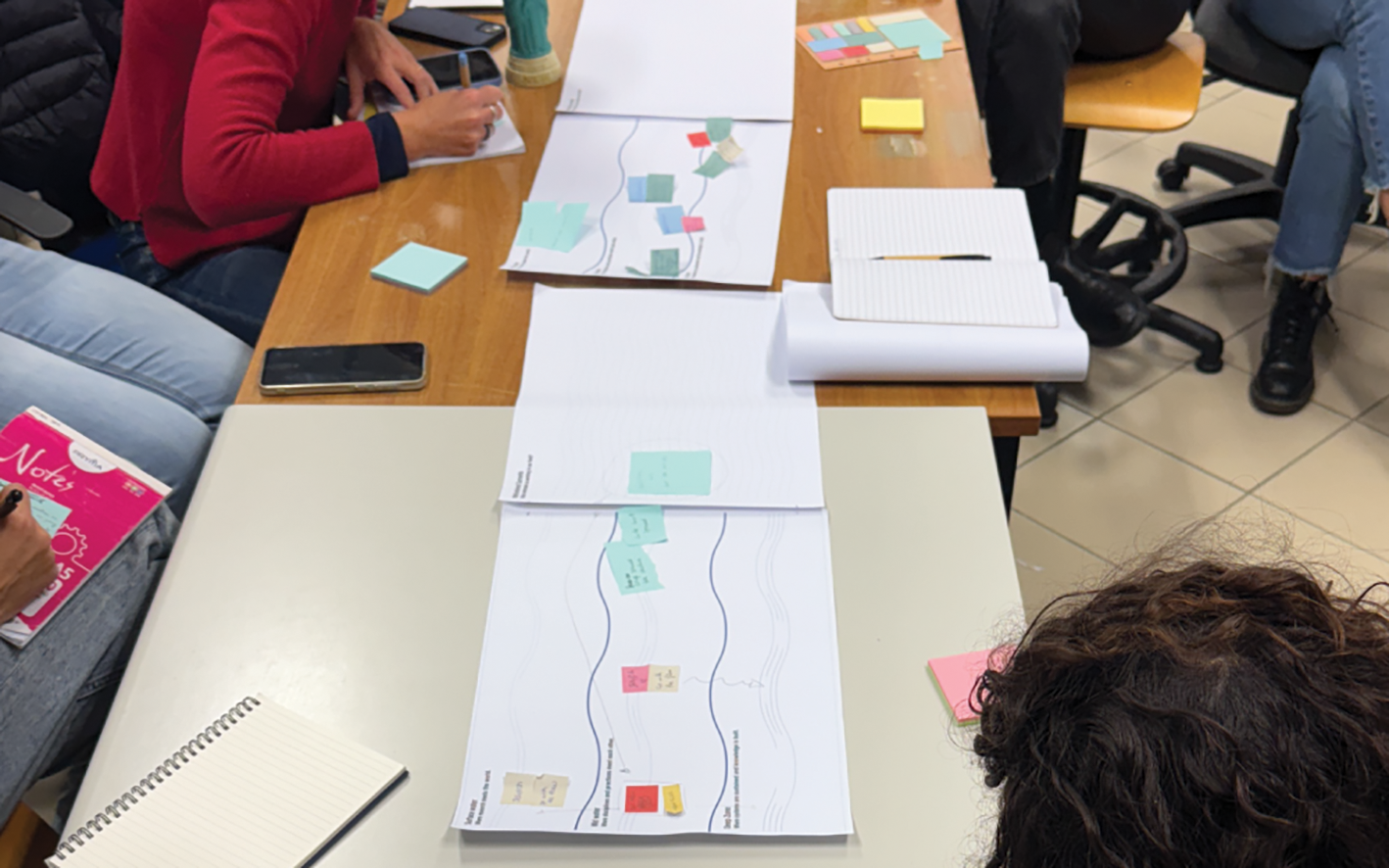
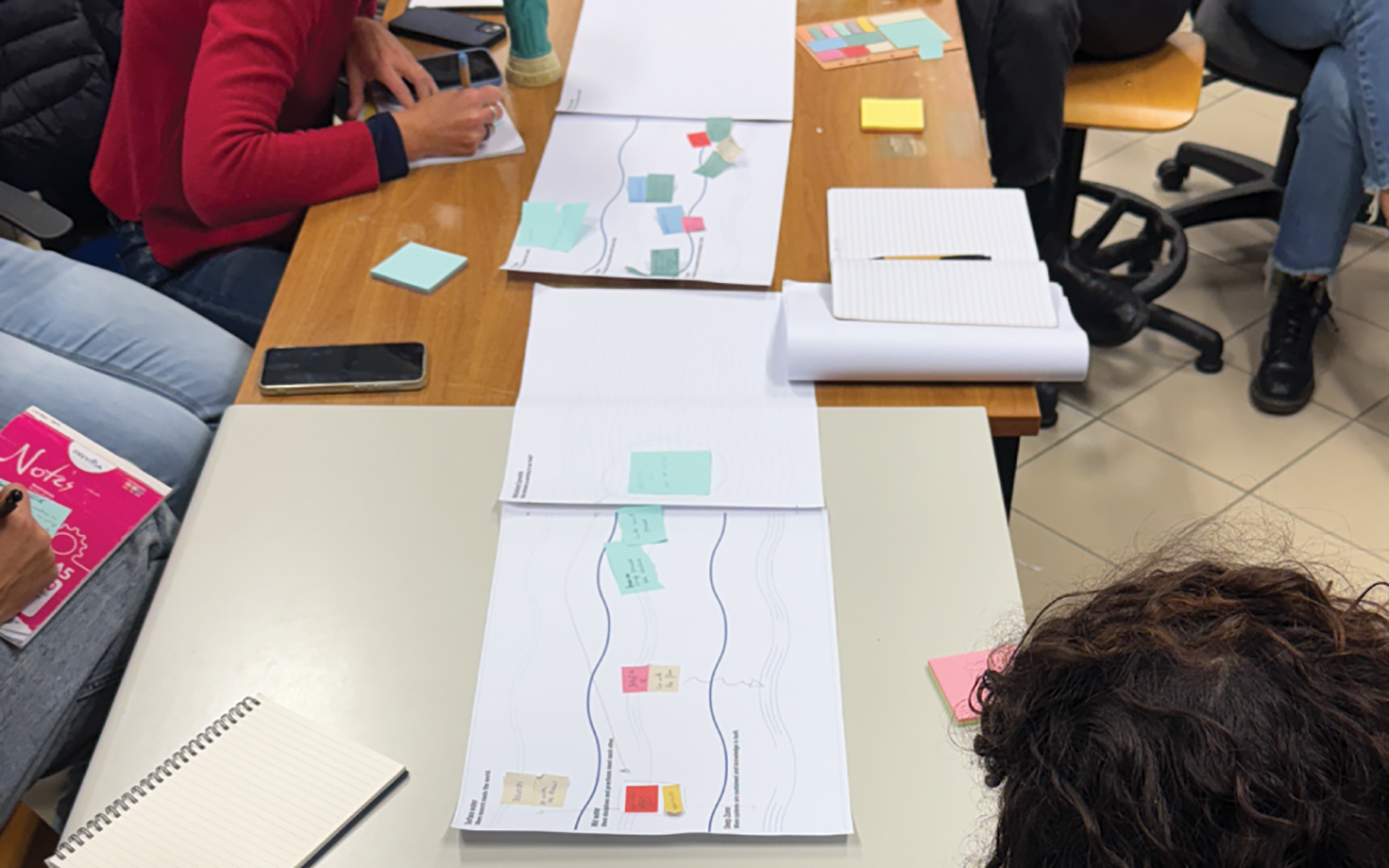
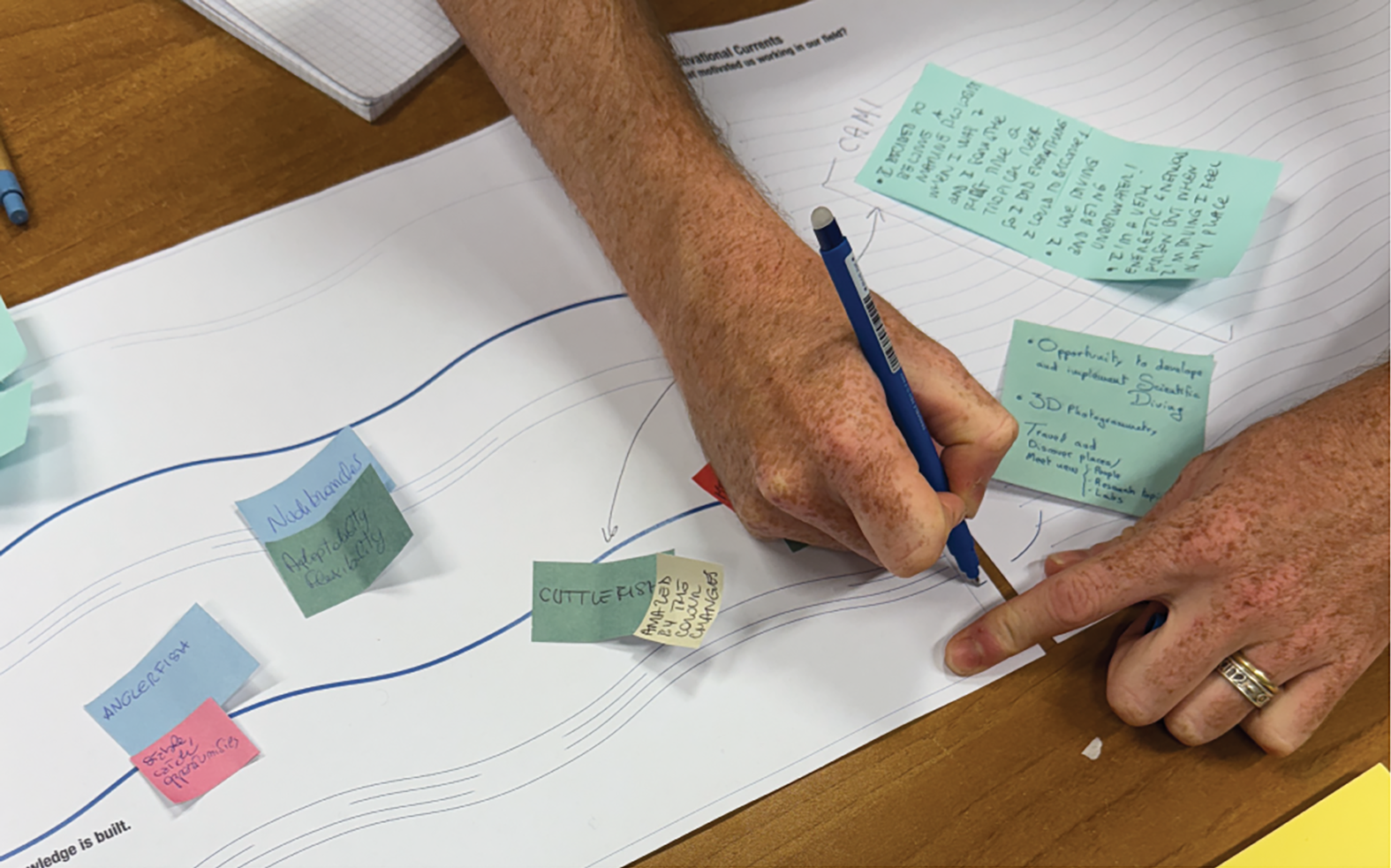
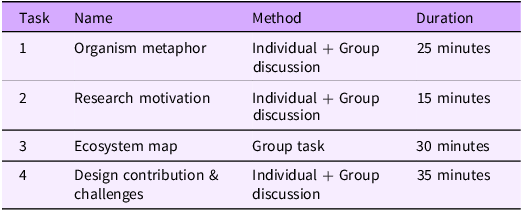
On the following day, we conducted the approximately 2-hour workshop in the research laboratory of the Department of Life and Environmental Sciences (DiSVA) at Università Politecnica delle Marche (Figures 1 and 2). The workshop was structured around four tasks using visual templates and collaborative materials designed specifically for this study, consistent with participatory design approaches that use visual scaffolds to support dialogue (Sanders and Stappers Reference Sanders and Stappers2008). Rather than functioning as a generic participatory or co-design method, however, the workshop was designed as a diagnostic instrument: its purpose was not primarily to generate ideas or foster engagement, but to surface latent assumptions, role expectations, structural constraints and epistemic orientations before collaboration begins.
Participants working collaboratively around workshop templates.
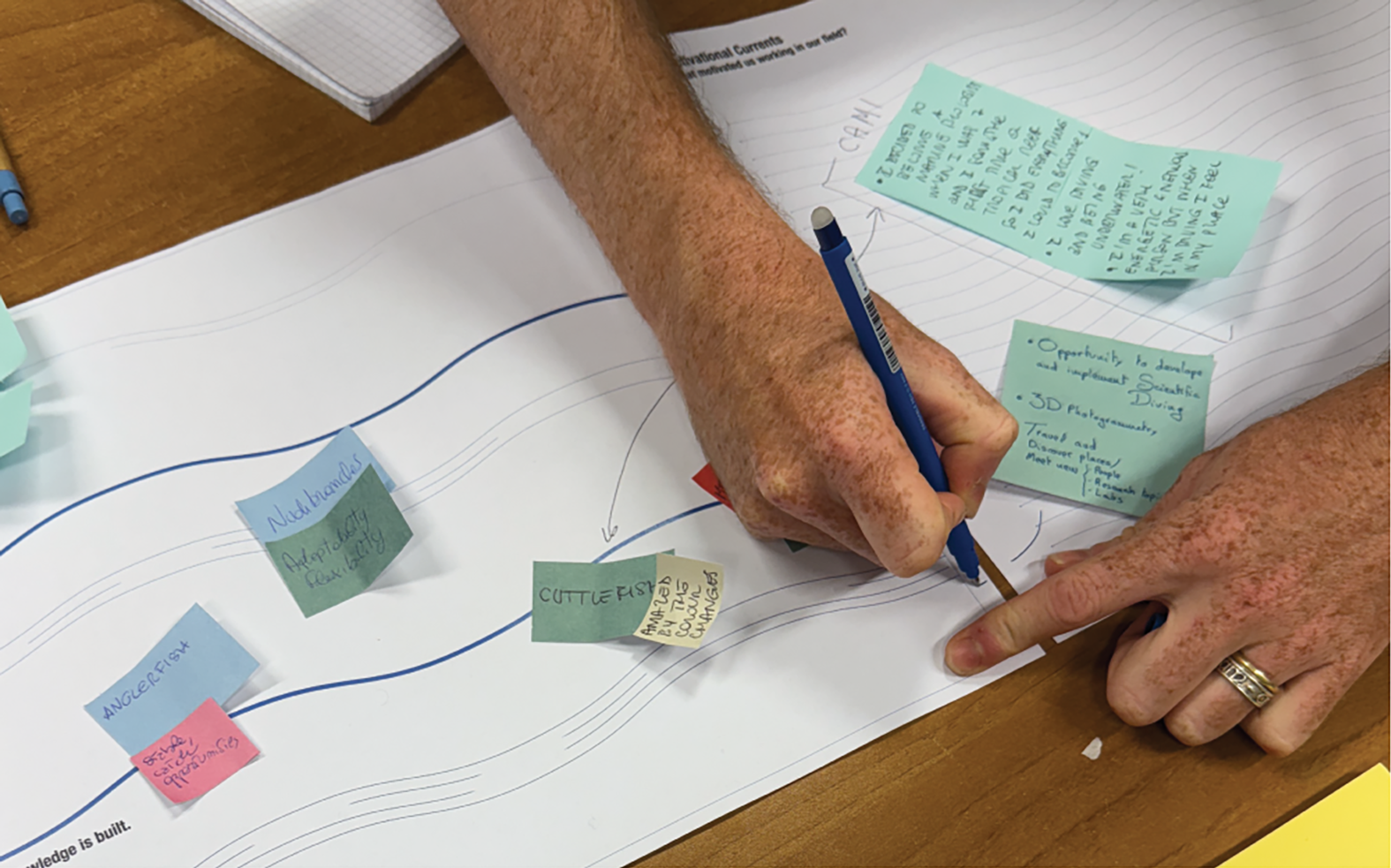
Participant placing motivations on the ocean depth zone template during Task 2.
Task 1
Organism Metaphor – Participants were asked: “If your role or work in marine research were an ocean organism, which one would it be, and why?” Participants individually selected one organism, coupled with one distinctive character triad of the chosen organism and positioned it across three ocean depth zones representing different aspects of research work: surface (where research meets the world), mid-water (where disciplines meet) and deep zone (where systems are sustained). This visual metaphor enabled participants to position themselves within the marine research ecosystem while establishing a metaphorical mode of engagement. Each participant shared their choice and reasoning with the group.
Task 2
Research Motivation Mapping – Building on Task 1, participants wrote personal or institutional motivations for their career path on post-its and placed them in a “currents” space, drawing connection lines to their organism position from the previous task, creating a visual network of identity and motivations. Participants shared and discussed their motivations with one another. Together, tasks 1 and 2 took around 40 minutes to complete, with the discussion phases occupying most of the time.
Task 3
Collaborative Ecosystem Mapping – This task aimed to visualise how collaboration happens in participants’ research ecosystem. The template presented nested categories: centre (project name), first ring (human collaborators), second ring (non-human and material agents, organisms, tools, technologies) and third ring (contextual spaces and institutions enabling or constraining collaboration). Participants collaboratively mapped a shared project, and during the working phase itself added an additional self-named category, “Barriers,” for elements that did not fit the existing structure.
Task 4
Design Contribution and Challenges – Participants received a template divided into two columns: “What designers could bring” and “What design might misunderstand.” Working initially individually, then sharing collectively, participants wrote keywords in each column, followed by group discussion to elaborate on meanings and reasoning behind their responses. This task aimed to directly surface their expectations of design collaboration and anticipated barriers. Approximately 30 minutes were allocated to this task.
Data collection
The first author collected data through three methods: field notes capturing verbal responses, expressions of hesitation or enthusiasm, group dynamics and body language; photographs of all visual outputs produced on the researcher-designed templates, including post-its, the ecosystem map and design contribution lists; and retrospective analysis written immediately after the workshop while observations remained fresh. The workshop content and setting guided the decision to choose photographs, field notes and retrospective analysis over audio recording. Conversations addressed personal motivations, professional positioning and disciplinary stereotypes, where the informal atmosphere of the workshop encouraged more open responses than a recorded interview setting would likely allow. Because the workshop relied heavily on visual mapping, spatial positioning and collaborative interaction around templates, audio recording alone would have captured only part of the interactional dynamics relevant to the analysis. The written and visual outputs produced by participants during the workshop provided a direct record of participants’ responses, in their own words, while the combination of participant-generated materials, observational field notes and reflexive analysis enabled triangulation across multiple forms of data rather than relying solely on retrospective interpretation.
Data analysis
Analysis followed a reflexive thematic approach, treating three types of data as equally valid sources of insight: participant data (what scientists said and wrote during the workshop), observational data (how they engaged with tasks, patterns of silence, enthusiasm or discomfort) and reflexive data (the first author’s own surprise, assumptions revealed through the encounter, moments where the first author’s expectations were challenged), consistent with qualitative triangulation across multiple forms of evidence (Flick Reference Flick2018).
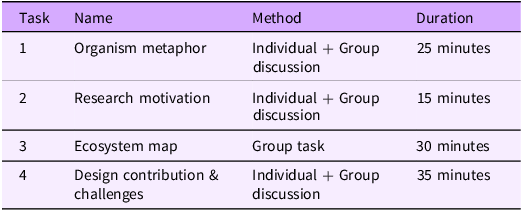
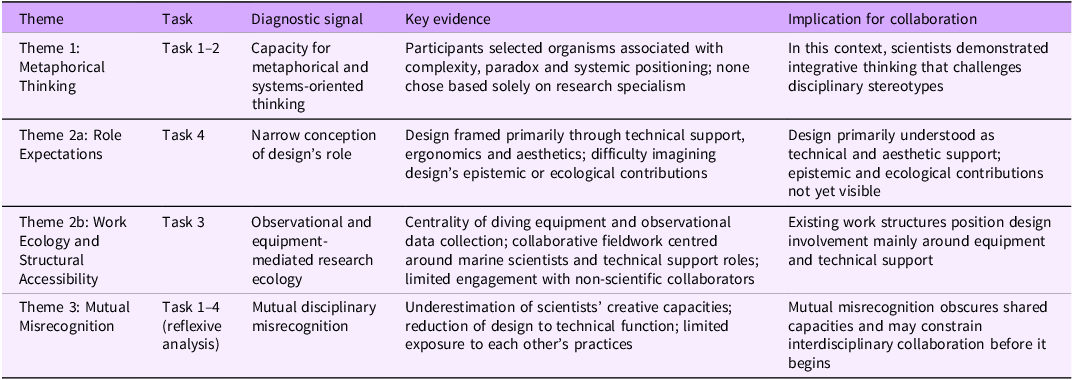
The first author analysed the collected data using inductive thematic analysis (Braun and Clarke Reference Braun and Clarke2006). The data were coded by identifying patterns and recurring themes across participant responses, with particular attention to moments of dissonance, where controversy appeared and expectations were challenged. The themes emerged through interactive analysis, not predefined categories. From this analysis, four main themes emerged: scientists’ capacity for metaphorical thinking (Task 1), narrow equipment-focused design expectations (Task 4), how field-based work ecology contextualises these expectations (Task 3) and mutual disciplinary stereotyping (reflexive analysis across tasks) (Table 1).
Overview of workshop tasks and duration
Findings & analysis
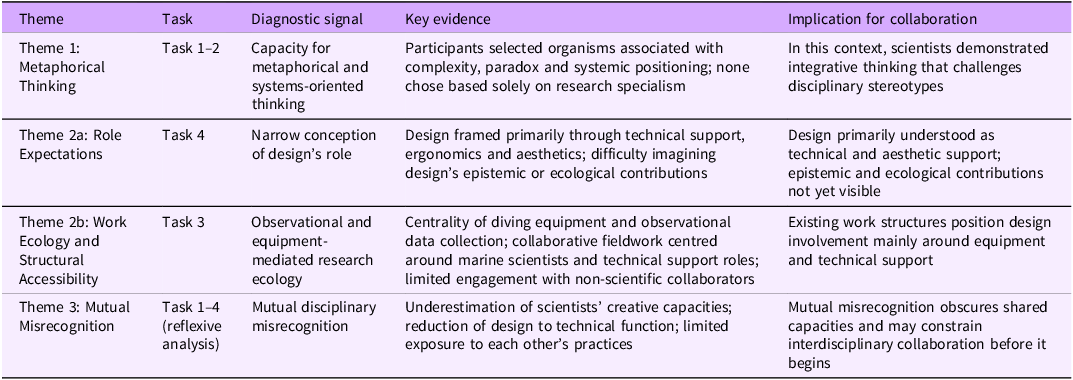
The workshop surfaced four dimensions of formation-phase compatibility. Taken together, they suggest that compatibility cannot be assessed through disciplinary labels alone; it operates across cognitive capacities, role expectations, work ecologies and mutual recognition simultaneously.
Theme 1: metaphorical thinking
Tasks 1 and 2 brought up the first compatibility dimension of cognitive capacities by asking participants to engage metaphorically with their professional identity.
When participants were asked to associate their professional role in the marine science ecosystem with an underwater organism, this task appeared difficult for many of the early-career researchers, consistent with the first author’s expectations. Most of them justified this by explaining they had never thought in this way before, both in terms of metaphorical thinking itself and in relation to associating themselves with an underwater organism. After a brief confirmation from the workshop facilitator (the first author) that the choice of organism could be made intuitively and that there were no right or wrong answers, with the aim of overcoming initial uncertainty, the first metaphors were put to paper. Shortly after, those who were still more hesitant followed.
The organism choices revealed that participants deliberately selected organisms embodying complexity, controversy and paradox. None of the scientists chose an organism exclusively based on their research field. Instead, they selected organisms whose characteristics enabled them to articulate professional positioning, personal qualities and systemic dynamics simultaneously. Three overlapping dimensions emerged repeatedly: duality and contradiction (organisms with opposing properties), positional dynamics (visibility, recognition, hierarchy) and transitional states (formation, becoming, movement between domains).
The jellyfish was selected for its material composition – it consists of approximately 2 per cent protein, the rest of its body being water. Almost entirely lacking substance and simultaneously at the mercy of currents, it floats and “goes with the flow” wherever the current takes it. This flowing quality coupled with its fragile appearance makes the jellyfish seem constantly adaptive, mirroring the position of several young scientists who let themselves be guided by new currents and possibilities. Yet despite its vulnerable appearance, the jellyfish always maintains its morphological stability and integrity and has developed stinging cells that serve as a self-defence mechanism. This paradox – material vulnerability coupled with defensive capacity; ancient integrity paired with spatial adaptability – becomes a multi-dimensional metaphor.
The basket star, Gorgonocephalus eucnemis, represents another such metaphor. Living in the twilight zone, where sunlight only partially reaches, the participant explained that the basket star lives hidden in shadow and therefore appears rather shy, “but once the basket star feels safe and comfortable, shows its beauty.” This dualism of shy yet radiant integrates personal traits with conditional visibility and professional position. As the participant explained, he likes to work at the intersection of deep science and community engagement.
One participant used filter-feeders to represent the positioning of early-career researchers: fundamental to the academic system, yet mostly invisible, just like filter-feeders, without whom the ocean ecosystem would collapse. These metaphors provide insights into the relationship between contribution and recognition, suggesting that capacity and visibility function independently of one another: one can be fundamental yet invisible, capable yet unnoticed.
Workshop participants deliberately chose organisms capable of carrying multiple, sometimes contradictory meanings simultaneously, integrating professional identity with personal temperament. The organisms embodied paradoxes, conditional and relational connections. Contrary to the stereotype that scientists prioritise analytical and logical thinking over intuitive and emotional approaches, participants proved thoroughly capable of metaphorical thinking. The early-career marine biologists demonstrated integrative, systems-oriented thinking that refused to separate professional role from personal temperament or career stage from relational positioning. As a diagnostic signal, this provides evidence that in this specific research ecology, the capacity for integrative thinking may be higher than disciplinary stereotypes would predict.
Theme 2a: role expectations – what scientists think design is
Task 4 surfaced role expectations as the second compatibility dimension, by asking participants where they see designers contributing and where they anticipate challenges.
Participants were asked to share their ideas and thoughts on where they see designers contributing to marine biology and where they anticipate potential challenges in collaboration. After an initial silence of a few minutes, participants began to share their ideas. The resulting proposals revealed a very narrow conception of designers’ potential. Before concrete scenarios were articulated in which designers could positively contribute, fundamental scepticism was expressed that revealed underlying assumptions about the relationship between designers and marine ecosystems.
One participant reflected on a past encounter with two product design students who had asked for scientific help with their project. He explained that the students had exciting ideas but were unable to understand the real underwater conditions and thus did not adequately consider the material performance requirements in their design, making the project unrealistic. Underwater equipment has several important material requirements – durability, while simultaneously being lightweight and efficient. According to him, the design students lacked connection and depth of purpose, which is why they were unable to develop holistic considerations for performance in aquatic spaces. This anecdote led to broader agreement that there is a “lack of connection” between design and marine biology. Many participants felt that it can be difficult for designers to grasp the complexity of marine biological topics and to understand the interplay of many relevant components in their research and fieldwork.
These concerns became the starting point of the discussion about where designers could do valuable work, and one of the reasons designers were primarily assigned technical tasks. The implied argument seems to be that without deep marine system knowledge, designers might be better suited to hands-on problem solving where biological knowledge is less central: ergonomic development of existing equipment, improving visual appearance or giving new tools a final polish once they have been proven technically sound.
In most cases, participants expressed ideas about how design could improve their technical equipment, for example through ergonomic refinement of the form, size and aesthetics of diving equipment such as cameras, sampling equipment and data collection devices, thereby improving the convenience of the diving experience. Several participants saw equipment redesign as a constructive task for designers, noting that satellite transmitters attached to marine animals could be made less invasive through changes in volume, weight and complexity. Others suggested designers could improve self-built autonomous instruments for data collection. One participant, who was developing a water filtering device for sample collection, explained she was currently in the technical validation phase but envisioned future collaboration with a designer to make the device “more efficient and especially more attractive.” Another idea discussed was integrating biologically informed design into tools, for instance, developing devices that mimic “nature-based entities” or supporting the development of environmental enrichment devices (EEDs).
Besides technical contributions, design as an aesthetic and communication practice also came up. Design was seen as a potential mediator between science and broader society, with ideas emerging around how designers could help with “marketing” or open up possibilities for new types of funding. Notably absent were any design framings that presuppose ecological or biological knowledge – even methodologies that already exist within design such as ecodesign, regenerative design and biodesign seemed almost unimaginable to participants, despite the previous day’s presentation introducing these approaches through marine-focused examples.
Design remained, until the end, tied to human-centred approaches, physical objects and the functional and aesthetic improvement of their properties. As a diagnostic signal, this points to a significant role expectation mismatch: scientists framed design as technical service rather than as an epistemological contribution, adding another layer of complexity to the challenge at the formation phase.
Theme 2b: work ecology and structural accessibility
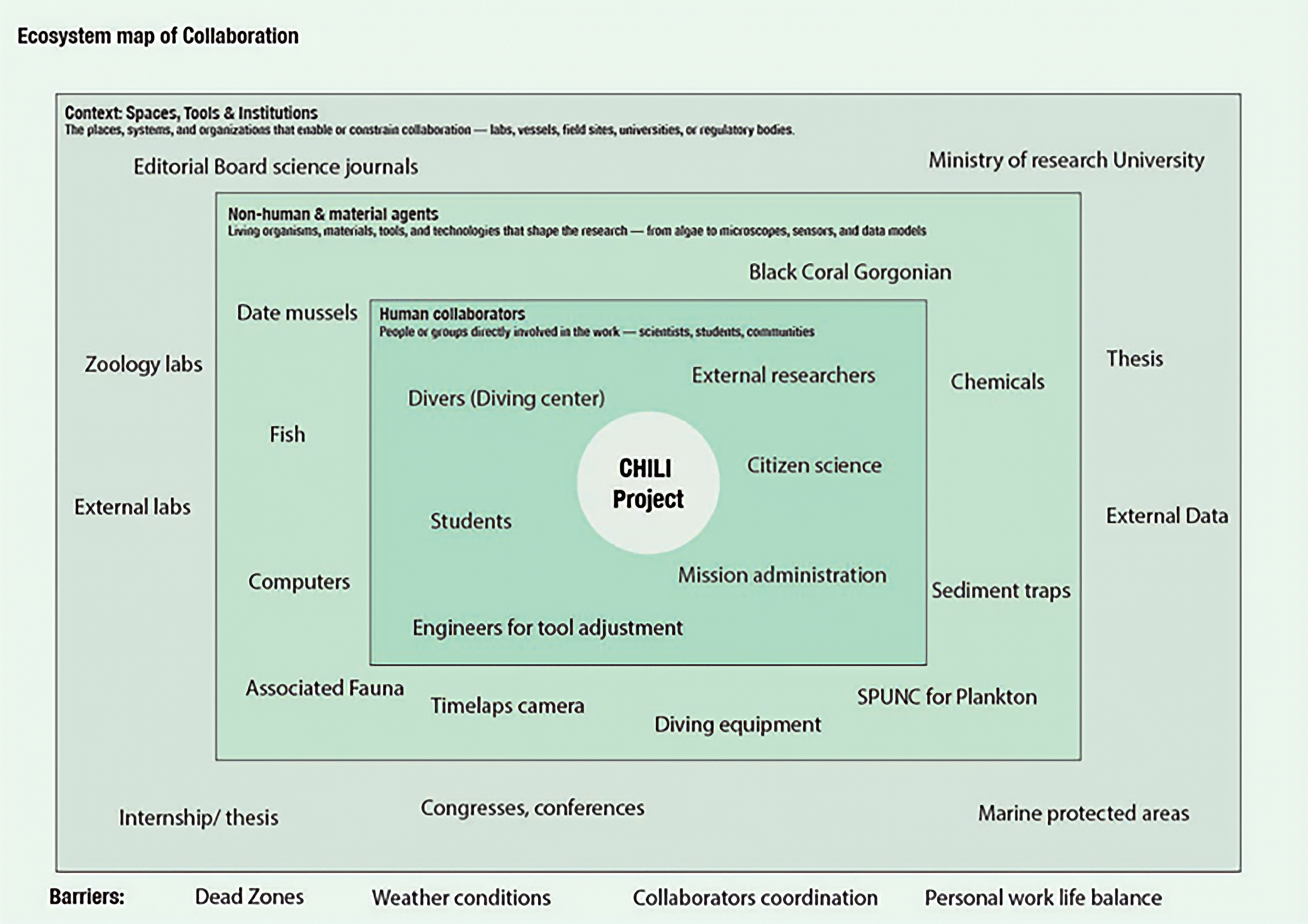
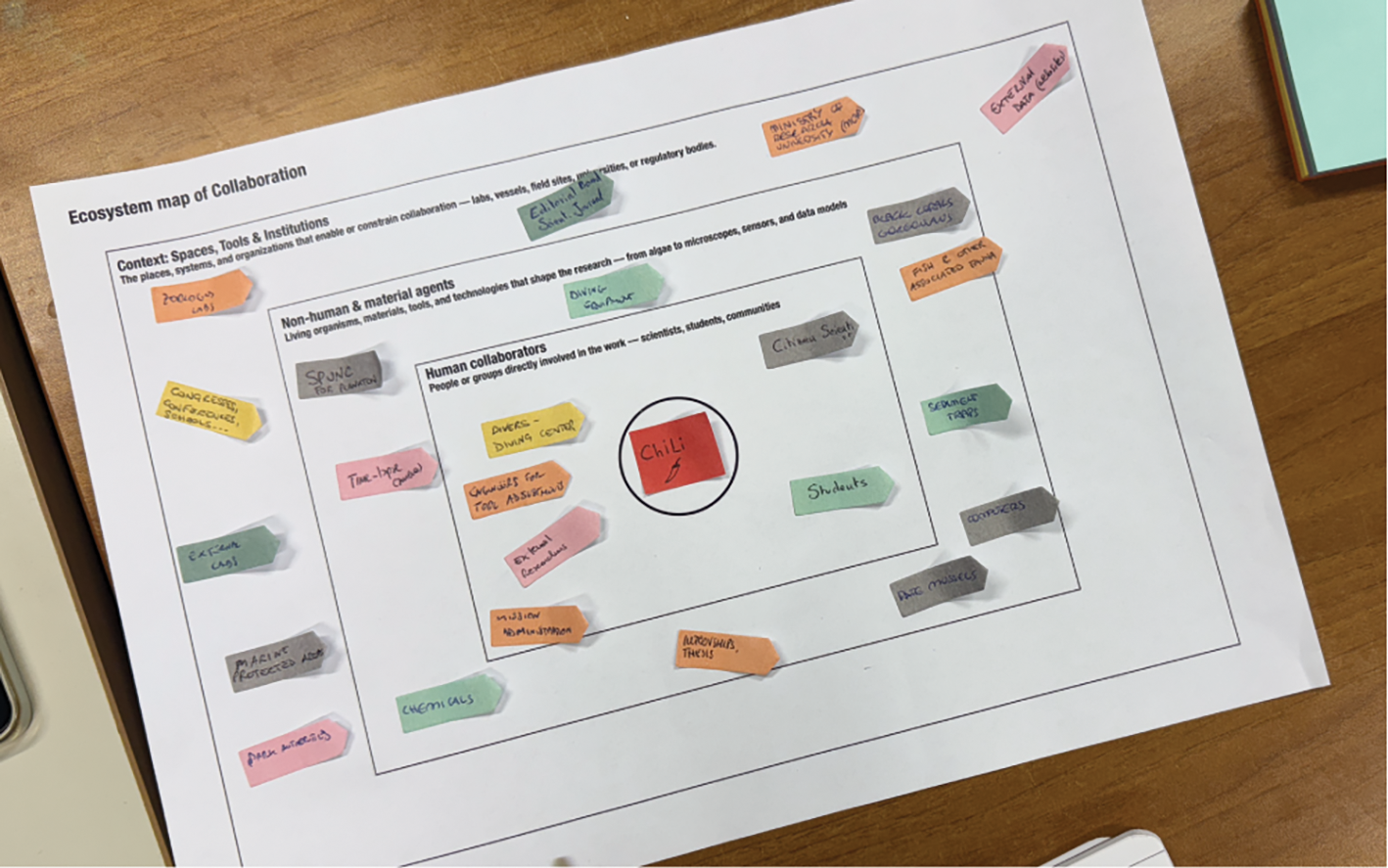
Task 3 surfaced the third compatibility dimension, work ecology and structural accessibility, through collaborative ecosystem mapping, and helped contextualise the narrow role expectations revealed in Theme 2a. The tendency observed above, where scientists associate designers primarily with constructing and improving equipment, becomes more understandable when their way of working is better understood. The task of analysing the ecosystem of one of their projects helped contextualise why this equipment-based thinking is so present. Instead of working in groups or individually on this ecosystem map associated with a specific project as originally intended, the group collectively decided to use the “CHILI” project as a case study (Figures 3 and 4).
Ecosystem map of the CHILI project, reconstructed from participant outputs during Task 3. Items are distributed across three concentric rings representing degrees of proximity to the research: human collaborators (inner), non-human and material agents (middle) and contextual spaces and institutions (outer). The Barriers category (bottom) was self-generated by participants outside the original template.
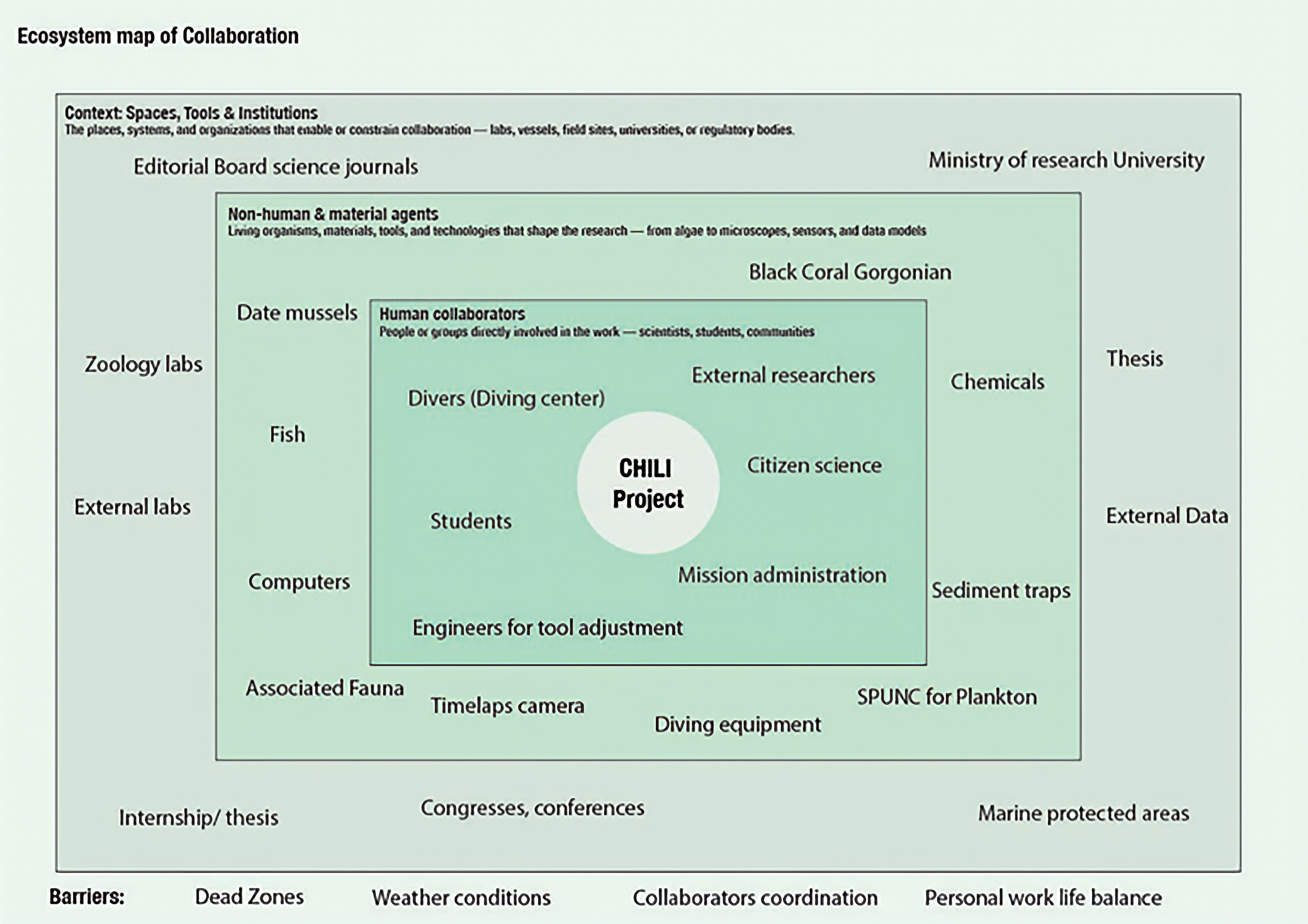
Original ecosystem map of the CHILI project produced collaboratively during Task 3.
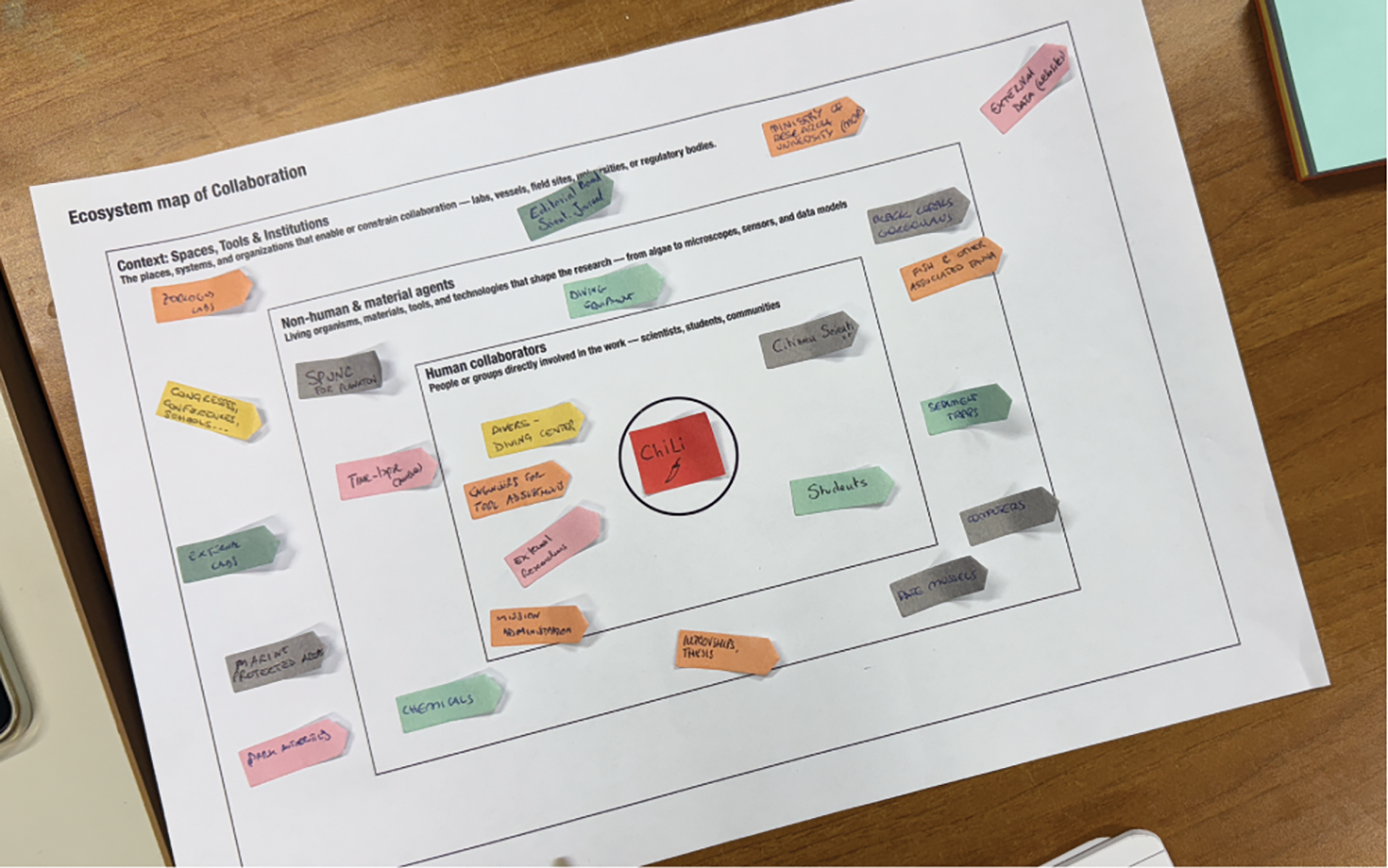
The project has the research goal of studying behaviour and predator-prey dynamics through field observation and data collection. This decision to analyse a shared case study instead of splitting into small groups already provided an important insight: many of the research endeavours do not take place as individual work but are characterised by collective effort. This has perhaps to do with the environment in which the research group operates, which is very strongly based on underwater fieldwork. For this work environment, they work in buddy systems, not least for health and safety reasons. Additionally, equipment operation often requires the coordination of multiple divers.
Participants organised their ecosystem map based on the template of three concentric squares, later adding a self-generated “barriers” category. The inner square represents the closest degree of cooperation: external researchers, mission administration, students, dive coordinators and “engineers for tool adjustment.” The second level records non-human and material agents central to the research project: time-lapse cameras, chemicals, computers, sediment traps, fish and associated fauna, black corals, gorgonians and diving equipment. The outer ring contains contextual infrastructures including zoological laboratories, conferences, external laboratories, marine protected areas, external data sources, the ministry of research, university structures and editorial boards. In the self-designated barriers category, participants named weather conditions reducing diving visibility, formal approval requirements, coordination of collaborators, dead zones underwater and the challenge of maintaining work–life balance.
What crystallises from both the visual map and the conversations conducted around it is the fact that equipment plays a central role and has a daily presence in the work on the CHILI project, but also in the larger work context. The observation of underwater organisms – in this case zooplankton, corals and algae – is at the centre of the research method, and it is less about manipulating or intervening. The work of the marine biologists involves repeated diving with specialised equipment, the development and use of sampling instruments such as sediment traps and data collection devices. They install and operate time-lapse cameras to better observe the behaviour of corals and their prey and subsequently extract datasets from sensors. The ecosystem map revealed above all an observational relationship with marine organisms: filming, sampling, documenting, rather than cultivating or intervening.
The equipment-focused expectations from Theme 2a become contextually rational when viewed within this work ecology. Despite the fact that the marine biologists internally rely on deep cooperative work, the external network appears limited to other marine biologists, external diving personnel and engineers responsible for equipment. Non-technical, non-natural-science-based actors are absent. When workshop participants suggested designers could improve EEDs or revise self-made equipment, they were responding from within their direct work reality. Design, in this ecology, has no established place yet, which makes the question of where and how it might enter all the more pressing.
Theme 3: mutual stereotyping and misrecognition
The fourth dimension of compatibility, mutual recognition, emerged from reflexive analysis across all themes. The workshop brought forth a paradox that cuts across the three previous ones: the marine biologists demonstrated a high degree of metaphorical and systemic thinking in their choice of organism. Nevertheless, they viewed the role of design in a very reduced way, breaking it down to the technical and aesthetic improvement of equipment when asked where they see engagement with design as beneficial. This points to bilateral stereotyping on two levels: on the one hand, the assumption about what each discipline is, and on the other hand, the assumption about what capacity the respective other discipline possesses.
I developed the workshop with an assumption about natural scientific thinking that proved to be inaccurate. The task of choosing a metaphorical marine organism was originally planned as an icebreaker, with the goal of introducing participants to a qualitative way of thinking corresponding to the arts and humanities way of working. My fear at the beginning of the workshop – that this task might be too abstract and “unscientific” – already reflects an underlying stereotype: that scientists from the natural sciences prefer logical, analytical thinking and that intuitive, emotion-informed thinking could trigger resistance. However, the results refuted this assumption. Participants engaged quickly with the task and chose organisms capable of embodying complex and even paradoxical metaphors, consistently integrating professional identity and personal temperament while resisting categorical thinking. My surprise at the results exposed my own stereotyping: I had underestimated the marine biologists in their capacity for creative and integrative thinking.
On the other hand, the framing of design contribution revealed a similarly narrow assumption from the scientists’ side. Design was positioned almost exclusively as a service practice focused on the optimisation and development of physical objects. The roles assigned to design require general technical skills but little explicit knowledge about marine systems. This assumption became even more explicit when participants communicated their concern that designers, as externals, bring a deficit of knowledge and understanding of the sea – suggesting the designer as better positioned when tied to technical problems rather than as part of the knowledge-generation team. Despite the presentation the day before introducing biodesign, material-driven design and the work of designers with living systems in the ocean, participants demonstrated difficulty going beyond the purely object-based design process.
Both stereotypes obscure what the workshop revealed: participants possess the capacity for integrative and reflexive thinking. In the moment of the workshop, neither side was able to recognise this shared capacity. The scientists viewed design as a technical service requiring marine biological knowledge; I assumed that scientists would struggle with non-analytical thinking. Both sets of assumptions were shaped by limited prior exposure to each other’s actual working conditions – precisely the kind of blind spot that persists when disciplines have few opportunities to observe each other’s practice directly, as is the case in field-based research ecologies where the central work happens in environments outsiders cannot easily access. To make this contribution explicit, Table 2 synthesises the four compatibility dimensions surfaced through the workshop and shows how each relates to evidence and implications for collaboration formation.
Summary of formation-phase compatibility dimensions surfaced through the workshop
Discussion
Insights from a field-based work ecology
Assessing the compatibility of biodesign–science collaboration partners during the initial encounter and collaboration formation phase requires understanding beyond disciplinary identity alone. Through the implementation of a low-threshold diagnostic workshop format, multiple layers of compatibility were surfaced, including work practices, role expectations, structural conditions and cognitive orientations. Taken together, these layers suggest that compatibility in such collaboration setups is not solely based on personality or disciplinary labels, but on how multiple dimensions align simultaneously.
A tension revealed itself as the most notable observation throughout the workshop: when participants were given structured prompts to engage with their professional role and identity in a more abstract and metaphorical way (Tasks 1 and 2), all participants responded integratively to the prompts, combining professional positioning with personal disposition and systemic awareness, challenging the common stereotype that natural scientists primarily operate through analytical modes of thinking in their work environment. Yet when the same participants were asked where they see designers contributing to their work (Task 4), their proposals clustered narrowly around equipment improvement: ergonomic refinement of diving cameras, less invasive satellite transmitters, more efficient water filtering devices. Design methodologies that presuppose ecological or biological knowledge – ecodesign, regenerative design, biodesign itself – seemed, as the findings note, almost unimaginable to participants, despite the previous day’s presentation introducing exactly these approaches.
In another workshop task (Task 3), participants were asked to map the ecosystem around an existing marine science project. The group chose to map the CHILI project collectively, and through this mapping the tension became traceable. The collaborative map documented a work environment structured around diving expeditions, observational data collection and equipment-mediated engagement with organisms. The relationship with marine organisms is observational – filming, sampling, documenting – rather than the cultivation or material manipulation that often grounds biodesign collaboration in laboratory contexts (Benony and Maudet Reference Benony and Maudet2020; Pollini Reference Pollini2024; Sawa Reference Sawa2016). In laboratory-based biodesign, designer and scientist share material practice with organisms in the same physical space, creating what Quijano et al. (Reference Quijano, Jing, Ferrero-Regis, Navone, Golberg and Zhang2026) describe as “points of overlap” that support interdisciplinary work. In the CHILI project, this materially mediated common ground is structurally reduced: the central moment of knowledge production occurs underwater, in environments designers cannot easily access, and even if a designer were present, the observational mode of engagement would not offer the hands-on shared practice that laboratory collaboration provides. This is further reflected in who participants identified as their closest collaborators: other marine biologists, dive coordinators and “engineers for tool adjustment,” with non-technical, non-natural-science actors absent from the map entirely.
Bringing these different insights and workshop observations into context, they suggest that the participants’ equipment-focused imagination of design’s role was not ignorance or lack of imagination but situated rationality. Participants responded based on the structural conditions of their work, in an ecology where the central research activities happen outside of the designer’s reach, where the engagement with organisms is observational rather than interactive and hands-on, and where collaborations with external individuals remain almost exclusively within the natural science community. Based on these structural conditions, equipment improvement represents a structurally accurate assessment of where design intervention with young marine scientists is currently most feasible. This also shows that, instead of relying on broad disciplinary labels, assessing collaboration compatibility requires understanding the distinct modes of working of each disciplinary sub-field: a zoologist working in marine fieldwork operates in a very different research ecology than a marine microbiologist based in an aquaculture laboratory, for instance. This workshop demonstrated that structured diagnostic tasks within a low-threshold workshop format can reveal how these modes of working shape collaboration imaginaries in ways that informal conversations cannot – and that the resulting picture is multi-dimensional, requiring assessment across work ecology, role expectations, cognitive orientation and mutual recognition simultaneously.
Misrecognition and the role of structured encounters
The workshop surfaced, on the one hand, how scientists imagine design, and on the other, the assumptions with which the design researcher entered the encounter. Both proved to partially misrecognise the other party.
The design researcher entered the workshop with a bias, expecting that metaphorical thinking and intuitive tasks might be difficult for natural scientists trained in analytical reasoning. This assumption turned out to be inaccurate from the beginning of the workshop. The scientists, on the other hand, saw the opportunity for design to engage with their field of practice mainly through technical services focused on refining equipment and the aesthetics of tools. This framing remained present even after the scientists had been introduced to emerging design disciplines that engage with biology and natural science beyond product development. Neither side recognised what the other was capable of: scientists demonstrated the kind of integrative, paradox-holding thinking that the designer had not expected, while the epistemological range of design, well established in the literature (Archer Reference Archer1979; Cross Reference Cross1982), remained largely invisible to the scientists.
This bilateral misrecognition points to a challenge distinct from the structural constraints discussed above. The distinction between cognitive compatibility and work practice alignment points to a broader challenge in forming transdisciplinary collaborations (Kalinauskaite and Brankaert Reference Kalinauskaite and Brankaert2021). Informal conversations or brief introductions, which are the typical way designers and scientists first encounter each other, may reveal shared intellectual curiosity or mutual respect, but they rarely surface mutual blind spots (Maudet et al. Reference Maudet, Asada and Pennington2020; Norris et al. Reference Norris, O’Rourke, Mayer and Halvorsen2016). Without structured formats that make both dimensions visible, potential collaborators risk either overestimating compatibility based on positive interpersonal dynamics or underestimating it based on superficial disciplinary stereotypes.
There is often tension between scientific rigour and iterative, creative processes (Benabdallah et al. Reference Benabdallah, Lazaro Vasquez, Devendorf and Alistar2025), a misrecognition that can derail promising collaborations before they even begin. Research on interdisciplinary materials collaboration reveals that such misrecognition often stems from fundamental differences in how disciplines understand the value of creative contributions, with scientists frequently viewing design work as communicative rather than epistemic (Groth et al. Reference Groth, Pevere, Kääriäinen and Niinimäki2019). This misunderstanding can carry significant costs: pursuing collaborations that structural conditions cannot support wastes time and resources, while dismissing potentially productive partnerships based on initial misrecognition forecloses opportunities for meaningful interdisciplinary work.
Beyond technical service roles, one participant imagined design as a potential mediator between science and broader society, a less expected observation, but understandable in the context of his own research trajectory towards citizen science and community engagement. He articulated the idea of designers not as technical service providers but as possible mediators between scientific knowledge and the broader public, supporting communication, public engagement and new forms of funding. While this remained a singular perspective within the group, it points to the possibility that design can be understood beyond its association with objects and technical refinement. This observation, though preliminary, suggests that the conditions for imagining design’s role may vary not only across work ecologies but also across individual researchers’ positioning within those ecologies. For field-based marine research, where knowledge often remains inaccessible beyond specialist communities, this mediating role may represent a more structurally available entry point for design engagement than direct participation in fieldwork.
The observations from the workshop activities, the bilateral misrecognition, the unexpected openings towards design as mediator, and the structural constraints surfaced in the previous section, share the fact that they would likely not have surfaced in an informal conversation. In order to reveal them, structured tasks probing beyond surface-level assumptions were required. The literature has documented extensively the challenges that emerge once collaboration has already begun: aligning disciplinary jargon, navigating power asymmetries, sustaining long-term investment (Benony and Maudet Reference Benony and Maudet2020; Crawford Reference Crawford2024; Sawa Reference Sawa2016). But the prior question has received little attention so far: whether and how to begin in the first place. Such decisions typically happen under conditions of significant uncertainty (Maudet et al. Reference Maudet, Asada and Pennington2020; Norris et al. Reference Norris, O’Rourke, Mayer and Halvorsen2016). Given that biodesign collaborations often require significant investments of time, learning effort and infrastructural resources, the ability to assess compatibility before committing these resources becomes critical. Yet the question of how such assessments might be conducted remains largely unanswered, particularly given that transdisciplinary team formation itself constitutes a wicked problem characterised by inherent uncertainty (Norris et al. Reference Norris, O’Rourke, Mayer and Halvorsen2016).
The workshop presented in this paper tests a low-threshold diagnostic encounter within this formation phase, drawing on established co-design methodologies that use structured making activities to support collaborative inquiry (Sanders and Stappers Reference Sanders and Stappers2008). Structured tools and workshop formats have shown promise for supporting interdisciplinary ideation and reducing misunderstandings in biodesign contexts (Välk et al. Reference Välk, Chen, Dieckmann and Mougenot2023), yet their use as diagnostic instruments for assessing collaboration feasibility before substantial investment remains underexplored. Each task in the workshop surfaced a different dimension of compatibility – cognitive orientation, role expectations, work ecology, mutual recognition – that is unlikely to become visible through a single conversation or a brief introduction.
Through the workshop, both compatibilities and incompatibilities were revealed, and both types of findings offer valuable insights for decision-making about whether a long-term commitment has potential for a successful outcome. Discovering shared capacities for integrative reasoning challenged the cognitive stereotypes that both sides held. At the same time, identifying misalignment at the level of work practice highlighted structural constraints that could lead to difficulties or even disappointment during the course of collaboration. Where the workshop reveals that a configuration of partners is poorly aligned structurally, it gives both parties the basis to make an informed decision about whether a long-term engagement is viable, or to seek out partners whose goals and modes of working align more closely, before investing substantial resources in a collaboration that structural conditions cannot support. The barriers to successful collaboration appear to stem less from epistemological incompatibility and more from a mutual failure to recognise existing shared capacities. These are precisely the capacities that structured encounters, unlike informal conversations, can make visible. Compatibility, this workshop suggests, is not a question of whether two disciplines align in theory, but whether a specific configuration of people, practices and structural conditions can support viable collaboration. Assessing this requires a multi-dimensional approach that no single conversation can provide.
Conclusion
This workshop was a first attempt at making the formation phase of interdisciplinary collaboration visible. It revealed that interdisciplinary compatibility is unlikely to be fully gauged from a conversation alone. It operates across dimensions that only become apparent when structured conditions are created to surface them.
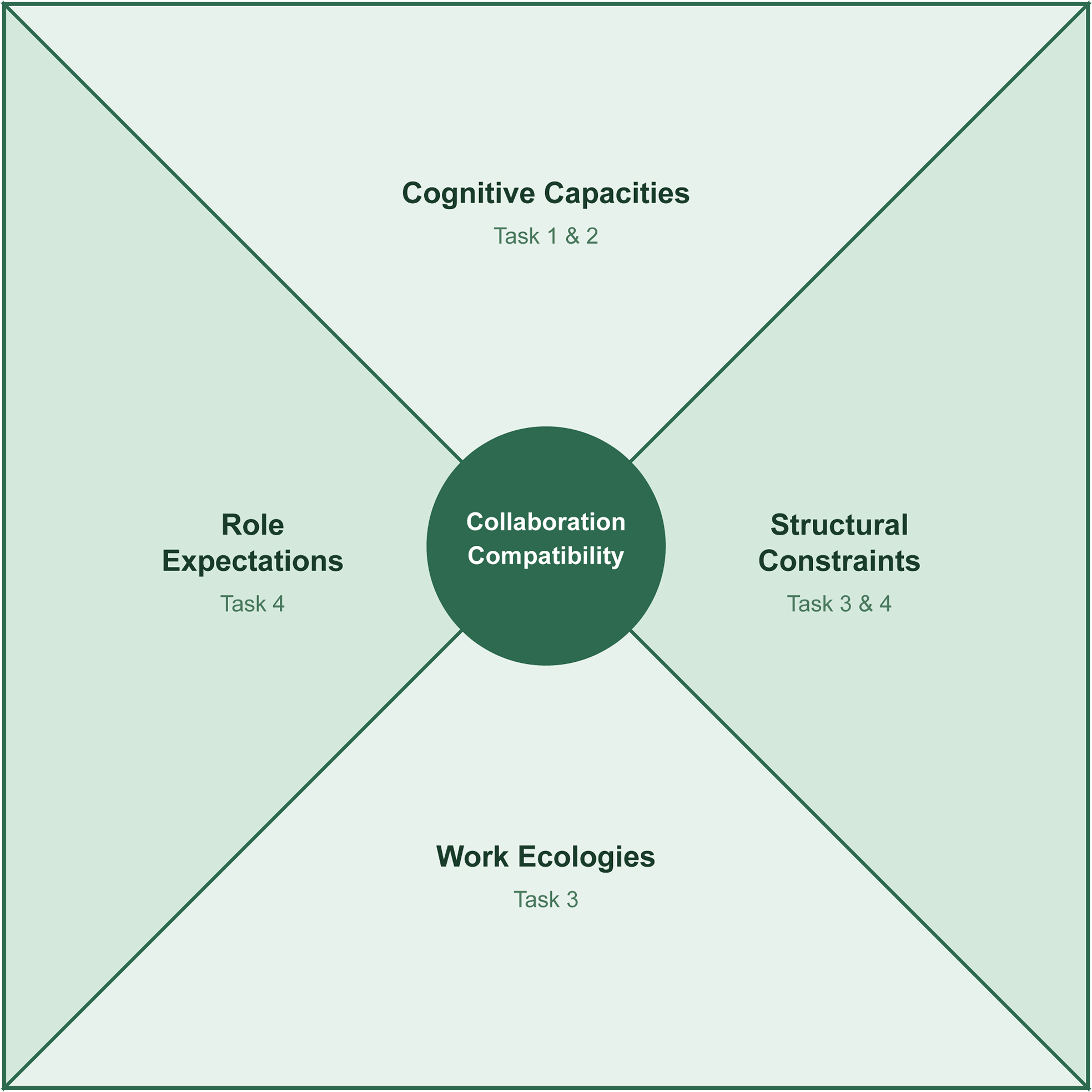
The paper makes two contributions. First, the diagnostic workshop format trialled in this study demonstrated that structured tasks can surface dimensions of compatibility – cognitive capacities, work ecologies, role expectations and mutual recognition – that informal encounters leave implicit. Second, the workshop produced initial empirical insights into how a group of field-based marine scientists understands its work ecology, imagines design’s role and articulates the conditions under which interdisciplinary collaboration might become possible. Cognitive capacities, work ecologies, role expectations and structural constraints all play a role in shaping compatibility (Figure 5), yet none of these dimensions surface reliably through informal encounters.
Four dimensions of interdisciplinary collaboration compatibility surfaced during the formation phase. All dimensions are treated as equal weight at this exploratory stage; their relative importance remains an open question for future research.

For biodesign, positioned at the intersection of biology and design, these findings carry a particular urgency. As the field begins to move beyond laboratory spaces into in situ engagement with living systems and ecological restoration, it increasingly relies on collaboration with scientists whose work environments, work ecologies, knowledge systems and research conditions differ from those described in much of the collaboration literature, which has often focused on laboratory-based science. Developing better ways to navigate this formation phase – to surface compatibility and incompatibility early, before significant resources are committed – is therefore not only a practical concern for biodesign practitioners. In light of broader calls for transdisciplinary collaboration, including those articulated within the Ocean Decade, attention to this formation phase becomes part of the larger challenge of building the science needed for ocean sustainability. Before committing to collaboration, prospective partners need structured ways to assess whether their configuration of practices, conditions and expectations can support the work ahead.
These contributions should be understood within the scope of the study’s limitations. This study is based on a workshop with a narrow participant group: all nine participants were early-career marine zoologists from a single institution working in field-based observation of marine habitats. It should also be noted that the designer perspective in this study is represented through the experience and reflexive data of a single designer – the first author of this paper. This means that the insights into how a designer reads compatibility signals during a formation-phase encounter reflect one particular positionality, and future research involving multiple designers would help broaden and diversify this perspective.
The workshop was conducted as an exploratory encounter in the initial phase of forming an interdisciplinary team as part of doctoral research. It should therefore be understood as a first exploratory attempt to uncover interdisciplinary group formation dynamics, expectations and challenges. The findings offer qualitative insights into how collaboration imaginaries surfaced within this specific ecology and may not be generalisable to “marine biologists” or “biodesign collaboration” in general.
While the workshop gave relevant insights into the professional and personal situation of participants, surfaced expectations and revealed structural constraints, these do not predict actual collaboration outcomes. Collaboration success depends on sustained engagement, mutual adaptation and factors that only reveal themselves when working together over time. Testing this workshop tool as a group formation format across different biological sub-fields, design specialisations, career stages and institutional settings would be necessary before broader claims can be made. Future developments might also include workshops conducted with designers as participants, or with scientists and designers together, to surface how compatibility signals differ when both disciplines are present from the outset. How design might engage with field-based marine biology beyond technical mediation, and whether approaches like ecological restoration or habitat design find practical intersection points with observational research goals, remains an open empirical question for future investigation.
Data availability statement
The data that support the findings of this study are available within the article. Raw workshop data including field notes and visual outputs are available from the corresponding author upon reasonable request.
Acknowledgements
The authors would like to thank Professor Carlo Cerrano of the Department of Life and Environmental Sciences (DiSVA) at the Università Politecnica delle Marche in Ancona for facilitating access to his research team and for his generous support in making this collaboration possible. They would also like to thank the early-career researchers of the same department for their time, openness and the valuable insights they brought to the workshop. Their willingness to engage thoughtfully with an unfamiliar process made this research possible.
The authors used AI-assisted tools (Claude, Anthropic; ChatGPT, OpenAI; accessed February 2026) for language editing and proofreading.
Author contributions
Conceptualisation: M.L. Methodology: M.L. Data curation: M.L. Visualisation: M.L. Writing – original draft: M.L. Writing – review & editing: M.L.; V.R. All authors approved the final submitted draft.
Financial support
This contribution was supported by the doctoral scholarship of the Polytechnic University of Milan awarded to Malu Luecking.
Competing interests
None.
Ethical standards
All participants were informed about the nature and purpose of the research and provided informed consent prior to data use. Individual responses have been anonymised throughout. This study was conducted in accordance with the ethical guidelines of the Polytechnic University of Milan.

 Open access

