




1. Introduction
Although the Germanic languages are closely related, the morphosyntax of adjectives varies greatly. This article focuses on two adjectival phenomena. Since further data and a broader cross-linguistic comparison come later in this article, the cursory data in this introduction serve only to illustrate these two phenomena. The first is the Double Definiteness Effect (henceforth DDE), a trait of Norwegian in (1) and contrasting with German in (2).


The Norwegian definite noun phrase modified by an attributive adjective has two elements that correspond roughly to ‘the’: the free-standing det and the affixed -et. The German equivalent, on the other hand, has only one: the free-standing das.
The second phenomenon is the Predicate/Attributive Asymmetry (henceforth PAA), illustrated in German in (3).

The attributive adjective in (3a) carries the inflection -es, which is absent from the predicate counterpart in (3b).Footnote 1
While German exhibits the PAA, Norwegian does not, evident in (4).

Unlike German, Norwegian has the inflection -t on both the attributive and predicate adjectives.
The crucial observation developed below is that the DDE and the PAA are in complementary distribution. In other words, no language exhibits both. In this article I argue that noun phrases contain a functional head that can produce either the DDE or the PAA, but never both in a single language.
The remainder of this article is structured as follows. In section 2 I present relevant data from the Germanic languages. Section 3 focuses both on the syntactic relation of an attributive adjective to its host noun phrase and on the morphosyntax of predicate adjectives. In section 4 I argue that a single functional head produces the two phenomena discussed. A typology beyond Germanic is developed in section 5, showing what kinds of languages are attested, expected, and ruled out by the claims made in this article. Section 6 concludes.
2. Data
This section identifies which Germanic languages exhibit the PAA, followed by an examination of Germanic languages with the DDE.
2.1. Languages with the Predicate/Attributive Asymmetry
As stated in the introduction, German exhibits the PAA unlike Norwegian. In fact, this distinguishes West Germanic (with the PAA) from North Germanic (without the PAA). The examples in (5) and (6), taken from Vikner (Reference Vikner, Adamzik and Christen2001:402), show the PAA across West Germanic.Footnote 2


The attributive adjectives in (5) are inflected, while their predicate counterparts in (6) are uninflected.
North Germanic patterns differently than West Germanic of (5) and (6). In North Germanic, the attributive adjectives in (7) inflect like their predicate counterparts in (8) (Norwegian from Kester Reference Kester1993:141; Swedish from Schoorlemmer Reference Schoorlemmer2012:112–113; Danish, Faroese, and Icelandic from Vikner Reference Vikner, Adamzik and Christen2001:400–401).Footnote 3


The upshot to (5)–(8) is that, while all Germanic languages inflect attributive adjectives, North Germanic languages also inflect predicate adjectives, and West Germanic languages do not.
2.2. Languages with the Double Definiteness Effect
As also stated in the introduction, Norwegian exhibits the DDE and German does not. Norwegian shares this trait with Swedish and Faroese, as shown in (9), taken from Julien (Reference Julien2005:26–27).

In these three languages, a definite noun phrase modified by an adjective has two definiteness markers: a freestanding the at the left edge of the phrase and an affixed the that is attached to the noun.Footnote 4
The remaining North Germanic languages and all West Germanic languages lack the DDE, as shown in the representative examples in (10) (Icelandic and Danish from Lohrmann Reference Lohrmann, Sleeman and Perridon2011:113; German and Dutch from Schoorlemmer Reference Schoorlemmer2012:139).

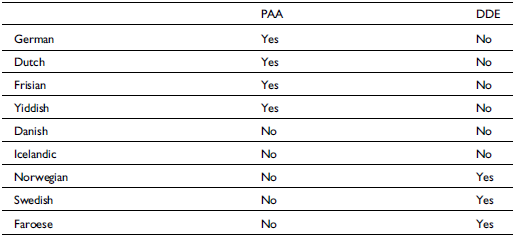
The upshot of (9) and (10) is that a subset of North Germanic languages, namely Norwegian, Swedish, and Faroese, exhibit the DDE, while all remaining Germanic languages do not. Table 1 captures the distribution of the PAA and the DDE across Germanic languages.
PAA and DDE in Germanic languages

As is clear in table 1, some languages have the PAA (German, Dutch, Frisian, and Yiddish) and some languages have the DDE (Norwegian, Swedish, Faroese). Two languages exhibit neither (Icelandic and Danish), but crucially no language exhibits both. In other words, the PAA and the DDE are in complementary distribution across Germanic languages. Section 4 provides a principled account of this complementary distribution, but first it is necessary to discuss the structure of noun phrases, which is the topic of the following section.
3. Phrase structure
This article bears on two aspects of nominal phrase structure. First is the integration of an attributive adjective into the noun phrase. Second is the derivation of predicate adjectives. This section addresses these two topics in turn. Note that I assume a “noun phrase” syntactically to be a D(eterminer) P(hrase), which contains the N(oun) P(hrase) and the attributive A(djective) P(hrase).
3.1. Attributive adjectives
Scholars make several claims, both implicit and explicit, about the location of attributive adjectives within the DP. I group these claims into the following three analyses: Adjective-as-Head, Adjective-as-Adjunct, and Adjective-as-Specifier. The arboreal representations in (11)–(13) illustrate these types, with the example phrase the big red balloons.

In (11), AP is the complement of D, and AP can take either NP or another AP as its complement. This analysis was proposed by Abney (Reference Abney1987) and is taken up by Kester (Reference Kester1993) and Embick & Noyer (Reference Embick and Noyer2001).

In (12), both APs are adjuncts of NP, and NP is the complement of D. This analysis finds resonance in the proposals of Ritter (Reference Ritter and Rothstein1991), Santelmann (Reference Santelmann1993), Svenonius (Reference Svenonius1994), Valois (Reference Valois1996), and Abels & Neeleman (Reference Abels and Neeleman2012). Note that in Schoorlemmer’s (Reference Schoorlemmer2009) analysis, NP is dominated by a lower DP, and AP adjoins to this lower DP.

In (13), each AP is the Specifier of a functional head whose title varies based on the scholar consulted. I have settled on Agr(eement), though nothing hinges on this terminology. D takes AgrP as its complement, and Agr can take either NP or another AgrP as its complement. Analysis III has a robust following, with variations on this analysis including Giusti (Reference Giusti1992), Cinque (Reference Cinque, Cinque, Koster, Pollock, Rizzi and Zanuttini1994, Reference Cinque2010), Lattewitz (Reference Lattewitz1997), Julien (Reference Julien2005), Knittel (Reference Knittel2005), Laenzlinger (Reference Laenzlinger2005), Rowlett (Reference Rowlett2007), Aljović (Reference Aljović, Hofherr and Matushansky2010), Lohrmann (Reference Lohrmann2010, Reference Lohrmann, Sleeman and Perridon2011), and Roehrs & Julien (Reference Roehrs, Julien, Sleeman and Perridon2014).
There are other suggestions. Corver (Reference Corver1997) has AP within AgrP, and AgrP is N’s specifier. Roehrs (Reference Roehrs2015) has Infl(ection) P(hrase) as Agr’s specifier, and Infl takes AP as its complement. Alexiadou (Reference Alexiadou2001 and elsewhere) argues that D selects CP, a reduced relative clause, and the AP predicate of that clause phrase-moves to Spec-C. For the present purposes, these accounts have the essence of Adjective-as-Specifier, namely that DP contains a functional head whose specifier provides a location for attributive AP. To be clear, I assume as in Corver (Reference Corver1997) and Roehrs (Reference Roehrs2015) that AP is more elaborate than indicated in (13), although I abstract away from the precise structure internal to AP and instead use “AP” as a kind of shorthand for the maximal projection of the adjective that sits in Spec-Agr. The remainder of this section offers arguments against the Adjective-as-Head and Adjective-as-Adjunct analyses and in favor of the Adjective-as-Specifier analysis.
The Adjective-as-Head analysis has difficulty handling the following three facts. First is the thematic complement of an attributive adjective, as in (14).

In this example, the adjective stolz ‘proud’ takes the complement auf seinen Sohn ‘of his son’. The English word order, with the adjective following the noun, may lead one to assume that ‘proud of his son’ is a sort of reduced predicate adjective. However, the inflection -er on the German stolzer indicates that the adjective is attributive, since German exhibits the PAA. In (11) above, which illustrates the Adjective-as-Head analysis, A’s syntactic complement is NP (or a recursive AP), and its semantic complement auf seinen Sohn ‘of his son’ has no locus in the DP.
Two anonymous reviewers suggest the possibility that auf seinen Sohn could be in Spec-A. In addition to the semantic complement being the syntactic specifier, such a suggestion faces the difficulty of the same phrase used predicatively, as in (15).

If the phrase auf seinen Sohn is the specifier of stolz, it is unclear why it rightward moves when used predicatively.
A second difficulty for the Adjective-as-Head analysis is the scope relation of A1 and A2. In the phrase the big red balloons, the two adjectives both relate to the noun equally. In other words, the phrase means ‘as far as balloons go, these are both big and red’. However, the phrase structure illustrated in (11) above indicates that A1 big c-commands A2 red and therefore has an undesired semantic scope over it. In other words, the phrase structure erroneously indicates ‘as far as red balloons go, these are big’. Furthermore, it is possible for the phrase the big red balloons to mean ‘as far as red balloons go, these are big’, in which big takes scope over red. It is unclear how the Adjective-as-Head analysis can capture the distinction between the neutral order the big red balloons and the scope order the big red balloons since they have the same word order and presumably the same syntactic structure.
Finally, the third difficulty is the issue of an adverb modifying only one of the two attributive adjectives. In the phrase this barely warm black coffee, the adverb barely is meant to modify only warm and neither black nor coffee. In other words, the intended reading is ‘as far as coffee goes, this is black and barely warm”. However, in the phrase structure in (11) above, A1 c-commands A2 and N, thereby taking semantic scope over them. This yields the erroneous reading ‘as far as coffee goes, this is barely warm and barely black, and possibly barely coffee’.
The Adjective-as-Adjunct analysis of (12) also faces three difficulties. First is the fact that in Germanic languages, attributive adjectives canonically precede their nouns. In other words, nothing in principle prevents rightward adjunction which would allow adjoined attributive adjectives to follow the noun. Haider & Rosengren’s (Reference Haider and Rosengren1998:48) Basic Branching Condition stipulates that “[t]he branching node of the projection line is to the right of its sister node,” and Vikner (Reference Vikner, Adamzik and Christen2001:409) invokes the Basic Branching Condition to account for the fact that “all adjoined positions … are exclusively found on left branches.” Although these observations about adjunction are descriptively adequate for the relative order of attributive adjectives and nouns, they fail to offer explanation for this linear order.
A second difficulty for the Adjective-as-Adjunct analysis is the fact that attributive adjectives have canonical orderings (Sproat & Shih Reference Sproat and Shih1988, Scott Reference Scott and Alexiadou2002, Cinque Reference Cinque, Cinque, Koster, Pollock, Rizzi and Zanuttini1994, Laenzlinger Reference Laenzlinger2005). In Germanic languages, for example, adjectives of size occur before adjectives of color, as in the big red balloons, with the reading ‘as far as balloons go, these are both big and red’. A reverse order is possible only if the color adjective takes scope over the size adjective, as in the red big balloons, meaning ‘as far as big balloons go, these are red’. If attributive adjectives are adjuncts, it is unclear how the adjoining of big to red balloons yields a reading in which both adjectives modify the noun in the same manner, but the adjoining of red to big balloons causes red to take scope over big.Footnote 5
The third difficulty for the Adjective-as-Adjunct analysis is the agreement morphology of attributive adjectives in all Germanic languages. Adjuncts with agreement is irreconcilable with “the minimalist assumption that Case and agreement are local Spec-head relations” (Chomsky Reference Chomsky1995:252). In other words, the fact that attributive adjectives show agreement inflection indicates that they are specifiers and not adjuncts.
The Adjective-as-Specifier analysis suffers from none of the difficulties of the other two analyses highlighted above. In fact, the Adjective-as-Specifier analysis has two strengths illustrated in the following. The first strength is the fact that the adjective order falls out from the order of the functional Agr-heads (inter alia Scott Reference Scott and Alexiadou2002, Rowlett Reference Rowlett2007:88, Cinque Reference Cinque2010). Each Agr-head is dedicated to a specific class of adjective, such as size or color, and Universal Grammar dictates the order of these Agr-heads in DP while playing no role in scope.Footnote 6 In the example the big red balloons, the Agr-head dedicated to size precedes the Agr-head dedicated to color.
The second strength is the fact that all attributive adjectives, being specifiers of devoted functional heads in the architecture of the DP, must necessarily be prenominal according to the Linear Correspondence Axiom, since “asymmetric c-command invariably maps into linear precedence” (Kayne Reference Kayne1994:3).Footnote 7 Crucially, the Linear Correspondence Axiom links the linear order of specifiers and heads to c-command, while Vikner’s employment of the Basic Branching Condition enforces the linear order of adjuncts and heads to nothing independent of adjunction.
The purpose of this subsection was to provide arguments in favor of analyzing attributive adjectives as specifiers of dedicated functional heads in the architecture of the DP. The following subsection focuses on the derivation of predicate adjectives.
3.2. Predicate adjectives
A predicate is the constituent following a copular verb, whose denotation is ascribed to the subject. A typical predicate is a DP, as in (16), where the DP is marked off with brackets.

Through the linking function of the copular bin ‘am’, the predicate DP ein stolzer Student ‘a proud student’ is ascribed to the subject ich ‘I’.
Constituents other than DP can also be predicates. In (17), two constituents typically found within DPs function as predicates.Footnote 8

The predicate in (17a) is AP, while it is NP in (17b). The construction in (17b), in which the predicate is NP without an article, is not possible in English. Identifying which restrictions are placed on bare noun predicates in which languages goes beyond the scope of this article (see, for example, Holmberg Reference Holmberg1993 and Borthen Reference Borthen2003 for different accounts within Mainland Scandinavian noun phrases). The grammaticality of (17b) shows that a predicate does not need to be a full DP.
The fact that the predicates of (17) are phrases and not heads is shown by the examples in (18), in which both stolz ‘proud’ and Student ‘student’ take a complement.

The upshot of (17) and (18) is that predicates are elements larger than heads but can be smaller than full DPs. Relevant for the remainder of this article is that predicates can be AP.
Since a predicate adjective is AP, a construction like (17a) indicates the form of AP in a given language. In the Norwegian and German examples of (19), the predicate AP of a language with PAA is contrasted with a corresponding predicate AP in a language lacking PAA.

The Norwegian predicate AP in (19a), with its inflection -e, shows that adjective inflection in Norwegian is housed within AP. This contrasts with the situation in German, where AP is uninflected.
Note that predicate APs with complements exhibit the same behavior as their counterparts in (19) without complements, as in (20).

The Norwegian adjective in (20a) bears the -e inflection, unlike the German equivalent in (20b).
As a point of reference, the Norwegian and German examples in (21) show the same adjective ‘young’ as an attributive AP.

In attributive position, both Norwegian and German adjectives bear an inflectional morpheme. However, based on the analysis of predicate AP in (19) above, the inflectional morpheme is housed in a different location in Norwegian and German. In Norwegian, it is part of AP. In German, it must be outside of AP.
4. Analysis
In section 3.1, I argued that attributive adjectives are housed in Spec-Agr, and that AgrP in turn is the complement of D. Following that in section 3.2, I argued that German AP does not contain the adjective ending. Because the German DP has the functional head Agr, which apparently has no phonetic exponence, and because the German DP contains adjective morphology, which apparently has no head in the DP whose exponence it could be, I argue that the German adjective morphology is the exponence of Agr. Consider the DP in (22).

The syntactic representation of (22), including its inflection -es, is given in (23).Footnote 9

Here and throughout, I borrow the general assumptions in syntactic derivations of Distributed Morphology (Halle & Marantz Reference Halle and Marantz1994), Antisymmetry (Kayne Reference Kayne1994), and Minimalism (Chomsky Reference Chomsky1995). Therefore, a representation such as the one in (23) must have the caveat that the narrow syntax, which builds the structure, has access only to morphosyntactic feature bundles devoid of lexical and phonological items, and that this information is provided after the narrow syntax has performed all operations. For the sake of exposition, however, I have included the lexical items in representations such as (23) that are added after narrow syntax.
The Norwegian equivalent of (22) is given in (24).

Despite having the adjective ending -t, superficially equivalent to the German -es of (22), the DP in (24) has the syntactic representation in (25).

The Norwegian adjective ending of (25) is housed within AP, and the Agr-head is phonetically empty.
The account so far captures the PAA in terms of the locus of the adjective ending: either AP-internal or as the exponence of Agr. The other trait relevant to this article, namely the DDE, still requires an account. Recall that in a DDE language like Norwegian, a definite noun phrase with an adjective contains two elements that roughly correspond to English ‘the’, as in (26).

Because the Norwegian DP has the functional head Agr, which apparently has no phonetic exponence, and because the Norwegian DP contains a second ‘the’, which apparently has no head in the DP whose exponence it could be, I argue that the second ‘the’ in Norwegian is the exponence of Agr. The DP in (26) therefore has the syntactic representation in (27).

This produces the Spell-out order det * store * -et * hus, with the undesired order of the suffix et preceding its head hus. Recall from above that I assume the basic tenets of Distributed Morphology. I also assume there is a post-syntactic process such as Embick & Noyer’s (Reference Embick and Noyer2001) Local Dislocation, as employed for precisely this issue by Schoorlemmer (2009:16, Reference Schoorlemmer2012). Local Dislocation is a process that can reorder string-adjacent elements only if the reordering is sensitive to the vocabulary. In other words, during the syntactic derivation, the elements being merged and moved are morphosyntactic feature bundles with no phonological content. Specifically, the syntactic component building a structure such as the one in (27) does not know what type of morpheme the second ‘the’ will be. In principle, it could spell-out as a prefix, a suffix, a clitic, or a free-standing morpheme. Only after Vocabulary Insertion occurs and the second ‘the’ has the phonological content -et does the system know that this is a suffix, and Local Dislocation reorders the string -et * hus into hus * -et.
As a reviewer points out, the surprising consequence of this analysis is that Agr in Norwegian bears semantics (see footnote 4 above) but apparently not in German, since Agr houses the second ‘the’ in Norwegian but the attributive adjective inflection in German. While I leave the question open as to whether a given functional head in one language must have the same semantic contribution in another language, I point out here that in isolated constructions, the German attributive adjective inflection disambiguates phrases, which is to say that it bears semantics. In addition to DPs headed by uninflected nominative ein ‘a’ with an omitted head noun, the following minimal pair differs only in the adjective inflection.

Because the otherwise homonymous Band ‘ribbon’ and Band ‘tome’ differ only in gender, and because German DPs with a possessive proper name lack overt determiners, it is only the adjective ending in (28) that disambiguates the two sentences.
The complementary distribution of PAA and DDE noted in table 1, namely that a language can have PAA or DDE, but no language can have both PAA and DDE, receives a principled account. Within the architecture of the DP, there is a functional head that I refer to as Agr, and Agr can have one of two functions. On the one hand, it may be responsible for attributive adjective inflection, as in German. In such a language, predicate adjectives cannot show inflection because the predicate is an AP without Agr, since Agr is a DP-head not located within the AP. This accounts for German and the other PAA languages. On the other hand, in a language like Norwegian, attributive and predicate adjectives both inflect, indicating that the adjective ending is AP-internal and not the exponence of Agr. In such a language, Agr is instead responsible for the second ‘the’. This accounts for Norwegian and the other DDE languages. The complementary distribution of PAA and DDE falls out from the fact that Agr can perform only one of these two functions in a given language, but not both.
5. Discussion
This section provides a brief foray into languages outside of Germanic showing that the arguments made in section 4 hold. Because Agr houses either the attributive adjective inflection of a PAA language or the second article in a DDE language, the following two falsifiable claims emerge:

I first discuss (29a) and consider Russian as a language that upholds it.
As Russian lacks articles, and it therefore intrinsically lacks the DDE, one needs only to show that its attributive adjectives receive an inflection not found on predicate adjectives. Russian adjectives have two forms: the long form and the short form. Siegel (Reference Siegel and Partee1976) identifies seven semantic and syntactic behaviors of the long and short forms. Relevant here is that long forms are found in attributive position, as in (30), while short forms are predicates, shown in (31), both from Siegel (Reference Siegel and Partee1976:293). For the sake of consistency within this study, I indicate long forms with infl and short forms with no special gloss.


When used predicatively, the long form has a different meaning than the short, shown in (32)–(33) from Siegel (Reference Siegel and Partee1976:297).


The distinction between (32) and (33) can be captured in a PAA language like German:


The predicate in (34) is an AP, while in (35) it is a full DP. Because DP contains Agr but AP does not, and because Agr is responsible for adjective inflection in German, the DP predicate of (35) shows inflection, but the AP predicate of (34) does not. The structure of the Russian of (33) is essentially that of the German of (35), the only difference being German’s overt article eine, which is tangential here. In fact, the Russian of (33) fits the analysis developed here, namely that Agr is responsible for infl, and that copular AP, like in (32) and (34), does not have Agr. Bailyn (Reference Bailyn and Toman1994) puts forth a similar analysis, where AgrP corresponds to his ModP. The data in (30)–(35) show that Russian, a language inherently lacking the DDE, behaves like a PAA language, thereby upholding the falsifiable claim in (29a).
I turn now to (29b) and the DDE. While several unrelated languages exhibit multiple definiteness exponence in the DP, I am aware of no language with multiple definiteness that behaves quite like the DDE of Scandinavia. Modern Greek, for example, has multiple definite articles in the DP, at first glance superficially similar to Norwegian. Example (36) is from Alexiadou (Reference Alexiadou2014:19).

Compare this to (37), the proposed Spell-out of Norwegian det store huset ‘the big house’ from (26) above.

While it is tempting to stress the apparent similarities between (36) and (37), there are crucial differences, not the least of which is the fact that the noun precedes the adjective in (36) but follows it in (37). Alexiadou (Reference Alexiadou2014:62–68) elucidates other differences between multiple definiteness of Greek and the DDE, claiming that Greek adjectives as in (36) derive from postnominal reduced relative clauses. Indeed, nonpredicative adjectives such as ‘alleged’ and ‘former’ do not trigger multiple definiteness in Greek but do so in Swedish, as in (38) from Alexiadou & Wilder (Reference Alexiadou, Wilder, Alexiadou and Wilder1998:306) and (39) from Alexiadou (Reference Alexiadou2014:66).


Indeed, Alexiadou (Reference Alexiadou2014) provides tools to diagnose the nature of multiple definiteness cross-linguistically, and she provides no language typologically similar to the North Germanic DDE languages discussed in this article. Therefore, I must leave the falsifiable claim of (29b) open for further research.
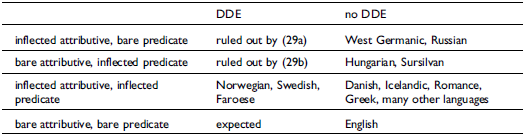
In closing this section, I provide the typology of adjectivally modified DP behavior in table 2.Footnote 10
Typology of DP behavior
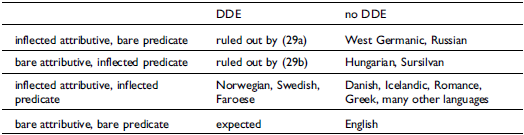
The first row in table 2 contains languages whose attributive adjectives are inflected but whose predicate adjectives are bare. The first possibility, namely that such a language has the DDE, is claimed here to be impossible, ruled out by (29a). Languages in this row that lack the DDE include West Germanic and Russian.
The second row contains languages with bare attributive adjectives and inflected predicate adjectives. According to (29b), a DDE language cannot inflect adjectives in such a manner. This row contains languages that lack the DDE, for example Hungarian (Schoorlemmer Reference Schoorlemmer2009:104) and Sursilvan (Roberge Reference Roberge1989).
The third row is most robustly represented, in which both attributive and predicate adjectives inflect. Such languages with the DDE are Norwegian, Swedish, and Faroese. There are numerous such languages without the DDE, including but not limited to the rest of North Germanic, various Romance languages, Greek, etc.
The final row contains languages that inflect neither attributive nor predicate adjectives. English is representative of such languages, and it lacks the DDE. The present analysis expects the existence of such a language that also exhibits the DDE, namely where Agr spells-out as a second determiner, but AdjP has no inflection. Although such a language is expected to exist, I am familiar with no such language.
6. Conclusion
Despite being closely related, Germanic languages exhibit variation in their adjectival morphosyntax. This article provides a principled account unifying two phenomena of Germanic adjectives. First is the asymmetry in West Germanic between inflected attributive and uninflected predicate adjectives. Second is the double expression of definiteness in some North Germanic languages.
To account for these phenomena, it was necessary to consider the derivation of adjectives in both attributive and predicate positions. Because predicate AP can serve as a test to determine the form of AP not housed in DP, it was shown that adjective inflection can have different locations in the DP. For West Germanic, it is outside the AP, while the North Germanic adjective inflection is AP internal. Specifically, I argued that the functional head whose specifier position houses attributive AP is responsible for the West Germanic inflection. Furthermore, I also argued that this same Agr is responsible for the second ‘the’ in those North Germanic languages with the Double Definiteness Effect.
Because the same head performs either one of these functions, a falsifiable claim emerges that these two phenomena are in complementary distribution. While this claim holds observably for Germanic, I showed how this is tentatively confirmed with examples from Russian, and a typology was offered identifying which language types are attested, expected, and ruled out.

 Open access

