


Introduction
Public trust in government is increasingly recognised as a key determinant shaping how people evaluate the quality of public services. Because service performance is often difficult to observe, individuals rely on generalised beliefs about institutional competence when forming evaluations (Bouckert and Van de Walle, Reference Bouckaert and Van de Walle2003; Levi and Stoker, Reference Levi and Stoker2000; Rothstein and Stolle, Reference Rothstein and Stolle2008).
This raises a central question: to what extent do institutional trust and governance quality shape citizens’ perceptions of public service performance?
Tap water provides a particularly relevant case study, as it is a universal and highly regulated public service whose technical quality is difficult for citizens to assess, and information asymmetries between providers and users are substantial. Drinking-water provision operates under harmonised European standards and continuous monitoring, ensuring broadly comparable safety conditions across regions (ARERA, 2023; Directive (EU), 2020/2184; Istituto Superiore di Sanità, 2022). Therefore, regional differences are interpreted as reflecting citizens’ evaluations rather than systematic disparities in objective water quality.Footnote 1 , Footnote 2
Under these conditions, institutional trust acts as a cognitive heuristic through which individuals interpret ambiguous signals about service quality: when trust is low, the same signals are more easily interpreted as evidence of malfunctioning or inadequacy (Pidgeon et al., Reference Pidgeon, Walls, Weyman and Horlick-Jones2003; Siegrist and Cvetkovich, Reference Siegrist and Cvetkovich2000).
In Italy, public confidence in tap water is relatively low (ISTAT, 2025), and bottled water consumption is among the highest in Europe despite stringent regulatory standards (Beverfood, 2021; ANSA, 2021). These patterns suggest that perceptions of tap water are strongly influenced by broader views regarding institutional performance.
While existing studies mainly focus on health risks, socio-demographic factors, and environmental attitudes, the institutional dimension remains comparatively underexplored (Borusiak et al., Reference Borusiak, Szymkowiak, Pierański and Szalonka2021; Bulut and Seçer, Reference Bulut and Seçer2019; Levêque and Burns, Reference Levêque and Burns2018; Lloyd-Smith et al., Reference Lloyd-Smith, Schram, Adamowicz and Dupont2018). Recent contributions show that institutional trust and institutional quality jointly shape a wide range of economic behaviours, including public savings (Facchini et al., Reference Facchini, Massin and Brookes2024), property rights protection (Chung and Kwon, Reference Chung and Kwon2024), and stock market participation (Asgharian et al., Reference Asgharian, Liu and Lundtofte2024). Experimental evidence further suggests that improvements in institutional quality can causally increase generalised trust (Martinangeli et al., Reference Martinangeli, Povitkina, Jagers and Rothstein2024). Our paper contributes to this literature by shifting the focus to citizens’ evaluations of a core public service – tap water quality – within a single country. Leveraging the regional variation in Italy, we analyse how institutional trust and governance quality jointly shape perceptions of service performance.
From this perspective, the Italian context offers a natural setting: governance patterns shape the reputational environment in which utilities operate, and institutional trust provides a rule of thumb when citizens evaluate services they cannot directly monitor (Kaufmann et al., Reference Kaufmann, Kraay and Mastruzzi2009; Levi and Stoker, Reference Levi and Stoker2000; Murphy, Reference Murphy2004; Nifo and Vecchione, Reference Nifo and Vecchione2014, Reference Nifo and Vecchione2015; Rothstein and Stolle, Reference Rothstein and Stolle2008; Tyler, Reference Tyler1990, Reference Tyler2006). By reframing perceived water quality as a window into the trust–performance relationship, this paper advances a general framework for understanding how citizens evaluate government effectiveness under uncertainty.
The contributions of this paper are threefold. First, we develop a multilevel framework that combines psychological theories of trust (e.g., Pidgeon et al., Reference Pidgeon, Walls, Weyman and Horlick-Jones2003; Tyler, Reference Tyler2006) with institutional theories of governance (North, Reference North1990; Williamson, Reference Williamson2000), highlighting the mechanisms, such as information asymmetries, the attribution of responsibility and reputation, through which institutional trust is associated with evaluations of public services. Second, whereas existing research on tap water perceptions has mainly emphasised individual-level characteristics such as socio-economic status (Dupont et al., Reference Dupont, Adamowicz and Krupnick2010; Gambino et al., Reference Gambino, Bagordo, Coluccia, Grassi, Filippis, Piscitelli, Galante and Leo2020), health concerns (March et al., Reference March, Garcia, Domene and Sauri2020; Olagunju et al., Reference Olagunju, Sante, Bracey and Greenfield2022), and environmental attitudes (Graydon et al., Reference Graydon, Gonzalez, Laureano-Rosario and Pradieu2019; Saylor et al., Reference Saylor, Prokopy and Amberg2011), we examine trust across three levels (local, regional, and national), highlighting a differentiated pattern of institutional proximity. Third, we integrate the framework with regional indicators of governance performance, including government effectiveness, regulatory quality and control of corruption (Nifo and Vecchione, Reference Nifo and Vecchione2014), to assess how institutional context conditions citizens’ attitudes towards tap water.
We draw on data from the Italian Multipurpose Household Survey (MHS) conducted by the Italian National Institute of Statistics (ISTAT) for the period 2014–2019 and apply hierarchical logit models to assess both micro- and macro-level effects. The results show that individual trust in institutions is positively associated with perceived tap water quality at all levels, with local trust having the strongest association. At the regional level, the overall institutional quality index (IQI) exerts a positive influence, particularly through its government effectiveness and control of corruption components, suggesting that more effective and less corruption-prone institutional environments foster greater public confidence in utilities. These findings indicate that perceptions of public service quality are associated not only with individual characteristics but also with broader patterns of institutional trust and governance quality.
The remainder of the paper is organised as follows. The sections on Theoretical background, Data and variables, The econometric model, Descriptive statistics, Results present the theoretical framework, data, methodology and main results. The sections on Cross-level effects between local trust and institutional quality, Robustness checks show heterogeneity analysis and robustness check. The section on Discussion discusses the findings, and the section on Conclusions concludes.
Theoretical background
Trust, public services performance and perception gaps
Citizens rarely observe the technical performance of public services directly. Individuals form their judgements by combining personal experience, occasional information, and general beliefs about the functioning of institutions (Bouckaert and Van de Walle, Reference Bouckaert and Van de Walle2003; Levi and Stoker, Reference Levi and Stoker2000). This informational environment creates a basis for systematic perception gaps between service performance and subjective assessments.
Institutional trust plays a crucial role in shaping these gaps. First, trust works as a cognitive heuristic under uncertainty, as individuals who trust authorities are more willing to rely on institutional information and to revise their assessments when negative signals become persistent and widely shared (Levi and Stoker, Reference Levi and Stoker2000; Rothstein and Stolle, Reference Rothstein and Stolle2008). In contrast, when the level of trust is low, ambiguous signals are more easily interpreted as evidence of uncertainty and institutional malfunctioning (Hetherington, Reference Hetherington2005; Rudolph and Evans, Reference Rudolph and Evans2005). This mechanism extends to various public services whose performance is difficult to observe; thus, trust shapes how people weigh available evidence about quality (Bouckaert and Van de Walle, Reference Bouckaert and Van de Walle2003).
Second, trust is affected by institutional performance. Impartial and effective public services tend to encourage widespread support for institutions, whereas corruption, arbitrariness, or inefficiency erode it (Rothstein and Teorell, Reference Rothstein and Teorell2008). Recent research (Asgharian et al., Reference Asgharian, Liu and Lundtofte2024; Chung and Kwon, Reference Chung and Kwon2024; Facchini et al., Reference Facchini, Massin and Brookes2024; Kaufmann et al., Reference Kaufmann, Kraay and Mastruzzi2009; Nifo and Vecchione, Reference Nifo and Vecchione2014) shows that higher-quality institutions are associated with stronger trust and that governance effectiveness can increase generalised trust (Martinangeli et al., Reference Martinangeli, Povitkina, Jagers and Rothstein2024).
These arguments suggest that institutional trust and service performance jointly shape how citizens interpret incomplete information about public services. We apply this framework to drinking water as a case study. As a service characterised by limited observability, the provision of drinking water makes perceptions especially likely to reflect both trust and the governance context (Kaufmann et al., Reference Kaufmann, Kraay and Mastruzzi2009; Nifo and Vecchione, Reference Nifo and Vecchione2014).
Trust and perceived tap water quality
In the context of public services, institutional trust refers to citizens’ beliefs about the effectiveness, fairness, transparency and reliability of public authorities (Khodyakov, Reference Khodyakov2007; Kouvo, Reference Kouvo2011).
In the drinking water sector, these beliefs are likely to matter because users have limited direct knowledge of technical parameters and therefore rely on confidence in the competence and integrity of the institutions that are responsible for service delivery and oversight (Tyler, Reference Tyler1990, Reference Tyler2006; Pidgeon et al., Reference Pidgeon, Walls, Weyman and Horlick-Jones2003).
Adapting Tyler’s (Reference Tyler2006) model and Pidgeon et al. (Reference Pidgeon, Walls, Weyman and Horlick-Jones2003) multilevel trust framework to water governance, we distinguish trust across levels of government, with each level potentially influencing subjective quality assessments through different channels. Geographical and institutional proximity play an important role: trust in closer institutions is strongly rooted in direct experience and perceived procedural fairness, whereas trust in more distant institutions depends more on reputation and broad policy commitments (Bouckaert and Van de Walle, Reference Bouckaert and Van de Walle2003).
At the local level, direct experiences with water services (taste, service interruptions, etc.) interact with perceptions of responsiveness and fairness (Grönlund and Setälä, Reference Grönlund and Setälä2012). At the regional level, trust reflects views about consistent standards, equitable resource allocation, and effective crisis management (Gangl, Reference Gangl2003). At the national level, trust is linked to the credibility of long-term commitments to water safety, including infrastructural investments (Pidgeon et al., Reference Pidgeon, Walls, Weyman and Horlick-Jones2003).
Perception gaps are most likely to occur when these layers transmit conflicting signals – for example, when national standards appear stringent but local implementation is perceived as weak. In such cases, precautionary behaviours such as reliance on bottled water may become a way to cope with perceived institutional shortcomings (De Simone et al., Reference De Simone, Dileo and Marzano2024).
Because proximity increases both direct experience and accountability, we expect trust in institutions that are closer to service delivery to be more strongly associated with perceived water quality.
Based on this framework, the following hypotheses are proposed:
H1a. Trust in local institutions is positively associated with perceived water quality.
H1b. Trust in regional institutions is positively associated with perceived water quality.
H1c. Trust in national institutions is positively associated with perceived water quality.
How institutional quality is associated with perceived tap water quality
While institutional trust captures citizens’ subjective confidence, institutional quality refers to the performance of formal public institutions at the macro level (North, Reference North1990; Williamson, Reference Williamson2000). In our framework, institutional quality operates as a regional-level condition that shapes how water utilities function, i.e., how citizens experience service delivery.
Institutional quality is captured by governance performance indicators, such as government effectiveness, rule of law, regulatory quality, control of corruption, and voice and accountability (Kaufmann et al., Reference Kaufmann, Kraay and Mastruzzi2009; Nifo and Vecchione, Reference Nifo and Vecchione2014, Reference Nifo and Vecchione2015).Footnote 3
In the water sector, higher-quality governance is expected to support investment in infrastructure, the enforcement of standards, and credible public communication, thereby reducing uncertainty and improving perceptions of tap water quality (Rothstein and Stolle, Reference Rothstein and Stolle2008). Conversely, weaker governance is more likely to be associated with infrastructural deficits, irregular monitoring, and limited accountability, which can increase perceived risk.
Public goods theory (Samuelson, Reference Samuelson1954) explains this dynamic: effective provision reduces reliance on private alternatives. However, perceptions vary due to personal experiences and cultural factors. Even competent institutions may fail to generate positive evaluations without visible accountability (Newton and Norris, Reference Newton and Norris2000; Mishler & Rose, Reference Mishler and Rose1997; DeCaro and Stokes, Reference DeCaro and Stokes2013).
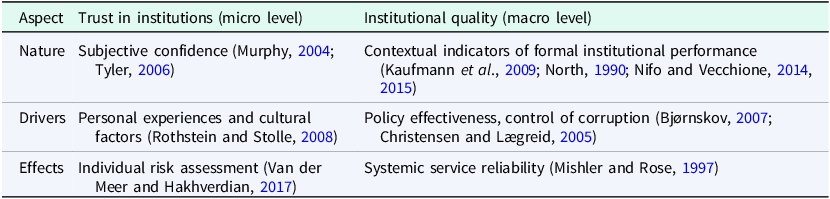
Table 1 summarises the complementary roles of micro-level trust and macro-level institutional quality in shaping perceived water quality, while Figure 1 shows the theoretical conceptualisation.
Micro–macro distinctions in water quality perceptions

Source: Own elaborations based on the literature.
Theoretical conceptualisation. Source: Own conceptual elaboration based on Tyler (Reference Tyler1990, Reference Tyler2006); Pidgeon et al. (Reference Pidgeon, Walls, Weyman and Horlick-Jones2003); Doria et al. (Reference Doria, Pidgeon and Hunter2009) and Nifo and Vecchione (Reference Nifo and Vecchione2014, Reference Nifo and Vecchione2015).

Accordingly, we propose the following:
H2a. Higher levels of the institutional quality index (IQI) at the regional level are associated with higher perceived water quality among citizens.
H2b. Higher levels of government effectiveness at the regional level are associated with higher perceived water quality among citizens.
H2c. Regulatory quality is positively associated with perceived water quality.
H2d. Higher levels of control of corruption are associated with higher perceived water quality.
H2e. The rule of law is positively associated with perceived water quality.
H2f. Higher levels of voice and accountability are associated with higher perceived water quality.
Data and variables
Data
The dataset used is drawn from the MHS, a large-scale cross-sectional household survey conducted annually by ISTAT since 1993. For this analysis, we pooled data from six survey waves (2014–2019), resulting in a dataset consisting of approximately 110,000 observations. Following ISTAT guidelines, we use the household reference person to avoid multiple observations per household; since the household reference person is more often male, the female share in the estimation sample is lower than that in the full adult population.Footnote 4
The dataset provides detailed information on the socio-demographic characteristics of the respondents, their households, and their trust in institutions.
Variables: individual level
In the MHS, perceived tap water quality is measured through a single item referring to its organoleptic characteristics (e.g., taste, smell and clarity). Following the literature (Debbeler et al., Reference Debbeler, Gamp, Blumenschein, Keim and Renner2018; Delpla et al., Reference Delpla, Legay, Proulx and Rodriguez2020; Doria et al., Reference Doria, Pidgeon and Hunter2009; Grupper et al., Reference Grupper, Schreiber and Sorice2021; ISTAT, 2022; Massarutto et al., Reference Massarutto, Roder and Troiano2022; Parag and Roberts, Reference Parag and Roberts2009; Pierce and Gonzalez, Reference Pierce and Gonzalez2017; Saylor et al., Reference Saylor, Prokopy and Amberg2011; Yang et al., Reference Yang, Butcher, Edwards and Faust2023; York et al., Reference York, Barnett, Wutich and Crona2011), we recode our dependent variable (perceived water quality) into a binary indicator equal to 1 if the respondent is very/quite satisfied and 0 otherwise.
In line with Fazio et al. (Reference Fazio, Giambona, Vassallo and Vassiliadis2018), this study uses data from the ISTAT MHS – Aspects of Daily Life, but methodologically departs from previous works based on latent class analysis. We introduce a set of dummy variables to capture local, regional and national trust, assigning a value of 1 for high levels of trust (scores 8–10) and 0 otherwise (Suárez-Varela and Dinar, Reference Suárez-Varela and Dinar2017).Footnote 5
As socio-demographic controls, Gender is known to influence risk perceptions of tap water quality, with women tending to perceive higher risk (Saylor et al., Reference Saylor, Prokopy and Amberg2011; García-Rubio et al., Reference García-Rubio, Tortajada and González-Gómez2016; Graydon et al., Reference Graydon, Gonzalez, Laureano-Rosario and Pradieu2019). We include a standard binary indicator for gender (1 = female), as in Aprile and Fiorillo (Reference Aprile and Fiorillo2017), to capture potential differences in water-related attitudes by gender.
Age produces mixed results: while Ochoo et al., (Reference Ochoo, Valcour and Sarkar2017) report that older individuals are more satisfied with tap water, Doria (Reference Doria2010) observes the opposite trend. We follow Dupont et al., (Reference Dupont, Adamowicz and Krupnick2010) and construct a dummy variable named Age, which is coded 1 for respondents aged 18–39 years (reference category: 40+).
Employment status is coded 1 if the respondent is employed, following the operationalisation used by Aprile and Fiorillo (Reference Aprile and Fiorillo2017) and Spicer et al., (Reference Spicer, Parlee, Chisaakay and Lamalice2020). Homeowner is a predictor of perceived tap water quality, as property owners are generally more familiar with their water supply systems (Javidi and Pierce, Reference Javidi and Pierce2018; Pierce and Gonzalez, Reference Pierce and Gonzalez2017). This variable is coded 1 for owners and 0 otherwise. Following Gustavsen and Hegnes (Reference Gustavsen and Hegnes2020), we construct a categorical variable (Education) coded 1 if the respondent has no qualification (reference category), 2 for a primary school or low secondary school qualification, 3 in the case of a high school diploma and 4 for those with a bachelor’s degree or post-graduate degree (Zapata, Reference Zapata2021; Chatterjee et al., Reference Chatterjee, Triplett, Loh and Johnson2022). As argued by Doria (Reference Doria2010), individuals with higher levels of education are potentially able to attribute lower risks to drinking water contamination, as they are better able to objectively evaluate the scientific information on the quality of tap water provided by the management body (Dupont et al., Reference Dupont, Adamowicz and Krupnick2010), but the results remain conflicting (Spicer et al., Reference Spicer, Parlee, Chisaakay and Lamalice2020).
We also include a dummy variable named Health, which is coded 1 if respondents declare satisfaction or high satisfaction with their health status in the past 12 months (Olagunju et al., Reference Olagunju, Sante, Bracey and Greenfield2022; Saylor et al., Reference Saylor, Prokopy and Amberg2011). Poor health perceptions may lead consumers to opt for alternatives (Gheorghe et al., Reference Gheorghe, Purcarea and Gheorghe2019), although perceptions of water quality and health concerns often do not reflect objective water quality (Valavanidis, Reference Valavanidis2020).
To capture changes in households’ material conditions, we include a binary indicator (Improved economic situation) equal to 1 if the respondent indicates that his or her household’s economic situation has improved over the past 12 months and 0 otherwise (Fernández-Urbano and Kulic, Reference Fernandez-Urbano and Kulic2020). This variable proxies for recent variation in perceived economic well-being, which may be associated with both confidence in institutions and the evaluation of public services such as the provision of tap water.
Variables: regional level
We conceptualise regional institutional quality through a composite IQI and its main governance dimensions (Kaufmann et al., Reference Kaufmann, Kraay and Mastruzzi2009; Christensen and Lægreid, Reference Christensen and Lægreid2005; Nifo and Vecchione, Reference Nifo and Vecchione2014). We expect higher-quality regional governance to be associated with more favourable perceptions of tap water, net of individual-level characteristics and institutional trust.
The IQI developed by Nifo and Vecchione (Reference Nifo and Vecchione2015) is a composite indicator that assesses the quality of institutions across Italian regions; it encompasses five key dimensions -government effectiveness, regulatory quality, control of corruption, rule of law, and voice and accountability- and is constructed from administrative and outcome-based statistics. This index has been widely applied in the literature in relation to several topics, including regional inequalities (Ferrara et al., Reference Ferrara and Nisticò2019; Arbolino et al., Reference Arbolino, Boffardi and De Simone2019), household consumption behaviour and private health expenditure (Lucadamo et al., Reference Lucadamo, Mancini and Nifo2019), university student mobility (Amendola et al., Reference Amendola, Barra and Zotti2023; Millemaci and Patti, Reference Millemaci and Patti2025), and the productivity and efficiency of local businesses and public services (Agostino et al., Reference Agostino, Nifo, Trivieri and Vecchione2016; Finocchiaro and Guccio, Reference Finocchiaro and Guccio2025; Finocchiaro Castro et al., Reference Finocchiaro, Guccio, Romeo and Vidoli2025).
To investigate overall institutional quality, we include in our empirical model the variable IQI, which represents the natural logarithm of the IQI.
Given that Gheorghe et al., (Reference Gheorghe, Purcarea and Gheorghe2019) emphasise the role of government effectiveness – noting that awareness of tap water quality depends on effective public education campaigns by governments and institutions (Fazio et al., Reference Fazio, Giambona, Vassallo and Vassiliadis2018) – we specifically consider the natural logarithm of government effectiveness at the regional level (Government).
Regarding regulatory quality, Pacheco-Vega (Reference Pacheco-Vega2019) highlights the role of weak or fragile regulatory frameworks in undermining public perceptions of the safety and reliability of tap water services. Accordingly, we include the variable Regulatory, which is the natural logarithm of regulatory quality at the regional level.
Moreover, following Breen and Gillanders (Reference Breen and Gillanders2024), who report that corruption has a significant negative association with the quality of water services, and Baldino and Sauri (Reference Baldino and Sauri2018), who document widespread water theft by illegal operators in Italy, we investigate this dimension by including the natural logarithm of control of corruption at the regional level (Control of corruption).
Rule of law, defined as the enforcement of contracts, property rights, policing, judicial activities, and crime prevention (Licht et al., Reference Licht, Goldschmidt and Schwartz2007; Nifo and Vecchione, Reference Nifo and Vecchione2015), is also considered. Tignino (Reference Tignino2011) argues that legitimate and credible institutions that enforce water quality policies and safeguard legal frameworks are essential for realising the human right to safe drinking water. For this reason, we include the natural logarithm of the rule of law at the regional level.
The dimension of voice and accountability – which reflects the rate of participation in public elections, the density of associations and cooperatives, and cultural vibrancy, as measured by, for example, the number of books published and purchased (Nifo and Vecchione, Reference Nifo and Vecchione2015) – is also included in the analysis through the natural logarithm of voice and accountability at the regional level (Voice).
Finally, income has emerged as an important determinant of perceived tap water quality (García-Rubio et al., Reference García-Rubio, Tortajada and González-Gómez2016; Hopland and Kvamsdal, Reference Hopland and Kvamsdal2022; Turgeon et al., Reference Turgeon, Rodriguez, Thériault and Levallois2004). We address it by including the natural logarithm of net household income at the regional level, in current euros (Net family income).
Variable definitions are reported in Online AppendixFootnote 6 (Table A.4)Footnote 7 .
The econometric model
Multilevel regression models, also known as random coefficient or mixed effects models, are used to analyse hierarchical data structures where individuals (level 1) are nested within contextual units (level 2) (Hox et al., Reference Hox, Moerbeek and Van de Schoot2017; Rabe-Hesketh and Skrondal, Reference Rabe-Hesketh and Skrondal2012; Snijders and Bosker, Reference Snijders and Bosker2012). In line with Neumann et al., (Reference Neumann, Stehfest, Verburg, Siebert, Müller and Veldkamp2011), in a two-level multilevel framework, the regional units constitute level-two clusters, whereas the respondents belong to level one.
The regional-level variables are expected to explain some of the differences in citizens’ perceptions of water quality. This methodological approach is suitable because the MHS records the region of residence for each respondent, allowing us to construct a hierarchical structure with individuals nested within regions.
Consistent with previous contributions that use MHS data to study regional disparities in health and socio-economic conditions (Franzini and Giannoni, Reference Franzini and Giannoni2010; Masseria and Giannoni, Reference Masseria and Giannoni2010), we adopt multilevel techniques to investigate how both individual-level characteristics (e.g., institutional trust and socio-demographic traits) and regional contextual factors (e.g., institutional quality and net family income) shape the probability that the respondents perceive tap water as being of high quality.
To the best of our knowledge, only a limited number of studies in the field of domestic water consumption have applied hierarchical models to account for geographic heterogeneity (Barnett et al., Reference Barnett, Jackson-Smith, Endter-Wada and Haeffner2020; Maldonado-Devis and Almenar-Llongo, Reference Maldonado-Devis and Almenar-Llongo2021; Worland et al., Reference Worland, Steinschneider and Hornberger2018), and no study has specifically implemented these models for perceived water quality.
Given the binary nature of our dependent variable, we estimate multilevel logistic models. Let y ij denote the binary outcome for individual i in region j, which takes a value of 1 if the respondent evaluates tap water quality as high and 0 otherwise. The probability that y ij = 1 is modelled as follows: ${\rm logit}\left[P\left(y_{ij}=1\right)\right]=\beta _{0j}+{u_{0j}}+\boldsymbol{X^\prime}_{ij}\boldsymbol{\beta }+\boldsymbol{Z^\prime}_{j}\gamma. $
where X ij is the vector of individual-level covariates, Z′ j contains regional-level covariates, β and γ are fixed effect parameters, and u 0j is a region-specific random intercept.
The random intercept u 0j induces intra-regional correlation in the latent propensity to report good water quality. The corresponding intra-class correlation coefficient (ICC), which measures the share of unexplained variance that is attributable to between-region differences, is computed from the latent variable representation of the logit model (Chasco and López, Reference Chasco and López2009; Huang, Reference Huang2016) as follows: $ICC={{\sigma }_{u}^{2} \over {\sigma }_{u}^{2}+ \frac{\pi ^{2}}{3}}, $
where ${\pi ^{2} \over 3}$
is the level-1 variance of the standard logistic distribution (Snijders and Bosker, Reference Snijders and Bosker2012). Estimation proceeds by maximum likelihood via mixed effects logistic regression (Cameron and Trivedi, Reference Cameron and Trivedi2010; Rabe-Hesketh and Skrondal, Reference Rabe-Hesketh and Skrondal2012; Wooldridge, Reference Wooldridge2010).
${\pi ^{2} \over 3}$
is the level-1 variance of the standard logistic distribution (Snijders and Bosker, Reference Snijders and Bosker2012). Estimation proceeds by maximum likelihood via mixed effects logistic regression (Cameron and Trivedi, Reference Cameron and Trivedi2010; Rabe-Hesketh and Skrondal, Reference Rabe-Hesketh and Skrondal2012; Wooldridge, Reference Wooldridge2010).
We adopt a sequential estimation strategy. First, a null model (empty model) with a random intercept is estimated to assess how much of the total variance in perceived water quality is due to regional differences. Second, an individual-level model includes only level-1 predictors. Third, we add regional-level covariates -the overall IQI and, in alternative specifications, its individual dimensions- together with regional income to estimate contextual effects net of individual characteristics. This progression allows us to quantify how much of the regional heterogeneity in perceived water quality can be explained by institutional differences.Footnote 8 We include fixed effects for Italy’s five macro-areas (northwest, northeast, centre, south, islands) to control for broad territorial gradients. A full set of region fixed effects is not included because it would absorb all between-region variation and prevent identification of region-level covariates such as the IQI.
Descriptive statistics
Descriptive statistics are reported in Online Appendix Table A.1. Perceived water quality has a high mean (0.744), while trust variables display relatively low average values, indicating limited confidence in institutions. Socio-demographic characteristics are broadly consistent with the structure of the ISTAT sample.
The correlation matrix, reported in Online Appendix Table A.2, does not indicate major multicollinearity concerns. As expected, the IQI and its sub-components are highly correlated; therefore, these dimensions are not included simultaneously in the regressions but are introduced separately to isolate their individual effects.
The IQI and its components display meaningful regional variation across Italian regions (see Online Appendix Table A.3).Footnote 9
The left-hand map below shows, for each region, the average share of respondents who perceive tap water as good quality (Istat Multipurpose survey, 2014–2019). The right-hand map displays the IQI.
Results
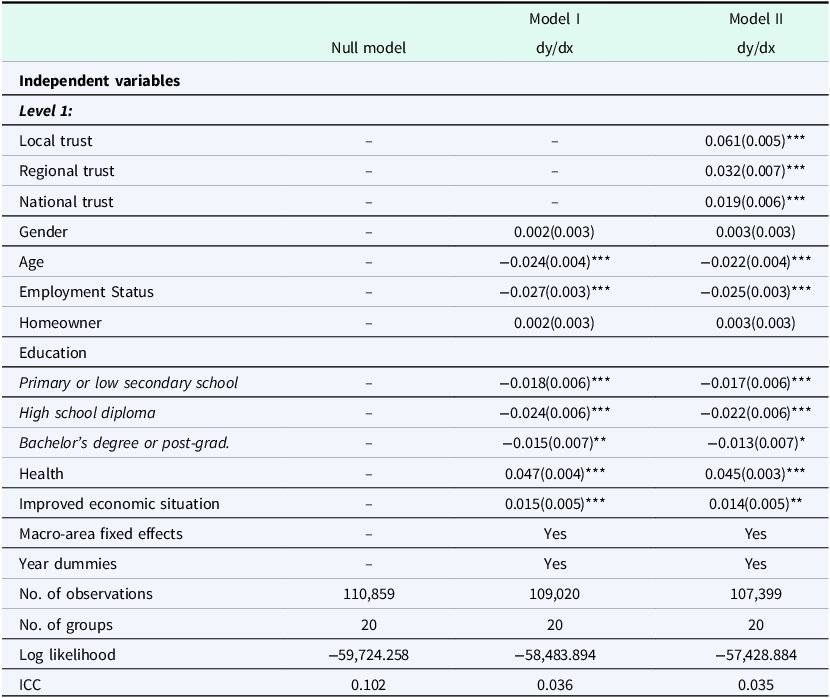
Table 2 includes only variables at the individual level. Following standard practice in multilevel modelling (e.g., Rabe-Hesketh and Skrondal, Reference Rabe-Hesketh and Skrondal2012; Snijders and Bosker, Reference Snijders and Bosker2012), we estimate the models sequentially. In particular, we first report a null model, i.e., a two-level logit with only a random intercept at the regional level (null model). Model I adds controls (gender, age, employment status, homeowner, education, health, and improved economic situation), together with macro-area fixed effects and year dummies. Model II then adds the three institutional trust variables (local, regional, and national). All coefficients are reported as average marginal effects (AMEs, dy/dx).
Multilevel logit models (individual level); average marginal effects

Notes: Average marginal effects are computed over the estimation sample. Robust standard errors are in parentheses.
* p < 0.10, **p < 0.05, ***p < 0.01.
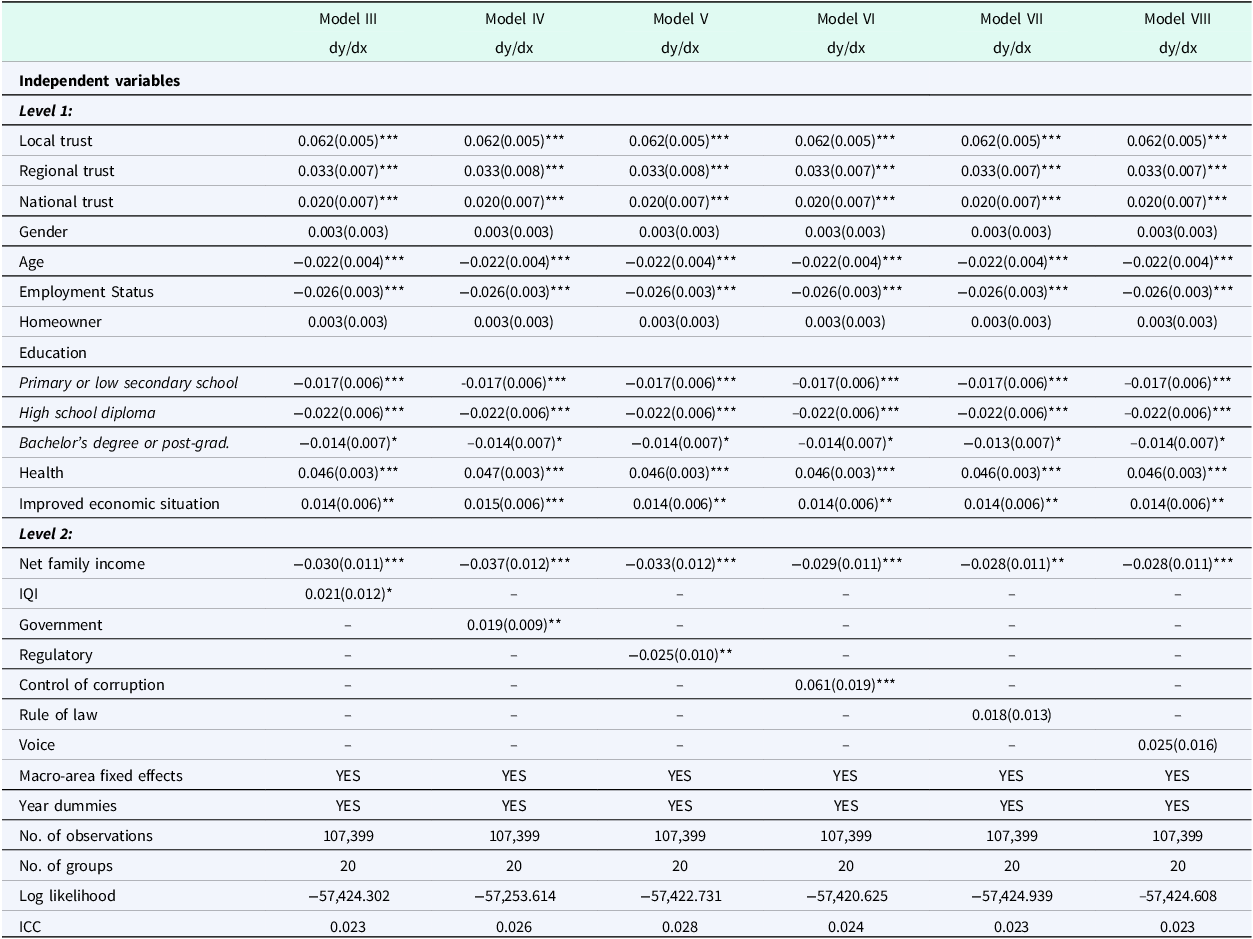
Table 3 extends these specifications by adding regional-level covariates. Specifically, Model III includes Net family income and the aggregate IQI. Models IV–VIII, then add institutional quality sub-components (Government, Regulatory, Control of corruption, Rule of law, and Voice) one at a time.
Multilevel logit models (individual and regional levels); average marginal effects

Notes: Average marginal effects are computed over the estimation sample. Robust standard errors are in parentheses. Random intercepts are included at the regional level to control for intra-regional correlation, allowing each of Italy’s 20 regions to have its own baseline level of perceived water quality.
* p < 0.10, **p < 0.05, ***p < 0.01.
Both Tables 2 and 3 report the region-level random intercept variance and the ICC, summarising how much residual heterogeneity in perceived tap water quality lies between regions. Comparing these quantities across specifications indicates whether regional institutional factors account for some of the cross-regional clustering in perceptions: a reduction in the random intercept variance (and in the ICC) after adding regional covariates suggests that the institutional context explains some of the between-region variation.
The null model yields an ICC of approximately 0.10, indicating that approximately 10% of the unexplained variance in perceived water quality is attributable to between-region differences. When individual covariates and trust variables are added (Table 2), the ICC falls to approximately 3–4%, suggesting that a substantial share of territorial heterogeneity is accounted for by micro-level characteristics. Adding regional covariates (Table 3) leads to a further, albeit modest, reduction in the ICC (to approximately 2–3%), indicating an additional role of the institutional context.
Individual level: institutional trust and socio-economic characteristics (H1a–H1c)
Table 2 shows that all three trust variables are positively and significantly associated with the probability of reporting high tap water quality. Because the coefficients are reported as average marginal effects, they can be read directly as percentage-point changes in predicted probability.
In particular, local trust increases the probability by approximately 6–7 percentage points (dy/dx ≈ 0.06, p < 0.01), followed by regional trust at approximately 3–4 percentage points (dy/dx ≈ 0.03, p < 0.01), and national trust at approximately 2 percentage points (dy/dx ≈ 0.02, p < 0.01). This ordering is consistent with the proximity argument, as institutions that are closer to citizens are more visible in everyday service delivery and exert a stronger association with perceived quality.
The controls remain stable in terms of sign and magnitude across all models. Younger respondents, those who are not employed, and individuals with lower education levels are more likely to report high water quality, whereas having higher levels of education and being employed are associated with more critical assessments. Self-reported good health is strongly and positively related to perceived water quality, whereas gender and homeowner status do not display systematic effects. Finally, an improved economic situation is positive and statistically significant.
Overall, these results provide robust support for Hypotheses 1a–c: higher local, regional and national trust is associated with a higher probability of perceiving tap water as good quality, with local trust exerting by far the clearest effect.
Regional level: institutional quality dimensions (H2a–H2f)
At the contextual level (Model III, Table 3), the overall IQI shows positive but weak evidence (AME = approximately 2 percentage points) and is only weakly significant (p < 0.10), suggesting that specific governance dimensions matter more than the composite index (H2a weakly supported).
The disaggregated analysis of IQI components is more informative. Government (Model IV) has a positive and statistically significant marginal effect of approximately 2 percentage points (p < 0.05), which is in line with H2b (hypothesis supported).
In contrast, regulatory quality (Model V) is negative and statistically significant, and does not support H2c (hypothesis not supported). One possible interpretation is that stricter or more visible regulation may increase risk salience.
The strongest macro-level association emerges for Control of corruption (Model VI), whose marginal effects are positive (approximately 6 percentage points) and highly significant (p < 0.01). This finding provides consistent evidence in favour of H2d. In contrast, Rule of law and Voice (Models VII and VIII) display positive but statistically non-significant marginal effects; therefore, we find no evidence in favour of H2e and H2f. These findings suggest that not all aspects of governance are equally relevant for perceived service quality.
Finally, Net family income is negatively associated with perceived water quality. This finding is consistent with higher-income contexts being more critical or demanding in their service evaluations (perceived quality).Footnote 10
Cross-level effects between local trust and institutional quality
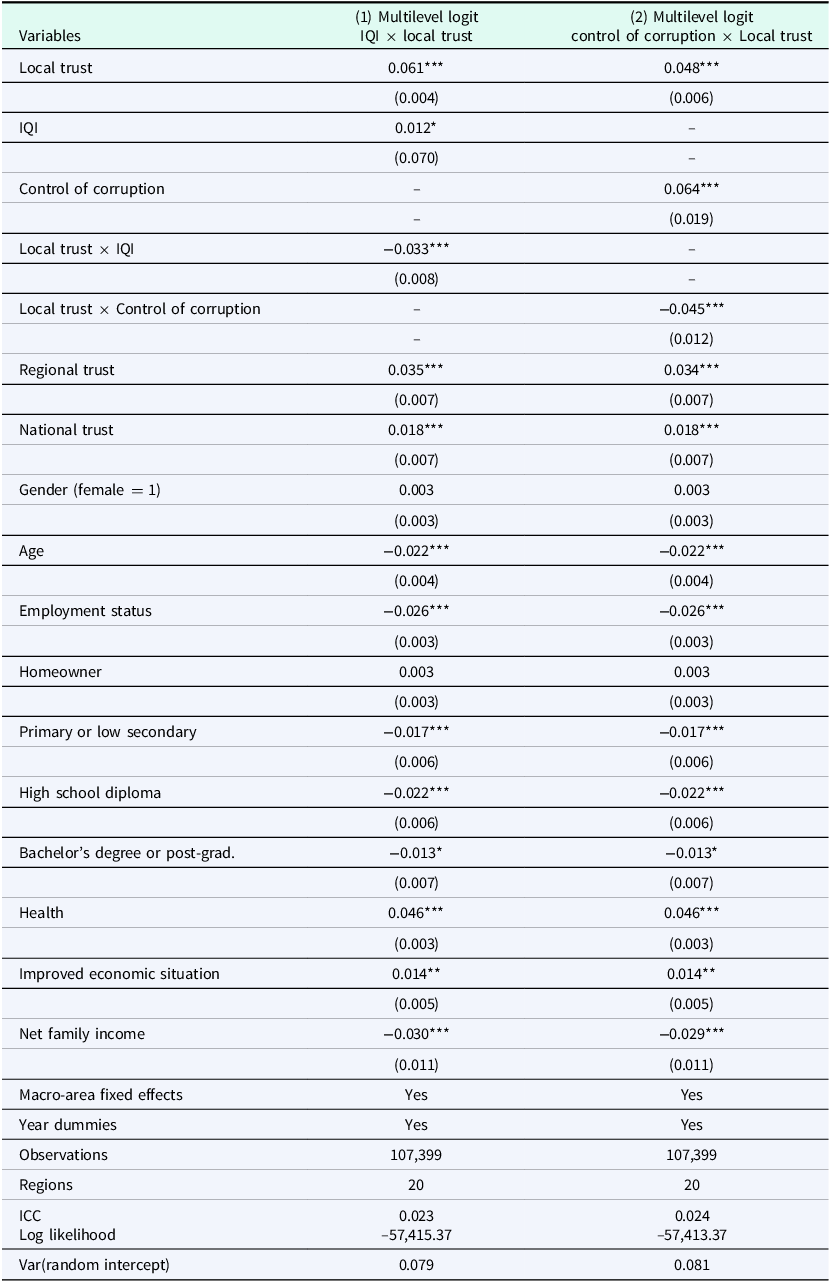
We estimate additional multilevel logit models with interaction terms between local institutional trust and regional governance indicators. Specifically, we augment the baseline two-level random intercept specification with (1) interaction effects between local trust and the IQI and (2) interaction effects between local trust and the Control of corruption component of the IQI. In both cases, the institutional indicators are mean-centred, and the models include the same set of covariates, including macro-area fixed effects and year dummies as in the main specification, with random intercepts at the regional level.
Table 4 shows that the main patterns are consistent across the two specifications. First, local trust and regional institutional quality remain positive and statistically significant, suggesting that they are independently associated with more favourable perceptions of tap water quality. Second, the interaction terms between local trust and IQI/Control of corruption are negative and statistically significant. This finding indicates that the marginal effect of local trust decreases as regional institutional quality increases. In regions with weaker institutional environments, local trust plays a stronger role in shaping perceptions of service quality, while in regions with higher institutional quality, the additional influence of local trust is weaker. In other words, stronger institutions are associated with more favourable perceptions overall, but local trust matters especially where institutional performance is weaker.
Multilevel logit with cross-level interaction effects

Notes: Average marginal effects are computed over the estimation sample. Robust standard errors are in parentheses.
* p < 0.10, **p < 0.05, ***p < 0.01.
Robustness checks
Mundlak multilevel logit (correlated random effects)
To assess whether our multilevel results are robust to potential correlations between regional random effects and individual-level regressors, we estimate a Mundlak (correlated random effects) specification (Chamberlain, Reference Chamberlain1982; Mundlak, Reference Mundlak1978; Rabe-Hesketh and Skrondal, Reference Rabe-Hesketh and Skrondal2012; Wooldridge, Reference Wooldridge2010). This approach relaxes the standard random effects assumption by allowing unobserved regional characteristics to be correlated with individual-level trust.
Specifically, local trust is decomposed into two components: a within-region component, obtained by centring individual trust around the regional mean, and a between-region component, captured by the regional average level of local trust and included as a level-2 regressor.Footnote 11
The within-region component of local trust remains positive and highly statistically significant (AME = 0.06, p < 0.01), very close to the baseline multilevel estimates. In contrast, the between-region component is positive but weak, indicating that most of the association operates through within-region variation once the institutional context is controlled for.
Regional trust and national trust, as well as individual-level controls, remain stable across specifications, while the IQI preserves a positive, albeit weaker, association with perceived tap water quality. Full results are reported in Online Appendix.Footnote 12
Endogeneity analysis
The relationship between local trust and perceived water quality may be affected by endogeneity. Unobserved local factors could simultaneously influence social cohesion and service performance, while negative service experiences may themselves erode citizens’ trust. To address these concerns, we adopt a control function (CF) approach (Rivers and Vuong, Reference Rivers and Vuong1988), also referred to as two-stage residual inclusion (2SRI).
In the first stage, local trust is instrumented via two variables that are theoretically related to citizens’ confidence in institutions but unlikely to directly affect perceptions of tap water quality, conditional on regional controls: i) the natural logarithm of the average duration (in days) of civil judicial proceedings, obtained from the Ministry of Justice; and ii) the natural logarithm of reported thefts, which is based on ISTAT crime statistics.Footnote 13
Judicial duration reflects institutional efficiency and administrative capacity, while theft rates capture local insecurity and institutional weakness; neither variable has an obvious direct channel to water quality perceptions. Both variables are associated with citizens’ trust in local institutions and, conditional on controls, are assumed not to affect individuals’ perceptions of tap water quality. This strategy is consistent with standard econometric practice (Angrist and Pischke, Reference Angrist and Pischke2009; Lewbel, Reference Lewbel2012; Wooldridge, Reference Wooldridge2010).
Instrument relevance and validity are supported by standard diagnostic tests. The Cragg–Donald Wald F statistic (F = 232.54) significantly exceeds the conventional Stock–Yogo critical values, indicating that weak instruments are not a concern. The Anderson canonical correlation LM test rejects the null hypothesis of under-identification (p < 0.001). The Sargan test for over-identification yields a non-significant p value (p > 0.05), providing no evidence against the joint validity of the instruments under the maintained exclusion assumptions.
In the second-stage logit model, the first-stage residual is included alongside local trust and the full set of controls. This term proxies for the potential correlation between local trust and unobserved determinants of perceived water quality, thereby providing a test of endogeneity. The results suggest that accounting for potential endogeneity is empirically meaningful in this setting, while the positive and statistically significant association of local trust remains robust. In contrast, regional trust and national trust lose statistical significance, suggesting that their baseline associations partly reflected unobserved heterogeneity. Overall, citizens’ evaluations of tap water quality appear to be mediated by trust in the most proximate level of governance, which is directly responsible for local public service provision.
Finally, the IQI varies only at the regional level and is constant for individuals within the same region. While this finding does not establish causal identification per se, it reduces concerns about reverse causality. The larger magnitude may reflect the correction of attenuation bias or omitted-variable bias affecting local trust. Full results are reported in the Online Appendix.Footnote 14
Discussion
Beyond confirming the patterns observed in other public service domains, this analysis shows that trust in institutions is closely related to citizens’ evaluations of essential services even in a context where tap water is generally considered technically safe and where outcomes capture perceived quality rather than measured contamination.
Three key insights emerge from the multilevel analysis. First, the results point to a proximity gradient: as trust operates across institutional levels, its association with perceived quality decreases with geographic and administrative distance.
Trust in local institutions has the strongest relationship with favourable perceptions, which is consistent with procedural fairness and legitimacy arguments (Tyler, Reference Tyler2006). This proximity gradient may reflect the greater visibility and daily experience that individuals have with local governance actors and service delivery, making trust judgements more concrete at this level and potentially buffering broader scepticism towards higher-level institutions (Hegewald, Reference Hegewald2024; Sabbi et al., Reference Sabbi, Osei, Wigmore-Shepherd and Ahlin2024).
The evidence also suggests that the quality of regional governance matters. Government effectiveness and control of corruption appear relevant, probably because they signal competence and reliability in public administration and reduce the perceived risks associated with service provision. In contrast, the rule of law and voice show no statistically significant link to service-specific evaluations, which may reflect more indirect and long-term pathways of influence, as well as limited variation across regions.
Additionally, the negative association observed for regulatory quality suggests a potentially important perception mechanism: more visible or stringent regulation may heighten risk awareness (Pidgeon et al., Reference Pidgeon, Walls, Weyman and Horlick-Jones2003) or increase expectations, leading to more critical assessments of service quality. In settings where enforcement is uneven, stringent rules without credible implementation may foster cynicism, a pattern often discussed in relation to Italy’s long-standing territorial divide (e.g., Italy’s north–south divide; ISTAT, 2022).
In terms of broader theoretical implications, traditional public goods theory (Samuelson, Reference Samuelson1954) implies that effective public provision should reduce individuals’ reliance on private alternatives. Our findings reveal that this relationship is mediated by institutional trust, even when a service is perceived as technically adequate, on average. In this sense, trust can be viewed as a key determinant of citizens’ reliance on public goods.
This perspective helps explain why technically sound service provision may not translate automatically into public confidence and consistent behavioural compliance (Parag and Roberts, Reference Parag and Roberts2009).
Our findings should be interpreted as evidence of systematic associations within a multilevel framework rather than definitive causal effects.
Overall, the evidence indicates that institutional proximity is central: while trust at all levels is positively associated with perceived service quality in our baseline models, only local trust remains consistently robust across specifications that address unobserved heterogeneity and potential endogeneity. This finding suggests that citizens’ evaluations of local public services are anchored primarily in their confidence in the most proximate level of governance.
Conclusions
This paper highlights the role of institutional trust and governance quality in shaping citizens’ perceptions of tap water quality in Italy. The results suggest that trust in public institutions at different territorial levels is associated with more favourable evaluations, with the strongest relationship emerging for local trust. Overall, this study sheds light on how individuals evaluate public services when performance is difficult to observe and information is imperfect. In this respect, institutional trust can shape perceptions and may contribute to systematic gaps between experienced service quality and measured performance.
The multilevel framework also suggests that some of the territorial clustering in perceptions is linked to contextual characteristics. Differences in governance quality account for some cross-regional variation, particularly through dimensions related to effectiveness and integrity. These findings suggest that perceived tap water quality reflects not only individual characteristics but also the institutional environment in which service provision is embedded.
Consistent with the interaction models and the macro-area heterogeneity analysis, the main conclusions are not driven by a single region or macro-area: the patterns are consistent across the north and south, with greater associations in areas with weaker governance.
Policy measures may benefit from integrating improvements in service delivery with approaches aimed at fostering institutional credibility and trust. Strengthening transparency and responsiveness, especially at the local level – for example, through regular and accessible communication on monitoring and testing – may reinforce citizens’ confidence in water services. Strengthening integrity and accountability can further support trust in the reliability of public utilities. Finally, regulatory efforts may not automatically translate into better perceptions unless they are accompanied by clear communication and visible effectiveness; targeted information strategies could help align expectations and reduce uncertainty, especially among groups that are prone to evaluating services more critically.
Nevertheless, this paper has some limitations. First, perceived water quality is an overall subjective judgement item that encompasses different sensory dimensions (taste, smell and clarity), which in turn may respond differently to institutional factors. Second, the MHS is a repeated cross-section rather than a panel and prevents us from following the same households over time or fully identifying dynamic effects. Third, harmonised regional-level indicators of tap water quality are not consistently available for the study period. Moreover, variation in source-water conditions – which may affect treatment intensity and, in turn, organoleptic characteristics such as taste or odour – is not directly observed in our data. While regulatory standardisation and continuous monitoring substantially reduce these differences, we cannot fully rule out their influence on perceived water quality. However, these limitations also point to avenues for future research. The trust mechanisms analysed here could be extended to policy areas beyond water services, especially where regulatory complexity, overlapping or inconsistent rules, and weak enforcement are more salient. In such a setting, future research could further investigate how regulatory quality, rule of law, and voice and accountability jointly affect both institutional trust and citizens’ perceptions of service performance.
While we treat institutional quality and institutional trust as analytically distinct dimensions, they are likely to interact dynamically over time. Our cross-sectional design does not allow us to model potential feedback processes whereby improvements in governance performance may gradually reinforce institutional trust.
Supplementary material
The supplementary material for this article can be found at https://doi.org/10.1017/S1744137426100538
Acknowledgements
This research is funded within the framework of the PRIN Project (Progetti di Ricerca di Interesse Nazionale) ‘Bridge over troubled water (consumption): drivers of consumers’ behaviours and policy interventions’. We also express our gratitude to ISTAT (Italian National Institute of Statistics) for providing the data relating to the MHS. A preliminary version of this work was presented at the international conference Consumption Behavior and Sustainable Uses of Natural Resources (COBENARE), held in October 2024 at the University of Naples Parthenope, Napoli. The work was also presented at the XXXVII SIEP Conference 2025, held in September 2025 at the University of Naples Federico II. We are grateful to conference participants for their insightful comments and constructive suggestions, which have substantially contributed to improving the quality of this work.



 Open access

