


1. Introduction
Interdisciplinary connected products, such as smart products, are inherently complex in both their architecture and development processes (Abramovici, Reference Abramovici, Chatti, Laperrière, Reinhart and Tolio2019). One of the main challenges in their development is the management of heterogeneous and unstructured data, which can lead to delays and quality issues (Kamm et al., Reference Kamm, Jazdi and Weyrich2021). In this context, unstructured data refers to information presented in non-identifiable and non-normalized formats, such as images or textual content. These challenges arise from various factors, including different modeling environments, methodological approaches, and the integration of diverse components. Model-Based Systems Engineering (MBSE) serves as a crucial enabler for managing and controlling this complexity by providing more precise and comprehensive system modeling than traditional document-based approaches. This involves the formalized application of modeling to facilitate activities such as system requirements definition, design, analysis, verification, and validation throughout the engineering lifecycle (INCOSE, 2023). Harmonizing existing model-based solutions can facilitate engineering resource reuse and conservation. The integration of Artificial Intelligence (AI) into MBSE presents promising opportunities to enhance sustainable modeling practices. AI can improve efficiency and automation in model generation by automating model creation and management, thus making the development process more resource-efficient (Sultan and Apvrille, Reference Sultan, Apvrille, Egyed, Wimmer, Chechik and Combemale2024). Furthermore, AI facilitates the integration and management of large datasets, promoting knowledge exchange and interoperability among different modeling environments or stakeholders (Zhang and Yang, Reference Yang, Zhan, Fan, Jiang and Zhou2024). Existing approaches focus single parts of the MBSE-concept, for example, the AI supported requirements definition and modeling (Dehn et al., Reference Dehn, Jacobs, Zerwas, Berroth, Hötter, Korten, Müller, Gossen, Striegel and Fleischer2023). Especially the aspect of management of the large data amount in these early phases needs to be secured, thus the following lifecycle phases have an ensured and early access to it and act as a basis for the AI approach (Aldoseri et al., Reference Aldoseri, Al-Khalifa and Hamouda2023). This becomes important while developing collaboratively in large value creation networks and the integration of various stakeholders (Allee, Reference Allee2009). By employing ontologies and semantic rules, AI supports sustainable development through improved data management. At the same time, it offers valuable support in decision-making through real-time visualization, enhancing the understanding of complex systems and fostering innovative approaches. Especially ambiguous nomenclature of different stakeholders which may pose a challenge in collaboration engineering (Sankowski et al., Reference Sankowski, Küchenhof, Dambietz, fle, Wallisch, Krause and Paetzold2021), can be homogenized. Focusing on these general facts this paper aims to explore how the integration of AI into MBSE can improve the management of heterogeneous and unstructured data to enhance sustainability in the development of complex, interdisciplinary system models.
This paper presents a framework that enables AI supported and tool independent modeling in an MBSE-approach. By using different layers and configuration solutions, the framework results in an environment that saves engineering resources and enables sustainable engineering.
The Design Research Methodology (Blessing and Chakrabarti, Reference Blessing and Chakrabarti2009), was used to provide the critical context of the approach. In chapter 2 existing approaches were analyzed for their strengths (Research Clarification and Descriptive Study I), clarifying the need for a more comprehensive framework using existing standards and best practices where applicable (Prescriptive Study), as it is presented in chapter 3. In chapter 4 the framework was validated using an existing system model to highlight the improved traceability (Descriptive Study II). Chapter 5 provides a conclusion and outlook to finalize the paper.
2. State of the art
Sustainability and circularity are increasingly recognized as essential components for the future, not only from the perspective of products but also from the viewpoint of engineering processes. (Kirchherr et al., Reference Kirchherr, Reike and Hekkert2017) differentiated circularity as a specific approach focused on reducing waste and optimizing resource use within a closed-loop system. Thereby sustainability encompasses a broader framework that includes environmental, social, and economic considerations. Circularity is one method to achieve sustainability but does not always address all aspects of sustainability, and social equality / acceptability (Geissdoerfer et al., Reference Geissdoerfer, Savaget, Bocken and Hultink2017) in particular. The integration of these principles into engineering is crucial for fostering sustainable science (Stojčić et al., Reference Stojčić, Zavadskas, Pamucar, Stevic and Mardani2019).
The approach presented in this paper emphasizes that circularity and sustainability should not only focus on physical goods or climate-related aspects but also on the engineering process itself, with particular attention to the role of engineers as key resources that must be preserved and supported. By saving and protecting the resource engineer, due to reusing established knowledge, circularity can be achieved.
Further research activities will only focus on the integration of circularity within the engineering process. Engineering within a model-based environment, continues to face challenges related to both acceptance and effective usage. Despite the potential benefits of MBSE, engineers often struggle with its efficient application, as highlighted by (Chami and Bruel, Reference Chami and Bruel2018). Surveys indicate that engineers encounter difficulties in adopting MBSE practices due to various factors, including technical complexity and organizational resistance (Akundi et al., Reference Henderson and Salado2022; Henderson and Salado, Reference Akundi, Ankobiah, Mondragon and Luna2024). One of the primary barriers to MBSE adoption is the increasing complexity of modern systems, such as smart products and cyber-physical systems. These systems integrate mechanical, electrical, software, and communication components, which complicates holistic modeling efforts. The challenge of managing this complexity is well-documented in literature. For instance, (Abramovici, 2019) and (Derler et al., Reference Derler, Lee and Vincentelli2012) emphasize that the interconnected nature of these systems makes it difficult to create comprehensive models that capture all relevant interactions. This complexity is further increased by the need to manage data across different domains and ensure interoperability between various subsystems. Another significant issue is the management and reuse of models. (Cameron and Adsit, Reference Cameron and Adsit2020) and (Madni and Sievers, Reference Madni, Sievers, Madni, Boehm, Ghanem, Erwin and Wheaton2018) point out that despite the potential for model reuse to reduce costs and improve efficiency, this practice is not consistently implemented across industries (Robinson et al., Reference Robinson, Nance, Paul, Pidd and Taylor2004). Effective reuse approaches are among others within Computer Aided Design (CAD) and the concept of Knowledge Based Engineering (KBE), nevertheless it has a strong CAD-focus (Verhagen et al., Reference Verhagen, Bermell-Garcia, van Dijk and Curran2012). Effective reuse requires organizational commitment and appropriate tools for managing model libraries. Ontologies can support the management, networking and the representation of large amounts of knowledge or data models. To ensure potential reuse, the networking of the models is crucial. However, many organizations lack the necessary infrastructure or incentives to prioritize reuse (Robinson et al., Reference Robinson, Nance, Paul, Pidd and Taylor2004). As a result, engineers often face high costs associated with creating new models from scratch rather than leveraging existing ones (Yang et al., Reference Yang, Zhan, Fan, Jiang and Zhou2017). The financial burden associated with developing MBSE models is considerable. (Ramadesigan et al., Reference Ramadesigan, Northrop, De, Santhanagopalan, Braatz and Subramanian2012) note that the initial investment in creating detailed models can be substantial, particularly when model reuse is not fully exploited. This can lead to inefficiencies in the engineering process, where time and resources are spent on redundant modeling efforts. To address these challenges, integrating AI into MBSE processes offers promising solutions. AI can enhance model reuse by automating aspects of model creation, validation, and optimization. For example, AI-driven tools can analyze large datasets to identify patterns and suggest improvements in model design, thus reducing the time and effort required for manual modeling tasks, as described by (Ghoreishi and Happonen, Reference Ghoreishi and Happonen2020). Additionally, AI can support the circularity of models by enabling predictive maintenance, optimizing resource usage, and facilitating reverse logistics in product lifecycle management (Madanaguli et al., Reference Madanaguli, Sjödin, Parida and Mikalef2024). This integration not only improves efficiency but also contributes to sustainability by reducing waste and promoting the reuse of engineering assets.
Nevertheless, there is a significant lack of approaches, to enable AI-based modeling in an MBSE environment. (Chami et al., Reference Chami, Zoghbi and Bruel2019) presented the Text-to-Model framework which enables the generation of single parts of Systems Modeling Language (SysML) models from text by using AI. Different roles are needed to ensure the correct data input, transformation and usage within the SysML tooling. Importing text is divided into phases deployment and training, to ensure high-quality results on the modeling parts. Regarding the problems of model interchanges combined with the often document based engineering, the focus of using a text-based model creation enables a deeper and wider knowledge baseline.
(Kourani et al., Reference Kourani, Berti, Schuster, van der Aalst, van der Aa, Bork, Schmidt and Sturm2024) developed a Large-Language-Model (LLM) based framework for process modeling along the engineering phase. Thereby the framework is LLM independent and each LLM that offers code generation can be used. Users can input text in natural language which will then be supported by additional information, such as an example code snippet or the SysMLv2 language specification file, to craft a comprehensive prompt. With this prompt the LLM can then generate executable code, which can be used by different environments, such as Business Process Model and Notation (BPMN), to generate the process model. Through an integrated loop mechanism, models can be refined and potential errors handled. The aspect of using an independent LLM for the code generation is effective and enables an easy model generation. Through the natural language communication, the usage for unskilled users is ensured.
(Kestel et al., Reference Kestel, Kügler, Zirngibl, Schleich and Wartzack2019) has created an ontology-based approach for the provision of knowledge and focusing especially on simulation. Text mining is used to integrate and acquire knowledge from text-based simulation documents. As a result, structured data sets will be created and can then be analyzed by a data mining approach. Both steps are ensuring the later ontology generation and the transfer into an ontology knowledge base. By the transfer from text-based knowledge into ontologies, the knowledge will be automatically captured and structured. These networking concepts are the baseline for a later potential AI-driven design and knowledge provision.
(DeHart, Reference DeHart2024) has developed a methodology that enables the interaction of LLM with SysML v2. The LLM has interactions with several systems models via natural language queries. Thereby Python code snippets are provided to execute data manipulations tasks. These steps ensure communication between the model and the systems engineers via natural languages and is supported by the LLM due to the automated script generation. Via the given Application Programming Interface (API) a direct communication to the SysML v2 is given. Loop mechanisms are integrated to reduce code failures and level up the quality. There is no active support for the systems engineer and the focus is only on the SysML v2. In conclusion, a viable approach for AI-driven modeling within model-based systems engineering, which would enhance circularity in engineering, is currently lacking. Based on the reviewed state of the art on AI-driven model-based engineering, the following research questions can be identified for this contribution:
How can large language models and ontology-based approaches improve model reuse in MBSE environments, and what are the implications for engineering towards enhanced circularity?
What are the key technical and organizational barriers to the adoption of MBSE in complex systems, and how can AI-driven solutions mitigate these challenges?
3. Framework for AI-driven model-based Systems Engineering
Considering the challenges associated with reusing system models and the necessity for AI-based support for system engineers during the modeling process, a novel framework is proposed. The framework is designed to meet several critical requirements. First, it must facilitate comprehensive support during the early stages of model definition, leveraging the reuse of existing knowledge within a MBSE environment. This support should be independent of specific tools, ensuring compatibility with various established MBSE platforms. The integration of multiple knowledge models will be achieved by ontologies and AI techniques, ensuring the required level of granularity and information condensation. Additionally, lifecycle management considerations must be incorporated to ensure that early model-based solutions are robust, and that development knowledge is effectively captured and utilized. The framework relies on the integration of various lifecycle data sources with both structured and unstructured data. Unstructured data may include implicit knowledge, while structured data can encompass existing Product Lifecycle Management (PLM) models. Figure 1 illustrates the general structure of the framework. The framework emphasizes the initial phases of model creation and definition, particularly in requirements specification and both discipline-specific and interdisciplinary system development. The approach is structured into four distinct layers to ensure sustained support for the generated model environment. Some layers are further subdivided into additional levels, representing essential steps for successful future implementation.
Framework for Artificial Intelligence-supported model-based Systems Engineering

3.1. Data pre-processing layer
Accessing data across multiple sources is the framework’s foundation. The goal of the Data Preparation and Acquisition level is to gather data from various heterogeneous IT systems and to find a way to access, restructure and reorganize the data for the following steps. The database level then aggregates the data and presents them to the following levels in a uniform structure. The simplest solution is to manually upload data from the source systems. Another possibility is the use of an existing knowledge base as the primary data source. The third option is to use a common API based on a federated data integration platform like the architecture presented in (Eickhoff et al., Reference Eickhoff, Eiden, Göbel and Eigner2020) or a standard like OSLC (Speicher, Reference Speicher2019). Hybrid approaches are possible. The first two levels provide a unified structure as an input for the next level, ontology-based Data Preparation. In this level, the data is integrated into a single, multiple or hybrid approach of ontologies for the purpose of creating an easily human and machine readable, uniform knowledge source. Single ontologies use source schemas that are related to a shared global ontology, whereby multiple ontologies represent each data source by an own ontology. Hybrid is the combination of single and multiple ontologies (Fahad, Reference Fahad2023). Ontologies serve the purpose of basic reasoning to validate newly input knowledge against constraints such as a changing regulatory framework. Additionally, they maintain consistency while importing knowledge from multiple different stakeholders and collaboration partners using different nomenclature or the same tools, parts and principles in different product development contexts. In relation to the upper layers of the framework, the ontologies take on the role of a unified data source to enhance the AI in the context of Retrieval Augmented Generation (RAG), to provide very domain specific knowledge that would otherwise not be available or unlikely to be retrieved.
3.2. Knowledge architecture layer
Whereas the ontologies used in the previous layer can potentially use logical reasoning to generate the knowledge required for the following steps, the Knowledge Architecture Layer bundles all functionality related to LLM. This includes functionality to analyze existing models, either based on inspecting the model in a machine-readable format or by visually analyzing existing diagrams as images. Another basic functionality of this layer is the generation of new model elements or partial models. This is based on the generative capabilities of an LLM. To ensure the syntactic and factual correctness of this approach, multiple techniques can be used, centered around providing the LLM with the data gathered in the previous steps. This can be achieved by injecting relevant knowledge into the prompt (Retrieval-Augmented Generation, RAG), or by allowing the LLM to call various functions during the generation step. Additionally, approaches such as grammar-based decoding as well as automated checks have been used to improve LLM accuracy in engineering contexts (Eickhoff et al., Reference Eickhoff, Ngamakoua Hakoua and Gobel2024). These capabilities can support the user during model creation in different ways such as providing him with automatic updates to regulatory changes using tools to scrape websites of relevant governmental bodies.
The scraped information can in turn be stored in the previously mentioned Data Pre-Processing Layers and ontologies to later be retrieved and enable the respective engineers to adapt and control the newly arising constraints. The newly generated knowledge can be modeled in different ways. Once using a direct modeling approach in which the LLM writes the code corresponding to the model directly and saves it in the required file format. This approach has the advantage of easier implementation but requires the LLM to loop every time the output causes an error due to slight syntactical errors in the targeted file format. An alternative approach is the option to use the LLM for indirect modelling of the knowledge using function calling to improve the basic LLM capabilities by building agentic systems. Using this methodology, the number of loops can be reduced as the LLM does no longer write the code for the knowledge model directly but calls the functions responsible for generating the code of the respective file and therefore reduces the risk of incompatible syntax. With the advent of current open-source models such as the Llama, or Mistral family of models, providing and being optimized for function calling, this approach becomes increasingly attractive to a wide audience of researchers.
3.3. Model generation layer
As previously discussed, a primary objective is to enable support for multiple tool environments in connection within MBSE solution development. A key prerequisite for this is the availability of an open API from the tool side. Additionally, the tool must adhere to an established open standard to facilitate functionalities such as AI-driven function calls and automated model generation. For this framework mostly standards from the Object Management Group are used, due to being based on the Meta-Object Facility (MOF) and thus supporting the reuse of knowledge for different disciplines. For example, through the MOF, which is integrated in all mentioned standards of the Model Generation Layer in Figure 1 and the usage of different standards within different disciplines, the software discipline can easier and more effectively reuse solutions from the mechanical disciplines.
The Model Generation Layer serves as the interface between the engineer and the developed ecosystem. By leveraging API support, each tool environment can access the established knowledge network, regardless of the specific tools or knowledge sources being used. The primary goals are to enable direct and active integration of knowledge during the modeling process and to automate model generation based on this existing knowledge. An example of this is the utilization as a modeling support in SysML v1. Here, prior knowledge in the form of a BPMN model can be reused to help generate an activity diagram in a SysML Model. This means that the Model Generation Layer offers two kinds of usage, first the direct communication via chat and the resulting automated model generation. The second kind of usage would be the active assistance while modeling. These differentiated usage possibilities are addressing different expert levels, thus can enable a wide range of possible usage and acceptance from the user site. While non-experts can use the automated model generation, the expert can use the sequential active support while modeling. This is only an unbiased recommendation, and at the same time auto-generated models can actively be supported while models get extended, e.g., in their scope.
3.4. MBSE-lifecycle management layer
The MBSE-Lifecycle Management Layer addresses various concepts aimed at the efficient handling and governance of data throughout the engineering lifecycle. Unlike other layers in the framework, this layer offers flexibility, allowing users to determine the specific management requirements that need to be integrated into the modeling environment. During the modeling process within the proposed framework, a significant amount of information and knowledge is generated, necessitating systematic management. This layer will focus on discussing strategies for managing this data and exploring possibilities for its subsequent utilization. Two key approaches already highlighted within the framework are PLM and the Asset Administration Shell (AAS). The integration of PLM facilitates early-stage management of engineering data, including the governance of various model-based systems. This early data management is crucial for later validation processes and for ensuring a comprehensive, holistic model. PLM supports continuous tracking and refinement of models, which is essential for maintaining consistency across different stages of product development. In addition to PLM, the AAS concept plays a central role within the MBSE-Lifecycle Management Layer by ensuring that model-based solutions are created and represented as assets. The primary objective of integrating AAS is to enable early incorporation of engineering data into assets, paving the way for the subsequent development of digital twins. By embedding engineering models into digital twins from the initial phases, a holistic perspective of the product is achieved, allowing for advanced considerations such as simulation data integration. This early integration facilitates early-stage verification and validation of models, ensuring that potential issues are identified and addressed before they propagate through later stages of development. Furthermore, different management environments can be seamlessly integrated through APIs. By enabling direct and automated communication between layers within the framework, results can be efficiently stored in these environments without manual intervention. This automation enhances traceability and ensures that all relevant data is systematically captured and made available for future analysis or decision-making processes. In summary, effective lifecycle management through tools such as PLM and AAS ensures comprehensive oversight of engineering data from its inception through to its utilization in digital twins, facilitating early verification, validation, and continuous improvement throughout the product lifecycle.
4. Instantiation
In this chapter, the framework presented in Figure 1 is instantiated for a well-established engineering use case, specifically, “enabling wireless charging (WLC) of mobile phones during driving a car”. Initially, a configuration of the framework will be developed, followed by the utilization of both chat-based and active support mechanisms to facilitate the AI-driven generation of various system models.
4.1. Enabling AI-driven model-based Systems Engineering
The development of AI-driven support relies fundamentally on a robust data foundation. For the selected validation case, initial knowledge from prior tests and developments in WLC technology within the consumer electronics sector is available across various modeling environments and knowledge repositories. In terms of data acquisition and preparation, multiple departments and teams associated with the engineering concept will be involved. It is crucial that the imported data is directly relevant to the concept or its individual subsystems. An innovation engineering knowledge base, as established by (Mollahassani et al., Reference Mollahassani, Eickhoff, Juresa and Göbel2023), is integrated directly. Additional models and knowledge are imported via API-based input as described by (Eickhoff et al., 2020). The innovation engineering knowledge base encompasses preliminary test results, system models, and requirements models. Concurrently, different departments have concentrated on the development of components such as coils, microcontrollers, and sensors. All related knowledge models are stored in distinct modeling environments, such as Cameo Systems Modeler, which includes SysML v1 and BPMN models. Additionally, the PLM tool (CIM-Database) is connected to ensure access to stored PLM data and other relevant system models with MBSE relationships. Consequently, the initial data must be imported, organized, and integrated for proper use. An ontology-based approach is used to relate these different models to one another.
A hybrid approach is utilized, wherein individual application ontologies are created to establish connections between the various models and are managed by an upper domain level ontology. As a domain ontology a smart product ontology (Mollahassani et al., Reference Mollahassani, Becker and Göbel2024) is used to manage single application ontologies, such as coil-, sensor- or service-ontology, which can be called “knowledge chains”. Knowledge chains represent a subset of an ontology which in itself is a smaller ontology, where different models are directly connected to the single different classes of the ontology. By networking the ontologies, the connected models will be automatically networked too. Those single application ontologies are created by the user and an excerpt of the creation process and possibilities is given in Figure 2. This guarantees the correct data preparation and later creation of networking. In the next step the Llama-LLM from Meta (Meta-llama, 2024) is used to enable the AI-based networking.
This condensed networking is supported by analyzing the content of the different models. By using a created XML-reader different imported models can be analyzed, and the results are represented in a list that includes the different model elements, naming and quantity. This result can then be used by Llama for condensed networking, commonly with the results from the function-based, textual and visual analysis. Several diagrams within the SysML v1 models were saved as SVG, to show how the framework can incorporate existing models that are only available in visual form.
Creation of the framework

The next step would be the LLM based modeling which compares the different knowledge chains leveraging Llama. An excerpt is shown in the middle of Figure 2, where two different chains are merged and generated new combined models. By the combination of different knowledge models, new models or partial models will be created, ensured by the generative capabilities of Llama. For this purpose, the LLMs capabilities are enhanced by enabling function calling. Function calling enables the language model to call and execute functions for different tasks by defining the input parameters and keywords so that a relevant framework can execute the functions and return the relevant information back to the LLM for output quality. One example of this is calling the SysMLv2 API so the language model can implement SysML models on its own. Other scenarios might include accessing web browsers or specific website APIs to perform checks on regulatory constraints and changed laws and retrieve information from standards or technical documentation documents (Manduzio et al., Reference Manduzio, Galatolo, Cimino, Mario, Scilingo and Cominelli2024). This is realized by using open-source frameworks that enable developers to create agents and agentic networks such as CrewAI and LangChain. By implementing the data and AI layer, users can leverage the framework to either generate complete models or receive active assistance during the modeling process.
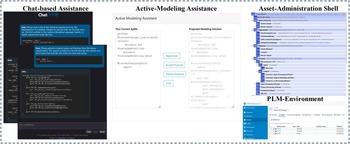
Both approaches are utilized in this specific case. For instance, using the prompt “Generate a system model in SysML v2 that includes the requirements and functional architecture of a mobile phone wireless charger used in a car while driving”, a portion of the overall system model is created. An excerpt of this generated model is shown in the left view of Figure 3. This initial model can then be further refined by the user with the aid of Active-Modeling Assistance. For example, since the generated model does not include a logical architecture for the WLC system, the user must manually define this part. As the modeling process occurs within the textual SysML v2 environment, the generated code can be imported and extended. The Active-Modeling Assistance, illustrated in the middle excerpt of Figure 3, supports this process by providing suggestions for aspects such as the logical architecture of the “WirelessChargingUnit”. These suggestions are presented as import and autofill options and are based on continuous comparisons with relevant pre-existing solutions. In this case, potential solutions focus on a pre-existing logical architecture for an energy transfer coil, which has been tested in various environments to analyze transfer rates. This environment demonstrates support for iterative and circular modeling of new systems by reusing and building upon existing model artifacts. Additionally, the framework facilitates comprehensive management of these models by establishing direct integration between different modeling environments and management tools. For the WLC use case, connections to CIM and the AASX Package Explorer are employed to enable asset creation and lifecycle management and is presented in the right view of Figure 3.
Validation of the framework along the wireless charger

The collected data will subsequently be utilized for the development of the digital twin of the WLC, incorporating simulation aspects to enhance its representation. The integration of PLM facilitates early-stage management, which is essential for comprehensive validation and traceability throughout the product lifecycle. In this case, both used management concepts operate autonomously and are dynamically triggered by ongoing modeling activities, regardless of whether these are chat-based interactions or active assistance processes. REST APIs achieve this functionality, enabling seamless integration across diverse management environments. The application of the framework demonstrates its capability to establish a circular modeling environment within MBSE. It supports users in both system modeling and solution development for new systems by leveraging a highly interconnected network of pre-existing models and solutions, which serve as foundational elements for further innovation.
5. Conclusion and outlook
MBSE solutions are applied across various disciplines and engineering phases. However, several factors often constrain their holistic adoption, including insufficient support mechanisms, increased implementation effort, and the prevalence of heterogeneous and unstructured data. Furthermore, the current state of practice lacks robust methodologies to address these challenges, particularly in enabling supported and partially automated model generation. Integrating AI into MBSE presents significant potential to overcome these limitations by addressing the complexities associated with managing diverse and unstructured datasets. The proposed framework leverages AI-driven approaches, such as ontology-based knowledge management and LLMs, to enhance engineering processes' efficiency, sustainability, and circularity. Automating model generation, facilitating knowledge reuse, and improving decision-making through real-time visualization, this framework addresses critical barriers to MBSE adoption, including technical complexity, organizational resistance, and high costs associated with redundant modeling efforts. Its layered architecture, comprising the Data Pre-Processing Layer, Knowledge Architecture Layer, Model Generation Layer, and MBSE-Lifecycle Management Layer, provides comprehensive support for system modeling throughout various stages of the engineering lifecycle. Key features include ontology-driven data integration for harmonizing diverse knowledge sources, LLM-enabled model generation to minimize manual effort, and lifecycle management tools such as PLM or AAS to improve traceability and validation. The application of this framework to a WLC use case demonstrates its utility in establishing circular modeling environments while fostering innovation by reusing existing models. A limitation of the approach lies in its dependency on networking capabilities and quality, as these factors directly influence the outcomes. Additionally, the framework is restricted to use standardized and structured MBSE-tools. Future research should prioritize addressing scalability and interoperability challenges to ensure the proposed framework can effectively manage increasingly complex datasets and systems. To further validate the practicality of the presented framework, industrial or industrial-oriented test will have to be conducted.



 Open access

