




Introduction
In recent years, there has been increasing emphasis in Central Europe on replacing traditional conventional tillage (CT) with no-tillage (NT) soil management to reduce greenhouse gas emissions in agriculture. The European Union aims to reduce greenhouse gas emissions to a level at least 55% below the 1990 levels by 2030, and the main goal is to achieve carbon neutrality by 2050 (European Commission, 2020). Reducing emissions from the industrial, heating and transport sectors is the main target. Nevertheless, carbon sequestration in agricultural soils is considered a key policy measure to sequester some of the CO2 present in the atmosphere into long-term storage (Olhoff and Christensen, Reference Olhoff and Christensen2020). The amount of carbon contained in the soil is two to four times greater than that in the atmosphere and four times greater than that stored in vegetation (Hussain et al., Reference Hussain, Guo, Sarwar, Ren, Krstic, Aslam, Zulifqar, Rauf, Hano and El–Esawi2021). Carbon is a natural component of soil; its active incorporation into the soil can increase the current levels of soil organic carbon (SOC) and reduce the amount of carbon present in the atmosphere, mitigating the effects of climate change (Hussain et al., Reference Hussain, Guo, Sarwar, Ren, Krstic, Aslam, Zulifqar, Rauf, Hano and El–Esawi2021; Li et al., Reference Li, He, Guo, Zhang and Li2021). Throughout history, tillage has been part of field practices in crop production. The tillage practice was initially targeted to ensure good contact between seeds and soil for proper seedling emergence. Over time soil tilling has evolved into a technique that is also used to mix crop residues with soil to foster rapid decomposition before the next crop is sown. Tillage influences many soil physical properties, such as bulk density (BD), pore size distribution, hydraulic conductivity, water infiltration rate, soil aggregate size and stability and structure, and leads to the redistribution of SOC in the tilled soil horizon (Maharjan et al., Reference Maharjan, Prescher, Nendel, Ewert, Mboh, Gaiser and Seidel2018). Furthermore, well-timed mechanical tillage of soil can kill weeds (Cordeau et al., Reference Cordeau, Smith, Gallandt, Brown, Salon, DiTommaso and Ryan2017), and surface tillage (harrowing, hoeing) for weed control can be applied even when a crop has already emerged, allowing for multiple weeding operations during a season.
In some cropping systems, farmers and researchers see good reasons for not tilling the soil because this approach supports carbon sequestration (Sombrero and De Bonito, Reference Sombrero and De Benito2010; Huang et al., Reference Huang, Liang, Wang and Zhou2015; Chen et al., Reference Chen, Cao, Zhang, Cui, Guo, Shen, Zhou, Han and Ning2022), which is related to an increase in the formation of macroaggregates (Huang et al., Reference Huang, Liang, Wang and Zhou2015; Chen et al., Reference Chen, Cao, Zhang, Cui, Guo, Shen, Zhou, Han and Ning2022) and an overall increase in soil biological functions (Kladivko, Reference Kladivko2001; Mbuthia et al., Reference Mbuthia, Acosta–Martínez, DeBruyn, Schaeffer, Tyler, Odoi, Mpheshea, Walker and Eash2015; Fiorini et al., Reference Fiorini, Boselli, Maris, Santelli, Perego, Acutis, Brenna and Tabaglio2020). The main approach in NT involves direct seeding without disturbing the soil surface. The most common method of direct sowing involves the use of a disc furrower to cut crop residues and open a slit in the soil, into which a seed is placed; the slit is then closed by a press wheel. With this approach, the soil surface remains covered with plant residues (Nichols et al., Reference Nichols, Verhulst, Cox and Govaerts2015; Villamil et al., Reference Villamil, Little and Nafziger2015; Kinoshita et al., Reference Kinoshita, Schindelbeck and Van Es2017). This mulch layer protects the soil from erosion (Strohmeier et al., Reference Strohmeier, Laaha, Holzmann and Klik2016; Lal, Reference Lal2019; Hussain et al., Reference Hussain, Guo, Sarwar, Ren, Krstic, Aslam, Zulifqar, Rauf, Hano and El–Esawi2021) and reduces evaporation from the soil (Kinoshita et al., Reference Kinoshita, Schindelbeck and Van Es2017; Liebhard et al., Reference Liebhard, Klik, Neugschwandtner and Nolz2022). Moreover, NT is a way to reduce costs for farmers (Soane et al., Reference Soane, Ball, Arvidsson, Basch, Moreno and Roger–Estrade2012), as fewer field passes are needed, which reduces fuel consumption and labour costs (Komissarov and Klik, Reference Komissarov and Klik2020). In addition, repeated ploughing to the same depth can lead to the formation of a compact layer at the bottom of the ploughing layer (hardpan), which reduces root growth beyond that depth (Batey, Reference Batey2009). The periodic mixing of soil each year causes a reduction in the number of aggregates with C storage capacity (Sekaran et al., Reference Sekaran, Sagar and Kumar2021) and in soil aggregate stability (Sapkota et al., Reference Sapkota, Mazzoncini, Bàrberi, Antichi and Silvestri2012), which is accompanied by a faster decomposition of biomass (Liang and Zhu, Reference Liang and Zhu2021; Wulanningtyas et al., Reference Wulanningtyas, Gong, Li, Sakagami, Nishiwaki and Komatsuzaki2021) and thus an increase in the rate of carbon dioxide release (Sombrero and De Benito, Reference Sombrero and De Benito2010; Karlen et al., Reference Karlen, Cambardella, Kovar and Colvin2013). Therefore, it is assumed that abandoning practices in which the soil is frequently mixed can result in a reduction in CO2 emissions from fields. Nevertheless, there is a downside to not tilling soil: farmers express concerns about higher amounts of postharvest residues with subsequent problems related to inhomogeneous seed emergence and the lack of weed control, which increases the demand for herbicides (Van Donk et al., Reference Van Donk, Martin, Irmak, Melvin, Petersen and Davison2010).
Long-term repeated tillage leads to the gradual degradation of soil in arable land and to irreversible environmental changes (Hussain et al., Reference Hussain, Guo, Sarwar, Ren, Krstic, Aslam, Zulifqar, Rauf, Hano and El–Esawi2021). Conservation tillage systems reverse this process and improve soil quality (Karlen et al., Reference Karlen, Cambardella, Kovar and Colvin2013; Idowu et al., Reference Idowu, Sultana, Darapuneni, Beck and Steiner2019). However, these effects often do not result from reduced tillage alone but from a suite of management strategies that include diverse crop rotations and intermediate crop planting (Serri et al., Reference Serri, Pérez–Brandan, Meriles, Salvagiotti, Bacigaluppo, Malmantile and Vargas–Gil2022). In NT systems that leave the soil surface almost untouched, a surface mulch layer is generated over time, which hosts a rich population of soil fauna and microorganisms (Kladivko, Reference Kladivko2001), and these systems look like organic farming. This contrasts with the widespread use of herbicides in NT systems (Okada et al., Reference Okada, Costa and Bedmar2016, Reference Okada, Costa and Bedmar2019), among which glyphosate is the most common. While herbicides help to efficiently control weeds, they can affect the activity of soil microorganisms (Kladivko, Reference Kladivko2001; Vazquez et al., Reference Vazquez, Benito, Espejo and Teutscherova2019) and are suspected to be a cause of the significant declines in insect numbers observed over the past decades in agricultural landscapes (Habel et al., Reference Habel, Samways and Schmitt2019), with consequences for the wider food chain (Noman et al., Reference Noman, Aqeel, Qasim, Haider and Lou2020).
Literature suggests that the success of NT strategies strongly depends on the pedoclimatic conditions of individual sites. To determine whether NT practices help to reduce CO2 emissions from agriculture without compromising the agronomic benefits of CT, the literature was reviewed to compare the effects of NT and CT on the changes in the SOC content and BD in temperate climates under these systems. All the studies analysed included values for SOC and BD under CT and NT, and a more detailed description of the differences in management practices, crops, fertilization rates and types, plot sizes and experiment durations is available in the supplementary materials. Experiments were performed on similar soils at each location, to at least a depth of 30 cm (topsoil), and the soils were classified by soil texture or soil composition for further analysis. It was hypothesized that NT would increase topsoil SOC over time, whereas the soil BD under NT would be almost the same as that under CT (no compaction). The use of soil compaction as an indicator to evaluate the effects of CT versus NT has often been discussed, as it manifests differently under different site conditions (Batey, Reference Batey2009). Some studies have shown a reduction in BD under NT (e.g. Chen et al., Reference Chen, Bai, Wang, Chen, Li, Tullberg, Murray, Gao and Gong2008; Alam et al., Reference Alam, Islam, Salahin and Hasanuzzaman2014; Alhameid et al., Reference Alhameid, Ibrahim, Kumar, Sexton and Schumacher2017; Sekaran et al., Reference Sekaran, Sagar and Kumar2021), whereas others have reported increases in BD and compaction under NT (e.g. Ogle et al., Reference Ogle, Breidt and Paustian2005; Soane et al., Reference Soane, Ball, Arvidsson, Basch, Moreno and Roger–Estrade2012; Sapkota et al., Reference Sapkota, Mazzoncini, Bàrberi, Antichi and Silvestri2012; Dai et al., Reference Dai, Li, Ouyang, Wang and Wilson2013; Villamil et al., Reference Villamil, Little and Nafziger2015) across different climatic zones. However, changes in BD cannot be assessed without considering changes in SOC, as both properties influence each other (Sekaran et al., Reference Sekaran, Sagar and Kumar2021).
The current study was also interested in determining whether agroecosystem models are currently able to reproduce the effects of different tillage strategies. A properly calibrated mechanistic model can predict future developments in crop production and related greenhouse gas emissions under changing conditions (e.g. global warming) (Nendel et al., Reference Nendel, Kersebaum, Mirschel and Wenkel2014). In the current research, two mechanistic agroecosystem models, the HERMES (Kersebaum, Reference Kersebaum2007) and MONICA (Nendel et al., Reference Nendel, Berg, Kersebaum, Mirschel, Specka, Wegehenkel, Wenkel and Wieland2011) models, were tested for their ability to reproduce differences in SOC under the CT and NT systems. The soil properties, including SOC and BD, were determined to be close to the original values for each soil type when typical climatic data and crop rotation data for the Czech Republic were used. The main goal of the study was to obtain independent results from available sources and increase understanding of whether (i) NT is a plausible alternative for crop production in the context of climate adaptation and climate change mitigation in temperate regions and (ii) whether currently available simulation models are fit for supporting this decision-making process.
Materials and methods
The current study analysed data from multiple field experiments conducted in temperate climatic regions to compare the effects of NT and CT systems on two key soil parameters – BD and SOC. These parameters were evaluated across a range of soil types and experimental durations. Data were collected from independent sources to ensure objectivity and allow for broader generalization. Detailed descriptions of the individual experiments, including site characteristics and management practices, are provided in the supplementary material to support the reproducibility and transparency of the analysis.
The following criteria were defined for this analysis:
-
a) Depth
NT agriculture implies that the organic matter remains close to the soil surface. Consequently, SOC values only increase within the top few centimetres of the soil profile, and C transport to lower soil layers is an extremely slow process. In the analysed experiments, some sites involved transitions from long-term CT to NT systems, allowing the assessment of changes in SOC distribution across soil layers in the absence of continued organic matter incorporation through ploughing. Sampling depth is therefore an important parameter for determining the SOC content. Studies comparing tillage practices at different locations have shown an increase in SOC in the topsoil (0–10 cm, Álvaro-Fuentes et al., Reference Álvaro–Fuentes, López, Cantero–Martínez and Arrúe2008; 0–15 cm, Villamil et al., Reference Villamil, Little and Nafziger2015) under NT. However, deeper soil profiles (0–60 cm) presented no significant differences in carbon sequestration in CT and NT systems (Blanco-Canqui and Lal, Reference Blanco–Canqui and Lal2008) or even showed a lower content of SOC in the subsoil in NT systems (Christopher et al., Reference Christopher, Lal and Mishra2009). In the current study, a depth of 0–30 cm was used. CT is often performed to a maximum depth of 30 cm, and for this reason, the comparison was performed at this depth.
-
b) Soil type
The second parameter monitored that affects the SOC and BD contents is soil texture (Blanco-Canqui and Lal, Reference Blanco–Canqui and Lal2008). In theory, clay soils have a much greater potential to protect SOM against decomposition than arenic soils (Kaiser and Zech, Reference Kaiser and Zech2000). It was expected that soils with clay minerals and very small pores would respond more significantly to changes in the distribution of organic matter input over the long term. For this reason, all reports used in the current study were sorted into four soil texture categories according to the World Reference Base (WRB) for Soil Resources (IUSS Working Group WRB, 2022) and were investigated separately (Fig. 1).
-
c) Experiment duration
Overview of the duration of the studies analysed. The colours refer to soil textures according to the World Reference Base for Soil Resources (IUSS Working Group WRB, 2022).

A third important criterion is the time required for soil properties to show differences that can be detected with certainty in the CT and NT systems. This timeframe often exceeds 10 years (Christopher et al., Reference Christopher, Lal and Mishra2009). Therefore, a subset of the data, for which the duration of the experiment was longer than 10 years, was investigated separately.
Database
All the data used in the current study were collected from studies containing the required parameters for the two different tillage management practices (CT, NT) via the search engines (Web of Science, Scopus and Google Scholar) for the period from 1 January 2000 to 30 September 2023. An overview of the analysed articles is provided in the supplementary material because several of the studies compared sites at different locations with different experimental durations or management methods.
The search keywords ‘no-till’ OR ‘zero tillage’ OR ‘conservative tillage’ AND ‘conventional tillage’ AND ‘soil carbon’ OR ‘SOC’ AND ‘bulk density’ were used to search for peer-reviewed articles. The inclusion criteria for the articles were as follows:
-
a) The observed data were from real field experiments (plot or field).
-
b) The SOC and BD values were measured in soil under different tillage practices (CT, NT) at the end of the experiment, at specific depths (tables or graphs), at the same site or at sites that were very close.
-
c) The experiment was performed in a temperate climatic zone.
-
d) Other monitored parameters were recorded: experiment duration, country, coordinates, temperature, precipitation, plot size, crop type, residue management practices, fertilizers used and soil classification.
A total of 26 studies with 72 experimental sites were selected for comparison. On the basis of the assumption that soil texture affects SOC mineralization and BD, the selected studies were divided into four different textural classes (Fig. 1). The textural boundaries for each class were based on the WRB (IUSS Working Group WRB, 2022). Data analyses of the model outputs were performed via the R statistical programming language in RStudio (RStudio Team, 2020), version 4.4.0 (R Core Team, 2020) and Microsoft Excel (2024).
Analysis
In the current study, continuous randomized effects (Borenstein et al., Reference Borenstein, Hedges, Higgins and Rothstein2009) were used to assess changes in SOC and BD in the topsoil (0–30 cm) over time under CT and NT practices. Additional variables listed in the supplementary material (e.g. plot size, cultivated crops or fertilizer management) were also examined and recorded. The measured values at different depths were integrated into a weighted summary value, primarily for BD and SOC.
For SOC determination, automated gas analysers are commonly used to measure total soil carbon, but they do not distinguish between organic and inorganic carbon, as both forms are converted to CO2 during analysis. However, the methods used to determine SOC are explicitly stated in each referenced study. The primary objective was to utilize SOC values specifically for CT and NT systems, as determined within a single experiment with comparable soil properties. The SOC values were recalculated as accurately as possible following standard practices. Ideally, each study reported SOC in both concentration (‘%’) and stock (‘Mg/ha’); if only one value was available, a conversion formula was applied to calculate the missing one.
For the conversion of SOC reported in Mg/ha (or conversely to % – appropriately modified), the formula in Tadiello et al. (Reference Tadiello, Perego, Valkama, Schillaci and Acutis2022) (without stone content) was used:
 $$SOC\;\left( \% \right) = {{SOC\left( {Mg/ha} \right)} \over {BD\left( {Mg/\;{m^3}} \right) \cdot LT\left( m \right)}} \cdot 100$$
where SOC (Mg/ha) is the stock of SOC within the selected depth, BD (Mg/m 3 ) denotes the bulk density within the same depth and LT (m) denotes the selected depth to which the SOC stock is calculated (in the current study: 0.3 m).
Student’s t-test (Student, 1908) was used to determine significant differences between the means of the two groups, which, in this case, involved differences under CT and NT among the four textural classes.
Simulating the outcomes of different tillage practices via two agroecosystem models
Two established agroecosystem models, the HERMES (Kersebaum, Reference Kersebaum2007) and MONICA (Nendel et al., Reference Nendel, Berg, Kersebaum, Mirschel, Specka, Wegehenkel, Wenkel and Wieland2011) models, were applied to test whether the models can capture the differences in SOC that emerge from different tillage practices. The value of bulk density is one of the basic input parameters that change range during the crop season, but SOC offers higher dynamics over a longer period, especially in the topic of carbon sequestration. Both models are designed to simulate soil–crop interactions for crop rotations and have been applied frequently in Central Europe (e.g. Kollas et al., Reference Kollas, Kersebaum, Nendel, Manevski, Müller, Palosuo, Armas–Herrera, Beaudoin, Bindi, Charfeddine, Conradt, Constantin, Eitzinger, Ewert, Ferrise, Gaiser, García de Cortázar–Atauri, Giglio, Hlavinka, Hoffmann, Hoffmann, Launay, Manderscheid, Mary, Mirschel, Moriondo, Olesen, Öztürk, Pacholski, Ripoche–Wachter, Roggero, Roncossek, Rötter, Ruget, Sharif, Trnka, Ventrella, Waha, Wegehenkel, Weigel and Wu2015; Yin et al., Reference Yin, Kersebaum, Kollas, Manevski, Baby, Beaudoin, Öztürk, Gaiser, Wu, Hoffmann, Charfeddine, Conradt, Constantin, Ewert, García de Cortázar–Atauri, Giglio, Hlavinka, Hoffmann, Launay, Louarn, Manderscheid, Mary, Mirschel, Nendel, Pacholski, Palosuo, Ripoche–Wachter, Rötter, Ruget, Sharif, Trnka, Ventrella, Weigel and Olesen2017; Pohanková et al., Reference Pohanková, Hlavinka, Kersebaum, Rodríguez, Balek, Bednařík, Dubrovský, Gobin, Hoogenboom, Moriondo, Nendel, Olesen, Rötter, Ruiz–Ramos, Shelia, Stella, Hoffmann, Takáč, Eitzinger, Dibari, Ferrise, Bláhová and Trnka2022). Both models work on similar principles and input datasets. However, HERMES was originally a nitrogen model and uses a constant C:N ratio to calculate the SOC from two active and one inert organic N pools (Kersebaum, Reference Kersebaum2007), whereas MONICA is a complete carbon and nitrogen model that uses the DAISY (Hansen et al., Reference Hansen, Jensen, Nielsen and Svendsen1991; Jensen et al., Reference Jensen, Mueller, Bruun and Hansen2001) approach involving seven carbon pools. Both models simulate the effect of soil tillage by averaging the soil properties and state variables of the impacted soil layers at the date of a tillage event. Both models use a 0.1 m thickness to discretize the soil into layers; i.e. tillage to a depth of 0.1 m or less has no effect on the two models (Maharjan et al., Reference Maharjan, Prescher, Nendel, Ewert, Mboh, Gaiser and Seidel2018).
The simulation in the current study was partly inspired by Pohanková et al. (Reference Pohanková, Hlavinka, Kersebaum, Rodríguez, Balek, Bednařík, Dubrovský, Gobin, Hoogenboom, Moriondo, Nendel, Olesen, Rötter, Ruiz–Ramos, Shelia, Stella, Hoffmann, Takáč, Eitzinger, Dibari, Ferrise, Bláhová and Trnka2022). The current study used the same crop rotation and meteorological datasets for Domanínek (49°32´ N, 16°15´ E, 530 m a.s.l.), a locality situated in the Czech Republic which experimental field data have previously been used for model simulations (e.g. Hlavinka et al., Reference Hlavinka, Trnka, Kersebaum, Takáč, Balek, Semerádová and Žalud2015; Pohanková et al., Reference Pohanková, Hlavinka, Kersebaum, Rodríguez, Balek, Bednařík, Dubrovský, Gobin, Hoogenboom, Moriondo, Nendel, Olesen, Rötter, Ruiz–Ramos, Shelia, Stella, Hoffmann, Takáč, Eitzinger, Dibari, Ferrise, Bláhová and Trnka2022; Thaler et al., Reference Thaler, Pohankova, Eitzinger, Hlavinka, Orság, Lukas, Brtnický, Růžek, Šimečková, Ghisi, Bohuslav, Klem and Trnka2023).
Both models were tested for the sensitivity of SOC content to different tillage practices. The main difference between the CT and NT simulations was that ploughing was omitted from the NT part; otherwise, identical input data were used for both models, including SOC content (range of SOC values for loamy textural classes for CT); it was assumed that this range would be theoretically valid for central Europe. The soil texture parameters were generated separately for each location for loamy textural classes (Fig. 2).
Loamy textural classes and the amount of clay, silt, and sand fractions were used as soil texture characteristics in the models.

A crop rotation of four crops over a 5-year period was used in the following order: winter wheat, spring barley, silage maize, winter wheat and winter oilseed rape (Pohanková et al., Reference Pohanková, Hlavinka, Kersebaum, Rodríguez, Balek, Bednařík, Dubrovský, Gobin, Hoogenboom, Moriondo, Nendel, Olesen, Rötter, Ruiz–Ramos, Shelia, Stella, Hoffmann, Takáč, Eitzinger, Dibari, Ferrise, Bláhová and Trnka2022). The dates of sowing, harvest and mineral fertilization were automatically determined by the model using temperature and soil moisture triggers within a given temporal window to find ideal conditions. Postharvest residues were left in the field in both treatments (CT and NT). Meteorological data from Domanínek (Czech Republic) were used for all simulations.
The models were run for the period between 1951 and 2021, including a 10-year spin-up. The spin-up period was designed such that both models arrived at the SOC values, specified in the literature review. Consequently, since the two models applied different approaches for SOM turnover, the initial values to start the spin-up period were different for the two models.
HERMES2Go
HERMES is a crop model based on plant–soil–atmospheric interaction processes for arable land in agriculture (Kersebaum, Reference Kersebaum2007). During its history and development, it has been calibrated several times for SOC modelling studies (e.g. Kersebaum Reference Kersebaum2007; Hlavinka et al., Reference Hlavinka, Trnka, Kersebaum, Takáč, Balek, Semerádová and Žalud2015; Grosz et al., Reference Grosz, Dechow, Gebbert, Hoffmann, Zhao, Constantin, Raynal, Wallach, Coucheney, Lewan, Eckersten, Specka, Kersebaum, Nendel, Kuhnert, Yeluripati, Haas, Teixeira, Bindi, Trombi, Moriondo, Doro, Roggero, Zhao, Wang, Tao, Rötter, Kassie, Cammarano, Asseng, Weihermüller, Siebert and Ewert2017). The model can consider processes of plant growth and N uptake, which are related to net mineralization, denitrification and the transport of water and nitrate, which are modified by temperature, soil moisture and clay content (Kersebaum, Reference Kersebaum2007). Soil organic matter is represented in HERMES by only two Norg pools with different turnover rates, with the size of the slowly decomposable pool being initialized as 13% of the total soil organic nitrogen. The SOC is derived daily from Norg by assuming a constant C/N ratio. Ploughing is implemented by averaging all the soil properties and state variables over the ploughing depth at the time of the ploughing event. The model has been modified from its initial version, and model calculations for large datasets have recently been accelerated with the use of a new programming language. Detailed model concepts, including descriptions, are available in Kersebaum (Reference Kersebaum1995), Kersebaum and Beblik (Reference Kersebaum, Beblik, Shaffer, Ma and Hansen2001), Kersebaum (Reference Kersebaum2007) and Kersebaum (Reference Kersebaum2011). The new version, called HERMES2Go, was used in the current study (version 0.3.1).
MONICA
The second model used, MONICA (MOdel for NItrogen and Carbon in Agroecosystems), was built primarily on the concept of HERMES and was developed to predict the impact of climate change on the environment and agriculture (Nendel et al., Reference Nendel, Berg, Kersebaum, Mirschel, Specka, Wegehenkel, Wenkel and Wieland2011). For this purpose, it has been extended for the soil and plant carbon cycles on the basis of the DAISY model (Hansen et al., Reference Hansen, Jensen, Nielsen and Svendsen1991; Jensen et al., Reference Jensen, Mueller, Bruun and Hansen2001). The model uses crop-specific parameters, which describe the physiology and development of a large range of crops, including wheat (Asseng et al., Reference Asseng, Ewert, Rosenzweig, Jones, Hatfield, Ruane, Boote, Thorburn, Rötter, Cammarano, Brisson, Basso, Martre, Aggarwal, Angulo, Bertuzzi, Biernath, Challinor, Doltra, Gayler, Goldberg, Grant, Heng, Hooker, Hunt, Ingwersen, Izaurralde, Kersebaum, Müller, Naresh Kumar, Nendel, O’Leary, Olesen, Osborne, Palosuo, Priesack, Ripoche, Semenov, Shcherbak, Steduto, Stöckle, Stratonovitch, Streck, Supit, Tao, Travasso, Waha, Wallach, White, Williams and Wolf2013; Dueri et al., Reference Dueri, Brown, Asseng, Ewert, Webber, George, Craigie, Guarin, Pequeno, Stella, Ahmed, Alderman, Basso, Berger, Bracho Mujica, Cammarano, Chen, Dumont, Eyshi Rezaei, Fereres, Ferrise, Gaiser, Gao, Garcia–Vila, Gayler, Hochman, Hoogenboom, Kersebaum, Nendel, Olesen, Padovan, Palosuo, Priesack, Pullens, Rodríguez, Rötter, Ruiz Ramos, Semenov, Senapati, Siebert, Srivastava, Stöckle, Supit, Tao, Thorburn, Wang, Weber, Xiao, Zhao, Zhao, Zhao, Zhu and Martre2022), barley (Rötter et al., Reference Rötter, Palosuo, Kersebaum, Angulo, Bindi, Ewert, Ferrise, Hlavinka, Moriondo, Nendel, Olesen, Patil, Ruget, Takáč and Trnka2012; Salo et al., Reference Salo, Palosuo, Kersebaum, Nendel, Angulo, Ewert, Bindi, Calanca, Klein, Moriondo, Ferrise, Olesen, Patil, Ruget, Takáč, Hlavinka, Trnka and Rötter2016), maize (Bassu et al., Reference Bassu, Brisson, Durand, Boote, Lizaso, Jones, Rosenzweig, Ruane, Adam, Baron, Basso, Biernath, Boogaard, Conijn, Corbeels, Deryng, De Sanctis, Gayler, Grassini, Hatfield, Hoek, Izaurralde, Jongschaap, Kemanian, Kersebaum, Kim, Kumar, Makowski, Müller, Nendel, Priesack, Pravia, Sau, Shcherbak, Tao, Teixeira, Timlin and Waha2014; Durand et al., Reference Durand, Delusca, Boote, Lizaso, Manderscheid, Weigel, Ruane, Rosenzweig, Jones, Ahuja, Anapalli, Basso, Baron, Bertuzzi, Biernath, Deryng, Ewert, Gaiser, Gayler, Heinlein, Kersebaum, Kim, Müller, Nendel, Olioso, Priesack, Ramirez Villegas, Ripoche, Rötter, Seidel, Srivastava, Tao, Timlin, Twine, Wang, Webber and Zhao2018), oilseed rape (Wang et al., Reference Wang, He, Wang, Lilley, Christy, Hoffmann, O’Leary, Hatfield, Ledda, Deligios, Grant, Jing, Nendel, Kage, Qian, Eyshi Rezaei, Smith, Weymann and Ewert2022) and soybean (Battisti et al., Reference Battisti, Sentelhas and Boote2017; Nendel et al., Reference Nendel, Reckling, Debaeke, Schulz, Berg–Mohnicke, Constantin, Fronzek, Hoffmann, Jakšić, Kersebaum, Klimek–Kopyra, Raynal, Schoving, Stella and Battisti2023), at daily time steps. Soil organic matter turnover is governed by temperature, moisture and clay content (Aiteew et al., Reference Aiteew, Rouhiainen, Nendel and Dechow2024) and decreases with increasing soil depth, mimicking the decrease in oxygen concentration typically observed at deeper soil depths. MONICA has been intensively tested and successfully calibrated for its ability to reproduce short-term (Specka et al., Reference Specka, Nendel, Hagemann, Pohl, Hoffmann, Barkusky, Augustin, Sommer and Van Oost2016; Khaledi et al., Reference Khaledi, Kamali, Lischeid, Dietrich, Davies and Nendel2024) and long-term (Farina et al., Reference Farina, Sándor, Abdalla, Álvaro–Fuentes, Bechini, Bolinder, Brilli, Chenu, Clivot, De Antoni Migliorati, Di Bene, Dorich, Ehrhardt, Ferchaud, Fitton, Francaviglia, Franko, Giltrap, Grant, Guenet, Harrison, Kirschbaum, Kuka, Kulmala, Liski, McGrath, Meier, Menichetti, Moyano, Nendel, Recous, Reibold, Shepherd, Smith, Smith, Soussana, Stella, Taghizadeh–Toosi, Tsutskikh and Bellocchi2021; Aiteew et al., Reference Aiteew, Rouhiainen, Nendel and Dechow2024; Couëdel et al., Reference Couëdel, Falconnier, Adam, Cardinael, Boote, Justes, Smith, Whitbread, Affholder, Balkovic, Basso, Bhatia, Chakrabarti, Chikowo, Christina, Faye, Ferchaud, Folberth, Akinseye, Gaiser, Galdos, Gayler, Gorooei, Grant, Guibert, Hoogenboom, Kamali, Laub, Maureira, Mequanint, Nendel, Porter, Ripoche, Ruane, Rusinamhodzi, Sharma, Singh, Six, Srivastava, Vanlauwe, Versini, Vianna, Webber, Weber, Zhang and Corbeels2024) C dynamics in agricultural soil–atmosphere systems.
A detailed description of the model is available at https://github.com/zalf-rpm/monica/wiki. MONICA version 3.3.1 was used in the current study.
Results
Locality descriptions
Using keywords, 76 experimental sites from 26 studies were identified that contained the values required for BD and SOC content under the CT and NT systems. All the experimental sites are depicted in Fig. 3. The background of the map represents the global aridity index (Trabuco and Zomer, Reference Trabucco and Zomer2022), which is the ratio of the mean annual precipitation to the mean annual reference evapotranspiration. Given that the dataset was limited to temperate climatic conditions and similar soil management practices, most of the sites were located in North America (mainly the USA) and Europe. The colour of the points in Fig. 3 indicates different texture classes according to the WRB (IUSS Working Group WRB, 2022).
Map of the global aridity index, where points denote the sites analysed in the current study and classified by soil texture (IUSS Working Group WRB, 2022).

Changes in bulk density
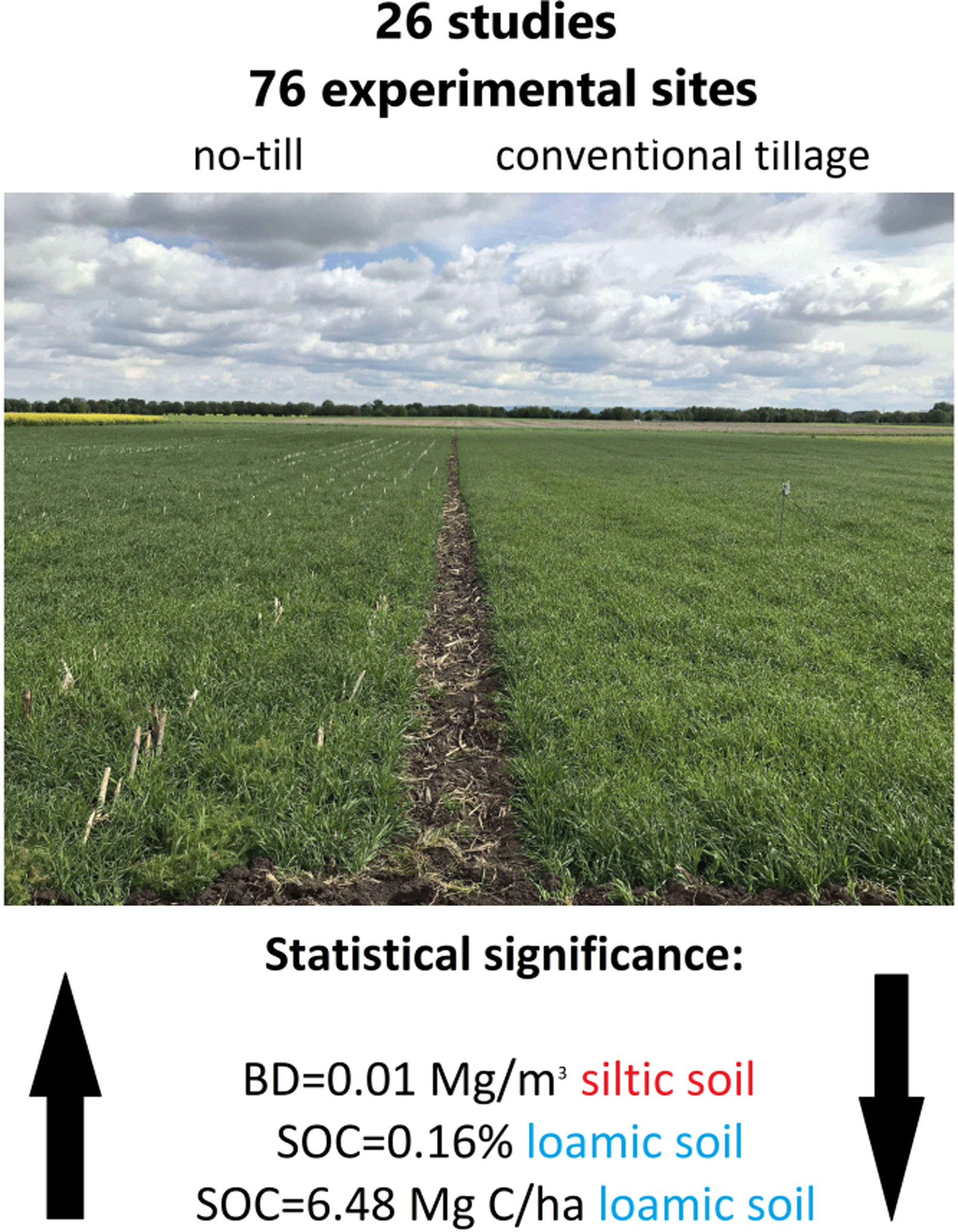
The left upper part in Fig. 4 represents detected changes in BD for all studies. The results of the comparison of all the experiments and the durations of experiments lasting longer than 10 years (Fig. 4, lower left) show similar patterns. The t-test revealed a statistically significant difference only for silty soils, even though a slight increase in compaction was observed for both of the well-represented soil classes (silty and loamy soils). For the other two classes, the number of data points was much smaller and was too small to detect significant changes. The supplementary material shows that, on average, the increase in BD of the silty soil under NT was 0.01 Mg/m3, with no difference observed across all the experiments or for those with measurements older than ten years.
Effects of NT management on soil BD and SOC. The upper plots contain data from all the studies (experiments), and the lower plots contain data from experiments lasting longer than 10 years. The t-test result is represented by a P value when the significant correlation value S * is less than 0.05 and S ** is less than 0.01. The colours of point and linear regression lines (dashed) refer to the WRB soil qualifiers. Note that the soil texture classes arenic and clayey contain a very small number of samples.

Changes in soil organic carbon
The SOC dynamics were compared both in terms of concentration (Fig. 4, centre column) and as the SOC stock, which includes the soil bulk density (Fig. 4, right column). The SOC stocks show a trend similar to that of concentration, but in some cases, slightly different results are noticeable, according to the values given in the selected studies. The SOC concentrations for all the studies significantly increased for both the loamy and clayey soils. In contrast, the soils that were most represented, silty soils, did not show any significant changes. For studies containing experimental data older than ten years, clayey soils have inconclusive differences in SOC content. However, similar to arenic soils, only two studies included clayey soils in this group. Additionally, with respect to the C stocks, the loamy soils were the only group that presented significantly greater SOC stocks under NT than under CT; all other soil textural classes showed no statistically significant differences. The difference in the significance level for C concentrations and C stocks in the clayey soils is explained by the fact that we consistently used the values that were reported in the respective studies, even when a different formula was used for interconversion. Equation 1 was only used for studies that reported either C concentrations or C stocks.
For the loamy soils, the average increase in C concentration was 0.16%, which corresponds to a C stock increase of 6.48 Mg C/ha across all years and of 0.20% or 8.45 Mg C/ha for experiments with durations longer than 10 years. The slope of the CT–NT regression in both durations indicates that, for higher SOC contents, the SOC-increasing effect of NT was greater than that for lower SOC contents.
HERMES2Go and MONICA simulations
Since significant SOC differences between CT and NT were observed only for loamy soils, the capability of the models was tested only for the subset of sites with loamy soils. The SOC concentration in the simulations was compared at the end, after a continuous run of 60 years from 1961 to 2020 (with a spin-up period 1951–1961). While the HERMES2Go model generally predicted decreasing SOC concentrations over time under NT compared with those under CT, MONICA predicted increasing SOC concentrations, as suggested by the observed data. In general, both models showed only slight differences in SOC dynamics between the NT and CT systems at the end of the simulation (Figs. 5 and 6). After the spin-up period, both models started from SOC concentrations that corresponded to the CT values of the experimental data at each location, which covered a range of 0.004–0.025 kg C/kg or 21.80–108.11 Mg C/ha. After 60 years of simulation, the HERMES2Go simulation values remained closer to those initial values, arriving at 0.004–0.023 kg C/kg (Fig. 7), or 21.65–96.96 Mg C/ha, with an average loss of C stocks over 60 years under NT of –0.308 Mg C/ha. In contrast, the MONICA-simulated values ranged from 0.008 to 0.021 kg C/kg (Fig. 8) or 43.02 to 91.52 Mg C/ha under NT, with an average increase of 0.529 Mg C/ha, corresponding to an average increase of 1.33% of the initial values. The MONICA simulations also resulted in a slightly larger range of SOC concentrations for CT than for NT, indicating that SOC accumulation in the top layer under NT led to more uniform SOC dynamics across sites.
Results at the end of the 60-year simulation of SOC dynamics via HERMES2Go on the loamy soil subset of the experimental data for CT and NT management. The blue points represent the experimental data as references, with a linear regression and confidence interval applied. The black points represent the results of the simulations in HERMES2Go, which are close to the identity line (grey colour).

Results at the end of the 60-year simulation of SOC dynamics via MONICA on the loamy soil subset of the experimental data for CT and NT management. The blue points represent the experimental data as references, with a linear regression and confidence interval applied. The black points represent the results of the simulations in MONICA, which are close to the identity line (grey colour).

Results of a 60-year simulation of SOC content using the HERMES2Go model for CT and NT on different soils. The soil characteristics and initial SOC values for a 10-year spin-up period (1951–1960) were selected according to the soils identified in the experiments presented in the review section of the current study.

Results of a 60-year simulation of SOC content using the MONICA model for CT and NT on different soils. The soil characteristics and initial SOC values for a 10-year spin-up period (1951–1960) were selected according to the soils identified in the experiments presented in the review section of the current study.

The results of both models (Figs. 7 and 8) represent trends in the SOC content (%) of the upper 30 cm of soil, and a wider range was determined for CT at the end of the simulation using the 5th and 95th percentiles. The results of the HERMES2Go model (Fig. 7) indicate smaller differences, whereas the MONICA model (Fig. 8) shows greater differences between the CT and NT systems. However, both models show a greater content of SOC in CT than in NT. A smoother inner-annual dynamic was expected with the HERMES2Go approach since the model does not consider a temporal increase in the C:N ratio caused by the introduction of crop residues with high C:N ratios, such as straw.
Discussion
Effects of no-tillage on soil properties
A range of studies have investigated the effects of NT on soil properties. The total duration of NT and soil texture are the main parameters affecting BD, wet aggregate stability and penetration resistance (Blanco-Canqui and Ruis, Reference Blanco–Canqui and Ruis2018). Leaving postharvest residues on the soil surface is likely the most influential factor (Kinoshita et al., Reference Kinoshita, Schindelbeck and Van Es2017). Crop residues on the soil surface support an increase in humidity and a uniform temperature in the topsoil, providing favourable conditions for microorganisms (Kladivko, Reference Kladivko2001; Li et al., Reference Li, He, Guo, Zhang and Li2021). The effect of these factors on microbial activity, in turn, influences the chemical and physical properties of the soil (Serri et al., Reference Serri, Pérez–Brandan, Meriles, Salvagiotti, Bacigaluppo, Malmantile and Vargas–Gil2022). In general, NT, in combination with other fertility-enhancing measures, has been reported to have a strong positive impact on soil quality and health (Wulanningtyas et al., Reference Wulanningtyas, Gong, Li, Sakagami, Nishiwaki and Komatsuzaki2021). However, the emphasis should be on the need for further research into how SOC from surface residues in NT systems can improve soil porosity, biopore formation and resistance to compaction, as well as the long-term recovery of soil structure after tillage and machinery traffic (Silva et al., Reference Silva, Dos Santos, Lollato, Santi and Fontaneli2023).
Changes in bulk density
Bulk density is an important indicator of soil quality, and many farmers are concerned about increasing soil compaction. In many cases, the impact of NT on soil compaction has been found to be rather short-lived (Mondal et al., Reference Mondal, Chakraborty, Bandyopadhyay, Aggarwal and Rana2020). The current study revealed, on average, no relevant changes for loamy, sandy or clayey sites at which NT was previously implemented, but significant increases in BD were identified in silty soils. In the current work, a difference greater than 0.1 Mg/m3 was found in six localities in the USA, whereas 28 other sites with silty soils did not show any strong effect, and two sites from the USA presented a decrease in BD (greater than 0.1 Mg/m3) (available in supplementary material). In earlier studies by Castellini et al. (Reference Castellini, Fornaro, Garofalo, Giglio, Rinaldi, Ventrella, Vitti and Vonella2019) and Çelik et al. (Reference Çelik, Günal, Acar, Acir, Barut and Budak2019), the compared plots had larger differences in one location but, on average, showed only slight differences or non-significant trends. Another study concluded that the stability of organic matter and the structure of soil aggregates, and consequently soil BD, improved with 15 years of NT; however, that study was focused on only the top 10 cm of soil where the organic matter had accumulated (Sapkota et al., Reference Sapkota, Mazzoncini, Bàrberi, Antichi and Silvestri2012). In addition, in the temperate region of Brazil, NT systems cause less soil compaction and pressure from agricultural machinery compared to CT, with NT being the least damaging to soil physical quality (Silva et al., Reference Silva, Dos Santos, Lollato, Santi and Fontaneli2023).
The depth of sampling in tilled soils is a factor that affects whether differences in BD can be identified. Under NT, four studies reported a lower BD in the topsoil (0–10 cm) but, at the same time, a higher BD was observed in the layers below (10–30 cm) (Mazzoncini et al., Reference Mazzoncini, Sapkota, Barberi, Antichi and Risaliti2011; Sapkota et al., Reference Sapkota, Mazzoncini, Bàrberi, Antichi and Silvestri2012; Autret et al., Reference Autret, Mary, Chenu, Balabane, Girardin, Bertrand, Grandeau and Beaudoin2016; Awale et al., Reference Awale, Machado and Rhinhart2018), although, for the latter two, the differences were not statistically significant. The opposite trends were presented in a study by Dolan et al. (Reference Dolan, Clapp, Allmaras, Baker and Molina2006), where BD was greater in the topsoil (5–20 cm) under NT, but under the ploughing layer, the soil under CT was more compact due to tillage.
However, farmers are advised to pay attention to whether additional measures to mitigate soil compaction (e.g. deep-rooted intermediate crops) are necessary when implementing NT in fields on the basis of their local conditions. The current study suggests that silty soils in temperate climates are at greater risk for soil compaction under NT.
The impact of tillage on soil microbiome, aggregate stability and carbon sequestration
According to the results of the current study, compared with CT, NT in loamy soils significantly increased C storage in the topsoil (0–30 cm), regardless of the duration of the experiment. On a broader scale, it is important to consider not only organic carbon but also soil inorganic carbon, primarily in the form of carbonates. During analysis, it is essential to separate these two carbon fractions, as various methods for carbon determination are available (Wang et al., Reference Wang, Wang and Zhang2012). However, there are still many discrepancies in the reported distribution patterns of SOC and disagreements regarding relevant mechanisms (Liang and Zhu, Reference Liang and Zhu2021). In addition to the redistribution of C in the different soil layers due to a lack of mixing under NT, one prominent reason for the apparently greater loss of C under tillage (Karlen et al., Reference Karlen, Cambardella, Kovar and Colvin2013) is the aeration of the soil, the destruction of aggregates, and the subsequent exposure of SOC to oxygen and microbes, which then results in higher rates of activity and organic matter mineralization (Young and Ritz, Reference Young and Ritz2000). Through physical protection mechanisms, soil aggregates play an important role in C storage. Liu et al. (Reference Liu, Han and Zhang2020) reported that after agricultural land abandonment, macroaggregates rapidly formed, and the SOC sequestration capacity was calculated to be 64–83%. A similar observation was reported by Sekaran et al. (Reference Sekaran, Sagar and Kumar2021), who reported higher C sequestration rates in small macroaggregates (2−0.25 mm) than in larger ones. In plots with straw cover or straw removal and manure application, the highest amount of SOC and stable macroaggregates were found at the soil surface (Huang et al., Reference Huang, Liang, Wang and Zhou2015). A significant increase in macroaggregate and aggregate-associated SOC contents was evident under NT and subsoil tillage to a depth of 40 cm (Chen et al., Reference Chen, Cao, Zhang, Cui, Guo, Shen, Zhou, Han and Ning2022).
Soil aggregate stability is directly related to the presence of soil biota, especially glomalin-producing earthworms and fungi. The impact of tillage on earthworms is highly variable and site-dependent (Chan, Reference Chan2001), but scholars largely agree on the detrimental effects of tillage operations on fungal hyphae, as the ability of fungi to recover from rupture is limited (Kabir, Reference Kabir2005; Orrù et al., Reference Orrù, Canfora, Trinchera, Migliore, Pennelli, Marcucci, Farina and Pinzari2021; Korniłłowicz-Kowalska et al., Reference Korniłłowicz–Kowalska, Andruszczak, Bohacz, Kraska, Możejko and Kwiecińska–Poppe2022; Li et al., Reference Li, Zhang, Meng, Rudgers, Cui, Zhao, Chai, Yang, Sternberg and Sun2023). Schmidt et al. (Reference Schmidt, Mitchell and Scow2019) reported that NT changed the functional composition of the fungal community in the soil profile. However, the species phylogenetic diversity of the community remained conserved, regardless of the tillage practice employed.
To date, the mechanisms by which SOC content decreases under frequent physical disturbances have not been well elucidated. Consequently, agroecosystem models are not well equipped with algorithms that represent the feedback of tillage on soil mesofauna and microbial activity and the related effects on aggregate stability and SOC protection against microbial decomposition (Maharjan et al., Reference Maharjan, Prescher, Nendel, Ewert, Mboh, Gaiser and Seidel2018).
Distribution of SOC over the soil profile
Many researchers have examined differences in soil properties in the topsoil, but the lower soil layers have been largely overlooked (Gál et al., Reference Gál, Vyn, Michéli, Kladivko and McFee2007). This is one reason why most studies report a large increase in soil carbon in fields without tillage, as they often disregard the simultaneous decrease in soil carbon in the lower layers, which no longer receive organic matter inputs. This matter has been addressed in recent reviews (e.g. Haddaway et al., Reference Haddaway, Hedlund, Jackson, Kätterer, Lugato, Thomsen, Jørgensen and Isberg2017) but must be reconsidered when examining individual studies. Notably, numerous studies have confirmed that under NT, less organic matter reaches soil layers below 5 cm depth. Under NT, there is a continuous accumulation of SOC in the topmost layer, while the zones below this layer are depleted in SOC. Frequent mixing under CT results in equal SOC concentrations within the ploughing layer, which, in comparison with NT, results in lower SOC concentrations in the topmost layer and higher SOC concentrations in the zone below the ploughing depth (e.g. Gál et al., Reference Gál, Vyn, Michéli, Kladivko and McFee2007; Sun et al., Reference Sun, Hallett, Caul, Daniell and Hopkins2011; Martínez et al., Reference Martínez, Chervet, Weisskopf, Sturny, Etana, Stettler, Forkman and Keller2016; Alhameid et al., Reference Alhameid, Ibrahim, Kumar, Sexton and Schumacher2017). However, a few exceptions exist: for the different tillage treatments employed by Autret et al. (Reference Autret, Mary, Chenu, Balabane, Girardin, Bertrand, Grandeau and Beaudoin2016), the SOC content remained constant in the 10–30 cm layer over time.
In temperate latitudes, studies on conservation agriculture in Brazil have shown that soil sampling to a depth of 100 cm is crucial for accurately assessing differences between CT and NT systems. When considering the full soil profile to 100 cm, the potential for soil carbon accumulation increased by 59%, with rates varying in one year from 0.48 to 1.53 Mg C/ha, compared to accumulation rates of 0.04 to 0.88 Mg C/ha in the top 30 cm (Boddey et al., Reference Boddey, Jantalia, Conceição, Zanatta, Bayer, Mielniczuk, Dieckow, Dossantos, Denardin, Aita, Giacomini, Alves and Urquiaga2010).
Effect of postharvest residues
The effect of NT on soil properties is strongly affected by the amount of postharvest residues left on the soil surface. These residues provide shelter to soil fauna against climatic stress, and larger soil organisms find suitable habitats in the mulch layer, which leads to a greater abundance of soil organisms in NT systems than in ploughed systems (Kladivko, Reference Kladivko2001). A typical soil faunal gradient over depth develops in NT systems (Kinoshita et al., Reference Kinoshita, Schindelbeck and Van Es2017; Wulanningtyas et al., Reference Wulanningtyas, Gong, Li, Sakagami, Nishiwaki and Komatsuzaki2021). Fiorini et al. (Reference Fiorini, Boselli, Maris, Santelli, Perego, Acutis, Brenna and Tabaglio2020) reported an increase in the abundance of earthworms and microarthropods in all soil types under NT management. At three monitored locations (in Spain and Italy), researchers demonstrated that crop diversification, together with reduced soil disturbance and chemical inputs, helped to improve soil properties (SOCs) and sustain crop yields (and profits) (Vanino et al., Reference Vanino, Di Bene, Piccini, Fila, Pennelli, Zornoza, Sanchez–Navarro, Álvaro–Fuentes, Hüppi, Six and Farina2022). Straw return from maize and wheat strongly enhances the capacity of NT systems for SOC sequestration (Zhu et al., Reference Zhu, Ran, Wang, Ye, Niu, Schulin and Wang2022). In contrast, Villamil et al. (Reference Villamil, Little and Nafziger2015) reported that in an NT treatment, the SOC content decreased to the levels observed in CT treatments when postharvest residues were removed.
Advantages and disadvantages of no-tillage
In temperate climates, NT is an effective measure for improving the biological and physical properties of soil. However, most of the beneficial effects of NT often result from a broader management regime that includes the use of intermediate crops and appropriate nitrogen fertilization rates (Sapkota et al., Reference Sapkota, Mazzoncini, Bàrberi, Antichi and Silvestri2012). In fact, some of the observed effects of NT are amplified through high N supply, which results in increased biomass that contributes to SOC accumulation through root and aboveground residues (Mazzoncini et al., Reference Mazzoncini, Sapkota, Barberi, Antichi and Risaliti2011; Jug et al., Reference Jug, Brozović, Đurđević, Wilczewski, Vukadinović, Stipešević and Jug2021).
Many farmers in temperate climatic zones decide against the use of NT, as weed control is their primary concern, and in narrow crop rotations, natural weed control mechanisms are limited (Nichols et al., Reference Nichols, Verhulst, Cox and Govaerts2015). For the successful integration of NT on farms, appropriate crop rotation is key (Cui et al., Reference Cui, Zhang, Zhang, Liu, Zhang, Zheng, Luo and Zou2022). In tropical systems, the success of NT is closely related to the use of total herbicides, such as glyphosate. However, Okada et al. (Reference Okada, Costa and Bedmar2019) reported that glyphosate degradation in NT and CT was very similar, which indicates the existence of glyphosate-degrading microflora in both systems. Alternatively, occasional tillage in NT systems may reduce weed pressure, and it has no obvious negative consequences for the physical properties of soils. Furthermore, occasional ploughing in NT systems may prevent the spread of diseases whose vectors develop in residues (Blanco-Canqui and Ruis, Reference Blanco–Canqui and Ruis2018). In the end, the combined use of three methods may offer enhanced weed control: minimum tillage, appropriate crop rotation, and the formation of a mulch layer on the soil surface from postharvest residues (Nichols et al., Reference Nichols, Verhulst, Cox and Govaerts2015).
Evaluation of the capabilities of models to represent no-till soil management
For predicting yield under the effects of climate change in sites in the Czech Republic, both the HERMES2Go and MONICA models have been previously tested (Pohanková et al., Reference Pohanková, Hlavinka, Kersebaum, Rodríguez, Balek, Bednařík, Dubrovský, Gobin, Hoogenboom, Moriondo, Nendel, Olesen, Rötter, Ruiz–Ramos, Shelia, Stella, Hoffmann, Takáč, Eitzinger, Dibari, Ferrise, Bláhová and Trnka2022). In the current research, it was aimed to test whether both models are fit to reproduce the effects of NT versus conventional tillage on SOC dynamics. Since the experimental results confirmed a significant effect of NT on SOC only in loamy soils, the model evaluation was made exclusively to data from sites with loamy soil. The evaluation revealed that the models were not sensitive enough in their present versions to sufficiently reflect the observed differences between CT and NT.
On the other hand, specific crop rotations with catch crops in NT are an important factor when the DayCent model demonstrated differences between CT and NT, showing that while NT systems without cover crops would continue to deplete SOC, more complex cropping diversification systems with cover crops promoted significant SOC sequestration (Locatelli et al., Reference Locatelli, Del Grosso, Santos, Hong, Gurung, Stewart, Cherubin, Bayer and Cerri2025). While the HERMES2Go model predicted a general depletion of SOC under NT compared with CT, which contradicts the experimental evidence, the MONICA model predicted an increase in accordance with the experimental results, but the increase was lower by a factor of 10. Both models revealed a distinct stratification of SOC in the top three 10 cm layers, with an accumulation in the top 10 cm and a depletion in the 10–30 cm zone for no-till, which is in line with most results reported in the literature (Luo et al., Reference Luo, Wang and Sun2010). Both models lack a representation of a mulch layer on the soil surface, which is why feedback from soil moisture and temperature in the presence of such a mulch cannot be simulated in the models, which includes the effects of soil moisture and temperature on soil microbial population dynamics (Zapata et al., Reference Zapata, Rajan, Mowrer, Casey, Schnell and Hons2021), as represented in the MONICA model. Maharjan et al. (Reference Maharjan, Prescher, Nendel, Ewert, Mboh, Gaiser and Seidel2018) concluded that ‘tillage affects the system in a way that a pure temperature and moisture-dependent decomposition approach is not sufficient to describe its impact. Apparently, there are more feedback relationships that determine the final effect of tillage on soil–crop systems, which need to be considered in such models’. This highlights the necessity of including more process knowledge in agroecosystem models, which requires rigorous testing against suitable datasets. The model ensemble framework offers a strong mechanism for propagating uncertainty across different scales, helping to identify weak points in agroecosystem models. However, implementing model ensembles in practice remains challenging due to the limited number of available models, and future research will need to address these challenges, including how to handle model disagreements, align outputs, adapt individual processes or interpret differences as uncertainty (Hassall et al., Reference Hassall, Coleman, Dixit, Granger, Zhang, Sharp, Wu, Whitmore, Richter, Collins and Milne2022). At this stage, the current study prioritizes the following improvements:
-
1) Mulch layer dynamics, e.g. as previously developed by Findeling et al. (Reference Findeling, Garnier, Coppens, Lafolie and Recous2007), Wang et al. (Reference Wang, Thapa, Timlin, Li, Sun, Beegum, Fleisher, Mirsky, Cabrera, Sauer, Reddy, Horton and Tully2021) or inspired by Thorburn et al. (Reference Thorburn, Probert and Robertson2001)
-
2) Effect of aeration dynamics on microbial activity, e.g. as previously described by Cook and Knight (Reference Cook and Knight2003) or inspired by Lei et al. (Reference Lei, Yu, Zang, Pan, Liu, Zhang and Du2022)
-
3) Effects of SOC concentration in the mineral matrix on soil hydraulic properties, e.g. as previously reported by Stătescu et al. (Reference Stătescu, Cotiușcă–Zaucă, Biali, Cojocaru and Pavel2017) or inspired by Rawls et al. (Reference Rawls, Nemes and Pachepsky2004)
-
4) Soil aggregate formation, e.g. as previously described by Laub et al. (Reference Laub, Blagodatsky, Van de Broek, Schlichenmaier, Kunlanit, Six, Vityakon and Cadisch2024) or inspired by Reference Wang, Brewer, Shugart, Lerdau and AllisonWang et al. (2019).
Conclusion
After a comparison of 76 experimental sites under NT and CT across the temperate zone, it was found that NT induced a slight increase in BD in the top 30 cm of soil, which was statistically significant for silty soils. No-till had a statistically significant effect on increased SOC concentrations and stocks only in loamy soils, and the effect was more prominent in studies older than 10 years.
In the context of an agroecosystem model study for the Czech Republic, it was found that the employed models HERMES2Go and MONICA are currently unable to sufficiently capture changes in SOC content under NT practices. Mulch layer dynamics, the effects of periodic aeration on microbial activity, feedback from SOC content in the mineral matrix on soil hydraulic properties, and soil aggregate formation and destruction were identified as the improvements most needed to enhance the fits of the models. For this purpose, targeted experiments that aid in the further elucidation of the physical and biological processes triggered by tillage events are urgently needed for a range of different site conditions.
Supplementary material
The supplementary material for this article can be found at https://doi.org/10.1017/S0021859625000292
Author contributions
All authors contributed to the study conception and design. JB and EP prepared materials, collected data and analysed them. KK and CN performed simulations using agroecosystem models. The first draft of the manuscript was written by JB, and all authors commented on previous versions of the manuscript. All the authors have read and approved the final manuscript.
Funding statement
Jakub Bohuslav was financially supported by the Internal Grant Agency of the Faculty of AgriSciences at Mendel University in Brno as part of research project no. AF-IGA2023-IP069.
This research has been supported by the Ministry of Education, Youth and Sports of the Czech Republic (grant AdAgriF-Advanced methods of greenhouse gases emission reduction and sequestration in agriculture and forest landscape for climate change mitigation (CZ.02.01.01/00/22_008/0004635).
Competing interests
The authors declare there are no conflicts of interest.
Ethical standards
Not applicable.


 Open access

