


INTRODUCTION
How does a state legislator’s experiences in her home chamber map into her subsequent political career? Between the 93rd–118th Congress (1973–2025), approximately half of all members of Congress had served as members of their state legislatures, with state legislative office being the most common pathway through which members enter Congress (Hirano and Snyder Reference Hirano and Snyder2019; Thomsen Reference Thomsen2017). Recent empirical scholarship points to the benefits of state legislative service for those who want to pursue higher office (McCrain and O’Connell Reference McCrain and O’Connell2023). However, it is not clear whether it is simply any state legislative service that matters, or whether the quality and adroitness of that service are also important in determining a state legislator’s decision to run for higher office, and the likelihood that she is successful in moving up the political ladder.
Ideally, one of the benefits of American federalism is that state legislative experience enhances the quality of national representatives. For this to be true, of course, the best of the state legislators must be the ones to seek out and win seats in the U.S. Congress. In other words, legislators who excelled at the state level would be more likely to run for higher office, and they would likewise be able to make a compelling case to voters based on their experiences and lawmaking success. If such a process were working well, with state legislatures offering a “farm team” for Congress, proponents of political reform and governing capacity (e.g., LaPira, Drutman, and Kosar Reference LaPira, Drutman and Kosar2020) should, perhaps, focus their efforts on promoting those who have proven their worth at policymaking and reform in the states, and encouraging them to expand their political aspirations to higher offices.
Drawing on data from the lawmaking activities and electoral ambitions of legislators in 97 state legislative chambers between 1993 and 2018, we provide the first systematic exploration of whether American federalism serves its purpose of promoting effective lawmakers from the states to the federal level. Specifically, we uncover strong evidence that effective lawmakers in the states are nearly twice as likely to end up in Congress as ineffective lawmakers. We then ask whether this pattern arises due to the progressive ambition of effective lawmakers or due to the preferences of voters. On this point, we find that more effective state lawmakers appear to be generally more likely to run for a seat in the U.S. House than their less effective lawmaking counterparts. In particular, ineffective lawmakers are notably less likely to run than are either average or highly performing lawmakers. However, we also demonstrate that, among those who choose to run, state legislators who are more effective lawmakers are no more or less likely to win their primaries or their general elections than less effective state lawmakers.
Moreover, we uncover an important distinction between candidate emergence in more- versus less-professional legislatures. More effective lawmakers in less professional (i.e., citizen) legislatures are generally more likely to run for Congress than their less effective counterparts. However, in more professional legislatures, more effective lawmakers are more likely to run for Congress only in open-seat contests. Lacking an opportunity to run for an open seat, those legislators who have achieved lawmaking success continue to do their impactful work at the state level. These findings highlight the differences in the relative attractiveness of serving in legislatures of varying degrees of professionalism, resonating with earlier studies of progressive ambition. As such, this Research Note also adds foundational knowledge that the cost–benefit calculations involved in progressive ambition include the attractiveness and meaningful policy work that lawmakers are able to accomplish in their current position, in addition to the attractiveness of higher office.
EXPLORING THE RELATIONSHIP BETWEEN STATE LEGISLATIVE EXPERIENCE AND HIGHER OFFICE
Scholars of congressional elections have long noted the increased success of candidates with prior experience in elective office (Abramowitz Reference Abramowitz1991; Jacobson and Carson Reference Jacobson and Carson2019). The ability to win a previous election is an excellent indicator of one’s potential to win a seat in Congress, as it provides individuals with political resources, including lawmaking and policy experience, political connections, name recognition, staff resources, and fundraising acumen (e.g., Box-Steffensmeier Reference Box-Steffensmeier1996; Maestas et al. Reference Maestas, Fulton, Maisel and Stone2006). Serving in the state legislature is particularly valuable because it offers individuals opportunities to gain experience and develop political resources akin to those needed to campaign for and serve in Congress. State legislators gain experience drafting, debating, and amending legislation, serving on committees, representing constituents, and running political campaigns (Berkman Reference Berkman1993; Maestas et al. Reference Maestas, Fulton, Maisel and Stone2006). For these reasons, it is unsurprising that state legislators often develop ambitions to serve in Congress (Black Reference Black1972; Schlesinger Reference Schlesinger1966). These state legislators with aspirations for higher office demonstrate what Schlesinger (Reference Schlesinger1966) labeled progressive ambition. Scholarship on progressive ambition finds that factors such as being term limited, constituency overlap between the current and future districts, and whether there is an open seat all influence when officeholders choose to make a bid for higher office (Brace Reference Brace1984; Rohde Reference Rohde1979; Treul Reference Treul2009).
Several studies have drawn on samples of state legislators to examine variation in progressive ambition and the choice to run for Congress (e.g., Aldrich and Thomsen Reference Aldrich and Thomsen2017; Hall Reference Hall2019; Maestas et al. Reference Maestas, Fulton, Maisel and Stone2006; Phillips, Snyder, and Hall Reference Phillips, Snyder and Hall2024; Stone and Maisel Reference Stone and Maisel2003; Thomsen Reference Thomsen2014; Reference Thomsen2017). Lacking from such studies, however, is an assessment of whether the most effective state lawmakers are the ones who are elected to Congress, with state lawmaking thus serving as a pipeline for effective governance within the American federal system.
In order for such a pipeline of effective lawmaking to occur, one or both of the following two processes must be at work. First, effective state legislators could choose to run at a higher rate, and, second, voters could select effective lawmakers over ineffective ones at a higher rate. Sound motivations exist for either of these processes. Specifically, state legislators who are successful in advancing their agendas may recognize that they are generally more skilled in lawmaking than others. They find lawmaking to be rewarding, and they seek to apply their skills in a more prominent legislative arena: the U.S. Congress. Such sentiments would be consistent with broader progressive ambition literatures, beginning with Rohde (Reference Rohde1979) and advanced by a wide range of scholars, including Fowler and McClure (Reference Fowler and McClure1989), Hall (Reference Hall2019), Maestas et al. (Reference Maestas, Fulton, Maisel and Stone2006), Stone and Maisel (Reference Stone and Maisel2003), and Thomsen (Reference Thomsen2014; Reference Thomsen2017). This literature points to how potential candidates are cognizant of their skills and limitations, as well as the opportunities that are provided to them, given the current political environment, and they make choices about whether to run for higher office in a manner consistent with maximizing their expected utility. More specifically, they weigh the costs of giving up their current seat and running for higher office against the probabilistic benefits of gaining a more prestigious and powerful position.
For those state legislators who value bringing about policy change, amassing a track record of legislative successes at the state level might inform them about their underlying ability to advance their agendas more broadly, such as through service in the U.S. Congress. Such progressive ambition, based on their ability to make a policy impact, might induce them to choose to run for higher office. In contrast, those who are not successful in advancing legislation at the state level should have little reason to believe that they will achieve any more success in Congress and may therefore be less inclined to run. In addition, those less effective lawmakers likely receive less encouragement from policy activists and party leaders who are recruiting candidates to seek higher offices. Moreover, their ineffectiveness could lead to an inability to raise campaign contributions needed for any viable campaign for Congress. In tandem, these factors would contribute to less effective lawmakers being less likely to seek higher office. Volden and Wiseman (Reference Volden and Wiseman2014, 33–6) find such divergent paths between high-performing and low-performing freshmen in the U.S. House. Those who were highly effective were more likely to seek higher office (such as the U.S. Senate) over the next decade, while those who were ineffective were more likely to leave Congress to try something other than lawmaking. This logic motivates our first testable hypothesis:
Lawmaking Effectiveness and Progressive Ambition Hypothesis: more effective state lawmakers are more likely to run for Congress than are less effective state lawmakers.
A second theoretical reason that we might see effective, rather than ineffective, state lawmakers in Congress is that voters may reward the more effective state lawmakers in their primary and general elections. An extensive scholarly literature points to how most voters are not well-informed about their elected representatives’ activities (e.g., Lupia Reference Lupia2015), especially as they pertain to the lawmaking process (e.g., Grimmer, Westwood, and Messing Reference Grimmer, Westwood and Messing2014). However, lawmaking effectiveness might be considered a valence dimension that is generically appealing to voters, independent of their party affiliation or political ideology (i.e., Groseclose Reference Groseclose2001; Wiseman Reference Wiseman2006). On this point, recent scholarship by Butler et al. (Reference Butler, Hughes, Volden and Wiseman2023) demonstrates that, although voters are generally uninformed about the lawmaking effectiveness of their members of Congress, credible information about their representatives’ lawmaking effectiveness from an objective source significantly improves their opinions of their representative—regardless of their political party. Moreover, Treul et al. (Reference Treul, Thomsen, Volden and Wiseman2022) demonstrate how primary voters, in particular, are more likely to vote for those House incumbents who are more effective lawmakers in Congress.
Taken together, these recent findings suggest that congressional primary and general electorates might weigh a state legislator’s prior lawmaking effectiveness when deciding how to cast their ballots, motivating our second testable hypothesis:
Lawmaking Effectiveness and Electoral Victory Hypothesis: more effective state lawmakers are more likely to win their primary and general elections for seats in the U.S. House than are less effective state lawmakers.
These two hypotheses need not be in competition with one another. It is also plausible that more effective state lawmakers are more likely to serve in Congress because of a combination of these two factors: they are more likely to run for Congress, and they are more likely to win their races, conditional on running. Our analysis below is designed to disentangle these two plausible paths.
DATA
Our first major research question is: are more effective state lawmakers more likely to serve in Congress than less effective state lawmakers? If so, our secondary research questions, motivated by the above hypotheses, are: is the election of more effective state lawmakers to Congress driven largely by patterns of candidate entry, by the preferences (and decisions) of primary or general election voters, or by both of these factors combined? Engaging with these questions requires: metrics of lawmaker effectiveness for each state legislator, information regarding which of them chose to run for the House (entry), and whether they ultimately won their primary and general elections for a House seat (victory).
Our metric of lawmaking effectiveness for state legislators is drawn from Bucchianeri, Volden, and Wiseman (Reference Bucchianeri, Volden and Wiseman2025), who generated nearly 80,000 state legislative effectiveness scores for legislators who served in 97 different state legislative chambers between 1987 and 2019. They employed a methodology that is analogous to that used in Volden and Wiseman’s (Reference Volden and Wiseman2014) generation of Legislative Effectiveness Scores (LESs) for the U.S. Congress. More specifically, Bucchianeri, Volden, and Wiseman (Reference Bucchianeri, Volden and Wiseman2025) draw on publicly available data to identify every bill that was introduced into each state legislature, to match the bill to its primary sponsor, and to identify how far each bill went through each of five different status steps in the legislative process between introduction and (possibly) becoming law. Each bill is coded as being commemorative, substantive, or substantive and significant; and then a State Legislative Effectiveness Score (SLES) is generated for each state legislator as a weighted average of these fifteen metrics (numbers of bills across five lawmaking stages and three levels of bill significance). Later lawmaking stages and more significant legislation are given greater weight. The SLES is normalized to take a mean value of “1” within each chamber for each legislative term (between elections). Replication data are available at Thomsen et al. (Reference Thomsen, Treul, Volden and Wiseman2026).
While the SLES is a transparent and objective indicator of a given legislator’s lawmaking effectiveness, concerns can be raised when employing the scores in their raw forms in the kinds of analyses that we propose to undertake. First, given the wide variation in legislative procedures and practices across state legislatures (e.g., Squire and Hamm Reference Squire and Hamm2005), simply comparing the SLESs of legislators across different states and times might not be substantively meaningful. An SLES value of, say, 1.5 might more strongly signal outstanding lawmaking effectiveness in Georgia than it does in Montana. Second, as is often the case when exploring the relationship between legislator behavior and electoral politics, concerns could be raised about including SLES data from the legislative terms in which legislators are potentially choosing to run for higher office in our analysis. Legislators who are seeking higher office might plausibly employ very different legislative tactics and strategies in their final terms than the legislative approaches that they engage with in a more typical legislative session; including their final terms of office in our analysis might facilitate biased results and inferences regarding the relationships between lawmaking effectiveness and running for (and winning) higher office.
To engage with the first potential concern, in our main analysis, we employ a transformed version of the SLES data that allows us to consider how effective a state legislator was in comparison to a similarly situated legislator (in terms of seniority, party affiliation, and institutional positions) in the same chamber and the same legislative term. Following Bucchianeri, Volden, and Wiseman’s (Reference Bucchianeri, Volden and Wiseman2021) approach, for each state, chamber, and term, we first regress a state legislator’s SLES on a set of indicator variables for whether the legislator was in the majority party and/or held a committee chair, as well as the number of terms served in the state legislature (seniority)—all of which are expected to be positively correlated with lawmaking effectiveness. More specifically, we would expect that being a more senior legislator, as well as being a member of the majority party and/or serving as a committee chair, will all provide legislators with opportunities for lawmaking successes that differ from those of the more junior, minority party, or rank-and-file members of the chamber. Hence, these initial regressions allow us to assess the marginal impacts of these personal and institutional circumstances on each legislator’s lawmaking effectiveness in each state and chamber (for each term). From these regression results, we then generate a predicted SLES, which is denoted as a state legislator’s benchmark SLES, capturing the effectiveness of the average similarly positioned state legislator in the chamber in that term.
Any state legislator whose SLES exceeds her benchmark by at least 50% is then coded as being above expectations in lawmaking effectiveness, while any state legislator whose SLES is below 50% of her benchmark score is coded as being below expectations (those remaining legislators performing near their benchmarks are denoted as meeting expectations in lawmaking effectiveness). Calculating the ratio of a legislator’s SLES to her benchmark score allows us to engage in apples-to-apples comparisons across legislators (and across states and chambers) regarding whether a particular legislator is notably more or less effective as a lawmaker, compared to what one would expect, given her personal and institutional circumstances in a particular term.Footnote 1
To engage with the second potential concern, in various empirical specifications that follow, we account for a legislator’s Lagged SLES Relative to Expectations, which captures whether a state legislator was below (coded as a 1), meeting (2), or exceeding (3) expectations in her lawmaking effectiveness in the penultimate legislative session before facing any given opportunity to run for Congress. By relying on a legislator’s lagged transformation of her SLES, we are able to sidestep many of the endogeneity concerns that would be associated with those running for Congress paying differential attention to state lawmaking during such electoral competition.Footnote 2 Taken together, these data allow us to employ a consistent and objective metric of lawmaking effectiveness for every state legislator in our dataset.
To capture the overall movement from the state legislature to Congress, we create an indicator variable that takes a value of “1” if a state legislator is elected to Congress in a particular election and “0” otherwise. Such an outcome can only occur if the legislator chooses to run, and if voters support her candidacy. Because we are interested in both of these steps, we create separate dependent variables for each. To measure candidate entry, we create an indicator variable that takes a value of “1” if a state legislator runs for a seat in the U.S. House during any particular election cycle, and “0” otherwise.Footnote 3 To measure whether a candidate wins her election(s), we create indicator variables taking a value of “1” if a state legislator wins her primary or general election, conditional on running for Congress, and “0” otherwise. In addition to these main dependent and independent variables of interest, we also account for a wide range of political and electoral variables that likely influence patterns of candidate entry and election outcomes.
Several methodological choices are discussed in the Supplementary Material regarding how to pool candidates into the proper districts and how to formulate control variables to account for the nature of the electoral conditions and the potential candidates. As shown across the many specifications there, our results are robust to alternative specifications common in the scholarly literature. Descriptive statistics for all variables in our analyses are provided in Supplementary Table A1.Footnote 4
FINDINGS
We begin our analysis by exploring the extent to which there is a relationship between a state legislator’s lawmaking effectiveness and whether he or she eventually serves in the U.S. House. In Table 1, we present the results from a series of cross-sectional time-series OLS regressions, where the dependent variable in Model 1.1 takes on a value of “1” if state legislator i was elected to the U.S. House in election year t. The sample in Model 1.1 consists of all state legislators in our dataset, including those who never ran for election to the House, who resided in congressional districts that had open and safe seats in a particular election cycle. We focus on open and safe seats because that is where most of the movement from state legislatures to Congress occurs; similar results hold for other subsets of the data, as shown in the Supplementary Tables. The analysis in Model 1.1, therefore, represents an overview of the data in these districts, blurring together self-selection effects on the part of the candidates who choose to run (or not run) for Congress as well as the selection effects on the part of voters to elect (or choose not to elect) more effective state lawmakers to the House. That said, analyzing the data in this manner does allow us to ask and answer, in a very direct way: are more effective state lawmakers more likely than less effective state lawmakers to serve in Congress?
The Progressive Ambition of Effective State Lawmakers

Note: Results are from OLS regressions where the dependent variable is whether a state legislator was elected to the U.S. House (1.1), whether a state legislator ran for a U.S. House Seat (1.2), and whether a state legislator won her primary (1.3) or general (1.4) election for a seat in the U.S. House of Representatives. Robust standard errors, clustered by legislator, are shown in parentheses, and all models control for election-year fixed effects. Models 1.1 and 1.2 are restricted to open, safe seats. Models 1.3 and 1.4 are restricted to candidates who ran for Congress. *p < 0.05, **p < 0.01, ***p < 0.001, one-tailed.
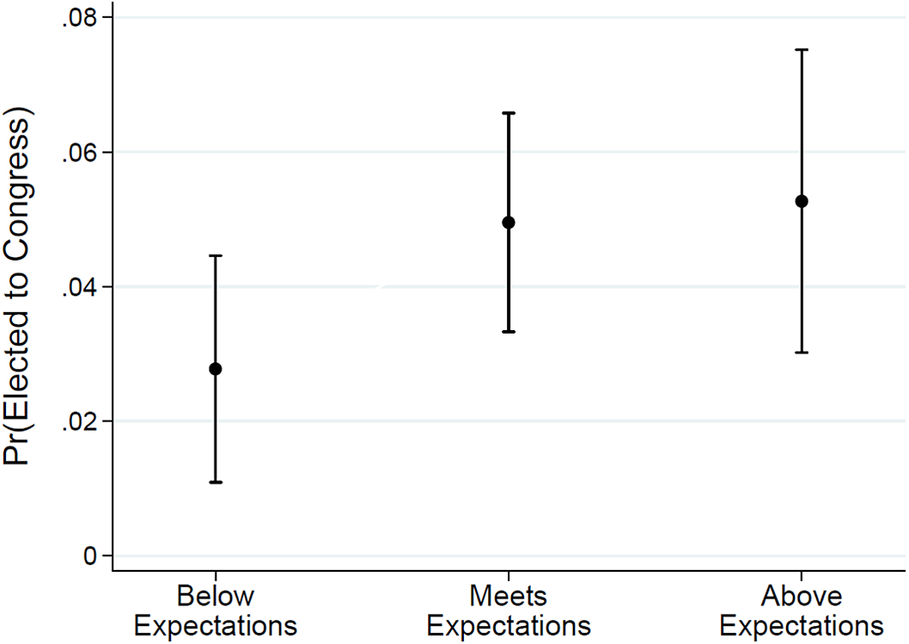
The answer to this question is a resounding “yes.” Even when controlling for numerous candidate and electoral considerations, we see that those state legislators who are above expectations or meeting expectations in lawmaking effectiveness are notably more likely to be elected to Congress than less effective lawmakers (those who are “below expectations” in lawmaking effectiveness—the excluded baseline category). We present these results graphically in Figure 1, where we see that a state legislator who meets or exceeds her benchmark value of lawmaking effectiveness is nearly twice as likely to be elected to Congress as that of those who are below expectations. More specifically, for the attractive case of an open seat in a safe district, the predicted probability of election to Congress for an ineffective state lawmaker is 2.8%, compared to 4.9% for an average lawmaker, and 5.3% for a highly effective lawmaker.
Ineffective State Lawmakers Are Elected to Congress Less Frequently
Note: Predicted probabilities with 95% confidence intervals are constructed based on Model 1.1. The figure shows the probability of different types of state lawmakers being elected to Congress in the case of an open seat in a safe district, with all other control variables held at their means (or modes in the case of binary variables). Results reveal that lawmakers performing above expectations or meeting expectations are significantly more likely to be elected to Congress than are those performing below expectations.

A series of regressions in Supplementary Tables point to the robustness of these results by employing different empirical specifications and focusing on different samples. More specifically, in Supplementary Tables A2, A3, and A5, we include the full set of state lawmakers, not just those presented with open seats in safe districts. In Supplementary Table A2, we control for a legislator’s untransformed Lagged SLES, rather than her Lagged SLES relative to her benchmark score. In Supplementary Table A3, we explore potential non-linear relationships between a legislator’s lawmaking effectiveness and her election to Congress. In Supplementary Table A5, we replicate the analysis in Model 1.1 by estimating a logistic regression, rather than an OLS regression model. Finally, in Supplementary Table A4, we explore the robustness of our results to other important subsets of the data, including safe districts, as well as safe and open districts (e.g., Canon Reference Canon1993; Carson et al. Reference Carson, Crespin, Finocchiaro and Rohde2007; Jacobson and Kernell Reference Jacobson and Kernell1983). Taken together, these findings, combined with those in Model 1.1, provide compelling support for the claim that more effective state lawmakers are more likely to end up in Congress than less effective state lawmakers. Exactly why this relationship holds, however, is an open question.Footnote 5
Turning to the supply-side component of electoral outcomes, in Model 1.2 we present the results from a cross-sectional time-series OLS regression model, where the dependent variable takes on a value of “1” if the state legislator i ran for the House in year t, and “0” otherwise. Once again, we focus here on open seats in safe districts, with results for other subsets shown in Supplementary Tables. Because any particular legislator may be in the dataset across multiple opportunities to choose to run, we rely on clustered standard errors by lawmaker in the models.
Consistent with the Lawmaking Effectiveness and Progressive Ambition Hypothesis, we expect that the coefficients on Lagged SLES Met Expectations and Lagged SLES Above Expectations will be positive and statistically significant, indicating that more effective state lawmakers are more likely to run for Congress than state legislators who were ineffective lawmakers (i.e., those who were below expectations in their lawmaking effectiveness). This is precisely the relationship that is observed, where we see that the coefficients on both of these variables are positive and statistically significant. While the coefficient on Lagged SLES Above Expectations is greater in magnitude than the coefficient on Lagged SLES Met Expectations, these differences are not statistically significant. Hence, relative to both highly effective lawmakers and average lawmakers, it is clearly the case that less effective lawmakers are more likely to forgo the opportunity to seek higher office, all else equal.
The coefficients on control variables point to the strategic elements of choosing to run for Congress: state legislators are more likely to run for Congress when they are term limited out of office, and when they face less (potential) competition from other state legislators who reside in the district. It also appears to be the case that state legislators from more professional legislatures are more likely to run for the House, perhaps indicating that most citizen legislators see themselves as just that—citizens without a heightened progressive ambition.
On the other hand, we see that many of a legislator’s personal and/or institutional circumstances do not seem to affect their likelihood of running for Congress. A legislator’s gender, party status, seniority, and institutional position (with respect to holding a committee chair or being seated on a power committee), for example, are not correlated with choosing to run for the House. Rather, when focusing on the cases of open, safe seats, for which competition is most likely, it appears that state legislators’ decisions are influenced largely by the strategic considerations noted above.
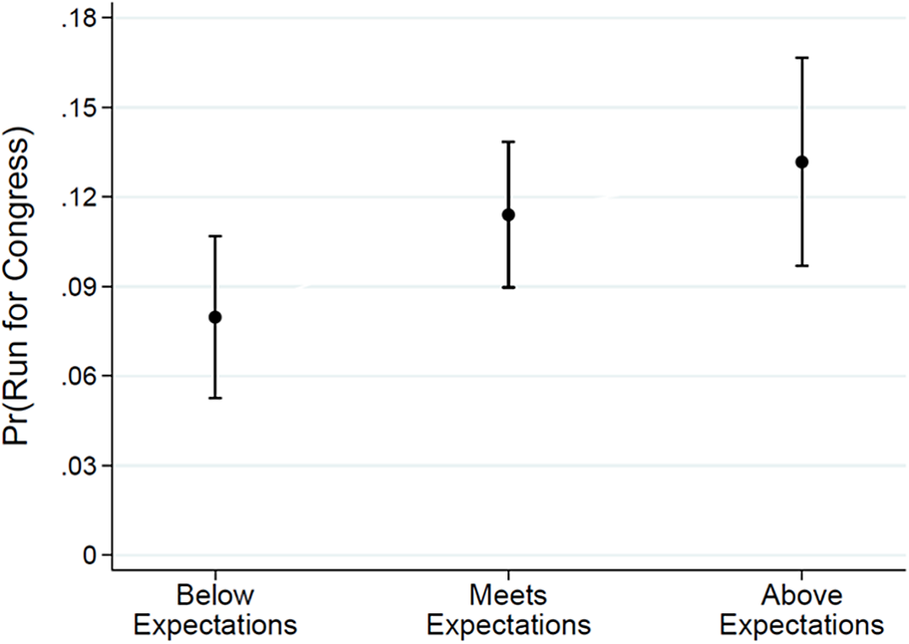
We illustrate the effect sizes in Figure 2, based on predicted values from Model 1.2. As the figure shows, for those cases in which a state legislator finds herself presented with the fortuitous circumstances of a safe, open seat, ineffective state lawmakers (those below expectations relative to those in similar positions) seek a seat in the U.S. House of Representatives 8.0% of the time. In contrast, highly effective state lawmakers (above expectations) are much more likely to run—at a 13.2% frequency. Legislators of average effectiveness in lawmaking enter such races at an 11.4% rate.Footnote 6 Put another way, more effective lawmakers are around 50% more likely to seek higher office than are less effective state lawmakers.
Effective State Lawmakers Run for Congress More Frequently
Note: Predicted probabilities with 95% confidence intervals are constructed based on Model 1.2. The figure shows the probability of different types of state lawmakers running for Congress in the case of an open seat in a safe district, with all other control variables held at their means (or modes in the case of binary variables). Results reveal support for the Lawmaking Effectiveness and Progressive Ambition Hypothesis, with lawmakers performing above expectations and meeting expectations being significantly more likely to run for Congress than are those performing below expectations.
On the whole, these results provide support for the Lawmaking Effectiveness and Progressive Ambition Hypothesis: those legislators who are relatively more effective lawmakers (in that they meet or exceed expectations in lawmaking effectiveness) appear to appreciate their skills as legislators, and they seek to apply their skills within more prestigious venues as opportunities arise.Footnote 7 On the other hand, less effective lawmakers (those who are below expectations in lawmaking), perhaps because they are unable to secure support among campaign contributors, policy activists, and/or other leaders who might serve as candidate recruiters, run for higher office at lower rates. In other words, one clear reason why less effective state lawmakers are less likely to end up in Congress is that they are simply less likely to run for Congress. That said, these results do not provide us with any insights as to whether voters favor more over less effective state lawmakers when evaluating potential candidates.
To engage directly with these latter questions, we turn to Models 1.3 and 1.4 in Table 1, where we present the results from two OLS regressions, where the dependent variable takes on a value of “1” if legislator i won the primary (Model 1.3) or general (Model 1.4) election in year t, and “0” otherwise. Hence, the sample differs from the sample analyzed in Models 1.1 and 1.2 in that a state legislator only enters the sample analyzed in Models 1.3 and 1.4 if he or she ran for Congress, and we are including candidates who ran in all districts, not just those that were in safe open seats. As was the case with Models 1.1 and 1.2, the core independent variables of interest are whether a state legislator met or exceeded expectations in lawmaking effectiveness: Lagged SLES Met Expectations and Lagged SLES Above Expectations. Consistent with the Lawmaking Effectiveness and Electoral Victory Hypothesis, we expect that the coefficients on both of these variables will be positive and significant, indicating that more effective state lawmakers are more likely to win their primary and general congressional elections than are less effective state lawmakers.
Across both models, however, we see that the coefficients on Lagged SLES Met Expectations and Lagged SLES Above Expectations, while positive, are statistically indistinguishable from zero. Hence, we are unable to reject the null hypothesis that there is essentially no relationship between the lawmaking effectiveness of a state legislator and the likelihood of winning the primary or general election to serve in the House, conditional on running. In Supplementary Tables A10 and A11, we show these results to be robust across many alternative specifications, as well as whether we measure lawmaking effectiveness as a legislator’s untransformed Lagged SLES. At best, the positive coefficients in many of the models are suggestive, but the lack of statistical significance leads us ultimately to reject the Lawmaking Effectiveness and Electoral Victory Hypothesis. Regardless of whether the contest is a primary or general election, voters are not clearly choosing candidates based on their demonstrated lawmaking effectiveness, all else equal.
Taken together, these findings are consistent with broader theoretical arguments and empirical findings about the lack of a meaningful accountability relationship between voters and their elected officials (e.g., Achen and Bartels Reference Achen and Bartels2016; Lupia Reference Lupia2015), especially as it pertains to legislative behavior and outcomes. While lawmaking effectiveness could plausibly serve as a valence consideration that influences voters’ choices, this appears not to be the case when focusing on state legislators who are running for higher office. Either voters simply do not care about a state legislator’s prior lawmaking effectiveness, or such information has not been presented to them in a compelling manner so as to influence their decisions, or both are true.Footnote 8 In any event, one main implication of our findings is that the extent to which we see more highly effective state lawmakers being elected to Congress than less effective state lawmakers has little to do with expressed voter preferences for lawmaking effectiveness per se. Rather, it appears that ineffective state lawmakers, perhaps because they have lacked encouragement or have been unable to secure bases of support and campaign resources, are less likely than more effective lawmakers to step forward and accept the challenge of competing for a congressional seat.
WHERE AND WHEN DO EFFECTIVE LAWMAKERS SEEK HIGHER OFFICE?
The findings above invite a further brief exploration of the progressive ambition motivations of highly effective state lawmakers. Specifically, is the tendency for more effective lawmakers to choose to run for Congress generalizable across all state legislators, or are there aspects of their respective legislative environments that influence their decisions over whether to stay in their current positions or try to attain higher office? As we noted earlier, the theory of progressive ambition would suggest that incumbents’ decisions to run for higher office should be influenced by the opportunities they are presented with, as well as the relative attractiveness of their current positions.
Central to such choices may be the professionalism of the state legislature in which they sit (Squire Reference Squire1992). We have already demonstrated in Model 1.2 that there appears to be a positive relationship between the scope of a legislature’s professionalism (as measured by the Squire Index) and a state legislator’s decision to run for higher office; but there also may be reason to believe that the decisions of more and less effective lawmakers may be moderated by the professionalism of the chamber in which they serve. After all, given that the most professional state legislatures (e.g., California) are analogous to mini-congresses, highly effective lawmakers in these environments can have a substantial influence on important policy decisions. Hence, they might be less enthusiastic about pursuing the opportunity to obtain a seat in Congress, compared with highly effective lawmakers in less professional legislatures, for whom the difference between serving in their state houses and the U.S. House is notably starker.
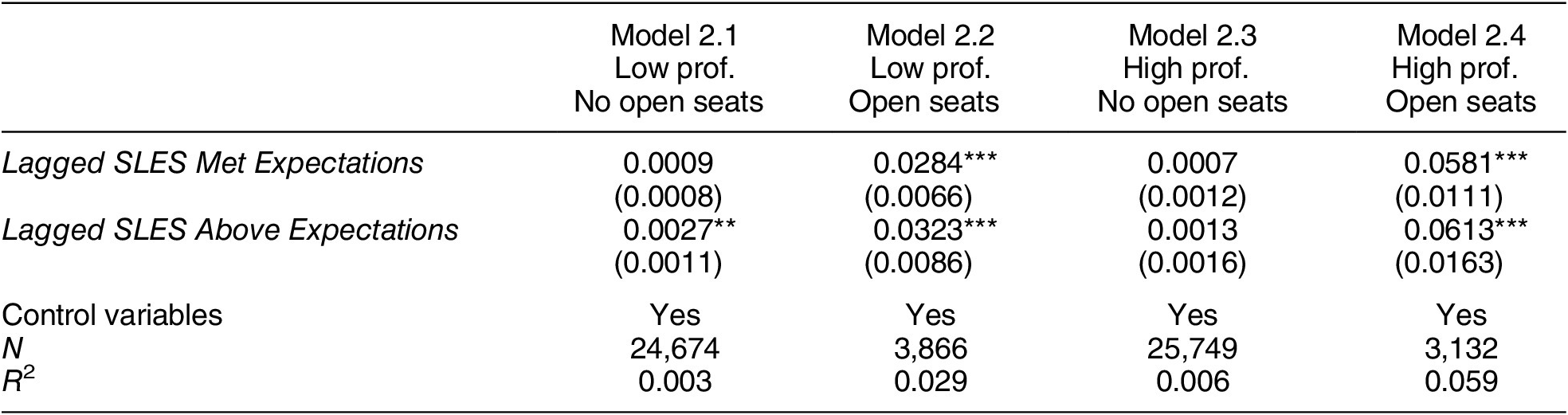
We engage with these considerations in Table 2, where we present the results from a series of OLS regression analyses that are analogous to those presented in Model 1.2, where the dependent variable takes on a value of “1” if a legislator chooses to run for the House, and “0” otherwise. We partition the sample based on the scope of a legislature’s professionalism (as measured via the Squire Index) and whether the state legislator could compete for an open House seat.Footnote 9 Because we are particularly interested in trying to assess how a legislature’s professionalism affects the entry decisions of incumbent legislators who serve in that legislature, the sample consists solely of those legislators who were sitting in the legislature in the term directly preceding a congressional election cycle in which they might have chosen to run for the House. In other words, we do not include any legislators who had exited the state legislature prior to their congressional election entry decisions.Footnote 10
Professionalism and Open Seats Influence Effective Lawmakers’ Decisions to Run
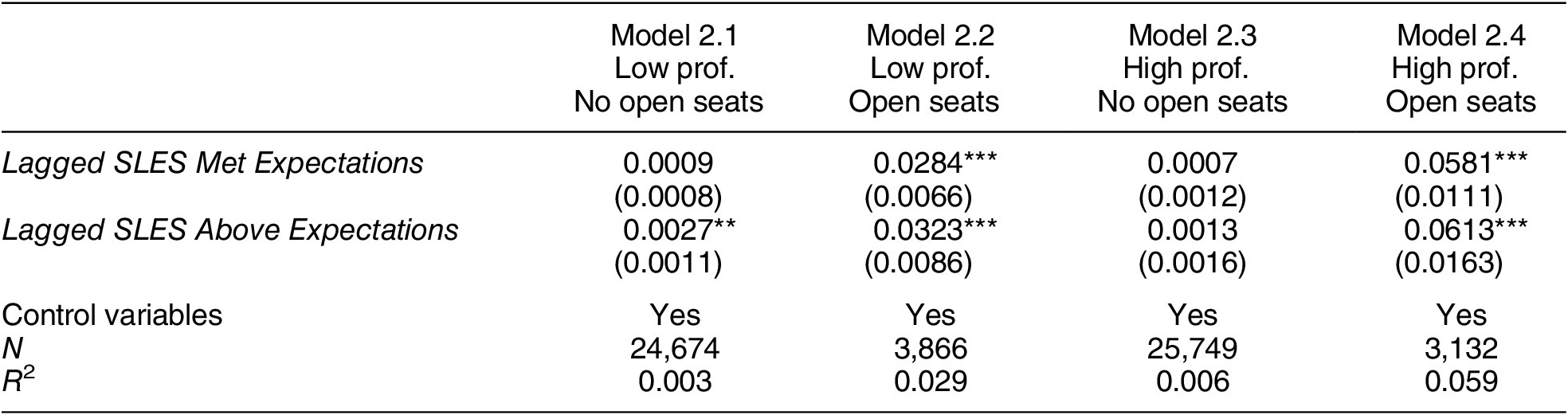
Note: Results are from OLS regressions where the dependent variable is whether a sitting state legislator ran for a seat in the U.S. House of Representatives, and the sample includes all sitting state legislators during each election in which they could have run (including those who never ran for election to the House). Robust standard errors, clustered by legislator, are shown in parentheses, and all models control for election-year fixed effects and for the standard set of controls used throughout (see Supplementary Table A16 for the full specification). *p < 0.05, **p < 0.01, ***p < 0.001, one-tailed.
Taken together, the results in Table 2 point to an important nuance in the relationships between lawmaking effectiveness, legislative professionalism, and progressive ambition. Beginning with Model 2.1, we see that the coefficients on Lagged SLES Met Expectations and Lagged SLES Above Expectations are both positive, but only the latter is statistically significant, suggesting that in less professionalized legislatures, only highly effective lawmakers are likely to run for higher office in non-open-seat races. In contrast, in Model 2.2, we see that the coefficients on both of these variables are positive and statistically significant, which implies that in less professionalized legislatures, those legislators who meet or exceed expectations in their lawmaking effectiveness are more likely to run for higher office when the seat is open, compared to less effective lawmakers (those whose lawmaking effectiveness is below expectations). In either case, however, we see that highly effective lawmakers (those who are above expectations in their lawmaking effectiveness) are more likely to run for Congress from less professionalized legislatures, regardless of whether or not they are presented with an open seat.
Turning to Models 2.3 and 2.4, however, we see that a somewhat different relationship emerges when analyzing the entry decisions of state legislators in more professionalized legislatures. More specifically, when the seat is not open (Model 2.3), even those state legislators who exceed expectations in lawmaking effectiveness are no more likely to run for higher office than those who are below expectations in lawmaking. Perhaps highly effective lawmakers in professional legislatures are loath to leave their successful environment without some heightened assurances of victory on their quest for higher office. We explore this possibility in Model 2.4, where we analyze the entry decisions of state legislators in highly professionalized legislatures in the presence of an open seat. Here, we see that a highly effective lawmaker’s decision to run for higher office appears to be related to the political opportunity structure that she inherits, and the same is true for those legislators who meet expectations in their lawmaking effectiveness. The positive and statistically significant coefficients on Lagged SLES Met Expectations and Lagged SLES Above Expectations indicate that in more professional legislatures, more effective lawmakers are only more likely to run for Congress when there is an open seat. When there is not an open seat, however (as indicated by the results in Model 2.3), a legislator’s lawmaking effectiveness has no bearing on her decision to run for the House.
Specifically, lacking an open seat, only about 0.2% of highly effective legislators (in our Above Expectations category) are willing to leave a professional legislature to seek higher office—no different from ineffective legislators in the Below Expectations category. But when a congressional seat opens up, highly effective lawmakers are much more likely to take the leap. They seek a competitive open seat at a 7.7% rate (compared to 1.5% for ineffective lawmakers). And for a safe open seat, highly effective lawmakers in professional legislatures throw their hats in the ring at a 12.8% rate (nearly double the 6.7% rate for ineffective lawmakers).
IMPLICATIONS AND CONCLUSION
One of the benefits of American federalism is the possibility of states serving as laboratories of democracy. For public policies, this means the opportunity to experiment with various approaches, abandoning policy failures and spreading successes to other states or upward to the nation as a whole. For politicians, this means gaining state-level experience at lawmaking, ideally with the most effective performers continuing their service as they move from the states to the national level. While the scholarly work on policy diffusion is immense, we offer here the first systematic test of the diffusion of effective lawmakers from the state to the national level.
Relying on new scores for the lawmaking effectiveness of members of state legislatures, we find strong evidence that those who are more effective lawmakers are nearly twice as likely to enter Congress as those who are less effective. Most of this effect seems to result from self-selection, with more effective lawmakers being much more likely to seek higher office than are less effective lawmakers in certain types of legislatures. Although there may be a slight electoral advantage for effective lawmakers, the effects based on analyses conditional upon running for office show neither sizable nor statistically significant support from voters for effective over ineffective lawmakers as candidates.
In sum, these patterns suggest that, for American federalism to serve the purpose of leading the most effective politicians to higher office, recruitment and selection are highly important. Relying on voters to be discerning in terms of the selection of effective lawmakers is not likely to be sufficient, at least not without offering them better information about the lawmaking effectiveness of state officials seeking higher office. More work could be done in exploring whether and how such information provision might change voting outcomes. Scholars might also seek to explore the conditions under which effective or ineffective lawmakers stay in their state legislature or seek higher office. Our results highlight the ways in which more effective lawmakers in professional legislatures appear to be particularly opportunistic in waiting for open seats.
In addition to the findings put forth here, it will be important for future researchers to examine the transferability of effective lawmaking skills from the state to the national level. Are effective state lawmakers likely to be more effective once they reach Congress? Are such effects conditional on state legislatures mimicking Congress in terms of professionalism? Are there other institutional differences that allow for some states to become even better training grounds than others for effective lawmaking in Congress? The analysis presented here will help to motivate these future inquiries.
SUPPLEMENTARY MATERIAL
To view supplementary material for this article, please visit http://doi.org/10.1017/S0003055426101683.
DATA AVAILABILITY STATEMENT
Research documentation and data that support the findings of this study are openly available at the American Political Science Review Dataverse: https://doi.org/10.7910/DVN/L6YB5I.
ACKNOWLEDGMENTS
The authors thank discussants and participants at the American Political Science Association Conference and the Center for Effective Lawmaking Research Conference, as well as anonymous reviewers for helpful guidance. Volden and Wiseman thank the Arthur M. Blank Family Foundation, the U.S. Democracy Program of the Hewlett Foundation, and the Democracy Fund for their support for the Center for Effective Lawmaking.
CONFLICT OF INTEREST
The authors declare no ethical issues or conflicts of interest in this research.
ETHICAL STANDARDS
The authors affirm this research did not involve human participants.



 Open access


Comments
No Comments have been published for this article.