

Archaeologists on the Northwest Coast are perpetually confronted with the challenge of adequately sampling large shell midden sites because these deposits can be expansive and deep, and they can contain an overwhelming abundance of faunal remains. Conventional excavation is time consuming and faces logistical constraints, particularly where recorded deposits are commonly over 3 m deep and 5,000 m2 in extent (Cannon Reference Cannon, Fitzhugh and Habu2002, Reference Cannon, Fitzhugh and Habu2020; Letham Reference Letham2014; McKechnie Reference McKechnie2015). Archaeologists have employed a number of different sampling strategies in order to collect archaeological data, including core and auger sampling (Cannon Reference Cannon2000a; Casteel Reference Casteel1970; Letham et al. Reference Letham, Martindale, Supernant, Brown, Cybulski and Ames2017, Martindale et al. Reference Martindale, Letham, McLaren, Archer, Burchell and Schone2009; Stein et al. Reference Stein, Deo and Phillips2003), and to investigate millennial-scale trends in subsistence patterns within coastal shell midden sites (Cannon Reference Cannon2000b; Cannon et al. Reference Cannon and Yang2011; Moss Reference Moss2012).
This article reports on the use of a vibracore to obtain multiple chronologically overlapping samples from a single large and deep shell midden site (EjTa-13) to investigate Indigenous settlement and fisheries management on the Central Coast of British Columbia. The study site is situated on the west side of Hecate Island and is protected from the open ocean by Calvert Island to the west and south, and the relatively sheltered Fitz Hugh Sound to the north and east (Figure 1). Meay Channel (or Northern Kwakshua) and Kwakshua Channel separate Hecate and Calvert Islands.
Overview map of the study location within British Columbia (created by Seonaid Duffield).

The site of EjTa-13 is situated in a 230 m wide protected bay near the southwest corner of Hecate Island, facing Meay Channel. The site is covered by dense salal and stands of conifers, including western redcedar and coastal western hemlock. Hecate Island is in the central temperate rainforest of British Columbia, with cool summers and mild, very wet winters.
Regional Archaeological Investigations and Zooarchaeological Sampling Approaches
Survey and excavation projects on the Central Coast have occurred at a number of sites beginning in the 1940s (Carlson Reference Carlson and Carlson1976; Conover Reference Conover1972; Drucker Reference Drucker1943; Luebbers Reference Luebbers1971; Pomeroy Reference Pomeroy1972). Namu (Mawas, ElSx-1) is the most intensely excavated and reported site, where a record of continuous human occupation spans 11,000 years BP (Cannon Reference Cannon1991, Reference Cannon1995; Hester and Nelson Reference Hester and Nelson1978; Pomeroy Reference Pomeroy1980). It includes temporal components (Periods 1–6) spanning the Holocene, including the early Holocene (11,480–5760 cal BP), but with faunal assemblages preserved in temporally distinct components (Periods 3–6) dating to within the past 6,000 years (Cannon Reference Cannon1991, Reference Cannon, Carlson and Bona1996, Reference Cannon2000a).
Due to the large size and depth of many shell midden sites, it is uncommon for researchers on the Northwest Coast to excavate an entire shell midden site, let alone analyze the vast amount of preserved shell and bone (Gray Reference Gray2008; Lyman Reference Lyman1991). As such, sampling is necessary, most commonly using column or auger sampling. Site impacts are much larger when excavation is undertaken than when most coring methods are used, and as a result, there is a higher chance of disturbing human burials, which occur in shell midden sites in the area. A challenge in core sampling is the small diameter of commonly used percussion coring devices (<5 cm). Although suitable for documenting stratigraphy and obtaining datable samples, it lacks adequate recovery of vertebrate fauna due to the very small volume recovered. Alternatively, bucket auger sampling has a larger diameter (7–15 cm). This recovers volumes sufficient for zooarchaeological analysis, but the twisting motion of the auger physically disturbs the sediment and constrains fine-scale vertical comparisons as well as fragments larger bones and shells (Cannon Reference Cannon2000b). Column sampling from the sidewalls or portions of a conventional excavation unit is another method for fine-screen recovery, but it is rarely conducted in multiple areas of a site (Cannon Reference Cannon2000b, Reference Cannon, Bailey, Hardy and Camara2013; Casteel Reference Casteel1976; Letham Reference Letham2014; McKechnie Reference McKechnie, McMillan and St. Claire2005, Reference McKechnie, McMillan and St. Claire2012).
Pairing percussion coring and auger sampling using an Environmentalist's Subsoil Probe (ESP) and a bucket auger provides a quick, efficient, and cost-effective method to extract zooarchaeological and paleoenvironmental data from a variety of site areas; these methods also provide an alternative to large-scale excavation and are established methods on the Northwest Coast (Letham Reference Letham2014; Martindale et al. Reference Martindale, Letham, McLaren, Archer, Burchell and Schone2009; McKechnie Reference McKechnie2015; Taylor et al. Reference Taylor, Stein and Jolivette2011)—or more specifically, on the Central Coast (Cannon Reference Cannon2000a, Reference Cannon2000b, Reference Cannon, Bailey, Hardy and Camara2013; Cannon et al. Reference Cannon and Yang2011; McLaren Reference McLaren2013, Reference McLaren2014). However, a drawback of using this approach is that auger sampling churns the sediments, and the device must be removed in 10–20 cm increments, which can result in contamination. Percussion cores are not used for collecting a representative faunal sample, which is due, in part, to the small diameter cores recovering very small volumes of sediments. In contrast, bucket augers have effectively recovered fauna from deep shell midden deposits.
Collected in association with excavation units, column samples are comparable or larger in volume to an auger core sample test. Column samples are fixed volumes of archaeological matrix removed from a wall of an excavation unit to document the fine-scale contents of the sediments (e.g., fauna). This is facilitated by 100% examination of washed sediments in a well-lit laboratory environment (Casteel Reference Casteel1976). Column sampling (as well as auger sampling) is an established method for investigating the most frequently occurring fauna in cultural sediments, which are typically fish and shellfish remains (Casteel Reference Casteel1976; Conover Reference Conover, Hester and Nelson1978; McKechnie Reference McKechnie, McMillan and St. Claire2005; Sumpter Reference Sumpter, McMillan and St. Claire2005), but it is less effective for recovering comparatively less abundant and larger faunal elements such as mammal and bird bones. Given that an excavation unit is required prior to sampling, the areal extent of column sampling is limited by the amount of excavation that occurs across the site.
Methods
Field Methods
Vibracoring is an efficient means of obtaining intact stratigraphic records and fauna within a vertical column of archaeological sediments. This coring device facilitates access to both radiocarbon date samples and fauna. In addition, vibracoring uses a wider diameter core than traditionally employed methods such as bucket auger and ESP core samples. We tested the vibracore device in a previously identified but uninvestigated shell midden site, EjTa-13, in Meay Channel on the eastern shoreline in a protected bay in proximity to the Hakai Institute's Calvert Island Ecological Observatory.
Vibracoring works on the principles of high-frequency ultrasonic vibrations: the drill head and drill rods are attached to a 6.5 horsepower engine, which transmits 7,000–12,000 acoustic vibrations per minute to the mechanical “flex cable,” which is attached to the drill head (Figure 2A).Footnote 1 Aided by gravity and high-frequency vibrations, the vibracore collects sediments into a 7.5 cm diameter plastic sample tube inserted within the drilling rod (each rod is a maximum of 152.5 cm in length; Figure 2B). A specially built drill bit was designed to push cobble-sized clasts out of the way. Once the proximal rod has been drilled to approximately 15 cm above ground surface, the drill string is hoisted out of the surrounding sediment using a winch system.
(A) Maxwell Johnson Jr. (Heiltsuk community member) operating the vibracore, while archaeologist John Maxwell directs the “flexcable,” which feeds rotational power from the motor to the drill head, and Seonaid Duffield operates the motor (photo courtesy of Johnny Johnson, Wuikinuxv Nation); (B) an example of a vibracore sample tube containing a sediment sample (photo courtesy of Seonaid Duffield); (C) map of test locations at EjTa-13 (created by Seonaid Duffield).
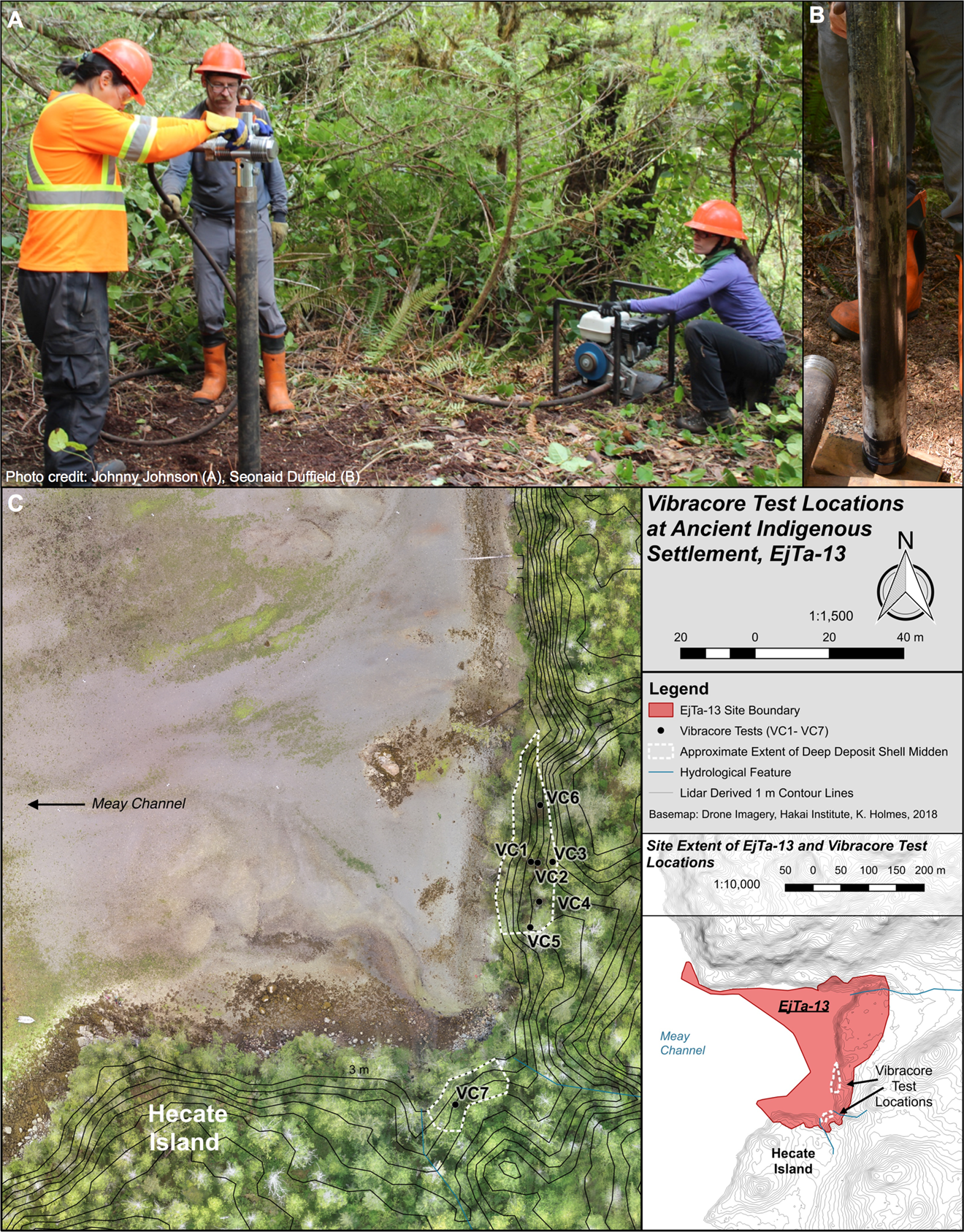
Using this method, we recovered seven successful core samples (VC1 through VC7; Figure 2C) up to 5 m in length from the site, totaling approximately 100 L of cultural-bearing sediments. The cores were analyzed in a laboratory setting at the University of Victoria. Stratigraphy from cores was documented (Supplemental Figures 1–7), and charcoal samples were selected for radiocarbon dating with a focus on stratigraphic transitions and basal cultural deposits (Duffield Reference Duffield2017).
Laboratory Methods
To document stratigraphy across sections of individual core samples, we split cores in half lengthwise, photographed and recorded the stratigraphy, and then partitioned the core sample into 5 cm thick sections (0.2 L). To establish chronology, we submitted 21 radiocarbon dates on terrestrial charcoal to the Keck Carbon Cycle AMS facility at the University of California Irvine (UCIAMS). Calibrations were calculated with Calib 8.2 (Stuiver et al. Reference Stuiver, Reimer and Reimer2021) using the IntCal20 curve (Reimer et al. Reference Reimer, Austin, Bard, Bayliss, Blackwell, Ramsey and Butzin2020). Table 1 provides a complete summary of charcoal-derived radiocarbon ages from multiple vibracore tests (VC1, VC3–VC7). The first core was dated intensively, focusing on clear stratigraphic breaks, whereas charcoal was submitted from the earliest and latest cultural bearing sediments for core samples that followed.Footnote 2 The VC1 core sample returned a continuous series of dates, ranging from 5000 to 1200 cal BP, and reflected stratigraphic integrity except for one minor date reversal. Subsequent dating determined that the tested site area was occupied between 5800 and 380 cal BP.
Twenty-One Radiocarbon Dates Using Charcoal from Six Vibracore Samples and Two Auger Tests.

Note: Calibrations were calculated with Calib 8.2 (Stuiver et al. Reference Stuiver, Reimer and Reimer2021) using the IntCal20 curve (Reimer et al. Reference Reimer, Austin, Bard, Bayliss, Blackwell, Ramsey and Butzin2020).
a Median probability estimated by Calib 8.2.
b Charcoal removed from auger sample (dbs).
Site stratigraphy was grouped into three major layer categories due to the inherent complexity exhibited in most Northwest Coast shell midden sites (Stein Reference Stein1992; Stein et al. Reference Stein, Deo and Phillips2003) and included minerogenic, cultural, and organic layers. See Supplemental Text 1 for more information relating to site stratigraphy.
All subsamples were screened through 2 mm mesh (cf. Moss et al. Reference Moss, Minor and Page-Botelho2017). We identified faunal remains using the extensive zooarchaeological comparative collection at the University of Victoria under the guidance of faunal identification specialist Rebecca Wigen (Pacific Identifications Inc.). Basic measures of abundance for vertebrate fauna were tallied, including the number of identified specimens (NISP) and number of (unidentified) specimens present (NSP). NISP is used to calculate relative abundance (i.e., the percentage of a particular item relative to all other specimens within the same category), per liter (i.e., it shows the number of specimens per liter of cored volume), and ubiquity (i.e., it refers to the percentage of contexts in which a certain taxon is present or absent).
Results
The total number of vertebrate specimens examined from the 2 mm fraction is 17,959, which includes fish, mammal, and bird. Of the overall total, 6,417 specimens could be identified to family, genus, or species level, representing 23 fish taxa, nine mammals, and two birds across all seven core samples. Typical of many Northwest Coast shell midden sites, fish taxa are overwhelmingly the most numerically abundant class of vertebrate fauna recovered from the site.
Figure 3A illustrates continuity of the four most ubiquitous and relatively abundant taxa (Pacific herring, salmon species, rockfish species, and greenling species) across the site. All other identified fish taxa represent 2% or less of the overall NISP, totaling 442 identified elements (Table 2). Calculations of ubiquity across all core sections containing identified faunaFootnote 3 (n = 311) indicate that herring (76%) and salmon (75%) are the two most ubiquitous taxa, closely followed by rockfish (56%); greenling (42%); flatfish (15%); dogfish and sablefish (11%); sculpin (6%); anchovy (4%); ratfish and halibut (3%); cod and pollock (2%); and lingcod, eulachon, skate, and sardine (1%).
(A) ubiquity and relative abundance of the four most numerous fish taxa and all other fish with NISP (2 mm screen size); (B) plot of radiocarbon dates against depth below surface from all dated core samples (the estimated dbs measurements of charcoal samples used for radiocarbon dating were determined by calculating compaction for individual core samples)—numbers indicate the midpoint of the calibrated range; (C) chart showing relative abundance (%) of the most abundant fish taxa and all other fish taxa at EjTa-13 by time period.

Results from 2 mm Sized Screened Fauna: NISP, NISP Percentage, NSP, Age Range, and Estimated Volume per Core, and Overall Volume.

a Small unidentified land mammal.
b Large unidentified land mammal.
c Calibrated age range based on Table 1.
Estimated Depth below Surface Measurements Plotted with Radiocarbon Dates
Dates from multiple core samples indicate a strong linear relationship (R2 = 0.82) between age and depth below surface for all dated samples. Core VC3 had a slower rate of accumulation and also contained the lowest frequency of shell and fauna, and it is an outlier (see Supplemental Text 1 and Supplemental Figure 8 for the ratio of compression and accumulation estimates). The strong linear relationship reflected by the R2 value may be influenced by the large number of dates in VC1 versus smaller numbers in the other cores. It is also probable that all sediments were not compressed equally (e.g., basal deposits may be more compressed than those closer to the surface). Despite these limitations, Figure 3B demonstrates that broad-scale site formation processes exhibit striking similarities across core locations with relative uniformity across six millennia of regular human use. Accordingly, fauna from multiple core samples can be used to estimate age using depth to interpret trends over time.
Evaluating Temporal Trends
To explore temporal patterning in zooarchaeological data at EjTa-13 and evaluate the trends in relation to other sites in the region, we compare calibrated ages and depths to define large chronological intervals comparable with Namu, a well-dated site with a detailed zooarchaeological record spanning 6,000 years. At Namu, researchers conducted multiple seasons of excavations in different areas of the site to develop a Holocene archaeological sequence, including an extensive faunal assemblage where bone was preserved in the matrix (Cannon Reference Cannon1991, Reference Cannon2000a; Carlson Reference Carlson and Cannon1991). Significantly, the chronology of fauna represented at EjTa-13 has similarities to that of Namu (6000 cal BP to contact). This provides an opportunity to compare millennial-scale faunal trends over time in two separate sites in relatively close proximity on the Central Coast (only 25 km apart, or 33 km by boat).
Carlson (Reference Carlson and Cannon1991) devised a chronological framework based on a combination of stratigraphy, distribution of artifacts and fauna, and 31 radiocarbon dates to identify six time periods across multiple areas of the site.Footnote 4 The earliest period at Namu with preserved fauna (Period 3) overlaps with the earliest component at EjTa-13 (5800–5000 cal BP), and subsequent time periods (Periods 4–6) span the past 5,000 years to contact and provide four broad periods for temporal comparison. The accumulation rate estimates from EjTa-13 were used to derive equivalent time periods. Carlson's (Reference Carlson and Cannon1991) previously uncalibrated radiocarbon dates were calculated with Calib 8.2 (Stuiver et al. Reference Stuiver, Reimer and Reimer2021) using the IntCal20 curve (Reimer et al. Reference Reimer, Austin, Bard, Bayliss, Blackwell, Ramsey and Butzin2020). Cannon and colleagues (Reference Cannon, Yang, Speller, Moss and Cannon2011)Footnote 5 use these time periods to analyze salmon and herring (2 mm screen size) from Namu, and as a result, these same time periods were used to analyze EjTa-13 data for the purpose of consistency between sites.
The earliest and latest time periods at EjTa-13 (5800–5000 cal BP and 2000–380 cal BP, respectively) show that the least amount of fish remains were identified per liter from these two periods. The earliest period was also poorly represented in terms of number of examined liters (3.8 L). Only VC3, VC4, and VC5 contained sediments that were determined to be between 5800 and 5000 cal BP.
The four most abundant and ubiquitous taxa in the EjTa-13 assemblage are herring, salmon, rockfish, and greenling, respectively (Figure 3C). The prominence of these fish in terms of their proportional abundance and regular occurrence in multiple depositional contexts illustrates a remarkable continuity of fish use through time, similar to the broad-scale patterning at Namu. Herring and salmon are dominant throughout the sequence, with the exception of the earliest period, when rockfish numerically displace herring with a slightly higher relative abundance value. The combined abundance of herring and salmon are highest in the latest period. Period 5 (ca. 4000–2000 cal BP) has a slight increase in the category “all other fish taxa.”Footnote 6
EjTa-13 has a notably higher abundance of herring and a lower abundance of salmon in comparison with the site of Namu (Figure 4). Namu is situated at the mouth of a productive salmon river, which likely accounts for a higher abundance of salmon bones. The extensive history of archaeological investigations at Namu and long-term temporal record have been used to highlight the importance of stable salmon fisheries in the rise of early Holocene winter villages among other settlement patterns (Cannon Reference Cannon1991, Reference Cannon2000a, Reference Cannon2001b; Cannon and Yang Reference Cannon and Yang2011; Cannon et al. Reference Cannon, Yang, Speller, Moss and Cannon2011). EjTa-13 has an even higher number of dates and temporal resolution from which the longevity of fish availability and successful management can be drawn for similar interpretations on a broader geographic scale.
(A) trends in salmon from Namu and EjTa-13 by Namu time period (Namu data adapted from Cannon et al. Reference Cannon and Yang2011:62, Table 5.1); (B) trends in herring from Namu and EjTa-13 by Namu time period (Namu data adapted from Cannon et al. Reference Cannon and Yang2011:62, Table 5.1).

Comparison of herring bone from EjTa-13 and Namu by time period shows remarkable similarity and suggests continuity of marine resource use between sites (Figure 4A). Comparable to salmon, herring bones are continuously represented throughout the faunal assemblages at EjTa-13 and at Namu, reflecting a persistence of use of these taxa throughout the site occupation. Herring is regionally high ranking in abundance and ubiquity among Central Coast sites (Cannon Reference Cannon2000b; McKechnie et al. Reference McKechnie, Lepofsky, Moss, Butler, Orchard, Coupland, Foster, Caldwell and Lertzman2014). These results highlight the efficiencies of using this methodology to understand trends through time.
Artifact Recovery
A total of 55 artifacts (including lithic debitage) were located within approximately 100 L of cultural sediments during the sorting and faunal identification phases of the project (Figure 5). This amounts to an estimated artifact density of 550 artifacts per m3. These estimates are far higher than artifact densities at other shell midden sites on the Northwest Coast that have not been subject to wet screening or fine-mesh recovery (cf. Ames Reference Ames2005; McMillan and St. Claire Reference McMillan and St. Claire2005). See Supplemental Text 1 for additional information about artifact recovery from EjTa-13 core samples.
A selection of artifacts recovered from vibracore core samples within EjTa-13. (Photo courtesy of Andrew Eckert.)

Discussion
Effectiveness of Coring
Vibracore technology proved to be a useful methodology for establishing chronology, recovering fine-screen fauna and artifacts, and documenting stratigraphy. This makes this technology superior to a combination of auger sampling and percussion coring, and it preserves sediments within a single sample tube. In contexts where obtaining stratigraphically intact samples from multiple areas of a large shell midden is needed, vibracoring would be ideal. However, it is also the case that there are some challenges and limitations of the technology. For example, vibracoring was less successful in paleobeach sediments consisting of a mix of sand, gravels, and cobbles where cores were not collected as quickly as in other, softer silty sediments and where more machine running time was required to complete the test. In some instances where the crew was met with rock refusal, the coring unit was withdrawn, and the test was resumed using a bucket auger instead, which was often effective in dislodging an obstruction, thereby allowing vibracoring to proceed. Typically, samples terminated in a rock refusal or when cores reached blue-gray, fine-silty clay, characteristic of glacial-proximal minerogenic sediments in the region. Using an auger is therefore an effective solution for finishing tests in difficult sediments because the vibracore leaves a “neat” test hole into which an auger fits easily.
The expense of the coring unit itself (upfront cost approximately $15,000 CDN), in addition to ongoing maintenance that involves transporting heavy components, is another major consideration. The bulk and weight of the composite system (approximately 136 kg or 300 lbs.) is a challenge for transporting the machine to remote and difficult-to-access field sites, and this is exacerbated by the added weight and care needed in transporting recovered 1.52 m core samples upright. In this study, the site was easily accessible by a 15-minute boat ride from the Hakai Institute's Ecological Observatory on Calvert Island, but it required transportation logistics that would otherwise be extremely costly and impractical for informal exploratory surveys. Finally, the device requires a strong, able-bodied, and mechanically minded three-person crew for efficient and safe sample recovery.
Further logistical considerations include the large amount of time spent during the post-recovery processing of cores (e.g., documenting stratigraphy, washing sediments, and picking the fauna) as well as the faunal identification phase of the project. Dividing the core samples into 5 cm vertical sections involved a significant time investment.
Overall, fauna was analyzed from 311 individual 5 cm sections, resulting in a total assemblage of 17,959 bones specimens. A total of 35.7% of specimens were identified to species, genus, or family level, with the remainder being assigned to more general taxonomic categories (i.e., order, class). Identifying fauna from the assemblage took one nonexpert an estimated six months, so approximately 3,000 bones were analyzed per month (1,070 identified bones/month).
Other considerations include the potential to recover ancestral remains within the core sample inadvertently. Ancestral remains were encountered in a single vibracore sample. Following direct guidance from Indigenous team members, ancestral remains were carefully wrapped, minimally handled, and reburied on-site. Detailed work has since established that no other ancestral remains had been inadvertently disturbed. Protocols and process relating to this are further described in Duffield (Reference Duffield2017).
Regional Contextualization
The archaeologically observed Indigenous fishing practices presented in this article are relatively consistent with what other archaeologists have observed elsewhere on the Northwest Coast in general and on the Central Coast in particular over the past 5,000 years (Cannon Reference Cannon, Bailey, Hardy and Camara2013; McKechnie and Moss Reference McKechnie and Moss2016). For instance, the overall ubiquity and mean rank order of salmon and herring are strongly consistent between Namu and EjTa-13, and these remain the two most important fish taxa identified at sites on the Central Coast. Such stability indicates durable patterns of resource use over millennial time scales among contemporaneously occupied archaeological sites. Such persistent practices have implications for present-day management strategies in this region, where commercial fishing practices specific to herring and all five coastal salmon species remain a conservation concern (Okamoto et al. Reference Okamoto, Hessing-Lewis, Samhouri, Shelton, Stier, Levin and Salomon2019; Walsh et al. Reference Walsh, Connors, Hertz, Kehoe, Martin, Connors and Bradford2020). Present-day management strategies may include community-based management or Indigenous stewardship programs of fish taxa found in the archaeological record over millennia (Ban et al. Reference Ban, Wilson and Neasloss2020; Quintana Morales et al. Reference Quintana Morales, Lepofsky and Berkes2017). Although vibracore sampling at EjTa-13 highlights broad-scale changes through time, it is clear that availability of key resources persisted in similar abundances through millennia.Footnote 7
Conclusion
This study investigated the utility of vibracore technology at a mid to late Holocene shell midden site on the Central Coast of British Columbia. Archaeological sediments obtained from core samples were used to generate zooarchaeological data and investigate fisheries’ resource use through time and in comparison to the intensively studied archaeological site of Namu (ElSx-1). A considerable amount of lithic debitage and artifacts was also recovered. Continuity of resource use over millennial scales was observed at EjTa-13 through the four most abundant and ubiquitous fish taxa: herring, salmon, rockfish, and greenling. Similar to Namu, this indicates that certain resources were preferentially targeted over 5,800 years at EjTa-13. A number of other fish, bird, and mammal taxa—as well as shellfish—were also regularly present (Duffield Reference Duffield2017). Further analysis of these persistently occurring taxa can expand perspective on the range of resource use, technologies, and social practices over time and throughout multiple areas of the site.
The proportional abundance of fish remains within shell-bearing Northwest Coast archaeological sites is indicative of a diet rich in marine resources. At EjTa-13, fish taxa contributed to 99% of the identified vertebrate faunal remains recovered from the vibracore samples in fine screens. The abundance of fish, especially in comparison to mammal and bird, indicates that fish were caught and consumed with high regularity, both for immediate consumption and presumably long-term storage as culturally preferred taxa. These results are illustrative of the effectiveness of vibracore technology in showing long-term patterns of fisheries management through time. This technology is therefore another viable option for collecting information about broad trends of subsistence.
Vibracore sampling and radiocarbon dating documented relatively consistent accumulation rates between core samples and created flexible estimates of time periods. Further refinement of time periods could be accomplished given the strength of the relationship. We analyzed fish bones using existing Namu time periods with fish remains from within samples from EjTa-13 and with Namu data (Cannon et al. Reference Cannon, Yang, Speller, Moss and Cannon2011). Despite the logistical and analytical challenges, vibracoring holds great promise for future research efforts in coastal shell middens, particularly for recovering small-scale zooarchaeological samples such as ancient fisheries and shellfisheries.
Acknowledgments
Thanks to Heiltsuk Nation and Wuikinuxv Nation for supporting this project. Thanks also to the Tula Foundation cofounders Christina Munck and Eric Peterson for financial support of the project. Thanks to Rebecca Wigen of Pacific Identifications Inc. for assistance with faunal identifications. Duncan McLaren facilitated archaeological investigations and the overarching Hakai Ancient Landscapes Archaeology Project under Heritage Conservation Act, permit 2011-171. Further financial support was also provided through a Hakai / Mitacs Accelerate Fellowship (facilitated by Iain McKechnie) and the University of Victoria Department of Anthropology graduate program. Thanks to Keith Holmes (Hakai Institute) for cartographic assistance and drone imagery, including access to lidar, and to Andrew Eckert for the artifact photo. Many thanks to Callum Abbott, Darcy Mathews, Duncan McLaren, Alex Nuchini, and Brittany Witherspoon (in 2015); and to Johnny Johnson, Maxwell Johnson Jr., and John Maxwell (in 2016) for operating the vibracore. We also thank the staff and support personnel at the Hakai Institute, Calvert Island Ecological Observatory. Finally, thanks to Ariel Reyes Antuan for translating the Spanish abstract, and to Debra Martin and an anonymous reviewer for helpful feedback.
Data Availability Statement
The data presented in this report was originally submitted as part of the primary author's master's thesis, which can be accessed through a University of Victoria website: https://dspace.library.uvic.ca//handle/1828/8936.
Supplemental Material
For supplemental material accompanying this article, visit https://doi.org/10.1017/aaq.2021.113.
Supplemental Figure 1. EjTa-13 Vibracore Sample VC1 Core Profile.
Supplemental Figure 2. EjTa-13 Vibracore Sample VC2 Core Profile.
Supplemental Figure 3. EjTa-13 Vibracore Sample VC3 Core Profile.
Supplemental Figure 4. EjTa-13 Vibracore Sample VC4 Core Profile.
Supplemental Figure 5. EjTa-13 Vibracore Sample VC5 Core Profile.
Supplemental Figure 6. EjTa-13 Vibracore Sample VC6 Core Profile.
Supplemental Figure 7. EjTa-13 Vibracore Sample VC7 Core Profile.
Supplemental Figure 8. A: Ratio of Compression for Individual Core Samples, B: Accummulation Rate per 100 years.
Supplemental Figure 9. Cumulative Number of Taxa and Different Taxa per Core Sample.
Supplemental Text 1. Laboratory Methods, Ratio of Compression, Accumulation Rates, Assessing Sample Adequacy Artifact Recovery, and Future Directions.


 Open access

