





Non-technical Summary
With field guides of shells of the Atlantic Ocean and other guides for the shells of the Pacific Ocean it is commonly thought that snails are not widely distributed geographically in the marine environment because adult snails move around on the bottom of the ocean which limits how far they are found. However, this work shows that the genus Plocezyga from the Pennsylvanian period (about 323 million years ago to about 299 million years ago) of the United States had a wide geographical distribution. During their juvenile stage, these snails were able to float in the water. This allowed them to be more widely distributed geographically. Various species of this genus had limited occurrence in time when they lived. These time-limited snails are useful in determining the age of the Pennsylvanian rocks in the United States. New species of the genera Plocezyga, Gamizyga, and Cyclozyga were found in the Pennsylvanian rocks of the United States and have been described.
Introduction
The Pennsylvanian period was a time of plate collisions and glacial eustatic sea level changes (Dawson, Reference Dawson1854; Newberry, Reference Newberry1874; Chang, Reference Chang1975; Vail et al., Reference Vail, Mitchum, Thompson and Payton1977). At its maximum extent, the inland sea that covered the North American plate stretched from Texas thru the Midcontinent region (today the states of Oklahoma, Kansas, and Missouri), into the Illinois Basin and on into the Appalachian Basin (today the states of Ohio, Kentucky, West Virginia, Virginia, and Pennsylvania) (Schuchert, Reference Schuchert1955). Due to uplift from the collision of Gondwana, this Pennsylvanian inland sea waxed and waned over this area of North America. In addition, Gondwana’s continental glaciers melted as it was brought into the tropical latitudes, causing eustatic sea level rise. So, what we find in North America during the Pennsylvanian are cyclic sedimentary environments ranging from deep marine during maximum glacial melts to shallow marine and even continental fluvial environments as continental uplift displaced the marine environments of the inland sea (Wanless and Weller, Reference Wanless and Weller1932; Heckel, Reference Heckel1977; Ramsbottom, Reference Ramsbottom1979; Anderson and Goodwin, Reference Anderson and Goodwin1980; Busch, Reference Busch1984; Busch and Rollins, Reference Busch and Rollins1984). These cycles stressed the marine environment on and off the North American continental plate, causing extinction and evolution of new species during the Pennsylvanian period.
This changing marine environment led to a wide variety of organisms that can be used as index fossils for zonation of the marine strata of North America. Notable examples include conodonts (Lane et al., Reference Lane, Merrill, Straka, Webster, Sweet and Bergstrom1970; Merrill, Reference Merrill1975; Barrick et al., Reference Barrick, Lambert, Heckel and Boardman2004, Reference Barrick, Lambert, Heckel, Rosscoe and Boardman2013, Reference Barrick, Alekseev, Blanco-Ferrera, Goreva, Hu, Lambert, Nemyrovska, Qi, Ritter and Sanz-López2022; Boardman et al., Reference Boardman, Wardlaw and Nestell2009; Abplanalp, Reference Abplanalp2014), ammonoid cephalopods (Smith, Reference Smith1903; Girty, Reference Girty1909, Reference Girty1911, Reference Girty1915; Plummer and Scott, Reference Plummer and Scott1937; Miller and Furnish, Reference Miller and Furnish1940a, Reference Miller and Furnishb; Unklesbay, Reference Unklesbay1962; McCaleb et al., Reference McCaleb, Quinn and Furnish1964; Gordon, Reference Gordon1965, Reference Gordon1986; McCaleb, Reference McCaleb1968; Saunders, Reference Saunders1973; Saunders et al., Reference Saunders, Manger, Gordon, Sutherland and Manger1977; Manger and Saunders, Reference Manger and Saunders1980; Boardman et al., Reference Boardman, Work, Mapes and Barrick1994; Bogoslovskaya et al., Reference Bogoslovskaya, Kusina, Leonova, Rozanov and Shevyrev1999; Korn and Klug, Reference Korn, Klug, Klug, Korn, De Baets, Kruta, Royal and Mapes2015), and fusulinid foraminifera (Dunbar and Condra, Reference Dunbar and Condra1927; Dunbar and Henbest, Reference Dunbar and Henbest1942; Myers, Reference Myers1960; Thompson, Reference Thompson1960; Ross, Reference Ross, Sutherland and Manger1984; Myers, Reference Myers1988; Sanderson et al., Reference Sanderson, Verville, Groves and Wahlman2001; Wahlman and King, Reference Wahlman and King2002; Wilde, Reference Wilde2006; Wahlman, Reference Wahlman2013, Reference Wahlman and Ruppel2019; Barrick and Wahlman, Reference Barrick and Wahlman2019; Ueno, Reference Ueno2021; Akbaş and Okuyucu, Reference Akbaş and Okuyucu2021). Most of these organisms swam or floated, thus enabling them to have a more regional geographical extent. Benthic organisms are not widely geographically distributed unless their juvenile forms swam or floated in the water column for a short while after hatching. It has been determined, based on the dimensions of the protoconch, that certain gastropod species have planktonic juvenile forms (planktotrophic), and thus the ability to gain regional to worldwide distribution within the marine environment (Shuto, Reference Shuto1974; Jablonski, Reference Jablonski and Broadhead1985; Nützel, Reference Nützel1998, Reference Nützel2014).
The family Pseudozygopleuridae, to which the genus Plocezyga belongs, has very distinct protoconchs that have been described thoroughly by Knight (Reference Knight1930) and by Hoare and Sturgeon (Reference Hoare and Sturgeon1978). Protoconch preservation is rare in Paleozoic gastropods and these faunas from the Appalachian Basin and from North-Central Texas are exceptionally well preserved. These gastropods have collabral ornamentation that abruptly changes at the protoconch–teleoconch line of juncture and measurements of the protoconchs of this group show that they have the potential to have been planktotrophic. Nützel (Reference Nützel2014) found that that some Pseudozygopleuridae protoconchs are paucispiral and may not have had a planktotrophic larval stage, although Nützel (Reference Nützel1998, Reference Nützel2014) stated that most species of this family had planktotrophic larval development. This is indicated by small embryonic shells succeeded by two to six larval whorls. The species of Plocezygya in this study have protoconchs similar to what Nützel (Reference Nützel1998, Reference Nützel2014) described, thus, were planktotrophic and would have had the ability to have a wide geographical distribution within the marine environments of the Pennsylvanian of the United States.
This paper utilizes the microgastropod pseudozygopleurid genus Plocezyga in a biostratigraphic zonation of the Pennsylvanian strata of the United States. Microgastropods are specimens in which the total shell height ranges from 0.8 to 4.0 millimeters. The pseudozygopleurid gastropods from the Appalachian Basin as well as North-Central Texas are exquisitely preserved and show the protoconch well on most specimens. New species of the genera Plocezyga, Gamizyga, and Cyclozyga were identified within this study. Descriptions of these new species are presented in this paper. Two of the new species of Plocezyga were limited in stratigraphic range and have been used as zone species within the biostratigraphic zonation.
Microgastropod biostratigraphic zonation of the United States
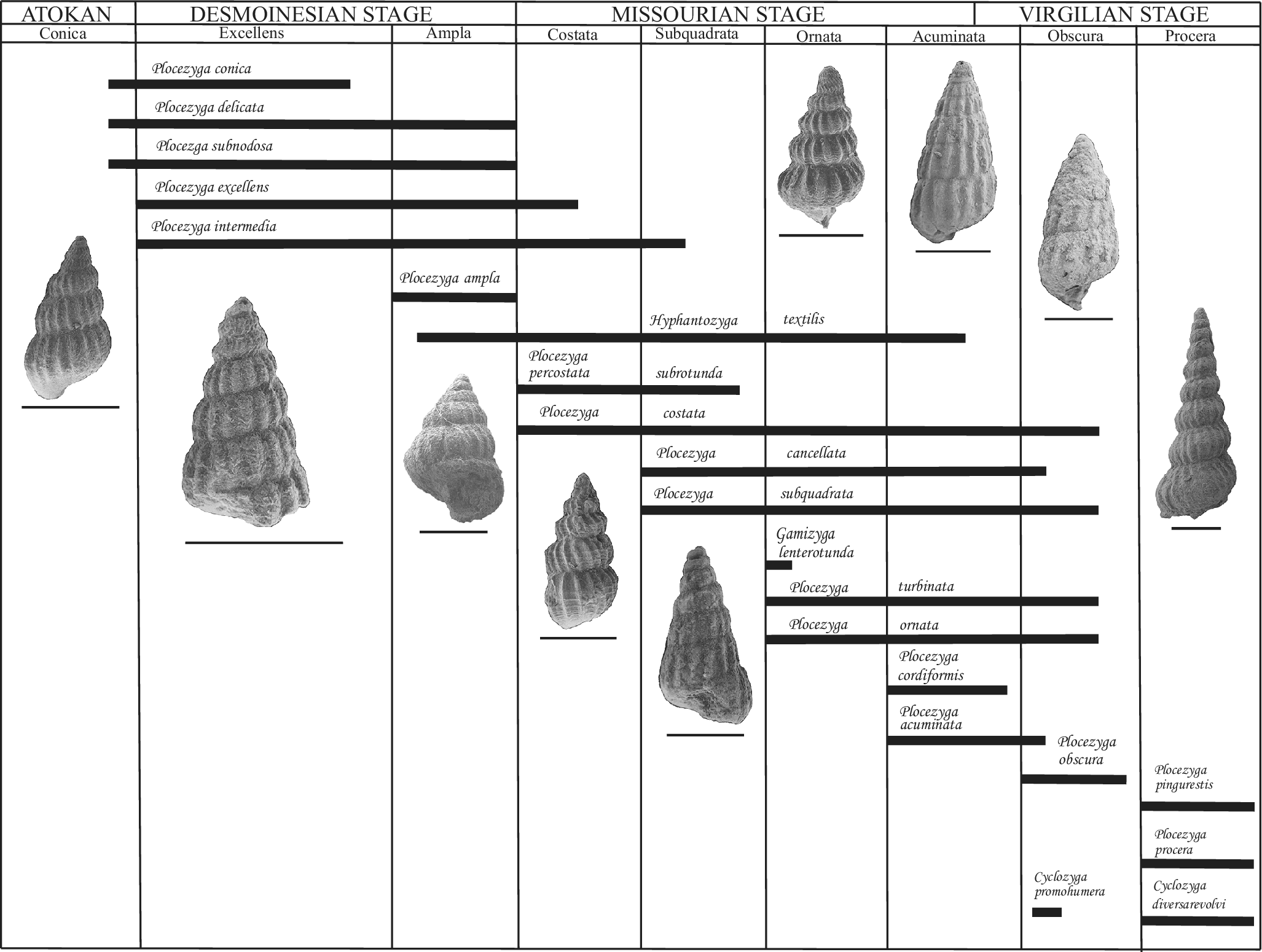
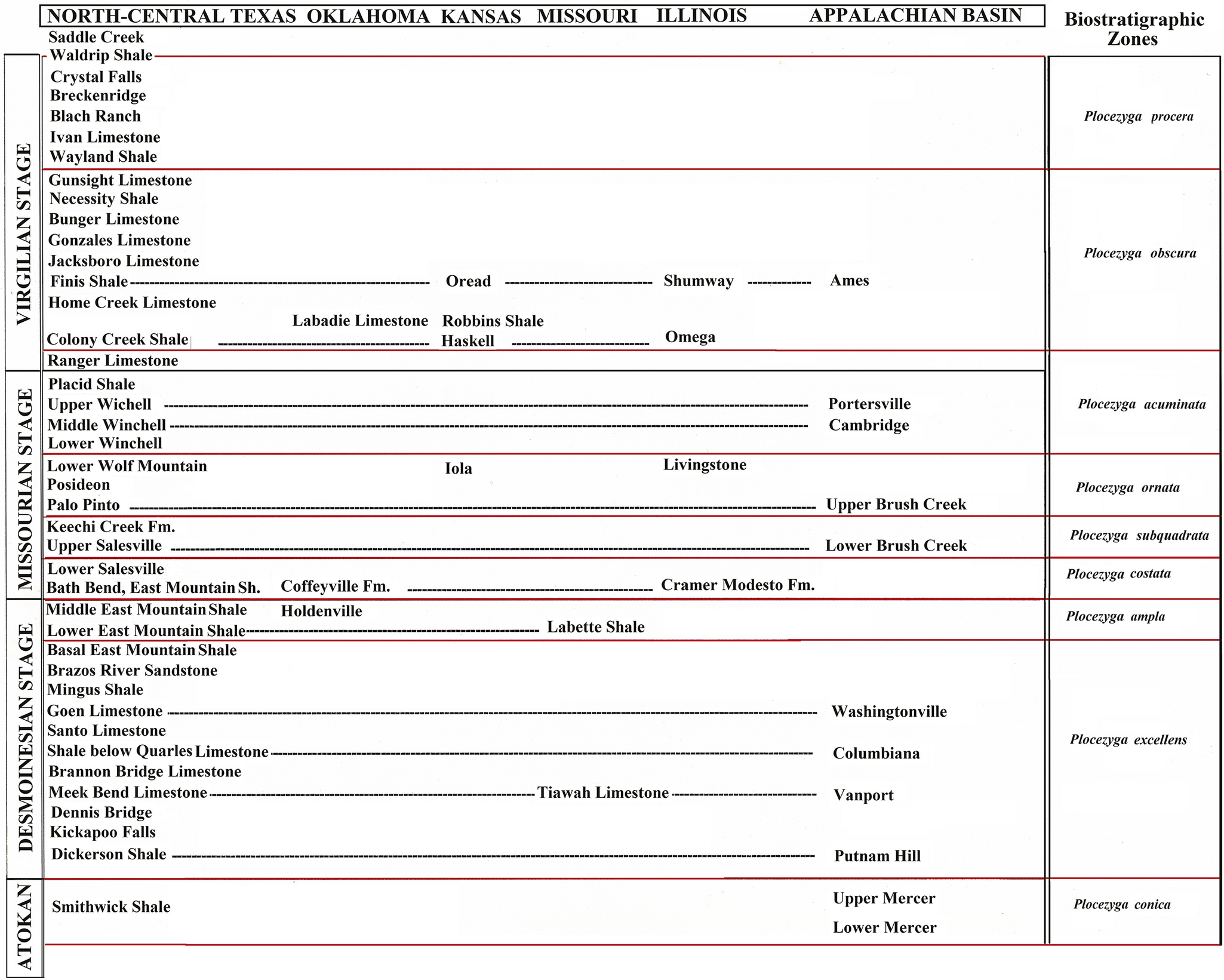
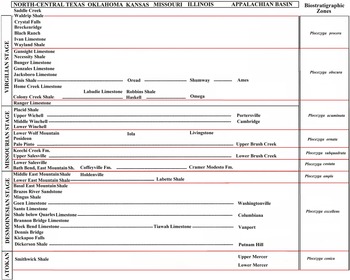
We propose that the upper Atokan through the Virgilian interval be zoned utilizing a series of first-occurrence range zones of species from the microgastropod genus Plocezyga (see Fig. 1). The zones from oldest to youngest proposed are Plocezyga conica, P. excellens, P. ampla, P. costata, P. subquadrata, P. ornata, P. acuminata, P. obscura, and P. procera zones. The upper Atokan zone is defined mainly from the Appalachian Basin for the first occurrence with the remaining stratigraphic extent being described from North-Central Texas. All of the remaining zones are defined from North-Central Texas because the stratigraphic section is far more complete than in the Midcontinent, Illinois Basin, and the Appalachian Basin. Figure 2 shows the correlation of stratigraphic units from North Central Texas through the Midcontinent to the Appalachian Basin. An earlier zonation (Anderson et al., Reference Anderson, Boardman, and Strathearn, Yugan and Chun1989; Hoare et al., Reference Hoare, Sturgeon and Anderson1997) used species from the genus Pseudozygopleura, and Plocezyga as was used in Anderson (Reference Anderson1986).
Range Chart for Plocezyga species, Gamizyga species, Hyphantozyga species, and Cyclozyga species with Plocezyga biostratigraphic zones. Plocezyga conica Hoare and Sturgeon, Reference Hoare and Sturgeon1980a, CM 34760, SL6583 from the Grindstone Creek Formation; Plocezyga excellens Hoare and Sturgeon, Reference Hoare and Sturgeon1980a, CM 34757, SL6585, from the East Mountain Shale; Plocezyga ampla n. sp., holotype CM 34770, SL6588, from the East Mountain Shale; Plocezyga costata, CM 34776, SL6594, from the Lower Placid Shale; Plocezyga subquadrata, CM 34789, SL6592, from the shale in the Palo Pinto Limestone; Plocezyga ornata, CM 34788, SL6603, from the uppermost Jasper Creek Shale; Plocezyga acuminata, CM 34780, SL6598, from the Upper Placid Shale; Plocezyga obscura, CM 34779, SL6597, from the Colony Creek Shale; Plocezyga procera n. sp., holotype CM 34785, SL6595, from the Wayland Shale. Scale bar for images is 1 mm.
Stratigraphic Correlation and Plocezyga Pennsylvanian Biostratigraphic Zones from North-Central Texas to the Appalachian Basin. Dashed lines show correlation of units based on this study.
Plocezyga conica zone
The base of this zone is defined by the first occurrence of the species Plocezyga conica Hoare and Sturgeon, Reference Hoare and Sturgeon1980a, and the top by the first appearance of the species P. excellens Hoare and Sturgeon, Reference Hoare and Sturgeon1980a. This zone also is represented by the first occurrence of the species P. delicata Hoare and Sturgeon, Reference Hoare and Sturgeon1980a, and P. subnodosa Hoare and Sturgeon, Reference Hoare and Sturgeon1980a. This zone in the Appalachian Basin is from the base of the Lower Mercer Limestone of the Pottsville Group to the base of the Putnam Hill Shale of the Allegheny Group. In North-Central Texas this zone is within the Smithwick Shale of the Bend Group to the top of the Dickerson Shale of the Strawn Group.
Plocezyga excellens zone
The base of this zone is defined by the first occurrence of Plocezyga excellens and the top by the first occurrence of P. ampla n. sp. This zone is also represented by the first occurrence of P. intermedia Hoare and Sturgeon, Reference Hoare and Sturgeon1980a. The last occurrence of the species P. conica is also found within this stratigraphic interval. In North-Central Texas this zone is from the top of the Dickerson Shale to the base of the fossiliferous shale immediately underlying the Hog Mountain Sandstone Member of the East Mountain Shale. In the Appalachian Basin this zone is recognized from the base of the Putnam Hill Shale to the top of the Washingtonville Shale of the Allegheny Group.
Plocezyga ampla zone
The base of this zone is defined by the first occurrence of Plocezyga ampla n. sp. and the top by the first occurrence of P. costata (Mark, Reference Mark1912). The new species P. ampla is only found within the stratigraphic interval of this zone. The species Hyphantozyga textilis Hoare and Sturgeon, Reference Hoare and Sturgeon1980a, is first observed within the stratigraphic interval of this zone but not as low in the section as P. ampla n. sp. The last appearance of the species P. delicata and P. subnodosa are observed at the top of this zone. The stratigraphic range of this zone is from the base of the fossiliferous shale immediately underlying the Hog Mountain Sandstone Member of the East Mountain Shale to the base of the Bath Bend bed of the East Mountain Shale. This zone is not represented in the Appalachian Basin because there are no marine strata of this time interval found within the Appalachian Basin. There are equivalent marine stratigraphic units found in the Midcontinent region in the United States.
Plocezyga costata zone
The base of this zone is defined by the first appearance of Plocezyga costata and the top by the first appearance of P. subquadrata Hoare and Sturgeon, Reference Hoare and Sturgeon1980a. This zone is also represented by the first occurrence of the species P. percostata subrotunda Hoare and Sturgeon, Reference Hoare and Sturgeon1980a. The stratigraphic range of this zone is from the base of the Bath Bend bed of the East Mountain Shale to the shale immediately underlying the Devil’s Hollow Sandstone Member of the Salesville Formation. This zone is not observed within the strata of the Appalachian Basin because there are no marine units of this time interval within the Appalachian Basin. This species is found within the Appalachian Basin within younger marine intervals.
Plocezyga subquadrata zone
The base of this zone is defined by the first appearance of the species Plocezyga subquadrata and the top by the first appearance of P. ornata (Mark, Reference Mark1912). This zone is also represented by the first occurrence of the species P. cancellata (Mark, Reference Mark1912). This zone also has the last occurrence of the species P. percostata subrotunda near the top of the stratigraphic extent of this zone. The stratigraphic range of this zone in North-Central Texas is from the base of the fossiliferous shale immediately underlying the Devil’s Hollow Sandstone Member of the Salesville Formation to the base of the Palo Pinto Formation. This zone is recognized in the Appalachian Basin as occurring from the base of the Lower Brush Creek Limestone to the base of the Upper Brush Creek Limestone of the Conemaugh Group.
Plocezyga ornata zone
The base of this zone is defined by the first occurrence of the species Plocezyga ornata and the top by the first occurrence of the species P. acuminata Hoare and Sturgeon, Reference Hoare and Sturgeon1980a. This zone is also represented by the first occurrence of the species P. turbinata Hoare and Sturgeon, Reference Hoare and Sturgeon1980a, and Gamizyga lenterotunda n. sp. The new species G. lenterotunda is only found in the lower stratigraphic intervals of this zone. The stratigraphic range of this zone in North-Central Texas is from the base of the Palo Pinto Formation to the base of the middle Winchell Limestone. The middle Winchell Limestone is equivalent to the upper Wolf Mountain Shale and the middle Jasper Creek Shale. This zone is recognized in the Appalachian Basin as occurring from the base of the Upper Brush Creek Limestone to the base of the Cambridge Limestone units of the Conemaugh Group.
Plocezyga acuminata zone
The base of this zone is defined by the first occurrence of the species Plocezyga acuminata and the top by the first occurrence of the species P. obscura Hoare and Sturgeon, Reference Hoare and Sturgeon1980a. This zone is also represented by the first occurrence of the species P. cordiformis Hoare and Sturgeon, Reference Hoare and Sturgeon1980a, which is restricted stratigraphically to this zone. The last occurrence of Hyphantozyga textilis is within this zone. The stratigraphic range of this zone in North-Central Texas is from the base of the middle Winchell/upper Wolf Mountain Shale/middle Jasper Creek Shale to the base of the Colony Creek Shale Member of the Caddo Creek Formation. The zone is recognized in the Appalachian Basin as occurring from the base of the Cambridge Limestone to the base of the Ames Limestone units of the Conemaugh Group.
Plocezyga obscura zone
The base of this zone is defined by the first occurrence of the species Plocezyga obscura and the top by the first occurrence of P. procera n. sp. The species P. obscura is restricted in range to the strata of this zone. The new species Cyclozyga promohumera is also only found solely within this zone. The last occurrences of the species P. costata, P. cancellata, P. subquadrata, P. turbinata, P. ornata, and P. acuminata are found within the strata of this zone. The stratigraphic range of this zone in North-Central Texas is from the base of the Colony Creek Shale Member of the Caddo Creek Formation to the base of the Wayland Shale Member of the Graham Formation. This zone is recognized in the Appalachian Basin as occurring in the Ames Limestone Member of the Conemaugh Group. Above the Ames Limestone Member in the Appalachian Basin are two marine limestones the Gaysport and Skelley limestones of the Conemaugh Group. No species of the genus Plocezyga have been found within these limestone units. Based on the stratigraphic position of the Gaysport and Skelley limestones they most likely would fall within this zone.
Plocezyga procera zone
The base of this zone is defined by the first occurrence of the species Plocezyga procera n. sp. The top is not defined by any species of Plocezyga. This zone is also defined by the first occurrence of the new species P. pingurestis and Cyclozyga diversarevolvi. The stratigraphic range of this zone in North-Central Texas is from the base of the Wayland Shale Member of the Graham Formation to the top of the Blach Ranch Limestone Member of the Thrifty Formation. This zone is not represented by any marine strata in the Appalachian Basin because there are no open-marine horizons above the Gaysport and Skelley limestone members of the Conemaugh Group in the Appalachian Basin. The Plocezyga procera zone is interpreted to be the correlative of the Monongahela Group, which is made up of non-marine strata, in the Appalachian Basin.
Introduction to new species
Studies have described specimens from the family Pseudozygopleuridae from the Appalachian Basin and the St. Louis outlier (Knight, Reference Knight1930; Hoare and Sturgeon, Reference Hoare and Sturgeon1978, Reference Hoare and Sturgeon1980a, Reference Hoare and Sturgeonb, Reference Hoare and Sturgeon1981a, Reference Hoare and Sturgeonb, Reference Hoare and Sturgeon1985; Hoare et al., Reference Hoare, Sturgeon and Anderson1997; Nützel, Reference Nützel1998; Bandel, Reference Bandel2002). Hoare and Sturgeon (Reference Hoare and Sturgeon1980a, Reference Hoare and Sturgeonb) raised Knight’s (Reference Knight1930) subgenus Plocezyga to the genus level for specimens they described from the Appalachian Basin. Other works by several authors (e.g., Mark, Reference Mark1912; Morningstar, Reference Morningstar1922; Knight, Reference Knight1930, Reference Knight1941; Sayre, Reference Sayre1930; Warthin, Reference Warthin1930; Hoare, Reference Hoare1961; Carew, Reference Carew1978, Reference Carew1980) have recognized a number of species that have been placed within this genus. Recent studies (Bandel, Reference Bandel2002; Bouchet et al., Reference Bouchet, Rocroi, Hausdorf, Kaim, Kano, Nützel, Parkhaev, Schrödl and Strong2017) have redefined the superfamily and family for this group of gastropods. The subgenera for the genus Plocezyga have been elevated to genera within Bandel’s (Reference Bandel2002) paper on Carboniferous and Permian gastropods, thus the subgenera Plocezyga, Gamizyga, and Hyphantozyga are all now genera. Synonymy for each of the elevated subgenera to genera is given in the systematic paleontology since there have been name changes through the subgenera history.
Work in the eastern shelf of the Midland Basin in North-Central Texas and the Midcontinent region of Oklahoma (Anderson and Boardman, Reference Anderson, Boardman, Boardman, Barrick, Cocke and Nestell1989; Anderson et al., Reference Anderson, Boardman, and Strathearn, Yugan and Chun1989) has yielded numerous pseudozygopleurid gastropods. Among these are rare to abundant Plocezyga, Gamizyga, and Cyclozyga specimens. The new species from these collections form the basis for the descriptions of new species for this paper. These new species were compared with the type specimens for these genera from the Appalachian Basin and the St. Louis outlier.
Stratigraphic occurrences for the new species
The stratigraphic distribution of each species is given under its description in the systematic section. In general, the genera Plocezyga, Gamizyga, and Cyclozyga are abundant and are found in the marine units within the Pennsylvanian stratigraphic section of the Midcontinent outcrop belt.
The species described in this paper are restricted to various stratigraphic intervals within the Pennsylvanian of the Midcontinent, thus are useful in biostratigraphic zonation of the Pennsylvanian strata of the United States. Plocezyga ampla n. sp. is only found in the upper Desmoinesian units within the Midcontinent. Gamizyga lenterotunda n. sp. is only found in Missourian units. Plocezyga pingurestis n. sp., P. procera n. sp., Cyclozyga promohumera n. sp., and C. diversarevolvi n. sp. are only found in the Virgilian units of the Midcontinent.
Materials and methods
Bulk samples of the shales and limestones were collected from each locality and in the laboratory were boiled in a solution of Quaternary-O to extract the fossils from the rock. Specimens were then picked from the dried boiled residue, mainly from the 2–0.25 mm size range, using a binocular stereomicroscope. Species of gastropods were identified and recorded as to their abundance for each locality and stratigraphic unit.
The abundance of each species is ranked for each locality where it was found using: rare, ≤ 10 specimens; common, 11–20 specimens; abundant, 21–40 specimens; and very abundant, > 40 specimens. Measurements for the specimens of the new species were made using a microscope digital camera, AmScope model MU1000 through the ocular of a Bausch and Lomb stereomicroscope and the AmScope software version x64, 4.11.19627.20210925.
Respository and institutional abbreviations
Types, figured, and measured specimens within this paper are designated by numbers, which are reposited in the Invertebrate Section of the Carnegie Museum of Natural History, Pittsburgh, Pennsylvania. Locality information was given stratigraphic locality (SL) numbers by the Carnegie Museum as well (Appendix 1).
Systematic paleontology
The locality coordinates are given in the UTM grid system for localities in Texas. Superscript numbers are not necessary to locate points with a 7.5′ quadrangle but are important for larger scale locations.

Reference Knight1930 Hemizyga (Plocezyga) Knight
Reference Hoare and Sturgeon1980a Gamizyga (Plocezyga); Hoare and Sturgeon
Reference Hoare and Sturgeon1980b Plocezyga (Plocezyga); Hoare and Sturgeon
Reference Nützel1998 Plocezyga; Nützel
Reference Bandel2002 Plocezyga; Bandel
Type species
Plocezyga corona (= Hemizyga (Plocezyga) corona Knight, Reference Knight1930) from the Labette Shale of St. Louis, Missouri, USA.
Plocezyga ampla new species
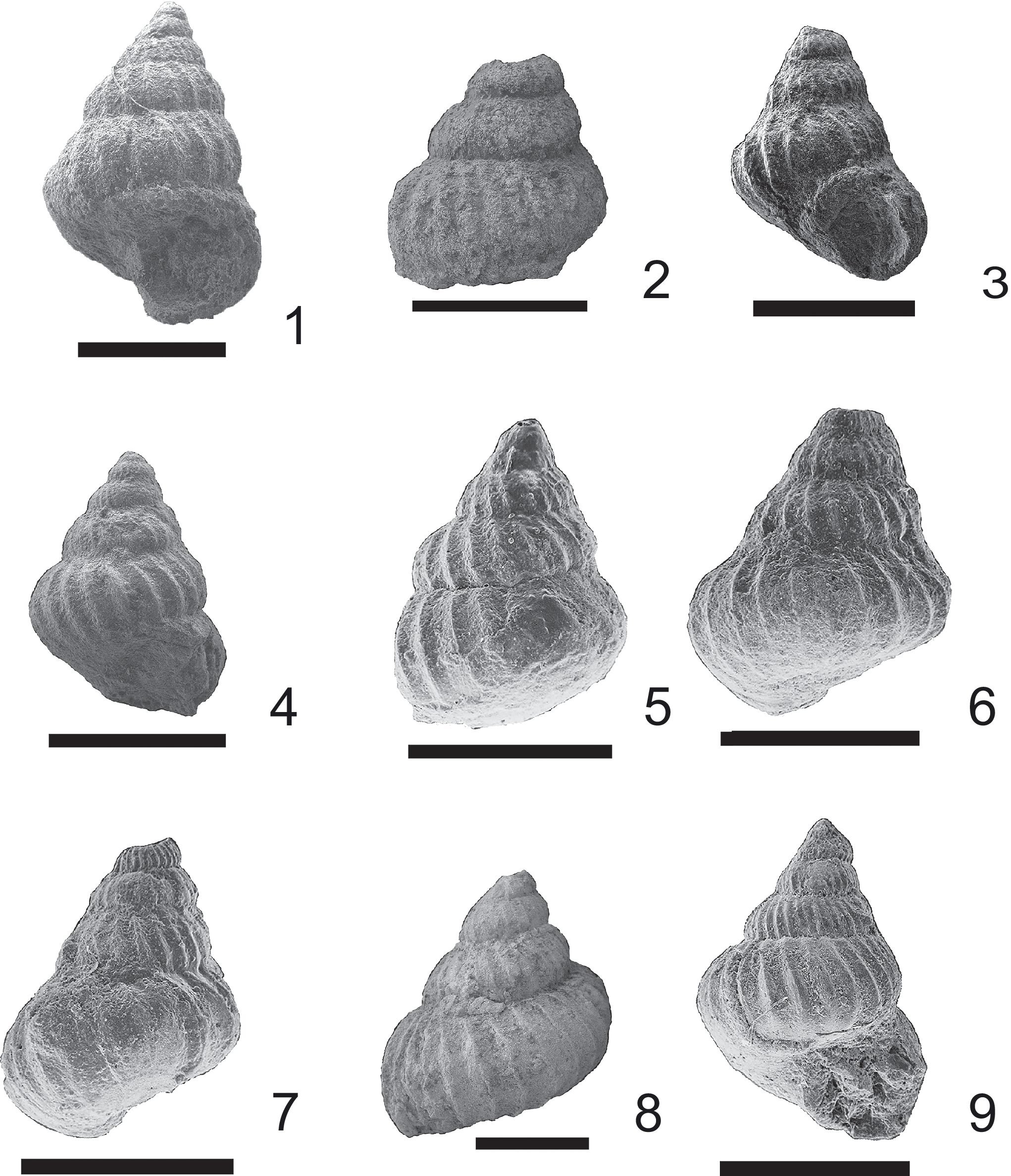
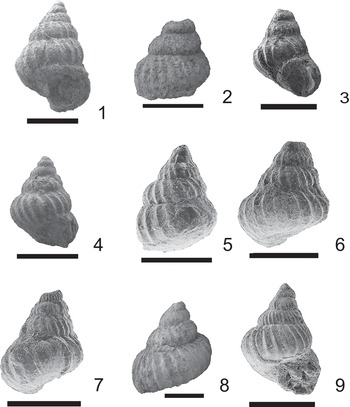
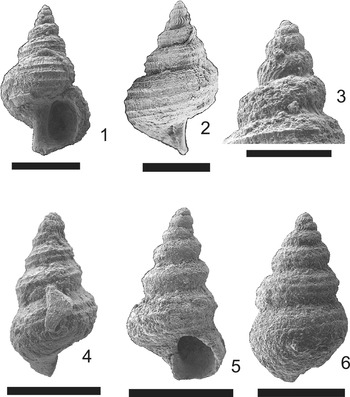
Plocezyga ampla new species. (1, 2) Specimens from the East Mountain Shale at locality SL6588, (1) holotype CM 34770, apertural view, (2) paratype CM 55951, abapertural view; (3, 6) paratype CM 55961 from the Coffeyville Formation, basal Tacket Shale at locality SL6633, (3) apertural view, (6), abapertural view; (4, 5) paratype CM 55965 from the lowermost Beeman Formation at locality SL6635 (4) apertural view, (5) abapertural view; (7–9) paratypes from the Upper Holdenville Formation at locality SL6634, (7) CM 55959, abapertural view, (8) CM 55958, abapertural view, (9) CM 55957, apertural view. Scale bar is 1 mm.
Reference Anderson, Boardman, and Strathearn, Yugan and Chun1989 Plocezyga (Plocezyga) n. sp. 1, Anderson and Boardman, pl. 1, fig. 16.
Holotype
CM 34770, East Mountain Shale, immediately below the Hog Mountain Sandstone at locality CM SL6588, exposed on a hillside in Fort Wolters, Texas. Legal description UTM14SNM58755363150, Palo Pinto County, Texas, Mineral Wells 7.5′ Quadrangle. It is abundant within this unit and is associated with a diverse molluscan fauna.
Paratypes
CM 55951–55965.
Diagnosis
Broadly turbiniform conch with prosocline transverse cords. Fine revolving threads faint.
Occurrence
Abundant in the East Mountain Shale (CM SL6588), common in the Upper Holdenville (CM SL6634) and Coffeyville formations, basal Tacket shale bed (CM SL6633), rare in the Lower East Mountain Shale (CM SL6585) and the Beeman Formation (CM SL6635).
Description
Small turbiniform shell with sutures moderately impressed. Average sutural slope of 15°. Whorl profile moderately rounded. Base is rounded and anomphalous. Aperture circular in shape.
The protoconch is composed of two and one-half whorls. The first whorl of the protoconch is smooth with the remaining one and one-half protoconch whorls, with fine collabral threads separated from the teleoconch by a prominent transverse cord.
The teleoconch is ornamented with evenly spaced, prosocline transverse cords, which thicken mid-whorl. Revolving threads are very faint to absent between transverse cords. The apertural margin is prosocline.
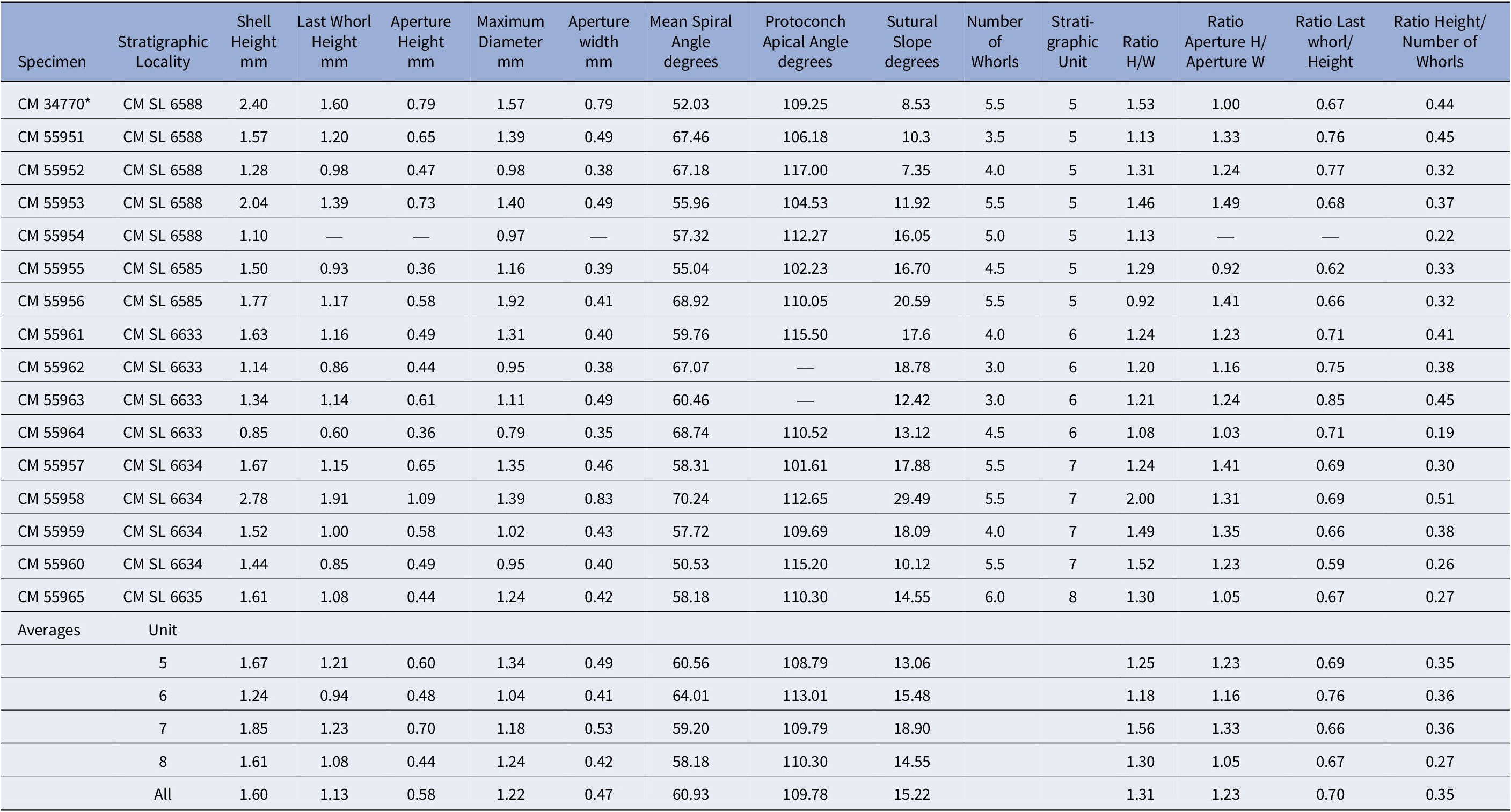
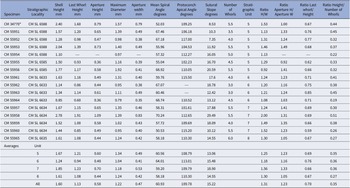
Measurements given in Table 1.
Measurements for Plocezyga ampla new species; * = holotype; stratigraphic units: 5, East Mountain Shale; 6, Coffeyville Formation, basal Tacket shale bed; 7, Upper Holdenville Formation; 8, Beeman Formation
Etymology
ampla, Latin for ample, large, wide.
Remarks
Plocezyga ampla n. sp. is easily distinguished from other species of this genus for its turnbiniform shape. It is similar to Plocezyga turbinata Hoare and Sturgeon (Reference Hoare and Sturgeon1980a) from the Appalachian Basin in shape of the whorls and fine transverse cords, but is differentiated by the faint to obsolescent revolving treads. The later teleoconch whorls of P. turbinata are much taller and wider than those of P. ampla n. sp. Later teleoconch whorls of P. ampla are similar in height and width to P. percostata subrotunda Hoare and Sturgeon, Reference Hoare and Sturgeon1980a, from the Appalachian Basin, but earlier teleoconch whorls are much taller and wider.
Plocezyga pingurestis new species
Plocezyga pingurestis new species from the Wayland Shale at locality SL6595. (1, 2) Holotype CM 34777, (1) apertural view, (2) abapertural view; (3) paratype CM 55972, abapertural view; (4, 5) paratype CM 34778, (4) apertural view, (5) abapertural view; (6) paratype CM 55966, abapertural view. Scale bar is 1 mm.
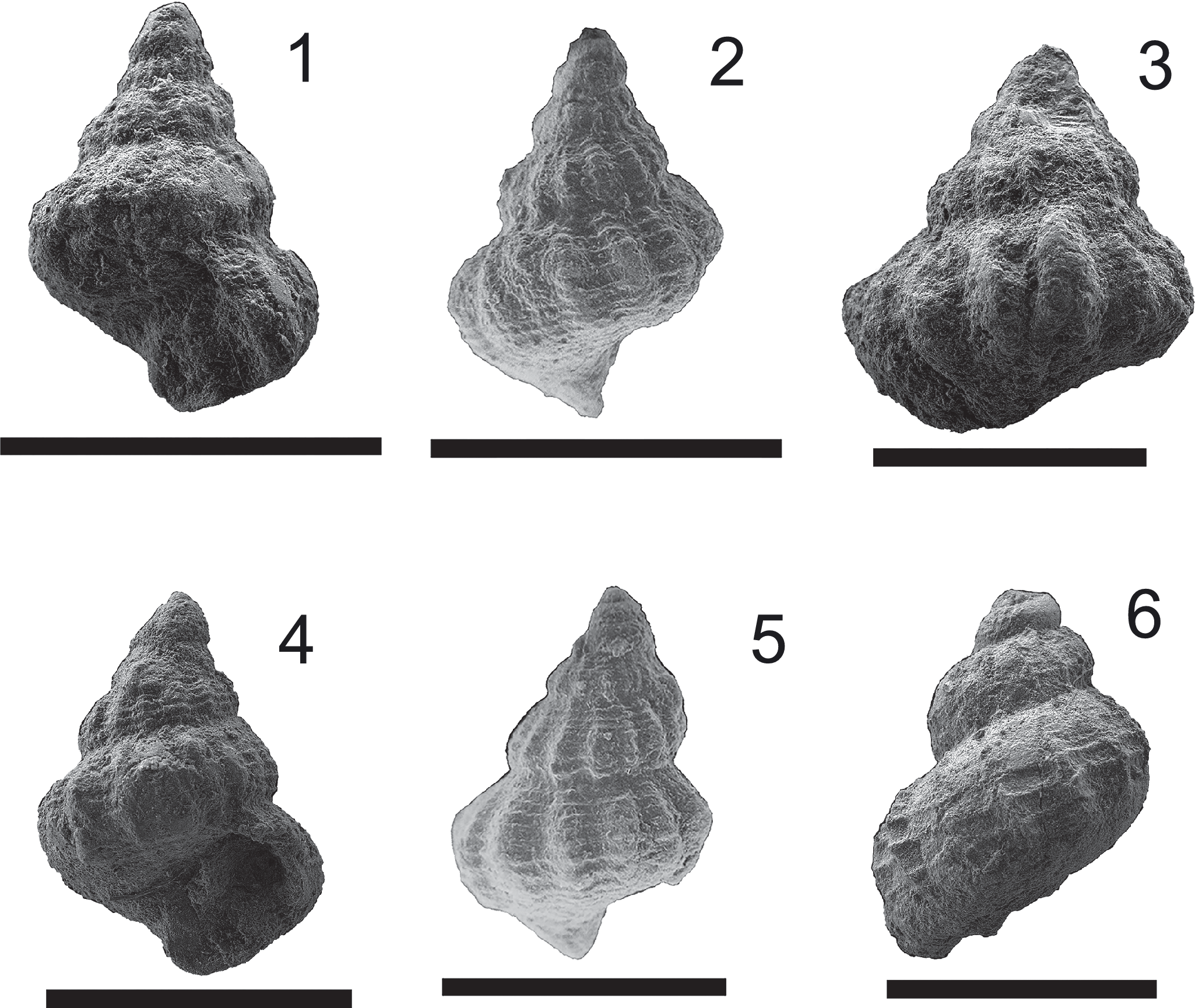
Reference Anderson, Boardman, and Strathearn, Yugan and Chun1989 Plocezyga (Plocezyga) n. sp. 2, Anderson and Boardman, pl. 2, figs. 4, 5.
Holotype
CM 34777; Wayland Shale unit at locality CM SL6595, exposed on a hillside south of Texas Route 765. Legal description UTM14RMK46646347267, McCulloch County, Texas, Whon 7.5′ Quadrangle. It is associated with a large and diverse molluscan fauna.
Paratypes
CM 34778, 55966–55973.
Diagnosis
Broadly turbiniform shell with prosocline transverse costae that are heavy and swollen. The teleoconch has prominent revolving threads.
Occurrence
Common in the Wayland Shale (CM SL6595) and rare in the Blach Ranch Shale (CM SL6596).
Description
Small turbiniform shell. Sutures moderately impressed. Average sutural slope of 14°. Whorl profile rounded. Base moderately rounded and anomphalous. Aperture circular in shape.
Protoconch of two and one-half whorls. First whorl smooth with the remaining one and one-half protoconch whorls with fine collabral threads. The protoconch is separated from the teleoconch by prominent transverse costae.
Teleoconch ornamented with evenly spaced, slightly prosocline, thick transverse costae. The costae thicken from upper whorl face to lower whorl face. Revolving threads very prominent and are evenly spaced on whorl face. Revolving threads form small projections where they cross the transverse costae. Apertural margin slightly prosocline.
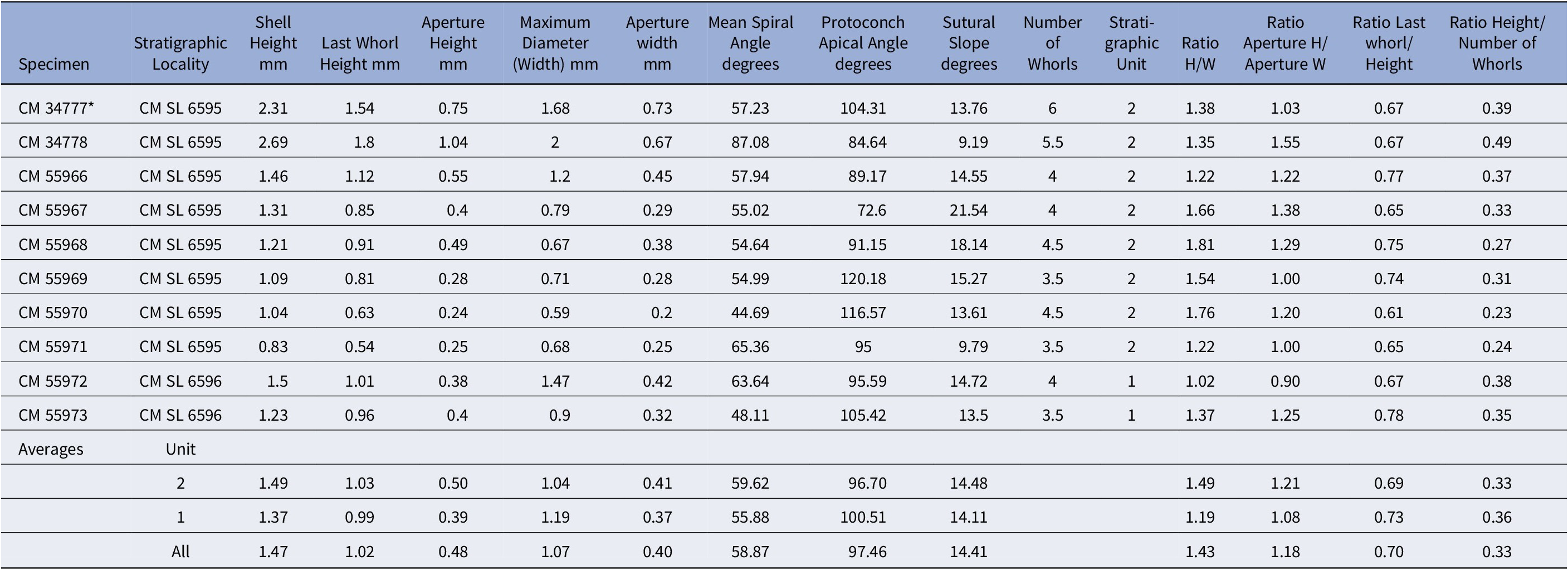
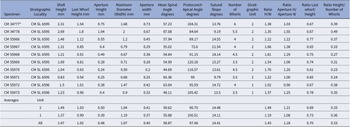
Measurements given in Table 2.
Measurements for Plocezyga pingurestis new species; * = holotype; stratigraphic units: 1, Blach Ranch Limestone and Shale; 2, Wayland Shale
Etymology
pingui – Latin for thick or stout + restis – Latin for cord.
Remarks
Plocezyga pingurestis n. sp. is similar to P. percostata subrotunda, Hoare and Sturgeon, Reference Hoare and Sturgeon1980a, from the Appalachian Basin in shape of the whorl profile and the teleoconch height and width, but the ornament of these two gastropods is very different. Plocezyga pingurestis n. sp. has very prominent bulbous transverse costae whereas P. percostata subrotunda has more numerous fine prosocline transverse cords.
Plocezyga procera new species
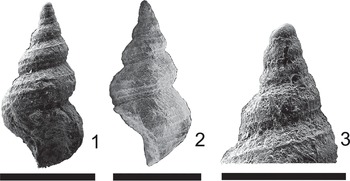
Plocezyga procera new species, (1–5) from the Wayland Shale at locality SL6595, (6) from the Blach Ranch Limestone and shale at locality SL6596; scale bars are 1 mm unless noted. (1) Holotype CM 34785, abapertural view, and (2) holotype, protoconch, scale bar 0.5 mm; (3) paratype CM 55974, apertural view; (4, 5) paratype CM 55975, (4) protoconch, scale bar 0.5 mm and (5) abapertural view; (6) paratype CM 55983 apertural view.
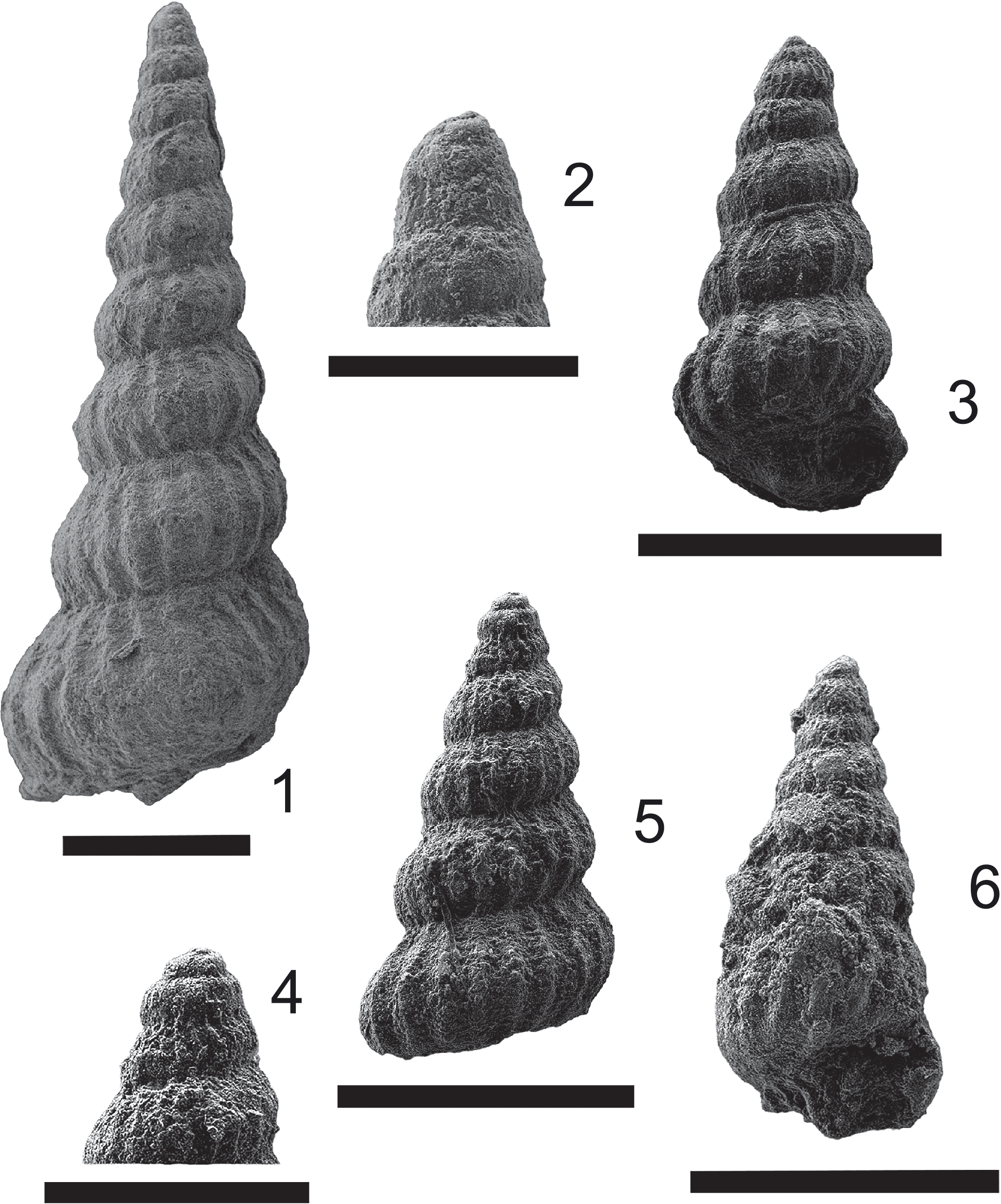
Reference Anderson, Boardman, and Strathearn, Yugan and Chun1989 Plocezyga (Plocezyga) n. sp. 3, Anderson and Boardman, pl. 2, fig. 12.
Holotype
CM 34785. Wayland Shale unit at locality CM SL6595, exposed on a hillside south of Texas Route 765. Legal description UTM14RMK46646347267, McCulloch County, Texas, Whon 7.5′ Quadrangle. It is associated with a diverse molluscan fauna.
Paratypes
CM 55974–55986.
Diagnosis
Protoconch normal for family, sutures deeply impressed, whorl profile strongly rounded. High-spired turriculate shape with transverse cords orthocline and thin.
Occurrence
Common in the Wayland Shale (CM SL6595). Rare in the Blach Ranch Shale (CM SL6596).
Description
Medium size, high-spired turriculate shell. Sutures deeply impressed with the whorl profile strongly rounded. Average sutural slope of 12.32°. The base flatly rounded and anomphalous. Aperture nearly circular in shape.
Protoconch of two and one-half to three whorls. First whorl is smooth. The following one and one-half to two whorls with fine collabral threads. Protoconch separated from teleoconch by a prominent transverse cord.
Teleoconch ornamented with evenly spaced, thin orthocline transverse cords. Revolving threads between transverse cords crowded on whorl face. The number of revolving threads increases on later whorls. Apertural margin is orthocline.
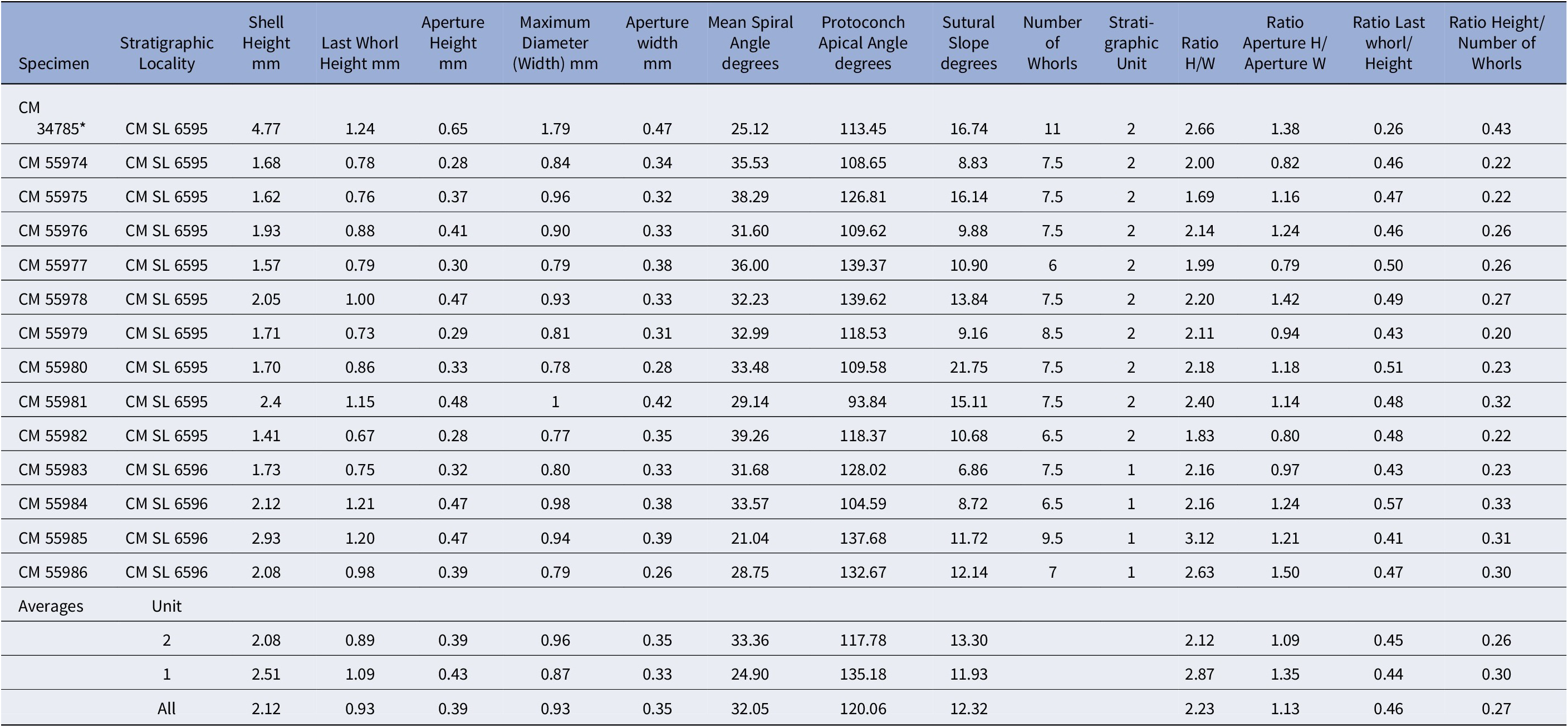
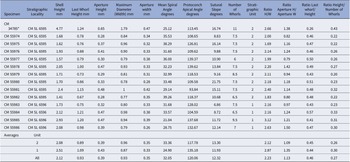
Measurements given in Table 3.
Measurements for Plocezyga procera new species; * = holotype; stratigraphic units: 1, Blach Ranch Limestone and Shale; 2, Wayland Shale
Etymology
procera – Latin for tall.
Remarks
Plocezyga procera n. sp. is similar to P. markae Hoare and Sturgeon, Reference Hoare and Sturgeon1980a, from the Appalachian Basin, in whorl profile, orthocline transverse cords, deeply impressed sutures, and crowded revolving threads, but has much narrower and fewer transverse cords. It is also similar to P. ornata (Mark, Reference Mark1912) from the Appalachian Basin, in whorl profile, narrow orthocline transverse cords, and deeply impressed sutures, crowded revolving threads, but the transverse cords are much narrower in P. procera n. sp. than in P. ornata.
Genus Gamizyga Hoare and Sturgeon, Reference Hoare and Sturgeon1980a
Reference Knight1930 Hemizyga (Hemizyga) Knight.
Reference Hoare and Sturgeon1980a Gamizyga (Gamizyga) Hoare and Sturgeon.
Reference Hoare and Sturgeon1980b Plocezyga (Gamizyga) Hoare and Sturgeon.
Reference Bandel2002 Gamizyga; Bandel.
Type species
Gamizyga corpulentissima (= Hemizyga (Hemizyga) corpulentissima Knight, Reference Knight1930) from the Labette Shale of St. Louis, Missouri, USA.
Gamizyga lenterotunda new species
Gamizyga lenterotunda new species. (1, 2) Holotype CM 34774 from SL6592, from the Palo Pinto Formation, shale lithofacies of the Wynn Member (1) apertural view, (2) abapertural view. Scale bar is 1 mm.
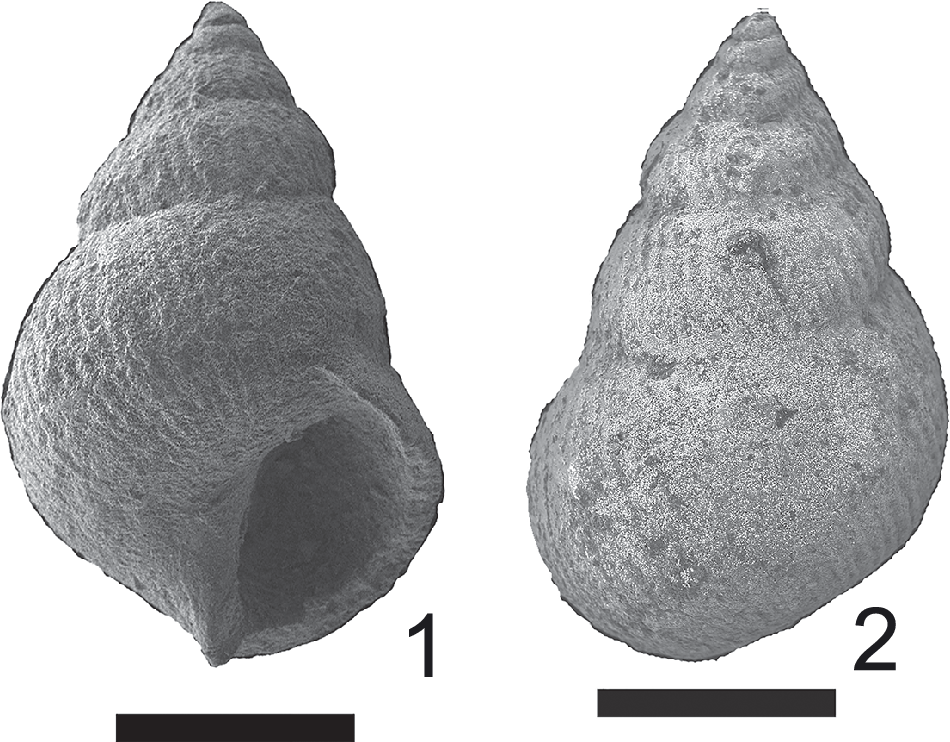
Reference Anderson, Boardman, and Strathearn, Yugan and Chun1989 Plocezyga (Gamizyga) n. sp., Anderson and Boardman, pl. 2, fig. 1.
Holotype
CM 34774 in the shale within the Palo Pinto (Wynn) Limestone at locality CM SL6592, exposed on a hillside. Legal description UTM14SNM57956363972, Palo Pinto County, Texas, Graford East 7.5′ Quadrangle. It is associated with a diverse molluscan fauna.
Diagnosis
Shallow impressed sutures with closely spaced prosocline transverse cords on the whorl face. Whorl profile gently rounded.
Occurrence
Rare in the shale member of the Palo Pinto (Wynn) Limestone (CM SL6592).
Description
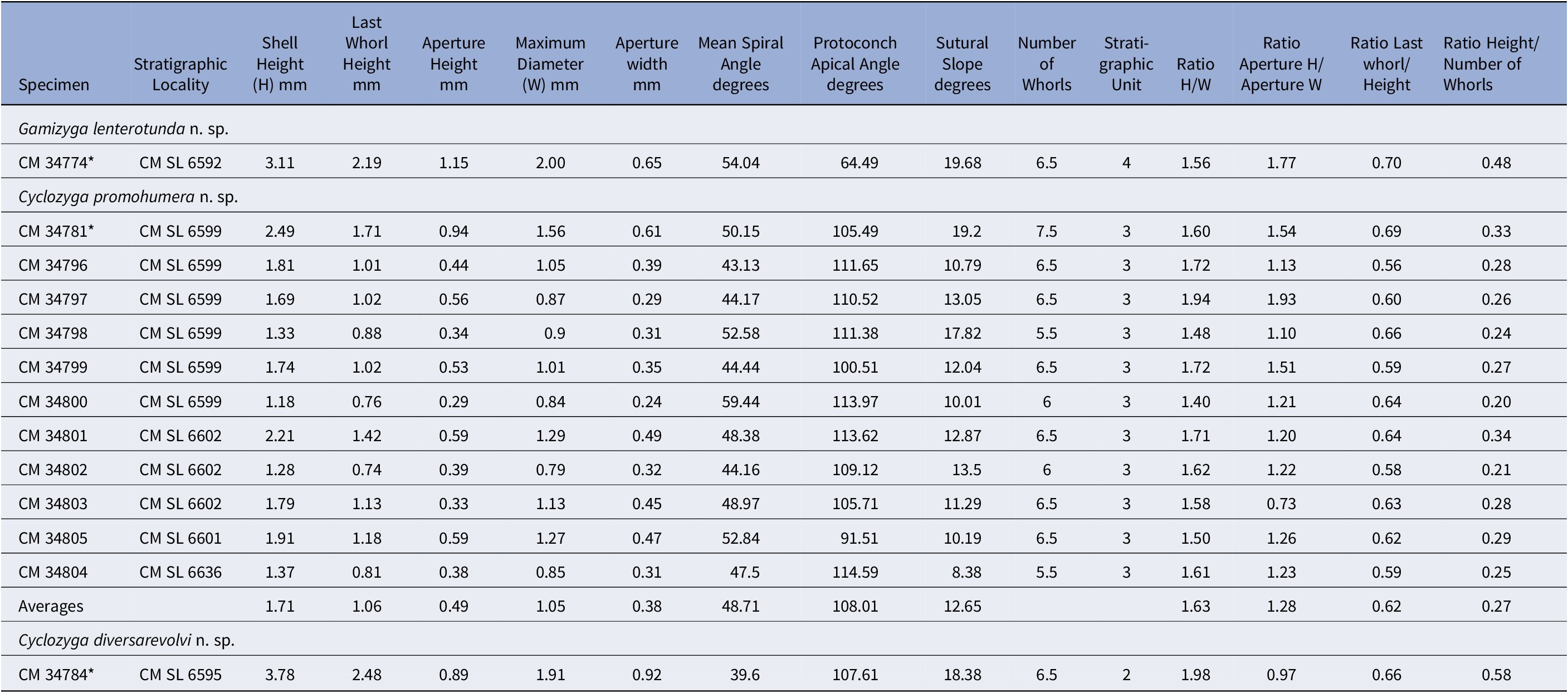
Small- to medium-sized shell with shallow impressed sutures on the whorl face. Average sutural slope of 17°. Gently rounded whorl profile. Base is rounded and anomphalous. Aperture is sub-oval in shape.
Protoconch has three whorls. Two and one-half whorls are smooth with the following one-half whorl with fine collabral threads. Protoconch is separated from the teleoconch by a prominent transverse cord.
Teleoconch ornamented with fine, closely spaced prosocline transverse cords. The cords become more prominent on the whorl base. No revolving threads visible on the whorl face.
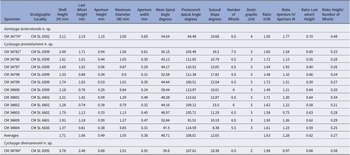
Measurements given in Table 4.
Measurements for Gamizyga lenterotunda new species, Cyclozyga promohumera new species, and Cyclozyga diversarevolvi new species; * = holotype; stratigraphic units: 2, Wayland Shale; 3, Finis Shale; 4, Palo Pinto Formation
Etymology
lente – Latin for slowly or leisurely; + rotunda – Latin for round, spherical.
Remarks
Gamizyga lenterotunda n. sp. is similar to G. nitida Hoare and Sturgeon, Reference Hoare and Sturgeon1980a, from the St. Louis outlier, in having closely spaced prosocline transverse cords, but has shallow impressed sutures and is shorter in height. This new species is also similar to G. expansa Hoare and Sturgeon, Reference Hoare and Sturgeon1980a, from the St. Louis outlier and G. girtyi Hoare and Sturgeon, Reference Hoare and Sturgeon1980a, from the Appalachian Basin, in having closely spaced transverse cords, but G. lenterotunda n. sp. has prosocline cords whereas G. expansa and G. girtyi have orthocline cords. The whorl profile of these species is much narrower and taller than G. lenterotunda n. sp.
Genus Cyclozyga Knight, Reference Knight1930
Type species
Cyclozyga mirabilis Knight, Reference Knight1930, from the Labette Shale of St. Louis, Missouri, USA.
Cyclozyga promohumera new species
Cyclozyga promohumera new species from the Finis Shale; (1–5) from SL6599, (6) from SL6602; scale bars are 1 mm unless noted. (1–3) Holotype CM 34781, (1) apertural view, (2) abapertural view, (3) protoconch, scale bar is 0.5 mm in (3); (4) paratype CM 34797, abapertural view; (5) paratype CM 34796, apertural view; (6) paratype CM 34801, abapertural view.
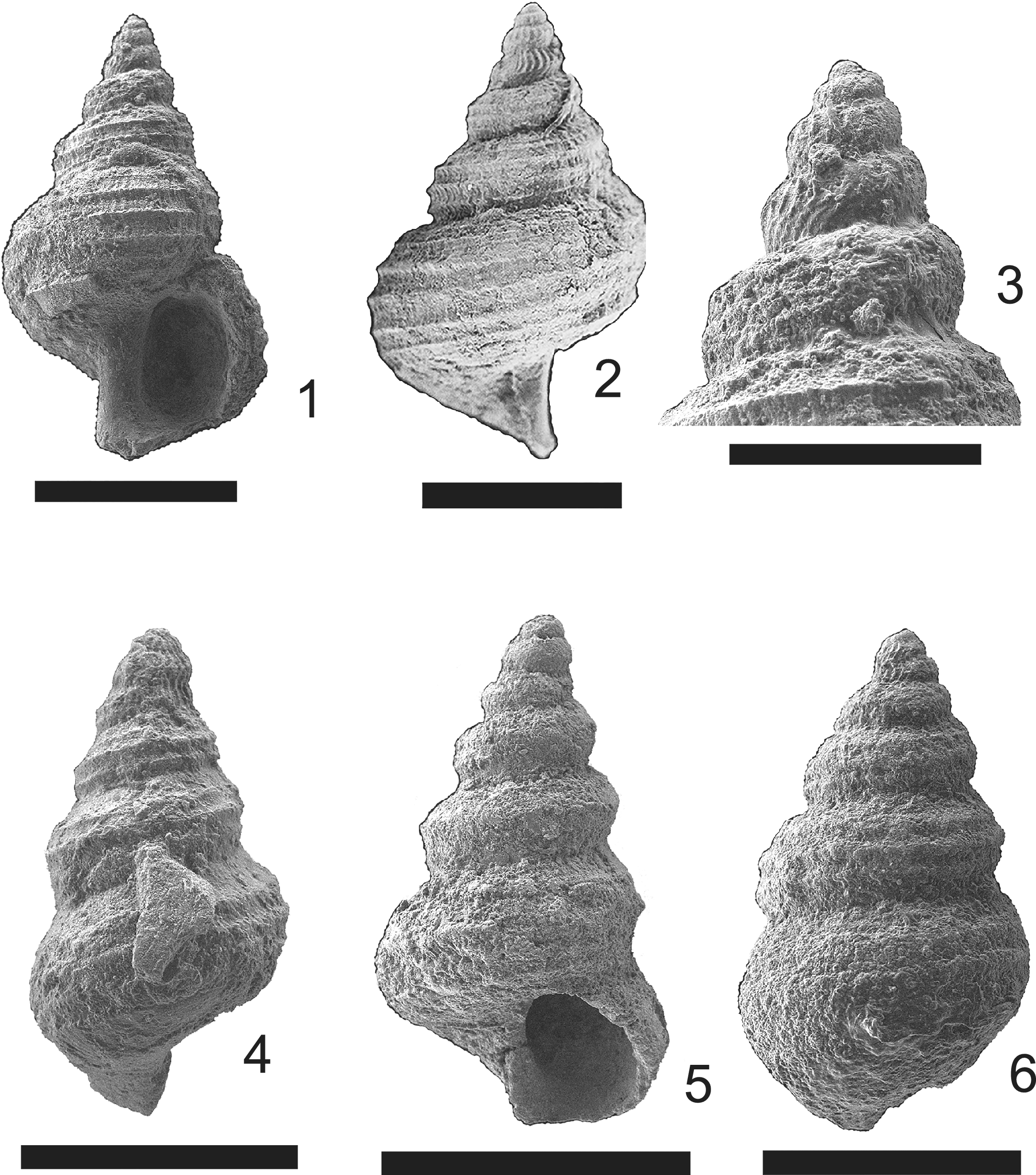
Reference Anderson, Boardman, and Strathearn, Yugan and Chun1989 Cyclozyga n. sp. 1, Anderson and Boardman, pl. 2, fig. 8.
Reference Nützel1998 Cyclozyga sp., Nützel, pl. 30, figs. P, Q.
Holotype
CM 34781 in the Finis Shale at locality CM SL6599, exposed on a well pad near the Salt Creek Cemetery. Legal description UTM14SNM56822366582, Jack County, Texas, Long Hollow 7.5′ Quadrangle. It is associated with a diverse molluscan fauna.
Paratypes
CM 34796–34805.
Diagnosis
Rounded whorl profile with strong revolving, near horizontal, costae evenly spaced on entire whorl surface. Thick outer apertural lip.
Occurrence
Rare to common in the Finis Shale (CM SL6599, CM SL6602, CM SL6636).
Description
Very small, turbinate shell with gently impressed sutures with very low-angled sutural slope, average of about 12°. Whorl profile strongly rounded with an anomphalous rounded base. Aperture round to sub-oval in shape with thick outer lip.
Protoconch with one to one and one-half smooth whorls followed by two whorls with well-developed collabral costellae. The protoconch is separated from the teleoconch with a distinct growth line.
The teleoconch has four to five nearly equally spaced prominent narrow revolving costellae with wide, shallowly concave interspaces on the lower two-thirds of the whorl face. Interspace between costellae is weak on upper whorl face. Revolving costellae are very prominent on the later whorls. Growth lines are slightly raised orthocline. The last whorl is about 62% of the total shell height.
Measurements given in Table 4.
Etymology
promo – Latin for to bring out, to produce; humera, umera – Latin for shoulder.
Remarks
Cyclozyga promohumera n. sp. is similar to C. carinata (Knight, Reference Knight1930) in having prominent revolving costae but differs by having wider costae and not having distinct growth lines. Cyclozyga promohumera n. sp. is similar to C. mirabilis (Knight, Reference Knight1930) in the number of whorls, having a shoulder on the whorl profile and sutural slope but differs in having more prominent revolving costae. It is similar to C. attenuata (Hoare and Sturgeon, Reference Hoare and Sturgeon1978) in having a shouldered whorl profile but differs in having a more rounded profile.
Cyclozyga diversarevolvi new species
(1–3) Cyclozyga diversarevolvi new species, holotype CM 34784, from the Wayland Shale at locality SL6595; scale bars are 1 mm unless noted. (1) Apertural view; (2) adapertural view, (3) protoconch, scale bar = 0.5 mm in (3).
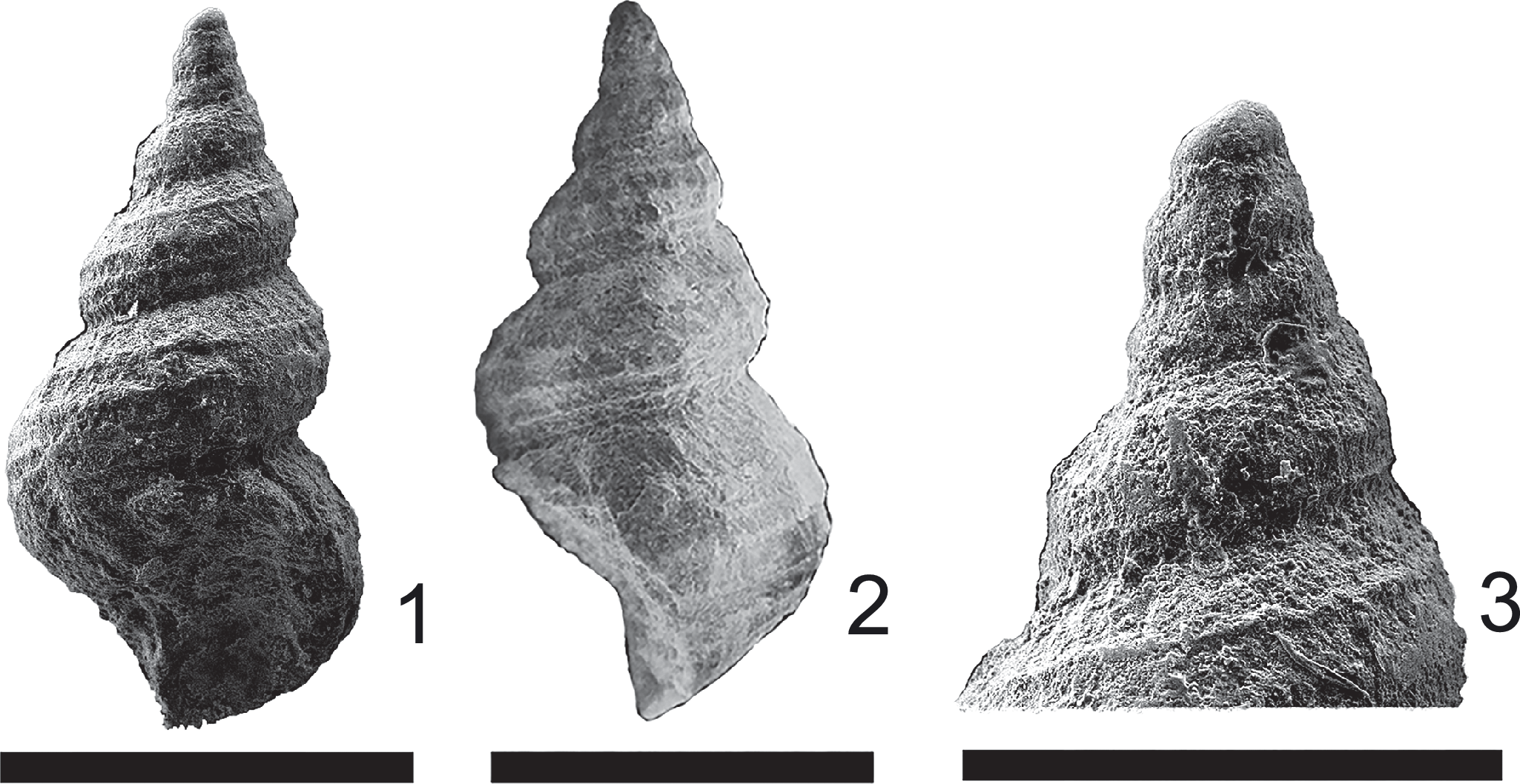
Reference Anderson, Boardman, and Strathearn, Yugan and Chun1989 Cyclozyga n. sp. 2, Anderson and Boardman, pl. 2, fig. 11.
Holotype
CM 34784 in the Wayland Shale unit at locality CM SL6595, exposed on a hillside south of Texas Route 765. Legal description UTM14RMK46646347267, McCulloch County, Texas, Whon 7.5′ Quadrangle. It is associated with a large and diverse molluscan fauna.
Diagnosis
Moderately high-spired conch with near-horizontal revolving costae. Moderately steep sutural slope. Well-rounded whorl profile. Sharp angled point to the columellar end of aperture.
Occurrence
Rare in the Wayland Shale (CM SL6595).
Description
Medium-size shell with moderately impressed sutures with gently angled sutural slope, average of about 18°. Whorl profile strongly rounded with an anomphalous rounded base. Aperture sub-oval in shape with thin outer lip. Outer lip meets the columella forming a gentle point.
Protoconch has three whorls. One whorl is smooth with the following two whorls with fine collabral threads. Protoconch is separated from the teleoconch by a prominent transverse cord.
Teleoconch ornamented with four fine revolving costae. The top two revolving costae are more prominent on the whorl face than the lower two revolving costae. Upper surface of whorl is devoid of revolving costae. Growth line weakly present on the whorl face.
Measurements given in Table 4.
Etymology
diversa – Latin for apart + revolvi to revolve or to come around again.
Remarks
Cyclozyga diversarevolvi n. sp. is similar to C. mirabilis (Knight, Reference Knight1930) with the upper surface of the whorl face devoid of revolving costae and similar mean spiral angle of the shell but differs by having a thin apertural lip at the columella, taller shell height, and steeper sutural slope. Cyclozyga diversarevolvi n. sp. differs from C. attenuata (Hoare and Sturgeon, Reference Hoare and Sturgeon1978) in having more impressed sutures and a greater mean spiral angle by 20°. Cyclozyga diversarevolvi n. sp. differs from C. promohumera n. sp. by having a greater mean spiral angle and a greater height to width ratio.
Corrections of previous published work
We found several errors within the plate descriptions for Anderson and Boardman (Reference Anderson, Boardman, Boardman, Barrick, Cocke and Nestell1989). Copies of the plates and corrected plate descriptions are given in Appendix 2.
Acknowledgments
We would like to thank D. Gnidovec of the Orton Geological Museum, Department of Geology and Mineralogy, The Ohio State University, and R. White of the Peabody Museum of Natural History, Division of Invertebrate Paleontology, Yale University, for graciously loaning type and other specimens used for comparison in this study. We would also like to thank the reviewers of this paper. Their suggestions improved this paper greatly.
Competing interests
The authors declare none.
Appendix 1—Locality register for the Pennsylvanian strata for North-Central Texas, Oklahoma, Kansas, and New Mexico
The numbers listed for each locality are Carnegie Museum locality designations. Also listed in parentheses are locality designations of Boardman et al. (Reference Boardman, Cocke, Mapes, Boardman, Barrick, Cocke and Nestell1989, p. 351–380). The locality coordinates are given in the UTM grid system for localities in Texas. Superscript numbers are not necessary to locate points with a 7.5′ quadrangle but are important for larger scale locations. Locations are given using the Public Land Survey System, Township and Range, for localities in Oklahoma and New Mexico.
SL6583.—(TXD-17) Grindstone Creek Formation, shale below Quarles Limestone, Santo 7.5′ Quadrangle, Palo Pinto County, Texas; locality in road cut on access road to Interstate 20; legal description: UTM14SNM57540360348.
SL6584.—(TXM-16) Lower Placid, Costello Island 7.5′ Quadrangle, Palo Pinto County, Texas; locality in a road cut on Park Road 36, at a point 0.95 miles south of the junction where Park Road changes from an east–west road to a north–south road; legal description: UTM14SNM54917363794.
SL6585.—(TXD-07) East Mountain Shale, just above the Hog Mountain Sandstone, Mineral Wells East 7.5′ Quadrangle, Palo Pinto County, Texas; locality is a hillside exposure at the base of East Mountain; legal description: UTM14SNM58336363094.
SL6586.—(TXD-01) Dickerson Shale, Dennis 7.5′ Quadrangle, Hood County, Texas; locality is the shale in a cut bank 30 meters north of TX 1189, where Rocky Branch intersects with the road; legal description: UTM14SNM59524360040.
SL6587.—(TXD-14) Shale immediately below the Meek Bend Limestone, Lipan 7.5′ Quadrangle, Parker County, Texas; locality is the quarry at the base of Potato Hill; legal description: UTM14SNM59119360919.
SL6588.—(TXD-06) East Mountain Shale, just below Hog Mountain Sandstone, Mineral Wells East 7.5′ Quadrangle, Palo Pinto County, Texas; locality is the hillside exposure on outlier in Fort Wolters, Texas; legal description: UTM14SNM58755363150.
SL6589.—(KSV-01) Robbins Shale above the Haskel Limestone of the Lawrence Formation, Peru 7.5′ Quadrangle, Chautauqua County, Kansas; locality is a roadcut along U.S. Highway 166, west of Peru, Kansas, center of NW¼, NE¼, sec. 20, T.34S., R.21E.
SL6590.—(TXV-50) Colony Creek Shale, Caddo N.E. 7.5′ Quadrangle, Palo Pinto County, Texas; locality in road cut on both sides of U.S. 180; legal description: UTM14SNM54362362305.
SL6591.—(TXD-16) Shale between Lower and Middle Brannon Bridge Limestone, Brazos East 7.5′ Quadrangle, Parker County, Texas; locality is within the White’s Quarry, southern quarries, west and southwest of Meeks Bend of the Brazos River and south and southeast of Interstate 20; legal description: UTM14SNM589 to 591, 3611 to 3612.
SL6592.—(TXM-33) Palo Pinto Formation, Wynn Member, shale lithofacies, Graford East 7.5′ Quadrangle, Palo Pinto County, Texas; locality is a roadcut on Texas Highway 337, 5.56 miles north of the intersection of TX 337 and U.S. 180; legal description: UTM14SNM57576363742.
SL6593.—(TXV-77) Upper Placid Shale, Graford West 7.5′ Quadrangle, Palo Pinto County, Texas; locality is an exposure in a road cut on the west side of Texas Highway 337, at a point 3.83 miles south of the intersection of TX 337 and TX 16.
SL6594.—(TXM-19) Lower Placid, Costello Island 7.5′ Quadrangle, Palo Pinto County, Texas; locality is a hillside exposure, near the base of the hill 100 meters due west of Texas Highway 16 at a point 1.97 miles south of the intersection of TX 16 and TX 337; legal description: UTM14SNM55722364826.
SL6595.—(TXV-03) Wayland Shale, Whon 7.5′ Quadrangle, McCulloch County, Texas; locality in a hill side exposure south of TX 765; legal description: UTM14RMK46646347267.
SL6596.—(TXV-100) Blach Ranch Limestone and Shale, Senate 7.5′ Quadrangle, Jack County, Texas; locality is a hillside exposure; legal description: UTM14SNM56072367858.
SL6597.—(TXV-47) Colony Creek Shale, Lake Brownwood 7.5′ Quadrangle, Brown County, Texas; locality is on a hill side; legal description UTM14RML49779352472.
SL6598.—(TXV-78) Upper Placid Shale, Costello Island 7.5′ Quadrangle, Palo Pinto County, Texas; locality is the exposure in a road cut on the west side of TX 16 at a point 1.27 miles by road south of the intersection of TX 16 and TX 337; legal description: UTM14SNM55710364948.
SL6599.—(TXV-70) Finis Shale, Long Hollow 7.5′ Quadrangle, Jack County, Texas; locality is on an oil well pad near the Salt Creek Cemetery; legal description: UTM14SNM56822366482.
SL6600.—(TXM-34) Palo Pinto Formation, Wynn Member, shale lithofacies, Graford East 7.5′ Quadrangle, Palo Pinto County, Texas; locality is a hill side exposure at the base of a prominent hill, 0.62 miles northeast of Union Hill Cemetery; legal description: UTM14SNM57989363988.
SL6601.—(TXV-28) Finis Shale, Ross Mountain 7.5′ Quadrangle, Young County, Texas; locality in a road cut on Finis Road northwest of the town of Finis, Texas; legal description: UTM14SNM55017365550.
SL6602.—(TXV-29) Finis Shale, Lacasa 7.5′ Quadrangle, Stephens County, Texas; Locality is in the spillway of a pond dam near Mount Zion Cemetery; legal description: UTM14SNM52793360588.
SL6603.—(TXM-44) Upper Wolf Mountain Shale = Upper Jasper Creek Shale, Bridgeport West 7.5′ Quadrangle, Wise County, Texas; locality is a road cut on the east side of TX 2952, at a point 0.1 miles north of the intersection of TX 2952 and TX 1658; legal description: UTM14SPM60948367735.
SL6633.—(OKM-39) Coffeyville Formation, basal Tacket shale bed, Wewoka East 7.5′ Quadrangle, Hughes County, Oklahoma; locality exposure on a hill side adjacent to Long George Creek, SE¼, NW¼, NW¼, sec. 30, T.9N., R.9E.
SL6634.—(OKD-21) Upper Holdenville Formation, Nuyaka Creek shale bed, Sasakwa 7.5′ Quadrangle, Seminole County, Oklahoma; locality is an exposure on a hill side at Center of southern half of SE¼, NW¼, sec. 25, T.6N., R.7E.
SL6635.—(NMM-01) Uppermost Gobbler Formation and Lowermost Beeman Formation, Alamogordo North 7.5′ Quadrangle, Otero County, New Mexico; locality is precise, but is an exposure of shale unit close to the boundary of the Gobbler and Beeman Formation in Beeman Canyon, secs. 4 or 5, T.16S., R.10E.
SL6636.—(TXV-73) Finis Shale, Jacksboro 7.5′ Quadrangle, Jack County, Texas; locality in the spillway for Lake Jacksboro (was a new quarry); legal description: UTM14SNM58006367787.
Appendix 2—Corrections of previous published work (JRA)
Several errors within the plate descriptions for Anderson and Boardman (Reference Anderson, Boardman, Boardman, Barrick, Cocke and Nestell1989) have been identified by one of the co-authors (JRA). Some of the Carnegie Museum specimen numbers were typed incorrectly, one of the Carnegie Museum numbers was already in use so the number has changed. Some of the locality designations were typed incorrectly, which caused some confusion as to where a specimen locality actually is, but now these issues have been resolved. One of the figured specimens has been determined to have been incorrectly identified, thus the correct name is presented. Within this paper the new species in the Anderson and Boardman, Reference Anderson, Boardman, Boardman, Barrick, Cocke and Nestell1989, paper have now been described; thus, the new names appear in these corrected Plate descriptions. Both of DRB’s locality designations are listed as well as the Carnegie Museum stratigraphic localities (SL) numbers within these corrected plate descriptions.
Corrected plate descriptions for Anderson and Boardman (Reference Anderson, Boardman, Boardman, Barrick, Cocke and Nestell1989)
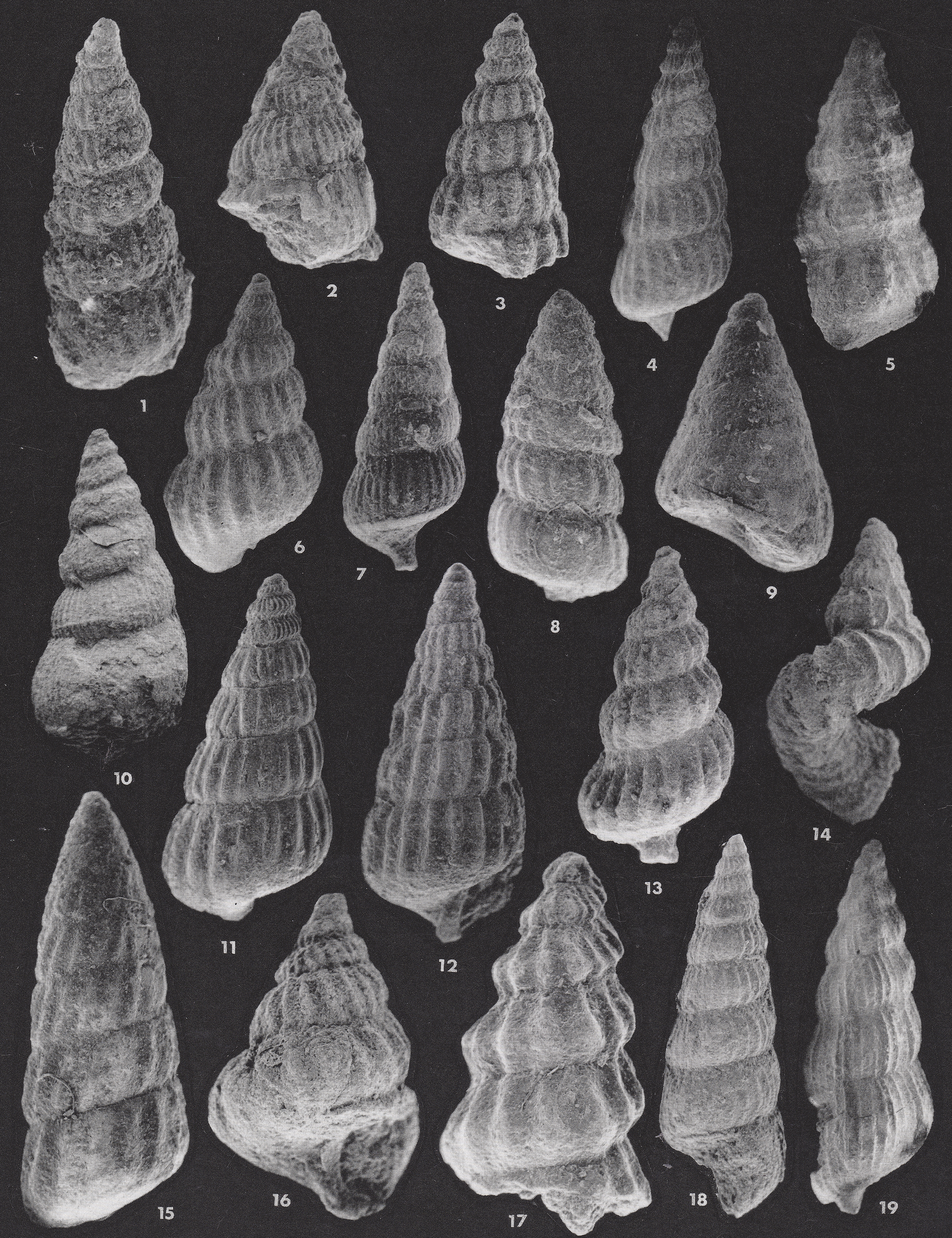
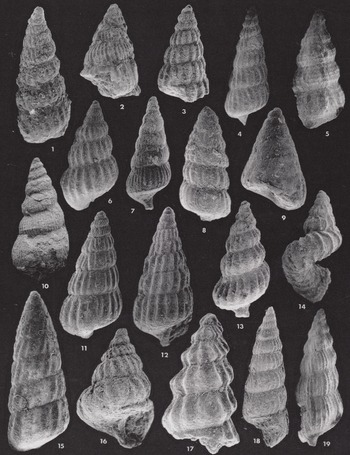
Middle and Upper Pennsylvanian pseudozygopleurid microgastropods (Appendix Figure 1).—All specimens illustrated in Anderson and Boardman (Reference Anderson, Boardman, Boardman, Barrick, Cocke and Nestell1989, pl. 1) are reposited in the Carnegie Museum of Natural History, Pittsburgh, PA.
Figure 1.—Pseudozygopleura (Pseudozygopleura) acuminata (now Pseudozygopleura acuminata) ×25, Grindstone Creek Formation, 0.3 meter above base of section, Locality [TXD-17], CM SL6583, (CM 55987).
Figure 2.—Pseudozygopleura (Pseudozygopleura) multicostata (now Pseudozygopleura multicostata [Meek and Worthen, Reference Meek and Worthen1866]) ×35, lower Placid Shale, sample 3, Locality [TXM-16], CM SL6584, (CM 34756).
Figure 3.—Plocezyga (Plocezyga) excellens (now Plocezyga excellens) ×35, East Mountain Shale, shale immediately above Hog Mountain Sandstone, basal sample, Locality [TXD-07], CM SL6585, (CM 34757).
Figure 4.—Pseudozygopleura (Pseudozygopleura) eximia (now Pseudozygopleura eximia Hoare and Sturgeon, Reference Hoare and Sturgeon1985) ×25, Dickerson Shale, Locality [TXD-01], CM SL6586, (CM 34758).
Figure 5.—Plocezyga (Hyphantozyga) perattenuata (now Hyphantozyga perattenuata Hoare and Sturgeon, Reference Hoare and Sturgeon1980a) ×35, Grindstone Creek Formation, 0.75 meter above base, Locality [TXD-17], CM SL6583, (CM 34759).
Figure 6.—Plocezyga (Plocezyga) conica (now Plocezyga conica) ×35, Grindstone Creek Formation, 0.75 meter above base, Locality [TXD-17], CM SL6583, (CM 34760).
Figure 7.—Plocezyga (Plocezyga) delicata (now Plocezyga delicata) ×25, Grindstone Creek Formation, 1 meter above base, Locality [TXD-17], CM SL6583, (CM 34761).
Figure 8. Pseudozygopleura (Pseudozygopleura) angusta (now Pseudozygopleura angusta Hoare and Sturgeon, Reference Hoare and Sturgeon1985) ×25, shale immediately below Meek Bend Limestone, Locality [TXD-14], CM SL6587, (CM 34762).
Figure 9.—Strobeus sp., ×35, Grindstone Creek Formation, 0.3 meter above base, Locality [TXD-17], CM SL6583, (CM 34763).
Figure 10.—Plocezyga (Hyphantozyga) textilis (now Hyphantozyga textilis) ×18, East Mountain Shale, shale immediately above Hog Mountain Sandstone, base of section, Locality [TXD-07], CM SL6585, (CM 34764).
Figure 11.—Pseudozygopleura (Pseudozygopleura) contractus (now Pseudozygopleura contractus Hoare and Sturgeon, Reference Hoare and Sturgeon1981b) ×25, East Mountain Shale, shale immediately below Hog Mountain Sandstone, Locality [TXD-06], CM SL6588, (CM 34765).
Figure 12.—Pseudozygopleura (Pseudozygopleura) marvinwelleri (now Pseudozygopleura marvinwelleri [Knight, Reference Knight1930]) ×25, East Mountain Shale, immediately above Hog Mountain Sandstone, base section, Locality [TXD-07], CM SL6585, (CM 34766).
Figure 13.—Plocezyga (Plocezyga) intermedia (now Plocezyga intermedia) ×25, Dickerson Shale, Locality [TXD-01], CM SL6586, (CM 34767).
Figure 14.—Helminthozyga vermicula Knight, Reference Knight1930, ×25, Colony Creek Shale, 1 meter above base of section, Locality [TXV-50], CM SL6590, (CM 34768).
Figure 15.—Pseudozygopleura (Pseudozygopleura) dunbari (now Pseudozygopleura dunbari Knight, Reference Knight1930) ×25, Grindstone Creek Formation, 0.3 meter above base of section, Locality [TXD-17], CM SL6583, (CM 34769).
Figure 16.—Plocezyga (Plocezyga) n. sp. 1, (now Plocezyga ampla Anderson, Shares, and Boardman, this paper) ×25, East Mountain Shale, shale immediately below Hog Mountain Sandstone, Locality [TXD-06], CM SL6588, (CM 34770).
Figure 17.—Plocezyga (Plocezyga) subnodosa (now Plocezyga subnodosa) ×35, shale between the lower and middle ledges of the Brannon Bridge Limestone, Locality [TXD-16], CM SL6586, (CM 34771).
Figure 18. Pseudozygopleura (Pseudozygopleura) inornata (now Pseudozygopleura inornate Knight, Reference Knight1930) ×25, Dickerson Shale, Locality [TXD-01], CM SL6586, (CM 34772).
Figure 19.—Plocezyga (Hyphantozyga) fenestrata (now Hyphantozyga fenestrate Hoare and Sturgeon, Reference Hoare and Sturgeon1980a) ×25, Grindstone Creek Formation, 0.75 meter above base of section, Locality [TXD-17], CM SL6583, (CM 34773).
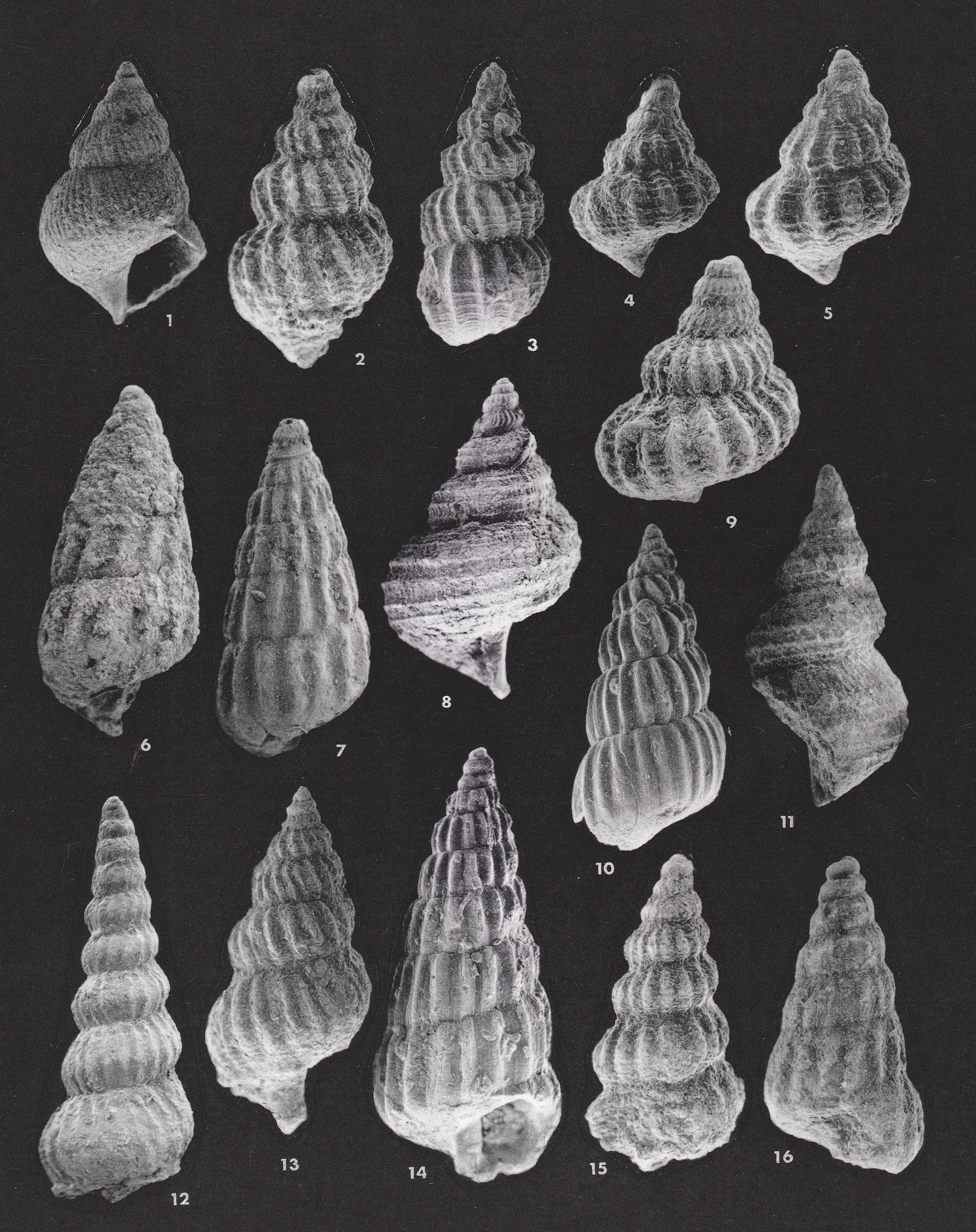
Upper Pennsylvanian Pseudozygopleurid microgastropods (Appendix Figure 2).—All specimens illustrated in Anderson and Boardman (Reference Anderson, Boardman, Boardman, Barrick, Cocke and Nestell1989, pl. 2) are reposited in the Carnegie Museum of Natural History, Pittsburgh, PA.
Figure 1.—Plocezyga (Gamizyga) n. sp. (now Gamizyga lenterotunda Anderson, Shares, and Boardman, this paper) ×54, shale within the Palo Pinto (Wynn) Limestone, sample 7, Locality [TXM-33], CM SL6592, (CM 34774).
Figures 2, 3.—Plocezyga (Plocezyga) costata (now Plocezyga costata): 2. ×35, upper Placid Shale, sample 13, Locality [TXV-77], CM SL6593, (CM 34775); 3. ×25, lower Placid Shale, middle sample, Locality [TXM-19], CM SL6594, (CM 34776).
Figures 4, 5.—Plocezyga (Plocezyga) n. sp. 2 (now Plocezyga pingurestis Anderson, Shares, and Boardman, this paper): 4. ×35, Wayland Shale, 2.0 meters above the contact of the underlying red shale, Locality [TXV-03], CM SL6595, (CM 34777); 5. ×35, Wayland Shale, 2.0 meters above the contact of the underlying red shale, Locality [TXV-03], CM SL6595, (CM34778).
Figure 6.—Plocezyga (Plocezyga) obscura (now Plocezyga obscura) ×25, Colony Creek Shale, sample 4, Locality [TXV-47], CM SL6597, (CM 34779).
Figure 7.—Plocezyga (Plocezyga) acuminata (now Plocezyga acuminata) ×25, upper Placid Shale, upper sample, Locality [TXV-78], CM SL6598, (CM 34780).
Figure 8.—Cyclozyga n. sp. 1 (now Cyclozyga promohumera Anderson, Shares, and Boardman, this paper) ×25, Finis Shale, 2 meters below Jacksboro Limestone, Locality [TXV-70], CM SL6599, (CM 34781).
Figure 9.—Plocezyga (Plocezyga) turbinata (now Plocezyga turbinata) ×54, shale within the Palo Pinto (Wynn) Limestone, sample 8, Locality [TXM-33], CM SL6592, (CM 34782).
Figure 10.—Plocezyga (Plocezyga) cordiformis (now Plocezyga cordiformis) ×25, lower Placid Shale, middle sample, Locality [TXM-19], CM SL6594, (CM 34783).
Figure 11.—Cyclozyga n. sp. 2 (now Cyclozyga diversarevolvi Anderson, Shares, and Boardman, this paper) ×35, Wayland Shale, 2.0 meters above the contact of the underlying red shale, Locality [TXV-03], CM SL6595, (CM 34784).
Figure 12. Plocezyga (Plocezyga) n. sp. 3 (now Plocezyga procera Anderson, Shares, and Boardman, this paper) ×18, Wayland Shale, 2.0 meters above the contact of the underlying red shale, Locality [TXV-03], CM SL6595, (CM 34785).
Figure 13.—Plocezyga (Plocezyga) cancellata (now Plocezyga cancellata) ×25, upper Placid Shale, sample 15, Locality [TXV-77], CM SL6593, (CM 34786).
Figure 14.—Pseudozygopleura (Pseudozygopleura) scruposus (now Pseudozygopleura scruposus Hoare and Sturgeon, Reference Hoare and Sturgeon1981b) ×25, lower Placid Shale, middle sample, Locality [TXM-19], CM SL6594, (CM 34787).
Figure 15.—Plocezyga (Plocezyga) ornata (now Plocezyga ornata) ×25, uppermost Jasper Creek Shale, Locality [TXM-44], CM SL6603, (CM 34788).
Figure 16.—Plocezyga (Plocezyga) subquadrata (now Plocezyga subquadrata) ×25, shale in the Palo Pinto (Wynn) Limestone, sample 1, Locality [TXM-33], CM SL6592, (CM 34789).






 Open access

