

In 1690, one of the peaks of the Little Ice Age in Cyprus, a new watermill sits in the flood plain of the Karkotis, the most powerful river in Cyprus. The power of this river is generated by its catchment across much of the north face of the Troodos mountains, and distributed across a bewildering network of weirs, channels, shared rights and time slots measured by shadows and stars. The miller gauges the flow, adjusts the gap between the millstones, and checks the volume of the sacks brought by the women who wait outside the door, talking, spinning, exchanging information.
All this involves constant argument, negotiation, conflict, compromise and a generally accepted dependence on the water, the soil, the crops and everything else that generates life. And there is another shared awareness, that of the dangers of the flash floods which roar down the river bringing boulders, tree trunks and huge volumes of cobbles and gravel that blanket any fields placed injudiciously on the flood plain. For all the dangers, this watermill, with its non-human and human collaborators, is a convivial tool, which draws life from its wide-ranging relationality and works within its environmental and social limits.
Three hundred years before that and 50 kilometres to the south, another watermill stands grandly on a spur within a monumental complex, enjoying the extra warmth and rainfall of the Medieval Climate Anomaly. This mill processes not smallholders’ grain but a plantation owner's sugar cane. It is part of a fabrica, a factory, an integrated and elaborate machine. It is a circular system of interlocking processes, each one with its own specialized human and animal servants. The controlled bodies of these workers plant, weed, reap, crush, press, boil, pour, extract and dispatch the sugar, a commodity that generates a return on the owner's capital when exported to Venice and the West. The control, the commodification and the scale generate inherent tensions and contradictions. The higher the production, the more the fabrica is threatened by its own devouring of fuel, water, labour and materials. This mill is a tool that has broken the environmental and human limits of conviviality.
The first aim of this article is to use these contrasting examples to explore the concept of conviviality, and to evaluate how it can help archaeological interpretation and engagement in what is increasingly being called the Anthropocene, the era when human impact on the planet has reached a geological scale (Lane Reference Lane2015; Waters et al. Reference Waters, Zalasiewicz, Summerhayes, Barnosky, Poirier, Gałuszka, Cearreta, Edgeworth, Ellis, Ellis, Jeandel, Leinfelder, McNeill, Richter, Steffen, Syvitski, Vidas, Wagreich, Williams, Zhisheng, Grinevald, Odada, Oreskes and Wolfe2016). I will try to understand and communicate the intricately interconnected relationships and interdependencies that constitute life in the world, and how they are variously understood, engaged with and subverted, both by people of the past and by ourselves today.
What happens when these two systems of watermills, one more convivial, one less so, are put under stress by social and environmental pressures, above all by the challenges of climate change? How did these different systems of interconnectedness cope with the periodic floods and droughts of the Little Ice Age, for example? The second aim of this article is to examine the resilience of social institutions such as watermills and sugar estates when under climatic and societal stress.
I ask these questions in a very specific historical context. Today, we huddle on the flood plain, looking nervously upstream and wondering how to understand and express the immense changes that are happening to what we used to think was ‘our’ world. Floods, droughts and melting ice caps create ‘knowledge controversies’, forcing us to reimagine the agents who produce such disasters, to rethink the old assumed divisions between human and natural (Whatmore Reference Whatmore2013; see also Lane Reference Lane2015, 489). No longer can we stand tall in the fabrica on the spur, surveying our plantations as masters of all the nature and culture we can see.
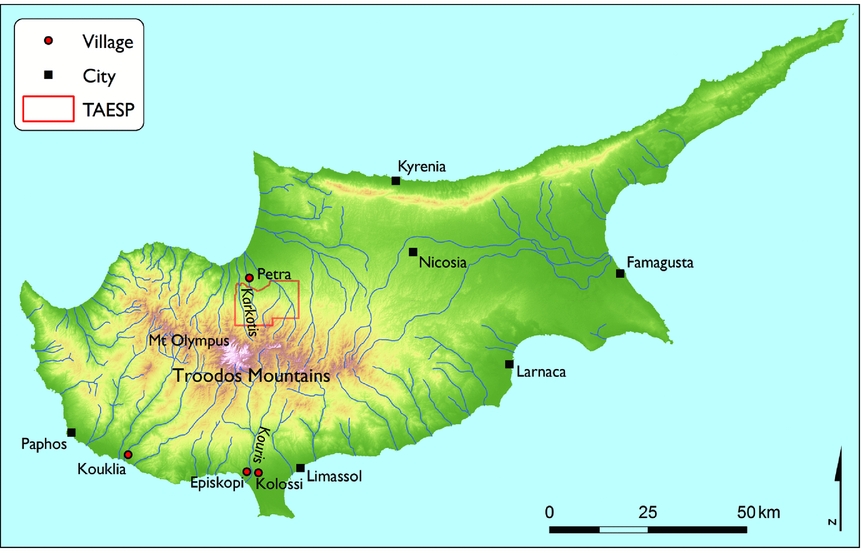
I will begin with a discussion of conviviality as both theory and practice, and then demonstrate its utility by analysing the levels of conviviality within two types of watermill from historical Cyprus, and their resilience to climate change and other environmental and social pressures (figure 1). The first type consists of the small-scale grain mills of the Ottoman period (1571–1878), themselves part of complex systems of water channels and water sharing. The second is the European-owned sugar cane plantations, mills and refineries of the Lusignan (1191–1489) and Venetian (1489–1571) periods. I will finish by considering how players such as millers, customers and archaeologists engage with the politics of conviviality, both past and present.
Map of Cyprus. TAESP = Troodos Archaeological and Environmental Survey Project (Michael Given).
Conviviality
There is far more to conviviality than the ‘tipsy jolliness’ of its modern general usage (Illich Reference Illich1975, 13). Its origins as a critical tool lie in the work of Ivan Illich (1926–2002), the Austrian polymath, polemicist and ‘archaeologist of ideas’ (Todd and La Cecla Reference Todd and La Cecla2002). In his 1975 book Tools for Conviviality, he defines conviviality as ‘autonomous and creative intercourse among persons, and the intercourse of persons with their environment’ (Illich Reference Illich1975, 24) – though the intercourse between persons and environment features much less in his work than intercourse among humans. A society which engenders this intercourse and recognizes natural scales and limits, particularly in its institutions and ‘tools’, is a convivial one (ibid., 12).
The second key work in the history of conviviality theory is Overing and Passes's Anthropology of love and anger (Overing and Passes Reference Overing and Passes2000a). They use conviviality to represent the significance of collective being to many or most indigenous Amazonian peoples, including a rejection of hierarchical structures, high affectivity and ‘a metaphysics of human and non-human interconnectedness’ (Overing and Passes Reference Overing, Passes, Overing and Passes2000c, xiii–xiv). As with Illich, the connectedness with non-humans features considerably less in their work than do connections among humans. This social and intersubjective sense of conviviality has been taken up, a little, by prehistoric archaeologists wanting to investigate the role of affect, value and aesthetics in bonding human communities (e.g. Harris Reference Harris, Lally and Moore2011; Whittle Reference Whittle, Bailey, Whittle and Cummings2005).
My take on conviviality tries to incorporate more of Illich's thinking on the tools and limits of conviviality, and to engage more fully with the active participation of non-humans in shared being. There are six key issues to conviviality, as I intend to use it: interconnectedness, vitality, tools, limits, precariousness and politics.
InterconnectednessConviviality is, above all, a framework for understanding and engaging with the integrated action that powers the fertile and shifting communities of interest among things, materials, living beings and environmental processes. Between people, this is the rich affectivity of Overing and Passes's Amazonians. But these networks and webs are equally interspun with rain, soil, cattle, boulders, millstones, pots, trees, concrete. The geographies are always hybrid (Whatmore Reference Whatmore2002); we can only act in the world from within a ‘human–nonhuman working group’ (Bennett Reference Bennett2010, xvii); agency can only be collaborative (Plumwood Reference Plumwood2006, 125–26).
VitalityAs its etymology suggests, the essence of conviviality is living together. This more-than-physiological life is generated by the constant interacting, proliferating, transforming and becoming of all beings in the world (Wylie Reference Wylie2007, 201–2). My own life, for example, is constituted by the lively interaction and strife between the food I have ingested; the bacteria in my gut; the water, air and viruses in and around me; and all the things and clothes that situate me in the world (Fouke Reference Fouke2011). Like the demons of the air and water, I am – we are – legion. Conviviality as vitality helps us escape from our centuries-old fantasies of uniqueness in the eyes of God, of mastery of nature, of human supremacy (Bennett Reference Bennett2010, viii; Tsing Reference Tsing2012, 144). Although Illich does not explore this, these fantasies have spurred us on to break the convivial limits of our tools.
ToolsFor Illich, conviviality is not a descriptor of people but of tools, the institutions that enable or direct the way people and others act and interact in the world. Convivial tools ‘give each person who uses them the greatest opportunity to enrich the environment with the fruits of his or her visions’ (Illich Reference Illich1975, 34). These tools can vary greatly in their degree of conviviality: the specialized equipment used by a team of craftworkers; specific methods of production, whether of grain, sugar, ships, laptops or futures; social institutions such as schools, cafes or universities; systems of communication and transport. Illich's book is, above all, a critique of industrial society, but the same tool or technology can often be used convivially or unconvivially. Schools, for example, can socialize children to be regimented consumers and deny privileges to those who refuse to submit, or can stimulate the growth of convivial action and confidence (Illich Reference Illich1975, 37).
LimitsA key point is that there are appropriate or ‘natural’ scales for such tools. In this sense, conviviality clearly shares with the concept of environmental sustainability a concern for living within the carrying capacity of ecosystems (Morelli Reference Morelli2011, 5–6). Tools work best for the greatest number of people if the tool is controlled by and for the benefit of the user, rather than the tool taking over, using its own logic and sheer power to drive its workers for the perpetuation of its own momentum (Illich Reference Illich1975, 34). If tools transgress their social and environment limits, they break down the interconnectedness. Persons become cogs, driven in isolation and serving the demands of the machine, rather than gaining identity and personhood through mutual feedback and interaction with the world (Crawford Reference Crawford2015), while the tool itself is driven by the unconvivial logic of its own growth.
PrecariousnessIt is very easy to transgress these limits, and so conviviality is always precarious. There is no generous Mother Earth, no easy harmony of people and nature, no mystical union of individual and world. We inhabit a turbulent, difficult world where materials and relations are continually colliding, changing, merging, disintegrating (Bennett Reference Bennett2010, xi). Tensions, dissonances, competition and violence are part of the interaction, part, even, of the conviviality, for all the positive associations of its common contemporary usage. For Amazonians, convivial relations can quickly become negative, ugly and destructive, partly because of the inherently dangerous cosmos, and partly because of the very intensity of convivial social relations (Overing and Passes Reference Overing, Passes, Overing and Passes2000b, 21–22). It therefore needs constant work, vigilance and even suffering to maintain conviviality (ibid., 24).
Politics of convivialityThis work to maintain conviviality is inevitably political. It needs to counteract unconvivial forces, whether the capricious spirits of the Amazonian cosmos, the continual upscaling of a machine, or a deeply entrenched and monopolistic political and legal system. This means that conviviality is not just a way of understanding society, but also itself a tool for generating rhetoric and critique, for making change, for reaffirming a collaborative social and environmental agency (Illich Reference Illich1975, Chapters 4 and 5; Whatmore and Hinchcliffe Reference Whatmore, Hinchcliffe, Hicks and Beaudry2010, 452–56; see also Given Reference Given2013, 16–20). Like the communities facing floods in northern England, archaeologists need to ‘slow down expert reasoning’ (Whatmore Reference Whatmore2013, 41), and start listening to the things, materials, living beings and environmental processes that humans most beneficially work with, both today and in the past.
Water and stone
In the summer of 2001, the Troodos Archaeological and Environmental Survey Project (TAESP) carefully surveyed the last working watermill in Cyprus, the Mylos tou Stylli in Evrykhou, with extensive support and information from its miller, Styllis Alexandrou (Floridou Reference Floridou, Given, Knapp, Noller, Sollars and Kassianidou2013b). One year after that, the mill was at a standstill. The water that normally squirted out of the nozzle from the penstock to drive the horizontal turbine had been deflected by the paddle-brake. The turbine itself sat motionless, while the upper millstone had been lifted off by a derrick so the lower millstone could be examined. Icons on each of the four walls made the sign of the cross over the mill house, and a row of icons above the lever of the paddle brake and candles on the lever itself protected that vulnerable point where, directly below, the water would spin the turbine and so animate the whole mill. The miller demonstrated how the lower millstone had worn down to the level of the central boss, and decades of milling had cemented the stone to the boss with flour, making it impossible to dismantle and reassemble. The mill was almost certainly beyond the point of repair.
The water-powered grain mills of medieval to 20th-century Cyprus are essentially convivial tools. For the most part, they worked within the limits of available water and labour (the miller and his family, often including a son as apprentice). Once the water had been diverted and channelled, the mills made little environmental impact, particularly as the water was then passed on for drinking and irrigation elsewhere, and they were generally under community rather than centralized control. They acknowledged and embraced their own dependence on non-human forces, from water and gravity to the properties of stone, grain and wood.
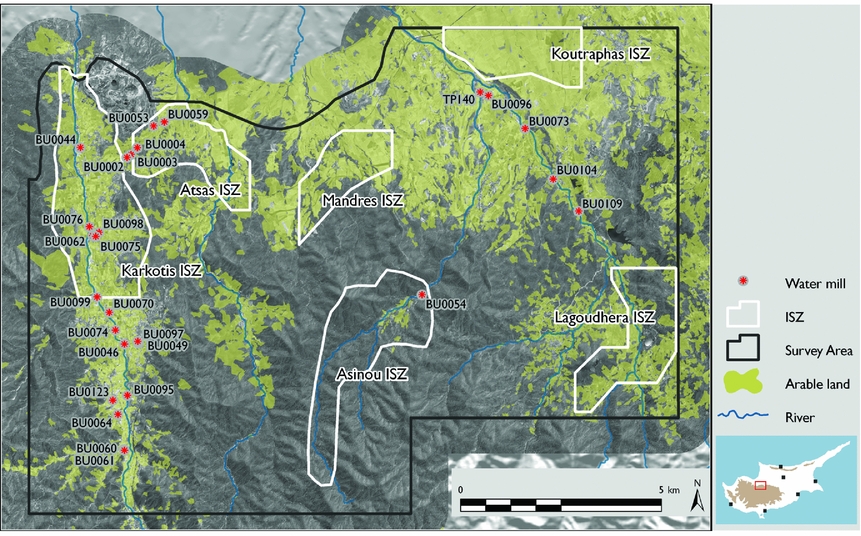
As these mills show, conviviality is not evenly distributed across the landscape. Most of the mills lie along the middle portions of the rivers, where enough tributaries have joined and there is still plenty of gradient to feed the penstocks, but before the rivers reach the level plain and begin to lose substantial water through evaporation. As can be seen in figure 2, much arable land is at a substantial distance from the nearest mill, meaning that people of one village often need to attend a mill in another village. Travel is often made easier by the location of the mill on a ford or by a bridge. All this stimulates inter-village networks of conviviality, information sharing and intermarriage, this last through women arranging marriages for their children while waiting for their flour at the mill.
Distribution of watermills and arable land in the TAESP survey area. The Karkotis is the westernmost river. Lachistos is BU0070, Molos mill is BU0076, Mylos tou Stylli is BU0049. ISZ = ‘Intensive Survey Zone’ (Jay Noller, Luke Sollars).
Mills, then, tend to sit in particular nodes in the landscape, both contributing to and benefiting from their more intense levels of conviviality. These nodes are the recipients of long-distance connections and flows, carried along in the water of a river or channel, and on the road, mule-path or animal track. The same river that brings the power for the mill brings water for drinking and irrigation, sediment for fields, and rounded, igneous river stones for building mills and the foundations of houses; it drives conviviality through its wide-ranging interconnections and flows (Edgeworth Reference Edgeworth2011, 19; Krause and Strang Reference Krause and Strang2016, 633). Of the 24 mills in the TAESP survey area, all but six are fed by the Karkotis river. This drains half of all land in Cyprus lying above 1,650 metres, including the highest points of the island, and has the shortest route to the sea (figure 1; Boutin et al. Reference Boutin, Given, Banks, Digney, Evans, Floridou, Gabrieli, Hadjianastasis, Horowitz, Ireland, Janes, Kassianidou, Knapp, McCartney, Noller, Ntinou, Schriwer, Slevin, Urwin, Vroom, Winther-Jacobsen, Given, Knapp, Sollars, Noller and Kassianidou2013, 53). It brings both volume and power.
This river running northwards down the Troodos range feeds a convivial network of energy, fertility, flow, communication and constant interaction. The network continually proliferates. The river brings down water, silt and building stone. The smoothed river boulders in the masonry of the penstock and leat are interlocked with tiles, limestone chinking and plaster (figure 3). The plaster within the stone-built channels smooths the flow of the water. The fluvial terrace supports the mill and provides a route over the ford to the far bank. Donkeys waiting for the filled sacks of flour browse the grasses and herbs watered by the river. Mice feed on the spilt flour and grain in corners of the mill. Flies breed in the donkey dung. Women spin wool and exchange information while they wait for their flour. The miller is closely attuned to the workings of the machinery and the interaction of its parts, and adjusts them continually. According to Mr Styllis of Evrykhou, the miller's goal is always alavrokopima, ‘streamlined lightness’ (Floridou Reference Floridou, Given, Knapp, Noller, Sollars and Kassianidou2013b, 70). Conviviality is the constant immersion, engagement and shifting interdependences of all these players.
Molos watermill (1690). The water passes along the aqueduct from the left to the penstock on the right. The cross and inscription (figure 6) lie directly under the projecting block in the side of the penstock (Chris Parks).

The interplay of water with all these participants is not just restricted to the mills. Particularly in the Karkotis valley, there is a much wider water distribution landscape which is finely interspun with local topography and the organization of human communities (Floridou Reference Floridou, Given, Knapp, Noller, Sollars and Kassianidou2013a). Since at least the medieval period, water channelled by a succession of weirs from the river has been shared according to an elaborate agreement centred on varying time slots and a range of differently sized openings to let the water through. This involves intense and ongoing negotiation, argument and tension, and utilizes a very carefully defined specialized vocabulary for different types of flow, opening and sharing. Even the minute flow that escapes under and over a closed sluice gate, termed polyiman and polyin respectively, is argued and apportioned (Floridou Reference Floridou, Given, Knapp, Noller, Sollars and Kassianidou2013a, 282).
In 1972, the government's Department of Water Development vainly tried to capture these agreements and negotiations on paper. They constructed a circular diagram 59 centimetres in diameter and divided radially into 24 hours and concentrically into seven days. The segments are coded with symbols representing seven villages and 29 weirs. Local indicators for measuring time include the rising of constellations over particular mountain peaks, being able to distinguish the gender of a person from 200 paces in the dusk, and the landholder's shadow reaching a line seven of their own paces away (Floridou Reference Floridou, Given, Knapp, Noller, Sollars and Kassianidou2013a, 284). Inevitably, the Department of Water Development's attempts to impose rational clock time on these locally embedded practices failed significantly.
It has become increasingly clear over the last decade or two that major hydraulic systems do not have to be driven by centralized states (Ertsen Reference Ertsen2016, 3). On the contrary, the most resilient ones are often self-regulated by reasonably egalitarian village or rural systems. In the Hawran in Syria, for example, the impressively long-lasting systems for channelling drinking water are based on village, community and micro-regional organization, where participants bring local knowledge and self-regulation to their maintenance. Brief interludes when centralized powers such as the Roman and Byzantine states built systems aimed at supplying a few large cities or strategic roads turned out to be inherently unstable, with a much shorter lifespan than the self-regulating village systems (Braemer et al. Reference Braemer, Genequand, Dumond Maridat, Blanc, Dentzer, Gazagne and Wech2009).
Similarly, village-based irrigation systems in the medieval Balearics gained their resilience not just from local knowledge and commitment but also from firm social resistance to expanding them beyond what the water sources could supply (Kirchner Reference Kirchner2009). This is precisely Illich's vision of a convivial society, based on rich interaction among humans and many others, and staying within its social and environmental limits.
As Kirchner points out, though, the resilience and stability of these hydraulic systems are charged with extreme fragility. For all their users’ precautionary management, they are highly vulnerable to change and, above all, expansion – often brought about by outside managers more attuned to the large-scale aims of external projects than to local conditions and practices (Kirchner Reference Kirchner2009, 160; cf. Weiss Reference Weiss2015). The conviviality, in other words, is precarious.
For all the negotiation, community integration and convivial measurements, the sharing of water rights was often beset with tension. Divergence, dissonance and struggle are an integral part of any convivial tool, particularly when they can be managed by strong social norms and effective conflict resolution measures (Weiss Reference Weiss2015, 259). But they can all too easily transgress the limits and fuel new machinery that gives control to a single party or to the tool itself.
Local stories up and down the Karkotis valley tell of a large landowner named Ahmed Agha in the village of Petra, reliant on the much smaller and poorer Atsas river immediately to the east of the Karkotis. So he built a series of mills on a channel which extracted water from a major weir on the Karkotis 2.5 kilometres upstream and brought it over the watershed into his own drainage. This captured water powered his new mills and continued on to irrigate his estates around Petra (see the line of mills from BU0002 to BU0059 in figure 2; Boutin et al. Reference Boutin, Given, Banks, Digney, Evans, Floridou, Gabrieli, Hadjianastasis, Horowitz, Ireland, Janes, Kassianidou, Knapp, McCartney, Noller, Ntinou, Schriwer, Slevin, Urwin, Vroom, Winther-Jacobsen, Given, Knapp, Sollars, Noller and Kassianidou2013, 102–3). This may have been in the 18th century, though the mills and therefore the major water channel supplying them seem late medieval. Whatever the date, the impact on the villages of the Karkotis river downstream of the weir is undeniable. The church, too, had a keen eye for the control of exploitation and control of crops, and could own part or all of watermills (Ireland et al. Reference Ireland, Evans, Moutafov, Schriwer, Given, Knapp, Noller, Sollars and Kassianidou2013, 270; Schriwer Reference Schriwer2015, 77–78), just as it did with olive mills (Hadjisavvas Reference Hadjisavvas and Åström1992). It also controlled the apotropaic protection of mills, as we will see.
The threat to Mr Styllis's mill in Evrykhou came from a much more general breakdown in the conviviality of modern technology and society. The increasing pace of industrialization and urbanization had left his watermill isolated, as bulk industrial milling created a monopoly over grain processing, sucking in customers and producers as it did so (Ireland et al. Reference Ireland, Evans, Moutafov, Schriwer, Given, Knapp, Noller, Sollars and Kassianidou2013, 270; Attalides Reference Attalides1981, 53–58). No longer were there craftworkers such as mill engineers, millstone producers and ironmongers to help him solve the technical problems he faced. For Illich, the unnecessary elaboration of production and designed obsolescence imposes compulsory innovation on society, often at the expense of convivial relations (Illich Reference Illich1975, 88). This convivial system of milling, though, for all its tensions and dissonances, had lasted almost two millennia. The contrast with medieval sugar production is striking.
Circles and slavery
Medieval sugar mills in Cyprus and across the Mediterranean and Middle East had at their core the same technology as grain mills: a horizontal turbine which drove a millstone via a vertical axle. The main difference was that in the sugar mill, the millstone was an edge-runner, rolling vertically round the axle to crush the cane, as opposed to the horizontal upper stone of the grain mill. A much more considerable difference was that sugar-refining complexes were unconvivial tools as an integral part of their design. They broke social and environmental limits, they exercised control over large numbers of labourers, and they restricted the abundance and interaction of life across wide sectors of environment and society. Even as far back as the 14th century, their precocious industrialism was prefiguring the sugar booms of the early capitalist plantations first on Madeira, then on the other Atlantic islands, and ultimately in the Caribbean and the Americas (Engineer Reference Engineer, Gerritsen and Riello2015, 198; Moore Reference Moore2009, 360).
Medieval sugar production still depended on the environment, the climate and the extraction of resources from soil and water. The plantations needed extensive level land and fertile soil with, above all, a plentiful water supply. The land and soil were not a challenge for big landowners along the southern coastal plains of Cyprus and, to a lesser extent, in the broader alluvial valley floors round the Troodos range (figure 1). Thanks to the Medieval Climate Anomaly, the 11th to 14th centuries were generally warmer and wetter in the eastern Mediterranean (Finné et al. Reference Finné, Holmgren, Sundqvist, Weiberg and Lindblom2011, 3164; Luterbacher et al. Reference Luterbacher, García-Herrera, Akcer-On, Allan, Alvarez-Castro, Benito, Booth, Büntgen, Cagatay, Colombaroli, Davis, Esper, Felis, Fleitmann, Frank, Gallego, Garcia-Bustamante, Glaser, Gonzalez-Rouco, Goosse, Kiefer, Macklin, Manning, Montagna, Newman, Power, Rath, Ribera, Riemann, Roberts, Sicre, Silenzi, Tinner, Tzedakis, Valero-Garcés, van der Schrier, Vannière, Vogt, Wanner, Werner, Willett, Williams, Xoplaki, Zerefos, Zorita and Lionello2012, 114). But even so, much Mediterranean sugar cane was growing at the limits of its range, resulting in the cane being harvested immature with low sugar levels (Galloway Reference Galloway1989, 36), and there were constant challenges of water, labour and fuel. By its inherent structure, sugar production on Cyprus was an unconvivial tool.
The surviving structures and relevant documents show very well the intricate organization of product, machinery, labour and space within the milling and refining complexes. As von Wartburg (Reference Von Wartburg2001, 327–28) has demonstrated, the large sugar complexes of Kouklia, Episkopi and Kolossi were all built according to a ‘master plan’ that prefigured the Industrial Revolution. They carefully separated the four different operations: crushing and pressing the cane, boiling and refining the juice, firing and stoking, storing and workshops. Walls, steps and pathways controlled the movement of product and workers alike.
Venetian ideologies of water, circulation and the fabrica play a major role here, and were firmly embedded in the sugar plantations of Cyprus. The Venetian Cornaro family acquired the rich Episkopi estate in 1367, and immediately started investing hugely in sugar production for the export trade, viewing it explicitly as a lucrative enterprise (Ouerfelli Reference Ouerfelli2008, 118). In 1488 the Cornaros acquired Kolossi as well (Enlart Reference Enlart and Hunt1987, 495), and the following year the Venetian state annexed Cyprus and appropriated the royal sugar estate at Kouklia (Ouerfelli Reference Ouerfelli2008, 129). Acting as a colonial power, the Venetians treated the island as a source of grain, sugar, salt and, above all, revenue for the mother city (Arbel Reference Arbel, Karageorghis and Michaelides1996; Luttrell Reference Luttrell, Karageorghis and Michaelides1996, 169).
Since the end of the 13th century, Venice had been very concerned with circulation systems of both water and sediment, particularly by diverting the rivers which flowed into the Venetian lagoon so that they dumped their sediment load in the sea and the lagoon itself was scoured out by tidal action (Appuhn Reference Appuhn, Howe and Wolfe2002, 73). Characteristically, Venetian engineers understood these systems in philosophical and theological terms. They were models of God's creation, each one a fabrica, an articulated whole whose parts worked together. Best of all were systems whose operations formed a circle, an expression of perfection and the circular cosmos. For modern rational humans, this principle was best materialized by a machine such as a water wheel or an Archimedean screw (Cosgrove Reference Cosgrove, Cosgrove and Petts1990, 45–49). This principle of circularity could produce convivial tools, such as, arguably, the successful balancing of the actions and affordances of rivers, farmers, sediment, ships and tidal currents. As the sugar plantations of medieval Cyprus demonstrate, other products of this principle were distinctly unconvivial.
The concept of the circular system is very evident in Jan van der Straet's depiction of a sugar mill from the second half of the 16th century (figure 4). The viewer's eye is drawn to the group in the centre foreground who are chopping the cane into sections. We follow the shovel down to the baskets on the left, then the next shovel up again to the vertical waterwheel on the left which powers the crushing mill above it; a worker is about to unload a basket into it. Continuing its circular momentum, the eye travels to the screw press, where two workers push the bar, squeezing the juice into a vat sunk into the floor. Both the bar and the handle of a tool in the vat lead to the two big cauldrons where the sugar juice is being boiled and reduced. One worker stirs, while another stokes the fire, and behind him the reduced sugar juice is ladled into the mould. The bowl of the ladle is immediately over the hat of a man turning out the moulds onto a bench, and the finished loaves are lined up directly behind the backs of the choppers of the cane.
Sugar mill, by Jan van der Straet (second half of the 16th century) (Van der Straet Reference Van der Straet1600, plate 13).

And so the perfect circle of the fabrica is completed. This control of the integrated machine and its specialized labourers is exactly that of the ‘master plan’ of the Kouklia, Episkopi and Kolossi sugar refineries. Individual humans are cogwheels in a machine that has forged its own momentum and control. They still interact with levers, shovels, water and sugar cane, but compared to the fuller conviviality of the Ottoman-period watermills this is a highly restricted range of connections and choices, which compromises the vitality at the heart of their relational being. In the background of the image, extraneous to the mill but part of its own system of circulation and annual cycles, are the plantations, where workers harvest the cane and bring it to the fabrica by mule.
The locations of the Cypriot sugar refineries are striking, and contrast greatly with the flour mills down in their ravines and flood plains. Even though the refineries need to be lower than their water source, it is clearly just as important that they should be visible, preferably on a high place such as a spur. This is particularly evident at Episkopi Serayia, where the sugar mill occupies a prominent spur below the village of Episkopi, dominating the coastal plain where the plantations were. This view was enhanced by the height of the buildings: the vaulted storerooms where hundreds of sugar moulds were found clearly had upper storeys (Young Reference Young and Swiny1982, 156).
At Kouklia, the royal manor itself sits on an even more prominent spur overlooking the coastal plain. With its central courtyard and two-storey walls, the surviving east wing being 37 metres long, it is a strong visual marker over the plantations, two sugar mills (and a third built in the ancient sanctuary of Aphrodite directly behind it), the coastal road and the major sea route along the southern coast of Cyprus to both east and west. As for Kolossi, the flat terrain in which the Commandery sits was more than made up for by the Hospitallers’ squat but high keep, 21 metres square and 29 metres high, giving panoptic control over the sugar refinery, aqueducts, plantations and roads (figure 5; Enlart Reference Enlart and Hunt1987, 496).
View south from the restored battlements of Kolossi Castle, looking over the vaulted sugar refinery (Michael Given).

Apart from these elite residences and industrial sugar refineries, no archaeological evidence for the organization of these enterprises survives. Historical documents, however, give good indications of the unconvivial management of labour. The principal labour source of feudal Cyprus was the corvée, forced labour by serfs for an agreed number of days each week, though there are also references to francomati, free peasants who were paid (Luttrell Reference Luttrell, Karageorghis and Michaelides1996, 167; Ouerfelli Reference Ouerfelli2008, 120, 127). Pietro Casola, visiting Cyprus in 1494, described over 400 workers at the Cornaros’ sugar estate in Episkopi, employed ‘some in one way, some in another’, making so much sugar that ‘it should suffice for all the world’ (Grivaud Reference Grivaud1990, 146).
Labour shortages were endemic, particularly after the Black Death of 1347 and its ensuing demographic crisis. There are increasing references to slaves, though numbers rarely seem to have been high. There were slaves on the Cornaro estate in Episkopi in the 1360s, for example (Arbel Reference Arbel1993, 160–61). Continuing economic crisis by 1415, mainly because of lack of labour, led to King Janus ordering two ships to capture 1,500 slaves from the Egyptian coast, to supply the urgent need for labourers and planters in the sugar plantations (Ouerfelli Reference Ouerfelli2008, 128). A telling indication of the shortness of labour was when the big plantations started raiding each others’ workers. In 1436 the Crown complained that the Venetians had kidnapped slaves from its plantations, while in 1455 Venice complained similarly to the king about the kidnapping of their own workers and serfs in Episkopi (Luttrell Reference Luttrell, Karageorghis and Michaelides1996, 167; Ouerfelli Reference Ouerfelli2008, 124).
All this is a far cry from Illich's (Reference Illich1975, 26) three convivial values of survival, justice and self-defined work. Even if numbers of slaves were rarely high, the principle of large-scale plantations based on slavery and other forms of enforced labour was passed to the Atlantic islands and the Caribbean; the link between sugar cane and slavery had been ‘firmly forged in Crete, Cyprus and Morocco’ (Galloway Reference Galloway1989, 42). This unconvivial system of production had, ultimately, a global impact. Plantation-scale production and slave labour empowered new European and North American elites who then upgraded from slave energy to fossil fuel energy. This in turn fuelled the Industrial Revolution, social inequalities on a global scale, the global warming of the Anthropocene, and the alienated, devastated landscapes and workforces of what Haraway has called the ‘Plantationocene’ (Haraway Reference Haraway2015, 162; see also Engineer Reference Engineer, Gerritsen and Riello2015, 198; Lane Reference Lane2015, 490; Tsing Reference Tsing2012, 148–49).
Crushing resilience
Dependence on large forces of coerced labour was clearly a major tension built into the medieval sugar plantations of Cyprus. Political divisions between the European states who had a stake in Cyprus were another, as was the colonial possession's increasingly precarious political situation in the eastern Mediterranean. In the 15th and 16th centuries the big sugar plantations suffered from attacks by Genoese and Mamluks, and also by Turkish pirates using the same methods of acquiring slaves as the plantation owners themselves (Ouerfelli Reference Ouerfelli2008, 115).
What really demonstrates the unconviviality of medieval sugar production in Cyprus is its transgression of its environmental limits. The refineries’ development, growth and success specifically required them to consume water, fuel and soil at a level which would inevitably bring about their fall. This was exacerbated by the concentration of monoculture and labour on the best land, which both increased the demand for food crops for the workforce and restricted their supply. From the 15th century, all these pressures were increased by the transition from the Medieval Climate Anomaly to the Little Ice Age, with its cold snaps, lower rainfall and periodic floods (Devillers and Lécuyer Reference Devillers and Lécuyer2008; Grove and Rackham Reference Grove and Rackham2001, 130–40). An unexpected frost in autumn 1447, for example, totally destroyed the sugar crop at Kolossi (Luttrell Reference Luttrell, Karageorghis and Michaelides1996, 167).
One clear impact of the Little Ice Age was an overall decrease in precipitation, for example in the ‘Venetian Dry’ of the early 16th century (Noller and Urwin Reference Noller, Urwin, Given, Knapp, Noller, Sollars and Kassianidou2013, 302). Even in the late 14th century and the 15th, the quarrels of the plantation owners over water show that they had expanded beyond the carrying capacity of the land. In the late 14th century, the Cornaros were aggressively expanding their production, leading them into competition with the Hospitallers in neighbouring Kolossi over their shared source of water, the Kouris river (figure 1). In 1468 the rivalry over water had escalated, with the Hospitallers diverting the water from Episkopi, with the result that the Cornaros lost their entire crop, worth 10,000 ducats, and had to import new plants from Syria (Luttrell Reference Luttrell, Karageorghis and Michaelides1996, 166; Ouerfelli Reference Ouerfelli2008, 123–25).
Sugar refineries were substantial users of wood fuel. Kouklia Stavros, Kolossi and Episkopi Serayia all had eight boiling hearths; those at Stavros are one metre in diameter, while their fire chambers, each serving two hearths, are seven to eight cubic metres (von Wartburg Reference Von Wartburg2001, 322). The inquiry into the crop at Kolossi destroyed by frost in 1447 stated that if the harvest had been started on 20 November as required, they should have done four boilings a day, completing 100 boilings by Christmas (Luttrell Reference Luttrell, Karageorghis and Michaelides1996, 167). No work on the quantification of fuel use has been done for Cyprus, but these figures show its enormous scale. It is telling that when the master sugar refiner Francesco Coupiou was contracted in 1468 to refine the sugar from the royal estates, he promised to use one-third less firewood than his Syrian predecessors (ibid., 165). As the intensity and volume of sugar production increased with its advance westwards, the plantations of Madeira in the early 16th century and Barbados in the 17th substantially cleared the ancient forests of these islands (Engineer Reference Engineer, Gerritsen and Riello2015, 203; Moore Reference Moore2009).
Large-scale sugar production was followed not just by deforestation but also by malaria. The ditches, water channels, barrels, basins and discarded or broken sugar moulds and jars all provided breeding grounds for mosquitoes. Cargo ships provided speedy means of larval distribution, while a constant stream of imported labour provided fresh blood which had no immunity (Engineer Reference Engineer, Gerritsen and Riello2015, 211–13). Malaria was endemic in Cyprus, and Ottoman-period travellers frequently comment on it (e.g. Cobham Reference Cobham1908, 478, 420, 424); James III, the infant son of Caterina Cornaro, died of it in 1474 (Hill Reference Hill1948, 710–11). Did sugar plantations and refineries work to concentrate mosquitoes round areas of human settlement and labour? This might be a short-term success for capitalists and was clearly beneficial to the mosquitoes; but when looking at the ecological system of Cyprus holistically and in the longer term, it is clear that medieval sugar production in Cyprus was a fundamentally unconvivial tool.
This unconviviality and the consequent lack of environmental sustainability were built into the very structure of the sugar industry. Large-scale production depended on contributions from the very players it was alienating and consuming: water, firewood, labour, soil, peace. If any one of these were to fail, a crisis was immediately precipitated – as has been demonstrated very clearly for the plantations in Sicily (Epstein Reference Epstein1992, 214–15). In the 1520s the booming sugar plantations of Madeira collapsed under the weight of their own socio-ecological contradictions: by devouring the forests, the sugar plantations engendered simultaneously their own growth and crash (Moore Reference Moore2009, 359). Using conviviality as an interpretive framework shows that the results of all this are not just isolated instances of human poverty and lessened biodiversity. These unconvivial systems drastically, sometimes catastrophically, reduced the interconnections and mutual dependencies that constitute life itself. The vitality of these island worlds was greatly diminished.
The sugar plantations of Cyprus lasted some 300 years. As production and capitalism intensified and fed off each other, the boom periods accelerated as the sugar frontier moved west. In Madeira, the boom lasted just 50–75 years (Moore Reference Moore2009, 381). The small-scale water-powered grain mills of Cyprus, by contrast, lasted most of two millennia. What was it that gave these systems their resilience?
Living with demons
Conviviality extends far beyond human relations to the non-human powers and forces that people live and work with. These connections are constantly shifting, stabilizing and transforming, as they incorporate, resist and succumb to the effects of near and distant contingencies and feedback loops. For the small-scale grain mills of Cyprus, some of the most testing impacts came from climate change, especially the Little Ice Age.
The spatial and chronological resolution of the climate data from Cyprus is relatively low, but there is in general a good agreement between data across Anatolia, Greece and the Middle East in this period (Luterbacher et al. Reference Luterbacher, García-Herrera, Akcer-On, Allan, Alvarez-Castro, Benito, Booth, Büntgen, Cagatay, Colombaroli, Davis, Esper, Felis, Fleitmann, Frank, Gallego, Garcia-Bustamante, Glaser, Gonzalez-Rouco, Goosse, Kiefer, Macklin, Manning, Montagna, Newman, Power, Rath, Ribera, Riemann, Roberts, Sicre, Silenzi, Tinner, Tzedakis, Valero-Garcés, van der Schrier, Vannière, Vogt, Wanner, Werner, Willett, Williams, Xoplaki, Zerefos, Zorita and Lionello2012, 158). The Little Ice Age in the eastern Mediterranean made an impact on weather across the region from the 14th to 18th centuries, with clear peaks in the 14th, late 16th, late 17th and early 18th centuries (Grove and Rackham Reference Grove and Rackham2001, 133–37). These brought lower temperatures, an overall decrease in rainfall, and greater extremes, causing both droughts and increased fluvial activity and floods (Finné et al. Reference Finné, Holmgren, Sundqvist, Weiberg and Lindblom2011, 3167; Luterbacher et al. Reference Luterbacher, García-Herrera, Akcer-On, Allan, Alvarez-Castro, Benito, Booth, Büntgen, Cagatay, Colombaroli, Davis, Esper, Felis, Fleitmann, Frank, Gallego, Garcia-Bustamante, Glaser, Gonzalez-Rouco, Goosse, Kiefer, Macklin, Manning, Montagna, Newman, Power, Rath, Ribera, Riemann, Roberts, Sicre, Silenzi, Tinner, Tzedakis, Valero-Garcés, van der Schrier, Vannière, Vogt, Wanner, Werner, Willett, Williams, Xoplaki, Zerefos, Zorita and Lionello2012, 109, 11). The impacts of this can be seen in churches buried by sediments (Grove and Rackham Reference Grove and Rackham2001, 131), a flourishing in the snow trade for cool drinks and ices (Boutin et al. Reference Boutin, Given, Banks, Digney, Evans, Floridou, Gabrieli, Hadjianastasis, Horowitz, Ireland, Janes, Kassianidou, Knapp, McCartney, Noller, Ntinou, Schriwer, Slevin, Urwin, Vroom, Winther-Jacobsen, Given, Knapp, Sollars, Noller and Kassianidou2013, 53; Grove and Rackham Reference Grove and Rackham2001, 132), and numerous reports of failed harvests due to drought and flash floods (ibid., 133–37).
On the Mesaoria plain in Cyprus, the increased frequency of fine sediment deposits suggests higher fluvial activity but fewer flash floods (Devillers and Lécuyer Reference Devillers and Lécuyer2008). In the narrow, steep-sided valleys of the Troodos range, however, the deposits are much coarser and include substantial boulder bars, indicating a major increase in both the frequency and power of the flash floods (Deckers Reference Deckers2005, 173; Noller and Urwin Reference Noller, Urwin, Given, Knapp, Noller, Sollars and Kassianidou2013, 302). The watermills are concentrated in these valleys: the same landscape players which maximize their water supply also put them at risk from the floods.
Recent experiences of flooding in England demonstrate the strikingly visceral character of people's memory of them (Whatmore Reference Whatmore2013, 42), particularly so when it is becoming increasingly clear that one of the factors increasing their frequency and severity is anthropogenic climate change (Toonen et al. Reference Toonen, Foulds, Macklin and Lewin2017, 332). Climate events have long been articulated as geomythologies, from Noah's primeval flood to the dust veil event of A.D. 536 which seemed to prefigure the Twilight of the Gods (Gräslund and Price Reference Gräslund and Price2012). In the village of Tembria in the Karkotis valley, the river used to be known as the ‘Dragon's Stream’; every time it flowed it would bring damage by carrying the bridge away or flooding the meadow and the road (TAESP interview 2002). Popular proverbs emphasize the foolishness of sowing on the flood plain (Panaretos Reference Panaretos1967, 71, 80, 90). In the Karkotis valley, villagers still tell the story about when the river burst its banks in 1965 and washed away many orchards. When the villagers went to complain to the president, Archbishop Makarios, he replied to them, ‘The river washed away the land it owned’ (TAESP interview 2001).
Water and rivers, then, are understood to have specific powers and agencies, which bring both life and destruction. This ambiguity is articulated and explored in the Greek Orthodox baptism ritual. The priest blesses the water by recalling how God blessed the river Jordan and crushed the heads of the dragons that lurked there; then he blesses the olive oil for anointing the novitiate by remembering the dove bringing the olive branch to Noah's ark, the token of salvation after the flood (Stewart Reference Stewart1991, 201–2). The role of the water is deeply ambivalent throughout. For all its role as the ‘water of redemption’ and ‘fountain of life’ (ibid., 200), it is water above all that holds demons.
The core of the baptism ritual is the exorcism of the exotika, those outside human society, demons. These possess both the novitiate and the water, and must be expelled by blowing, anointing and especially by the sign of the cross (ibid., 209). This was the action of the icons on each wall of Styllis's mill room, and of the icons and candles over the point where the water animates the entire mill. The exorcism text that is still used, written by Saint Basil in the 4th century, is explicit that demons can be found ‘in the sea, or in the river or beneath ground or in a stream, or from a fountain or ditch, or swamp or reeds’ (quoted in ibid., 217).
As vulnerable as any novitiate, watermills stand in the flood plain and bring into themselves exotika carried by the water that powers them. For protection against these dangers, the penstock of Molos mill in Phlasou village on the Karkotis river (figure 3) has a cross and inscription on the downstream, north, side: it is to be viewed when facing upstream towards the incoming flood. It dates to 1690, the third peak of the Little Ice Age, and is given apotropaic and exorcizing power by the monogrammatic expression of the text (figure 6).
Cross and inscription at Molos Mill (Kyriakos Humbert and Luke Sollars).
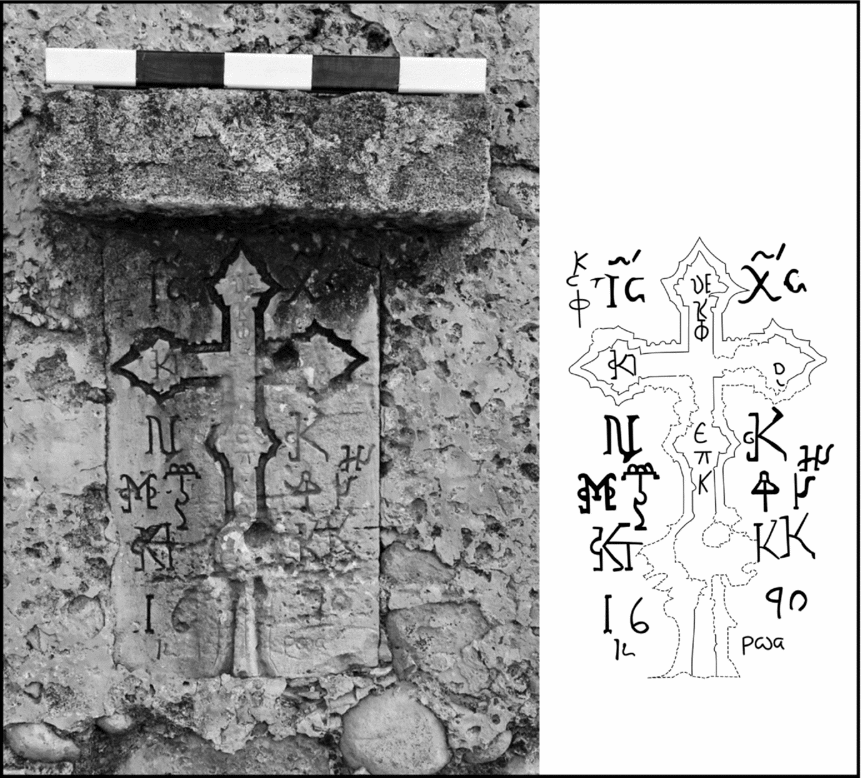
In addition to abbreviations for ‘King of the Jews’ and ‘Jesus Christ is victorious’, ‘PhKR’ invokes ‘The voice of the Lord over the waters’, and ‘KKKK’, with its powerful alliteration, ‘The Lord sits enthroned over the flood, and the Lord will sit as king for ever’. Both are from Psalm 28 of the Septuagint Bible (Psalm 29 of the western Bible). Both recognize the power of the flood, and invoke in visual and material form the protection of God; the inscribed cross drives that home, its power increased by the letters ‘KStPh’: ‘The cross of the Lord is a protector’ (Moutafov, in Ireland et al. Reference Ireland, Evans, Moutafov, Schriwer, Given, Knapp, Noller, Sollars and Kassianidou2013, 270–73).
The small size of the cross against the seven-metre-high penstock and the 2,000-metre dome of Mount Olympus beyond it seems a clear acceptance of the dependence and risk at the heart of this relationship among people, stone, water, gradient and climate. But there is a conviviality here, which brings a certain resilience to such watermills. Unlike the sugar plantations, these grain mills and the small-scale agriculture they supported did not produce mass deforestation, erosion and labour shortages. The grain that that they milled came from small, family-owned plots, often terraced against erosion and dispersed for security against highly localized hailstorms, water shortages or locust attacks. As for the water, that was controlled not by colonial elites but by intense negotiation among communities.
This conviviality is expressed in the location and build of the mills themselves (figure 3). With their tall penstocks to create a head of water, they are monumental, but not in a way that expresses elite power, like the manor house of Kouklia up on its commanding spur. They sit down on the flood plain or on the valley sides, anchored to the lower slopes by a stone aqueduct that is solid and secure, but pierced by arches so it is porous to floods and vision. Unlike the vertical walls of Kolossi castle, the narrow tiers of the penstocks make them solid and rooted, growing from the flood plain like a tree or a mountain.
Similarly, their range of building materials means that they are not monolithic, expressing a single material source, social entity or power, but varied and convivial (figure 7). The plaster expresses and enhances the pattern of the stonework, leaving the varied forms and colours of the igneous river boulders visible. Quoins and voussoirs pick out corners and arches, flat-fired bricks make thin string courses to emphasize the horizontality and stability of the penstock, and the chinking between the river stones welcomes a variety of limestone chunks and reused sherds (Ireland et al. Reference Ireland, Evans, Moutafov, Schriwer, Given, Knapp, Noller, Sollars and Kassianidou2013, 269–70). Most of all, the masonry of the mills incorporates and displays the very river boulders that threaten them, brought down in the flash floods of the past. They are not so much apotropaic as integrated, convivial: they show an acceptance of the properties of water and sediment, which can both nourish and devour. This is the same as the acceptance and ambivalence of water in the baptism ceremony, which simultaneously holds demons and exorcizes them, threatens and protects.
Lachistos mill: penstock (above), milling room (with window) and turbine room (with arch) (Chris Parks).

Human threats to conviviality can be harder to absorb. Even in the face of 20th-century unconvivial industrialization and globalization, Mr Styllis the miller and his customers kept his mill in Evrykhou alive by finding a particular niche of immense cultural importance. A key dish in the days-long wedding ceremonies of Cypriot villages was resi, cracked wheat boiled with meat. Until the 1960s the wheat was ground in the village by hand, with prescribed participants and locations, and accompanied by musicians (Rizopoulou-Egoumenidou Reference Rizopoulou-Egoumenidou2004, 117, 21). Industrialization brought an end to this, except for Styllis's mill, which used its old convivial millstones to grind this substance at the heart of social reproduction.
Conclusion: the politics of conviviality
Human society and its relations with the world it is immersed in have together created different versions of conviviality, found different balances, and achieved varying levels of resilience. These have ranged from negotiation, argument and tension over long-lived systems of water channels; to the piecemeal ownership of mills; to precarious alliances between farmers, millers and prelates; to the unconvivial machines of the short-lived sugar industries of the medieval and early modern Plantationocene. Using conviviality as a conceptual framework enables us to understand these processes and interconnections across whole ecologies, not just those environmental factors that seem particularly relevant to humans. We can identify when particular tools have transgressed the limits that enable a lively collaboration among all the non-human and human players, and see the impact of particular practices on the vitality of communities that are – like all communities – composed of non-humans and humans together.
There is a politics here, in each of these shifting, precarious negotiations, balances and tensions. Many of these players are persistently pursuing the convivial alliances and opening interconnections, breaking away from the unconvivial machines and closed circles. This used to be called resistance, glossed as the often surreptitious recapturing of agency from centralized powers: people took back the power and initiative to act autonomously, in the face of humiliation and control (e.g. Given Reference Given2004; Scott Reference Scott1990). The politics of conviviality, by contrast, requires turning that on its head. People reject their own autonomy and control: they relinquish their individual agency and immerse themselves in the distribution of agency across all the players of the world they participate in (Crawford Reference Crawford2015; Whatmore and Hinchcliffe Reference Whatmore, Hinchcliffe, Hicks and Beaudry2010).
This is exactly what we have seen in the Ottoman watermills of Cyprus. They are scaled at the level of their community and environment, and are intricately incorporated into the ecology of both. Their very stones embrace the threats they are warding off. Similarly, goatherds in the British colonial period persisted in their daily collaboration and integration with forest, goats, soil and saplings, in spite of the colonial boundary cairns which tried to assert the opposition of nature and culture (Given Reference Given2013, 16–20). Even slaves tended gardens, sources not just of human food but also of identity, pride and biodiversity in the oppressive monoculture of the plantation (Haraway Reference Haraway2015, 162).
What about us? As ice caps melt, sea levels rise and floods alternate with droughts and forest fires, how can we engage in a politics of conviviality? By a closer attentiveness to the non-human forces that surround and interlace us, we can let the convivial relationships begin to flow. The ‘knowledge controversies’ that come in the aftermath of ecological crises force us to rethink our most cherished cultural myths and generate new, more convivial geomythologies and biomythologies (Plumwood Reference Plumwood2009, 113; Whatmore Reference Whatmore2013, 39).
The mythologies of other places and other times are a rich challenge to our own narratives of human-centredness and hyperseparation, and bring trenchant warnings of the dangers of our ecological and social injustices (Lane Reference Lane2015; Plumwood Reference Plumwood2009, 116; Strang Reference Strang2014, 141). Conviviality will always be precarious, but it flows more richly through the watermill in the flood plain than in the industrial castle up on the spur.
Acknowledgements
I am very grateful to all the funders and supporters of the Troodos Archaeological and Environmental Survey Project, particularly the Arts and Humanities Research Council (Grant no RG/4164/14633), and the Department of Antiquities of the Republic of Cyprus. I have also learnt much from the project's team members and hosts, particularly Styllis Alexandrou, Marios Hadjianastasis, Emmanuel Moutafov, Mihalis Ppandjiaris and Charlotte Schriwer, and have benefited greatly from Sevina Floridou's keen observation and insight. Thanks to Erin Gibson, Marios Hadjianastasis, Charlotte Schriwer and two anonymous reviewers for their comments on earlier drafts, which have significantly improved this article.


 Open access

