





Introduction
Learning to internally regulate behavior is a key developmental task in early childhood. Voluminous research has examined top-down self-regulation (SR), sometimes referred to as effortful control, self-control, inhibitory control, or executive function, encompassing processes of modulating thoughts, affects, behaviors, or attention through the deliberate use of specific skills to guide goal-directed activities over time and across various contexts (Karoly, Reference Karoly1993; Kopp, Reference Kopp1982; Nigg, Reference Nigg2017; Rothbart & Bates, Reference Rothbart and Bates2006). That research has robustly demonstrated that SR is concurrently and longitudinally associated with a broad range of adjustment measures: interpersonal relationships, school readiness, academic achievement, behavioral adjustment, and physical and mental health (e.g., Eisenberg et al., Reference Eisenberg, Hernández, Zuffianò and Spinrad2024; Kochanska et al., Reference Kochanska, Murray and Harlan2000, Reference Kochanska, Coy and Murray2001; Kostyrka-Allchorne et al., Reference Kostyrka-Allchorne, Wass and Sonuga-Barke2020; McClelland et al., Reference McClelland, Cameron, Connor, Farris, Jewkes and Morrison2007, Reference McClelland, Geldhof, Morrison, Gestsdóttir, Cameron, Bowers, Duckworth, Little, Grammer, Halfon, Forrest, Lerner and Faustman2018; Moffitt et al., Reference Moffitt, Arseneault, Belsky, Dickson, Hancox, Harrington, Houts, Poulton, Roberts, Ross, Sears, Thomson and Caspi2011, Reference Moffitt, Poulton and Caspi2013; Rademacher & Koglin, Reference Rademacher and Koglin2019; Robson et al., Reference Robson, Allen and Howard2020; Spiegel et al., Reference Spiegel, Goodrich, Morris, Osborne and Lonigan2021; Yang et al., Reference Yang, Shields, Zhang, Wu, Chen and Romer2022). Thus, identifying antecedents and factors that account for individual differences in children’s SR is a critical goal, essential for both basic research and translational efforts to foster adaptive and healthy development and prevent negative outcomes.
Broadly accepted ecological perspectives have long portrayed children’s development as best understood when considered in a rich, multilayered context (Belsky, Reference Belsky1984; Bronfenbrenner & Morris, Reference Bronfenbrenner, Morris, Damon and Lerner2007; Cicchetti & Rogosch, Reference Cicchetti and Rogosch2002; Taraban & Shaw, Reference Taraban and Shaw2018). Challenges in families’ environments, especially ecological adversity impinging on parents at the time when they assume the caregiving role, can substantially undermine children’s future adaptation trajectories. Ecological adversity can refer to a single dimension of the early environment (e.g., poverty, parental young age, low education, or stressful events) or it may represent a combination of multiple dimensions. Many researchers have advocated for the latter approach to achieve a more comprehensive understanding of contextual effects on child development (Appleyard et al., Reference Appleyard, Egeland, van Dulmen and Alan Sroufe2005; Deater-Deckard et al., Reference Deater-Deckard, Dodge, Bates and Pettit1998; Evans et al., Reference Evans, Li and Whipple2013; Kraemer et al., Reference Kraemer, Lowe and Kupfer2005; Sameroff, Reference Sameroff1998). Empirical evidence has shown that a confluence of multiple risk factors is especially detrimental (Evans, Reference Evans2003; Roy & Raver, Reference Roy and Raver2014; Sameroff et al., Reference Sameroff, Seifer, Barocas, Zax and Greenspan1987). Consequently, we defined and measured ecological adversity as a construct that integrates cumulative risks associated with various demographic and environmental sources; we then investigated its developmental implications for children’s future SR.
According to the bioecological model (Bronfenbrenner & Morris, Reference Bronfenbrenner, Morris, Damon and Lerner2007), child development occurs in intricate interactions between individuals and environments through proximal processes that vary as a function of a person, immediate and distal environmental contexts, and time. In this perspective, the pathway from early ecological adversity to children’s SR can be understood as multi-faceted, multi-layered processes influenced by distal and proximal environmental factors both directly and indirectly.
Children’s future SR can be directly influenced by ecological adversity early in their lives. A large body of research has highlighted negative implications of early ecological adversity on children’s developing SR or related outcomes, such as behavioral problems (e.g., Gach et al., Reference Gach, Ip, Sameroff and Olson2018; Lengua et al., Reference Lengua, Kiff, Moran, Zalewski, Thompson, Cortes and Ruberry2014; Wade et al., Reference Wade, Wright and Finegold2022; Wallander et al., Reference Wallander, Berry, Carr, Peterson, Waldie, Marks, D’Souza and Morton2019; Wanless et al., Reference Wanless, McClelland, Tominey and Acock2011), and linked exposure to environmental risks to the impact on brain networks and functions related to SR (Blair, Reference Blair2010; Cornwell et al., Reference Cornwell, Toschi, Hamilton-Giachritsis, Staginnus, Smaragdi, Gonzalez-Madruga, Rogers, Martinelli, Kohls, Raschle, Konrad, Stadler, Freitag, De Brito and Fairchild2023; Gee & Cohodes, Reference Gee and Cohodes2023; Pechtel & Pizzagalli, Reference Pechtel and Pizzagalli2011).
SR can also be indirectly affected within person-context interactions (Liew et al., Reference Liew, Morris and Kerr2023). A large body of evidence has documented that negative impacts of early ecological risks on later developmental outcomes, including SR, were largely accounted for by the effects of those risks on parenting, which is the most prominent proximal factor early in life (Abidin, Reference Abidin1992; Belsky et al., Reference Belsky, Bell, Bradley, Stallard and Stewart-Brown2007; Blair & Raver, Reference Blair and Raver2012; Hackman et al., Reference Hackman, Gallop, Evans and Farah2015; Lengua et al., Reference Lengua, Kiff, Moran, Zalewski, Thompson, Cortes and Ruberry2014; Mistry et al., Reference Mistry, Benner, Biesanz, Clark and Howes2010; Scannell, Reference Scannell, Benedetto and Ingrassia2020; Trentacosta et al., Reference Trentacosta, Hyde, Shaw, Dishion, Gardner and Wilson2008). Ecological adversity can overwhelm parents and disrupt the quality of caregiving, ultimately exacerbating children’s difficulties in regulating their emotions and behaviors. However, most studies have primarily focused on adversity’s detrimental impacts on positive parenting, including warmth, responsiveness, availability, autonomy support, and appropriate scaffolding and structuring. While informative, this approach is incomplete, as it underestimates adversity’s exacerbating impact on negative aspects of parenting, which have also been implicated as factors that undermine children’s SR, for example, intrusiveness (Geeraerts et al., Reference Geeraerts, Endendijk, Deković, Huijding, Deater-Deckard and Mesman2021), or harsh, coercive, and power-assertive control (e.g., Kochanska & Knaack, Reference Kochanska and Knaack2003).
Despite negative associations among ecological adversity, parenting, and developmental outcomes, only a handful of studies have examined the entire path from adversity to negative parenting to SR. For instance, Rhoades et al. (Reference Rhoades, Greenberg, Lanza and Blair2011) found significant indirect relations between environmental risk in infancy and executive function at age 3 years through both positive and negative mother-child interaction, but this study examined separate paths from each risk indicator. Another study with cumulative risk as a predictor found significant mediation from cumulative risk in infancy to behavior outcomes and executive function at age 3 years through both negative (harsh and controlling) and positive (sensitive and responsive) parenting (FLP Key Investigators, 2013).
Importantly, although the effects of ecological adversity on dysfunctional parenting have been well documented, not all parents are uniformly affected. As with all types of adversity and stress, there is great heterogeneity in human response (Rutter, Reference Rutter2013); many parents show resilience and ability to function adaptively in the parenting role despite challenging circumstances. Multiple factors have been implicated as determinants of parents’ varying ability to function effectively despite adversity (e.g., Löchner et al., Reference Löchner, Ulrich and Lux2024). Understanding the diversity in cascading developmental processes (i.e., multifinality) – or moderators of the paths triggered by early ecological adversity – is an important research goal that remains at the center of developmental psychopathology (Cicchetti & Rogosch, Reference Cicchetti and Rogosch2002; see also the recent Special Issue of Development and Psychopathology, Masten et al., Reference Masten, Tyrell and Cicchetti2023).
Recently, researchers have increasingly focused on parental mentalization processes as a set of critically important inner resources that may affect trajectories of parenting, parent-child relationships, and child developmental outcomes, including SR. Parents’ mentalization, often rooted in their own relationship histories, encompasses both implicit and explicit components (relational schemas, reflective functioning, mind-mindedness, perceptions, expectations, and attributions regarding their child). That exponentially growing research, often informed by the attachment perspective and its constructs of parents’ internal working models (IWMs) of the child, has demonstrated a key role such mental representations play in parents’ relationships with their children (e.g., An et al., Reference An, Bendel-Stenzel and Kochanska2022; Camoirano, Reference Camoirano2017; Dykas & Cassidy, Reference Dykas and Cassidy2011; Garon-Bissonnette et al., Reference Garon-Bissonnette, Bailes, Kwasneski, Lempres, Takemoto, Li, DeLuca, Salo and Humphreys2024; Humphreys et al., Reference Humphreys, Garon-Bissonnette, Hill, Bailes, Barnett and Hare2024; Katznelson, Reference Katznelson2013; Kochanska et al., Reference Kochanska, Boldt and Goffin2019; Luyten et al., Reference Luyten, Campbell, Allison and Fonagy2020; McMahon & Bernier, Reference McMahon and Bernier2017; Sharp & Fonagy, Reference Sharp and Fonagy2008; Sher-Censor, Reference Sher-Censor2015; Weston et al., Reference Weston, Hawes and S. Pasalich2017).
Mentalization processes can also influence how parents cope with stress (Buttitta et al., Reference Buttitta, Smiley, Kerr, Rasmussen, Querdasi and Borelli2019; Camoirano, Reference Camoirano2017; Park et al., Reference Park, Johnston, Colalillo and Williamson2018; Snyder et al., Reference Snyder, Cramer, Afrank and Patterson2005). Research has supported a model that focused on parental IWMs as moderators of the association between child difficulty – a common source of parenting stress – and the parent’s harsh, power-assertive discipline (An & Kochanska, Reference An and Kochanska2022b, Kochanska & An, Reference Kochanska and An2024a, Reference Kochanska and An2024b; Kochanska et al., Reference Kochanska, Boldt and Goffin2019). Parents with negative IWMs perceive their child’s difficult behaviors as intentional and deliberate, increasing the risks of their resorting to power-assertive or harsh parenting.
In the current work, we expanded that model to examine whether parents’ negative IWMs of their children can moderate the effects of early ecological adversity on their parenting and future developmental trajectories. As mentioned earlier, developmental sequelae of ecological adversity can be highly divergent, leading to diverse outcomes depending on moderating factors, as highlighted in the concept of multifinality (Cicchetti & Rogosch, Reference Cicchetti and Rogosch2002). Parental mentalization or IWMs of their children can shape how parents interpret and respond to environmental stressors, potentially exacerbating or mitigating the adverse effects of ecological risks (Narayan et al., Reference Narayan, Cicchetti, Rogosch and Toth2015). Of note, for parents coping with high adversity, the effects of mentalizing have been especially pronounced (Engbretson et al., Reference Engbretson, Nix, Park, Gill and Hostetler2023; Meins et al., Reference Meins, Centifanti, Fernyhough and Fishburn2013, Reference Meins, Fernyhough and Centifanti2019; Suchman et al., Reference Suchman, DeCoste, McMahon, Dalton, Mayes and Borelli2017; Wendelboe et al., Reference Wendelboe, Reijman, Madsen, Støve, Stuart, Smith-Nielsen and Væver2024). Humphreys and colleagues (2024) characterized parental representations of the child as the key factors linking the caregiving context and parenting, with cascading effects on child outcomes, and crucial for understanding resilience. Based on the earlier research, we expected the paths from early ecological adversity to dysfunctional parenting to be stronger for parents who had more negative IWMs of their children.
Bioecological and developmental psychopathology models presented above align also with adult research on transdiagnostic models of the origins of psychopathology, with ecological adversity, or environmental context, conceived as a distal risk factor. Nolen-Hoeksema and Watkins (Reference Nolen-Hoeksema and Watkins2011) proposed that distal risk factors, such as environmental context, predict proximal risk factors, which in turn lead to future disorders, or psychopathology outcomes. The associations between proximal risk factors and disorders can be moderated by a number of variables, accounting for divergent developmental trajectories. Although Nolen-Hoeksema and Watkins (Reference Nolen-Hoeksema and Watkins2011) conceptualized proximal risk factors mediating between distal risk factors and psychopathology as within-person characteristics, we believe that their model can be adapted to research like ours, which aims to connect features of the distal environment, or adverse ecology, the parent-child relationship, and child outcomes (poor SR). We see dysfunctional parenting as a proximal factor that mediates the path from the distal factor (ecological adversity) to child poor SR.
In addition, we examined if parental negative IWMs of the child can also serve as a moderator of the stability of parental power assertion over time. To our knowledge, few, if any, studies have yet addressed this question. Parenting styles are often assumed – and found – to be modestly to moderately stable over time and typically modeled as autoregressive paths in studies where their measures have been obtained repeatedly (e.g., Dahl & Chan, Reference Dahl and Chan2017; Dallaire & Weinraub, Reference Dallaire and Weinraub2005; Hoeve et al., Reference Hoeve, Blokland, Dubas, Loeber, Gerris and Van der Laan2008; Holden & Miller, Reference Holden and Miller1999; Kochanska, Reference Kochanska1990; Kochanska et al., Reference Kochanska, Aksan and Nichols2003; Loeber et al., Reference Loeber, Drinkwater, Yin, Anderson, Schmidt and Crawford2000; Teuber et al., Reference Teuber, Tang, Sielemann, Otterpohl and Wild2022; Verhoeven et al., Reference Verhoeven, Junger, Van Aken, Dekovic and Van Aken2007; Zhang et al., Reference Zhang, Wei, Ji, Chen and Deater-Deckard2017), across multiple cultures (e.g., Putnick et al., Reference Putnick, Bornstein, Lansford, Chang, Deater-Deckard, Di Giunta, Dodge, Malone, Oburu, Pastorelli, Skinner, Sorbring, Tapanya, Uribe Tirado, Zelli, Alampay, Al-Hassan, Bacchini and Bombi2018). Of note, in a study with high-risk families, negative parenting profiles, such as harsh-intrusive and detached parenting, were more consistent over one year than positive parenting styles (Owen et al., Reference Owen, Pacheco, Dyer, Barnes, Von Hatten and Caughy2023). However, many of those studies were limited due to their reliance on parental or child self-report. This could make it hard to distinguish the stability of actual parenting from that of measurements, often reported by the same informant, and likely stable. Thus, assessing parenting behaviors in naturalistic settings may provide more accurate information on the stability of parenting. Studies that have relied on behavioral measures of parenting have often demonstrated only moderate rank-order stability over time, suggesting that changes in parenting over time, including power-assertive control, are also quite likely (Dahl & Chan, Reference Dahl and Chan2017; Kochanska et al., Reference Kochanska, Aksan and Nichols2003).
We explored whether the parent’s negative IWM of the child can account for both elevating and maintaining dysfunctional power-assertive parenting over time. Parents with negative schemas regarding their children may be more inclined to see power assertion as effective in controlling children’s behaviors and to continue to rely on it consistently. Research on abusive mothers, who often perceive their children in a negative light, has shown that, in comparison to non-abusive mothers, they resorted to power assertion much more often, regardless of the discipline situation (Trickett & Kuczynski, Reference Trickett and Kuczynski1986). In contrast, parents with less negative schemas may use diverse strategies and be more flexible and open to adapting their parenting to changing circumstances, such as the child’s developmental level, the type of misbehavior being addressed, or a specific parenting goal (Kuczynski & De Mol, Reference Kuczynski, De Mol, Overton and Molenaar2015).
In sum, we examined a longitudinal path from early ecological adversity, a distal risk factor, to later child SR. We conceptualized parental power assertion as a mediating mechanism or a proximal risk factor, accounting for the negative impact of adversity (Nolen-Hoeksema & Watkins, Reference Nolen-Hoeksema and Watkins2011). We further conceptualized parental negative IWMs of the child as moderators accounting for multifinality of trajectories unfolding in the aftermath of adversity. This perspective integrates various developmental contexts, emphasizes continuity and changes across life stages, and highlights the interplay of risk and protective processes, aligning with the bioecological model’s emphasis on dynamics among person, process, context, and time (Bronfenbrenner & Morris, Reference Bronfenbrenner, Morris, Damon and Lerner2007) and with the tenets of developmental psychopathology.
When mapping the developmental path, we assessed ecological adversity impinging on the family when children were infants. Extending previous research, which had commonly assessed parental power assertion and their IWMs only once, we measured both twice – at 16 months and at age 3. Age 16 months is typically considered the time of onset of parental control, but toddler years continue to be replete with conflict, resistance, and common control struggles, making the dynamics between parents and children challenging and complicated. Measuring both IWMs and parenting repeatedly produces a more complete picture of the longitudinal developmental cascades originating in ecological adversity experienced by the family in infancy and it may help pinpoint whether there is a specific window or windows in which IWMs exert their moderating effects. Humphreys and colleagues (2024) explicitly advocated repeated longitudinal assessments of parental IWMs as a goal for the future agenda in research in developmental psychopathology. Investigating repeated measures of mediating and moderating factors can provide a deeper, more developmentally informed understanding of mechanisms and protective factors that enable children from at-risk contexts to develop more adaptive SR skills, and of multifinality in the developmental pathways that can be triggered by early adversity.
First, we examined IWM at 16 months as influencing the path from ecological adversity to parental power assertion at 16 months. Based on past research, we expected that parents facing higher ecological adversity would rely on more power-assertive control, but only if they also had more negative IWMs of the child. Second, we examined negative IWMs at age 3 as potentially influencing the autoregressive path from power assertion at 16 months to power assertion at age 3. Due to the scarcity of research, the examination of the latter effect was exploratory. For example, we considered it possible that for parents with high negative IWMs at 16 months, their elevated power-assertive control would further increase at age 3 if their negative IWMs are also high at age 3. However, we also considered another potential scenario – that once elevated at 16 months, high power-assertive control may remain high regardless of parental negative IWMs at age 3. The latter scenario would imply a particularly lasting significance of the early emerging parental IWMs.
We relied on empirically and theoretically proven measures. We measured ecological adversity using an approach proposed by Kochanska et al., (Reference Kochanska, Aksan, Penney and Boldt2007, Reference Kochanska, Kim and Koenig Nordling2012, Reference Kochanska, Kim and Boldt2013), informed by research on established ecological factors that challenge early parenting. Those often include six factors: parental young age (Crugnola et al., Reference Crugnola, Ierardi, Gazzotti and Albizzati2014; Duncan et al., Reference Duncan, Lee, Rosales-Rueda and Kalil2018), low education and low income (Cooper & Stewart, Reference Cooper and Stewart2021; Dickson et al., Reference Dickson, Gregg and Robinson2016), decreasing stability of the family structure (married, cohabitating, single, divorced; Bachman et al., Reference Bachman, Coley and Carrano2011; Lee & McLanahan, Reference Lee and McLanahan2015), more children (Keenan et al., Reference Keenan, Gunthorpe and Grace2007; Trentacosta et al., Reference Trentacosta, Hyde, Shaw, Dishion, Gardner and Wilson2008), and more stressful recent life events (Abidin, Reference Abidin1992; Reiss et al., Reference Reiss, Meyrose, Otto, Lampert, Klasen and Ravens-Sieberer2019). Although often researchers studying ecological adversity score each risk as present or absent and sum them, more fine-grained approaches have been advocated in research on cumulative risks (Burchinal et al., Reference Burchinal, Vernon-Feagans and Cox2008; Evans et al., Reference Evans, Li and Whipple2013; Kochanska et al., Reference Kochanska, Aksan, Penney and Boldt2007, Reference Kochanska, Kim and Koenig Nordling2012). To that effect, we graded the severity of each of those six risk factors, incorporating data for each parent, and summed them into an overall score.
We assessed parents’ IWMs using the Five-Minute Speech Sample interview (FMSS, Bullock & Dishion, Reference Bullock and Dishion2007). FMSS has become one of the most prominent instruments in developmental psychology, with comprehensive reviews supporting its value, especially the dimension of criticism, or the expression of negative relational schemas regarding the child (Narayan et al., Reference Narayan, Herbers, Plowman, Gewirtz and Masten2012, Reference Narayan, Cicchetti, Rogosch and Toth2015; Rea et al., Reference Rea, Factor, Kao and Shaffer2020; Sher-Censor, Reference Sher-Censor2015; Waller et al., Reference Waller, Gardner, Dishion, Shaw and Wilson2012; Weston et al., Reference Weston, Hawes and S. Pasalich2017). FMSS is especially well suited for research informed by attachment theory, as its assessment of the parent’s relational schemas captures both conscious or explicit and sub-conscious or implicit elements, consistent with Bowlby’s construct of IWMs (Bowlby, Reference Bowlby1969/1982; Thompson et al., Reference Thompson, Simpson and Berlin2022).
We observed parental power assertion in lengthy naturalistic parent-child interactions, designed to be “saturated” with control issues typical for the toddler age. That approach has consistently produced valid and rich measures of parenting behaviors (An & Kochanska, Reference An and Kochanska2022a; An et al., Reference An, Bendel-Stenzel and Kochanska2022; Kochanska et al., Reference Kochanska, Coy and Murray2001; Kuczynski & Kochanska, Reference Kuczynski and Kochanska1990), and has been often adopted (e.g., Dahl & Chan, Reference Dahl and Chan2017). Finally, we measured child SR using both parents’ reports and observed performance in standard tasks to minimize the method bias and increase the ecological validity of the results (Bank et al., Reference Bank, Dishion, Skinner, Patterson and Patterson1990).
We collected all measures from both mother-child and father-child dyads to address the stubborn gap in parenting research, as studies on the relations between ecological adversity and parenting or between parenting and SR – and parenting in general – have predominantly involved mothers only. For instance, a meta-analysis on the associations between parenting and SR reported that fewer than 20% of studies included both mothers and fathers (Karreman et al., Reference Karreman, Van Tuijl, van Aken and Deković2006). Yet, the importance of fathers’ contributions to children’s development, and specifically in the context of resilience under challenging conditions, has been emphasized (Feldman, Reference Feldman2023).
Method
Participants
The current study included 200 typically developing 8-month-old infants (96 girls and 104 boys) born in 2017 and 2018 and their biological parents (mothers and fathers), recruited through flyers and advertisements distributed in various community venues in a U.S. Midwestern region and posts on social media targeting parent groups. The families were mostly White, but one or both parents were not White in 20% of the families. The median household income was $85,000 (SD = $44,530, ranging from $4,000 to $320,000). The levels of parents’ education were as follows: 39% of mothers and 32.5% of fathers had a postgraduate degree, 46.5% of mothers and 43.5% of fathers had an associate or bachelor’s degree, and 14.5% of mothers and 24% of fathers had no more than high school education.
All data were collected during 2-3-hour carefully scripted sessions at home (at age 8 months, N = 200, 96 girls, 104 boys) and in naturalistic laboratory settings including a Living Room and a Play Room (at 16 months, N = 194, 93 girls, 101 boys, at age 3, N = 175, 86 girls, 89 boys, and at age 4.5, N = 177, 86 girls, 91 boys), conducted by female experimenters (Es).
Data were coded from recorded videos by multiple teams. Coders used 15% – 20% of cases for reliability, followed by regular realignments. Attrition at 3 and 4.5 years was mostly due to the COVID-19 pandemic, although some families provided online data. No differences were found in most of the measures between families that did and did not return at 4.5 years except for two measures: Families that did not return had higher levels of ecological adversity at 8 months, ΔM = .91, ΔSE = .34, t(27.56) = 2.69, p < .05, and maternal power assertion scores at 16 months, ΔM = .60, ΔSE = .20, t(191) = 3.05, p < .01, compared to those that returned. Parents completed informed consent, and the Institutional Review Board at the University of Iowa approved the study (Children and Parents Study, CAPS, 201701705).
Measures
Ecological adversity, 8 months
To create the index of ecological adversity, we assigned graded risk points for demographic characteristics that have been broadly associated with adversity and developmental disadvantages (0-3, except for relationship status, 0-1; Kochanska et al., Reference Kochanska, Aksan, Penney and Boldt2007, Reference Kochanska, Kim and Koenig Nordling2012, 2013). The scores were as follows (higher scores indicate higher risk).
-
a. Parental age (for each parent): 20 and younger = 3, ages 21 – 22 = 2, ages 23 – 24 = 1, older than 24 = 0
-
b. Parental education (for each parent): did not complete high school = 3, completed high school = 2, associate’s degree = 1, completed college or beyond = 0
-
c. Family annual income: less than $40,000 = 3, $40,000 – $60,000 = 2, $60,000 – $80,000 = 1, greater than $80,000 = 0
-
d. Number of children: four and more = 3, three = 2, two = 1, one = 0
-
e. Relationship status: not married but living together, or other arrangements = 1, married = 0
-
f. Life stress (from the Parenting Stress Index, PSI, Abidin, Reference Abidin2012, encompassing weighted scores of up to 19 stressful life events during the last year for each parent): 15 and greater = 3, 9 – 14 = 2, 4 – 8 = 1, 3 and lower = 0
The scores were transformed using the proportion of maximum scaling method (Little, Reference Little2013) to have a consistent scale from 0 to 1 and summed into a composite score of ecological adversity. The possible range was from 0 to 9. There was no difference between families with girls and boys.
Parental power assertion, 16 months and 3 years
Parental power assertion was coded in naturalistic interaction and toy cleanup contexts. At 16 months, the naturalistic interaction contexts (total 15 min) included introduction to the laboratory (when E asked the parent to prohibit the child from touching extremely attractive toys and objects on a low shelf, 5 min), free time (5 min), snack prohibition (when the child, already quite hungry, was asked to wait for a snack, 5 min). The toy cleanup lasted 10 min. At age 3, the naturalistic interaction contexts (total 20 min) included introduction to the laboratory (5 min), snack prohibition (5 min), snack (5 min), and play (5 min). The toy cleanup again lasted 10 min. All contexts were carefully scripted to elicit parents’ typical control behaviors toward the child. We coded parental power assertion for each of the 20s segments (for naturalistic interactions) or 30s segments (for toy cleanups) using the following codes: No control (no interaction, purely social exchange, play), Gentle Guidance (gentle, subtle, playful suggestion or direction), Control (non-forceful, matter-of-fact, relatively assertive control), and Forceful or Harsh Control (negative, power-assertive control often accompanied with hostility, frustration, or threats). The verbal, affective, and physical markers of each code were specified on coding conventions based on extensive past research. Reliability, weighted kappas, ranged from .65 – .86 at 16 months and .61 – .92 at 3 years.
We tallied the instances of each code, created relative scores by dividing each tally by the number of coded segments (for naturalistic interaction only), weighted each score by multiplying No Control by 1, Gentle Guidance by 2, Control by 3, and Forceful or Harsh Control by 4, and added and standardized them. We then created a single power assertion score for each parent by averaging across all the naturalistic contexts and the toy cleanup, with a higher score indicative of higher power assertion. At both time points and for both mother-child and father-child dyads, parents directed more power assertion toward boys than girls, Ms = -.25 – -.15, SDs = .71 – .82 for girls, Ms = .14 – .23, SDs = .73 – .87 for boys, t(147–188.42) = -4.15 – -2.52, ps < .05, .01, or .001. Comparisons of mothers’ and fathers’ scores (prior to standardization) revealed that fathers were more power assertive than mothers when children were 16 months, M = 22.89, SD = 2.71 for mothers, M = 24.42, SD = 3.52 for fathers, t(185) = -5.24, p < .001, but not at 3 years.
Parental negative internal working model of the child, 16 months and 3 years
At the end of the session, while the child was in a separate room, E conducted the FMSS interview with the parent, asking them to talk about the child and their relationship with the child for 5 minutes (Bullock & Dishion, Reference Bullock and Dishion2007). E did not provide any further prompts and engaged in paperwork during the entire interview, consistent with FMSS instructions. The audio-recorded speech was coded by a professional coding team at another university.
We focused on the Criticism scale as reflecting the parent’s negative IWM of the child. It consists of 6 9-point items tapping negative evaluations or messages about the child, such as being critical regarding behavior, traits, or personality of the child, expressing negative humor or sarcasm regarding the child (1 = no evidence, 9 = clear, multiple examples). The average percent agreement among coders was 95.6% at 16 months and 93.6% at 3 years (with 80% being the required standard, Smith et al., Reference Smith, Dishion, Moore, Shaw and Wilson2013; Waller et al., Reference Waller, Gardner, Dishion, Shaw and Wilson2012). Additionally, intra-class correlations (ICCs) for the Criticism scale were .75 at 16 months and .80 at 3 years. At 16 months, one of the items was dropped because it had high kurtosis and skewness and lowered internal consistency. We standardized and averaged the remaining 5 items to create a final IWM score (Cronbach’s alphas = .59 for mothers, .52 for fathers). At 3 years, a total of 6 items were standardized and averaged (Cronbach’s alphas = .69 for mothers, .69 for fathers). There were no gender differences. When comparing unstandardized scores between mothers and fathers, mothers had more negative IWM of the child at 16 months, mothers, M = 2.19, SD = 0.94; fathers, M = 1.93, SD = 0.79, t(185) = 3.22, p < .01, and at 3 years, mothers, M = 2.12, SD = 1.03; fathers, M = 1.80, SD = 0.84, t(149) = 3.31, p < .01.
Child self-regulation (SR), 4.5 years
We used two measures of child SR: parent-reported SR difficulties and observed SR.
Parent-Reported SR Difficulties. We used mothers’ and fathers’ scores from Children’s Behavior Questionnaire (CBQ; Rothbart et al., Reference Rothbart, Ahadi, Hershey and Fisher2001). We selected Frustration (6 items, e.g., Gets angry when told s/he has to go to bed) and (reversed) Inhibitory Control (6 items, e.g., Can easily stop an activity when s/he is told “no”), all rated on a 7-point Likert scale (1 = extremely untrue, 7 = extremely true). Cronbach’s alphas of each measure were acceptable: Frustration .75 for mothers, .78 for fathers; Inhibitory Control .62 for mothers, .65 for fathers. The two scales cohered (r = .33, p < .001), and were standardized and averaged into the final mother- and father-reported SR difficulty scores. Higher scores denote more difficulties in SR. Boys were rated as having more SR difficulties than girls by mothers, M = -.24, SD = .76 for girls, M = .23, SD = .80 for boys, t(169) = -3.88, p < .001, and by fathers, M = -.22, SD = .85 for girls, M = .21, SD = .74 for boys, t(157) = -3.40, p < .001. There were no differences between mothers’ and fathers’ scores.
Observed SR. The tasks to measure active SR performance included Day/Night and Snow/Grass (Carlson & Moses, Reference Carlson and Moses2001), Gift Delay – Wrap and Bow, and Gift Delay – Bag (Kochanska et al., Reference Kochanska, Murray and Harlan2000). In the Day/Night task, E showed the child two cards, one depicting a nighttime sky and the other depicting a daytime sky, and asked them to point to the nighttime sky when E says “Day” and the daytime sky when E says “Night” for 10 trials (5 trials each for Day and Night). The same procedure was applied to Snow/Grass. Child answers were coded as 0 = fails to point, 1 = incorrect and never self-corrects, 2 = self-corrects, or 3 = correct on first attempt and doesn’t change mind. We standardized the summed score of Day/Night and Snow/Grass. ICCs ranged from .99 to 1.00.
Gift Delay – Wrap and Bow was performed in mother-child sessions. E brought a loosely wrapped gift and asked the child not to look at the gift while she was wrapping it up. E wrapped the gift noisily for 60 s with her back to the child (Wrap segment). Child behavior was coded as 0 = turns around, doesn’t return fully forward, 1 = turns around but turns back forward, 2 = peeks over shoulder far enough to see wrapping, 3 = turns head to side but less than 90 degrees, or 4 = does not try to peek. Latency to worst transgression was also coded in seconds (60 if never). After 60 s, E said she had forgotten a ribbon for a bow, asked the child to stay in the chair and not to touch or peek inside until she returned, and left the room for 3 min (Bow segment). Child behavior was coded as 0 = opens gift, 1 = lifts up gift, 2 = touches gift but does not lift, or 3 = does not touch gift. Child seat score was also coded as 0 = in seat for less than 30 s, 1 = in seat for more than 30 s but less than 1 min, 2 = in seat for more than 1 min but less than 2 min, or 3 = in seat for more than 2 min. Latencies to the “worst” violation and to leaving the seat were coded in seconds (180s if never). We aggregated the behavior scores, seat scores, and latencies from the two segments into a single score by standardizing and averaging them (Cronbach’s alpha = .74). Reliability, weighted kappa, for the behavior score was .96, and ICC for the latency score was 1.00 for the Wrap segment. Kappas, for behavior and seat scores ranged from .86 to 1.00, and ICC for latencies ranged from .95 to .99 for the Bow segment.
Gift Delay – Bag was an analogous task, administered in father-child sessions. E brought a gift in a bag, said she had forgotten a bow, asked the child to stay in the chair and not to touch or peek in the bag until she returned, and left for 3 min. Child behavior was coded as 0 = removes gift from bag, 1 = puts hand into bag but does not remove gift, 2 = peeks in, with or without touching, 3 = touches bag without peeking, or 4 = does not touch bag or peek. Child seat score and latencies to worst transgression and leaving the seat were coded analogously to Gift Delay – Wrap and Bow. We created a single score by standardizing and averaging the behavior score, seat score, and latencies (Cronbach’s alpha = .66). Kappas for behavior and seat scores were .89 – 1.00, and ICCs for latencies were .89 – 1.00.
We created the observed SR score by aggregating scores across tasks (rs = .18 – .53, ps < .05 or .001). Higher scores indicate better observed SR. Girls outperformed boys, M = .12, SD = .75 for girls, M = -.16, SD = .78 for boys, t(155) = 2.24, p < .05.
Data Aggregation. Because the two measures, parent-reported SR difficulties and observed SR, were significantly correlated (r = -.30 for mothers, r = -.28 for fathers, ps < .001) and had similar patterns of relations with the predictors (described in the sensitivity analyses below), we averaged them within the mother-child and father-child dyads to simplify the model (having reversed observed SR to denote SR difficulties).
Covariates
We covaried children’s gender, their scores on Orienting/Regulatory Capacity (ORC), assessed at 8 months, and the other parent’s power assertion at age 16 months. ORC, defined by Duration of Orienting, Low Intensity Pleasure, Cuddliness, and Soothability, is often considered a fledgling early form, or antecedent of future SR, which is not typically assessed until after age 18 months. We averaged and standardized the mean of 12 ORC items reported by parents in the Infant Behavior Questionnaire – Very Short Form (Putnam et al., Reference Putnam, Helbig, Gartstein, Rothbart and Leerkes2014), answered on a 7-point Likert scale. Cronbach’s alphas were .66 for mother-child dyads and .77 for father-child dyads.
Results
Descriptive statistics and correlations
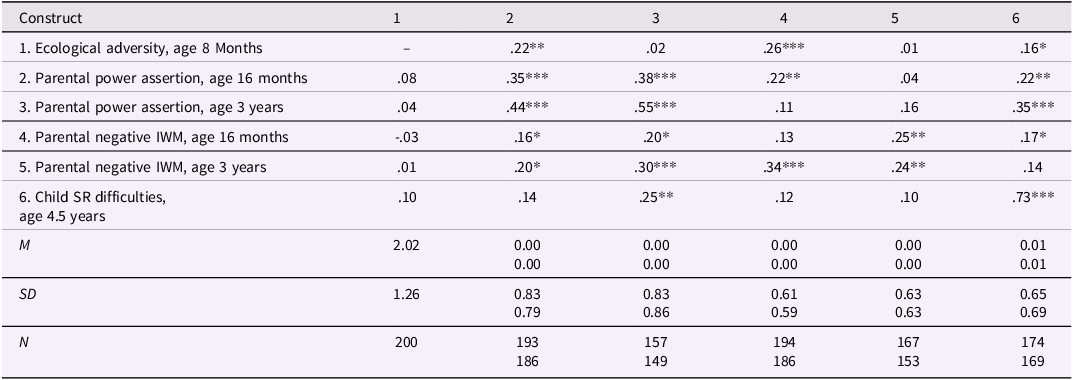
Descriptive statistics and the correlations among variables computed in SPSS 29 (IBM Corp, 2023) are presented in Table 1. Higher ecological adversity at 8 months was related to mothers’ higher power assertion and their more negative IWMs at 16 months but not at 3 years. However, no significant correlations were found between ecological adversity and either power assertion or negative IWMs in father-child dyads.
Table 1. Descriptive statistics of and correlations among study variables

Note. IWM = internal working model. SR = self-regulation. Correlations for mother-child dyads are above the diagonal, and correlations for father-child dyads are below the diagonal. Values on the diagonal represent correlations for the variables across mother-child dyads and father-child dyads. For mean, standard deviation, and number of observations, the upper and lower values are from mother-child and father-child dyads, respectively. * p < .05. ** p < .01. *** p < .001.
Higher ecological adversity was related to children’s more SR difficulties at 4.5 years in mother-child but not in father-child dyads. Maternal higher power assertion at 16 months and 3 years both correlated with more SR difficulties at 4.5 years. Paternal higher power assertion at 3 years correlated with more SR difficulties at 4.5 years. Maternal and paternal power assertion were moderately stable from 16 months to 3 years.
Main analysis: Parental negative internal working model of the child as a moderator of the path from ecological adversity to child self-regulation, mediated by parental power assertion
To test the proposed moderated mediation, ecological adversity was modeled as the predictor of child SR difficulties (i.e., combined scores of parent-reported SR difficulties and reversed observed SR) separately in mother-child and father-child dyads. Parental power assertion scores at 16 months and 3 years were modeled as consecutive mediators (an autoregressive path). Parental negative IWM of the child at 16 months was modeled as a moderator of the path from ecological adversity at 8 months to power assertion at 16 months, and negative IWM at 3 years as a moderator of the path from power assertion at 16 months to power assertion at 3 years. Child gender, ORC, and the other parent’s power assertion at 16 months were covaried.
The path models were estimated in Mplus 7 (Muthén & Muthén, Reference Muthén and Muthén1998-2012) with 5,000-sample bootstrapping, using codes adapted from Stride et al. (Reference Stride, Gardner, Catley and Thomas2015). Based on Little’s (1988) missing completely at random (MCAR) test, data were considered MCAR in both mother-child, χ2(60) = 61.24, p = .43, and father-child models, χ2(68) = 69.54, p = .43. Thus, we used full information maximum likelihood estimator to handle missing data. The significance of mediation was tested using a bias-corrected 95% confidence interval (CI). For significant moderation, simple slopes were probed and plotted at the 16th and 84th percentile (Hayes, Reference Hayes2022). Model fit was evaluated using the chi-square, the comparative fit index (CFI), and the root mean square error of approximation (RMSEA) and its 90% CI. Model fit is considered good when the chi-square is not significant, CFI is larger than or equal to .95, and RMSEA is less than or equal to .05 and acceptable when CFI is larger than or equal to .90 and RMSEA is less than or equal to .08 (Hu & Bentler, Reference Hu and Bentler1999; Little, Reference Little2013).
Mother-child dyads
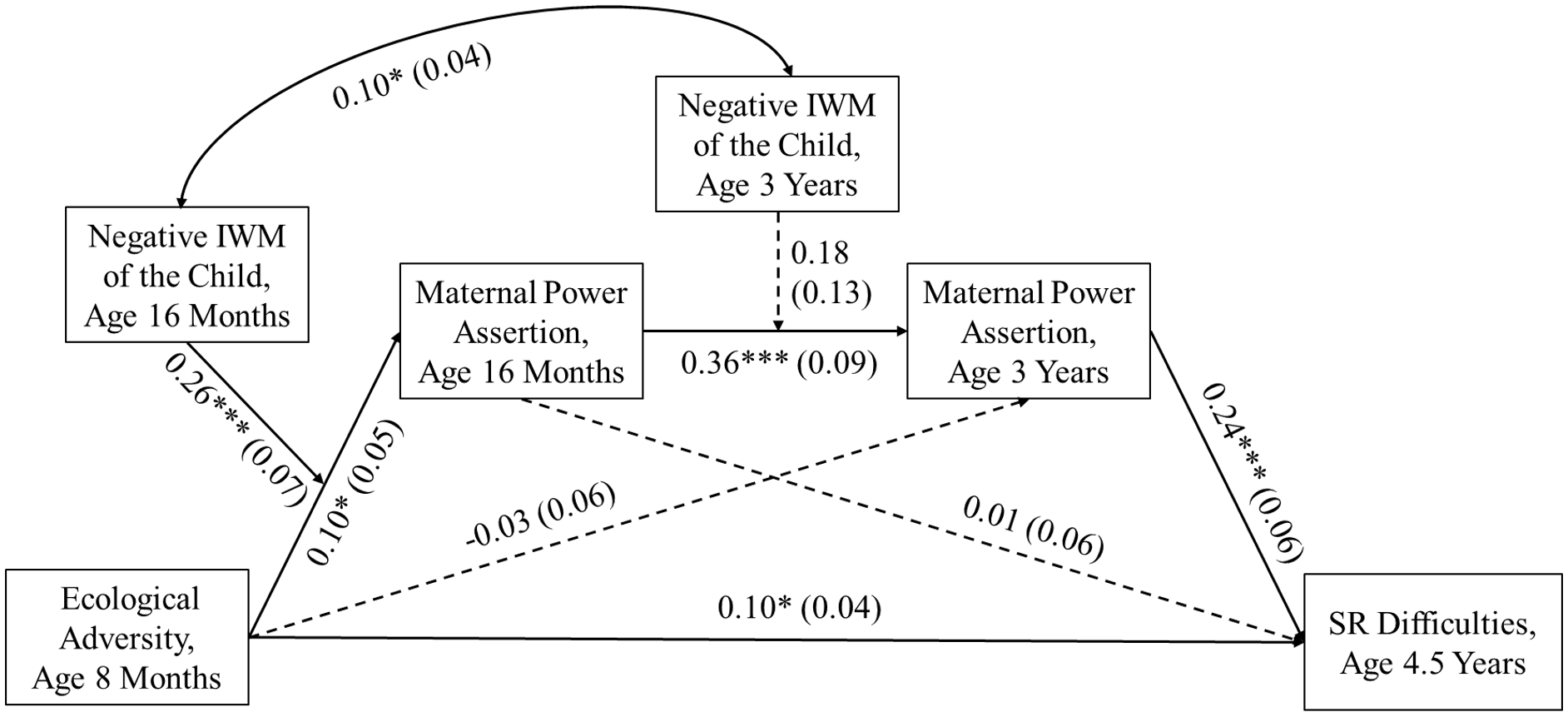
The results are presented in Figure 1. First, the direct paths from early ecological adversity to later child SR were significant, such that higher ecological adversity at 8 months was related to more SR difficulties at 4.5 years.

Figure 1. Longitudinal relations from ecological adversity at age 8 months to maternal power assertion at age 16 months and age 3 years to children’s self-regulation at age 4.5 years in mother-child dyads.
Note. IWM = internal working model, SR = self-regulation. Solid lines represent significant paths and dashed lines represent non-significant paths. Child gender, SR antecedent at age 8 months (Orienting/Regulatory capacity), and paternal power assertion at age 16 months were covaried but not depicted for clarity. Unstandardized coefficients and standard errors (in parentheses) are presented. * p < .05. *** p < .001. Significant moderated mediation from ecological adversity at age 8 months to SR difficulties at age 4.5 years through maternal power assertion at age 16 months and age 3 years, with mothers’ negative IWM of the child at age 16 months serving as the significant moderator (see Table 2).
Table 2. Moderated mediation from ecological adversity at age 8 months to maternal power assertion at age 16 months and age 3 years to children’s self-regulation at age 4.5 years: Moderation by maternal negative internal working model at age 16 months and at age 3 years

Note. The bolded paths depict moderated mediation present for the entire trajectory from ecological adversity to self-regulation. The path was significant for mothers with high negative IMW of the child at 16 months. Note that although maternal negative internal working model (IWM) at 16 months (but not at 3 years) was the significant moderator, the moderated mediation effect appeared bolstered when maternal negative IWM was high at both 16 months and 3 years.
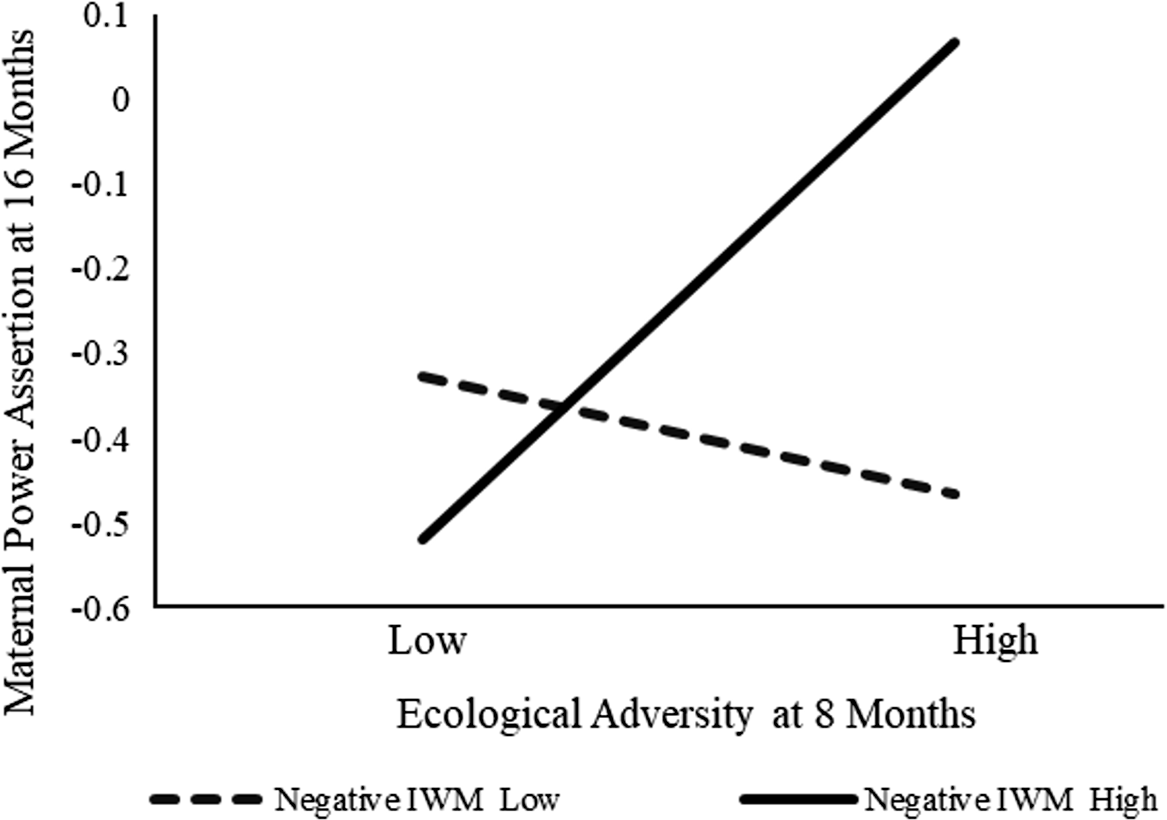
Second, we examined the paths from the predictor to the mediators as well as the moderated effects of maternal negative IWMs. Ecological adversity at 8 months was significantly related to maternal power assertion at 16 months but not to maternal power assertion at 3 years. Additionally, as expected, the former path was moderated by maternal negative IWMs of the child at 16 months. Mothers who experienced higher ecological adversity when their child was an infant relied on more power assertion at 16 months, but only if they also had highly negative IWMs of the child, B = 0.23, SE = 0.06, 95% CI [0.11, 0.35], p < .001. Simple slopes are depicted in Figure 2.

Figure 2. Maternal negative internal working model of the child at age 16 months as a moderator of the relation between ecological adversity at age 8 months and maternal power assertion at age 16 months.
Note. IWM = internal working model. A simple slope of maternal negative IWM at the high level (84th percentile) was 0.23, SE = 0.06, 95% confidence interval [0.11, 0.35], p < .001.
Higher maternal power assertion at 16 months was related to higher power assertion at 3 years, but this path was not moderated by maternal negative IWM of the child at 3 years. In other words, the stability of maternal power assertion from 16 months to 3 years was not contingent on the mothers’ negative IWMs of the child.
Third, we examined the paths from the mediators to the outcomes. Higher maternal power assertion at 3 years was related to children’s more SR difficulties at 4.5 years. However, there were no significant paths from maternal power assertion at 16 months to child SR difficulties.
Finally, fourth, we tested the significance of moderated mediation for the entire cascade from early ecological adversity to SR at preschool age: We examined if the paths from ecological adversity in infancy to child SR through maternal power assertion at 16 months and at 3 years were significantly different for mothers differing in their negative IWMs of the child. Maternal negative IWMs of the child at 16 months moderated the mediated path from early ecological adversity to mother-reported SR difficulties through maternal power assertion at 16 months and then 3 years. When maternal negative IWM of the child was high at 16 months, higher ecological adversity in infancy initiated a cascade to first, more power assertion at 16 months, and next, to more power assertion at age 3, and ultimately, to more mother-reported SR, regardless of the level of maternal negative IWM of the child at 3 years.
We include Table 2 to illustrate the presence or absence of moderated mediation for the entire path from ecological adversity at 8 months to SR at 4.5 years for mothers with high (16th percentile) or low (84th percentile) negative IWMs of the child at both times when IWMs were assessed. Although recall that only IWMs at 16 months exerted statistically significant moderating impacts and unique moderation by maternal negative IWM at 3 years was not significant, the examination of effect sizes for the moderated mediation is informative. The moderating effect seemed bolstered when maternal negative IWMs of the child at both 16 months and at 3 years were high, although the difference in effects narrowly missed statistical significance, ΔB = 0.013, SE = 0.012, 95% CI [-0.002, 0.049].
In sum, higher ecological adversity parents experienced when their child was an infant might be detrimental for later parenting and subsequent child SR, especially when mothers had an early formed, highly negative IWM of the child. However, the negative effects could be buffered when mothers had less negative IWM of the child.
Father-child dyads
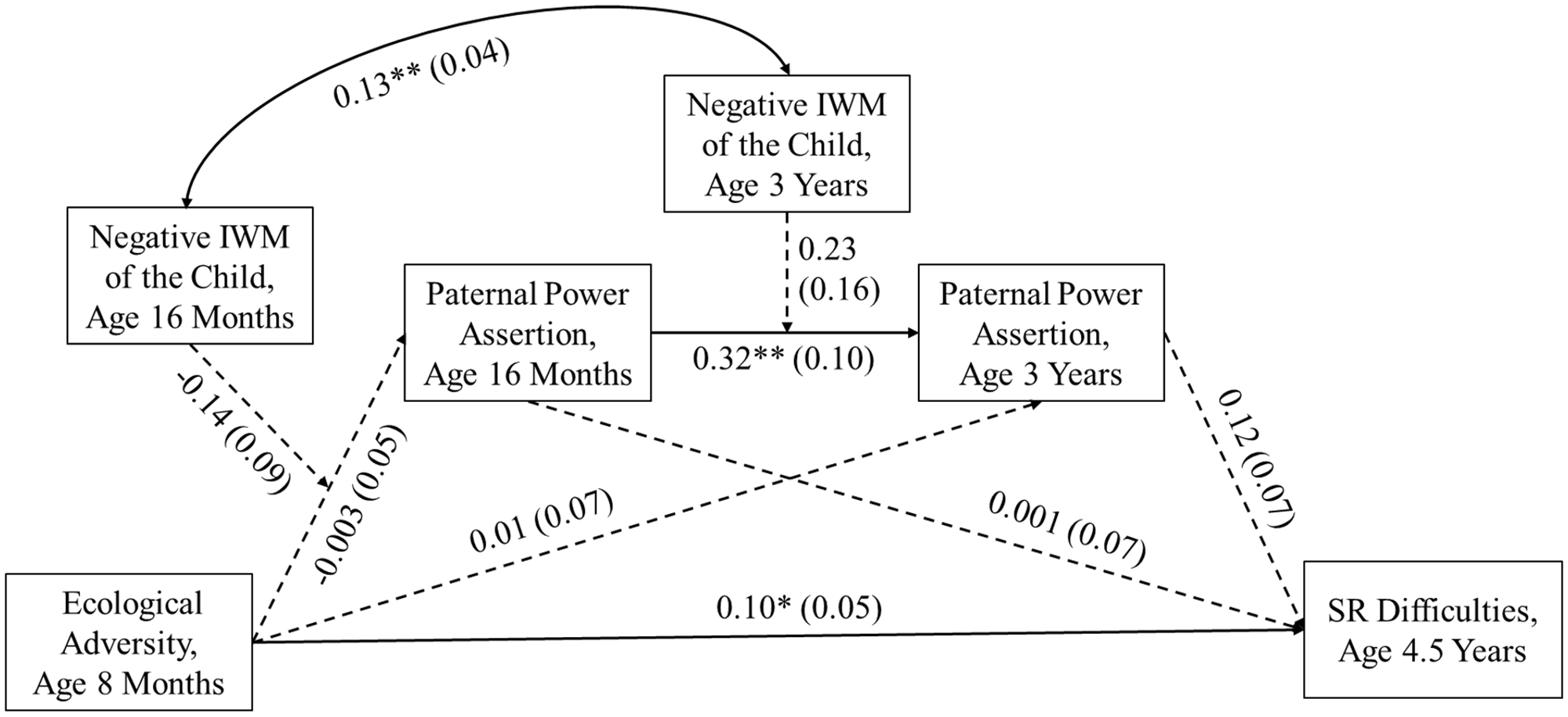
Relatively few significant paths were found in father-child dyads. The results are in Figure 3. As for mothers, higher ecological adversity at 8 months was directly related to more SR difficulties at 4.5 years and paternal power assertion was stable from 16 months to 3 years. Paternal power assertion at 16 months and 3 years did not predict children’s SR difficulties. In contrast to mother-child dyads, we found no evidence of significant mediation through power assertion or moderation by negative IWM of the child.

Figure 3. Longitudinal relations from ecological adversity at age 8 months to paternal power assertion at age 16 months and age 3 years to children’s self-regulation at age 4.5 years in father-child dyads.
Note. IWM = internal working model, SR = self-regulation. Solid lines represent significant paths and dashed lines represent non-significant paths. Child gender, SR antecedent at 8 months (Orienting/Regulatory capacity), and maternal power assertion at age 16 months were covaried but not depicted for clarity. Unstandardized coefficients and standard errors (in parentheses) are presented. * p < .05. ** p < .01. No significant moderated mediation was found.
Sensitivity analyses
We conducted additional analyses with separate SR variables – parent-reported SR difficulties and observed SR – modeled as child outcomes. The results of the original models were essentially replicated in both mother-child and father-child dyads. We found significant moderated mediation in mother-child dyads, from higher early ecological adversity to poorer observed SR through higher maternal power assertion for mothers with more negative IWM of the child at 16 months. The moderated mediation on mother-reported SR difficulties yielded similar patterns. The results are in Supplement Table S1. We found no significant moderated mediation in father-child dyads.
Additionally, we estimated alternative models that included parental power assertion and negative IWM of the child at 16 months only (without the respective measures at 3 years). The findings are in Supplement Table S2, Figure S1. In both dyads, our key hypothesized model (one including power assertion and IWM at both 16 months and age 3) was supported, given that the chi-square difference was not significant between the two models and other fit indices were similar. Consequently, our conclusions did not change.
Discussion
Early exposure to ecological adversity affecting families is universally seen as potentially transdiagnostic risk factor, detrimental to children’s future outcomes. However, understanding specific mechanism or mechanisms mediating such effects along the developmental trajectory is incomplete. Understanding moderating factors that explain multifinality in those trajectories or identifying parents who are and who are not negatively affected is likewise incomplete. Additionally, very little is known about such moderated mediation processes in father-child relationships.
We traced the longitudinal paths from ecological adversity in infancy to one important developmental outcome – self-regulatory difficulties – at preschool age in both mother-child and father-child dyads. We proposed parental power assertion and negative IWMs of the child in toddlerhood as mediators and moderators of those paths, respectively. Given that toddlerhood is a period during which parents and children often navigate control challenges, we assessed parental power assertion and negative IWMs at the approximate times of onset and offset of the toddler age (at 16 months and at 3 years). We included those two developmental windows to better understand the timing when moderating factors may exert their impacts.
In mother-child dyads, we supported our conceptual model. Power-assertive parenting mediated the path from early ecological adversity to later child SR, and mothers’ negative IWMs of the child moderated the mediated path. For mothers who had highly negative IWMs of the child, higher ecological adversity when children were infants predicted more power-assertive control in toddlerhood, which in turn predicted poorer SR at preschool age. This mediated relation, however, was absent for mothers whose IWMs of the child were less negative. These results are consistent with previous findings regarding significant indirect relations from multiple risk factors to behavioral outcomes and executive function through parenting (FLP Key Investigators, 2013; Rhoades et al., Reference Rhoades, Greenberg, Lanza and Blair2011); however, we add to that previous research. Due to the inclusion of parental IWMs of the child, our findings are more nuanced, in that they specify for whom the relations are present, consistent with recent research that considered a critical moderating role of parental representations (An & Kochanska, Reference An and Kochanska2022b, Kochanska & An, Reference Kochanska and An2024a, Reference Kochanska and An2024b; Kochanska et al., Reference Kochanska, Boldt and Goffin2019). The findings highlight the complex interplay between individuals and contexts, consistent with bioecological models.
The timing of developmental events and potential sensitive periods have always been core and compelling topics in developmental psychopathology. The findings provide initial insights into specific developmental windows critical for the effects due to maternal negative IWMs. Maternal negative IWMs moderated the path from ecological adversity to maternal power assertion at 16 months, but not the autoregressive path for power assertion across the toddler age (16 months to age 3). These findings are new and important, as they illustrate how maternal early implicit negative schemas regarding the child, formed at the end of the first year, can impact harsh parenting for mothers coping with adverse circumstances. Mothers with higher negative IWMs of the child, when faced with stressful circumstances, may be more vulnerable to environmental risks and get easily distressed. In turn, higher stress can increase the likelihood of harsh and coercive parenting. Importantly, once harsh parenting is elevated, it remains high through the toddler age regardless of maternal future perceptions of the child.
Consistent with the tenets of developmental psychopathology, these findings have implications for both basic and translational research. They support the attachment theory’s premise that early experiences can be “privileged” in development (Sroufe, Reference Sroufe2009) and that they play an especially important role in developmental trajectories triggered by adversity (Gee & Cohodes, Reference Gee and Cohodes2023). Maternal negative IWMs of their children, formed throughout the first year, prior to the onset of control, have significant consequences for mothers’ discipline style once control issues become salient, and their impactful detrimental legacy continues through preschool age, affecting children’s SR skills as they face the important transition to kindergarten.
The findings also have implications for the question of which risk factors are modifiable. Although maternal negative schemas at age 3 per se no longer impacted parenting, the entire detrimental trajectory from ecological adversity to harsh parenting to children’s poor SR appeared most pronounced for mothers whose negative IWMs were high at both assessments (note that this inference should be treated with caution and as a preliminary but promising lead, see Table 2). In other words, our key findings indicate that maternal power assertion, elevated at 16 months for mothers with highly negative IWMs, remained stable; however, it is possible that negative IWMs may continue to matter in the associations among adversity, parenting, and child SR throughout the early years. This pattern of findings highlights the need for intervention for parents coping with difficult circumstances as early as infancy and suggests that such early interventions may be most beneficial. Several interventions addressing maternal IWMs have proved successful (Borelli et al., Reference Borelli, DeCoste and McMahon2023; Camoirano, Reference Camoirano2017; Suchman et al., Reference Suchman, DeCoste, McMahon, Dalton, Mayes and Borelli2017). Important from a prevention point of view, lower levels of negative IWMs can buffer the negative effects of early ecological adversity to later SR by weakening or severing the link between adversity and harsh parenting at the beginning of the second year. Interventions later in development, however, past age 3, may miss the important window and be less effective.
In the father-child model, the individual paths showed similar patterns as in the mother-child model. However, we did not replicate any significant moderation or moderated mediation found in mother-child dyads. It is inconsistent with the previous results that showed a significant moderating effect of paternal mentalization on the relations between family income and autonomy support (Buttitta et al., Reference Buttitta, Smiley, Kerr, Rasmussen, Querdasi and Borelli2019). Whereas the latter study relied on a single source of adversity (i.e., low income), we combined several sources of demographic and environmental risks, which might render the interaction between ecological adversity and paternal mentalization more complicated.
The discrepant findings between mother-child and father-child relationships suggest potential differences in the associations among ecological adversity, parental negative IWMs, and power assertion. Mothers’ greater investment in child care can explain, in part, different findings for the two parent-child relationships. In our sample, at the entry to the study, mothers spent approximately 59 hours per week on average with the child, while fathers spent 35 hours. Thus, mothers’ parenting may have been more vulnerable to environmental risks compared to fathers.
In both mother-child and father-child relationships, the direct effects of early ecological adversity on child future SR remained significant even after accounting for the mediation effects of parenting and moderating effects of the IWMs. There are several possible interpretations of these findings, involving constructs we did not measure. SR does have a genetic and neural basis (Blair, Reference Blair2010; Bridgett et al., Reference Bridgett, Burt, Edwards and Deater-Deckard2015; Conradt et al., Reference Conradt, Fei, LaGasse, Tronick, Guerin, Gorman, Marsit and Lester2015; Perone et al., Reference Perone, Almy, Zelazo, Gibb and Kolb2018), shared between the parent and the child. Parents whose own self-regulatory capacities are poor are likely to be over-represented in high-risk ecologies, as SR robustly predicts multiple dimensions that are markers of such ecologies (low education, young age at childbirth, unstable family structures, etc., Moffitt et al., Reference Moffitt, Arseneault, Belsky, Dickson, Hancox, Harrington, Houts, Poulton, Roberts, Ross, Sears, Thomson and Caspi2011, Reference Moffitt, Poulton and Caspi2013). Thus, ecological, genetic, socialization, and experiential factors all work in concert, accounting for developmental trajectories of children’s SR (Deater-Deckard, Reference Deater-Deckard2014).
This work has several strengths. We studied both mother- and father-child dyads, and employed well-established measures, such as a fine-grained index to assess cumulative ecological adversity, observed behavioral data for parental power assertion, and parent-reported and observed measures for child SR. The FMSS interviews to capture parental implicit negative relational schemas or IWMs of the child were especially valuable, as many parents may feel reluctant to share – or may have difficulty accessing cognitively – their negative emotions and views explicitly. Yet, such implicit relational schema exerts a significant impact on their parenting. We further believe that our investigation of developmental timing of effects of parental IWMs was an innovative aspect of this work and, although preliminary, provided leads for future research on this question.
The current study had limitations. Ethnic diversity was limited (although recall that 20% of families were not “White alone”). Parents and children were mostly from low-risk families. Although ecological adversity data were normally distributed, its levels were low – likely lower than adversity in the overall population. Parent-child relationships were generally adaptive and harmonious, with power assertion used relatively rarely. Parents’ Criticism scores in FMSS were also low.
In addition, it can be argued that our ecological adversity construct was in part arbitrary. We focused on ecological adversity in terms of sociodemographic risks, but other dimensions of adversity could certainly be considered. One example is intergenerational trauma, including the parent’s experience of maltreatment, which can uniquely impact parenting (Assink et al., Reference Assink, Spruit, Schuts, Lindauer, van der Put and Stams2018). As well, underrepresented racial or ethnic groups are likely to experience historical trauma and have higher rates of related symptoms such as post-traumatic stress disorder (O’Neill et al., Reference O’Neill, Fraser, Kitchenham and McDonald2016; Pole et al., Reference Pole, Gone and Kulkarni2008). Parental mental or physical illness is another possible dimension of early adversity, as are environmental factors such as the quality of neighborhoods (Ursache et al., Reference Ursache, Barajas-Gonzalez and Dawson-McClure2022) and early childhood education (Kangas et al., Reference Kangas, Ojala and Venninen2015; Williford et al., Reference Williford, Vick Whittaker, Vitiello and Downer2013).
Multiple future directions of research can extend this work. Aspects of parenting other than power-assertive control can serve as proximal risk factors (e.g., parental unresponsiveness or emotional unavailability, inconsistent discipline, intrusiveness), and they can be potential candidates accounting for the link between ecological adversity and SR. In addition, individual differences in children’s emotion regulation processes can be substantially involved in the pathways from the ecological context to children’s regulatory skills, as proposed in neuroecobiological models. In those models, features of the ecological context are seen as influencing the child’s emotion regulation, which then serves as a mediator linking the context with SR (Liew et al., Reference Liew, Morris and Kerr2023). Further, children with certain biologically based traits may be more affected than others by ecological adversity and by the quality of parenting they receive, consistent with differential susceptibility models (Belsky & Pluess, Reference Belsky and Pluess2009). Thus, future studies with multiple mediators or moderators from different systemic levels – from biological markers of both the parent and the child to measures of individuals’ interactions to relationship-based constructs to indices of broader contexts – would provide a more comprehensive understanding regarding a complex, multi-level interplay among person, process, context, and time factors in the development of SR in children in families that experience early adversity (Bronfenbrenner & Morris, Reference Bronfenbrenner, Morris, Damon and Lerner2007; Masten et al., Reference Masten, Tyrell and Cicchetti2023).
Consequently, future research would benefit from including families coping with more extreme adversity, including parental psychopathology, traumatic experiences, chaos, single parenting, poverty, severe deprivation, displacement, and other risks, and engaging in highly dysfunctional parenting, including child maltreatment. More robust indirect effects are expected with more diverse samples including high-risk families, which can emphasize the important role of early adversity more strongly (Taraban & Shaw, Reference Taraban and Shaw2018). For instance, in a study with Head Start families, harsh discipline mediated the link between socioeconomic adversity and child behavior problems (Baker & Brooks-Gunn, Reference Baker and Brooks-Gunn2020). Thus, if high-risk families are included, non-significant paths in the current study (e.g., the relations between parental power assertion and parent-reported SR difficulties, or relations between adversity and parenting) may likely become significant, making the overall mediation more robust. Of note, in a past study of highly stressed, high-risk, low-income, low-education, and ethnically diverse mothers and toddlers, our ecological adversity index was indeed robustly associated with observed parenting (Kochanska et al., Reference Kochanska, Kim and Koenig Nordling2012, Reference Kochanska, Kim and Boldt2013). Nevertheless, even in the relatively low-risk, well-functioning families in the current study, we were able to trace a significant negative path from early ecological adversity to later parenting and to child SR, and the detrimental effects of early parental negative mentalization regarding the child, highlighting the critical role of early experiences for future developmental trajectories.
Supplementary material
The supplementary material for this article can be found at https://doi.org/10.1017/S0954579425000148.
Acknowledgements
We thank all Child Lab team members for their contributions and all the participating families for their commitment to our research.
Funding statement
This work was funded by the grants from National Institute of Child Health and Human Development (R01 HD091047 and R01 HD110427) to Grazyna Kochanska, and additionally supported by the National Center for Advancing Translational Sciences of the National Institutes of Health (UL1TR002537).
Competing interests
The authors declare no conflicts of interest.



 Open access

