




The epithets are sweetly varied, like a scholar at the least.
(Shakespeare, Love’s Labour’s Lost IV.ii.90)
1. Introduction
In the last two decades the semantics of the English phrase at least has received a fair amount of scholarly attention, especially the contrast between the uses illustrated in (1) and (2) – examples taken from Kay (Reference Kay, Lehrer and Kittay1992), probably the first study that focuses on the semantics of English at least.

Kay (Reference Kay, Lehrer and Kittay1992) calls (1) a ‘scalar’ use and (2) an ‘evaluative’ use. There is also a use or a set of uses which has received very little attention. These uses are illustrated in (3) to (5). Kay (Reference Kay, Lehrer and Kittay1992) calls them ‘rhetorical’.

Almost nothing has been written about the alternative expressions at the least and at the very least.

This article reviews the important ideas presented in the literature on these constructions, it offers an analysis of the core meaning of the three constructions, it confirms Kay’s analysis of the rhetorical nature of the uses in (3) to (5) and shows how the rhetorical meaning relates to the core meaning.
In section 2 I introduce at least as a member of a family of constructions and offer a preliminary account of its meaning. Section 3 aims to take this semantic analysis to a higher level, largely in terms of the scalar nature of the meaning of at least. What I present as the ‘core meaning’ will be illustrated with at least pairings with cardinal numbers, but I claim that this core meaning characterizes all uses of at least, as well as of at the least and at the very least. Section 4 broadens the analysis to non-numerical constructions. Section 5 focuses on uses such as (2), and section 6 is about the uses illustrated in (3) to (5). Section 7 deals with the special meaning of at the very least and with the different usage profiles of at least, at the least and at the very least. Section 8 is the conclusion.
Some of the example sentences come from the English Sketch Engine TenTen corpus. Sketch Engine, founded by Adam Kilgarriff and Pavel Rychlý, is an online corpus tool (www.sketchengine.eu) and the TenTen corpus (Jakubíček et al. Reference Jakubíček, Kilgarriff, Kovář, Rychlý and Suchomel2013; English Web 2021) is a text collection that was crawled from the web between December 2021 and January 2022. On the negative side, web crawling collects materials that are of variable acceptability and from different varieties. For our data, however, I have no evidence that false or unreliable hits give us a distorted picture of present-day usage, but regional differences or preferences may well remain undetected. On the positive side, the corpus is enormous: it has more than 52 billion words. Sketch Engine includes a sampling routine. The interpretation of the examples was the author’s and it was always straightforward, in part because Sketch Engine provides examples with a context. The Sketch Engine examples, extracted between November 2024 and February 2025, are marked with ‘<SkEng>’. Other examples come from the literature. I also make up simple examples innocently based on sentences either from the Sketch Engine corpus or from the literature; (6) and (7) are such variations.
2. At least and related constructions
In this section I present at least followed by a numeral, as illustrated in (1), as a member of a family of constructions, and I give it a preliminary semantic description.

Least is the superlative of little and constructions such as at least have been called ‘superlative modifiers’ (e.g. Geurts & Nouwen Reference Geurts and Nouwen2007; Chen Reference Chen2018). At least is not the only superlative strategy: even just restricting ourselves to modifiers with an alternative for at least that precedes the numeral three, there are at least eleven more constructions:

Each of these words or phrases is attested in front of the numeral three in the TenTen corpus, but all except at least three have a frequency below 0.01 per million, compared to a frequency of 4.67 per million for at least three. These constructions are worthy of being investigated, but in this article I restrict myself to at the least and at the very least.
Next to superlative modifiers there are also comparative ones, illustrated in (9).

In constructions with cardinal numerals, the superlative and comparative strategies are (close to) synonymous, but I will not go into this matter here – for an analysis of the relation between at least three and more than two, see e.g. Geurts & Nouwen (Reference Geurts and Nouwen2007), Nouwen (Reference Nouwen2008) or Alexandropoulou (Reference Alexandropoulou2018). There are also combinations of superlative and comparative modifiers, illustrated in (10).

The latter have not been discussed in the literature at all and though I will not discuss them either, they should not be disregarded. At least three or more appears 394 times in the TenTen corpus, which is double the frequency of at the very least three, and 10 out of the 22 occurrences of three if not more are preceded by at least.
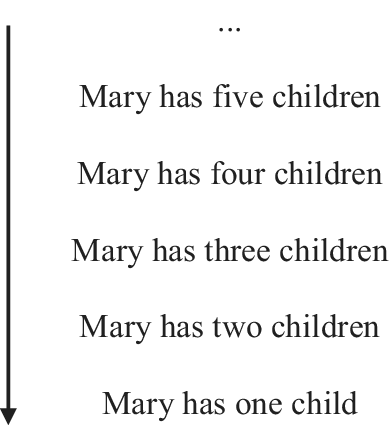
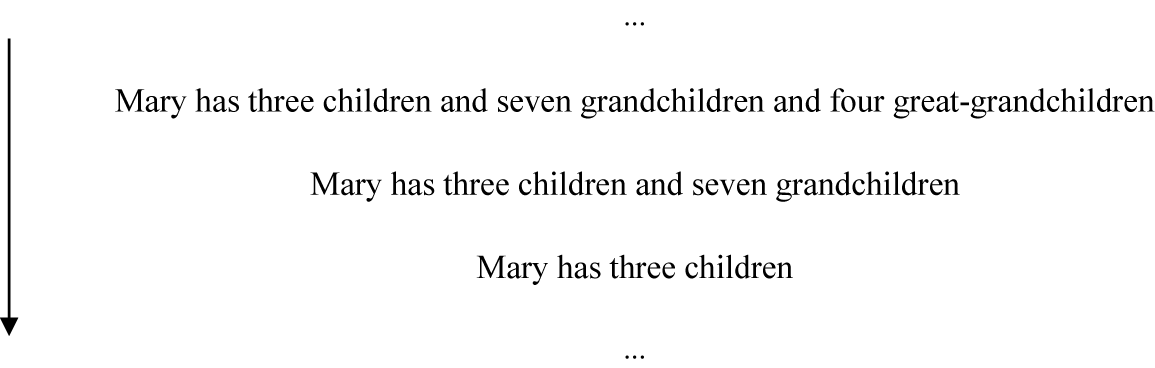
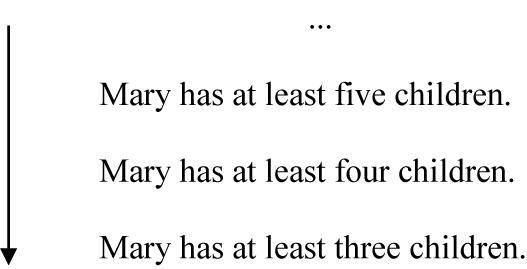
In the reading of (1) that comes to mind first, at least relates to a simple numerical scale, with Mary having three children, possibly more, and thus also (by entailment) two children as well as one child. In conformity with the literature, three will be called the ‘focus value’ or the ‘focus constituent’; it refers to the part of the proposition for which propositions that are higher or lower on a scale offer alternatives. The scale is visualized in figure 1 and the arrow stands for the entailments from the higher to the lower values. The proposition without at least, i.e. Mary has three children, is commonly called the ‘prejacent’. The prejacent finds a place on the scale, and above and below are propositions with an alternative value.
A scale for Mary has at least three children

With at least three, speakers express a partition on the scale, with the focus value of three siding with the values higher than three. Both when Mary has three children and when she has four, five or more, (1) is true. When we are below the partition, i.e. when Mary has fewer than three children, (1) is false. Note that the scale starts with a proposition with one, so it does not include propositions with zero or with negative numbers. Note also that I take it that three, in Mary has three children, is ambiguous between ‘exactly three’ and ‘at least three’. Thus I do not endorse the Gricean view that three means ‘at least three’ (e.g. Horn Reference Horn1972; Levinson Reference Levinson1983: 106−7; Chierchia Reference Chierchia and Belletti2004). This non-Gricean vagueness view applies to my metalanguage, too. Thus the three on the scale in figure 1 is also ambiguous between ‘at least three’ and ‘exactly three’ and I assume that ambiguous ‘at least three or exactly three’ of sentence (1) entails ‘at least two or exactly two’.Footnote 1 I further take it for granted that the counterarguments to the Gricean view are successful (see esp. Bultinck Reference Bultinck2005, but also e.g. Carston Reference Carston and Kempson1988; Horn Reference Horn, Barker and Dowty1992; Krifka Reference Krifka and Turner1999: 260; Ariel Reference Ariel2015) and I will not go into this issue.
Finally, at least is related to even if only, another construction that has not been discussed much and that needs more work.

It contains two particles, viz. the scalar additive particle even and the restrictive particle only. The first one scopes over a conditional element if and the second over the numeral. Example (11) trivially entails that Mary has children; this is contributed by the Mary has children part. Even if only three adds that there may be three children, but maybe not more. Even if only is thus similar to at most, illustrated in (12).Footnote 2

Like with at most, it is possible that Mary only has three children; however, like with at least, it is also possible that Mary has more than three children. Interestingly, there are contexts in which this use of if is given a factive reading. Thus (11) is felicitous when the speaker knows that Mary definitely has three children and allows that there could be more. This comes very close to what at least three means. But there is still a difference: the restrictive particle only has the effect of making a higher number less probable. One could reflect this by saying that this meaning does not so much convey that more than three is possible but rather that no more than three is possible. At least three looks up the scale and reflects an optimistic speaker attitude (about a value higher than three), whereas with even if only three, in the right context, the speaker is pessimistic. Also, according to a reviewer, in the most prominent reading even if only three just means ‘only three’. Be that as it may, even if only phrases deserve a place on the research agenda, together with the other alternatives for at least.
3. The core meaning of numerical at least
The numerical use of at least has been studied in cognitive semantics (Kay Reference Kay, Lehrer and Kittay1992, building on Ducrot Reference Ducrot1980 and Anscombre & Ducrot Reference Anscombre and Ducrot1983), mostly in formal semantics (e.g. in Krifka Reference Krifka and Turner1999; Geurts & Nouwen Reference Geurts and Nouwen2007; Büring Reference Büring, Chang and Haynie2008; Nakanishi & Rullmann Reference Nakanishi and Rullmann2009; Schwarz Reference Schwarz, Aloni, Franke and Roelofsen2013, Reference Schwarz2016), and also in an approach that profits from both traditions (Gast Reference Gast, Gil, Harlow and Tsoulas2013). These accounts are similar. Thus when Geurts & Nouwen (Reference Geurts and Nouwen2007: 533) write that
an utterance of At least three girls snored conveys two things: first, that it is certain that there was a group of three snoring girls, and, second, that more than three girls may have snored
this is close to Büring (Reference Büring, Chang and Haynie2008: 114) writing that ‘“at least n” is essentially “exactly n or more than n”’. Kay’s (Reference Kay, Lehrer and Kittay1992: 312) approach, phrased in terms of at least entailing that Mary has three children and blocking an implicature that Mary has no more than three children, is compatible too (compare also Gast Reference Gast, Gil, Harlow and Tsoulas2013: 116; Schwarz Reference Schwarz, Aloni, Franke and Roelofsen2013: 187, Reference Schwarz2016: 2). There are also many differences between these accounts, especially on deciding which aspects of the meaning of at least are semantic and which are pragmatic. Some of these differences will be discussed in sections 5 and 6.
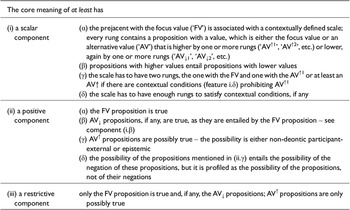
In this section I focus on the semantics of the ‘core meaning’ (or the ‘Gesamtbedeutung ’). This core is defined in terms of three components, viz. a scalar one, a positive one and a restrictive one – see table 1. I claim that all uses of at least involve these three components.
The core meaning of at least

I will now discuss each of the nine features of the definition. Note also that though I take the core meaning hypothesis to be valid for all uses of at least, in this section I only discuss numerical uses. The first four properties define the scale. (i.α) seems unnecessarily complex. At least, for the at least three children of sentence (1), I used the simple scale of figure 1, which I didn’t call ‘contextually defined’. But the account has to be valid also for sentences like (13), a variant of a sentence discussed by Huang (Reference Huang and Cummings2010: 412).

For this use I need the scale in figure 2. The ordering of the values is the reverse of the one in figure 1.Footnote 3
The scale of John’s attempt to deal with his addiction to smoking

One could claim that the order of figure 1 is the natural one, the ‘semantic’ one, but the point is that we always need to consider the context to define the scale that is relevant for a use of at least. Even if one takes the order in figure 1 to be the natural one, it is still the context that has to allow it.Footnote 4 The notion of the ‘contextually defined’ scale corresponds to Gast & van der Auwera’s (Reference Gast and van der Auwera2011: 9) notion of ‘contextual implications’, due to Wilson & Sperber (Reference Wilson and Sperber2004: 608). It is a way of making explicit what Coppock & Brochhagen (Reference Coppock and Brochhagen2013: 3) have in mind with ‘pragmatic strength’. ‘Pragmatic strength’ may be based on semantic strength, as in (1), allegedly ‘natural’, or on something else. This ‘something else’ can be a simple reversal of the ‘natural’ order, as in figure 2, but we will see in section 3 that the contextual ‘adaptation’ may be more complex.Footnote 5
Point (i.γ) says that the contextually defined scale must have two rungs and need not have more, one has the FV and the other one, ceteris paribus, the AV↑1. Consider a context in which all that matters is whether or not Mary has one or two children. That context allows (14).

Example (14) is also allowed when the context concerns the question whether Mary has one, two, three or more children. Note that the requirement for there to be an AV↑1 effectively blocks at least from associating with a highest FV.Footnote 6 Obviously, there is no value higher than a highest one. This is illustrated in (15). Example (15a) sketches the context: in that context (15b) is fine, but (15c) is not. I use ‘#’ for contextually unacceptable sentences; ‘*’ would not do, because (15c) is grammatical.

Note that this does not mean that the proposition with the highest value cannot be true, only that the highest value cannot be the focus value.

Component (i.δ) deals with contextual conditions. Example (16a) illustrates what is meant by a ‘contextual condition’.

With (16a) as the context for (16b), it is impossible for the second pupil to get three books, when the first pupil gets eight books. Example (17) illustrates how a contextual condition can block a AV↑1 proposition. The context is that of (17a).

The positive component first specifies that the proposition with the focus value is true – (ii.α). Feature (ii.β) says that propositions with lower values are also true: when Mary has three children, she also has two children. The (ii.γ) and (ii.δ) components can be called ‘modal’, a point stressed also by Geurts & Nouwen (Reference Geurts and Nouwen2007): the higher values are possible. It is important to be specific about the kind of possibility that is involved. There are at least four kinds; they go under different labels and the labels I use for the examples with English modal verbs in (18) are the ones advocated in van der Auwera & Plungian (Reference van der Auwera and Plungian1998).

The possibility of at least allows both the non-deontic participant-external and the epistemic reading – pace Geurts & Nouwen (Reference Geurts and Nouwen2007), who describe at least only in terms of epistemic possibility. The first one is illustrated in (19a), the second one in (19b).

I thus agree with Geurts & Nouwen (Reference Geurts and Nouwen2007), followed by Chen (Reference Chen2018, Reference Chen2024), who claim that at least has a semantic possibility component, but I reject that this modality has to be epistemic. What we need is a wider notion of possibility (allowing both non-deontic participant-external possibility and epistemic possibility). In the at least literature the context-dependent reading of the epistemic possibility is called an ‘ignorance’ reading (e.g. Schwarz Reference Schwarz, Aloni, Franke and Roelofsen2013; Mendia Reference Mendia, Hammerly and Prickett2016; Göbel & Wagner Reference Göbel and Wagner2023). The non-deontic-external possibility reading is what e.g. Alexandropoulou (Reference Alexandropoulou2018) calls ‘speaker indifference’.
Feature (ii.δ) says that propositions with higher values are possibly true. When Mary has three children, the proposition that Mary has four children gets evaluated as possibly true. But the negation of this proposition is also possibly true. The difference is that at least conveys some optimism: the possibility is characterized as the possibility of the proposition rather than of the negation of the proposition, which, as mentioned earlier, makes at least different from even if only. At least ‘brings good news’ (Horn Reference Horn, Andronis, Debenport, Pycha and Yochimura2002: 57). This upward orientation is the reason why at least does not occur in the scope of clausal negation − I leave echoic/metalinguistic uses out of account.

At least can thus be considered a ‘positive polarity item’, though only a weak one (cp. Van der Wouden Reference van der Wouden1997: 123−5), for at least is fine in other ‘negative polarity contexts’.

Then there is the restrictive component, the ‘other side of the coin’ of the positive component. The FV proposition is true and so are the AV↓ propositions, if any, but the AV↑ propositions are only possible. Truth is ‘restricted’ to FV and AV↓ propositions. Note that I choose to speak about a ‘restrictive’ component rather than about a ‘negative’ component. The meaning of at least is basically positive, more so than at most and even if only.
4. More parameters in the use of at least
So far, I have only dealt with simple numerical constructions, viz. ones in which at least occurs immediately to the left of the numeral. I have described their core meaning and I claimed that this core meaning does not characterize only these simple numerical constructions. I now turn to some other constructions. My goal is limited: I only want to show that the non-numerical constructions share the core meaning. The goal is not to provide a detailed analysis of the non-numerical constructions.
4.1. Substitutive scales
Numerals have the property that they instantly induce a scale. We do not need a context for this, though we do need one for the direction of the scale, as was shown with the contrast between (1) and (13). Thus three calls up both the higher and the lower numbers and on the upper and the lower rungs these are substitutes for the number three. In this sense, the scales are substitutive.
Numerals are not the only entities that automatically conjure up substitutive scales. Quantifiers have that property too. So a few induces a scale with e.g. quite a few or most, on the one hand, and very few or almost none, on the other hand. Unsurprisingly, at least occurs with quantifiers and then the definition of table 1 fully applies to these quantifiers.

Example (23) shows that at least does not combine with the highest quantifier and that it does not occur in the scope of clausal negation, as fits properties (i.γ) and (ii.δ). Compare (23) with (15) and (20).

At least does not combine with all quantifiers though. Thus at least does not (easilyFootnote 8) combine with few, though it does with a few. An account of this difference is beyond the confines of this article.

An automatic substitutive scale is also triggered by temporal expressions. This is the case with October 2007 in (25).

October 2007 is preceded by September 2007, and it is followed by November 2007. If N was interred until October 2007, then N was also interred before October 2007 and possibly later too.
The link between the focus of at least and its scale is often not automatic, but instead context-dependent. This is illustrated with (26).

If one is a British a soccer fan, one will understand (26) to invoke a scale of prestige. It is more prestigious to be successful in the European Cup than in the FA Cup, and success in the latter is more prestigious than success in the Carabao Cup. Thus the contextually defined scale going with at least could be the one on the right side of figure 3. ‘PPP’, ‘PP’ and ‘P’ stand for different prestige levels, with ‘PPP’ being the highest. It is the context that associates these levels with the different cups. I mark these links with a broken horizontal line. The propositions on the right are the ‘contextual implications’ that characterize ‘pragmatic strength’, the notion introduced in the discussion of example (13).
A scale for Arsenal’s recent FA Cup success

On the left side I show the prejacent with the FA Cup, as well as variants with the other cups. But there is no entailment between these propositions. Entailments only hold for the ordering on the contextual scale on the right, and here the contextual scale involves more than the inverse of the ordering of the prejacent with focus and alternative values that was discussed with example (13). This scale is again substitutive: on the higher rungs the ‘PPP’ and ‘PP’ replace ‘P’. But does (26) also make sense if one does not know about the various cups and their prestige? This takes us to the next section.
4.2. Additive scales
Anybody who says or hears (26), whether or not (s)he knows about the prestige of the various cups, is likely to know that soccer teams can compete in more than one cup and that success in one cup is thus compatible with success in another one. Thus (26) allows a second interpretation. Figure 4 sketches such an interpretation, for somebody who at least knows about the existence of the three cups mentioned in figure 3.
Another scale for Arsenal’s recent FA Cup success

The scale is not ‘substitutive’ as in figure 3, in which higher prestige levels substitute for lower ones. Instead, the scale in figure 4 is ‘additive’, with lower values reappearing on higher scales, but in the company of additional content.Footnote 9
Curiously, even though there is a substantial literature on the collocation of at least with noun phrases containing numerals, the additive reading has not been discussed (much). The distinction between additive and substitute scales goes back to at least Foolen (Reference Foolen and Weydt1983) and was picked up by van der Auwera (Reference van der Auwera, van der Auwera and Vandeweghe1984, Reference van der Auwera, Athanasiadou and Dirven1997).Footnote 10 An additive scalar interpretation is no less possible for Mary’s three children. The ‘three and possibly four’ reading of figure 1 is appropriate when the number of Mary’s children is at issue. But something else could be at issue, like a description of Mary’s offspring. For that situation a scale like that of figure 5 could be appropriate.
Another scale for Mary has three children

Here too the scale is additive. Note that for this reading the focus constituent is not just three but three children. So by itself, everything else being equal, at least three children is vague between a substitutive and an additive reading. Of course, in this article we make abstraction from intonation. Emphatic stress on three will trigger the substitutive reading.
The vagueness of what is the focus value can also be illustrated with an Arsenal example. Consider the variant of (26) in (27), the latter being the variant that actually occurs in the TenTen corpus.

In (27) at least precedes the verb phrase. So is the focus enjoyed or regular or even success? Can it also be the FA Cup or recent? Again, intonation can identify the focus. Thus emphatic stress on the FA Cup has an effect similar to putting at least in front of the FA Cup. But without intonation there is no clear focus and nothing in the sentence clearly induces a substitutive scale nor does the sentence itself give any clue about a possible additive scale. But scales are contextual and we do have a context for (27).

So what is at issue is whether Arsenal could have any success in winning a cup this year. Thus the scale, an additive one, is something like the one shown in figure 6.
An additive scale for Arsenal’s recent FA Cup success

4.3. Extra-clausal at least
In all the examples so far at least occurs inside a clause and it finds its focus inside the same clause. It may be vague, though, what the focus is. Even with the simple clause in (1), repeated once more, the focus could be ‘three’ as an alternative to ‘four’, but also ‘three children’, as an alternative to ‘three children and seven grandchildren’.

This vagueness of at least and its strong context dependency is very clear when at least occurs outside the clause, when it is ‘extra-clausal’ instead of ‘intra-clausal’. Consider (29).

In (29) at least is in front of the clause let me help you get your friend back and it is not clear what its focus is. In (30) I vary the position of at least to exemplify possible focuses and scales, both substitutive and additive (cp. Gast Reference Gast, Gil, Harlow and Tsoulas2013: 112−13 for a similar thought experiment). It could also be done with intonation or with both intonation and word order.

The right interpretation, so the context makes clear, is likely to be the one in (30d). Somebody, presumably not the you of your friend, replies to (29) with ‘And mine’.
An extra-clausal at least can be pre-clausal as in (29), but it also be ‘post-clausal’ as in (31).Footnote 11

Note that ‘pre-clausal’ should be distinguished from ‘clause-initial’. In (32) the most prominent reading at least is clause-initial, in front of its focus constituent ‘192’.

Similarly, in (33) at least is not post-clausal, but rather, in its most prominent reading, clause-final.

I have implied that when at least is extra-clausal, at least is still associated with a focus and a scale, in the manner described with the concept of ‘core meaning’. But there is more that needs to be discussed. It so happens that the key examples for what has been called the ‘evaluative’ and the ‘rhetorical’ uses of at least, illustrated in (2) to (5), and repeated below, are extra-clausal.

In (2) at least is pre-clausal and in (3) to (5) at least is post-clausal. I will turn to the pre-clausal use of (2) in section 5 and to the post-clausal ones in (3) to (5) in section 6.
5. ‘Evaluative’ at least
Sentence (2) is one of the examples that Kay (Reference Kay, Lehrer and Kittay1992: 316) uses to analyse what he calls the ‘evaluative’ meaning. The idea is simple: the comfort of the hotel is evaluated as something good, though for a perfect hotel, one would require more than comfort. So there are two components in the evaluation, and I will discuss both in some detail. The analysis relies on Anscombre & Ducrot’s (Reference Anscombre and Ducrot1983: 139) analysis of the French counterpart au moins, where the evaluative use was called ‘modal’. There are three other terms and table 2 shows who uses these terms, and also what terms are used for the three children case and whether the distinction is semantic or pragmatic.
Views on At least the hotel is comfortable
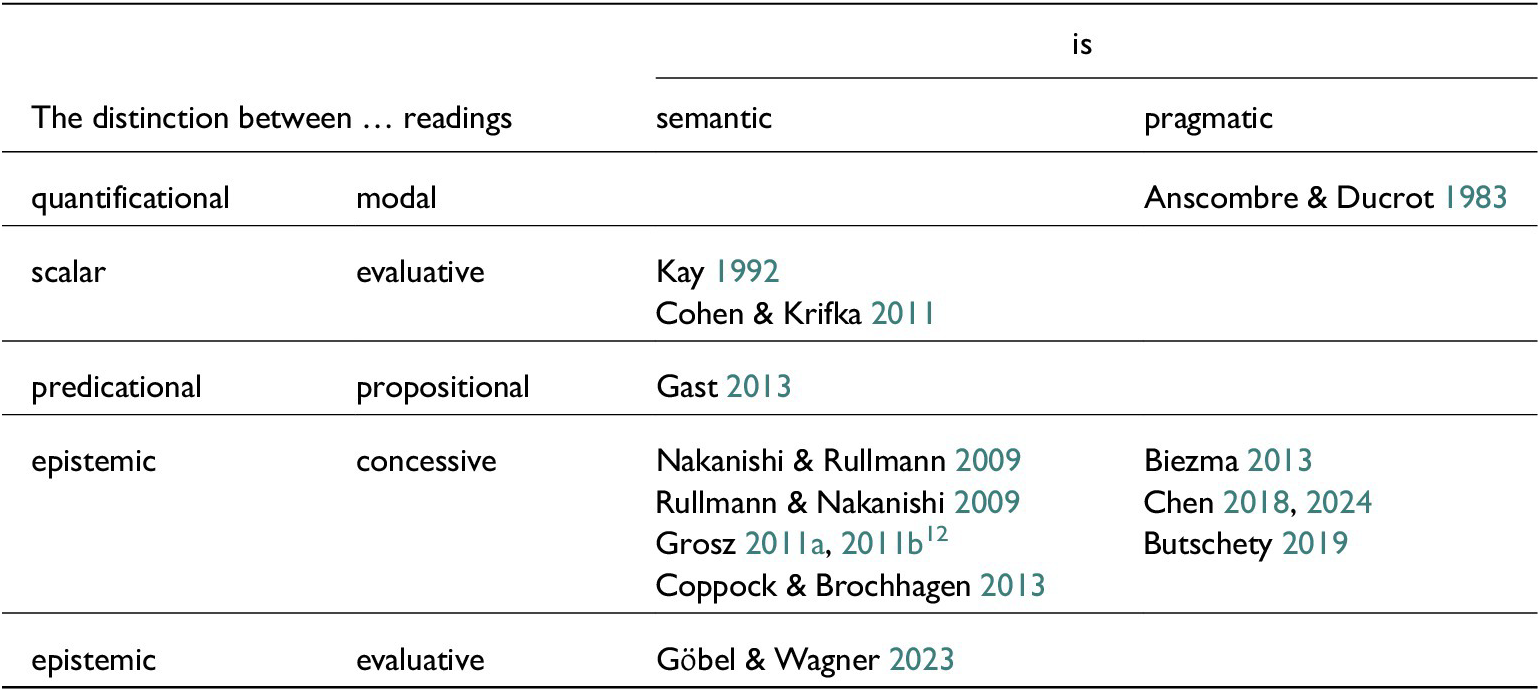
The term ‘modal’ was given by Anscombre & Ducrot (Reference Anscombre and Ducrot1983: 139) with a strong hedge: they consider their terminological proposal ‘arbitrary’. Kay’s ‘evaluative’ is a good term, if one accepts, as is done in each study listed in table 2, that this use involves an evaluation, a positive one. Still, Gast (Reference Gast, Gil, Harlow and Tsoulas2013), the linguist who is most indebted to Kay (Reference Kay, Lehrer and Kittay1992) and who also accepts that this meaning involves evaluation, does not accept the term ‘evaluative’. The main problem for Gast is Kay’s use of the term ‘scalar’, for they both consider the ‘evaluative’ meaning to be no less scalar than Kay’s ‘scalar’. Gast’s own proposal, with ‘predicational’ versus ‘propositional’, suggests a scope difference, with ‘propositional’ scoping over the whole proposition. This links up with the claim that it is the preferred interpretation of an extra-clausal, in particular, a pre-clausal placement of at least (Kay Reference Kay, Lehrer and Kittay1992: 313; Nakanishi & Rullmann Reference Nakanishi and Rullmann2009; Rullmann & Nakanishi Reference Rullmann and Nakanishi2009; Gast 2012: 111). The term ‘concessive’ is due to two unpublished conference presentations, viz. Rullmann & Nakanishi (Reference Rullmann and Nakanishi2009) and Nakanishi & Rullmann (Reference Nakanishi and Rullmann2009). They distinguish between ‘epistemic’ and ‘concessive’ meanings. The former is Kay’s ‘scalar’ use and the latter his ‘evaluative’ one. For the former they rely on of Krifka (Reference Krifka and Turner1999), Geurts & Nouwen (Reference Geurts and Nouwen2007) and Büring (Reference Büring, Chang and Haynie2008), and for the latter they don’t rely on any earlier work, so not Kay (Reference Kay, Lehrer and Kittay1992), and the distinction seems to be their own. Like Kay (Reference Kay, Lehrer and Kittay1992), they also posit an evaluative component. One of their examples is shown in (34a) and their paraphrase, which shows both the evaluative and the concessive component, is shown in (34b).

I take issue with both the terms ‘epistemic’ and ‘concessive’. The first term is rather general. The second is ill-suited. It is true though that concessive still can replace at least in (34a), giving (34c).

The concessivity hypothesis also aligns well with the earlier observation in Poutsma (Reference Poutsma1914: 501), with dictionary entries in the Oxford English Dictionary and in Webster’s. All three sources describe two senses, the second of which they paraphrase with at any rate, at all events and in any event. At any rate can replace at least in (34a) too, and so can nonetheless and nevertheless, of which the -less morpheme shows a family resemblance to least.

However, as (35) shows, at least, on the one hand, and still, at any rate and nonetheless/nevertheless, on the other hand, are not always interchangeable.

The difference is that at least has to announce something positive and not winning a silver medal is negative.
Independently of one’s terminological preference, all researchers agree that the at least of the comfortable hotel (of example (2)) and the silver medal (of example (34a)) conveys a positive evaluation.Footnote 13 Kay (Reference Kay, Lehrer and Kittay1992: 315) formulates this idea as follows: ‘[evaluative at least] has the two semantic properties of indicating positive evaluation and of indicating a less than maximal degree’. The point about the less than maximal degree is well taken if it is a way of rendering what feature (i.γ) implies in table 1: at least cannot combine with a highest FV. It is important to stress, though, that the proposition with the highest degree may still be true – see (15d). Example (36) shows that ‘evaluative’ at least has the same property.

Example (36b) also shows that ‘evaluative’ at least is scalar. The scale can be additive, as in figure 7, or substitutive, when the speaker appreciates location, quietness less, and price less still and comfort least – figure 8. The context associates these properties with satisfaction levels, with ‘SSSS’ being the highest level and ‘S’ the lowest one.
An additive scale for At least the hotel is comfortable

A substitutive scale for At least the hotel is comfortable

It should also be pointed out that Gast (Reference Gast, Gil, Harlow and Tsoulas2013), inspired by Hole’s (Reference Hole2004) analysis of the Chinese particle jiù, takes the non-maximality point to mean something different. For Gast non-maximality means that not all AV propositions are presupposed to be true. I have shown with (36b) that evaluative at least allows all AV propositions to be true, but Gast’s point is different, for it concerns the presupposition that they are not all true. He draws a parallel between evaluative at least and too. For too he proposes the analysis in (37).

Example (37a) presupposes (37b) and we see this in (37c), for the presupposition cannot be denied, the latter being Gast’s criterion for the status of presupposition. Is evaluative at least indeed like too? Example (38) shows that the alleged presupposition can be externally denied. Hence we are not dealing with a presupposition.

Let me now focus on the point about the positive evaluation. Let us consider (2) again. Note first that Kay’s hotel example does not only show the FV proposition that we see in (38a). In example (2) the at least proposition is immediately preceded by a description of a negative property.

Then comes but and the at least proposition describes a positive property. In my proposal, summarized in table 1, at least always has a positive component, and not only does the hotel have the one positive property of comfort, but it is possible that there are more. But expresses a contrast and it therefore highlights (emphasizes) this positive component. Example (40), from a brief observation in König (Reference König1991: 45), is similar and so is the silver medal example in (34a), discussed in Rullmann & Nakanishi (Reference Rullmann and Nakanishi2009) and Nakanishi & Rullmann (Reference Nakanishi and Rullmann2009).

The pattern with but at least seems to be somewhat conventionalized, as is also confirmed by the fact that of the ten relevant attestations of at least in a sample of 100 attestations in the TenTen corpus, three display the but at least strategy. Example (41), from Gast (Reference Gast, Gil, Harlow and Tsoulas2013: 111), going back to König et al. (Reference König, Stark and Requardt1990: 246), lacks but, but it still starts with a negative property.

So but is not actually necessary and neither is a mention of a negative property. In Kay’s example the description of the negative property is preceded by the speaker’s recommendation to stay in that hotel and if we only had the recommendation, this would also emphasize the positive side.

My hypothesis is this: the positive evaluation is part of the core meaning, as formulated in the positive component in table 1. But it can get highlighted when it is contrasted with a negative point or announced from a positive perspective or both. Also, the restrictive component is present too: there may be other positive features, but this is not guaranteed. And the context may also highlight the restrictive component of the at least meaning, as in (43).

The at least part, the fact that the hotel is comfortable, is still a positive feature and it is possible that there are other positive features, but (43) strongly highlights the negative features. The potential positive features will not be that the hotel is quiet, cheap, not crowded, clean, that the breakfast is good or that the hotel is in a good neighbourhood.
The point can be made with the silver medal example in (34a) too.

Again, the but at least proposition follows a negative proposition and it highlights the inherently positive aspect of the at least proposition. And again, there may be other positive aspects to Mary’s sports performance, as in (44).

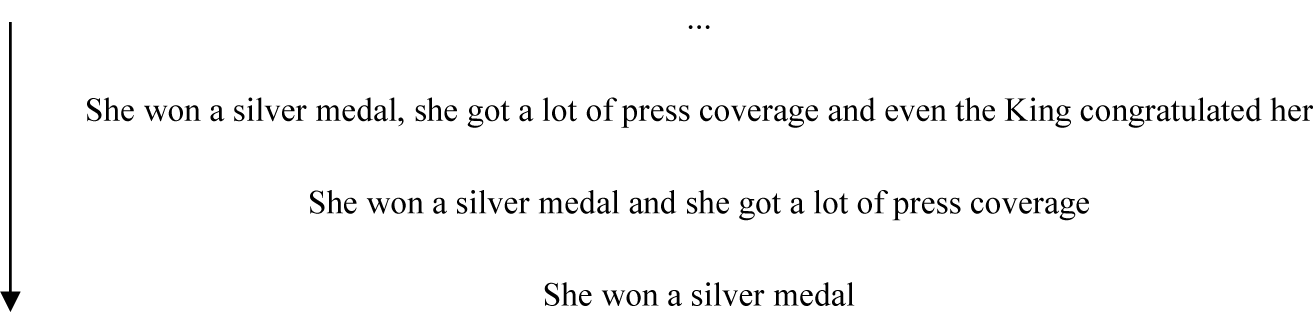
Figure 9 shows an additive contextual scale that fits (44).
An additive scale for At least she won a silver medal

The context can also highlight the restrictive component of the at least proposition.

Note that in one respect the silver medal (of (34a)) is different from the comfortable hotel (of (2)). Comfortable does not figure on any scale of hotel properties, independent of the speaker’s private appreciation. Comfortable is thus not scale-including, with e.g. cost or location inherently ranking higher.Footnote 14 The silver medal, on the right, immediately conjures up the higher golden medal.
As a final point, let me briefly discuss whether there are other attempts to find a common core for the three children and the comfortable hotel / silver medal cases. Most of the researchers are not concerned about this: they do not discuss whether their evaluative and non-evaluative uses have a common core. Kay might have been expected to look for a common core, for he considers both to be scalar, in some sense, but he does not engage in showing this.Footnote 15 Gast (Reference Gast, Gil, Harlow and Tsoulas2013) does. He argues that the non-maximality feature is present in the non-evaluative uses, but in a way that is different from what he describes for the evaluative ones. For the latter, non-maximality means that it is presupposed that not all alternative propositions are true (Gast Reference Gast, Gil, Harlow and Tsoulas2013: 112). For the non-evaluative use, non-maximality means that there is an implicature that there is no evidence that the higher alternatives are true. For Biezma (Reference Biezma2013: 18) and Chen (Reference Chen2018: 50, Reference Chen2024: 384–5), finally, the common core concerns the presence of a scale, the (main) difference residing in the question whether or not the higher values are possible – in the non-evaluative use – or false – in the evaluative use. I agree on the first point, but I disagree on the second point. To repeat, it is positive that the hotel is comfortable, but the hotel may have other positive features. It is positive to win a silver medal, but there can be good things about a competition other than winning this medal. So the higher value propositions for the evaluative uses need not be false.
6. ‘Rhetorical’ at least
I now come to the ‘rhetorical’ or ‘illocutionary’ reading or family of readings, the ones illustrated in (3) to (5), repeated in table 3. Only Kay (Reference Kay, Lehrer and Kittay1992) and Gast (Reference Gast, Gil, Harlow and Tsoulas2013) analyse this type. They both distinguish three subtypes. Table 3 sketches their classification and terminology.Footnote 16 For the subtypes Gast (Reference Gast, Gil, Harlow and Tsoulas2013) supplies a label covering two subtypes, the label is ‘epistemic’, and for lack of a better term I call the remaining type ‘non-epistemic’.
Kay (Reference Kay, Lehrer and Kittay1992) and Gast (Reference Gast, Gil, Harlow and Tsoulas2013)

Note that Kay’s examples (and all the other ones discussed in the literature) show a post-clausal at least. More particularly still, it is not only at least that is post-clausal, the focus values are post-clausal too. For a short time, for instance, is just as external to the clause Mary will help me as the at least that precedes for a short time.
There are differences between Kay (Reference Kay, Lehrer and Kittay1992) and Gast (Reference Gast, Gil, Harlow and Tsoulas2013), but most importantly, Kay and Gast agree that the three ‘rhetorical’/ ‘illocutionary’ types mark what Kay (Reference Kay, Lehrer and Kittay1992: 324−6) calls a ‘rhetorical retreat’. I find Kay’s epithet ‘rhetorical’ appropriate, because the retreat concerns something that is not expressed literally. When the speaker asserts that Mary will help him/her and stops there, (s)he does not signal any conditions, and by not doing that, (s)he implicates conversationally that there are none or that they are not relevant. But then, after the proposition Mary will help me, (s)he adds a scalar restriction, viz. that the help will definitely last for a short time, possibly for longer, but possibly not. As claimed before, all uses of at least have a positive as well as a restrictive component. In the previous section I studied contexts for which the research literature focused on the highlighting of the positive component. Here we are dealing with a construction that highlights the restrictive component. The positive component is still present, of course – the help may last longer – but it is not highlighted. Figure 10 represents a sensible contextual scale.
A scale for Mary will help me, at least for a short time

The uses in (4) and (5) are similar. With Mary is at home the speaker conversationally implicates that (s)he is certain that Mary is home. But then this unspoken but implicated commitment is qualified and even restricted. The speaker’s implicated certainty is toned down to some level of uncertainty. In (4) the uncertainty relates to the fact that evidence of somebody’s car in the driveway is not very strong, and in (5) the speaker explicitly states that(s) he only thinks so. So on the essential idea, I fully agree with Kay’s and Gast’s analysis, but I integrate it in a simple way in the wider analysis of at least. At least has a core meaning with a restrictive component and the rhetorical retreat highlights the restrictive component.
I want to stress that the above account takes the at least in the restrictive context to have the same meaning as elsewhere, and a scalar one for that matter. Kay (Reference Kay, Lehrer and Kittay1992) does not deal with the question whether the uses in (3) to (5) are scalar. Twenty-two years later (Kay Reference Kay2004) he does, but unsatisfactorily. Kay (Reference Kay2004: 681) considers them scalar, but two pages further he writes that this family of uses ‘does not appear to be scalar in any straightforward way’, adding that ‘perhaps that observation reflects nothing more than our ignorance regarding’ these uses. Gast (Reference Gast, Gil, Harlow and Tsoulas2013) takes the uses in (3) to (5) to be scalar too, but he describes the peculiarity of these uses in a different way. First, he states that these uses do ‘not require a scale of positive evaluation’. This comes close to my account, but it is still different: in my view, rhetorical at least does require positive evaluation, but it is not highlighted, and what is highlighted here is the restrictive component. There is a second difference. For Gast (Reference Gast, Gil, Harlow and Tsoulas2013: 114) the uses in (3) to (5) have a non-maximality presupposition that not all alternative propositions are true. This is not convincing. Example (46a) is the alleged presupposition for (3), it should be impossible to deny it – for that is how Gast finds a presupposition, and (46b) shows that this is not the case. So (46a) is not a presupposition, and non-maximality, presupposed or not, is not necessary to show rhetorically restrictive at least to be scalar.

7. At least versus at the least and at the very least
Not much has been written about at the least and at the very least. Kay (Reference Kay, Lehrer and Kittay1992: 314) writes that at least and at the very least mean the same thing as at least ‘as far as I [Kay] can tell’. Gast (Reference Gast, Gil, Harlow and Tsoulas2013: 111) calls at least, at the least and at the very least ‘near equivalents’, and Geurts & Nouwen (Reference Geurts and Nouwen2007: 535) take at least and at the least to be ‘semantically equivalent’. The latter also report a comment by a colleague to the effect that at the least ‘might be preferred’ to at least in the pre-clausal position. I checked this on a sample of 100 TenTen attestations and I included at the very least. The results are shown in table 4.
At least, at the least and at the very least in pre-clausal position

We indeed see that at the least is more frequent in pre-clausal position, but also that at the very least ‘prefers’ the pre-clausal position even more.
Nakanishi & Rullmann (Reference Nakanishi and Rullmann2009) as well as Chen (Reference Chen2018: 271−2, Reference Chen2024: 389−90), however, argue for a semantic difference between at least and at the very least – they do not discuss at the least. They claim that at the very least does not allow the use that they call ‘concessive’, i.e. the comfortable hotel case. This is not correct. But at the very least occurs with a frequency of 0.13/million in the TenTen corpus and (47) is just one example showing the contrast with but and it expresses the same kind of contrastive positive judgment that we see in the but examples discussed in the literature.

The only other claim on the difference between at least, at the least and at the very last that I am aware of is found in König et al. (Reference König, Stark and Requardt1990: 247): they claim that at the very least is more emphatic.
I agree on the synonymy claims on at least and at the least. I also agree that at the very least is emphatic, but it is somewhat puzzling, for the use of very in front of a superlative seems redundant.

If the speaker of (48) is already the tallest dwarf, what could very add? And (48) is not the only attestation of very tallest – there are 115 other TenTen attestations.
I propose to consider very tallest as ‘doubly superlative’: it identifies the ‘most tallest dwarf’ out of group of tallest dwarfs. Thus there is a double comparison: some dwarfs are the tallest ones, in comparison with other dwarfs, and within that group, one dwarf is again the tallest one, in comparison with the other tallest dwarfs. We can draw inspiration from this to analyse at the very least as compared to at least. With at the very least one envisages not just one at least partition, but more than one, but within that set, one expresses the most restrictive partition. With at the very least three there is an at least three focus partition and the partitions with the higher numbers are alternative partitions. There has to be at least one higher alternative partition. Just like with the ‘normal’ scales, the higher alternatives entail the lower ones. See figure 11.
A scale for Mary has at the very least three children

Thus when Mary has at the very least three children, the speaker evokes a contrast with the possibility that the lowest guaranteed number of children is higher than three. This is shown in (49), in which the use of a ‘repair disjunction’Footnote 17 is fine when at the very least is contrasted with a higher partition, but not with a lower one.

At the very least means what at least means, but it involves an additional scalar comparison.
Possibly related to this semantic distinction is the fact that or at the very least, inviting an analysis as a repair construction, as in (49a) and (50), is rather common for at the very least, and much more so than for at least and at the least; see table 5 (TenTen 100 hits sample).

The corrective or at (the (very)) least construction

The three constructions differ in many other ways. Table 4 showed that at the very least is more frequent in the pre-clausal position, with at the least taking up a mid position. This may be related to the fact that at the very least is very infrequent with numeral foci; see table 6 (TenTen 100 hits sample).
Numerical with at least, at the least and at the very least

All three constructions prefer to focus from the left, but at the least seems the most tolerant for focusing form the right, as in (51); see table 7 (TenTen 100 hits sample).

Focusing from the right

Interestingly, though at the very least is more restrictive than at least and the rhetorical uses profile the restrictive side of at least and its alternatives, at the very least is the least preferred strategy there; see table 8 (TenTen 100 hits sample). For the epistemic subtypes the difference in the numbers is small, but for the non-epistemic ones the difference is substantial. Perhaps the afterthought character of the rhetorical uses is less compatible with the emphatic nature of at the very least.
At least, at the least and at the very least

I should be clear that the observations registered in tables 6 to 8 count as invitations for further research.
8. Conclusion
The major goal of this article was to plead for a uniform analysis of at least. I proposed that all uses have a common semantic core, a Gesamtbedeutung. This core meaning has a scalar, a positive and a restrictive component and the latter two components can be highlighted by the context. Uses called ‘evaluative’, ‘propositional’ or ‘concessive’ were analysed in terms of the highlighting of the positive component. Uses called ‘rhetorical’ or ‘illocutionary’ were analysed in terms of the highlighting of the restrictive component. For at the very least the contribution of very is seen as a reference to a second scale, which highlights restriction. These proposals are compared with other contemporary analyses.
A secondary goal of the article was to draw attention to alternatives for at least. Thus I embarked on the investigation at the least and at the very least. For both I argued that they share the core meaning proposed for at least. I also stressed that besides at the least and at the very least there are many more alternatives, viz. other ‘superlative’ elements with least, like leastwise, or without least, like at minimum, or ‘comparative’ ones like if not more, combinations of superlative and comparative elements, like at least … if not more, or constructions that are neither superlative nor comparative, like even if only. Some work has been done on these constructions, but they deserve more work.
An interesting issue for the research agenda is the diachrony of at least and related constructions (see Lewis Reference Lewis2000: 154–86, Reference Lewis2002; Gast Reference Gast, Gil, Harlow and Tsoulas2013: 116 for at least). Another issue for future research is the cross-linguistic study of the counterparts of at least-like constructions. A start has been made by Nakanishi & Rullmann (Reference Nakanishi and Rullmann2009) and Rullmann & Nakanishi (Reference Rullmann and Nakanishi2009), Grosz (Reference Gast and van der Auwera2011: 347–61), Gast (Reference Gast, Gil, Harlow and Tsoulas2013), Butschety (Reference Butschety2017), Chen (Reference Chen2018: 29–32, 2024), Kolyseva (Reference Kolyseva2022), and van der Auwera & Pappuswamy (Reference van der Auwera and Pappuswamy2024), and we should not forget that the primum movens was work on French (Ducrot Reference Ducrot1980; Anscombre & Ducrot Reference Anscombre and Ducrot1983).
Acknowledgements
Thanks are due to the anonymous reviewers as well as to Daniel Van Olmen (Lancaster University) and Tom Bossuyt (Ghent University).















 Open access

