


There is a much greater awareness now of the importance of Se to human health than there was even 10 years ago. This is partly due to the publication of the landmark trial of Clark et al. (Reference Clark, Combs and Turnbull1) that appeared to show that Se could reduce the risk of cancer. As a result, there is now much more aggressive marketing of Se supplements and functional foods, even in situations where additional consumption of Se is inappropriate.
Both individuals, who take a measure of responsibility for their own health and that of their families, and more importantly, advisory bodies, need to be aware of the complexities surrounding the issue of optimal Se intake in order to make informed judgments. The subject is often treated too simplistically. The present review attempts to air the issues that need to be considered.
Perhaps primarily, individuals need to be aware of the baseline intake in their country or region and whether that intake is adequate or not. There are currently too few data on which to base this judgment, hence companies are able to market Se supplements or functional foods to populations that may already have a perfectly adequate intake of Se. Even in relatively low Se areas, some individuals may consume foods of good Se content (for example, fish) or containing more potent Se species (for example, from garlic, onions or broccoli) that may give them a higher or more effective intake than might be predicted. An appropriate intake for an individual who is a cigarette smoker or has a family history of prostate cancer may well not be the same as for an individual with a family history of squamous cell carcinoma or diabetes. Individuals may eventually learn whether they have a compromised ability to make selenoproteins, in which case they may need to increase their intake of Se-rich foods.
On the other hand, some evidence is now emerging that links the risk of more subtle adverse health effects to levels of intake well below those known to be toxic. There may even be a possibility of increased risk of one condition even where risk of another is reduced.
An understanding of these niceties requires a certain background knowledge such as: how Se gets into the food chain; the variability of Se content of foods and how that content is affected by food preparation or cooking; how intake varies according to country or region of country; health effects in relation to level of intake and the factors modifying those effects. These issues are addressed below, following which the potential solutions for increasing Se intake, if required, are discussed. Lastly, the difficulties of balancing the risks and benefits in relation to Se intake are highlighted.
How selenium gets into the food chain
Se enters the food chain through plants; intake through drinking water is generally trivial(Reference Reilly2). The amount of Se in foods depends on a number of geological, geographical and other factors. While the Se concentration of the soil is primarily controlled by the underlying geology (carbonatic v. silicatic), the bioavailability of that Se to plants is dependent on pH, redox conditions, amounts of organic matter in the soil, competing ionic species such as sulfate, microbial activity, soil texture, compaction and mineralogy, soil temperature, level of rainfall during the growing season, irrigation and by pedoclimatic variables (temperature and rain intensity excursions) related to fluctuations of soil moisture and pH(Reference Diplock3–Reference Zhao, Lopez-Bellido, Gray, Whalley, Clark and McGrath10). The uptake of Se by the plant can be greatly inhibited by the simultaneous occurrence of a high soil content of organic matter, Fe hydroxides and clay minerals, all of which can adsorb or bind Se(Reference Fordyce, Guangdi, Green and Xinping4). Se speciation in soils also affects Se bioavailability: selenate is more mobile, soluble and less-well adsorbed than selenite(Reference Fordyce, Selinus, Alloway, Centeno, Finkelman, Fuge, Lindh and Smedley8). Thus oxidising, alkaline conditions that favour the formation of selenate improve Se bioavailability, while reducing acid conditions that favour the formation of selenite lower bioavailability. According to Fordyce(Reference Fordyce, Selinus, Alloway, Centeno, Finkelman, Fuge, Lindh and Smedley8), it is important to understand that even soils that contain adequate or high total Se concentrations can result in Se-deficient crops if the element is not in a form amenable to plant uptake. This is well illustrated by data from the Keshan disease area of Hebei Province, China, that showed a high soil Se content but very low Se bioavailability owing to high organic matter content and lower pH than other soils in the region(Reference Fordyce, Selinus, Alloway, Centeno, Finkelman, Fuge, Lindh and Smedley8).
A further important factor is that flowering plant species (angiosperms) differ in their ability to assimilate and accumulate Se. They can be divided into three groups: non-accumulators, Se-indicators (or secondary Se-accumulators) and Se-accumulators(Reference Broadley, White and Bryson11). It appears that the transporters that are responsible for the uptake or translocation of Se are selective such that the ratio of Se:S in the shoots can be higher or lower than that of the solution surrounding the roots(Reference Broadley, White and Bryson11). While non-accumulators rarely accumulate more than 100 μg Se/g dry weight, Se-accumulators can contain up to 40 000 μg Se/g dry weight when grown in Se-rich environments(Reference Broadley, White and Bryson11). The only Se-accumulator plant regularly used as a food source is the tree Bertholletia excelsa which produces Brazil nuts, but some crop species of commercial importance can be described as secondary Se-accumulators, for example, Brassica species (rapeseed, broccoli, cabbage) and Allium species (garlic, onions, leeks and wild leeks)(Reference Broadley, White and Bryson11, Reference Terry, Zayed, De Souza and Tarun12). Cereal crops such as wheat, oats, rye and barley are non-accumulators(Reference Fordyce, Selinus, Alloway, Centeno, Finkelman, Fuge, Lindh and Smedley8).
The distribution of Se in various parts of the plant depends on species, phase of development and physiological condition(Reference Terry, Zayed, De Souza and Tarun12). In Se-accumulators, Se accumulates in young leaves during the early vegetative stage of growth but during the reproductive stage it is found at much higher levels in seeds. In non-accumulator cereal crops, there is often about the same amount in grain and roots with smaller amounts in stems and leaves(Reference Terry, Zayed, De Souza and Tarun12).
Selenium content of foods is very variable
Se concentration in natural food sources has been tabulated by Rayman et al. (Reference Rayman, Goenaga Infante and Sargent13) According to a WHO report(14), the typical Se content of foods varies as follows: organ meats and seafood, 0·4 to 1·5 μg/g; muscle meats, 0·1 to 0·4 μg/g; most agricultural crops, < 1 μg/g dry weight, for example, cereals and grains, less than 0·1 to greater than 0·8 μg/g; dairy products, less than 0·1 to 0·3 μg/g; fruits and vegetables, less than 0·1 μg/g. The variation may be even greater than the above figures imply: for instance in the UK where national sampling of wheat grain has been undertaken over a 16-year period, consistent, extremely low, mean values of 0·025–0·033 ng/g dry weight have been found(Reference Adams, Lombi, Zhao and McGrath6). Even when grown on seleniferous soils, most vegetables contain a maximum of 6 μg/g and the level in both fruits and vegetables is more likely to be < 0·01 μg/g(Reference Whanger and Cheeke15, Reference Barceloux16).
The variation in Se content of (fresh weight) foods purchased in the upper Midwest of the USA was 72-fold (11–774 μg Se/100 g) for wheat flakes, 57-fold (14–803 μg Se/100 g) for wheat, and 11-fold (19–217 μg Se/100 g) for beef(Reference Keck and Finley17) while two brands of the same maize product purchased at the same time from the same store in North America had a 10-fold difference in Se concentration(Reference Finley, Matthys, Shuler and Korynta18). The same foods purchased in different countries may have very different Se content, for example, an average of 57 μg Se/100 g (dry weight) in pasta products made in the USA compared with only 6 μg Se/100 g in Italian pasta(Reference Keck and Finley17). Some idea of the Se content of foods purchased in Europe may be obtained by inspecting the values found by Barclay et al. (Reference Barclay, MacPherson and Dixon19) who measured the Se content of a range of about 100 foods purchased in the UK between 1993 and 1994. Reilly(Reference Reilly2) has tabulated Se levels in twelve common foods from a number of countries about the world giving a good illustration of the variability that exists. He also addresses in more detail the Se content of a number of individual foodstuffs: milk, bread and cereals, meat, fish, fruit, vegetables, and Brazil and other nuts.
Brazil nuts are the richest source of food Se, but the content is very variable, ranging from 0·03 to 512 μg/g fresh weight in the studies quoted in the companion paper by Rayman et al. (Reference Rayman, Goenaga Infante and Sargent13) Brazil nuts are harvested from an enormous area of the Amazon basin but soil levels vary from high, in the Menaus to Belem region of the lower Amazon, to low, in the Acre-Rondonia region on the upper Amazon, resulting in high variability in Se content(Reference Reilly2). Three studies have reported a higher Se content in unshelled than shelled nuts though the reason is not known(Reference Lisk, Bache, Essick, Reid, Rutzke and Crown20–Reference Kannamkumarath, Wrobel, Wrobel, Vonderheide and Caruso22). Two of these studies have drawn attention to the fact that Brazil nuts are exceedingly high in barium, containing levels up to 4000 μg barium/g. Lisk et al. (Reference Lisk, Bache, Essick, Reid, Rutzke and Crown20) found that a serving of three Brazil nuts (flesh weight 13·2 g), containing 290 μg Se, also provided 26 mg barium. Barium can be toxic, causing gastroenteritis, muscular paralysis, K deficiency, decreased pulse rate, ventricular fibrillation and extra systoles, and 90 % of the barium ingested in that study was retained in the body. The US Environmental Protection Agency's oral reference dose for barium based on toxicological data is 0·2 mg/kg per d, which for a 75 kg individual would be 15 mg/d(23). It is clear that this could readily be exceeded by a modest serving of Brazil nuts. Furthermore, Brazil nuts contain small amounts of radium, a radioactive material. Although the amount is very small, typically about 70 (range 3–240) Bq/kg, and most of it is not retained by the body, this is 1000 times higher than in other foods(24). Individuals relying on Brazil nuts as their Se source, of whom there are a not-inconsiderable number, in the UK at least, should be aware both of the uncertainty surrounding the quantity of Se they may be consuming and of the fact that they may be inadvertently consuming barium in amounts exceeding the oral reference dose and radium.
Effect of preparation and cooking on food selenium
According to Fordyce(Reference Fordyce, Selinus, Alloway, Centeno, Finkelman, Fuge, Lindh and Smedley8), cooking reduces the Se content of most foods, and studies have shown that vegetables that are normally high in Se such as asparagus and mushrooms can lose 40 % during boiling owing to leaching with water. Other studies have estimated that 50 % of the Se content is lost from vegetables and dairy products during cooking especially if salt and low-pH components such as vinegar are added, whereas frying foods results in much smaller Se losses(Reference Fordyce, Selinus, Alloway, Centeno, Finkelman, Fuge, Lindh and Smedley8, 14, 25). For Se-enriched Allium and Brassica plants such as garlic and cabbage, recent studies have estimated that 85 and 89 %, respectively, of the total Se is leached into boiling water (H Goenaga Infante, personal communication, 2006). The distribution, concentration and speciation of Se in different edible parts of a plant may well be different: for example, the total Se concentration in the skin of Se-enriched potatoes was found to be almost three times higher than that of the flesh though the highest percentage of Se as selenomethionine (73 % of the total Se) was found in the flesh (H Goenaga Infante, personal communication, 2006). Thus mode of preparation of food must be taken into account when estimating magnitude or nature of Se intake.
Variability in selenium intake by country and region
Intake of Se varies considerably between countries and regions of countries largely owing to the variability of the Se content of plant foods (and hence of animal forage) from one part of the world to another. Se intake data are summarised in Table 1(Reference Rayman7, Reference Combs26–Reference Combs and Combs60). Though the level of reliability of such intake data is somewhat variable, it is clear that there is an immense range of intakes, from toxic (approximately- = 5 mg/d) in parts of China affected by selenosis (areas of Enshi County, Hubei Province and Ziyang County, Shaanxi Province), through high (Venezuela, parts of North America (North and South Dakota, Montana and Wyoming); approximately = 200–724 μg/d) to high–adequate (rest of North America, Japan; approximately = 100–200 μg/d) to adequate–marginally adequate (Australia, Europe, New Zealand; approximately = 30–90 μg/d) to low or deficient (Eastern European countries, parts of China; approxi-mately = 7–30 μg/d) as judged against current recommendations (tabulated by Rayman(Reference Rayman7)). Though plants are the primary source of Se in the diet, animals may be a more reliable source at least for omnivores, as, unlike plants, they have an absolute requirement for Se which they must get through feed or forage (though it must be remembered that animals, like humans, can be Se deficient)(59). In the UK, for instance, where forage is very low in Se, animal feed is generally supplemented with Se, thereby modestly increasing the Se content of meat and milk. Thus in the UK, meat and poultry make a more important contribution than bread and cereals to dietary Se intake(Reference Rayman and Callahan61). Se is found in highest amounts in organ meats such as kidney and liver while some seafoods contain nearly as much.
Selenium intake data for a number of countries

Human Se status is dependent not only on the Se content of locally grown foods but also on the extent of use of imported foods. During the 1950s, UK wheat constituted only 15 % of the grist(Reference Broadley, White and Bryson11), while wheat imported from Canada, which was much higher in Se content, made a much larger contribution. This situation persisted up to the mid-1980s, but by 2005 the percentage of UK wheat in grists had risen to 80 %(Reference Broadley, White and Bryson11). Se intake and status in the UK has fallen in parallel with the decline in imports(Reference Rayman62) though increased use of sulfur fertilisers (competition of chemically similar species), breeding for higher grain yield per plant, lower atmospheric deposition of Se from coal combustion and the reported decline in cereal consumption are other important factors(Reference Adams, Lombi, Zhao and McGrath6, Reference Broadley, White and Bryson11, 58). The opposite situation has been seen in New Zealand where Australian wheat with a higher Se content has recently made a significant contribution to Se intake, thereby improving Se status(Reference Thomson63).
Health effects of selenium in relation to level of intake
Intake of Se ranges from clearly deficient to toxic. At intermediate levels of intake, more subtle health effects have been reported. The situations of deficiency and toxicity are relatively straightforward to describe and will be summarised first. The question of optimal intake for health is much more difficult to address as it requires consideration of the interplay between a large number of factors.
Deficient intake
Overt Se deficiency is associated with Keshan disease, a cardiomyopathy affecting mainly children and women of child-bearing age, frequently fatal, named after the province in the extreme north-east of China where it was endemic(Reference Cheng and Qian64). Affected areas had soils that were subject to a strong leaching effect and a high proportion of subsistence farmers who were very dependent on their local food supply(Reference Fordyce, Selinus, Alloway, Centeno, Finkelman, Fuge, Lindh and Smedley8, Reference Li65). The disease occurred in areas where grain crops contained < 0·04 μg Se/g and total daily Se intake was between 10 and 15 μg Se/d. Based on epidemiological studies in Keshan disease areas, Chinese workers have suggested a deficiency threshold of 0·02 μg/g in cereal crops for human consumption(Reference Fordyce, Selinus, Alloway, Centeno, Finkelman, Fuge, Lindh and Smedley8). Large-scale Se supplementation (0·5–1 mg sodium selenite/week) between 1974 and 1977 dramatically reduced disease incidence(Reference Fordyce, Selinus, Alloway, Centeno, Finkelman, Fuge, Lindh and Smedley8). Though the disease was Se-responsive, it is now thought likely that it also had a viral cofactor which in the presence of Se deficiency in the Keshan disease area mutated to a more virulent form that caused the heart condition, as has been shown in the case of Se-deficient mice infected with Coxsackie virus(Reference Levander and Beck66). Coxsackie virus has been isolated from archived heart tissue from patients with Keshan disease(Reference Su, Gong, Li, Chen, Zhou and Jin67).
Though Kashin–Beck disease, an osteoarthropathy found in rural areas of China, Tibet and Siberia, has also been associated with severe Se deficiency, other factors, notably low iodine status, or the presence of fulvic acids or mycotoxins in foods appear likely to be more important(Reference Moreno-Reynes, Suetens, Mathieu, Begaux, Zhu, Rivera, Boelaert, Nève, Perlmutter and Vanderpas68, Reference Coppinger, Diamond and Hatfield69). More recent data from Tibet appear to support the hypothesis that Kashin–Beck disease occurs as a consequence of oxidative damage to cartilage and bone cells when associated with decreased antioxidant defence, though inhibition of bone remodelling by certain mycotoxins has also been suggested as a potential mechanism(Reference Suetens, Moreno-Reyes, Chasseur, Mathieu, Begaux, Haubruge, Durand, Neve and Vanderpas70).
While levels of Se deficiency of this magnitude are not normally seen in the West, a number of cases of cardiomyopathy, some of which have been shown to be Se-responsive, have been reported in subjects on intravenous nutrition receiving inadequate Se in their infusion solutions(Reference Huttunen71, Reference Cooper, Rader and Ralston72).
Excessive intake
Overt Se toxicity in humans is far less widespread than Se deficiency(Reference Fordyce, Selinus, Alloway, Centeno, Finkelman, Fuge, Lindh and Smedley8). Se toxicity has been studied in animals and observed in humans where signs of selenosis are hair loss, brittle, thickened and stratified nails, garlic breath and skin(Reference Whanger, Vendeland, Park and Xia73). Chronic exposure to high levels of Se has been observed in several populations in seleniferous areas of the world, such as the northern great plains of the USA, parts of Venezuela and Colombia, and one county in China (Enshi, Hubei Province) where the average daily intake of 4·9 mg was associated with a blood Se concentration of 3200 μg/l and symptoms of selenosis. In Enshi, selenosis was associated with the consumption of high-Se crops grown on soils derived from coal containing, on average, greater than 300 μg Se/g (one sample exceeded 80 000 μg/g)(Reference Yang, Wang, Zhou and Sun74). Se from the coal entered the soil by weathering and was available for uptake by crops because of the traditional use of lime as fertiliser in that region. Furthermore, food was cooked and maize was dried over the open flame of this burning coal which also contaminated the atmosphere inside the houses. Morbidity rates reached 50 % during peak prevalence years (1961–4) in the worst affected villages which were all located in remote areas among populations of subsistence farmers(Reference Fordyce, Selinus, Alloway, Centeno, Finkelman, Fuge, Lindh and Smedley8). The particular outbreak of human selenosis was due to a drought that caused failure of the rice crop, forcing the villagers to eat more high-Se vegetables and maize and fewer protein-rich foods(Reference Yang, Wang, Zhou and Sun74).
Though some plants that grow on seleniferous soils – the Se-accumulators – can take up extremely large amounts of Se ranging from 1000 to 100 000 μg/g (air-dried), farm crops rarely accumulate levels greater than 25–30 μg/g, even in seleniferous areas(Reference Whanger and Cheeke15, Reference Barceloux16). Based on epidemiological studies in areas affected by selenosis, Chinese workers have suggested a toxicity threshold of 1 μg/g in cereal crops for human consumption(Reference Fordyce, Selinus, Alloway, Centeno, Finkelman, Fuge, Lindh and Smedley8). From published data, no health or toxicity problems have been observed up to levels of intake of 819 μg Se/d in China(Reference Yang and Zhou75, Reference Longnecker, Taylor and Levander76) or 724 μg Se/d in the USA(Reference Longnecker, Taylor and Levander76). If from cereal or rice, such intake is largely in the form of selenomethionine and selenate(Reference Whanger77). By contrast, the high daily intake of Se in the Inuit of North Greenland (estimated as 193–5885 μg/d), where the diet consists largely of meat and organs from marine mammals, seabirds, fish, and the whales' skin delicacy, muktuk(Reference Hansen and Sloth Pederson78), may include a more substantial amount of selenocysteine from selenoproteins. Apart from the noted longitudinal striation on the nails, no clinical signs of selenosis have been reported in this population, notwithstanding the extremely high Se intake and blood concentrations well above 1000 μg/l(Reference Reilly2): it would appear that Se supplied through a marine diet can be tolerated at levels much higher than normally considered safe. Similarly, despite the Se contamination of the Kesterson National Wildlife Refuge in California and levels of 96 μg/g (wet weight) in fish, up to 130 μg/g (dry weight) in the liver of aquatic birds and up to 5·3 μg/g (wet weight) in the flesh of waterfowl, no adverse health effects were seen in the local population or in domestic animals(Reference Fan, Book, Neutra and Epstein79).
Based on the classic studies of Yang et al. in China, the ‘low observed adverse effects level’ was established as 1540 μg/d(Reference Yang, Yin, Zhou, Gu, Yan, Liu and Liu80) and the ‘no observed adverse effects level’ (NOAEL) as 819 μg/d(Reference Yang and Zhou75). It should be noted, however, that these values apply only to total Se and may be inaccurate for any specific form. Applying a safety factor to the NOAEL has allowed expert groups in a number of countries to define an upper level of total Se intake believed to be safe. Thus for adults, the ‘tolerable upper intake level’ for the USA and Canada is 400 μg/d, based on a NOAEL of 800 μg/d(59). This same value has been adopted by the WHO(25) and is to be adopted by Australia and New Zealand. The ‘safe upper limit’ in the UK is set at 450 μg/d for adults(81).
Remarkably, in Enshi, China, as described above, Keshan disease and selenosis occur within 20 km of one another; their incidence is dependent on the very different geologies of the two relatively isolated areas(Reference Fordyce, Selinus, Alloway, Centeno, Finkelman, Fuge, Lindh and Smedley8).
Optimal intake
Despite food supplies coming from diverse sources, at least in developed countries, there is evidence that in some population groups that Se intake, while not deficient, may be sub-optimal for protection against a number of adverse health conditions. Table 2(Reference Akbaraly, Arnaud, Hininger-Favier, Gourlet, Roussel and Berr82–Reference Flores-Mateo, Navas-Acien, Pastor-Barriuso and Guallar123) summarises published studies that showed evidence of an Se-associated health benefit. For each health condition or health effect included in this Table, there is more than one strand of published evidence for a beneficial effect of Se. Where trials are included, they are blinded or double-blinded, randomised and placebo-controlled. Use of data from these studies allows an attempt to be made to estimate optimal intake in relation to specific health benefits.
Summary of evidence-based health effects of selenium together with an indication of the likely dose-level required blinded, randomised, placebo-controlled trials (RCT), except where specified as double blind)
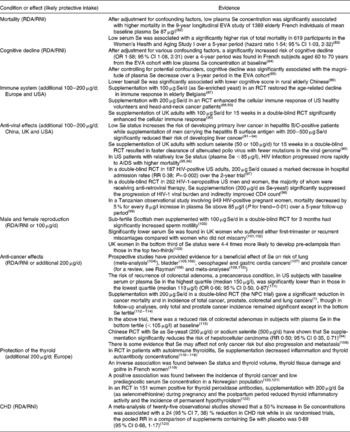
RNI, reference nutrient intake; EVA, Etude du Vieillissement Artériel; RR, relative risk; NPC, Nutritional Prevention of Cancer.
Ascertaining the optimal intake of Se is not a trivial matter since it is dependent on a number of factors. These include consideration of the mechanism by which Se is thought to act in any particular situation, the species of Se ingested, which type of disease (or which type of cancer) is being considered, the overall nutritional adequacy of the group or population, the extent to which genomic differences between individuals or populations may be relevant, and what other risk or lifestyle factors may be present within the population under consideration. These factors will be considered separately below.
Which function of selenium is being considered?
In the case of the many disease conditions associated with oxidative stress (for example, asthma, rheumatoid arthritis, pancreatitis, CHD), it would seem important to have an intake of Se that would at least allow full expression of selenoproteins with an antioxidant function. Current recommendations for intake of dietary Se (mean 57 (range 30–85) μg/d)(Reference Rayman7), hereinafter referred to as the RDA/reference nutrient intake (RDA/RNI), have been set with this objective in mind though we now know that some recommended intakes would be insufficient for the expression of selenoprotein-P, a selenoprotein that appears to have a special role in scavenging peroxynitrite(Reference Arteel, Briviba and Sies124, Reference Xia, Hill, Byrne, Xu and Burk125).
Furthermore, selenoprotein-P is required for the transport of Se to a number of tissues after its synthesis in the liver(Reference Burk, Hill, Motley, Austin and Norsworthy126) and mouse knock-out studies show its absolute requirement by the brain to avoid neurological dysfunction and brainstem axonal degeneration(Reference Hill, Zhou, McMahan, Motley and Burk127, Reference Valentine, Hill, Austin, Valentine, Goldowitz and Burk128). It would seem, therefore, that Se intake needs to be sufficient to optimise the concentration of plasma selenoprotein-P. Though we do not yet know what level of intake that would require, we do know that current intakes in some parts of Europe, specifically Eastern Europe, and parts of China are inadequate for full expression of glutathione peroxidase (GPx) let alone for full expression of selenoprotein-P(Reference Xia, Hill, Byrne, Xu and Burk125).
Apart from the selenoproteins, small-molecular-weight Se compounds such as Se-methyl selenocysteine and γ-glutamyl-Se-methyl selenocysteine are thought to be precursors of the potent anti-cancer agent methyl selenol(Reference Dong, Lisk, Block and Ip129) which is purported to cause apoptosis, cell-cycle arrest, inhibition of tumour cell invasion and angiogenesis(Reference Ip130, Reference Zeng and Combs131). Though small amounts of these compounds are found in members of the Allium and Brassica families, production of adequate amounts for cancer prevention by metabolism of Se compounds more commonly found in foods probably requires a considerably larger intake, perhaps up to 290 μg Se/d, as was the case in Nutritional Prevention of Cancer (NPC) trial subjects(Reference Clark, Combs and Turnbull1).
Nature of selenium species in food or supplements consumed
The predominant species of Se in the food (or supplement) consumed will affect the level of intake considered to be optimal, as it will affect bioavailability (absorption and retention), usefulness for synthesis of selenoproteins and ability to produce methyl selenol metabolites. For instance, Se from high-Se broccoli (mainly Se-methyl-selenocysteine, a precursor of methyl selenol) does not accumulate in tissues or increase GPx enzyme activity to the same extent as selenite or selenoamino acids(Reference Finley132). Selenite, on the other hand, can be effectively used for selenoprotein synthesis, but it cannot be stored in the body for later use. Selenomethionine (for example, from cereals or high-Se yeast) can act as a storage form of Se in body proteins from which it can slowly be released by catabolism to maintain Se requirements over a longer period. Burk's group has shown(Reference Xia, Hill, Byrne, Xu and Burk125) that when Se was supplemented to Chinese subjects in the form of selenomethionine, maximum enzyme activity was reached with a supplement dose of 37 μg/d (on top of a background intake of 10 μg Se/d). When the supplement was selenite, a daily dose of 66 μg was required to reach the same maximum level. Thus, Se in the form of selenomethionine was almost twice as effective as Se in the form of selenite in supporting plasma GPx activity. These issues are addressed in depth in the companion paper by Rayman et al. (Reference Rayman, Goenaga Infante and Sargent13)
Which health condition is being considered?
Mortality
As mortality reflects vulnerability to a number of diseases combined, it is worthy of consideration despite the fact that there have been very few studies on plasma Se and mortality in elderly populations. Furthermore, such studies are particularly prone to confounding, as plasma Se concentrations are known to be higher in fit and well-nourished elderly individuals and lower in those who are frail, poorly nourished and unwell(Reference Bates, Thane, Prentice and Delves133), possibly reflecting a higher level of inflammatory cytokines and lowering of Se in the acute-phase response(Reference Hesse-Bahr, Dreher and Kohrle134). Such a criticism cannot be levelled at randomised controlled trials: in a meta-analysis of randomised controlled trials, Bjelakovic et al. (Reference Bjelakovic, Nikolova, Gluud, Simonetti and Gluud135) found that Se supplementation tended to reduce mortality.
Serum Se was measured at baseline in 619 participants in the Women's Health and Aging Study I (Baltimore, Maryland, 1992–8) and all-cause mortality was determined over a 5-year period. Those with the lowest Se status had a significantly higher risk of total mortality (hazard ratio 1·54, 95 % CI 1·03, 2·32)(Reference Walston, Xue, Semba, Ferrucci, Cappola, Ricks, Guralnik and Fried83). Results suggested that the beneficial effect of Se on mortality was linked to a reduction in levels of the inflammatory cytokine, IL-6.
In the 9-year longitudinal Etude du Vieillissement Artériel (EVA) study of 1389 elderly French individuals living independently where various potential confounding factors (sociodemographic characteristics, dietary habits, health, and cognitive factors) were controlled for, low plasma Se concentrations were associated with higher mortality, i.e. for a reduction of 16 μg/l in plasma Se, the relative risk of death was 1·54 (95 % CI 1·25, 1·88)(Reference Akbaraly, Arnaud, Hininger-Favier, Gourlet, Roussel and Berr82). With a mean plasma Se concentration in the EVA study population of 87 μg/l, a considerable proportion of the participants may not have had a sufficient Se intake for optimal expression of selenoproteins(Reference Thomson63) including that of selenoprotein-R (methionine sulfoxide reductase), a selenoprotein that has been linked to lifespan(Reference Papp, Lu, Holmgren and Khanna136). This study therefore suggests that the RDA/RNI level of intake may benefit longevity.
Cognitive function
There can be no doubt that Se is important to the brain(Reference Rayman137): (i) animal models of neurodegenerative disease show enhanced cell loss in Se depletion; (ii) genetic inactivation of cellular GPx increases the sensitivity towards neurotoxins and brain ischaemia while increased GPx activity as a result of increased Se supply or overexpression ameliorates the outcome; (iii) genetic inactivation of selenoprotein-P leads to a marked reduction in brain Se content with a corresponding movement disorder and spontaneous seizures in animal models(Reference Schweizer, Bräuer, Köhrle, Nitsch and Savaskan138).
Data from elderly French and Chinese populations of low–moderate Se status (mean baseline plasma Se 86·0 μg/l and mean toenail Se 0·21–0·61 μg/g, respectively) suggest that being at the top rather than the bottom of the low–moderate range of Se status is sufficient to reduce the risk of cognitive decline (see Table 2(Reference Berr, Balansard, Arnaud, Roussel and Alperovitch84–Reference Gao, Jin and Hall86)). This should be achieved by an RDA/RNI level of intake.
However, in the context of cognitive function in the elderly, it should be appreciated that low plasma Se may at least partly reflect a lower production of plasma GPx3 by a less efficient kidney(Reference Schiavon, Guidi, Biasioli, De Fanti and Targa139) or lower selenoprotein synthesis resulting from the action of inflammatory cytokines (in the acute-phase response)(Reference Hesse-Bahr, Dreher and Kohrle134). Failing kidneys also leak homocysteine, a known risk factor for dementia, into the bloodstream(Reference Ravaglia, Forti, Maioli, Muscari, Sacchetti, Arnone, Nativio, Talerico and Mariani140) while in the elderly, hyperhomocysteinaemia is also associated with a pro-inflammatory state(Reference Gori, Corsi, Fedi and Gazzini141). Whether toenail Se would reflect plasma Se in this context is unknown.
Immune function
The studies in Table 2 show that the cell-mediated immune response can be improved by an additional 100 or 200 μg Se/d even in healthy US volunteers whose baseline Se intake and status are already sufficient to optimise selenoenzyme activity(Reference Peretz, Neve, Desmedt, Duchateau, Dramaix and Famaey87–Reference Kiremidjian-Schumacher, Roy, Glickman, Schneider, Rothstein, Cooper, Hochster, Kim and Newman89). In line with these findings, UK researchers concluded that in the UK population, an additional 100 μg Se/d may be insufficient to support optimal function(Reference Broome, McArdle, Kyle, Andrews, Lowe, Hart, Arthur and Jackson90).
Antiviral effects and HIV
Though animal studies have shown that adequate Se for antioxidant GPx1 activity is important for the avoidance of viral mutation to more virulent forms(Reference Beck, Esworthy, Ho and Chu142), the success of supplementation studies with 100 or 200 μg Se/d suggests that this level of intake on top of basic diet may be necessary for antiviral effects in humans (Reference Broome, McArdle, Kyle, Andrews, Lowe, Hart, Arthur and Jackson90, Reference Yu, Zhu and Li91, Reference Li, Zhu, Yan, Zhang, Li, Ni, Shen, Yao and Zhu93, Reference Burbano, Miguez-Burbano, McCollister, Zhang, Rodriguez, Ruiz, Lecusay and Shor-Posner97, Reference Hurwitz, Klaus, Llabre, Gonzalez, Lawrence, Maher, Greeson, Baum, Shor-Posner, Skyler and Schneiderman98) (Table 2). It has been suggested that retroviruses such as HIV and Coxsackie B3 have the potential to deplete the host's Se supply by incorporating the Se into viral selenoproteins for their own protection, as has been demonstrated for the DNA virus, Molluscum contagiosum (Reference Zhao, Cox, Ruzicka, Bhat, Zhang and Taylor143–Reference Shisler, Senkevich, Berry and Moss145). Although unproven, this is a potential explanation for the requirement for a Se intake higher than the RDA/RNI.
Fertility and reproduction
The selenoproteins phospholipid GPx4 and sperm nuclei selenoprotein are required for sperm motility and sperm maturation, respectively(Reference Maiorino and Ursini146, Reference Pfeifer, Conrad, Roethlein, Kyriakopoulos, Brielmeier, Bornkamm and Behne147), while selenoprotein-P is required for Se supply to the testes(Reference Flohé148). The level of Se intake required to optimise the activities of these selenoproteins is probably somewhere within the range of currently recommended intakes (RDA/RNI), say between 55 and 75 μg/d, as both are high in the hierarchy of selenoprotein expression(Reference Behne, Kyriakopoulos, Kalcklösch, Weiss-Nowak, Pfeifer, Gessner and Hammel149, Reference Brigelius-Flohé150). It follows that the fertility of men whose Se intake is lower than that required to optimise selenoenzyme activity may be improved by supplementation as was demonstrated in sub-fertile Scottish men who showed a significant increase in sperm motility when supplemented with 100 μg Se/d for 3 months(Reference Scott and MacPherson100) (Table 2). There is, however, a suggestion that relatively high intakes (about 300 μg/d) may decrease sperm motility(Reference Hawkes and Turek151).
It seems likely that the risk of miscarriage and the pregnancy disease, pre-eclampsia, may also require an intake sufficient to give optimal selenoprotein expression. This can be concluded from studies in UK pregnant women where those with higher Se status had a significantly lower risk of first-trimester or recurrent miscarriage(Reference Barrington, Lindsay, James, Smith and Roberts101, Reference Barrington, Taylor, Smith and Bowen-Simpkins102) and of pre-eclampsia(Reference Rayman, Bode and Redman103) (see Table 2). As UK Se intake has been measured as 29–39 μg/d(58), it is clear that raising it to the RDA/RNI level of intake would be sufficient to optimise female reproductive success.
Cancer
Results of the numerous prospective studies and trials are summarised in Table 2. From prospective studies, the mean or median level of plasma Se required for a significant reduction in cancer risk ranges from >84 μg/l (for example, for oesophageal and gastric cardia cancer in China(Reference Wei, Abnet, Qiao, Dawsey, Dong, Sun, Fan, Gunter, Taylor and Mark107)) to 147 μg/l (for example, for prostate cancer in Hawaii(Reference Nomura, Lee, Stemmermann and Combs152)) according to the study, while from trial data, the minimum mean plasma Se for significant reduction in cancer risk in an Eastern US population in the NPC trial ranged from 105 μg/l (all cancers)(Reference Duffield-Lillico, Reid, Turnbull, Combs, Slate, Fischbach, Marshall and Clark112) to 123 μg/l (prostate cancer)(Reference Duffield-Lillico, Dalkin, Reid, Turnbull, Slate, Jacobs, Marshall and Clark113). The minimum Se intake required to achieve these plasma concentrations ranges from just below the RDA/RNI level to a total intake of about 140 μg/d from dietary Se (or Se-yeast, which is similarly absorbed and retained(Reference Levander, Alfthan, Arvilommi, Gref, Huttunen, Kataja, Koivistoinen and Pikkarainen153)). This assertion is based on results of a UK supplementation study in healthy volunteers with a baseline dietary intake of approximately 40 μg/d in which a further 100 μg Se/d as Se-enriched yeast raised plasma Se from 90·3 to 148·4 μg/l(Reference Rayman, Thompson, Warren-Perry, Galassini, Catterick, Hall, Lawrence and Bliss154).
The significant benefit of the Se treatment effect in the NPC trial was restricted to males and to those with baseline plasma Se ≤ 105·2 μg/l. In fact, there was a non-significant increased risk of cancer among those in the highest tertile (baseline plasma Se >121·6 μg/l) and a significantly increased risk of squamous cell carcinoma in NPC participants with baseline plasma Se in the top two tertiles(Reference Duffield-Lillico, Reid, Turnbull, Combs, Slate, Fischbach, Marshall and Clark112, Reference Duffield-Lillico, Slate and Reid155). In addition, further analysis of NPC trial data has shown an increased risk of self-reported type 2 diabetes in those supplemented with Se, though the effect was significant only in those in the top tertile of plasma Se at baseline(Reference Stranges, Marshall, Natarajan, Donahue, Trevisan, Combs, Cappuccio, Ceriello and Reid156). Though such secondary end-point analyses must be regarded with caution, the advisability of supplementing individuals of already-replete status (say 120–125 μg/l or more(Reference Burk, Norsworthy, Hill, Motley and Byrne157)) with Se must be questioned.
Certainly it should be apparent that in populations that already have a mean baseline intake at the level associated with reduced cancer risk, for example, the Prostate, Lung, Colorectal and Ovarian Cancer Trial population where mean plasma Se was 141·3 μg/l(Reference Peters, Foster, Chatterjee, Schatzkin, Reding, Andriole, Crawford, Sturup, Chanock and Hayes158), no significant benefit at higher intake or status should be expected, nor indeed was seen in that population. Such populations should not be exposed to additional dietary Se or supplementation.
To date, no cancer trial has used a level of dose that would give a total intake of 140 μg Se/d as suggested above, all having opted for 200 μg Se/d or more.
Thyroid effects
Since the selenoenzymes GPx and thioredoxin reductase are crucial to the protection of the thyroid from the H2O2 that is produced there for thyroid hormone synthesis(Reference Beckett and Arthur159) and the selenoenzyme iodothyronine deiodinase is required for the production of active thyroid hormone, it might be expected that an intake of about the RDA/RNI which would optimise the activities of these selenoproteins would be sufficient for the protective effects of Se on the thyroid (see Table 2). However, it was found that sodium selenite or selenomethionine at 200 μg/d was required to decrease inflammation and thyroid autoantibody concentrations in patients with autoimmune thyroiditis, the lower dose of selenomethionine at 100 μg/d being ineffective(Reference Turker, Kumanlioglu, Karapolat and Dogan118). The reason for this rather surprising result is not known.
Coronary heart disease
Evidence that Se affects CHD risk has generally been equivocal despite a good biological rationale for optimal selenoprotein activity and concentration conferring benefit. However, a recent excellent meta-analysis of twenty-five observational studies found the pooled relative risk in a comparison of the highest with the lowest Se concentration categories to be 0·85 (95 % CI 0·74, 0·99) in fourteen cohort studies and 0·43 (95 % CI 0·29, 0·66) in eleven case–control studies(Reference Flores-Mateo, Navas-Acien, Pastor-Barriuso and Guallar123) though the authors warn that observational studies have provided misleading evidence for other antioxidants. Only two randomised trials have used Se as a single agent, one in Finland that found a significant reduction in risk(Reference Korpela, Kumpulainen, Jussila, Kemilä, Kääriäinen, Kääriäinen and Sotaniemi160) and the other in the USA that did not(Reference Stranges, Marshall, Trevisan, Natarajan, Donahue, Combs, Farinaro, Clark and Reid161), though the latter was in an Se-replete population with respect to selenoprotein activity and concentration. Inspection of the serum, plasma and toenail values reported in the meta-analysis together with the randomised trial evidence suggests that achieving the RDA/RNI level of intake may generally be sufficient to reduce CHD risk.
Conclusion on optimal intake for health effects
Partly because of the presence of potential confounding in observational studies from which most of the above data are derived, it is difficult to be categorical about the mean population intake required to minimise the risk of any particular condition (let alone the intake required by any individual when all relevant circumstances, including genotype, are taken into account). However, it does seem clear that the optimal intake of Se depends on the health effect being considered, the risk apparently being reduced at the RDA/RNI level of intake in many cases while others such as cancer and the immune response appear to require a higher intake. Results of many studies are consistent with a threshold effect, i.e. an intake (as represented by serum, plasma or toenail concentration) of Se above which risk is uniformly decreased(Reference Zhuo, Smith and Steinmaus104, Reference Wei, Abnet, Qiao, Dawsey, Dong, Sun, Fan, Gunter, Taylor and Mark107, Reference Duffield-Lillico, Reid, Turnbull, Combs, Slate, Fischbach, Marshall and Clark112, Reference Brooks, Metter, Chan, Sokoll, Landis, Nelson, Muller, Andres and Carter162).
General nutritional adequacy
The intake of other nutrients needs to be taken into account when establishing Se requirements. If a population is well nourished, for instance, with good intake levels of vitamin E and other antioxidant micronutrients, the requirement for Se is likely to be somewhat lower than may be the case for a poorly nourished population such as some of those described in Chinese studies(Reference Li, Taylor and Li163). Thus, the strongest effect of Se on cancer risk has been shown among those subjects with the lowest levels of dietary antioxidant vitamins and carotenoids, and particularly at low α-tocopherol concentrations (for a review, see Rayman(Reference Rayman108)). Where the population is iodine deficient (for example, the Democratic Republic of Congo), Se intake should not be increased until iodine status has been optimised, as there may be adverse effects on brain development(Reference Vanderpas, Contempré, Duale, Deckx, Bebe, Longombé, Thilly, Diplock and Dumont164).
If ability to make selenoproteins is compromised, additional selenium intake may be needed
The ability to make selenoproteins may be reduced in individuals with failing liver (selenoprotein-P) or kidney (GPx3) function(Reference Schiavon, Guidi, Biasioli, De Fanti and Targa139, Reference Burk, Early, Hill, Palmer and Boeglin165). Furthermore, the expression of selenoproteins, particularly of selenoprotein-P, is inhibited by pro-inflammatory cytokines and the acute-phase reaction(Reference Hesse-Bahr, Dreher and Kohrle134, Reference Mostert, Dreher, Kohrle and Abel166, Reference Dreher, Jakobs and Kohrle167). Selenoprotein-P mRNA synthesis is also inhibited by insulin (elevated in certain conditions, for example, obesity) which inactivates the transcription factor FoxO1a that is required for selenoprotein-P promoter activity(Reference Walter, Steinbrenner, Barthel and Klotz168). As selenoprotein-P is largely synthesised in the liver and is the main blood-borne vehicle for transport of Se to other tissues(Reference Papp, Lu, Holmgren and Khanna136), a reduction in selenoprotein-P expression may have a knock-on effect, reducing the synthesis of selenoproteins in other tissues. By analogy with studies in mice, increased Se intake may be able to compensate for a deficit in selenoprotein activity to some extent(Reference Valentine, Hill, Austin, Valentine, Goldowitz and Burk128, Reference Irons, Carlson, Hatfield and Davis169). With respect to colon cancer risk, the compensation may result from increased concentration of low-molecular-weight Se metabolites that can produce methyl selenol(Reference Irons, Carlson, Hatfield and Davis169).
Individuals differ substantially in their ability to increase selenoprotein activity in response to additional dietary Se(Reference Brown, Pickard, Nicol, Beckett, Duthie and Arthur170). This inter-individual variation may to some extent be accounted for by single nucleotide polymorphisms in selenoprotein genes that determine the efficiency with which individuals can incorporate Se into selenoproteins(Reference Hu and Diamond171–Reference Méplan, Crosley, Nicol, Beckett, Howie, Hill, Horgan, Mathers, Arthur and Hesketh174). Selenoprotein synthesis is a complex process requiring multiple factors for the successful insertion of Se as selenocysteine, many of which are encoded by polymorphic genes(Reference Papp, Lu, Holmgren and Khanna136). This results in inter-individual and inter-racial variation in the efficiency with which selenoproteins are expressed.
A notable example is the GPx1 gene polymorphism at proline/leucine-198 where possession of the leucine-198 allele is associated with an increased risk of bladder cancer in a Japanese population(Reference Ichimura, Habuchi, Tsuchiya, Wang, Oyama, Sato, Nishiyama, Ogawa and Kato175) and of lung cancer in Caucasians but not among ethnic Chinese who do not appear to show this polymorphism(Reference Ratnasinghe, Tangrea, Andersen, Barrett, Virtamo, Taylor and Albanes173). A Danish study found a highly significant correlation between the GPx1 polymorphism and erythrocyte GPx activity such that GPx1 catalytic activity was lowered 5 % for each additional copy of the variant leucine-allele (P = 0·0003)(Reference Ravn-Haren, Olsen, Tjonneland, Dragsted, Nexo, Wallin, Overvad, Raaschou-Nielsen and Vogel176). Furthermore, the activity of GPx1 derived from the leucine-containing allele was found to be less responsive to increasing Se supplementation than that from the proline-containing allele(Reference Hu and Diamond171). Thus requirements for dietary Se for optimal protection against cancer may be higher in individuals carrying particular functional selenoprotein single nucleotide polymorphisms (for a review, see Rayman(Reference Rayman108)).
Epigenetic inactivation of selenoprotein gene expression may also have the potential to alter Se requirements. For instance, a high frequency of GPx3 promoter hypermethylation and progressive loss of GPx3 expression has been found in Barrett's adenomacarcinomas and associated lesions(Reference Lee, Schneider-Stock, McChesney, Kuester, Roessner, Vieth, Moskaluk and El-Rifai177). GPx3 biallelic hypermethylation and inactivation increased significantly with progression toward neoplasia. It is currently unknown whether increased Se intake can compensate for such loss of selenoprotein expression though the work of Irons et al. (Reference Irons, Carlson, Hatfield and Davis169) suggests that that may be the case.
Presence of additional stressors
A number of factors may increase Se requirements and need to be considered when deciding on optimal intake.
Cigarette smokers have higher levels of oxidative stress and lower plasma Se(Reference Bates, Thane, Prentice and Delves133) and may therefore require a higher Se intake. Similarly, exposure to As, as occurs from drinking water in Bangladesh and Taiwan, may increase the Se requirement since Se can interact with As to reduce its toxicity, possibly by the formation of an Se–As–glutathione conjugate formed in the liver and excreted into bile(Reference Chen, Hall, Graziano, Slavkovich, van Geen, Parvez and Ahsan178). It is also postulated that a high Hg intake may limit the availability of Se through strong chemical binding(Reference Cooper, Rader and Ralston72).
Other factors known to be associated with lower Se status that may increase Se requirements are obesity, occurrence of CVD, infection or inflammation(Reference Bates, Thane, Prentice and Delves133, Reference Arnaud, Akbaraly, Hininger, Roussel and Berr179).
Potential solutions for increasing selenium intake
If further evidence accrues that a certain level of Se intake or status is optimal for reduced disease risk, appropriate solutions for increasing intake will vary according to whether a public-health or an individual solution is envisaged.
Agronomic fortification with selenised fertilisers was the public-health solution successfully adopted in 1984 by Finland, formerly a low-Se country, that resulted in an increase in Se intake from 38 μg/d (for a daily energy intake of 10 MJ) before fortification to 80 μg/d in 2001(Reference Broadley, White and Bryson11, Reference Eurola and Hietaniemi180, Reference Hartikainen181). A similar increase in intake in many European countries would enable populations to achieve recommended Se-intake levels (RDA/RNI). This solution has the merit of using plants as effective buffers, because their growth is reduced at high Se exposure(Reference Aro, Alfthan, Ekholm, Varo, Frankenberger and Engberg182). Other public-health solutions include fortification of the food supply or supplementation of animal feed, which is more effective if the supplement is organic. This last solution again introduces a biological barrier that protects the target population from the effects of accidental overdose(Reference Aro, Alfthan, Ekholm, Varo, Frankenberger and Engberg182).
Genetic biofortification is a more novel solution where food crops are enriched with Se by selecting or breeding crop varieties with enhanced Se-accumulation characteristics(Reference Broadley, White and Bryson11). This method may also minimise the need to use Se fertilisers in all but the lowest soil Se situations. It also has the potential for breeding crop varieties with higher concentrations of specific forms of Se, such as Se-methyl selenocysteine or γ-glutamyl-Se-methyl selenocysteine that can readily be converted to methyl selenol.
Individual solutions may encompass an increased intake of Brazil nuts, offal, fish or shellfish which are good sources of Se(Reference Reilly2) or the increasingly available and widening range of functional foods that have been created with market demand in mind. High-Se bread, potatoes, garlic, onions, broccoli, beer, tea and mussels can be sourced through the Internet, Se-enriched mushrooms providing a good source of bioavailable Se are now produced in Northern Ireland(Reference Rayman, Angus and Goenaga Infante183) while Korea has a chain of restaurants selling pork fed with organic Se (‘Selenpork’)(Reference Cole, Lyons and Cole184). Se-enriched eggs are produced more than in twenty-five countries worldwide and enjoy a substantial market share in Russia(Reference Lyons, Papazyan and Surai185). The eggs are claimed to remain fresh for longer(Reference Lyons, Papazyan and Surai185) while the mushrooms have improved shelf-life(Reference Rayman, Angus and Goenaga Infante183).
Supplements are a popular way of increasing Se intake for more affluent consumers. Se from selenomethionine was found to be 1·6 times more bioavailable and much more effective in raising plasma Se than was sodium selenite(Reference Burk, Norsworthy, Hill, Motley and Byrne157). Se consumed in this way appears to reach its target as shown by significantly increased concentration of Se in prostate tissue in men that consumed Se supplements for up to 1 month(Reference Arnold and Thrasher186–Reference Sabichi, Lee and Taylor188). Se-methyl selenocysteine is also available as an over-the-counter supplement though there is as yet no published human data on the pharmacokinetics, toxicity or health benefits of this supplement.
According to Taylor & Greenwald(Reference Taylor and Greenwald189), at- or near-physiological doses of Se are the appropriate choice in a public-health fortification plan while higher doses might be considered if individual supplementation (or consumption of functional foods) is contemplated.
Striking a balance
Though there are clearly individuals and populations that might benefit from a higher level of intake of Se than they currently have, the evidence presented in the present review highlights the large number of factors that need to be taken into account before reaching a conclusion on optimal intake. Furthermore, though full knowledge of all the relevant factors in any particular set of circumstances can never be achieved, advisory bodies are obliged to do their best to make appropriate public-health recommendations. An attempt must be made to balance risks and benefits. While there seems no downside to optimising intake to the RDA/RNI level, is it sensible to increase Se intake to the level apparently required to reduce the risk of prostate cancer if it may simultaneously increase the risk of squamous cell carcinoma or type 2 diabetes(Reference Duffield-Lillico, Dalkin, Reid, Turnbull, Slate, Jacobs, Marshall and Clark113, Reference Duffield-Lillico, Slate and Reid155, Reference Stranges, Marshall, Natarajan, Donahue, Trevisan, Combs, Cappuccio, Ceriello and Reid156)? Potential benefits in terms of immune response, cancer risk and thyroid autoimmune disease must be balanced against the potential risks that may be associated with a supraphysiological intake.
It is very important to be aware of background intake in any particular country or region, as what may be an appropriate additional intake in one country may well be excessive in another. For instance, in those with a background level of intake that already gives them a plasma Se concentration of ≥ 122 μg/l, cancer risk may potentially be increased with further Se intake(Reference Duffield-Lillico, Reid, Turnbull, Combs, Slate, Fischbach, Marshall and Clark112). This is a concern in the current Selenium and Vitamin E Cancer Prevention Trial (SELECT) where US participants, of mean plasma Se 125 μg/l (as found in the Third National Health and Nutrition Examination Survey (NHANES III)(Reference Niskar, Paschal and Kieszak190)) are being supplemented with 200 μg Se/d as the highly bioavailable selenomethionine(Reference Taylor and Greenwald189). Similarly, high users of multivitamin and multimineral supplements should also be aware that they may place themselves at excess risk by topping up their Se intake with additional single supplements(Reference Lawson, Wright, Subar, Mouw, Hollenbeck, Schatzkin and Leitzmann191).
With a view to balancing risks and benefits, it would seem sensible to aim just to reach the appropriate threshold level of intake for any particular individual or indeed for a population insofar as it may be judged.
Acknowledgements
Thanks are due to Dr Heidi Goenaga Infante for sharing unpublished results. The author has no conflict of interest to declare.



