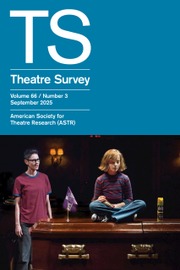


One day in 2018, I arrived at Playwrights Horizons in New York City excited to see a new play by Lindsey Ferrentino called This Flat Earth. I did not know much about the story aside from the fact that it had teenage actors playing teenager characters, but I quickly realized that it was about two teens trying to make sense of a recent mass shooting event as their school. The most striking part of this experience was watching Ella Kennedy Davis playing a thirteen-year-old white girl named Julie who takes out her anger, grief, and confusion about this senseless violence on those around her.Footnote 1 Davis spent much of the play on the emotional limits of anguish, screaming, crying, and shaking to the point where she continued to do so throughout the curtain call. Both my discomfort with the actor's obvious distress, and my genuine dislike for the whiny, sad, one-dimensional role—whose main characteristic is her ignorance of previous school shootings—were enough to distract me from the play itself. But what created this distancing effect? I first thought of Bert O. States's phenomenological observation that children onstage often break our illusion of the theatrical world, but I noted that my phenomenological response was distinctly different from what I feel when I see children acting onstage. Instead of wondering if the actor understood the play she was in, I instead feared she understood all too well.
Was it ethical to put Davis, or any teenage girl actor, in a role that demands such active consideration of a traumatic event that (too) many teenagers experience in this country? What roles are there for actors of Davis's age, gender, and race that avoid this situation? My mind moved to the most well-known theatrical examples of teenage girls. For example, do teenage characters in plays such as Mary in The Children's Hour, Abigail in The Crucible, or Regina George in the musical Mean Girls demand less from their performers? The “mean girls” that appear in these plays are both victims and aggressors, in the same way that Davis's character has both experienced a traumatic event and has apparently victimized other characters both before and after said event. I had spent a lot of time thinking about Mary and Abigail when teaching their plays in an undergraduate American Drama course, but now I found myself searching for teenage girls who did more than cause the conflict in their plays.
William Congreve famously intimated that hell hath no fury like a woman scorned, but a quick look at the twentieth-century American stage might lead one to conclude that a vindictive teenage girl has even more hellish fury. White teenage girls have routinely served as agents of chaos in plays from the beginning of the twentieth century through the present moment, resulting in a lack of diverse, positive representations of teenage girlhood on our stages. This extends beyond the stage, as American culture has a penchant for using “bad” young women—who use gossip as a weapon, whose sexual desires cause the downfall of supposedly moral men, and who will psychologically destroy anyone who is perceived as a threat—as foils to the flawed but ultimately “good”—stable, rational, and predictable—characters surrounding them. Examples of this phenomenon range from Abigail, who is portrayed as a fickle (underage) “temptress” of the adult man whom she once lured into “an affair”; to Mary, whose desire to skip school leads her to fabricate (or reveal) a lesbian affair between her teachers; to Regina, who is the manipulative dictator of her high school's social scene.
This overrepresented archetype of the “bad teenage girl” is deeply problematic, especially if we ask teenage girl actors to step into these roles. And yet these plays enact story lines in which white teenage girls have the power to make social change. I do not mean to imply that these examples of powerful teenage girls are strictly “bad” representations, but rather that the cultural impact of their association between “power” and “being mean” is increased in the absence of other ideas of what a teenage girl can be and do onstage. To paraphrase Stacy Wolf's seminal essay on teenage girl fans of Wicked, by taking teenage girls seriously as participants in culture, I aim to revalue their representations onstage.Footnote 2
Furthermore, I trouble the notion of “bad” representation by looking at the real societal histories and forces that have created the “teenage girl” as cisgender, straight, white, middle-class, and as an antagonist to a clear protagonist's story line. This aspect of my analysis follows scholars like Racquel J. Gates, who challenges the notion of “good” and “bad” depictions of Black people in media, as such binary categorizations rely on critical misunderstandings of how representation works. Gates writes that one such assumption is “the notion that media representations have a direct and straightforward impact on people's ideologies, that media images matter more than histories of institutional oppression, and that audiences always interpret images in predictable and knowable ways. . . . In other words, there is an unshakable belief that images do work outside of the histories and contexts in which they circulate.”Footnote 3 Although the history of the representations of a particular age is not the same as the history of a specific racial group, the societal forces that create stereotypes are similar. And my argument here is not that we see “bad” or “mean” teenage girls onstage and assume that all teenage girls behave that way. Instead, I hope to highlight that there are simply more stories to tell about more teenage girls. The histories of teenage girlhood rely on the multiple identity markers that come along with age and gender—particularly race, sexual orientation, and economic privilege, to name only a few factors that greatly impact societal treatment—and therefore demand an intersectional approach. Fortunately, several twenty-first-century plays have taken on the challenge of representing American teenage girlhood in more of its nuanced, diverse dimensions, and put young adult actors into these roles. Clare Barron's Dance Nation (2018), Jocelyn Bioh's School Girls; or, The African Mean Girls Play (2017), David Byrne's Joan of Arc: Into the Fire (2017), Sarah DeLappe's The Wolves (2016), and Tori Sampson's If Pretty Hurts Ugly Must Be a Muhfucka (2019) challenge and subvert the archetypes of teenage girlhood exemplified onstage by Arthur Miller's Abigail, Lillian Hellman's Mary, and Tina Fey's Regina by putting teenage girls at the center of their own stories. And yet these plays are also able to explore the positive, negative, ambivalent, and neutral aspects of this period of gendered adolescence because they purposefully cast nonteenage actors to play these roles.
I see the nuanced teenage girls in Dance Nation, Schoolgirls, The Wolves, Joan of Arc: Into the Fire, and If Pretty Hurts. . . as direct responses to the most prominent and “negative” theatrical representations of teenage girls, which represent only a fraction of the psychosocial realities of teenage girlhood. Following Kimberlé Crenshaw's definition of intersectionality as a term that highlights the multiply marginalized experiences of Black women as being compounded by the lack of privilege they experience based on both their race and gender, each of these plays centers teenage girls who challenge the monolith of white, straight, cisgender, economically privileged teens present on American stages. The Children's Hour (1934) and The Crucible (1953) are two of the most visible examples, although the cultural omnipresence of Mean Girls (movie 2004, musical 2017) is another important influence. After contextualizing the characteristics of these stereotypical “mean girls” through psychological studies of girlhood adolescence, I move on to exploring the ways that the aforementioned plays push back against that incomplete story. My argument is twofold: that these plays expand the experiences of teenage girlhood onstage both through new, intersectional story lines and through the casting of young adult women to play these roles. In terms of content, these plays expand the range of adolescent girlhood onstage by representing nuanced and complex relationships between girls and by focusing on the multiple forces of marginalization that impact teenage girlhood, such as race, class, and sexuality. In terms of casting, young adults can embody the realistic awkwardness of teenage girlhood present in these plays without phenomenologically alienating certain actors and audience members in the process. The American theatre has not served teenage girls in the past, but certain playwrights have begun to rectify that dearth of representation. Both the failures and successes can make us more aware of how to write and produce theatrical versions of adolescent girls that enable actors and audience members to engage phenomenologically with that complex time of a young woman's life without villainizing or dismissing the imperfect girls who populate it.Footnote 4
“The actors’ older bodies are haunting these 13-year-old[] characters”:Footnote 5 Casting Adults as Teens
What does it mean that some representations of teenage girls are more easily digestible when performed by adults? Phenomenologists such as States have noted that children onstage cause a split in an audience's attention, redirecting their focus away from the character and toward the apparent skill of the child actor as child actor. When we see a child onstage, argues States, we wonder if the young actor understands any of the play's action or plot, or we think about how well the child acts, “for a child!”Footnote 6 For States, this disruption of the willful suspension of disbelief can be used to a play's advantage, in comedy for example, but it cannot be avoided. He writes, “The point is not so much that they are children but that they are conspicuously not identical with their characters. As a consequence, the medium becomes the message: the form winks at the content.”Footnote 7 A teenager, however, is neither a child nor fully an adult. This liminality creates a separate, understudied phenomenological reaction. Most teenage actors do not look so young as to cause an audience member pause, let alone fear about their level of comprehension vis-à-vis the play. And yet there is a particular kind of discomfort that comes from watching an adolescent girl actor play a particularly toxic character onstage.
Far from being taken out of the illusion because the actor is so conspicuously separate from the part, the fear generated by “mean” teenage girl characters results when the actor is too convincing in the role. This is not a fault of the actor, but rather of the overall way that adolescent girls are portrayed in American culture. When I see an actor successfully playing such a character, I begin to wonder how closely this actor's experience matches up with the character's, or if she has been the victim or witness to the kind of manipulative, cruel behavior she is emulating onstage. I am also, necessarily, reminded of the awkward or negative aspects of my own adolescent girlhood, causing me to wonder about how the teenage actor's self-esteem might be impacted by playing through these perhaps all too familiar scenarios. This phenomenological response is mitigated when the teenage girl characters are written in more nuanced ways and played by adult women, which is why Dance Nation, Schoolgirls, Joan of Arc: Into the Fire, The Wolves, and If Pretty Hurts. . . are so important to combating the harmful norms of teenage girlhood representation that are so pervasive in the twentieth and twenty-first centuries.
Young adult women can more fully represent the awkward and uncomfortable experiences of teenage girlhood without causing the audience to worry about the way that this role is impacting the actor's adolescent experience; in turn, the adult actor could use such a role to take control over certain aspects of her own teenage girlhood. There is also less fear, in this instance, that any “negative” aspects of the teenage girl character will result in typecasting, limiting the teenage actor's opportunities to play other kinds of character. Intersectionally mindful girlhood experiences portrayed by adults provide reminders of teenage girlhood's challenges and benefits without the dissociative response that could come from too close of an identification between actor and character. Helen Schultz expresses this balancing act in her response to The Wolves, writing, “Oh to experience the world of a teenage girl in ninety minutes (disclosure: I wish my teenage years had only lasted ninety minutes). . . . I found myself back at sixteen—no more acne or braces, but with a distinct sense of longing for a time that felt both limitless and impossibly constricting.”Footnote 8 Schultz's layered response mirrors my own experiences with the plays in this study, whose young adult actors highlight the distance between my current age and these formative years by both reminding me of, and expanding the ways I think about, how our teenage selves influence our adult lives.
“She is fourteen, neither pretty nor ugly”:Footnote 9 The Origins of Dissembling Teenage Girls
Conversely, I felt no personal relevance when I first encountered Mary Tilford and Abigail Williams, who form a kind of pair in the American theatrical canon. Both girls are in their teens, and both of them are the agents of destruction in their respective plays, where they lie to get revenge on the adults whom they loathe. They can wreak havoc within their respective societies because they are white, socially privileged teens who know how to play up childish innocence when it can get them out of adult consequences. What follows is not an argument that no such girls or young women exist, but rather that these examples loom large in the American theatre in ways that make these two representations bear more weight. And yet, these two plays ignore the societal forces that influence these characters’ behaviors. Mary and Abigail are easy to dismiss as churlish, petty, arrogant, and vindictive, even more so because these characters are more often met on the written page than on the embodied stage.
Although The Children's Hour and The Crucible are both works of fiction, they share ties to actual events from the distant past that ostensibly justify the roles that Mary and Abigail play in their respective plots. In the case of The Children's Hour, Lillian Hellman was inspired by the true story of two Scottish schoolteachers who ran a boarding school for girls and had been subjected to societal shunning due to reports of a lesbian relationship. Jane Pirie and Marianne Woods ran the Drumsheugh school until they were accused of an affair by the only nonwhite student in the school in 1810.Footnote 10 Hellman always insisted that the play itself had nothing to do with lesbianism but was instead about a child's lie; then again, she also insisted she came up with the play's plot herself and denied its historical basis. Although she changed names, whitewashed Mary's character, and certainly dramatized moments that do not have accompanying historical accounts, Hellman's play retains the gender and age dynamics of the original story. Despite being a teenager, Mary's role is predicated on her being viewed as a child. Even the play's title, The Children's Hour, builds on the notions of the “innocent and angelic” nature of children that Henry Wadsworth Longfellow describes in his 1860 poem with the same title.Footnote 11 The language used by many of the contemporary critics and commentators referred to Mary as “the young villainess,” “the kid's part,” “a brat student,” and “the child,”Footnote 12 although this character is about as old as Abigail was when she “seduced” John Proctor. This categorization also applied to the play as a whole, with contemporary critics at Time and The New Republic referring to the play's focus on the “arcane criminality of childhood” and “adolescent banality,” respectively.Footnote 13
Conversely, Abigail is often treated as an adult capable of consent, and even described as a part of the “femme fatale” tradition.Footnote 14 The Crucible is also more closely aligned with a well-known historical antecedent, and yet has no direct connection to a known historical event. As Edmund S. Morgan writes,
Part of the verisimilitude of the play and part of its dramatic tension depend on our knowledge that men and women were hanged at Salem Village in 1692 for crimes they could not have committed. . . . It does not bother me, for example, that Arthur Miller has simplified the legal transactions involved in the trials and assigned to some individuals judicial powers they did not have. Nor does it bother me that he has transformed Abigail Williams from a child into a woman and given her a love affair with his principal character, John Proctor, a love affair that is nowhere suggested by the records. Miller's Abigail is not so much a transformation as a creation.Footnote 15
Morgan's assessment is as notable for its insistence on the connection between the play's event and its actual history as it is for his focus on the role of Abigail, a seventeen-year-old girl, who some years earlier had an “affair” with John Proctor, who is in his thirties. Morgan notes that Miller transformed Abigail from a “child” into a “woman,” and yet the playwright did not make Abigail say, twenty.
Why is it that one seventeen-year-old character is treated as an adult woman, and one fourteen-year-old character as a little girl? Mary and Abigail are both creations of their respective playwrights in terms of their attitudes and personalities, if not their choices. Yes, Mary's real-life counterpart, Jane, did report on her teachers, but what she reported might very well have been true.Footnote 16 Yes, a character like Abigail might have existed, but this girl did not. The particular use of homophobia in The Children's Hour relies on the malicious intent of Mary's gossip, as the true villain in the play is not either of the potentially queer schoolteachers, but rather the teenager who knows that this unspeakable accusation could be used as a weapon. Similarly, The Crucible does not villainize John Proctor, who had an extramarital sexual encounter with a minor, but rather Abigail, whose words and feminine guile become the embodiment of “evil.” These plays are twenty years apart, yet they remain some of the most recognizable examples of white, cisgender, straight adolescent girl characters in the American canon. But what do these characters have in common with real, contemporary teenage girls and how do such representations impact them?
The question of teenage girlhood experience and impact is, of course, impossible to answer without oversimplifying. Teenage girls, like any population demographic, are not a monolith, but there are some studies that show general trends in what happens to teenage girls’ self-esteem and attitudes toward the world as they grow. Paul Howe discusses how the evolution of teenagers as a distinct social group is a result of compulsory education, which kept teenagers in environments around their peers rather than their families. He even calls adolescence “a crucible,” writing,
While the lesson from these events—and from the persecution of communists under Senator Joseph McCarthy in the 1950s that inspired Miller's allegorical play—is to be vigilant against groupthink and the suspension of rational thought, they also highlight just how powerful mutual influence can be in tight social quarters. . . . To describe adolescence as a crucible is to think about it not only as a particular phase of life between the ages of thirteen and nineteen, but also a social milieu where intense interaction has powerful effects on people's ways of thinking, acting, and being. Even as teenagers are engaged in a deeply personal process of self-discovery over the adolescent period, they are profoundly influenced and shaped by those around them.Footnote 17
In other words, although Mary and Abigail are playwrights’ creations meant to be the forces of chaos in their respective plays, their social interactions with their peers play large parts in the generative forces behind their behaviors. This is a shift from earlier periods of childhood, where the home life (as opposed to traditional schooling or play) was the most significant area of influence. In fact, the word “teenager” itself rose to prominence in the period in between The Children's Hour and The Crucible, signaling a monumental shift in how this period of life was conceptualized and represented.Footnote 18
Once teenagers were recognized as a distinct social group, people began to notice differences in how gender impacted the still entirely overwhelmingly white studies of socialization. By the 1990s, researchers were interested in how self-esteem and social influence worked within various intersectional demographics of teenagers. Self-esteem is particularly hard to measure due to its rather amorphous definition. As Bruce Bower notes,
Some researchers assess a person's “global” self-esteem with questions about general feelings of worth, goodness, health, attractiveness and social competence. Others focus on people's evaluations of themselves in specific situations. [Philip] Robson, of Oxford University in England, notes that an individual might score high on one type of test but not on another, presumably because the measures reflect different aspects of self-esteem. Moreover, he argues, high test scores may sometimes indicate conceit, narcissism or rigidity rather than healthy feelings of self-worth.Footnote 19
The slippery slope between high self-esteem, which American culture generally commends, and a series of toxic forms of overinflated self-worth, which it generally condemns, is evident in how Mary and Abigail, and even Regina George, are perceived. Knowing what they want and thinking they are smarter than their peers is a sign of either healthy confidence or narcissism that can extend to the manipulation of those around them. But Hellman, Miller, and Fey do not spend much time on the idea that these characters’ behaviors might result from navigating the increased social freedoms of childhood transitioning to the more rigid social confines of adulthood.
The exact balance of these forces is left to each reader, actor, and director, but Hellman and Miller's stage directions for Mary and Abigail reveal what the playwrights feel is most important for their expression. Mary's first appearance is preceded by affective stage directions with a strong emphasis on her appearance, as Hellman makes clear: “At this point the door opens far enough to let Mary Tilford, clutching a slightly faded bunch of wild flowers, squeeze cautiously in. She is fourteen, neither pretty nor ugly. She is an undistinguished-looking girl.”Footnote 20 Abigail's entrance contains important information about her appearance and age, but also includes information about her motivation. Miller writes, “Abigail Williams, 17, enters. A strikingly beautiful girl, an orphan, with an endless capacity for dissembling. Now she is all worry and apprehension and propriety.”Footnote 21 At the moments these two girls arrive, their behavior is categorized by words like “cautious” and “apprehension,” which are not specified to be false. Are these the entrances of two confident, manipulative teenage girls? Maybe. In this case, Mary's popularity despite her “undistinguished” looks lulls people into a false sense of security around her, and yet Abigail's “beauty” seemingly does the same. Hellman does not warn the reader of what is to come, but Miller notes Abigail's destructive nature immediately following his praise of her physical appearance. These two teens are presented as the forces of power in their plays, but they enter in deference to the characters who are already present. How can we assess how these characters feel about themselves as fully fleshed-out teenage girls when their playwrights seem to prefer them as simply problematic?
Mary and Abigail's whiteness and white privilege also intersect with gender identity in ways that impact self-esteem. Writing in 2000, social worker Sandra Turner explains that
There are variations in the loss of self-esteem for girls belonging to different ethnic groups. One study found that when self-esteem is conceptualized as both core self-esteem (conceptions of self-efficacy and self-confidence) and public self-esteem (perceived ability to perform in institutional contexts), difference in core self-esteem scores are more effected [sic] by gender than ethnicity. For public self-esteem differences are greater for ethnicity than for gender. The study found that girls, with the exception of black girls, had the lowest core self-esteem.Footnote 22
These statistics should not imply that Black girls’ experiences are easier because of their higher core self-esteem. More recent interviews by Wendy Smooth and Elaine Richardson reveal “that [Black] girls get the message from adults, schools, and society that their headstrong characteristics are negative, though these characteristics are essential leadership qualities.”Footnote 23 Whereas white boys, unsurprisingly, scored the highest in both core and public self-esteem, it is notable that white girls are comfortably in the middle of the pack for both of those areas of inquiry.Footnote 24 Not only do these two plays lack a range of intersectional identities for the girls within them, but they also fail to show age-appropriate white boys. This is part of what seems to obviate a discussion of these teenage white girls’ places in their overall societal settings. This does not condone their behavior, but these characters’ actions do not exist in a vacuum.
Bower also points out that the measures we do have of self-esteem gradually rise for all adolescents, but they drop across racial and ethnic groups as teenage girls enter the large, generally new populations and spaces of junior high school and high school.Footnote 25 The way that schooling fits into our concepts of teenage life, and specifically teenage girlhood, certainly applies to Mary's behavior within the setting of an all-girls boarding school and Regina's as the queen bee of her contemporary high school. And yet Abigail—who is not a product of the seventeenth century, but the creation of a twentieth-century playwright—is undoubtedly also influenced by the dynamics of middle-school and high-school young women. As Howe writes, “The adolescent crucible was fully formed, its origins lying in the first decades of the twentieth century when its principal physical embodiment, the modern high school, opened its doors to one and all.”Footnote 26 The setting of a high school, or after-school activity, plays into many of the contemporary examples of plays that represent a more varied experience for their teenage girl characters, but it is important to understand that even those plays that do not make this conceit explicit are still influenced by the overwhelming impact of high-school experiences and representations.
Mary and Abigail provide examples of some of the negative stereotypes of American teenage girlhood that have been left unchallenged for many of the decades since their inception. The homosocial relationships in these plays are about power and control, with Mary and Abigail (and Regina) as the clear leaders of their social groups. Their behavior makes clear that they rose to these positions through deception, intimidation, and manipulation, which they used to assemble a following and gain power. All three are also cisgender, straight, white girls with social capital, and their social circles consist of teenage girls who have the same general backgrounds. Perhaps because of the overwhelming number of privileges these characters have, people have been hesitant to push on the ways in which their playwrights demonize them for the ills of the societies that created them. But more contemporary, diverse examples of teenage girlhood are starting to appear, embodied by adult actors who allow us to see complex characters without fearing that adolescent actors might internalize their actions and responses. As each such play is written and performed, Mary, Abigail, and even Regina can cease to loom as large as they do in the list of representations of teenage girls onstage.
“Welcome to the planet of teenage girls”:Footnote 27 Rethinking Teenage Girlhood Relationships
An important recurring theme in both the movie and musical versions of Mean Girls is that teenager Cady Heron, who has grown up in an unspecified country in Africa before moving to Illinois, perceives the social tension in her American high school as a human version of the behavior of wild animals at a watering hole. Throughout the movie, teenage girls are shown to be as vicious as those wild animals, operating through attacks that involve three-way phone calls instead of physical ambushes. This cultural touchstone configures white teenage girls as natural enemies competing for the limited resources of dateable teenage boys and popularity. Abigail's desires, and both her and Mary's tactics, are recognizable here in more antiquated versions of these same stereotypes. Deirdre M. Kelly and Shauna Pomerantz could just as well be talking about these two teens when they write, “In Mean Girls, girls are the ultimate ‘bitches’ who ruthlessly use each other in strategic power plays worthy of a melodrama.”Footnote 28 Surely bullying is one of the most hot-button issues of our time, but are there no other possible scenarios for teenage girlhood relationships other than torturer and victim? What if a teenage girl is nonwhite? Not rich? Not straight? Not interested in sex at all? Not socially competent? Then she is often deemed “less than” and included only in stories about her embarrassment and degradation.
Of course, there are other choices. In Jocelyn Bioh's School Girls; or, The African Mean Girls Play, for example, the audience is presented with a similar setup to the movie referenced in its title: a teenage girl who has been socialized outside of the country now returns to finish her school experience in her father's country of origin—in this case, Ghana. But when biracial new student Ericka arrives at the Aburi Girls Boarding School with her lighter skin tone and American beauty products, she immediately becomes more popular than the former queen bee, Paulina. All the schoolgirls are preparing to audition to be a contestant for the Miss Ghana pageant, the winner of which will go on to the Miss Global Universe pageant. In the end, pageant representative Eloise Amponsah chooses Ericka to compete, despite her American birth (which should disqualify her), and Paulina is promised another chance the following year if she can be discrete about this fact. The play ends with all of the teenage girls aside from Ericka watching a television broadcast of Ericka failing to place in the Miss Global Universe pageant, meaning that the collective plan has failed.
Despite its titular reference to Mean Girls, Bioh's script changes not only the races and nationalities of the characters, but also fundamental aspects of how the girls relate to each other. The “outsider” here has no desire to join the popular group, it simply happens, nor is the queen bee character nearly as privileged and caricatured as Regina. Instead, Bioh shows us a group of Ghanaian teenage girls who are trying to find their places in the world. A note at the top of the play reveals that Bioh was inspired by a true story from 2011:
Yayra Erica Nego (an American-born and Minnesota-raised biracical [sic] woman) [was named] the winner of the Miss Ghana pageant. Officials claimed that her father was from the Volta region of Ghana (a region that is considered extremely obscure and rarely have people ever emigrated from there) but never confirmed his name or whereabouts before procuring her as a contestant for the Miss Ghana pageant. She beat out two of Ghana's most famous models at the time. Erica went on to the Miss Universe pageant that year where she did not place.Footnote 29
Instead of focusing on the pageant itself, Bioh chooses to let that story unfold within the context of the daily lives of high-school girls whose status quo is disrupted by a newcomer. Here Paulina's incredible bullying of her fellow students is confronted early in the play, as her classmates abandon her the moment Ericka arrives on the scene. Paulina discovers that Ericka's mom was white and had had an affair with Ericka's father, the head of a major Ghanaian cocoa factory, and reveals these facts during Miss Ghana auditions. Ericka then calls Paulina out for claiming she had rich cousins in America, when in fact those cousins work at White Castle and send her fake designer clothing and handbags.
Although Mean Girls “offers its heroines various modes for expressing control, anger, and agency, these forms of power are surprisingly disconnected from any overt politics or critique of larger power structures, depositing girls directly into a postfeminist landscape without recourse or remedy—except their own sheer willpower.”Footnote 30 In contrast, School Girls pulls back the curtain to reveal the forces outside of these teenage girls’ control without falling into stereotypes about African and Afro-diasporic stories. The play does not follow what Black girlhood studies scholar Jen Katshunga observes of many stories about African girlhood in that it does not “propagate tales of poverty, sexual violence, dearth of education, and a diligent ahistorical belief that they are victims of their uncivilized environments.”Footnote 31 This means that the even the “mean” girl's behavior in this play is shown to be the result of a series of external forces. Paulina is sure that she will be chosen as the school's candidate for Miss Ghana 1986 and then continue on to the international pageant, but Ericka's arrival challenges this, even though Ericka was not born in Ghana. The two girls lash out at each other verbally, but then immediately acknowledge what challenges lie behind each of their well-manicured exteriors. Despite what Paulina thinks, Ericka did not grow up rich and popular in America. Instead, she was the only Black child in her town, she watched her mother die of cancer, and she struggled financially while knowing her father was rich. Ericka then says she is envious of Paulina's home life, to which Paulina responds,
Lucky? Are you serious? Lucky where?! That my mother has eight children, most of us with different fathers? Lucky that we are the poorest people in our village? Lucky to be the darkest one in my family? That even with our little bit of money, my mother gave me bleaching cream instead of food—’cause that would “serve me better in life”?! . . . That's not luck Ericka, okay?! The only luck I had was getting a scholarship to Aburi. [. . .] Trust me—my mother would have gladly traded me in for you . . . Clearly . . . She was right.Footnote 32
Paulina's words make clear how her lack of a stable home environment, limited economic resources, and experiences of colorism weigh on her as she struggles to find a path forward. Paulina sees Aburi as her one chance, and her determination to take advantage of this privilege seems to be a matter of life or death for her: either she will succeed or all of her striving and sacrifices will have been for nothing. These pressures also reveal the adultificationFootnote 33 to which Paulina has been subjected both internally and externally (from the well-meaning Headmistress Francis).
How can we hate a character who is acting out in the one arena where she has some sense of control? Bioh's play reclaims the narrative, enabling a viewer such as myself to feel empathy for each and every one of these teenage girls while watching a cast led by young Black women who are telling a complex story. Even when the actors are not actually sixteen- to eighteen-year-olds, having these Black teenage girls fight and forgive each other onstage is an important step toward dismantling, as Katshunga writes, “the disparities between white girls in the Global North who are afforded humanity and notions of complexity while their Black African counterparts within the Global North and South are not discussed the same way.”Footnote 34 Indeed, as much as white teenage girls lack nuanced representation, BIPOC teenage girls have even more societal marginalization to overcome to have their stories told. Although this play is set in 1986, having contemporary Black teenage actors step into these discussions could still feel emotionally exhausting for individuals who might be dealing with some of these topics on a daily basis in school. Young adult actors, on the other hand, can have the distance to appreciate the resonance of these themes without having to be in the thick of them.
It is also worth noting that, instead of focusing solely on the “new girl,” Bioh's play takes a more holistic view of the characters’ group dynamic. The collective protagonist approach is also present in Dance Nation and The Wolves, where a group of teenage girls navigate relationships with each other, parents, coaches, and strangers while pursuing a collective task such as a dance routine or a game. Clare Barron's Dance Nation, which follows a group of thirteen-year-old girls on a dance team, leads with a casting note specifying that the young teenage girls should be played by adults of a variety of ages, racial identities, and body types. Rather than ignoring the adult bodies in front of us, the play leans into the juxtaposition of childhood ideas with fully adult women. Barron writes,
Think of it as a ghost play: the actors’ older bodies are haunting these 13-year-olds [sic] characters. (We're getting to see who they grow up to be!) And these 13-year-old characters are haunted by the specters of what they will become. At times we should be fully in “13-year-old land” with all its ridiculousness, pain and pleasure. And at times we should be palpably aware of the actors’ real ages and their distance from this moment in their lives.Footnote 35
This “distance” that Barron mentions is particularly useful when it comes to the discomfort of teenage girls dealing with rejection, shame, and sexual awkwardness. Adults screaming lines such as “My pussy is perfect”Footnote 36 or first experimenting with masturbation become nostalgic instead of cringeworthy. Similarly, the characters’ asides about their innermost hopes, dreams, and fears gain a new resonance when an audience looks at an adult who has clearly passed that moment in her own evolution. The teenage girls are friends, but they are still learning what makes them unique, who they want to befriend, and how to deal with failure. The difficult balance of competition and friendship comes to a head for Zuzu and Amina, close friends who compete for lead roles. Amina is a stronger dancer, and she places dance over her friendship, which becomes clear when Zuzu freezes following a mistake in her solo and Amina jumps in to save the number. Amina does not think about how this overstep will affect her friend, but instead thinks of the overall impact and the group's score. And yet Barron does not use this betrayal to catalyze a vicious “girl fight.” Zuzu lies on the ground, comforted by another one of the dancers, as Amina comes to check on her. Zuzu makes clear that she does not want Amina to comfort her, which is sad for both girls. This moment is not about anger, revenge, or shame, but it is instead about these two teenage girls mourning the fact that their friendship cannot remain the same now that they are getting older, and the stakes are changing.
Sarah DeLappe's The Wolves takes these changing relationships between teenagers into another kind of team activity: soccer. There is no casting note specifying that the actors should be older than their counterparts, but the inclusion of topics such as death, abortion, and disordered eating make casting skew toward actors in their mid-twenties. Regardless, as DeLappe writes in her preface:
Welcome to the planet of teenage girls. [. . .] I thought of the play like a war movie. Instead of a troop of young men preparing for battle, we watch a team of young women warming up for their soccer game. [. . .] [O]n their artificial grass, these girls are allowed to define themselves amongst themselves. Their bodies are their own and they are strong. We do not meet them as the property or accessory of a man—a boyfriend, a father, an institutional custodian in school or in government—we meet them with each other. We're on their turf. They're not on ours.Footnote 37
As DeLappe explains, the play's action follows the members of an indoor girls’ soccer team; the script refers to the girls by their numbers rather than assigning them names, further emphasizing that the audience is following a team instead of a single character. Much as in Dance Nation, the members of the soccer team known as The Wolves are shown practicing for a championship. They run drills, but they also talk to each other about their lives outside of soccer. For example, the play opens with two simultaneous conversations: one about the Khmer Rouge and the other about playing soccer while menstruating.Footnote 38 They are both conveyed with the frankness that comes with passing along information one has just learned, which gives us an immediate sense of how these sixteen- and seventeen-year-olds relate to each other. Abigail, Mary, and Regina use the thirst for knowledge for ill in their plays, but here DeLappe allows this exchange of information to exist without value judgment. There is no nefarious plan attached to sharing this knowledge, even though the Khmer Rouge is not a neutral subject. This is simply how these girls communicate with each other, and their reactions to this information begin to tell us more about who these soccer players are.
Much like School Girls, and Mean Girls itself, The Wolves relies on the specific dynamic caused by introducing a new teenage girl into a preexisting social environment. And yet, #46, who is awkward but very talented, slowly wins over most of the team with her prowess on the field despite her lack of social skills. The sole holdout is #7, who is clearly the most traditionally “popular” of the teammates. Not only is #46 a threat to #7's spot as striker, but #46's popularity despite her ignorance of middle-class American teenage girlhood norms seems to be an affront to #7's understanding of the world. However, unlike Abigail, Mary, or Regina, #7 cannot manipulate or control the other members of the team, and she loses her power as she is outshone on the field. Reality catches up with #7 when she not only gets an injury that benches her, but also when her best friend, #14, is killed in a car accident while out for a run. Though #7 can be a bully, that is not the only side of her we see, and she is still a full member of The Wolves. Having an adult actor in this role helps an audience see the insecurity that causes #7 to use her sexuality and bad attitude as defense mechanisms against the world. She is flawed, but she is not unidimensional—and the actor playing her is not likely to be in the same situation as the character, meaning that we do not have to be distracted by worrying that the character's dangerous behaviors might be the same as the actor's. This is not to say that a woman over the age of seventeen might not be in a similar situation to #7, but rather that slightly older women are, in general, slightly more mature and also removed from the politics of being a high-school girl.
Although only Dance Nation specifies that the actors should not be the same age as their characters, professional productions of School Girls and The Wolves have routinely cast actors in their twenties to play their teenagers. Phenomenologically, I was not taken out of the action to worry about the teenage actors while watching these plays in the way I was during This Flat Earth. I attribute my increased comfort in these viewing experiences not only to the age differential, but also to the vast network of teenage girlhood relationships in these three plays. Instead of tokenizing one teenage girl's villainy, or victimhood, these plays provide the actors and audience with five to ten fully formed roles for teenage girls whose relationships with each other run the gamut. The behaviors we see within these characters combine with their adult actors to allow audience members to see these teenage girls in all their nuances without being pulled out of the action. The variety of relationships among these characters is an important step forward in diversifying our views of teenage girlhood, but the intersectional identities of the girls themselves are also crucial to understanding the importance of these plays.
“Beautiful girl. 17 years life”:Footnote 39 Representing the Intersectionality of Teenage Girlhood
The overwhelming whiteness, straightness, and general normativity of characters such as Abigail and Mary extend into many of the most popular media representations of teenage girlhood, as exemplified onscreen by Mean Girls, Gossip Girl, and Pretty Little Liars. Although there is some small victory in the fact that these movies and television shows chose not to villainize teenage girls of color, diverse roles and representations of BIPOC, queer, and otherwise marginalized teenage girls are even harder to come by than roles for cishet white teens. More recently, TV's Yellowjackets has pushed back on white heteronormativity a bit, but still leans on those assumptions. Not only are leading roles created for BIPOC teenage girls rare, but research on nonwhite girlhood is also greatly underrepresented. The field of Black girlhood studies has made a crucial and excellent intervention in this area, but there is still work to be done. The best way to rectify this problem is, of course, to increase the general diversity of our theatre seasons, specifically in terms of writers and production teams; but, until then, we must still contend with the ways that a fuller diversity of teenage girlhood can make its way onto the stage without simply expanding it to include nonwhite teenage “mean girls.”
Once again, Mean Girls provides a clear snapshot of how race, class, and sexuality are particularly key in representations of popular teenage girlhood. Kelly and Pomerantz explain that, “For girls, popularity is derived from thinness, ‘hotness,’ the acquisition of a popular boyfriend, long hair, sexy clothes, and the ability to follow the rules of girl-world (without seeming to follow any rules at all). Popularity is implicitly coded as white, middle to upper class, and heterosexual.”Footnote 40 The musical adaptation of Mean Girls notably cast Korean American actor Ashley Park as Gretchen Wieners, marking the first time that “the Plastics” were not uniformly white, but the show also chose to cast Cady and Regina with white actors. Indeed, Park's casting still does not provide a nuanced representation of how intersectional forces impact a teenage girl's experience in the contemporary United States. Interestingly, Park was cast to play the Jewish-coded character of the original group, whose cultural otherness and desperation to belong are forces Regina uses to manipulate her in the original story. With Park in the role, Gretchen's desire to use her class privilege to overcome her racial marginalization becomes even more visible. Yet Gretchen is also the only member of the Plastics who seems to be distrustful of the delicate balance of social dynamics that result in either social cruelty or acceptance, which lends her a humanity emphasized by Park's charismatic performance. What would it look like if a protagonist was not tokenized for her identity, but instead allowed to be the focus of the story for all of the banalities of teenage girlhood without either ignoring aspects of marginalization or focusing solely on them?
School Girls and If Pretty Hurts. . . stand out as plays that not only have entirely Black casts, but that also focus specifically on groups of Black teenage girls who are complex characters. Tori Sampson acknowledges the importance of not just representing Black women onstage, but also celebrating their joy and beauty when she writes in her preface:
In a world where Viola Davis is not “classically beautiful,” First Lady Michelle Obama is compared to an ape, Cosmopolitan Magazine places Black women as examples of “trends that need to die,” where Black Lives Matter assertions fade when Black girls go missing, where Lupita N'yongo's splendor is regarded as an anomaly . . . In a world where it feels attacking to others for more than one of us to shine at a time, where the phrase Beautiful Black Women feels more like a mantra than a fact . . . In this world where beauty is placed out of our reach.
We Reach,
We Reach,
We Reach.Footnote 41
Sampson's play is focused on recognizing the outward beauty of Black girls and women, but it also specifies that each and every one of the four Black seventeen-year-old characters is beautiful regardless of her relationship to white, Western, normative beauty standards. If Pretty Hurts. . . is part Cinderella story, part West African fable that is set in the stylized world of “Affreakuh-Amirrorkuh.”Footnote 42 The action follows Akim, the most beautiful girl in the world, and her three friends, Massassi, Adama, and Kaya, who are also beautiful but pale in comparison. Akim knows she is beautiful and does not understand why her friends would be envious over something none of them can control. It does not help that Kasim, a seventeen-year-old boy, is in love with Akim despite being promised to Massassi. To guard against colorism, Sampson has included a note specifying that “Akim should not have a lighter skin tone than Massassi.”Footnote 43 This works against the preference for Ericka's skin tone over Paulina's in School Girls, which is, unfortunately, not simply a reality confined to the past. After attending a ball to which her parents forbade her to go, Akim slips under the waves of the river because she has not brought the proper offering. Adama, who is attempting to save her, slips under as well. Akim's parents eventually feed the river enough offerings to get both girls back, but they want Massassi and Kaya to be killed for leaving the girls to their fates without attempting to save them. As the crowd discusses what should be done, Massassi sacrifices herself, only to pop back up in a realistic bedroom where she goes through daily affirmations before, presumably, going to high school.
Although there is a clear protagonist (Akim) and clear antagonist (Massassi), Sampson refuses to make things so simple. Massassi wants Akim out of the picture, but her envy is not abstract; we see how she and the other beautiful teenage girls are ignored by the community around them. Even though the beauty of Black girls and women is fully recognized in this world, there is still only room for one most beautiful Black teenage girl. By focusing specifically on the teenagers in a world where beautiful Black women also exist, If Pretty Hurts. . . highlights the Black teen girls’ “individualized, collective, and nuanced experiences and livelihoods” without causing them to be “carelessly added to conversations on African and Afro-Diasporic women.”Footnote 44 As Katshunga explains within her framework of a Black African Girl Approach, “The concepts of age and girlhoods are complex within African and Afro-Diasporic contexts, which can also be explained by the role of various neo/colonial and imperialist forms of interventions and occupations.”Footnote 45 Black teenage girlhood in If Pretty Hurt. . . exists in its own space that is deeply influenced by African diaspora without ignoring the colonial influences of Western culture. The play both highlights the beauty of Black teenage girls and pushes back against a simplified story line of progress and perfection by ending with Massassi's pain rather than Akim's triumph. This sets the play up to represent a wide variety of Black teenage girls as beautiful and worthy of admiration; regardless of how beautiful Akim is, Massassi also deserves to be seen and appreciated as beautiful. As Sampson writes in her notes on casting, “Nobody needs to be tall, skinny, have straight teeth, clear skin, long hair etc. BE beauty in all your glory.”Footnote 46 This also opens the play's casting to other kinds of intersectional representations beyond gender and race. What if Akim is a transgender woman? What if she is a wheelchair user? Regardless of exactly what kind of Black women play these roles, this play provides opportunities to represent a variety of Black teenage girls at the centers of their own stories.
If Pretty Hurts. . . , like School Girls, features an entirely Black cast. This means that even if these plays contained “mean teenage girls” along the lines of Mary and Abigail, they would at least be seen alongside other representations of Black teenage girls in ways that would not reinforce implicit (and explicit) biases that configure Black teenage girls as less innocent than their white counterparts. Connie Wun, an education researcher and advocate, writes about the overt policing of Black girls’ behavior in high school and the additional disciplinary measures they face. For example, “from 2011 to 2012, Black girls in public elementary and secondary schools across the nation were suspended at a rate of 12%, compared to the rate of 2% for white girls.”Footnote 47 Perhaps unsurprisingly, the reasons for these suspensions
differ from their male peers. In particular, girls are more likely to be disciplined for failing to meet dominant cis-gendered expectations of femininity. Black girls, in particular, are more likely to be disciplined for “talking back” and being “unladylike.” Black girls are also likely to be arrested for being “disrespectful” and “uncontrollable.” The characterizations and subsequent disciplinary actions are characterized by underlying racial stereotypes and assumptions about appropriate behaviors, which often indicate that girls are expected to be obedient and docile.Footnote 48
This bias against Black teenage girls in particular is why writing and casting them as unnuanced villains is so dangerous and unethical. Kelly and Pomerantz also point to the frequency with which teenage girls of color are routinely represented in media, film, and television as unruly, writing, “Girls who diverge from the norm by virtue of their race, class, sexuality, body type, and ability are largely invisible within popularized discourses of girl power, with the exception that ‘wild girls’ are coded as working class and racialized. As a result, ‘real’ girls—particularly working-class girls of color—come under more scrutiny.”Footnote 49 These negative stereotypes mean that having adults in a variety of roles provides an opportunity for Black women to reclaim a more complex narrative from a place of slightly more agency. In other words, free of the controlling forces of high school, or even college, adult Black actors can portray these teenage girls without having to step back into a school structure that not only fails to understand or support them, but also looks for ways to criminalize them. In this way, Bioh and Sampson have created characters that reimagine the spaces that Black teenage girls can fully inhabit without ignoring the realities of life as a Black teenage girl in the contemporary United States.
Race is an incredibly important and socially pressing area of intersectional representation within these plays, but it not the only one. Sexuality is another important dimension to teenage girlhood not only in terms of a diversity of sexual orientation, but also the kinds of power dynamic within heterosexual relationships. Although the latter is also important, for the sake of space I deal here only with queerness. David Byrne and Steven Hoggett's musical adaptation of Joan of Arc's story, Joan of Arc: Into the Fire, reimagines the nineteen-year-old Maid of Orleans as a rock superstar. It covers Joan's transformation from an adolescent girl from a small village into the (literally) visionary leader of a French military campaign. The play is inseparable from its original production at The Public, where singer and actor Jo Lampert played the eponymous heroine. Jo is not only at least ten years older than the character, but she is also a well-known androgynous, queer downtown performer whose persona inflected the role. The play itself does not call Joan of Arc queer, but the story of a teenage girl surrounded by men who have no sexual interest in her shifts when the performer at the center is explicitly gender-nonconforming and sexually fluid. Age and sexuality combine here to enable an actor who bears no actual resemblance to the character to have the distance necessary to bring new resonance to her story. When Lampert sings—
Joan of Arc's “virginal” reputation during the fifteenth century could mean that she was a heterosexual teenage girl who had no sexual history with men, or that her history with men was well-concealed, or that she had a complicated sexual history that either did not merit a mention as “sex” and/or was not befitting of a religious martyr, or that Joan did not identify as a girl at all. Byrne's musical is not a historical document, but Lampert's casting recontextualized the myth of an actual teenage girl whose gender performance was unusual—or “queer”—at the time. Lampert's performance of Joan is a perfect example of how casting can influence the way we perceive a character, representing new areas of teenage girlhood that have been hidden from view. Having an adult actor play Joan of Arc is not a new concept—George Bernard Shaw wrote the role of Saint Joan for the forty-year-old actor Sybil Thorndike, for example—but Lampert's intersectional adult identity brought not only the distance that her more mature age allowed, but also a particular understanding of being an outsider to the role. The fact that Lampert's, and therefore Joan's, queerness is not sensationalized becomes the most important thing about it. Although I am not advocating for unspoken queerness, both Joan of Arc: Into the Fire and The Wolves have characters that can be read as queer, and yet neither plot turns on that fact or revelation. In the latter, the team captain of The Wolves is clearly dating a schoolmate who helps her shave her head later in the play. As opposed to queerness destroying either of these characters’ authority and membership in their respective group, as it does in The Children's Hour and threatens to do for Janice in Mean Girls, this is simply another aspect of their identities.
Joan of Arc is, of course, a historical figure who was an undeniable leader and force to be reckoned with. Her story has been dramatized countless times, even on the stage, but Joan of Arc: Into the Fire does more than queer the famous teenage martyr. Joan's leadership in the play stands out because the ten or so men surrounding her do not come to see her as a sexual being first and a leader later; indeed, the men in her crew never make any sexual advances toward her at all. Queerness aside, this works against the vast array of plays, movies, and television shows that use sexuality as a teenage girl's most powerful currency. This is certainly the case with Abigail, whose sexual power over John Proctor is the most powerful witchcraft in The Crucible. Yet Joan simply leads the men with the courage of her conviction. The fact that the adult men around her believe a teenage girl who has religious visions enough to follow into battle is somewhat astonishing, even in the era of #MeToo. But Joan of Arc: Into the Fire configures Joan's purity in a different way from other Joan of Arc stories: here, Joan need not be a heteronormative, “traditionally attractive” heroine who overcomes societal shyness to become a figurehead. Lampert's Joan is strong in presence and voice, even when she is afraid. Joan's power in the musical is therefore tied to her queerness, which comes both from her lack of sexualization and also from Lampert's visible queerness in terms of both sexuality and gender presentation.
Lampert's real-life experience comes to bear in Joan of Arc: Into the Fire much as that of any cast member does in If Pretty Hurts. . . , where each Black woman's specific experience of adolescence brings new dimensions and layers to the representations of beauty. These older actors are not too far removed from the circumstances of their teenage characters, and yet they are separate from the social situations that the characters are experiencing. Lampert's adult sense of self becomes part of Joan of Arc's power. This distance from adolescence gives these actors a chance at working through and (re)presenting a different version of the experiences they had as teenagers, while keeping an audience from worrying if teenage actors can comment on situations they might be living through at the time. Teenage girls who are marginalized not only by gender, but also by race and/or sexual orientation, could be put even more at risk by embodying these few examples of their realities. And yet it is these groups who need representation more than relatively privileged groups of teenage girls. Adults provide the most ethical choice for telling such crucial stories for both the adolescents who need to see themselves represented and the adult women who want to understand their adolescence in new ways.
Not all forms of intersectional representation are so visible, but that does not mean that actors and audience members do not deserve to see them onstage as well. For example, socioeconomic forces are often tied to race and ethnicity, but plays like If Pretty Hurts. . . make a point of holding monetary privilege stable in order to focus on other forces. The Wolves does not explicitly highlight the monetary inequalities of the team's members—we do not, for example, go into any of the teenage girls’ homes or see them in many street clothes. And yet there are a few very clear moments that acknowledge the privilege that often accompanies teenage girls who can play extracurricular organized sports. New player #46, for example, takes the bus to practice, which is clearly an anomaly. One day she is late to practice and blames her bus, and #13 is startled enough to repeat the phrase aloud: “(her bus?) [. . .] she takes the bus?” To this #11 responds, “she told me she has to take like 3 buses to get here,” prompting #13 to reply, “wow.”Footnote 51 Their disbelief continues into a discussion of #46's homeschooling and the fact that she lives in a yurt with her mother. The teammates are also baffled by the fact that #46 has not played on the travel teams with the rest of the girls, which shows the assumptions of socioeconomic means that are associated with playing an organized sport outside of a school situation. These girls who live in houses and are dropped off at practice cannot conceive of a circumstance in which a travel team might be out of financial reach for someone, but they seem to understand that possibility for the first time. Recent addition #46 is different from the other members of The Wolves for a variety of reasons, but this particular aspect of her marginalization is only acknowledged, not highlighted.
School Girls also acknowledges the way that disposable income and brand-name products play into cultural capital in high school. Paulina claims to have designer clothes that her family has sent her from the United States, and yet Ericka quickly clocks them as counterfeit. Ericka's decision to tell Paulina's peers that she is lying is a major blow to Paulina's outward appearance of wealth. And yet those assumptions go both ways, as both Ericka and Mercy (another member of the friend group) have rich parents who have not raised their daughters in the lap of luxury. Paulina knows that, even if she and Ericka were both raised poor, Ericka is “the daughter of one of the richest men in the country. [She] will always have something . . . Always.”Footnote 52 Even if they were socioeconomically equal, Ericka has privileges (her lighter skin tone, American nationality, and rich father) that will give her more options in the outside world.
Socioeconomic status, sexual orientation, and racial identities are all intersectional aspects of teenage girlhood identity that impact the experience of adolescence, and yet they are even more rarely discussed than the cisgender, straight, white, middle-class teenage girlhood that render Mary and Abigail (and Regina) the villains of their stories. The five plays analyzed here do the admirable work of shining a light onto these issues, and yet they also show how many kinds of teenage girlhood are still not present, or presentable, on our stages. What about transgender teenage girls? What about disabled teenage girls? What about immigrant teenage girls? These experiences could also benefit from being portrayed by adult actors who can represent these marginalized experiences without being forced into a situation that might bear some resemblance to their own. They can also become the teenage girlhood role models and peers that they should have seen onstage when they were younger.
“What am I going to do with all this power?”:Footnote 53 The Future of Teenage Girlhood Onstage
There is no girl version of popular high-school musicals such as Dear Evan Hansen or Be More Chill; the closest counterpart is, unsurprisingly, Mean Girls. I am not advocating for story lines such as those with girl protagonists, but I do find it concerning that teenage boy protagonists are allowed to fail and learn in ways that do not villainize them within their stories, even when it seems warranted. Instead of making new versions of the same stories, Barron's Dance Nation, Bioh's School Girls; or, The African Mean Girls Play, Byrne's Joan of Arc: Into the Fire, DeLappe's The Wolves, and Sampson's If Pretty Hurts Ugly Must Be a Muhfucka chart new paths through the collective past, present, and future of teenage girlhoods. And they are not alone.
There is a moment in Jackie Sibblies Drury's Pulitzer Prize–winning Fairview (2018) in which Keisha, a Black teenage girl, stops the play's action. She has the power, in that moment, to halt the forward progress of the other characters, and to call the white members of the audience into her stage space. I remember being struck by this moment not only because the play itself is so powerful and beautifully structured, but also because I realized afterward how unusual it is to see a sympathetic teenage girl, let alone a Black teenage girl, have that kind of power in the theatre. Throughout this essay, I have focused on five very specific examples of teenage girlhood onstage that subvert the villainous representations that are so ubiquitous, but the plays mentioned here are only a small sample of the problems and solutions to the question of teenage girlhood representation. More work needs to be done to understand the variety of factors that impact teenage actors taking on these various roles and the ways in which we can ethically prepare those actors for that process.
In the meantime, my hope is that we as a theatre community recognize several important aspects of how we represent teenage girls, and teenage girlhood, onstage. The first is that, historically, teenage girls are often represented as amalgams of our society's fears about sexuality and angst. Their desires and insecurities become weapons against those around them and, although this can be the case, this pathway is overrepresented. When we ask teenagers to step into these cruel roles, we ask them to play through our society's worst expectations of them without also providing other kinds of story for balance. This can be overwhelming and alienating for both the teenage actors and the audience members watching, whose own experiences can phenomenologically break them out of the play's world by transporting them back into their own experiences. The solution to this problem is twofold: we need to represent a wider range of teenage girlhood experiences, and we also need to consider the benefits of casting young adults to play these roles. I am not arguing that teenage girls should never be cast, but instead that we consider their participation in the most ethical ways possible.
In terms of diversifying the ways teenage girls exist onstage, Dance Nation, School Girls, The Wolves, Joan of Arc: Into the Fire, and If Pretty Hurts. . . all challenge the norms. They refuse the traditional model of the teenage girl bully and her crew. They reveal that teenage girls are not all cishet, white, middle-class, and heteronormatively attractive. Having young adult actors play these roles enables girl actors to have the distance necessary to represent some of the difficulties of navigating adolescence, which benefits both actors and audience members. Women have all been teenagers at one time, but they are free of the social confines that attend teenage girlhood in the United States.
Regardless of who plays these characters, we need more of them. That way the mean teenage girls of the past can become a kind of character, as opposed to the stereotype of teenage girlhood as a whole. This also means that we need more diverse voices writing about intersectional identities within this category: BIPOC girls, trans girls, disabled girls, fat girls, neurodiverse girls, undocumented girls, and so on. Only then can we fully begin to rebuild the expectations that characters like Mary, Abigail, and Regina have created with their endless capacities for dissembling.
Bess Rowen is an Assistant Professor of Theatre at Villanova University. She is a theatre theorist, historian, and practitioner. Her work focuses on what she terms “affective stage directions,” which are stage directions written in ways that engage the physical and emotional responses of future theatre makers. Her first book, The Lines Between the Lines: How Stage Directions Affect Embodiment, was published by University of Michigan Press in October 2021. Her next book project focuses on representations of teenage girls onstage. She is also coeditor of a forthcoming volume that pulls together work from the Transfeminisms working group at the ASTR, where she and her collaborators take up important issues of trans and nonbinary representation in theatre and performance. In addition Bess serves as the co-editor of the Journal of American Drama and Theatre and the Performance Review Editor of The Eugene O'Neill Review. Recent articles can be found in Modern Drama, Theatre Topics, the Journal of Dramatic Theory and Criticism, and Theatre Journal, among others.

 Open access

