


Diet plays an important role in health( Reference Sofi, Abbate and Gensini 1 ). The Dietary Inflammatory Index (DII®) characterizes an individual’s diet on a continuum from maximally anti- to pro-inflammatory( Reference Shivappa, Steck and Hurley 2 ). The DII has been used in relation to several health outcomes (e.g. mortality, cancer, obesity, cardiometabolic diseases)( Reference Shivappa, Blair and Prizment 3 – Reference Wirth, Burch and Shivappa 7 ) including cognition( Reference Kesse-Guyot, Assmann and Andreeva 8 – Reference Frith, Shivappa and Mann 10 ) mainly among adults and older adults, but there are few studies focused on young populations and none of those in relation to cognitive outcomes( Reference Almeida-de-Souza, Santos and Barros 11 – Reference Sen, Rifas-Shiman and Shivappa 14 ). However, as the diet pattern that individuals adopt during childhood might determine their diet pattern in adulthood, it is important to consider the DII early in the lifespan.
Previous studies in youth have found that the Mediterranean diet, associated with lower levels of inflammation, may positively influence academic performance( Reference Feinstein, Sabates and Sorhaindo 15 , Reference Esteban-Cornejo, Izquierdo-Gomez and Gómez-Martínez 16 ), whereas the Western diet, associated with higher levels of inflammation, may impair academic development( Reference Vassiloudis, Yiannakouris and Panagiotakos 17 ). In addition, a recent review showed that inflammation may also be associated with cognitive processes, which, in turn, might influence academic performance( Reference Miller, Lee and Lumeng 18 ). To the best of our knowledge, no previous study has investigated how the DII may influence academic performance among youth. Therefore, we aimed to examine the association between the DII and academic performance in children.
Methods
The SALTA Study (Environmental Support for Leisure and Active Transport) is a longitudinal study designed to assess environmental and social influences on physical activity( Reference Pizarro, Ribeiro and Marques 19 ). Baseline data were collected in nine middle schools in the Porto area (Portugal) during the 2010/2011 academic year. A total of 641 children (299 girls) from 6th grade participated in the SALTA Study. The present work included 524 children (277 girls; 93 % of the original sample) aged 11·56 (sd 0·86) years with complete data at baseline on dietary constituents and academic performance. All participants were informed about the objectives of the study and parents or guardians of each participant provided written informed consent. This study protocol was approved by the Faculty of Sport at the University of Porto ethics committee and the Portuguese Foundation for Science and Technology ethics committees.
Dietary intake for each participant was obtained from a single 24h dietary recall( Reference Salvador Castell, Serra-Majem and Ribas-Barba 20 ). Inflammatory properties of the diet were assessed using the DII developed by Shivappa et al. ( Reference Shivappa, Steck and Hurley 2 ). The DII considers different nutritional data including energy intake, consumption of different beverages, and macro- and micronutrients intake such as vitamins and minerals. The DII is a literature-based tool( Reference Shivappa, Steck and Hurley 2 ) that measures the diet’s inflammatory properties by a score and is based on a review about the role of foods and dietary constituents on the following inflammatory biomarkers: C-reactive protein, TNF-α and IL-1β, -4, -6 and -10. The review pointed to forty-five food parameters and they were scored with +1, −1 or 0 according to their inflammatory effects: pro, anti or null, respectively. The number of articles and the type of study were also used to weight each one of the forty-five food parameters and calculate a ‘food parameter-specific overall inflammatory effect score’, used as multiplying factors, to calculate a DII score. In the present study, it was possible to obtain the DII based on twenty-nine different food parameters. Eugenol, garlic, ginger, onion, saffron, turmeric, green/black tea, flavan-3-ol, flavones, flavonols, flavonones, anthocyanidins, isoflavones, pepper, thyme/oregano and rosemary were not included because no information was available for these components in the Food Processor nutritional database. For each participant, the DII score was calculated as a sum of the twenty-nine adjusted food parameters. Our DII score values ranged from −4·27 to 3·21, and were categorized based sex- and age-specific quartiles of the DII, with mean (sd) as follows: first quartile, −1·79 (0·72); second quartile, −0·6 (0·36); third quartile, 0·94 (0·30); and fourth quartile, 1·98 (0·47). A higher DII score evidences a more pro-inflammatory diet and a lower DII score evidences a more anti-inflammatory diet.
Academic performance was assessed using school records from the end of the school year, provided by the administrative services of the schools participating in the study. We used three indicators: the final grades of Maths, Language, and the average of Maths and Language. For analytical purposes, individual grades were converted to numerical data from 1 to 5, according to the Portuguese classification system, where 1=F and 5=A. The measures of academic performance used were robust and valid. The General Board of Education has established the guiding principles of the organization and management of the curriculum and evaluated the knowledge to be acquired and the skills to be developed by all students in Portugal; and, consequently, these final grades are used for students to pass to a new level of education.
Data on sex, age, socio-economic status and BMI status were collected and calculated according to procedures described elsewhere( Reference Pizarro, Ribeiro and Marques 19 ).
Statistical analysis
The association between DII and academic performance was analysed using linear regression adjusting for sex, age, socio-economic and BMI status. We used regular regression rather than mixed model because the intraclass correlation coefficient mean values representing the clustering effect (i.e. schools) were virtually zero. We also examined differences in academic performance variables by sex- and age-specific quartiles of the DII using ANCOVA with Bonferroni adjustment controlling for previous covariates. Analyses were conducted using the statistical software package IBM SPSS Statistics version 18.0 for Windows, with significance set at P<0·05.
Results
The descriptive characteristics of the study sample are shown in Table 1. The DII was calculated considering twenty-nine of the forty-five food parameters including energy, carbohydrate, protein, total fat, alcohol, fibre, cholesterol, SFA, trans-fatty acids, MUFA, PUFA, n-3 and n-6 PUFA, niacin, vitamins (A, B6, B12, C, D and E), caffeine, Fe, Mg, Zn, Se, folic acid, β-carotene, thiamin and riboflavin. The DII was associated with academic indicators; standardized β values ranged from −0·121 to −0·087 (all P<0·05). Children in the fourth quartile had significantly lower scores in all academic indicators compared with children in the first quartile (score differences ranged from −0·377 to −0·292). Additionally, children in the fourth quartile had significantly lower scores in the average of Maths and Language compared with children in the second quartile (score difference of −0·304; 95 % CI −0·308,−0·299; Table 2).
Descriptive characteristics of the sample of children from nine middle schools in the Porto area (Portugal) during the 2010/2011 academic year: SALTA Study (Environmental Support for Leisure and Active Transport)
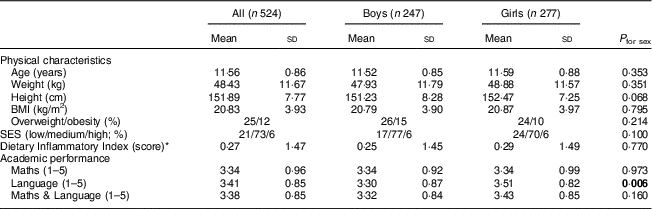
SES, socio-economic status.
Significant P values are indicated in bold font.
* Score computed from the sum of adjusted scores of dietary constituents.
Differences in academic performance according to quartiles of Dietary Inflammatory Index (score) among children from nine middle schools in the Porto area (Portugal) during the 2010/2011 academic year: SALTA Study (Environmental Support for Leisure and Active Transport)

Analyses were adjusted for sex, age, socio-economic status (low/medium/high) and BMI status (normal weight/overweight–obesity).
Significant P values are indicated in bold font.
* Significant difference between the first and fourth quartiles.
† Significant difference between the second and fourth quartiles.
Discussion
The main finding of the present study was that the DII was associated with academic performance in children, independently of potential confounders. The contribution of diet to academic performance has been previously stated; however, these novel results suggest for the first time that the inflammatory potential of diet may negatively influence academic performance in children.
Recent studies regarding the DII in relation to several health outcomes (e.g. mortality, cancer, obesity, cardiometabolic diseases, cognitive impairment) have focused on adults and older adults( Reference Shivappa, Blair and Prizment 3 , Reference Frith, Shivappa and Mann 10 ), and there are few studies focused on young populations( Reference Almeida-de-Souza, Santos and Barros 11 – Reference Sen, Rifas-Shiman and Shivappa 14 ); however, to our knowledge, the DII has not yet been applied to a young population in relation to cognitive outcomes. In fact, the present study is the first showing the associations between the DII and academic performance in children. Diet has been shown to regulate inflammation and, in turn, inflammation may be associated with cognitive development( Reference Miller, Lee and Lumeng 18 , Reference Esmaillzadeh, Kimiagar and Mehrabi 21 ). The pro- or anti-inflammatory roles of diet depend on the type of food consumed and the nutrients of such food. Nutrients assumed to have an anti-inflammatory effect, such as fibre or vitamins, are mainly related to Mediterranean-style diets, whereas nutrients assumed to have a pro-inflammatory effect, such as SFA or carbohydrates, are associated with Western diets( Reference Calder, Ahluwalia and Brouns 22 ); each of these may have different influences on cognitive development.
Previous findings in youth have shown the association between Mediterranean or Western diets and academic performance. For example, a longitudinal study in children found that those who adopted a Western-related diet based on junk food (e.g. nutrients from high-fat processed foods and snack foods high in sugar) had lower academic score( Reference Feinstein, Sabates and Sorhaindo 15 ). In contrast, two studies in children and adolescents observed that good adherence to the Mediterranean diet (e.g. nutrients from fruits and vegetables) may have a beneficial influence on academic performance( Reference Esteban-Cornejo, Izquierdo-Gomez and Gómez-Martínez 16 , Reference Vassiloudis, Yiannakouris and Panagiotakos 17 ). Present findings showed that the DII was negatively related to academic performance in children independent of BMI status. The DII is a score that categorizes an individual’s diet on a continuum from the most anti-inflammatory to the most pro-inflammatory accounting for the whole diet of an individual, and not individual nutrients or food items( Reference Shivappa, Steck and Hurley 2 ). In the present study, the DII score includes pro-inflammatory components (i.e. energy, carbohydrate, total fat, SFA, protein, cholesterol, Fe, vitamin B12, trans-fatty acids) and anti-inflammatory components (i.e. caffeine, alcohol, fibre, n-3 and n-6 PUFA, MUFA, vitamins A, B6, C, D and E, thiamin, riboflavin, niacin, β-carotene, Fe, folic acid, Mg, PUFA, Se, Zn). Importantly, those children in the highest quartile of DII (i.e. consumption of a more pro-inflammatory diet) had worse academic performance than those in the first quartile (i.e. consumption of a more anti-inflammatory diet). It is possible that a consumption of a more pro-inflammatory diet would augment the levels of C-reactive protein and interleukins circulating in the blood, which may cross the blood–brain barrier and could potentially affect brain function and, in turn, academic performance( Reference Banks 23 , Reference Wärnberg, Gomez-Martinez and Romeo 24 ).
Strengths of the present study include its novelty, being the first study that investigates how the DII may influence academic outcomes in youth; the ability to account for several confounders; and the performance of standardized procedures by trained personnel. We must also acknowledge several limitations. First, the cross-sectional design preludes drawing causal relationship. Second, 24 h dietary recalls have inherent limitations in individual dietary assessment, owing to daily variations in food intake. However, a longitudinal study recently found that the DII stays relatively constant over a period of years( Reference Tabung, Steck and Zhang 25 ). Third, several food parameters were not included in the DII calculation because of the lack of information in the database.
Conclusion
In conclusion, the inflammatory potential of diet may negatively affect academic performance. Children should avoid the consumption of a pro-inflammatory diet and adhere to a more anti-inflammatory diet to achieve academic benefits. However, further research in youth is necessary to examine the inflammatory potential of diet on academic performance for targeting interventions in school-aged children.
Acknowledgements
Acknowledgements: The authors thank the children and parents who participated in this study. Financial support: This study was funded by grant numbers PTDC/DES/099018/2008 – FCT/FCOMP-01-0124-FEDER-009573 and FCT/UID/DTP/00617/2013. I.E.-C. received a scholarship from the Santander Bank for a brief stay in the Centre on Physical Activity Health and Leisure (CIAFEL), University of Porto, Portugal. The funders had no role in the design, analysis or writing of this article. Conflict of interest: I.E.-C. is supported by a grant from the Alicia Koplowitz Foundation. The authors declare that there are no conflicts of interest. Authorship: I.E.-C. had full access to all data in the study and takes responsibility for the integrity of the data and the accuracy of the data analysis. Study concept and design: J.M., A.N.P., M.P.S. and I.E.-C. Acquisition of data: S.A., A.N.P. and M.P.S. Analysis and interpretation of data: S.A., J.M. and I.E.-C. Drafting of the manuscript: I.E.-C. Critical revision of the manuscript for important intellectual content: J.M., S.A., A.N.P., M.P.S. and I.E.-C. Ethics of human subject participation: This study followed the ethical standards recognized by the Declaration of Helsinki (reviewed in Seoul, Republic of Korea, in October 2008). Ethical approval for this study was obtained from the Faculty of Sport at the University of Porto ethics committee, the Portuguese Foundation for Science and Technology ethics committee and the regional section of the Ministry of Education. Parents or legal guardians provided written informed consent.



