


Khowar (ISO 639-3: khw) is an Indo-Aryan language spoken by 200,000–300,000 (Decker Reference Decker1992: 31–32; Bashir Reference Bashir, Cardona and Jain2003: 843) people in Pakistan's Khyber Pakhtunkhwa Province (formerly North-West Frontier Province). The majority of the speakers are found in Chitral (a district and erstwhile princely state bordering Afghanistan, see Figure 1), where the language is used as a lingua franca, but there are also important pockets of speaker groups in adjacent areas of Gilgit-Baltistan and Swat District as well as a considerable number of recent migrants to larger cities such as Peshawar and Rawalpindi (Decker Reference Decker1992: 25–26). Its closest linguistic relative is Kalasha, a much smaller language spoken in a few villages in southern Chitral (Morgenstierne Reference Morgenstierne1961: 138; Strand Reference Strand1973: 302, Reference Strand, Cacopardo and Cacopardo2001: 252). While Khowar has preserved a number of features (phonological, morphological as well as lexical) now lost in other Indo-Aryan languages of the surrounding Hindukush-Karakoram mountain region, it has, over time, incorporated a massive amount of lexical material from neighbouring or influential Iranian languages (Morgenstierne Reference Morgenstierne1936) – and with it, new phonological distinctions. Certain features might also be attributable to formerly dominant languages (e.g. Turkic), or to linguistic substrates, either in the form of, or related to, the language isolate Burushaski, or other, now extinct, languages previously spoken in the area (Morgenstierne Reference Morgenstierne1932: 48, Reference Morgenstierne1947: 6; Bashir Reference Bashir, Bolton and Shafqat2007: 208–214). There is relatively little dialectal variation among the speakers in Chitral itself, probably attributable to the relative recency of the present expansion of the language (Morgenstierne Reference Morgenstierne1932: 50).
Map showing the location of Chitral district in northern Pakistan (Henrik Liljegren).

The speech described here is primarily that of Mastuj in upper Chitral. The transcription is based on a recording of the speech of the second author, Afsar Ali Khan, himself a native speaker, born 1984 in Chinar, Mastuj, now residing in Islamabad. The orthography used in the sample below is essentially one that was gradually developed from the early 20th century onward by Mehtar (ruler of Chitral) Nasir-ul-Mulk, Mirza Mohammad Ghufran, and the father-and-son team of Prince Hisam-ul-Mulk and Prince Samsam-ul-Mulk, and subsequently promoted by Anjuman-e-taraqqi-e-Khowar [the Society for the Promotion of Khowar] (Buddruss Reference Buddruss1982: 7–27; Shahzad Reference Shahzad1989: 32; Munnings Reference Munnings1990a: 18–20).
Consonants
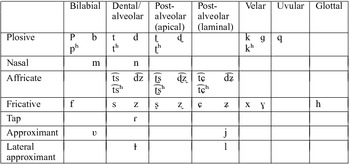

Khowar makes use of seven places of articulation, of which five (excluding the more marginally used uvular and glottal places) play a major contrasting role within its manner-of-articulation subsets. The plosives within the area labelled dental/alveolar have a distinctly dental, or even interdental, closure, whereas for the affricates and fricatives, the tongue touches the alveolar ridge near the upper row of teeth. The consonants belonging to this set all have, as far as we have been able to determine, an apical articulation.
Two of the columns are labelled postalveolar, emphasizing that the primary contrast is one between (retracted) apical and laminal articulations. Following a traditional treatment, the sounds in the apical postalveolar set are transcribed using the symbols for retroflexion, as they are often pronounced with the tongue slightly curled back, with the tip meeting the region posterior to the alveolar ridge. It should be noted, however, that the degree of retroflexion is lesser than that of many of the more well-known South Asian languages. As for the laminal postalveolar consonants, the closure, using the blade of the tongue, covers a larger area than that of the corresponding apical sounds, stretching from the alveolar ridge, or the area just posterior to it, to the palatal region; this is the reason we have chosen to represent the affricates and fricatives with symbols normally reserved for alveolo-palatal sounds.
While the occurrence of the sounds /f/, /q/, /x/, and /ɣ/, in most other Indo-Aryan languages, even in the surrounding region, is restricted to relatively recent (but pervasive) loans from Persian and Arabic, they occur in Khowar quite frequently also in native and basic vocabulary items (Bashir Reference Bashir, Bolton and Shafqat2007: 217), for example /qɑf/ ‘paw’, /lɔq/ ‘rags’, /ɣɑɫ/ ‘polo, game’ and /mɔx/ ‘face’. The plosive contrast /k/ vs. /q/ is well-established and consistently upheld, an areal feature of adjacent Central Asia rather than of South Asia and Indo-Aryan at large (Tikkanen Reference Tikkanen2008: 252–254). There is no corresponding velar–uvular contrast in the fricative set; instead, there is a wider articulatory scope of the fricatives /x/ and /ɣ/ listed in the velar column; they are often realized as [χ] and [ʁ], respectively.
The only unambiguous contrast in the nasal set is that between /m/ and /n/. Nasals with laminal postalveolar, apical postalveolar or velar places of articulation should probably be regarded as environmentally conditioned allophones of /n/. A palatal (or alveolo-palatal) allophone often occurs immediately preceding a laminal postalveolar affricate, /
 ɑn
ɑl/ [
ɑn
ɑl/ [
 ɲˈ
ɜl] ‘dispute’; a retroflex one preceding an apical postalveolar occlusive segment, /
ɲˈ
ɜl] ‘dispute’; a retroflex one preceding an apical postalveolar occlusive segment, /
 ʐɛn
ʐɛɾ/ [
ʐ
ʐɛn
ʐɛɾ/ [
ʐ
 ɳˈ
ʐɛːɾ] ‘chain’ (< Persian /zæn
ɳˈ
ʐɛːɾ] ‘chain’ (< Persian /zæn
 ʒir/); and a velar preceding a velar occlusive, /ɑnɡɑɾ/ [
ŋˈɡɑːɾ] ‘fire’. There are also some indications that retroflex assimilation may apply across entire syllables (and beyond), as in /ʈʰu
n/ [ʈʰ
ʒir/); and a velar preceding a velar occlusive, /ɑnɡɑɾ/ [
ŋˈɡɑːɾ] ‘fire’. There are also some indications that retroflex assimilation may apply across entire syllables (and beyond), as in /ʈʰu
n/ [ʈʰ
 ɳ] ‘pillar’ or /ʂɑnɑx/ [ʂ
 ˈɳɐx] ‘white-faced (cattle)’, an areal feature in line with the findings of Arsenault (Reference Arsenault2015). A plosive preceded by a nasal segment can be dropped when in coda position, as in /ɖɑnɡ/ [ɖ
ŋ] (also realized as [ɖ
ŋk]) ‘hard’.
ˈɳɐx] ‘white-faced (cattle)’, an areal feature in line with the findings of Arsenault (Reference Arsenault2015). A plosive preceded by a nasal segment can be dropped when in coda position, as in /ɖɑnɡ/ [ɖ
ŋ] (also realized as [ɖ
ŋk]) ‘hard’.
The placement in the table of the two contrasting lateral approximants is somewhat debatable. /l/ is either alveolar or postalveolar, and it is often slightly palatalized, whereas /ɫ/ is dental and velarized. Khowar has no retroflex flap in its inventory. Instead, /ɫ/ corresponds regularly to /ɽ/ in loans from e.g. Urdu: /ɡɑɫí/ ‘(wrist-)watch’ (< /ɡʱaɽi/). Although the Khowar orthography also makes use of the same symbol that signifies Urdu /ɽ/ for Khowar /ɫ/, it should be duly noted, as already pointed out by Bashir (Reference Bashir1988: 37–38), that the Khowar sound is not retroflex.Footnote 1
While /ɾ/ in careful speech indeed has a tap pronunciation, it shows a great deal of variation in connected speech, although we are not at this point able to systematically account for its allophonic variation. It is sometimes realized as an approximant [ɹ] and, especially word-finally, it is often wholly or partly devoiced, as in /tɑqɑt
dɑɾ/ [
 ɐqəˈ
ɐqəˈ
 ɑː
ɑː
 ] ‘powerful’.
The approximant /ʋ/ is mostly labiodental but has a rather wide articulatory range, including labiodental [ʋ] as well as bilabial [w] realizations. Apart from the lexically defined approximants /ʋ/ and /j/, occurring unambiguously mainly at word boundaries, [ʋ] and [j] may also be inserted epenthetically at syllable boundaries, to separate two vowels, /tʰuɛk/ [tʰuʋɛk]. The glottal fricative /h/ has a voiced allophone [ɦ], mostly occurring intervocalically.
We conclude that contrasts in voicing and aspiration are neutralized word- or utterance-finally, noted also by Endresen & Kristiansen (Reference Endresen and Kristiansen1981: 238). Therefore, no examples are shown in the table of voiced or aspirated plosives, affricates or fricatives in final position. We only have stable evidence of plosive sounds with a voiceless unaspirated realization in utterance-final environments. This process is also reflected through regular voicing and aspiration alternations in inflectional paradigms:

However, a reason for regarding the final sound of e.g. /pɑz/ ‘chest’ or /tʰɑɣ/ ‘new twig’ as underlyingly voiced, is the consistent lengthening of the vowel preceding it (see below) along with native-speaker intuition. Whether there are other acoustic traces of voicing or aspiration in de-voiced or de-aspirated items, and whether de-voicing or de-aspiration should be seen as gradual rather than complete (as seems to be what Baart (Reference Baart1997: 13–15) suggests for utterance-final de-voicing in Indo-Aryan Kalam Kohistani), remain pending questions.
The contrast between the voiced fricatives /z/, /ʐ/, /ʑ/ and their affricate counterparts /
z/, /
ʐ/, /
/ is marginal, partly allophonic, and far from uniform throughout the speaker community. Of these, the phonemic status of /
z/ seems particularly uncertain (Bashir Reference Bashir, Bolton and Shafqat2007: 237). The contrast is in any case neutralized following a nasal, an environment where only an affricate pronunciation occurs. We have found no examples of intervocalic /
z/ or /
ʐ/. While the evidence for a phonological contrast between voiceless unaspirated and voiceless aspirated affricates has been identified as weak (Endresen & Kristiansen Reference Endresen and Kristiansen1981: 239), our own acoustic data indicate significant phonetic differences between such segments across near-minimal pairs (as can be seen in Figure 2).
Spectrograms showing the unaspirated and aspirated affricates in the near-minimal pair /
 ɑnɡ/ ‘hug’ and /
ʰɑn/ ‘leaf’. The words are uttered in the middle of an identical sentence frame, /hɑmɔtɛ ___ ɾɛɾ/ ‘This is called ___’ (lit. ‘To this ____ he/she says’).
ɑnɡ/ ‘hug’ and /
ʰɑn/ ‘leaf’. The words are uttered in the middle of an identical sentence frame, /hɑmɔtɛ ___ ɾɛɾ/ ‘This is called ___’ (lit. ‘To this ____ he/she says’).

The segment of friction in the aspirated item is both longer in duration and of higher intensity, and there is a concomitant lowering of the f0 on the following vowel. However, some evidence seems to indicate that the realization of aspiration, at least with affricates, might be limited to stressed syllables (e.g. [dɾɔˈ
ʰɔ] ‘grapes obl’ and [ˈdɾɔ
ɑ] ‘grapes loc’ are the phonetic realizations of two case forms of /dɾɔ
ʰ/ ‘grapes’).
In the speech of the second author, the affricate vs. fricative contrasts, along with a three-way voicing and aspiration contrast, are consistently upheld in word-initial position, thus giving us a set of nine affricates, which is in line with previous reports (Munnings Reference Munnings1990b: 6) of the speech typical of Upper Chitral, i.e. the original homeland of the language.
Vowels


Khowar has five contrastive vowels. The chart represents target articulations of those, especially as they are realized in stressed positions. Unlike many other Indo-Aryan languages, nasalization is not distinctive, but any vowel adjacent to, particularly preceding, a nasal consonant becomes slightly nasalized. There is no evidence of duration as a primary contrast within the vowel system, although lengthening of vowels occurs concomitant with a few other phonological features (see below). The distinguishing features are front /i ɛ/ vs. back /u ɔ ɑ/; open /ɛ ɑ ɔ/ vs. close /i u/; and unrounded /i ɛ ɑ/ vs. rounded /u ɔ/. Our conclusion is therefore that the main distinguishing feature between /ɑ/ and /ɔ/ is roundedness rather than tongue position, further evidenced by the overlapping /ɑ/ and /ɔ/ tokens plotted in Figure 3.
Khowar vowels in F1 vs. F2 space. The measurements were those of vowels occurring in 64 vocabulary items uttered within an identical sentence frame (see Figure 2 caption) by one male speaker.

Each of the five vowels has a wider, and often overlapping, range of realizations in natural speech, as can be seen in Figure 3, where the measurements of F1 and F2 of individual vowels are plotted in a vowel space chart. Most of the vowels have more centralized allophones, particularly in unstressed syllables. In connected speech, vowels may also take on a breathy or rhotic pronunciation (see such cases in the narrow transcription of the recorded passage below), primarily as the result of assimilation with features of surrounding consonants.
Stress, tone and vowel duration
The placement of stress is lexically contrastive in Khowar. The most frequent stress pattern is one with main stress on the final syllable, but it may also fall on the penultimate (and possibly even the antepenultimate) syllable of an uninflected word (here marked with an acute accent).

The most prominent acoustic correlate of stress is pitch height or pitch change associated with the syllable nucleus, but it is often accompanied by greater intensity as compared with adjacent unstressed syllables. Differences in vowel duration or vowel quality, on the other hand, do not seem to bear any direct significance as far as stress is concerned, although, as we will elaborate on shortly, only vowels in stressed syllables can be subject to lengthening. Apart from making purely lexemic differentiations, stress placement can have derivational or inflectional functions (/ɡɑrúʈi/ ‘leprosy patient’ vs. /ɡɑr
uʈí/ ‘leprosy’; /
ʰέt
rɔ/ ‘field loc’ vs. /
ʰɛt
r
 / ‘field obl’). A minority group of affixes are lexically stressed. When more than one stressed morpheme occurs in a word, the main stress (normally) falls on the rightmost lexically stressed syllable.
Apart from stress, as described above, a number of items have a low tone, lexically assigned to a vowel (as previously noted by Morgenstierne Reference Morgenstierne1932: 49–50 and Bashir Reference Bashir, Bolton and Shafqat2007: 237). In those cases, stress is associated with the locus of the low tone (here marked with a grave accent), usually realized as a noticeably low-rising pitch throughout the vowel, the latter of significantly longer duration than vowels occurring in otherwise identical or analogous environments, as exemplified by the following non-low vs. low tone monosyllabic minimal pairs:

While Old Indo-Aryan had voiced aspirated consonants (Cardona & Jain Reference Cardona and Jain2003: 10), many of the descendant languages in the region, including Khowar, have lost those as distinctive segments. There is, however, a notable co-occurrence of a low tone with (preserved) voiceless aspiration in Khowar; and there is also the occurrence of a low tone in words that involved voiced aspiration in the ancestor language (Buddruss Reference Buddruss1982: 26–27), although with a far from total one-to-one mapping, e.g. /bàs/ ‘flame’ < Old Indo-Aryan bhāsá- ‘light’ (Turner Reference Turner1966: 9480); and /d
 n/ ‘ghee’ < *dhadan- < OIA dadhan- (Morgenstierne Reference Morgenstierne1932: 49). While in the speech of the second author, the only reflex of this historical voiced aspiration is the low-rising pitch, Morgenstierne (Reference Morgenstierne1932: 49–50) reported almost a century ago that there were traces of aspiration with voiced plosives in some varieties of the language.
Stress of this latter kind further stays on the tone-bearing unit of the root even when a normally stressed affix is added to it – as illustrated with the lexical item /d
n/ ‘ghee’ in its basic and inflected form, respectively, in Figure 4; this contrasts with the stress shift that /dɔn/ ‘tooth’ undergoes when inflected, as can be seen in Figure 5 – at least as far as we have been able to ascertain.
f0 in /d
n/ ‘ghee’ and /d
nɔ/ ‘ghee obl’, respectively.

f0 in /dɔn/ ‘tooth’ and /dɔn
/ ‘tooth obl’, respectively.

Apart from the significantly longer vowel duration concomitant with a low-rising pitch (as noted above), it has been suggested (Bashir Reference Bashir, Cardona and Jain2003: 843, Reference Bashir, Bolton and Shafqat2007: 237) that certain lexical items contain a (half-)long vowel with falling pitch and that Khowar therefore may be analysed (and represented) similarly to e.g. neighbouring Shina languages, in which the tone-bearing unit equals a vocalic mora (Radloff Reference Radloff1999: 57–88; Schmidt & Kohistani Reference Schmidt and Kohistani2008: 2 4–27; Liljegren & Haider Reference Liljegren and Haider2009: 385).Footnote
3
This analysis has not been confirmed in our study. Instead, we found that vowels are often pronounced with a longer duration if stressed (see Morgenstierne Reference Morgenstierne1955) and followed by a voiced consonant, particularly so in closed syllables with /ɾ/ or /ɫ/ in the coda. Such lengthened vowels may in addition display a (high-)falling pitch pattern, as in /kɑr/ [k
 ˑr] ‘ear’ and /ɣɑɫ/ [ɣ
ˑɫ] ‘polo, game’. As already mentioned, this is also the case when an underlyingly voiced consonant is subject to utterance-final devoicing, e.g. /pɑz/ [p
ˑs] ‘chest’. The only instance where we find it necessary to use two identical vowel symbols adjacent to one another in the representation of Khowar (phonological) words is when a vocalic morpheme is suffixed to a stem ending in an identical (stressed) vowel, thus creating a long stressed vowel, as in /ɑl
mɑɾíi/ [ɑl
mɑˈɾiː] ‘in the cupboard’ (< /ɑl
mɑɾí/ ‘cupboard’ + /i/ ‘loc’).
ˑr] ‘ear’ and /ɣɑɫ/ [ɣ
ˑɫ] ‘polo, game’. As already mentioned, this is also the case when an underlyingly voiced consonant is subject to utterance-final devoicing, e.g. /pɑz/ [p
ˑs] ‘chest’. The only instance where we find it necessary to use two identical vowel symbols adjacent to one another in the representation of Khowar (phonological) words is when a vocalic morpheme is suffixed to a stem ending in an identical (stressed) vowel, thus creating a long stressed vowel, as in /ɑl
mɑɾíi/ [ɑl
mɑˈɾiː] ‘in the cupboard’ (< /ɑl
mɑɾí/ ‘cupboard’ + /i/ ‘loc’).
Recorded passage
Broad transcription of the recorded passage

Narrow transcription of the recorded passage

Orthographic version

Acknowledgements
We would like to thank Joan Baart and the two anonymous reviewers for a number of valuable comments and suggestions. This work is part of the project ‘Language contact and relatedness in the Hindukush region’, supported by the Swedish Research Council (421-2014-631).



