





Introduction
Effective weed management is essential for minimizing corn yield loss due to weed interference (Alptekin et al. Reference Alptekin, Ozkan, Gurbuz and Kulak2023; Soltani et al. Reference Soltani, Dille, Burke, Everman, VanGessel, Davis and Sikkema2016, Reference Soltani, Shropshire and Sikkema2022; Tursun et al. Reference Tursun, Datta, Sakinmaz, Kantarci, Knezevic and Chauhan2016). Postemergence herbicide applications are widely used to mange weeds in corn across North America, and growers often co-apply multiple herbicides with different modes of action to increase the spectrum of weeds controlled and to manage herbicide-resistant biotypes (Basilio et al. Reference Basílio, Furtado Júnior, de Alvarenga, da Vitória, Vargas, Privitera, Caruso, Cerruto and Manetto2024; Carey and Kells Reference Carey and Kells1995; Evans et al. Reference Evans, Williams, Hager, Mirsky, Tranel and Davis2018; Fluttert et al. Reference Fluttert, Soltani, Galla, Hooker, Robinson and Sikkema2022; Willemse et al. Reference Willemse, Soltani, Benoit, Hooker, Jhala, Robinson and Sikkema2021a, Reference Willemse, Soltani, Benoit, Jhala, Hooker, Robinson and Sikkema2021b). Spray additives such as surfactants, oils, and drift reduction agents are commonly added to enhance herbicide performance and reduce off-target movement (Brankov et al. Reference Brankov, Vieira, Alves, Zaric, Vukoja, Houston and Kruger2023; Harbour et al. Reference Harbour, Messersmith and Ramsdale2003; Hewitt Reference Hewitt2024; Langdon et al. Reference Langdon, Soltani, Raeder, Robinson, Hooker and Sikkema2020).
Herbicides with isoxaflutole as the active ingredient are often co-formulated with the safener cyprosulfamide and are used in corn production because of their broad-spectrum weed control and flexible application timing including preplant, preemergence, and early postemergence application timings (Bayer 2017; Robinson et al. Reference Robinson, Soltani, Shropshire and Sikkema2013; Stephenson and Bond Reference Stephenson and Bond2012; Willemse et al. Reference Willemse, Soltani, Benoit, Hooker, Jhala, Robinson and Sikkema2021a; Zhao et al. Reference Zhao, Zuo, Li, Guo, Liu and Wang2017). Isoxaflutole is frequently co-applied with atrazine to increase the spectrum of weeds that can be controlled, and increase the level, speed, and consistency of weed control.
Adjuvants can improve herbicide retention on the leaf surface. Activator adjuvants help the herbicide penetrate the leaf surface, whereas drift reduction agents increase droplet size to reduce the chance of the herbicide moving away from the target area (Hatzios and Penner Reference Hatzios and Penner1985; Idziak et al. Reference Idziak, Sobczak, Waligora and Szulc2023; Kudsk and Mathiassen Reference Kudsk and Mathiassen2007; Legleiter et al. Reference Legleiter, Butts, Essman, Ikley, Lancaster and Werle2024; Penner Reference Penner2000; Yao et al. Reference Yao, Myung, Wang and Johnson2014). However, these effects may also lead to increased herbicide retention and absorption by the crop, particularly under conditions that favor rapid absorption, and increase the risk of crop injury (Brankov et al. Reference Brankov, Vieira, Alves, Zaric, Vukoja, Houston and Kruger2023; Deveau Reference Deveau2025; Holloway et al. Reference Holloway, Ellis, Webb, Western, Tuck, Hayes and Miller2000; Legleiter et al. Reference Legleiter, Butts, Essman, Ikley, Lancaster and Werle2024). In Ontario, the activator adjuvant HiActivate (WinField United Canada 2019) and the drift reduction agent InterLock (WinField United Canada 2007) are used in mixtures with some corn herbicides, but the impacts of these combinations on corn injury and yield have not been fully investigated under Ontario environmental conditions;. The overuse of spray additives in herbicide mixtures has the potential to lead to unintended consequences such as corn injury and yield loss (Barbieri et al. Reference Barbieri, Young, Dayan, Streibig, Takano, Merotto and Avila2023; Das et al. Reference Das, Behera, Nath, Ghosh, Sen, Raj and Pramanik2024; Ozkan Reference Ozkan2017).
Corn sensitivity to postemergence herbicides depends on growth stage, because herbicides applied at more advanced growth stages can increase herbicide interception and may coincide with periods of rapid vegetative growth resulting in greater crop injury (Kudsk Reference Kudsk2017; Kudsk and Mathiassen Reference Kudsk and Mathiassen2007; Maciel et al. Reference Maciel, Silva, Helvig, Oliveira Neto, Guerra, Sola Júnior and Karam2018; Metzger et al. Reference Metzger, Soltani, Raeder, Hooker, Robinson and Sikkema2019). Corn injury caused by isoxaflutole appears as bleaching, chlorosis, necrosis, and stunting and is often transient; however, yield reductions can occur if stress coincides with environmental stress or occurs at sensitive growth stages (Bradley Reference Bradley2009; Hager Reference Hager2012; Johnson et al. Reference Johnson, Young and Matthews2002; Metzger et al. Reference Metzger, Soltani, Raeder, Hooker, Robinson and Sikkema2019; Richburg et al. Reference Richburg, Norsworthy, Barber, Roberts and Gbur2020).
Visible corn injury was reported following early postemergence applications of complex tank mixtures that contain multiple herbicides, the activator adjuvant HiActivate, and the drift reduction agent InterLock. Limited published information exists regarding the effect of these multi-component tank mix combinations on corn injury and yield, when applied at different vegetative growth stages. A better understanding of the risks associated with mixture composition and application timing is needed to guide weed management decisions in corn production systems.
Thus, the main objective of this research was to evaluate mixtures containing different herbicides plus two spray additives applied at the V2 to V3 and V3 to V4 growth stages on visible corn injury, height, biomass, and grain yield.
Materials and Methods
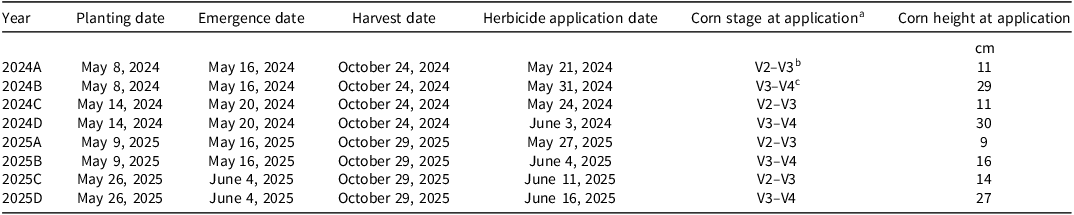
Eight field trials were conducted between 2024 and 2025 near Ridgetown, Ontario, Canada. The trials were arranged as a randomized complete block design with four replications in 2024 and three replications in 2025. Information on corn planting, emergence, and harvest dates, and herbicide application dates are presented in Table 1. The soil was conventionally tilled, and corn was planted between mid-May to early June at a rate of approximately 83,500 seeds ha−1 to a depth of 5 cm. Glyphosate-resistant corn hybrids DKC39-97 and DKC39-93 were planted in 2024 and 2025, respectively. The plots were 3 m wide (four corn rows spaced 75 cm apart) and 8 m long.
Corn agronomic and herbicide application data for the eight experiments.

Table 1. Long description
The table presents data on corn planting, emergence, and harvest dates, as well as herbicide application dates for eight field trials. It includes information on the year, planting date, emergence date, harvest date, herbicide application date, corn stage at application, and corn height at application in centimeters. The table has eight rows and seven columns, with each row representing a different trial. Notable trends include consistent planting and emergence dates within each year, with variations in herbicide application dates and corn stages. The corn height at application varies significantly across different trials and years.
a Crop growth stage is based on the criteria described by Williams et al. (1999). The V2 stage occurs when two collars are visible; V3 means three collars are visible; V4 means four collars are visible.
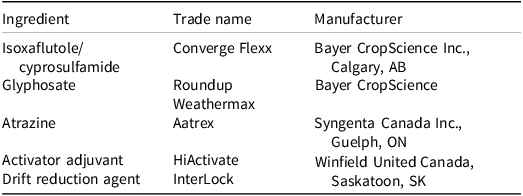
The complete experimental area was maintained weed-free with pendimethalin (Prowl H2O, 1,680 g ai ha−1; BASF Agricultural Solutions Canada Inc., Calgary, AB) + dicamba/atrazine (Marksman, 1,800 g ai, ha−1; BASF Canada) applied preemergence followed by hand weeding as needed. Herbicide active ingredients, trade names, and manufacturers are presented in Table 2.
Active ingredients and adjuvants used in the study.

Table 2. Long description
The table contains three columns: Ingredient, Trade name, and Manufacturer. It has six rows, each detailing a specific active ingredient or adjuvant used in the study. The ingredients listed include Isoxaflutole, Cyprosulfamide, Glyphosate, Atrazine, Activator adjuvant, and Drift reduction agent. The corresponding trade names are Converge Flexx, Roundup, Weathermax, Aatrex, HiActivate, and InterLock. The manufacturers are Bayer CropScience Inc., Calgary, AB; Bayer CropScience; Syngenta Canada Inc., Guelph, ON; and Winfield United Canada, Saskatoon, SK.
The treatments as listed in Table 3 were applied to corn at the V2 to V3 or V3 to V4 growth stages using a CO2-pressurized backpack sprayer equipped with a hand-held boom containing three ULD-120-02 (Pentair Canada Inc., Cambridge, ON) nozzles spaced 50 cm apart producing a spray width of 1.5 m at an operating pressure of 207 kPa that was calibrated to deliver a spray volume of 200 L ha−1 to reflect common regional practice for postemergence applications. Application dates are presented in Table 1.
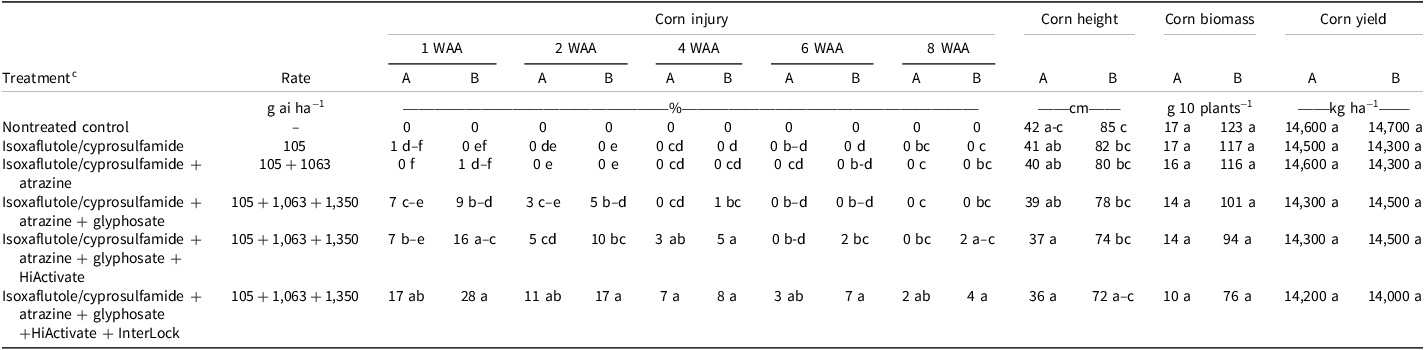
Visible corn injury, height, biomass, and yield as affected by herbicide treatments applied at the V2–V3 stage or the V3–V4 stage from eight field experiments in 2024 and 2025. a , b

Table 3. Long description
The table presents data on corn injury, height, biomass, and yield affected by different herbicide treatments applied at the V2 to V3 or V3 to V4 growth stages. It includes measurements taken at 1, 2, 4, 6, and 8 weeks after application (WAA), corn height in centimeters, corn biomass in grams per 10 plants, and corn yield in kilograms per hectare. The table has 9 rows and 14 columns, with treatments listed in the first column and various metrics in the subsequent columns. Notable trends include variations in corn injury percentages and yield impacts across different treatments and time points. Units of measurement include percentage for injury, centimeters for height, grams per 10 plants for biomass, and kilograms per hectare for yield.
a Abbreviations: A, mixture applied to corn at the V2–V3 stage; B, mixture applied to corn at the V3–V4 stage; WAA, weeks after application.
b Means followed by the same letter within each variable column are not statistically different based on the Tukey HSD test (P < 0.05).
c Preformulated mixtures are indicated using “/” whereas separate products in mixture are indicated using “+”. HiActivate (an activator adjuvant) was applied at 500 mL L−1. InterLock (a drift reduction agent) was applied at 150 mL L−1.
Weed control efficacy was not evaluated in this study, and while this limited the ability to fully assess agronomic performance, the focus was intentionally placed on quantifying corn response to the treatments evaluated. Visible corn injury was assessed at 1, 2, 4, 6, and 8 wk after herbicide application (WAA) on a scale from 0% to 100%, with 0% being no visible injury and 100% being complete plant death. Corn height in centimeters and biomass were assessed at 2 WAA. Corn height was determined by measuring the extended leaf height of 10 randomly selected corn plants per plot; the average height in centimeters was recorded. Corn biomass was determined for another 10 randomly selected plants per plot by cutting the corn plants at the soil surface and placing them into paper bags. The bags were then placed in a dryer for 2 wk at 60 C. The contents of the bags were then weighed using an analytical scale, and the dry biomass was recorded. At corn harvest maturity the center two rows of each plot were harvested using a small-plot combine; the weight and moisture content were recorded. Corn yield was adjusted to 15.5% moisture.
Statistical analysis was completed using GLIMMIX, a mixed model analysis of variance, with SAS software (v.9.4; SAS Institute Inc., Cary, NC). Data from 2024 and 2025 sites were combined for analysis. The main fixed effects of the model include treatment, application timing, and treatment by application timing, whereas the main random effects include block, replication by year, and replication by year within block. Significance of fixed effects was verified by assessing Type III fixed effects and random effects were assessed using a COVTEST statement for each random effect. The analysis determined a significant interaction between treatment and timing; therefore, treatment means are separated by application timing (Table 3). The COVTEST indicated no significant contribution of variation from random effects, therefore the data across all site-years were pooled. The assumptions of ANOVA were met by plotting the residuals against predicted treatment, timing, year, replication, and block. The Shapiro-Wilk test statistic was verified to ensure the data fit a normal distribution. Crop injury data at all time points were transformed using the arcsine square root transformation and back transformed for presentation. Data from the untreated control was removed for analysis of crop injury at all time points. Data for all other parameters were fitted to a normal distribution. A significance level of P = 0.05 was used to separate treatments using the Tukey HSD test.
Results and Discussion
Visible Corn Injury
Visible estimates of corn injury generally increased as more herbicides were combined in the mix, and the severity of injury also depended on when the mixture was applied (Table 3). Isoxaflutole, applied alone or in combination with atrazine, at the V2–V3 and V3–V4 leaf stages caused minimal visible corn injury across all evaluation timings (1, 2, 4, 6, and 8 WAA), with ≤1% injury observed at 1 WAA and no injury observed at 2, 4, 6, and 8 WAA, which is consistent with previous research that has shown acceptable corn tolerance to isoxaflutole + atrazine when applied early postemergence (Benoit et al. Reference Benoit, Soltani, Hooker, Robinson and Sikkema2019; Robinson et al. Reference Robinson, Soltani, Shropshire and Sikkema2013; Stephenson and Bond Reference Stephenson and Bond2012; Willemse et al. Reference Willemse, Soltani, Benoit, Hooker, Jhala, Robinson and Sikkema2021a, Reference Willemse, Soltani, Benoit, Jhala, Hooker, Robinson and Sikkema2021b; Zhao et al. Reference Zhao, Zuo, Li, Guo, Liu and Wang2017).
Isoxaflutole + atrazine + glyphosate applied at the V2–V3 and V3–V4 stages of corn, caused 7% and 9% injury at 1 WAA and 3% and 5% injury at 2 WAA, respectively; however, little to no injury (≤1%) was observed at 4, 6, and 8 WAA (Table 3). Even though glyphosate is safe for use on glyphosate-resistant corn, the adjuvant in commercial glyphosate formulations can increase the absorption of the tank mix partners resulting in greater injury under some environmental conditions (Armel et al. Reference Armel, Wilson, Richardson and Hines2003; Duke and Carvalho Reference Duke and Carvalho2025; Soltani et al. Reference Soltani, Shropshire and Sikkema2018).
Isoxaflutole + atrazine + glyphosate + HiActivate applied at the V2–V3 and V3–V4 stages, caused greater and more persistent visible corn injury, with 7% and 16% injury observed at 1 WAA; 5% and 10% injury at 2 WAA; 3% and 5% injury at 4 WAA; 0% and 2% injury at 6 WAA; and 0% and 2% injury at 8 WAA, respectively (Table 3). Similar increases in herbicide injury associated with adjuvant inclusion in herbicide mixtures previously have been reported and attributed to enhanced herbicide retention and absorption by the crop (Brankov et al. Reference Brankov, Vieira, Alves, Zaric, Vukoja, Houston and Kruger2023; Holloway et al. Reference Holloway, Ellis, Webb, Western, Tuck, Hayes and Miller2000; Legleiter et al. Reference Legleiter, Butts, Essman, Ikley, Lancaster and Werle2024).
The greatest injury occurred with the multi-component mixture, which included three herbicides, HiActivate, and InterLock (Table 3). Isoxaflutole + atrazine + glyphosate + HiActivate + InterLock, applied at the V2–V3 and V3–V4 stages, resulted in 17% and 28% visible corn injury at 1 WAA; 11% and 17% injury at 2 WAA; 7% and 8% injury at 4 WAA; 3% and 7% injury at 6 WAA; and 2% and 4% injury at 8 WAA, respectively. Researchers have noted that the increased and prolonged visible corn injury may be attributed to improved herbicide retention, increased herbicide absorption, and reduced/delayed herbicide metabolism (Hatzios and Penner Reference Hatzios and Penner1985; Kudsk and Mathiassen Reference Kudsk and Mathiassen2007; Penner Reference Penner2000; Yao et al. Reference Yao, Myung, Wang and Johnson2014). Even though drift reduction agents are generally considered safe for crops, their use in multi-component mixtures has the potential to increase herbicide absorption (Brankov et al. Reference Brankov, Vieira, Alves, Zaric, Vukoja, Houston and Kruger2023; Holloway et al. Reference Holloway, Ellis, Webb, Western, Tuck, Hayes and Miller2000; Legleiter et al. Reference Legleiter, Butts, Essman, Ikley, Lancaster and Werle2024). The response observed is not necessarily unique to the specific adjuvants evaluated, because other drift reduction agents and surfactants with similar chemistries may produce comparable effects.
Across all treatments, herbicide mixtures applied at the V3–V4 stage consistently caused greater visible corn injury than when applied at the V2–V3 leaf stage of corn. This suggests that corn sensitivity to multi-component mixtures increases with delayed herbicide application, most likely due to increased spray interception, retention, and absorption (Metzger et al. Reference Metzger, Soltani, Raeder, Hooker, Robinson and Sikkema2019; Silva 2018).
Corn Height and Biomass
All treatments applied at either growth stage did not cause a significant reduction in corn height or biomass (Table 3). There was a concomitant stepwise numeric decrease in both plant height and biomass with the addition of herbicide and adjuvants, but the differences were not statistically significant at both application timings (Table 3).
Corn Yield
Grain yield was not affected by any of the treatments applied at either growth stage (Table 3). Yield ranged from 14,000 to 14,700 kg ha−1 and did not differ from the control (Table 3). This is similar to other studies in which early season corn injury caused by herbicides does not always affect vegetative growth beyond the initial injury period and corn yield at harvest (Miller et al. Reference Miller, Barber, Bond, Steckel, Stephenson, Foster, Butts and Kouame2024; Richburg et al. Reference Richburg, Norsworthy, Barber, Roberts and Gbur2020).
Although there was no statistical decrease in corn yield in this study, persistent visible corn injury may still be of concern to growers, particularly in seasons where corn may experience additional stress caused by cold or hot temperatures, drought or excessive moisture, insect damage, disease injury, and/or nutrient deficiencies (Bradley Reference Bradley2009; Hager Reference Hager2012; Landau et al. Reference Landau, Hager and Williams2021; Lingenfelter Reference Lingenfelter2024). Under such conditions, the risk of yield loss associated with mixtures with multiple active ingredients can be significantly greater.
This research concludes that corn tolerance to early postemergence applications of herbicides was influenced by the active ingredients in the mix and application timing. Visible estimates of crop injury generally increased as additional herbicides and adjuvants were included in the mixture, with the greatest and most persistent injury occurring when mixtures that contained HiActivate and InterLock were applied at the V3 to V4 leaf stage. In contrast, isoxaflutole applied alone or combined with atrazine resulted in minimal injury regardless of application timing. Greater early season injury was observed when more complex mixtures were applied, but plant height, biomass, and corn grain yield were not significantly affected by any treatment. Based on these results, early season injury from mixtures with multiple active ingredients was transient and corn recovered under the environmental conditions of this study. However, the consistent increase in corn injury associated with later application timing and the inclusion of HiActivate and InterLock shows the importance of carefully evaluating multi-component mixtures with postemergence herbicides when being applied to corn. Future research should evaluate whether the added complexity of mixtures delivers sufficient gains in weed control to warrant the higher input costs and increased risk for crop injury. It is also important to assess the specific active ingredients and sites of action that contribute to this complexity to determine whether certain combinations pose a greater risk of injury than others.
Practical Implications
Corn tolerance varies with herbicide mixture composition and application timing. Early postemergence corn injury increases with the inclusion of additional active ingredients and adjuvants, particularly when HiActivate and InterLock are used in combination with isoxaflutole, atrazine, and glyphosate, and when mixtures are applied at the V3 to V4 leaf stage. Observed injury was transient and did not significantly affect plant height, biomass, or grain yield under the conditions of this study.
Applying herbicide mixtures that contain multiple active ingredients and adjuvants at the V2 to V3 growth stage generally reduced the severity and persistence of injury compared with herbicides applied at the V3 to V4 growth stage. Based on the results of this study, we advise growers to consider simplifying the herbicide mixtures they apply to a corn crop, applying the mixture earlier, and including multiple adjuvants only when the benefit to weed control outweighs the risk of transient injury.
Acknowledgments
We gratefully acknowledge Christy Shropshire for her valuable technical assistance.
Financial support
Partial funding for this study was provided by the Grain Farmers of Ontario, Winfield United Canada, and the OMAFA Alliance.
Competing interests
The authors report they have no conflicts of interest related to this study.

 Open access

