




Around twenty cyclists from India embarked on long and arduous intercontinental journeys between 1923 and 1942 individually or in groups.Footnote 1 The riders frequently received considerable media attention while en route and enthusiastic receptions when they arrived back home (see Figure 1). Many of these ‘globe cyclists’, as they were often referred to by the Indian press, later wrote media articles and longer travelogues about their expeditions.Footnote 2 Some of these found wide readership and inspired generations of South Asian cyclists and globetrotters. This article examines the narratives of these long-distance cycling expeditions to argue that these journeys can illuminate new histories of the bicycle’s socio-cultural impact beyond the west, the self-fashioning of Indian cyclotourists as an example of complicit masculinity, and world tours as a novel form of anti-imperial counter-mobility. It does so by drawing on several historiographical subfields that have hitherto rarely been mobilized together, namely the histories of sports, masculinity, colonialism and decolonization, tourism, and (everyday) technology.
The three remaining members of Adi Hakim’s expedition with their bicycles are received by an enthusiastic crowd in Bombay in March 1928 after four and a half years on the road. Note the quasi-military Scout outfit of the riders! (Source: Hakim et al., With Cyclists around the World, n.p.)

Our account will focus pars pro toto on the tours of Adi Hakim, Jal Bapasola, and Rustom Bhumgara, who took their trip as a team from October 1923 to March 1928, and Ramnath Biswas, who made three separate world excursions of about two years each, between 1931 and 1940. The first group was chosen for two reasons: they pioneered the new trend, and their co-authored travelogue provides rich insights; and all three riders were Parsis, the South Asian ethno-religious group that was disproportionally over-represented in extreme distance cycling endeavours.Footnote 3 Our second case study examines the journeys of the left leaning Bengali Ramnath Biswas. Apart from the fact that he was an incredibly inventive writer, as a Bengali, Biswas represents the second most prolific community of South Asian globe cyclists. Furthermore, due to his contacts with anti-colonial organizations and radical revolutionary beliefs, his writings provide an interesting contrast to the moderately patriotic Parsi group. Long-distance tours by other Indian cyclists during the same period will be occasionally referenced to round off the picture.
These sportive exploits took place in the two decades before the end of British rule in 1947, which was a time of intense anti-colonial agitation in India. As a result, both the riders’ own writings as well as media reports in India and abroad on their tours were strongly over-determined by the contexts of colonialism, anti-colonialism, and decolonization, with nationalist masculinity representing another recurring trope. The cyclists themselves, as well as the Indian press and several political leaders who commented on their remarkable feats, hailed them as living proof of Indian manliness and fortitude. The Indian National Herald celebrated the return of Adi Hakim’s team in March 1928 by emphasizing that the ‘heroes of the day’ had ‘brilliantly served their country’, demonstrating that ‘India [was] as capable as other countries of producing young men of adventurous spirit’.Footnote 4 In a similar vein, nationalist leader and future prime minister Jawaharlal Nehru expressed the hope that the globe cyclists would inspire the young men of India to ‘do great deeds’.Footnote 5 Such statements acquired a particular anti-colonial connotation considering that South Asians were denied the supposedly ‘male’ qualities of physical prowess, courage, self-reliance and persistence that the globe cyclists embodied. This denial was a keystone of the powerful colonial stereotypes and discourses legitimizing British colonial rule in the Indian subcontinent.Footnote 6
In recent years, scholars have explored the topic of recovering Indian masculinities in the context of Indian nationalism during the early twentieth century through the practice of various sports and physical activities ranging from football to wrestling and scouting. Yet, they have largely overlooked the appropriation of the bicycle as a tool in the service of Indian nationalism and anti-colonialism more broadly.Footnote 7 This is surprising since the quasi-political instrumentalization of the bicycle by patriotic South Asians as a liberating tool of masculine self-empowerment and autonomy fits in well with the wider history of the bicycle. Especially during the peak years of the bicycle boom in Europe and North America in the 1890s and early 1900s, the ‘intensely modern object that accelerated personal mobility’ played an emancipatory role that extended to the field of politics, continuing into the interwar years.Footnote 8 Thus, the Swedish Democratic Workers’ Party was known to encourage the cycling community in a social advocacy role and to promote their idea of democracy and sociability.Footnote 9 Similarly, the Parti Communiste Français tried to exploit the working-class passion for cycling by presenting the cycle-commuting labourer as the ideal French worker.Footnote 10 In Italy, cycling arguably stimulated a sense of mass participation in the nation and acted as a context for making nationalist claims about the country’s position in the hierarchy of European nations.Footnote 11 This article examines this well-established connection between nationalism, politics, physical prowess, and sport in an extra-European context by surveying the experiences of selected Indian globe cyclists.
Whereas the first part of the article provides an overview of the bicycle’s co-option into projects of self-empowerment more generally, the second part examines the man-making dimension of the long-distance bicycle expeditions by South Asians in the interbellum. Our study of the close relationship between globetrotting on two wheels and masculinity builds on the attribution of endurance and risk-taking as quintessential traits of such tours in the literature on western cyclotourism in the interwar years.Footnote 12 One of the key arguments in this scholarship is the suggestion that endurance feats such as the strenuous cycling adventures of the Australian Hubert Opperman reinvigorated and reassured a nation insecure about their physical and moral conditions.Footnote 13 In this context, we make several important claims. Modifying the existing historical account of bicycles as a tool of western techno-modernity, we argue that the vehicles were no longer primarily associated with modernization and colonial oppression in the 1920s and 1930s. In this period, i.e., more than three decades after their introduction to the Indian subcontinent as mass products, they were instrumentalized by South Asians for political purposes.Footnote 14 Our two case studies aim to draw attention to the contradictions in this appropriation of the bicycle as a tool of self-empowerment and especially the use of extreme long-distance tours by patriotic Indians as proof of Indian masculinity, contending that it often involved the uncritical reproduction of established imperial tropes and images. Using a concept coined by R.W. Connell and James W. Messerschmidt, we suggest that the self-fashioning of the Indian riders can be understood as an example of a ‘complicit masculinity’, which, though not openly accepting the norms of the hegemonic (imperial) variety of masculinity, ‘yet, through practice … helped sustain’ it.Footnote 15
The third part focuses on our protagonists’ attempts at ‘world-making’ and advances a set of arguments in conversation with the historiography of travel and mobility. We argue that the global journeys facilitated by this affordable means of locomotion represented an entirely novel form of non-labour related movements by colonized Asians. The study of the selected Indian travelogues provides an opportunity to reassess a general argument made in the literature on European cycling that the machine offered more flexibility and independence of travelling and greater sensory experience of the route than trains and cars.Footnote 16 Echoing a phrase coined by Gijs Mom,Footnote 17 we propose the label ‘touristic anti-imperialism’ for this particular form of mobility that prefigured some political aspects of non-western leisure travelling during the age of decolonization in the 1950s and 1960s.Footnote 18
Unlike established acceptable forms of non-western elite movement by Indian princes, students, and businessmen, the racialized imperial world order saw the unhindered mobility of ‘subaltern’ colonial subjects during the heyday of anti-colonial agitation in the west as potentially disturbing and dangerous.Footnote 19 In fact, in the interwar years, western states, empires, and settler colonies intensified their attempts to curb or at least channel such mobilities through stricter migration laws, border regimes and identification practices.Footnote 20 Recent research has demonstrated that British India was no exception in this regard.Footnote 21 The highly individualistic form of mobility enabled by the bicycle (and the allegedly close and ‘authentic’ experience of the regions in which one travelled) was particularly hard to control. Inspired by a concept developed by cultural geographers Derek H. Alderman and Joshua Inwood, we would like to propose that the touristic anti-imperialism expressed in the global bicycle tours of colonial subjects from British India can be interpreted as a ‘countermobility’ of sorts.Footnote 22 The Indian globe cyclists were fully aware of the ubiquitous restrictions and harassments they would encounter and their protracted journeys therefore arguably constituted a form of ‘movement as anti-imperial praxis’.Footnote 23 Their writings can be retrospectively categorized as a counter-hegemonic project of promoting a progressive identity politics and reclaiming selfhood.Footnote 24 We need to emphasize here, too, that this anti-imperial strategy was not an entirely unproblematic form of ‘writing back’, fraught as it was with tensions and contradictions. As we shall presently see, the use of condescending language or stereotypical images when describing certain populations in Africa and Asia as backward or ‘uncivilized’ partly undermined the political agenda of the South Asian globe cyclists.
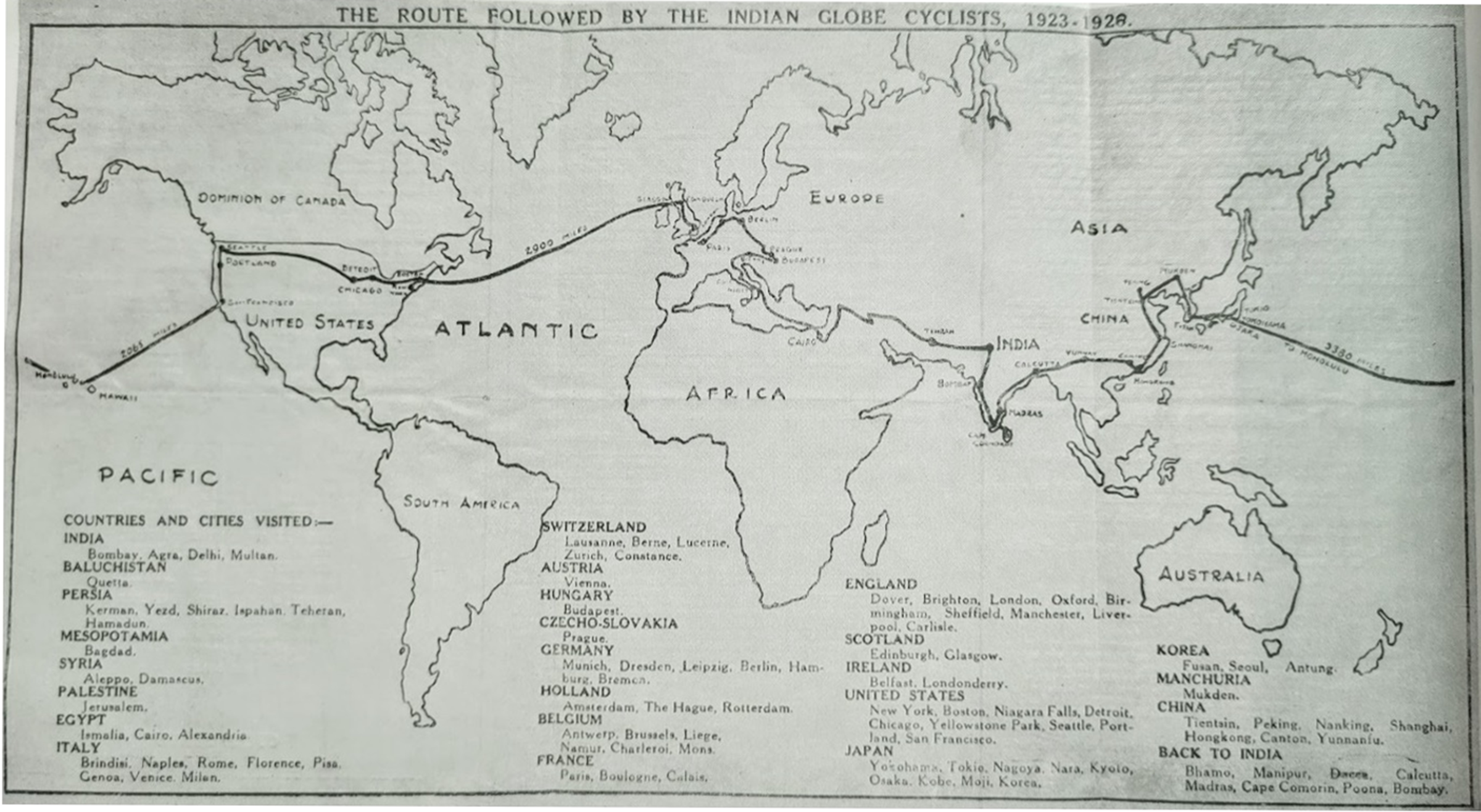
This article draws to a large extent on the accounts of its protagonists. The Parsi expedition led by Adi Hakim initially comprised six members when it left Bombay on 15 October 1923, equipped, amongst other things, with ‘a complete camera outfit, a doctor’s dispensary on a miniature scale [and] an enormous number of maps and charts of all imaginable countries’.Footnote 25 They completed their 70,000 kilometres tour du monde through twenty-seven countries in four years, five months and five days (see itinerary in Figure 2). From Bombay, they rode north to Delhi and then continued their journey through the mountainous terrain of Baluchistan further into Persia and Iraq. About half a year later, the group separated in Damascus due to personal tensions and eventually only three riders completed the journey. As their route was ‘deliberately planned to include the most difficult overland desert journey’, they subsequently passed through the Syrian Desert and Sinai Peninsula.Footnote 26 From Port Said, they took a ferry to Brindisi and then traversed Italy, Switzerland, Austria, Hungary, Czechoslovakia, Germany, the Netherlands, Belgium, and France. Next, they crossed the Channel and stayed for several months in the United Kingdom, especially in London, where they were hosted by members of the local Parsi community.Footnote 27 From Ireland, they boarded an ocean liner to New York and spent the next few months criss-crossing the United States. From San Francisco, they reached Japan by boat via Hawaii, and from there, they eventually returned to their home country passing through Korea, China, French Indochina, Siam, Burma, and Ceylon.
Map of the route covered and list of the countries visited by the three Parsi cyclists - Hakim, Bapasola and Bhumgara - during their word tour from October 1923 to March 1928. (Source: Hakim et al., With Cyclists around the World, n.p.)
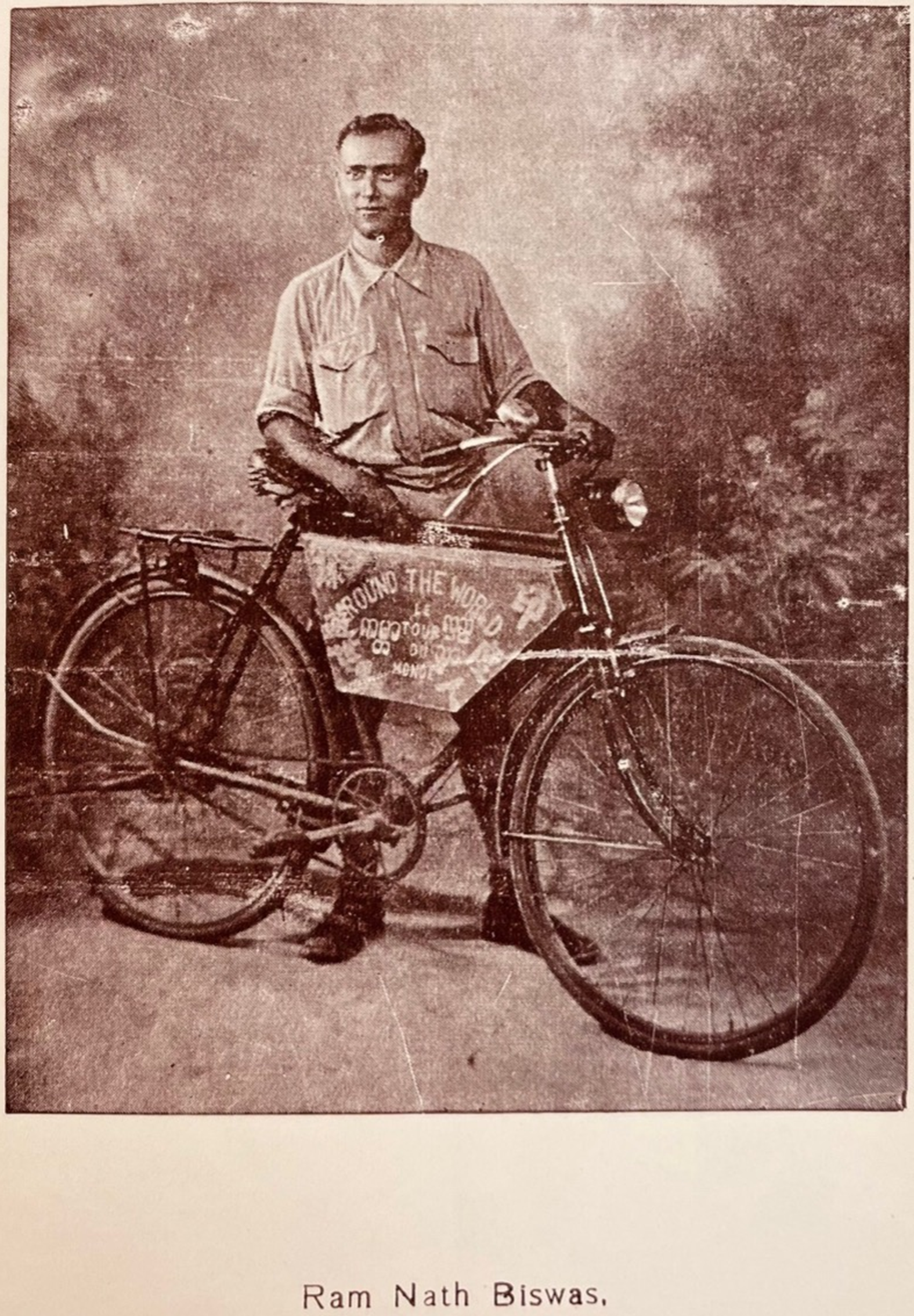
Ramnath Biswas was a clerk at the Singapore port in 1931 when he started out on a journey that took him to Malaya, Siam, Indochina, China, Korea, Japan, Canada, the Philippines, and Indonesia, before returning to Singapore in 1933. In 1935-37, he embarked on a second trip, travelling in Burma, Afghanistan, Iran, Iraq, Syria, Lebanon, Turkey, Bulgaria, Yugoslavia, Hungary, Austria, Czechoslovakia, Germany, Holland, Belgium, France, and Britain. In 1938, he made a third trip to Kenya, Uganda, Tanganyika, Nyasaland, North and South Rhodesia, East Africa, South Africa, the US and Canada, concluding his journey in 1940 (see Figure 3).
Map of the routes covered during Ramnath Biswas’ second and third expeditions undertaken between 1936 and 1940. Note that unlike the Parsis Biswas has chosen an Asia-centred and not a Eurocentric map. (Source: Ramnath Biswas, Ajker America (America Today) (Parjatak Prakashana Bhawan, 1945), n.p.

The three Parsi riders penned a 430-page travelogue in English, describing every single stage of their journey in minute detail. It needs to be emphasized that Hakim, Bapasola, and Bhumgara depict their journey largely as a collective experience. Their entire account presents their adventures in the saddle and their perception of various parts of the world as an almost monolithic narrative and there is surprisingly little space for individual nuances and viewpoints. Ramnath Biswas tended to prioritize making political statements and comments on the particular social and cultural constellations he encountered en route before narrating his own personal experiences. A prolific writer, he published thirty-nine travelogues and novels in Bengali and English as well as a ‘Lonely Planet’ guide of sorts, with practical tips for non-elite Indian globetrotters on a shoestring budget, who planned to travel abroad by bike or on foot.Footnote 28 Alongside this, he wrote articles in the popular Calcutta daily Anandabazar Patrika and the periodicals Prabartak and Desh.Footnote 29 His Bengali publications, in particular, provide rare non-elite accounts of South Asian travel experiences, as they were written to translate the world to a vernacular readership that came, like himself, mostly from a humble educational background.Footnote 30
The bicycle and the quest for self-empowerment
Historians of Europe and North America have persuasively argued that the bicycle emerged as a ‘machine of empowerment’ and even as a symbol of modernity itself during the era of the short-lived cycling craze from the 1890s to the early 1900s.Footnote 31 From an elite activity, cycling soon became part of male upper class and upper middle class forms of ‘respectable recreation’ between the late 1860s and early 1890s.Footnote 32 Canadian scholar Glen Norcliffe has shown how bourgeois men developed various forms of ‘a decidedly masculine cycling ethos’ during these years.Footnote 33 Precepts regarding the appropriate attire, posture, and riding behaviour were all part of this code.Footnote 34 Once the dangerous ‘ordinary bike’ was increasingly ousted by the so-called safety bike (i.e. a bicycle with pneumatic tyres and two wheels of exactly the same size) in the 1890s, the new sport gained a much wider popularity.Footnote 35 As Dutch sociologist Harry Oosterhuis has aptly observed, the ‘two-wheeled freedom machine’ was fostering ‘self-autonomy’.Footnote 36 The first societal group to realize this were ‘progressive’ women in western countries. Around the turn of the twentieth century, the pushbike came to be widely considered an ‘empowerment machine’ for female riders and it was increasingly identified with bloomer-wearing suffragists.Footnote 37 When bicycles became more affordable shortly thereafter, they performed a similar liberating function for both male and female members of the working classes, who were now also sharing the privilege of spatial mobility, enjoying, for example, recreational weekend trips to the countryside.Footnote 38 Most importantly for our case study, adopting the new vehicle blurred not only gender and social but also racial boundaries. In the American South, for instance, an aspiring segment of African Americans embraced the bicycle as an important element of their wider strategy to challenge the assumptions underlying Jim Crow legislation. In the early 1900s, cycling became a key component of their ostentatious self-fashioning as modern and respectable middle-class men.Footnote 39
While the bicycle was thus increasingly adopted by emancipated women and ‘marginal men’, the ‘hegemonic masculine’ image of cycling did not disappear. Indeed, it was further reinforced in Europe, and the Americas, when professional cycling competitions and particularly extreme long-distance racing became spectacles celebrating a new ideal of a decidedly modern masculinity.Footnote 40 This new masculine ideal was crucially defined by speed, an obsession with records and the performance of almost superhuman feats, driven by typical working-class values of endurance and stubborn unwillingness to accept physical limitations and boundaries.Footnote 41 The rising popularity of professional road cycling, and particularly the emergence of the national multi-stage races such as the Tour de France and the Giro d’Italia in the 1900s, led to a marginalization of female riders in Europe. Although they had played a significant role in track racing competitions during the previous decade, the sport became at least partly ‘re-masculinized’ through the media-driven invention of a new all-male hero, the géant de la route (a.k.a. le roi de la pédale).Footnote 42 French journalist Henri Desgrange can serve as a prime example of this new thinking. He founded the Tour de France acting upon the idea that cycling could foster a masculinity embedded in the ideologies of progress, modernization, and national identity.Footnote 43
The bond between bicycles and masculinity was additionally strengthened by the popularity of adventurous long-distance cyclotourism and especially attempts to cycle around the world. The British-American Thomas Stevens (1854-1935) from San Francisco was the first to circle the globe in its entirety on a bicycle in 1885-87.Footnote 44 His successful books, describing his adventures with bad roads, harsh climates, wild animals, and reckless ‘natives’ in graphic detail, stimulated many young men from Europe and North America to undertake similar expeditions in the two decades that followed. Thus, roughly between 1885 and 1905, world tours on bicycle became tremendously fashionable and the respective travelogues developed into a distinct and commercially successful literary genre.Footnote 45
In the context of this study, it is relevant to emphasize that these expeditions and the writings they inspired had a quasi-imperial quality about them. The Englishman M. Kemp made one of the earliest attempts to demonstrate Anglo-Saxon physical prowess and stamina to ‘native’ onlookers when he traversed the Indian subcontinent on a ‘bone shaker’Footnote 46 in 1870.Footnote 47 As historian Duncan Jamieson contends, Thomas Stevens, too, ‘vaunted [his] superiority to the uncivilized, benighted natives in the wilds of Eastern Europe and Asia’.Footnote 48 Stevens rejoiced in his description of his adventures on the Great Trunk Road that in India a ‘Sahib was still a Sahib’. According to him, the subcontinent was a particularly attractive destination for white adventurers on two wheels, partly because of the high quality of the roads, but also due to the submissiveness and the ‘refreshing absence of the spirit of obtrusion’ among the Indian populace.Footnote 49
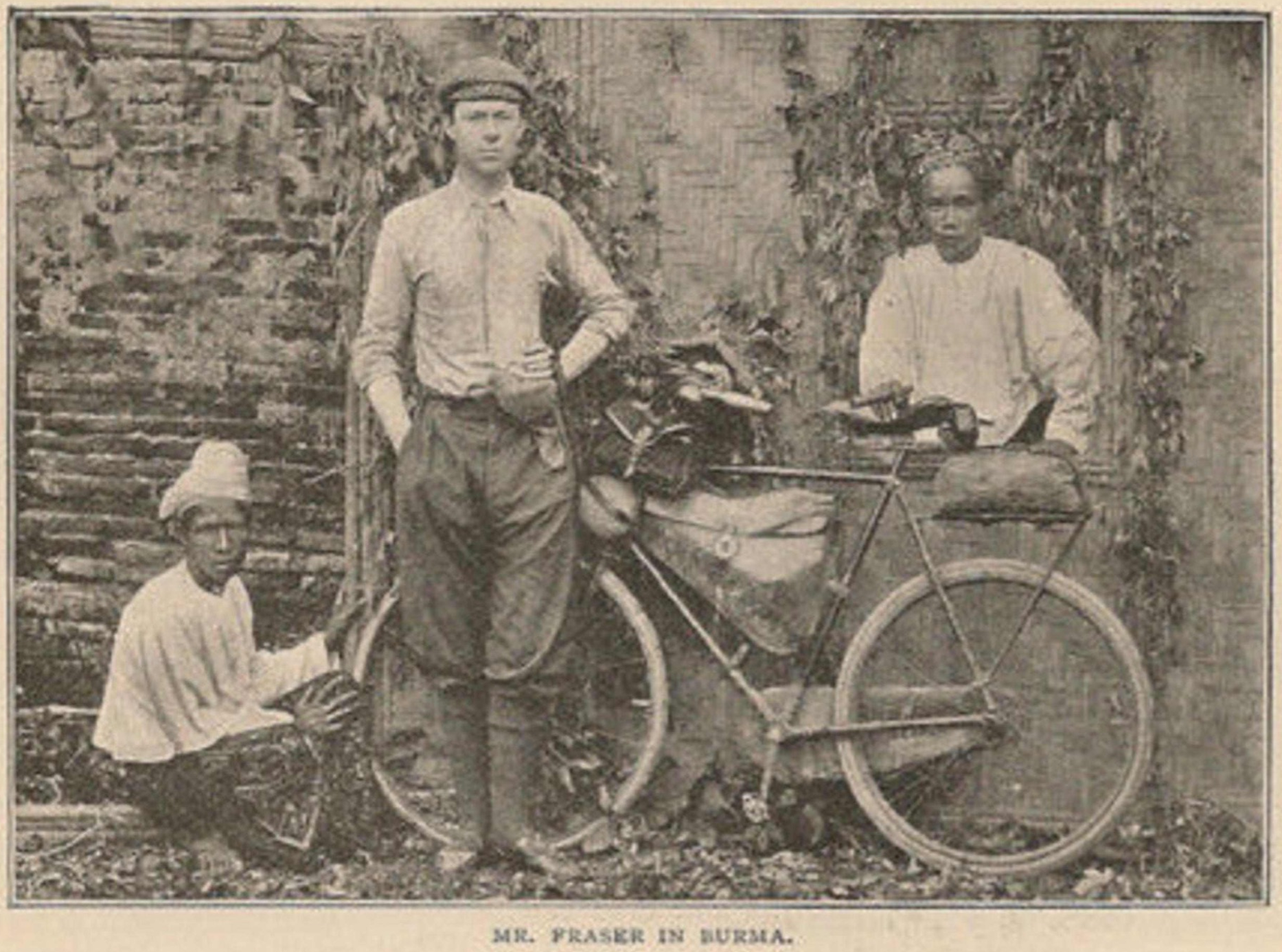
These early globetrotters also pioneered what would soon become a standard ingredient in most subsequent journey reports by western world cyclists: the visual self-representation (either on a photograph or a drawing) of the heroic rider with his machine in quasi-imperial poses involving ‘natives’ in sharply contrasted exotic garb. The photograph reproduced in British cyclotourist John F. Fraser’s travelogue Round the World on a Wheel about his adventures in Burma (see Figure 4) illustrates this very well. Revealingly, during their world tour in 1896-97 that coincided with the empire-wide celebrations of Queen Victoria’s diamond jubilee, Fraser and his two companions acquired the status of imperial heroes and were greeted with enthusiastic cheering by the local European community in Calcutta, the capital of British India, and honoured with a banquet organized by government officials.Footnote 50 In many ways, then, the extreme global cycling ventures undertaken predominantly by western men around the turn of the twentieth century provide powerful examples of the mutually constitutive relationship between tourism and western imperialism that recent work in the historiographical subfield concerned with the history of leisure related mobility has emphasized.Footnote 51
Embodying imperial masculinity: A photographic depiction of Scottish cyclist John F. Fraser and his ’safety bike’ in Burma from his book on his around the world tour 1896-97. (Source: Alamy)
Even before it had fully acquired this ideological baggage, the bicycle was exported on a large scale to non-western regions of the globe. Especially for British manufacturers, the Empire in general and British India in particular soon became important outlets.Footnote 52 As early as 1886, a London company produced and advertised ‘ordinary’ bicycles that were especially designed ‘to meet the requirements of Indian and colonial cyclists’.Footnote 53 The two-wheeler was perceived in India and other colonies as a symbol of modernity and it was soon closely associated with imperial power.Footnote 54 The widespread association of bicycles with colonial oppression had emerged because — particularly between 1890 and 1920 — the fashionable avant-garde vehicle was conspicuously used by key agents of imperial power and exploitation. Amongst others, plantation overseers, missionaries, and colonial administrators, but also the colonial armies, police forces and postal services, made frequent usage of the two-wheeled ‘tool of empire’.Footnote 55
It was precisely for this reason that the bicycle tended to divide colonized societies: it was either scornfully rejected or enthusiastically embraced by the ‘natives’, depending on their respective position vis-à-vis the colonial rulers and western modernity at large. Thus, many ethnic Chinese living in the Dutch East Indies would perform their modernity and cosmopolitanism by having their pictures taken in a photo studio with a (borrowed) bicycle.Footnote 56 At the same time, a great many Indonesian youths in the Dutch colony and middle-class Vietnamese in French Indochina gladly embraced the bicycle and bicycle races ‘as a vehicle for showing bravado’ to their self-proclaimed colonial masters.Footnote 57
In India, initially, it was almost exclusively Indian princes or members of the small but affluent South Asian comprador class who embraced the two-wheeler.Footnote 58 The conflation of the bicycle with cutting-edge modernity eventually began to wane in colonial Asia in the 1920s, when the imperial and missionary establishment quickly replaced pushbikes with motorcycles and cars.Footnote 59 It was at this juncture that South Asians of humbler social backgrounds not only began to adopt the bicycle in more significant numbers, but also to instil it with new social and political meanings. The appropriation of the bicycle by the lower middle and working classes in India began in earnest after the end of the First World War, when an average of 70,000 bicycles per year was imported into the country.Footnote 60 In 1938, shortly before the outbreak of the Second World War, the annual import figures peaked at 170,000.Footnote 61 By the 1930s, bicycles were commonly used in anti-colonial demonstrations.Footnote 62 This trend was to some extent facilitated by the fact that British bikes gradually lost market shares to the cheaper products from the United States and Japan as the twentieth century progressed.Footnote 63 Especially, Japanese entrepreneurs tried to carve out a niche for their products in the South Asian market with rather aggressive means, thus contributing to a significant price drop.Footnote 64 Taken together, these developments help explain why the ‘liberating technology’ of the bicycle could be appropriated by patriotically inclined young Indian men as a tool of masculine self-empowerment without provoking accusations of ‘colonial complicity’ by their compatriots.Footnote 65 This leads us to the next section that examines how these ‘grand tours’ provided Indian globe cyclists opportunities to build and demonstrate their masculinity.
Man-making: the South Asian globe cyclists on the road
Over the past three decades, a copious body of historical research has explored how the British rulers of South Asia deployed colonial discourses of ‘effeminacy’ to cement their position of power. They targeted educated elite groups that posed a threat to British claims to power in South Asia. The Bengalis, especially, formed part of such potentially ‘perilous’ communities and were consequently dubbed ‘effeminate’ or ‘degenerate’.Footnote 66 The story of the Parsis is slightly more complex. Many Parsi intellectuals derived a certain sense of ethnic superiority from their western orientalist representation as Aryans. Nonetheless, in their community, too, anxieties around perceived effeminacy and racial degradation came up in the second half of the nineteenth century.Footnote 67
In a reaction to the discursive manoeuvre by the imperial authorities of denying manliness and hence the right to leadership and responsibility to select groups of Indian men, important currents of Indian (proto-)nationalism took on the shape of a ‘man-making mission’ during the last quarter of the nineteenth century.Footnote 68 This was partly expressed in the revival of traditional Indian sports and martial arts such as wrestling,Footnote 69 and partly through the appropriation of typically English pastimes such as football and cricket with the goal of beating the masters at their own game.Footnote 70 Finally, the new interest in training Indian bodies also found expression in the warm reception of modern western schemes of physical education and physical culture. Such programmes were increasingly on offer in India by the 1900s and widely disseminated, among others, by the Boy Scouts and the popular Indian branch of the Young Men’s Christian Association (YMCA).Footnote 71 The cyclists in the focus of this study were socialized in precisely these emerging sporting milieus. During their tour around the world, the three Parsi riders would mostly wear Scout uniforms and often stay at local YMCAs, be it in Zurich, Chicago, or Shanghai (see Figures 5 and 7).Footnote 72 Unsurprisingly, YMCA branches in the UK, the United States, China, Korea and other places were also instrumental in helping them organize lectures and magic lantern slide shows, in which the globe cyclists from Bombay presented their adventures to crowds numbering occasionally several thousand people.Footnote 73
Rambling revolutionary: Ramnath Biswas in the 1930s. (Source: R.N. Biswas, Round the World Without Money, 1936, n.p).
‘Dash and daring in the service of Mother India’: the cover photo of the Parsis’ travel account shows the three riders shortly before their return to Bombay and illustrates their penchant for masculine self-fashioning. (Source: Hakim et al., With Cyclists around the World, n.p.)

Demonstration of pan-Asian solidarity? ―The Indian globe cyclists Hakim, Bhumgara and Bapasola are welcomed by Chinese YMCA members in Shanghai (July 1926).

The Parsi community was particularly inclined to physical exercises of all types and adopted western sports from the mid-nineteenth century onwards. This enthusiasm grew stronger after eugenicist writings in the early twentieth century triggered debates on their alleged ‘racial degeneration’.Footnote 74 Several Parsi intellectuals and reformers took inspiration from the conspicuous cult of the body in the 1900s and 1910s. The Parsi cyclists are a perfect example of this trend. Adi Hakim and his mates shared a ‘passion for body building’.Footnote 75 They were all members of the Bombay Weightlifting Club and had close contacts with both the Boy Scouts in Bombay and the local YMCA. Their eagerness to demonstrate their masculine qualities and physical prowess through an extreme bike tour should also not come as a surprise. Parsis were among the earliest groups in Indian society who had taken an interest in the bicycle as a potential means to improve the health of their community.Footnote 76
The Bengali Ramnath Biswas likewise belonged to an ethnic and social group whose collective ‘quest for manhood’ was particularly pronounced and even generated extensive discussion on racial improvement.Footnote 77 Born in 1894, Biswas grew up in an atmosphere of anti-colonial political dissent among educated, middle-class Bengalis.Footnote 78 As a member of the Anushilan Samiti in the 1910s, he was linked to the nationalist attempt at recuperating beleaguered Indian masculinities through physical upgrading.Footnote 79 Founded in 1902, the Anushilan Samiti was a militant Bengali organization responsible for bomb blasts and armed attacks on imperial officials. The colonial authorities considered its members ‘terrorists’.Footnote 80 The secret revolutionary society nurtured a cult of masculinity and had developed a strict training regime including body-building and martial arts with a view to prepare allegedly ‘effeminate’ Bengali youths to overthrow their colonial oppressors.Footnote 81 It seems plausible to speculate that Biswas was thus at least to some extent influenced by the nationalist pedagogy of a disciplined and masculinized body that was perceived by many South Asian reformers and activists as the key locus of nation-building. Eventually, Biswas became a member of another revolutionary association Jugantar in Bengal and the Free Bengal Brigade in Singapore that had given him the responsibility to circulate sensitive information in the guise of a traveller. He lost his job when the police came to know that he harboured nationalists and donated to the revolutionary cause, which, in turn, prompted him to start a life in travelling the world.Footnote 82
The Indian cyclotourists would use every opportunity to link the account of their manly courage and physical prowess with their anti-colonial political agenda. Biswas, for instance, dedicated one of his books on Africa ‘to those gallant Indian workers who fought against the colour-bar in South Africa under the leadership of Mahatma Gandhi’.Footnote 83 If his travelogues can be trusted, he met several protagonists of the Indian nationalist movement during his journeys. In his books he mentions that he spent hours, sometimes days, talking politics with diasporic revolutionaries like Raja Mahendra Pratap in Japan and Ajit Singh in Germany. He also claimed to have met one of Subhas Bose’s associates in a hotel on Harrison Street in Calcutta in 1940 and given him directions about the route to Afghanistan, facilitating Bose’s famous escape from house arrest.Footnote 84 In his writings, however, he also frequently expressed his disenchantment with the mainstream of the Indian freedom struggle and its leadership.Footnote 85 A holistic reading of Biswas’ books suggests that his criticism of bourgeois nationalism grew stronger after 1942, the year of the failed Quit India Movement, when left-wing internationalist rhetoric replaced the nationalist overtones in his writings. In fact, most of Biswas’ publications stand testimony to his faith in global revolutionary socialism and anti-imperialism: ‘All imperial powers are on their deathbed’, he wrote, adding, ‘British, French, Portuguese, Dutch and American imperialists will die together’.Footnote 86 The bicycle certainly enabled him to experience and understand the world and compare various social and political systems, helping him form and express his political opinions. Adi Hakim and his co-authors show a more straightforward patriotism and an unqualified support for the political agenda of the Indian National Congress (INC). They describe their feeling of pride after completing the four-and-a-half-year journey as follows:
Were we happy? Yes, you bet, we sure were. But not because we succeeded in putting an extra feather in our cap; not because we craved for applause; not because we wanted to win a fair dame after the conclusion of our tour […], but we felt proud we did our wee bit for Mother India, whose illustrious name we carried into the nooks and corners of the world, where we showed sons of Mother India were as able, as enterprising, as courageous as the children of any other nation in the world.Footnote 87
This example effectively deploys the influential discursive trope of a disciplined, serving masculinity, the manliness of loyal ‘sons’, performing service on behalf of their ‘mother’, that was widespread during the great nationalist campaigns of the 1920s and 1930s (see Figure 6).Footnote 88 Not surprisingly, several leaders of the Indian national movement returned the favour and praised the globe cyclists’ patriotic service. The prominent Hindu reformer and nationalist Lala Lajpat Rai (1865-1928), for instance, willingly contributed to the Parsis’ autograph collection.Footnote 89 As stated in the introduction, Nehru even wrote a short preface to the Parsi travelogue, in which he praised the courage of the young cyclists and presented them as role models that would hopefully ‘fire the imagination’ of Indian young men.Footnote 90 One of the Parsi globe riders indeed actively supported the Indian freedom struggle after his return: Rustom J. Bhumgara became an INC worker and was appointed as general officer, commanding the Congress volunteers.Footnote 91 He took part in several Satyagraha (passive resistance) campaigns in the late 1920s and early 1930s and spent several months in Yerawada Jail near Pune at the same time as Mahatma Gandhi.Footnote 92
In slight tension with their overall anti-imperial stance, however, the Parsi riders’ travelogue suggests that they were apparently heavily inspired by the popular accounts of the Victorian and Edwardian gentlemanly extreme cyclists from the west.Footnote 93 The stereotypical stories of insurmountable passes, extreme climatic conditions, attacks by wild animals and/or encounters with ‘savage’ natives – arguably calculated to raise their position on the masculinity scale – aligned with the valiant ideals claimed by their Euro-American counterparts. The conquest of an undomesticated and hostile nature by sheer willpower, for instance, was a firmly established trope in the earlier quasi-imperial travel accounts. This tendency of highlighting manly heroism and the impulsive penetration of untouched territory was echoed in the travelogues of the South Asian cyclotourists, suggesting an astonishing degree of intertextuality between ‘imperial’ and ‘anti-imperial’ travel writing. Thus, for instance, the Parsi riders proudly mention how they ‘entered the thickets of a tropical jungle’ in Annam completely unarmed, fully knowing that it ‘harbour[ed], tigers, wild elephants, wild buffaloes and wild deer’.Footnote 94 They express relief to have left the Siamese Kingdom – ‘a territory thickly infested with wild animals and snakes and populated by a semi-savage people’.Footnote 95 An even more drastic example of this trope can be gathered from the following excerpt, in which the Parsis describe their crossing of the Syrian Desert:
For all we knew, death in its most horrible form might claim us as its victim […]. What was there to guide us through 617 miles of these barren wastes, where no cyclist ever rode his machine […]? What was there to relieve the monotony of our journey, save the skeleton of some unfortunate victim, who had attempted too much, bleaching in the desert sun, exciting at once our sympathy and a gruesome interest.Footnote 96
Ramnath Biswas, too, deployed this kind of rhetoric, albeit less frequently than the Parsis. Thus, the experienced traveller warns the readers of his globetrotter manual, not to sleep under trees, as ‘big snakes … will simply fall from the tree like a rope, tie you up, smash your bones first, and then swallow your lump’.Footnote 97 In a newspaper interview published in 1935, the revolutionary globetrotter, by contrast, highlighted the dangers emanating not from wild animals, but from ‘savage’ locals: ‘China is the most dangerous country in the world, in my opinion. … After having escaped from a house in Indo-China, where the husband and wife were sharpening their swords prior to killing me, I was captured by bandits in the interior of China’.Footnote 98
A similar propensity to masculine bragging surfaces also in the recurrent stories revolving around the interest they supposedly created among local women they encountered on the road. Thus, in their chapter on Britain, Hakim and his co-authors underscore that their ‘female admirers were many and very inquisitive to know everything’ about them. According to their account, ‘English girls’ would ‘flock’ to them as if they ‘were some renowned celebrities’, even ‘jostling with one another to secure [their] autographs’.Footnote 99 They likewise perceive the United States as a country promising sexual adventure – New York, in particular, as a ’bewitching’ temptress, with ’violent gusts of wind that lift up the skirts’.Footnote 100 A passage in their account on the brief stint in Bangkok is even more explicit. They introduce a young woman they met at a dinner party as follows: ‘Her name was Peggy, a beautiful blonde, who was always in the forefront and to whose company we owe the pep put into what could otherwise have been a dull time.’Footnote 101 The active soliciting of flirtatious adventures was not limited to western women. Describing their travels in China, they mention that ‘a little distance away from Shanghai, we shaved our beard […] as we knew at Shanghai we would have to present ourselves before many a fair dame, who would scarcely appreciate the bushy growth of our countenance’.Footnote 102 Islamic regions, such as Persia, where ‘women very seldom move out without their purdah or veil’, presented a challenge.Footnote 103 Their travelogue subsequently describes in great detail that they nevertheless developed sophisticated flirtation techniques to overcome this difficulty.Footnote 104
One would be tempted to conclude, then, that through the reproduction of motives and narratives that had been integral to imperial (cyclotourist) self-fashioning, some of the Indian riders adopted elements of what was considered the ‘hegemonic’ form of masculinity, even at the risk of compromising their rigid anti-imperial outlook. Arguably, this tendency was reinforced by another feature that Biswas and the Parsis shared: they all had undergone training in British-led military units. The three Parsis were members of the second Battalion of the Bombay Pioneers, while Biswas was one of the selected few Bengalis, who were enlisted in the famous 49th Bengali Regiment.Footnote 105 This regiment, better known as the ‘Bangali Paltan’, was stationed in Mesopotamia during the First World War and its aftermath (1916-20).Footnote 106 Biswas often displayed an ostentatiously rebellious or revolutionary masculinity, repeatedly brandishing his ethos of a man liberated from the need to placate one’s superior or the tethers of social obligations. ‘I am a man of the road and I will walk freely, why should I fear?’, he remarked in one of his books.Footnote 107 Biswas used his empathy for the oppressed as a manifesto throughout his body of writings. His tirade against bondage and inequity was a natural extension of his involvement in Indian revolutionary nationalism. Although he inherited no political power from this association, his travelogues remain as affective registers of his soldier citizen persona. In all the narratives about his interactions with European left-leaning students and politicians, he portrayed himself as an active insurgent in opposition to the indecisive self-proclaimed radicals. This continuous performance of political subversion differentiated Biswas’ masculinity ideal at least partly from the ‘complicit’ one cultivated by the Hakim group. With its ‘emphasis on fearlessness, physical prowess, and individual initiative’, it was very close to the kind of revolutionary manhood propagated by some contemporary Indian diasporic revolutionaries in the United States ‘to contest a concerted imperial campaign to emasculate them’.Footnote 108
However, Biswas also deployed more conventional tropes to show off his male prowess. In his Balkan travelogue, he discusses the plight of his two European companions en route to Sofia, who thought him unfit to cycle along the mountainous terrain but were exhausted sooner and stopped for rest several times.Footnote 109 On reaching Sofia, he came down with high fever for two days. In his words, he took care of himself and nursed himself to strength with a strict diet of quinine and milk.Footnote 110 According to his own accounts, Biswas also demonstrated his courage and toughness in open physical conflicts more than once. Thus, he mentions that in England, he got into fights when he saw Indian seamen heckling women,Footnote 111 and while in South Africa, he got repeatedly involved in fierce punch-ups with Boers who had racially abused him.Footnote 112 Biswas kept reminding his readers about his moral courage and age-defying physical strength, not as bluntly as the Parsi group but nevertheless with noticeable pride in his masculinity.
Finances were a major hurdle to globetrotting, and the way these cyclotourists obtained funding for their tours, also reveals their inventiveness and strong resolve. Hakim and his friends raised funds from local Parsi dignitaries and saved money staying with them, for example, for as long as twenty-five days in the Zoroastrian House in London.Footnote 113 They received free tyres and inner tubes from the Irish-based, but globally operating Dunlop company.Footnote 114 Their meagre budget was regularly topped up through the sale of specially produced postcards with their picture and autographs.Footnote 115 The global media attention their ride also garnered presumably helped them. By the time the group reached India’s new capital Delhi, Reuters had spread the word about the world tour, which was followed by international headlines.Footnote 116 During the course of their journey, they also developed additional strategies to earn money on the road. As indicated earlier, all six Parsis were members of a weightlifting club in Bombay. They exploited their training to regularly perform feats of physical strength, calculated to attract a paying audience. In the Persian city of Shiraz, for example, they offered ‘a sort of variety entertainment, where one of [them] heaved a stone on his chest and had it broken on chest with big hammers.’Footnote 117 Occasionally, they also organized fake boxing fights among themselves to entertain their changing global audience and afterwards collected money to further build up their travel budget. In some countries, especially in the United States, Korea, and China, the three globetrotters earned money by giving lantern-slide lectures about their journey, which were usually co-organized by the local YMCAs.Footnote 118 (Figure 7)
Biswas collected donations from the people of the places he visited. He presented them with a printed flyer about his cycling expeditions and the need for money, which they read and sometimes offered voluntary donation. In a Parisian restaurant, some of the patrons paid him twenty Francs for filling in a questionnaire about India and for his observations on the condition of Indians under British rule.Footnote 119 In South Africa, he received an honorarium for speaking on the radio.Footnote 120 When his bicycle was stolen in Mukden, China, the manager of the Dunlop company supplied him with a new bicycle and spare parts.Footnote 121 Similarly, his contemporary Bimal Mukherjee, who travelled the world from 1926 to 1937, earned his passage by working odd jobs as photographer, sailor, maritime pilot, fisherman, dairy farmer, schoolteacher, and giving travel talks in schools and colleges.Footnote 122
As different as the cyclists’ strategies to secure funding for their global rides might have been, their self-reliance must have boosted their sense of ‘male’ autonomy.Footnote 123 Autonomy and self-reliance are also the leitmotivs in the frequent passages in the travelogues describing in great detail the ways in which the riders managed to repair their machines on a regular basis all by themselves, even if they did not have the necessary spare parts.Footnote 124 Their constant emphasis on their survival skills is quite similar to the acknowledged tendency of other travellers from marginalized nations such as Ireland whose mettle was a way of expressing pride in their culture.Footnote 125 The risks and uncertainties of a long journey came across as expected and constitutive elements of the riding expedition, while frequent references to these obstacles in the travelogues also served to heighten the celebration of the authors’ masculine qualities.
World-making: coping with inequities
The most fascinating aspect of the cyclotourists’ travelogues is their implicit claim to deliver an accurate and realistic account of the cultures, societies, and political realities they encountered on their journey. Such claims certainly benefitted from the running trope that bicycle touring allowed for a particularly ‘unfiltered’ and ‘authentic’ travel experience of the respective tourist destination and was in this respect superior to any other form of recreational travel.Footnote 126 In his travelogue of France, Biswas claimed to have observed Europe more keenly than any Indian political leader, and gained unique and incontrovertible insights.Footnote 127 Most importantly, travelling on a bicycle allowed him to fraternize with the lower classes. He considered upper class people hypocrites who hid behind masks of culture and were bereft of empathy for the poor.Footnote 128 On other occasions, he criticized ‘rich’ Indian travellers to Britain for falsely representing their experiences in the country and interactions with local people.Footnote 129 Much like the Parsis, who complained that ‘usually the notions of an Easterner of the West are warped and distorted’,Footnote 130 Biswas was convinced that educated and intelligent Indian travellers in particular unreasonably glorified Europe.Footnote 131
In the vein of the imperial cyclotourists of the previous generation, the Indians sometimes depicted foreign countries and their inhabitants through certain superficial and pre-existing clichés and stereotypes. The same authors, however, showed a remarkable nuance and sophistication in interpreting the various forms of inequality and oppression they encountered on their tours. The persistent analysis of social and racial hierarchies in the accounts of both Biswas and the less overtly political Parsi group must be seen in the context of their anti-colonial agenda and their broader social and political engagement in general. Three topics recur in the Indian globe cyclists’ travelogues: first, the general perception of racial hierarchies and everyday racism and strategies to resist or subvert them; second, the experience of racialized border regimes and mobility control; and third, the solidarity shown with the struggle of global South Asian diasporas.
Biswas claims that his dark skin and his passport, identifying him as a ‘British-Indian subject’, determined the ways in which the world looked at him.Footnote 132 His travelogues contain numerous sketches relating to his harassment by the common people and government officials owing to his race and nationality. He experienced several racist encounters in the Netherlands; on one instance white patrons in a restaurant let out a collective cry of annoyance seeing him enter the premises.Footnote 133 In Belgium, a man attacked him without provocation when he was waiting for food at a restaurant, and people including small children repeatedly called him ‘blackie’.Footnote 134 In the United States, people would not sit next to him on a bench, and waiters would ask him to leave so that white customers did not avoid the restaurant.Footnote 135 Beyond the pale of western countries, in Iraq, the police suspected him to be a habitual criminal and searched his hotel room.Footnote 136 The Korean police refused to believe that the 250 Yen found on his person was legitimately earned in the country and had him watched.Footnote 137 Biswas explained these harassments as a combination of the local people’s racist aggression and their suspicion of non-elite tourists, especially those who relied on bicycles or walked, as potential vagrants or criminals.
Arguably, the degrading perception of the Indian riders might indeed have been reinforced through their means of locomotion. Recent scholarship agrees that by the 1930s, the bicycle, the erstwhile symbol of bourgeois wealth and respectability, was widely perceived as a ‘subaltern vehicle’ in the age of incipient mass motorization in the west.Footnote 138 Thus, in his globetrotter manual, Biswas cautions his readers that imperial authorities and consulates were suspicious of South Asian travellers ‘on foot or on cycle’ and that they hence should dress and behave inconspicuously in order to avoid an arrest under the Vagrancy Law. According to him this had to do with the officials’ anxieties that these highly individualized subaltern forms of mobility might facilitate espionage: as a cyclist or a pedestrian you could ride or ‘walk from village to village, you talk with every person, you enjoy full liberty, therefore you serve the spying purpose better than any ordinary spy.’Footnote 139
Biswas did not have an image problem in relatively less mechanized countries like Iraq. Reminiscing about his interactions in Khanaqin, he writes that the local people admired him as a globe cyclist.Footnote 140 Similarly, the Parsi riders reflected with some amusement on becoming a subject of curiosity as they travelled north of Mandalay, where the local people seemed to be amazed at their ability to maintain balance on two wheels.Footnote 141 However, in his account of his sojourn in South Africa in 1939, Biswas mentions with a palpable degree of bitterness that in Cape Town he was ‘known by the name of a “cooly world cycle tourist” and not an Indian traveller’.Footnote 142 He paints an exceedingly sinister picture of the country on the verge of the introduction of the Apartheid regulations, complaining that the ‘much hated colour-bar’ heavily constrained his mobility. He was denied entry into Transvaal on grounds of being an ‘Asiatic’. Likewise, he observes that in Johannesburg, the Indians had ‘to move like thieves’ because they were expected to ‘quit the foot-path in order to allow passage for a European’.Footnote 143 Intriguingly, Biswas maintains that this flagrant discrimination was part of the everyday experience of non-white travellers all over the world and not restricted to the notoriously racist regime in South Africa:
Colour-bar prevails not only on the shore but on the sea also. […] A European will not like the idea of having the company of an Asiatic or a Negro on board a ship. They will by no means share the same cabin with us. It is not true to say that this kind of hatred exists in [South] Africa only — but it does exist in many other countries of the West also. Those of us who have taken a trip to England know it very well, but they will never give out the truth for publication.Footnote 144
Border-crossing – visa application, passport control and the compulsory exchange of currency in particular – made the existing racialized hierarchies even more visible. Biswas had to experience this already during his first journey, when the Canadian immigration authorities refused him permission to land in Vancouver in October 1932. They detained him for weeks in solitary confinement as, in the words of a local newspaper, ‘a guest of the immigration department’.Footnote 145 He was forced to take a Japan-bound ship on his release. The Japanese authorities refused him a visa and compelled him to return to Shanghai. When he travelled to Philippines from China, the Philippine authorities refused him entry and redirected him to the Dutch East Indies (today’s Indonesia). He was harassed so much in the Dutch colony that he had to leave after ten days and prematurely conclude his first global trip.Footnote 146 Even in France, the country he admired for its liberalism, the police would detain him and take him in custody for hours without a clear reason on several occasions.Footnote 147 While stamping his passport for entry to the Netherlands, the customs officer refused to let him sit and moved the chair out of his reach.Footnote 148 In contrast, the celebrated English traveller Patrick Leigh Fermor, who traversed Europe on foot between 1933 and 1939, writes that in Romania, ‘the yawning official stamped [his] passport without a single glance at [his] stuff’, while his stolen passport was ‘trustingly issued in Munich’.Footnote 149 Fermor’s travelogues evince no concern about any political impediment to his mobility or border-crossing, which was arguably afforded by his British citizenship and whiteness. A comparison between these experiences testifies to the national ontologies of mobility and surveillance of travellers in the interwar years, demonstrating the increased hardening of borders as a technology of articulating national and racial identity.
The three Parsis, too, had their share of harassment. They arrived in New York in 1925, one year after the Johnson-Reed Act severely limited all immigration to the United States.Footnote 150 They were surprised by the ‘strictness and jealousy’ with which the new laws were enforced. They were allowed to enter the country but complained that aliens with a dark complexion had to experience a degrading ‘searching examination’.Footnote 151 Towards the end of their journey, they were treated even worse in Southeast Asia. French Indochina put them through humiliating procedures because of their nationality, which seemed to turn them automatically into coolies for the ‘autocratic French officials’.Footnote 152 They gave fingerprints, were confined for a few days, and freed after paying a ridiculously high poll-tax — a requirement that did not apply to European travellers. In their travelogue, the three Parsis regard the bigotry of the French imperial regime much worse than the most shocking forms of racist discrimination they had encountered in the United States:
The immigration rules are designed with a devilish ingenuity to keep Indo-China free from Indian and Chinese immigrants. Directly the Indian enters the Saigon port, his passport is confiscated and he is marched into a lock-up […] Then follows a terrible ordeal of filling up forms wherein the Indian is subjected to a searching cross-examination. The immigrant, no matter what his social status and position are, is asked to furnish fingerprints of all five fingers. As if this were not enough, a heavy poll tax is levied for the terrible offence the Indian has committed of having been born an Indian. […] When we recollected how the Indian Army saved France at the most critical period of her national existence and how their immigration rules now placed us in the category of criminals, our blood boiled.Footnote 153
Considering the ubiquity of racial prejudice, intimidation, and discriminatory practices that turned the cross-border mobility of people of colour into a persistent ordeal, the act of traveling itself emerges as a form of resistance. By crossing borders over several years against all these odds and subsequently writing about their experiences, Biswas and the Parsi group made claims to the same privilege of unimpeded mobility enjoyed by white travellers. It is noteworthy that they frequently self-identified as ‘tourists’. This term had come to denote the idea of effortless individual mobility for leisure purposes by the interwar years. When sharing their traveling experiences, they repeatedly identified themselves as part of this imagined global community of cosmopolitan leisure travellers. Indeed, through their continuing counter-mobility, they ultimately made a powerful claim to be treated on par with ‘the European tourist [who] goes about free’.Footnote 154
Looking at the world as tourists, the globe cyclists destabilized existing power relations by reversing the usual (white, male) tourist gaze on the exotic destination. Paul Smethurst has correctly observed that ‘[b]icycle mobility occupies some of the same physical and theoretical space as flanerie’.Footnote 155 Indeed, turning colonial clichés and prejudices upside down by sharing the impressionistic observations of the cycling flâneur was an effective way of demystifying assertions to western racial and/or civilizational superiority. The Parsis’ description of their first days on the European continent offers a particularly potent illustration of this discursive strategy. Much in the same way that backwardness, dirt, and disease are invoked in countless travel narratives describing the arrival of western voyagers in Calcutta or Bombay, the Parsi group remembers their initial impression of Europe:
Our journey from Brindisi to Naples was very instructive [a]s […] it totally destroyed the high opinion we held about European countries in general. The roads were bad, houses awful and the people dirty. Little urchins ran about the streets as if they were nobody’s children. They wore tattered clothes that bore blots and patches of grease, dirt soot, mud and everything and wherefrom a stench of the most unbearable type ensued. […] In the course of our 8,000 miles tour we had come across poverty-stricken villages and districts, but nowhere could we see the appalling filth and slovenliness, which greeted us as we first set our foot on the continent. We do not think a laundry business could succeed in this part of the world.Footnote 156
Both the Parsi narrative as well as Biswas’ travelogues place a lot of emphasis on depicting the inner workings of social and racial hierarchies in the countries they visited. This is particularly obvious in the case of the United States, where racism was by no means restricted to the discriminating border regime on Ellis Island. Hakim and his co-authors observe that ‘the colour prejudice is deep-seated in the heart of the average citizen of the United States’, but they immediately reassure their readers that during the several months of their sojourn in that country they themselves, being ‘fair-skinned Indians’, had never been ‘recipients of such unpleasant attention’. ‘Indians with darker complexion’, by contrast, were frequently ‘mistaken as darkies and subjected to sub-human treatment’.Footnote 157 The way in which the Parsi globe cyclists are eager to emphasize that they possessed a light complexion could be interpreted as evidence of the tacit acceptance of the colour-coded taxonomies undergirding social hierarchies in the United States and providing the raison d’être of the imperial world order.Footnote 158 Yet, at the same time, recent research has pointed to the existence of pre- and extra-colonial traditions of ‘colourism’ in South Asia and it could perhaps more appropriately be read as a convergence of co-existing systems of differentiation.Footnote 159 The flair for status distinctions and particularly for hierarchies based on the alleged dichotomy between purity and defilement that loomed large in the Parsi globe cyclists’ worldview is also corroborated by the description of another encounter in the United States. While in Chicago, they stayed with a group of Indian students, who provided them with long missed Indian food for almost two weeks.Footnote 160 Hakim and his co-authors explain to their readers that:
Many of these students came down to Cicago (sic) for study in dentistry or some other craft. Like ourselves they are faced with the problem of balancing their budgets. Consequently they manage to earn their living working as clerks and in some cases we were grieved to learn as dishwashers and waiters in fashionable hotels. It is true that ‘honour and shame from no condition rise’, but we just could not help feeling sorry that nationals from our country did not occupy better positions.Footnote 161
On the one hand, the authors pay lip service to the ideal of dignity and social equality, irrespective of one’s occupation, but on the other hand, their uneasiness with accepting that respectable educated men carried out supposedly ‘defiling’ activities such as washing dishes that would be performed in India exclusively by members of the lowest social strata, is obvious.
The internalization of not only South Asian notions of social hierarchies and entitlements, but also the outright racialist prejudices and tropes characteristic of the imperial world order becomes evident in the descriptions of supposedly ‘uncivilized’ regions and peoples in the travel accounts. As Subho Basu has shown, nineteenth-century Bengali authors of geography textbooks viewed Asian and African countries through a racial lens, partly informed by European writers such as J.F. Blumenbach and J.C. Prichard.Footnote 162 Their selective appropriation and idiosyncratic interpretation of the idiom of western race science allowed them to challenge white supremacy, all the while reproducing ‘racialised discourses about the relationship between physical appearance of local populations and their level of civilization’.Footnote 163 This observation fits in well with the travelogues under purview. We have already seen a sample of this in the Parsis’ account of the Italian Mezzogiorno and its inhabitants, and they had similarly unflattering comments to make about the population of rural China. Hakim and his co-authors not only attested a complete ‘absence of hospitality’ to Chinese peasants, they also somewhat sweepingly attributed ‘superstition, ignorance and suspicion of the foreigners’ to the average ‘Chinaman’.Footnote 164 In a similar vein, they described their host in one of the Persian towns, a Borah merchant, as someone ‘by racial habits fitted to be a cold calculator of tangible gains’.Footnote 165
Biswas’ description of African and Asian populations was ambivalent, not least because he loved to fashion himself as a deracinated socialist. In an attempt at demonstrating his receptive and broadminded politics, he actively sought the company of ‘oppressed’ and ‘progressive’ people, saying the oppressed had no national identity and the progressive transcended the reductive notion of national and community belonging.Footnote 166 He reiterated his close association with these two categories of people across the world in several of his books, including in the preface to his Japan travelogue in which he fondly remembered his interactions with Japanese revolutionaries in 1931 and dedicated the book to them.Footnote 167 Contradicting his own identification with Indian nationalism, he sometimes even eschewed the idea of a homeland. In his own view, his self-identification as a destitute with no kinship helped him impartially observe the home and the abroad.Footnote 168 This notwithstanding, a sense of superiority plainly shines through in some of his writings on Africa. On the one hand, he deplores the European oppression of black Africans and criticizes all Indians in South Africa who were complicit in racist discrimination.Footnote 169 On the other hand, however, his writings on Africa contain many passages describing sub-Saharan Africans as primitive, openly doubting their intelligence. He repeatedly appoints himself as a sort of benevolent guardian and liberator for the Blacks who supposedly had no conception of education or civil rights.Footnote 170 The most drastic example of Biswas’ ‘South-South-racism’, however, is a small picture book in English on his tour through East and South Africa. The voyeuristic and ridiculing ways, in which African villagers are represented in this volume both in visual and textual form, is puzzling. The racialist overtones are already apparent on the cover illustration that Biswas chose for his publication (see Figure 8). In a manner reminiscent of the posters and postcards advertising human zoos in Europe or the National Geographic magazine’s sensationalized depiction of tribal people as noble savages in the first half of the twentieth century, the cover shows a corpulent African person in front of a thatched hut.Footnote 171 Favourably looking at contemporary western standards of bodily proportions as ideal, Biswas introduces the person with a cynical caption that reads: ‘This Zulu chief is rarely absent at meal times.’Footnote 172 The Chief is presented as a glutton and conceivably indolent and inefficient in serving his people in a challenging environment. As Sabrina Strings has persuasively demonstrated, this kind of ‘fat-phobia’ has been integral to European racist ideologies since the Renaissance.Footnote 173 The picture may seem repugnant in today’s standard, but it is an important document that not only strengthens our argument regarding Biswas’ ambivalent stance on racism in a way that a mere textual discussion could not, but also elucidates the broader phenomenon that even politically conscious non-western elites widely accepted the tropes and aesthetic norms that were at the heart of the European discourse of civilizational decline in the non-west.Footnote 174
Cover of Ramnath Biswas’ Africa booklet (1940)

The other illustrations in Biswas’ booklet continue to reduce Africa to a set of well-established imperial clichés, especially through pictures of wild animals and scantily-clad ‘natives’. On a page that claims to show the ‘true nature of men and women of Africa proper’, Biswas places a photograph of five young, bare-breasted African women. In the caption, he illuminates his readers that African ‘women like very much to put on fancy or grotesque dress’, and that they ‘are not cannibals [b]ut they do not like to come into contact with the civilized world’.Footnote 175 The choice of such an optic, resulting in dismissive representations of the local population, may strike one as disturbing in a volume dedicated to the ‘gallant fighters against the colour-bar’ and edited by an ardent champion of Afro-Asian solidarity.Footnote 176
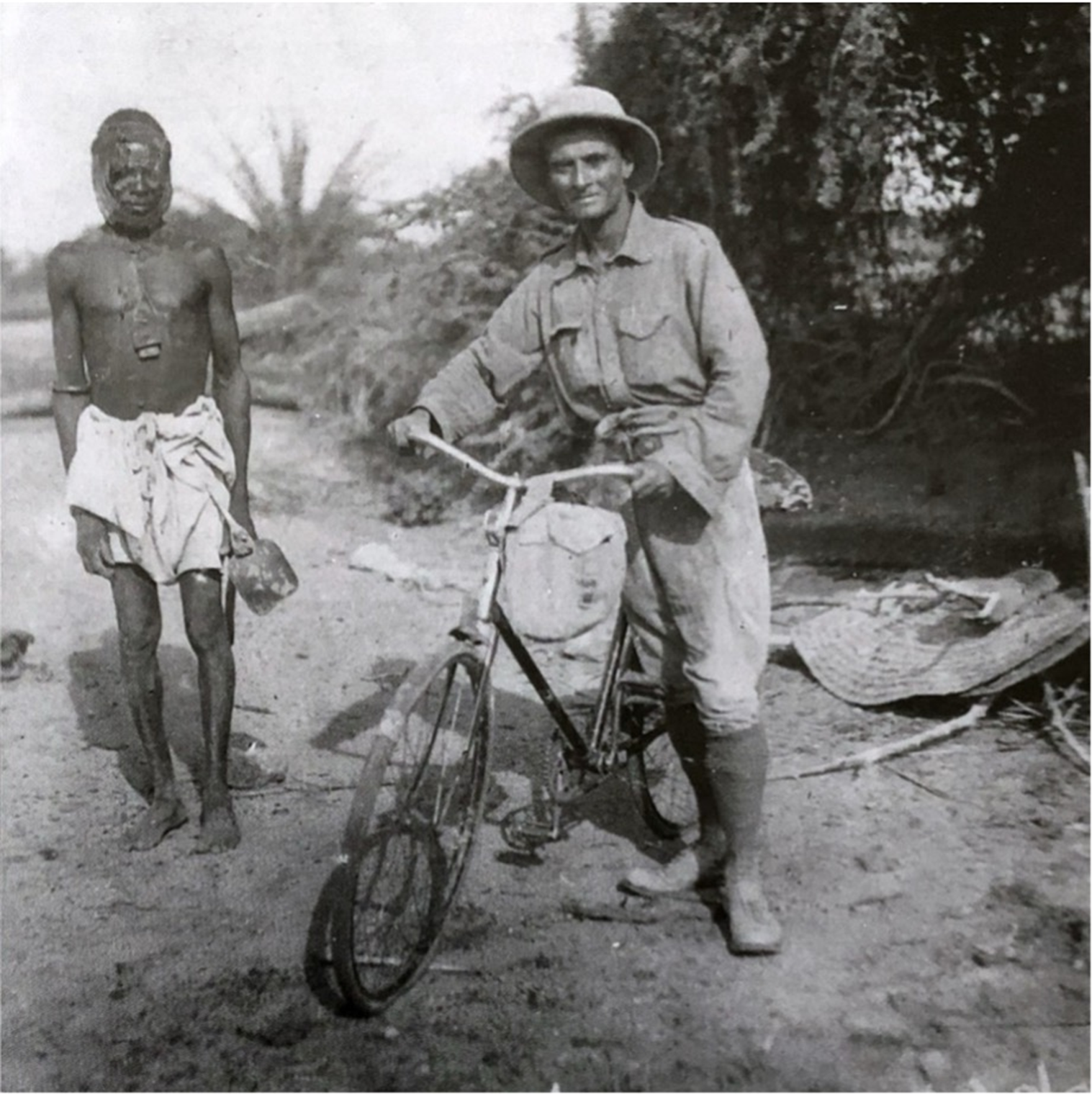
Biswas was not the only Indian rider to recycle elements from the textual and visual repertoire of the gentlemanly globe cyclists of the late nineteenth century. Framroze Davar, the Parsi Scoutmaster, who crossed Africa in the late 1920s together with his Czech fellow rider Gustav Sztavjanik during his world tour, had his photograph taken wearing a khaki uniform and a pith helmet (see Figure 9). His pose with a villager from sub-Saharan Africa reminds the reader of the imperial self-fashioning of Victorian long-distance cycling pioneers like John Fraser (see Figure 3). Davar’s depictions of the local customs in sub-Saharan Africa follow a similarly imperial narrative. He describes the ‘bamboula dance’ of a ‘half-clothed young woman’ in a West African village in a very negative and hyper-sexualized light, to the point of shocking his readers with the observation that ‘the savage dance culminated in the most depraved gesticulations of her hand and body’ at the sight of which the crowd allegedly ‘joined in the dance roaring like maddened beasts’.Footnote 177 The tendency to ridicule the social life and behaviour of Africans on account of its unfamiliarity and non-conformity to ideals practiced in the personal social circles of these tourists is a recurrent trope in their writings.
South-South racism? Indian globe cyclist Framroze J. Davar poses as quasi-imperial explorer with a West African villager after his Sahara crossing (August 1926).
Conclusion: a bumpy ride to autonomy?
Our study of the travels and tribulations of South Asian globe cyclists has offered strong evidence for the fact that the bicycle did not only serve as an ‘empowerment machine’ for western first wave feminists and the European working classes but was also successfully appropriated by lower middle class ‘colonial subjects’ from British India to make political claims. As we have seen, however, the decolonial potential of the bicycle could only fully unfold during the interwar years, when the two-wheeler was no longer closely associated with either western techno-modernity or with colonial officialdom. This observation reinforces the point made by several STS scholars, namely that everyday technologies are ‘effectively co-constructed by their users’ and, as such, they can ‘become repurposed in often-unexpected ways’.Footnote 178 Most importantly, they tend to take on a life of their own, once they spread to diverse cultural, social, and political settings. The analysis of the Indian cyclotourists thus broadens the global history of cycling, while at the same time restoring the bicycle to South Asia’s social, political and gender history.
It has likewise become obvious that the close interrelation between cycling in general and extreme long-distance cyclotourism in particular with notions of masculinity and male autonomy remained crucial for the emancipatory project of the patriotic Indian globe cyclists. In their attempt to falsify imperial theories about the alleged softness and effeminacy of Indian men, they resorted to the well-rehearsed repertoire of imperially tinged heroism and adventure. In that sense, the travelogues of the South Asian globetrotters can be read as perfect examples of a ‘complicit masculinity’ that apes existing forms of hegemonic masculinity with a view to reach wider acceptance and thus increase their political leverage. Ultimately, to repeat the observation made by US historian Kornel Chang in a similar context, their self-empowerment had ‘the contradictory effect of reproducing the operative logic of colonial masculinity, of tightening the links between gender, nation, and empire’.Footnote 179
The third important point that we were trying to make refers to the place of these South Asian long-distance cyclists in the wider history of mobility and tourism. We have suggested that their protracted journeys across the globe represented a new form of countermobility that may be tagged ‘touristic anti-imperialism’. The globe cyclists’ performative and subversive act of continuously crossing borders despite the constant harassment and racist abuse, their adamant insisting on being accepted as ‘tourists’ and their outspoken commentaries made in press interviews and their travelogues on the inequities of the imperial world order and especially of global border-regimes, clearly constitute forms of anti-imperial practice.
While acknowledging the courage, determination and dexterity of the historical actors whose travels and agendas we have analysed, we are hesitant to uncritically celebrate them as ‘quintessential heroes’ or one-dimensionally cast them as ‘intensely conscious civil right advocate[s] promoting equality and social justice’, as other authors have done.Footnote 180 Our probing has shown that while undeniably contributing to debunking the injustice of a racialized imperial world order, the self-fashioning of the South Asian globe cyclists under study was also characterized by tensions and contradictions. Their fight against the doctrines and practices of white supremacy could well go in tandem with the adoption of somewhat problematic discourses about certain groups and communities. In spite of their keen critique of western racist practices, the Indian globe cyclists’ travel narratives also demonstrate what might be described as ‘South-South racism’. While constantly emphasizing international anti-colonial solidarities, the South Asian cyclotourists sometimes adopted the cultural and racial postulates that marginalized ethnic or social groups as ‘uncivilized’ and inferior. This hybrid world-view – an assemblage of colonial and indigenous epistemologies – was a result of the ways in which these resisting subjects internalized imperial and modernist modes of travel. We have seen that this peculiar form of ‘civilizationism’ was based on a racial world-mapping, relegating, for instance, African rural populations to a lower scale of development, thus reproducing and strengthening the Euro-imperial tropes of cultural ‘othering’. The historical trajectories, spatial ramifications, and social impacts of such non-western adoptions of racialized worldviews and practices would be a rewarding future topic for global historians to explore in greater depth.


 Open access

