


Introduction
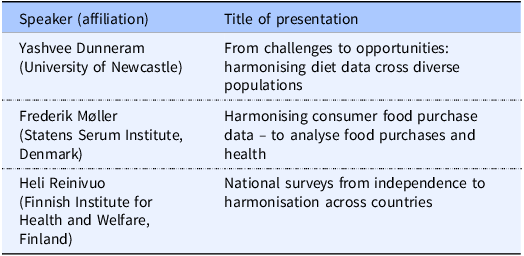
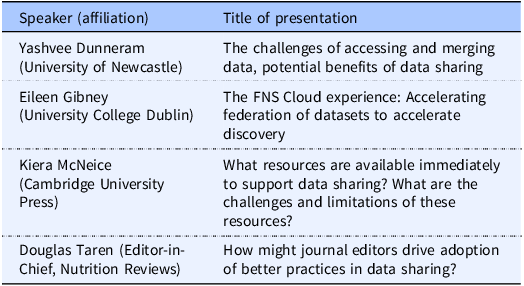
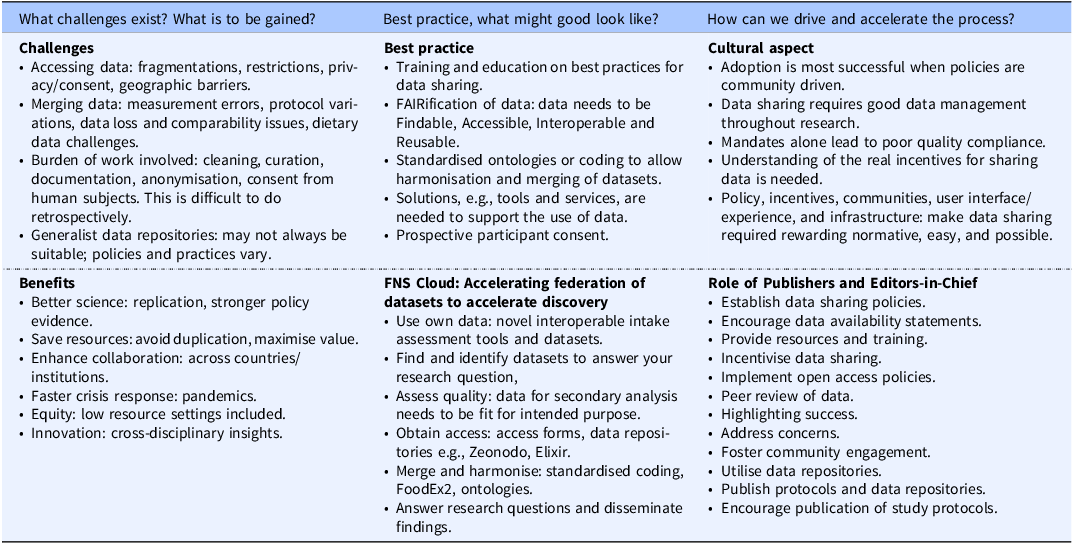
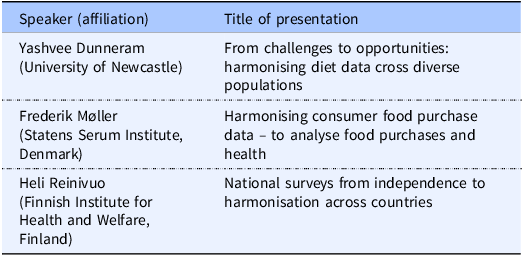
A symposium on improved data sharing in nutritional science was convened at the International Union of Nutritional Sciences-International Congress of Nutrition (IUNS-ICN) 2025 in Paris, France, to discuss among key panel experts (Table 1) and attendees why data should be shared, including the associated gains, perceived barriers, and potential opportunities, and how data sharing in nutritional science can be driven forward and accelerated (Table 2). This symposium built on a FENS Task Force Northern Europe Networking webinar in March 2025 (Table 3). This paper summarises the proceedings and recommendations.
Speakers and talk titles at the Journal of Nutritional Sciences-sponsored symposium. on ‘How can we share data better in nutritional science’
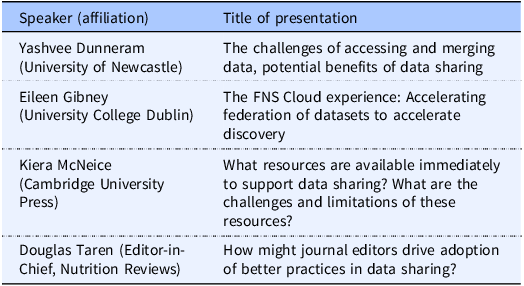
Table 1. Long description
The table presents details of speakers and their presentation titles at a symposium focused on data sharing in nutritional science. It includes four rows and two columns. The first column lists the speakers along with their affiliations: Yashvee Dunneram from the University of Newcastle, Eileen Gibney from University College Dublin, Kiera McNeice from Cambridge University Press, and Douglas Taren, Editor-in-Chief of Nutrition Reviews. The second column provides the titles of their presentations: The challenges of accessing and merging data, potential benefits of data sharing, The FNS Cloud experience: Accelerating federation of datasets to accelerate discovery, What resources are available immediately to support data sharing? What are the challenges and limitations of these resources?, and How might journal editors drive adoption of better practices in data sharing?
Abbreviation: FNS, Food Nutrition Security.
Challenges, opportunities, and best practice for data sharing in nutritional sciences
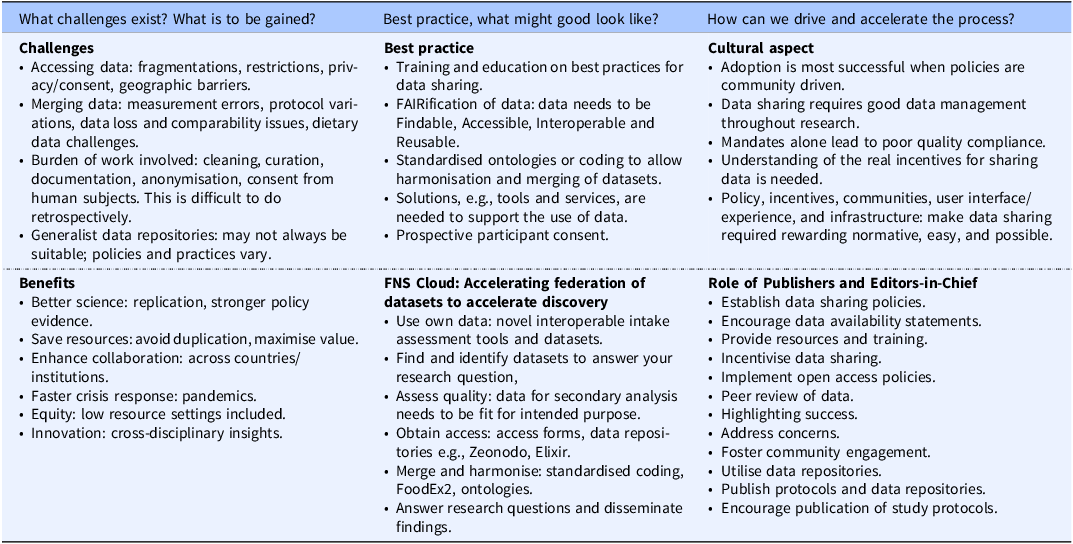
Table 2. Long description
The table outlines challenges, opportunities, and best practices for data sharing in nutritional sciences. It includes three main columns: Challenges, Best practice, and Cultural aspect. The Challenges column lists issues such as accessing data, merging data, burden of work involved, and generalist data repositories. The Best practice column suggests solutions like training and education, FAIRification of data, standardized ontologies, and prospective participant consent. The Cultural aspect column discusses adoption, mandates, understanding incentives, and policy incentives. The table also highlights benefits like better science, saving resources, enhancing collaboration, faster crisis response, equity, and innovation. It mentions the FNS Cloud for accelerating federation of datasets and the role of publishers and editors-in-chief in establishing data-sharing policies.
Abbreviation: FNS, Food Nutrition Security.
Speakers and titles of the FENS Northern Europe Networking Task Force Webinar on ‘Cross validation of dietary surveys across countries’
Data sharing challenges
Nutrition research is critical to informing evidence-based interventions, practice, policy, and appropriate resource allocation. Despite the increasing volume of diet-related data collected globally, effective data-sharing practices remain limited due to various structural, cultural, and methodological constraints.(Reference Bardon, Bennett and Weech1–Reference Micha, Coates and Leclercq4) These barriers impede data reuse and comparison, inhibiting translation into robust and actionable evidence.
Existing dietary datasets are often institutionally and geographically fragmented, with access further restricted by ethical, consent, and legal protocols not originally designed to support data reuse. Moreover, the heterogeneity present in many accessible datasets, such as diverse dietary assessment methods(Reference Micha, Coates and Leclercq4) (e.g., food frequency questionnaires, 24-hour dietary recalls, food diaries),(Reference Shim, Oh and Kim5) portion size quantification approaches (e.g., actual vs estimated measures), food aggregation and classification (coding) procedures, and variable definitions,(Reference Slimani, Deharveng and Unwin6) create substantial retrospective data harmonisation challenges for researchers, introducing potential measurement error and bias risk. Of particular importance, the significant time and resource investment required for effective data sharing and harmonisation cannot be overlooked. For example, in the initiative led by the Global Dietary Database to harmonise global dietary intake data,(Reference Miller, Singh and Onopa7) 76% of the included surveys (n 55 identified and included; n 52 ultimately harmonised) were not publicly available, requiring significant accessibility efforts from the research team.(Reference Karageorgou, Lara Castor and Padula De Quadros2) In addition, remuneration up to $7700 was offered to data owners per harmonised survey, that is, $2584 (mean) per survey.(Reference Karageorgou, Lara Castor and Padula De Quadros2) Beyond this, the competitive research environment and the requirements often important to career progression can also discourage data sharing, whereby researchers may prioritise the publication of innovative and impactful research.(Reference Tamhula, Lulamba and Mutemaringa3) For example, researchers may be hesitant to share data prior to fully exploiting their datasets for future publications, which remain a key metric to academic career progression and promotion. In addition, the potential that others may independently publish findings based on their dataset without the involvement or acknowledgement of the original researcher team is also viewed as a perceived risk. This existing limited recognition associated with data sharing relative to publication outputs for career advancement, accompanied by concerns regarding data (or code) misinterpretation or misuse, increased exposure to methodological critique, significant time investment to respond to queries from external users, and prioritisation of data ownership, also represent contributing factors to data sharing resistance.(Reference Pisani and AbouZahr8)
Data sharing opportunities
Although data sharing presents many challenges, capitalising on existing data offers substantial benefits to nutrition research. Utilising existing datasets enables exploration of novel research questions beyond the original study design, minimising unnecessary data duplication. Such an approach improves efficiency of limited resources, mitigates research waste, and enhances scientific progression, all enabling a more sustainable research system. At the same time, data sharing advances scientific quality, innovation, impact, and equitable practice, fostering improved collaborations from a regional to global scale and more inclusive access to researchers based in research-constrained locations. Notably, data sharing and harmonisation can also enhance analytical rigour. Pooling of dietary datasets can facilitate increased population sample sizes, enhancing statistical power, and more robust detection of associations, which can remain inconclusive in isolated datasets.(Reference Dunneram, Lee and Watling9) Several recent studies demonstrate the opportunities arising from the larger and more powerful datasets accessible through improved data sharing. Dunneram et al. exemplifies this, successfully harmonising data from eleven prospective cohort studies across Northern America, East Asia, South Asia, and Western Europe to prospectively explore site-specific cancer risk among vegetarians and vegans.(Reference Dunneram, Lee and Watling9) Although several study limitations are acknowledged, this cohort represents the largest available observational dataset (n 2,337,152) on vegetarian and vegan diets and individual cancer-site risk. These harmonisation opportunities also extend to consumer purchase data. For example, the My Purchases cohort includes the prospective collection of purchasing data (n 495 participants; recruitment ongoing) across several retailers via the use of digital receipts, spanning 2,225,010 purchased items from 223,440 unique products.(Reference Møller, Junker and Kold Sørensen10) Similarly, the Health, Food, Purchases, and Lifestyle (SMIL) cohort includes the prospective collection of purchasing data (n 11,214 users; recruitment ongoing) via a smartphone-based receipt collection application, including 157,998,751 unique purchases between 2018–2022.(Reference Sørensen, Andersen and Møller11) Of interest, an added benefit is that both the My Purchases cohort(Reference Møller, Junker and Kold Sørensen10) and SMIL cohort(Reference Sørensen, Andersen and Møller11) facilitate linkage of data to health outcomes. Taken together, these studies showcase how the merging of available data can overcome the limitations of small sample sizes or improve understanding of infrequent events in smaller subpopulations, leading to more definitive outcomes than previous individual-level studies.(Reference Dunneram, Lee and Watling9) These data sharing opportunities could also apply to meta-analyses and individual participant data (IPD) meta-analyses. In principle, qualitative data can also be included in data-sharing initiatives. However, this warrants consideration due to the subjective and interpretative nature that can exist in qualitative analyses and the selected methodological approach. For instance, a thematic analysis method may result in different themes across varying research groups, dependent on interpretation. Thus, methodological and analytical transparency among researchers is required.
Achieving best practice in data sharing
For data sharing to become normative practice in nutrition research, a coordinated effort among academic institutions, the research community, funding agencies, and publishers to establish standardised and complementary strategies is warranted (Figure 1). Academic institutions are well-positioned to promote such initiatives by embedding data sharing as a key career metric and facilitating tailored training programmes for researchers spanning all career stages. Ensuring researchers are adequately trained to safeguard participant confidentiality and adhere to the conditions agreed in informed consent is a crucial component of responsible data sharing with external parties. This can also enhance participant trust in data sharing, minimising confidentiality breach concerns and hesitancy to participate in future research. Moreover, the research community can take a proactive role at the initial study design stage via inclusion of prospective participant consent for data sharing and reuse within participant information leaflets and consent forms, minimising future accessibility and sharing barriers. There are discussions among the community regarding informed consent under GDPR, in which the European Health Data Space (EHDS) regulations should be considered.Footnote 1 Funding bodies can further support such strategies by implementing mandatory data sharing criteria as an essential condition for successful grant applications. Genomics presents a leading example of how effective data sharing practices can be implemented at scale within a scientific field, with data sharing becoming a key requirement among funding bodies.(Reference Pisani and AbouZahr8,Reference Kaye, Heeney and Hawkins12) For example, two key funders of the Human Genome Project-the National Institutes for Health and the Wellcome Trust-made substantial infrastructure investments to support long-term, large-scale, data sharing, whilst amending funding mechanisms to look beyond publication and citation records and recognise contributions such as data management.(Reference Pisani and AbouZahr8) To complement these efforts, implementation of data-sharing policies in Journals also presents a prime opportunity to drive data-sharing initiatives and cultural change in the nutrition research community. In addition to mandatory and well-defined data availability statements, explicit documentation within manuscripts of how data were accessed, curated, and analysed would enhance transparency across nutrition research. In line with well-established reporting guidelines, such as CONSORT,(Reference Hopewell, Chan and Collins13,Reference Moher, Hopewell and Schulz14) the development and adoption of similar frameworks for reporting data sharing and reuse would accelerate inclusion and consistent reporting across publications. Journal Editors can also promote clear data-sharing standards by providing training and clear criteria to Editorial Board Members and peer-reviewers, enabling adequate evaluation of data-sharing statements, compliance with data-sharing reporting, and appropriate requests for insufficient or missing information during the peer review process. In addition, publishers can encourage the publication of study protocols and incentivise data sharing among researchers via citation credits and formal recognition of high-quality contributions to the field, including successful data sharing practices and secondary analysis studies. In the transition toward improved data sharing in nutritional science, researchers must also account for the variation of consent and participant permissions that exist across previously collected, existing, and future data. Thus, the use of previously collected data may be constrained in future open data initiatives. Moreover, the additional complexity of integrating nutrition and health data must not be overlooked in this transition.
A diagram illustrating coordinated efforts to achieve best practice in nutrition research.
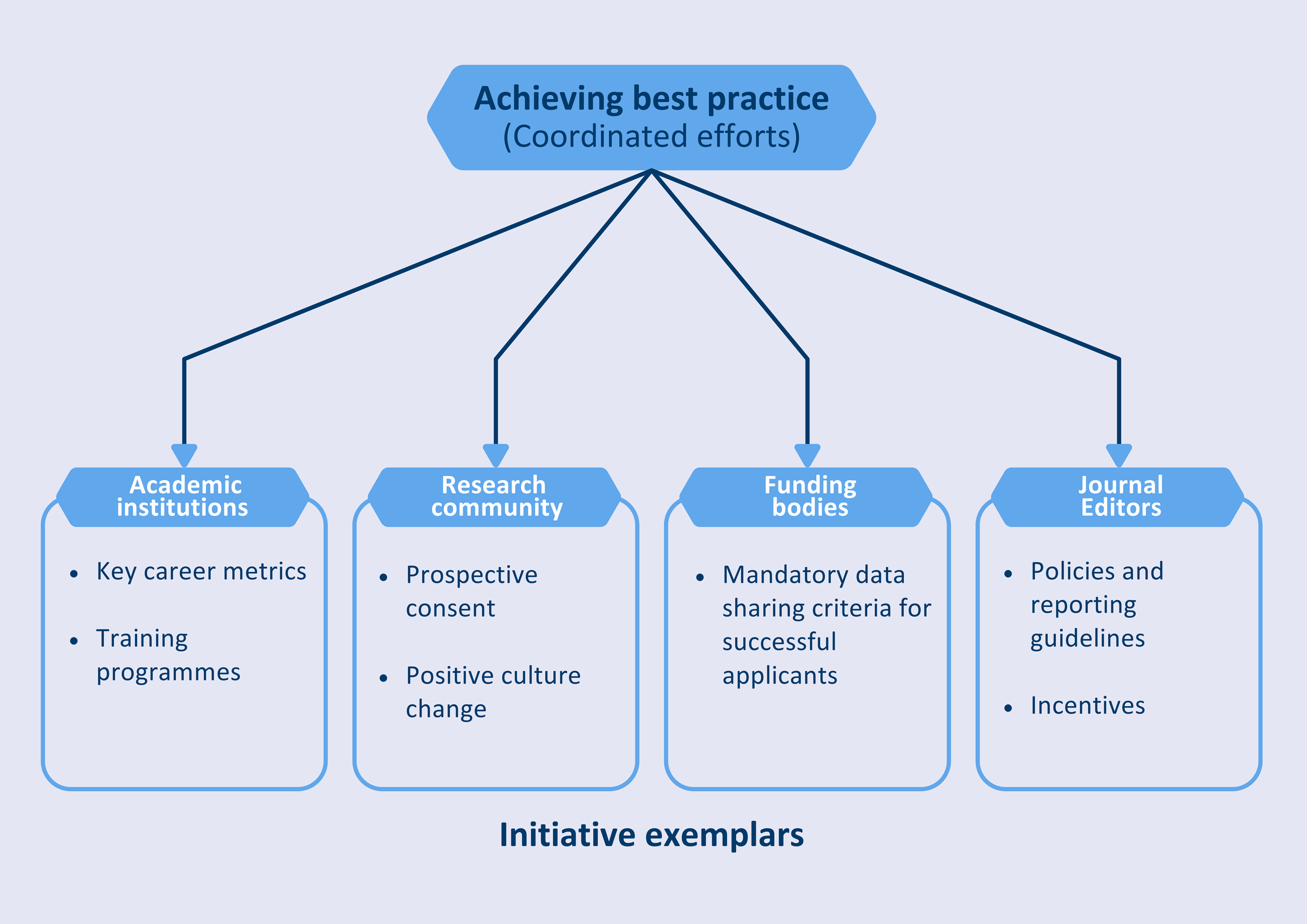
Figure 1. Long description
The diagram shows a central hexagon labeled ‘Achieving best practice (Coordinated efforts)’ with four arrows pointing to four separate boxes labeled ‘Academic institutions’, ‘Research community’, ‘Funding bodies’, and ‘Journal Editors’. Each box contains bullet points outlining specific initiatives: ‘Academic institutions’ includes ‘Key career metrics’ and ‘Training programmes’; ‘Research community’ includes ‘Prospective consent’ and ‘Positive culture change’; ‘Funding bodies’ includes ‘Mandatory data sharing criteria for successful applicants’; and ‘Journal Editors’ includes ‘Policies and reporting guidelines’ and ‘Incentives’. The diagram emphasizes the collaborative efforts required among different stakeholders to improve data-sharing practices in nutrition research.
FAIR data: data that is findable, accessible, interoperable, and reusable
A wealth of nutrition and health data exists; however, these resources (data, knowledge) are fragmented, with uneven accessibility and availability, resulting in knowledge gaps and redundancy in research effort. In 2016, the FAIR Guiding Principles for scientific data management and stewardship were published, describing foundational principles for data to be Findable, Accessible, Interoperable and Reusable.(Reference Wilkinson, Dumontier and Aalbersberg15) The Food Nutrition Security Cloud (FNS-Cloud) was launched as the first ‘food cloud’ to overcome European research fragmentation by integrating and federating existing food nutrition security data, tools, and services to provide added value FAIR data that can reduce knowledge gaps, facilitate better research and exploitation, inform policy, and help deliver sustainable diets to European citizens.(16) A key barrier in this space is knowing that data exists or how or where to find data. A catalogue incorporating metadata was established, allowing researchers to find and identify datasets, while a quality assessment framework was developed, which comprised decision trees and feedback messages to support researchers in deciding whether a dataset is appropriate for reuse.(Reference Bardon, Bennett and Weech1) Finally, in order to merge datasets, a standardised coding system, or ontology, is needed to allow harmonisation of datasets. To support the linking of food composition and food consumption data, a semi-automatic system for classifying and describing foods according to FoodEx2 was developed.(Reference Eftimov, Korošec and Koroušić Seljak17) While a number of ontologies (a method to define concepts, properties, and relations) exist in the food and nutrition space, such as FoodOn,(Reference Dooley, Griffiths and Gosal18) Ontology for Nutritional Studies,(Reference Vitali, Lombardo and Rivero19) and Compositional Dietary Nutritional Ontology,(Reference Andrés-Hernández, Blumberg and Walls20) these are not widely implemented in data curation.
Culture change for improved data sharing
While data repositories are well-established in many fields, for example, GenBank was first released in 1982,(Reference Sayers, Beck and Bolton21) repositories for nutritional science are lacking. Nonetheless, registers of research data repositories(22) and informative and educational resources on data and metadata standards are publicly available.(Reference Sansone, McQuilton and Rocca-Serra23) For example, tools such as the Nutritional Phenotype Database,(24) FoodCASE,(25) and FNS Cloud(16) were developed to advance food and nutrition data sharing. Whilst a number of generalist data repositories exist, such as the Dataverse Project, FigShare, Zenodo, Mendeley Data, policies and practices vary, and they may not be suitable in all cases. This has led to many authors in this field reporting that data will be available ‘on request’ in their Data Availability Statements, now a requirement upon manuscript submission to peer-reviewed Journals; however, compliance with these claims is low. Gabelica et al., reviewed 3556 articles and found that only 14% (n 254) of authors who indicated willingness to share data (n 1792) responded to a data sharing query, only half of which (n 123) provided data.(Reference Gabelica, Bojčić and Puljak26) Further challenges in data sharing exist owing to the additional labour burden required for cleaning, curation, documentation, anonymisation of personally identifying information, and obtaining consent from human subjects. In an ideal situation, this should be incorporated into the data management plan from the outset of study design. Culture plays a big role in the acceptance of data sharing amongst scientists, with adoption being most successful when policies are community driven. Good data management is required throughout research and mandates alone lead to poor-quality compliance. This leads to the question, what are the real incentives for sharing data? Policy makes data sharing required, incentives offer reward, while communities make it normative. User interface and experience make it easy while infrastructure makes it possible.(Reference Nosek27) The infrastructure which underpins cultural change in this area is reinforced by addressing norms, incentives, and policies.(Reference Nosek27)
Conclusions
-
• Nutritional science is dominated by complex, isolated, and heterogeneous datasets, limiting the robustness of findings; the establishment and normalisation of data-sharing practices is warranted in the field.
-
• It is essential that the benefits of data sharing outweigh the existing challenges to effect a positive cultural shift within the nutrition field. This may manifest as training opportunities, career progression incentives, and clear funder and Journal policies to support this transition.
-
• Such a transition would foster improved research collaborations, a strengthened evidence base, and greater trust in the discipline.
-
• Thus, reframing the narrative within the research community that ‘publishing data’ relative to ‘publishing papers’ is reflective of increased success is of importance.
Acknowledgements
The authors thank the Journal of Nutritional Sciences for sponsoring the symposium at the International Union of Nutritional Sciences-International Congress of Nutrition on 28th August 2025 and FENS for support of the FENS Task Force Northern Europe Networking webinar series. The authors also thank Evert-Ben van Veen for the legal counsel of this manuscript and the insightful feedback and suggestions.
Author contributions
All authors reviewed the manuscript and agreed on its content; MR and LDD attended and contributed to the forum, wrote the first draft of the manuscript, and edited the final version of the manuscript; BC, YD, ERG, KMcN, DT contributed presentations at IUNS-ICN; YD, FM, and HR contributed presentations to the FENS webinar series; ET, MF, KL and BMC co-designed the FENS, BMC designed the IUNS-ICN meeting. BMC edited the final version of the manuscript.
Financial statement
KMcN was supported to attend IUNS-ICN by Journal of Nutritional Science, no other funding to declare.
Competing interests
The authors declare that they have no conflicts of interest.


 Open access

