





The protest movements of the late 1960s produced an abundance of pithy slogans, graffiti and (particularly in France) a striking panorama of posters or prints.Footnote 1 Nonetheless, despite this verbal and visual impact, the typical archival trace of these student protest movements is the typewritten document. Impersonal, rarely specifying an individual author, often only one page, designed for easy reproduction and circulation, they are usually strident in tone, make frequent use of caps or underlining and embody a call to action. Among one of the many folders of such documents in the archives of the student movement of Trento (the first faculty of sociology in Italy, a centre of radical protest and ‘student power’ in 1968), there exists an isolated image inconsistent with this typically textual archival record. The image appears to be a photocopy (the reverse is blank). The poor quality and the way the print from other pages has bled onto the image suggests it originally belonged in a newspaper. The man in the picture looks like the archetypal bearded male 1960s protester. That much is confirmed by the beginning of the caption. ‘I am a sociologist and a protester’. So far, so typical, even stereotypical, of 1968. However, the caption continues in an unexpected direction: ‘But I dont contest the authenticity and efficacy of Elisir Novasalus Cappelletti, the natural bitters of the officinal plants of the mountains of the Trentino (Figure 1)’.Footnote 2 In this image, the revolts of 1968 and the critical charge of sociology come to a stop at contesting local digestive liquors. Revolution appears to have been harnessed for consumption, an embodiment of the nightmare of radical protest in which revolution is sold back to protesters in the service of capitalism.

Figure 1. Advertisement for Elisir Novasalus Cappelletti, 1969. Image Credit: Fondazione Museo storico del Trentino, Fondo Movimento Studentesco (B.5 f.1).
What is to be made of such an image? How did it come about and what does it reveal about the relation between the forces of consumerism, advertising and radical protest in Western Europe in the late 1960s? This article analyses the student protest movements that emerged in the ‘68 years’ from the mid-1960s to the early 1970s in France, Italy and West Germany.Footnote 3 While ‘1968’ included workers, students and youth, as well as ‘other 68ers’, not all radical or revolutionary, the focus here is primarily on those revolutionary groups that put themselves at the core of the student protests as well as their anarchist, gauchiste and far-Left successors.Footnote 4 Based on a mix of archival materials from the student protest movements (primarily their leaflets and internal documents), memoir literature, the radical press of the late 1960s and early 1970s and the mainstream press, it examines how these protesters understood their relation to consumption and the extent to which radical protest was absorbed by consumerism.
Consumerism can be a very capacious term – ‘a floater, whose precise definition will depend on circumstance’.Footnote 5 Indeed, as Frank Trentman has argued, analysis needs to go ‘beyond consumerism’ and pay more attention to the distinctions between processes that encompass ‘purchases, digestion, or services’ and what ‘historical subjects themselves thought of as consumption’.Footnote 6 This article is concerned with ‘consumerism’ firstly, as a historical narrative that gives meaning to the causes and consequences of ‘1968’ or the ‘68 years; secondly, as a concept adopted by protest movements (less the analyses and critiques of consumerism by intellectuals such as Jean Baudrillard, Guy Debord or Herbert Marcuse, but how protesters downstream from intellectual production mobilised them) and thirdly, as a set of practices, particularly here in relation to advertising.Footnote 7 Advertising, paid information to entice consumers to buy a product but also the cultural mediation of the meaning of goods and the act of purchasing, offers a particularly useful case study of the clash between how consumption was conceived and practiced by protesters.Footnote 8 This article argues that in the ‘68 years’ protesters simultaneously critiqued advertising and appropriated its techniques for revolution.
1968 and the Narratives of Consumerism
There are two distinct ways of framing the place of consumerism in the events of 1968. The protest movement has been understood as either a rebellion against consumerism or having been inspired by and stimulated consumer society.Footnote 9 The former is the most common analysis. Kristen Ross labelled 1968 as an ‘interruption’ to the Americanisation of French consumerism.Footnote 10 More fundamentally, however, this interpretation understands the revolts as a demand for freedom, democracy and non-alienated labour that could not be satisfied by ‘consumerism’. Victoria de Grazia characterised 1968 as a movement directed against ‘the closing off of a sense of future in the substitution of grand projects of social redemption by the humdrum of small increments of material change’.Footnote 11 As one French graffito put it, ‘Since 1936 I have fought for wage increases. My father before me fought for wage increases. Now I have a TV, a fridge, a Volkswagen. Yet my whole life has been a drag. Dont negotiate with the bosses. Abolish them’.Footnote 12 The interpretation of 1968 as a revolt against consumerism captures this revolutionary charge, a project of grand social transformation, rather than politics as offering lifestyle choices amid the end of ideology. Indeed, consumerism was just one element, and not necessarily the primary one, against which revolutionary protest erupted in the late 1960s.
The interpretation of anti-consumerist revolts draws in part on the writings of intellectuals – Situationists and surrealists – who developed a critique of consumer culture in the early 1960s, of capitalist spectacle that substituted ‘real life’ for consumer dreams, and who developed the practice of creating ‘situations’ in which people would exercise ‘freedom’ in their daily life. These texts provided a model of provocative protest, as scholars such as Gerd-Rainer Horn and Timothy Scott Brown have demonstrated.Footnote 13 A direct line can be established between the key actors in the revolts, their texts and the critique of consumption and spectacle. Nonetheless, if 1968 was an anti-consumerist revolt, it is usually understood to have failed. Arthur Marwick characterised the 1960s as a cultural revolution in which protesters failed to realise revolution was impossible and consumerism embraced by the majority: ‘those who railed … against the consumer society … forget how welcome it was to those who were only in the process of joining it’.Footnote 14 Recent research has confirmed that most youth broadly embraced consumerism.Footnote 15 Michael Seidman took this point further to argue consumerism vanquished political revolt: 1968 demonstrated ‘the attractions of a consumer society that had effectively smothered revolution while integrating hedonism’.Footnote 16 This vision of consumerism stifling revolt was already common in the Sixties, used to explain how the working class had been ‘bought off’ from revolution. Consumerism becomes the catch-all answer that explains first the failure of revolution among the working class and then the Sixties middle-class revolts.
In Consumption and Violence, Alexander Sedlmaier offers a more complex formulation of anti-consumerism and its collapse, arguing that the critique of consumer society ‘was not a question of not consuming, of embracing radically ascetic ideals, but of consuming differently, of attaching alternative social or moral values to consumption, and of inflicting less destruction’.Footnote 17 Sedlmaier traces that impulse to a variety of alternative milieux from rent-strikes to squatting, while also noting that the revolts ‘hardly impeded the commercial success of the targeted businesses or economic growth based on consumer goods more generally’.Footnote 18 There is much to be said for understanding the 1960s revolts less as anti-consumption than seeking alternative forms of consumption, yet as will be argued below, the ascetic, straightforwardly anti-consumerist critique nonetheless remained a prominent component within protest movements and one that at times came into conflict with the practices of the revolts.
The second major interpretation of the relation of ‘1968’ to consumption sees consumerism as inherent to the revolts, despite their ostensible anti-consumerist ethos, practices and anti-capitalist intellectual lineage. Thomas Frank in The Conquest of Cool argued that the critique of ‘mass society’ was adopted by business and advertising alongside (if not before) the political and cultural revolts of the 1950s and 1960s. Rebellion did not conflict with consumerism so much as ride the wave of a critique within consumerism: ‘far from opposing the larger cultural revolution of those years, the business revolution paralleled — and in some cases actually anticipated— … the counterculture’.Footnote 19 The protest movements need to be located within this shift rather than simply ‘for’ or ‘against’ consumerism.
The transformation of consumerism preceded and paralleled the political revolts of the 1960s. Nepomuk Gasteiger has demonstrated how in West Germany between 1964 and 1975 the image of consumerism as a socially levelling phenomenon (‘mass society’) fell in favour of one in which consumerism offered new forms of differentiation.Footnote 20 These transformations reflected the saturation of the market and changes in prevailing sociological and psychological ideas. Importantly, however, the critique of ‘manipulation’ via advertising long predated 1968, dating at least to Vance Packard’s 1957 bestseller The Hidden Persuaders.Footnote 21 Thus, 1968 can be placed within two existing trends: the intensification of the critique of advertising ‘manipulation’ and the ongoing critique of ‘mass society’.
While Frank and others placed the revolts within the history of consumerism, others have seen consumer society as spurred on by ‘1968. Gilles Lipovetsky argued that ‘the spirit of May recaptured … the central value that historically promoted mass consumerism: hedonism’ and thereby ‘contributed … to the acceleration of contemporary narcissistic individualism’.Footnote 22 From this perspective the surface appearance of political revolt turned out via the cunning of History to have unleashed hyper-individualism. Two decades later, Stephan Malinowski and Alexander Sedlmaier argued that 1968 was not (as it might first appear) an anti-capitalist revolt, but a cultural revolution of European bourgeois elites that catalysed the restructuring of consumption and production by destroying conservative and traditional relations and creating new markets.Footnote 23
The interpretation of 1968 as the harbinger of rampant consumerism is an interpretation primarily of the 1980s and 1990s. Luc Boltanski and Ève Chiapello, in The New Spirit of Capitalism, demonstrated that 1990s management literature incorporated a variety of the critiques of the 1960s – for authenticity, creativity, anti-hierarchy and autonomy (without, of course, adopting radical demands for social justice or anti-capitalism). They divided the anti-capitalist critique of May 1968 into two parts, a ‘social critique of a fairly classical Marxist stamp’ and an ‘artistic critique’ appealing to ‘creativity, pleasure, the power of the imagination … to the destruction of the “consumer society”’.Footnote 24 Management literature assimilated these latter demands, something that helped explain ‘why many of the “class of ‘68” felt so at ease in the emerging new society that they made themselves its spokesmen and egged on the transformation’.Footnote 25
The idea that 1968 and 68ers morphed from radical protesters in the 1960s and 1970s to decadent bourgeois hypocrites in the 1990s is a common one, but there remains little actual evidence for the trend other than biographical anecdote, usually of high-profile (and therefore relatively atypical) individuals. The stereotype of the radical protester become bourgeois bohemian does not conform to the reality of many committed 68ers who, as Julie Pagis has demonstrated, retained their commitment to radical values well beyond a few years and found reintegration into mainstream society difficult.Footnote 26 The 68er Jean-Pierre Duteuil acidly noted that ‘there were certainly more managers among the opponents of 68 than among the 68ers!’Footnote 27 More importantly, if, as Frank suggests, much of the critique of mass society (or the artistic critique of capitalism) predated 1968, the adoption of such ideas in management literature can be understood as a take-up of pre-existing trends rather than a reaction to 1968. The tragic story of assimilation or betrayal of 68er ideals is probably better formulated as a more comic history of appropriation of similar ideals by different groups with very different meanings.Footnote 28
The narrative of assimilation of the ideas of 1968 is not necessarily useful to understand either the meaning of those ideas in context, or their long-term implications. In their elegy for the radicalism of May 1968, Boltanski and Chiapello note that ‘There is no ideology, however radical its principles and formulations, that has not eventually proved open to assimilation’.Footnote 29 Yet, even if ideas were ‘eventually’ co-opted, they can be radical in the moment. The process of ‘assimilation’ of radical ideas is posed at a very abstract level. To be sure, it is possible to demonstrate that management literature adopted some ideas of 1968 (drained of their radical political charge). Lacking is any evidence that protesters attached to radical ideas of autonomy and anti-hierarchy found themselves somehow trapped or ‘assimilated’ by this appropriation.
The analysis of Boltanski and Chiapello adopts the analytical framework of 1960s protest – of consumerism as soporific and the spectre of ‘co-optation’. In one of its early documents, the 22nd March Movement declared that ‘there is no act so radical that ideology will not try to recuperate it’.Footnote 30 The assumptions that ‘all cultural contents can be recuperated’Footnote 31 and ‘nothing prevents the ruling class from making itself cultural revolution as spectacle’ were premises from which protest began.Footnote 32 Marcuse likewise diagnosed ‘the disappearance of all genuinely radical critique, the integration of all opposition in the established system’.Footnote 33 To see the cultural critique of 1968 as effectively assimilated in the aftermath repeats the analysis of the time. The concepts of ‘recuperation’ or ‘co-optation’, widespread in the late 1960s, need to be subjected to critique rather than repurposed to analyse the revolts. There can be no doubt that it is possible to move from the critique of consumption in the 1960s to management literature in the 1990s, from revolutionary protest to rampant consumerism, but this required a radical break with the anti-capitalist and egalitarian ethos of the revolts.
Consumerism in the 1960s: Manipulation, Hedonism and Collectivisation
This section analyses what ‘consumption’ meant to protesters in the ‘68 years’. Protesters evoked consumerism most often to describe a position of passivity rather than to analyse the practices related to consumer goods, or the construction of identity through the purchase of consumer items. A statement of the Sozialistischer Deutscher Studentenbund (the German Socialist Student League; SDS) in 1967 put it quite simply: ‘press, radio, television and film build an illusory world that … lead to psychic immiseration and the destruction of political judgement’. The SDS condemned in particular ‘political advertising … [that] is shaped as a consumer good that keeps its reader in dependent passivity’.Footnote 34 A fundamental presupposition of student protest was that to be a consumer was to be passive and manipulated (and, conversely, that to be a protester was to be active and to have escaped manipulation). Not for nothing did the posters of the École des Beaux Arts declare ‘the radio lies’, graffiti reject being ‘tele-manipulated’ (télémanipulés)Footnote 35 or West Germans write of ‘the manipulation of public opinion through the press, radio and television’.Footnote 36 As noted, this reflected a critique of advertising that dated at least to the 1950s. Only in some instances did activism or analysis lead to an attempt to go beyond manipulation, as when some West German students declared their ‘decisive concepts, manipulation and agitation, were false,’ that rather than being manipulated, ‘the oppression of the BILD-reader occurs with his consent’.Footnote 37
The protest movement adopted this image of the consumer as constrained or seduced into a position of passivity. Advertising and media performed this function more than consumer goods. French protesters indicted advertising as ‘an indirect means of diffusion of . . . bourgeois culture’.Footnote 38 Protest movements diagnosed how critique could itself be rendered a consumer product: ‘the public is kept immature through crude as well as imperceptible manipulation . . . every critique is killed off or itself prepared for consumption as the worries of the little guy’.Footnote 39 The concept of consumerism mattered most for explaining why the working class failed to fulfil its historical role, although this need to explain proletarian passivity disappeared somewhat after the French May events and Italy’s hot autumn of 1969. The notion that consumer goods had dissipated the militancy of industrial workers appeared less convincing in the immediate aftermath of 1968 than it did either before 1968 or a few decades later.
The protest movements thus adopted an understanding of consumerism as passivity and manipulation, one that often referred less to consumer goods than functioned as a metaphor for politics and education. Consumption thus also stood for the relation between professor and students in the university – the latter condemned to be passive recipients of professorial knowledge: ‘the lecture, the grade, the exam make the student an impotent imbecile who must consume the alienated culture imposed on him’.Footnote 40 Experimental educational structures aimed to overcome this passivity, although one group reported that ‘it was more difficult than foreseen to break through the servile consumer behaviour of receptive reading and listening’.Footnote 41 Consumerism could refer to the behaviour of students, but students also appeared as the consumer product. In one document from the northern Italian protest movement, the university was defined as a ‘productive institution’, a social factory that spat out students like any other good: ‘the student “Cadum soap” … can be placed on the market, sold, consumed’.Footnote 42 The university assembly line shaped students for obedience, passivity and conformity. French protesters articulated the same idea: ‘the goal of the productive university is to produce a particular sort of good: the man of high qualifications and to then introduce him on the work market so that this good can be sold in the global cycle of social reproduction, that is to say, consumed’.Footnote 43 Consumerism was a labile term that evoked a manipulated subjectivity and alienation, a nightmare of a subjectivity reduced to passive consuming and being consumed.
If much of the protest movement understood consumption as a position of dependent passivity, those who argue 1968 embodied a consumerist drive point primarily to an embrace of hedonism. Lipovetsky argued 1968 recaptured hedonism. Likewise, Malinowski and Sedlmaier argued that ‘all the best known slogans – “under the cobblestones lies the beach” “let your desires be reality” “it is forbidden to forbid” “we want everything and now”– attest less to an ascetic denial of consumerism than a hedonistic-Dionysiac undertone’.Footnote 44 Of course, Kristen Ross long ago warned, rightly, against how ‘May as a festival of ludic self-expression … relied heavily on the graffiti at the expense of any other “texts” or documentary evidence’.Footnote 45 Graffiti cannot be read as a direct insight into the revolts – they were often the product of a minority. As Gerd-Rainer Horn noted, it has even been suggested that most French graffiti in 1968 are the product of a single little-known Situationist.Footnote 46
Graffiti are a very slight edifice on which to build an interpretation of 1968. The best known are not necessarily the most representative. For every piece of graffiti that might imply a ‘hedonistic-Dionysiac’ drive, another could be cited that condemned consumerism: ‘the more you consume, the less you live’, ‘are you a consumer or a participant’ or, quite simply, ‘down with consumer society’.Footnote 47 That the best known are most compatible with consumer society suggests their fame comes in part from precisely their capacity to be redeployed in contexts very different to 1968. The textual record of protest movements offers far less material to support the hypothesis of hedonism.
Enjoyment and pleasure undoubtedly played a key part of the revolt and the subjectivity of protest in 1968. But most protesters deployed a distinction between ‘authentic’ and ‘inauthentic’ desire and condemned ‘consumerism’ to the latter. Descriptions of the experience of 1968 evoke a pleasure of the suspension of everyday rules and the connections forged between individuals as part of a collective rather than hedonism as consumption of consumer goods. An important element of the protest movements explicitly rejected the notion of sacrifice – sacrificing oneself for work, for the promise of consumer goods, or for the Communist Party. As the Situationist Raoul Vaneigem put it in 1967, ‘The moment revolution calls for self-sacrifice it ceases to exist’.Footnote 48 Graffiti echoed this statement – ‘a revolution which demands one sacrifice oneself for it is a daddy’s revolution (une révolution à la papa)’.Footnote 49 Likewise, the Cohn-Bendit brothers insisted that ‘sacrifice is counterrevolutionary and the result of a Stalinist-Judeo-Christian humanism’.Footnote 50 In this particular context, desire and hedonism cannot be equated with consumerism, but ought to be understood as the expression of an undeveloped notion of authentic freedom. As the Cohn-Bendits instructed: go to the cinema, ‘when the first ad appears on the screen, take the tomatoes and act. Take eggs and act. Refuse everything. Then go out into the street, tear down all the posters…. find new relations with your girlfriend, love differently, refuse the family. Not for the others, but with the others, its for you that you make the revolution, now and here’.Footnote 51 The movements of 1968 contained both hedonistic and ascetic elements. The driving question was what sort of pleasure and whether it was authentic.
When the actions rather than just the rhetoric and graffiti of the protest movements are examined, one of the primary features in relation to consumption is the practice of socialisation. This collectivisation of goods and disparagement of personal income and wealth took various forms. There was the socialisation of income: those activists with jobs, stipends, or family money often dedicated that money to the protest movement. One West German protester remembered how ‘we counted as rich, because we worked. Though we also didn’t have any money’ (because it was immediately donated to the collective).Footnote 52 Another noted that their stipend went directly to the extra-parliamentary opposition.Footnote 53 The 68er Karin Adrian described how the communes of West Berlin aimed to abolish individual consumer needs:
living was divided into secondary and primary needs. We wanted in this way to overcome our own capitalist consumerism. Consequently, with us all clothes were hung in a single wardrobe and everyone could wear anything. Naturally, we also had a common fund. From the money paid in, rent came out first and what remained was for food and other expenses. You were allowed to, privately, take out at most five or ten Marks without asking others. But the amount had to be written down. If it was more money, it had to be discussed together.Footnote 54
In these sorts of practices, protesters attempted to follow through on the ideological critique of consumption and private property. They demonstrate the presence of an anti-capitalist ideology that hardly equates to consumer hedonism.
In some accounts the communal lifestyle appears as an embodied fantasy of egalitarianism. The Italian student leader Mauro Rostagno described how ‘for the first time in my life, I felt at ease, there was no need to ask to take something. We shared everything. Whoever got up first took whatever clothes they found . . . except for shoes’.Footnote 55 To be sure, the reality did not always correspond to this idealised depiction. Another Italian described the life of radical activism (in retrospect) not as an escape from constraints but an arduous sacrifice of time and energy: ‘we had to bend over backwards to get a bit of money, the issue of food was always very important, who did translations, who sought help from the most distant relations…. We all made huge sacrifices on the personal level rejecting a university career and easy integration after ‘68’.Footnote 56 The pleasures of communal living and full-time activism co-existed with significant sacrifices even if individuals embraced the romantic image.
The fantasy of collective living could also serve to disguise new and old hierarchies. The husband of one West German activist was an architect, earned an income and therefore had a washing machine ‘socialised’ by activists (who simultaneously designated the architect as a ‘class enemy’). Practically, as one noted, this meant the architects wife washed everyones clothes.Footnote 57 The socialisation of goods did not dispense with gender hierarchies in household labour. Similarly, the relation of Dagmar Przytulla with the Communard Dieter Kunzelmann collapsed ‘when I reproached him that he actually exploited me because he was living off my money’.Footnote 58 One worker who lived with radicals in West Berlin ultimately dismissed them as ‘lazy. The idea to have no employer and only work for food held them together’.Footnote 59 Attempts to abolish consumer capitalist relations conflicted with gender hierarchies, class hierarchies and the celebrity status of some protesters. Nevertheless, these social experiments demonstrate a search for the perceived pleasures of communal goods and lifestyle rather than consumerist hedonism.
One element of the protest movements of the 1960s and 1970s was thus the demonstrative rejection of private property and ownership of consumer goods. Revolutionaries stole rather than paid for books. They targeted department stores. One West German activist proposed ‘to storm a department store and distribute the consumer goods on the street’.Footnote 60 The fantasy of destruction of goods or their distribution or simply expropriation recurred in various parts of the protest movements:
It would be great, for example, if we occupied a Bilka [a department store]…. Simply fantastic 500 or 1000 people eating their fill … dressing up and undressing, doing an extra-parliamentary fashion show. We could talk, open tins of food, it would be a big party. If the cops came … then we would threaten to smash everything…. to make clear to demonstrators that the attack on finance capital is not only fun but can also fill your belly.Footnote 61
One of the pleasures of radicals in 1968 and after was that found in the destruction of consumer goods, the pleasure of their appropriation (or theft), the intoxication that came from both the collective and individual escape from the role of purchaser of consumer goods. These features cannot be taken to be representative of the entirety of the social movements of the late 1960s, but they formed a significant element. Parts of the protest movements practiced a demonstrative, ascetic rejection of money and consumer goods. Others endorsed a hedonism that rejected asceticism and the language of sacrifice, but without thereby endorsing rampant consumerism. In some instances, a dreary, daily grind of struggle and sacrifice sustained the lived and imagined utopianism of political activists. The communes and the attempt to revolutionise daily life, the family and daily consumption formed one pole of the spectrum of possibilities in the long 1960s.
Advertising Revolutions
The relation of the revolts of 1968 to advertising is a useful case study within the larger question of consumerism and revolt. As with consumerism, there exists a wide variety of interpretations. Advertising can be understood as having provided a model for revolutionaries, as the epitome of what revolutionaries revolted against and of being the ultimate tool for the successful reintegration of protest into consumer capitalism. These are often suggestive and productive interpretations, yet they all too frequently rely on a limited and at times anecdotal evidence base.
The idea that advertising reshaped political activism in the 1960s can invoke either the appropriation of the idea of personal self-transformation cultivated by the advertising industry or a shared goal of destruction of tradition. Victoria de Grazia has suggested the former, that concepts of ‘individual makeover proliferating out of the commercial-public sphere were now refashioning models of collective political action’.Footnote 62 Quoting one piece of graffiti that proclaimed ‘self-transformation washes whiter than revolution’ (a play on the Persil soap slogan ‘washes whiter than white’), De Grazia argued that ‘by the end of the 1960s detergent could be a metaphor for radical change as well as for reactionary coverup’.Footnote 63 This is an intriguing and provocative suggestion, but a single item of graffiti is a rather slim evidentiary base on which to erect such a grand interpretive schema. Furthermore, the meaning of the source material is ambiguous. The French slogan appears to have been not ‘self-transformation washes whiter than revolution’, but ‘change (mutation) washes whiter than revolution or reform’.Footnote 64 In his speech of 24 May 1968, De Gaulle had argued that the May events ‘demonstrated the necessity of a change (mutation) in our society’.Footnote 65 That ‘mutation’ washed whiter than revolution or reform indicted the term as an advertisers duplicity.Footnote 66
A second understanding of the relation of the revolts of 1968 to advertising is that they shared a fundamental identity of interests in the disruption of contemporary tastes. Stephan Malinowski and Alexander Sedlmaier have asserted the existence of a parallel between the provocative tactics of the protest movement and that of the advertising industry: ‘If this pattern of argument is detached from its political context, then a technique – in itself neutral – becomes clear: the performative gaining of attention while simultaneously eroding traditional patterns of behaviour and consequently creating innovative cultural and social distinctions’.Footnote 67 Protest and advertising were united by breaking rules and the goal of overcoming repression or tradition. From this, 1968 can be read as a catalyst of consumer society. There is, no doubt, much to be said for this argument that 1968 and 68ers shared with consumer capitalism a common enemy in ‘tradition’. Yet the parallel probably says little fundamental about protest in 1968 or its relation to advertising. To exclude political context and intention of the authors renders most practices meaningless or at least ahistorical.
The revolts cannot be limited to the attack on tradition, but the fundamental question of what would replace it.Footnote 68 At that point, radicals’ critique of consumerism and that of the advertising industry starkly diverged. The technique of grabbing attention and an attack on tradition could serve both radical and consumerist ends. Similarly, the revolts of the late 1960s could both serve consumer capitalism (once shorn of their egalitarian ethos) and offer imagined and real alternatives to mass consumption. The following seeks to explore the nature and limits of this duality in the relation of 1968 to advertising.
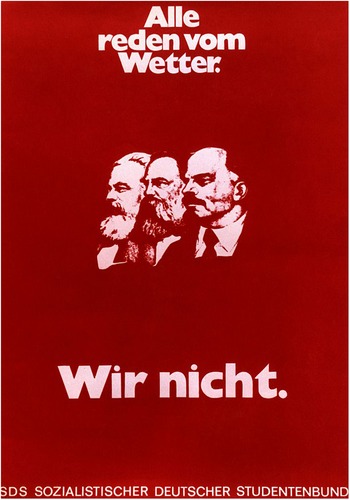
How did the radicals of 1968 understand their relation to advertising and repurpose it? What were the limits to this convergence of revolution and advertising? There are several instances of advertising being reinvented for revolution. The Persil soap slogan is one. A more direct inspiration is the famous German Socialist Student League poster ‘Everybody talks about the Weather. We don’t! (Figure 2), which played on a well-known Deutsche Bahn campaign (Figure 3). While the SDS leadership initially rejected the poster (‘We dont do railway plagiarism’), it became one of its best known.Footnote 69 No doubt its ironic and witty repurposing of an existing campaign helped its popularity. Here, then, is an example of how the structures of advertising could be used to communicate politics, despite the considerable hesitancy of the revolutionary organisation. Advertising technique – neither revolutionary nor conformist in itself – could be repurposed for revolt. Revolutionaries also had to advertise their own journals, which, as Sarah K. Miles has shown, led to an advertising discourse that imagined an ethics that ‘linked subscription, readership, and participation as important parts of militant action’.Footnote 70

Figure 2. SDS Poster: ‘Everyone talks about the Weather, We Don’t.’ 1968. Image Credit: ullstein bild Dtl. via Getty Images.

Figure 3. Deutsche Bahn Poster, ‘Everybody talks about the Weather. We Don’t.’ 1966. Image © DB Museum Nürnberg.
Advertising companies themselves were not immune to protesters. Perhaps the most famous slogan of the revolts in May 1968, ‘sous les pavés, la plage’ (beneath the paving stones, the beach) appears to have been created by two men employed in an advertising agency (although its origin is disputed).Footnote 71 None other than Daniel Cohn-Bendit would briefly be employed in the art department of the J. Walter Thompson advertising agency in Frankfurt (before being fired once his identity was discovered).Footnote 72 His brief sojourn in advertising could be read as either the inevitable fusion of advertising and revolution or, given he was fired, their clear incompatibility. Others in the industry sought to put advertising in the service of protest more explicitly. After the self-immolation of a worker in September 1970, fired because he had long hair, the advertising agency Hautefeuille published a full-page advertisement in Le Monde with a picture of Albert Einstein and the caption ‘he had long hair’ (Figure 4).Footnote 73 The image was the work of a group of employees close to the mouvement de libération des femmes who wanted to use their advertising expertise for political activism.Footnote 74 This confluence of advertising and revolt nonetheless had certain limits. As the journal Combat put it, the advert was not easily labelled politically: ‘to have long hair is not to belong to the gauche prolétarienne.Footnote 75 While the tools of advertising were available to 68ers and advertising agencies could adopt some causes of the revolt, the convergence only occurred either in a strictly formal sense, or within a universal and humanist discourse. Instead, the most common attitude towards advertising among the most politicised was the fear of having protest itself sold for consumption.

Figure 4. Advertisement in Le Monde 21 October 1970: ‘E=mc2. He had long hair.’ Image of Einstein © Philppe Halsman/Magnum Photos.
The spectre of ‘recuperation’ (the idea of being recaptured, reclaimed or assimilated) haunted the protest movements of the 1960s. As Timothy Scott Brown has noted, ‘These worries were in part about the deforming power of mass media, but this concern was intimately related to a broader fear that only became more acute as the decade wore on: that authentic rebellion was being replaced by rebellion-as-commodity’.Footnote 76 Even before the outbreak of revolt, radicals declared that ‘there is no act so radical that ideology will not try to recuperate it’.Footnote 77 Yet the protest movements, while declaring nothing could not be ‘recuperated’, nonetheless displayed an intense desire to avoid it. In practice, these statements translated into a directive to engage in revolutionary rather than reformist activity and to beware investing too much meaning in any particular action (especially voting, cultural protest) that could be easily repurposed by the ‘system’. The spectre of recuperation demanded revolutionary purity.
Protesters understood advertising as engaged in a process of taming revolution. This interpretation has sometimes been adopted by historiography. Rudi Maier has sketched a logic of ‘the disciplining of the symbols of protest’ in which ‘the symbols and practices of protest are trivialised, made ridiculous, reframed, dismantled, exoticised and ironised with the view to transform the carriers of revolt, dissidence and deviation into fools and “others”’.Footnote 78 Timothy Scott Brown has likewise noted that ‘The ultimate vehicle of recuperation was advertising’.Footnote 79 Such statements, as Brown demonstrates, are common in the revolutionary milieu. The satirical magazine Pardon declared in 1968 that advertising is ‘the best way to make youth protest harmless and make capital out of the revolutionary impulse of the young’.Footnote 80 As evidence, Pardon reprinted some advertisements from the magazines Hör Zu, Bravo and Neue Revue that showed ‘protesters’ demonstrating for (among other things) washing machines (Figure 5). Visually, these images nonetheless contrast strikingly to the long-haired, bearded, angry revolutionaries that formed the visual shorthand of revolt. Brown also notes Pardon’s collection of ‘recent examples of recuperative advertising strategies. “Greet the revolution – in a brilliant jacket” read one representative example’.Footnote 81 Yet this example was in fact satirical, produced by Pardon itself. Among their proposals was to use Che Guevara to advertise cigars and yet another advertisement for Deutsche Bahn – for how else would Lenin have reached Russia in 1917 (Figure 6)? Actual advertising was not nearly as funny.

Figure 5. Adverts excerpted in German satirical magazine Pardon. 1968. Image: © Verlag Bärmeier & Nikel.

Figure 6. Satirical advert in Pardon for Deutsche Bahn. ‘Everyone talks about revolution. We too.’ 1968 © Verlag Bärmeier & Nikel.
In short, the notion of recuperation, of advertising as disciplining protest, was very much a part of the milieu of 1968. Historians, however, should be more sceptical. As Brown rightly notes, ‘The visual nature of countercultural fashion meant that its elements could easily be repackaged. The surfaces of style were empty of meaning as such’.Footnote 82 But the point, here, is precisely that the emptiness could go in any direction. There is no need to assume that the appropriation by advertising of the symbols of revolt was effective in any way. The fear of recuperation described a phenomenon already occurring in which the lexicon and symbols of revolution had been appropriated for advertising. Yet that appropriation had clear limits. The banal examples of revolution being used for advertising in Pardon hardly seem worthy of being seen as dangerous. The image of Marx had already been appropriated before 1968 to sell Remington electric shavers, something that could hardly be said to have undermined the use of Marx by revolutionaries in these years.Footnote 83 Advertising appropriations co-existed easily alongside serious evocations. The juxtaposition was sometimes literal, as when the German magazine Stern advertised a ‘cold revolution’ brought by Polarfrost fridges in the kitchen with an interview with SDS revolutionaries on the opposite page.Footnote 84 Advertisers adopted the language of revolution alongside if not before the protesters of 1968.
If advertisers already drew on the language and symbols of revolution before 1968, this was a superficial appropriation, mostly evoking liberty (usually in a narrow sense of free time) and technological transformation. ‘Liberty to what end’, asked one page in the Nouvel Observateur – an advertisement for Club Med.Footnote 85 The ‘SEB révolutionnaire’ (a fryer) marched across French periodicals in the 1960s, complete with Phrygian cap.Footnote 86 Equality, however, was a much harder ideological tradition to draw on.Footnote 87 Krups superficially evoked feminism in its 1967 advertisement for an electric potato-peeler (‘We are against women having to peel potatoes’), but this was explicitly rationalised not as a form of equality but to ensure that womens ‘well-manicured hands’ not be ‘spoiled through onerous kitchen work such as potato peeling’.Footnote 88 The machine was only directed at ‘housewives’.Footnote 89 The rhetoric of revolution in advertising thus preceded 1968, was limited and superficial and in no way rendered the language of revolution unavailable or ineffective for political mobilisation. After 1968, the revolt itself provided material for advertisers. Gerd-Rainer Horn has described how the Dutch Provos ‘white’ campaign to close Amsterdam city centre to cars and make 20,000 bicycles free was already being reused by the Dutch Milk Council in 1967.Footnote 90 Symbols that were relatively easily detached of content could be quickly repurposed.
What, then, of the image at the beginning of this article? Is it satirical in the vein of the images from Pardon? The answer is no. The image appears among the many ads for aperativi in the pages of the Bolzano edition of the Alto Adige newspaper.Footnote 91 The man in the picture, named Giorgio, was a student at the Faculty of Sociology at Trento.Footnote 92 He had even asked permission from the political leadership to do the advert. But the reaction from the student movement was horror. ‘A teacher in the movement was scandalised and said “such a thing would never have happened in 1968!” [this being 1969] . . . I, who had done it for two plates of food and a bottle, felt like a worm, . . . I had destroyed the idea of the committed sociologist or rather the image of it’.Footnote 93 This advertisement is thus more evidence that some businesses found it feasible to use the image of revolution to sell products but is hardly an example of advertising rendering protest harmless, or converting actual protest activity into passive consumption. Instead, it points once again to the crucial importance of authenticity to the protest movement and the deep suspicion of advertising and media. Advertising did not discipline the revolution, but the spectre of recuperation could be used within the protest movement to discipline and shame its members. Nevertheless, some pushed back against the anti-consumerist critique of morality purity. When the Trotskyist journal Rouge announced advertisements, it countered the moral critique with practical realities, or ‘infantile purism’ with ‘revolutionary realism’:
already some are outraged … what our readers like is intransigence, incorruptibility, journalistic Robespierrism. Advertising, it’s the most spectacular form of brainwashing, of stupefaction and capitalist alienation! … In our desire to be pure revolutionary antibodies we should want no part of it. Yes, but . . . we are not a sect, nor a primitive tribe.Footnote 94
In this instance, the anti-consumerist critique implied the end of the revolution. ‘We prefer a journal with advertisements to no journal at all’, Rouge insisted, declaring its willingness to exploit the contradictions in capitalism where the bourgeoisie advertised in the revolutionary press.Footnote 95
Most protesters were more careful than Giorgio in their attitude towards advertisers, hopeful of using the revolt and its celebrities to sell products. As Sedlmaier and Malinowski note, the advertiser David Ogilvy immediately saw the star power of student leaders: ‘why shouldnt Dany the Red or Dutschke be given an advertising task … He knows how to sell something to young people’.Footnote 96 Unsurprisingly, given the assumption consumerism meant soporific passivity, the protest movements adopted a politics of suspicion in relation to media and the consumerisation of revolt. The visual nature of much protest and revolt, its performative dimension, meant precisely that everything came to down to the agency of how products were used. Thus, the Atelier Populaire that produced posters in France during the May–June events, felt the need to specify that their posters were not purely aesthetic objects: the posters are ‘are weapons in the service of the struggle…. To use them for decorative purposes, to display them in bourgeois places of culture or to consider them as objects of aesthetic interest is to impair both their function and their effect’.Footnote 97 Yet it was impossible to control such appropriation.
A greater fear than commercialisation of revolt was how media could distort the hierarchies of protest movements. West German student leader Rudi Dutschke was asked to have a bottle of Pepsi ‘unobtrusively’ with him at his appearance and at teach-ins, with the guarantee of a couple of thousand DM per month in return.Footnote 98 He declined. But Dutschke was threatened with exclusion from the SDS for an interview with the newspaper Capital and the photo shoot that accompanied it that threatened to make an even greater media star of him.Footnote 99 Daniel Cohn-Bendit likewise reported receiving all sorts of offers on becoming famous: ‘I had self-interest to remain a star, a material interest, the taste for the great life. Take a plane for London, then Amsterdam, Berlin … paid for here by the TV, there by a publishing house’.Footnote 100 The way media created celebrities out of protest leaders and reshaped the hierarchies of the movements themselves proved a much bigger concern than buying off revolution via consumption.
With a few exceptions, the appropriation of 1968 by advertisers played out in the pre-existing and generic vein of the rhetoric of ‘revolution’, shorn of any radical and egalitarian meaning. Despite the protesters paranoia of recuperation, this posed no threat to the language or symbols of radicalism. Advertisers typically responded to the challenges of the 1970s less by adopting the language of revolution, or its symbols, than by mobilising other discourses. One such case is the celebrity of ‘la mère Denis’ (Jeanne Marie Le Calvé), a 79-year-old former washerwoman who burst onto the French advertising scene in 1972 as the face of Vedette washing machines. The campaign responded in part to 1968, at least according to the advertising agency head: ‘it was in the wake of 1968, reticence towards new technology, denunciation of polluters. It was necessary to advertise the washing machine with a completely new, original and human dimension’.Footnote 101 Thus Sarah Farmer has analysed ‘la mère Denis as a modernising peasant, fusing technology, tradition and authenticity’.Footnote 102 Here, then, is another attempt to provide authenticity detached from a radical future and integrated with capitalist consumerism, smoothing the friction between technology and tradition in an era when some radicals embraced a communal anti-capitalist rural lifestyle while others envisaged a workers’ revolution. La mère Denis offered ‘the authentic, the natural, the waterfront’ without the anti-capitalism.Footnote 103 The proclaimed victory of la mère Denis over the alternatives of the long 1960s is symbolised by how, on the eve of François Mittérands 1981 electoral victory, Bazaine adapted the ‘68 slogan of ‘we are all undesirables’ (Figure 7).Footnote 104 Yet instead of Daniel Cohn-Bendit and solidarity with ‘undesirables’, the Bazaine advertisement showed three women marching, not to protest, but to declare that ‘we are all “la mère Denis”’.Footnote 105 The campaign was, however, widely regarded as a flop.Footnote 106 The advertising agency felt la mère Denis did not suit the individualism of the 1980s as she had the ‘values dear to the 1970s’.Footnote 107

Figure 7. Atelier des Beaux arts. ‘We are all “undesirables”.’ 1968. Image: Bibliothèque nationale de France.
Well over a decade after the revolts of 1968, the most famous slogans had become available for commercial use, if not necessarily successfully. This indicates much more about the 1980s and the growing consensus around the interpretation of 1968 as a vaguely imagined efflorescence of cultural freedom than anything more profound about advertising’s role in recuperating radicalism.Footnote 108 Since the 1980s, other aspects of 1968 have been mobilised for commercial purposes, such as the department store Leclerc’s 2005 campaign against the loi Galland (that sought to limit large firms selling goods below cost), in which images from 1968 were repurposed by the advertising agency Australie.Footnote 109 By this point, May 1968 could be evoked as a moment of generic social protest but not one that actually involved setting fire to the Bourse, throwing paving stones or carrying out a sit-in of (and destruction of the goods in) a department store.
The appropriation of the imagery of 1968 by advertising begins to occur around a decade after the events, after the waning of the revolutionary horizon. An early example is Mustang Jeans, embodying the familiar triumphalist narrative of consumerism having converted radicals of 1968 to contented consumers in the 1970s.Footnote 110 Uli Weber, pictured in the advertisement, had in fact made the passage from protest to advertising himself. The same issue of Stern could nonetheless report on the abduction of Hans-Martin Schleyer and an article by Rudi Dustchke on his Christianity, indicating a number of other ‘68s that did not all involve embrace of consumerism via a narrative cliché of youthful revolt to middle-aged consumption.
For all the occasional attempts to address or appropriate revolution, advertising continued oblivious to social protest as much as possible. Only on rare occasions did advertising companies attempt to address anti-consumerism head on. In 1967, the West German SDS had proclaimed its goal of ‘scientific analysis and general enlightenment of the systematic destruction of social abundance through consumer terror (Konsumterror)’.Footnote 111 By 1975, the advertising company Gruner & Jahr responded with an advertising campaign to defend consumerism.Footnote 112 One advert that appeared in Stern declared that someone from fifty years ago would have needed to work twenty-five hours in a day to live as one did in the 1970s (Figure 8).Footnote 113 West Germans never had it so good, the advertisers insisted: ‘some think now that we live in a world full of Konsumterror, controlled by hidden persuaders and unprincipled entrepreneurs. But that is a good thing’.Footnote 114 The unapologetic defence of consumerism against its critics is probably much more representative of advertising cultures after 1968 than the occasional and superficial repurposing of revolution.

Figure 8. Gruner + Jahr advertisement in Stern Magazine: ‘50 Years ago we would have had to work 25 hours a day to live as we do today’ (1975). Image © Gruner + Jahr.
Conclusion
Advertising in the ‘68 years’ stood for the epitome of ‘consumerist’ manipulation. Yet protesters also adopted the tools of advertising, if hesitantly, and deployed them for radical or revolutionary ends. The tension between the straightforward position of anti-consumerism and the adoption or adaptation of its tools ran within the protest movements. The anti-consumerist ethos could be used to discipline the movement and its members or rejected as an unpractical stance of moral purity. The appropriation of the tools of advertising was thus fraught and limited. Conversely, advertisers adopted the imagery of revolution and revolt – albeit superficially and within limits, detached from its radicalism and egalitarianism. This appropriation sparked a fear of ‘recuperation’, but that remained a spectre that served more revolutionaries’ attempts to discipline the protest movement internally than to undermine revolution. Undoubtedly, many anti-capitalist and anti-consumerist protesters of the late 1960s eventually abandoned revolution and embraced ideas of liberation and freedom more compatible with consumer society, but this was a process marked by discontinuity.
This analysis of advertising in relation to the ‘68 years’ suggests the need to go beyond narratives of straightforward opposition to, recuperation by or stimulus to consumption and to look within the protest movements for how the tensions between asceticism and hedonism, anti- and alternative consumerisms, operated in practice.Footnote 115 The revolts emerged both within and against a society of mass consumption, appropriating a critique of consumerism and advertising and extending it to the university and politics. The protest movements were anti-consumerist (even if this was rarely their primary focus), where consumption was understood as manipulative and inculcating passivity. Yet that framework of manipulation often proved inadequate and did not reflect the movements’ own occasional reappropriation of advertising tools for revolt. The protest cultures demonstrated both an ascetic drive and attempts to reimagine hedonism outside of consumerism. Yet asceticism could become limiting and, unsurprisingly, the reimagination of pleasure no easy task. The revolts can be read as contributing to the long-term triumph of consumerism, but only by diminishing the explicitly anti-consumerist element, dehistoricising how hedonism was understood within protest cultures and emphasising continuity over discontinuity. While consumerism always remained popular for the majority, the minority’s anti-consumerist rejection of goods had an impact well beyond those who espoused or lived it, posing the fundamental question of a politics beyond consumer abundance.
Acknowledgements
I would like to acknowledge and the feedback of the anonymous reviewers.
Funding statement
This research was supported by funding from the Australian Research Council (DP200102623)



 Open access

