

Introduction
The social wellbeing of older adults needs to be addressed, because 50 per cent of older adults living in Europe experience loneliness (Vozikaki et al., Reference Vozikaki, Papadaki, Linardakis and Philalithis2018). Moreover, loneliness is related to serious health issues such as depressive symptoms, chronic and cardiovascular disease (Valtorta et al., Reference Valtorta, Kanaan, Gilbody, Ronzi and Hanratty2016; Vozikaki et al., Reference Vozikaki, Papadaki, Linardakis and Philalithis2018) and increased mortality risk (Holt-Lunstad et al., Reference Holt-Lunstad, Smith, Baker, Harris and Stephenson2015). This stresses the importance of interventions that aim to reduce or prevent feelings of loneliness in older adults, of which the first step is to strengthen social interactions. Interestingly, images of nature, videos and computer-animated nature scenes can promote social aspirations (Van Houwelingen-Snippe et al., Reference Van Houwelingen-Snippe, Van Rompay, De Jong and Ben Allouch2020b), elicit diverse associations (Schertz et al., Reference Schertz, Sachdeva, Kardan, Kotabe, Wolf and Berman2018) and stimulate social interactions (Piff et al., Reference Piff, Dietze, Feinberg, Stancato and Keltner2015). Moreover, with virtual reality development software such as Unity (https://unity.com), researchers have the potential to create and systematically manipulate nature characteristics and thereby produce virtual representations of nature (VN). Therefore, this study investigated whether VN, implemented in the current study as computer-animated nature images, can trigger associations that could serve as conversational material.
Current solutions to diminish or prevent feelings of loneliness frequently aim at increasing social interaction, including video conferencing, reminiscence interventions, discussion groups, indoor gardening and physical exercise (Jarvis et al., Reference Jarvis, Padmanabhanunni, Balakrishna and Chipps2020; Quan et al., Reference Quan, Lohman, Resciniti and Friedman2020), and most interventions have shown positive results (Gardiner et al., Reference Gardiner, Geldenhuys and Gott2018; Jarvis et al., Reference Jarvis, Padmanabhanunni, Balakrishna and Chipps2020). These findings indicate that various methods can be used to increase social interaction, varying in terms of setting, use of technology and availability of support. This diversity suggests that social connectedness is a multi-level concept that comprises both interpersonal interactions and feelings of connectedness to neighbourhoods and society at large (Morgan et al., Reference Morgan, Wiles, Park, Moeke-Maxwell, Dewes, Black, Williams and Gott2021). However, research has focused less attention on initiating social interactions, e.g. conversations. By having a conversation, empathy and development of new social bonds are encouraged, and intimacy and bonding in existing relationships are strengthened (Fivush et al., Reference Fivush, Haden, Reese and Rubin1996; Cohen, Reference Cohen1998). Therefore, an intervention aimed at stimulating conversations could possibly be a suitable method to encourage social interaction and, in turn, social wellbeing.
In research on social wellbeing, the role of the environment is generally underacknowledged. Considering social wellbeing, however, exposure to natural environments, such as forests, parks and gardens, has been related to benefits including social cohesion and perceived social support (Keniger et al., Reference Keniger, Gaston, Irvine and Fuller2013). This also is apparent in the lives of older adults; a systematic review showed that horticulture therapy, such as gardening, has wellbeing and social benefits (Nicholas et al., Reference Nicholas, Giang and Yap2019), and other research showed that more urban park visits are related to having a closer social network (Enssle and Kabisch, Reference Enssle and Kabisch2020). Moreover, persons with dementia and their care-givers reported nature experiences to be important for social aspects and reminiscing (Hendriks et al., Reference Hendriks, Van Vliet, Gerritsen and Droes2016; Evans et al., Reference Evans, Barrett, Mapes, Hennell, Atkinson, Bray, Garabedian and Russell2019), while a meta-analysis showed that horticulture promotes, amongst other aspects, social behaviour in persons with dementia (Zhao et al., Reference Zhao, Liu and Wang2022). Hence, these combined findings suggest that nature experiences can promote social interaction among older adults.
An important question is how nature experiences can promote conversations and whether exposure to different natural environments varies in the extent to which it triggers conversational material. Previous research has shown that nature experiences can trigger a wide range of associations. For instance, research by Hendriks et al. (Reference Hendriks, Van Vliet, Gerritsen and Droes2016) showed that for people with dementia, nature experiences can be traced to eight different benefits: social contact, reminiscing, listening to/looking at nature, having fun, feeling useful, rest/relaxation, feeling fit and feeling free. Furthermore, Schertz et al. (Reference Schertz, Sachdeva, Kardan, Kotabe, Wolf and Berman2018) revealed that visiting parks that were closer in appearance to wild (rather than cultivated) nature were more frequently associated with topics such as spirituality and life. Accordingly, it seems that nature experiences can provide a wide range of associations that might be used as conversational material, warranting research further identifying which specific type(s) of natural environments are particularly promising in this regard.
The findings from Hendriks et al. (Reference Hendriks, Van Vliet, Gerritsen and Droes2016) and Schertz et al. (Reference Schertz, Sachdeva, Kardan, Kotabe, Wolf and Berman2018), however, do not identify specific nature characteristics (e.g. high or low tree density, presence or absence of water) that should be considered when selecting natural environments or designing representations of them. Regarding the types of associations triggered, arguably, associations are more suited for conversational purposes if they are personally engaging and of positive valence. Negative associations (e.g. bitterness revival: ‘The recall of memories about unjust treatments, providing the justification to maintain negative thoughts and emotions to others’; Westerhof et al., Reference Westerhof, Bohlmeijer and Webster2010: 700) are related to lower levels of mental health. Additionally, when experiencing nature leads to more associations, it also more likely provides (diverse) conversational material. The current study therefore extends previous research by investigating whether nature experiences using VN can provide conversational material by measuring personal engagement, valence and the number of associations, and seeks to pinpoint key nature characteristics.
To test the effects of nature characteristics, a virtual reality-based approach is used to allow for experimental control over the key variables. In addition, VN might prove a welcome complementary means to interact with nature for older adults who have difficulties accessing nature due to mobility constraints (Schwanen and Páez, Reference Schwanen and Páez2010; Mitra et al., Reference Mitra, Siva and Kehler2015). Although VN cannot and should not replace real nature (Kahn et al., Reference Kahn, Severson and Ruckert2009), the literature does show that representations of nature can convey similar benefits to real natural environments. For instance, VN exposure positively influences prosocial aspirations and behaviour (Zhang et al., Reference Zhang, Piff, Iyer, Koleva and Keltner2014; Van Houwelingen-Snippe et al., Reference Van Houwelingen-Snippe, Van Rompay, De Jong and Ben Allouch2020b) and feelings of connectedness to the community (Van Houwelingen-Snippe et al., Reference Van Houwelingen-Snippe, Van Rompay and Ben Allouch2020a). Moreover, improved social engagement after experiencing VN was reported in a case study (Ludden et al., Reference Ludden, Van Rompay, Niedderer and Tournier2019). Hence, VN might be very well suited to investigate nature characteristics and to explore the positive effects that nature experiences may have on social interactions.
Nature characteristics and the study's hypotheses
Natural environments are diverse; they vary from deserts to tropical rainforests. However, the question of which specific nature characteristics are most influential with respect to social wellbeing has been largely ignored in previous research (Marselle et al., Reference Marselle, Hartig, Cox, de Bell, Knapp, Lindley, Triguero-Mas, Bohning-Gaese, Braubach, Cook, De Vries, Heintz-Buschart, Hofmann, Irvine, Kabisch, Kolek, Kraemer, Markevych, Martens, Muller, Nieuwenhuijsen, Potts, Stadler, Walton, Warber and Bonn2021). Importantly, when selecting and designing VN, strategic and practical choices must be made as to which nature characteristics are implemented, further stressing the importance of insights into relationships between specific nature characteristics and the associations they trigger. Attention restoration theory (ART; Kaplan and Kaplan, Reference Kaplan and Kaplan1989), the dominant framework in studies on nature experiences, provides four initial directions: soft fascination, mystery, spaciousness and compatibility, described in detail below along with their corresponding hypotheses.
Soft fascination is an essential characteristic of nature experiences in ART. Stressing restorative aspects of nature experiences, ART proposes that experiencing nature is restorative, as it is generally softly fascinating, i.e. highly engaging and at the same time non-demanding in terms of cognitive effort (Kaplan and Kaplan, Reference Kaplan and Kaplan1989; Kaplan, Reference Kaplan1995). Examples include the presence of water, leaves rustling in the wind, clouds rolling by or a field of colourful flowers. By being fascinating and aesthetically pleasing, VN experiences could trigger associations that are engaging and of positive valence. Accordingly, the following hypothesis is proposed:
• Hypothesis 1 (H1): Exposure to VN high (rather than low) in soft fascination leads to more associations with VN, more personally engaging associations and more positive associations.
Mystery (i.e. unpredictability; Van Rompay and Jol, Reference Van Rompay and Jol2016) also is considered a key characteristic in ART, as it stimulates curiosity and exploration by suggesting that there is more to experience if one travels deeper into a nature scene (Kaplan and Kaplan, Reference Kaplan and Kaplan1989). Examples include a winding path with no obvious destination, twilight or midnight reducing overall visibility, or hills obscuring (parts of) the distant horizon (Kaplan and Kaplan, Reference Kaplan and Kaplan1989). Viewing nature images that are more mysterious resulted in better cognitive (Szolosi et al., Reference Szolosi, Watson and Ruddell2014) and creative performance (Van Rompay and Jol, Reference Van Rompay and Jol2016). Consistent with these findings, the following hypothesis is proposed:
• Hypothesis (H2): Exposure to VN high (rather than low) in mystery leads to more associations with VN, more personally engaging associations and more positive associations.
Spaciousness (i.e. extent; Kaplan and Kaplan, Reference Kaplan and Kaplan1989) is considered important both in ART and awe research, as it is associated with overview, opportunities for exploration and positive emotions, including awe, an emotion that is traced to interactions with vast settings that inspire a sense of feeling ‘small’ and feeling connected to the world at large (Keltner and Haidt, Reference Keltner and Haidt2003; Piff et al., Reference Piff, Dietze, Feinberg, Stancato and Keltner2015). In natural environments, such as parks and forests, spaciousness can be related to tree density, with more spacious environments having a lower tree density (Van Houwelingen-Snippe et al., Reference Van Houwelingen-Snippe, Van Rompay, De Jong and Ben Allouch2020b). Of relevance to the current study, exposure to more spacious natural environments has been found to enhance social aspirations, e.g. ‘I would like to meet here with a friend’ (Van Houwelingen-Snippe et al., Reference Van Houwelingen-Snippe, Van Rompay, De Jong and Ben Allouch2020b). Moreover, visiting parks with a spacious layout promoted personal reflection by visitors when they were invited to write down their thoughts (Schertz et al., Reference Schertz, Sachdeva, Kardan, Kotabe, Wolf and Berman2018). Based on these findings, the following hypothesis is proposed:
• Hypothesis (H3): Exposure to VN high (rather than low) in spaciousness leads to more associations with VN, more personally engaging associations and more positive associations.
Compatibility is described as the link between the environment and human aspirations (Kaplan, Reference Kaplan1995). When older adults think about nature experiences, it triggers tendencies to engage in social interaction (Hendriks et al., Reference Hendriks, Van Vliet, Gerritsen and Droes2016). Hence, natural environments compatible with social interaction should provide affordances for doing so, e.g. benches for comfort while having a conversation or appropriate lighting to feel safe and secure during social interaction. In line with this notion, findings from a recent study showed that exposure to cultivated (rather than wild) nature positively affected social aspirations (Van Houwelingen-Snippe et al., Reference Van Houwelingen-Snippe, Van Rompay and Ben Allouch2020a). Consequently, the following hypothesis is proposed:
• Hypothesis (H4): Exposure to VN incorporating characteristics compatible with having conversations, i.e. high compatibility (rather than low), leads to more associations with VN, more personally engaging associations and more positive associations.
In addition to nature characteristics, the effects of nature experiences vary depending on an individual's physical contact and mental connection with nature (Marselle et al., Reference Marselle, Hartig, Cox, de Bell, Knapp, Lindley, Triguero-Mas, Bohning-Gaese, Braubach, Cook, De Vries, Heintz-Buschart, Hofmann, Irvine, Kabisch, Kolek, Kraemer, Markevych, Martens, Muller, Nieuwenhuijsen, Potts, Stadler, Walton, Warber and Bonn2021), referred to as nature relatedness by Nisbet et al. (Reference Nisbet, Zelenski and Murphy2009). Generally, people with high nature relatedness spend more time in nature and are more concerned about how their behaviours affect nature (Nisbet et al., Reference Nisbet, Zelenski and Murphy2009). Additionally, the amount of nature nearby affects time spent in nature and has been shown to, amongst other impacts, influence perceptions of social support (Maas et al., Reference Maas, Van Dillen, Verheij and Groenewegen2009). Consequently, the following hypothesis is proposed:
• Hypothesis (H5): When exposed to VN, people who are more related to nature or have more nature opportunities available have more associations with VN, more personally engaging associations and more positive associations.
Taken together, soft fascination, mystery, spaciousness and compatibility are characteristics of nature environments that are hypothesised to affect positively the personal engagement, valence and number of associations people have with VN. These associations could, in turn, serve as conversational material, possibly making VN a useful instrument for promoting conversations and social interaction.
Methods and materials
Stimuli
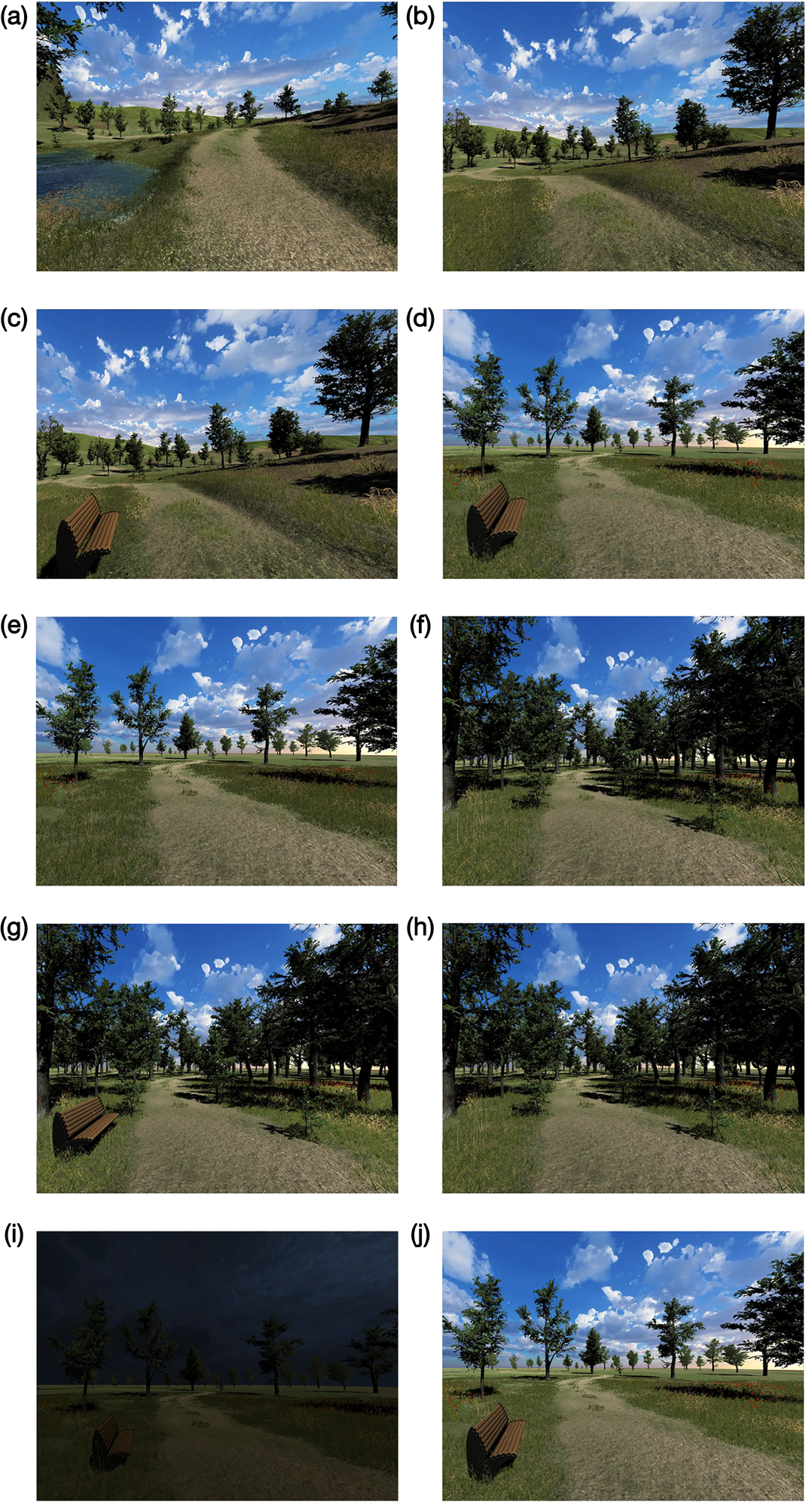
The VN were created with purpose-built software developed using the 3D development platform Unity3D by the BMS Lab at the University of Twente. A demo version of the software is accessible online (BMS Lab, 2020). The software allows for VN environments to be authored and then exported as videos and images. The current study made use of VN environments in the form of images. Soft fascination was manipulated with the presence or absence of water, which has proven to be an important antecedent of soft fascination perception (Kaplan, Reference Kaplan1995); mystery with the presence or absence of hills, as Szolosi et al. (Reference Szolosi, Watson and Ruddell2014) demonstrated in their study where they obscured parts of the scene from view; spaciousness with low and high tree density, resulting in an open or denser scene (Van Houwelingen-Snippe et al., Reference Van Houwelingen-Snippe, Van Rompay and Ben Allouch2020a); and compatibility with the presence or absence of a bench, which is compatible with the needs for social interaction in a comfortable setting (Kaplan and Kaplan, Reference Kaplan and Kaplan1989). In the VN images, these four characteristics could be present or not, leading to 16 different VN designs. Examples of the VN images can be seen in Figure 1. For explorative purposes, one extra VN image was designed using a night-time version of one of the daytime versions. In total, 17 VN images were created.
Examples of the virtual representations of nature (VN) images for each manipulated nature characteristic.
Notes: The VN images consisted of a high or low level of soft fascination (a = high, b = low), mystery (c = high, d = low), spaciousness (e = high, f = low) and compatibility (g = high, h = low), resulting in 16 variations. Additionally, one extra night-time VN image (i) was designed and compared to its daytime counterparts (j).
Research design
A randomised factorial design was used to investigate the effect of exposure to different characteristics of VN on the associations of older adults. To balance the power of the study and feasibility of recruitment, each participant was shown four VN images. To prevent confusion caused by seeing VN images that might be too similar, four sets (Sets 1–4) of four VN images were created to ensure that the VN images within a set would deviate from each other as much as possible. One extra set (Set 5) was created that contained the night-time version of its daytime counterpart in Set 4. The other three VN images were identical in Sets 4 and 5. Each participant was randomly assigned to see one set of four VN images, which were shown in random order.
Outcome measures
Associations with the VN images were measured using three dependent variables: personal engagement, valence and the number of associations. Personal engagement and valence were obtained from qualitative data collected when participants were asked for their spontaneous associations with the VN images. They could type their response in a text box and were asked to be as detailed as possible when describing their self-expressed associations. In this way, the potential of VN exposure to stimulate conversations was explored. When a subsequent VN image produced associations already noted by the participant, e.g. when participants wrote ‘Same as previous’, their previous association(s) also were assigned to that particular VN image.
Personal engagement was constructed as an ordinal variable of five levels (0–4): none, observation (e.g. ‘I see a forest’), affective judgement (e.g. ‘nice scenery’ or ‘beautiful clouds’), utilisation (e.g. ‘walking’ or ‘resting on that bench’) and personal reflection (e.g. ‘On this bench I see myself sitting and musing for a while’ or ‘This reminds me of our vacation in the Netherlands last year’).
Valence was measured as an ordinal variable with three levels (0–2): negative (e.g. ‘unattractive’), neutral/ambivalent (e.g. ‘none’, ‘walking’) and positive (e.g. ‘This landscape is fantastic!’). Higher scores indicated more personal engagement or a more positive valence.
The number of associations was measured quantitatively using one multiple-choice question: ‘Which of the following answers do you find most fitting with the image?’ The participants could select more than one of the following associations, based on results from Hendriks et al. (Reference Hendriks, Van Vliet, Gerritsen and Droes2016): social contact, reminiscing, feeling free, listening/looking at nature, having fun, feeling useful, rest/relaxation and feeling fit. In addition, the participants could choose the option ‘other’. Each association was measured as a dichotomous variable, and for each participant, a total score was calculated as the sum of the selected associations.
Covariates
Nature relatedness reflects an individual's connectedness with the natural world (Nisbet et al., Reference Nisbet, Zelenski and Murphy2009) and was measured and scored using the short version of the Nature Relatedness Scale (Nisbet and Zelenski, Reference Nisbet and Zelenski2013), consisting of six items (Cronbach's alpha current sample = 0.876), such as ‘My relationship to nature is an important part of who I am’ and ‘My ideal vacation spot would be a remote, wilderness area’.
Available nature opportunities was measured using a multiple-choice question: ‘Which nature opportunities are currently available to you?’ There were six options: private balcony, private garden, communal garden, nearby park, nearby nature area and other. The participants could select more than one option.
Procedure
Older adults eligible to participate received either an email with a link to the online survey or, in the case of nursing home residents, staff provided a laptop with the link to the survey and helped with typing if necessary. When entering the survey, the participants were first briefed about the topic and aim of the survey. Subsequently, the survey software registered on which device the survey was performed. Only desktop computers (PCs) and laptops were allowed, and mobile devices (e.g. smartphones or tablets) were rejected because these devices could not show the stimuli as intended. If participants tried to enter the survey using a mobile device, they received a notification (explaining why the survey ended) and a link to start a new response on a PC or laptop. After the briefing and device checking, informed consent was obtained. When consent was not given, the participants received a notification of why the survey ended. When agreeing to consent, a non-nature example question was shown to familiarise the participants with the questions concerning their associations with VN. After the example, the participants were randomly assigned to one of the five sets. First, the self-expressed associations were measured for all four VN images in the set, followed by the number of associations of the same four VN images. Next, nature relatedness and nature opportunities were measured, and demographic characteristics were obtained. After completing the survey, the participants were debriefed about the purpose of the study and had the opportunity to leave questions or remarks. Finally, the participants were thanked for their contribution.
Participants
The recruitment of Dutch participants occurred in accord with two organisations. One in Utrecht, the Netherlands, aims to improve the digital skills of older adults. They recruited participants by sending email invitations to their research panel consisting of older adults. Additionally, participants were recruited in person by staff of a nursing home located in Kampen, the Netherlands. Using these two organisations allowed for the inclusion of older adults. The two organisations themselves contacted eligible participants: adults aged 60 years and over. No further inclusion or exclusion criteria were applied. In total, 263 older adults responded. Among the responses, 98 were incomplete, and two participants did not provide fully informed consent. Another 13 responses had to be removed because participants started on a mobile device. In the final analyses, 150 participants were included. The measured demographic characteristics were age, sex, highest educational level, household (single or multiple persons in their household) and residential situation (independent, partially dependent or fully dependent). Table 1 shows the percentages of the demographic characteristics of the participants and corresponding statistics. The average age of the participants was 78.3 years (standard deviation (SD) = 6.4, range = 62–98), and the majority were male (67%), had a college or university degree (44%), lived together with others (67%) and lived independently (83%). Randomisation did not lead to significant differences in demographic characteristics among the five sets of VN images (p > 0.05).
Overview of the demographic characteristics of the participants
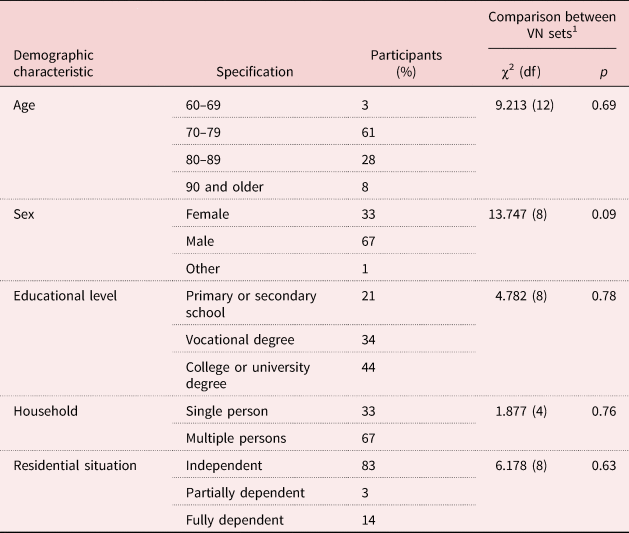
Notes: N = 150 participants. VN: virtual representations of nature. df: degrees of freedom. 1. Comparison between all five VN sets on the demographic characteristics was performed with Pearson's chi-square (χ2).
Analyses
The qualitative data (self-expressed associations) were analysed using both deductive and inductive methodology in a blended approach, also referred to as abduction (Skjott Linneberg and Korsgaard, Reference Skjott Linneberg and Korsgaard2019). In the first cycle, inductive analysis on a subsample revealed that associations differed on valence (positive, neutral, negative) and that associations varied on personal engagement: from none to impersonal/no personal meaning (e.g. ‘I see a meadow’) and personal meaning (e.g. ‘This reminds me of our vacation in the Netherlands last year … [description of vacation]’). In the second cycle, all authors decided on using the above-mentioned valence codes, and consensus led to the use of four personal engagement codes (none, objective, affective judgement, personal meaning). In the third cycle, inductive coding revealed that personal meaning should be divided into utilisation and personal reflection, after which all responses were assigned a valence code and a personal engagement code. In the last cycle, the assignments of valence codes and personal engagement codes were reviewed, and the assignment of codes was finalised. ATLAS.ti version 9.1 was used for the qualitative analyses.
Results
Description of associations with VN
In Table 2, the results of the personal engagement, valence and number of associations are shown for the total number of responses and per VN characteristic. The associations (N = 600) provided by the participants consisted, on average, of 12 words (SD = 10). In total, 5 per cent were not categorised as an association or regarded as objective observations due to their lack of any type of engagement (e.g. ‘does not remind me of anything’ or ‘I see a forest’). All other associations were personally engaging as follows: affective judgement at 24 per cent, utilisation at 24 per cent or personal reflection at 47 per cent. Associations lacking any personal engagement were the least reported (2%) after exposure to VN with a high level of soft fascination (water present), a high level of mystery (hills present) and a low level of spaciousness (high tree density). Personal reflective associations of participants were most frequently seen (52%) after exposure to VN high in mystery.
Personal engagement, valence and number of associations for the total sample and for the virtual representations of nature (VN) characteristics
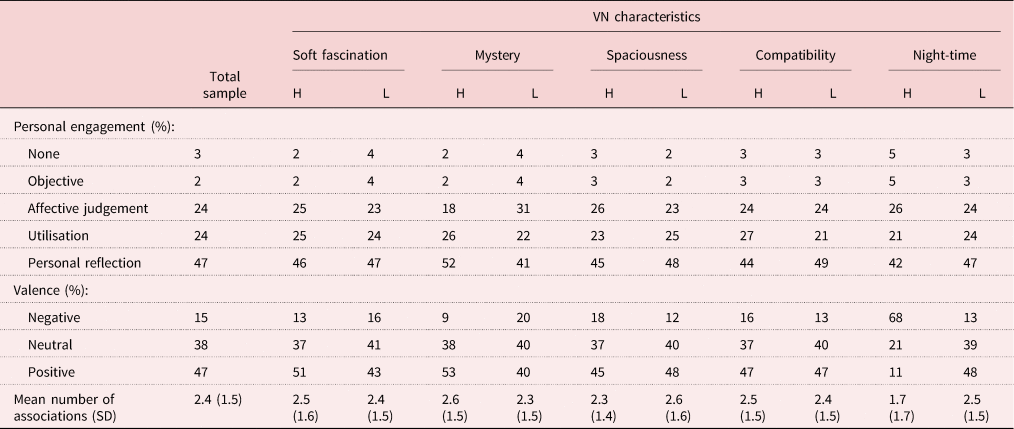
Notes: N = 150 participants. For the total sample, the number of responses is 600. For each level (H: high level, L: low level) of the virtual representations of nature (VN) characteristics, the number of responses is 300, except for night-time; high level is 19 and low level is 581. SD: standard deviation.
In total, the valence of the associations was mostly positive (47%), followed by neutral (38%) and negative (15%). Negative valence was most frequently seen after exposure to VN with a high level of night-time (68%), neutral valence most frequently after exposure to VN with a low level of soft fascination (absence of water; 41%) and positive valence most frequently after exposure to VN with a high level of mystery (presence of hills; 53%).
With respect to the number of associations, in the total sample, on average, 2.4 (SD = 1.5) associations were chosen. The most chosen associations after VN exposure were listening/looking at nature (50%) and rest/relaxation (50%), followed by feeling free (42%), feeling fit (28%), reminiscing (19%), having fun (16%), social contact (12%), and feeling useful (8%). The option ‘other’ was chosen in 19 per cent of the responses.
Exposure to VN with a high level of mystery (presence of hills) and low level of spaciousness (high tree density) led to the highest number of associations: 2.6 (SD = 1.5) and 2.6 (SD = 1.6), respectively. Exposure to VN with the presence of night-time led to the lowest number of associations: 1.7 (SD = 1.7). The descriptive results show that VN exposure, in general, can trigger several associations among older adults, which can be (very) personal and of positive valence.
Effects of VN characteristics (H1–H4)
Soft fascination did not have a significant effect on personal engagement (F(1, 17) = 0.405, p = 0.525) or number of associations (F(1, 17) = 0.846, p = 0.358). Soft fascination did have a marginally significant effect on valence (U = 41,258, p = 0.054), as the results showed that exposure to VN images high in soft fascination (rather than low) led to more positive associations. Second, mystery had a significant effect on personal engagement (F(1, 17) = 13.579, p < 0.001, η2p = 0.023) and valence (U = 37,456, p < 0.001) but not on the number of associations (F(1, 17) = 2.535, p = 0.112). Exposure to VN images high in mystery (rather than low) led to more personal engagement and more positive associations. Third, spaciousness had no significant effect on personal engagement (F(1, 17) = 1.350, p = 0.246) or valence (U = 42,413, p = 0.183). Spaciousness did have a marginally significant effect on number of associations: F(1, 18) = 3.394, p = 0.066, η2p = 0.006. Exposure to VN images high in spaciousness (rather than low) led to fewer associations. Fourth, compatibility did not have a significant effect on personal engagement (F(1, 17) = 0.332, p = 0.565), valence (U = 44,075, p = 0.634) or number of associations (F(1, 17) = 1.304, p = 0.254). Finally, night-time had a significant effect on valence (U = 2,125, p < 0.001) but not on personal engagement (F(1, 17) = 0.288, p = 0.592) or number of associations (F(1, 17) = 1.119, p = 0.291). The valence of the expressed associations was more negative after exposure to night-time VN images than after exposure to daytime VN images.
Correlations between personal engagement, valence and number of associations
Personal engagement correlated significantly with valence (Spearman rho = 0.191, N = 600, p < 0.01) and number of associations (Spearman rho = 0.171, N = 600, p < 0.01). Participants who expressed higher levels of personal engagement also expressed themselves more positively and had more associations with the VN images. Moreover, valence correlated significantly with number of associations (Spearman rho = 0.323, N = 600, p < 0.01). Participants who expressed themselves more positively had more associations with VN images.
Influence of nature relatedness and nature opportunities (H5)
The current results partly confirmed H5. Nature relatedness had a positive significant correlation with personal engagement (Spearman rho = 0.084, N = 600, p = 0.039) and number of associations (Spearman rho = 0.112, N = 600, p = 0.006). The participants expressed higher levels of engagement and had more associations with VN images when they felt more related to nature. Moreover, available nature opportunities had a positive significant correlation with number of associations (Spearman rho = 0.236, N = 600, p < 0.001). Participants with more available nature opportunities had more associations with VN images than participants with fewer available nature opportunities. Valence was not related to nature relatedness (Spearman rho = 0.050, not significant (ns)) or available nature opportunities (Spearman rho = 0.066, ns). Because of these results, nature relatedness and available nature opportunities were used as covariates in the analyses on personal engagement and number of associations.
Discussion
The aim of the current study was to explore whether exposure to virtual representations of nature (VN) can trigger associations that can act as conversational material for older adults and to test which nature characteristics best suit this purpose. VN exposure was related to several distinct associations, and nearly half of all self-expressed associations were personal reflections and of positive valence. The number and diversity of associations show that VN exposure triggers a range of topics that can be used for conversational material. Moreover, these personal reflections can improve social wellbeing, as personal information enables people to better understand, empathise and bond with each other, thereby creating and sustaining social relationships (Fivush et al., Reference Fivush, Haden, Reese and Rubin1996; Cohen, Reference Cohen1998). In addition, the predominantly positive valence of the associations can be beneficial for social wellbeing since negative associations can have adverse effects on mental health (Westerhof et al., Reference Westerhof, Bohlmeijer and Webster2010). Finally, the weak (though significant) association between personal engagement and valence of associations further suggests that higher levels of personal interaction with nature are more likely to trigger positive rather than negative associations, confirming the potential of nature interaction to benefit social wellbeing. This shows that, in general, VN exposure can trigger associations among older adults and that these associations are largely positive and personal and hence suitable for promoting pleasant and engaging conversations.
Regarding soft fascination (presence of water), this study could not confirm the proposed hypothesis (H1). In contrast, the literature shows that soft fascination can have restorative benefits, as suggested in the Attention Restoration Theory (ART; Basu et al., Reference Basu, Duvall and Kaplan2018). However, the literature demonstrating any relationship of soft fascination to conversations or social wellbeing is scarce (Marselle et al., Reference Marselle, Hartig, Cox, de Bell, Knapp, Lindley, Triguero-Mas, Bohning-Gaese, Braubach, Cook, De Vries, Heintz-Buschart, Hofmann, Irvine, Kabisch, Kolek, Kraemer, Markevych, Martens, Muller, Nieuwenhuijsen, Potts, Stadler, Walton, Warber and Bonn2021). In addition, soft fascination can be related to a wide variety of aspects in nature. For instance, apart from the current manipulation of water, consider leaves rustling in the wind, clouds rolling by or a field of colourful flowers. Follow-up studies should further explore how soft fascination relates to other nature elements and whether perceptions of soft fascination indeed benefit conversations.
The hypothesis for mystery (H2) was partly confirmed. Exposure to VN with high levels of mystery (presence of hills) led to the expression of more personal engagement and more positive associations, suggesting that hills are more suited for promoting conversation. This is in accordance with previous research in which a high level of mystery had positive effects on cognitive and creative performance (Szolosi et al., Reference Szolosi, Watson and Ruddell2014; Van Rompay and Jol, Reference Van Rompay and Jol2016). In ART (Kaplan and Kaplan, Reference Kaplan and Kaplan1989), mystery is described as the promise that, if one were to enter more deeply into an environment, more might be experienced. Current findings suggest that exposure to mysterious nature triggers associations by presenting something that is not fully revealed and leaves room for one's imagination (e.g. ‘What is behind those hills?’). Next to the hills used in this study, curving pathways, partial concealment and shadows are among the kinds of characteristics that can enhance perceptions of mystery in natural environments. Future research should investigate whether other implementations of mystery can be as effective.
For spaciousness, the hypothesis (H3) was not confirmed, in contrast to the positive effects of exposure to spacious natural environments described by Piff et al. (Reference Piff, Dietze, Feinberg, Stancato and Keltner2015) and Van Houwelingen-Snippe et al. (Reference Van Houwelingen-Snippe, Van Rompay, De Jong and Ben Allouch2020b). A possible explanation could lie in the fascinating qualities of dense nature (Van Houwelingen-Snippe et al., Reference Van Houwelingen-Snippe, Van Rompay, De Jong and Ben Allouch2020b). Moreover, it could be that dense VN images in the current study were more appealing or more realistic, as one participant wrote: ‘This looks more like it, because at least a little bit of mystery and a little bit of “real” nature is suggested.’ Another wrote: ‘Nice woods! I continue walking and wonder what lies ahead.’ Clearly, this characteristic needs further investigation.
Concerning compatibility, the hypothesis (H4) could not be confirmed. Our findings suggest that social aspirations do not differ across exposure to VN that are high or low in social compatibility. This is in accordance with the finding that social aspirations did not differ after exposure to cultivated versus wild nature scenes (Van Houwelingen-Snippe et al., Reference Van Houwelingen-Snippe, Van Rompay, De Jong and Ben Allouch2020b). An important question is, therefore, how to implement social presence in VN. Arguably, other or additional cues (e.g. seeing or hearing other people in a scene, or cues suggestive of the presence of others such as footsteps or the sounds of children playing in the background) might lead to more promising results.
With respect to the VN night-time characteristic, no hypotheses were formulated. The findings revealed that exposure to the night-time VN images led to significantly more negative associations. For instance, participants related the night-time VN image to sombreness and retreat because of inclement weather approaching. Night-time VN images should therefore be avoided because of the potential harmful consequences of negative associations on mental health (Westerhof et al., Reference Westerhof, Bohlmeijer and Webster2010).
The results partly confirmed the hypothesis on nature relatedness and available nature opportunities (H5). In older adults, nature relatedness was positively related to the number and personal engagement of associations but not to valence. Additionally, in older adults, availability of nature opportunities was positively related to number of associations, but available nature opportunities did not relate to personal engagement or valence. These findings corroborate previous findings by Nisbet et al. (Reference Nisbet, Zelenski and Murphy2009) and Maas et al. (Reference Maas, Van Dillen, Verheij and Groenewegen2009) and highlight the importance of both nature relatedness and available nature opportunities when investigating effects of VN exposure in older adults.
Arguably, more opportunities for nature interaction might result in higher levels of nature relatedness, which also could influence the impact of exposure to VN in our study. Hence, nature opportunities, both in real nature and through VN, can be beneficial for older adults in several ways. First, having more nature opportunities in general leads to positive effects on (precursors of) social wellbeing, which is supported by previous research (Maas et al., Reference Maas, Van Dillen, Verheij and Groenewegen2009; Van den Berg et al., Reference Van den Berg, Van Poppel, Van Kamp, Ruijsbroek, Triguero-Mas, Gidlow, Nieuwenhuijsen, Grazuleviciene, Van Mechelen, Kruize and Maas2019). However, apart from the importance of stimulating contact with nature in general, our findings further suggest that having more opportunities for real nature interaction also increases the impact of VN exposure on social wellbeing. Finally, older adults can experience mobility constraints for various reasons (Schwanen and Páez, Reference Schwanen and Páez2010; Mitra et al., Reference Mitra, Siva and Kehler2015). Consequently, VN exposure can be considered a complementary means of nature experience for older adults with limited or no access to real nature. All these arguments call attention to the relevance of using VN, because it can provide nature opportunities that could, in turn, promote social wellbeing in older adults.
Limitations
In the current sample, being 60 years of age or older was used as an inclusion criterion, and no other inclusion or exclusion criteria were used. This means that other extraneous factors could have had an influence on the results. For instance, although nursing staff responsible for participant recruitment considered (cognitive) skills required for participation, (subtle) differences across participants in terms of cognitive impairments could have affected our results.
Due to COVID-19-related restrictions, the current study made use of an online survey and relied on available hardware and software configurations for stimulus presentations at participants' homes. This resulted in a relatively small scale (13–30 inches; i.e. exposure via laptop or PC), rather than large-scale (e.g. 200 inches; i.e. wall projections), presentation format, which may have weakened the effects of the VN exposure in general (Yeo et al., Reference Yeo, White, Alcock, Garside, Dean, Smalley and Gatersleben2020) and exposure to the specific VN characteristics in particular (e.g. spaciousness; Van Houwelingen-Snippe et al., Reference Van Houwelingen-Snippe, Van Rompay, De Jong and Ben Allouch2020b). Moreover, sample screen size could not be controlled for within the current study, although only desktop computers and laptops were allowed. Previous studies, however, showed that only small screen sizes (4.6 inches; e.g. smartphone) show reduced immersion compared to medium (13 inches; e.g. laptop) and large (30 inches; e.g. desktop monitors) screen sizes (Rigby et al., Reference Rigby, Brumby, Cox and Gould2016), while there were no differences found between medium (13 inches) and large (30 inches) (Rigby et al., Reference Rigby, Brumby, Cox and Gould2016) or between large (31 inches) and extra-large (72 inches) screen sizes (De Kort et al., Reference De Kort, Meijnders, Sponselee and Ijsselsteijn2006). Hence, the current variance in screen size (desktops versus laptops) is unlikely to have affected the results of this study.
Additionally, the current study made use of static and single-sensory exposure to VN (low immersion) rather than dynamic and multisensory exposure (high immersion). This could have influenced the results, as research indicates that higher levels of immersion lead to more positive effects on mood and nature relatedness (Yeo et al., Reference Yeo, White, Alcock, Garside, Dean, Smalley and Gatersleben2020) and stress recovery (Annerstedt et al., Reference Annerstedt, Jonsson, Wallergard, Johansson, Karlson, Grahn, Hansen and Wahrborg2013). It is important to note, however, that too much detail or a mismatch between different modalities (e.g. bird sounds without birds that can be seen) can negatively affect nature experiences (Annerstedt et al., Reference Annerstedt, Jonsson, Wallergard, Johansson, Karlson, Grahn, Hansen and Wahrborg2013; Neo et al., Reference Neo, Won and Shepley2021).
Finally, although the current study investigated four VN characteristics, exposure to other VN characteristics also might influence associations with nature. These can be related to the natural environment itself (e.g. animals and/or flowers) but also to the individual who is exposed to the natural environment (e.g. recognisability, personal preference). Specifically, exposure to more diverse natural environments is correlated with more psychological wellbeing (Fuller et al., Reference Fuller, Irvine, Devine-Wright, Warren and Gaston2007), and nature experienced as beautiful promotes prosocial behaviour (Zhang et al., Reference Zhang, Piff, Iyer, Koleva and Keltner2014). Manipulation checks with intended target groups are therefore highly recommended to control for such confounders.
Recommendations for future research
In this paper, VN exposure has been shown to stimulate personal associations in older adults, which can be useful conversational material. However, the current study instructed participants to write down any associations that arose while they viewed the VN image. This instruction might have made the participants feel obliged to write down anything, even though they had no limits in time, word length or topic to express their associations. Future research should therefore focus on stimulating actual conversations, for instance, by investigating the number and duration of conversations and aspects such as turn-taking when older adults are exposed to environments with VN. By implementing the results of such studies, VN exposure has the potential to become an effective instrument to improve social interaction and wellbeing among older adults.
Moreover, technologies that promote conversations, such as smartphones, digital picture frames and touchscreen computers, have been proven successful for people with dementia (Goodall et al., Reference Goodall, Taraldsen and Serrano2021). However, these technologies seem to rely on active use of the technology by caretakers and/or people with dementia, which might be difficult to sustain because people might lose interest or find it challenging to understand and use the technology. A solution could be a well-designed VN setting that gently persuades people to interact socially, similar to how a cosy library accompanied by a reading lamp and comfortable chair may encourage people to start reading. Further research is therefore required to investigate whether VN settings, by simply being present, can effectively promote social interaction in an unobtrusive manner.
Practical implications
In nursing homes, people might have fewer nature opportunities due to mobility constraints (Schwanen and Páez, Reference Schwanen and Páez2010; Mitra et al., Reference Mitra, Siva and Kehler2015) and less-frequent social interactions, causing feelings of loneliness (Slettebø, Reference Slettebø2008). VN exposure could be considered a complementary means for interacting with nature, and due to its personally engaging and positive associations, it also might be a means for promoting valuable social interaction. Implementing VN technology for enhancing the wellbeing of residents in nursing homes (using various means, such as projections on walls, digital picture frames or screensavers on computers) would therefore be an important topic for further investigations.
Conclusion
The results of the present study show that exposure to VN elicited personally engaging and positive associations, suggesting that VN could be used to provide conversational material for older adults. However, these findings warrant follow-up studies testing whether VN exposure can actually initiate and sustain conversations that are essential for the social wellbeing of older adults.
Acknowledgements
The authors would like to thank SeniorWeb and the Amandelboom, a residency for older adults, for recruiting participants for this study.
Author contributions
All authors made substantial contributions to the design and analyses of this study, as well as drafting or revising this article, and have given approval for publication.
Financial support
This research did not receive any specific grant from funding agencies in the public, commercial or not-for-profit sectors.
Conflict of interest
The authors declare no conflicts of interest.
Ethical standards
This study received ethical approval from the Faculty of Behavioural, Management and Social Sciences at the University of Twente (application number 200921).


 Open access

