We partner with a secure submission system to handle manuscript submissions.
Please note:
You will need an account for the submission system, which is separate to your Cambridge Core account. For login and submission support, please visit the
submission and support pages.
Please review this journal's author instructions, particularly the
preparing your materials
page, before submitting your manuscript.
Click Proceed to submission system to continue to our partner's website.
To save this undefined to your undefined account, please select one or more formats and confirm that you agree to abide by our usage policies. If this is the first time you used this feature, you will be asked to authorise Cambridge Core to connect with your undefined account.
Find out more about saving content to .
To send this article to your Kindle, first ensure no-reply@cambridge.org is added to your Approved Personal Document E-mail List under your Personal Document Settings on the Manage Your Content and Devices page of your Amazon account. Then enter the ‘name’ part of your Kindle email address below. Find out more about sending to your Kindle.
Find out more about saving to your Kindle.
Note you can select to save to either the @free.kindle.com or @kindle.com variations. ‘@free.kindle.com’ emails are free but can only be saved to your device when it is connected to wi-fi. ‘@kindle.com’ emails can be delivered even when you are not connected to wi-fi, but note that service fees apply.
In this paper, we prove the existence of at least one solution to the problem
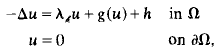
where ∆k is an eigenvalue of the linear part, h is orthogonal to the eigenspace corresponding to ∆R and g is a nonlinear perturbation which can be, for instance, a continuous periodic real function with mean value zero. We employ the techniques used by the second author in a previous paper in which the same result was obtained in the case in which ∆R is assumed to be simple. The final result is obtained by using variational methods and in particular a suitable version of the saddle point theorem of P. Rabinowitz.
We show that if B(z) is either (i) a transcendental entire function with order (B)≠1, or (ii) a polynomial of odd degree, then every solution f≠0 to the equation f″ + e−zf′ + B(z)f = 0 has infinite order. We obtain a partial result in the case when B(z) is an even degree polynomial. Our method of proof and lemmas for case (i) of the above result have independent interest.
We consider a class of semilinear elliptic boundary value problems depending on a parameter, which arise in the theory of combustion. Based on the results in another paper by the same author, a rigorous quantitative connection is shown between the solution set of the boundary value problem and that of a simple scalar equation (the Semenov approximation).
In this paper, we study the converse of comparison results for solutions to linear second-order elliptic equations. Namely, in the inequalities proved by G. Talenti and others, we study the case of equality and prove that “equalities are achieved only in the spherical situation”. We also present some applications of these results to semilinear elliptic equations.
In this paper we establish conditions to prove that if classical solutions to the initial boundary value problems for nonlinear elastodynamics exist, then they depend Hölder continuously on their initialdata and body forces.
A Rees matrix semigroup over an inverse semigroup contains a greatest regular subsemigroup. The regular semigroups obtained in this manner are abstractly characterized here. The greatest completely simple homomorphic image and the idempotent generated part of such semigroups are investigated. Rectangular bands of semilattices of groups and some special cases are characterized in several ways.
Two alternative characterizations of semidirect products of semigroups are given. Characterizations are provided of such products that are groups, regular semigroups, and inverse semigroups, respectively.
It is proved that if a ring R has the extension property in containing ringSi, then the amalgam [R; Si,] is strongly embeddable. Using a result of P. M. Cohn, a necessary and sufficient condition for a ring to be an amalgamation base is then given. It is also shown that R is a level subring of a ring S if and only if S/R is flat. From this, a classical result of P. M. Cohn on flat amalgams is proved.
Let B(k) be a linear bounded mapping of a Banach space X into a Banach space Y meromorphic in the parameter k on a connected domain of the complex plane. Under certain assumptions on B(k), more general than previously considered, the singularities of the inverse operator are described.
We give generalizations of the Landau–Hadamard inequality ‖u′‖2 ≦ K ‖u‖ ‖u″‖ replacing u” by the second-order differential expression u″ − (α + β)u′ + αβu (α, β ∈ ℂ). The new functional inequalities are then used to obtain similar inequalities for dissipative and skew-Hermitian operators.
In this paper, it is proved that the problem (∂2u/∂t2) + ∆xu = v, u(x, 0) = u0(x), ut(x, 0) = u1(x), with homogeneous Dirichlet conditions on the boundary, is well posed provided v, u0, u1 belong to a suitable space of functions.
We consider the characterisation of a class of free boundary problems arising in the flow of a viscous liquid in a porous medium (or, in two dimensions, a Hele–Shaw cell). Injected air forms a bubble which grows as time increases; it is shown that three kinds of behaviour can occur. Firstly, the solution may cease to exist in finite time; secondly, the solution may exist for all time and the free boundary may have one or more limit points as t tends to infinity; and thirdly, the bubble may exist for all time and fill the whole space as t tends to infinity. Two-dimensional explicit examples arc given of all three types of behaviour, and it is proved that the only solutions of the third kind are those in which the bubble is always elliptical; the proof uses the theory of null quadrature domains. It is shown that solutions for ellipsoidal bubbles exist in three dimensions and it is conjectured that the only three-dimensional null quadrature domains with finite complement are those whose complement is an ellipsoid.
In this paper we introduce the concept of fractional powers of a pair of operators between two Banach spaces. The operators need not be closed, but form a closed pair. The properties of the fractional powers are studied. An application of the theory is briefly discussed.
This paper proves the existence of a solution of a non-linear Goursat problem for a partial differential equation of order 2p (p ≧ 2) with the boundary conditions given on 2p curves emanating from a common point. The problem is reduced to a system of integro-differential-functional equations and then Schauder's fixed point theorem is applied.
A sequence of transformations of the type Y = (I + o(1))Z is developed for the system Y′(x) = {Λ(x) + R(x)}Y(x), where Λ is diagonal. The transformations bring in the derivatives of R in succession until the Levinson form is obtained when a given derivative is reached. This theory covers rapidly varying coefficients and it extends results which are known for constant Λ.