




We have only the world that we bring forth with others, and only love helps us bring it forth.
Humberto R. Maturana and Francisco J. VarelaFootnote 1
Creating music embodies a political dimension shaped by the threads of social interdependence, connecting the creative process to the broader canvas of societal discourse. It is an act of resistance against homogeneity, an affirmation of life and freedom. Music, along with all forms of art, thrives on the act of sharing, as the arts are bound by their very nature to be a communal endeavour, fostering connections that transcend the boundaries of individual expression. Besides these subtle political undertones in music and artistic expression, some approaches openly embrace explicit political dimensions. A theme that has permeated much of my work over the last ten years is the quest for liberation from oppression. My concern has been inquiring about the oppression imposed by social structures and about the mental constraints built in our minds, particularly those imposed by patriarchal systems, religion, and traditional gender roles.
The aim of this article is to give an overview of some of my works, which have been inspired by the fight against oppression and the search for liberation, with a focus on my work for chamber orchestra XLIII Memoriam Vivere. There are many examples of musical works in history with this approach. A composer who has been a personal source of inspiration in this regard is Luigi Nono, who was deeply committed to political and social justice and reflected that in his music. I was particularly moved by his piece Como una ola de fuerza y luz (1972). It is dedicated to the memory of the Chilean left activist Luciano Cruz, whom Nono had met in Santiago, Chile, before the presidency of Salvador Allende. The suspicious death of Luciano Cruz, which was reported as an accident, is a preamble to the era of oppression and terror that was imposed in Chile by Pinochet after the coup d’état in 1973. Even though Nono referred to his piece as an epitaph for Luciano Cruz, the dedication of Nono was ‘Luciano Cruz para vivir’, which translates into ‘that Luciano Cruz may live’, which reads as an attempt to keep the memory of Cruz alive. In the fall of 2014, I was driven by an urge to create a piece that intends to give memory and reflection to one of the most atrocious acts of violence inflicted by the Mexican state on the country’s youth. This is how I composed XLIII Memoriam Vivere, a work that emerged as a necessity to resist the oblivion of injustice.
XLIII Memoriam Vivere
In the fall of 2014, while living in Nayarit, Mexico, I was deeply affected by the tragic news of the disappearance of young college students. Forty-three Ayotzinapa Rural Teachers’ College students were abducted and disappeared in Iguala, Guerrero, Mexico, on September 26 of that year. They were taken into custody by local police officers from Cocula and Iguala, in complicity with organized crime. This outrage has left a deep wound in Mexican culture, and I believe such an act of inhumanity must not be forgotten. That is why I dedicated my work for chamber orchestra XLIII Memoriam Vivere to the memory of these forty-three students. The Cervantino Festival and the Huddersfield Festival commissioned the work for the London Sinfonietta in 2014, premiered it in London, and performed it in Mexico City and Guanajuato in 2015. Notably, the Mexican performances held a profound significance for me, as it was evident that the audience connected with the meaning of the work. The essence of that piece is to maintain the memory of those forty-three missing young men and the unjust acts that took them away. In Mexico, the disappearances before, during, and after the social movement of 1968 are part of what is known as the ‘Guerra Sucia’ (‘Dirty War’). This term refers to the military and social repression measures aimed at dissolving political and armed opposition movements against the Mexican state from the late 1960s until the early 1980s. These methods of forced disappearance as repression of political activism exponentially increased after the Mexican government created a war against drug trafficking in 2006. The most affected are the families of the disappeared, who continue to fight and demand answers.
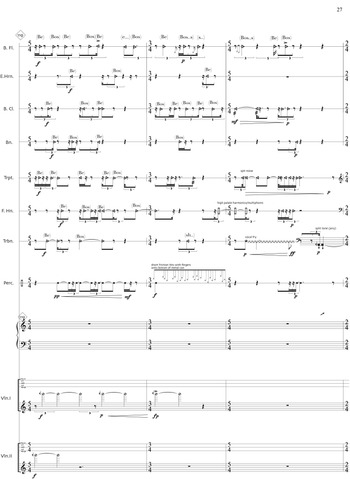
XLIII Memoriam Vivere is devoid of any explicit programmatic musical narrative. Rather than pursuing a literal representation, I employed compositional strategies to evoke the essence of the Ayotzinapa tragedy. The foundational compositional technique revolves around utilizing the number forty-three as a framework of proportions, intricately shaping various facets of the composition. Being a prime number, forty-three is divided into five segments of prime numbers: five, eleven, seven, seventeen, and three, to create the proportions of the main material of the piece. An additional compositional technique involves integrating symbolic elements, such as fragments of spoken words, that are seamlessly interwoven into the fabric of the music. Among these symbolic elements, specific fragments morph into poetic musical expressions. For instance, at bar 43 the Mexican pronunciation of the Spanish word ‘Vivos’ (‘alive’) is spoken through wind instruments. The term is broken into syllables and expressed in percussive, polyrhythmic gestures, creating a musical texture resembling the echo of an enraged crowd. The motivation behind using the word ‘Vivos’, with the Mexican pronunciation (‘Bebos’), is to evoke the fight of the forty-three students’ families, friends, and thousands of activists. The lack of explanation and knowledge of what happened to them leaves an open wound and endless suffering without closure. Because the bodies of the students were never found, the families demanded that they be brought back alive. The motto of the numerous protest marches: ‘Vivos los llevaron, vivos los queremos’ (‘alive they took them, alive we want them’, Example 1).
XLIII Memoriam Vivere, ‘Vivos [Bebos]’ (b. 43).

Generative systems
The search for expanded possibilities of musical form in my works led me to delve into creating personal generative strategies of music structures, flexible systems designed to generate musical patterns teetering on the brink of chaos. These systematic constructs serve as the bedrock upon which I sculpt my compositions’ micro- and macro-structures, introducing an element of unpredictability that breathes life into the sonic flux. I used a system to create particular conditions for expression to let them emerge and not to determine them. My preference is to maintain an openness in using a system or technique that is always relative to the needs of the material when sculpting the overall spectral qualities of the sounds, rhythmical patterns, harmonies, and their gestural articulations. For many years, I had an obsession with prime numbers. I applied them to proportional rhythmic, metric, and harmonic intervallic constructs. The fact that forty-three is a prime number made it feel destined for me to use those patterns in the music. Some recurrent patterns in my music are sonic materializations of infinite number series. Examples of this are my chamber and electronics work TINIWE and XLIII Memoriam Vivere. Those works are knitted designs derived from numbers with infinite decimal expansion, such as pi and phi. These patterns are expressed in the morphology of sonic entities, particularly in its rhythmic and proportional aspects. In XLIII Memoriam Vivere, a rhythmic stratification is created with layers that, at times, change their proportions in a constant modulation of different tuplets (Example 2). In this example, a numerical sequence’s unfolding pattern follows a quintuplet stratum and randomly switches to triplets to alter the pattern proportions.
XLIII Memoriam Vivere, Modulation of quintuplets and triplets (bb. 119–120).

Structural references to forty-three
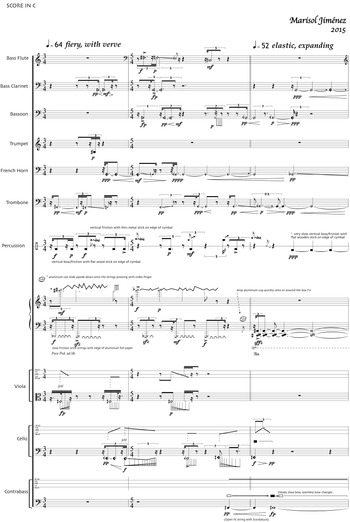
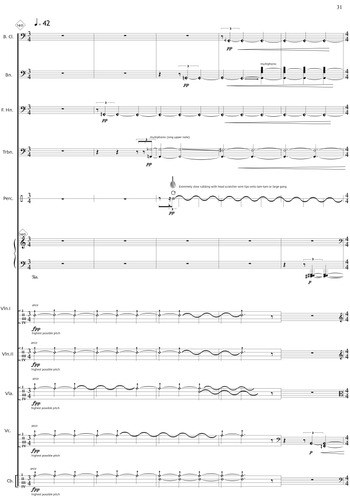
The number forty-three, which has become a symbol of political activism in Mexican culture, is used as a reference in the piece to shape micro- and macro-structural elements of the music. For instance, in Example 3 the percussive, polyrhythmic music texture comprises forty-three sonic elements. The term ‘sonic element’ or ‘entity’ is used here to describe every sound produced by the performers with or without a specific pitch. The forty-three sonic entities, particularly at the work’s opening, represent every one of the missing students to give them a presence and a voice.
XLIII Memoriam Vivere, opening breaking point (bb. 1–3).

The composition’s structure weaves a dynamic interplay between fluid, unbroken musical gestures and discrete sonic fragments. This draws an evocative parallel to the human experience of memory – a fleeting moment stretched to its furthest reaches, embodying both the fractures and expanses inherent in recollection. The fractures or breaking points are constructed with discrete sonic fragments, like at the piece’s opening (Example 3).
Gestural and timbral resonances
For over two decades, I have been interested in exploring timbre and gesture as a structural and polyphonic source. I have created a number of pieces with this in mind, including an early work for string quartet entitled Sed de Arcano (2004), which explores timbral/gestural polyphony and timbral/gestural monophony to either expand each instrument into multiple entities or unify all instruments into a single one. Similarly, XLIII Memoriam Vivere weaves a vast timbral gestural multiplicity that contrasts with passages of single timbral gestures. The term ‘timbre’ refers here not only to the individual sonic qualities of instruments or instrumental colour, but also to the variations of sound quality that are possible on each instrument. The various sound colours combine those defined by the spectral qualities of specific playing techniques and those achieved with instrument preparations. Example 4 shows a fragment of the score where the strings play multiple individual voices with specific sound qualities such as artificial harmonics, percussive sounds, or distorted glissandi. In contrast, Example 5 shows two examples where all the strings play a single music entity with a single timbral profile.
XLIII Memoriam Vivere, passage of gestural polyphony on the strings (bb. 98–102).

XLIII Memoriam Vivere, example of gestural monophony on the strings (bb. 140–3).

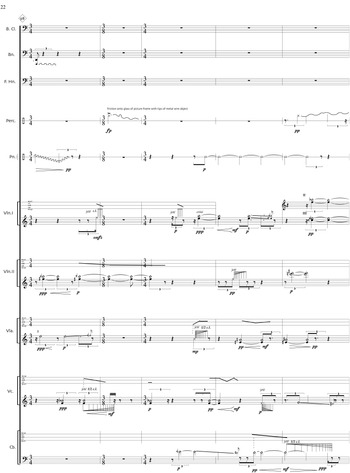
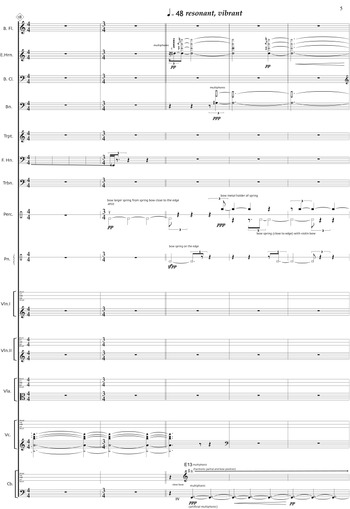
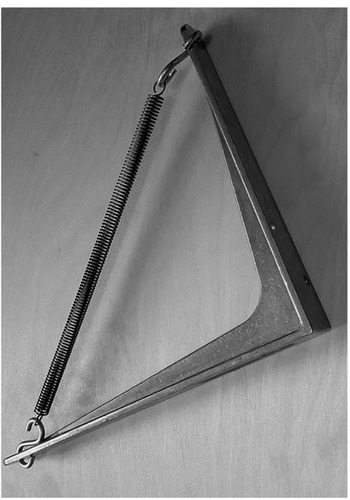
The seventeen instruments are expanded into forty-three voices or timbral entities by transforming the sound of the instruments through extended techniques, preparations, and the addition of externally found objects. Preparations are used for the strings, piano, and percussion. For instance, the strings in a particular passage of the piece attach a metal candle clip holder to the strings and directly bow the edges of the metal, producing a series of metallic high tones. At certain points in the piece, the pianist and percussionist use a flat wooden stick to bow a ‘noise spring bracket’ (Figure 1), which is a self-made instrument with a metal spring attached to a metal bracket. This is an instrumental extension of both the piano and the percussion. The pianist places the noise spring bracket on top of the piano frame and strings and bows it with a violin bow and a wooden stick. Similarly, the percussionist places the same instrument on top of a bass drum. In both cases, the piano and bass drum are used as resonators. Example 6 shows a moment in the score where the percussionist and pianist bow a noise spring bracket.
XLIII Memoriam Vivere, score fragment of bowed noise spring bracket (bb. 18–22).

Noise spring bracket.

Harmonic patterns
I have abandoned the traditional tuning and temperament systems for many years and opted for more open microtonal systems. Initially, I expanded the chromatic scale to a mixture of quarter- and eighth-tone scales. The harmonic patterns of XLIII Memoriam Vivere are derived from a quarter tone-based intervallic unfolding of an infinite number series. Taking an F-quarter sharp as fundamental, the harmonic buildup emphasizes particular overtones whose partials correspond to prime numbers.
There are moments of what I call ‘ghost harmonies’, cluster-like groupings of partials that are missing their fundamental or most basic structural overtones (Example 7). To convey a feeling of unsolved and cryptic energy, the whole piece remains on a single harmonic region that is often obscured by the appearance of microtonal deviations. Only a few instances exist where pure pitches are sounded without distortion or extended techniques. These brief moments of pitch clarity are reserved for the contrabass and the brass and wind instruments, evoking the search for a truth that seems to be buried in the chaos of reality.
XLIII Memoriam Vivere, ghost harmony and music metaphor of absence (bb. 145–8).

One of the most noticeable symbolic elements of the piece is the prolonged silence at the piece’s ending section, lasting exactly forty-three seconds. This silence represents each missing student, and its precision was crucial to ensure its impact. Rather than imposing complete silence, I allowed the natural resonance of the music to linger, symbolizing the enduring memory of those lost. Before this silence, I crafted a dense harmonic section that creates a sense of emptiness and isolation, emphasizing the void left by the students’ absence. The musicians freeze all movement during this silence, heightening its significance and creating tension. These symbolic sonic and performative aspects of the music reflect on what should be unforgettable: an act of injustice, the unrepairable absence of forty-three promising young lives, and the sorrow and rage of their families; all should be engraved in our memories, and motivate us to fight for changing the conditions that made it possible that such atrocities occur. It is clear that music alone does not have the power to change human behaviour, but it can awaken in us the desire to bring change. In this regard, I intended to create awareness and space for reflection. Apprehension and distress are present in the musical discourse; however, the main motto, ‘Vivos’, is like a dim light that illuminates a dark journey, bringing us hope and encouraging us to continue an endless search.
Caro Cibus: the quest for mental freedom
As a child growing up in a Catholic family, I was confronted with the weight of an oppressive masculine vision of God and a patriarchal culture. The concept of sin imposes a censorship of critical thought and sexual pleasure. I believe there are mental patterns ingrained in the minds through specific religious ideas that are repressive, such as guilt and fear. In Catholic belief, the ultimate punishment is to eternally burn in hell. I abandoned those beliefs by age eight and initially became completely sceptical of any religious beliefs. Later in my teens, I became curious and more tolerant of non-religious spirituality. In the fall of 2012, I visited Rome and the Vatican, where I toured numerous museums and churches. This journey marked a significant reconciliation with my earlier rejection of religious art, which had become difficult for me to appreciate due to my traumatic upbringing in Catholic beliefs. During my visit to the Vatican, I collected materials such as videos and images from many churches and museums, focusing on images that contained violent and erotic content.
That same year, I received a commission from the ensemble Decoder. I composed a piece allowing me to sublimate what I have experienced as repressive aspects of the Catholic religion. This led to the creation of Caro Cibus, a composition for bass clarinet, cello, prepared piano, electric guitar, percussion, electronics, and video. The title, Latin for ‘my flesh is the true food’, is derived from the biblical text ‘Caro mea vere est cibus’, which originates from the essential Catholic ritual symbolizing the consumption of Christ’s flesh. In my work, I use the metaphor of consuming animal meat and the oppressive treatment of animals to symbolize the repression of minds subjected to such religious thought.
I created additional videos and audio recordings of industrial animal farms to deepen this metaphor. Despite what could seem a crude subject matter, Caro Cibus ultimately conveys a sense of liberation and peace, suggesting that the end of suffering coincides with the cessation of self-repressive mental patterns. It is not a critique of religion but a reflection on the mechanisms generated through oppressive and backward-looking ideas transmitted through generations. It is mainly a personal account of what has been a struggle for recognizing my own freedom.
Caro Cibus is structured in four movements, each featuring various instrument combinations from the overall ensemble. The first movement, ‘Cavea’ (‘The Cage’), involves the entire ensemble, including a live electronics performer. The vocal gestures and techniques reflect agony and madness, incorporating techniques such as vocal fry and whispering in rapid repetitions, akin to a prayer.
The second movement, ‘Sanguinare’ (‘To Bleed’), is scored for voice, bass clarinet, cello, percussion, and electronics. It expands and fluidifies the materials from the first movement, culminating in a frantic texture where the whispering of prayer transforms into a dense, active soundscape (Example 8).
Caro Cibus, fragment of second movement ‘Sanguinare’, bb. 98–101.

The third movement, ‘Cœde’ (‘Killing’ or ‘Slaughter’), is the most violent in both sound and energy. It is scored for electric guitar, percussion, prepared piano, and electronics, employing repetitive polyrhythmic motives with a high volume of noise and distortion.
The fourth and final movement, ‘Mortuorum Cibus’ (‘Food of the Dead’), addresses the death of the animal and the liberation of its soul, equating this death with overcoming repressive beliefs through critical thought. Scored for the entire ensemble, this movement symbolizes the end of a mental pattern, using death as a metaphor for the transcendence of self-repressive mechanisms. The number four, significant in many cultures, such as Chinese and Japanese, symbolizes death, reinforcing the thematic conclusion of liberation through the cessation of imposed beliefs.
Cybernetic constructions
Ettore Garzia, an Italian music writer specializing in contemporary music, once characterized my musical oeuvre as ‘spectral dilations and cybernetic constructions’.Footnote 2 This apt description encapsulates my last decade-long exploration into expansive musical structures and the fusion of abstract and tangible sonic technologies. The works from the five years previous to XLIII Memoriam Vivere and a few years after incorporate self-made electro-acoustic instruments, which I called noise harps and noise spring harps. The noise spring bracket previously mentioned is an element of one of the noise spring harps. Subsequently, my artistic path has also seen the birth of tangible manifestations of sonic experimentation: these are real sonic machines. In 2015, in Berlin, I found the right person to help me develop these autonomous sound machines: Andreas Marckchaeffel, a German/Pakistani engineer and cybernetic expert who has, through the years, become an important collaborator and a dear friend. Crafted from recycled metallic materials and powered by DC motors, these kinetic electro-acoustic constructions incorporate metal springs as integral components for generating sound. These springs are not mere adornments, but vital elements meticulously integrated into the machinery, serving as conduits for transmitting vibrations and creating complex sonic textures. Dubbed ‘noise spring machines’, these creations are engineered with a deliberate emphasis on embracing and amplifying chaotic tendencies (Figure 2). By harnessing mechanical systems’ inherent unpredictability, these machines blur the boundaries between art and technology, inviting audiences to witness the convergence of mechanical ingenuity and sonic exploration. An example of this is my work for cybernetic ensemble Sensuous Matter, a large-scale performative installation for intervening autonomous music machines and performers.
Noise spring machines in Sensuous Matter (https://vimeo.com/333321912).

Machinic social constructs and cybernetic voices
Through many phases, my work has been driven by the need to reflect on psychological and social constructs, intending to activate the imagination to engage in more profound forms of listening and reflection. A recent work in which I continue to develop such ideas is entitled Maŝinika Deliro, an experimental opera fragment for cybernetic voices and electro-acoustic sculptures. At its core, Maŝinika Deliro serves as a poignant interrogation of the deeply entrenched gender roles perpetuated within our society, mainly through the lens of mechanization and technology. Drawing inspiration from critical feminist discourse and Gilles Deleuze and Félix Guattari’s concept of desiring production – the idea that desire itself is a generative, machinic force that produces reality rather than merely reflecting lackFootnote 3 – the work endeavours to decode the intricate layers of patriarchal influence woven into the very essence of machines and their societal implications.
In resonance with Félix Guattari’s reflections in Chaosmosis,Footnote 4 where subjectivity is understood as a process in constant transformation and reconfiguration, Maŝinika Deliro seeks to imagine new modalities of listening and being. It stages a space where cybernetic voices and electro-acoustic matter do not simply reproduce dominant codes but instead open up possibilities for fluid, non-hierarchical assemblages. Here, the machinic and the human intertwine in ways that resist the fixity of gender norms, proposing instead a poetics of becoming that destabilizes inherited boundaries.
Machines are the running engine of the capitalist–patriarchal, product-oriented society, not only as manifestations and constructs of mechanics and production, but also as abstract structures of the social, cultural, and political environment. By deconstructing the function-dependent patriarchal aspects ingrained within machines and endeavouring to merge machine and human organisms into cybernetic voices, Maŝinika Deliro aims to challenge the concept of duality as a foundational principle of the patriarchal capitalist system. The work emphasizes gestural and facial articulation, exploring the interplay between non-verbal communication and sound action. Body movements and sound gestures are intricately intertwined, invoking a sense of minimalist physicality that transcends traditional operatic conventions. Performers’ voices are mechanized through individual electro-acoustic sound stations, enabling a fusion of human and machine elements within the sonic choreography (Figure 3).
First performance of Maŝinika Deliro. Festival Heroines of Sound (Berlin, 13 July 2024).

The vocal expressions in Maŝinika Deliro traverse a spectrum from primal rawness to experimental acoustics, blurring traditional gender distinctions. By amplifying vocal functions through experimental use of microphones and resonators, the work aims to create an androgynous grotesque of maximal acoustic carnality, challenging preconceived notions of gender within the sonic realm.
This work was developed in collaboration with ensemble PHØNIX16, and under the artistic direction of Timo Kreuser, who jointly worked in a search for a novel form of musical expression and performative language for operatic performances that expands the boundaries of the possible by creating a hybrid between given social, political, and cultural dualities: man/woman, machine/human, soloist/orchestra, protagonist/collective, electronic/acoustic and definite/indefinite.
Conclusion
While music may not single-handedly transform society, it has the undeniable potential to inspire reflection and action to pursue a more equitable and compassionate world. In this way, music becomes a form of artistic expression and a vital instrument for social and political awareness. The main themes that connect works like XLIII Memoriam Vivere and Maŝinika Deliro are those of reflecting and inciting resistance to different forms of oppression. I am currently working on a series of electro-acoustic pieces for a cybernetic ensemble that deeply contemplates the nature of love, exploring its importance as an indispensable expression of individual and collective development. In this sonic exploration, love appears as a central theme – a force that transcends the boundaries of individual expression and becomes a universal language. In its myriad forms, love becomes the driving force behind our ability to evolve as individuals and as a networked society. The common thread runs through the fabric of our coexistence, promoting understanding, compassion, and a shared purpose in being.
I believe one of the greatest achievements of the twenty-first century is the recognition that there is no single absolute truth or singular path to follow. We now live in an era that openly embraces multiplicity, diversity of thought, and a range of perspectives. However, this progress does not unfold without resistance. There are always forces that fear these changes and seek to pull us back into a more rigid and limited way of thinking.
In this context, the role of artists has become more critical than ever. It is no longer enough to simply warn of the dangers posed by the excesses of mass production and consumption, which are driving humanity toward chaos and a climate crisis. While these warnings are vital, what is most urgently needed in both art and politics is a renewed sense of hope – a belief in the possibility of a better future that we can all work together to build. Artists have a unique ability to inspire and provoke thought, to imagine new possibilities, and to challenge the status quo. In a world where pessimism and fear often dominate, the artist’s task is to inject optimism and a vision of collective progress. Through their work, artists can remind us that change is possible and that a more just, sustainable, and compassionate world is within reach.
Moreover, art can serve as a powerful tool for connection and understanding, bridging divides and bringing people together across differences. By embracing the multiplicity of voices, stories, and experiences, artists can help to cultivate a culture of empathy and solidarity, laying the groundwork for a future that values diversity and inclusivity. In essence, the mission of contemporary artists is twofold: to confront the pressing issues of our time, and to illuminate pathways to a brighter future. By doing so, they not only reflect the complexities of our world, but also inspire the hope and action needed to transform it.
Funding statements
This work was financially supported by the European Union’s Horizon 2020 research and innovation programme under the Marie Skłodowska-Curie grant agreement No. 101027828 (project ONTOMUSIC), the Schulich School of Music of McGill University, and the Canada Research Chair in Music and Politics at the Université de Montréal Faculty of Music. The funding bodies played no role in the development of this article, which reflects only the author’s view.



 Open access

