Adequate nutrition and food security are fundamental elements of health and well-being, and considered one of the primary basic human needs. Food security is defined as: ‘Access by all people at all times to enough food for an active, healthy life’Reference Anderson1. About 800 million people – one-sixth of the developing world's population – do not have access to sufficient food to lead healthy, productive livesReference Pinstrup-Andersen, Pandya-Lorch, Rosegrant, Pinstrup-Andersen and Pandya-Lorch2.
In Iran, 20% of the population suffers from energy and protein insufficiency, while the prevalence of micronutrient insufficiency is estimated to be much higherReference Ghassemi3. This problem can lead to suboptimal quality of life as well as reduced physical, social and mental well-beingReference Vailas, Nitzke, Becker and Gast4–Reference Pheley, Holben, Graham and Simpson6. Thus monitoring of community food security is necessary for planning appropriate programmes. Such measures can serve to monitor and evaluate the effectiveness of relief programmes, such as food subsidies, and to facilitate planning and targeting decisions.
In Iran, owing to the current absence of suitable, simple, low-cost and accurate tools, several indirect indicators are being used to measure food insecurity, including income, food intake and nutritional status. However, these indirect indicators are not specific and do not measure important aspects of the food insecurity experienceReference Wolfe and Frongillo7. Therefore, development of a valid, reliable and simple method to measure food insecurity and hunger is considered a priority for programme planners and policy-makers at community, local and national level.
One of the widely used measures of food security is the 12-item questionnaire developed by Radimer/CornellReference Radimer, Olson and Campbell8, Reference Radimer, Olson, Greene, Campbell and Habicht9. The items in this tool seemingly can capture most food insecurity components and the tool has been shown as highly reliable and valid in households with childrenReference Kendall, Olson and Frongillo10–Reference Frongillo13. However, because of social and cultural differences, it is argued that such tools – which are designed to measure psychosocial phenomena in Western communities – should be thoroughly validated and their reliability assessed before they can be applied in cross-cultural settingsReference Kotobi14–Reference Enriquez16. Studdert et al. found an adapted version of the Radimer/Cornell questionnaire to be valid and applicable in assessing food insecurity in households in Java, IndonesiaReference Studdert, Frongillo and Valois17. However, further research is warranted to validate this tool in various cultural and economic settings. Thus the present study aimed to validate an adapted Radimer/Cornell questionnaire in assessing the food security of poor urban households in the city of Tehran, Iran.
Methods
Radimer/Cornell questionnaire adaptation
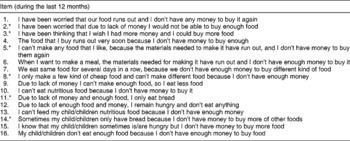
The 12-item Radimer/Cornell questionnaireReference Kendall, Olson and Frongillo11 was translated into Farsi and then modified through semi-structured interviews with 30 women who participated in Komiteh Emdad Imam Khomeini (KEIK) in district 20 of the city of Tehran. KEIK is a relief centre for households who are identified as low-income and at-risk, including low-income female-headed households. In adaptation we did not remove any statement; rather we minimised the ambiguity of the questions and provided alternative wording based on the feedback received during the interviews. We also added six questions to the original questionnaire (Q2, Q3, Q5, Q8, Q11 and Q14). In each interview, the respondents were asked whether they thoroughly understood the questions and if they had any suggestions on the wording and content of the questions. Based on these interviews, the following modifications were made to the original items.
● The phrase ‘a balanced meal’ and ‘properly’ were replaced with ‘nutritious food’ (Table 1).
Table 1Food insecurity questionnaire items: English back-translation from Farsi

* Items added to the adapted version of the Radimer/Cornell questionnaire.
● To transmit the concept more thoroughly, three extra items were added to the original questionnaire (Q2, Q3 and Q5).
● Three more items were deemed necessary by the respondents, to reflect the experience and perception of hunger and food insecurity (Q8, Q11 and Q14).
● The verb tenses of questions were changed and the wording of most questions was modified.

The modified questionnaire was reviewed and confirmed by a panel of six experts in the field of nutrition and social sciences.
Pilot study
The instrument was a questionnaire composed of four sections: (1) sociodemographic characteristics; (2) income; (3) a food-frequency questionnaire (FFQ); and (4) the adapted Radimer/Cornell questionnaire.
The primary food list in the FFQ was developed using previous dietary surveysReference Ghassemi3, Reference Amin-Rashti18–Reference Ghassemi, Kimiagar and Koopahi20 and key informants. Special emphasis was given to foods with higher income elasticity. The initial FFQ consisted of 55 items, including six groups: (1) bread and cereals, (2) grains, (3) meats, (4) dairy, (5) vegetables and (6) fruits. After the pre-test, some of the food items in the FFQ were revised and some other items were added. The final FFQ included 64 items.
The instrument was pre-tested in a sample of 15 women from households within the community who were similar to the study sample.
Study population and sampling
The study was performed in district 20 of the city of Tehran. This district, which is located in the south of Tehran, is ranked as an area with low socio-economic status21. Based on the estimated prevalence of hunger in IranReference Ghassemi3, a sample of 250 households was selected. Sampling was carried out in three stages. In the first stage, the district was divided into three socio-economic zones (low, middle and high). Stratification was performed via informal queries to native staff from the health centre of the district and KEIK, who were familiar with the area. Eventually, four zones (two low, one middle, one high) were selected. In the second stage, clusters in the defined zones were selected. In the third stage, in each defined cluster six households were selected through a systematic random sampling method. Household selection criteria included being an Iranian, non-immigrant, nuclear family; the presence of a non-pregnant, non-lactating woman of childbearing age; a minimum of one child aged 1–18 years; and willingness to sign a consent form to participate in the study.
Data collection
Data were collected by a trained graduate nutrition student and N.Z.S., who were accompanied by local health volunteers, from January to March 2003. Interviews were conducted at the respondent's residence. The average time for each interview was about 45 min. At the beginning of each interview, the goals of the study were introduced and the confidentiality of the answers was assured. Interviewers did not offer any economic incentive to the respondents and clearly explained to them that the information provided would not be used in any decision concerning food assistance or social benefits.
Statistical analysis
The respondents were categorised into four categories, based on following rules.
● Household secure: answered ‘not true’ for all items related to hunger and food insecurity.
● Household insecure: answered ‘sometimes true’ or ‘often true’ in one or more items related to household-level food insecurity (Q1–Q8), but ‘not true’ in all adult- or child-level items.
● Individual insecure: answered ‘sometimes true’ or ‘often true’ in one or more adult-level items (Q9–Q13).
● Child hunger: answered ‘sometimes true’ or ‘often true’ in child-level items (Q14–Q16).
Construct validity of the questionnaire was assessed using principal components factor analysis with varimax rotation. Reliability of the measures and internal consistency of the items were examined using Cronbach's α and part-to-part and part-to-all correlations. Criterion validity of the measures was assessed through cross-tabulation of income and sociodemographic characteristics by the above categories, and the χ2 test. One-way analysis of variance was used to compare income-related frequencies of food consumption. Income-related food consumption frequency items or groups were those food groups or items that had high and significant correlation with income. In cases where the association of income with a food group was not significant, the food items in that group that had a significant relationship with income were selected as the income-related food consumption frequency items. All analyses were conducted using SPSS for Windows (version 11.5).
Results
Sample characteristics
Survey respondents were women with an average age of 36 ± 6.7 years. The average household size was 5. The mothers and fathers of most households had a primary level of education (45% and 39%, respectively). The first quartile of monthly income was less than 320 120 Rials ($36) per capita and the highest income quartile was >750 000 Rials ($84) per capita.
Construct validity
Principal components and factor analysis with varimax rotation of the adapted Radimer/Cornell scale resulted in the extraction of three factors: the first contained items on food anxiety and food depletion, the second factor contained items about food intake inadequacy of adults and children and food intake insufficiency of adults, and the third factor was composed of items about food intake insufficiency of children (Table 2). In most cases the factor loadings of the items were as expected and similar to those reported in previous studies, with the exception of items 7, 8 and 12. Items 7 and 8 were loaded on factor 1 instead of factor 2, and item 12 loaded on factor 3 instead of factor 2. Each scale was analysed separately (Table 3). The results were according to our expectations.
Item loadings of the adapted Radimer/Cornell questionnaire

Factor loadings for household food insecurity, adult food insecurity and child hunger scales, each scale analysed separately

Internal consistency
Cronbach's α was 0.897 for household security, 0.820 for individual insecure and 0.796 for the child hunger scales. In behavioural research, Cronbach's α of 0.70 or greater is considered desirableReference Henerson, Morris and Fitz-Gibbon22. Therefore, all measures of the scale had a good internal consistency.
Criterion-related validity
Criterion-related validity was assessed by comparing results obtained from the adapted Radimer/Cornell questionnaire with demographic characteristics, monthly per capita income and consumption frequency of income-related foods, including red meat, vegetables, fruit, dairy, bread, rice and potato. As pointed out by previous researchersReference Ghassemi3, Reference Samimi, Djazayeri, Siasi, Mahmudi, Vallaii and Dorosti-Motlagh19, rice and potato consumption were inversely associated with income, while other food items were directly associated with it. Tables 4 and 5 show the associations between food insecurity groups and sociodemographic criteria. Adult food insecurity and child hunger were inversely associated with income, father's education, mother's education and occupational status of the father (P ≤ 0.001, P ≤ 0.002, P ≤ 0.013 and P ≤ 0.001, respectively), but directly associated with household size (P ≤ 0.001). Household insecurity was inversely associated with household size, but directly associated with mother's education, father's education, father's occupational status and income. Consumption frequency of fruits, vegetables, dairy, red meat and rice decreased progressively as food insecurity score increased, while consumption of bread and potato increased (P ≤ 0.001).
Relationships between food security status and socio-economic and demographic characteristics (%) in urban households, district 20 of city of Tehran

Household frequency of food groups/items consumption by food security status*, district 20 of the city of Tehran

* Values are mean (standard deviation).
† P-value for the test across food insecurity groups.
Discussion
This paper describes the modification and validation of an adapted Radimer/Cornell questionnaire to measure household food insecurity in a low socio-economic community in the city of Tehran, Iran. It is the first attempts at validating a direct tool for the measurement of food security in Iranian households. Based on the findings, the questionnaire measured household food insecurity in three levels, labelled as household insecure, adult insecure and child hunger. Most of the items in the questionnaire loaded on the related scales, as expected, with the exception of ‘Due to lack of enough food and money, I remain hungry and don't eat anything’, ‘We eat same food for several days in a row, because we don't have enough money to buy different kind of food’ and ‘I only make a few kind of cheap food and can't make different food because I don't have enough money’.
However, factor analysis of the items related to each scale separately resulted in a single underlying factor, indicating the relevance of the items to the underlying concept when considered separately. Further examination of the internal consistency and part-to-all correlations of each item indicated that these items contributed to the conceptual clarity and reliability of each scale when they remained in the scales.
The criterion-related validity of the items within measures of adult insecurity and child hunger was within our expectations; however, the household insecurity scale did not discriminate as expected.
Adapted versions of the Radimer/Cornell questionnaire and other experience-based measures of food insecurity, such as the CCHIP (Childhood Hunger Identification Project) and the CFSM (Core Food Security Measure), have successfully been applied and validated in various cultural and economic settings such as IndonesiaReference Studdert, Frongillo and Valois17, VenezuelaReference Lorenzana and Sanjur23, BrazilReference Segall Correa, Perez-Escamilla, Kurdian Maranha, Sampaio, Vianna and Vieira-Freire24, Reference Perez-Escamilla, Segall-Correa, Kurdian Maranha, Sampaio Md Mde, Marin-Leon and Panigassi25, Asians/Pacific IslandersReference Derrickson, Fisher and Anderson26, India and UgandaReference Nord, Satpathy, Ray, Webb and Houser27. Results of these studies are generally consistent with results of the original versions and lend support to the applicability and validity of adapted versions of these tools in cross-cultural applications. Consistent with previous findings, the present study also lends general support to the validity and applicability of an adapted version of the Radimer/Cornell in the Iranian social, economic and cultural context. However, the findings show that the scale works more accurately at the level of adult food insecurity and child hunger, and further research is warranted to improve the applicability of the measure at household level.
There were two major limitations in the validation process. First, as pointed out by many researchers, in efforts to adapt an instrument in cross-cultural settings, careful translation of experience-based measures, coupled with cognitive testing, is necessary to achieve satisfactory resultsReference Nord, Satpathy, Ray, Webb and Houser27. No such cognitive testing of the questionnaire was carried out. The second limitation involves the sample selected to carry out the modification of words and phrases. This was carried out through interviews with women who most probably had experienced high and moderate food insecurity; our sample did not included food-secure or marginally food-secure cases. It would have been more desirable if a broad range of insecure to marginally secure cases was also included in the study. Despite our expectations, we observed that people were not reluctant or embarrassed to express their deprivation, even when it was expressed using the word ‘hunger’.
We conclude that the adapted Radimer/Cornell questionnaire can be used to categorise food-secure and food-insecure households in low-income urban communities in Iran. The applicability of this questionnaire to measure degrees of household food insecurity is promising for improving food and nutrition monitoring systems and the screening of relief programmes. However, further research is required to construct and validate the tool for subgroups of the population.
Acknowledgements
Sources of funding: This work was accomplished by financial support of N.Z.S.
Conflict of interest declaration: There is no conflict of interest.
Authorship responsibilities: N.Z.S. was the author of this paper. It was her thesis that was supervised by N.O. and M.G.-T., whose fields are community nutrition and social science, respectively. A.H.R., H.F. and Y.M. were her advisors, giving advice about food consumption, study design and data analyses, respectively.
Acknowledgements:The authors would like to thank Dr Nasser Mohammadi, who led to the initiation of this work, and Shahrzad Rokni for her encouragement. We thank Leila Kaboodanian for her cooperation in data collection and data entering. Also, the contribution of the women who participated in the study, the Komiteh Emdad Imam Khomeini and the health centre of district 20 of Tehran city is gratefully acknowledged.