




Introduction
In 2018, I had my first encounter with the All Bathou MahasabhaFootnote 2 (Dularai Bathou Gouthum) through Olongbar,Footnote 3 an important figure involved in the Mahasabha. It was he who first told me about the distinction between what he called Bathouism and Hinduism. According to him, Bathou is a distinct ancestral religion of the Boros, the largest plains tribe in Northeast India, with its own distinct features. Like Olongbar, other leaders of the All Bathou Mahasabha distinguish Bathou from Hinduism. Sitting alongside Olongbar’s assertions are those of the Sangh Parivar, a group or a family of Hindu nationalist organizations, which maintains that Bathou is one of the many manifestations of Hinduism.Footnote 4 However, what Olongbar believed about Bathouism and its distinction from Hinduism did not resonate with many Bathou worshippers who believe that Bathou falls within Hinduism, given its long-standing interaction with popular Hindu traditions. For many, identifying Bathou as Hindu has also become a means of distinguishing oneself from other major religious groups, primarily Christianity and Islam. Often, Bathou worshippers looked at me perplexedly when I asked them, ‘Is Bathou Hindu?’ After a moment of confusion, they quickly answered, ‘Yes! It is Hindu’ and further asserted, ‘If Bathou is not Hindu, what is it?’ This question about what Bathou is and its relationship with Hinduism has continued to emerge and re-emerge throughout the history of the Boros since the early twentieth century. Olongbar’s ideas about Bathou did not materialize in the present. Rather, his ideas are deeply rooted in the early twentieth-century Boro identity politics that shall be discussed here. This article is an attempt to revisit this question and to understand how it has continued to play a dynamic role in the Boro religious landscape amid the stringent efforts of the Sangh Parivar to incorporate Bathou within its fold. It explores the complexities involved in the making of a ‘traditional’ religion, Bathou, among the Boros of Assam, especially in relation to its affinities as well as discordance with Hinduism. It will delve into the historical debates around the religious affiliation of the Boros and move on to look into the Sangh Parivar’s efforts to incorporate Bathou within its fold. The case of Bathou reformation among the Boros is one of many where the Sangh Parivar is active among the tribal communities with the intention of incorporating tribal faiths into its notion of Hinduism. Recent studies on religious reformations and revivals in the Northeast reveal a complex interplay between the religious assertions of the tribal communities and the Hindu nationalist movement.Footnote 5
This article is a product of my engagement with various actors of the Bathou reformation movement and the Sangh Parivar in the districts of Kokrajhar and Udalguri in the Bodoland Territorial Region (BTR), Assam. It involved consulting colonial and missionary writings and census reports, and includes about 20 personal interviews with Bathou leaders and followers, and Sangh Parivar activists. It also incorporates numerous group discussions with Bathou followers, and ethnographic fieldwork conducted in the two districts. Efforts were made to participate in and observe some of the rituals, ceremonies, and meetings of Bathou. In the article, I begin by providing a historical background of the late nineteenth and early twentieth centuries when religious groups were consolidating in colonial India and Assam. I will explore the dynamics that shaped the ideas of Hinduism and tribal religions. I then move on to the debates around the Boro religion, shedding light on the marginalized voices within the larger debate around Hinduism and its constructions. In the third section, I discuss the contemporary religious landscape of the Boros shaped by long-standing complex interactions between the Boros and Hinduism, and the role of the All Bathou Mahasabha in mediating those complexities. The last section will discuss contemporary efforts at the consolidation of Hinduism by the Sangh Parivar and of Bathou by the Bathou reformists.
Constructing Hinduism and animism in colonial Assam
Colonial understandings of religion were based on certain universalist ideas that were unfit to describe South Asian religious traditions. In his well-known work The Meaning and End of Religion Wilfred Cantwell Smith argues that what we understand by the term ‘religion’ is a Western construct or concept, which the West has imposed based on their understandings of India that do not fit there.Footnote 6 Distinguishing the term ‘religion’ from ‘religious’, he argues that people may well be religious without the assistance of a special term and that the term ‘religion’ may not have the same connotation across different communities. Jaqueline Suthren Hirst and John Zavos argue that interpreting South Asian religious traditions through a model of ‘world religions’ inevitably assumes the existence of major religious systems that can be identified as having clear, discrete characteristics. Such a paradigm of understanding religion dominated colonial understandings of religion in South Asia and has continued to provide the framework for religious studies.Footnote 7 While such a model for understanding religion was put in place in colonial India, it lay in contrast with the practices that characterized the religious landscape of the region. Several scholars have argued that in colonial India, the British went on to categorize those they governed in terms of religion and understood Hinduism as a world religion. This resulted in the idea that Hinduism is a well-organized and definite religion.Footnote 8 Others argue that religious identities existed long before the arrival of the British, and that a Hindu religion has disparate forms of religious practices.Footnote 9 Although a more disparate form of Hinduism may have existed before the arrival of the British, the consolidation of Hinduism as a definite religion, primarily based on a Brahmanical hegemony, is the result of what Romila Thapar calls ‘a range of reactions to specific historical situations’.Footnote 10 Indian society was marked by differences in caste, sects, and region, and the modern search for a Hindu identity is a product of the British imagination of what constitutes Hinduism and, simultaneously, the aspirations of some Indian nationalists, mostly Brahmins, who went on to redefine Hinduism as an umbrella term for various sociopolitical motifs, as we will explore. In colonial India, political mobilization around religion became a key to power, particularly where such representation gave access to economic resources.Footnote 11 As Talal Asad reminds us, the game of defining religion becomes a highly political one given the context of who extends the umbrella, and for what purposes.Footnote 12
The fact that colonial ideas of religion did not fit into popular understandings of everyday religious life can be understood from colonial works such as Brian Hodgson’s study on the Boros. In his attempt to document the Koch, Dhimal, and Bodo tribes of Assam in the latter half of the nineteenth century, he writes, ‘their languages have no word for god, for soul, for heaven, for hell, for sin, for piety, for prayer, for repentance’.Footnote 13 The idea of religion among tribal communities across colonial India lay in contrast with colonial understandings of religion. Colonial ideas on religion and Hinduism, in particular, became absurd when people were not able to respond to the question of what their religion was. In the census report on Assam, 1901, the census commissioner wrote, ‘a very large proportion of the population can give no clear and intelligible account of the faith that is in them’.Footnote 14 Again, Muirhead Thomson writes, ‘many Hindus, even educated ones are not very helpful at describing their own customs and beliefs, and … their opinions, in turn, are mainly determined by their caste and social position’.Footnote 15 Nevertheless, amid underlying discrepancies, the latter half of the nineteenth and early twentieth centuries were marked by the beginnings of colonial anthropological knowledge production which sought to categorize the people into diverse categories—religion being a crucial element in classifying them. Colonial knowledge, backed by local informants, mostly Brahmins,Footnote 16 continued to uphold the idea of Hinduism as an umbrella term; a wide category that would embrace the faiths that were not well-defined. On the one hand, as Hinduism was considered a broad category, the religion of the tribes, often considered to be animism or tribal faiths, became ‘a small island which is sapped and crumbles into the depths of Hinduism’.Footnote 17 Census enumerators and colonial ethnographers were eager to record who these tribes worshipped, how they worshipped, and when they worshipped. However, the task of defining the religion of these tribes underwent numerous stages of indecisiveness owing to the inability to identify boundaries between Hinduism and the tribal religions. Often, blurred distinctions between the two meant identifying the latter as falling within the ambit of the former. Confusion regarding the religious affiliation of tribes as Hindus or animists was rampant in colonial Assam which was perceived as an anthropologically rich space due to the diversity of its population.Footnote 18 Assam was considered distinctive because of its differences from mainland India in terms of the physical traits of the people, language, and religious practices. Confusion about Hinduism resulted in bewilderment when defining the religion of the Boros and other tribes of colonial Assam.Footnote 19 While attempts were made to understand the religion practised by the people, they were constantly evaluated in relation to their ‘Hindu’ neighbours, often considered as the marker of civilization. Sometimes, they were grouped together as Hindus for convenience of enumeration,Footnote 20 and at other times they were included as Hindus out of confusion and indecisiveness. On the other hand, animism became the religion of the so-called primitive tribes who, it was thought, would gradually move towards civilization by embracing Hinduism. Embracing Hinduism thus signified adopting certain values, abandoning certain foods and drinks, embracing the language of the upper castes, and abandoning ancestral rituals.Footnote 21
As colonial attempts at categorizing religion surged, the same period saw growing attempts towards consolidating Hinduism as an organized religion. Scholars like John Zavos, Romila Thapar, and Amiya P. Sen point out that the consolidation and organization of Hinduism can be roughly traced back to the late nineteenth century—that Hinduism became a coherent religious entity as a result of the political climate of the late nineteenth century.Footnote 22 Hinduism was reimagined as a well-defined and historically evolved religion with a clearly defined Hindu community in terms of religion.Footnote 23 The term ‘Hindu’ increasingly became a response to the colonial political mechanisms which prioritized political representation based on numerical majority. The need thus emerged to bring together the disintegrated segments of caste, sect, and region, and move towards a unified Hindu community cutting across the said divisions in colonial India.Footnote 24 Thapar points out that while the notion of a uniform religious community readily identified as Hindu was absent, the term ‘Hindu’ first occurred as a geographical nomenclature referring to the inhabitants of the Indian subcontinent, the land across the Sindhu or Indus river, and those who professed a religion other than Islam and Christianity.Footnote 25 The early decades of the twentieth century witnessed organized forms of Hindu nationalism. In 1923, V. D. Savarkar produced his work Who is a Hindu that later became the foundation on which the Hindu nation could be built. For him, these ancient inhabitants, the Sindhus, spread out and created a nation that grew into a great Hindu race and civilization. He identified that the problem was that defining Hindu could not be done solely based on religion. He writes, ‘Hindutva is not identical with what is vaguely indicated by the term Hinduism. It embraces all the departments of thought and activity of the whole being of our Hindu race.’Footnote 26 ‘Hindu’ was now associated not only with a form of religion but also with a race, culture, and community of people with a shared past. It turned into a racial, national, geographical, and political unit. Savarkar strongly asserted that the Hindu nation needed to move away from caste and Untouchability. For the Hindutva ideologues, not only did it increase the numerical majority but also aided in increasing manpower at a time of war against the potentially threatening ‘other’, that is, the Muslims and the Christians.Footnote 27 By 1931 the number of Hindus in Assam had increased, which was attributed to the workings of the Hindu Mahasabha, a Hindu nationalist organization established in 1915.Footnote 28 The Hindu Mahasabha stepped in with answers to the colonial government’s confusion regarding Hinduism and animism, and the distinction between the two. It moved towards removing the blurred distinctions between them by employing ideas that would focus on the affinities of tribal religions with Hinduism rather than their differences. The lack of a universal definition of Hinduism contributed towards the making of a Hindu religion that would incorporate a variety of religious traditions within its fold. Madhumita Sengupta points out that in colonial Assam, ‘Becoming a Hindu was now easier that the definition of Hinduism as a loosely bound corpus of ritually coded behaviour enabled a wide array of practices to be labelled as “Hindu”.’Footnote 29 Ideas upheld by the Hindu Mahasabha regarding the tribes of the region can be illustrated through an excerpt from a pamphlet it distributed which read,
There still remain about four million of animists in these provinces who may be easily assimilated into the Hindu society. All that is required is a little propaganda, humanitarian services, and social liberalism.Footnote 30
There is a long gap between the entry of the Hindu Mahasabha and the entry of the Rashtriya Swayamsevak Sangh (RSS) into Assam. It was only in 1946 that the organizational beginnings of the RSS can be traced in the Northeast where the first shakha (branch) of the RSS was established in Guwahati.Footnote 31 Since its inception in the Northeast, the RSS, with its family of organizations, together known as the Sangh Parivar, has relentlessly pushed the idea of tribes as Hindus, with the agenda of ‘eradicating the fissiparous tendencies arising from the diversities of sect, faith, caste and creed from political, economic, linguistic and provincial differences amongst Hindus’.Footnote 32 By the second half of the twentieth century, Indian sociologists like G. S. Ghurye took the debate on religious affiliation further by stating that the tribes were backward Hindus who would inevitably be absorbed into mainstream Indian society.Footnote 33 Contemporary Hindu nationalism continues to promote this idea that the variety of tribal religions of the Northeast is part of a larger river of Hinduism. Knowledge production on Indian religion and consolidation of Hinduism went side by side and, in turn, created the idea of a great Hindu religion that accommodates the various religious traditions. Problems in defining Hinduism and identifying who the Hindus were, in fact made it convenient to include all those who were not the followers of world religions like Christianity and Islam. These claims go hand in hand with the assertions made by various tribal communities about their religious identity. Sangh Parivar activists actively engage with such assertions, further asserting the idea of Hinduism as the largest and all-encompassing indigenous religion.Footnote 34 As we move on with the article, we will find that such assertions constantly seek out affinities between tribal faiths and popular Hindu traditions.
Are the Boros Hindus? Revisiting the early twentieth-century debates
In 1847, Brian Hodgson produced his work Essay on the First: On the Koch, Bodo, and Dhimal Tribes in which he provided an elaborate description of the ‘Bodos’, an umbrella term that he used to denote a variety of allied tribes, including the Boros. With his knowledge of the rituals and the Boro pantheon, Hodgson faced a certain difficulty in how to make the Boro religion intelligible to himself and to others.Footnote 35 Nevertheless, he identified the religion of the Boros as one belonging to a ‘primitive era’.Footnote 36 In the early twentieth century, Sidney Endle went on to define the religion of the Boros chiefly as animism.Footnote 37 Both Endle and Hodgson identified the chief god of the Boros as Bathou, represented in the form of the Sijou plant (euphorbia splendens). Both noted that Bathou was the chief god but neither claimed the existence of a religion named Bathou. These works maintained that the Boros had embraced certain gods that were perceived as belonging to the Hindu pantheon and had indigenized them. Endle and Hodgson both attempted to record the deities of the Boros and concluded that many were borrowed from Hinduism, a category with no definite boundaries. Based on a comparison between ‘traditional’ and borrowed elements, the Boros were sometimes identified as Hindus and sometimes as semi-Hinduized. This tendency to identify Hinduism solely on the basis of modes of worship and the similarity of deities marginalized other factors, primarily caste, that significantly shaped relationships among different communities in Assam. A section of the Boros actively participated in the various debates around the religious affiliation of the tribes of the Northeast and the prevalent caste prejudices against the Boros, asserting their distinction from caste Hindu society.Footnote 38 For them, to be a Hindu did not only mean to be inclined towards a particular religious dogma, and did not merely refer to the worship of certain deities, consuming certain foods, or following certain practices. For many Boros, the so-called Hindus were people who would not dine with them or touch them.Footnote 39 Such memories of social exclusion are still alive today in the memories of many elderly Boros who speak about their experiences of social exclusion. In the memories of these Boros, the Hindus are often represented in the guise of the Assamese caste society. In a memorandum submitted in the late 1920s to the Simon Commission, the Assam Kachari Jubok Sanmilani, an organization of the Kachari tribes of Assam which also includes the Boros, stated, ‘to call them Hindus will be a misname in as much the Hindus do not receive them into their society, do not dine with them, and are mostly unsympathetic with their ideals and aspirations’.Footnote 40
Such claims towards distinction from Hinduism were constantly raised in the early twentieth century. In one of the petitions filed in front of the census commissioner, the renowned tribal leader Rupnath Brahma wrote,
They, (Boros) may be fairly treated as HindusFootnote 41 but a majority of the Boros are not willing to recognize themselves as Hindus, simply because according to their views, they would be losers thereby in the social and political spheres.Footnote 42
As these memorandums recorded the debates around the religious affiliation of the tribal communities, so do the historical experiences of social exclusion continue to linger in the minds of many Boros. For instance, when I met Gaide, an elderly Boro in her early eighties, she recalled her youth,
They (the Assamese) would not dine with us. One day, my friend was passing by a heap of paddy laid out in the sun to dry. It belonged to an Asomiya (Assamese). My friend’s shadow fell on it as she passed by. The Asomiya used harsh words against her and threw away everything only because her shadow fell on it. Another time, I had mistakenly touched a scarf that belonged to an Asomiya. It was kept to dry in the sun. They threw it away. (Gaide, Kokrajhar, January 2020)
Such experiences of social exclusion are less spoken of today. However, the feeling of distrust towards caste society continues among the Boros. They have been known to worship many deities that are supposedly borrowed from the Hindu pantheon, as Endle and Hodgson pointed out. However, to merely consider the Boros as Hindus based on overlapping religious practices fails to recognize the intricacies that shape Hinduism as a religion. It overlooks the dynamics of caste, social exclusion, and the process by which religion becomes an instrument of identity assertion, as has been the case with the Boros. It is noteworthy here that, as Rupnath Brahma pointed out, even though the Boros may be treated as Hindus owing to the influence of some Hindu traditions among them, they rejected being counted as Hindus. In colonial India, as religion increasingly became associated with political representation, to be counted as Hindu was considered more than a religious category. The caste structure that deeply characterized Assamese society created conditions wherein to be categorized as Hindu not only meant affiliation to a particular religious category, it was a marker of a crucial instrument of identity politics in the early twentieth century. The large-scale proselytization to neo-Vaishnavism and practices of purity and pollution created conditions wherein the Boros gradually began to assimilate into caste society, albeit as lower castes. They continued to be socially excluded by the caste Assamese. This was realized by a section of the Boros who demanded that they not be counted as Hindu. The above testimonies clearly indicate the deep underlying intricacies that are involved in the identification of Boros as Hindu. The debates around the Boro religion in the early twentieth century are a testimony to the tensions that existed between the Boros and caste society. Religion, thus, was deeply intertwined with social and political aspects of life wherein affiliation to a particular religious category signified identity, representation, and political power. Amid the intense interaction between colonialism and the modern search for a Hindu self, the Boros actively participated and debated their position within the complex interplay of contesting religious identities.
As historical experiences of social exclusion informed the debates around the Boro religion and its affiliation to Hinduism, it also led to the initiation of several socio-religious reforms among different sections of the Boros. As the emergent Boro leaders were against the enumeration of the Boros as Hindus, there emerged several socio-religious reforms that were attempts towards upward social mobility. Often these movements took the form of challenging the prevalent caste prejudices by attempting to emulate the practices of the upper caste and negating Brahmanical hegemony. They also aimed towards abolishing the practices that were considered impure by the caste society, primarily the brewing and consumption of rice beer, pig and poultry rearing, and sacrifice of live animals to ancestral deities. One of the most important reformist movements among the Boros was the Brahma-dharma movement that was initiated by Kalicharan Brahma, a Boro social reformer in the early twentieth century in the erstwhile undivided Goalpara district of Assam. Kalicharan Brahma introduced Brahma dharma under the influence of Sibnarayan Swami, preaching a Vedic religion in Assam, Bengal, and other parts of colonial India.Footnote 43 Amid rampant caste prejudice, Swami Sibnarayan’s teachings appealed to a section of the Boros as they provided possibilities of social mobility,Footnote 44 which in turn provided equal access to rituals such as making offerings to the hom agya (holy fire), otherwise reserved for the Brahmins.Footnote 45 It was by emulating those practices that Kalicharan Brahma attempted to reform Boro society and challenge the caste prejudices against the Boros. Kalicharan Brahma preached Brahma-dharma to the Boros of western Assam and encouraged them to discontinue practices that were considered ‘impure’. An important aspect of his ideas was his belief that these practices associated with the ancestral religion of the Boros were responsible for the degeneration of the Boros; and that it was due to such practices that the Boros continued to lag behind economically, socially, and politically. These were practices that were deemed unfit for a so-called civilized society, in this case, caste Hindu society.Footnote 46 In the process, Kalicharan Brahma is said to have attempted to eradicate the practices associated with the ancestral religion. Some Bathou reformists today do not hesitate to argue that Kalicharan Brahma pushed towards destroying the Boro culture which they perceive is deeply associated with the traditional religion Bathou.Footnote 47
As Kalicharan Brahma preached Brahma-dharma, another section of the Boros resorted to consolidating and redefining their ancestral and traditional religion under the banner of Bathou.Footnote 48 They, similarly, aimed at abolishing those practices that were deemed unfit, primarily those of the brewing and consumption of rice beer and making sacrificial offerings in rituals. Reforming Bathou resorted to adopting a similar approach as that of Brahma-dharma of supposedly cleansing Boro society through socially accepted reforms, although with the idea of preserving some of the core traditional elements of Bathou. Numerous attempts at standardizing Bathou emerged across different parts of Boro-dominated areas of Assam.Footnote 49 One section reformed Bathou by abolishing ‘heathen’ practices, while another strongly advocated for the continuation of those practices, arguing for an authentic version of ancestral Bathou. They argued for the need to preserve Bathou, albeit with certain reforms that would make it more organized and adjustable to the needs of a modern Boro. Historical experiences of social exclusion pushed such a need for religious reformation of the Boros wherein they sought to reform themselves through various localized efforts, moving away from ‘darkness’ towards an ‘enlightened’ Boro society.Footnote 50 Throughout the twentieth century, a reformist phase shaped Boro society. On the one hand, there were organized attempts towards standardizing Bathou at various local levels; on the other hand, unorganized forms of Bathou worship continued among the Boros, including sacrificial offerings, the performance of shamanistic dances, and the use and consumption of liquor in rituals, among others. These also involve reverence to popular Hindu deities like Shiva, Lakshmi, Parvati, and Ganesh, along with the ancestral deities. Several reformers emerged who continued to attempt to assimilate Bathou with popular Hindu deities. In areas of western Assam, one can still witness the diverse forms of Bathou religious practices prevalent among the Boros. In the early 1990s, the All Bathou Mahasabha was established; it became a strong institution that placed the reformation of Bathou centre stage in the religious reformation movements of the Boros. In contrast to popular forms of Bathou worship, it has emerged as a powerful organization that claims distinction from Hinduism and to be moving towards unifying the variety of Bathou worship under the banner of Bathouism. This important organization has left its footprint among the Boros across different geographical areas. In the next section we turn to the assertions of the All Bathou Mahasabha amid the complex religious landscape of the region.
Bathouism and Hinduism: The All Bathou Mahasabha and their assertions
At this point, let us recall my conversation with Olongbar regarding the distinction between Hinduism and Bathouism. Assertions made in the early twentieth century were shaped by many dynamics, many of which are beyond the scope of this article. Nevertheless, it is the question of the relationship with Hinduism that has remained crucial and has been sustained over the decades. The early twentieth-century debates around the religious affiliation of the Boros in terms of its relationship with Hinduism have continued to become part of the contemporary religious landscape of the Boros. A turning point was reached with the entry of the All Bathou Mahasabha as a powerful institution that claimed distinction from Hinduism and with the Sangh Parivar’s aim to consolidate a Hindu community. However, the assertions of the All Bathou Mahasabha tend to be in contrast to the various dynamics that shape the trajectory of Bathou as the traditional religion of the Boros that we will discuss in this section.
I met other people like Olongbar who have dedicated themselves to the cause of asserting Bathou. Scholars, intellectuals, and political leaders are all involved in pushing towards making Bathou the organized religion of the Boros. Bathou as the traditional religion of the Boros is a well-established postulation today. It is deeply associated with the cultural identity of the Boros. However, although it has been intrinsically associated with identity, the complexities that shape the trajectory of Bathou as the traditional religion of the Boros remain unexplored. The All Bathou Mahasabha has established itself as a powerful organization, bringing in many Bathou followers from different parts of Assam to its fold. However, the case of Kokrajhar district remains peculiar. The Boros of Kokrajhar are surrounded by localized religious practices, along with a strong presence of Christianity and Brahma-dharma. With diverse forms of localized versions of Bathou, the All Bathou Mahasabha finds its influence in Kokrajhar and among its people limited. Olongbar was a Bathou leader from Kokrajhar and he constantly worried that the extent of religious diversity in Kokrajhar disrupted the entry of the All Bathou Mahasabha into the region. It was early morning when I first met him at his residence in Kokrajhar where he had been working on his research on Bathou. He has written many prayer songs known as Aroj and has worked extensively on the reorganization of Bathou. As a leader of the All Bathou Mahasabha and a resident of Kokrajhar, Olongbar is constantly faced with anxiety over the religious diversity in Bathou. He said,
We have been working on reforming and organizing Bathou to make it an attractive and disciplined religion. But through our survey, we have come to know that today, there are more than forty-seven sects of Bathou, all with their own philosophy and idea of God. Despite that, we do not force people to embrace our form of Bathou. Rather, we work on ourselves and constantly try to make Bathou as feasible as possible for the followers. (Olongbar, November 2018)
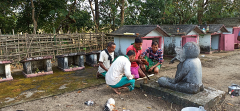
A ritual where a rooster is sacrificed to Ganesh and an offering of fermented liquor is made. Source: The author.
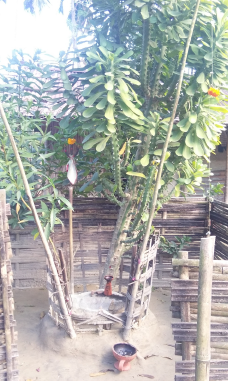
A Bathou altar with a trishul beside a Sijou plant. (Kokrajhar in 2018.) Source: The author.
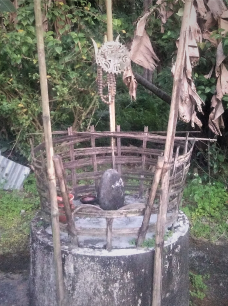
A Bathou altar with a rock representing the lingam. (Kokrajhar in 2018.) Source: The author.
As religion has become a marker of identity, Bathou worship among the Boros has moved towards the consolidation of rituals and practices. It is geared towards achieving a universal definition of Bathou. Mukta, an eminent scholar associated with the All Bathou Mahasabha, said to me that Bathou represents the five elements of air, water, sky, fire, and earth; it centres around the super power of ‘Borai-Bathou’, the almighty god. Mukta has worked extensively on Bathou and on defining its core ideas. When I met him at his residence in Kokrajhar, pointing out that the Boros are not Hindus, he said, ‘The All Bathou Mahasabha has been established to assert that the Boros are not Hindus. We are ancient Bathou worshippers.’ As much as the leaders of the All Bathou Mahasabha like Olongbar and Mukta have relentlessly pushed for the need for uniformity in Bathou, as one moves from one village to another in Kokrajhar, the meanings of the symbols in the Bathou altar change. Anything that is given a place in the Bathou altar holds different meanings to worshippers across different spaces.Footnote 51 Some plant a tulsi (holy basil) plant beside the Sijou and attribute different meanings to it. For some, it signifies the presence of popularly known Hindu deities like Parvati; for others, Lakshmi, and so on.Footnote 52 It is also common to worship popular Hindu deities like Ganesh by offering them fermented liquor and sacrificial offerings (see Figure 1). Apart from these, ancestral forms of Bathou worship involve the reverence of numerous spirits and deities who can sometimes possess people and cause trouble in the villages. These spirits need to be appeased through rituals and sacrificial offerings. For the All Bathou Mahasabha, these practices pose a barrier to their assertions that the religion is distinct from Hinduism and in defining Bathou as a universal religion. Sacrificial offerings, performance of shamanistic dances, and reverence to spirits defy the attempts of the All Bathou Mahasabha to portray Bathou as a religion of the modern Boro. The prevalence of diversity in terms of reverence to different deities also challenges the meanings attributed to Bathou by the All Bathou Mahasabha which asserts that Bathou is the sole chief god that manifests in the Sijou plant. It strives to promote the sole reverence to the supreme deity, Bathou-bwrai (wise one), and rejects the worship of these popular Hindu deities.
In contrast, although Bathou is significantly associated with the Sijou plant, certain Bathou worshippers offer reverence solely to symbols that represent Shiva, considered to be a popular Hindu deity, such as the trishul (trident held by Shiva) or the lingam (Shiva’s symbol) which is sometimes represented by a rock (see Figures 2 and 3). The idea that Shiva is one of the manifestations of Bathou is a dominant idea among many Boros.Footnote 53 While scholars like R. N. Mosahary have argued that the etymological meaning of Bathou is the five elements, he also points out that it is often associated with Shiva.Footnote 54 With the expansion of the activities of the All Bathou Mahasabha, this idea of equivalency of Bathou as Shiva has been mostly removed among the Boros who have embraced the All Bathou Mahasabha, especially in the Udalguri district which is its stronghold. Olongbar’s own residence had a Sijou plant neatly installed in his courtyard. Compared to the variety of Bathou altars that can be seen in most Bathou households in Kokrajhar, the Bathou altar in Olongbar’s residence is different. It looked almost as if the Sijou plant was newly planted with a circular fence around it. He showed me the altar and said that the Sijou is supposed to stand alone, and there should not be anything else besides the Sijou plant. He went on to say,
Many Boros may have worshipped Shiva in the past and many Boros of Kokrajhar still do, but that is not our history. We are not Hindus. Bathou has an identity of its own, which is why it is Bathouism and not Hinduism. The Boros may be divided in terms of rituals and beliefs but we are working on it. We are organizing Bathou. Some of the ancestral practices are not fit for our society and there is an urgent need to change those practices. People evolve with rituals and society is closely linked to religion. It is through religion that change can be brought into our society. (Olongbar, Kokrajhar, 2018)
A priest educating Bathou worshippers inside a Bathou prayer house known as a thansali. At the end of the ritual gathering, he stood up and spoke about Bathou, its origins, and its distinction from Hinduism. He went on to say that Bathou is not Shiva and it is a huge mistake to believe so. (Udalguri, 2018.) Source: The author.
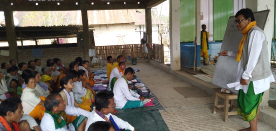
It is to bring about change in the existing structure and belief system of Bathou followers that the All Bathou Mahasabha organizes workshops and meetings, and also imparts knowledge on Bathou at the weekly prayer meetings that have been set for Tuesdays of every week. Many such thansalis (prayer houses) (Figure 4) can be seen as one passes through Udalguri where Bathou followers gather every Tuesday in uniform-coloured clothes—women in yellow dokhona (Boro attire for women) and men in green gamsa (Men’s cloth covering the lower body). When I visited one of these thansalis in Udalguri, the priests enthusiastically guided me through the rituals and showed me the sacred book of Bathou known as the Bathou Thandwi. For me, who had never witnessed a congregational gathering of Bathou in Kokrajhar, it was a spectacle. Men and women sat on each side with the Bathou altar at the front, chanting the aroj with the kham (drum), sifung (flute), and jotha (cymbals) playing in harmony.Footnote 55 It depicted a sense of order. In contrast, Kokrajhar provides a space of worship for different forms of Bathou. By 2019, there was only one temporary gathering space for the Bathou worshippers of the All Bathou Mahasabha in Kokrajhar town, showing its limited number of followers. To observe a Bathou religious gathering in the villages of Kokrajhar, one witnesses what some might consider to be disarray. I once visited a village that has continued with the rituals of sacrificial offerings in Bathou. During the day, people of the village gathered in an open area known as the garja sali where sacrificial offerings are made to the deities. The priests and a few other men were seen performing the sacrificial offerings and chanting prayers while others watched. Some were seen happily consuming alcohol and talking, and others were cleaning the sacrificed meat that would be prepared for the communal feast that night. What is immediately striking is that while one form of Bathou worship depicts order, the other embraces a frenzied space of religious experience, often considered as a lack of organization and discipline, unsuitable for a supposedly modern and civilized society. These practices vary as one moves from one village to another. Nevertheless, amid the heterogeneous beliefs and religious practices, the All Bathou Mahasabha has made continuous efforts towards consolidating the religious practices of Bathou. The process remains complex due to the existence of multiple sects of Bathou, making it almost impossible to incorporate them within a single fold. On the other hand, despite limited influence in Kokrajhar, which is the administrative headquarters of BTR, the All Bathou Mahasabha has a significant position in cultural and social gatherings as the torchbearer of religious assertion, whereas other sects of Bathou are not as strongly organized.
The All Bathou Mahasabha has altered many of the older rituals and ceremonies. Similar instances have also been observed by Arkotong Longkumer in his study of the Heraka movement wherein attempts have been made to alter or reform such rituals that do not adhere to the principles of modernity. It, thus, attempts the making of a modern religion and also connects to certain elements by being both traditional and modern at the same time.Footnote 56 The agenda is to achieve a collective sense of identity by bringing together the diverse forms of Bathou religious practices. Many have embraced the All Bathou Mahasabha. Ancestral forms of worship that involve sacrificial offerings are increasingly considered expensive and unfeasible for contemporary Boro society. Communal gatherings for rituals that last for days have also become difficult for people to sustain. Amid such issues, the All Bathou Mahasabha has emerged with reforms that suit the needs of contemporary Boro society. In its endeavour to form an organized religion, the All Bathou Mahasabha has put forward the need to have sacred texts to pass on religious traditions. Not only have the old rituals been changed but so have the prayers and hymns.Footnote 57 It is apparent that the project of shaping a uniform religious faith among the Boros remains a challenging task. Rigorous attempts at transferring the desired ideas about Bathou and its distinction from Hinduism are made, signalling that there is a gap between the desire of the Bathou leaders to have a unified distinct religious identity and the meaning of religion for the Bathou worshippers. Although the All Bathou Mahasabha has advocated for a separate religious identity under the banner of Bathouism, the task of bringing in the followers of Bathou into the framework remains complex. Amid the diverse forms of religious practices and beliefs among the Bathou worshippers, universalist ideas of Bathou find little significance among the Boros of Kokrajhar where Bathou worship has remained largely localized with long-standing historical interactions with Hinduism. For a section of the Bathou worshippers, the idea of a Bathou religion uninfluenced by Hinduism or existing outside of it is difficult to reconcile with their existing practices, and thus the claims of its distinction from Hinduism by the All Bathou Mahasabha remains challenged. The notion of ‘world religions’ has had such deep implications that to imagine Bathou as a distinct religion that is outside the purview of Hinduism remains complex. The ideas surrounding Hinduism that tend to define it as a fluid entity continue to promote the idea that religious faiths that do not fall under any defined category are inevitably within the ambit of Hinduism. It is this perceived characteristic of Hinduism that continues to be appropriated by the Sangh Parivar as it tries to build a unified Hindu identity based on the diversity of religious faiths in the Northeast. The Sangh Parivar takes it further by dictating what it truly means to be a Hindu and diminishing the peculiar characters of tribal faiths.
Bathouism, Hinduism, and the Sangh Parivar
Studies of the Sangh Parivar in the Northeast have asserted that the region, characterized as it is by numerous separatist movements challenging Indian hegemony, has never been ideal territory for the Sangh to gain its stronghold.Footnote 58 In Assam, Malini Bhattacharjee writes, ‘a mélange of races, ethnicities, faiths, customs and cultures—and a multiplicity of issues make it extremely difficult for an ideology riding on religious nationalism to gain a foothold in the state’.Footnote 59 However, in the last few decades, the presence of the Sangh Parivar can be felt increasingly among the tribal communities of the region, with the Sangh attempting to incorporate the tribes within the framework of a Hindu nation. Since the late 1980s the increasing influence of the Sangh can be felt among the Boros in Assam.Footnote 60 For the Sangh, it has remained crucial to find affinities between tribal practices and Hinduism, to search for a Hindu identity in tribal communities, and to mobilize them against the forces of Islam and Christianity. As the Boros have taken up the project of redefining their traditional religion, it has coincided with the attempts of the Sangh Parivar to redefine Hindu. Amid the process of defining and redefining Bathou as the traditional religion of the Boros, the question of whether Bathou is Hindu continues to arise. It is in among the tensions that exist in defining Bathou as the traditional religion of the Boros and its affinity to or distinction from Hinduism that the Sangh Parivar has inserted itself in the religious landscape of the Boros. Longkumer, in discussing the presence of the Sangh in the Northeast, mentions that indigenous religions are used by the Sangh as a way to define non-Christian groups. By doing so, it enables the celebration of traditional culture, the ties to land and nature, and the moving away from colonial missionary understandings of animism.Footnote 61 The idea of Bathou as nature worship has been used by the Sangh Parivar to find affinities between Bathou and Hinduism, and assert that all forms of nature worship are inevitably a manifestation of Hinduism. While, on the one hand, there are people like Olongbar who stand firm in asserting the distinctiveness of Bathou from Hinduism, on the other, the Sangh Parivar constantly pushes the idea that such contentions will ultimately be subsumed into the assertions of Hindutva. I first met Ringkhang, one such RSS activist, in Kokrajhar in 2018. He is a resident there and lives a few kilometres away from Olongbar’s residence. When Olongbar and I discussed Bathou and the Sangh Parivar’s engagements in it, he casually mentioned Ringkhang who constantly approached him to try to convince him to become a part of the Sangh Parivar, therein persisting in trying to build alliances with the All Bathou Mahasabha. Ringkhang is in his late thirties and an active swayamsevak (a strong advocate of Hindu Rashtra). He pointed out,
The RSS is against conversion but not against any religion. All religions except Christianity and Islam are Hindu. A Boro can never be a Christian, they have always been Hindus. They worship nature. This is why, Bathou is Hindu. Other religions do not offer reverence to nature. Some people argue that Bathou is not Hindu but that is a misunderstanding. We are constantly trying to reach out to people for such discussions. Religion is crucial to a community’s culture and identity and the RSS works towards the protection of this very identity. (Ringkhang, Kokrajhar, 2019)
Such an approach by the Sangh, wherein they constantly look for new alliances, especially with the religious movements of the region, has become an important part of its strategy in the Northeast. Pralay Kanungo writes, ‘Hindutva usually launches its operations through the elites and notables; the same practice is followed in the tribal areas.’Footnote 62 In his study of the Sangh Parivar in Arunachal Pradesh, Kanungo writes that the Sangh did not make inroads into the internal affairs of the indigenous communities, but rather made an alliance with the indigenous elites because they shared a somewhat similar goal—to keep the indigenous communities within the indigenous religious fold. It has been an important agenda of the All Bathou Mahasabha to bring more followers into its fold, while, at the same time, curtailing religious conversions among the Boros, especially to Christianity. This agenda has coincided with that of the Sangh Parivar and so it has become crucial for the Sangh to make alliances with local religious leaders to pursue its own goal of building a Hindu Rashtra. As Kokrajhar becomes a site of heterogeneity in religious practices, both the All Bathou Mahasabha and the Sangh Parivar strive to navigate their way through this complex religious landscape. When religious practices remain confined at the local level, it becomes difficult for the Sangh to convince people about the existence of an organized religious identity and, hence, to mobilize them. Disparate forms of Bathou worship that exist at the local level and are not governed by any powerful institution restrict negotiations with the Sangh Parivar. The few villages in Kokrajhar that have continued ancestral forms of Bathou worship are not governed by powerful religious institutions. For the Sangh Parivar, barriers to penetrating the religious affairs of these villages remain. The attempts of organizations like the All Bathou Mahasabha to organize Bathou to consolidate a Boro religious identity and to become an established religious organization aids the Sangh in reaching out to the many Bathou followers. At the same time, the Sangh also believes that the lack of religious organization makes tribal communities more likely to convert to Christianity. As such, the attempts of indigenous religious institutions to organize their religion become an instrument for the Sangh Parivar in reaching out to the tribal communities and in curtailing conversions.
M. S. S. Pandian writes that the desire for homogeneity and the existing and ever-emerging diversity are at the heart of the nationalist dilemma.Footnote 63 He argues that the nation-form exists in a state of constant anxiety due to the existence of and contestation among different identities since the nation-form is based on the desire for sameness and homogeneity. This dilemma is manifested by the nationalism of the Sangh in its endeavour towards building a Hindu nation. It is also manifested in the endeavours of the All Bathou Mahasabha as it strives to achieve a homogeneous Bathou religion among the Boros. Thapar writes, ‘Because identity is linked to religion, it can lead to the redefinition of the particular religion, more so as in the case of one as amorphous as Hinduism. Such identity tends to iron out diversity and insists on conformity, for it is only through the uniform acceptance of the religion that it can be best used for political ends.’Footnote 64 The Sangh Parivar anxiously strives for a homogeneous Hindu identity. However, in the case of Hindu nationalism, it becomes crucial for us to acknowledge that often inconsistencies in religious practices further aid the definition of Hinduism as a broad category, encompassing a variety of religious traditions. While the Sangh remains anxious over the heterogeneity in religious practices of the Boros, interestingly, it also finds refuge in embracing the diverse forms of Bathou worship within its fold in such a manner that the inconsistencies in Bathou become conducive in shaping Hinduism as a fluid entity. The consolidation of Hinduism which began in the late nineteenth and the early twentieth centuries by bringing together the undefined categories of religion is continued by the Sangh Parivar in the present. In speaking of the religious identity of the Boros, Rupali, another Sangh Parivar activist, tells me that they have been working towards achieving religious unity among the Boros and therein among the Hindus. Although she found the extent of religious heterogeneity among the Boros to be a problem, she further asserted, ‘They are all Hindus, nevertheless.’ Although there are tensions among the numerous sects of Bathou, the Sangh Parivar has promoted the idea that a variety of Bathou religious practices can exist within Hinduism. In this context, Ringkhang pointed out,
We, Boros, have a problem. We are not united. We neither have religious uniformity nor unity and unity is what we are working towards. Everyone does as they please. There is no uniformity in rituals and practices. There are so many branches of Bathou in Kokrajhar itself. Yet, we are on good terms with all the major Bathou religious organizations. Some may claim distinction from us or disagree with us but they will need us at one point. (Ringkhang, Kokrajhar, 2018)
In the last few years, the Sangh has continued to make attempts to navigate through the complex heterogeneous religious landscape of the Boros and has situated itself as a protector of Boro identity. Often, I had long conversations with the RSS activists regarding the need for the protection of tribal culture and religion. We would have these conversations in a room inside the RSS karyalaya (office) with huge portraits of K. B. Hedgewar, M. S. Golwalkar, and Bharat Mata (Mother India) on the walls. Many Boros, like Ringkhang and Rupali, have become part of the Sangh Parivar. Like Ringkhang, people from different walks of life have come together and become the messengers of Hindu nationalism among the Boros. As the Sangh seeks to perform a paternalist role, Bathou leaders are constantly navigating their way through the religious nationalism of the Sangh. In the process of reforming and consolidating Bathou, different actors from the Bathou reformist movements are negotiating with the Sangh Parivar, sometimes by collaborating and sometimes by asserting their distinctiveness. Olongbar’s position shows us one side of the story. The other side of the story reveals a range of negotiations and dilemmas characterizing the complex relationship between Bathou leaders and those of the Sangh. As I met more leaders belonging to different Bathou sects and their followers, it was increasingly revealed to me the complexities that are shaping the Sangh Parivar’s trajectory among the Boros. When I met Baneswar, a priest of Bathou Shiva Dharma Sangha,Footnote 65 he confided in me, saying,
We may be Hindus but often, they (the Sangh Parivar) try to convince us to follow their ways. For instance, sometimes they tell us to worship their gods like Ram and Durga. They are not our gods. We have been resisting these impositions. We have distinct ways of practising our religion. After all, there are many forms of Hinduism. (Baneswar, Kokrajhar, 2021)
During our conversation, Baneswar often paused and thought carefully about his words, wondering what might or might not be appropriate to say. He further mentioned that although there are differences, Bathou needs a strong and powerful institution like the RSS that can safeguard its interests. The Sangh Parivar is keen on building new alliances with people like Olongbar and Baneswar through constant negotiations. As Olongbar strived to assert the difference between Bathou and Hinduism, Baneswar claimed to offer reverence to Bathou which he believed to be a form of Hinduism, albeit distinct from the Hinduism preached by the Sangh Parivar or Hindutva. However, other Bathou reformists reveal a sense of vulnerability and they consider themselves to be a small religious sect that needs a powerful organization like the Sangh Parivar on its side. For instance, in 2017, a Boro family converted from Bathou worship to Christianity. The All Bathou Mahasabha tried tirelessly to convince the family to reconvert to Bathou but failed. Reaching an impasse, some leaders of the All Bathou Mahasabha approached the Sangh Parivar to step in. Although the latter also failed, this story illustrates the manner in which the Sangh Parivar and the All Bathou Mahasabha work together amid their inherent disjunction. At the same time, within such negotiations with the Sangh Parivar, the All Bathou Mahasabha as well as other Bathou organizations attempt to strive to assert their uniqueness. However, such assertions by the All Bathou Mahasabha are sidelined by the Sangh Parivar who argue that being ‘Hindu’ is a way of life that encompasses all forms of religious practices, including Bathouism. Today, through the persistent efforts of the All Bathou Mahasabha, the second Tuesday of Magh (a month in the Assamese calendar) is celebrated as Gwthar Bathou San (Bathou Day). Despite this, by building a narrative of a Hindu Boro identity, the Sangh Parivar has given new cultural meanings to what it means to become a Hindu and what defines a Boro religion.
Today, areas of the BTR reveal a place where two forms of nationalist projects are at play. The last few years have witnessed the growing influence of the All Bathou Mahasabha, which includes its influence in the heterogeneous religious landscape of Kokrajhar. It has become a common sight to witness regular events organized by the All Bathou Mahasabha, asserting its distinctive role in building a Boro religious identity. It has also become a common sight to see numerous events and gatherings organized by the Sangh Parivar in which a Hindu identity among the Boros is asserted. As much as the negotiations with the Sangh are shaping the contemporary socio-political landscape of the Boros, it is imperative for the Boros that the traditional religionists acknowledge the historical trajectory of Boro identity assertion. Such negotiations have been playing a significant role not only in the formation of Bathou as the traditional religion of the Boros but also in significantly shaping the relationships between different religious groups.
Conclusion
Since the late nineteenth and early twentieth centuries, there have been constant negotiations and debates around Hinduism and the religious identity of the tribes. Experiences of colonialism and the aspirations of Indian elites paved the way for the construction of religion as a crucial instrument in identity politics. Hinduism emerged as an all-encompassing religion that went on to incorporate tribal faiths. Tribal communities, including the Boros, have been actively engaged in debates that produce contested religious identities. In its endeavour to build a Hindu nation, the Sangh Parivar has met with a similar nationalist project that is attempting to consolidate its religious identity. As we conclude the article, we are constantly reminded of who defines religion and for what purposes. On the one hand, the Sangh Parivar is attempting to consolidate a Hindu identity that surpasses the divisions of caste, sect, and diversity in religious practices. On the other hand, Bathou reformists are striving to assert their distinctiveness from the Sangh. Amid this tussle of nationalist projects, complexities arise as the gap continues to grow between the meaning of religion to the people and that attributed by traditional religionists and Hindu nationalists. In the contemporary socio-political scenario, religion has not remained confined to ritual practices, scriptures, or belief in a supernatural deity. Rather, it is blended with identity assertion, nationalism, and power. By illustrating the Boro case, I have attempted to show the debates in the process of Hinduism-in-the-making. These negotiations continue today between Bathou leaders and the Sangh Parivar. Within the complexities of building a unified religious identity of the Boros as Bathouism, the Sangh has situated itself in the complex religious, social, and political landscape of the region, acting as a ‘saviour’ of the Boros. It continues to pursue an anxious nationalist project towards homogenization and tends to collide with similar nationalist projects emerging from the margins of its own imagined ‘Hindu’ community.Footnote 66 It has, therein, continued to pursue new meanings of Hinduism and, simultaneously, of the Boro religion by asserting what defines Hinduism and what the religion of the Boros truly is. These meanings have significant repercussions for the assertions of the tribal groups of the Northeast. The case of the Boros is one of the many ways in which the Sangh engages with the tribal communities of the Northeast. Studies engaging with contemporary assertions of tribal religions must be explored against the backdrop of such ongoing negotiations that shape the dynamic relationship between the Sangh Parivar and the tribal communities.
Acknowledgements
Some parts of this article were submitted to the Indian Institute of Technology, Guwahati, as a requirement for the fulfilment of a Master’s degree. This article would not have been possible without the people who have given me their valuable time during the course of my fieldwork. It has greatly benefitted from the comments, suggestions, and the mentoring sessions received from the British Academy Effective Writing Workshop (2020–2022) held in Kohima that was organized by the University of Edinburgh and The Highland Institute. I would like to thank Dr John Thomas, Dr John Zavos, Dr Michael T. Heneise, and Ada James for reading the initial drafts of the article and providing me with their valuable feedback. I also thank Dr Arkotong Longkumer for his valuable suggestions and insights into doing fieldwork. I am grateful to the two anonymous reviewers of Modern Asian Studies for their detailed comments. I thank Anjali, Nasir, and Kuriakose for helping me out with the preparation of the manuscript and the submission process. Lastly, I thank Pranab, Sourav, Debasish, Prarthana, and Gayotree without whom I could not have finished this article.
Competing interests
The author declares none.


 Open access

