




Introduction
In the past 30 years of theoretical debates, archaeologists seem to be reaching a new consensus, i.e., the material world actively shapes human behaviour. Advocates of material agency (Gosden Reference Gosden2005; Knappett Reference Knappett2005), symmetrical archaeology (Olsen Reference Olsen2010), entanglement theory (Hodder Reference Hodder2012), material engagement theory (Malafouris, Reference Malafouris2013) and even the more recent posthuman approaches (Crellin et al. Reference Crellin, Cipolla, Montgomery, Harris and Moore2020; Piezonka et al. Reference Piezonka, Angelbeck, Cunningham, Furholt, Schneeweiß, Wunderlich and Müller-Scheeßel2023) agree on the idea that materials surrounding us, whether constructed or encountered, can transform human behaviour. Without doubt this consensus has been the result of numerous arduous debates occurring somewhat contemporaneously and extending well beyond archaeology. While most of these developments have been theoretical, recent work combining archaeology, neuroscience and/or cognitive sciences have provided empirical support to this claim (Criado-Boado et al., Reference Criado-Boado, Martínez, Blanco, Alonso-Pablos, Porto and del Barrio-Álvarez2023; Forte et al. Reference Forte, Sartori, Visalli, Yildirim, Galati, Vidale, Faresin and Vallesi2025; Gandon et al. Reference Gandon, Nonaka, Coyle, Coyle, Sonabend, Ogbonnaya, Endler and Roux2021; Stout and Chaminade Reference Stout and Chaminade2009).
Although this new theoretical consensus about the active role of materials offers major opportunities for explaining changes we observe in the archaeological record in a more nuanced way, providing more depth to traditional explicative models – such as technological advancement, migration or diffusion –, it is certainly not without its challenges. For instance, if materials actively transformed human behaviour in the past as it does today, the way we infer these processes through our systems of classification and analysis might not be apt for explaining how these behavioural changes occurred. Therefore, it is timely to propose an account that specifically addresses which materially induced mechanisms are actually involved in the transformation of human behaviour. In other words, at an analytical level we require the means to take formulations from the armchair to the ‘field’, which at the time are rather limited (see for an exception Robb Reference Robb2015).
The present paper aims to formalise some mechanisms through which human perception and behaviour can be modified by materials, providing a guideline for empirical research. Drawing mainly from recent cognitive approaches, such as the active inference framework (AIF; e.g. Clark Reference Clark2013; Parr and Friston Reference Parr and Friston2017) and Material Engagement Theory (MET; Malafouris Reference Malafouris2013), we describe three different ‘transformative’ mechanisms. Illustrated with archaeological case studies, these mechanisms are (i) visual enchantment, which is exemplified in both the design and consumption of objects; (ii) mechanical degradation, which predominantly occurs through the manufacture and handling of artefacts; and (iii) obtrusion, which is exposed more clearly in depositional contexts. Through the formalisation of these mechanisms, further suggestions are offered on how to reconsider the classification and analyses of artefacts to infer human socio-motoric behaviour. In short, the article attempts to bridge many theorisations about materially induced behavioural changes from more humanities-inclined approaches in archaeology and anthropology with hypothesis-driven formulations from cognitive sciences and experimental psychology.
Practices, cognition and materials
To formalise the transformative mechanisms that materials – understood as the components of things – can bring forth, we must establish some principles on how humans, as socialised agents, perceive and act with materials. That is, we need to link principles about the embodied socio-cultural behaviour of human agents with those from a material ecology (Fig. 1; see the table in the supplementary material).
Cognitive embodiment and practice. The open action-perception loops
Humans are social animals par excellence. As such, human agents act according to a set of historically constituted and durable bodily dispositions or habitus (Bourdieu Reference Bourdieu1990, 74) – this is a generally acknowledged principle in archaeological studies. These dispositions are a socialised way of feeling and doing (Bourdieu Reference Bourdieu1990, 69–70) and are acquired practically by the human agent from early development and are rarely questioned throughout their lifetime. During practice, a dialectic unfolds between the agent’s historically constructed ‘way of doing’ (modus operandi) and the actual ‘result–effect’ of practice (opus operatum), which either transforms or reproduces this modus operandi. In other words, the habitus involves a recursive relationship between performed activities and incorporated body dispositions (Bourdieu Reference Bourdieu1977, 72). Of course, human agents are never isolated but are always performing within certain fields. These fields or spaces of/for action become structured according to the changing dynamics of human agents’ positions in these spaces, which emerge as a sort of struggle with other agents to secure specific forms of capital (Bourdieu and Wacquant Reference Bourdieu and Wacquant1992, 97). Nevertheless, while human dispositions are involved in a larger field of positions, human bodily actions are ultimately what allow the reproduction or the transformation of such fields (Fig. 1). Thus, the place of the body in the world is of central importance.
Diagram synthesising the basic principles of practice, embodiment and materiality in the act of constructing a table.

Among the emerging approaches in cognitive science addressing the mind–body–world relationship, the AIF (Clark Reference Clark2013; Parr and Friston Reference Parr and Friston2017) is particularly promising. It grants equal importance to perception and action while aligning closely with sociological formulations detailed above. AIF posits that agents constantly generate predictions about their surrounding world, while continuously readjusting, updating and refining those predictions according to the principles of minimisation of prediction errors and precision (Clark Reference Clark2013, 186; Veissière et al. Reference Veissière, Constant, Ramstead, Friston and Kirmayer2020, 11). Agents act in and experience the world according to a generative model they build of it (akin to Bourdieu’s ‘structuring structures’ of the habitus). This generative model allows the agents to formulate expectations about how the world ought to be but also about their own ability to perceive and act in it. Expectations, defined as ‘priors or beliefs that reflect action readiness’ (Veissière et al. Reference Veissière, Constant, Ramstead, Friston and Kirmayer2020, 6; see also Bourdieu Reference Bourdieu2000, 207), guide agents in sampling their environment to resolve uncertainty and refine their models to build accurate predictions (Hohwy Reference Hohwy2020). Perception and actions are thus both forms of gathering information. On the one hand, these expectations are related to agents’ ability to perceive the world, building a model of the upcoming sensorimotor flow. On the other hand, these expectations relate to the potential for the agents to modify their own environment. That is, agents select and perform motor actions that more likely will allow them to fulfil their own expectations (Clark Reference Clark2013, 186). In this light, cognitive processes form a continuous feedback loop between historically informed expectations (modus operandi) and the concrete outcomes of action (opus operatum).
Given the world is rich in stimuli, agents selectively attend to aspects that align with their expectations and minimise prediction errors. When sensory input deviates from predicted outcomes, prediction errors arise. Since not all predictions are of equal importance, a mechanism known as precision weighting modulates the impact the errors have: high weighting drives learning and further engagement, while low weighting renders error units relatively impotent (Clark Reference Clark2015; Reference Clark2013). To resolve significant errors, agents can either revise their generative model or act to bring the world in line with their predictions (Hohwy Reference Hohwy2020). The latter means that agents can adjust their actions, e.g., motor reflexes, so that the conditions of their initial prediction are met (Friston Reference Friston and Djebbara2022, 212). Thus, uncertainty plays a crucial role in changing the agent’s predictive model through ongoing environmental interaction.
Situations of uncertainty can be broadly categorised as expected or unexpected (Miller et al. Reference Miller, Nave, Deane and Clark2020; Parr and Friston Reference Parr and Friston2017). When there is expected uncertainty, prediction errors are considered of a low magnitude. For example, when going to a noisy bar to hear a band play, it is already expected that some noise will be interfering with our appreciation of the music; no real change in our model of the world is really necessary, and most of the noise would fall on deaf ears (Koelsch et al. Reference Koelsch, Vuust and Friston2019, 65). When the circumstances lead to unexpected uncertainty, our environment changes to a point that it provokes a distrust in our own generative model, but not in our ability to cope with the unexpected change (Miller et al. Reference Miller, Nave, Deane and Clark2020). In these situations, learning and plastic change is encouraged, leading to novelty. It is a potentially ‘habit changing’ scenario. The introduction of new practices, new equipment or tools or new social networks can thus stimulate prediction-based learning (Clark Reference Clark2018, 531).
In sum, we have stated that (a) the way we do things is inextricably linked to the historically constituted environments in which we are brought up; (b) perception and action occur in an open loop; (c) this iterative process is based on a continuously updating model about what an agent ‘expects’; and (d) when certain prediction errors occur, i.e., when uncertainty is to a degree ‘high’, agents’ generative model of the world can be modified (cf. Clark Reference Clark2013, 183).
Materials and their transformative effects
Everyday materials actively shape action–perception loops in often unpredictable ways. Thus, recognising the body’s role in cognition is insufficient without also considering how materials, as something continually flowing and ‘leaking’ beyond humans (Ingold Reference Ingold2012, 435), shape the body itself (Malafouris Reference Malafouris2013, 65). For instance, certain mnemonic systems, such as the khipu, Wanjina regeneration rituals or megalithic monuments, will enhance and trigger memory in very different ways (Malafouris Reference Malafouris2013, 83) but in practice can also be reformattable, allowing ‘encoded’ information that is of relevance to bodily memory to be transformed. This is a process termed as ‘thinging’ (Malafouris Reference Malafouris2020), which involves thinking ‘with and through things, [and] not simply about things’ (Malafouris Reference Malafouris2020, 4). Creative thinging is, thus, envisioned as the ‘discovery of new varieties of material forms […] through a saturated, situated engagement of thinking and feeling with things and form-generating materials’ (Malafouris Reference Malafouris2014, 144). It can be arguably characterised as a form of improvisational thinking emerging from working with materials.
Recent AIF research has emphasised the environment as a key source of uncertainty (Clark Reference Clark2018; Di Paolo et al. Reference Di Paolo, White, Guénin–Carlut, Constant and Clark2025). In a recent simulation study using both AIF and MET’s principles of creative thinging applied to a pottery-making scenario, it was shown how, when lowering the precision of generative models and under conditions of uncertainty precipitated by changes in the workability of clay, there is more room for creativity and learning from the material at the cost of several failed attempts (Di Paolo et al. Reference Di Paolo, Vindrola-Padrós, Clark and Constantn.d.). However, if the precision is too low (i.e. uncertainty is too high), then effects are counterproductive, and specimens will either fail completely or not achieve their intended function (Di Paolo et al. Reference Di Paolo, Vindrola-Padrós, Clark and Constantn.d.). In this way, human interaction with different kinds of materials, some more perishable than others, ‘train and tune our cognitive functions in different ways’ (Di Paolo et al. Reference Di Paolo, White, Guénin–Carlut, Constant and Clark2025). Therefore, materially induced uncertainty is a powerful contributor to cognitive change.
We argue that one of the main consequences of the trajectories of materials beyond humans is the introduction of uncertainty into our generative models. The material world, most prominently material culture, promotes prediction-based learning by generating (a degree of) uncertainty in our surroundings (Clark Reference Clark2018, 531). This uncertainty, in turn, prompts epistemic actions (Friston et al. Reference Friston, FitzGerald, Rigoli, Schwartenbeck, Doherty and Pezzulo2016, 868), such as shifts of our patterns of attention, gestures and movements (Adams et al. Reference Adams, Shipp and Friston2013; Constant et al. Reference Constant, Tschantz, Millidge, Criado-Boado, Martinez, Müeller and Clark2021), aimed at resolving that uncertainty. Understanding how this ‘way of doing’ emerges from our engagement with materials – some of them unintended, unforeseen and/or unpredictable – appears to be a logical proposition. Thus, we suggest pinning down these mechanisms of transformation to promote further empirical research.
A guide through three mechanisms of transformation
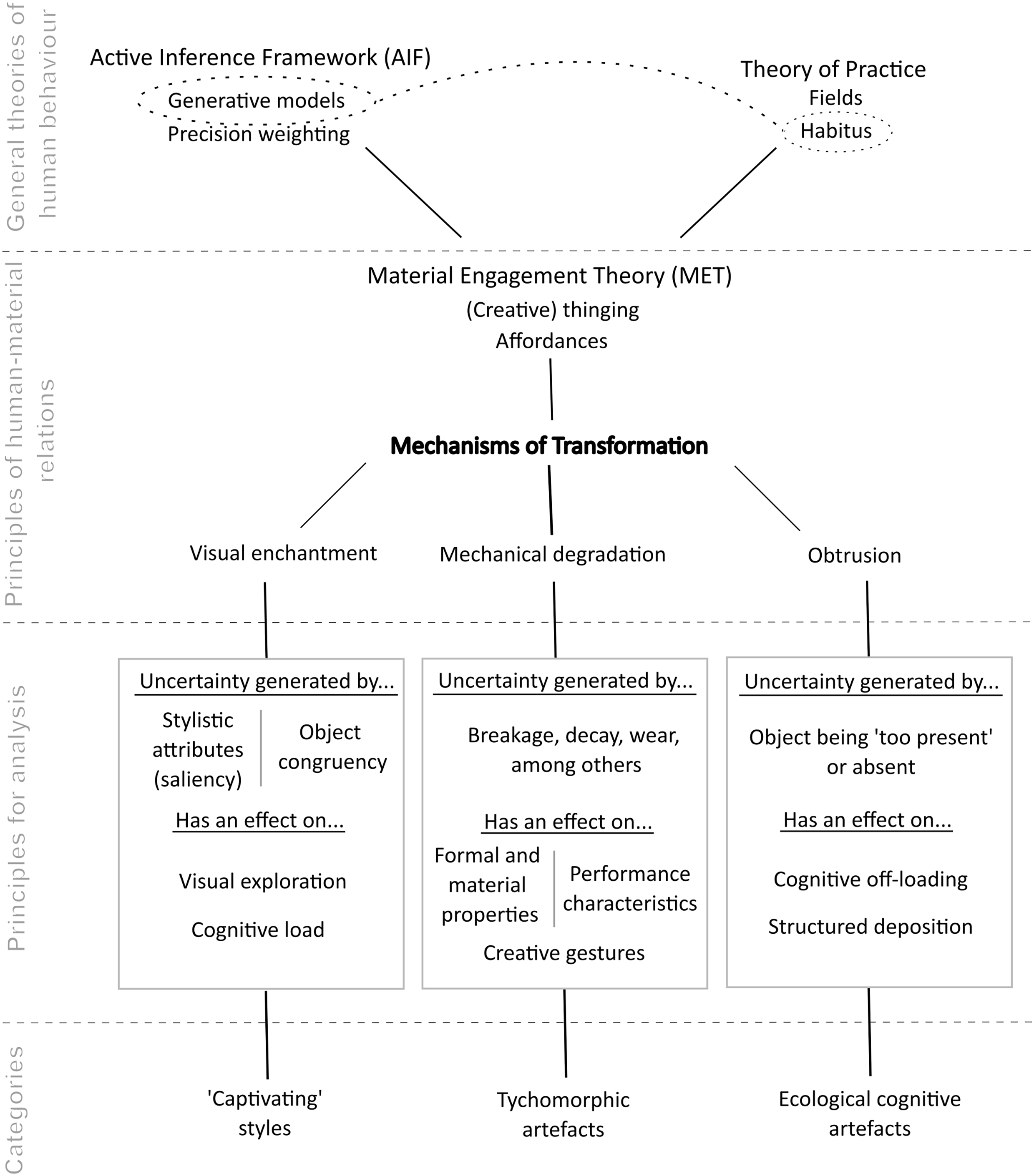
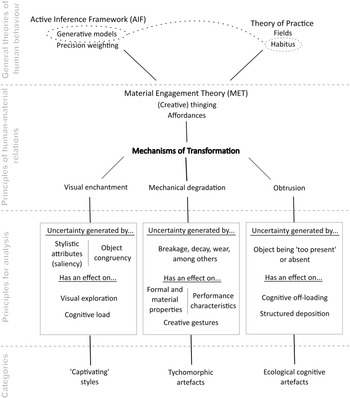
In this section we formalise some mechanisms through which materially induced changes occur in practice and provide some archaeological examples (Fig. 2). As will be illustrated, these mechanisms play with our expectations, creating outcomes that are not always predictable and thus forcing changes in our patterns of attention, movements and gestures. In short, they are ways in which the material world introduces habit-changing uncertainty.
Conceptual diagram integrating mechanisms of transformation into principles of human cognitive behaviour.
Visual enchantment
Alfred Gell’s Art and Agency (Reference Gell1998) provides a starting point for outlining this mechanism of transformation. In his search for creating a theory of art devoid of traditional conjectures of aesthetics (Layton Reference Layton2003, 447), Gell characterised art objects to understand what makes them so compelling. These objects are made to be seen, and they are captivating, but also they are difficult to see, think or transact (Gell Reference Gell and Dudley2012, 340). Of more relevance to our formulations is his understanding of artefacts as acting upon people. In this sense, Gell’s theory of art is one of action in that it focuses on what art objects do rather than what they symbolise (Gell Reference Gell1998, 6). These function through their visual properties but ‘only in terms of the intended effect […] in its context of use’ (Layton Reference Layton2003, 449), e.g., the design of a large ornamented prow board to dazzle overseas Kula partners and trick them into providing more valuable shells or necklaces than originally intended (Gell Reference Gell, Coote and Shelton1992, 44). One of these properties is undeniably decoration; it is fundamental to what Gell terms ‘the technology of enchantment’ (Gell Reference Gell, Coote and Shelton1992) or the power of artefacts to captivate their audience by displaying the technical prowess involved in their making. Placed in their context, these visual properties cast a spell on the viewer to make them see the world in an enchanted way. In other words, they introduce uncertainty in what the viewer expected to perceive of the visual stimulus in its specific context.
In terms of visual cognition, we can argue that enchantment occurs when the visual properties of objects alter human patterns of attention because of the unreliability of the generative model. From an active inference perspective, visual exploration, as a central means for acquiring sensory information, is fostered by the necessity to solve the ‘uncertainty about the states of affairs in the world’ (Parr and Friston Reference Parr and Friston2019). We actively seek for visually rich areas to gather information about our environment using an internal generative model to predict sensory input (Parr and Friston Reference Parr and Friston2017). Our eye movements are thus driven by our expectations about information-rich or ‘salient’ areas (Parr et al. Reference Parr, Sajid, Da Costa, Mirza and Friston2021). Visual perception under active inference is, thus, epistemic and fosters selective attention.
Nonetheless, our visual engagement with the world always provides surprises that can lead to predictive errors and alter patterns of overt visual attention to contend with them. In eye-tracking experiments, for example, researchers often display objects that are altered to be congruent or incongruent with the gist of a scene (e.g. Coco et al. Reference Coco, Nuthmann and Dimigen2020) or are designed to come into view abruptly in a scene (Brockmole and Henderson Reference Brockmole and Henderson2005a). While some of these modifications are unnoticed (Matsukura et al. Reference Matsukura, Brockmole and Henderson2009), others grab participants’ attention regardless of the instruction given to participants (Brockmole and Henderson Reference Brockmole and Henderson2005b, 866). When noticed, semantically incongruent objects or those that appear abruptly can create predictive errors and increase signals for surprise or ‘cognitive load’, i.e., higher demand for visual exploration. Some eye-tracking experiments on object–scene congruency have, for instance, shown that the total time spent looking at incongruent objects upon its first encounter was longer than for congruent ones (Coco et al. Reference Coco, Nuthmann and Dimigen2020). Modern eye trackers also measure pupil size, which reflects cognitive load and is sensitive to violations of expectations (for a review see Einhäuser Reference Einhäuser and Zhao2017). In these cases, since the observers’ expectations are not met, a greater mental effort is required to resolve this inconsistency, which results in a larger pupil dilation or longer fixation times.
Object saliency, defined as the conspicuousness of an object to their surroundings, can also influence human visual exploration. Low-level saliency mostly involves factors that come from the visual stimuli and are mostly influential during the first fixation of viewing the stimuli (Schütt et al. Reference Schütt, Rothkegel, Trukenbrod, Engbert and Wichman2019, 17), e.g., luminance, colour and contrast, among others (Itti and Koch Reference Itti and Koch2000; Massaro et al. Reference Massaro, Savazzi, Dio, Freedberg, Gallese, Gilli and Marchetti2012). High-level saliency factors also relate to the visual properties of the stimuli but require the viewer to encode much more complex information, such as textures, patterns or structures (Bergen and Landy Reference Bergen, Landy, Landy and Movshon1991; Schütt et al. Reference Schütt, Rothkegel, Trukenbrod, Engbert and Wichman2019). In archaeological research, these factors are linked to stylistic attributes of objects, such as their decoration patterns. Free-viewing eye-tracking experiments on archaeological pottery styles have shown, for instance, that decorative patterns on the vessels are the main areas of focus for participants, such that form and textural features become of secondary interest (Criado-Boado et al. Reference Criado-Boado, Martínez, Blanco, Alonso-Pablos, Porto and del Barrio-Álvarez2023; Vindrola-Padrós et al. Reference Vindrola-Padrós, Scholtus, Müller, Furholt and Nuthmannn.d.). Furthermore, decorative patterns on pottery vessels have also been shown to elicit larger pupil dilations and longer fixation times (Vindrola-Padrós et al. Reference Vindrola-Padrós, Scholtus, Müller, Furholt and Nuthmannn.d.). Thus, high-level saliency, as seen with decorative patterns, can also propitiate predictive errors that foster a greater demand for visual exploration.
By studying the effects that object (in)congruency and saliency have on patterns of visual exploration, we can explain how, in certain situations, stylistic attributes of objects can generate uncertainty. In other words, perceived in their context of use, these visual properties modify our visual attention patterns and the predictions we make about (and build from) the world. This is the mechanism of visual enchantment.
The evolution of pottery styles in prehistoric central Germany
In a recent eye-tracking experiment, Vindrola-Padrós et al. (Reference Vindrola-Padrós, Scholtus, Müller, Furholt and Nuthmannn.d.) illustrate how human patterns of attention, influenced by the design of decorative patterns, shifted throughout a sequence of over five thousand years (5500–1 B.C.) in central Germany. The authors argue that (a) the signal for cognitive load, produced by the participants viewing a certain sequence of pottery styles and measured through fixation duration and pupil diameter, can enable the identification of the styles that are more enchanting or ‘attention-grabbing’, and (b) when placed in their socio-historical context, the effects of decorative patterns on patterns of overt visual attention in past human populations could be assessed.
The eye-tracking experiment consisted of a free-viewing task (i.e. without any instruction but to observe the object displayed), where participants were presented 41 complete or reconstructed vessels from the Early Neolithic period to the Late Iron Age non-chronologically in 15-second intervals. Vessels were sampled according to arbitrary phases of 250 years, selecting the most representative types that were present within each phase. Selected participants (n = 33) were from three different groups: archaeologists, people with experience working with clay and people without either archaeological or pottery training.
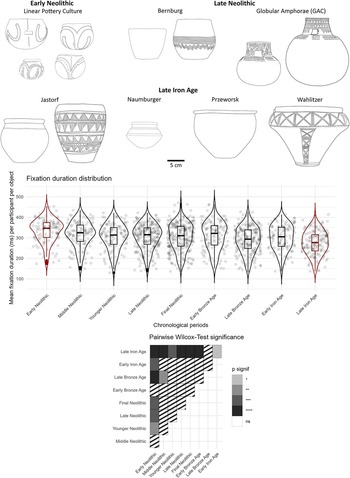
Participants showed differences in responses, i.e., fixation duration and pupil diameter, to these decorative patterns. Three patterns can be observed: a peak during the Early Neolithic (5500/5400–5000 B.C.), an increase in the variation of visual responses starting in the Late Neolithic (3500 B.C.) and ending towards the Early Iron Age (700 B.C.) and a depression during the Late Iron Age (450–51 B.C.; Fig. 3). The vessels sampled from the Early Neolithic in central Germany correspond to what is termed the Linear Pottery Culture (LPC; ca. 5500/5400–5000 B.C.). These styles mainly consisted of a series of small and medium-sized bowls and globular vessels decorated with incised spiral or meandriform bands. While in later LPC styles these bands were filled in with other ‘secondary’ patterns (such as dotted or small incised lines) and the regional variation of decorative patterns increased, the main motifs were continually used throughout this 500-year timeframe. Values for all four pots used from the LPC suggest the spiral motifs had a powerful effect. In this regard, a spiral motif would be a more complex visual stimulus than a linear one and therefore more cognitively demanding to process (Vindrola-Padrós et al. Reference Vindrola-Padrós, Scholtus, Müller, Furholt and Nuthmannn.d.).
Discussed pottery styles sampled for eye-tracking experiments (top; drawings: ©Susanne Beyer) and cognitive load measurements (bottom) for participants (n = 33) according to fixation duration. Red boxplots and violins indicate Early Neolithic and Late Iron Age, which display a statistically significant difference to the other chronological periods. The matrix provides p-values for the non-parametric test (data from Vindrola-Padrós et al. Reference Vindrola-Padrós, Scholtus, Müller, Furholt and Nuthmannn.d.).
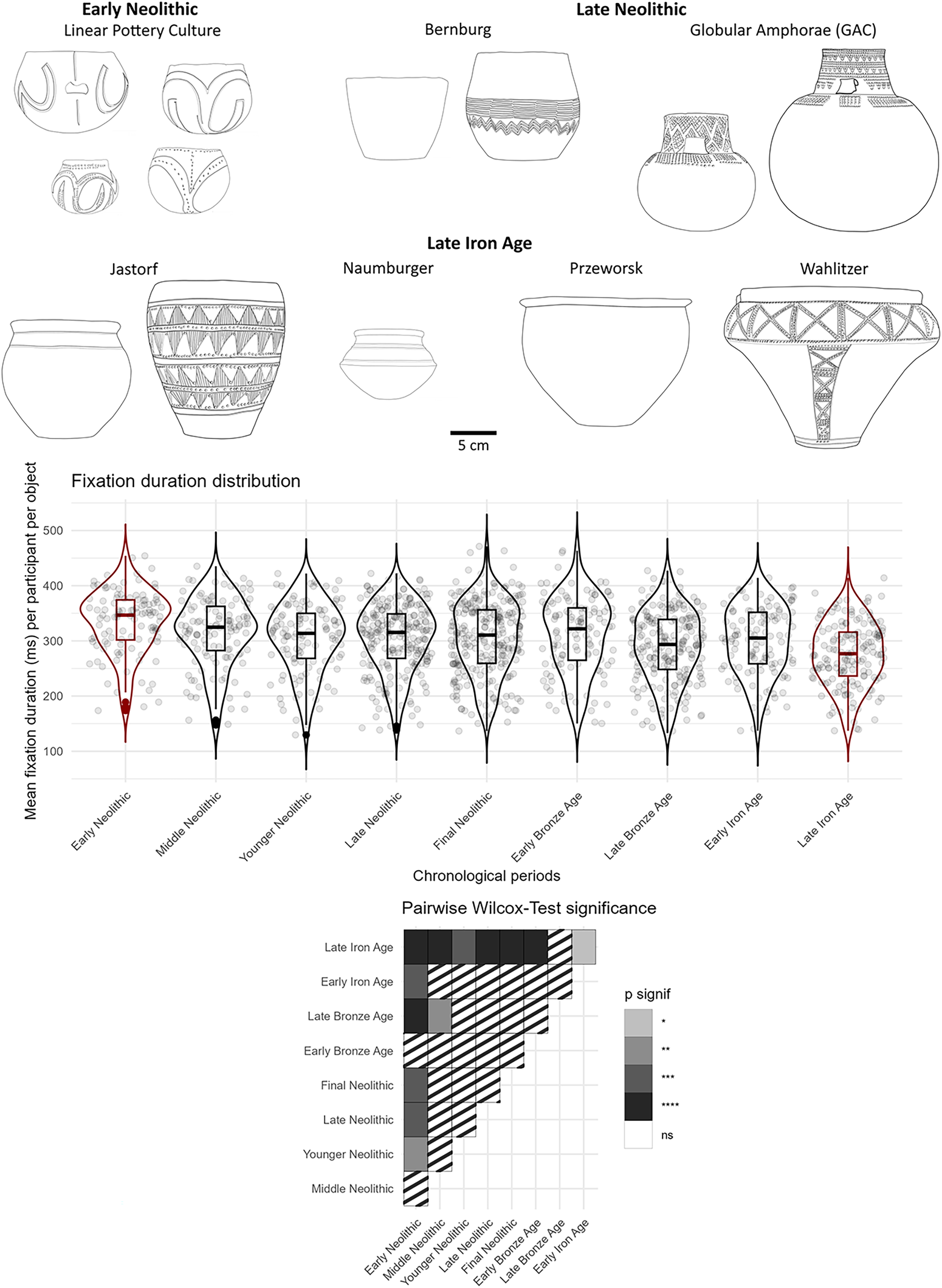
When considered in their context, the peak observed in the values for cognitive load at the beginning of the Neolithic attests to the enchantment process described before (Fig. 3). Pottery at this time is believed to have been produced by individual households, and decorative designs appear in vessels from multiple contexts including in pits, in graves and even in wells (as seen in later phases). Thus, decorated pottery was ubiquitous in everyday life and available to be seen by all members of society. Furthermore, the increasing regionalisation of decorative patterns has also been argued to indicate the use of pottery for delimiting social boundaries, demonstrating a high investment in pottery as a medium for symbolic expression. The extraordinary effort in changing decoration patterns of pottery by adding a layer of birch bark in the LPC Sarka style (Elburg Reference Elburg, Otten, Kunow, Rind and Trier2015) is further evidence of this investment. Therefore, the authors argue that these pottery designs (perhaps inadvertently) had the effect of captivating their audience; i.e., they contained decorative patterns that elicited a higher cognitive load because there was a high investment in the craft in all social spheres, more particularly in respects to delimiting social boundaries and differentiation from other groups (Vindrola-Padrós et al. Reference Vindrola-Padrós, Scholtus, Müller, Furholt and Nuthmannn.d.).
In central Germany the captivating styles are visible in the hybridisation of pottery in sedentary pastoralists (GAC, phases A–D) and regional farmers towards the end of the fourth millennium B.C. (Bernburg, phases 1–3; modified from Müller Reference Müller2023).
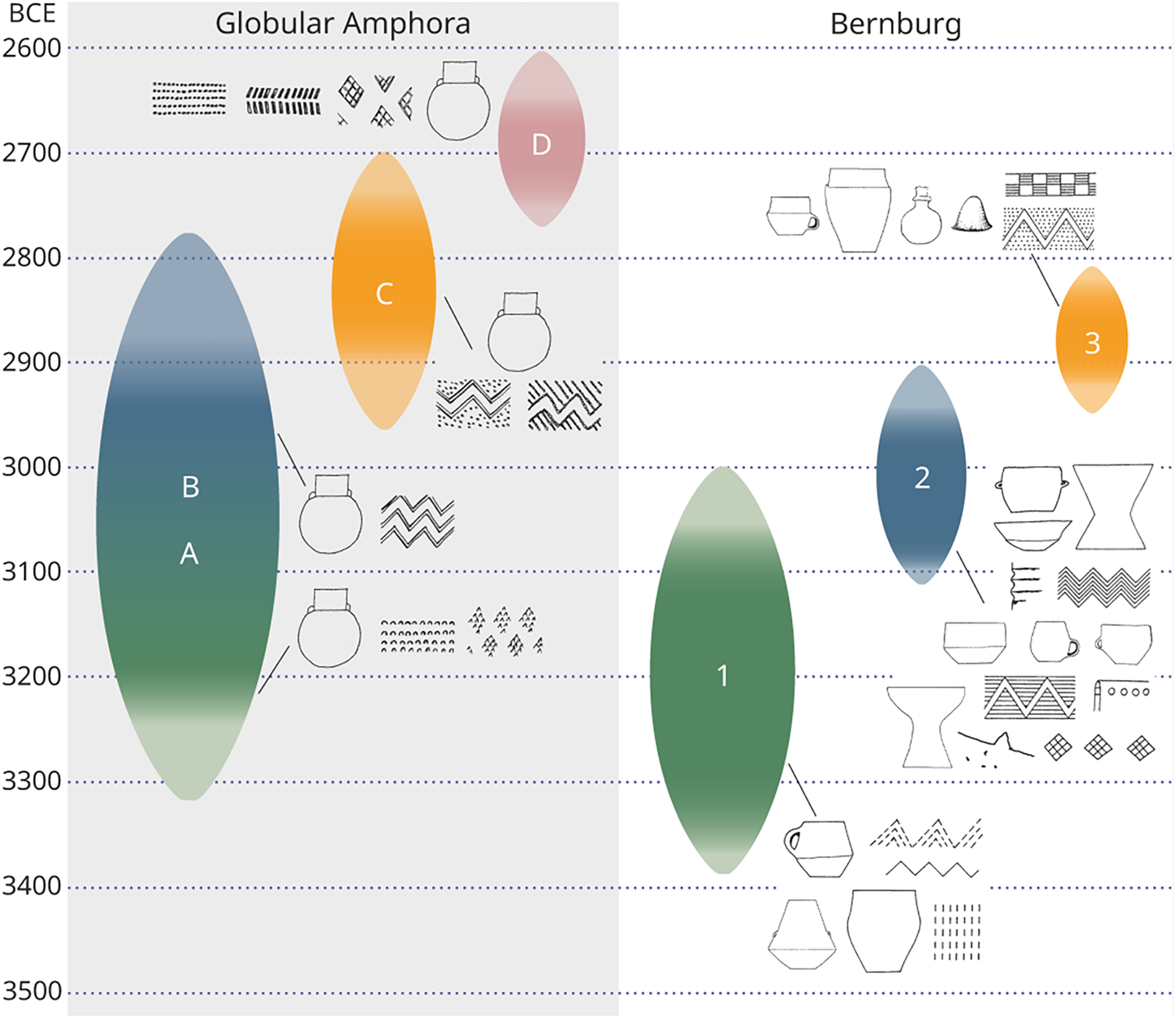
There are numerous context-specific processes that could explain the increased variation in values from the Late Neolithic to the Early Iron Age. One example is the so-called globular amphorae (GAC). From 3200–2700 B.C., there was not only a social but also a symbolic hybridisation between the regional farming communities with Bernburg pottery and the supra-regional networks of GAC pottery associated with sedentary pastoralists. This is evident through the mutual adoption of decorative motifs on entirely different vessels with distinct functions (Fig. 4; Müller Reference Müller2023, 232, Fig. 197). Furthermore, towards the end of the GAC (ca. 2800–2700), the characteristic chevron band decorations previously observed in domestic spheres starts appearing exclusively in graves and on vessels containing special oils (Weber et al., Reference Weber, Brozio, Müller and Schwark2020). This phenomenon points to the restriction of characteristic GAC decorative motifs from the more general domestic sphere to the ritual funerary sphere. Thus, we observe a higher variation of decorative patterns as a consequence of the mingling between supra-regional and local networks and a restriction of particularly embellished items in funerary contexts, which together explain the increase in variation of visual responses to styles from this period.
Vessels sampled from the Late Iron Age (ca. 450–51 B.C.) are associated with Jastorf, Naumburger, Przeworsk and Wahlitzer styles, which consisted most commonly of wheel-shaped vessels. In contrast to the Early Neolithic pottery, but congruent with the Late Neolithic GAC, designs from the Late Iron Age were shorter-lived phenomena and are found mostly in funerary contexts. Furthermore, the designs were also shown to be less visually attractive to participants. The low demand for visual exploration can be linked to several factors, such as their limited decorations, homogenous textures, standardised shapes, and bilateral symmetry. The latter factor is particularly important because information from symmetrical visual stimuli is normally processed with less effort than asymmetrical ones (Wagemans Reference Wagemans1995, 14).
There were two significant developments in the Late Iron Age. Firstly, during this period most craftwork had become specialised and standardised, and potters’ workshops were widespread across settlements. Thus, there was less variation of pottery shapes and decorative patterns, as a few individuals were producing for the non-potting population. Secondly, wheel-shaping techniques became widespread, which had a direct effect in the design of vessels. There was now the possibility for individual potters to mass produce vessels with uniform textures and symmetrical and standardised shapes and decorations.
When considered within their socio-historical context, Early Neolithic, Late Neolithic and Late Iron Age pottery styles in central Germany illustrate the clear contrasts between decorative patterns that can visually ‘enchant’ their viewers and those that attract very little attention. Most LPC decorated pots were (perhaps inadvertently) manufactured with captivating designs partly as a result of the social need to convey group affiliation. In contrast, most Late Iron Age pottery was mass produced in specialised workshops and, thus, designed with little need to attract viewership. At the more general level, the trend at the very end of prehistory in central Germany demonstrates the decline in the creation of ‘captivating styles’. As the craft itself lost its central role as a medium for symbolic expression, pottery designs were decreasingly captivating. Thus, enchantment as a mechanism for cognitive change via the creation of visual uncertainty was either a social strategy that was no longer possible by means of pottery design or was simply reserved for specific contexts or individuals.
Mechanical degradation
Materials and artefacts do not only transform human behaviour ‘from a distance’; they also actively perform in practice. During practice, there are ‘areas of choice’ (Sillar and Tite Reference Sillar and Tite2000, 3; Van der Leeuw Reference Van der Leeuw and Lemonnier1993) made by practitioners that correspond with how both the materials and consequent artefacts mechanically behave, i.e., in terms of their material properties (e.g. strength, toughness, thermal conductivity, etc.), formal properties (e.g. size, shape and weight) and performance characteristics (e.g. heating effectiveness), and their place in a socio-cultural context (Sillar and Tite Reference Sillar and Tite2000, 4). These choices have often been associated with the production or design of artefacts but could also integrate how people decide to handle, use and curate them (Sillar Reference Sillar2003). To truly engage with the latter, however, we must recognise that materials wear out, break and/or deform throughout their history, and as a result their material properties and performance characteristics are modified in often unpredictable ways.
Therefore, different situations of uncertainty emerge. For instance, worn-out car tires can lose grip with the asphalt road and encourage a trip to the nearest repair station. Mechanical degradation refers to the emergent material modifications that have an influence in the intended behaviour of artefacts and by extent also to human behaviour. In AIF terms, this means that practitioners are required to tailor their actions and/or revise expectations.
These situations of uncertainty propitiated by the changes in object performance can function at the level of affordances, defined as opportunities or constraints for actions that are relative to a creature and its history with a specific environment (Gibson Reference Gibson1979; Knappett Reference Knappett2005). In a scenario where the object is new to the user, the mechanical degradation of the object will mostly constrain actions, i.e., ‘limit the number of alternatives’ (Norman Reference Norman1998, 82). However, once the user is better acquainted with breakdown scenarios within a community of practitioners, these become opportunities for actions. Essentially, in situations of ‘chance’ (Tyche), such as those propitiated by material breakdown, opportunities for the attunement between the practitioner and the material occur (Malafouris Reference Malafouris2023, 308–309). Yet, these opportunities can only arise with increasing skill (Malafouris Reference Malafouris2023, 307), as not every breakdown will lead to a recognised affordance. Therefore, mechanical degradation affects our perception of affordances and with increasing skill can generate changes to our predictive models.
Once the practitioner’s level of skill is judged to be high and affordances become more of the ‘opportunities’ kind, two potential strategies for contending with the breakdown of materials can be envisioned when reconstructing technological choices. Firstly, when materials degrade there can be a complete re-evaluation of the sequence of actions and expectations, such as when an object is considered to need to be fully repaired (Vindrola-Padrós Reference Vindrola-Padrós2023, 267). Secondly, gestures and movements may be adjusted to reproduce the intended function and performance of the object, i.e., ‘creative gestures’ (Malafouris Reference Malafouris2023), such as a potter adjusting the drying conditions of a pot because a small crack started to form. This adjustment involves an addition of ‘steps’ in the original productive/use sequence, increasing the complexity of the cognitive task. The latter is a way of modifying the state of the world so that predictions can be met, while the former implies a revision of the original expectations.
In synthesis, the mechanism of mechanical degradation operates by creating uncertainty in how the artefact will operate in regard to the intended outcome of the activity. While some culturally informed responses will involve changing the state of the world to fulfil the expected conditions, others will completely modify the expectations. With increasing skill, the transformative effects of this mechanism on the person’s predictive models are mitigated. The task for the archaeologist is not only to discover how this mechanism appears but also to uncover which ‘tinkering’ strategies are used to solve the uncertainty. In the next subsection, we provide the example of object breakage, understood as one of those unpredictable and continuous phenomena that unbind an object’s form (Vindrola-Padrós Reference Vindrola-Padrós2023, 272).
Pottery breakage in Early Neolithic Upper Tisza/Tisa Basin and northern Harz Foreland
The start of the Early Neolithic period in the Upper Tisza/Tisa Basin and northern Harz Foreland is associated with the Starčevo–Körös–Criș (SKC) and the oldest LPC ceramic styles, respectively. In general, pottery-making during this period has been widely hypothesised to have been a domestic activity, such that there was no craft specialisation or institutionalised division of labour involved (Lüning Reference Lüning1988; Pavlů Reference Pavlů2000, 172; Spataro Reference Spataro2019, 382). The clays used were mostly acquired from locally available sources, which is attested to by the variation of mineral inclusions that are often found in the different regional clays, and were tempered with organic matter, such as wheat chaff (Cladders Reference Cladders2001, 39; Spataro Reference Spataro2019, 370).
An empirical study inquiring about the mechanical behaviour of this organic-tempered pottery has revealed that these ceramics exhibit ‘stable crack growths’ under conditions of thermal shock (Vindrola-Padrós et al. Reference Vindrola-Padrós, Schuldt and Wojcik2025). Stable crack growth occurs when cracks propagate in a controlled way through mechanisms such as crack arrest, bridging or deflection, generated by different material phases when stresses are applied (Tite et al. Reference Tite, Kilikoglou and Vekinis2001, 304). Contrary to commercial tableware ceramics production, where vessel use-life is extended by minimising the number of flaws per unit of volume, in early LPC and SKC pottery the temper had this energy-dissipating role, deflecting and bridging cracks when the ceramic material was exposed to certain stresses. Thus, these ceramics had a presumably long use-life due to the addition of types of defects that, despite promoting the initiation of cracks, increased the resistance of the material to crack propagation. It was a ‘cracking technology’. Furthermore, flexural strength tests showed that the addition of organic temper reduces the variation in the failure of specimens, which means it has the effect of making the material slightly more predictable despite the unpredictable nature of breakage (Vindrola-Padrós et al. Reference Vindrola-Padrós, Schuldt and Wojcik2025).
This cracking behaviour afforded a range of actions in terms of the forms of repair and reuse (Fig. 5), which suggests that their users had a high level of skill when it came to handling the mechanical breakdown of these vessels. During manufacturing stages, both in LPC and SKC there have been indications of the use of clay to conceal cracks (Cladders Reference Cladders2001, 44; Makkay Reference Makkay and Bökönyi1992, 140; Vindrola-Padrós Reference Vindrola-Padrós2021, 325). Once fired, because these ceramics exhibit stable crack growth, pots could be repaired before fracture by drilling holes on opposite ends of cracks and binding them with a fibre or leather strap. At Méhtelek-Nádas, SKC pots mostly selected for repair were open small and medium-sized vessels. Perforations were made in most cases by rod-drilling techniques (i.e. use of a hafted perforator on a rod, rotating it with the palms of the hands) on the interior of pots, while thumb-drilling (i.e. rotating the perforator with the thumb and index finger) was used to match the perforations from the vessels’ exterior (Vindrola-Padrós and Vilde Reference Vindrola-Padrós and Vilde2024). Yet, these repair methods were adapted to the specific broken state of vessels. In some cases, cracked vessels were perforated only by thumb-drilling, as they were too fragile and thumb-drilling allowed the practitioner to hold the vessel with care and assess the damage more closely (Vindrola-Padrós and Vilde Reference Vindrola-Padrós and Vilde2024). When fractured, adhesives were potentially incorporated in the repair process, as suggested by some residues on the fractured surfaces of sherds with repair holes. Thus, repairing these vessels involved a constant monitoring of cracks to decide when but also how to repair them.
Sherd reuse in SKC sites (Tășnad Sere, © Muzeul Judeţean Satu Mare; Méhtelek-Nádas, © Jósa András Múzeum) and LBK sites (© Braunschweig Landesmuseum; after Vindrola-Padrós Reference Vindrola-Padrós2025). Figure adapted from Vindrola-Padrós (Reference Vindrola-Padrós2021).
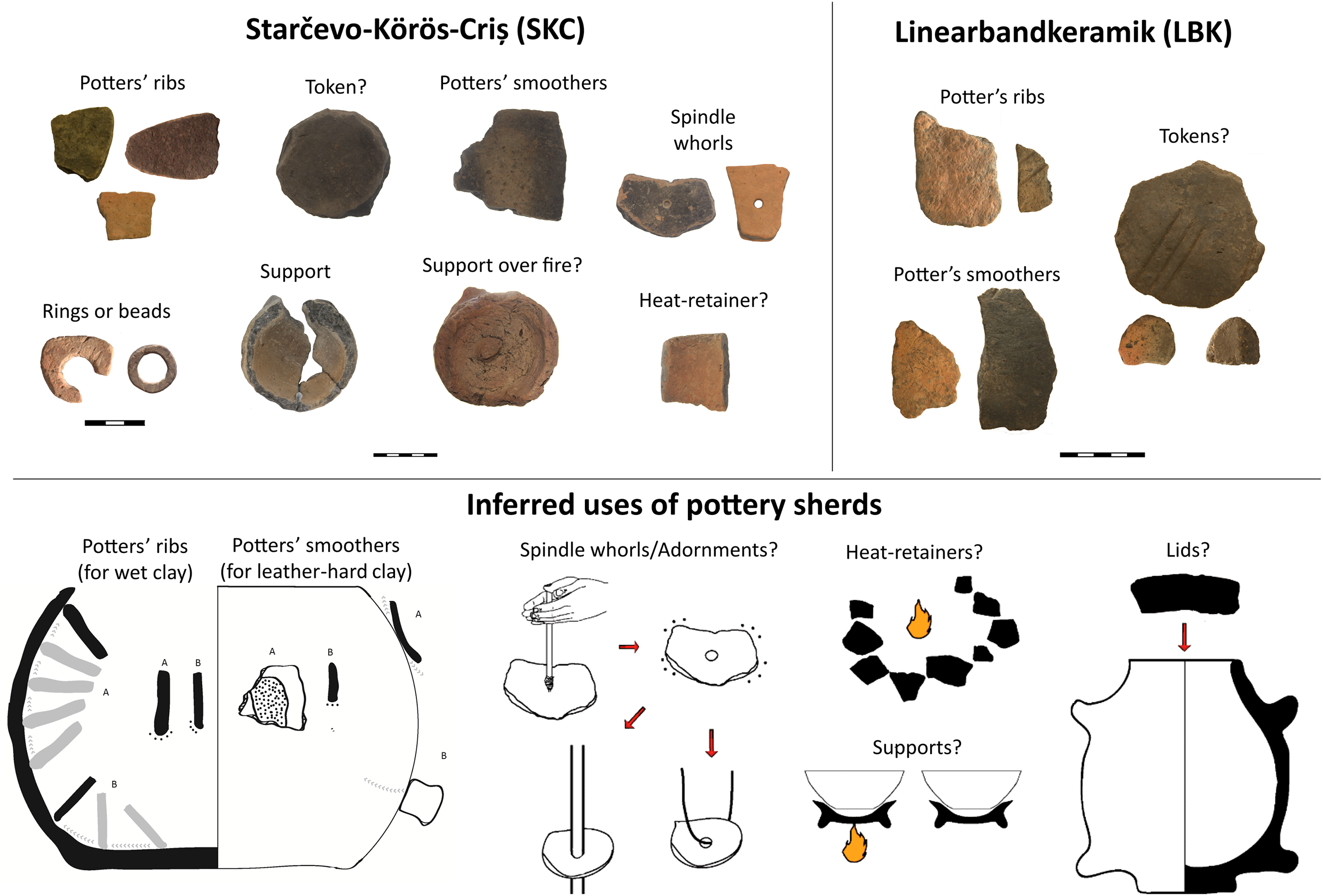
There was also a repertoire of creative gestures concerning the reuse of broken vessels. Some used fragments were collected and reshaped into other objects, such as the production of spindle whorls (e.g. Lazarovici and Maxim Reference Lazarovici and Maxim1995, Figs. 30 and 31; Pavlů Reference Pavlů2000, 316) and the formatting of sherds into discs of unknown use either by abrasion or percussion (Makkay and Starnini Reference Makkay and Starnini2008, Figs. 18, 10; Vindrola-Padrós Reference Vindrola-Padrós2021; Reference Vindrola-Padrós2025). At SKC sites, fragments also seem to have been shaped for personal adornments (Makkay Reference Makkay2007, Fig. 131), and there are also examples of broken pedestal bases that were flattened after breakage for their use as lids or supports for other vessels (Makkay and Starnini Reference Makkay and Starnini2008, Fig. 18, 113; Vindrola-Padrós Reference Vindrola-Padrós2021).
Yet, most (re)used fragments did not go through a ‘manufacturing phase’. Scrapers with convex edges and different types of smoothers used in potting activities were used as they were picked up (Vindrola-Padrós 2021, 365; Reference Vindrola-Padrós2025). It is because cracks are deflected by the organic fibres in the material that convex edges are formed and therefore can be used in this way (Vindrola-Padrós et al. Reference Vindrola-Padrós, Schuldt and Wojcik2025). At the SKC site of Tășnad Sere and the LPC site of Eitzum, there was evidence of reuse of sherds for scraping and smoothing clay at various stages of pottery manufacture (Vindrola-Padrós Reference Vindrola-Padrós2021; Reference Vindrola-Padrós2025). In SKC and LPC sites, there is also evidence of the reuse of potsherds for cooking activities and/or retaining heat in houses or other structures (e.g. Lenneis Reference Lenneis, Lenneis, Neugebauer-Maresch and Ruttkay1995, 18; Thér et al. Reference Thér, Kallistová, Svoboda, Květina, Lisá, Burgert and Bajer2019, 1146; Vindrola-Padrós Reference Vindrola-Padrós2021). Given there is no production process involved for the uses of these sherds, they cannot be considered tools sensu stricto. Instead, they can be termed ‘tychomorphic’ artefacts (sensu Vindrola-Padrós Reference Vindrola-Padrós2025), i.e., artefacts formed by chance. The life history of these artefacts begins with vessel breakage, and through this unpredictable phenomenon, new possibilities are afforded for activities such as pottery manufacturing or cooking.
Figure 6 shows the reconstruction of what we can term a ‘dark’ chaîne opératoire, exposing the effect of breakage in LPC and SKC pottery manufacturing and cooking activities in operational sequences. There are multiple trajectories in the sequences of actions during pottery manufacturing and cooking activities. In some trajectories, breakage patterns ‘prolong’ or add steps to the operational sequence, such as the collection and addition of sherds in pottery forming and firing or in the case of pre-firing repair. In others, such as in the case of post-firing pottery repair or in cases of deposition, the sequence is completely rearranged from its intended path by breakage phenomena. In both cases we observe the role of mechanical degradation in shaping practitioners’ expectations. Lastly, despite the production vessels having technologically similar properties, the differences between SKC and LPC pottery manufacture or use are also highlighted in Fig. 6; this shows that different choices were made in regard to the repair and reuse of vessels.
Sequences of actions of LBK and SKC pottery manufacturing (top) and cooking activities (bottom) integrating the effects of pottery breakage.

In sum, Early Neolithic organic-tempered ceramics exhibited a peculiar mechanical behaviour, where cracks were constantly developed to release stresses but in a controlled manner, retaining the vessels’ form and possibly their function. However, through use, cracks eventually altered the mechanical behaviour of vessels, demanding constant attention from their users but affording further actions. Pottery repair was adjusted according to the state of the vessel’s damage (Vindrola-Padrós and Vilde Reference Vindrola-Padrós and Vilde2024). In addition, the fact that most fragments of reused pots were tychomorphic indicates that these Neolithic populations had a certain awareness of the surrounding broken materials and their breakage patterns. As mentioned above, this was in great part enabled by the crack deflection patterns, which formed fragments with convex edges (useful for scraping). In short, the uncertainty generated by breakage phenomena fostered creative gestures (in this case how people contended with breakage).
Obtrusion
It has long been held that materials work as referential guidelines (Barrett Reference Barrett and Hodder2001, 152). It is through the ‘mnemonic abilities’ of material culture, i.e., their capacity to guide us in reproducing our past experiences (Barrett Reference Barrett and Hodder2001, 152), that human dispositions can be made durable. In this sense, we continuously alter the environment to record information that needs to be remembered without the need of involving internal representations (Kirsh Reference Kirsh1995, 32), which have been promoted by enactive approaches (e.g. Kiverstein and Rietveld Reference Kiverstein and Rietveld2018). This process has been often referred to as cognitive offloading, which can be defined as ‘the use of physical action to alter the information processing requirements of a task so as to reduce cognitive demand’ (Risko and Gilbert Reference Risko and Gilbert2016). For instance, the use of purposely marked landscape cues in Aboriginal Australian storytelling, where spatial patterning of stone arrangements and paintings holds important cosmological information (e.g. Tonkinson Reference Tonkinson, Meusburger, Heffernan and Wunder2011).
However, human behaviour can be altered when these very objects we depend on ‘stand in the way’ and affect our ‘externally’ encoded mnemonic cues, thus creating uncertainty about how to perform certain tasks. This is the mechanism of transformation we refer to as obtrusion, and there are two potential ways for this mechanism to occur. Firstly, obtrusion happens in situations where objects are overtly present (or figuratively ‘noisy’), causing a hinderance for perceiving memory cues and consequently performing further actions. For example, waste materials can be seen as a useful reminder of activities and where things should be placed, as mentioned above, but when there is ‘too much’ it becomes a hinderance, affecting the intended activities by shifting practitioners’ attention and body movements. The other possibility for this mechanism to occur is much subtler, it corresponds with situations where the person recognises that the object necessary for performing a task is missing (Heidegger Reference Heidegger1962, 103), forcing an interruption in the flow of practice. It is the realisation of the artefact’s absence, which obtrudes by generating uncertainty about how the task will be effectively performed. The practitioner’s attention shifts towards filling this absence.
Archaeologically, activities of ‘structured deposition’ are particularly useful at exposing the mechanism of obtrusion. The term originally referred to the formalised repetitive behaviour of placing artefacts during rituals or ceremonies (Richards and Thomas Reference Richards, Thomas, Bradley and Gardiner1984, 191) but has been revised to include also deposition of more mundane activities (Garrow Reference Garrow2012). Thus, a more apt definition would be situations ‘where people have placed or dropped particular classes of material in particular locations […] simply because “that is how it is done”’ (Thomas Reference Thomas2012, 126). Structured deposits, at a more mundane level, provide a way of conducting cognitive offloading and structuring settlement spaces. For instance, some deposits involved in processes such as ‘provisional discard’ (Deal Reference Deal1985) and secondary or tertiary refuse disposal (Kuna Reference Kuna, Kristiansen, Šmejda and Turek2015), among others (Schiffer Reference Schiffer1987), provide mnemonic cues as to where broken materials should be deposited. Similarly, midden construction provides important cues of past activities, which is why they have been considered ‘structuring structures’ (McNiven Reference McNiven2013). These structured deposits are also spaces where accumulation of artefacts is more clearly visible and, more importantly, may become excessively prominent, requiring a restructuring of spatial mnemonic cues.
During the creation of structured deposits, there is also a certain tension generated when objects that are still of use are consciously concealed into deposits. In this situation, there is a concern over how a future task will continue to be performed once an artefact that is depended on is absent. Whether the structured deposits are created in a ceremonial context, such as in burials (what some call ritualised or ‘odd deposits’; Garrow Reference Garrow2012), or a more mundane one, such as with cases of hoarding, a similar effect is generated. In synthesis, the mechanism of obtrusion alters our encoded ‘external’ cues in ways that can generate a certain mnemonic uncertainty, either by making things too present or, on the contrary, absent. This is explored in more detail with the case of grave goods.
Late Neolithic grave goods in the Carpathian Basin
Burial rituals can be seen as a communal action in which the deceased are at the centre of attention of the living (Fig. 7). The entire burial process is a transformation of the deceased as well as the mourning community (Aspöck Reference Aspöck and Müller-Scheeßel2013), where every action can be seen as a rite of passage between the biological and the social death (Fig. 7). The active engagement of the mourning community with the dead body is a memory-making process that in many cases follows a strict sequence. The selection of a burial place, the digging of a grave, the placement of grave goods, orientation and positioning of the body often follow group-specific standards (Hallam and Hockey Reference Hallam and Hockey2020). These heavily ritualised sequences create a cognitive regularity or a structured set of expectations about how the deceased should be ‘sent away’. Nonetheless, ritualised burials also leave room for choices to be made, particularly regarding what is buried with the deceased, i.e., grave goods.
The transformation of the mourning community from the biological to the social death.
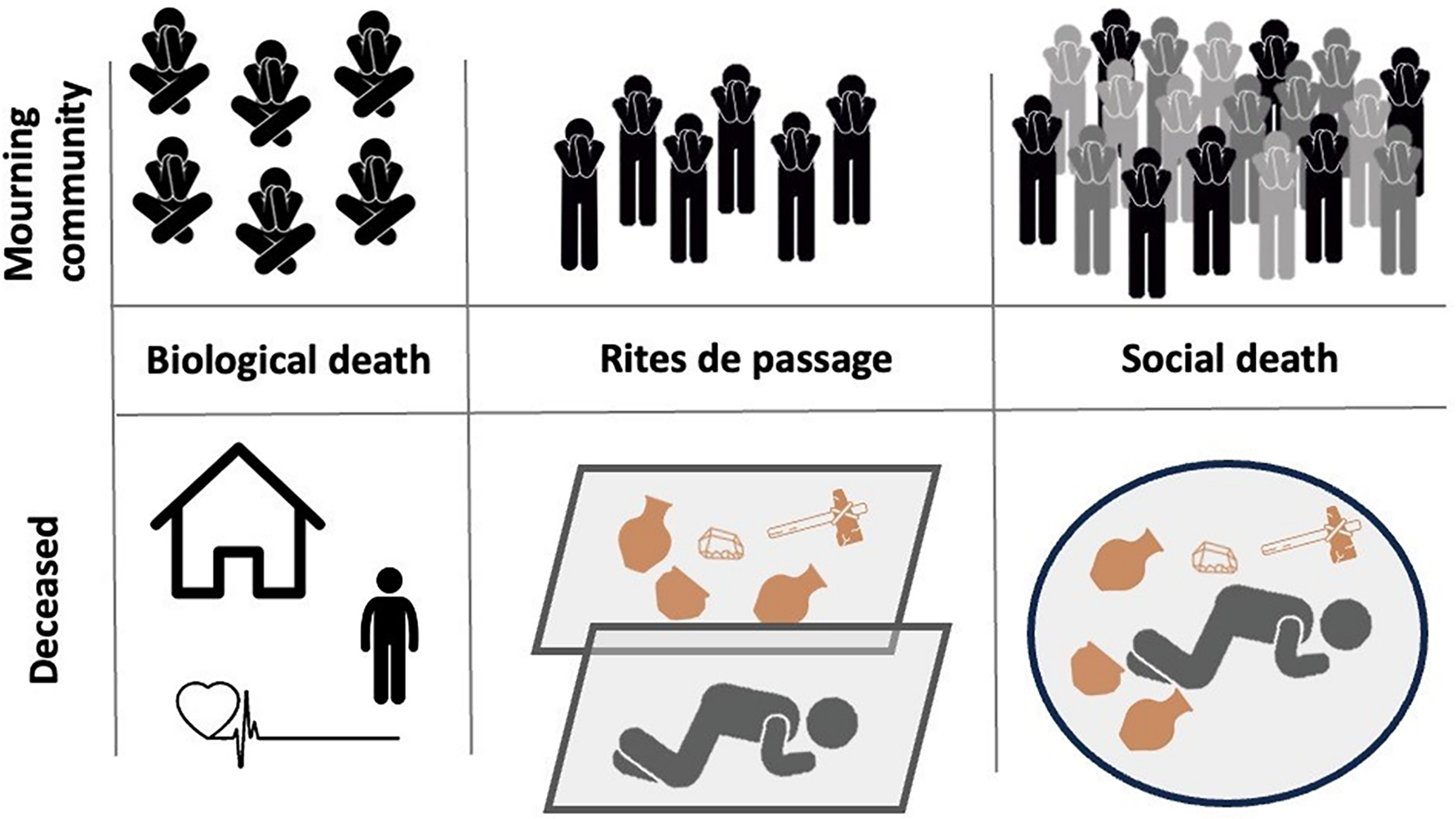
Studying the role of grave goods in this cognitive process is essential for understanding the emergence of ritualised burial practices. The objects placed into a grave and their specific positions on or around the dead body can have a particularly powerful effect for mourning and bereavement but also in memorialising the dead. However, during this process uncertainty also emerges about the objects that should be given in the burial (Harper Reference Harper2012). For the Sara (Chad), mourning communities offer pots from their households to be broken and spread out over the deceased. However, such is their beauty and importance that there are sometimes hesitations when clan members offer these vessels. Robert Jaulin recounts in his ethnographic work how he once saw a woman offer a magnificent jar and afterwards pick it up and escape with it in the moment in which it was going to be shattered (Jaulin Reference Jaulin1985, 185). In short, grave goods not only act exclusively as memory aids but also effectively transform the enactment of burial rituals.
The case of the burial records from the Late Neolithic period (5000–4500/4400 B.C.) in the Carpathian Basin provides a curious example. In this context, around 4000 burials have so far been excavated, more than 2200 of which were uncovered at the settlement site of Alsónyék, southern Carpathian Basin (Szilágyi Reference Szilágyi, Heitz, Wunderlich, Hinz and Furholt2023). An interesting feature of this site is that two-thirds of the burials, corresponding to 92 grave groups, had a designated area within the settlement. These graves reflect a major change compared with the earlier domestic mortuary practices of the Middle Neolithic period, where burials were placed randomly in the settlement (Hofmann Reference Hofmann, Devlin and Graham2015, 112–116) beside others in graveyards. This suggests that the pattern found in Late Neolithic Alsónyék represents the enactment of a new spatial structuring principle within domestic burials. As extra-mural graveyards are already known 5300–4900 B.C. in the Northern Carpathian Basin (e.g. the LPC graveyard of Nitra), this describes a shift also occurring in other communities. Furthermore, the selection of grave goods and the positioning of the bodies become much more standardised in these grave groups as opposed to the earlier Middle Neolithic period burials.
Lithic materials placed in these graves have been studied in detail (Szilágyi Reference Szilágyi, Heitz, Wunderlich, Hinz and Furholt2023). Polished stone items of all kinds of raw materials, including blades of distant raw materials, were placed on or around the skull (Fig. 8). Moreover, when only a single chipped stone was deposited in the grave, in almost every case this was a single blade found on the skull. Numerous blade and trapeze series were also placed in a heap around the lower body area. Specific types, such as trapezes, are reflected in their extreme homogeneity – which in this case does not merely denote their metric parameters – but also the fact that they could be refitted into single blades, suggesting that the process of trapeze production was possibly linked to the mortuary rite.
A burial arrangement of chipped stones at Alsónyék: (1) a blade made from distant raw materials and (2) trapezes and (3) blades made from Bakony radiolarite (prepared by Kata Furholt).

This development towards a recurring and stable spatial separation of the realm of the deceased from the realm of the living and the regularity of the selection and placement of objects in the burials have, according to the extended mind hypothesis, to be seen as expressions of an important change, and collectively shared stabilisation of practices and cognitive processes. Seen more widely, these processes represent a fundamental shift towards the dominance of extramural burial areas or cemeteries. More importantly, the shift from the deposition of objects pertaining to the dead or offered by living from their own belongings (as can perhaps be inferred from Middle Neolithic burials) to the standardised deposition of grave goods can be seen as the emergence of a collective strategy used to mitigate the uncertainty generated by the obtrusion of the gifted objects. In this case, the standardised grave goods can be considered as ecological cognitive artefacts, and this can be said as well of other standardised deposits. Rather than exhibit information ‘about the world’, ecological cognitive artefacts instead display encoded external information ‘as the world’ to simplify choice in a cognitive task (Heersmink Reference Heersmink2013). Thus, standardised grave goods become non-representational cues that facilitate the choice of what will be placed in graves. In other words, the fact that both the selection of objects and their placement were standardised helped contend with the decision of which objects should be offered, as well as which ones to keep for memorialising the dead, which helped resolve the uncertainty generated by the mechanism of obtrusion.
Discussion. How to account for the mechanisms of transformation
Lying at the interstices between theories of material engagement, cognition and practice, the mechanisms of transformation work as a guideline to understanding how materials can introduce uncertainty in social practices, which can lead to habit-changing scenarios. Following the three mechanisms listed, the case studies gave testament to the influence materials play in shaping practitioners’ expectations, shifting their patterns of attention, movements and gestures.
In the case of stylistic attributes, the viewer becomes enchanted by the encounter with unexpected decorative patterns. This was a mechanism that was likely prominent for societies attempting to use stylistic attributes of pottery vessels to mark differentiation with other social groups, such as the LPC, and where the craft was a central means for symbolic expression (Vindrola-Padrós et al. Reference Vindrola-Padrós, Scholtus, Müller, Furholt and Nuthmannn.d.). The same mechanism is an exploited strategy in ceremonial practices, where items of great value, often concealed from public eye and requiring great workmanship, such as heirlooms or sacred religious items, are prominently unveiled. The mechanism of visual enchantment also provides insights into discussions on the development of European Palaeolithic rock art. While spirals are thought to have been produced at a particular stage during altered states of consciousness (Lewis-Williams Reference Lewis-Williams2002), the example of prehistoric pottery styles from central Germany enables us to consider that the spiral motifs might have been painted to produce specific visual responses from the viewers. Thus, the mechanism of visual enchantment revitalises the study of styles by shedding light on the role of decorations in shifting human patterns of attention, providing different explanations for their temporal and/or regional variation.
The case of pottery breakage in the Early European Neolithic highlights how contingent scenarios can mould technological choices and can provide explanations for much of the technical variation we reconstruct from the archaeological record. This variation has cognitive implications, particularly with regards to working memory. The supposition is that the more mechanically unpredictable the material is, the higher demand there will be of attention and the larger the need for tinkering, which could imply the addition of steps in a sequence of actions or a re-evaluation of the entire sequence. These observations have implications for evolutionary studies, where it is argued that the extension of working memory likely had a central role in our evolution (Beaman Reference Beaman2010; Haidle Reference Haidle2010; Wynn and Coolidge Reference Wynn and Coolidge2011). Mechanical degradation fosters an increase in the number and variation of operational steps, which in turn increase the subgoals needing to be ‘retained’ to solve the uncertainty. In sum, the mechanism of mechanical degradation makes visible a series of creative gestures that are made to contend with it, which may bear consequences to the practitioner’s working memory.
Lastly, the standardisation of the selection and placement of grave goods in Late Neolithic burial practices in the Carpathian Basin provided a social strategy to cope with artefact obtrusion. Standardised grave goods not only played a symbolic role in funerary rituals but also likely worked as ecological cognitive artefacts enabling the resolution of the uncertainty generated by the missing artefacts. More generally, the mechanism of obtrusion sheds new light on the study of structured deposits. In the first version of obtrusion, i.e., when artefacts become ‘too much’, these deposits can be conceived not only as structures that grow but also as structures that eventually can ‘act back’ (Gille Reference Gille2007) to scramble mnemonic cues. In the second version, structured deposits can also generate hesitations about what is being deposited; thus, despite being formalised, structured deposition is not a straightforward practice. Regardless of which version of obtrusion we encounter, analysing this mechanism places structured deposits within larger mnemonic schemes in the landscape.
The three mechanisms detailed have implications when it comes to how these can be integrated into the ways we analyse archaeological materials. One key implication is the need to move beyond a schematic representation of human–material engagement as a purely sequential affair, i.e., the archetypical production–use–discard–deposition scheme. Perception, e.g., in the form of expectations, is constantly revised throughout what is enacted in materially charged environments. To do justice to how practices occurred in the past, materially emergent phenomena must also be included in our inference of open action–perception loops.
The chaîne opératoire approach (COA) sets the stage for this discussion. For decades, this approach has enable the reconstruction of the gestures and techniques involved in making or using artefacts by organising them in a series of sequential stages. The concept of operational memory, defined as the socially motivated embodiment of tool and gesture (Leroi-Gourhan Reference Leroi-Gourhan1993, 230–234), is the baseline for entertaining the idea that the sequences of actions required to make artefacts correspond with both material constraints and certain culturally constituted motor skills. Thus, the COA has been defined as a ‘succession of mental operations and technical gestures, in order to satisfy a need (immediate or not), according to a pre-existing project’ (translation of Perlès in Sellet Reference Sellet1993, 106). Since then, this framework has been mostly referred to as a method to model human technical behaviour (Coupaye Reference Coupaye, Bruun, Wahlberg, Douglas-Jones, Hasse and Hoeyer2022, 40; Schlanger Reference Schlanger, Renfrew and Bahn2005). Thus, from a series of tools and/or by-products, the analyst reconstructs the succession of movements or technical sequences and infers the technical system of a particular group (Pelegrin Reference Pelegrin, Karlin, Bodu and Tixier1988).
However, the nature of how action–perception loops emerge in practice is challenging to reconstruct through this model (see also Slaughter Reference Slaughter2024), partly because perception, uncertainty and contingency are not aspects that are considered. Consequently, technical change becomes hard to determine, although some promising discussions have been made, for example, about copying errors during learning processes (Gandon et al. Reference Gandon, Nonaka, Coyle, Coyle, Sonabend, Ogbonnaya, Endler and Roux2021; Roux et al. Reference Roux, Bril, Goujon, Lara and Charbonneau2024). The example given above with the ‘dark’ COA (Fig. 6) highlights how technical sequences can be shaped by contingent scenarios, but this is only made visible by integrating materially induced uncertainty into these reconstructions. Therefore, while diagrams of COA have been increasingly proficient in integrating numerous aspects of human technical behaviour (Coupaye Reference Coupaye2009; Pétrequin Reference Pétrequin and Lemonnier1993), there are limitations when explaining technical change.
In this regard, the recent work on cognigrams (Haidle Reference Haidle, Wynn, Overmann and Coolidge2022) appears promising. Cognigrams enable the encoding of the reconstruction of perception–action sequences in any aspect of human behavioural performance, although tool-making and use are usually the focus. These diagrams are constructed on the base of ‘if, then’ or ‘if, then, else’ clauses and integrate components of both perception and action in every part of the behavioural sequence. Most importantly, cognigrams provide a way to think through the causal effects that both perceptual and action-based components have on each other, which accounts for the iterative nature of action–perception loops. In sum, the diagram may well be a way to expand and refine the COA as well as incorporate the phenomenological concern over human perception to reconstruct human behavioural and cognitive processes.
Cognigrams start with the perception of a need, which may be a desire or wish, an emerging problem needing a solution or some unconscious impulse, and terminate with an action that either fulfils the need or discards it (Haidle Reference Haidle, Wynn, Overmann and Coolidge2022). Afterwards, both the foci of attention of the practitioner and the subproblems that might trigger them during the performance as well as the sequence of operational actions are established. The effects of the actions are then determined, which may in turn modify or enhance other foci. So, while both the COA and cognigrams schematise sequences of actions, the latter provide more details on the contexts of artefact production and use, the foci of the practitioner (attention) and the relation between items (Haidle Reference Haidle, Wynn, Overmann and Coolidge2022).
Integrating the mechanisms of transformation into the cognigrams model offers another layer of explanation as to why the variations in sequences of actions occur, but to make these diagrams account for the mechanisms of transformation, we suggest factoring in three components: (i) the practitioner’s expectations, (ii) the changes in the materials’ states and what they might afford and (iii) the variation of possible outcomes or contingencies.
Accounting for expectations (i) is important for understanding not only the areas of choice people contend with in social life, including practicing certain crafts and daily activities, but also the ways in which sensory information is accounted for in the (cultural) development of motor habits. Given that expectations function according to generative models, they can be inferred from the regular patterning of archaeological artefacts. In the cognigram model, by contextualising the sequences of actions and integrating the perceptual foci (e.g. attention patterns), expectations at every stage of the sequence could in principle be inferred. Furthermore, by considering the practitioner’s expectations, we can include how these expectations were not met, i.e., how uncertainty arises, providing explanations about changes in generative models.
The alteration of materials (ii) themselves during activities can also be informative when it comes to the affordances that can emerge and provide an understanding of the decisions taken by the practitioner. The more we enquire about these components, the better our understanding about materially induced changes. We are not referring to the expected changes in material states throughout the sequence, such as core, flake and then tool, but rather to the potential changes of materials beyond what was expected. Breakage of the tools is a clear way of exemplifying this point, as was shown in Fig. 6, but other processes such as wear and tear or use-related modifications are also important (Sillar Reference Sillar2003). One such example is the boiling of fatty residues in a porous pot when cooking can clog up the vessel’s pores, which could improve vessel permeability and perhaps also thermal conductivity.
By including both the practitioner’s expectations (i) and the alteration of materials (ii) in the sequences of actions, contingent scenarios (iii) can be reconstructed. These are often recognised by analysts when attempting to reconstruct action sequences but normally remain anecdotal and are seldom included in the diagrams. Contingencies are those actions that do not fall within the ‘regular’ behavioural pattern but remain a possibility and in certain scenarios can still be expected to happen. Some of these scenarios are fuelled by changes in material states, e.g., the mechanisms of transformation, while others might relate to the context in which the task is performed. Some examples of the latter could range from situations in which there is a temporary shift in principles guiding social, political or economic fields to more concrete situations where access to raw materials are limited.
Nonetheless, the integration of these three components (i.e. expectations, changes in material states and contingent scenarios) challenge at least two assumptions in cognigram models. For instance, the fact that materials might change in a way that did not coincide with the practitioner’s expectations can lead to new expectations. This violates one principle of the cognigram model, namely that the sequence must start from the perception side of the equation, e.g., an impulse, a conscious wish or a problem to be solved (Haidle Reference Haidle, Wynn, Overmann and Coolidge2022), and not that the impulse, wish or problem arises from an action. In addition, if we include the range of contingent possibilities into the cognigram model, this might challenge the idea that a single diagram of a performance (e.g. fabricating an Acheulean hand axe) can be reconstructed to represent the ‘general trend’. Thus, it would be pertinent to integrate several performances where the variation of this ‘general trend’ can potentially shift, i.e., to recognise the relationship between structure (‘general trend’) and contingency.
Regardless of these challenges, with the integration of these three components into our models, we can account for the mechanisms of transformation and provide more nuanced reconstructions of materially induced cognitive processes in human behaviour. Visual enchantment and mechanical degradation seem like a better fit for this endeavour. However, while cognigrams (as well as the COA) have mostly focused on tool production and use, there is no reason why these could not also integrate depositional practices and consequently the mechanism of obtrusion. Perhaps, it is at this point where the computational power of the AIF can come into fruition by integrating archaeological reconstructions of social practices into agent-based simulations.
Concluding remarks
The study of the mechanisms of transformation are in our view paramount to archaeological analysis because they allow for the detailing of the decision-making processes involved in craftwork and more generally in practical life, giving a place to human ‘tinkering’ behaviour. Furthermore, these mechanisms provide fresh lines of enquiry about the causes of material culture change seen in the archaeological record, rather than utilising monocausal explanations such as migration, diffusion or ‘technological improvement’. In addition, contrary to the contextual vacuum often found in theories about ‘things’, our theorisations focused on a relational and contextualised understanding of these mechanisms of transformation.
If we consider human agents to be generally driven towards solving the uncertainty of their practical world, understanding the role of material culture is central. In our integration of some principles from MET and in consideration of the last two decades of research on material agency, things, etc., we have formulated the understanding that an important contribution from the material world is its role in generating uncertainty in human practices. The three listed mechanisms consist of different ways in which this occurs and provide a way to enquire about how past populations practically solved this uncertainty. Integrating the mechanisms of transformation into artefactual analyses of different kinds uncovers not only what people did but also some ideas about why they did it. They provide another layer of understanding of the culturally informed processes behind some technological choices or sequences of actions, such as object stylistic design (visual enchantment), production and use (mechanical degradation) and deposition (obtrusion). In this sense, it may well be that novelty ‘is better explained as (at least in large part) a result of the framing and scaffolding of human activity by shifting cultural practices and changing sets of concrete constraints’ (Clark Reference Clark2018, 531).
In line with this discussion, we would like to end our text with the following open question: Given the development in interpretative and analytical techniques in our field, as well as the emerging nuanced models in cognitive sciences that are stressing more and more the plasticity of human cognition, is it not time to re-evaluate how we practically analyse artefacts from the past such that we can account for human tinkering behaviour?
Supplementary material
For supplementary material accompanying this paper visit https://doi.org/10.1017/S1380203825100159
Acknowledgement
The authors would like to thank the Braunschweig Landesmuseum, the Jósa András Museum and the Muzeul Județean Satu Mare for providing access to the materials displayed in this paper as well as for providing permission for publishing these images. The work for the article was financed within the European Research Council (ERC) Synergy Grant 951631 XSCAPE: Material Minds: Exploring the Interactions between Predictive Brains, Cultural Artifacts, and Embodied Visual Search at Kiel University. We have to also thank the general discussions within the XSCAPE project, which further enriched the contents of this paper.
Funding statement
This work was supported by the European Research Council under ERC-2020-SyG 951631 Material Minds: Exploring the Interactions between Predictive Brains, Cultural Artefacts, and Embodied Visual Search (XSCAPE) (https://cordis.europa.eu/project/id/951631/results).
Competing interests
None.



 Open access

