




Introduction
Of the many forms used to render the human body in ancient times, portable figurines are perhaps the most ubiquitous. Crafted from clay, stone, wood, wax, bone or metal, they are found throughout the world in both domestic and monumental archaeological contexts (Insoll Reference Insoll2017). In Mesoamerica, the tradition of crafting clay figurines pre-dates the use of pottery vessels and persisted through the colonial period and even to the present day (Marcus Reference Marcus2019: 1–2, 26–27). Much like ceramic vessels, Mesoamerican figurines exhibit tremendous variability in paste composition, construction techniques, form and stylistic rendering. They therefore serve as another proxy in the reconstruction of the identities, interactions and boundaries of the societies that created them. Yet, the functions and meanings of the figurines are often enigmatic and prone to varied interpretations, presenting both different possibilities and problems to the analysis of pottery (Blomster Reference Blomster2002; Meskell Reference Meskell and Insoll2017; Marcus Reference Marcus2019). Furthermore, a single type of figurine may assume various, often contrasting, meanings that depend on nuances of context, sometimes reinforcing notions of hierarchy and sometimes attesting to more community-oriented ritual behaviours.
Bolinas-type figurines illustrate these challenges and opportunities, serving as tangible examples of the complex relations between ritual, hierarchy and monumental architecture. The Bolinas figurines are associated with various Middle and Late Preclassic (1000–350 BC and 350 BC–AD 250, respectively) sites along the Pacific coast of Guatemala and westernmost El Salvador. The term derives from the name of a private ranch in El Salvador—Finca Bolinas—located some 6km south of the modern Salvadoran town of Chalchuapa (Figure 1). A large collection, consisting of 95 figurines, was found there around the middle of the twentieth century, although the circumstances of the discovery—and thus context—of the figurines remain uncertain (Boggs Reference Boggs1977). Most of the figurines (93/95) represent human females of various ages, either standing or sitting with widely parted legs; just two may represent males. The heights vary from a few to well over 200mm, but all are solid, made of either a light cream or reddish-brown paste and are well and evenly fired and smoothed or polished. Most bear traces of either white, orange or both coloured slips, while some display traces of black paint. The majority feature styled hair, ranging from simple buns, curls or braids to elaborate coiffures, and almost all wear some kind of jewellery, such as anklets, bracelets, necklaces and earspools. Those that lack clay earspools have large holes in the earlobes, leading to speculation that actual earspools made of jade may have originally adorned these figurines. Some figures are depicted naked, but most wear various lower body covers, leaving chests, with their small or non-existent breasts, exposed. A limited number of specimens have protrusions and matching sockets once connected with strings for the articulation of the head or limbs (Boggs Reference Boggs1977; Paredes Umaña Reference Paredes Umaña2012; Schieber Reference Schieber2016).
Map of south-eastern Mesoamerica showing the location of sites mentioned in the text (figure by J. Szymański/PASI).

The diversity of forms within this collection renders the category ‘Bolinas’ broad and, perhaps, overly inclusive, yet the elaboration of the eyes with punctures made by a sharp object, possibly a stylus, does provide a unifying feature. The alternative, more technical term, ‘Alvarez three-punctate-eye’, coined by Bruce Dahlin (Reference Dahlin and Sharer1978), is equally general and is also misleading, as not all figurines have three-punctate eyes; some only have the pupils marked this way, while others have two punctures in each corner of the eye, making the centre—where the pupil is supposed to be—stand out. While the issue of adequate naming remains unresolved, the term Bolinas is retained here for continuity.
The first well-documented figurines emerged during large-scale excavations at the monumental site of Kaminaljuyu, now situated amidst Guatemala City, run by the Carnegie Institution during the 1940s and 1950s (Kidder et al. Reference Kidder, Jennings and Shook1946; Shook & Kidder Reference Shook and Kidder1952; Kidder Reference Kidder, Wauchope and Willey1965). Most of the Kaminaljuyu examples were fragmentary, as were nearly all specimens found two decades later at Vista Hermosa, Guatemala, and at Chalchuapa, Santa Leticia and the Zapotitán Valley, in westernmost El Salvador (Dahlin Reference Dahlin and Sharer1978; Black Reference Black and Sheets1983; Demarest Reference Demarest1986: 219; Wauchope & Bond Reference Wauchope and Bond1989: 88; González Argumedo Reference González Argumedo2009; Estrada de la Cerda Reference Estrada de la Cerda2017). These fragments were primarily sourced from surface or structure fills, or from other deposits of mixed or secondary character. More recent excavations at Ataco, El Salvador, have also yielded fragments of Bolinas-type figurines from structural fills (Paredes Umaña Reference Paredes Umaña2012), contributing to the prevailing consensus that Bolinas figurines were objects of mundane, domestic use that found their way into the fill of monumental structures after being discarded from household middens, having completed their primary life cycle (Boggs Reference Boggs1977).
It was not until 2012 that the first whole Bolinas figurines were found within a primary context. An intact late Middle Preclassic burial (Burial #2), dated to the Nil 2 ceramic phase (350–100 BC), was found in one of the largest, centrally located structures at Tak'alik Ab'aj, a site located on the Pacific-facing piedmont of the western Guatemalan highlands. Lavish funerary offerings comprised several high-quality ceramic vessels, jade jewellery, including a four-string necklace with a celtiform pendant in the form of an avian personage, and, in one corner, six broken but complete Bolinas figurines. Found overlapping one another, the bodies of the figurines were arranged roughly along a north-south axis. All represent standing, naked females, ranging in height from 273 to 424mm, with open eyes, parted lips revealing teeth and arms bent at the elbows with hands resting on their stomachs around the navels. One specimen has an articulated head capable of turning sideways, while two bear traces of elaborate black painting, particularly visible on their backs (Schieber Reference Schieber2016; Schieber et al. Reference Schieber, Inomata, Claudio, Medina, Corzo, Aoyama, Nasu, Arroyo, Méndez Salinas and Ajú Álvarez2019). Despite their rather diminutive feet, all of the figurines from the burial are balanced enough to stand upright without additional support (Schieber 2023, pers. comm.).
Figurine tableau at San Isidro
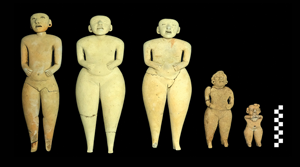
During the 2022 field season at San Isidro, a large Middle to Late Preclassic site in the Department of Sonsonate, western El Salvador, excavations around the top of the largest structure, Cerrito 1, revealed a group of complete Bolinas figurines (Figure 2). The stratum has been dated by ceramic typology and radiocarbon assays to 410–380 BC—slightly earlier than the Tak'alik Ab'aj context (Schieber et al. Reference Schieber, Inomata, Claudio, Medina, Corzo, Aoyama, Nasu, Arroyo, Méndez Salinas and Ajú Álvarez2019; Szymański & Méndez Reference Szymański and Méndez2024). Five figurines were found near each other towards the southern extent of the excavation; three are larger (all approximately 0.30m tall, labelled A, B & C), made of very fine, cream-coloured paste, while the other two are significantly smaller (approximately 0.18 and 0.10m, labelled D & E, respectively) and made of cruder, orange-brown paste (Figure 3). All bear remnants of a white kaolinite slip, particularly around the lips and on the lower legs. Patches of red slip, detectable mostly on the backs, are fainter. The three larger figurines (A–C) have articulated, adjustable heads, facilitated by conical protrusions on the necks and matching sockets in the base of each head. Each socket has two holes drilled through to the top of the head, and each neck protrusion has one horizontal hole and a shallow vertical canal on each side, allowing a string to be passed through the neck and tied on the top of the head (Figure 4). This technique for head articulation is virtually identical to that of the figurine with an articulated head from Tak'alik Ab'aj.
Location of the tableau and the hollow figurine body in the excavation on top of Cerrito 1, north at the top (figure by M. Sokołowski/PASI).

Five figurines from the San Isidro deposit. Scale in centimetres (figure by J. Przedwojewska-Szymańska/PASI).

Protrusion and socket allowing for articulation of the head seen in all three large figurines (figure by J. Przedwojewska-Szymańska/PASI).

The larger figurines (A–C) are naked and devoid of hair or jewellery. The smaller ones (D & E), also naked, are modelled with locks of hair on their foreheads and earspools in the lobes. The smallest figurine (E) is adorned with bracelets on the wrists and a necklace or pectoral on the chest, it is also the only one of the group that has the hands raised to the chin; the others, like the Tak'alik Ab'aj examples, rest their palms on their stomachs around the navels. Two large (B & C) and both smaller (D & E) figurines at San Isidro represent females, while the A figurine represents a male—perhaps the first complete example found to date. The male is distinguished by a delicately incised linear design that covers the face, depicting either a tattoo or scarification (Figure 5), a more elongated torso and shorter, thinner hips.
Head of the male figurine with tattoos or scarification. Width 55mm (figure by J. Przedwojewska-Szymańska/PASI).

All five figurines were found within an area of just over 0.6m2, less than 0.5m below the current surface at the top of the mound. Their placement is represented in Figure 6. The two large female figurines (B & C), discovered just south of the summit, were each oriented along an axis skewed 15° north of the east-west cardinal directions, parallel to the main axis of the mound itself. The smallest figurine (E) lay prone along a 15°-east-of-north axis with the head pointing north, almost touching the left elbow of the second large female figurine (C). Approximately 150mm from the feet of the smallest figurine, the larger of the small female figurines (D) and the large male figurine (A) were found lying parallel to each other, extending in supine positions along the main axis of the mound with the heads pointing east. The feet of the male (A) were aligned with the feet of the other large figurines (B & C). Each of the figurines, except the smallest one, was fragmented, with fractures typically occurring through the legs and the neck. Associated artefacts include two polished jade disks, two stacks of serving-ware vessels and a smashed metate (a grinding stone on three legs).
Reconstructed topography of the tableau as it appeared in situ (figure by J. Przedwojewska-Szymańska & G. Prejs/PASI).

Two caveats to this reconstruction should be noted. First, due to the location of the site on freely accessible terrain belonging to a local agricultural co-operative, exploration of the deposit proceeded element by element over the course of several days. For various reasons it was not possible to keep the excavations under full surveillance; thus, each newly discovered object needed to be explored, documented and removed before the end of the day. Second, the figurines were found under a double trunk of a bullhorn tree (Acacia cornigera, locally known as Ixkanal). Two large roots passed through the context, potentially altering the original relative and absolute topography of the artefacts.
Hypothetical reconstruction of the San Isidro tableau
The size of the larger figurines, along with the ability to move their heads, inevitably provokes an analogy with modern toy dolls. Clay is not a particularly practical material for toys, arguably being more suitable for more hieratic activities, such as portraiture or rituals (Boggs Reference Boggs1977: 10). Here, we contend that the figurines may have served a combination of purposes, being, effectively, marionettes or puppets in re-enactments of certain scenes, both static and dynamic (see Neer Reference Neer and Elsner2020 for more examples of puppets in archaeology). These scenes must have denoted readily decodable events, mythical or real. Thus, we use ‘tableau’ to describe the purposeful spatial arrangement of the Bolinas figurines in both the Tak'alik Ab'aj and San Isidro deposits.
Theorising about the function and meaning of the Tak'alik Ab'aj tableau, Christa Schieber (Reference Schieber2016) proposes a reconstruction of an elaborate ritual involving the careful placement of pairs of figurines at the cardinal directions along a scaled-down horizon circle. In this interpretation, the ritual would take place at the conclusion of the funerary rites for a deceased ruler, symbolically perpetuating a dance related to the movement of the sun and the cycle of life (Schieber Reference Schieber2016). The finds from San Isidro allow us to now build upon this thought-provoking hypothesis.
As with the Tak'alik Ab'aj specimens, the reconstructed San Isidro figurines can stand upright unaided, and may have re-enacted a scene before burial. Not all of the fractures on the figurines, particularly those on the legs, correspond with points of weakness (such as the knees or ankles), suggesting that the breakage may be intentional rather than taphonomic. If so, the figurines could not have stood on their own as the San Isidro offering was buried, though this does not exclude the possibility that the fragments were intentionally placed in approximation of their standing positions. That said, the forming process of solid figurines, usually requiring modelling of the neck and limbs separately from the torso, may result in structural weaknesses where the disparate elements are joined together, despite the lack of surface visibility for these junctures (Guernsey Reference Guernsey2020: 93). How the San Isidro specimens were manufactured is not readily discernible; no ‘seams’ are visible either on the surface or in the exposed breaks, so any intention behind the breaks remains hypothetical.
The non-random internal topography of the San Isidro tableau suggests that the placement of each of the figurines was meaningful. They appear to have originally stood in a row facing west, except the smallest, which may have faced north or may have been disturbed by one of the large roots that passed over it after burial. In Mesoamerican cosmography, known mostly through the Maya culture, the west is associated with the night and the realm of death (Wagner Reference Wagner and Grube2006; Stone & Zender Reference Stone and Zender2011: 146–47), raising the possibility that the deposit was of a funerary character despite the lack of any human remains—perhaps a cenotaph or else the body was completely obliterated by taphonomic processes. It is also possible that the deposit relates to the wider architecture of the site. The Cerrito 1 mound stands on the eastern edge of a large plaza, with a smaller structure (Trapiche 3) juxtaposed on the western edge. During the first field season in 2018, a large plain stela was dragged to the surface of Trapiche 3 by a plough (Figure 7) and subsequently moved to the edge of the plantation. The projected original location of the stela at the centre of Trapiche 3, aligns with the centre and main axis of Cerrito 1. The 15°-north-of-west axis provided a focal alignment among Middle and Late Preclassic polities throughout Mesoamerica (Šprajc Reference Šprajc2017: 206; Šprajc et al. Reference Šprajc, Inomata and Aveni2023). The figurines, if stood upright in a row, would face the stela and the smaller mound across the plaza, gazing along the principal axis of the entire site (Figure 8).
Plain stela found atop the Trapiche 3 structure at San Isidro in 2018 (figure by R. Cea/PASI).

Plan view of the centre of San Isidro based on photogrammetry (figure by J. Martecki/PASI).

The nudity of the San Isidro figurines, although not unique in the Bolinas category, is unusual, as is their lack of hair and jewellery. The absence of hair is striking, as particular care is given to the portrayal of the varied hair styles of most of the other Bolinas figurines. The earlobes of the three large figurines (A–C) feature holes like some of the Finca Bolinas figurines and comparable to an example from Tak'alik Ab'aj that had detachable miniature earspools made of jade (Schieber Reference Schieber2016). It is possible, therefore, that garments, coiffures and perhaps pieces of jewellery were once also worn by the San Isidro specimens; the absence of such adornment in the archaeological record may reflect their manufacture from perishable materials.
The open mouths of the figurines suggest that they were made to convey an utterance of exclamation, speech or song. The hands raised to the mouth of the smallest figurine are less readily decodable. Such a gesture, especially in conjunction with inflated cheeks, may denote secrecy, as if the depicted personage covered their mouth to avoid speaking out (Guernsey Reference Guernsey2020: 73). Yet, the San Isidro figurine does not really cover their mouth, but rather lifts the hands to just below the chin, as if holding a missing whistle or ocarina, or simply lifting food to be consumed. The white kaolin found around the mouths of all five figurines may relate to a ritual ‘feeding’, an activity attested elsewhere in the world (see Elsner Reference Elsner2020).
It remains uncertain whether the ability to adjust the articulated heads of the large figurines was an important feature employed during rituals conducted at the time of deposition, perhaps in an act of turning towards different cardinal directions while maintaining body position. It is possible that the figurines had longer life cycles, serving some other purpose prior to their placement in the final offering— this is also a possibility for figurines included in deposits associated with the Olmec civilisation in what is now Mexico (c. 1200–400 BC) (Brittenham Reference Brittenham and Elsner2020). Among the six figurines found at Tak'alik Ab'aj, only one has an articulated head—curiously, one of the two that faced west (Schieber Reference Schieber2016).
The meaning of figurine tableaus in south-eastern Mesoamerica
Thus far only two groups of Bolinas figurines have been found in situ in primary contexts (i.e. Tak'alik Ab'aj and San Isidro; Finca Bolinas cannot be considered secure context); too small a sample to draw meaningful conclusions beyond speculation. Though analogies can be drawn from the wider range of archaeological data, at present these are most useful in the formulation of questions for further inquiry once more primary deposits are available. Most of these questions revolve around the function of the activity represented by the tableau, and discerning intentionality from randomness or taphonomic interference. For instance, if the fragmentation of figurines was intentional and done prior to their final deposition, then is the distinction between the prone and supine figures meaningful? Although rare, burial in a prone position is reported throughout pre-Hispanic times in southern Mesoamerica, including examples from Preclassic El Salvador (Amaroli Reference Amaroli2015: 100–102). However, the meaning of such burials remains unclear.
Another question concerns the potential identities of the figurines and whether or not they served as portraits of actual individuals. For example, a ruler (figurine A), his two wives—the one found face-down (figurine B) perhaps previously deceased, the other (figurine C) current—and two daughters (figurines D & E)—again, the small one perhaps having died before the act of deposition of the tableau. Or they might be representations of specific groups of people (e.g. singers or ‘ritual performers’) or embodiments of other concepts or deities analogous to Roman lares and penates—household deities or symbolic elements of a society (see Beard et al. Reference Beard, North and Price1998: 49). The figurines could also have served as idealised alter egos, avatars or servants, parallel to ancient Egyptian ushabti figurines that served their ‘masters’ in the afterlife (Taylor Reference Taylor2000: 320–21). The tattoo on the face of the male figurine suggests that he is meant to represent an actual personage, either real or divine. The large female figurines (B & C) in comparison, although hand-made and with subtle differences, are very similar to each other and lack individualistic features. It is possible that the plain but well-crafted clay figurines were canvasses for further—perhaps perishable—adornments that would convey hints of identities decodable by the intended audience.
In addition to the figurines, Tak'alik Ab'aj burial 2 and the Cerrito 1 offerings at San Isidro included further objects that bear similarities in shape, material and relative find position—for example, miniature jade celtiform pendants representing avian personages, and tubular and disk beads made using similar techniques. Yet these similarities are juxtaposed by equally curious differences. First and foremost is the lack of even the faintest traces of a human body or any other direct indications that there was ever a burial associated with the figurines at San Isidro. The number, positioning and character of figurines also differ, indicating comparable but not identical activities at the two sites, perhaps with distinct purposes and goals.
We believe that a tradition of rituals involving ‘puppetry’ analogous in form and function to modern puppet theatres existed during the late Middle Preclassic and early Late Preclassic periods in south-eastern Mesoamerica. Within this tradition some figurines may have been multi-purpose, capable of assuming various identities through interchangeable apparel, like the large female figurines at San Isidro; others, like the male figurine with the tattooed face, may have been role-specific in design. The articulated heads indicate versatility and the ability to assume and change positions, as needed. There is a limited number of other Bolinas figurines with articulated heads and/or limbs, bolstering the potential reusability of these figurines despite their being found outside of primary contexts, or without contexts altogether (see Boggs Reference Boggs1977: 8).
A plethora of other figurine fragments were found within the fill of Cerrito 1, including the hollow upper body of a large figurine (Figure 1). The head and both arms are broken off, but the lower edge, surrounding an internal cavity, shows a smooth finish, as if designed to be placed on a detachable lower body. The smallest figurine from the tableau (figurine E) fits perfectly in the hollow, evoking notions of intentionality in the design (Figure 9). The distance of about 4m separating the contexts of the tableau and the hollow torso imply that the latter was not intended to be part of the tableau in this instance, but perhaps was an element of another scene previously enacted with the small figurine—a re-enactment of birth, for example. Indirect support for this interpretation may be found in the observation that most of the complete figurines from the Finca Bolinas collection have protruding abdomens, evoking various stages of pregnancy and post-partum recovery.
The smallest figurine from the tableau fits inside the hollow belly of another figurine found outside of the deposit (figure by G. Prejs/PASI).

Thus, enactments involving Bolinas figurines could have differed in significance, function and meaning while all conforming to a common canon. In that sense, the places where such tableaus were found may be considered communities of practice in the tradition of enactment (sensu Wenger Reference Wenger1998; Joyce Reference Joyce, Goodwin, Johnson and Figueroa2021), regardless of otherwise considerable differences. As such, these places could be considered as nodes in a common network of exchange, not only of material goods but of shared mental templates and technological solutions, suggesting direct interactions.
Bolinas figurines in broader sociopolitical context
The internal topography and overall location of the San Isidro tableau arguably point to it being a physical remnant of some important, special action, probably of a public character. Cerrito 1 is centrally located within the site and is, by far, the largest visible structure. The deposit was found in a stratum associated with the enlargement of the mound, therefore likely part of a termination ritual for the previous construction or a dedicatory rite for the new structure, that enclosed its predecessor. The latter is perhaps more plausible, as vestiges of an earlier offering on the floor level of the older structure were found in 2024, possibly constituting the final ritual before the enlargement commenced. Thus, the placement of the tableau would belong to the subsequent stage of dedication.
Understanding the activity that encompassed burying a row of figurines would potentially bring us closer to unravelling such key matters as the identity of the ‘puppeteers’—the early societies in western El Salvador, and the nature of their internal organisation, leadership and customs. Given the prominent nature of the place—atop the largest structure—any burial associated with the deposit would most likely belong to a community leader, and the ritual would probably revolve around their veneration.
Nevertheless, as no traces of human remains were found in the context of the deposit, it might be concluded that the ‘special place’ of the Cerrito 1 summit was reserved for some other purpose, not related to any single personage, but rather for community-oriented public activity. The restricted space at the summit suggests that the participants or proximate audience were limited; though it is conceivable that a more numerous group of spectators, perhaps an entire community, could gather in the plaza in front of the mound. We are hesitant to posit a truly egalitarian society because an ambitious architectural programme, in our opinion, would require at least some level of centralised management. That said, there is a whole spectrum of possible power structures between a divine ruler and a leaderless commune. The inferred elite group attending the ritual at the summit of Cerrito 1 would constitute an upper echelon of San Isidro society, one that did not necessarily have further internal stratification. Monumentality may arise independently of rulership; at Chalchuapa, some 25km north-west of San Isidro, massive architectural structures, including the largest pyramid in El Salvador, are associated with communal rather than elite contexts (Sharer Reference Sharer1978). The site of Quelepa, 150km due east, displays three consecutive stages of monumental development between 500 BC and AD 1000, while providing very little in terms of unambiguous evidence for centralised leadership (Andrews Reference Andrews1976). Outside of Mesoamerica, the pre-Columbian Norte Chico civilisation of Peru provides several examples of prodigious engineering without central rulership (Makowski Reference Makowski, Silverman and Isbell2008).
Although found within very different archaeological contexts throughout Mesoamerica and beyond, figurines have distinctly non-elite origins (Arroyo Reference Arroyo, Lohse and Valdes2004; Halperin Reference Halperin2014). As a class of artefact, they pre-date the more individual-oriented portraiture favoured by rulers and nobles, such as large stelae, in-the-round sculptures and paintings. This does not negate the use of figurines to venerate individual rulers, or at least accompany their earthly remains—a custom evidenced by the Tak'alik Ab'aj tableau or the elaborate later Classic Period (AD 250–600) figurines from the cemetery-island of Jaina in the Mexican state of Campeche (Miller Reference Miller2019). Yet, the identification of the San Isidro tableau, in south-eastern Mesoamerica at a time before the transition from the Middle to the Late Preclassic—a period of nascent divine rulership—is significant. Recently reformulated chronologies at key sites, such as Tak'alik Ab'aj and Kaminaljuyu, dramatically shift this transition from c. 400 BC to as late as 100 BC (Schieber et al. Reference Schieber, Inomata, Claudio, Medina, Corzo, Aoyama, Nasu, Arroyo, Méndez Salinas and Ajú Álvarez2019; Arroyo et al. Reference Arroyo, Inomata, Ajú, Estrada, Nasu and Aoyama2020). A growing corpus of evidence indicates that, even in later periods, the southern fringes of Mesoamerica and particularly the north-central valleys of Honduras remained relatively egalitarian, or at least avoided extreme social stratification, despite matching (in broad strokes) the pace of cultural and social development of their western neighbours (Urban & Schortman Reference Urban and Schortman2024). Meanwhile, the Pacific highlands of Mesoamerica, from Izapa and Chiapa de Corzo in Mexico to Tak'alik Ab'aj, Kaminaljuyu and other places in Guatemala, saw a rapid growth of social stratification and the appearance of burials of early rulers, accompanied by other implicit signs of concentrated power from the Late Preclassic onward (Rosenswig Reference Rosenswig2010; Love & Kaplan Reference Love and Kaplan2011; Gallaga & Lowe Reference Gallaga and Lowe2018; Urban & Schortman Reference Urban and Schortman2024). The inhabitants of San Isidro shared traditions, customs and mental templates with the Highlands of Guatemala, manifest in the application of the same canon of ritual activities involving Bolinas figurines, and participated in similar long-distance networks of interaction reaching as far as the Isthmo-Colombian area of modern Nicaragua, Costa Rica and Panama, evident by presence of avian celtiform pendants (Doyle et al. Reference Doyle, Hoopes, Mora-Marín, McEwan and Hoopes2021; Szymański & Méndez Reference Szymański and Méndez2024). At the same time, the San Isidro social structure and political model may have been much closer to north-western Honduran societies such as in the Naco Valley, which consciously resisted adoption of the exaggerated hierarchy and veneration of individual leaders prevalent elsewhere in Mesoamerica (Urban & Schortman Reference Urban and Schortman2024).
Conclusions
The universal impetus for creating scaled-down humanoid figures appears to be mimetic—that is, imbuing these hand-held objects with deeper meanings that are readily decodable by the intended audience (see Insoll Reference Insoll2017; Elsner Reference Elsner2020). As such, each figurine on its own and the tableau as a whole, conform to the notion of ‘poetics’, understood as choices regarding formal aspects of any cultural message (Jakobson Reference Jakobson and Sebeok1960; Herzfeld Reference Herzfeld1985; Dobereiner Reference Dobereiner2016). To be understood, the senders of the message must conform to compositional and semantic elements that they perceive as shared by the receivers, elements that do not preserve in the archaeological record. Although we might be unable to decode the poetics of a message, insights may still be revealed regarding the relationship between senders and receivers, offering a glimpse of the ‘puppeteers’. The society that produced, used and buried the Bolinas figurines around 400 BC in western El Salvador most likely maintained a relatively flat social hierarchy, while being able to act together to create monumental architecture. Their world was large enough to encompass distant coastal sites of today's south-western Guatemala, and Pacific coast Costa Rica to the east. The contacts with Mesoamerica were direct, allowing for sharing of ideas, solutions, practices and mental templates, while the relations with the east may have been maintained through a chain of intermediaries, and limited to exchange of objects, not necessarily accompanied by the meaning intended by the creators.
Acknowledgements
We would like to thank all institutions and individuals that participated in, supported or otherwise helped our team's research at San Isidro. The Ministry of Culture of El Salvador, and particularly the Directorship of Archaeology, provided all the necessary permits. The people of San Isidro and the management of the Agricultural Cooperative ATAISI helped us greatly during fieldwork. We are grateful to all past and present members of the Proyecto Arqueológico San Isidro (PASI) and students and volunteers who participated in the PASI fieldwork for assistance with the article's Figures. Last but not least, we would like to thank our families for supporting us throughout the process of research and writing.
Funding statement
The funds for this research were provided by the National Science Centre of Poland, grant no. 2019/35/D/HS3/00219.


 Open access

