





Food is essential for human life and the ‘right to adequate food’ is set out in international law(1) hence supporting access to affordable food for all its people is seen as an essential role of government. Since national food systems are part of a global food system, trade (and hence the private sector) are also key players(Reference Friel, Schram and Townsend2). Food production is also a significant contributor to greenhouse gas emissions, biodiversity loss and other environmental damage(Reference Tilman and Clark3), the food sector is the biggest manufacturing industry in the UK and across the supply chain (i.e. from ‘farm-to-fork’) employs 4·3 million people(4). The dynamics of the ‘Food system’ is also a major driver of nutrition and thereby health(Reference Popkin5). Regulating the sector thus involves a number of government departments and evidence to inform ‘food policy’ is drawn from a wide range of disciplines. For example, the greenhouse gases associated with each kJ of energy and gram of protein (carbon footprint) offered to consumers will need to decrease as part of Net Zero roadmaps, while the aspects of food hygiene and safety in the UK are part of the Food Standards Agency in England and of Food Standards Scotland in Scotland. A further complication is that the UK imports close to 50 % of the food consumed (46 % in 2020 according to a UK Government report(6)). The report points out that this is a decrease since the 1980s, largely driven by changing consumer preferences. A further government department (regulating trade) thus generates an additional demand for evidence in support of food policy, due to the different farming systems in the countries of origin, which will have an impact on carbon footprints and other metrics of interest to both the government and consumers.
This review paper is based on a talk given in a Symposium on ‘Diet, Health and Inequalities’ and hence the focus of this review paper is on exploring policy options defining the ‘right to adequate food’ in terms of nutrition. Thinking of relevant metrics in the nutrition context is complex since nutritional value to the consumer depends on total diet ingested (i.e. the range of foods) which is not under direct government control, but dependent on consumer behaviour. This is a particularly contested policy area since the economic drivers of the private sector (selling high-value products) are frequently at odds with public sector drivers of trying to improve the nation’s health.
The review paper starts by recapping the conclusions from an earlier paper by Gill and Johnston which was published in this journal in 2010(Reference Gill and Johnston7) and which explored ways of effectively providing balanced evidence for policy development. This is followed by consideration of the implications for researchers of the move by research funders (e.g. the UK Research and Innovation Biotechnology and Biological Sciences Research Council, UKRI, BBSRC) to funding more complex interdisciplinary programmes which also require engagement with stakeholders. Two examples are then provided of tools for stakeholder engagement generated in the European Commission (EC) funded project Fit4Food 2030(8) and the approach adopted by the Scottish Science Advisory Council (SSAC)(9) in helping policy colleagues collect scientific and stakeholder evidence on a specific interest of the Good Food Nations Act (2022)(10). The concluding section provides some advice (based on lessons learnt) for the research community on bridging the ‘gap’ between science and policy.
Update from 2010
Gill and Johnston(Reference Gill and Johnston7) described the process for developing Scotland’s first national food strategy and looking forward identified some drivers of the need to change food systems and how research commissioning should change to meet these policy needs. It is worth considering whether that forward look was accurate. Gill and Johnston(Reference Gill and Johnston7) mentioned the need for food production systems to respond to climate change ‘policies’. Looking backwards from 2023, the pressure for change in the food sector appears to have been driven less by policies and more by consumers and the food industry. The need to commission more ‘holistic’ research to evaluate the trade-offs between increasing production and public health and environmental concerns has to some extent been addressed, both in the commissioning of research by the Scottish Government and by UKRI through initiatives led by BBRSC, such as the Transforming UK Food Systems(Reference Bhunnoo and Poppy11). Use of the word ‘holistic’ has, to some extent, been replaced by the concept of ‘Systems research’ and food ‘systems’. The end result of stimulating thinking about the entire food supply chain rather than just the production stage is the same, and what is needed.
UKRI approaches have also led to increased funding for partnership engagement and increased dialogue between the policy and scientific communities, which was suggested as a prerequisite in the 2010 paper, however, the barriers of language and culture between the two communities still persist.
Gill and Johnston(Reference Gill and Johnston7) also highlighted risks to global food security, anticipating the biggest threat as being from climate change – the risk is indeed there but was brought to public attention more rapidly due to Brexit and the invasion of Ukraine rather than public appreciation of the risks of climate change.
There have been other changes in nutrition priorities for science/policy dialogues since 2010 however, notably an increased awareness of potential negative impacts associated with high consumption of ultra-processed food(Reference Pagliai, Dinu and Madarena12). On the production side, there have been significant innovations in technologies to grow high-value crops in controlled environments, which could enable nutritional enhancements of produce. A recent (May to July 2023) BBSRC call (Protected and Controlled Environment Horticulture) has responded to that opportunity by inviting researchers to submit applications.
In summary, there is now a greater awareness of the complexity of developing regulation of the food sector to achieve multiple (and at times competing) goals. For researchers, steps are being taken to strengthen interdisciplinarity and in terms of designing and implementing policy, there is a greater recognition of the opportunities for innovations in food production to help meet the multiple goals. Science in generating an understanding of the intersections between sectors and emerging tools, such as models and digital twins(Reference Defraeye, Tagliavini and Wentao13,Reference Pylianidis, Osinga and Athanasiadis14) , can help government envisage the impacts of policies in one sector on other parts of the food system. These tools provide mathematical and electronic representations of complex systems to help identify the interactions between different elements of the system.
What is involved in research adopting a systems approach?
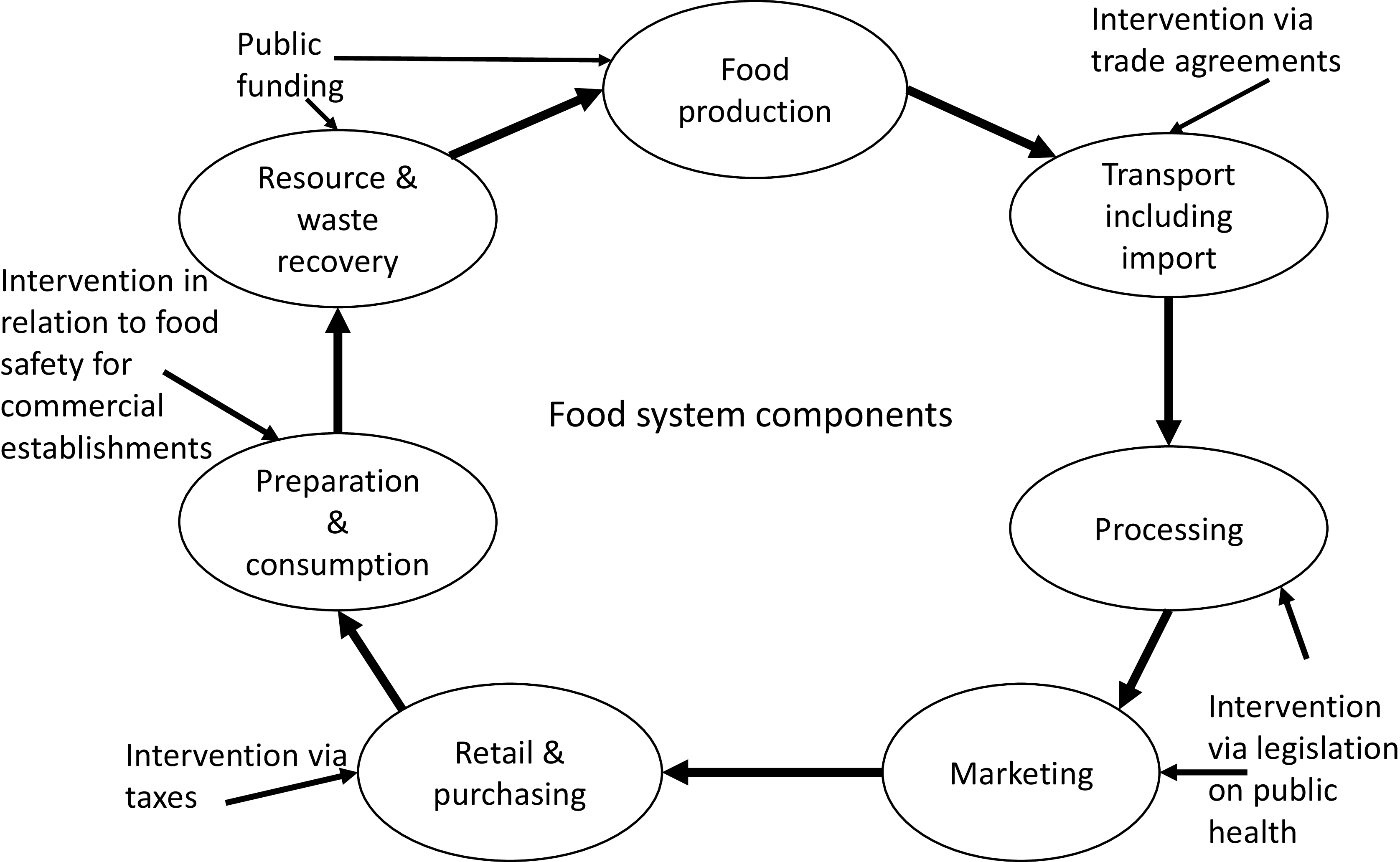
Adopt a ‘systems approach’ was the answer given to questions asked during the pandemic about how to make food systems more resilient. It is unlikely, however, that everyone supplying that answer had the same context of what it meant! There are probably thousands of diagrams on the internet to describe food systems, which is to be expected, given the many different entry points or lenses through which they are explored. Figure 1 is thus one of many, adapted to identify the different types of policy levers (e.g. funding or regulation) which are used at different parts of the ‘system’ to help deliver the ‘right to adequate food’. What is important in a ‘systems approach’ is that different disciplines working together use a common diagram of the ‘system’ to develop ‘A better understanding of key interactions between a multitude of actors, government levels and processes (production, consumption, distribution) generated by such an approach and involving stakeholders is crucial to delivery of transformation (Reference Gill, de Boer and Kok15) .’
Diagram of components of food systems with non-enclosed text indicating the main types of government intervention

Further examples of policy levers can be found in Wepner(Reference Defraeye, Tagliavini and Wentao13) which also draws the distinction between policies which are developed at the EU or the individual member level. Whilst the UK has left the EU, it continues to have different levels of governance: UK-wide, nation level (England separate from the devolved administrations of Scotland, Wales and Northern Ireland) and local government level. It is important for researchers (before embarking on research) to understand which layer of policymakers are likely to be most interested in their research outputs (tools to help with this are highlighted in the next section). For example, at European level a survey undertaken by the project Metrics, Models and Foresight for European Sustainable Food And Nutrition Security identified that a policy goal of balanced and sufficient diets for all citizens was largely the responsibility of national governments rather than the EU (44 % compared to 5 %), whilst the reverse was true for food safety (4 % compared to 51 % respectively)(Reference Wepner16).
Looking through a ‘nutrition lens’, a number of these ‘levers’ are relevant: for example, the nutrient content of crops grown can be manipulated by science (e.g. crop breeding); while regulations influencing the processing of food may become increasingly important as research identifies negative nutrition outcomes associated with ultra-processed foods(Reference Chen, Zhang and Yang17,Reference Pagliai, Dinu and Madarena18) . Marketing has been shown to influence consumer choice and the UK government has brought in a law in England around the display of food in supermarkets (where basically the UK government law which covers England, places strict limits on where larger stores can place goods classed as being high in fat, salt or sugar). One issue with that law(Reference Muir, Dhuria and Ro19) is the differing interpretations of its application between local authorities. This highlights both the importance of research to evaluate the impact of the implementation of policy so that lessons can be learnt for policy development and also the importance for researchers to understand the policy process and hence which part (national, devolved or local and which department) they should engage with.
The choice of speakers at the Symposium nicely illustrated how the breadth of disciplines (aligning biological sciences alongside social and behavioural sciences, for example) required to adopt a ‘systems approach’ is now more widely recognised as evidenced by the response of funders who have commissioned research through interdisciplinary programmes such as Transforming UK Food Systems(Reference Bhunnoo and Poppy11).
Tools for stakeholder (including policy) engagement
There are different approaches to stakeholder engagement and co-design of evidence gathering, but all approaches should start by considering who the relevant stakeholders are, what are their interests and what is the timescale over which the engagement will take place, and secondly who needs the evidence, in what form and what is their priority. Food policy and changes in food systems can be ‘shocked’, i.e. driven out of an established equilibrium, as we have seen following the conflict in Ukraine, or can take decades to change and adapt.
One project which has made a concerted effort to provide generic advice on how to categorise and prioritise stakeholders, design and analyse questionnaires and interventions for policymakers to engage with stakeholders in the food sector and leave a longer legacy is the Fit4Food2030 project(Reference Gill, Cahill and Callenius20). This project evolved the concepts of ‘Policy labs’ and ‘City labs’, now referred to as ‘Food’ and ‘Living’ labs. During the project itself, pilot City labs were developed in 12 cities across Europe and 11 policy labs were developed, with documents available online to advise on how to undertake ‘Citizen consultation on food system transformation’, ‘Designing multi-stakeholder events’ and ‘Co-designing educational modules(21).’
Case study: evidence to inform the implementation of Scotland’s Good Food Nations Act
The Scottish Science Advisory Council (SSAC)(9) has a remit to provide independent science advice to Scottish Ministers across any devolved policy sector. It is not commissioned to undertake research projects but has developed a process whereby, through engagement with relevant policy teams in the Scottish Government, agreement is reached on policy questions which could benefit from increased exposure to scientific evidence. Evidence is collected both from the scientific literature and through small group discussions involving stakeholders, policy officials and scientists (including social scientists). A recent topic (2023) addressed by SSAC was: ‘The contribution of local production to Scotland’s food systems’ where local production was defined as: ‘it is produced locally (this includes your, town, region or elsewhere in the rest of Scotland) and it has short supply chains (there are fewer steps than global and imported food between the primary producer of the food and the person who eats the food, this could include a farm supplying a local shop or supermarket (22).’
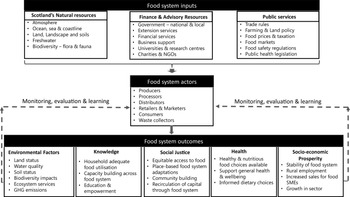
The approach adopted highlighted the large number of stakeholders (actors) involved in connecting consumers with local food, from those supplying inputs (people and financial resources) to those involved in production, distribution and marketing (Fig. 2). This was looked at through the lens of the five stated categories of desired outcomes of the Good Food Nation Act(10) (Environmental status, Knowledge, Social justice, Health and Socio-economic prosperity) to highlight evidence from the UK and internationally of successful policy interventions. Evidence on innovations, both technical and policy, was explored and summarised as ideas to be considered in the implementation of the Good Food Nation Act (Scotland). As laid out in the Act(10) the next stage in delivering the policy will be the drafting and then publication of implementation plans at both national and local levels.
Diagrammatic representation of the relationship between inputs, outcomes and food system stakeholders

‘The national plan must set out:
-
(a) the main outcomes in relation to food-related issues which the Scottish Ministers want to be achieved in relation to Scotland,
-
(b) indicators or other measures by which progress in achieving the outcomes may be assessed, and
-
(c) the policies which the Scottish Ministers intend to pursue in order to secure the achievement of the outcomes.
It must also have “regard to the scope for food-related issues to affect outcomes in relation to:
-
(a) among other things social and economic wellbeing,
-
(b) the environment, including in particular in relation to—
-
(i) climate change, and
-
(ii) wildlife and the natural environment,
-
-
(c) health and physical and mental wellbeing (including in particular through the provision of health and social care services),
-
(d) economic development,
-
(e) animal welfare,
-
(f) education, and
-
(g) child poverty.”’
The Act also calls on Health Boards, Local Authorities and specified Public Authorities to publish Good Food Nation plans which must set out:
-
“(a) the main outcomes in relation to food-related issues which the relevant authority wants to be achieved within the relevant authority’s areas of responsibility,
-
(b) indicators or other measures by which progress in achieving the outcomes may be assessed, and
-
(c)the policies which the relevant authority intends to pursue in order to secure the achievement of the outcomes (10) .”
Food plans must also have regard to the other seven issues as specified above for the National Plan. This is a highly ambitious ‘ask’ of Local Authorities (LAs) which are already suffering from tight budget allocations and have less access to scientific advice than central government, yet they are in the best position to prioritise local needs. Scotland is a very diverse country with four cities with over 100 000 inhabitants, 83 % of the population lives in urban areas (covering 2 % of the land) and 17 % in rural areas(23). 8 % of Scotland’s land area is classified as suitable for arable crops, while 51 % is only suitable for supporting rough grazing, 18 % is improved grassland and 20 % is suitable for mixed agriculture (e.g. barley grass and forage crops)(24). There are 93 inhabited islands.
Evidence suggests that some of the seven issues have a higher priority in some LA areas than others, e.g. evidence is clear that health is a major issue in Glasgow(Reference Reid25), while the emigration of young people from the islands(Reference Alexander26) is a concern reflected in strategic planning in Shetland, for example. The principles of animal welfare and education are strategic issues which are less context-dependent and hence should be considered at national level. Each Council has a Strategic Plan which sets out its top priorities, which academics should familiarise themselves with before approaching LAs. For example, Glasgow City Council has ‘Reduce poverty and inequality in our communities’ as one of their strategic priorities and Shetland Isles Council includes a ‘shared aim is for more young people to remain in, or relocate to, Shetland to live, work, study and raise families.’
Audit Scotland 2023(27) recommends discussion of priorities with the local community, as well as with other Councils, but many Councils do not have the resources (skills and financial) to do this professionally. Earlier references to the Fit4Food toolbox(Reference Gill, Cahill and Callenius20) give some ideas and UK-led projects and programmes such as Place-based Climate Action Network (P-CAN 2023)(28) are strengthening academic engagement with communities within the UK – this should aim to align with LA priorities. In addition to working with local communities, there is a need for researchers to work with colleagues from other disciplines. The Scottish Funding Council has recently funded three Alliances to address key challenges in a interdisciplinary and cross-sectoral approach, aligned with policy. One of these is on Food, Health, Equity and Sustainability(29). Other interdisciplinary initiatives include interdisciplinary Centres within individual universities, such as the Health, Nutrition and Wellbeing Centre at the University of Aberdeen and UKRI has also recognised the challenge with its interdisciplinary programme on food funded through the Strategic Priorities Fund(Reference Bhunnoo and Poppy11).
Conclusions for researchers on bridging the gap between science and food policy
A key aspect of any successful partnership is for it to bring benefits (albeit different ones) to each partner. For that to happen, each partner needs to start with a clear understanding of how other partners view success and also needs to respect the value each partner brings and not be tempted to switch roles! In other words, researchers should not be tempted to design policies – leave that to those trained and experienced in developing policies, and policymakers should not design research programmes without scientific input. As researchers, we need to listen carefully to what policymakers (national and local) are asking for and be honest about which questions research can answer. Food policy is particularly complex given the number of departments which may have an interest but systems research approaches and the use of tools to engage with stakeholders at an early stage can help to refine questions for which scientific understanding can help to broker discussions to help policy officials understand which types of interventions are likely to be acceptable to different types of stakeholder and hence likely to deliver the expected outcome when implemented.
In the end, decision-making is the responsibility of Ministers and the aim of providing evidence is to inform that decision-making both at a strategic level prior to the drafting of legislation but also at a detailed level of implementation (e.g. the development of the operational plans by which the Good Food Nations Act will deliver the intended outputs).
Acknowledgements
The Case Study was undertaken while MG and EMS were members of the Scottish Science Advisory Council (SSAC) and KF was an intern working on behalf of the SSAC. Comments from other members of a Short Life Working Group and members of the SSAC during the work behind the Case Study are gratefully acknowledged.
Financial support
KF was in receipt of funding from the Scottish Government, administered through James Hutton Ltd.
Conflicts of interest
Beyond membership of the SSAC, which is an independent advisory body to the Scottish Government, the authors have no conflicts of interest.
Authorship
M.G. is the lead author. K.F. and E.M.S. provided key inputs in relation to the Case Study.

 Open access

