


In the UK, 17·1 % of boys and 14·8 % of girls aged 2–15 years are reported to be obese (defined as BMI > 95th percentile of the 1990 UK reference population)(1). School meals play an important role in children's diet; lunches typically contribute between one-quarter and one-third of children's daily intake of energy and nutrients(2). Take up of school lunches in secondary schools in 2010–11 was 37·6 %(Reference Nelson, Nicholas and Wood3), representing an average of about 1·2 million secondary-school children having schools meals every day.
Improving the quality of school meals provides a key opportunity to improve children's health, especially in relation to efforts to decrease levels of obesity and future risks of related diseases such as diabetes and hypertension. Evidence suggests that improvements in diet may benefit children's concentration, behaviour and academic performance(Reference Golley, Baines and Bassett4–Reference Feinstein, Sabates and Sorhaindo6). In addition to providing sufficient energy and nutrients to support growth and development and maximise pupils’ learning potential, school meals can help to ensure that healthy eating messages delivered as part of education are reinforced whenever food is on offer in schools.
In April 2001, the Department for Education and Skills introduced food-based standards (FBS) for school meals to improve their balance and nutritional quality(7). A survey of lunchtime food provision and consumption in secondary schools in England in 2004 showed that these standards, coupled with the ‘cash cafeteria’ model of food service, failed to encourage pupils to select combinations of foods that contributed to a healthier diet. Almost half of pupils chose high-fat main dishes (e.g. burgers), starchy food cooked in oil (e.g. chips) and soft drinks. Only 6 % of pupils chose vegetables or salad, and only 2 % chose fruit(Reference Nelson, Bradbury and Poulter8). In response to concerns about the poor quality of school meals and increasing levels of childhood obesity, the government established the School Meals Review Panel to revise guidelines for school meals and to set standards for the nutritional content of school lunches(9). The panel proposed changes that would maximise access to healthier items and prohibit or restrict foods or drinks high in fat, salt and sugar.
From September 2009, catering provision in all secondary schools in England was required to be fully compliant with the new FBS and nutrient-based standards (NBS) for school lunches(10–13). Thirteen FBS are intended to increase access to healthier foods such as fruit, vegetables and bread (without added fat) and to limit the availability of less healthy foods such as confectionery, snacks and high-sugar drinks. For example, at least one portion of fruit and one portion of vegetable or salad must be provided at lunchtime for every pupil having a school lunch, and starchy food cooked in oil should not be provided across the school day more than three times per week. Fourteen NBS complement the FBS, ensuring that provision contains appropriate amounts (based on current UK nutrient recommendations(14, 15)) of energy, vitamins and minerals, and not too much fat, sugar or salt.
To assess the impact of the introduction of new school food standards, the School Food Trust carried out a survey of a nationally representative sample of secondary schools in England to assess: (i) catering provision of food and drink at lunchtime and morning break; (ii) pupils’ choices and consumption of food and drink at lunchtime (including packed lunches) and at morning break; (iii) the nutrient content of school lunches and morning break choices; and (iv) the compliance of provision with school food standards. The findings presented here on lunchtime food and drink provision and consumption are compared with those from a similar survey carried out in 2004(Reference Nelson, Bradbury and Poulter8). Findings on packed lunches and food provision and consumption at morning break will be reported separately.
Methods
Sample
In July 2010 a random sample of 200 secondary schools in England, stratified by region, school stage, school type and postcode, was selected from Edubase(16). Schools included secondary and middle-deemed secondary schools in England. Community, Voluntary-Aided, Voluntary-Controlled and Foundation Schools were included in the sample. Schools were excluded (to minimise research burdens) if they had taken part in the previous Secondary School Food Survey(Reference Nelson, Bradbury and Poulter8) or the School Lunch and Behaviour studies in secondary schools(Reference Storey, Pearce and Ashfield-Watt5). Schools were approached by letter and asked to take part in the study with the aim of achieving a representative sample of secondary schools across England. Information sheets were provided for head teachers and catering managers. Data from the previous survey in secondary schools in England in 2004 indicated that eighty schools were sufficient to achieve good generalisability and adequate variation across the selection criteria (school type, region, school size); the aim was to replicate that in the present survey. Of the 200 schools approached, seventy-six schools (38 %) agreed to take part; 105 schools declined, six schools withdrew and thirteen schools did not respond. To achieve a final sample of eighty schools, four schools that had participated in a pilot for the study were approached, of which three agreed to participate, and a further school was recruited via a local authority contact. School reply forms (confirming the school's consent) were collected from participating schools. The final sample included eighty schools spread across all nine government regions, with catering provision that generally matched patterns seen nationally(Reference Nelson, Nicholas and Wood3). Schools that completed the survey received £500.
One week before fieldwork commenced, participating schools were sent information sheets to send to all parents/guardians informing them about the survey and asking them to reply only if they did not wish their child to take part. A list of these students was made available to the fieldworkers on the first day of data collection in each school. Consent from students at the time of data collection was verbal, and non-participation was minimal (less than 0·5 %). Fieldworkers received two days’ training on sampling and data collection methods, which included recording and weighing food and drink items provided by catering services at lunchtime and recording information about what items pupils chose and ate at lunchtime.
Schools were visited on five consecutive days between October 2010 and April 2011. Each day at lunchtime fieldworkers recorded: all items provided; the number of portions and weights of each item provided (schools were reimbursed for the cost of food portions provided for weighing); and the number of pupils catered for. Of portion weights 4·1 % were missing, and these were subsequently imputed from within the data set. These most frequently related to vegetables and salad and condiments. Of portion numbers 4·7 % were missing, relating mainly to drinks and condiments. These values remained missing; schools with more than 5 % missing portion numbers (twenty-four schools) were excluded when analysing the nutrient content of an average school lunch.
Each day, fieldworkers selected fifteen school lunch pupils and five packed lunch pupils using a random selection technique. Sampling took place after food had been selected. Fieldworkers recorded pupil-level information (age, sex and school year) and described all items taken and eaten by these pupils. The pupils were asked to specify if any of the food or drink items selected were part of a meal deal (typically where combinations of items can be purchased more cheaply than if they were purchased individually). At the end of lunch, all participating pupils returned their tray or lunch box to the fieldworkers, who weighed any leftover items individually. A total of 5969 pupils (2696 boys; 3229 girls; sex not recorded for forty-four) aged from 10 to 19 years had data on school lunch recorded.
Pupils who did not return their leftover items to be weighed were assumed to have consumed all their meal. Weight eaten was estimated by subtracting leftover weight from the average portion weight determined for each item taken. In 0·7 % of cases (spread across a variety of food groups), the value was negative; it was assumed for these items that none of that particular item was consumed.
Ethical approval was granted from King's College London Research Ethics Committee (BDM/09/10-76).
The current survey was designed to have very similar methodology to that used previously in the 2004 survey(Reference Nelson, Bradbury and Poulter8). The main differences in methodology were: (i) for the 2011 survey, data collection included packed lunches, and food provision and consumption at morning break and lunchtime, whereas in 2004 data collection was limited to school lunches only; (ii) fifteen school lunch pupils were sampled each day at lunchtime in 2011 compared with ten pupils each day in 2004; and (iii) data on the number of portions of each food and drink item provided were collected in 2011 but not in 2004.
Data preparation
The Food Standards Agency nutrient databank provided the energy and nutrient data on food composition(17). School lunch items were categorised into one of forty-one different food groups (see Appendix 1). Items were further categorised into one of eighteen broad food groups to facilitate reporting (see Appendix 2). To allow comparisons with data collected in 2004, the 2004 data were re-coded to match the 2011 broad food group classification.
Compliance with the standards was assessed against published regulations(10). Compliance with the FBS was analysed for actual provision, relating to direct observations of school lunch provision in schools over the 5 d of fieldwork. Standards which required assessment over 2 or 3 weeks, such as those for meat products and oily fish, could not be assessed. Compliance of school meals with NBS was based on actual provision.
Statistical analyses
Data were analysed using the statistical software package SPSS version 20. The χ 2 test was used to assess differences in food group availability between years (2011 v. 2004). ANOVA was used to compare differences in nutrients eaten by different groups of pupils.
Results
Food and drink provision at lunchtime
Table 1 compares food provision at lunchtime, 2011 v. 2004, by food group. Compared with 2004, fewer schools in 2011 offered starchy food cooked in fat or oil, confectionery, desserts, cakes and biscuits containing confectionery, non-permitted snacks, non-permitted drinks and condiments (all P < 0·005) on 4 or 5 d/week. Conversely, more schools offered main dishes, starchy food not cooked in oil, vegetables and salad, sandwiches, other desserts, water (includes bottled water), fruit juice and other drinks on 4 or 5 d/week in 2011 than in 2004 (all P < 0·005). Compared with 2004, more schools in 2011 did not offer bread and bread-based items, confectionery, non-permitted snacks and non-permitted drinks; while fewer in 2011 did not offer water, fruit juice and other drinks (all P < 0·005). There were no statistically significant differences in the frequency of provision of dairy foods, fruit-based desserts or permitted snacks and cereals between 2011 and 2004.
Frequency of lunchtime provision of foods from different food groups, according to number of days provided per week, secondary schools, England, 2004 and 2011
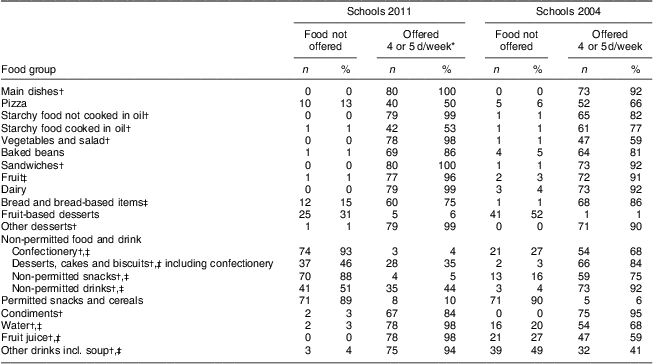
Base (schools): n 80 in 2011; n 79 in 2004.
*Identifies schools providing items every day or almost every day. Schools not shown in Table 1 are those providing items between 1 and 3d/week, so the row totals for 2011 do not add up to 80, and for 2004 do not add up to 79.
†The proportion of schools offering particular food items on 4 or 5 d/week was significantly different between the two studies (P < 0·005).
‡The proportion of schools not offering particular food items was significantly different between the two studies (P < 0·005).
Food and drink choices of pupils having a school lunch
Similar trends were seen in pupils’ food selection following changes in food/drinks provision (Fig. 1). In 2011, 15·5 % more pupils took sandwiches, 14·3 % more took other desserts, 12·4 % more took starchy food not cooked in oil, 11·2 % more took fruit juice, 11·0 % more took other drinks, 9·5 % more took dairy foods, 5·8 % more took vegetables and salad, 2·9 % more took water and 1·7 % more took fruit (P ≤ 0·0 0 1), compared with 2004. In contrast, 2·4 % fewer pupils took pizza, 3·4 % fewer took condiments, 9·3 % fewer took main dishes, 11·6 % fewer took bread and bread-based items, 32·6 % fewer took starchy food cooked in oil and 47·0 % fewer took non-permitted food and drink items (P ≤ 0·0 0 1).
Percentage of pupils taking specific items of food and drink at lunchtime, by food group, secondary schools, England, 2004 ( $$$$
) and 2011 (
$$$$
) and 2011 ( $$$$
). Base (pupils): n 5969 in 2011; n 5695 in 2004. All differences were statistically significant at P ≤ 0·001 except baked beans (P = 0·056) and permitted snacks and cereals (P = 0·474)
$$$$
). Base (pupils): n 5969 in 2011; n 5695 in 2004. All differences were statistically significant at P ≤ 0·001 except baked beans (P = 0·056) and permitted snacks and cereals (P = 0·474)

Table 2 shows the percentage of pupils choosing food or drink items, and the average weights taken and eaten, from each of the forty-one food groups. In addition to the choices described in Fig. 1, about a fifth of pupils took meat or fish main dishes, while only 10·0 % of pupils took meat products. Of the 9·5 % of pupils taking non-permitted items, more than half (5·0 %) took non-permitted drinks, with fewer than 1 % taking non-permitted snacks (0·6 %) or confectionery (0·3 %). Just under 40 % took permitted drinks, with fruit juice the most common choice (14·6 %). More pupils took vegetables (7·4 %) or salad (4·0 %) than fruit (3·1 %).
Percentage of pupils taking specific food and drink items, weight as taken, weight as eaten and wastage, by food group, secondary schools, England, 2011

Base (pupils): n 5969.
*The differences between the weight as taken and the weight as eaten were computed by item within each food group, so the values are not equal to the differences between the averages as given in the table.
Wastage varied by type of item; highest levels were observed for fruit, soup, fruit-based desserts and vegetables and vegetable side dishes. The average wastage of the food and drinks taken by pupils in 2011 was 7 %.
Table 3 shows that, on average, pupils were taking less than one portion of fruit and vegetables per day (see footnote to table for definition of ‘portion’). When all sources of fruit and vegetables were taken into account, across all pupils, an average of 0·8 portions were taken and eaten. Among ‘consumers’ (the 72·2 % of pupils who took some fruit or vegetables), an average of 1·2 portions were taken and 1·1 portions eaten. About 11 % of pupils consumed at least two portions of fruit and vegetables on a given day, and nearly a quarter (22 %) consumed at least 1·5 portions. Although it was not possible to make a direct comparison with 2004 (due to lack of data on fruit and vegetable content of composite dishes), analysis showed that mean fruit and vegetable intake for all pupils, not including the contribution from composite dishes, was 0·4 portions per pupil in 2011 compared with 0·2 portions per pupil in 2004.
Number of portions of vegetables and fruit taken and eaten, by food group, secondary schools, England, 2011
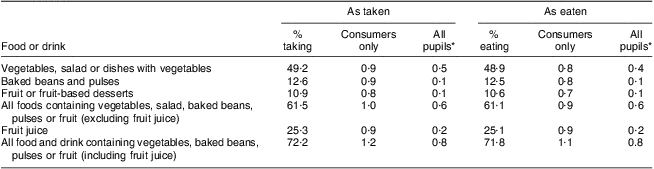
Base (pupils): n 5969.
One portion of vegetable = 80 g; one portion of fresh/tinned fruit = 80 g; one portion of dried fruit = 30 g; one portion of fruit juice = 150 ml; one portion of beans and pulses = 80 g. Fruit juice and baked beans and pulses count as a maximum of one portion per day regardless of the amount over 150 ml or 80 g, respectively. The fruit and vegetable content was calculated for each composite dish.
*All pupils taking a school lunch.
Nutrient content of school lunches
Table 4 shows the mean energy and nutrient content of school meals ‘as taken’ and ‘as eaten’ by pupils in 2011, and ‘as eaten’ by pupils in 2004, and compares them with the NBS (although standards relate to provision rather than consumption, they provide a useful benchmark to indicate to what extent meals ‘as taken’ or ‘as eaten’ are likely to satisfy the nutritional requirements of children). In 2011, the average meal ‘as taken’ and ‘as eaten’ met the standards for protein, non-milk extrinsic sugars (NMES), fat, SFA, Na and vitamin C.
Mean energy and nutrient intake from school lunch as taken and as eaten in 2011 and as eaten in 2004, secondary schools, England, compared with nutrient-based standards

NMES, non-milk extrinsic sugars.
Base (pupils): n 5969 in 2011; n 5695 in 2004.
*To meet the standard, mean nutrient content should be below the value shown.
†No standard for percentage of energy to be met from protein.
The energy content of an average meal ‘as taken’ and ‘as eaten’ was below the standard. Average meals ‘as taken’ and ‘as eaten’ met NBS for percentage of energy from carbohydrate, fat and saturated fat, but not for NMES.
There were some differences between subgroups (boys v. girls; 11–14 years v. 15–18 years) in relation to meeting NBS. Older (but not younger) boys and girls met the standard for percentage of energy from NMES; boys were marginally above the standard for percentage of energy from SFA (11·1 %, compared with the standard of not more than 11 %); only older boys did not meet the standard for Na (mean intakes ‘as taken’ of 779 mg compared with the standard of 714 mg).
Differences between 2011 and 2004 showed lower levels of energy, carbohydrate, NMES, fat, SFA, Na, vitamin C and folate in 2011, and higher levels of protein, fibre, vitamin A and Ca (all P < 0·0 0 1). For example, the average meal ‘as eaten’ had nearly 50 % more vitamin A and at least 30 % less NMES, fat, SFA and Na in 2011 compared with 2004.
Pupils spending at least the equivalent of the Free School Meal (FSM) value had nutrient intakes that met NBS for energy, carbohydrate and vitamin A (Table 5). Their intakes of folate, fibre, Ca, Fe and Zn were closer to meeting NBS than those of pupils spending less than the FSM value, or those in receipt of a FSM. Conversely, their NMES, SFA and Na intakes did not meet NBS whereas other groups’ intakes did. Table 5 also shows that pupils whose meals contained meal deal items had higher energy intakes than other pupils, and met the standard. Their average intakes met NBS for carbohydrate, fibre and vitamin A, whereas intakes of pupils not having meal deal items did not. Conversely, pupils having meal deal items did not meet NBS for NMES and SFA while other pupils did.
Mean nutrient intake from school lunch as eaten, according to spend and whether pupil had meal deal items, secondary schools, England, 2011

FSM, Free School Meal; NMES, non-milk extrinsic sugars.
Base (pupils): n 5969.
Average FSM value across all schools was £2·03.
*Mean values across the three spend groups were significantly different from each other (P < 0·001).
†Mean values across the two meal deal groups were significantly different from each other (P < 0·005).
‡To meet the standard, mean nutrient content should be below the value shown.
§No standard for percentage of energy to be met from protein.
Compliance of provision with food-based and nutrient-based standards for school food
Food-based standards
Based on actual provision (i.e. over 5 d of data collection), the standards met most consistently were for restricting salt and condiments (met by 91 % of schools), confectionery (90 %) and snacks (89 %). Nearly three-quarters of schools met FBS for providing drinking water (73 %) and more than half for providing only healthier drinks (55 %). Although most schools did not offer confectionery, cakes and biscuits containing confectionery were available in more than half (53 %) of schools. Nearly half of schools (46 %) met the standard for starchy food cooked in oil; in 2004 these foods were served on average 4·2 d/week, in 2011 this had fallen to 3·5 d/week. The standard for deep-fried food, which limits schools to providing no more than two deep-fried items per week, was met by fewer schools (35 %), although a further 11 % of schools were close to compliance, providing only three deep-fried items per week at lunchtime. Forty per cent of schools provided extra bread every day.
Fewer schools met FBS for fruit and vegetables. Compliance with these standards was assessed against all fruit and vegetables provided at lunchtime, including contributions from composite dishes. Just under a quarter of schools (23 %) provided at least one portion of vegetables or salad per pupil per day and met the standard. A further 20 % of schools provided at least three-quarters of a portion per pupil, and a further 25 % provided at least half a portion. Only two schools provided sufficient portions of fruit to meet the standard, with a further 30 % providing at least half a portion.
Nutrient-based standards
The mean energy and nutrient content of an average school lunch was compared with the NBS for secondary schools. The calculation was based on actual provision observed in the dining room at lunchtime over 5 d. Schools with more than 5 % missing portion numbers were excluded from the analysis; drinks provision was capped to account for over-provision; and take up was estimated from the number of pupils catered for each day, adjusted using average spend relative to FSM value to reflect the number of ‘meal equivalents’ provided. On initial calculation the energy content of the average school lunch appeared to be about 20 % higher than the standard, and was considered likely to reflect biases in the calculation. Therefore, to understand better whether pupils were being provided with the right balance of nutrients at lunchtime, the estimated energy content of the average school lunch was equated with the standard and the same adjustment applied proportionally to the other nutrients. (This is effectively a measure of nutrient density.) Table 6 shows that when the energy content of the average school lunch provided by caterers was equated with the NBS for energy, all provision appeared to meet the standard for protein and nearly all for vitamin C. About two-thirds of schools met NBS for carbohydrate, fat and vitamin A, and more than 60 % of schools met or were within 10 % of meeting NBS for NMES, SFA, fibre and folate. Only 18 % of schools met the standard for Na, but a further 27 % were within 10 %. Six schools met the NBS for Ca, two for Zn, and none met the NBS for Fe. The average lunch, as modelled, met about seven of the fourteen standards; 36 % of schools provided an average lunch that met eight standards.
Energy and nutrient content of an average school lunch compared with nutrient-based standards, modelled to meet the nutrient-based standard for energy, based on actual provision of food and drink at lunchtime, secondary schools, England, 2011

NMES, non-milk extrinsic sugars.
Base (schools): n 55 (twenty-four schools excluded due to more than 5 % missing portion numbers; one school excluded due to no estimated value for take up).
Discussion
The present survey is the first to assess the impact of the new FBS and NBS on food and drink provided in secondary schools in England, and to assess the changes in what pupils are taking and eating at lunchtime compared with 2004. The survey was carried out between October 2010 and April 2011, 12 to 18 months after the standards became compulsory for secondary schools in September 2009.
The results indicate that substantial progress has been made by caterers and schools in shifting the balance of food provision and consumption in secondary schools in a more healthy direction. Compared with 2004, fewer schools regularly offered pizza, starchy food cooked in oil and condiments, while more schools regularly offered starchy food not cooked in oil, vegetables and salad, water and fruit in 2011. In addition, the provision of confectionery and snacks has fallen substantially. In 2011, confectionery was not provided in 93 % of schools, compared with the 73 % of schools that did offer confectionery in 2004. Similarly, the provision of snacks such as crisps on at least 4 d/week fell from 75 % of schools in 2004 to 5 % in 2011. While it is clear that foods and drinks not permitted by the new standards have not disappeared completely from schools, their availability has been dramatically reduced as part of the transition towards healthier provision.
Similar changes were seen in relation to food consumption. The number of pupils taking starchy food cooked in oil fell from 50 % in 2004 to 17 % in 2011, with those taking starchy food not cooked in oil increasing from 15 % in 2004 to 27 % in 2011. There was a substantial decrease in the percentage of pupils taking non-permitted food and drink from 56 % in 2004 to 9 % in 2011, and although the proportion of pupils taking discrete portions of vegetables and salad and fruit in 2011 was low, it had doubled compared with 2004. Overall, the balance of food taken by pupils at lunchtime reflects the more healthy choices available.
The impact of the standards on both food provision and consumption is particularly evident in relation to chips. In 2011, only 7 % of pupils chose chips, compared with 43 % of pupils in 2004. This represents a reduction of about 80 %, which is of the same magnitude as the reduction in the number of days chips were available in schools (80 % of days in 2004, compared with 17 % of days in 2011).
There have been improvements in both fruit and vegetable provision and consumption since 2004, but further increases are needed. Caterers have been successful in including fruit and vegetables in composite dishes, meaning that nearly three-quarters of pupils had some fruit or vegetables as part of their meal, but more effective strategies than simply providing fruit and vegetables are needed to encourage pupils to eat two of their 5-a-day at lunchtime.
Low energy intakes suggest that pupils may not be consuming enough energy and nutrients at lunchtime to satisfy their hunger and prepare them for afternoon lessons. Data collected in the present study suggest that pupils using school catering services at morning break are having a substantial snack, on average equivalent to 15 % of their daily energy requirement, while those at lunchtime are not, on average, taking a complete meal. More needs to be done to understand how secondary-school pupils use school food services, in particular what proportion uses services at both break and lunchtime, and for those who do, how their choices and intakes are proportioned. This would help to determine if intakes at morning break and lunchtime considered together are providing sufficient energy and nutrients to ensure that pupils are able to satisfy their hunger and other needs at lunchtime in order to maximise their learning potential and performance at school. In addition, the need to balance energy intake and expenditure to address obesity needs to be considered.
There is evidence of a substantial improvement in the balance of macronutrients in relation to both food provision and consumption between 2004 and 2011. The average school lunch and the average pupil intake met NBS for percentage energy from carbohydrate and fat in 2011, with percentage of energy from fat falling by a quarter compared with 2004. Percentage of energy from SFA fell by one-fifth compared with 2004 and average pupil intake met NBS for consumption, but not for provision. The decrease since 2004 reflects a shift in sources of SFA away from starchy food cooked in oil, deep-fried food, meat products and snacks. Although in 2011 the percentage of energy from NMES in an average school lunch met the NBS and energy from NMES fell by one-sixth compared with 2004, average pupil NMES intake relative to energy was above the standard. However, there has been a shift in the sources of NMES from sweetened soft drinks and confectionery to fruit juice and other drinks containing fruit juice, although the contribution from other desserts remains high (nearly 50 %). Pupils need to be encouraged to take more fruit and fruit-based desserts to further reduce energy intake from NMES.
The Na content of an average meal (as provided) was higher than the standard. This may be due to more sandwiches being provided in 2011, as well as to caterers continuing to use products high in Na (e.g. canned products in brine, stock, etc.). Although only 10 % of schools met the standard for Na, the Na content of meals eaten by pupils in 2011 was more than one-third lower than in 2004, greater than could be attributed to the decrease in energy alone. This is likely to reflect changes in cooking practices consistent with those reported for primary schools (i.e. caterers using recipes that have no added salt and more cooking from scratch) and action reportedly taken by food manufacturers and wholesalers to decrease the salt content of their products(Reference Haroun, Harper and Wood18).
Secondary-school caterers were generally least successful in meeting the minimum Fe, Zn and Ca content of an average school lunch. Caterers need to continue their efforts to increase micronutrient levels in general, but particularly Fe, Zn and Ca by using Fe-rich, Zn-rich and Ca-rich foods and by modifying their existing recipes to use ingredients higher in these nutrients.
Secondary schools do not appear to have been as successful as primary schools in meeting school food standards(Reference Haroun, Harper and Wood18). The two main challenges are the style of service and the starting point prior to the introduction of the standards. In secondary schools, a greater number and variety of items are available at lunchtime, leading to more opportunity for misunderstandings or lack of clarity on the part of the caterer about the types of items that can be provided and how often (this applies particularly to standards for starchy food cooked in oil, deep-fried food, confectionery in cakes and biscuits and healthier drinks) and what should be included in the analysis of an average school lunch. In addition, pupils often do not take complete meals, meaning that items such as vegetables and fruit are often not taken so caterers are unlikely to provide one portion of each to meet FBS and risk substantial wastage. Providing a range of individual items that contain the required balance of micronutrients is more challenging than providing nutrient-dense meals, making NBS more challenging to meet (particularly evident in relation to Fe, Zn and Ca). Where complete meals were taken, they were closer to meeting standards for energy and other nutrients. In addition, there is an interaction with morning break provision which is not yet fully understood.
Prior to the introduction of the standards, secondary schools were likely to have been further from compliance than primary schools. More time may be required to change provision in secondary schools, and this in turn may depend on changes in catering practice (e.g. less choice, change in meal service) and changes in attitude on the part of school senior leadership teams and the pupils themselves. Despite this, there have been substantial changes since 2004 in the types of food provided by caterers and the choices made by pupils. It is encouraging that progress has been made in introducing tough new standards while maintaining (and more recently increasing) the take up of school lunches in secondary schools(Reference Nelson, Nicholas and Wood3). There is potential for further progress, which can be achieved by improving compliance with both the food-based and nutrient-based standards and by increasing the numbers of pupils using school catering services, as school lunches are consistently shown to be healthier than packed lunches or other food brought into school(Reference Stevens, Nicholas and Wood19).
Children's eating habits develop at an early age and these dietary patterns are likely to persist into adolescence and adulthood(Reference Mikkila, Rasanen and Raitakari20, Reference Wang, Bentley and Zhai21). The expectation is that improvements in food provision and consumption in primary schools(Reference Haroun, Harper and Wood18) are helping to prepare pupils for healthier eating in secondary schools. Given the change in environment and the increased choice available to pupils when they enter secondary school, it is essential that all pupils are not only given the opportunity to make healthier food choices, but supported in that decision making by removing less healthy options from the school environment and ensuring that healthy eating messages delivered as part of their education are reinforced whenever food is on offer in their school. The progress demonstrated here is evidence that legislation to promote healthier options (e.g. vegetables, wholegrain cereals, starchy foods not cooked in fat) and restrict access to less healthy options (foods high in salt, sugar and fat, e.g. snacks, confectionery, sugary drinks and starchy foods cooked in oil), together with support from organisations such as the School Food Trust (www.childrensfoodtrust.org.uk) for catering providers, schools, pupils and parents, is effective in bringing about change.
Our findings are consistent with research on the process and impact of change in the national school food policy on food and nutrient intakes of children aged 4–7 years (in primary schools) and 11–12 years (in middle schools) in Newcastle(Reference Adamson, White and Stead22). This showed similar changes in school food provision and consumption to those described here, together with corresponding improvements in total diet that relate to healthier eating in school. The impact of change was greater for younger than older children, reflecting the finding that middle schools were still working towards full implementation of the standards, and demonstrating the greater challenge of influencing food choice as children get older.
The present survey had a number of limitations, mainly relating to assessment of compliance with NBS and FBS. First, compliance with the standards in law relates to planned provision over a full menu cycle (typically three weeks). Due to the ‘cash cafeteria’ nature of food provision in secondary schools, menus often do not include all items available on a given day or information on the number of portions of each item provided. It was not therefore possible to assess planned provision against the standards. Ideally, planned and actual provision should be very similar, but in practice may not be. Our assessment of compliance, based on one week's worth of observations in each school, is likely therefore to differ from the school's own assessment of its compliance, based on provision data over a full menu cycle. Two FBS require assessment over either two weeks (meat products) or three weeks (oily fish). Consequently these could not be assessed in relation to actual provision. Second, it is common in secondary schools for there to be over-provision of some types of foods and drinks, related to pupil choice, stock flows and design of service areas. This particularly applies to drinks, where it is common for large quantities to be displayed each day in fridges or vending machines. Therefore the number of portions of drinks recorded as available each day is often in excess of the ‘planned’ provision for that day. To correct for this over-provision, portion numbers of drinks were capped (pupil consumption records were used to calculate the percentage of pupils buying drinks in each school; this figure, together with the number of pupils catered for at lunchtime, was used to calculate a maximum number of drinks provided per day at lunchtime, the ‘cap’; the number of portions of drinks each day was adjusted proportionally to meet the cap). It is likely that some other types of foods and drinks will also have been over-provided, but no adjustment has been made for these, which may result in an overestimation of the amounts of energy and nutrients in an average school lunch. Third, in some instances, fieldworkers were not able to collect information on the number of portions of items available at lunchtime (portion numbers were not recorded for 4·7 % of food and drink items overall). As there was no obvious rationale for imputing these data, energy and nutrients from these items were not included when calculating the energy and nutrient content of an average school lunch, resulting in some underestimation of the amounts of energy and nutrients provided. Schools with more than 5 % missing portion numbers were excluded from this analysis. Fourth, when assessing compliance with NBS, any items of morning break provision considered to form part of lunchtime provision should be included in the nutrient analysis and the income from this provision should be included when calculating the take up of school lunches. The quality of the data obtained from caterers relating to which elements of morning break provision should be included was not sufficient to allow these items to be factored into the analysis. Therefore, compliance with NBS was assessed for lunchtime provision only, using an estimate of the number of meals provided (calculated from data on pupil spend relative to FSM value and the number of pupils catered for at lunchtime each day). Finally, on initial calculation, the energy content of an average school lunch appeared to be about 20 % higher than the standard. This could be due to factors mentioned above such as over-provision of food and drink items and estimation of take up. It could also be due to caterers overestimating (‘rounding up’) the number of portions of each item provided. It is highly unlikely that caterers would be over-catering by around 20 %, as this would be wasteful and uneconomic. To understand better whether pupils were being provided with the right balance of nutrients at lunchtime, the analysis reported here was based on the estimated energy content of an average school lunch being equated with the standard and the same adjustment was applied proportionally to the other nutrients.
Other limitations were that it was not possible to compare the nutrient content of provision in 2011 with that in 2004 because the 2004 data included only a profile of the types of food and drink available and not the number of portions provided. Also, it was not possible to obtain recipes for all items provided in schools, and the information available on manufactured or prepared products was limited. It was necessary, therefore, to make some assumptions relating to recipe formulation and cooking methods, which may have had an impact on the accuracy of the estimates of the nutrient content of meals provided and eaten. However, most of the information collected included details on the composition of dishes and so it was possible to create recipes for those that were missing, or to use apparently similar recipes from other schools. Lastly, even though two typical portion weights of each item provided by schools were measured, variations in portion sizes served to pupils within the same school will not have been taken into account. Although this was likely to have little impact on the estimated average energy and nutrient content of meals, it may have had a greater impact on the estimates of wastage.
The survey response rate was 38 %. The main reasons given by schools for non-participation were that they were not interested (44 %), too busy (19 %) and did not participate in surveys (15 %). A further 17 % gave practical reasons for not taking part (such as staffing or refurbishment issues). Although the majority of the data collection was undertaken by fieldworkers, their presence in each school for a week, together with the input needed from catering staff and head teachers, was inevitably seen as a burden. The offer of £500 to participating schools may have encouraged a wider selection of schools to take part. This, together with the variation in rates of compliance with the standards between schools, and the fact that the participating schools were spread across all nine regions and had catering provision matching that seen nationally, suggests that the effect of the selection bias on the results is not significant.
Overall, the findings reported here provide evidence that the introduction of compulsory standards for school lunches (which both promote healthier options and restrict less healthy options), together with the efforts of caterers and schools, have resulted in healthier food provision at lunchtime in secondary schools in England. In addition, the balance of food taken by pupils at lunchtime reflects the more healthy choices available, and there has been a substantial improvement in the balance of macronutrients in relation to both food provision and consumption. However, pupils need to be encouraged to select full meals, and to take and eat more fruit and vegetables. Compulsory standards have been effective in bringing about change, despite the absence of a structured monitoring and inspection process which might have resulted in a more consistent implementation of the standards. Together with the fact that standards are no longer compulsory in academy schools, this may limit future improvements.
Acknowledgements
Sources of funding: The survey was funded by the School Food Trust and carried out in collaboration with TNS BMRB. Conflict of interest declaration: The authors have no conflicts of interest to declare. Authorship responsibilities: J.N. prepared the first draft of the manuscript. L.W. and J.N. carried out statistical analysis of the data. C.H. contributed to data collection, coding and analysis. All authors contributed to the final revisions of the manuscript. Acknowledgements: The authors gratefully acknowledge all the schools and pupils who took part in the survey. They would also like to thank TNS BMRB researchers (Gillian Prior, Louise Hall, Susie Smyth, Camilla Huckle), TNS BMRB nutritionists (Gemma Francis, Rachel Gillings, Carole Reid, Laura Scruby, Eleanor Spanjar), School Food Trust researchers and nutritionists (Lesley Stevens, Claire Wall, Jo Pearce, Alex Scott, Laura Sharp) and all TNS BMRB interviewers who helped collect the data.
Appendix 1 Food group classification for school lunches

Appendix 2 Broad food group classification for school lunches



