


Statement of Research Significance
Research Question(s) or Topic(s):
This study aimed to establish normative data for the Taiwan version of the Free and Cued Selective Reminding Test, examine demographic effects, and assess reliability and validity.
Main Findings:
All core indices were significantly influenced by age and education, while sex effects were confined to free-recall measures. The test showed good reliability and validity. Regression-based corrections and percentile norms were developed to provide representative benchmarks for Mandarin-speaking adults in Taiwan.
Study Contributions:
This study offers the first normative data for the Free and Cued Selective Reminding Test in Mandarin-speaking populations, addressing a key gap in culturally and linguistically appropriate memory assessment. By clarifying demographic influences and confirming the test’s psychometric soundness, it supports the Taiwan Free and Cued Selective Reminding Test as a sensitive tool for detecting episodic memory changes and enhancing its clinical and research applications in cognitive aging and early dementia among Mandarin-speaking populations in Taiwan.
Introduction
Memory decline is among the earliest and most salient cognitive changes observed in both normal aging and dementia with Alzheimer’s disease (AD) etiology. In contemporary clinical and research frameworks, AD is increasingly defined by biomarker evidence of underlying neuropathology, including cerebrospinal fluid and plasma markers of amyloid and tau pathology (Jack et al., Reference Jack, Andrews, Beach, Buracchio, Dunn, Graf, Hansson, Ho, Jagust, McDade, Molinuevo, Okonkwo, Pani, Rafii, Scheltens, Siemers, Snyder, Sperling, Teunissen and Carrillo2024). Nevertheless, neuropsychological assessment remains indispensable for characterizing how this pathology manifests at the cognitive and functional levels, particularly across the continuum from cognitively unimpaired aging to mild cognitive impairment (MCI) due to AD and dementia due to AD.
Cognitively healthy older adults commonly exhibit retrieval inefficiency, reduced attentional control, and diminished spontaneous use of strategic encoding (Coubard et al., Reference Coubard, Ferrufino, Boura, Gripon, Renaud and Bherer2011; Murphy & Castel, Reference Murphy and Castel2025). Importantly, their memory performance can improve substantially when semantic structure and retrieval cues are provided, suggesting relatively preserved encoding mechanisms despite age-related changes (Koen & Yonelinas, Reference Koen and Yonelinas2014; Wagnon et al., Reference Wagnon, Wehrmann, Kloppel and Peter2019). In contrast, individuals with dementia due to AD show pervasive impairments in both encoding and consolidation processes, resulting in limited benefit from cueing or repetition (Lemos, Simões, et al., Reference Lemos, Simões, Santiago and Santana2015; Teichmann et al., Reference Teichmann, Epelbaum, Samri, Levy Nogueira, Michon, Hampel, Lamari and Dubois2017). These impairments are consistent with early neurodegenerative changes in medial temporal lobe structures, particularly the hippocampus and entorhinal cortex (Zammit et al., Reference Zammit, Ezzati, Zimmerman, Lipton, Lipton and Katz2017). Accordingly, distinguishing retrieval inefficiency from true storage failure remains central to the clinical characterization of cognitive impairment across the AD continuum.
Traditional verbal episodic memory measures, such as the California Verbal Learning Test (CVLT) and Wechsler Memory Scale Logical Memory (WMS-LM), are sensitive to memory decline but have importance methodological limitations. Their reliance on spontaneous learning strategies, narrative comprehension, and language-based abilities (e.g., verbal fluency) may disadvantage individuals with lower educational attainment, limited literacy, or executive dysfunction, thereby complicating clinical interpretation (Campos-Magdaleno et al., Reference Campos-Magdaleno, Nieto-Vieites, Frades-Payo, Montenegro-Peña, Facal, Lojo-Seoane and Delgado-Losada2024; Cremona et al., Reference Cremona, Jobard, Zago and Mellet2020). To address these limitations, Grober and Buschke (Reference Grober and Buschke1987) developed the Free and Cued Selective Reminding Test (FCSRT), which standardizes encoding through semantic category cues and provides controlled retrieval support. This design allows for clearer dissociation between retrieval and storage deficits while minimizing confounds related to language proficiency and strategy use.
The FCSRT has demonstrated strong psychometric properties and diagnostic utility across numerous studies. Patterns characterized by low free recall and limited benefit from semantic cueing have been shown to predict progression from MCI due to AD to dementia due to AD (Grober et al., Reference Grober, Lipton, Hall and Crystal2000; Lemos et al., Reference Lemos, Maroco, Simoes and Santana2016). These memory profiles were incorporated into earlier international research criteria for prodromal AD (Dubois et al., Reference Dubois, Feldman, Jacova, Dekosky, Barberger-Gateau, Cummings, Delacourte, Galasko, Gauthier, Jicha, Meguro, OBrien, Pasquier, Robert, Rossor, Salloway, Stern, Visser and Scheltens2007), which have since been updated within biomarker-based diagnostic frameworks (Jack et al., Reference Jack, Andrews, Beach, Buracchio, Dunn, Graf, Hansson, Ho, Jagust, McDade, Molinuevo, Okonkwo, Pani, Rafii, Scheltens, Siemers, Snyder, Sperling, Teunissen and Carrillo2024). Given that linguistic, cultural, and educational factors can significantly affect verbal learning and memory performance (Ng et al., Reference Ng, Chiew, Lim, Rosa-Neto, Kandiah and Gauthier2018), direct application of Western norms to Mandarin-speaking populations may lead to inaccurate interpretation and potential misclassification of cognitive impairment.
To address this limitation, a Taiwanese picture version of the FCSRT (T-FCSRT) was developed and linguistically adapted to reflect semantic structures and cultural characteristics relevant to Mandarin-speaking adults in Taiwan. However, comprehensive normative data for the T-FCSRT have not yet been established. Moreover, demographic variables such as age, education, and sex exert well-documented and partially dissociable effects on episodic memory performance and must be systematically examined to ensure accurate clinical interpretation. Age-related decline typically manifests as reduced free recall and diminished mnemonic specificity (Greene & Naveh-Benjamin, Reference Greene and Naveh-Benjamin2023). Education contributes through cognitive reserve mechanisms that enhance encoding and retrieval efficiency and buffer against age-related decline (Clouston et al., Reference Clouston, Smith, Mukherjee, Zhang, Hou, Link and Richards2020). Sex differences have also been observed, with women generally outperforming men on verbal memory tasks (Chang & Moscovitch, Reference Chang and Moscovitch2022; Sundermann et al., Reference Sundermann, Maki, Rubin, Lipton, Landau, Biegon and Alzheimers Disease Neuroimaging2016). Variability in the magnitude and pattern of these demographic influences across populations further underscores the need for culturally and linguistically appropriate normative data.
The present study aimed to (1) establish normative data for the Taiwanese version of the FCSRT (T-FCSRT) based on a large sample of cognitively healthy adults; (2) examine the effects of key demographic variables (i.e., age, education, and sex) on test performance; and (3) evaluate the reliability and validity of the T-FCSRT to support its use in clinical and research settings among Mandarin-speaking adults in Taiwan. Establishing culturally appropriate norms and psychometric benchmarks for the T-FCSRT will facilitate accurate cognitive characterization in normative and research contexts and provide a foundation for future studies integrating neuropsychological assessment with biomarker-based approaches to the study of MCI due to AD, dementia due to AD, and related neurocognitive disorders in diverse populations.
Methods
Participants
A total of 435 cognitively healthy Taiwanese adults aged 45 years and older were recruited between March 2022 and April 2025 through stratified sampling based on age, sex, education, and geographic region, as referenced in the 2022 Population Statistical Yearbook (Ministry of the Interior, 2022). Individuals were excluded if they had a history of neurological disorders known to affect central nervous system functioning, including dementia, Parkinson’s disease, stroke, epilepsy, multiple sclerosis, or traumatic brain injury. Participants with major psychiatric disorders (e.g., major depressive disorder, bipolar disorder, schizophrenia, or other psychotic disorders), substance abuse or dependence, or current use of psychoactive medications that could substantially affect cognitive performance were also excluded. In addition, individuals with major systemic illnesses with potential neurological or cognitive consequences, such as autoimmune diseases (e.g., systemic lupus erythematosus), active cancer, or other severe medical conditions, were excluded. All exclusion criteria were assessed using a semi-structured clinical interview. Global cognitive function was screened using the Mini-Mental State Examination (MMSE), and participants scoring below 26/30, or below 24/30 for those with fewer than six years of education, were excluded (Kuo et al., Reference Kuo, Liu, Wang, Liao, Jen, Lin, Chen and Hsu1988). By the end of the recruitment, 63 individuals were excluded due to neurological conditions, cognitive impairment, or incomplete participation, yielding a final sample of 372 participants (139 males and 233 females). The expected and actual sample size distributions across demographic strata were summarized in Supplementary Table 1.
Materials
Free and cued selective reminding test (FCSRT)
The present study employed the Taiwan picture version of the Free and Cued Selective Reminding Test (T-FCSRT), which was translated and culturally adapted with permission from the original authors. In this version, all to-be-remembered items are presented visually as black-and-white line drawings, accompanied by verbally presented semantic category cues. Notably, the original item “bear” was replaced with “elephant” to avoid potential cultural ambiguity in naming of bears, and a new corresponding image was created and approved by the original authors. No other modifications were made to the original content, structure, or administration procedures. The translation and adaptation procedures were conducted in accordance with the International Test Commission Guidelines for Translating and Adapting Tests, as outlined by Nguyen et al. (Reference Nguyen, Rampa, Staios, Nielsen, Zapparoli, Zhou, Mbakile-Mahlanza, Colon, Hammond, Hendriks, Kgolo, Serrano, Marquine, Dutt, Evans and Judd2024), to ensure linguistic, cultural, and conceptual equivalence between the Taiwan version and the original test. During the encoding phase, participants are shown pictures and asked to name each target object aloud. The examiner then provides the corresponding semantic category cue verbally (e.g., “animal,” “fruit”), and participants are required to associate the item with the cue to ensure controlled semantic encoding. All recall phases are conducted verbally: during free recall trials, participants are asked to recall as many items as possible without cues, whereas during cued recall trials, semantic category cues are provided verbally to facilitate retrieval of items not spontaneously recalled.
The T-FCSRT consists of 16 category–word pairs presented with semantic cues across three immediate recall trials, followed by a delayed recall trial administered after a 20–30-minute interval. Scoring for each trial is based on the total number of items recalled by participant. Five core derived scores are calculated:
-
1. Immediate Free Recall (IFR): the sum of free recall responses across three immediate recall trials (range = 0–48).
-
2. Immediate Total Recall (ITR): the sum of free and cued recall responses across three immediate recall trials (range = 0–48).
-
3. Cueing Efficiency (CE): (ITR - IFR) / (48 - IFR)
-
4. Delayed Free Recall (DFR): total number of freely recalled items after delay (range = 0–16).
-
5. Delayed Total Recall (DTR): total number of freely and cued recalled items after delay (range = 0–16).
To further characterize individual memory processes, six supplementary indices were also computed for the establishment of normative data:
-
1. Immediate Free Recall – Trial 1 (IFR-1): range = 0–16.
-
2. Immediate Total Recall – Trial 1 (ITR-1): range = 0–16.
-
3. Immediate Free Recall – Trial 2 (IFR-2): range = 0–16.
-
4. Immediate Total Recall – Trial 2 (ITR-2): range = 0–16.
-
5. Immediate Free Recall – Trial 3 (IFR-3): range = 0–16.
-
6. Immediate Total Recall – Trial 3 (ITR-3): range = 0–16.
Logical memory test (LM)
To evaluate criterion-related validity, the LM subtest from the Wechsler Memory Scale-Third Edition (WMS-III) (Hua et al., Reference Hua, Chang, Lin, Yang, Lu and Chen2005) was administered to a subset of participants (n = 127) as a reference measure. Three primary scores were derived based on the number of story units recalled during the immediate and delayed recall phases, as well as recognition accuracy:
-
1. LM 1: raw score representing the number of story units recalled during the immediate recall phase (range = 0–75).
-
2. LM 2: raw score representing the number of story units recalled during the delayed recall phase (range = 0–50).
-
3. Recognition score: total number of correct responses in the recognition trial (range = 0–30).
Block design test (BD)
To assess discriminant validity, the BD subtest from the Wechsler Adult Intelligence Scale-Third Edition (WAIS-III) (Chen et al., Reference Chen, Chen and Hua2002) was administered to a subset of participants (n = 127) as a comparison measure, given its focus on visuospatial and constructional abilities rather than memory. The primary variable analyzed was the raw score, representing the total number of correctly constructed designs.
Procedure
All participants provided written informed consent prior to participation. The study protocol was approved by the Research Ethics Committee of National Taiwan University Hospital, and all procedures were conducted in accordance with the Declaration of Helsinki. Following a brief clinical interview and screening with the MMSE – administered using the serial subtraction item to assess attention and working memory – participants completed the T-FCSRT and, when applicable, additional measures for validity assessment. A subgroup of 24 participants were reassessed with the T-FCSRT after approximately three months (M = 96.83 days; SD = 8.85; range = 83–113) to evaluate test–retest reliability and potential practice effects. These participants were recruited using a convenience sampling approach, consisting of individuals who were available and willing to return for reassessment within the designated retest interval.
Statistical analysis
All statistical analyses were performed using IBM SPSS Statistics (version 30.0; IBM Corp.) and R Studio (version 3.6.0; Posit Software, PBC). Associations between T-FCSRT scores and demographic variables were examined using correlation analyses. Both standard multiple regression analyses and hierarchical regression analyses were performed to assess the contribution of demographic factors in performance on the test. Normative data were established through standard multiple regression-based adjustments for age, education, and sex, with percentile ranks provided to account for ceiling effects. Hierarchical regression analyses were performed to test the incremental explanatory power of each demographic variable based on theoretical considerations. Step 1 to reflect the well-established influence of aging on episodic memory. Education was added at Step 2 to evaluate its potential buffering effect, followed by sex at Step 3 to examine its additional predictive value beyond age and education. Age and Education were continuous variables, and sex was dummy-coded (male = 0, female = 1). Changes in explained variance (ΔR 2) and significance of F-change were used to assess the incremental value of each step.
Psychometric properties were further evaluated across multiple domains. Test–retest reliability was estimated using intraclass correlation coefficients (ICCs), while practice effects were examined with Wilcoxon signed-rank tests and minimal detectable change (MDC) indices. Criterion- and discriminant-related validity were assessed using Spearman rank-order correlations between the T-FCSRT indices and the raw scores of LM and BD subtests, respectively. Interpretation was guided by theoretical construct proximity – verbal episodic memory for LM versus visuoconstructional ability for BD – rather than by correlation magnitude alone. The significance level was set at p < .05 (two-tailed). Post hoc pairwise comparisons were conducted using the least significant difference procedure to obtain unadjusted p values. To control for Type I error, Bonferroni-adjusted alpha thresholds (p < .0083) were applied for multiple comparisons involving age and education groups, reflecting six pairwise comparisons per factor.
Results
Demographic characteristics
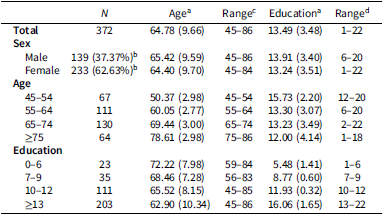
Table 1 presents the demographic characteristics of the participants. The overall mean age of was 64.78 years (SD = 9.66; range = 45–86), and the mean education level was 13.49 years (SD = 3.48; range = 1–22). No significant sex differences were found in either age (t = 0.984, p = .50) or years of education (t = 1.823, p = .966).
Descriptive statistics of demographic characteristic

Table 1 Long description
The table presents demographic characteristics of participants, focusing on age, education, and sex differences. It includes data for 372 participants, with an overall mean age of 64.78 years and a mean education level of 13.49 years. The table is divided into sections by sex and age groups, with columns for the number of participants, mean age, age range, mean education, and education range. Notable trends include the distribution of participants across different age groups and education levels, with no significant sex differences found in either age or years of education. The table provides a detailed breakdown of these characteristics, highlighting the diversity within the participant group.
Note: amean (standard deviation); bpercentage; crange for age; drange for education.
Demographic effects
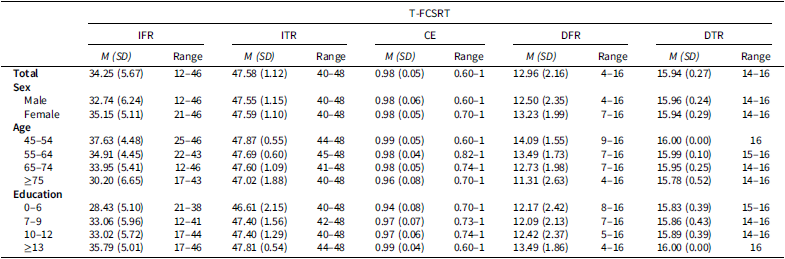
Descriptive statistics of the raw T-FCSRT scores stratified by sex, age, and education are presented in Table 2. To evaluate ceiling effects, the proportion of participants attaining maximum scores on each core measure was examined. Using the conventional 20% threshold (McHorney & Tarlov, Reference McHorney and Tarlov1995), ceiling effects were evident for ITR (76.9%), CE (76.9%), and DTR (95.4%), but not for IFR (0%) or DFR (8.6%). Detail information on ceiling effect rates across sex, age, and education subgroups is presented in Supplementary Table 2. Females outperformed males on free recall measures, IFR (Z = −3.503, p < .001) and DFR (Z = −2.860, p = .001), whereas no significant sex differences emerged for cued recall scores. Correlational analyses (Supplementary Table 3) revealed that age was negatively associated with all T-FCSRT indices, most notably with IFR (r = −.364, p < .001) and DFR (r = −.413, p < .001), while education showed positive associations across all indices (r range = .240–.303, all p < .001), strongest for IFR (r = .303, p < .001). Figure 1 presents the correlation coefficients between T-FCSRT scores and demographic variables, including sex, age, and education.
Descriptive statistics of T-FCSRT raw scores by sex, age, and education

Table 2 Long description
The table presents descriptive statistics of T-FCSRT raw scores categorized by sex, age, and education. It includes five columns: IFR, ITR, CE, DFR, and DTR, each with mean, standard deviation, and range values. The table has 16 rows, including totals, sex categories, age groups, and education levels. Notable trends include higher mean scores for females compared to males in IFR and DFR, and a negative correlation between age and all T-FCSRT indices, particularly IFR and DFR. Education shows positive associations across all indices, with the strongest correlation for IFR.
Note: M = mean; SD = standard deviation.
Correlation coefficients between T-FCSRT scores and demographic variables. Note: Circle size represents the magnitude of the correlation coefficient, and color indicates direction (blue = negative; red = positive). Sex was analyzed using point-biserial correlations; age and education were analyzed using Spearman rank correlations. Edu = Education; IFR = Immediate Free Recall; ITR = Immediate Total Recall; CE = Cue Efficiency; DFR = Delayed Free Recall; DTR = Delayed Total Recall. **p < .01, ***p < .001.

Figure 1 Long description
The matrix displays correlation coefficients between T-FCSRT scores and demographic variables, including Sex, Age, and Education. It consists of six rows and three columns. The rows represent different T-FCSRT scores: Immediate Free Recall (IFR), Immediate Total Recall (ITR), Cue Efficiency (CE), Delayed Free Recall (DFR), and Delayed Total Recall (DTR). The columns represent demographic variables: Sex, Age, and Education. Circle sizes indicate the magnitude of the correlation coefficients, with larger circles representing stronger correlations. Colors indicate the direction of the correlations: blue for negative and red for positive. Sex is analyzed using point-biserial correlations, while Age and Education are analyzed using Spearman rank correlations. Notable trends include strong negative correlations between Age and all T-FCSRT scores, particularly with Delayed Free Recall (DFR) at -0.413. Positive correlations are observed between Education and all T-FCSRT scores, with the highest being 0.303 for Immediate Free Recall (IFR). Sex shows a moderate positive correlation with Immediate Free Recall (IFR) at 0.206 and Delayed Free Recall (DFR) at 0.163. Significant correlations are marked with asterisks, indicating levels of statistical significance.
Regression analyses confirmed these results: age emerged as the strongest negative predictor, education as a positive predictor for all scores, and sex effects were limited to free recall measures (Supplementary Table 4). Age- and education-related trends in T-FCSRT scores were illustrated in Figure 2. The results of pairwise comparisons between age groups and education groups by post hoc test with Bonferroni corrections were summarized in Supplementary Table 5 and Supplementary Table 6 respectively. Overall, significant age and education effects across all five core scores (IFR, ITR, CE, DFR, DTR), with older age groups showing lower memory performance and participants with higher education demonstrating better memory performance (Supplementary Table 7).
FCSRT core scores by (A) age group (controlling for education) and (B) education group (controlling for age). Note: Bars represent mean scores with standard errors. (A) Age-related differences in memory performance are shown after controlling for education; (B) education-related differences are shown after controlling for age. Age groups: 1 = 45–54 years; 2 = 55–64 years; 3 = 65–74 years; 4 = ≥75 years. Education groups: 1 = 0–6 years; 2 = 7–9 years; 3 = 10–12 years; 4 = ≥13 years. IFR = Immediate Free Recall; ITR = Immediate Total Recall; CE = Cue Efficiency; DFR = Delayed Free Recall; DTR = Delayed Total Recall. *p < .0083, **p < .001, ***p < .0001.

Figure 2 Long description
The image contains two sets of bar graphs labeled A and B. Each set includes five separate bar graphs comparing different memory performance scores across age and education groups. The x-axis represents different groups, while the y-axis represents scores for various memory tests. In set A, age groups are compared, and in set B, education groups are compared. Each bar represents mean scores with standard errors. The tests include Immediate Free Recall, Immediate Total Recall, Cue Efficiency, Delayed Free Recall, and Delayed Total Recall. Significant differences are indicated by asterisks, with varying levels of statistical significance. The graphs show how memory performance varies with age and education, highlighting age-related and education-related differences in cognitive function.
Psychometric properties
Reliability
Supplementary Table 8 summarized the demographic details of the subsample used to assess test–retest reliability. Test–retest reliability was moderate to good (ICC = .656–.800). Minimal practice effects were observed, limited to IFR (Z = −2.83, p = .005). However, the mean change (M = 2.46) did not exceed the minimal detectable change (MDC95 = 6.694, 95% CI [4.80, 8.59]), and all mean score changes were smaller than the minimal detectable change (Supplementary Table 9).
Criterion-related validity
Demographic information for the subsample included in the criterion-related validity analysis with WMS-III Logical Memory (LM) were listed in Supplementary Table 10. Correlations with LM were significantly positive overall and strongest for IFR and DFR (Supplementary Table 11). After adjustment for demographics, IFR remained significantly associated with LM2 (ρ = .297, p < .001), whereas the correlations between LM and the other T-FCSRT scores were either reduced or rendered non-significant (Supplementary Table 12). These findings support the convergent validity of the T-FCSRT with established measures of verbal free recall.
Discriminant validity
The demographic characteristics of the subsample used in the discriminant validity analysis were shown in Supplementary Table 13. Correlations with WAIS-III Block Design were small to moderate (Supplementary Table 14). After controlling for demographics, only IFR (ρ = .230, p = .010) and DFR (ρ = .215, p = .017) remained significantly related (Supplementary Table 15), indicating that T-FCSRT performance was largely independent of visuospatial ability.
Construct validity: age effect
Age effects observed across all analyses further supported construct validity, with older adults showing reduced free and cued recall.
Normative data (regression-adjusted percentile norms)
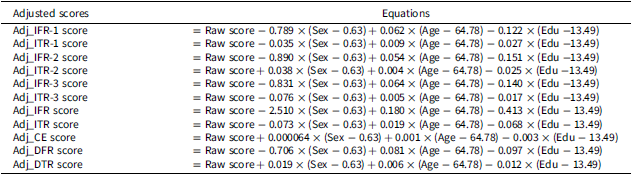
Percentile norms were established based on regression-adjusted scores (Table 3). Raw scores were first adjusted for the effects of age, education, and sex using multiple regression-based equations.
Corrected equations of raw scores

Table 3 Long description
The table presents adjusted scores and corresponding equations for raw scores, accounting for variables such as age, education, and sex. It includes columns for adjusted scores and equations, with rows detailing specific adjusted scores and their respective equations. Each equation adjusts the raw score based on sex, age, and education. The table provides a systematic way to convert raw scores into adjusted scores, considering demographic factors.
Note: Sex: 0 = male, 1 = female; Edu: education in years.
The adjusted scores were then rank-ordered to generate percentile ranks, providing an easily interpretable reference for clinical and research applications. Demographically corrected percentile ranks are presented in Appendix Table 1, with the 5th percentile recommended as the clinical cutoff.
Discussion
The present study aimed to establish representative normative data for the T-FCSRT and to examine the influence of demographic factors and psychometric properties on test performance. Results indicated that age, education, and more modestly, sex, significantly affected T-FCSRT scores. Age emerged as the most consistent and strongest predictor, with higher age associated with lower performances across all indices. Education exerted a positive influence, whereas sex differences were limited to free-recall measures. The T-FCSRT also demonstrated satisfactory reliability and validity, supporting its utility as a robust test for assessing episodic memory. Moreover, the provision of regression-based normative data derived from a large Taiwanese sample offers an important reference for both research and clinical applications.
Demographic effects on the T-FCSRT
Age effect
Age showed a pronounced effect and was the strongest predictor of T-FCSRT performance. A clear age-related decline was observed across all scores, accounting for the largest proportion of variance in immediate and delayed free recall (IFR and DFR). This pattern is consistent with extensive evidence that episodic memory is particularly susceptible to aging (Greene & Naveh-Benjamin, Reference Greene and Naveh-Benjamin2023; Maass et al., Reference Maass, Lockhart, Harrison, Bell, Mellinger, Swinnerton, Baker, Rabinovici and Jagust2018). Such decline likely reflects age-related structural and functional alterations in medial temporal regions, especially the hippocampus and entorhinal cortex, that are critical for episodic memory processing (Fjell et al., Reference Fjell, Sneve, Storsve, Grydeland, Yendiki and Walhovd2016; Johansson et al., Reference Johansson, Wåhlin, Lundquist, Brandmaier, Lindenberger and Nyberg2022).
Previous normative studies of the FCSRT have similarly reported that age significantly predicts performance, with older adults showing marked reductions in free recall despite relatively preserved cued recall (Girtler et al., Reference Girtler, De Carli, Amore, Arnaldi, Bosia, Bruzzaniti, Cappa, Cocito, Colazzo, Ghio, Magi, Mancardi, Nobili, Pardini, Picco, Rissotto, Serrati and Brugnolo2015). This dissociation has been interpreted as reflecting age-related deterioration in strategic retrieval processed, which depend on the functional connectivity between the hippocampus and frontal-parietal regions (Raud et al., Reference Raud, Sneve, Vidal-Piñeiro, Sørensen, Folvik, Ness, Mowinckel, Grydeland, Walhovd and Fjell2023). The present results extend these findings to a Mandarin-speaking population, supporting the validity of the T-FCSRT as a sensitive measure of age-related memory change. Furthermore, these findings underscore the importance of age-adjusted norms to differentiating normal aging from pathological memory impairment, particularly in the early stages of dementia due to AD.
Education effect
Compared with age, the influence of education on FCSRT performance has been less consistent across studies. While some have reported significant but modest educational effects across the FCSRT variables (Calderon-Rubio et al., Reference Calderon-Rubio, Oltra-Cucarella, Bonete-Lopez, Inesta and Sitges-Macia2021; Girtler et al., Reference Girtler, De Carli, Amore, Arnaldi, Bosia, Bruzzaniti, Cappa, Cocito, Colazzo, Ghio, Magi, Mancardi, Nobili, Pardini, Picco, Rissotto, Serrati and Brugnolo2015), others have found no such association (Ivnik et al., Reference Ivnik, Smith, Lucas, Tangalos, Kokmen and Petersen1997; Peña-Casanova et al., Reference Peña-Casanova, Quiñones-Ubeda, Quintana-Aparicio, Aguilar, Badenes, Molinuevo, Torner, Robles, Barquero, Villanueva, Antúnez, Martínez-Parra, Frank-García, Sanz, Fernández, Alfonso, Sol and Blesa2009). In the present study, education positively predicted all T-FCSRT indices, including IFR, ITR, CE, DFR, and DTR, even after controlling for age. The strongest effect emerged for IFR, followed by weaker yet significant effects for the other measures. Several theoretical accounts help explain these findings. The cognitive reserve framework posits that individuals with higher education develop more efficient and flexible cognitive networks, which facilitate compensation for age-related decline (Clouston et al., Reference Clouston, Smith, Mukherjee, Zhang, Hou, Link and Richards2020; Stern, Reference Stern2002). This advantage may be particularly evident in tasks requiring self-initiated retrieval (e.g., IFR, DFR) (Frankenmolen et al., Reference Frankenmolen, Fasotti, Kessels and Oosterman2018). From a neuroplasticity perspective, formal education fosters adaptive structural and functional changes in memory-related brain regions, thereby enhancing cognitive resilience in later life (Boller et al., Reference Boller, Mellah, Ducharme-Laliberté and Belleville2017; Montemurro et al., Reference Montemurro, Filippini, Ferrazzi, Mantini, Arcara and Marino2023). Moreover, individuals with higher education tend to engage in intellectually and socially stimulating activities, which further contribute to superior memory performance (Nie et al., Reference Nie, Richards, Kubinova, Titarenko, Malyutina, Kozela, Pajak, Bobak and Ruiz2021). Collectively, these perspectives suggest that educational experiences strengthen multiple stages of memory processing, including organization, integration, and retrieval (Nikolov & Yeh, Reference Nikolov and Yeh2022). Clinically, this implies that highly educated individuals may compensate for early memory decline, rendering subtle deficits more difficult to detect and increasing the risk of delayed diagnosis. Hence, education-adjusted norms are essential. The regression-based normative approach used in this study addresses this need and enhances diagnostic precision.
Importantly, the FCSRT employs controlled encoding and standardized semantic cueing, which minimizes linguistic and strategy-related demands and thereby reduces performance disparities linked to education attainment. This design contrasts with the WMS LM subtest, which places heavier demands on sustained attention, narrative comprehension, and language skills, rendering it more sensitive to educational variance. Supporting this distinction, Lemos et al. (Reference Lemos, Cunha, Maroco, Afonso, Simoes and Santana2015) demonstrated that the FCSRT effectively differentiated individuals with MCI due to AD from those with dementia due to AD across both low- and high-education groups, whereas the WMS LM subtest showed diagnostic utility primarily among highly educated participants (Lemos, Cunha, et al., Reference Lemos, Cunha, Maroco, Afonso, Simoes and Santana2015). By focusing on single-word processing rather than complex verbal narratives, the FCSRT offers a more equitable assessment of episodic memory across diverse educational backgrounds.
Sex-related effect
In the present study, sex contributed significantly to variance in IFR and DFR beyond the effects of age and education, with women outperforming men on both measures. This advantage persisted after demographic adjustment and is consistent with prior evidence from verbal and episodic memory tasks, including the CVLT (Kljajevic et al., Reference Kljajevic, Evensmoen, Sokołowski, Pani, Hansen and Håberg2023) and WMS (Hirnstein et al., Reference Hirnstein, Stuebs, Moè and Hausmann2023), with meta-analytic evidence suggesting that such differences are especially pronounced for free-recall tasks (Voyer et al., Reference Voyer, Saint Aubin, Altman and Gallant2021).
Although not directly assess in the present study, the observed sex differences may reflect cognitive factors documented in prior studies, including deeper semantic and lexical processing (Wirth et al., Reference Wirth, Horn, Koenig, Stein, Federspiel, Meier, Michel and Strik2006) and greater spontaneous use of elaborative encoding and semantic clustering strategies during memory task (Andreano & Cahill, Reference Andreano and Cahill2009; Kramer et al., Reference Kramer, Delis, Kaplan, O’Donnell and Prifitera1997). These factors are particularly relevant for free-recall tasks, which rely more heavily on internally guided retrieval and organization than do cued recall conditions.
Notably, some previous FCSRT normative studies did not report significant sex effects (Girtler et al., Reference Girtler, De Carli, Amore, Arnaldi, Bosia, Bruzzaniti, Cappa, Cocito, Colazzo, Ghio, Magi, Mancardi, Nobili, Pardini, Picco, Rissotto, Serrati and Brugnolo2015; Ramos-Henderson et al., Reference Ramos-Henderson, Avalos-Tejeda and Carvallo2025), which may partly reflect differences in sample composition. For instance, female participants in those studies generally had lower educational attainment (e.g., M = 11.6 in Girtler et al., Reference Girtler, De Carli, Amore, Arnaldi, Bosia, Bruzzaniti, Cappa, Cocito, Colazzo, Ghio, Magi, Mancardi, Nobili, Pardini, Picco, Rissotto, Serrati and Brugnolo2015) than those in the present sample (M = 13.24), potentially attenuating observable sex-related differences. In addition, the structured encoding and cueing procedures of the FCSRT provide uniform semantic support during both encoding and cued recall, thereby constraining variability associated with individual differences in strategy use. As a result, sex differences are more apparent in free-recall conditions (IFR and DFR), where external cues are absent, and are less pronounced when semantic cues are available.
Our findings extend prior work demonstrating that sex differences can influence clinical interpretation. In our earlier study on item and associative memory among older adults with amnestic MCI (Chang & Moscovitch, Reference Chang and Moscovitch2022), women maintained higher baseline memory performance than men despite comparable neuropathology. When fixed impairment thresholds are applied without considering sex, women’s decline may therefore go undetected until later stages – a concern echoed by Gale et al. (Reference Gale, Baxter and Thompson2016) and Sundermann et al. (Reference Sundermann, Maki, Biegon, Lipton, Mielke, Machulda and Bondi2019).
Taken together, these results highlight the importance of considering sex as a meaningful covariate in both normative development and clinical assessment. Incorporating sex alongside age and education into interpretive models may enhance normative precision and reduce potential bias, thereby supporting more accurate characterization of memory performance across populations.
Psychometric properties
Reliability
This study examined the test–retest reliability of the T-FCSRT to evaluate the temporal stability of its core indices. The results demonstrated moderate to good reliability across all primary scores (IFR, ITR, CE, DFR, and DTR), consistent with prior studies (Frasson et al., Reference Frasson, Ghiretti, Catricala, Pomati, Marcone, Parisi, Rossini, Cappa, Mariani, Vanacore and Clerici2011; Montesinos et al., Reference Montesinos, Parodi, Diaz, Herrera-Perez, Valeriano-Lorenzo, Soto, Delgado, Slachevsky and Custodio2022), and supporting the use of the T-FCSRT in longitudinal and clinical follow-up contexts.
Although a statistically significant increase in IFR scores was observed at retest (Z = −2.83, p = .005), the mean change (M = 2.46) did not exceed the minimal detectable change (MDC95 = 6.694, 95% CI [4.80, 8.59]). This finding suggests that the observed improvement likely reflects measurement variability or minor practice effects rather than a clinically meaningful gain. Notably, IFR also showed the highest MDC95 among the core indices, indicating greater interindividual variability and a higher threshold for detecting true change. In contrast, no significant practice effects were observed for ITR, CE, DFR, or DTR, all of which exhibited lower MDC95 values and high temporal stability.
The absence of ceiling effects in IFR and DFR supports their sensitivity across a broad range of episodic memory abilities and underscores their primary value for clinical interpretation in cognitively healthy and high-functioning individuals. In contrast, pronounced ceiling effects were observed for several total recall and cueing-related indices, particularly ITR, CE, and DTR, with approximately 75–95% of participants achieving maximum scores. These ceiling effects constrain the ability of these indices to capture subtle interindividual differences in normative samples and limit their discriminative utility outside clinically impaired populations. Accordingly, IFR and DFR should be prioritized as the most informative indices for detecting early or subtle memory changes, whereas total recall and cueing measures are best interpreted as complementary indices that become clinically informative primarily when free recall performance is impaired. Despite these limitations, the high test–retest reliability observed for the cued recall indices (ITR and DTR) supports their utility in longitudinal monitoring and clinical trial contexts, where measurement stability over time – rather than sensitivity at the upper performance range – is the primary consideration.
Validity
The results of this study provide converging evidence for the validity of the T-FCSRT across multiple dimensions, including criterion-related, discriminant, and construct validity.
In terms of criterion-related validity, T-FCSRT scores showed significant positive correlations with the WMS-III LM subtest, including both recall and recognition components, providing support for the measure’s criterion-related validity. These findings are consistent with prior research showing strong associations between the FCSRT and standardized memory measures in both healthy and clinical populations (Grober et al., Reference Grober, Ocepek-Welikson and Teresi2009; Lemos, Cunha, et al., Reference Lemos, Cunha, Maroco, Afonso, Simoes and Santana2015; Lemos, Simões, et al., Reference Lemos, Simões, Santiago and Santana2015). Similar to the moderate correlations reported by Vogel et al. (Reference Vogel, Stokholm, Andreasen, Henriksen, Bronniche, Madsen, Gustafsson, Overgaard, Guldberg and Jorgensen2018), our results suggest partial overlap between cued/free recall and narrative memory processes (Vogel et al., Reference Vogel, Stokholm, Andreasen, Henriksen, Bronniche, Madsen, Gustafsson, Overgaard, Guldberg and Jorgensen2018). However, after adjusting for age, education, and sex, most associations were attenuated or became non-significant, indicating that demographic factors contribute substantially to the observed relationships. Conceptual differences between the T-FCSRT and LM subtest may also account for the modest correlations. Whereas the T-FCSRT emphasizes controlled encoding and cue-based retrieval of discrete items, the LM test involves immediate and delayed recall of prose passages, engaging narrative comprehension, syntactic integration, and working memory. Thus, the LM subtest places greater demands on language and contextual processing, while the T-FCSRT targets item-level retrieval supported by semantic cues. These differences highlight the complementary nature of the two measures in capturing distinct facets of episodic memory.
With respect to discriminant validity, the T-FCSRT showed weak associations with the WAIS-III BD subtest, which primarily assesses visuospatial construction and nonverbal problem-solving abilities. Although small correlations were observed between BD and several T-FCSRT indices (DFR, IFR, ITR, DTR), their magnitudes were comparable to those observed for other cognitively demanding yet theoretically distinct tasks and were substantially attenuated after controlling for demographic variables, with only IFR and DFR remaining weakly associated. Importantly, the interpretation of discriminant validity is guided not solely by the magnitude of correlations but by the theoretical distinction between constructs. Whereas Logical Memory and the T-FCSRT both assess verbal episodic memory processes and therefore provide evidence of convergent validity, BD taps a distinct nonverbal visuoconstructional domain. The residual associations observed, particularly for free recall measures, likely reflect shared general cognitive resources such as attentional control or processing efficiency, rather than overlapping mnemonic demands. Taken together, these findings support the discriminant validity of the T-FCSRT with respect to visuospatial abilities, consistent with prior reports indicating that FCSRT performance is largely independent of nonverbal cognitive domains (Grober et al., Reference Grober, Ocepek-Welikson and Teresi2009; Lemos et al., Reference Lemos, Maroco, Simoes and Santana2016).
In addition, construct validity was further supported by the expected age effects. Consistent with previous research, FCSRT performance, particularly free recall, declined with age, reflecting the sensitivity of the test to age-related changes in the hippocampus and medial temporal lobe (Yoo et al., Reference Yoo, Umbach and Lega2021). Taken together, these findings confirm that the T-FCSRT is a valid and psychometrically sound measure of episodic memory. Its convergence with established verbal memory tests, independence from non-memory domains, and sensitivity to age-related differences underscore its utility for both clinical and research applications.
Norms appropriacy and clinical implications
Establishing culturally and demographically appropriate norms is essential for valid neuropsychological assessment in clinical settings. In this study, regression-based normative data were developed for the T-FCSRT, adjusting for the key demographic factors of age, education, and sex. Such regression-based approaches offer important advantages in clinical interpretation by reducing the likelihood of over- or under-identifying cognitive impairment due to demographic influences. Additionally, the cueing structure of the T-FCSRT reduces reliance on self-initiated retrieval strategies, thereby enhancing its suitability for individuals with diverse cognitive, educational, and sociocultural backgrounds. When combined with demographically corrected norms, this design feature makes the T-FCSRT a robust and equitable tool for detecting memory impairment across populations.
In summary, the regression-based normative data established in this study provide a psychometrically sound and clinically relevant benchmark for evaluating episodic memory performance among Mandarin-speaking middle-aged and older adults in Taiwan, supporting accurate and culturally sensitive diagnosis in both research and clinical contexts.
Limitation and future directions
While the present study provides robust normative and psychometric data for the T-FCSRT in a Mandarin-speaking adult population in Taiwan, several limitations should be acknowledged. First, although the sample was stratified by age, education, and geographic region, certain demographic subgroups, particularly younger adults (45–54 years) with lower educational attainment, were underrepresented. This uneven distribution may have introduced bias in the regression estimates and reduced the stability of normative corrections within certain demographic strata. The pattern likely reflects broader societal shifts in Taiwan’s educational system: compulsory education was extended to nine years in 1968 and to 12 years in 2014, making it far less common for individuals born after these reforms to have received fewer than nine years of formal schooling. Consequently, low-education participants were concentrated in older age groups and were scarcely represented among younger adults. Regional differences in educational access may have further contributed to sampling biases. For example, participants from northern Taiwan generally reported higher educational attainment. These factors could have produced unrecognized interactions between region and education in the regression models. Future studies should aim to larger, more evenly distributed samples across demographic strata to strengthen generalizability and precision of normative estimates.
Second, test–retest reliability was evaluated over a relatively short interval; however, the approximately 90-day retest period is comparable to, and in some cases longer than, the intervals commonly used to establish retest stability for widely adopted neuropsychological instruments (e.g., WAIS–IV, Hopkins Verbal Learning Test-Revised), which typically ranged from several weeks to a few months. Accordingly, the present findings provide robust evidence of short-term stability. Future studies may further extend this work by examining longer-term reliability, particularly in clinical follow-up and longitudinal contexts. In addition, the potential influence of practice effects, especially on IFR, should be systematically investigated across varying retest intervals.
Third, although participants were screened using MMSE cutoffs, the inclusion of individuals with subtle or very early cognitive decline cannot be entirely ruled out. The MMSE has limited sensitivity to preclinical or very mild cognitive impairment, particularly among highly educated individuals (Kim et al., Reference Kim, Bai, Koo, Cheon, Yun, Jo and Gu2025), and the inclusion of such cases may result in downward-shifted normative distributions and overly lenient cutoff thresholds. Accordingly, the present norms should be interpreted with caution when applied to early detection or differential diagnosis of pathological aging. Future studies incorporating more comprehensive neuropsychological screening and longitudinal follow-up will be important for enhancing normative purity and strengthening the clinical utility of the test for early identification purposes.
Finally, although demographic corrections improve fairness and interpretability in normative assessment, future research integrating neurobiological and biomarker measures (e.g., hippocampal volume, amyloid, or tau status) will be necessary to evaluate the added value of the T-FCSRT for early disease detection within biomarker-defined frameworks. The present findings provide a solid foundation for the culturally sensitive and psychometrically sound application of the T-FCSRT in Mandarin-speaking populations in Taiwan. Nevertheless, continued validation, particularly in clinical, biomarker-characterized, and longitudinal cohorts, will be essential to establish its diagnostic and prognostic utility beyond normative contexts.
Conclusion
This study established regression-based normative data for the T-FCSRT, adjusting for age, education, and sex. The resulting norms provide a reliable and culturally appropriate framework for interpreting memory performance among Mandarin-speaking adults in Taiwan, addressing the need for localized reference standards in neuropsychological assessment (Ng et al., Reference Ng, Chiew, Lim, Rosa-Neto, Kandiah and Gauthier2018).
Psychometric analyses confirmed good reliability and validity, with delayed recall indices showing good temporal stability, significant associations with the LM, and weak correlations with a visuospatial task, underscoring the specificity for episodic memory of the test. Despite limited subgroup representation and the absence of clinical samples, the findings offer a solid foundation for applying the T-FCSRT in research and clinical contexts and for future validation in clinical populations.
Supplementary material
The supplementary material for this article can be found at https://doi.org/10.1017/S1355617726101957.
Acknowledgements
The authors express their sincere appreciation to the volunteers of the Taipei Zhongshan Bade Meditation Center and the Banqiao Branch of the Buddhist Tzu Chi Foundation for their invaluable support in participant recruitment and administrative coordination. The authors used an AI-based language model (ChatGPT, OpenAI) solely to improve the clarity and fluency of the English writing. The AI tool was not used to generate, analyze, or interpret any scientific content.
Funding statement
This work was supported by the National Science and Technology Council, Taiwan (grant numbers 114-2423-H-002 -009-, 114-2410-H-031-083-, 112-2410-H-002-201-MY3, and 109-2629-H-002-001-MY3). This research was also supported by the Center for Artificial Intelligence & Advanced Robotics, National Taiwan University (grant number 113-2223-E-002-006).
Competing interests
The authors report there are no competing interests to declare.
Referential table for percentile rank of adjusted T-FCSRT scores

Appendix Table 1 Long description
The table presents percentile ranks for adjusted T-FCSRT scores, with columns labeled I R 1, I T 1, I R 2, I T 2, I R 3, I T 3, A I, T C E, and D T F R. The table includes 100 rows, each representing a different percentile from 1 to 100. Each row contains values corresponding to the columns, indicating the scores and their respective percentiles. Notable trends include increasing values across the columns as the percentile rank increases. The table provides a comprehensive reference for clinical and research applications, with the 5th percentile recommended as the clinical cutoff.
Note: IFR-1: adjusted IFR score in first trial; ITR-1: adjusted ITR score in first trial; IFR-2: adjusted IFR score in second trial; ITR-2: adjusted ITR score in second trial; IFR-3: adjusted IFR score in third trial; ITR-3: adjusted ITR score in third trail; IFR: adjusted IFR score; ITR: adjusted ITR score CE: adjusted CE score; DFR: adjusted DFR score; DTR: adjusted DTR score.




 Open access

