




Photographs of the German and Soviet pavilions facing off at the Paris International Exposition in 1937 offer an iconic image of the interwar period, and with good reason. This image captures the interwar period's great conflict of ideologies, the international interconnectedness of the age and the aestheticisation of political and ideological conflict in the age of mass media and mass spectacle. [Figure 1] Last but not least, it captures the importance in the 1930s of what we now call cultural diplomacy. Both pavilions – Germany's, in Albert Speer's neo-classical tower bloc crowned with a giant swastika, and the Soviet Union's, housed in Boris Iofan's forward-thrusting structure topped by Vera Mukhina's monumental sculptural group – represented the outcome of a large-scale collaboration between political leaders and architects, artists, intellectuals and graphic and industrial designers seeking to present their country to foreign visitors in a manner designed to advance the country's interests in the international arena. Each pavilion, that is, made an outreach that was diplomatic – in the sense that it sought to mediate between distinct polities – using means that were cultural – in the sense that they deployed refined aesthetic practices (like the arts and architecture) and in the sense that they highlighted the distinctive features, or ‘culture’, of a particular group (like the German nation or the Soviet state).Footnote 1
Visitors look out over the grounds of the International Exhibition in Paris, 1937.
Scherl, Süddeutsche Zeitung Photo / Alamy Stock Photo
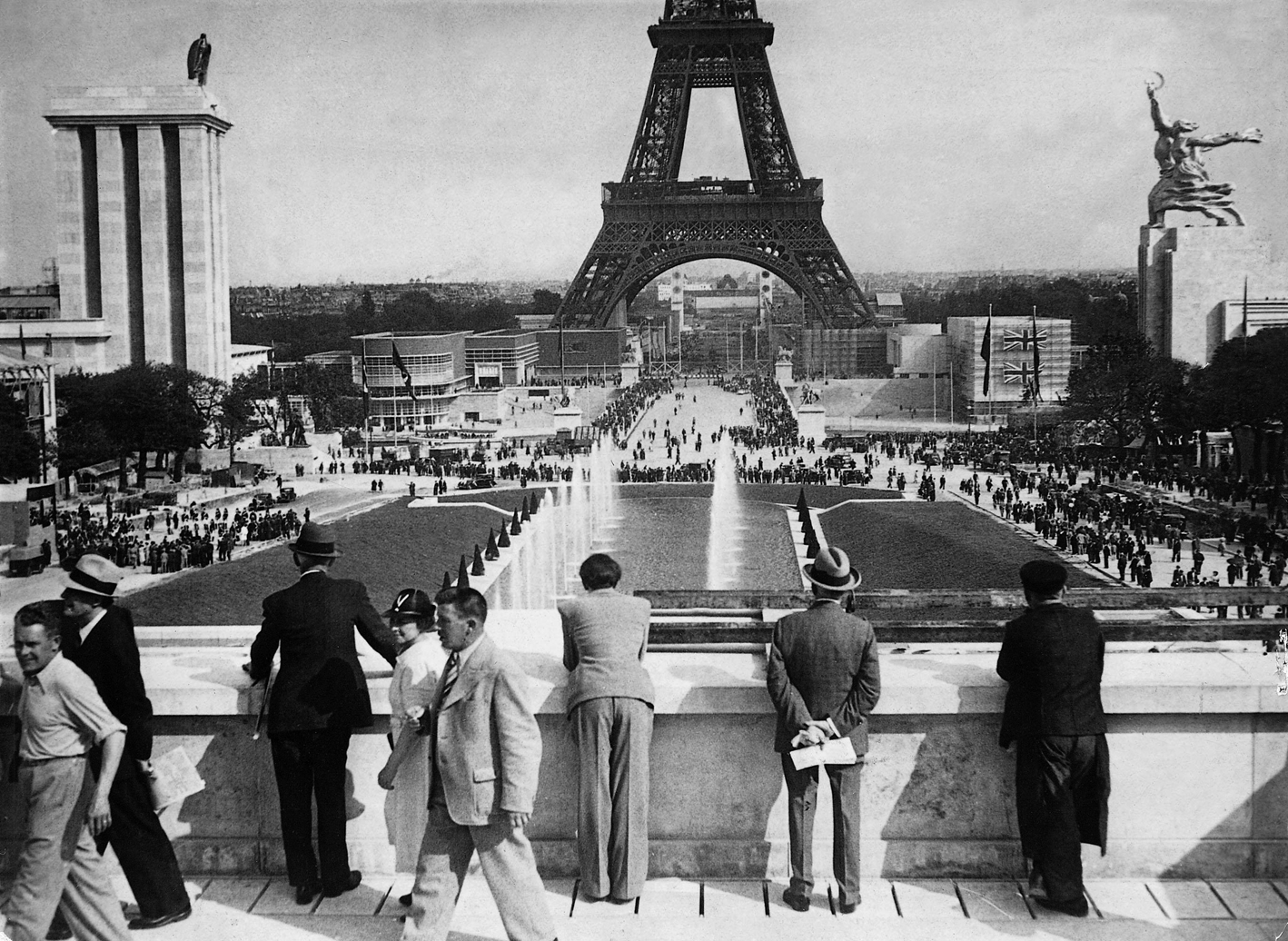
Indeed, as visitors to the Exposition discovered, each of the forty-five pavilions deployed a nationally distinctive blend of cultural symbols and activities in pursuit of what its leaders perceived to be their country's international goals, whether that meant showcasing the modernity and quality of its industrial products, highlighting the nation's historical achievements in the arts or sciences, celebrating its progressive social policies or strengthening its appeal as a tourist destination. Each pavilion, moreover, offered examples of these countries’ broader efforts to engage the cultural sector in international outreach, as musicians, dancers and cooks presented the national culture through concerts and performances and at nationally themed restaurants. By 1937 World's Fairs were themselves nearly a century old.Footnote 2 Yet, the cultural diplomatic character of the event in Paris struck observers as new. ‘For the first time so blatantly’, observed New York Times reporter Anne O'Hare McCormick, ‘the national pavilions are conceived and executed as “national projections”’.Footnote 3 Unlike earlier expositions, with their focus on industrial products or colonial goods, this event, the architect of the Hungarian pavilion wrote, felt like nothing less than a ‘world-wide competition of cultures’ – linked, as the famous image shows, to a battle of ideologies.Footnote 4
The famous image of Paris 1937 serves then as a fitting encapsulation of an important historical development: the explosive development in interwar Europe of cultural diplomacy. Defined as the cultivation of international cultural relations in the national interest, cultural diplomacy was evidently a set of practices that marked the interwar decades to a powerful degree. To be sure, these practices built – as the Parisian exhibition shows – on older traditions of commercial and national representation that go back to at least the nineteenth century; but even those who see cultural exchange as a nearly timeless practice of states recognise that the core practices of what we can call modern cultural diplomacy emerged in Europe between the world wars.Footnote 5 Between 1919 and 1939 almost all European foreign ministries founded ‘cultural departments’, established cultural diplomatic institutions like the German Academic Exchange Service (founded in 1925) or the British Council (1934) and streamlined and expanded the worldwide activity of existing organisations for the promotion of a national language and culture, like the Alliance Française or Italy's Società Dante Alighieri, which had existed since the late 1800s. It was in the 1920s and 1930s that many of the programmes today commonly associated with cultural diplomacy – student exchanges, concerted language promotion or international art and film festivals – were first adopted on a large scale, often through a new relationship with state authorities. Dictatorships and democracies alike embraced these new tools of international politics, thereby transforming European foreign relations as well as the continent's cultural life.
Yet part of the drama and poignancy of this famous image from Paris comes from our awareness that it captures a Europe in the throes of a terrible crisis, on the eve of a second horrific war. Europe's economies had been battered by the depression, many of its democracies had collapsed and its societies were riven by conflict. The prominence of the Soviet and Nazi pavilions was itself a sign of the weakness of liberal democracy and laissez-faire capitalism, now challenged by rivals on the left and right. The inter-state order created at Paris after the First World War was crumbling, while the ability of the League of Nations to offer ‘collective security’ seemed a bitter joke. It is true that the two decades between the end of the First World War and the start of the second saw phases of stability and optimism, too. Yet the designation of the period as ‘the twenty years’ crisis’ has stuck for good reason.Footnote 6
These two aspects of this image, then, raise an intriguing question: why, just when European states struggled with the overlapping political, economic, social and international crises of the 1920s and 1930s, did they invest substantial resources into a field as seemingly elusive as international cultural relations? How did the management of relations among peoples through the arts, literature, architecture, education and science, come to seem like an important concern for foreign ministries? This special issue explores this apparent conundrum. Exploring cases drawn from several European countries and from a broad range of diplomatic activities, the articles assembled here probe the relationship between Europe's interwar crisis and the emergence of modern cultural diplomacy. Our goal is to determine how the period's various crises conditioned the emergence and application of ‘cultural’ practices in diplomacy across Europe, while gauging to what degree the adoption of such practices alleviated (or exacerbated) these crises. The contributions to this special issue are linked by their exploration of the following argument: that cultural diplomacy developed in interwar Europe not despite but because of the period's crisis. It was precisely because European states faced myriad challenges in a fundamentally new international context that they pursued their interests through attention to fields that had previously stood outside of their official competence and interest.
The nine articles we have assembled – charting interwar developments in France, Germany, the United Kingdom, Hungary, Italy, Poland, Spain, the Soviet Union and Sweden – explore how dynamic constellations of policy makers, cultural leaders, intellectuals and diplomats debated and deployed new ways of linking the worlds of the arts, literature, education, tourism and youth exchanges to the pursuit of foreign policy objectives. As the contributions show, these coalitions used the management of international cultural relations as a means to pursue a range of competing and sometimes contradictory goals: to (re-)gain legitimacy, political influence and access to markets; to establish regional hegemony (or the appearance of it); to revise the 1919 peace treaties or to defend them; to disseminate a particular ideological position or to contain a rival ideology's spread. Europe's interwar period, we argue, was a laboratory for the testing of new ‘cultural’ tools in international politics. Like all laboratories, this one saw many failed experiments. But a striking number of the ideas and practices of cultural diplomacy that emerged to meet the period's challenges outlived the conditions of their emergence, shaping diplomatic practice to this day.
The dynamics that guided these experiments were different in each of these countries, yet the ‘laboratory’ in which they took place was one. We argue, that is, that only a transnational, pan-European approach to this history can hope to capture the development of cultural diplomacy in interwar Europe. Even where they focus on a particular national case, the articles of this special issue chart the transnational linkages, patterns of imitation and competition and pan-European contexts within which national-level policy developments took place. In this way, we seek to contribute to the scholarship on cultural diplomacy, to advance the methodological discussion within the field of international history and to shed light on the historical role of culture in international relations more broadly. In this introduction we outline our overarching argument, clarify some of our key terms and discuss trends in the relevant historiography. Against this background, we present the issue's nine articles and identify the historiographical stakes of the special issue as a whole.
Crises, Real and Perceived
In 1939 the British historian E. H. Carr used the phrase ‘the twenty years’ crisis’ to name his study of international relations since 1919. But what scholars call Europe's ‘international crisis’ – the breakdown of the nineteenth-century state system and the contested efforts to replace it with a new international order – was only one of the multiple, intertwined crises that characterised the period. One recent scholarly overview identifies political and economic crises of modernisation, capitalism, democracy and liberalism; social crises of urbanisation, sexuality, gender roles and ‘the masses’; as well as intellectual and cultural crises surrounding the meaning and value of ‘European civilisation’, of standards of taste in an age of mass culture and of the fate of ‘culture’ itself.Footnote 7
Three aspects of crisis are of particular relevance for understanding the interwar embrace of ‘cultural’ practices in international relations. First, the years immediately following the war saw what could be called a crisis of hard power. European countries that had been defeated in the war, like Germany, lost access to the means of using state violence or economic coercion to achieve their international goals. ‘Foreign policy needs power, army, navy and money’, observed the German general-turned-politician Wilhelm Groener in late 1918, but ‘we no longer have any of these’.Footnote 8 Elsewhere in Europe, new minority treaties ruled out coercive options.Footnote 9 States with competing claims to territory were now limited to pursue their irredentist policy goals by trying to win the favour of border populations through cultural appeals. Even those states that retained access to military measures quickly discovered the limits of hard power in the new post-war environment. French officials found, for example, that coercive occupation policies in the Rhineland (1920–30) and the Ruhr (1923–5) backfired, engendering civilian resentment and undermining international sympathies for France.Footnote 10 The pacifist activism of the post-war period likewise narrowed the scope of acceptable foreign policy behaviour.Footnote 11
Second, the interwar period saw a crisis of diplomacy. Already before the war, the traditional practices and values of Europe's nineteenth-century diplomacy were under extraordinary pressure from politicians’ demands for greater influence, a rapidly expanding range of countries and issue areas to address and a dramatically accelerated tempo brought about by new communication technologies.Footnote 12 The calamity of the Great War was widely perceived to have thoroughly discredited the ‘old diplomacy’, with its reliance on arcane negotiations conducted in closed rooms by aristocratic elites.Footnote 13 By 1919 diplomatic failures before and during the war, the enfranchisement of ever greater numbers of citizens and the foundation of new nation-states galvanised calls for a ‘new diplomacy’. Foreign ministries across the continent reorganised to better meet modern conditions and launched efforts to rethink their traditional methods and presuppositions.Footnote 14 ‘Even where the old elites remained in power’, Zara Steiner notes, ‘they faced a fundamentally altered environment both at home and abroad that required an expanded armoury of responses. While many of the traditional modes of diplomacy remained in place, new techniques and institutions were needed to deal with the vast expansion of the international map and agenda.’Footnote 15 Expanded, too, was the range of audiences diplomacy needed to please: elected officials demanded oversight and influence, the domestic and foreign press commented on diplomats’ every move, and ‘public opinion’ was seen to be too powerful to ignore.Footnote 16
Third, the interwar period witnessed a crisis of Europe's cultural and intellectual order. European intellectuals diagnosed crises ‘of European culture’ (Rudolf Pannwitz, 1917), ‘of the mind’ (Paul Valéry, 1918), ‘of the European sciences’ and ‘of European civilisation’ (Edmund Husserl, 1936).Footnote 17 If some of these claims sound melodramatic, in practical terms one can see that they were not wrong.Footnote 18 The war had shattered the networks of intra-European cultural and intellectual exchange that had grown so much since the last third of the nineteenth century. Many of the cultural and intellectual networks and institutions created after 1918, designed to punish and exclude Germany, carried the bitterness of the wartime conflict into the post-war decades. Indeed, the Paris peace treaties upended Europe's intellectual and cultural system no less than they altered the continent's military, economic and territorial fabric. Articles 282 and 289 of the Versailles Treaty as well as the territorial provisions of the Treaties of Saint-Germain and Trianon voided pre-war cultural and scientific arrangements and took away cultural and intellectual resources from various states, thus laying the groundwork for a new order that privileged inter-Allied organisations while barring the defeated Central Powers (and Soviet Russia) from membership. This recalibration affected international communications agreements, academic and scientific networks, the post-war Olympic games and even newly-founded humanitarian bodies.Footnote 19 In the academic world, the rift was so deep and resentments so intense that historians have spoken of a ‘cold war in international scientific relations’ that lasted for the better part of the interwar years.Footnote 20 The bitterness of this conflict underscored the fact that statesmen and industrialists, as well as writers and scholars, had come to see international networks of intellectual and cultural exchange as crucial levers of power in the modern world. Any new international order, it was understood, would need to include a vision of cultural order, too.Footnote 21 The shape of the new international intellectual and cultural order was, then, a matter of interest at European foreign ministries.
‘Crisis’ is a charged concept, with a rich historiography of its own.Footnote 22 We foreground the concept here, not in order to make any definitive claim about the true nature of Europe's troubles, but to call attention to the crucial role that perceptions of crisis played in the development of new strategies in international relations. Across the continent, Europeans active in this field shared the widely held view that theirs was a historical moment of extraordinary change and fluidity, in which great decisions must be taken that would have far-reaching consequences. The term ‘crisis’ itself, already a key concept of European modernity long before the First World War, was pressed into new service as a key tool for diagnosing the period's problems, envisioning solutions and outlining calls to action.Footnote 23 Used in the interwar decades to describe countless areas of modern life, the term captured the overlapping, imbricated quality of the period's challenges, reflecting the degree to which thinking about ‘the international crisis’ could never be completely divorced from real or perceived crises in economics, society or intellectual and cultural life.
Importantly, moreover, this multifaceted sense of crisis stimulated creativity. Precisely because so many old, established practices and values seemed to have collapsed, the way was open to advance new practices and values in their place.Footnote 24 It is against this background of crisis, we argue, that we can explore (and hope to make sense of) why statesmen across the continent investigated alternative means of pursuing foreign policy goals and exercising influence, developing partnerships with individuals and groups – including university professors, literary writers, the Catholic priesthood, avant-garde artists or the leadership of the Boy Scout movement – who could work with diplomatic officials in pursuing these ends.
Of course, that which was understood to be in crisis – in diplomacy, politics, economics or culture – varied widely across the continent and changed substantially over time. So, too, did the particular manner in which real and perceived crises stimulated the embrace of ‘cultural’ approaches to international relations in different European countries. In order to capture some of this multiplicity, this special issue brings together articles that explore a diverse set of activities that mobilised state power, non-state actors and various aspects of cultural and intellectual life in new cross-border configurations, focusing on several different European countries. This approach underlines an important feature of our argument: we do not claim to identify a single origin story for a generic practice called ‘cultural diplomacy’. On the contrary, our point is precisely that the interwar crisis called forth a multitude of experiments in the broad area of what would come to be called cultural diplomacy, accompanied by a rich debate about the goals, efficacy and significance of these experiments. Driven by that mix of possibility and fear that characterised the twenty years’ crisis, these experiments, and the debates about them, launched competing visions of what diplomacy could do and of what ‘the cultural’ included, producing policies and ideas that a richer history of modern cultural diplomacy needs to take into account.
Recasting Histories of Cultural Diplomacy
In making these arguments, we engage with and contribute in particular to two bodies of literature. The first of these is the historical scholarship on cultural diplomacy. This historiography has grown a great deal over the last decades, focusing particularly on state-sponsored forms in the twentieth century. Definitions of the term have varied and debate on its use continues; it has been labelled ‘one of the most confusing terms in modern diplomatic history’.Footnote 25 For the purposes of this special issue, we are most influenced by those definitions – like Michael David-Fox's proposal to define cultural diplomacy as ‘the systematic inclusion of a cultural dimension to foreign relations’ – that take a broad view of both culture and diplomacy and that remain agnostic as to which agents conduct it and why.Footnote 26 As we use the term here, that is, cultural diplomacy can refer to activities conducted by state as well as by non-state actors, designed to advance national or ideological agendas as well as to promote international understanding. Above all, we seek here to adopt perspectives wide enough to capture the range of unexpected, small-scale and sometimes accidental historical developments by which the practices that are now commonly called cultural diplomacy developed in particular historical contexts in interwar Europe.
Of course, if cultural diplomacy is as old as political power itself, as some have argued, then its existence in the twentieth century requires no particular explanation.Footnote 27 Yet, the bulk of the historical literature on cultural diplomacy focuses on the period after the Second World War, as if the practice had emerged only then.Footnote 28 This trend is exemplified by the research on US cultural diplomacy during the Cold War, which continues to constitute a significant, even disproportionate, part of the historical literature. This is not entirely surprising: during the Cold War cultural diplomacy became a large-scale, expansive and highly political undertaking, pursued with unprecedented financial means.Footnote 29 Organisations and offices like the CIA, the State Department, the Ford Foundation, the Peace Corps or the Fulbright Commission all fought on the frontlines of the cultural cold wars. Even as newer research on the twentieth-century cultural diplomacy of other countries and other continents has decentred the narratives of Americanisation that characterised much earlier research, most of these studies continue to foreground the Cold War as the period when cultural diplomacy became a politically significant phenomenon.Footnote 30
This Cold War focus in the historiography has been challenged by a growing range of studies on ‘cultural’ developments in the diplomatic history of the period before and during the First World War. The last third of the nineteenth century witnessed the foundation of path-breaking cultural organisations like the Alliance Française, a boom in national representations at world's fairs as well as the first academic exchange programmes. Increasing imperial and commercial competition prompted many Europeans to consider new ways to strengthen their nation's global influence. In fact, as recent research has shown, by the turn of the century it was not so much state administrations as self-appointed ‘cultural diplomats’, including writers, musicians, teachers, academics, journalists, athletes and tourists, that sought to promote what they felt to be their superior national culture abroad.Footnote 31 The Great War accelerated and reshaped these developments in profound ways. Studies of the role of propaganda have long occupied a solid place in the historical literature on the Great War, documenting the way European countries undertook new efforts to control their national image abroad (for example, by creating new institutions to control press outreach to domestic and foreign audiences, not least in neutral countries).Footnote 32 Building on this work, another body of research has explored various national cases of what Martha Hanna called ‘the mobilization of intellect’, referring to the wartime efflorescence of collaboration between state officials and intellectuals and artists in producing what has sometimes been called ‘cultural propaganda’.Footnote 33 More recently, historians of this period have shifted their focus, using the analytical category of diplomacy, rather than propaganda, to explore the rich variety of efforts to use academic, intellectual and cultural exchange and cooperation to create relationships, rather than only one-way projection or influence, as a means of advancing national interests. Historical research on international educational exchanges, for example, has shown the extent of ‘academic diplomacy’ already before the war, allowing us to see European intellectuals’ wartime mobilisation as part of a longer-term history of efforts to create and control transnational knowledge networks.Footnote 34 This work has emerged in dialogue with the (likewise expanding) historiography on late nineteenth- and early twentieth-century internationalism, not least through works exploring the field that Arika Iriye influentially identified as ‘cultural internationalism’.Footnote 35
A similar set of concerns – attention to the history of transnational relationship building, a belief in the historical significance of international intellectual and cultural networks and an interest in the role of culture in power relations – has likewise marked the recent growth of research on practices of cultural diplomacy in Europe during the interwar decades. This work has shown that programmes of cultural diplomacy were conducted by many countries, in a wide range of ways. By now, studies have documented the use of cultural strategies by the Hungarian, Czechoslovak, Italian, German, Spanish and Soviet governments to advance their international interests in the interwar period.Footnote 36 This scholarship's findings are complemented by studies emphasising the role of non-state actors, like Tara Windsor's on the cultural diplomacy of Weimar-era German writers, Katharina Rietzler's on the European peace-building projects of U.S. foundations, or Giuliana Chamedes's on the Vatican's innovative use of mass media to advance an anti-communist Catholic international. Recent transnational works have explored efforts to create cultural networks in support of broader political and economic visions of international order.Footnote 37 Taken together, these studies have begun to give the age ‘before the cultural cold wars’ (Rietzler) greater pride of place, while also outlining a wealth of new methodological insights.
With this special issue we seek to build on and add to this work in two main ways. First, the findings and approaches of this new research on the interwar period need to be collected and complemented by further research so that common features that this research has identified in separate cases can be seen together. These features include the emphasis on relationship building rather than on one-way projection or propaganda, the attention to a broad range of ‘cultural’ exchanges and activities rather than primarily on the press, the growing attention to the role of non-state actors and a subtler conceptualisation of the relationship between culture and power. There is so far no collection of research on the cultural diplomacy of the interwar period such as exists for the Cold War era (or indeed for particular decades of that period). Responding to this gap with the studies gathered here, we aim to state more strongly an argument that recurs in this recent research: that the interwar period was a pivotal moment for the emergence of modern cultural diplomacy.
Second, research on pre-1945 cultural diplomacy in Europe has been largely pursued through national case studies. Early efforts to understand ‘the cultural approach’ in interwar international relations (written generally by analysts and practitioners of diplomacy, rather than by historians) took a comparative approach as a matter of course.Footnote 38 Historians’ archive-based investigations have by contrast, if for good reasons, generally focused on a particular national case. This makes sense, yet it also means that we lack insight into the European (and in some cases transatlantic or global) contexts in which actors operated, or into the transnational processes of learning and competition that drove the development of cultural diplomacy.Footnote 39 It likewise remains difficult to ascertain what was distinctive and what representative about each national case, inviting exceptionalist claims and obscuring broader European developments. The essays we gather here seek to address this challenge by taking a Europeanist and transnational approach in our efforts to understand multiple cases of the embrace of cultural approaches in interwar European international relations. By exploring the way local, regional and global factors played out in several national cases, we seek, that is, to combine careful attention to the specificity of each national situation with an eye to broader features, like the role and agency of non-state actors, the role of cross-border contacts and foreign actors in the development of national policies and the broader contexts – from international cooperation to ideological competition – that shaped the particular practices of (and ideas about) cultural diplomacy in each country. Readers of the articles will note differences and idiosyncrasies among the cases, but also similarities and broad patterns.
New Perspectives on ‘New Diplomatic History’
The second body of historiography we engage with here is the field known as ‘new diplomatic history’. Transcending the traditional interest in how state decision makers conducted foreign affairs, this field is marked by an emphasis on how diverse groups operated on the world stage and influenced or were influenced by international developments.Footnote 40 This shift of emphasis can be seen in the recent work on the international history of the interwar period, in which the traditional emphasis on high politics and the official diplomacy deriving from or leading to the world wars has been enriched by attention to the diplomatic role of international organisations and transnational actors, such as humanitarians, tourists and health professionals.Footnote 41 This scholarship has broadened our understanding of interwar politics and led to a reevaluation of the era: an age often considered primarily for its diplomatic failures is now increasingly seen as a pivotal moment for the ‘emergence of international society’.Footnote 42 This re-evaluation is perhaps most apparent in the new scholarship on the League of Nations, including studies of the international intellectual and cultural initiatives associated with the League.Footnote 43
This special issue contributes to and complicates this historiography in several ways. Building on approaches associated with new diplomatic history, we embrace a broad view of what can be defined as diplomatic and seen as historically significant. The articles here invite us to turn our attention for a moment away from Rapallo and Locarno, reparations and disarmament, Woodrow Wilson and Aristide Briand, and grant it instead to youth jamborees and summer camps, international expositions and academic exchanges, tourism promotion and art exhibitions. This shift of focus, based on a broad view on the workings of power and of the nature of the political, offers a different understanding of where, how and by whom interwar politics was actually made, broadening our perspective on interwar politics by providing new vistas for the analysis of the workings of power in interstate relations.
This approach demands a balance between transnational and international approaches to interwar history, looking neither solely at state nor non-state actors but analysing multiple cases of the complex interactions between these groups. Indeed, the development of many new forms of collaboration between the state and private groups and individuals in efforts to advance a country's international interests through cultural means was, we argue, a defining feature of the interwar period. In many European countries, these evolving relationships between the state and artists, writers and professors (or youth leaders, religious officials or tourism promoters) took the form of ideological models, offering fascist, communist or liberal visions of the most appropriate and efficacious way to manage those relationships. Precisely because the interwar crisis had brought the broader relationship between state and society into question, models of this kind emerged, were articulated and did battle with one another in an international competition not only over which country would exert influence but over how they would go about doing it.
In this way, we touch on the interplay of nationalism and internationalism, an issue that has preoccupied historians of the interwar period. For example, Iriye distinguished sharply between cultural internationalism and cultural diplomacy. While the former, by his account, aimed for international harmony and understanding, the latter was a cynical use of cultural connections to advance state power.Footnote 44 The studies gathered here suggest that this opposition does not hold. They show, rather, that particular states’ programmes of cultural diplomacy were designed against the background of networks, institutions and values that were transnational in character, while many countries’ foreign offices actively made use of internationalist settings to advance national images. Here we build on the recent scholarship that challenges the earlier tendency to use a clearly drawn conflict between nationalists and internationalists as a master narrative of the interwar international crisis, emphasising instead the degree to which nationalism and internationalism were intertwined.Footnote 45 Appreciating these complexities in each case is a vital step toward improving our understanding of how cultural diplomacy (of even the most nationalist kind) emerged: namely, in a dialectical relationship with the internationalism that marked the interwar period. When European states promoted the cross-border exchange of students, sponsored an art exhibit abroad or opened a lavish national pavilion at an international exposition these activities could promote internationalism, the national interest or, quite frequently, both. This combination was a major part of what made the interwar period a defining moment for cultural diplomacy's historical development.
Finally, we challenge the widespread tendency of work on cultural diplomacy to get stuck in an overdetermined opposition between the apparently bona fide promotion of peace and understanding on one hand, and an aggressive nationalist use (or abuse) of culture on the other. We argue that a nuanced approach, one that does not define the goals of cultural diplomatic programmes in advance, that is attentive to the workings of power in different cases and that explores (rather than assumes) the dynamic relations between state officials and non-state actors, shows that interwar cultural diplomacy did both: it promoted real connections among peoples even as it served national and ideological interests.
Interwar Trends and European Perspectives
Our articles identify three interwar trends that in many respects came to define modern cultural diplomacy: expansion, professionalisation and nationalisation. The 1920s and 1930s saw a rapid expansion of cultural diplomatic activity. Although the process was uneven across Europe, it was then that cultural diplomacy began to encompass the sort of activities we associate with it today, including student exchanges and systematic language promotion, as well as lower-brow concerns like sports, tourism and popular festivals. Moreover, these cultural diplomatic activities were increasingly professionalised and institutionalised. The handling of specific sub-fields like academic exchange or language promotion was concentrated in specialised organisations like the German Academic Exchange Service or the British Council. Consequently, the pursuit of cultural diplomacy became less an endeavour of enthusiastic amateurs and more of a professional career. By the late 1930s there was a first generation of public and private cultural diplomats with a relatively sophisticated understanding of the practice and objectives of cultural diplomacy. For instance, interwar guidelines on how best to select and prepare exchange students for their role as ‘informal ambassadors’ abroad differ remarkably little from today's. Finally, and in some respects most importantly, state involvement in cultural diplomacy rose notably. While few state administrations had shown any coherent interest in this field by 1900 or even 1918, nearly all did by 1940. A number of European foreign ministries established ‘cultural departments’ already in 1919–20 and most others followed suit over the course of the 1920s and 1930s. The state's moral and financial resources underwrote the expansion of the field and provided a global support network through consulates and embassies. As they would during the Cold War, state and non-state actors began to align cultural programmes with perceived foreign policy objectives, while the Great Depression and the rise of totalitarian ideologies further strengthened state influence and control in the 1930s. As a consequence, whether an art exhibit or a lecture tour took place came to depend less and less on chance and individual initiative and more and more on the plans and priorities of foreign policy makers.
The European perspective that we take here helps explain why and how these developments took place, in three ways. First, a comparative European perspective shows that, in spite of many differences, the trends of expansion, professionalisation and nationalisation were broadly uniform across Europe.Footnote 46 What countries deemed worth advertising about themselves varied – whether it be claims to leadership in Wissenschaft (Germany), social reform (Sweden) or Christianity (Hungary) – but the means of communicating and showcasing these ‘national characteristics’ converged over the course of the 1920s and 1930s. For instance, most European countries began to adopt some form of language promotion and youth exchange and began to consider novel instruments like cultural attachés and bilateral treaties regulating cultural and intellectual exchange. This finding suggests that factors of difference among states – like their size, wealth or ideological commitments – were perhaps less important than factors that European states had in common. One such factor was the transnational circulation of information about cultural diplomacy. Many of our articles document the importance of learning processes. At the same time, they find that these processes of observation and imitation were driven by two apparently opposite tendencies: on one hand, the internationalist initiatives of the age brought cultural agents (and sometimes state officials) together as never before, often in efforts to streamline and coordinate modes of intellectual and cultural exchange, thus creating opportunities for participants to compare and contrast various approaches to cultural diplomatic outreach. On the other hand, the thirst for information about other states’ cultural programmes was driven by intense international competition, and the adoption of cultural policies often depended on the perceived successes of international rivals in that field.
Second, our European perspective confirms the degree to which cooperation between state and non-state actors was a defining feature of cultural diplomacy. In cultural diplomacy, ‘unlike in other areas of diplomacy,’ as Jessica Gienow-Hecht has observed, ‘the state cannot do much without the support of nongovernmental actors such as artists, curators, teachers, lecturers and students’.Footnote 47 Just how this support, or rather these dynamic relationships, looked varied in each case. Taken together, the cases we explore here underline the centrality of this dynamic for understanding what cultural diplomacy was and how it came to be.
Third, our pan-European perspective sheds light on the transformations of interwar diplomacy by allowing us to observe another broad similarity: the articles illustrate not simply the adoption of new policy measures but attest to a shift in thinking about the political significance of cross-border cultural relations. At the turn of the century hardly anyone thought of students or artists, let alone tourists, as relevant to international politics; by 1939 hardly anyone doubted they were. This suggests a broader historical question: how did cultural relations come to be perceived as political? We suggest here that a productive way to approach that question is to explore the emergence of cultural diplomacy in the context of Europe's interwar crisis. That is, by taking seriously historical actors’ perception of the period's multiple (yet overlapping and inextricably linked) crises – of the period's international political order and of its cultural order, as well as in economics, domestic politics and society more broadly – we can make sense of the development of so many versions of external policies that mixed cross-border exchange seen as ‘cultural’ with the pursuit of goals defined as ‘political’.
The nine articles that comprise this special issue explore the evolution of cultural diplomacy across the interwar period through a series of studies, each with a different focus – not only in terms of national cases, but in terms of the particular cultural field that was engaged, and the particular type of diplomatic programme under consideration: from exhibitions, to educational exchanges, to summer camps, to diplomatic agreements. We present these in three thematic groups.
Unlikely Partnerships
If crises seemed to demand that states turn to culture, that turn to culture demanded a reliance on new actors and agents from outside the state and, indeed, sometimes from outside of the country. The articles by Bérard, Windsor and Martínez del Campo explore the role that non-state actors played in the early development of cultural diplomatic initiatives after the First World War. Ewa Bérard's study of the planning that lay behind the 1922 Exhibition of Russian Art in Berlin shows that this event grew out of complex, chaotic cooperation (and competition) among state officials, intellectuals and artists within and beyond the Soviet Union. The desperate effort to respond to the crisis of the 1921 famine in the Soviet Union led Bolshevik officials to cooperate (more or less happily) with Soviet citizens and Russian émigrés who were not ideological supporters of the regime, and with ideological supporters who were not Soviet citizens. The Bolshevik's use of avant-garde art to advance the new state's legitimacy abroad – long seen as a distinctive achievement of early Soviet cultural diplomacy – was, Bérard shows, a practice that came about in a thoroughly public-private and transnational manner.
When German writers built a section in the PEN Club, this was routinely accused of being the ‘extended arm of Reich foreign policy’. Tara Windsor's study of the German section of the PEN Club shows however that this organisation brought together diverse private and state-affiliated actors in an uneasy form of collaboration. All sought to use the infrastructure of ‘literary internationalism’ to facilitate Germany's cross-border relations with the outside world, seeking to use cultural means where other forms of power were no longer available. But they did so in order to advance quite diverse agendas. Complicating a story that has often been reduced to a morality tale about the ‘politicisation’ of literary life, Windsor's article shows how the historical study of cultural diplomacy can shed light on the diversity of political, cultural and ethical visions that can, under certain circumstances, find reasons to cooperate.
Luis Martínez del Campo's study of the cultural diplomacy of interwar Spain combines insights into the role of non-state actors with a transnational focus to reinterpret the process whereby a modern institution of state-led cultural diplomacy emerged in that country. In the 1920s the dictatorship of Primo de Rivera perceived the value in using the Spanish language and the country's high cultural heritage to advance Spain's prestige and influence abroad, yet lacked the economic resources to develop a cultural diplomatic programme. The state, Martínez de Campo shows, succeed in establishing an infrastructure for cultural diplomacy only by building on the promotion of Spanish language and culture that had already been undertaken by foreign governments and institutions. Martínez del Campo's article thus again underlines the importance of a transnational approach to make sense of a national case.
Cultures of Revisionism
The second group of articles explores the relationship between cultural diplomacy and geopolitical struggles over the shape of the European international system in the interwar decades. Three articles explore cases in which coalitions of political leaders and private individuals and groups launched cultural diplomatic programmes that were designed to promote the revision of the interwar international political settlement – yet did so, ironically, in contexts that were marked by the spirit of international cooperation. Peter Polak-Springer's study of the German–Polish ‘summer vacation exchange for children’ from 1924 to 1938 shows how a cross-border exchange programme of the kind usually celebrated for promoting international understanding was mobilised in the service of ethnic-nationalist conflict in the disputed region of Upper Silesia.
Within the multi-faceted programme of cultural diplomacy developed in interwar Hungary, Zsolt Nagy shows, Hungarian officials brought international religious, cultural and youth events to Hungary in a calculated gambit: hosting events like the Fourth World Scout Jamboree (1933) and the International Eucharistic Congress (1938) would strengthen Hungary's claim to being the leading state in the region, and thereby legitimate its demands for a revision of the Treaty of Trianon that had stripped the pre-war Kingdom of Hungary of so much territory and population. In this way, Hungarian officials – working with private agencies in and outside of the country – pursued a cultural internationalism in the service of nationalist revisionism.
Elisabeth Piller's article documents the way transatlantic student exchanges were likewise repurposed to serve competing visions of the international order. While German officials hoped to use these to build a transatlantic ‘friendship’ with the Americans that could serve Berlin's revisionist politics, French officials – nervously observing the Germans’ programmes – expanded their own transatlantic academic outreach in order to gain US support in maintaining the system created at Versailles. This was only one of several cases, documented in this special issue, in which revisionist cultural diplomacy had powerful ripple effects on the development of policy initiatives elsewhere in Europe.
The Cultural Diplomacy of Ideological Struggle
The mid-twentieth century was the age of ideological struggle and by the mid-1930s this development made itself felt in the world of cultural diplomacy. Moreover, transnational ideological contestation also drove the developments of practices and tools by which the world of culture was mobilised in international relations. The special issue's three final papers explore various aspects of the relationship between ideological conflict and the development of cultural diplomacy.
Alice Byrne's study of British efforts to attract foreign students in the 1920s and 30s explores the strategic thinking that led British officials to develop an ambitious office for student recruitment in 1934, as part of the newly created British Council. Her findings, noting the fluctuating significance of economic, geopolitical and ideological concerns over the course of the interwar decades, underline the importance of approaches that allow us to see what Glena Sluga and Patricia Clavin have called ‘the ideologically and intellectually interconnected pasts of nationalism, imperialism and internationalisms’.Footnote 48 If the world's mightiest empire felt the need to develop a cultural diplomacy that could respond to the ideological conflicts of the 1930s, Europe's smaller states faced an even more pressing struggle to find their places in the period's ideological landscape, and had even fewer ‘hard power’ resources at their disposal.
Nikolas Glover and Andreas Hellenes explore the dynamics of small state cultural diplomacy in their study of Sweden's self-presentation at international expositions in the 1930s. Swedish officials, they show, developed a programme of cultural diplomacy that sought to seize the moment offered by the crisis. That is, Sweden's relative success in weathering the depression while retaining liberal democracy had captured the attention of international observers, while the crisis had knocked Europe's traditionally influential nations into positions of weakness. In crafting an image of Sweden as ‘a modern society catering to democratic citizens and rational consumers alike’, a coalition of arts and business leaders, advertising professionals and state officials helped launch themes that would prove central to the presentation of the Scandinavian model long after 1945. In the meantime, the ideological conflicts of the 1930s also stimulated the development of new cultural-diplomatic strategies and tools.
Benjamin Martin's article explores one such development: the growing use of bilateral diplomatic agreements to promote and regulate intellectual and cultural exchange. Comparing France and Italy's use of such agreements reveals that Italy's fascist regime developed a distinctive model of ‘cultural treaty’ that applied state power to international cultural exchange, and mobilised the idea of ‘culture’ itself, in new ways. Versions of this model agreement would go on to be a major tool of the cultural diplomacy of the Cold War. Fascist Italy's cultural treaty, then – like Sweden's carefully calibrated strategy of national self-presentation and Britain's new institutions for managing foreign students – was an innovation that reflected the specific circumstances of the interwar period, yet one that lasted long after those circumstances had passed into history.
Indeed, every article of this special issue reveals features of the emerging cultural diplomacy of interwar Europe that had important legacies in the decades after 1945. If we stress the importance of the specific interwar conditions that shaped the emergence of these features, our goal is not to mark off interwar Europe's cultural diplomacy as a topic apart. It is, on the contrary, to highlight the importance of Europe's interwar decades – and of transnational and pan-European perspectives – for understanding the long-term history of cultural diplomacy's practices, ideas and institutions. In turn, that is an approach that, we hope, can contribute to the broader historical investigation of the relationship between culture and power in the international arena in the twentieth century.


 Open access

