




1. Introduction.
The aspectual category progressive marks an action as “ongoing at reference time” (Bybee et al. Reference Bybee, Perkins and Pagliuca1994:26). In contrast to English (Mair Reference Mair and Robert2012), but like most other Germanic languages (Weber Reference Weber2023), German lacks progressive aspect, that is, there is no strongly grammaticalized category that obligatorily codes progressive aspectuality (or progressivity). There are, however, a couple of German constructions that are conventionally used for expressing the semantic notion of progressivity, which have the potential to develop into proper progressive constructions. The most grammaticalized German construction for expressing progressivity is the so-called am-progressive (for example, Krause Reference Krause2002, Van Pottelberge Reference Van Pottelberge2004, Flick Reference Flick2016, Kuhmichel Reference Kuhmichel2016). Another construction that is known to be used for expressing progressivity in Germanic languages, especially Mainland Scandinavian (for instance, Hesse Reference Hesse2009, Lødrup Reference Lødrup2014, Kinn et al. Reference Kinn, Blensenius and Andersson2018), but also in non-Germanic languages, for example, Bulgarian (Kuteva Reference Kuteva1999), is posture verb pseudo-coordination (henceforth posture verb PC). So far, this construction has been claimed not to belong to the inventory of constructions for expressing progressivity in German (for example, Ebert Reference Ebert2000, Hesse Reference Hesse2009, Behrens et al. Reference Behrens, Flecken and Carroll2013) and, accordingly, has not been studied for German. The present paper investigates pseudo-coordinated sitzen ‘sit’ and stehen ‘stand’ in spoken German and their aspectual potential. The study assumes that looking at variation in synchronic data can lead to hypotheses about possible diachronic developments.
The analysis shows that German posture verb PC has several functions. Apart from the general discourse pragmatic function of information packaging, which it shares with pseudo-coordination with other verbs in the first conjunct, it has both an aspectual and a subjective function. It is proposed that the two latter functions arise from different postural, durative, and locational meaning components of the posture verb. The postural component is inherent to the verbs themselves. While the specific posture differs for the two verbs, they share the more abstract semantic feature of durativity. Moreover, both verbs occur with an obligatory local adverbial, which specifies where the subject referent is located. This locational component can also be seen as part of the verb’s meaning via its argument structure. The aspectual function of posture verb PC arises as the event coded by the verb in the second conjunct is construed as temporally extended because of the posture verb’s durative semantics, while the postural and locational components are back-grounded. The subjective function, in turn, may arise from inferences drawn based on the extended duration. For example, the effort required to sit and study for an extended period of time can become associated with determination. This way, posture verb PC can be used to express the speaker’s evaluation of a subject referent as determined. In this paper, expressions that convey the speaker’s beliefs and attitudes are referred to as subjective, following Traugott (Reference Traugott, Davidse, Vandelanotte and Cuyckens2010, Reference Traugott2022). Attributing determination to the subject referent is just one facet of the subjective function (see section 5.3).
The analysis also covers the frequency of aspectual verb classes and verb lexemes in the second conjunct. There is a general preference for activity verbs, with one of the most frequent specific activities being waiting. This suggests that the majority of uses of posture verb PC has a progressive potential, as progressives typically prefer activity verbs. Yet the use of verbs denoting accomplishments, achievements, and states is also common, suggesting that the construction is not only used for expressing progressivity but has other functions as well. All findings are in line with what has been found for posture verb PC crosslinguistically. The study shows that although the German variant may be grammaticalized to a lesser degree, its potential for expressing aspectual and subjective meanings is comparable to the semantic tendencies of its counterparts in other languages.
The paper is structured as follows: After a review of the research on the interconnection of pseudo-coordination and aspectuality cross-linguistically, as well as previous research on pseudo-coordination in German (section 2), the data and method of the study are presented (section 3). The results are discussed in sections 4 and 5. First, some statistical tendencies in the realization of local adverbials and verb lexemes in the second conjunct are described and compared with findings on other languages (section 4.1). Second, the degree of grammaticalization of posture verb PC in German is assessed in light of the empirical findings (section 4.2). Finally, each of the above-mentioned functions are discussed in detail: discourse pragmatic (section 5.1), aspectual (section 5.2), and subjective (section 5.3). Finally, in section 6, a comparison is drawn between German posture verb PC and the am-progressive, and some thoughts are offered on the possible interconnection of the three functions.
2. Pseudo-Coordination and Aspectuality.
The term pseudo-coordination is generally used for cases of VP coordination in which the two VPs code only one event. This “single-event meaning” (Kinn et al. Reference Kinn, Blensenius and Andersson2018) distinguishes pseudo-coordination from coordination proper semantically.Footnote 1 A number of formal criteria for distinguishing between the two types of coordination have also been proposed in the literature, but these criteria vary from study to study and from language to language. According to the most restrictive definition of pseudo-coordination (Hesse Reference Hesse2009), the first verb appears without any nonsubject arguments, and there are also no other intervening constituents between the two verbs and the conjunction. Moreover, there are no individual modifications of the first verb; that is, adverbs, negation, etc. appearing in the first conjunct have scope over both conjuncts. The following two examples from English and Norwegian meet all of these criteria:
-
(1)


The first two formal criteria only rarely hold for German examples that can be classified as pseudo-coordination on semantic grounds. This is due to the more variable German word order and the presumably lower degree of grammaticalization of the construction (see section 4.2). Adverbial modifiers that have scope over both conjuncts, however, are not rare at all. In 2, the temporal adverbial zehn Minuten ‘ten minutes’ has scope over both gesessen ‘sat’ and Notizen gemacht ‘took notes’. The sentence in 2 is also one of the rare examples without a local adverbial.
-
(2)

Crosslinguistically, PC tends to contain specific, semantically basic verbs in the first conjunct, most commonly motion verbs, such as come and go, posture verbs, such as sit, stand, or lie, change-of-posture verbs, such as sit down, stand up, or lie down, and some other intransitive or transitive verbs, such as try and take. While it is important to note that pseudo-coordination is not restricted to this set of verbs (for example, Hopper Reference Hopper, Bybee and Noonan2002:170, Kinn et al. Reference Kinn, Blensenius and Andersson2018), it is these verbs that are generally well-known sources of grammaticalization crosslinguistically (see, among others, Hilpert & Koops Reference Hilpert and Koops2008:245, Paul Reference Paul2022, Fleischhauer, this issue). The first indicator of incipient grammaticalization of first verbs in PC is, of course, the construction’s single event meaning. The conceptualization as a single complex event in which the posture facilitates another action (see section 4.1) makes semantic changes of the first verb within the construction possible. These changes encompass the semantic bleaching of the verb’s original meaning and the emergence of subjective, modal or aspectual meanings. The first verb has the potential to develop into a light verb or even an auxiliary.
Different first verbs in PC show different grammaticalization tendencies, and different variants of the same verb can show different tendencies as well, depending on the grammatical or lexical context (for example, in combination with different particles or different second verbs; Stefanowitsch Reference Stefanowitsch2000, Newman & Rice Reference Newman, Rice and Lewandowska-Tomaszczyk2008, among others). Cross-linguistically, motion verbs and change-of-posture verbs tend to become intentional or ingressive markers (Stefanowitsch Reference Stefanowitsch2000, Hesse Reference Hesse2009, Proske Reference Proske2017). Verbs meaning ‘go’ sometimes become aspectual markers (Stefanowitsch Reference Stefanowitsch2000, Hesse Reference Hesse2009), and posture verbs more generally tend to become aspectual markers (Hesse Reference Hesse2009, Kinn et al. Reference Kinn, Blensenius and Andersson2018). The underlying semantic shifts (for example, motion > intention) are not restricted to pseudo-coordination and can be found for this set of basic verbs even in the absence of clear grammaticalization (Newman & Rice Reference Newman and Rice2004:371, Proske Reference Proske2019).
It is thus not PC per se that has a tendency to be used for the coding of aspectuality. Rather, several of its lexically specific subconstructions have been found to be used for the coding of aspectuality. However, these specific PC constructions are not exclusively or even primarily used for marking aspectuality; their aspectual interpretation depends on the context and particular collocations. This is true for languages with a comparatively low degree of grammaticalization of PC constructions expressing aspectuality, such as English and German, as well as for those with a higher degree of grammaticalization, such as the Scandinavian languages, as can be seen from corpus studies on the phenomenon. For English, for example, Newman & Rice (Reference Newman and Rice2004:371) conclude that in PC with cardinal posture verbs as verbs in the first conjunct (V1), it is the verb in the second conjunct (V2) that is responsible for a particular aspectual interpretation of V1. The event or state denoted by V2 receives an “extended duration” reading due to the semantics of V1, while the specific interpretation of this temporal extension as progressive, durative, continuative or habitual is contributed by the semantics of V2.
Kinn et al. (Reference Kinn, Blensenius and Andersson2018) come to a similar conclusion with respect to the Scandinavian languages. In their analysis of V2 lexemes in posture verb PC, they introduce the notion facilitation, “a theoretical construct aimed at accounting for the commonalities of V1–V2 meaning relations found among different PC subschemas” (section 3.2, paragraph 40); it broadly refers to a causal relation between V1 and V2: “V1 typically facilitates V2 through postural stability” (section 3.3, paragraph 50). For example, standing facilitates ironing, while sitting facilitates writing. The authors emphasize that such a facilitation relation holds for all cases of posture verb PC, but only some cases have an aspectual potential. In Frame Semantic terms, these latter cases are described as follows:
[These are] cases where both the posture meaning and the Location meaning are weak or absent. This means that the Duration frame element becomes all the more salient, and this, we argue, is how certain subschemas of the PVPC subschema come to develop mostly aspectual meaning. (section 3.3, paragraph 56)
In other words, if only the Duration frame element remains, it is transferred to the event or state referred to by V2. In these cases, posture verb PC develops an aspectual meaning.
It is this aspectual potential that the present study seeks to explore for German posture verb PC. It has often been claimed that pseudo-coordination does not exist in German (Hopper Reference Hopper and Good2008:276, Hesse Reference Hesse2009, Ross Reference Ross2013:61). This is probably because it often does not meet the full range of formal criteria (as mentioned above), in contrast to its counterparts in other languages. Also, there is not always clear evidence for single-event-hood, in the form, for example, of overt modifiers that take scope over both conjuncts.
Moreover, pseudo-coordination in German may not appear very frequently in traditional written data. A look at spontaneously spoken data, however, shows that coordinations with a single event meaning do occur frequently, and these coordinations have similar properties to their counterparts in other languages. For example, Proske (Reference Proske2017) shows that kommen ‘come’ and gehen ‘go’ as V1s impose a sense of determination on the event coded by V2. Furthermore, Proske (Reference Proske2019) presents a first exploration of possible future grammaticalization paths for other German V1s in PC, among them the posture verbs sitzen ‘sit’ and stehen ‘stand’, and the change-of-posture verbs sich hinsetzen ‘sit down’ and sich hinstellen ‘stand up’. Apart from these two studies, which use spoken corpus data, there is a recent study by Okabe (Reference Okabe2023), which includes an analysis of German posture verb PC in written data. The study focuses on the historical development of the Dutch posture verb progressive construction and uses the German data as an example of a comparatively low degree of grammaticalization. There is, to my knowledge, no other previous research on German pseudo-coordination in general or on posture verb PC in particular.
3. Present Study: Data and Method.
The present study analyzes posture verb PC in spoken German. The data come from the Research and Teaching Corpus of Spoken German (Forschungs- und Lehrkorpus Gesprochenes Deutsch, FOLK), which is the largest reference corpus of spoken German.Footnote 2 There are two main reasons for using conversational data. First, noncanonical constructions and incipient developments are always best investigated in spontaneously spoken data because they may not occur frequently enough in more monitored speech or in writing. Second, the discourse functional motivations behind such developments can be traced only or at least more directly in conversational data. This is because many factors that influence grammatical constructions are rooted in the specific conditions that underlie the interactional use of language, for example, dialogicity and temporality (see Auer Reference Auer2009, among others).
The corpus was searched for the lemmata sitzen and stehen with the conjunction und ‘and’ up to 15 tokens to the right.Footnote 3 There are two main reasons for admitting so many intervening tokens: German word order and spoken syntax. In German, all main, potentially long, verb-dependent constituents may occur after the finite verb, with the prefield being filled by a short (dummy) adverbial. For example, in 3, the subject se ‘they’ as well as the comitative adverbial mit der Tüte ‘with the bag’ and the local adverbial an der Straßenbahnhaltestelle ‘at the tram stop’ follow the finite form of stehen and precede the conjunction und and the finite form of V2 warten ‘wait’.Footnote 4
-
(3)

This syntactic potential for a large number of intervening tokens is increased due to phenomena typical of incrementally produced spoken syntax, such as corrections, hesitation markers (such as äh ‘um’ in the above example), restarts, and parentheses.Footnote 5
The results of the corpus search were inspected manually in order to exclude two kinds of structures: i) coordinations involving stehen and sitzen that do not match the formal and semantic criteria for pseudo-coordination in German (see below), and ii) cases in which the conjunction does not belong to the same syntactic structure as the posture verb.Footnote 6 The search results contained a large amount of the latter, because the corpus does not contain any syntactic segmentation, which could have been used to exclude such cases in advance. The manual inspection of all hits yielded 120 relevant cases of sitzen und and 67 of stehen und.Footnote 7
The necessary criteria for inclusion in the database were the following: i) The coordinated V1 and V2 have the same subject referent, which is realized overtly only once, and ii) it is possible to interpret the coordinate structure as having a single-event meaning. There are often overt indicators of this, mostly in the form of modifiers with scope over both V1 and V2. Cases with no such overt indicators were included if a single-event reading was not strictly ruled out due to overt marking of nonsimultaneity of the two events (for example, temporal adverbials such as dann ‘then’ in the second conjunct). These criteria were chosen to obtain the full range of potentially pseudo-coordinate cases, including cases with overt local adverbials (there are only a handful without one) and examples with formally different but semantically compatible tenses in the two conjuncts (mostly combinations of preterite and perfect, both of which code simple past in German).
The categories that were coded include the following: the form of the local adverbial, the form of the subject, the animacy of the subject, word order, tense, verb in the second conjunct (V2 lexeme), the aspectual verb class of V2 (activity, accomplishment, achievement or state), the distance, measured in words, between the conjunction, V1, and V2, the prosodic design (intonation units and accentuation), and several nonbinary semantic-pragmatic categories (such as bleaching, progressivity, passivity, kind of evaluation). This coding is the basis for the descriptive quantitative statements in the following sections. No specific statistical methods were used because of the small size of the set and the more qualitative focus of the study. The results sections of this paper focus on some of the coded categories, while others are mentioned only briefly.
The results of the quantitative segment of the study are provided in section 4. I first discuss some lexical and semantic tendencies in the realization of local adverbials as well as of V2s (section 4.1). Based on this discussion, some conclusions are drawn regarding the collocational profile of German posture verb PC in comparison to its counterparts in other languages, as well as its degree of grammaticalization (section 4.2).
The results of the qualitative pragmatic analysis are given in section 5. The three types of functions that this analysis yielded are outlined and illustrated with examples. The different pragmatic functions of the construction can help explain some of the quantitative findings. For example, a particular form of the local adverbial or a V2 from a particular aspectual class may be associated with a particular pragmatic function. More generally, as discussed in section 6, this wide range of functions shows that German posture verb PC is not specialized in expressing progressivity alone.
4. Results.
4.1. Results I: Local Adverbials and Aspectual Classification of V2s.
As mentioned in section 2, the frequent omission of verbal arguments that are obligatory outside PC is a strong indicator of grammaticalization of the verb within PC. Therefore, in order to assess the grammaticalization status of posture verbs within German PC, the frequency and form of local adverbials was analyzed in the present study. As can be seen from table 1, the local adverbial is omitted completely in only 5 out of 187 cases. In more than half of all the cases (57% with sitzen and 54% with stehen as V1), it is lexically realized as an adverb, such as draußen ‘outside’, or as a PP, such as im Auto ‘in the car’. In the remaining 42% of the cases, the local adverbial is realized as a deictic adverb, such as hier ‘here’ or da ‘there’, or as a verb particle, such as rum ‘around’. Cases with verb particles were included in the dataset because the boundary between a particle and a local adverbial realized as an adverb is fuzzy, as the former develop out of the latter. Synchronically, one finds cases that could be classified as either a particle or an adverb, or cases that are in-between. This is especially relevant with regard to the deictic adverb da, the most frequent single lexeme occurring as a local adverbial with both sitzen and stehen (approximately one quarter of all local adverbials are realized as da). The various instances of da can be placed along a continuum, ranging from clearly deictic uses, in which da refers to an aforementioned or visible place, to clearly nonreferential uses, in which da can be interpreted as a separable verb particle that contributes to the meaning of the predicate.Footnote 8 In the latter case, it might be argued that one is not dealing with an instance of stehen + local adverbial da but with the complex verb dastehen, which has no local adverbial. As it is not always easy to decide how a given corpus example should be categorized, all cases were included in the analysis.
Tendencies in realization of the local adverbial in German posture verb PC.

Table 2 shows the frequency of occurrence of verbs from each aspectual class (Vendler Reference Vendler1967) as V2.
Aspectual classes of V2 in German posture verb PC.

It can be seen that both posture verbs are most often used with activities. This tendency is a bit stronger for sitzen (54% versus 43%), whereas the data for stehen show a slightly larger proportion of V2 from the other three classes, which occur with similar frequency: achievements 13–21%, accomplishments 11–10%, states 7–12%.
Overall, these frequencies of occurrence do not correspond to the order of compatibility of verbs from different aspectual classes with progressive aspect that has been reported for PC in other languages (Hesse Reference Hesse2009) as well as for other German constructions expressing progressivity (Flick & Kuhmichel Reference Flick and Kuhmichel2013). Activities are most compatible with progressive aspect due to their inherent dynamicity, atelicity, and durativity. Accomplishments are a little less compatible: They are dynamic and durative, too, but also telic. Achievements and states are still less compatible due to their lack of durativity and dynamicity, respectively. Among V2s in German posture verb PC, however, achievements and states make up more than a third of all examples, taken together with cases that could be assigned no class at all (see note 9).
These findings cannot be interpreted independently of the grammaticalization status of posture verb PC in German, of course (see section 4.2). An extension to semantic contexts not preferred by a construction is typical of late stages of grammaticalization; with respect to a progressive construction, frequent occurrence of verbs other than activities and accomplishments could indicate that it is on its way toward becoming a continuative aspect marker (Mair Reference Mair and Robert2012). However, this may also be indicative of a very low degree of grammaticalization, as a great diversity of semantic-pragmatic functions might also mean that a construction has not (yet) become specialized for just one function.Footnote 10 In section 6, I argue that the latter is the case in German, which is in line with the other indicators of a low degree of grammaticalization discussed below in this section.
Without considering frequencies, the data in table 2 show that German posture verb PC is compatible with all verb classes. There are different semantic effects of V1 on V2 depending on the aspectual classification of the latter (except activities), as has been described for PC in other languages (Hesse Reference Hesse2009): Within the composite event, accomplishments are construed as atelic, as in 4a; achievements are construed as durative, which can result in a prolongation of the moment preceding the resulting state or in iteration, as in 4b, and states are construed as dynamic, as in 4c.
-
(4)

As shown in section 5, there are other semantic-pragmatic effects of V1 on V2 in posture verb PC that may not be captured in terms of Vendler’s (1967) aspectual classification. One such effect, for example, is a negative or a positive evaluation of the subject referent by the speaker.
Another interesting insight into the semantics of the second conjunct can be gained from the ranking of the most frequent single verb lexemes occurring as V2 (see table 3).
Frequency of all V2 occurring at least six times for both V1 taken together.

As table 3 shows, among the verbs occurring most frequently as V2 in posture verb PC are machen, sagen, denken, gucken, and haben, which are also some of the most frequent verbs in spoken German in general (see Proske Reference Proske2013). Therefore, without a more elaborate statistical analysis one cannot definitely tell that these verbs are particularly frequent in posture verb PC and would not appear with the same frequency in any other construction. Despite this caveat, however, there are a number of observations one can make about the verbs ranked in table 3. First, the high frequency of warten ‘wait’, essen ‘eat’, and trinken ‘drink’ as V2 could not have been expected simply based on their general frequency: While the lemmata machen, sagen, and haben occur more than 15,000 times in the corpus, and denken and gucken occur approximately 4,000 times each, warten, essen, and trinken are much less frequent occurring 1,346, 1,024, and 602 times, respectively. Thus, it is possible that they are genuinely associated with posture verb PC.
Second, equivalent verbs have been found to collocate with posture verbs meaning ‘sit’ and ‘stand’ in English and the Scandinavian languages (Newman & Rice Reference Newman and Rice2004:373, Kinn et al. Reference Kinn, Blensenius and Andersson2018). While warten and trinken are proportionally equally frequent with sitzen and stehen, essen occurs only with sitzen. This observation supports Kinn et al.’s (Reference Kinn, Blensenius and Andersson2018) idea of facilitation. Each posture facilitates a range of activities: Waiting and drinking can be done equally well while standing or sitting, whereas sitting seems to be the preferred posture for eating.
Among the verbs that may not be tied specifically to the V2 slot in posture verb PC, sagen ‘say’ and gucken ‘look/watch/see’ show some interesting tendencies as well: Sagen is proportionally more frequent with stehen than with sitzen. It is not immediately clear how to interpret this distribution. Kinn et al. (Reference Kinn, Blensenius and Andersson2018), who find that ‘say’ in the Scandinavian languages is “distinctive of STAND”, conclude that it “denotes one-way communication and appears not to be associated with the closeness between interlocutors typical of SIT” (section 5.2, paragraph 79). However, the verb meaning ‘say’ is highly polysemous in many languages, and in German, one finds sagen to be used with both posture verbs in more and less intimate communicative situations. Interestingly, the interpretation of sagen in any given example seems to partly depend on the local adverbial: With lexical PPs one finds a wider range of meanings than with da ‘there’ or hier ‘here’. These deictic adverbs foreground the posture component and background the location component of sitzen and stehen; they are typical of subjective uses of the posture verbs, which in turn foreground specific meaning components of sagen. The upright posture of (da)stehen can be interpreted metaphorically in these subjective uses: It is no longer a physical posture, but a mental posture, that is, a stance taken by the subject referent. (Da)stehen is associated with meanings of sagen in which the agent is very confident and active, such as ‘claim’. In contrast, (da)sitzen is associated with meanings of sagen in which the agent lacks control, such as ‘admit’. It seems that sagen has more meanings that have a lot of agentivity features (such as ‘intentional’, ‘active’, ‘in control’, see Dowty Reference Dowty1991). Stehen may facilitate these communicative actions better than sitzen and may therefore appear overall more frequently with sagen than sitzen does.
In contrast, gucken is proportionally more frequent with sitzen than with stehen. Almost all examples in the data have a lexically realized local adverbial. Thus, the posture is not foregrounded. Rather, the explicitly mentioned location facilitates the event of visual perception. There seem to be more locations that one usually sits at—rather than stands at—when looking at things, which may be sufficient to explain the statistical distribution.Footnote 11
4.2. Results II: Degrees of Grammaticalization.
This section briefly considers some coded categories in order to determine the degree of grammaticalization of German posture verb PC. In particular, I assess the status of the construction with regard to four different hypothesized diachronic processes:
i) grammaticalization of posture verb PC as a construction with single-event meaning;
ii) semantic bleaching of the posture verb;
iii) aspectualization of the posture verb;
iv) subjectification of the posture verb.
These four processes are assessed independently, as the way they interact is up for debate.
First, the degree of grammaticalization of posture verb PC as a construction denoting a single event can be conceptualized as the degree to which the two conjuncts show syntactic and semantic cohesion. One measure that can be used to determine such cohesion is the number of intervening words. There is no particularly strong tendency for a short distance between V1 and V2; in only 13 of all 187 cases there are no intervening elements between V1 and the conjunction as well as between the conjunction and V2. However, in another 136 cases, there are no intervening elements between either V1 or V2 and the conjunction. There is also no strong tendency for the two conjuncts to be realized within one prosodic unit (which could have been seen as indicating cohesion): In the majority of cases, they are produced as two separate intonation units. Yet it needs to be investigated in more detail how strong the boundary between the two prosodic units is, as they seem to be produced with relatively few “boundary cues” between them.Footnote 12
The two factors reviewed here (distance between the two verbs and prosodic design) suggest a low degree of grammaticalization of German posture verb PC: There would be strong cohesion if all or most cases had no intervening words between V1 + und + V2 and if all cases were realized within a single intonation unit. One can, however, argue that there is a certain degree of conventionalization of the two conjuncts as one complex unit: There are some examples with strong cohesion, which should not exist if the construction was not a well-known unit to speakers. The semantic level of cohesion (single-event meaning) cannot easily be operationalized: Not all instances contain adverbs with scope over both conjuncts, and so semantic cohesion cannot be assessed for each example. Yet it must still be taken into account in this assessment. Introspectively, the degree of semantic cohesion is quite high. It must also be taken into account that in contrast to other Germanic languages, especially English, German word order allows for many more constituents to occur between the verbs and the conjunction. This may slow down syntactic conden-sation, while it may not necessarily hinder semantic cohesion.
The second diachronic process is semantic bleaching. The data show that semantic bleaching of V1 in German PC is rare. There are no cases in which no postural meaning is left at all. Yet in some cases, it is simply highly implausible that the speaker was aware of the posture of the subject referent carrying out the V2 action; the specific posture is irrelevant for the meaning expressed by the construction as a whole. In the following example, knowledge of the posture can be ruled out because the V2 action is speculative and lies in the future.
-
(5)
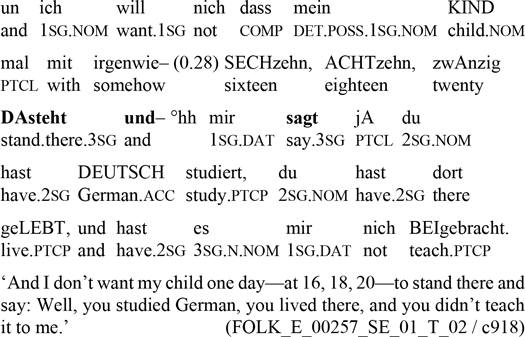
A general indicator of the degree of semantic bleaching is the realization of the local adverbial. If it is realized as a particle or deictic adverb rather than a lexically filled PP, the locational component of the posture verb’s meaning is backgrounded or even lost, while the postural and durative components are foregrounded. Thus, the large number of local adverbials realized as particles/adverbs such as da (see table 3) indicates advanced semantic bleaching at least of a part of the verbs’ meaning. The degree of semantic bleaching itself could be seen as another indicator of the degree of grammaticalization, as the former usually accompanies the latter. It has to be kept in mind, however, that semantic change does not necessarily entail grammaticalization and can always occur without it.
The next process is aspectualization. On an abstract level, the degree of aspectualization of PC can be related to the results on verb classes discussed in section 4.1: Although there is a general preference for activity verbs (they are the most frequently occurring V2s; see table 2), they are not as frequent and states are not as rare as V2s as would be expected in case of a proper progressive construction. On the level of single examples, one can use the following test: If a version of the same sentence without sitzen/stehen und would have a different or ambiguous aspectual interpretation, this might indicate that the progressive interpretation is directly contributed by the posture verb. Consider the examples in 6.
-
(6)

In contrast to the constructed example in 6b without a posture verb, which could receive either habitual or progressive interpretation, the clause in 6a clearly refers to an activity in progress at reference time. Thus, it could be argued that in cases like this, the main contribution to a progressive interpretation comes from the posture verb. Yet one must be cautious not to base such arguments on assumed default readings of decontextualized examples without having examined the actual surrounding sentences in more detail. In section 5.2, it is argued that the aspectual reading of German posture verb PC usually depends on enabling contexts.
Finally, determining the degree of subjectification is even more difficult than assessing aspectualization. There are no formal criteria that would help clearly identify subjective functions, as these are entirely context- and interpreter-dependent. Example 5 above illustrates the subjective use of the verb dastehen. The contribution of the posture verb to the subjective interpretation could be tested in the same way as its contribution to the aspectual interpretation: If the same sentence without sitzen/stehen und has no added subjectivity, this meaning may be attributed to the posture verb (see the examples in 6). Subjective functions are discussed in more detail in section 5.3.
5. Functions of German Posture Verb PC.
The question that underlies the discussion in this section is why the posture verb is used at all. In most contexts, it would not be necessary to mention the posture of the subject referent to form the core proposition. Thus, it is not immediately clear what meaning components or pragmatic effects are contributed by V1 that otherwise would not be there. In what follows, the corpus examples are grouped into three broad functional categories: aspectual, discourse pragmatic, and subjective. Note that these functions are not mutually exclusive, and many examples belong to more than one category.
5.1. Discourse Pragmatic Function.
I address the discourse pragmatic function first because in this case, emergent aspectual or subjective meanings are not necessarily present. It may be hypothesized that this function is historically older, and that the other two functions developed later (see section 6 for details). When the posture verb retains its literal meaning and does not convey any additional meaning, its use in PC nonetheless has important discourse pragmatic effects, namely, information packaging and visualization. It is a general tendency in spontaneous spoken language to introduce new information in chunks (Chafe Reference Chafe1994). More specifically, there is a tendency to avoid more than one new referent per clause (Du Bois Reference Du Bois2003, Proske Reference Proske2013). PC can be regarded as a conventional construction for packaging information in a way that reduces working memory load in spontaneous speech, as speakers strongly tend to split new referents evenly between its two conjuncts (Proske Reference Proske2019). This can be seen for sitzen und and stehen und in the following two examples:
-
(7)

In 7a, the new referent dreißig von seinen ehemaligen Kollegen ‘30 of his former colleagues’ is introduced as the subject of stehen. The local adverbial da does not contain new information, as it refers back to the street mentioned in the prior clause. The second conjunct of the PC introduces another new referent, ein Konzert ‘a concert’, as the object of machen ‘do’. If the posture of the subject referent had not been mentioned, the clause could have looked as follows: Da haben dreißig von seinen ehemaligen Kollegen ein Konzert gemacht ‘30 of his former colleagues gave a concert there.’ This clause has two new referents, which is avoided by the posture verb PC that was actually produced.
In 7b, two new pieces of information are introduced as well: by the local adverbial im Fahrschulauto ‘in the driving school car’ and by the comitative adverbial mit einem B-Führerschein ‘with a B license’.Footnote 13 The subject, ich ‘I’, is not new. In the second conjunct, it is the verb drauffahren ‘crash into’ that contains new and relevant information, whereas the pronoun jemandem ‘someone’ introduces a new, but indefinite referent. As in the previous example with stehen, the mentioning of the posture of the subject referent can be seen as motivated by discourse pragmatics instead of semantics.
An additional motivation for using a posture verb is what Hesse (Reference Hesse2009) has referred to as “visualization”: The use of sitzen or stehen indicates a specific posture that the subject referent assumes when performing the action denoted by V2, so that interlocutors will not imagine the subject referent in another posture, which they could have done if the utterance had been produced without a posture verb, for example if we had Viele Journalisten warten dort ‘Many journalists wait there’ instead of 8a or Wenn ich mir vorstelle, dass meine Mutter hier mit uns mit einem Sekt anstößt ‘If I imagine that my mother clinks glasses of sparkling wine with us here’ instead of 8b.
-
(8)

Both the chunking of new information and visualization are discourse pragmatic functions of PC that have been observed crosslinguistically. Newman & Rice (Reference Newman and Rice2004:369) summarize these functions as follows: “[…] cardinal posture verbs […] play a part in presenting, locating, and introducing referent objects to the reader/hearer as a prelude to describing them more fully.”
5.2. Aspectual Function.
The simultaneity of the two subevents denoted by posture verb PC is a prerequisite for its potentially aspectual uses. If someone is in a posture that facilitates a particular activity denoted by V2, they would likely maintain this posture for as long as the activity lasts. The stative verbs sitzen and stehen impose their durative meaning component on V2, and so the V2 action is construed as temporally extended. In 9a, the extended duration is also marked by the durative temporal adverbial ziemlich lange ‘for a pretty long time’, whereas in 9b, it is only marked by the posture verb.
-
(9)

In both examples in 9, the V2 is a durative verb. Yet in the absence of a posture verb, the duration of the event—pointing and waiting—may be relatively short. The verbs sitzen/stehen und clearly mark these events as extending longer than usual.
It could be argued that this “extended duration” meaning (Newman & Rice Reference Newman and Rice2004:371) is inherent to German posture verb PC, as nondurative verbs, such as achievements, may also be coerced into it (see 4b in section 4.1). A fully progressive reading, however, cannot be coded by the construction yet; instead, it relies on enabling contexts. Such contexts make clear the temporal relation between the V2 event and another event. For example, in 10, posture verb PC appears within a complex sentence that consists of a main clause and a temporal subordinate clause.
-
(10)

In 10a, the subordinate clause als ich komme ‘when I come’ refers to an event that occurred while the main clause activity—standing there and blow-drying her hair—was in progress. In 10b, it is the subordinate clause that contains the PC; the speaker asks how the addressee can review papers while another activity is taking place, namely, while they are sitting there and talking about something else. The sentences in 10 are examples of the “Inzidenzschema” ‘incidence pattern’ (Krause Reference Krause2002:20); that is, one action occurs while another is still in progress, which is one of the preferred contexts of grammaticalized progressives.
In many cases, the temporal relation between the V2 event and some other event is not coded syntactically but has to be inferred. For example, in 11, the adverb da in the independent main clause following the posture verb PC refers back to the PC event. The speaker was sitting at the desk and working on her homework when she came across a plan.
-
(11)

A progressive interpretation is also possible if the posture verb PC refers to an event that is ongoing at the moment of speech, as in 8a above. The progressive interpretation in this case can be supported by temporal adverbs such as jetzt/gerade ‘now’ or währenddessen ‘meanwhile’, as in 12.
-
(12)

In sum, the data show that progressivity is usually expressed by multiple linguistic means and not by posture verb PC alone. However, the construction can be used as the sole indicator of progressivity, if the context allows (see 6 and 11). Furthermore, the semantics of the posture verb is mostly not bleached, that is, there are no cases in which the subject referent cannot be conceptualized as sitting or standing, even though he or she may not actually be in the posture expressed by the verb used.
5.3. Subjective Function.
The third functional category comprises a variety of subjective meanings and connotations that posture verb PC has acquired. The term subjective is used here in Traugott’s (2010, 2022) sense and refers to the expression of the speaker’s beliefs and attitudes. Accordingly, what all uses of PC in this category have in common is that they highlight the “mental posture”, that is, the stance with which the subject referent carries out the activity denoted by V2 (as perceived by the speaker). This stance can be intentionality or determination, as in 13.Footnote 14
-
(13)

In examples such as 13, the use of a posture verb highlights the fact that the subject referent has actively taken a posture that facilitates the V2 activity. This highlighting is possible due to the implicit intentional semantic component of the posture verbs: Keeping up a posture requires intention, and this intentionality can be extended to V2 as well. For example, if a V2 does not have a prototypical agent (Dowty Reference Dowty1991) because its subject lacks a feature such as control or intentionality, it receives an intentional interpretation in posture verb PC. In 13a, the use of posture verb PC disambiguates the V2 beobachten, which has one meaning involving an intentional agent (‘observe’) and one involving a subject lacking control (‘witness’). The subject referent in 13a has to be interpreted as intentional. In 13b, the subject of the verb reinladen ‘load into’ is a prototypical agent. Yet its use within posture verb PC adds a sense of determination by emphasizing that the subject referent kept up the posture as long as necessary in order to complete the V2 activity.
The subject referent’s determination can be evaluated either positively (as in 13b above) or negatively, as in 14. Studies have reported that PC and related constructions are often used to convey a negative evaluation of the subject referent’s disposition or actions (for instance, Newman & Rice Reference Newman and Rice2004, Haddington et al. Reference Haddington, Jantunen and Sivonen2011, Proske Reference Proske2017).Footnote 15 Note, however, that in most cases, the negative evaluation does not come exclusively from the posture verb. The latter reinforces the negative meanings and connotations of other constituents, such as the expressions eine Krawatte kriegen ‘get angry’ or Sesselpupser ‘pen pusher’ in 14b.
-
(14)

Interestingly, the posture verbs sitzen and stehen can have the opposite effect from the one described above (that is, expressing agentivity): They can also be used to express that the subject referent is passive (see also Newman & Rice Reference Newman and Rice2004 for English posture verbs). This is especially clear in cases such as 15, where the second conjunct contains negation and thus denotes a “nonactivity”.
-
(15)

One could argue that the sense of passivity (or passiveness) is inherent in the semantics of posture verbs, as they denote states, that is, a lack of activity. At the same time, as postures facilitate activities, they must be actively kept up. Thus, postures occupy an intermediate position between activity and stativity, and so it is not surprising that both agentivity and passivity can be highlighted in PC.
The subject referent’s passivity may further invoke a sense of powerlessness, as in 16.
-
(16)

In 16a, the motorists have no control over the situation; all they can do is wait on the road for help to arrive. It is typical for the sense of powerlessness to arise from the combination of posture verb and warten. In 16b, the sense of powerlessness is attributable to dasitzen—the subject referent is unable to do anything but sit there—but also to the reported speech, Ich kann es nicht ‘I’m not able to do it’. Without the posture verb, the subject referent’s claim might be understood as conveying unwillingness instead of powerlessness. At the same time, a different wording of the reported speech might as well have blocked the powerlessness reading. Thus, in most cases, the sense of powerlessness cannot be attributed to V1 alone; the wording of V2 as well as the larger context of the utterance contribute to this sense as well.
Note that instances when posture verb PC has a subjective function are most likely to show semantic bleaching of V1. The verbs sitzen and stehen in such examples are used to emphasize either intentionality and determination or passivity and powerlessness on the part of the subject referent rather than denote an actual physical posture (see examples 14, 15, and 16b). Thus, these uses can be seen as involving a metaphorical shift from a physical to a mental posture (that is, stance). Moreover, many examples with a subjective function contain achievement verbs as V2, with verbs of communication and cognition, such as sagen and denken under their punctual reading, being especially common. This availability of achievement verbs sets the subjective function apart from the aspectual function: Unlike activities, which are compatible with both functions, achievements are infelicitous with the aspectual function due to their low compatibility with progressive aspectuality.
As mentioned in the beginning of this section, I use Traugott’s (2010, 2022) definition of the term subjective, whereby subjectivity refers to an expression of the speaker’s beliefs and attitudes. This concept covers a wide range of other concepts such as expressivity (D’Avis & Finkbeiner Reference D’Avis and Finkbeiner2019) and stance (Du Bois Reference Du Bois and Englebretson2007). Traugott’s concept is the most appropriate one among these for my purposes, as the synchronic notion of subjectivity is complemented by the diachronic notion of subjectifi-cation. Subjectification is a process of semantic change during which a lexical item or construction acquires a conventional subjective meaning. This process often occurs in the early stages of grammaticalization but is not limited to grammaticalization (Traugott & Dasher Reference Traugott and Dasher2002:90, 94). One might argue that sitzen and stehen in PC are currently undergoing subjectification: They have subjective functions in some contexts, which might become conventionalized subjective meanings at some point. Posture verb PC has, however, not (yet) entered a stage at which grammaticalization follows from subjectification. One might also argue that a case of grammaticalization that does not result in new grammatical meanings but in subjective or pragmatic meanings, should be referred to as pragmaticalization (Diewald Reference Diewald2011). In this view, posture verb PC has a potential for grammaticalizing progressivity as well as a potential for pragmaticalizing speaker attitude.
6. Discussion.
It has been shown that the meaning of the German posture verbs sitzen and stehen is rarely completely bleached when used in pseudo-coordination. At the same time, however, in many cases mentioning the posture of the subject referent while carrying out the V2 action is not necessary for forming the proposition, which points to additional functions of posture verbs in PC. Moreover, the locational component of these posture verbs can be seen as bleached in those cases that have no lexical local adverbial. These make up roughly half of all examples in the database. However, despite this frequent backgrounding of location and foregrounding of duration, there is no clear aspectualization of posture verb PC, as not all V2 automatically receive an extended duration reading. As Kinn et al. (Reference Kinn, Blensenius and Andersson2018) put it (see section 2), only with a consistent bleaching of both the posture and the location, an obligatory foregrounding of duration, and thus aspectualization, is possible. Thus, while there is no strong grammati-calization of progressivity in German posture verb PC, there is a progressive potential, arising from the frequent foregrounding of the durative component of sitzen and stehen. However, at least equally important is the development of subjective meanings and connotations, which foreground the posture component of the verbs’ meaning. This development involves a metaphorical shift from physical posture to mental posture (that is, stance).
To better understand the potential development of German posture verb PC, a brief comparison with the German am-progressive would be instructive.Footnote 16 The latter consists of the preposition am ‘at the’ plus a nominalized infinitive and a finite form of sein ‘be’, as in Ich bin am Arbeiten ‘I am working’. Both posture verb PC and the am-progressive are often used for establishing a temporal relation between two events or actions. Accordingly, the two constructions often occur in the “Inzidenz-schema” (‘incidence pattern’, see section 5.2): They both foreground the durative component of the verb’s semantics.
However, as occurrences of the am-progressive in FOLK show, the two constructions tend to be used rather differently. First, they prefer different verbs in their open slots. As table 4 shows, none of the verbs most frequently used in the am-progressive occurs frequently as a V2 in posture verb PC. Moreover, a much larger proportion of verbs used in the am-progressive are activities (76%) than in posture verb PC, as discussed in section 4.1, and a much smaller proportion are achievements (10%) and states (2%).Footnote 17
Verbs occurring at least three times in the am-progressive (FOLK, 94 instances overall).

Second, the am-progressive has a strong preference for first person singular subjects; in other words, this construction is most often used by speakers to refer to their own activities. Posture verb PC, in contrast, tends to be used for reference to third persons, which is in line with its evaluative function. Third, the constructions have different potentials to modify the meaning of the main verb: The posture verb in PC can convey different subjective and aspectual meanings and always contributes more than just progressivity to the meaning of the whole, while the am-progressive seems restricted to progressivity.Footnote 18 Due to this restriction, the am-progressive is not dependent on co(n)textual factors to evoke a progressive reading, as posture verb PC is.
These properties of the am-progressive are in line with the results of Flick & Kuhmichel Reference Flick and Kuhmichel2013. The authors show that at the moment, the use of states and achievements in the am-progressive is strongly restricted; yet it is gradually becoming more acceptable as the construction undergoes further grammaticalization. To my mind, this means that the am-progressive is at some intermediate stage—between, for example, the English be + V-ing progressive and German posture verb PC. It is subject to semantic restrictions typical of progressives but does not yet have as many extensions to new contexts as more grammaticalized progressives. In contrast, German posture verb PC does not impose strong restrictions on V2 yet. Its variety of functions (including aspectual and subjective ones) and low degree of grammaticalization allow and even call for a wider range of aspectual verb classes. It remains to be seen in which direction the specialization of the construction goes. Given the existence of a more grammaticalized progressive in the language, it would be plausible for the subjective function to become more prominent at the expense of the aspectual one.
Another interesting question that arises from the present study is the relationship between the various functions of German posture verb PC. This paper has treated the developments toward progressivity and subjectivity as independent processes, because synchronic data alone do not allow one to draw any firm conclusions about the interdependence or directionality of the two semantic changes. Moreover, the two processes are based on different semantic components of the posture verbs’ meaning. The aspectual function foregrounds the duration component (which is in line with well-known grammaticalization paths, from basic locational and postural to durative and progressive senses; Bybee et al. Reference Bybee, Perkins and Pagliuca1994, Heine & Kuteva Reference Heine and Kuteva2002), whereas the subjective function foregrounds the intentionality or inactivity associated with (keeping up) a posture.
Nevertheless, one can speculate on a possible connection between the two functions. For example, the durative reading could have developed first giving rise to subjective inferences. Crosslinguistically, progressives tend to develop subjective meanings (see, among others, Ebert Reference Ebert2000:628, Mair Reference Mair and Robert2012), but they are rarely discussed in detail in the literature (but see Anthonissen et al. Reference Anthonissen, De Wit and Mortelmans2016, Brisard Reference Brisard, Fischer, Gillmann and Schmuck2022).Footnote 19 The fact that German posture verb PC is not a highly grammaticalized construction for coding aspectuality but already has a somewhat conventionalized subjective use as well shows that a grammaticalized aspectual use is not a precondition for the development of subjective functions. It can be speculated that in general, postural constructions in early stages of grammaticalization tend to allow for several semantic-pragmatic functions, but they become more specialized as they undergo further grammaticalization. If a construction reaches a high degree of grammaticalization as a progressive, its subjective functions may first disappear, but (other) subjective functions might (re-) emerge in even later stages of grammaticalization. No such cases have been discussed in the literature to my knowledge. For PC in general, subjective uses can be observed independently of V1 and its aspectual potential, as is the case, for example, with German kommen, which has no aspectual uses (Proske Reference Proske2017).
Another open question is whether the discourse pragmatic functions are related to the aspectual and subjective functions, and if so, what this relation is. Proske (Reference Proske2019) hypothesizes that the information packaging use of PC in general is its basic use, which is related to a low degree of grammaticalization. The information packaging potential of more grammaticalized PC constructions is lower because the omission of V1 arguments leaves fewer opportunities for the introduction of new referents. Moreover, the semantically bleached V1 has acquired a stable new grammatical or subjective meaning that is not compatible with introducing referents. New referents are typically introduced using semantically vague main verbs or light verbs in spontaneously spoken language (see section 5.1), while in strongly grammaticalized PC, the V1 has become an auxiliary and the propositional semantics is contributed by the V2. Information packaging has occasionally been discussed as an initial motivation for the development of new grammatical categories or constructions (Du Bois Reference Du Bois1987, Hopper Reference Hopper and Good2008); yet it still needs to be integrated more thoroughly into theories of grammaticalization.


 Open access

