




1. Introduction
At its heart, this is a paper that could have been written some time ago. In 1970, Brian Day (Day (Reference Day and MacLane1970)) showed that a monoidal structure on a (small) category $\mathbb{C}$
produced a corresponding monoidal structure on the functor category
$\mathbb{C}$
produced a corresponding monoidal structure on the functor category $[\mathbb{C} \to \textbf {Set}]$
. This construction is now known as the Day monoidal product, or Day convolution. Although Day’s construction is often expressed using technology familiar only to category theorists, when we view it from an abstract perspective, its existence is not really a surprise. The topos
$[\mathbb{C} \to \textbf {Set}]$
. This construction is now known as the Day monoidal product, or Day convolution. Although Day’s construction is often expressed using technology familiar only to category theorists, when we view it from an abstract perspective, its existence is not really a surprise. The topos $[\mathbb{C} \to \textbf {Set}]$
can be viewed as a completion by colimits of
$[\mathbb{C} \to \textbf {Set}]$
can be viewed as a completion by colimits of $\mathbb{C}^{\textrm {op}}$
, and so it is not a surprise that structure on
$\mathbb{C}^{\textrm {op}}$
, and so it is not a surprise that structure on $\mathbb{C}^{\textrm {op}}$
extends to structure on the completion. But it is not completely straightforward. Given functors
$\mathbb{C}^{\textrm {op}}$
extends to structure on the completion. But it is not completely straightforward. Given functors $F,G: \mathbb{C} \to \textbf {Set}$
, we want to define
$F,G: \mathbb{C} \to \textbf {Set}$
, we want to define $F\otimes _D G: \mathbb{C} \to \textbf {Set}$
. The data we have is
$F\otimes _D G: \mathbb{C} \to \textbf {Set}$
. The data we have is

These functors do not compose, but there is a canonical choice of functor $\mathbb{C}\to \textbf {Set}$
on the right, given by left Kan extension, and this is how the Day monoidal product is defined. The left Kan extension can also be presented as a coend, which is how the Day monoidal product is often itself presented.
$\mathbb{C}\to \textbf {Set}$
on the right, given by left Kan extension, and this is how the Day monoidal product is defined. The left Kan extension can also be presented as a coend, which is how the Day monoidal product is often itself presented.
The purpose of this paper is to point out that Day’s construction generalises to other algebra structures on $\mathbb{C}$
, and to discuss how it generalises when the operations in those structures are partial.
$\mathbb{C}$
, and to discuss how it generalises when the operations in those structures are partial.
Others have also pointed out that if we translate this diagram into the language of profunctors, an idea already present in Day’s work of 1973 (Day (Reference Day1973)), then since the bicategory of profunctors is self-dual, we can reverse the direction of the $\otimes$
, and take the composite. This gives a third equivalent definition of Day convolution. But then we have a construction that involves operations on
$\otimes$
, and take the composite. This gives a third equivalent definition of Day convolution. But then we have a construction that involves operations on $\mathbb{C}$
followed by a sequence of functors in parallel, followed by products in
$\mathbb{C}$
followed by a sequence of functors in parallel, followed by products in $\textbf {Set}$
, and that makes it obvious that Day’s construction generalises to arbitrary algebra structures on
$\textbf {Set}$
, and that makes it obvious that Day’s construction generalises to arbitrary algebra structures on $\mathbb{C}$
.
$\mathbb{C}$
.
This is a significant fact in the context of categorical logic. Most approaches to logic deal with relations $M\vDash P$
, expressing the validity of a logical proposition
$M\vDash P$
, expressing the validity of a logical proposition $P$
in a context
$P$
in a context $M$
. Such relations always introduce a partial order on contexts:
$M$
. Such relations always introduce a partial order on contexts: $M \leqslant M'$
if and only if for all (possibly for all atomic)
$M \leqslant M'$
if and only if for all (possibly for all atomic) $P$
, if
$P$
, if $M\vDash P$
then
$M\vDash P$
then $M'\vDash P$
, and then the interpretation of (atomic) propositions is functorial from the partially ordered set of contexts to the partial order
$M'\vDash P$
, and then the interpretation of (atomic) propositions is functorial from the partially ordered set of contexts to the partial order $\unicode {x1D7DA} = (\bot \leqslant \top )$
. One particularly important instance of this is the construction of the Kripke models, used to give semantics to intuitionistic and other forms of logic. In a Kripke model, the context
$\unicode {x1D7DA} = (\bot \leqslant \top )$
. One particularly important instance of this is the construction of the Kripke models, used to give semantics to intuitionistic and other forms of logic. In a Kripke model, the context $M$
is described as a possible world
$M$
is described as a possible world $w$
and the relation
$w$
and the relation $w\vDash P$
is written
$w\vDash P$
is written $w\Vdash P$
. The set of worlds
$w\Vdash P$
. The set of worlds $W$
carries a partial order, and, for logics that are intuitionistic rather than classical, interpretations are expected to satisfy the monotonicity property: if
$W$
carries a partial order, and, for logics that are intuitionistic rather than classical, interpretations are expected to satisfy the monotonicity property: if $w\leqslant w'$
and
$w\leqslant w'$
and $w\Vdash P$
, then
$w\Vdash P$
, then $w'\Vdash P$
. As a result, the logic of the Kripke model lives naturally in the internal logic of the topos
$w'\Vdash P$
. As a result, the logic of the Kripke model lives naturally in the internal logic of the topos $[W\to \textbf {Set}]$
. The interpretation of propositions corresponds to subobjects of the terminal object, and the interpretation of the propositional connectives is as in the topos of functors, for example,
$[W\to \textbf {Set}]$
. The interpretation of propositions corresponds to subobjects of the terminal object, and the interpretation of the propositional connectives is as in the topos of functors, for example, $w \Vdash P \rightarrow Q$
if and only if, for each
$w \Vdash P \rightarrow Q$
if and only if, for each $w \leqslant \nu$
,
$w \leqslant \nu$
, $\nu \Vdash P$
implies that
$\nu \Vdash P$
implies that $\nu \Vdash Q$
(see e.g. Chagrov and Zakharyshev (Reference Chagrov and Zakharyshev1997) or Goldblatt (Reference Goldblatt1984), and for modal operations, i.e.
$\nu \Vdash Q$
(see e.g. Chagrov and Zakharyshev (Reference Chagrov and Zakharyshev1997) or Goldblatt (Reference Goldblatt1984), and for modal operations, i.e. $\square$
and
$\square$
and $\lozenge$
, see Kavvos (Reference Kavvos and Rehof2024)).
$\lozenge$
, see Kavvos (Reference Kavvos and Rehof2024)).
Viewed from this perspective, the question we are addressing is: “how does an algebra structure on the category of worlds translate into the interpretation of a novel logical connective that can be used to reason about propositions with Kripke semantics?”
This is not an abstract question. One of the most important forms of computational logic developed in recent years is separation logic (Ishtiaq and O’Hearn, Reference Ishtiaq and O’Hearn2001; O’Hearn, Reference O’Hearn2019). Separation logic is designed to reason about programs running in the standard execution model for modern languages that employ pointers and heap structures. Simplifying slightly, the semantics for separation logic is given by a Kripke model in which the worlds are heaps. In the original version, they form a discrete category, but in intuitionistic variants, they are ordered by inclusion. We reason about a relation $h\Vdash \varphi$
, where
$h\Vdash \varphi$
, where $h$
is a heap, and
$h$
is a heap, and $\varphi$
is a property of it. The key innovation of separation logic is the separating conjunction
$\varphi$
is a property of it. The key innovation of separation logic is the separating conjunction $\ast$
, which is interpreted as the Day monoidal product for a binary operation
$\ast$
, which is interpreted as the Day monoidal product for a binary operation $\sqcup$
representing the union of disjoint heaps. In the context of propositional logic, the coend formula simplifies, and we have that
$\sqcup$
representing the union of disjoint heaps. In the context of propositional logic, the coend formula simplifies, and we have that
 \begin{equation*}h\Vdash \varphi \ast \psi \iff \exists h_1,h_2.\ h_1 \sqcup h_2 \leqslant h\mbox{ and }h_1\Vdash \varphi \mbox{ and }h_2\Vdash \psi .\end{equation*}
However, $\sqcup$
is a partial operation. It is only defined when the heaps involved are disjoint. This is to ensure that a property true of two subheaps can be combined to make a property true of their union without requiring a side condition of consistency on the intersection. That, in turn, feeds into the ability to reason structurally about large systems. Given a small piece of code, properties can be determined with respect to the part of the heap that it actually touches, and then extended to properties valid for the whole codebase. This is one of the key technical properties that enables the verification of code at scale in the context of an entire codebase. This definition itself lives in the context of a logic, bunched implication logic (BI), which has a standard interpretation in Kripke semantics over a resource monoid (Pym et al., Reference Pym, O’Hearn and Yang2004) where there are two notions of combining resources, sharing, corresponding to conventional logic, and non-sharing, corresponding to a substructural logic.
$\sqcup$
is a partial operation. It is only defined when the heaps involved are disjoint. This is to ensure that a property true of two subheaps can be combined to make a property true of their union without requiring a side condition of consistency on the intersection. That, in turn, feeds into the ability to reason structurally about large systems. Given a small piece of code, properties can be determined with respect to the part of the heap that it actually touches, and then extended to properties valid for the whole codebase. This is one of the key technical properties that enables the verification of code at scale in the context of an entire codebase. This definition itself lives in the context of a logic, bunched implication logic (BI), which has a standard interpretation in Kripke semantics over a resource monoid (Pym et al., Reference Pym, O’Hearn and Yang2004) where there are two notions of combining resources, sharing, corresponding to conventional logic, and non-sharing, corresponding to a substructural logic.
This is not the only logic interpreted in a Kripke structure where the clauses follow a similar pattern. Hybrid logic includes a syntax for naming worlds (Blackburn et al., Reference Blackburn, Huertas, Manzano and Jørgensen2014), for example, a unary operation $@_w$
on propositions where
$@_w$
on propositions where
 \begin{equation*}w' \Vdash @_{w}\varphi \iff w\Vdash \varphi \end{equation*}
Hybrid and separation operations can be seen combined in recent work on reasoning about advanced algorithms in extensions of concurrent separation logic (see e.g. Brotherston et al. (Reference Brotherston, Costa, Hobor, Wickerson, Lahiri and Wang2020)).
Overview. The paper is laid out as follows.
-
(1) In section 2, we recall the basic technologies we will be using, namely profunctors and operads. We choose operads to formalise multi-variable equational theories as they enable relatively clear accounts of both the essential treatment of substitution and the coherence required when moving from a purely equational to a pseudo-algebraic theory.
-
(2) In section 3, we give the basic treatment for the extension of algebra structures. The key result is Theorem 3.6, which establishes a morphism of operads:
from which the extension of any given algebra structure on \begin{equation*}(\!-\!)_D \colon \textbf {End}(\mathbb{C}) \to \textbf {End}([\mathbb{C} \to \textbf {Set}])^{\textrm {op}},\end{equation*}
$\mathbb{C}$
follows as an immediate corollary.
\begin{equation*}(\!-\!)_D \colon \textbf {End}(\mathbb{C}) \to \textbf {End}([\mathbb{C} \to \textbf {Set}])^{\textrm {op}},\end{equation*}
$\mathbb{C}$
follows as an immediate corollary.
-
(3) Section 4 contains two extensions, one to partial operations and the other to adjoints of them, establishing that these operations are “residuated,” they support forms of implication, just like the Day monoidal product. We also discuss in more detail how the logical connectives of hybrid, linear temporal and separation logic are recovered. As explained further in subsection 4.4, we must be precise about how we interpret partial algebra structure, as our construction only preserves strong equality of partial operations (see Definition 4.11).


We conclude with an Appendix giving details of the coherence required.
2. Preliminaries
In this paper, a category $\mathbb{C}$
is assumed to be small. If
$\mathbb{C}$
is assumed to be small. If $\mathbb{C}$
and
$\mathbb{C}$
and $\mathbb{D}$
are a pair of categories,
$\mathbb{D}$
are a pair of categories, $\mathbb{C} \times \mathbb{D}$
will always refer to their product as categories, that is, the product in the (2-)category of categories
$\mathbb{C} \times \mathbb{D}$
will always refer to their product as categories, that is, the product in the (2-)category of categories $\textbf {Cat}$
. This will be important when we consider other (bi-)categories whose objects are categories but whose arrows are not functors. Similarly,
$\textbf {Cat}$
. This will be important when we consider other (bi-)categories whose objects are categories but whose arrows are not functors. Similarly, $\mathbb{C}^n$
will refer to the
$\mathbb{C}^n$
will refer to the $n$
-fold product of
$n$
-fold product of $\mathbb{C}$
with itself and
$\mathbb{C}$
with itself and $\unicode {x1D7D9}$
for the one object, one arrow category, that is, the empty product.
$\unicode {x1D7D9}$
for the one object, one arrow category, that is, the empty product.
We will also compromise between categorical and type-theoretic traditions by using $[\mathbb{C}\to \mathbb{D}]$
(in square brackets) to denote the category of functors from
$[\mathbb{C}\to \mathbb{D}]$
(in square brackets) to denote the category of functors from $\mathbb{C}$
to
$\mathbb{C}$
to $\mathbb{D}$
.
$\mathbb{D}$
.
2.1 Profunctors
Our generalisation of the Day monoidal product will be constructed using profunctors, which we recall here.
Definition 2.1.
Let $\mathbb{C}$
and
$\mathbb{C}$
and $\mathbb{D}$
be categories. A
$\mathbb{D}$
be categories. A $\mathrm{profunctor}$ $F \colon \mathbb{C} \;\;\, \shortmid \!\!\!\rightarrow \, \mathbb{D}$
is a functor
$F \colon \mathbb{C} \;\;\, \shortmid \!\!\!\rightarrow \, \mathbb{D}$
is a functor $F \colon \mathbb{D}^{\textrm {op}} \times \mathbb{C} \to \textbf {Set}$
. We will use
$F \colon \mathbb{D}^{\textrm {op}} \times \mathbb{C} \to \textbf {Set}$
. We will use $\mathbb{C} \to \mathbb{D}$
to denote a functor and
$\mathbb{C} \to \mathbb{D}$
to denote a functor and $\mathbb{C} \;\;\, \shortmid \!\!\!\rightarrow \, \mathbb{D}$
to denote a profunctor.
$\mathbb{C} \;\;\, \shortmid \!\!\!\rightarrow \, \mathbb{D}$
to denote a profunctor.
Profunctors generalise relations. If the categories $\mathbb{C}$
and
$\mathbb{C}$
and $\mathbb{D}$
are discrete, then a profunctor that takes values in the subterminals
$\mathbb{D}$
are discrete, then a profunctor that takes values in the subterminals $\unicode {x1D7DA} \subseteq \textbf {Set}$
corresponds to a relation between the object sets. Profunctors can be composed using a
$\unicode {x1D7DA} \subseteq \textbf {Set}$
corresponds to a relation between the object sets. Profunctors can be composed using a $\mathrm{coend}$
(Mac Lane Reference Mac Lane1969, §IX.6), which in the special case above is precisely the relational composite.
$\mathrm{coend}$
(Mac Lane Reference Mac Lane1969, §IX.6), which in the special case above is precisely the relational composite.
Given a pair of profunctors $F \colon \mathbb{C} \;\;\, \shortmid \!\!\!\rightarrow \, \mathbb{D}$
,
$F \colon \mathbb{C} \;\;\, \shortmid \!\!\!\rightarrow \, \mathbb{D}$
, $G \colon \mathbb{D} \;\;\, \shortmid \!\!\!\rightarrow \, \mathbb{E}$
, their composite
$G \colon \mathbb{D} \;\;\, \shortmid \!\!\!\rightarrow \, \mathbb{E}$
, their composite $G \circ F \colon \mathbb{C} \;\;\, \shortmid \!\!\!\rightarrow \, \mathbb{E}$
acts on objects
$G \circ F \colon \mathbb{C} \;\;\, \shortmid \!\!\!\rightarrow \, \mathbb{E}$
acts on objects $(e,c) \in \mathbb{E}^{\textrm {op}} \times \mathbb{C}$
by the coend
$(e,c) \in \mathbb{E}^{\textrm {op}} \times \mathbb{C}$
by the coend
 \begin{equation*} G \circ F(e,c) = \int ^{d \in \mathbb{D}} G(e,d) \times F(d,c). \end{equation*}
Concretely, this is the quotient set
 \begin{equation*} \left (\coprod _{d \in \mathbb{D}} G(e,d) \times F(d,c) \right ){/{\sim }} \end{equation*}
where $\sim$
is the equivalence relation generated by
$\sim$
is the equivalence relation generated by $(g,F(\alpha ,1_c)(f)) \sim (G(1_c,\alpha )(g),f)$
, for all
$(g,F(\alpha ,1_c)(f)) \sim (G(1_c,\alpha )(g),f)$
, for all $f \in F(d,c)$
,
$f \in F(d,c)$
, $g \in G(e,d')$
and
$g \in G(e,d')$
and $\alpha \colon d \to d' \in \mathbb{D}$
. On arrows
$\alpha \colon d \to d' \in \mathbb{D}$
. On arrows $(\beta ,\gamma ) \colon (e,c) \to (e',c')$
,
$(\beta ,\gamma ) \colon (e,c) \to (e',c')$
, $G \circ F \colon \mathbb{C} \;\;\, \shortmid \!\!\!\rightarrow \, \mathbb{E}$
acts by the universally induced arrow, which concretely sends the equivalence class of the pair
$G \circ F \colon \mathbb{C} \;\;\, \shortmid \!\!\!\rightarrow \, \mathbb{E}$
acts by the universally induced arrow, which concretely sends the equivalence class of the pair $(g,f) \in G(e,d) \times F(d,c)$
to the equivalence class of the pair
$(g,f) \in G(e,d) \times F(d,c)$
to the equivalence class of the pair $(G(\beta ,1_d)(g),G(1_d,\gamma )(f))$
.
$(G(\beta ,1_d)(g),G(1_d,\gamma )(f))$
.
Since coends, and hence the composite $G \circ F$
, are only defined up to natural isomorphism, this definition naturally gives rise not to a 2-category but a bicategory of profunctors
$G \circ F$
, are only defined up to natural isomorphism, this definition naturally gives rise not to a 2-category but a bicategory of profunctors $\textbf {Prof}$
. A 2-cell
$\textbf {Prof}$
. A 2-cell $F \Rightarrow G$
between profunctors is just a natural transformation of the underlying functors. Bicategories generalise 2-categories in that the associative and unit rules are only satisfied up to (coherent) isomorphism (see Bénabou Reference Bénabou1967, §1).
$F \Rightarrow G$
between profunctors is just a natural transformation of the underlying functors. Bicategories generalise 2-categories in that the associative and unit rules are only satisfied up to (coherent) isomorphism (see Bénabou Reference Bénabou1967, §1).
There are two ways to consider a functor $F \colon \mathbb{C} \to \mathbb{D}$
as a profunctor:
$F \colon \mathbb{C} \to \mathbb{D}$
as a profunctor:
-
(1)
$\mathbb{D}(1_{\mathbb{D}},F) \colon \mathbb{C} \;\;\, \shortmid \!\!\!\rightarrow \, \mathbb{D}$
, the profunctor that sends
$(d,c) \in \mathbb{D}^{\textrm {op}} \times \mathbb{C}$
to
$\mathbb{D}(d,Fc)$
; and, analogously, -
(2)
$\mathbb{D}(F,1_{\mathbb{D}}) \colon \mathbb{D} \;\;\, \shortmid \!\!\!\rightarrow \, \mathbb{C}$
, the profunctor that sends
$(c,d) \in \mathbb{C}^{\textrm {op}}\times \mathbb{D}$
to
$\mathbb{D}(Fc,d)$
.






These definitions extend to bifunctors $\textbf {Cat} \to \textbf {Prof}$
and
$\textbf {Cat} \to \textbf {Prof}$
and $\textbf {Cat}^{\textrm {op}} \to \textbf {Prof}$
. Importantly, this means that we can apply functors ‘in reverse’ by considering functors as profunctors.
$\textbf {Cat}^{\textrm {op}} \to \textbf {Prof}$
. Importantly, this means that we can apply functors ‘in reverse’ by considering functors as profunctors.
Example 2.2. Let $F \colon \mathbb{C} \to \mathbb{D}, G \colon \mathbb{E} \to \mathbb{D}$
be functors. It is an easy exercise to show that the composite
$F \colon \mathbb{C} \to \mathbb{D}, G \colon \mathbb{E} \to \mathbb{D}$
be functors. It is an easy exercise to show that the composite

is isomorphic to the profunctor $\mathbb{D}(G,F) \colon \mathbb{E}^{\textrm {op}} \times \mathbb{C} \to \textbf {Set}$
that sends
$\mathbb{D}(G,F) \colon \mathbb{E}^{\textrm {op}} \times \mathbb{C} \to \textbf {Set}$
that sends $(e,c) \in \mathbb{E}^{\textrm {op}} \times \mathbb{C}$
to
$(e,c) \in \mathbb{E}^{\textrm {op}} \times \mathbb{C}$
to $\mathbb{D}(G(e),F(c))$
.
$\mathbb{D}(G(e),F(c))$
.
Moreover, a functor $P \colon \mathbb{C} \to \textbf {Set}$
, that is, a co-presheaf, can be regarded as a functor
$P \colon \mathbb{C} \to \textbf {Set}$
, that is, a co-presheaf, can be regarded as a functor
 \begin{equation*} P \colon \unicode {x1D7D9}^{\textrm {op}} \times \mathbb{C} \to \textbf {Set} \end{equation*}
and hence as a profunctor $P \colon \mathbb{C} \;\;\, \shortmid \!\!\!\rightarrow \, \unicode {x1D7D9}$
. Indeed, the category of co-presheaves, denoted by
$P \colon \mathbb{C} \;\;\, \shortmid \!\!\!\rightarrow \, \unicode {x1D7D9}$
. Indeed, the category of co-presheaves, denoted by $[\mathbb{C} \to \textbf {Set}]$
, is isomorphic to the category
$[\mathbb{C} \to \textbf {Set}]$
, is isomorphic to the category $\textbf {Prof}(\mathbb{C},\unicode {x1D7D9})$
.
$\textbf {Prof}(\mathbb{C},\unicode {x1D7D9})$
.
2.2 Operads
Our applications to universal algebra will be framed in the language of operad theory. An operad formalises the composition of $n$
-ary operations. For the most part, we follow the conventions of Leinster Reference Leinster2004, §2.
$n$
-ary operations. For the most part, we follow the conventions of Leinster Reference Leinster2004, §2.
Definition 2.3.
An $\mathrm{operad}$ $P$
consists of the following data.
$P$
consists of the following data.
-
(1) For each
$n \in \mathbb{N}$
, a set
$P(n)$
, whose elements we call
$n$
-ary operations.
-
(2) A distinguished element
$1 \in P(1)$
called the unit. -
(3) For each
$n,k_1,\dots ,k_n \in \mathbb{N}$
, a function
which we call multi-composition (our reasons for this departure in terminology from Leinster (Reference Leinster2004) will be explained in Definition 2.6 ).
\begin{equation*} \circ \colon P(n) \times P(k_1) \times \dots \times P(k_n) \to P(k_1 + \dots + k_n) \end{equation*}




These must satisfy the unital condition that
 \begin{equation*} \theta \circ (1, \dots ,1) = \theta = 1 \circ \theta ,\end{equation*}
for all $\theta \in P(n)$
, and the associativity condition
$\theta \in P(n)$
, and the associativity condition
 \begin{equation*} \theta \circ \big(\theta _1 \circ \big(\theta _1^1, \dots , \theta _1^{k_1}\big), \dots , \theta _n \circ \big(\theta _n^1 , \dots , \theta _n^{k_n}\big)\big) = (\theta \circ (\theta _1, \dots , \theta _n)) \circ \big(\theta _1^1, \dots , \theta _n^{k_n}\big), \end{equation*}
for all $\theta , \theta _i , \theta _i^j$
such that these multi-composites exist.
$\theta , \theta _i , \theta _i^j$
such that these multi-composites exist.
Example 2.4. Below, we define the algebras for an operad and briefly sketch how operad theory is used in universal algebra. To that end, we describe here the ‘syntactic operads’ that are used to describe single-sorted algebraic theories. Let $\Sigma$
be a collection of operation symbols with arities, called a signature. We use
$\Sigma$
be a collection of operation symbols with arities, called a signature. We use $P_{\Sigma }$
to denote the operad freely generated by the operations in
$P_{\Sigma }$
to denote the operad freely generated by the operations in $\Sigma$
: for each
$\Sigma$
: for each $n \in \mathbb{N}$
,
$n \in \mathbb{N}$
, $P_\Sigma (n)$
is the set of terms over
$P_\Sigma (n)$
is the set of terms over $\Sigma$
with
$\Sigma$
with $n$
inputs. For example, suppose
$n$
inputs. For example, suppose $\Sigma$
consists of a unary operation
$\Sigma$
consists of a unary operation $\theta$
and a binary operation
$\theta$
and a binary operation $\psi$
, then
$\psi$
, then $P_\Sigma (1)$
contains
$P_\Sigma (1)$
contains $1$
,
$1$
, $\theta$
,
$\theta$
, $\theta ^2$
,
$\theta ^2$
, $\psi \circ (\theta ,\theta )$
, etc. If
$\psi \circ (\theta ,\theta )$
, etc. If $E$
is a collection of equations
$E$
is a collection of equations $t_1 = t_2$
between terms over
$t_1 = t_2$
between terms over $\Sigma$
, that is, an algebraic theory, we can quotient each
$\Sigma$
, that is, an algebraic theory, we can quotient each $P_{\Sigma }(n)$
by the congruence generated by
$P_{\Sigma }(n)$
by the congruence generated by $E$
to obtain an operad
$E$
to obtain an operad $P_{(\Sigma ,E)}$
, the classifying operad for the pair
$P_{(\Sigma ,E)}$
, the classifying operad for the pair $(\Sigma ,E)$
. Thus,
$(\Sigma ,E)$
. Thus, $P_{(\Sigma ,E)}(n)$
is the set of terms over
$P_{(\Sigma ,E)}(n)$
is the set of terms over $\Sigma$
, with
$\Sigma$
, with $n$
free variables, up to provable equivalence modulo
$n$
free variables, up to provable equivalence modulo $E$
.
$E$
.
Since we will encounter constructions that are defined only up to (canonical) isomorphism, we require a notion of operad that includes ‘transformations’ between operations. For our purposes, it suffices to consider operads enriched over $\textbf {Cat}$
. Essentially, we replace the words ‘set’ and ‘function’ in Definition 2.3 with, respectively, ‘category’ and ‘functor’.
$\textbf {Cat}$
. Essentially, we replace the words ‘set’ and ‘function’ in Definition 2.3 with, respectively, ‘category’ and ‘functor’.
Remark 2.5. Whenever working in higher dimensions, a choice must be made about whether composition/identities/etc. are defined up to equality or isomorphism. We do not work in the greatest generality, instead picking and choosing to suit our needs: our ‘operads with transformations’ will be strict, but their morphisms will be ‘pseudo’/‘lax’, in the sense that the unit and multi-composites are preserved up to (coherent) isomorphism/transformation. In contrast, pseudo-operads, where the unital and associativity conditions hold only up to isomorphism, are discussed in Day and Street (Reference Day and Street2003).
Definition 2.6.
A $\textbf {Cat}$
-operad
$\textbf {Cat}$
-operad $P$
is a
$P$
is a $\textbf {Cat}$
-enriched operad, and so consists of:
$\textbf {Cat}$
-enriched operad, and so consists of:
-
(1) a category
$P(n)$
, for each
$n \in \mathbb{N}$
, -
(2) a unit
$1 \in P(1)$
, -
(3) and, for each
$n,k_1,\dots ,k_n \in \mathbb{N}$
, a functor
Naming this functor multi-composition distinguishes it from the composition of arrows in
\begin{equation*} \circ \colon P(n) \times P(k_1) \times \dots \times P(k_n) \to P(k_1 + \dots + k_n). \end{equation*}
$P(n)$
.





These must satisfy the analogous unital and associativity conditions from Definition 2.3 .
Example 2.7 (Endomorphism operad). Our archetypal example is the $\textbf {Cat}$
-operad of
$\textbf {Cat}$
-operad of $n$
-ary endomorphisms on a category
$n$
-ary endomorphisms on a category $\mathbb{C}$
, which we denote by
$\mathbb{C}$
, which we denote by $\textbf {End}(\mathbb{C})$
. For each
$\textbf {End}(\mathbb{C})$
. For each $n \in \mathbb{N}$
,
$n \in \mathbb{N}$
, $\textbf {End}(\mathbb{C})(n)$
is the category
$\textbf {End}(\mathbb{C})(n)$
is the category $[\mathbb{C}^n \to \mathbb{C}]$
of functors
$[\mathbb{C}^n \to \mathbb{C}]$
of functors $\mathbb{C}^n \to \mathbb{C}$
and natural transformations between these. The unit is the identity functor
$\mathbb{C}^n \to \mathbb{C}$
and natural transformations between these. The unit is the identity functor $1_{\mathbb{C}}$
. Multi-composition is given by the composition of
$1_{\mathbb{C}}$
. Multi-composition is given by the composition of $n$
-ary functors, as suggested by our choice of terminology.
$n$
-ary functors, as suggested by our choice of terminology.
Definition 2.8.
If $P$
is a
$P$
is a $\textbf {Cat}$
-operad, we use
$\textbf {Cat}$
-operad, we use $P^{\textrm {op}}$
to denote the
$P^{\textrm {op}}$
to denote the $\textbf {Cat}$
-operad where
$\textbf {Cat}$
-operad where $P^{\textrm {op}}(n) = P(n)^{\textrm {op}}$
. The unit and composition remain the same (modulo taking the opposite category).
$P^{\textrm {op}}(n) = P(n)^{\textrm {op}}$
. The unit and composition remain the same (modulo taking the opposite category).
Operads, and $\textbf {Cat}$
-operads, can be used in universal algebra via the notion of an algebra for an operad.
$\textbf {Cat}$
-operads, can be used in universal algebra via the notion of an algebra for an operad.
Definition 2.9.
A lax-morphism of $\textbf {Cat}$
-operads
$\textbf {Cat}$
-operads $\omega \colon P \to Q$
consists of a functor
$\omega \colon P \to Q$
consists of a functor $\omega _n \colon P(n) \to Q(n)$
for each
$\omega _n \colon P(n) \to Q(n)$
for each $n$
such that the unit and multi-composition are preserved up to coherent transformation, by which we mean that:
$n$
such that the unit and multi-composition are preserved up to coherent transformation, by which we mean that:
-
(1) there is a morphism
$\lambda \colon 1 \to \omega _1 (1) \in Q(1)$
, -
(2) and, for each
$\theta \in P(n), \theta _1 \in P(k_1), \dots , \theta _n \in P(k_n)$
, a morphism
in
\begin{equation*} \eta _{\theta , \theta _1, \dots , \theta _n} \colon \omega _n(\theta ) \circ (\omega _{k_1}(\theta _1), \dots , \omega _{k_n}(\theta _n)) \to \omega _{k_1 + \dots + k_n} (\theta \circ (\theta _1 , \dots , \theta _n)) \end{equation*}
$Q(k_1 + \dots + k_n)$
, natural in
$\theta , \theta _i$
,





and moreover satisfying coherence axioms. While necessary, the coherence axioms are notationally cumbersome and somewhat unenlightening, and so they are postponed to Appendix
A
. We will call such an $\omega \colon P \to Q$
a pseudo-morphism if
$\omega \colon P \to Q$
a pseudo-morphism if $\lambda$
and each
$\lambda$
and each $\eta _{\theta , \theta _1, \dots , \theta _n}$
are isomorphisms, and a strict morphism if they are identities.
$\eta _{\theta , \theta _1, \dots , \theta _n}$
are isomorphisms, and a strict morphism if they are identities.
Definition 2.10.
An algebra for a $\textbf {Cat}$
-operad
$\textbf {Cat}$
-operad $P$
consists of a category
$P$
consists of a category $\mathbb{C}$
and a (strict) morphism of
$\mathbb{C}$
and a (strict) morphism of $\textbf {Cat}$
-operads
$\textbf {Cat}$
-operads $P \to \textbf {End}(\mathbb{C})$
. We define pseudo-algebras and lax-algebras similarly.
$P \to \textbf {End}(\mathbb{C})$
. We define pseudo-algebras and lax-algebras similarly.
In the case of a syntactic operad, this returns the notion of algebra we would have expected. Let $\Sigma$
be a collection of
$\Sigma$
be a collection of $n$
-ary operations and
$n$
-ary operations and $E$
a collection of equations over
$E$
a collection of equations over $\Sigma$
. An algebra of the syntactic operad
$\Sigma$
. An algebra of the syntactic operad $P_{(\Sigma ,E)}$
consists of a category
$P_{(\Sigma ,E)}$
consists of a category $\mathbb{C}$
with a choice of
$\mathbb{C}$
with a choice of $n$
-ary operation
$n$
-ary operation $\mathbb{C}^n \to \mathbb{C}$
for each operation symbol in
$\mathbb{C}^n \to \mathbb{C}$
for each operation symbol in $\Sigma$
such that the equations in
$\Sigma$
such that the equations in $E$
are satisfied. A pseudo-algebra is instead the case where these equations hold only up to (coherent) isomorphism.
$E$
are satisfied. A pseudo-algebra is instead the case where these equations hold only up to (coherent) isomorphism.
Example 2.11 (Monoidal categories). Monoidal categories can be presented either by giving an $n$
-ary tensor
$n$
-ary tensor $\otimes _n$
for each
$\otimes _n$
for each $n$
, or by giving just the binary (
$n$
, or by giving just the binary ( $\otimes$
) and nullary (unit) operations. Consider the signature
$\otimes$
) and nullary (unit) operations. Consider the signature $\Sigma _M$
containing an
$\Sigma _M$
containing an $n$
-ary operation
$n$
-ary operation $\otimes _n$
for each
$\otimes _n$
for each $n$
and the collection
$n$
and the collection $E_M$
of equations
$E_M$
of equations $\otimes _1 = 1$
and
$\otimes _1 = 1$
and $\otimes _n \circ (\otimes _{k_1}, \dots , \otimes _{k_n}) = \otimes _{k_1 + \dots + k_2}$
. An algebra
$\otimes _n \circ (\otimes _{k_1}, \dots , \otimes _{k_n}) = \otimes _{k_1 + \dots + k_2}$
. An algebra $P_{\Sigma _M, E_M} \to \mathbb{C}$
is a strict monoidal category, a pseudo-algebra is a monoidal category, and a lax algebra is a lax monoidal category (Day and Street Reference Day and Street2003, §1). (The usual definition of a (strict/skew) monoidal category, such as in Szlachányi (Reference Szlachányi2012), can be recovered by taking
$P_{\Sigma _M, E_M} \to \mathbb{C}$
is a strict monoidal category, a pseudo-algebra is a monoidal category, and a lax algebra is a lax monoidal category (Day and Street Reference Day and Street2003, §1). (The usual definition of a (strict/skew) monoidal category, such as in Szlachányi (Reference Szlachányi2012), can be recovered by taking $\otimes _0$
as the unit and
$\otimes _0$
as the unit and $\otimes _2$
as the binary product, see Bourke and Lack Reference Bourke and Lack2018, §7.)
$\otimes _2$
as the binary product, see Bourke and Lack Reference Bourke and Lack2018, §7.)
3. Day Algebras
In this section, we present the first of the two main constructions of the paper: a pseudo-morphism of operads $\textbf {End}(\mathbb{C}) \to \textbf {End}([\mathbb{C} \to \textbf {Set}])^{\textrm {op}}$
from the endomorphism operad on a category
$\textbf {End}(\mathbb{C}) \to \textbf {End}([\mathbb{C} \to \textbf {Set}])^{\textrm {op}}$
from the endomorphism operad on a category $\mathbb{C}$
to the opposite endomorphism operad on the category of co-presheaves
$\mathbb{C}$
to the opposite endomorphism operad on the category of co-presheaves $[\mathbb{C} \to \textbf {Set}]$
. Thus, if
$[\mathbb{C} \to \textbf {Set}]$
. Thus, if $\mathbb{C}$
has the structure of an pseudo-algebra for an operad
$\mathbb{C}$
has the structure of an pseudo-algebra for an operad $P$
, that is, if there is a pseudo-morphism of
$P$
, that is, if there is a pseudo-morphism of $\textbf {Cat}$
-operads
$\textbf {Cat}$
-operads $P \to \textbf {End}(\mathbb{C})$
, the structure can be extended to
$P \to \textbf {End}(\mathbb{C})$
, the structure can be extended to $[\mathbb{C} \to \textbf {Set}]$
by taking the composite pseudo-morphism
$[\mathbb{C} \to \textbf {Set}]$
by taking the composite pseudo-morphism $P \to \textbf {End}(\mathbb{C}) \to \textbf {End}([\mathbb{C} \to \textbf {Set}])^{\textrm {op}}$
.
$P \to \textbf {End}(\mathbb{C}) \to \textbf {End}([\mathbb{C} \to \textbf {Set}])^{\textrm {op}}$
.
3.1 Day monoidal product
Before presenting the main construction of this paper, we recall the construction of the Day convolution from Day (Reference Day and MacLane1970). Given a monoidal structure on a category $\mathbb{C}$
, there is a canonical extension of the monoidal structure to the category of co-presheaves
$\mathbb{C}$
, there is a canonical extension of the monoidal structure to the category of co-presheaves $[\mathbb{C} \to \textbf {Set}]$
.
$[\mathbb{C} \to \textbf {Set}]$
.
Definition 3.1 (Day monoidal product). Let $(\mathbb{C},\otimes ,I)$
be a monoidal category. Given two functors
$(\mathbb{C},\otimes ,I)$
be a monoidal category. Given two functors $F, G \colon \mathbb{C} \to \textbf {Set}$
, their Day product
$F, G \colon \mathbb{C} \to \textbf {Set}$
, their Day product $F \otimes _D G \colon \mathbb{C} \to \textbf {Set}$
can be defined in three equivalent ways.
$F \otimes _D G \colon \mathbb{C} \to \textbf {Set}$
can be defined in three equivalent ways.
-
(1) It is the left Kan extension of the functor
$F \times G \colon \mathbb{C} \times \mathbb{C} \to \textbf {Set}$
along
$\otimes \colon \mathbb{C} \times \mathbb{C} \to \mathbb{C}$
: -
(2) The left Kan extension can be computed as the coend
\begin{equation*} (F \otimes _D G)(c) = \int ^{(c_0,c_1) \in \mathbb{C} \times \mathbb{C}} F(c_0) \times G(c_1) \times \mathbb{C}(c_0 \otimes c_1,c). \end{equation*}
-
(3) Finally, and most importantly for us, this is precisely the composite of profunctors




Similarly, we define $I_D$
as the co-representable
$I_D$
as the co-representable $\mathbb{C}(I,1_{\mathbb{C}}) \colon \mathbb{C} \to \textbf {Set}$
, that is, the profunctor
$\mathbb{C}(I,1_{\mathbb{C}}) \colon \mathbb{C} \to \textbf {Set}$
, that is, the profunctor $\mathbb{C}(I,1_{\mathbb{C}}) \colon \mathbb{C} \;\;\, \shortmid \!\!\!\rightarrow \, \unicode {x1D7D9}$
.
$\mathbb{C}(I,1_{\mathbb{C}}) \colon \mathbb{C} \;\;\, \shortmid \!\!\!\rightarrow \, \unicode {x1D7D9}$
.
Proposition 3.2 (Theorem 3.3 Day (Reference Day and MacLane1970)). If $(\mathbb{C},\otimes ,I)$
is a monoidal category, then so too is
$(\mathbb{C},\otimes ,I)$
is a monoidal category, then so too is $([\mathbb{C} \to \textbf {Set}],\otimes _D,I_D)$
.
$([\mathbb{C} \to \textbf {Set}],\otimes _D,I_D)$
.
3.2 Day extension
We make the rather obvious observation that there is nothing special about the monoidal product used in defining its Day extension in Definition 3.1. Any algebraic structure on $\mathbb{C}$
can be extended to one on the category of co-presheaves
$\mathbb{C}$
can be extended to one on the category of co-presheaves $[\mathbb{C} \to \textbf {Set}]$
, if we allow equations to hold up to isomorphism. To describe the Day extension of an algebraic structure, we have two tasks:
$[\mathbb{C} \to \textbf {Set}]$
, if we allow equations to hold up to isomorphism. To describe the Day extension of an algebraic structure, we have two tasks:
-
(1) first, we construct the extension of arbitrary
$n$
-ary operations, -
(2) second, we must show that equations between operations are preserved.

Definition 3.3 (Day extension). Let $\theta \colon \mathbb{C}^n \to \mathbb{C}$
be a functor. The Day extension of
$\theta \colon \mathbb{C}^n \to \mathbb{C}$
be a functor. The Day extension of $\theta$
is the functor
$\theta$
is the functor $\theta _D \colon [\mathbb{C} \to \textbf {Set}]^n \to [\mathbb{C} \to \textbf {Set}]$
that acts on objects by sending
$\theta _D \colon [\mathbb{C} \to \textbf {Set}]^n \to [\mathbb{C} \to \textbf {Set}]$
that acts on objects by sending $(F_1, \dots , F_n)$
to the functor
$(F_1, \dots , F_n)$
to the functor $\mathbb{C} \to \textbf {Set}$
corresponding to the composite of profunctors
$\mathbb{C} \to \textbf {Set}$
corresponding to the composite of profunctors

On arrows, $\theta _D$
sends a tuple of natural transformations
$\theta _D$
sends a tuple of natural transformations $(\alpha _1 \colon F_1 \Rightarrow G_1, \dots , \alpha _n \colon F_n \Rightarrow G_n)$
to the natural transformation corresponding to the 2-cell of profunctors
$(\alpha _1 \colon F_1 \Rightarrow G_1, \dots , \alpha _n \colon F_n \Rightarrow G_n)$
to the natural transformation corresponding to the 2-cell of profunctors

Remark 3.4. Note that the Day extension $\theta _D(F_1, \dots , F_n)$
described above is equivalent to:
$\theta _D(F_1, \dots , F_n)$
described above is equivalent to:
-
(1) the coend
\begin{equation*} \theta _D(F_1, \dots , F_n)(c) = \int ^{(c_1, \dots , c_n) \in \mathbb{C}^n} F_1(c_1) \times \dots \times F_n(c_n) \times \mathbb{C}(\theta (c_1, \dots , c_n),c) , \end{equation*}
-
(2) and the left Kan extension


mirroring Definition 3.1.
Our Day extension is naturally contravariant for $n$
-ary operations.
$n$
-ary operations.
Let $\alpha \colon \theta \Rightarrow \chi$
be a natural transformation between two functors
$\alpha \colon \theta \Rightarrow \chi$
be a natural transformation between two functors $\theta , \chi \colon \mathbb{C}^n \to \mathbb{C}$
. We define
$\theta , \chi \colon \mathbb{C}^n \to \mathbb{C}$
. We define $\alpha _D \colon \chi _D \Rightarrow \theta _D$
as the natural transformation whose component at
$\alpha _D \colon \chi _D \Rightarrow \theta _D$
as the natural transformation whose component at $(F_1, \dots , F_n) \in [\mathbb{C} \to \textbf {Set}]^n$
is given by the map of co-presheaves corresponding to the transformation of profunctors
$(F_1, \dots , F_n) \in [\mathbb{C} \to \textbf {Set}]^n$
is given by the map of co-presheaves corresponding to the transformation of profunctors

Naturality follows from the interchange law for horizontal composition of 2-cells.
Lemma 3.5.
For a fixed $n$
, the Day extension
$n$
, the Day extension
 \begin{equation*}(\!-\!)_D \colon [\mathbb{C}^n \to \mathbb{C}] \to [[\mathbb{C} \to \textbf {Set}]^n \to [\mathbb{C} \to \textbf {Set}]]^{\textrm {op}}\end{equation*}
defines a functor.
Proof. This follows from the fact that the bifunctor $\textbf {Cat}^{\textrm {op}} \to \textbf {Prof}$
that sends
$\textbf {Cat}^{\textrm {op}} \to \textbf {Prof}$
that sends $F \colon \mathbb{C} \to \mathbb{D}$
to
$F \colon \mathbb{C} \to \mathbb{D}$
to $\mathbb{D}(F,1_{\mathbb{D}}) \colon \mathbb{D} \;\;\, \shortmid \!\!\!\rightarrow \, \mathbb{C}$
is functorial in 2-cells.
$\mathbb{D}(F,1_{\mathbb{D}}) \colon \mathbb{D} \;\;\, \shortmid \!\!\!\rightarrow \, \mathbb{C}$
is functorial in 2-cells.
3.3 Day extension as a morphism of operads
Next, we demonstrate that equations between operations are preserved by Day extension (up to canonical isomorphism). The language of operads gives a neat way of formulating this.
Theorem 3.6.
Day extension defines a pseudo-morphism of $\textbf {Cat}$
-operads
$\textbf {Cat}$
-operads
 \begin{equation*}(\!-\!)_D \colon \textbf {End}(\mathbb{C}) \to \textbf {End}([\mathbb{C} \to \textbf {Set}])^{\textrm {op}},\end{equation*}
where each $n$
-ary functor
$n$
-ary functor $\theta \colon \mathbb{C}^n \to \mathbb{C}$
is sent to
$\theta \colon \mathbb{C}^n \to \mathbb{C}$
is sent to $\theta _D \colon [\mathbb{C} \to \textbf {Set}]^n \to [\mathbb{C} \to \textbf {Set}]$
.
$\theta _D \colon [\mathbb{C} \to \textbf {Set}]^n \to [\mathbb{C} \to \textbf {Set}]$
.
Many readers will be accustomed to viewing Day extension in the context of presheaves, as in the following corollary:
Corollary 3.7.
Day extension defines a pseudo-morphism of $\textbf {Cat}$
-operads
$\textbf {Cat}$
-operads
 \begin{equation*}(\!-\!)_D \colon \textbf {End}(\mathbb{D}) \to \textbf {End}([\mathbb{D}^{\textrm {op}} \to \textbf {Set}]).\end{equation*}
Proof of Corollary
3.7. If $\mathbb{C} = \mathbb{D}^{\textrm {op}}$
, then
$\mathbb{C} = \mathbb{D}^{\textrm {op}}$
, then $\textbf {End}(\mathbb{C}) = \textbf {End}(\mathbb{D})^{\textrm {op}}$
.
$\textbf {End}(\mathbb{C}) = \textbf {End}(\mathbb{D})^{\textrm {op}}$
.
Proof of Theorem
3.6. By Lemma 3.5, $(\!-\!)_D$
defines a functor
$(\!-\!)_D$
defines a functor
 \begin{equation*}[\mathbb{C}^n \to \mathbb{C}] \to [[\mathbb{C} \to \textbf {Set}]^n \to [\mathbb{C} \to \textbf {Set}]]^{\textrm {op}}\end{equation*}
for each $n$
. It remains to show that the unit and multi-composition are preserved up to coherent isomorphism. To show that the unit is preserved, note that
$n$
. It remains to show that the unit and multi-composition are preserved up to coherent isomorphism. To show that the unit is preserved, note that $\mathbb{C}(1_{\mathbb{C}}, 1_{\mathbb{C}}) \colon \mathbb{C} \;\;\, \shortmid \!\!\!\rightarrow \, \mathbb{C}$
is the identity profunctor on
$\mathbb{C}(1_{\mathbb{C}}, 1_{\mathbb{C}}) \colon \mathbb{C} \;\;\, \shortmid \!\!\!\rightarrow \, \mathbb{C}$
is the identity profunctor on $\mathbb{C}$
. By unwrapping definitions,
$\mathbb{C}$
. By unwrapping definitions, $({1_{\mathbb{C}}})_D$
acts on
$({1_{\mathbb{C}}})_D$
acts on $[\mathbb{C} \to \textbf {Set}]$
as
$[\mathbb{C} \to \textbf {Set}]$
as $- \circ \mathbb{C}(1_{\mathbb{C}},1_{\mathbb{C}})$
. Thus, the right unitor
$- \circ \mathbb{C}(1_{\mathbb{C}},1_{\mathbb{C}})$
. Thus, the right unitor $\mathfrak{r}_{\mathbb{C}, \unicode {x1D7D9}}$
of the bicategory
$\mathfrak{r}_{\mathbb{C}, \unicode {x1D7D9}}$
of the bicategory $\textbf {Prof}$
(see Bénabou Reference Bénabou1967, Definition 2.1) yields the desired coherent isomorphism
$\textbf {Prof}$
(see Bénabou Reference Bénabou1967, Definition 2.1) yields the desired coherent isomorphism $- \circ \mathbb{C}(1_{\mathbb{C}},1_{\mathbb{C}}) = ({1_{\mathbb{C}}})_D \to 1_{[\mathbb{C} \to \textbf {Set}]} \in \textbf {End}([\mathbb{C} \to \textbf {Set}])$
(and hence an isomorphism
$- \circ \mathbb{C}(1_{\mathbb{C}},1_{\mathbb{C}}) = ({1_{\mathbb{C}}})_D \to 1_{[\mathbb{C} \to \textbf {Set}]} \in \textbf {End}([\mathbb{C} \to \textbf {Set}])$
(and hence an isomorphism $1_{[\mathbb{C} \to \textbf {Set}]} \to ({1_{\mathbb{C}}})_D$
in
$1_{[\mathbb{C} \to \textbf {Set}]} \to ({1_{\mathbb{C}}})_D$
in $\textbf {End}([\mathbb{C} \to \textbf {Set}])^{\textrm {op}}$
).
$\textbf {End}([\mathbb{C} \to \textbf {Set}])^{\textrm {op}}$
).
Now, we turn to multi-composition. Given $\theta \colon \mathbb{C}^n \to \mathbb{C}$
and
$\theta \colon \mathbb{C}^n \to \mathbb{C}$
and $\theta _i \colon \mathbb{C}^{k_i} \to \mathbb{C}$
, we must show that there is a canonical isomorphism
$\theta _i \colon \mathbb{C}^{k_i} \to \mathbb{C}$
, we must show that there is a canonical isomorphism $(\theta \circ (\theta _1, \dots , \theta _n))_D \cong \theta _D \circ ({\theta _1}_D, \dots {\theta _n}_D)$
. Given co-presheaves
$(\theta \circ (\theta _1, \dots , \theta _n))_D \cong \theta _D \circ ({\theta _1}_D, \dots {\theta _n}_D)$
. Given co-presheaves $F_1^1, \dots , F_1^{k_1}, F_2^1, \dots , F_n^{k_n}$
, consider the composable triple of profunctors
$F_1^1, \dots , F_1^{k_1}, F_2^1, \dots , F_n^{k_n}$
, consider the composable triple of profunctors

where the equality follows since hom-sets in a product of categories are products of hom-sets, that is, $\mathbb{C}^n((\theta _1,\dots ,\theta _n),1_{\mathbb{C}^n}) = \mathbb{C}(\theta _1,1_{\mathbb{C}}) \times \dots \times \mathbb{C}(\theta _n, 1_{\mathbb{C}})$
. There are two ways to compose this triple – either left pair first, or right pair first. The former yields a canonical isomorphism
$\mathbb{C}^n((\theta _1,\dots ,\theta _n),1_{\mathbb{C}^n}) = \mathbb{C}(\theta _1,1_{\mathbb{C}}) \times \dots \times \mathbb{C}(\theta _n, 1_{\mathbb{C}})$
. There are two ways to compose this triple – either left pair first, or right pair first. The former yields a canonical isomorphism
 \begin{align*} & \big(F_1^1 \times \dots \times F_n^{k_n}\big) \circ ( \mathbb{C}^n((\theta _1, \dots , \theta _n),1_{\mathbb{C}^n}) \circ \mathbb{C}(\theta ,1_{\mathbb{C}}) ) \\ \cong & \big(F_1^1 \times \dots \times F_n^{k_n}\big) \circ \mathbb{C}(\theta \circ (\theta _1, \dots , \theta _n),1_{\mathbb{C}}) \\ = & (\theta \circ (\theta _1, \dots , \theta _n))_D\big(F_1^1, \dots , F_n^{k_n}\big) \end{align*}
given by $(F_1^1 \times \dots \times F_n^{k_n}) \ast \mathfrak{c}_{\theta , (\theta _1, \dots , \theta _n)}$
, where
$(F_1^1 \times \dots \times F_n^{k_n}) \ast \mathfrak{c}_{\theta , (\theta _1, \dots , \theta _n)}$
, where

is the coherent choice of isomorphism given by the bifunctoriality of $\textbf {Cat}^{\textrm {op}} \to \textbf {Prof}$
. Next, recall that
$\textbf {Cat}^{\textrm {op}} \to \textbf {Prof}$
. Next, recall that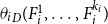 ${\theta _i}_D(F_i^1, \dots , F_i^{k_i})$
is the co-presheaf corresponding to the profunctor
${\theta _i}_D(F_i^1, \dots , F_i^{k_i})$
is the co-presheaf corresponding to the profunctor $(F_i^1 \times \dots \times F_i^{k_i}) \circ \mathbb{C}(\theta _i,1_{\mathbb{C}})$
, whence we deduce that, by composing the right pair first in Eq. (1), we obtain the composable pair of profunctors
$(F_i^1 \times \dots \times F_i^{k_i}) \circ \mathbb{C}(\theta _i,1_{\mathbb{C}})$
, whence we deduce that, by composing the right pair first in Eq. (1), we obtain the composable pair of profunctors

i.e. the co-presheaf $ \theta _D \circ ({\theta _1}_D(F_1^1, \dots , F_1^{k_1}) , \dots , {\theta _n}_D(F_n^1, \dots , F_n^{k_n}))$
. We conclude that there is a coherent isomorphism
$ \theta _D \circ ({\theta _1}_D(F_1^1, \dots , F_1^{k_1}) , \dots , {\theta _n}_D(F_n^1, \dots , F_n^{k_n}))$
. We conclude that there is a coherent isomorphism
 \begin{align*} & \theta _D \circ \big({\theta _1}_D\big(F_1^1, \dots , F_1^{k_1}\big) , \dots , {\theta _n}_D\big(F_n^1, \dots , F_n^{k_n}\big)\big) \\ = & \big(\big(F_1^1 \times \dots \times F_n^{k_n}\big) \circ \mathbb{C}^n((\theta _1, \dots , \theta _n),1_{\mathbb{C}^n})\big)\circ \mathbb{C}(\theta ,1_{\mathbb{C}}) \\ \cong & \big(F_1^1 \times \dots \times F_n^{k_n}\big) \circ ( \mathbb{C}^n((\theta _1, \dots , \theta _n),1_{\mathbb{C}^n}) \circ \mathbb{C}(\theta ,1_{\mathbb{C}}) ) \end{align*}
given by the associator $\mathfrak{a}_{\mathbb{C},\mathbb{C}^n,\unicode {x1D7D9}}$
of the bicategory
$\mathfrak{a}_{\mathbb{C},\mathbb{C}^n,\unicode {x1D7D9}}$
of the bicategory $\textbf {Prof}$
. Hence, the composite isomorphism
$\textbf {Prof}$
. Hence, the composite isomorphism $((F_1^1 \times \dots \times F_n^{k_n}) \ast \mathfrak{c}_{\theta , (\theta _1, \dots , \theta _n)} ) \circ \mathfrak{a}_{\mathbb{C},\mathbb{C}^n,\unicode {x1D7D9}}$
yields the coherent isomorphism
$((F_1^1 \times \dots \times F_n^{k_n}) \ast \mathfrak{c}_{\theta , (\theta _1, \dots , \theta _n)} ) \circ \mathfrak{a}_{\mathbb{C},\mathbb{C}^n,\unicode {x1D7D9}}$
yields the coherent isomorphism
 \begin{equation*}(\theta \circ (\theta _1, \dots , \theta _n))_D\big(F_1^1, \dots , F_n^{k_n}\big) \xrightarrow {\sim } \theta _D \circ \big({\theta _1}_D\big(F_1^1, \dots , F_1^{k_1}\big) , \dots , {\theta _n}_D\big(F_n^1, \dots , F_n^{k_n}\big)\big).\end{equation*}
It is easily shown that this isomorphism is natural in both $F_i^j$
and
$F_i^j$
and $\theta , \theta _i$
. By taking the inverse of the above natural isomorphism, we obtain the isomorphism in the desired direction
$\theta , \theta _i$
. By taking the inverse of the above natural isomorphism, we obtain the isomorphism in the desired direction $\theta _D \circ ({\theta _1}_D , \dots , {\theta _n}_D) \to (\theta \circ (\theta _1, \dots , \theta _n))_D \in \textbf {End}([\mathbb{C} \to \textbf {Set}])^{\textrm {op}}$
.
$\theta _D \circ ({\theta _1}_D , \dots , {\theta _n}_D) \to (\theta \circ (\theta _1, \dots , \theta _n))_D \in \textbf {End}([\mathbb{C} \to \textbf {Set}])^{\textrm {op}}$
.
Finally, the coherence axioms expressed in Appendix A follow as a direct consequence of the coherence equations satisfied by the bicategory $\textbf {Prof}$
and the bifunctoriality of
$\textbf {Prof}$
and the bifunctoriality of $\textbf {Cat}^{\textrm {op}} \to \textbf {Prof}$
(see Proposition A.1).
$\textbf {Cat}^{\textrm {op}} \to \textbf {Prof}$
(see Proposition A.1).
In particular, $(\!-\!)_D \colon \textbf {End}(\mathbb{C}) \to \textbf {End}([\mathbb{C} \to \textbf {Set}])^{\textrm {op}}$
sends invertible 2-cells to invertible 2-cells. It follows that Day extension send algebras in
$(\!-\!)_D \colon \textbf {End}(\mathbb{C}) \to \textbf {End}([\mathbb{C} \to \textbf {Set}])^{\textrm {op}}$
sends invertible 2-cells to invertible 2-cells. It follows that Day extension send algebras in $\mathbb{C}$
to pseudo-algebras in
$\mathbb{C}$
to pseudo-algebras in $[\mathbb{C}\to \textbf {Set}]$
(and similarly
$[\mathbb{C}\to \textbf {Set}]$
(and similarly $[\mathbb{C}^{\textrm {op}}\to \textbf {Set}]$
).
$[\mathbb{C}^{\textrm {op}}\to \textbf {Set}]$
).
Corollary 3.8.
Let $\Sigma$
be an algebraic signature (i.e. a collection of operations with finite arity) and
$\Sigma$
be an algebraic signature (i.e. a collection of operations with finite arity) and $E$
a collection of equations
$E$
a collection of equations $E$
over
$E$
over $\Sigma$
. Given a pseudo-algebra
$\Sigma$
. Given a pseudo-algebra $\mathbb{C}$
of
$\mathbb{C}$
of $(\Sigma ,E)$
, then the Day extension of each operation
$(\Sigma ,E)$
, then the Day extension of each operation $\theta \colon \mathbb{C}^n \to \mathbb{C}$
in
$\theta \colon \mathbb{C}^n \to \mathbb{C}$
in $\Sigma$
defines the structure of a pseudo-algebra for
$\Sigma$
defines the structure of a pseudo-algebra for $(\Sigma ,E)$
on
$(\Sigma ,E)$
on $[\mathbb{C} \to \textbf {Set}]$
.
$[\mathbb{C} \to \textbf {Set}]$
.
Indeed, the algebra structure is just the composite pseudo-morphism $P_{\Sigma ,E} \to \textbf {End}(\mathbb{C}) \to \textbf {End}([\mathbb{C} \to \textbf {Set}])^{\textrm {op}}$
.
$P_{\Sigma ,E} \to \textbf {End}(\mathbb{C}) \to \textbf {End}([\mathbb{C} \to \textbf {Set}])^{\textrm {op}}$
.
Remark 3.9. After writing this paper, Nathanael Arkor pointed out to the authors that the statement of Corollary 3.8 appears in D’Espalunge Reference D’Espalunge D’Arros2023, Proposition 1.4.28.
Example 3.10 (§7 Day and Street (Reference Day and Street2003)). In a similar fashion, postcomposing with $(\!-\!)_D$
sends lax algebra structure to op-lax algebra structure. In particular, given a lax monoidal category, that is, a lax-morphism of operads
$(\!-\!)_D$
sends lax algebra structure to op-lax algebra structure. In particular, given a lax monoidal category, that is, a lax-morphism of operads $P_{\Sigma _M, E_M} \to \textbf {End}(\mathbb{C})$
(cf. Example 2.11), its Day convolution yields an op-lax-morphism of operads
$P_{\Sigma _M, E_M} \to \textbf {End}(\mathbb{C})$
(cf. Example 2.11), its Day convolution yields an op-lax-morphism of operads $P_{\Sigma _M, E_M} \to \textbf {End}([\mathbb{C}\to \textbf {Set}])$
, and thus an op-lax monoidal structure on
$P_{\Sigma _M, E_M} \to \textbf {End}([\mathbb{C}\to \textbf {Set}])$
, and thus an op-lax monoidal structure on $[\mathbb{C} \to \textbf {Set}]$
.
$[\mathbb{C} \to \textbf {Set}]$
.
4. Partial Operations
There are important instances where the algebra operations are partial rather than total. For example, in separation logic, the key monoidal operation represents the union of disjoint subheaps (O’Hearn et al., Reference O’Hearn, Reynolds, Yang and Fribourg2001). In this section, we show that the Day extension considered in section 3 can be modified to incorporate partial operations as well.
4.1 The partial endomorphism operad
First, we will describe an operadic approach to algebraic structures with partial operations. When working with partial operations, we must make a choice about what it means to compose partial functors, that is, spans of functors $\mathbb{D} \hookleftarrow \mathbb{E} \to \mathbb{C}$
, which we write as
$\mathbb{D} \hookleftarrow \mathbb{E} \to \mathbb{C}$
, which we write as $\mathbb{D} \rightharpoondown \mathbb{C}$
. We adopt the convention that the composite of a pair of partial functors exists if there is a factorisation,
$\mathbb{D} \rightharpoondown \mathbb{C}$
. We adopt the convention that the composite of a pair of partial functors exists if there is a factorisation,

that is, $G$
only takes values in the domain of
$G$
only takes values in the domain of $F$
, in which case the composite is given by the outside span
$F$
, in which case the composite is given by the outside span $\mathbb{D} \hookleftarrow \mathbb{E}' \to \mathbb{C}$
(for further discussion on this choice, see subsection 4.4). As such, we must relax the notion of a
$\mathbb{D} \hookleftarrow \mathbb{E}' \to \mathbb{C}$
(for further discussion on this choice, see subsection 4.4). As such, we must relax the notion of a $\textbf {Cat}$
-operad to allow for situations where the multi-composite may not exist.
$\textbf {Cat}$
-operad to allow for situations where the multi-composite may not exist.
Definition 4.1 (Partial $\textbf {Cat}$
-operads and their morphisms). A partial
$\textbf {Cat}$
-operads and their morphisms). A partial $\textbf {Cat}$
-operad consists of:
$\textbf {Cat}$
-operad consists of:
-
(1) a category
$P(n)$
, for each
$n \in \mathbb{N}$
, -
(2) a unit
$1 \in P(1)$
, -
(3) for each
$n,k_1,\dots ,k_n \in \mathbb{N}$
, a partial functor
\begin{equation*} P(n) \times P(k_1) \times \dots \times P(k_n) \rightharpoondown P(k_1 + \dots + k_n) \end{equation*}




satisfying the associativity axioms
 \begin{equation*} \theta \circ \big(\theta _1 \circ \big(\theta _1^1, \dots , \theta _1^{k_1}\big), \dots , \theta _n \circ \big(\theta _n^1 , \dots , \theta _n^{k_n}\big)\big) = (\theta \circ (\theta _1, \dots , \theta _n)) \circ \big(\theta _1^1, \dots , \theta _n^{k_n}\big), \end{equation*}
 \begin{equation*} \alpha \circ \big(\alpha _1 \circ \big(\alpha _1^1, \dots , \alpha _1^{k_1}\big), \dots , \alpha _n \circ \big(\alpha _n^1 , \dots , \alpha _n^{k_n}\big)\big) = (\alpha \circ (\alpha _1, \dots , \alpha _n)) \circ \big(\alpha _1^1, \dots , \alpha _n^{k_n}\big), \end{equation*}
for all objects $\theta , \theta _i , \theta _i^j$
and arrows
$\theta , \theta _i , \theta _i^j$
and arrows $\alpha , \alpha _i , \alpha _i^j$
such that these multi-composites exist, and the partial unital axiom: not only is
$\alpha , \alpha _i , \alpha _i^j$
such that these multi-composites exist, and the partial unital axiom: not only is $ 1 \circ \theta$
is defined for all
$ 1 \circ \theta$
is defined for all $\theta$
, but moreover it is given by
$\theta$
, but moreover it is given by $\theta$
.
$\theta$
.
We define morphisms of partial $\textbf {Cat}$
-operads in a similar way to morphisms of
$\textbf {Cat}$
-operads in a similar way to morphisms of $\textbf {Cat}$
-operads (Definition
2.9
), except that we only preserve those multi-composites that are defined. That is to say, a lax-morphism of partial
$\textbf {Cat}$
-operads (Definition
2.9
), except that we only preserve those multi-composites that are defined. That is to say, a lax-morphism of partial $\textbf {Cat}$
-operads
$\textbf {Cat}$
-operads $\omega \colon P \to Q$
consists of the data of a functor
$\omega \colon P \to Q$
consists of the data of a functor $\omega _n \colon P(n) \to Q(n)$
for each
$\omega _n \colon P(n) \to Q(n)$
for each $n$
, a morphism
$n$
, a morphism $\lambda \colon 1 \to \omega _1(1) \in Q(1)$
, and for each
$\lambda \colon 1 \to \omega _1(1) \in Q(1)$
, and for each $\theta , \theta _i$
such that the multi-composite
$\theta , \theta _i$
such that the multi-composite $\theta \circ (\theta _1 , \dots , \theta _n)$
exists, then the multi-composite
$\theta \circ (\theta _1 , \dots , \theta _n)$
exists, then the multi-composite $\omega _n(\theta ) \circ (\omega _{k_1}(\theta _1), \dots , \omega _{k_n}(\theta _n))$
is also defined and there is a morphism
$\omega _n(\theta ) \circ (\omega _{k_1}(\theta _1), \dots , \omega _{k_n}(\theta _n))$
is also defined and there is a morphism
 \begin{equation*} \eta _{\theta , \theta _1, \dots , \theta _n} \colon \omega _n(\theta ) \circ (\omega _{k_1}(\theta _1), \dots , \omega _{k_n}(\theta _n)) \to \omega _{k_1 + \dots + k_n} (\theta \circ (\theta _1 , \dots , \theta _n)) \end{equation*}
in $Q(k_1 + \dots + k_n)$
. This data must satisfy the naturality and coherence conditions expressed in Definition
2.9
and Appendix
A
. Once again, we make the distinction between lax, pseudo and strict morphisms as in Definition
2.9
.
$Q(k_1 + \dots + k_n)$
. This data must satisfy the naturality and coherence conditions expressed in Definition
2.9
and Appendix
A
. Once again, we make the distinction between lax, pseudo and strict morphisms as in Definition
2.9
.
Initially, we restrict to partial operations whose domain is a full subcategory.
Definition 4.2 (Partial operation). Let $\mathbb{C}$
be a category. An
$\mathbb{C}$
be a category. An $n$
-ary partial operation on
$n$
-ary partial operation on $\mathbb{C}$
, written as
$\mathbb{C}$
, written as $\theta \colon \mathbb{C}^n \rightharpoondown \mathbb{C}$
, is a functor
$\theta \colon \mathbb{C}^n \rightharpoondown \mathbb{C}$
, is a functor $\theta \colon \mathbb{D} \to \mathbb{C}$
where
$\theta \colon \mathbb{D} \to \mathbb{C}$
where $\mathbb{D}$
is a full subcategory of
$\mathbb{D}$
is a full subcategory of $\mathbb{C}^n$
.
$\mathbb{C}^n$
.
Definition 4.3 (Partial endomorphism operad). Let $\mathbb{C}$
be a category. We denote by
$\mathbb{C}$
be a category. We denote by $\textbf {End}(\mathbb{C})_{\textrm {par}}$
the partial
$\textbf {End}(\mathbb{C})_{\textrm {par}}$
the partial $\textbf {Cat}$
-operad of partial operations. For each
$\textbf {Cat}$
-operad of partial operations. For each $n \in \mathbb{N}$
,
$n \in \mathbb{N}$
, $\textbf {End}(\mathbb{C})_{\textrm {par}}(n)$
is the category whose objects are
$\textbf {End}(\mathbb{C})_{\textrm {par}}(n)$
is the category whose objects are $n$
-ary partial operations
$n$
-ary partial operations $\theta \colon \mathbb{C}^n \rightharpoondown \mathbb{C}$
. An arrow
$\theta \colon \mathbb{C}^n \rightharpoondown \mathbb{C}$
. An arrow $\alpha \colon \theta \to \chi$
in
$\alpha \colon \theta \to \chi$
in $\textbf {End}(\mathbb{C})_{\textrm {par}}$
is a natural transformation
$\textbf {End}(\mathbb{C})_{\textrm {par}}$
is a natural transformation $\alpha \colon \theta \Rightarrow \chi$
between partial operations with the same domain.
$\alpha \colon \theta \Rightarrow \chi$
between partial operations with the same domain.
The unit of the operad is the identity functor $1_{\mathbb{C}}$
. For
$1_{\mathbb{C}}$
. For $n, k_1, \dots k_n \in \mathbb{N}$
, the multi-composite
$n, k_1, \dots k_n \in \mathbb{N}$
, the multi-composite
 \begin{equation*} \circ \colon \textbf {End}(\mathbb{C})_{\textrm {par}}(n) \times \textbf {End}(\mathbb{C})_{\textrm {par}}(k_1) \times \dots \times \textbf {End}(\mathbb{C})_{\textrm {par}}(k_n) \rightharpoondown \textbf {End}(\mathbb{C})_{\textrm {par}}(k_1 + \dots + k_n) \end{equation*}
is given as follows. The domain is the full subcategory spanned by those partial operations $\theta \colon \mathbb{C}^n \rightharpoondown \mathbb{C},$ $\theta _i \colon \mathbb{C}^{k_i} \rightharpoondown \mathbb{C}$
for which
$\theta _i \colon \mathbb{C}^{k_i} \rightharpoondown \mathbb{C}$
for which $(\theta _1, \dots , \theta _n) \colon \mathbb{C}^{k_1 + \dots + k_n} \rightharpoondown \mathbb{C}^n$
factors through the domain
$(\theta _1, \dots , \theta _n) \colon \mathbb{C}^{k_1 + \dots + k_n} \rightharpoondown \mathbb{C}^n$
factors through the domain $\mathbb{D} \subseteq \mathbb{C}^n$
of
$\mathbb{D} \subseteq \mathbb{C}^n$
of $\theta$
, that is, those tuples where the composite as partial functors exists. The composite as a partial functor describes the action on objects of the multi-composition
$\theta$
, that is, those tuples where the composite as partial functors exists. The composite as a partial functor describes the action on objects of the multi-composition $\circ$
. Let
$\circ$
. Let $\theta , \chi \colon \mathbb{C} \rightharpoondown \mathbb{C}$
,
$\theta , \chi \colon \mathbb{C} \rightharpoondown \mathbb{C}$
, $\theta _i, \chi _i \colon \mathbb{C}^{k_i} \rightharpoondown \mathbb{C}$
be partial operations for which the multi-composites
$\theta _i, \chi _i \colon \mathbb{C}^{k_i} \rightharpoondown \mathbb{C}$
be partial operations for which the multi-composites $\theta \circ (\theta _1 , \dots , \theta _n), \chi \circ (\chi _1, \dots , \chi _n)$
exist, and let
$\theta \circ (\theta _1 , \dots , \theta _n), \chi \circ (\chi _1, \dots , \chi _n)$
exist, and let $\alpha \colon \theta \to \chi , \beta _i \colon \theta _i \to \chi _i$
be arrows in
$\alpha \colon \theta \to \chi , \beta _i \colon \theta _i \to \chi _i$
be arrows in $\textbf {End}(\mathbb{C})_{\textrm {par}}(n)$
(respectively,
$\textbf {End}(\mathbb{C})_{\textrm {par}}(n)$
(respectively, $\textbf {End}(\mathbb{C})_{\textrm {par}}(k_i)$
). That is, the pairs
$\textbf {End}(\mathbb{C})_{\textrm {par}}(k_i)$
). That is, the pairs $\theta ,\chi$
and
$\theta ,\chi$
and $\theta _i,\chi _i$
all share the same domain. Note that since
$\theta _i,\chi _i$
all share the same domain. Note that since $(\theta _1, \dots , \theta _n), (\chi _1, \dots , \chi _n) \colon \mathbb{D}_1 \times \dots \times \mathbb{D}_n \to \mathbb{C}$
both factor through the full subcategory
$(\theta _1, \dots , \theta _n), (\chi _1, \dots , \chi _n) \colon \mathbb{D}_1 \times \dots \times \mathbb{D}_n \to \mathbb{C}$
both factor through the full subcategory $\mathbb{D} \subseteq \mathbb{C}$
(the shared domain of
$\mathbb{D} \subseteq \mathbb{C}$
(the shared domain of $\theta$
and
$\theta$
and $\chi$
), the natural transformation
$\chi$
), the natural transformation $(\beta _1, \dots , \beta _n) \colon (\theta _1, \dots , \theta _n) \Rightarrow (\chi _1, \dots , \chi _n)$
lifts to a natural transformation between the factoring functors
$(\beta _1, \dots , \beta _n) \colon (\theta _1, \dots , \theta _n) \Rightarrow (\chi _1, \dots , \chi _n)$
lifts to a natural transformation between the factoring functors $(\theta _1, \dots , \theta _n)' , (\chi _1, \dots , \chi _n)' \colon \mathbb{D}_1 \times \dots \times \mathbb{D}_n \to \mathbb{D}$
. We define
$(\theta _1, \dots , \theta _n)' , (\chi _1, \dots , \chi _n)' \colon \mathbb{D}_1 \times \dots \times \mathbb{D}_n \to \mathbb{D}$
. We define $\alpha \circ (\beta _1 ,\dots , \beta _n)$
as the horizontal composite of 2-cells
$\alpha \circ (\beta _1 ,\dots , \beta _n)$
as the horizontal composite of 2-cells

Example 4.4. Each total operation $\theta \colon \mathbb{C}^n \to \mathbb{C}$
can be considered as a partial operation
$\theta \colon \mathbb{C}^n \to \mathbb{C}$
can be considered as a partial operation $\theta \colon \mathbb{C}^n \rightharpoondown \mathbb{C}$
where the inclusion of the domain is just the identity
$\theta \colon \mathbb{C}^n \rightharpoondown \mathbb{C}$
where the inclusion of the domain is just the identity $1_{\mathbb{C}^n} \colon \mathbb{C}^n \to \mathbb{C}^n$
. Indeed, this identifies
$1_{\mathbb{C}^n} \colon \mathbb{C}^n \to \mathbb{C}^n$
. Indeed, this identifies $\textbf {End}(\mathbb{C})(n)$
as a full subcategory of
$\textbf {End}(\mathbb{C})(n)$
as a full subcategory of $\textbf {End}(\mathbb{C})_{\textrm {par}}(n)$
, for each
$\textbf {End}(\mathbb{C})_{\textrm {par}}(n)$
, for each $n \in \mathbb{N}$
. These inclusion functors together define a (strict) morphism of partial
$n \in \mathbb{N}$
. These inclusion functors together define a (strict) morphism of partial $\textbf {Cat}$
-operads
$\textbf {Cat}$
-operads $\textbf {End}(\mathbb{C}) \hookrightarrow \textbf {End}(\mathbb{C})_{\textrm {par}}$
, and in this sense
$\textbf {End}(\mathbb{C}) \hookrightarrow \textbf {End}(\mathbb{C})_{\textrm {par}}$
, and in this sense $\textbf {End}(\mathbb{C})$
is a suboperad of
$\textbf {End}(\mathbb{C})$
is a suboperad of $\textbf {End}(\mathbb{C})_{\textrm {par}}$
.
$\textbf {End}(\mathbb{C})_{\textrm {par}}$
.
4.2 Day extension of partial operations
Definition 4.5 (Day extension of partial operations). The Day extension of a partial operation $\theta \colon \mathbb{C}^n \rightharpoondown \mathbb{C}$
is the total functor
$\theta \colon \mathbb{C}^n \rightharpoondown \mathbb{C}$
is the total functor $\theta _D \colon [\mathbb{C} \to \textbf {Set}]^n \to [\mathbb{C} \to \textbf {Set}]$
given by sending
$\theta _D \colon [\mathbb{C} \to \textbf {Set}]^n \to [\mathbb{C} \to \textbf {Set}]$
given by sending $F_1, \dots , F_n \colon \mathbb{C} \to \textbf {Set}$
to the co-presheaf corresponding to the composite of profunctors
$F_1, \dots , F_n \colon \mathbb{C} \to \textbf {Set}$
to the co-presheaf corresponding to the composite of profunctors

and a tuple of natural transformations $\alpha _i \colon F_i \Rightarrow G_i$
between co-presheaves to the natural transformation corresponding to the transformation of profunctors
$\alpha _i \colon F_i \Rightarrow G_i$
between co-presheaves to the natural transformation corresponding to the transformation of profunctors

where $i$
is the inclusion
$i$
is the inclusion $\mathbb{D} \subseteq \mathbb{C}^n$
of the domain of
$\mathbb{D} \subseteq \mathbb{C}^n$
of the domain of $\theta$
.
$\theta$
.
Given a natural transformation $\alpha \colon \theta \Rightarrow \chi$
between partial operations
$\alpha \colon \theta \Rightarrow \chi$
between partial operations $\theta , \chi \colon \mathbb{C}^n \rightharpoondown \mathbb{C}$
with the same domain
$\theta , \chi \colon \mathbb{C}^n \rightharpoondown \mathbb{C}$
with the same domain $\mathbb{D} \subseteq \mathbb{C}^n$
, that is, an arrow
$\mathbb{D} \subseteq \mathbb{C}^n$
, that is, an arrow $\theta \to \chi$
in
$\theta \to \chi$
in $\textbf {End}(\mathbb{C})_{\textrm {par}}(n)$
, we define
$\textbf {End}(\mathbb{C})_{\textrm {par}}(n)$
, we define $\alpha _D \colon \chi _D \to \theta _D$
as the natural transformation whose component at
$\alpha _D \colon \chi _D \to \theta _D$
as the natural transformation whose component at $(F_1, \dots , F_n)$
is given by the transformation of profunctors
$(F_1, \dots , F_n)$
is given by the transformation of profunctors

The order of composition in this definition is not important as both choices are coherently isomorphic.
Remark 4.6. Note that, by taking $i \colon \mathbb{D} \hookrightarrow \mathbb{C}^n$
as
$i \colon \mathbb{D} \hookrightarrow \mathbb{C}^n$
as $1_{\mathbb{C}^n}$
in the above definition, we recover the description of the Day extension for total operations from Definition 3.3.
$1_{\mathbb{C}^n}$
in the above definition, we recover the description of the Day extension for total operations from Definition 3.3.
Remark 4.7. Let $\theta \colon \mathbb{C}^n \rightharpoondown \mathbb{C}$
be a partial operation and
$\theta \colon \mathbb{C}^n \rightharpoondown \mathbb{C}$
be a partial operation and $F_1, \dots , F_n$
co-presheaves. As a coend
$F_1, \dots , F_n$
co-presheaves. As a coend $\theta _D(F_1, \dots , F_n)$
is given by the formula
$\theta _D(F_1, \dots , F_n)$
is given by the formula
 \begin{align*} \theta _D(F_1, \dots , F_n)(a) & = \int ^{\vec {d} \in \mathbb{D}} \int ^{\vec {c} \in \mathbb{C}} \mathbb{C}(\theta (\vec {d}),a) \times \mathbb{C}^n(\vec {c},\vec {d}) \times \prod _{c_i \in \vec {c}} F_i(c_i), \\ & \simeq \int ^{\vec {c} \in \mathbb{C}} \int ^{\vec {d} \in \mathbb{D}} \mathbb{C}(\theta (\vec {d}),a) \times \mathbb{C}^n(\vec {c},\vec {d}) \times \prod _{c_i \in \vec {c}} F_i(c_i). \end{align*}
Lemma 4.8.
For each $n$
, the Day extension of partial operations yields a functor
$n$
, the Day extension of partial operations yields a functor $(\!-\!)_D \colon$ $\textbf {End}(\mathbb{C})_{\textrm {par}}(n) \to \textbf {End}([\mathbb{C} \to \textbf {Set}])(n)$
.
$\textbf {End}(\mathbb{C})_{\textrm {par}}(n) \to \textbf {End}([\mathbb{C} \to \textbf {Set}])(n)$
.
Proof. This is a consequence of the functoriality of $\textbf {Cat}^{\textrm {op}} \to \textbf {Prof}$
on 2-cells, just as in Lemma 3.5.
$\textbf {Cat}^{\textrm {op}} \to \textbf {Prof}$
on 2-cells, just as in Lemma 3.5.
Lemma 4.9.
Let $\theta \colon \mathbb{C}^n \rightharpoondown \mathbb{C}, \theta _i \colon \mathbb{C}^{k_i} \rightharpoondown \mathbb{C}$
be partial operations on a category
$\theta \colon \mathbb{C}^n \rightharpoondown \mathbb{C}, \theta _i \colon \mathbb{C}^{k_i} \rightharpoondown \mathbb{C}$
be partial operations on a category $\mathbb{C}$
(recall that, in particular, the domain of
$\mathbb{C}$
(recall that, in particular, the domain of $\theta$
is a full subcategory of
$\theta$
is a full subcategory of $\mathbb{D}$
). Suppose that
$\mathbb{D}$
). Suppose that $(\theta _1 , \dots , \theta _n ) \colon \mathbb{C}^{k_1 + \dots + k_n} \rightharpoondown \mathbb{C}$
factors through
$(\theta _1 , \dots , \theta _n ) \colon \mathbb{C}^{k_1 + \dots + k_n} \rightharpoondown \mathbb{C}$
factors through $\mathbb{D} \subseteq \mathbb{C}$
(i.e. the multi-composite
$\mathbb{D} \subseteq \mathbb{C}$
(i.e. the multi-composite $\theta \circ (\theta _1, \dots , \theta _n)$
exists). Then there is a canonical isomorphism
$\theta \circ (\theta _1, \dots , \theta _n)$
exists). Then there is a canonical isomorphism $(\theta \circ (\theta _1, \dots , \theta _n))_D \cong \theta _D \circ ({\theta _1}_D , \dots , {\theta _n}_D)$
.
$(\theta \circ (\theta _1, \dots , \theta _n))_D \cong \theta _D \circ ({\theta _1}_D , \dots , {\theta _n}_D)$
.
Proof. Let $m = k_1 + \dots + k_n$
. By assumption, we have the following commuting diagram of functors as displayed on the left, from which we obtain the diagram of profunctors on the right.
$m = k_1 + \dots + k_n$
. By assumption, we have the following commuting diagram of functors as displayed on the left, from which we obtain the diagram of profunctors on the right.

We observe that the diagram of profunctors on the right also commutes (up to coherent isomorphism). This follows from the bifunctoriality of the embedding of $\textbf {Cat}^{\textrm {op}}$
in
$\textbf {Cat}^{\textrm {op}}$
in $\textbf {Prof}$
, and since
$\textbf {Prof}$
, and since $\mathbb{C}^n((\theta_1,\dots,\theta_n),1_{\mathbb{C}^n})\circ \mathbb{C}^n(1_{\mathbb{C}^n},i) \cong \mathbb{C}^n ((\theta_1,\dots,\theta_n),i) = \mathbb{D}((\theta_1,\dots,\theta_n)',1_{\mathbb{D}})$
, with the last equality holding because
$\mathbb{C}^n((\theta_1,\dots,\theta_n),1_{\mathbb{C}^n})\circ \mathbb{C}^n(1_{\mathbb{C}^n},i) \cong \mathbb{C}^n ((\theta_1,\dots,\theta_n),i) = \mathbb{D}((\theta_1,\dots,\theta_n)',1_{\mathbb{D}})$
, with the last equality holding because $\mathbb{D}$
is a full subcategory of
$\mathbb{D}$
is a full subcategory of $\mathbb{C}^n$
.
$\mathbb{C}^n$
.
Given co-presheaves $F_1^1, \dots , F_n^{k_n} \colon \mathbb{C} \;\;\, \shortmid \!\!\!\rightarrow \, \unicode {x1D7D9}$
, for each
$F_1^1, \dots , F_n^{k_n} \colon \mathbb{C} \;\;\, \shortmid \!\!\!\rightarrow \, \unicode {x1D7D9}$
, for each $j$
,
$j$
, ${\theta _j}_D(F_j^1, \dots , F_j^{k_j})$
is given (up to coherent isomorphism) by the composite profunctor
${\theta _j}_D(F_j^1, \dots , F_j^{k_j})$
is given (up to coherent isomorphism) by the composite profunctor $(F_j^1 \times \dots \times F_j^{k_j}) \circ \mathbb{C}^n(1_{\mathbb{C}^n},i_j) \circ \mathbb{C}(\theta _j,1_{\mathbb{C}}) \colon \mathbb{C} \;\;\, \shortmid \!\!\!\rightarrow \, \unicode {x1D7D9}$
, and hence
$(F_j^1 \times \dots \times F_j^{k_j}) \circ \mathbb{C}^n(1_{\mathbb{C}^n},i_j) \circ \mathbb{C}(\theta _j,1_{\mathbb{C}}) \colon \mathbb{C} \;\;\, \shortmid \!\!\!\rightarrow \, \unicode {x1D7D9}$
, and hence $\theta _D \circ ({\theta _1}_D, \dots , {\theta _n}_D)(F_1^1 , \dots , F_n^{k_n})$
is (isomorphic to) the composite profunctor
$\theta _D \circ ({\theta _1}_D, \dots , {\theta _n}_D)(F_1^1 , \dots , F_n^{k_n})$
is (isomorphic to) the composite profunctor
 \begin{equation*} \big(F_1^1 \times \dots \times F_n^{k_n}\big) \circ \mathbb{C}^{m}(1_{\mathbb{C}^m}, (i_1, \dots , i_n)) \circ \mathbb{C}^n((\theta _1, \dots , \theta _n), 1_{\mathbb{C}^n}) \circ \mathbb{C}^n(1_{\mathbb{C}^n},i) \circ \mathbb{C}(\theta ,1_{\mathbb{C}}) \colon \mathbb{C} \;\;\, \shortmid \!\!\!\rightarrow \, \unicode {x1D7D9}. \end{equation*}
Note that this composite is itself defined only up to coherent isomorphism since we have left the order of the composition unspecified.
Meanwhile, the partial composite $\theta \circ (\theta _1, \dots , \theta _n)$
is the span
$\theta \circ (\theta _1, \dots , \theta _n)$
is the span

and so $(\theta \circ (\theta _1, \dots , \theta _n))_D(F_1^1, \dots , F_n^{k_n})$
is given by the composite profunctor
$(\theta \circ (\theta _1, \dots , \theta _n))_D(F_1^1, \dots , F_n^{k_n})$
is given by the composite profunctor
 \begin{equation*} \big(F_1^1 \times \dots \times F_n^{k_n}\big) \circ \mathbb{C}^{m}(1_{\mathbb{C}^m}, (i_1, \dots , i_n)) \circ \mathbb{C}(\theta \circ (\theta _1, \dots , \theta _n)', 1_{\mathbb{C}}) \colon \mathbb{C}^{m} \;\;\, \shortmid \!\!\!\rightarrow \, \unicode {x1D7D9}. \end{equation*}
By the bifunctoriality of $\textbf {Cat}^{\textrm {op}} \to \textbf {Prof}$
and the isomorphism
$\textbf {Cat}^{\textrm {op}} \to \textbf {Prof}$
and the isomorphism $\mathbb{D}((\theta _1 , \dots , \theta )',1_{\mathbb{D}}) \cong \mathbb{C}^n((\theta _1, \dots , \theta _n), 1_{\mathbb{C}^n}) \circ \mathbb{C}^n(1_{\mathbb{C}^n},i)$
established above, there are canonical isomorphisms
$\mathbb{D}((\theta _1 , \dots , \theta )',1_{\mathbb{D}}) \cong \mathbb{C}^n((\theta _1, \dots , \theta _n), 1_{\mathbb{C}^n}) \circ \mathbb{C}^n(1_{\mathbb{C}^n},i)$
established above, there are canonical isomorphisms
 \begin{align*} & \big(F_1^1 \times \dots \times F_n^{k_n}\big) \circ \mathbb{C}^{m}(1_{\mathbb{C}^m}, (i_1, \dots , i_n)) \circ \mathbb{C}(\theta \circ (\theta _1, \dots , \theta _n)', 1_{\mathbb{C}}) \\ \cong & \big(F_1^1 \times \dots \times F_n^{k_n}\big) \circ \mathbb{C}^{m}(1_{\mathbb{C}^m}, (i_1, \dots , i_n)) \circ \mathbb{D}((\theta _1 , \dots , \theta )',1_{\mathbb{D}}) \circ \mathbb{C}(\theta ,1_{\mathbb{C}}), \\ \cong & \big(F_1^1 \times \dots \times F_n^{k_n}\big) \circ \mathbb{C}^{m}(1_{\mathbb{C}^m}, (i_1, \dots , i_n)) \circ \mathbb{C}^n((\theta _1, \dots , \theta _n), 1_{\mathbb{C}^n}) \circ \mathbb{C}^n(1_{\mathbb{C}^n},i) \circ \mathbb{C}(\theta ,1_{\mathbb{C}}). \end{align*}
The latter is isomorphic to $\theta _D \circ ({\theta _1}_D, \dots , {\theta _n}_D)(F_1^1 , \dots , F_n^{k_n})$
. This yields the desired natural isomorphism
$\theta _D \circ ({\theta _1}_D, \dots , {\theta _n}_D)(F_1^1 , \dots , F_n^{k_n})$
. This yields the desired natural isomorphism $(\theta \circ (\theta _1, \dots , \theta _n))_D \cong \theta _D \circ ({\theta _1}_D , \dots , {\theta _n}_D)$
.
$(\theta \circ (\theta _1, \dots , \theta _n))_D \cong \theta _D \circ ({\theta _1}_D , \dots , {\theta _n}_D)$
.
Theorem 4.10.
Day extension of partial operations defines a pseudo-morphism of partial $\textbf {Cat}$
-operads
$\textbf {Cat}$
-operads
 \begin{equation*} (\!-\!)_D \colon \textbf {End}(\mathbb{C})_{\textrm {par}} \to \textbf {End}([\mathbb{C} \to \textbf {Set}])^{\textrm {op}}. \end{equation*}
Moreover, the triangle of pseudo-morphisms

commutes.
Proof. By Lemma 4.8, for each $n$
,
$n$
, $(\!-\!)_D \colon \textbf {End}(\mathbb{C})_{\textrm {par}}(n) \to \textbf {End}([\mathbb{C} \to \textbf {Set}])^{\textrm {op}}(n)$
is a functor. Just as in Theorem 3.6, the unit is preserved up to (canonical) isomorphism since
$(\!-\!)_D \colon \textbf {End}(\mathbb{C})_{\textrm {par}}(n) \to \textbf {End}([\mathbb{C} \to \textbf {Set}])^{\textrm {op}}(n)$
is a functor. Just as in Theorem 3.6, the unit is preserved up to (canonical) isomorphism since $\mathbb{C}(1_{\mathbb{C}},1_{\mathbb{C}}) \colon \mathbb{C} \;\;\, \shortmid \!\!\!\rightarrow \, \mathbb{C}$
is the identity profunctor on
$\mathbb{C}(1_{\mathbb{C}},1_{\mathbb{C}}) \colon \mathbb{C} \;\;\, \shortmid \!\!\!\rightarrow \, \mathbb{C}$
is the identity profunctor on $\mathbb{C}$
, while the preservation up to (canonical) isomorphism for those multi-composites that exist is given in Lemma 4.9. Finally, the commutativity of Eq. (3) follows from Remark 4.6.
$\mathbb{C}$
, while the preservation up to (canonical) isomorphism for those multi-composites that exist is given in Lemma 4.9. Finally, the commutativity of Eq. (3) follows from Remark 4.6.
Thus, Day extension also permits the extension of a partial algebraic structure, and in doing so, it takes a partial operator into a total one. An example of this, which we discuss further in Example 4.17, is the separating conjunction ( $\ast$
) of separation logic, which is the Day extension of the partial binary operation
$\ast$
) of separation logic, which is the Day extension of the partial binary operation $\sqcup \colon \mathbb{H}^2 \to \mathbb{H}$
that takes the union of disjoint heaps. The resultant operation on propositions
$\sqcup \colon \mathbb{H}^2 \to \mathbb{H}$
that takes the union of disjoint heaps. The resultant operation on propositions $\ast$
is total despite the partiality of
$\ast$
is total despite the partiality of $\sqcup$
.
$\sqcup$
.
When discussing partial operations, there are two notions of equality that are commonly considered.
Definition 4.11.
Let $\theta , \psi \colon \mathbb{C}^n \rightharpoondown \mathbb{C}$
be partial operations,
$\theta , \psi \colon \mathbb{C}^n \rightharpoondown \mathbb{C}$
be partial operations,
-
(1) then
$\theta$
and
$\psi$
are said to be weakly equal if they agree on the intersection of their domains,
-
(2) and
$\theta$
and
$\psi$
are said to be strongly equal if they are weakly equal and have the same domain, that is they are identical functors.


Definition 4.12.
By a partial algebra for a operad $P$
, we mean a category
$P$
, we mean a category $\mathbb{C}$
and a strict morphism of partial
$\mathbb{C}$
and a strict morphism of partial $\textbf {Cat}$
-operads
$\textbf {Cat}$
-operads $P \to \textbf {End}(\mathbb{C})_{\textrm {par}}$
. Similarly, we will talk of partial pseudo-algebras and partial lax-algebras.
$P \to \textbf {End}(\mathbb{C})_{\textrm {par}}$
. Similarly, we will talk of partial pseudo-algebras and partial lax-algebras.
In particular, if $\Sigma$
is a collection of operation symbols with arities, and
$\Sigma$
is a collection of operation symbols with arities, and $E$
is a collection of equations over
$E$
is a collection of equations over $\Sigma$
, then a partial algebra
$\Sigma$
, then a partial algebra $P_{(\Sigma ,E)} \to \textbf {End}(\mathbb{C})_{\textrm {par}}$
consists of a category
$P_{(\Sigma ,E)} \to \textbf {End}(\mathbb{C})_{\textrm {par}}$
consists of a category $\mathbb{C}$
and partial operations
$\mathbb{C}$
and partial operations $\theta \colon \mathbb{C}^n \rightharpoondown \mathbb{C}$
, for each operation symbol in
$\theta \colon \mathbb{C}^n \rightharpoondown \mathbb{C}$
, for each operation symbol in $\Sigma$
, for which the equations in
$\Sigma$
, for which the equations in $E$
are interpreted as strong equalities. We note that the Day extension of partial operations preserves strong equality, up to isomorphism. Thus, by postcomposing a strict/pseudo/lax partial algebra structure
$E$
are interpreted as strong equalities. We note that the Day extension of partial operations preserves strong equality, up to isomorphism. Thus, by postcomposing a strict/pseudo/lax partial algebra structure $P \to \textbf {End}(\mathbb{C})_{\textrm {par}}$
with the Day extension
$P \to \textbf {End}(\mathbb{C})_{\textrm {par}}$
with the Day extension $(\!-\!)_D \colon \textbf {End}(\mathbb{C})_{\textrm {par}} \to \textbf {End}([\mathbb{C} \to \textbf {Set}])^{\textrm {op}}$
, we obtain a pseudo/pseudo/op-lax partial algebra structure on
$(\!-\!)_D \colon \textbf {End}(\mathbb{C})_{\textrm {par}} \to \textbf {End}([\mathbb{C} \to \textbf {Set}])^{\textrm {op}}$
, we obtain a pseudo/pseudo/op-lax partial algebra structure on $[\mathbb{C} \to \textbf {Set}]$
.
$[\mathbb{C} \to \textbf {Set}]$
.
Corollary 4.13.
As in Corollary
3.8
, let $\Sigma$
be an algebraic signature (i.e. a collection of operations with finite arity) and
$\Sigma$
be an algebraic signature (i.e. a collection of operations with finite arity) and $E$
a collection of equations
$E$
a collection of equations $E$
over
$E$
over $\Sigma$
. Given a pseudo-partial-algebra
$\Sigma$
. Given a pseudo-partial-algebra $\mathbb{C}$
of
$\mathbb{C}$
of $(\Sigma ,E)$
, where the equations in
$(\Sigma ,E)$
, where the equations in $E$
hold up to strong equality, then the Day extension of each operation
$E$
hold up to strong equality, then the Day extension of each operation $\theta \colon \mathbb{C}^n \to \mathbb{C}$
in
$\theta \colon \mathbb{C}^n \to \mathbb{C}$
in $\Sigma$
defines the structure of a (total) pseudo-algebra for
$\Sigma$
defines the structure of a (total) pseudo-algebra for $(\Sigma ,E)$
on
$(\Sigma ,E)$
on $[\mathbb{C} \to \textbf {Set}]$
.
$[\mathbb{C} \to \textbf {Set}]$
.
Remark 4.14. Weak equality between partial operations cannot be preserved by Day extension in general, since the result is always a total operation. For example, the empty operation $0 \colon \emptyset \to \mathbb{C}$
is weakly equal to any other
$0 \colon \emptyset \to \mathbb{C}$
is weakly equal to any other $n$
-ary operation on
$n$
-ary operation on $\mathbb{C}$
, but
$\mathbb{C}$
, but $0_D$
is total and so cannot be weakly equal (up to isomorphism) to every
$0_D$
is total and so cannot be weakly equal (up to isomorphism) to every $n$
-ary operation on
$n$
-ary operation on $[\mathbb{C} \to \textbf {Set}]$
.
$[\mathbb{C} \to \textbf {Set}]$
.
Example 4.15 (Hybrid logic). This example and the next concern Kripke semantics for modal logic. Recall that a Kripke frame consists of a partially ordered set $W$
that is normally interpreted as the ‘possible worlds’. A propositional formula
$W$
that is normally interpreted as the ‘possible worlds’. A propositional formula $\varphi$
can either be true or false at a world
$\varphi$
can either be true or false at a world $w \in {W}$
(we write
$w \in {W}$
(we write $w \Vdash \varphi$
for the former) with the added monotonicity condition that if
$w \Vdash \varphi$
for the former) with the added monotonicity condition that if $w \leqslant \nu$
and
$w \leqslant \nu$
and $w \Vdash \varphi$
, then
$w \Vdash \varphi$
, then $\nu \Vdash \varphi$
. Thus, propositional formulae can be equated with the objects of
$\nu \Vdash \varphi$
. Thus, propositional formulae can be equated with the objects of $[{W} \to \unicode {x1D7DA}]$
, that is, the subterminal objects of
$[{W} \to \unicode {x1D7DA}]$
, that is, the subterminal objects of $[{W} \to \textbf {Set}]$
. The poset
$[{W} \to \textbf {Set}]$
. The poset $[{W} \to \unicode {x1D7DA}]$
inherits the structure of a Heyting algebra from the cartesian closed structure on
$[{W} \to \unicode {x1D7DA}]$
inherits the structure of a Heyting algebra from the cartesian closed structure on $[{W} \to \textbf {Set}] = \textbf {Prof}({W},\unicode {x1D7D9})$
.
$[{W} \to \textbf {Set}] = \textbf {Prof}({W},\unicode {x1D7D9})$
.
Hybrid logic extends modal logic via the addition of nominals that allow reference to specific elements of the Kripke frame $W$
(for further details, see Braüner (Reference Braüner2011, §1, §8)). Let
$W$
(for further details, see Braüner (Reference Braüner2011, §1, §8)). Let $a$
be an element of
$a$
be an element of $W$
and
$W$
and $\varphi$
a proposition. The nominal
$\varphi$
a proposition. The nominal $\textbf {a}$
is the proposition in
$\textbf {a}$
is the proposition in $[{W} \to \unicode {x1D7DA}]$
where
$[{W} \to \unicode {x1D7DA}]$
where $w \Vdash \textbf {a}$
if and only if
$w \Vdash \textbf {a}$
if and only if $ a \leqslant w$
. We also add the unary operation
$ a \leqslant w$
. We also add the unary operation $@_a$
, where
$@_a$
, where $w \Vdash @_a \varphi$
if and only if
$w \Vdash @_a \varphi$
if and only if $a \Vdash \varphi$
, that is, the proposition
$a \Vdash \varphi$
, that is, the proposition $@_a \varphi$
expresses “
$@_a \varphi$
expresses “ $\varphi$
is true in world
$\varphi$
is true in world $a$
”.
$a$
”.
We recognise that $\textbf {a} \colon \unicode {x1D7D9} \to [{W} \to \unicode {x1D7DA}]$
and
$\textbf {a} \colon \unicode {x1D7D9} \to [{W} \to \unicode {x1D7DA}]$
and $@_a \colon [{W} \to \unicode {x1D7DA}] \to [{W} \to \unicode {x1D7DA}]$
are examples of Day extensions.
$@_a \colon [{W} \to \unicode {x1D7DA}] \to [{W} \to \unicode {x1D7DA}]$
are examples of Day extensions.
-
(1) Let
$\iota _a \colon \unicode {x1D7D9} \to {W}$
be the inclusion of the element
$a \in {W}$
. The profunctor
${W}(\iota _a,1) \colon {W} \;\;\, \shortmid \!\!\!\rightarrow \, \unicode {x1D7D9}$
, as a function
${W} \to \unicode {x1D7DA} \subseteq \textbf {Set}$
, sends
$w \in {W}$
to
$\top \in \unicode {x1D7DA}$
if and only if
$a \leqslant w$
. Thus,
${W}(\iota _a,1)$
, which is the Day extension
$({\iota _a})_D$
, yields the interpretation of the nominal
$\textbf {a}$
. -
(2) Assuming that
$W$
is rooted (Chagrov and Zakharyshev Reference Chagrov and Zakharyshev1997, §2.3), that is
$W$
has a bottom element
$w_0 \in {W}$
, consider the partial function
$\iota _{w_0/a} \colon {W} \rightharpoondown {W}$
whose domain is
$\iota _{a} \colon \unicode {x1D7D9} \to {W}$
and whose action is
$\iota _{w_0} \colon \unicode {x1D7D9} \to {W}$
. It is readily calculated that the composite profunctoris precisely
$@_a \varphi$
, and thus the Day extension
$(\iota _{w_0/a})_D$
acts on propositions as
$@_a$
.








Example 4.16 (Linear temporal logic). Linear temporal logic (LTL) has long been employed in program verification (see Pnueli (Reference Pnueli1977)). In LTL, our set of worlds $W$
, interpreted as time stamps, is discretely ordered and equipped with a successor function
$W$
, interpreted as time stamps, is discretely ordered and equipped with a successor function $s \colon W \to W$
that represents a discrete time step. We recognise that the Day extension
$s \colon W \to W$
that represents a discrete time step. We recognise that the Day extension $s_D \colon [W \to \unicode {x1D7DA}] \to [W \to \unicode {x1D7DA}]$
acts on a proposition
$s_D \colon [W \to \unicode {x1D7DA}] \to [W \to \unicode {x1D7DA}]$
acts on a proposition $\varphi$
as the ‘next’ operator, usually written as
$\varphi$
as the ‘next’ operator, usually written as $\textbf {X} \varphi$
(Huth and Ryan, Reference Huth and Ryan2004, §3.2); that is,
$\textbf {X} \varphi$
(Huth and Ryan, Reference Huth and Ryan2004, §3.2); that is, $w \Vdash \textbf {X} \varphi$
if and only if
$w \Vdash \textbf {X} \varphi$
if and only if $s w \Vdash \varphi$
, or in other words
$s w \Vdash \varphi$
, or in other words $\textbf {X} \varphi$
expresses “
$\textbf {X} \varphi$
expresses “ $\varphi$
is satisfied in the next time step”.
$\varphi$
is satisfied in the next time step”.
Using Theorems 3.6 and 4.10, we can generate the logical congruences obtained when mixing the operators of hybrid logic and LTL. As a simple example, given $a \in W$
, we have that
$a \in W$
, we have that $s_D \circ (\iota _a)_D \cong (s \circ \iota _a)_D = (\iota _{s a})_D$
, expressing the tautology that
$s_D \circ (\iota _a)_D \cong (s \circ \iota _a)_D = (\iota _{s a})_D$
, expressing the tautology that $\textbf {X}\textbf {a}$
is logically equivalent to the nominal on
$\textbf {X}\textbf {a}$
is logically equivalent to the nominal on $s a$
.
$s a$
.
Example 4.17 (Separation logic). Separation logic was introduced for reasoning about programs which alter data structures. The key idea is adding a “separating conjunction” $\varphi \ast \psi$
between propositions that assert that
$\varphi \ast \psi$
between propositions that assert that $\varphi$
and
$\varphi$
and $\psi$
hold on separate parts of the data structure (O’Hearn et al. (Reference O’Hearn, Reynolds, Yang and Fribourg2001); Reynolds (Reference Reynolds2002)). The standard semantics for separation logic consists of a set
$\psi$
hold on separate parts of the data structure (O’Hearn et al. (Reference O’Hearn, Reynolds, Yang and Fribourg2001); Reynolds (Reference Reynolds2002)). The standard semantics for separation logic consists of a set $\mathbb{H}$
called heaps, equipped with a partial binary operation
$\mathbb{H}$
called heaps, equipped with a partial binary operation $\sqcup \colon \mathbb{H}^2 \rightharpoondown \mathbb{H}$
, whose domain
$\sqcup \colon \mathbb{H}^2 \rightharpoondown \mathbb{H}$
, whose domain $\mathbb{D}$
we call the disjoint heaps;
$\mathbb{D}$
we call the disjoint heaps; $\sqcup$
is intended to be the union of disjoint heaps. We write
$\sqcup$
is intended to be the union of disjoint heaps. We write $h \# h'$
if the pair
$h \# h'$
if the pair $h,h'$
are in the domain
$h,h'$
are in the domain $\mathbb{D} \subseteq \mathbb{H}^2$
of
$\mathbb{D} \subseteq \mathbb{H}^2$
of $\sqcup$
.
$\sqcup$
.
Given propositions $\varphi , \psi \in [\mathbb{H} \to \unicode {x1D7DA}]$
on heaps, their separating conjunction
$\varphi , \psi \in [\mathbb{H} \to \unicode {x1D7DA}]$
on heaps, their separating conjunction $\varphi \ast \psi \in [\mathbb{H} \to \unicode {x1D7DA}]$
is the proposition where
$\varphi \ast \psi \in [\mathbb{H} \to \unicode {x1D7DA}]$
is the proposition where $h \Vdash \varphi \ast \psi$
if and only if there exist
$h \Vdash \varphi \ast \psi$
if and only if there exist $h_1$
and
$h_1$
and $h_2$
such that
$h_2$
such that $h = h_1 \sqcup h_2$
,
$h = h_1 \sqcup h_2$
, $h_1 \Vdash \varphi$
and
$h_1 \Vdash \varphi$
and $h_2 \Vdash \psi$
, that is the heap
$h_2 \Vdash \psi$
, that is the heap $h$
can be decomposed into disjoint parts
$h$
can be decomposed into disjoint parts $h_1$
and
$h_1$
and $h_2$
on which
$h_2$
on which $\varphi$
and
$\varphi$
and $\psi$
hold respectively. We readily calculate that
$\psi$
hold respectively. We readily calculate that $\varphi \ast \psi$
, as a profunctor, is given by the composite
$\varphi \ast \psi$
, as a profunctor, is given by the composite

Thus, the separating conjunction $\ast$
of propositions is precisely given by the Day extension
$\ast$
of propositions is precisely given by the Day extension $\sqcup _D \colon [\mathbb{H} \to \unicode {x1D7DA}]^2 \to [\mathbb{H} \to \unicode {x1D7DA}]$
.
$\sqcup _D \colon [\mathbb{H} \to \unicode {x1D7DA}]^2 \to [\mathbb{H} \to \unicode {x1D7DA}]$
.
If we instead chose $\mathbb{H}$
to be a partially ordered set, and took
$\mathbb{H}$
to be a partially ordered set, and took $\sqcup \colon \mathbb{H}^2 \rightharpoondown \mathbb{H}$
as a monotone partial binary function, by the same construction we would recover the intuitionistic variant of separation logic (see, for instance, Ishtiaq and O’Hearn (Reference Ishtiaq and O’Hearn2001, §9)).
$\sqcup \colon \mathbb{H}^2 \rightharpoondown \mathbb{H}$
as a monotone partial binary function, by the same construction we would recover the intuitionistic variant of separation logic (see, for instance, Ishtiaq and O’Hearn (Reference Ishtiaq and O’Hearn2001, §9)).
4.3 Adjoints to day extensions
Recall that, given a monoidal category $(\mathbb{C}, \otimes , I)$
, the Day monoidal product
$(\mathbb{C}, \otimes , I)$
, the Day monoidal product $\otimes _D$
on
$\otimes _D$
on $[\mathbb{C} \to \textbf {Set}]$
is residuated, that is there are binary operations, usually denoted by
$[\mathbb{C} \to \textbf {Set}]$
is residuated, that is there are binary operations, usually denoted by $- / -, -\backslash - \colon [\mathbb{C} \to \textbf {Set}]^2 \to [\mathbb{C} \to \textbf {Set}]$
, such that there are adjunctions
$- / -, -\backslash - \colon [\mathbb{C} \to \textbf {Set}]^2 \to [\mathbb{C} \to \textbf {Set}]$
, such that there are adjunctions $F \otimes _D - \dashv F \backslash -$
and
$F \otimes _D - \dashv F \backslash -$
and $- \otimes _D F \dashv - / F$
for all
$- \otimes _D F \dashv - / F$
for all $F \in [\mathbb{C} \to \textbf {Set}]$
(in Day (Reference Day and MacLane1970) and Mac Lane (Reference Mac Lane1969, §VII.7), this is called a (bi-)closed monoidal structure, whereas we are following the terminology from classical order theory, for instance Ward and Dilworth (Reference Ward and Dilworth1939)). Thus, Day convolution can be used to generate a class of models for bunched implication logic (O’Hearn and Pym Reference O’Hearn and Pym1999, §3.1) (by also using the cartesian closed monoidal structure on
$F \in [\mathbb{C} \to \textbf {Set}]$
(in Day (Reference Day and MacLane1970) and Mac Lane (Reference Mac Lane1969, §VII.7), this is called a (bi-)closed monoidal structure, whereas we are following the terminology from classical order theory, for instance Ward and Dilworth (Reference Ward and Dilworth1939)). Thus, Day convolution can be used to generate a class of models for bunched implication logic (O’Hearn and Pym Reference O’Hearn and Pym1999, §3.1) (by also using the cartesian closed monoidal structure on $[\mathbb{C} \to \textbf {Set}]$
).
$[\mathbb{C} \to \textbf {Set}]$
).
We now observe that, just as there was nothing special about the monoidal product when defining its Day extension, the existence of adjoints to Day convolution also extends to all algebraic and partial algebraic structures.
Proposition 4.18.
Let $\theta \colon \mathbb{C}^n \rightharpoondown \mathbb{C}$
be a partial operation. The Day extension
$\theta \colon \mathbb{C}^n \rightharpoondown \mathbb{C}$
be a partial operation. The Day extension $\theta _D$
is residuated in each variable. That is, for each
$\theta _D$
is residuated in each variable. That is, for each $j$
there is an operation
$j$
there is an operation
 \begin{equation*}R^j_\theta \colon [\mathbb{C} \to \textbf {Set}]^n \to [\mathbb{C} \to \textbf {Set}]\end{equation*}
such that, for all tuples of co-presheaves $F_1, \dots , F_n , G \colon \mathbb{C} \to \textbf {Set}$
, there is a natural isomorphism
$F_1, \dots , F_n , G \colon \mathbb{C} \to \textbf {Set}$
, there is a natural isomorphism
 \begin{equation*} [\mathbb{C} \to \textbf {Set}]\left (\theta _D(F_1, \dots , F_n),G\right ) \cong [\mathbb{C} \to \textbf {Set}]\left (F_j,R^j_\theta (G, F_1, \dots , F_{j-1}, F_{j+1} , \dots , F_n)\right ). \end{equation*}
Proof. Our proof mimics the argument given in, for instance, Loregian Reference Loregian2021, Remark 6.2.4. We take $R^j_\theta (G, F_1, \dots , F_{j-1}, F_{j+1} , \dots , F_n) \colon \mathbb{C} \to \textbf {Set}$
to be the co-presheaf where
$R^j_\theta (G, F_1, \dots , F_{j-1}, F_{j+1} , \dots , F_n) \colon \mathbb{C} \to \textbf {Set}$
to be the co-presheaf where $R^j_\theta (G, F_1, \dots , F_{j-1}, F_{j+1} , \dots , F_n)(a)$
is given by the end:
$R^j_\theta (G, F_1, \dots , F_{j-1}, F_{j+1} , \dots , F_n)(a)$
is given by the end:
 \begin{equation*} \int _{\vec {c}\in \mathbb{C}^n, \vec {d} \in \mathbb{D}} \left [\left ( \mathbb{C}^n(\vec {c}\,[a/c_j],\vec {d}) \times \mathbb{C}(\theta (\vec {d}),c_j) \times \prod _{i \neq j} F_i(c_i) \right ) \to G(c_j)\right ]\!, \end{equation*}
where $\vec {c} \, [a/c_j]$
represents the tuple
$\vec {c} \, [a/c_j]$
represents the tuple $(c_1, \dots , c_{j-1},a,c_{j+1}, \dots , c_n)$
and
$(c_1, \dots , c_{j-1},a,c_{j+1}, \dots , c_n)$
and $[A \to B]$
represents the set of functions from a set
$[A \to B]$
represents the set of functions from a set $A$
to a set
$A$
to a set $B$
(i.e. the internal hom in
$B$
(i.e. the internal hom in $\textbf {Set}$
).
$\textbf {Set}$
).
The desired isomorphism is then obtained via ‘(co-)end yoga’:
 \begin{align*} & [\mathbb{C} \to \textbf {Set}]\left (\theta _D(F_1, \dots , F_n),G\right ) \\ \cong & \int _{a \in \mathbb{C}} [\theta _D(F_1, \dots , F_n)(a) \to G(a)], \\ \cong & \int _{a \in \mathbb{C}} \left [\left (\int ^{\vec {d} \in \mathbb{D}, \vec {c}\in \mathbb{C}^n} \mathbb{C}(\theta (\vec {d}),a) \times \mathbb{C}^n(\vec {c},\vec {d}) \times \prod _{c_i \in \vec {c}} F_i(c_i) \right ) \to G(a)\right ]\!, \\ \cong & \int _{a \in \mathbb{C}} \int _{\vec {d} \in \mathbb{D}, \vec {c} \in \mathbb{C}^n} \left [\left ( \mathbb{C}(\theta (\vec {d}),a) \times \mathbb{C}^n(\vec {c},\vec {d}) \times \prod _{c_i \in \vec {c}} F_i(c_i) \right ) \to G(a)\right ]\!, \\ \cong & \int _{\vec {d}\in \mathbb{D}, a, c_1 , \dots , c_n\in \mathbb{C}}\left [F_j(c_j) \to \left [\left (\mathbb{C}(\theta (\vec {d}),a) \times \mathbb{C}^n(\vec {c},\vec {d}) \times \prod _{{{c_i \in \vec {c}}, { i \neq j}}} F_i(c_i)\right ) \to G(a)\right ]\right ]\!, \\ \cong & \int _{c_j \in \mathbb{C}} \left [F_j(c_j) \to \int _{\substack {{\vec {d} \in \mathbb{D},} { \vec {c}\,[a/c_j] \in \mathbb{C}^n}}} \left [\left (\mathbb{C}(\theta (\vec {d}),a) \times \mathbb{C}^n(\vec {c},\vec {d}) \times \prod _{{{c_i \in \vec {c}}, { i \neq j}}} F_i(c_i)\right ) \to G(a)\right ] \right ]\!, \\ \cong & \int _{c_j \in \mathbb{C}} \left [F_j(c_j) \to R^j_\theta (G, F_1 , \dots , F_{i-1}, F_{i+1}, \dots , F_n)(c_j)\right ]\!, \\ \cong & [\mathbb{C} \to \textbf {Set}] (F_j, R^j_\theta (G, F_1 , \dots , F_{j-1}, F_{j+1}, \dots , F_n)), \end{align*}
where we have used Loregian Reference Loregian2021, Corollary 1.2.8 & Theorem 1.3.1 and Remark 4.7.
Example 4.19 (Separation logic, continued). In addition to the separating conjunction discussed in Example 4.17, separation logic also has a separating implication $\varphi \mathrel {-\mkern -6mu*} \psi$
, where
$\varphi \mathrel {-\mkern -6mu*} \psi$
, where $-\ast \varphi \dashv \varphi \mathrel {-\mkern -6mu*} -$
(see O’Hearn et al. (Reference O’Hearn, Reynolds, Yang and Fribourg2001, §2)). The right adjoint
$-\ast \varphi \dashv \varphi \mathrel {-\mkern -6mu*} -$
(see O’Hearn et al. (Reference O’Hearn, Reynolds, Yang and Fribourg2001, §2)). The right adjoint $\varphi \mathrel {-\mkern -6mu*} -$
to
$\varphi \mathrel {-\mkern -6mu*} -$
to $- \ast \varphi$
can be obtained by an application of Proposition 4.18, which yields that
$- \ast \varphi$
can be obtained by an application of Proposition 4.18, which yields that
 \begin{align*} (\varphi \mathrel {-\mkern -6mu*} \psi )(h) & = \int _{\substack {{h_1, h_2 \in \mathbb{H}}\\ {h'_1,h'_2 \in \mathbb{D}}}} \left [\left (\mathbb{H}^2((h_1,h),(h'_1,h'_2)) \times \mathbb{H}(h'_1 \sqcup h'_2, h_2) \times \varphi (h_1)\right ) \to \psi (h_2)\right ]\!, \\ & \cong \int _{h' \in \mathbb{H}, h' \# h} [\varphi (h') \to \psi (h' \sqcup h)]. \end{align*}
That is to say, we recover the standard interpretation of the separating implication where $h \Vdash \varphi \mathrel {-\mkern -6mu*} \psi$
if and only if, for every
$h \Vdash \varphi \mathrel {-\mkern -6mu*} \psi$
if and only if, for every $h'$
with
$h'$
with $h' \# h$
, if
$h' \# h$
, if $h' \Vdash \varphi$
then
$h' \Vdash \varphi$
then $h' \sqcup h \Vdash \psi$
.
$h' \sqcup h \Vdash \psi$
.
4.4 Replacing partial operations by spans – Concluding remarks
A reader may wonder why we have chosen not to define the composite of partial functors as the outside span in the diagram

where $G'$
is the (strict) pullback of
$G'$
is the (strict) pullback of $G$
along
$G$
along $\mathbb{E} \hookrightarrow \mathbb{D}$
, i.e.
$\mathbb{E} \hookrightarrow \mathbb{D}$
, i.e. $\mathbb{E} \times _{\mathbb{D}} \mathbb{E}' \subseteq \mathbb{E}'$
is the subcategory consisting of those objects and arrows whose image under
$\mathbb{E} \times _{\mathbb{D}} \mathbb{E}' \subseteq \mathbb{E}'$
is the subcategory consisting of those objects and arrows whose image under $G$
lies in
$G$
lies in $\mathbb{E} \subseteq \mathbb{D}$
. (Note that if
$\mathbb{E} \subseteq \mathbb{D}$
. (Note that if $G \colon \mathbb{E}' \to \mathbb{D}$
factors through
$G \colon \mathbb{E}' \to \mathbb{D}$
factors through $\mathbb{E}$
, as in Eq. (2), then the two notions of composite for partial functors coincide.)
$\mathbb{E}$
, as in Eq. (2), then the two notions of composite for partial functors coincide.)
The issue lies in the fact that (strict) pullback squares of functors are not exact in the sense of Guitart (Reference Guitart1980), meaning that the canonical natural transformation, or mate, between the corresponding profunctors

is not a natural isomorphism in general. This means that, if we were to perform an identical argument to Lemma 4.9 and Theorem 4.10, we would only obtain a lax-morphism of operads. More explicitly:
-
(1) Given partial operations
$\theta \colon \mathbb{C}^n \rightharpoondown \mathbb{C}, \theta _i \colon \mathbb{C}^{k_i} \rightharpoondown \mathbb{C}$
(whose domains we no longer require to be full subcategories), we define a new multi-composite
$\circ ^{\textrm {pb}}$
where
$\theta \circ ^{\textrm {pb}} (\theta _1 , \dots , \theta _n)$
is given by the outside span in the diagramWith this definition of multi-composite, we obtain a
$\textbf {Cat}$
-operad
$\textbf {End}(\mathbb{C})_{\textrm {par}}^{\textrm {pb}}$
which differs from the partial
$\textbf {Cat}$
-operad
$\textbf {End}(\mathbb{C})_{\textrm {par}}$
given in Definition 4.3 only in the definition of the multi-composite. -
(2) Let
$F_1^1, \dots , F_n^{k_n}$
be co-presheaves, and consider the diagramwhere
$\varepsilon$
is the induced mate. The outside composite profunctor
$\mathbb{C} \;\;\, \shortmid \!\!\!\rightarrow \, \unicode {x1D7D9}$
, along the top horizontal followed by the leftmost vertical, corresponds to
$(\theta \circ ^{\textrm {pb}} (\theta _1, \dots , \theta _n))_D(F_1^1, \dots , F_n^{k_n})$
, whereas the other composite is naturally isomorphic to
$(\theta _D) \circ ({\theta _1}_D , \dots , {\theta _n}_D)(F_1^1 , \dots , F_n^{k_n})$
. The mate
$\varepsilon$
yields a natural transformationwhich forms the underlying data of only a lax-morphism of
\begin{equation*}\eta _{\theta , \theta _1, \dots , \theta _n} \colon (\theta _D) \circ ({\theta _1}_D , \dots , {\theta _n}_D) \to (\theta \circ ^{\textrm {pb}} (\theta _1, \dots , \theta _n))_D\end{equation*}
$\textbf {Cat}$
-operads
$(\!-\!)_D \colon$
$\textbf {End}(\mathbb{C})_{\textrm {par}}^{\textrm {pb}} \to \textbf {End}([\mathbb{C} \to \textbf {Set}])^{\textrm {op}}$
. Thus, postcomposing by the Day extension
$(\!-\!)_D \colon$
$\textbf {End}(\mathbb{C})_{\textrm {par}}^{\textrm {pb}} \to \textbf {End}([\mathbb{C} \to \textbf {Set}])^{\textrm {op}}$
a lax algebra structure on
$\mathbb{C}$
is sent to an op-lax algebra structure on
$[\mathbb{C} \to \textbf {Set}]$
, but pseudo-algebras are not necessarily preserved.














In contrast, comma squares are exact. However, this means abandoning partial operations in favour of arbitrary spans. We briefly sketch how our constructions generalise for spans. We define a $\textbf {Cat}$
-operad of spans
$\textbf {Cat}$
-operad of spans $\textbf {Span}(\mathbb{C})$
where
$\textbf {Span}(\mathbb{C})$
where $\textbf {Span}(\mathbb{C})(n)$
is the category whose objects are spans between
$\textbf {Span}(\mathbb{C})(n)$
is the category whose objects are spans between $\mathbb{C}^n$
and
$\mathbb{C}^n$
and $\mathbb{C}$
, and whose morphisms are natural transformations of the right leg of a span with common left leg, as in the diagrams.
$\mathbb{C}$
, and whose morphisms are natural transformations of the right leg of a span with common left leg, as in the diagrams.

The unit is the identity span on $\mathbb{C}$
, while the multi-composite of spans
$\mathbb{C}$
, while the multi-composite of spans $(F,G) \in \textbf {Span}(\mathbb{C})(n), (F_1,G_1) \in \textbf {Span}(\mathbb{C})(k_1) , \dots , (F_n,G_n) \in \textbf {Span}(\mathbb{C})(n)$
is given by the outside span in the diagram
$(F,G) \in \textbf {Span}(\mathbb{C})(n), (F_1,G_1) \in \textbf {Span}(\mathbb{C})(k_1) , \dots , (F_n,G_n) \in \textbf {Span}(\mathbb{C})(n)$
is given by the outside span in the diagram

where $F \downarrow (G_1, \dots , G_n)$
is the comma object (see Mac Lane Reference Mac Lane1969, §II.6). Emulating Definition 4.5, we define the Day extension of a span
$F \downarrow (G_1, \dots , G_n)$
is the comma object (see Mac Lane Reference Mac Lane1969, §II.6). Emulating Definition 4.5, we define the Day extension of a span $\mathbb{C}^n \xleftarrow {F} \mathbb{D} \xrightarrow {G} \mathbb{C}$
as the functor
$\mathbb{C}^n \xleftarrow {F} \mathbb{D} \xrightarrow {G} \mathbb{C}$
as the functor $[\mathbb{C} \to \textbf {Set}]^n \to [\mathbb{C} \to \textbf {Set}]$
that sends co-presheaves
$[\mathbb{C} \to \textbf {Set}]^n \to [\mathbb{C} \to \textbf {Set}]$
that sends co-presheaves $F_1, \dots , F_n \in [\mathbb{C} \to \textbf {Set}]$
to the profunctor
$F_1, \dots , F_n \in [\mathbb{C} \to \textbf {Set}]$
to the profunctor

and a tuple of natural transformations $\alpha _i \colon F_i \Rightarrow G_i$
between co-presheaves to the transformation of profunctors
$\alpha _i \colon F_i \Rightarrow G_i$
between co-presheaves to the transformation of profunctors

Following an identical argument to the above, and using that comma squares are exact, we obtain a pseudo-morphism of $\textbf {Cat}$
-operads
$\textbf {Cat}$
-operads
 \begin{equation*}(\!-\!)_D \colon \textbf {Span}(\mathbb{C}) \to \textbf {End}([\mathbb{C} \to \textbf {Set}])^{\textrm {op}}.\end{equation*}
Example 4.20. As a final example, we revisit the $@_a$
operation from hybrid logic discussed in Example 4.15, and obtain it as the Day extension of a span in the unrooted case. Let
$@_a$
operation from hybrid logic discussed in Example 4.15, and obtain it as the Day extension of a span in the unrooted case. Let $W$
be a (potentially unrooted) Kripke frame, and consider the span
$W$
be a (potentially unrooted) Kripke frame, and consider the span

where $c_a \colon {W} \to {W}$
is the function that sends all of
$c_a \colon {W} \to {W}$
is the function that sends all of $W$
to a chosen element
$W$
to a chosen element $a \in {W}$
. The Day extension of this span, applied to a proposition
$a \in {W}$
. The Day extension of this span, applied to a proposition $\varphi \in [{W} \to \unicode {x1D7DA}]$
, i.e. the composite profunctor
$\varphi \in [{W} \to \unicode {x1D7DA}]$
, i.e. the composite profunctor $\varphi \circ {W}(1,c_a) \,\colon {W} \;\;\, \shortmid \!\!\!\rightarrow \, \unicode {x1D7D9}$
, is readily calculated to coincide with the proposition
$\varphi \circ {W}(1,c_a) \,\colon {W} \;\;\, \shortmid \!\!\!\rightarrow \, \unicode {x1D7D9}$
, is readily calculated to coincide with the proposition $@_a \varphi$
described in Example 4.15.
$@_a \varphi$
described in Example 4.15.
Acknowledgements
The first author would like to acknowledge the support of the UK EPSRC research grant EP/R006865/1. The second author acknowledges the support of the Agence Nationale de la Recherche (ANR), project ANR-23-CE48-0012-01.
Appendix A. Coherence axioms for morphisms of operads
We return to fully stating the coherence axioms for a lax-morphism of $\textbf {Cat}$
-operads from Definition 2.9. These are modelled on the standard coherence axioms for, say, pseudo-functors (Bénabou Reference Bénabou1967, Definition 4.1). Recall that a lax-morphism
$\textbf {Cat}$
-operads from Definition 2.9. These are modelled on the standard coherence axioms for, say, pseudo-functors (Bénabou Reference Bénabou1967, Definition 4.1). Recall that a lax-morphism $\omega \colon P \to Q$
consists of:
$\omega \colon P \to Q$
consists of:
-
(1) a functor
$\omega _n \colon P(n) \to Q(n)$
for each
$n \in \mathbb{N}$
, -
(2) a morphism
$\lambda \colon 1 \to \omega _1(1) \in Q(1)$
, -
(3) and, for each
$\theta \in P(n), \theta _1 \in P(k_1), \dots , \theta _n \in P(k_n)$
, a morphismnatural in
\begin{equation*} \eta _{\theta , \theta _1, \dots , \theta _n} \colon \omega _n(\theta ) \circ (\omega _{k_1}(\theta _1), \dots , \omega _{k_n}(\theta _n)) \to \omega _{k_1 + \dots + k_n} (\theta \circ (\theta _1 , \dots , \theta _n)), \end{equation*}
$\theta , \theta _i$
,





These must satisfy the following coherence axioms. Firstly, the composite

is equal to the composite

Note that the associativity axioms for $P$
and
$P$
and $Q$
ensure that the source and target of these composites agree.
$Q$
ensure that the source and target of these composites agree.
Secondly, the diagram

commutes. The top and bottom horizontal equalities are provided by the unital axioms of $P$
and
$P$
and $Q$
.
$Q$
.
Proposition A.1 (cf. Theorem 3.6). The Day extension from Definition 3.3 satisfies the above coherence conditions.
Proof. We will content ourselves with demonstrating that the right-hand square in the above diagram commutes, that is that $\eta _{1,\theta } \circ \left ( \lambda , 1_{\theta _D}\right )$
is the identity on
$\eta _{1,\theta } \circ \left ( \lambda , 1_{\theta _D}\right )$
is the identity on $\theta _D$
, as the other axioms follow by a similar manipulation of the coherence for bifunctors and bicategories. Recall that, in our context, the isomorphism
$\theta _D$
, as the other axioms follow by a similar manipulation of the coherence for bifunctors and bicategories. Recall that, in our context, the isomorphism $\lambda \colon 1_{[\mathbb{C} \to \textbf {Set}]} \to (1_{\mathbb{C}})_D = - \circ \mathbb{C}(1_{\mathbb{C}},1_{\mathbb{C}}) \in \textbf {End}([\mathbb{C} \to \textbf {Set}])^{\textrm {op}}$
is given by the right unitor
$\lambda \colon 1_{[\mathbb{C} \to \textbf {Set}]} \to (1_{\mathbb{C}})_D = - \circ \mathbb{C}(1_{\mathbb{C}},1_{\mathbb{C}}) \in \textbf {End}([\mathbb{C} \to \textbf {Set}])^{\textrm {op}}$
is given by the right unitor $\mathfrak{r}_{\mathbb{C},\unicode {x1D7D9}}$
of
$\mathfrak{r}_{\mathbb{C},\unicode {x1D7D9}}$
of $\textbf {Prof}$
, while the isomorphism
$\textbf {Prof}$
, while the isomorphism $\eta _{\theta , \theta _1, \dots , \theta _n} \colon \theta _D \circ ({\theta _1}_D, \dots {\theta _n}_D) \to ( \theta \circ (\theta _1, \dots , \theta _n))_D$
is given by the inverse to the composite
$\eta _{\theta , \theta _1, \dots , \theta _n} \colon \theta _D \circ ({\theta _1}_D, \dots {\theta _n}_D) \to ( \theta \circ (\theta _1, \dots , \theta _n))_D$
is given by the inverse to the composite $(- \ast \mathfrak{c}_{\theta , (\theta _1, \dots , \theta _n)} ) \circ \mathfrak{a}_{\mathbb{C},\mathbb{C}^n,\unicode {x1D7D9}}$
, where
$(- \ast \mathfrak{c}_{\theta , (\theta _1, \dots , \theta _n)} ) \circ \mathfrak{a}_{\mathbb{C},\mathbb{C}^n,\unicode {x1D7D9}}$
, where $\mathfrak{a}_{\mathbb{C},\mathbb{C}^n,\unicode {x1D7D9}}$
is the associator of
$\mathfrak{a}_{\mathbb{C},\mathbb{C}^n,\unicode {x1D7D9}}$
is the associator of $\textbf {Prof}$
and the isomorphism
$\textbf {Prof}$
and the isomorphism
 \begin{equation*}\mathfrak{c}_{\theta , (\theta _1, \dots , \theta _n)} \colon \mathbb{C}^n((\theta _1, \dots , \theta _n), 1_{\mathbb{C}^n}) \circ \mathbb{C}(\theta ,1_{\mathbb{C}}) \to \mathbb{C}(\theta \circ (\theta _1, \dots , \theta _n),1_{\mathbb{C}})\end{equation*}
is given by the bifunctoriality of $\textbf {Cat}^{\textrm {op}} \to \textbf {Prof}$
. We therefore desire to show that, for an operation
$\textbf {Cat}^{\textrm {op}} \to \textbf {Prof}$
. We therefore desire to show that, for an operation $\theta \colon \mathbb{C}^n \to \mathbb{C}$
, the following diagram of isomorphisms commutes in
$\theta \colon \mathbb{C}^n \to \mathbb{C}$
, the following diagram of isomorphisms commutes in $\textbf {End}([\mathbb{C} \to \textbf {Set}]) = \textbf {Prof}(\mathbb{C},\unicode {x1D7D9})$
:
$\textbf {End}([\mathbb{C} \to \textbf {Set}]) = \textbf {Prof}(\mathbb{C},\unicode {x1D7D9})$
:

First, note that since $\textbf {Cat}^{\textrm {op}}$
is a strict 2-category and the bifunctor
$\textbf {Cat}^{\textrm {op}}$
is a strict 2-category and the bifunctor $\textbf {Cat}^{\textrm {op}} \to \textbf {Prof}$
sends identities to identities on the nose, it follows from (Bénabou Reference Bénabou1967, Definition 4.1(M.2)) that the isomorphism
$\textbf {Cat}^{\textrm {op}} \to \textbf {Prof}$
sends identities to identities on the nose, it follows from (Bénabou Reference Bénabou1967, Definition 4.1(M.2)) that the isomorphism $\mathfrak{c}_{1_{\mathbb{C}},\theta } \colon \mathbb{C}(\theta ,1) \circ \mathbb{C}(1,1) \to \mathbb{C}(1 \circ \theta ,1) = \mathbb{C}(\theta ,1)$
is given by the right unitor
$\mathfrak{c}_{1_{\mathbb{C}},\theta } \colon \mathbb{C}(\theta ,1) \circ \mathbb{C}(1,1) \to \mathbb{C}(1 \circ \theta ,1) = \mathbb{C}(\theta ,1)$
is given by the right unitor $\mathfrak{r}_{\mathbb{C},\unicode {x1D7D9}}$
as well. The desired diagram Eq. (4) now commutes as a consequence of the coherence conditions satisfied by the bicategory
$\mathfrak{r}_{\mathbb{C},\unicode {x1D7D9}}$
as well. The desired diagram Eq. (4) now commutes as a consequence of the coherence conditions satisfied by the bicategory $\textbf {Prof}$
(cf. (Bénabou Reference Bénabou1967, Definition 1.1) and Kelly (Reference Kelly1964)).
$\textbf {Prof}$
(cf. (Bénabou Reference Bénabou1967, Definition 1.1) and Kelly (Reference Kelly1964)).

 Open access

