




Non-technical Summary
Kuamaia lata, an arthropod (jointed limbs and repeated body segments) from the Cambrian (approximately 518 million years ago) Chengjiang biota, China, belongs to a group of extinct arthropods that includes trilobites (i.e., Artiopoda). Computed tomography (CT) scans of new specimens of Kuamaia lata reveal a six-segmented head and predatory frontal appendages, the latter contrasting with sensory antennae considered to be a diagnostic character of Artiopoda. Evolutionary trees demonstrate that a predatory frontal appendage is ancestral for euarthropods but evolved secondarily in Kuamaia lata from an antenna within Artiopoda. The evolutionary position of Kuamaia lata adds support to a six-segmented head being ancestral for arthropods.
Introduction
Helmetiidae Simonetta and Delle Cave, Reference Simonetta and Delle Cave1975, which are non-biomineralized Cambrian arthropods that are considered closely related to trilobites (Edgecombe and Ramsköld, Reference Edgecombe and Ramsköld1999; Cotton and Braddy, Reference Cotton and Braddy2004; Stein et al., Reference Stein, Budd, Peel and Harper2013; Du et al., Reference Du, Ortega-Hernández, Yang and Zhang2019), is represented by four genera (Zhao et al., Reference Zhao, Hu, Zeng and Zhu2014): Haifengella Zhao et al., Reference Zhao, Hu, Zeng and Zhu2014; Helmetia Walcott, Reference Walcott1918; Kuamaia Hou, Reference Hou1987a; and Rhombicalvaria Hou, Reference Hou1987a. Helmetia is known from the Burgess Shale of western Canada, and the other three genera are known from the Chengjiang Lagerstätte of southern China. Among Chengjiang arthropods, Kuamaia lata Hou, Reference Hou1987a, is a well-documented helmetiid species (e.g., Hou, Reference Hou1987a; Shu and Zhang, Reference Shu and Zhang1996; Hou and Bergström, Reference Hou and Bergström1997; Edgecombe and Ramsköld, Reference Edgecombe and Ramsköld1999; Hou et al., Reference Hou, Bergström, Wang, Feng and Chen1999).
Descriptions of Kuamaia lata have presented inconsistencies with respect to the morphology of the anterior cephalic appendage, and the number of head segments is undetermined. It has been noted, for example, that “tiny segments of the antennae” bear long setae and that the head shield may bear at least “three pairs of biramous limbs” (Hou et al., Reference Hou, Siveter, Siveter, Aldridge, Cong, Gabbott, Ma, Purnell and Williams2017). Alternatively, Shu and Zhang (Reference Shu and Zhang1996), attributed a predatory function to the antennae of K. lata, and they bear a striking resemblance to robust frontal appendages found in Kiisortoqia soperi Stein, Reference Stein2010, and Bushizheia yangi O'Flynn and Liu in O'Flynn et al., Reference O'Flynn, Audo, Williams, Zhai, Chen and Liu2020 (see also Zeng et al., Reference Zeng, Zhao, Niu, Zhu and Huang2020). Indeed, K. lata occupies a curious position in arthropod evolution because despite its frontal appendage morphology it nests comfortably within Artiopoda Hou and Bergström, Reference Hou and Bergström1997—a euarthropod clade defined by the presence of filiform antennae (Stein and Selden, Reference Stein and Selden2012). Microtomographic study of new specimens of K. lata refines and corrects previous interpretations of head structures in this species. We use new observations on the morphology of the frontal appendages and number of head segments in K. lata to assess the evolutionary histories of these traits across the euarthropod stem- and crown-groups.
Materials and methods
Material
Five new specimens of Kuamaia lata were recovered from the Cambrian, Series 2, Stage 3, Eoredlichia–Wutingaspis trilobite biozone, Yu'anshan Member, Chiungchussu Formation (24°41′33″N, 102°59′26″E). The specimens are deposited in the Yunnan Key Laboratory for Palaeobiology (YKLP 17295–17298) and the Chengjiang Fossil Museum of the Management Committee of the Chengjiang Fossil Site World Heritage (CJHMD 00064). When necessary, the specimens were prepared mechanically with a mounted steel needle under a binocular microscope.
Photography and CT imaging
Several images were captured with a Digital SLR Camera (a Canon EOS 5DS R) fitted with a Canon EF 100 mm F/2.8L Macro IS USM. The photographs were mostly taken in cross-polarized light to limit reflection of light and increase contrast (Bengtson, Reference Bengston2000). We also captured photographs with cropped light from various angles to reveal the micro relief of the fossil. YKLP 17296, YKLP 17298, and CJHMD 00064 were also investigated with computed tomography (CT) using a ZEISS Xradia 520 Versa (beam strength: 70kV/6W, voxel size: 23.22 μm, number of TIFF images: 2834 for Fig. 2.3; beam strength: 80kV/7W, voxel size: 29.45 μm, number of TIFF images, 2765 for Fig. 4.3; beam strength: 70kV/6W, voxel size: 22.41 μm, number of TIFF images, 3190 for Fig. 5.3). We used Drishti software (Version 2.4) to generate three-dimensional (3-D) models of the fossils, from which high-resolution screenshots were then generated and figured.
Measurements
Measurements were made on digital photographs using the processing software ImageJ (Schneider et al., Reference Schneider, Rasband and Eliceriri2012).
Phylogenetic analyses
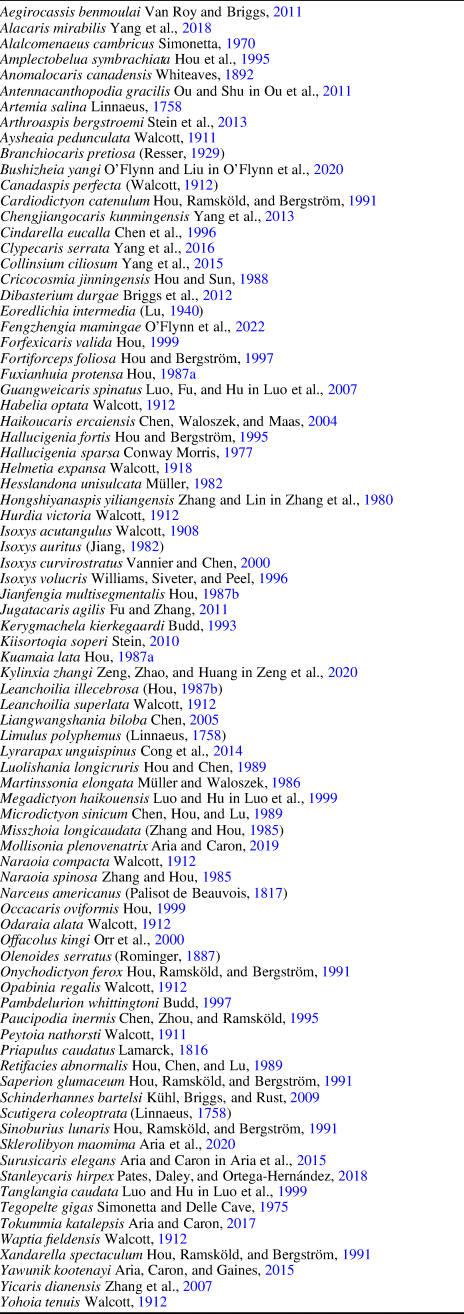
The phylogenetic position of Kuamaia lata was inferred using the data matrix of O'Flynn et al. (Reference O'Flynn, Williams, Yu, Guo, Audo, Schmidt, Mai, Liu and Edgecombe2024) (itself modified from Zeng et al., Reference Zeng, Zhao, Niu, Zhu and Huang2020). This matrix includes 283 characters and 85 taxa (Supplementary Data Set 1). The data matrix was constructed in WinClada 1.00.08 (Nixon, Reference Nixon2002), and parsimony analyses were performed with Tree analysis using New Technology (TNT) 1.5 (Goloboff and Catalano, Reference Goloboff and Catalano2016). The software was set to retain 99,999 trees in memory and perform 10,000 replications. Each analysis included a traditional search with tree bisection and reconnection, a random seed of one and 1000 trees saved per replicate. Jackknife supports (under equal weights), and group present/contradicted (GC) frequency differences (under implied weights) of nodes on the trees were calculated by resampling using 1000 replicates of traditional search, with a change probability of 36% and 33%, respectively, for the two types of nodal supports. We also explored character optimization with TNT and WinClada.
Repositories and institutional abbreviations
Specimens examined in this study are deposited in the following institutions: the Yunnan Key Laboratory for Palaeobiology (YKLP) and the Management Committee of the Chengjiang Fossil Site World Heritage (CJHMD)
Systematic paleontology
Phylum Euarthropoda Lankester, Reference Lankester1904
Class Artiopoda Hou and Bergström, Reference Hou and Bergström1997
Subclass Conciliterga Hou and Bergström, Reference Hou and Bergström1997
Order Helmetiida Novozhilov, Reference Novozhilov1960
Family Helmetiidae Simonetta and Delle Cave, Reference Simonetta and Delle Cave1975
Genus Kuamaia Hou, Reference Hou1987
Type species
Kuamaia lata Hou, Reference Hou1987a (CN 100128) from Maotianshan, level M2.
Kuamaia lata Hou, Reference Hou1987
Figures 1–5
- Reference Hou1987a
Kuamaia lata Hou, p. 283–284, figs. 3, 4.
- Reference Hou, Bergström, Simonetta and Conway Morris1991
Kuamaia lata; Hou and Bergström, p. 183, figs. 57–60.
- Reference Simonetta, Delle Cave, Simonetta and Conway Morris1991
Kuamaia lata; Delle Cave and Simonetta, p. 201, fig. 6E.
- Reference Shu and Zhang1996
Kuamaia lata; Shu and Zhang, pl. 1, 2.
- Reference Luo, Hu, Zhang and Tao1997
Kuamaia lata; Luo et al., pl. 2, fig. 3.
- Reference Edgecombe and Ramsköld1999
Kuamaia lata; Edgecombe and Ramsköld, p. 270, fig. 5.
- Reference Hou1999
Kuamaia lata; Hou et al., p. 119–120, figs. 169, 171.
- Reference Chen, Luo, Hu, Yin, Jiang, Wu, Li and Chen2002
Kuamaia lata; Chen et al., pl. 4, fig. 4.
- Reference Hou, Siveter, Siveter, Aldridge, Cong, Gabbott, Ma, Purnell and Williams2017
Kuamaia lata; Hou et al., p. 215, fig. 20.45.
- Reference Zeng, Zhao, Niu, Zhu and Huang2020
Kuamaia lata; Zeng et al., extended data fig. 7P, Q.
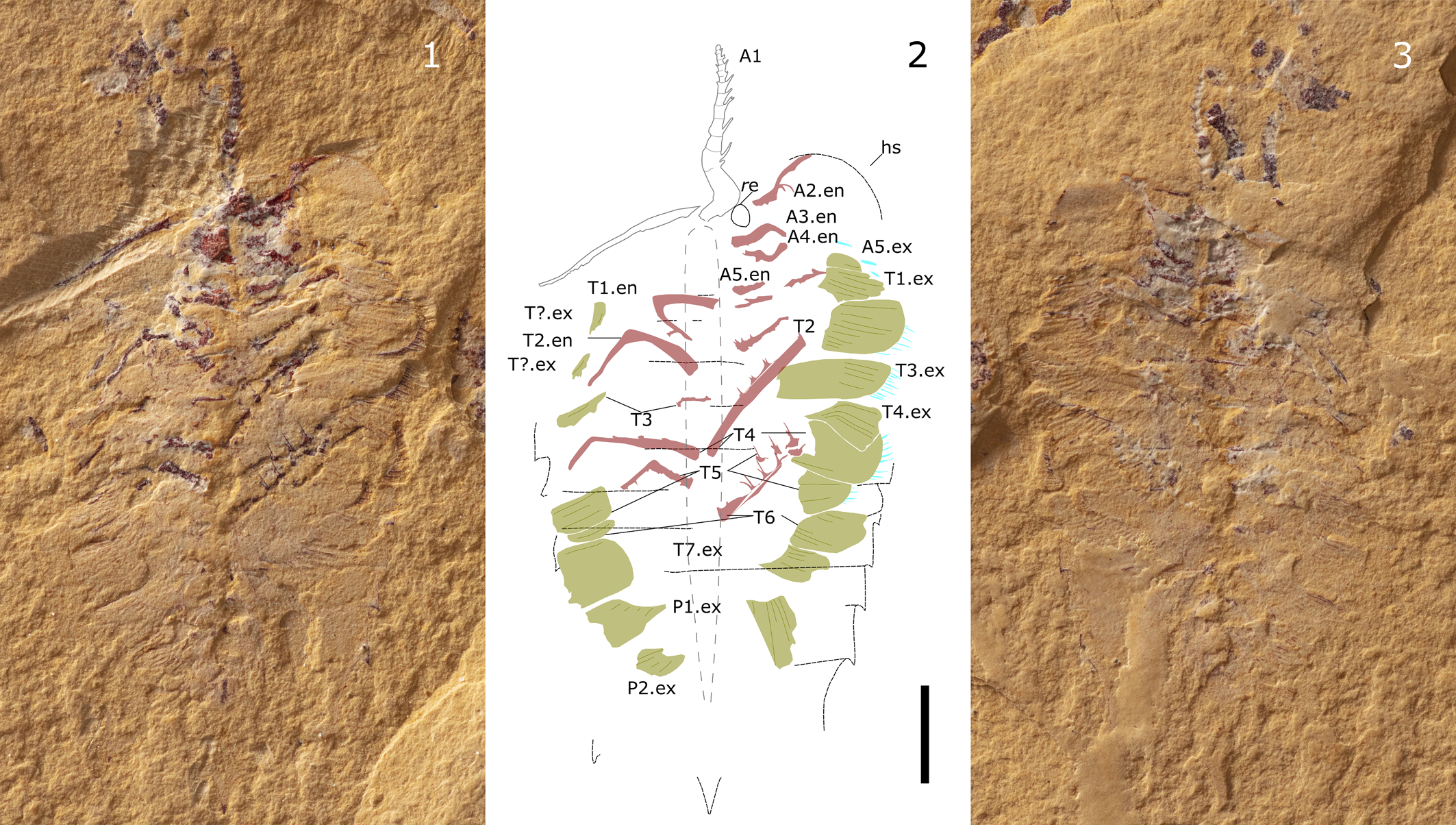
Kuamaia lata Hou, Reference Hou1987a (YKLP 17295): (1) photograph of dorsal view of part; (2) composite line drawing of dorsal view; (3) photograph of dorsal view of counterpart. Abbreviations: A1 (FA) = frontal appendage; An.en = endopod of head appendage (n); An.ex = exopod of head appendage (n); re = right eye; hs = head shield; Pn.ex = exopod of pygidial appendage (n); Tn = thoracic appendage (n); Tn.en = endopod of thoracic appendage (n); Tn.ex = exopod of thoracic appendage (n). Scale bar is 2 mm.
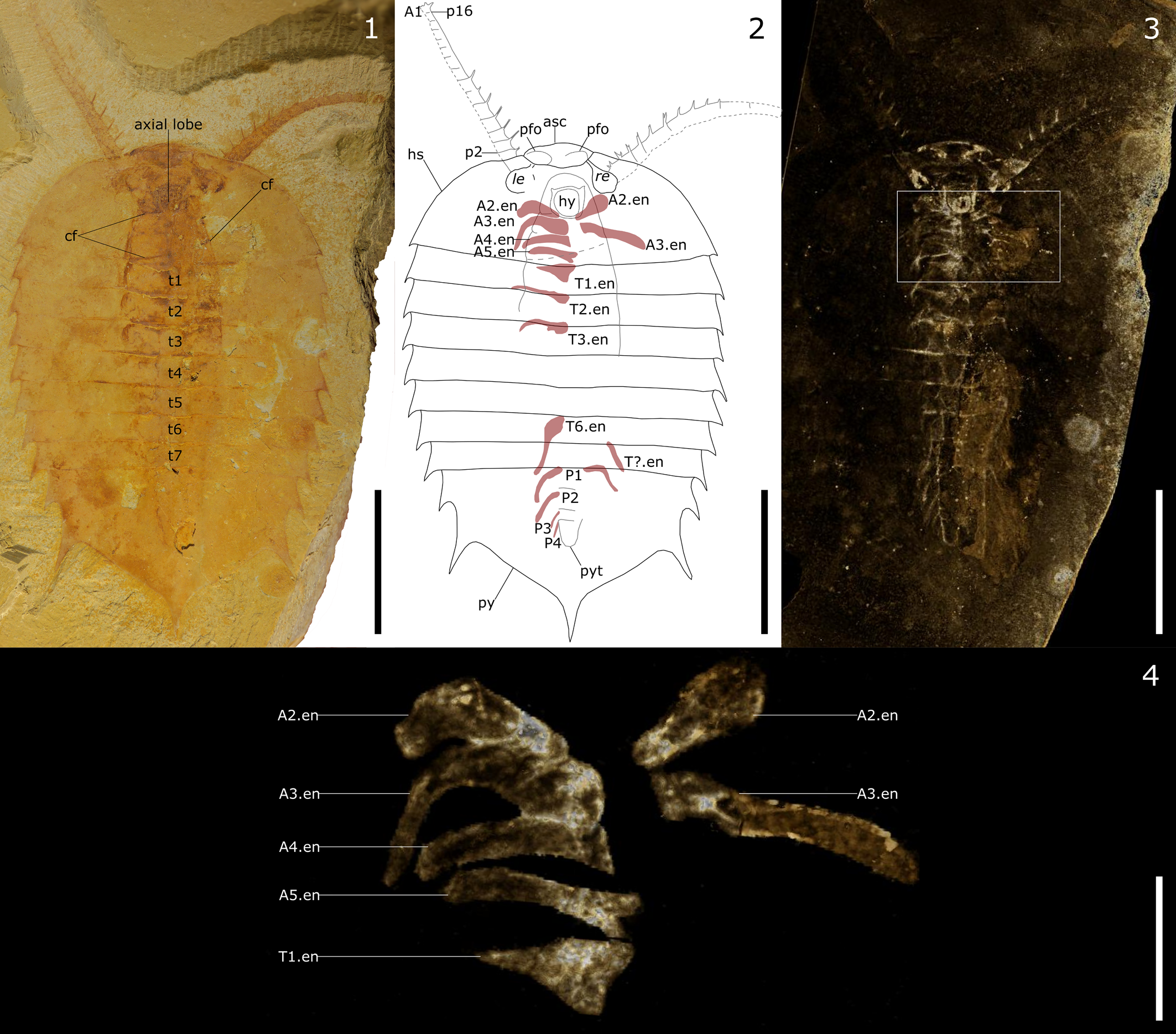
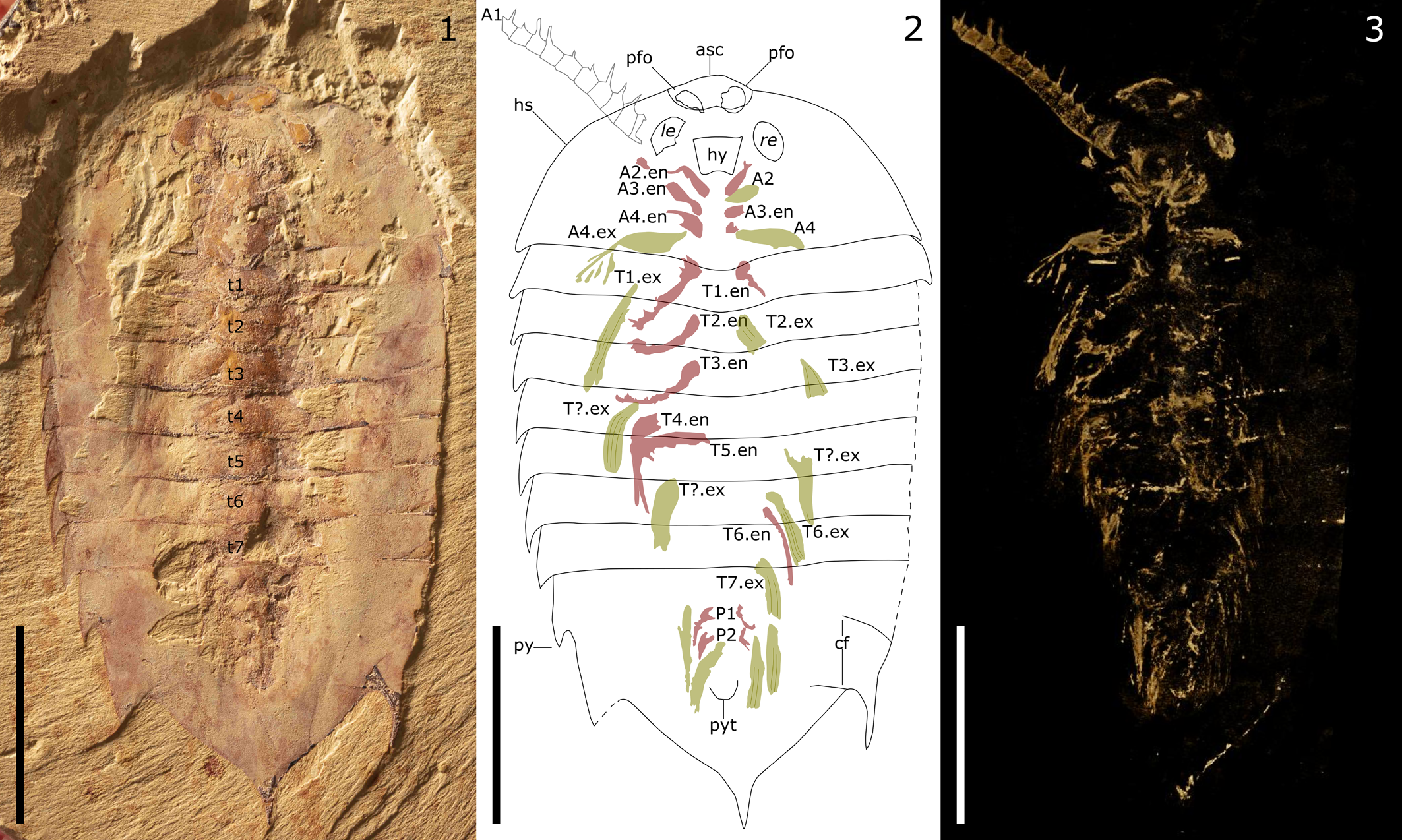
Kuamaia lata Hou, Reference Hou1987a (YKLP 17296): (1) photograph of dorsal view; (2) composite line drawing of dorsal view; (3) tomographic model of dorsal view, rectangle indicates field of view in (4); (4) post-A1 head appendages dissected. Abbreviations: A1 (FA) = frontal appendage; An.en = endopod of head appendage (n); asc = anterior sclerite; le = left eye; re = right eye; hs = head shield; hy = hypostome; Pn = pygidial appendage (n); pn = frontal appendage podomere (n); pfo = protocerebral frontal organ; py = pygidium; pyt = terminus of pygidial axis; Tn.en = endopod of thoracic appendage (n); tn = tergite (n). Scale bars are 10 mm (1–3); 2.5 mm (4).
Kuamaia lata Hou, Reference Hou1987a (YKLP 17297): (1) photograph of overall dorsal view, square indicates field of view in (2); (2) photograph of head; (3) line drawing of head. Abbreviations: A1 (FA) = frontal appendage; asc = anterior sclerite; le = left eye; re = right eye; hy = hypostome; ol = optic lobe; pfo = protocerebral frontal organ; tn = tergite (n). Scale bars are 10 mm.

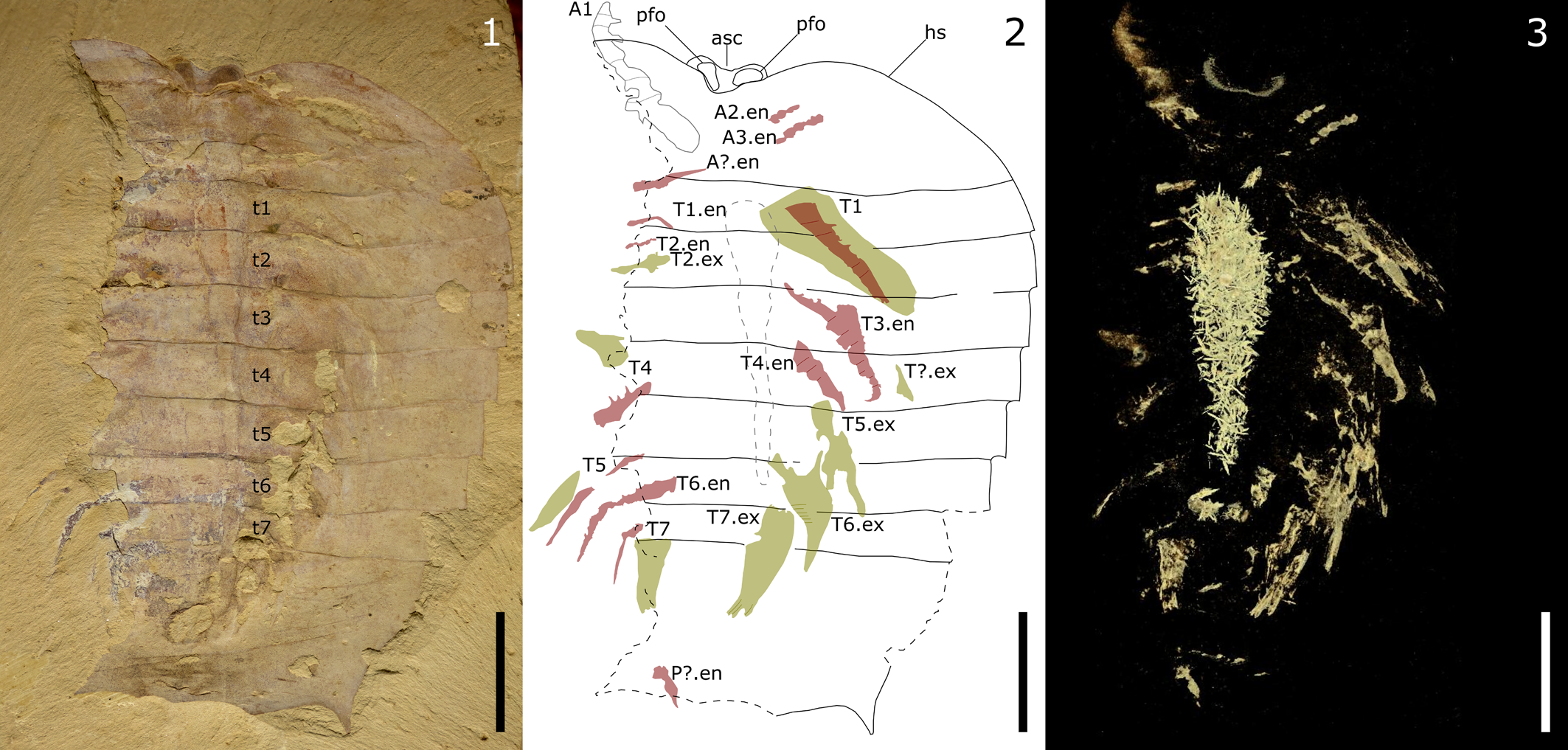
Kuamaia lata Hou, Reference Hou1987a (YKLP 17298): (1) photograph of dorsal view; (2) composite line drawing of dorsal view; (3) tomographic model of dorsal view. Abbreviations: A1 (FA) = frontal appendage; An.en = endopod of head appendage (n); asc = anterior sclerite; hs = head shield; Pn.en = pygidial appendage (n); pfo = protocerebral frontal organ; Tn = thoracic appendage (n); Tn.en = endopod of thoracic appendage (n); Tn.ex = exopod of thoracic appendage (n); tn = tergite (n). Scale bar is 10 mm.
Kuamaia lata Hou, Reference Hou1987a (CJHMD 00064): (1) photograph of dorsal view; (2) composite line drawing of dorsal view; (3) tomographic model of dorsal view. Abbreviations: A1 (FA) = frontal appendage; An = head appendage (n); An.en = endopod of head appendage (n); An.ex = exopod of head appendage (n); asc = anterior sclerite; cf = compactional fold; le = left eye; re = right eye; hs = head shield; hy = hypostome; Pn = pygidial appendage (n); pfo = protocerebral frontal organ; py = pygidium; pyt = terminus of pygidial axis; Tn.en = endopod of thoracic appendage (n); Tn.ex = exopod of thoracic appendage (n); tn = tergite (n). Scale bars are 20 mm.
Holotype
Incomplete specimen (CN 100128 housed in the Museum of the Nanjing Institute of Geology and Palaeontology) from Maotianshan (Hou, Reference Hou1987a, pl. 23, figs. 1, 2).
Diagnosis
Emended after Hou and Bergström (Reference Hou and Bergström1997). Six cephalic segments covered by head shield; from anterior to posterior, these are: protocerebral/ocular segment that carries paired optic lobes/eyes; post-ocular segment with paired raptorial deutocerebral frontal appendages (A1); and four subsequent segments each bearing a biramous appendage pair. A1 anterolaterally orientated, consisting of ≥ 16 podomeres that bear paired inward-facing spines that decrease in length gradually towards tip. Thorax comprises seven tergites with short pleural spines, each thoracic segment with one pair of biramous appendages. Large pygidium with a terminal tail spine and two pairs of marginal spines. Axis terminates in posterior half of pygidium.
Remarks
There are features observable in the new specimens that are not observable in specimens described to date (cf., Hou and Bergström, Reference Hou and Bergström1997). Collectively, our new material identifies: (1) a six-segmented head; (2) frontal organs within the anterior sclerite associated with the attachment site of the optic lobes on the protocerebral segment (see also Ortega-Hernández, Reference Ortega-Hernández2015, for the closely allied Helmetia expansa Walcott, Reference Walcott1918); (3) raptorial rather than sensory A1 on the deutocerebral segment; and (4) four pairs of post-A1 head appendages (A2–A5).
Results
Dorsal aspect of the head shield, thorax, and pygidium (Figs. 1–5)
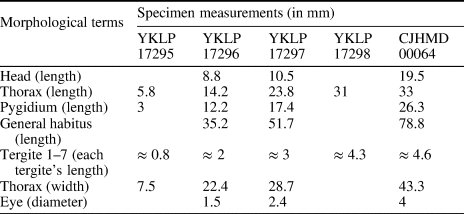
The five observed specimens, measured from the anterior margin of the anterior sclerite to the posterior termination of the pygidium's terminal spine, are approximately 14 mm, 35 mm, 52 mm, 54 mm, and 79 mm (Figs. 1–5, respectively). Previously described, complete specimens, are approximately 32–59 mm (Hou and Bergström, Reference Hou and Bergström1997). They are dorso-ventrally compressed and lie parallel to lamination. The five specimens have similar morphologies in that each has seven tergites irrespective of ontogenetic stage, and each tergite of each specimen accounts for approximately 14% of the length of the thorax. The varying state of preservation impedes collection of all measurements from each specimen (Table 1).
Measurements from each specimen (from smallest to largest, in mm).
Revised head organization (Figs. 1–5)
Photographs and CT data show that the head bears paired eyes with optic lobes that extend to the frontal organs within the anterior sclerite (Figs. 2, 3). The A1 inserts ventrally, behind the optic lobes and is therefore interpreted to be associated with the deutocerebral segment (Figs. 2, 4, 5). The frontal appendages (A1) are anterolaterally orientated in their proximal part (Figs. 2, 4, 5), with 16 podomeres evident in the portion of their limbs that extend beyond the head shield (Fig. 2). Podomeres 2–9 are of equal length but decrease in width distally (Figs. 2, 5). Each bears paired, well-developed, inward-facing spines, the basal attachment of which is located distally on each podomere (Figs. 2, 5). Spines are at least as long as each podomere is wide (Figs. 2, 4, 5) and decrease in length gradually towards the tip. Figures 1 and 2 illustrate A2–A5 (four post-A1 cephalic limbs, each with an endopod that consists of an indeterminate number of podomeres that bear endites); A2, A4 (Fig. 5), and A5 (Fig. 1) each possesses a paddle-shaped exopod. Figure 5 also illustrates A2–A4; A5 is absent or poorly preserved, but the space for insertion of the limb is evident between A4 and T1.
Gut content (Fig. 4)
The center of the thorax of YKLP 17298 possesses a convexity that runs longitudinally. This may be due to preserved gut content. This preservation appears as 3-D, spinose structures or elongated elements that show no preferential orientation (Fig. 4.3).
Post-A5 appendages
Endopods, which consist of an indeterminate number of podomeres, gradually shorten posteriorly from T5. No appendages are observed posterior to P4 (Fig. 2); pygidial endopods are considerably shorter than those of the thorax (P1 is less than half the length of T6). Each exopod is flap-shaped, lamellate (Figs. 1, 5), and setose (Fig. 1).
Phylogeny
To test the phylogenetic position of Kuamaia lata, phylogenetic analyses (Table 2) were updated to incorporate new data. Based on our observations, we recoded the following characters (numbered as in Zeng et al., Reference Zeng, Zhao, Niu, Zhu and Huang2020): (1) Number of segments in head region (character 104) to ≥ 6; (2) frontalmost appendages, composition of articulated podomeres (character 173) to heteronomous; (3) frontalmost appendages, antenniform (character 178) to absent; (4) frontalmost appendages, number of podomeres bearing well-expanded endites (character 188) to ≥ 8; (5) frontalmost appendages, differentiated main spines of endites (character 190) to present; (6) frontalmost appendages, relative length of endite to podomere height (character 191) to comparable; (7) frontalmost appendages, relative width of base of endite to podomere length (character 192) to comparable, along the entire podomere; (8) frontalmost appendages, morphology of enditic spines (character 193) to spiky; (9) frontalmost appendages, proximal podomeres differentiated and peduncle-like (character 203) to unknown; (10) number of claw elements on frontalmost appendage (character 239) to double; (11) large distal claw elements with a wide base on appendages (character 241) to present.
Taxa used for phylogenetic analyses
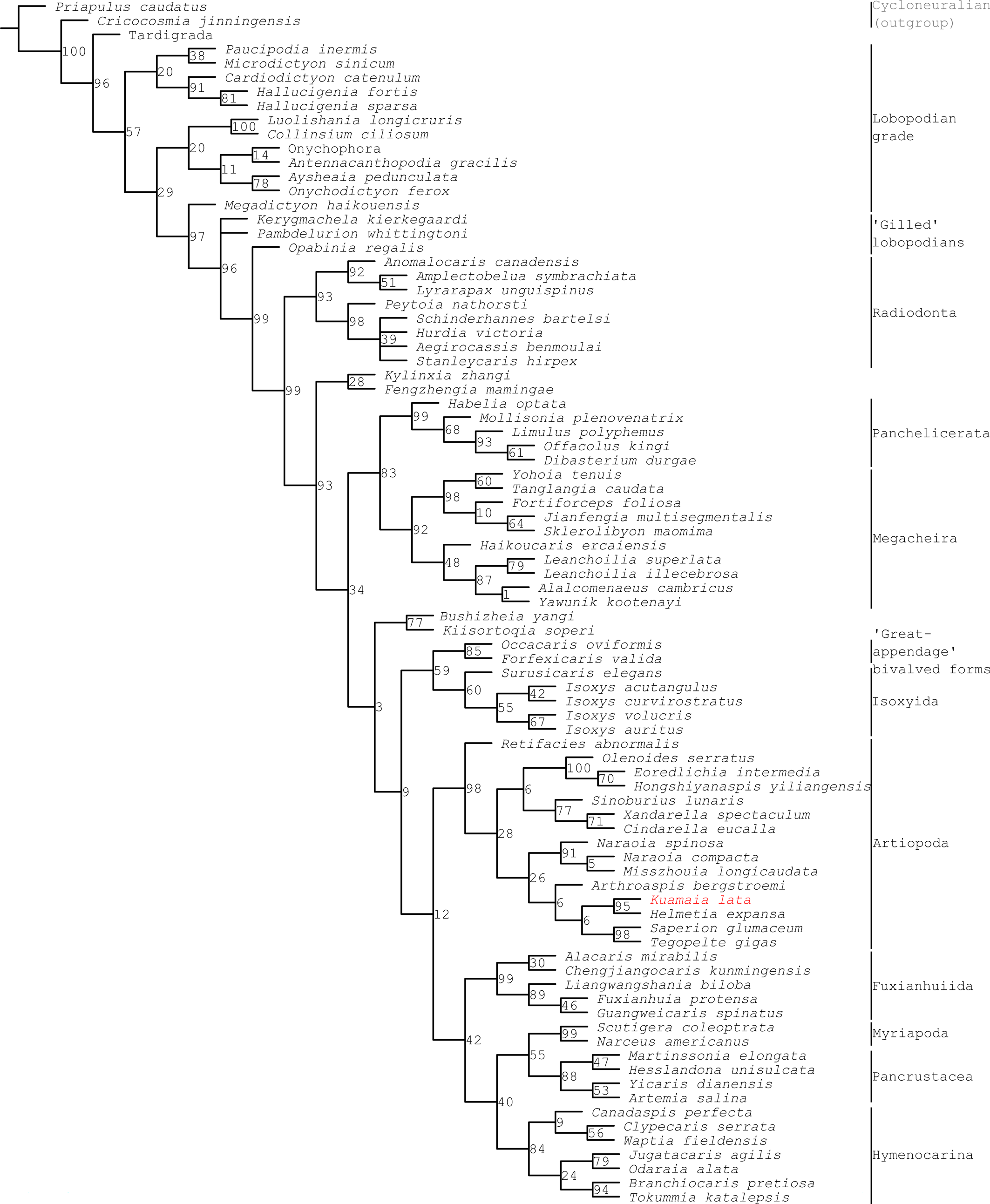
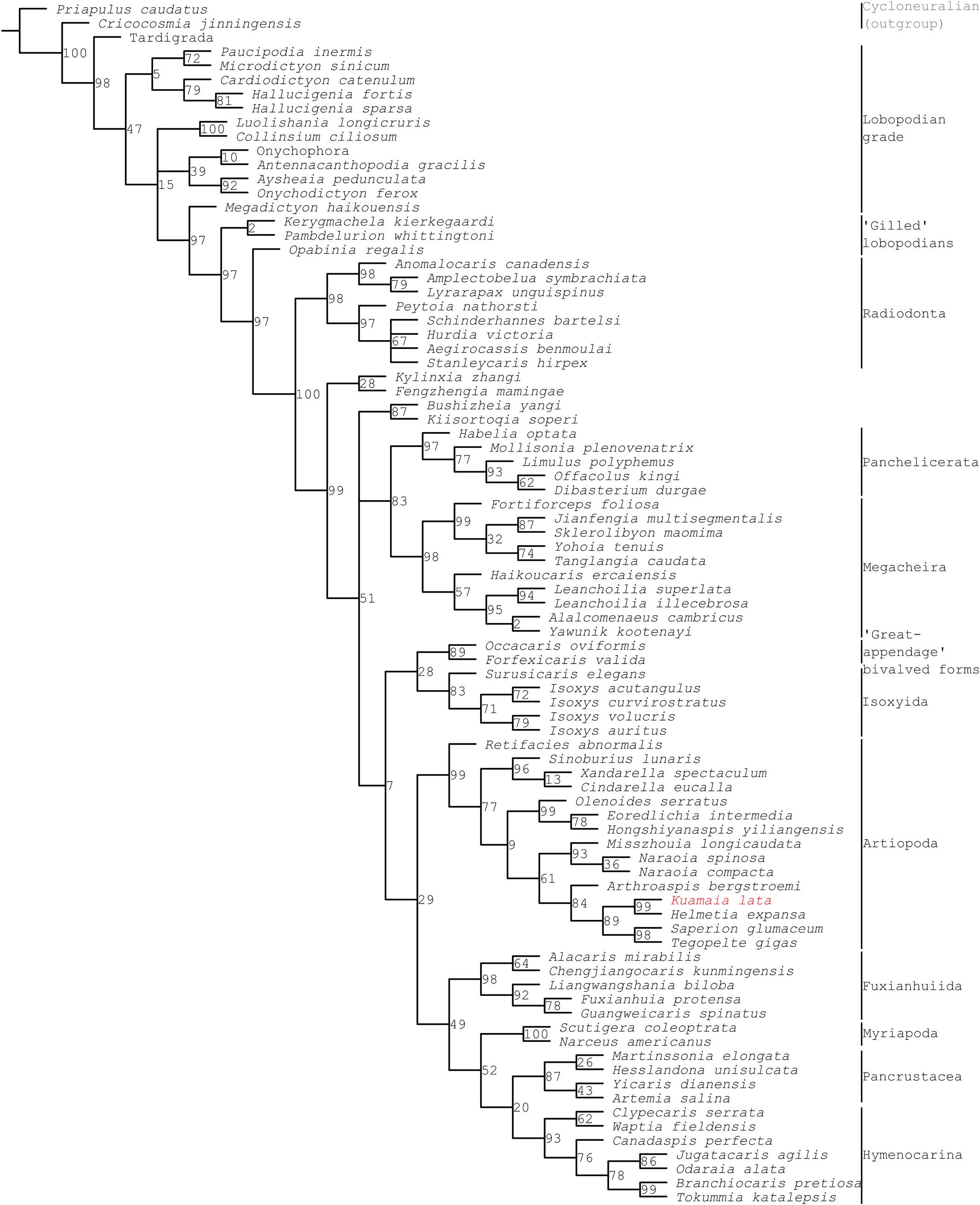
The following monophyletic groups are recovered: (1) panchelicerates + megacheirans; (2) isoxyids + ‘great-appendage’ bivalved forms; (3) artiopods; and (4) total-group mandibulates composed of fuxianhuiids, myriapods, pancrustaceans, and hymenocarines. Equal (Fig. 5) and implied (Fig. 6) character weighting resolve Kuamaia lata as the sister taxon to Helmetia expansa, and both constitute the sister taxon to Saperion glumaceum Hou, Ramsköld, and Bergström, Reference Hou, Ramsköld and Bergström1991, and Tegopelte gigas Whittington, Reference Whittington1985.
Consensus tree from phylogenetic analysis of panarthropod relationships based on a matrix of 283 characters and 85 taxa. Strict consensus of 60 most parsimonious trees with a score of 725 (consistency index = 0.47; retention index = 0.86) from analysis using equal weighting. Kuamaia lata Hou, Reference Hou1987a (red) is retrieved as sister taxon to Helmetia expansa Walcott, Reference Walcott1918.
The clade that supports Kuamaia lata, Helmetia expansa, Saperion glumaceum, and Tegopelte gigas (i.e., Helmetiida Novozhilov, Reference Novozhilov1960) is supported by: (1) hypostome attachment (narrow overlap with pre-hypostome); (2) ocular sclerite accommodated by notched fused head shield (present); and (3) additional anterior marginal structures of head shield (notched on single tergite)—nonhomoplasious characters 47, 73, and 96, respectively (Zeng et al., Reference Zeng, Zhao, Niu, Zhu and Huang2020). Artiopoda is supported by: (1) compound eyes accommodated by dorsal bulge on fused head shield (present); (2) optic lobes incorporated into fused head shield, forming eye ridges (present); (3) hypostome accommodating antennae and extensively covering the mouth (present); (4) ocular sclerite covered by true head shield (present); (5) post-oral appendages, endopodite, endites (serrated rows of spines); and (6) differentiation of setae along exopodite (present)—nonhomoplasious characters 23, 25, 48, 74, 251, and 269, respectively (Zeng et al., Reference Zeng, Zhao, Niu, Zhu and Huang2020).
Discussion
Phylogeny
Equal and implied weights (Figs. 6 and 7, respectively) resolved Kuamaia lata within Artiopoda, and the data provide strong support for that clade (jackknife supports of 98% under equal weights and GC frequency differences of 99% under implied weights). It may be asked whether Artiopoda should be revised to include arthropods with filiform or raptorial antennae (cf., Stein and Selden, Reference Stein and Selden2012). However, considering the number of taxa with, versus those without filiform antennae, coupled with a raptorial A1 in K. lata being deeply nested within the artiopod clade and unambiguously optimizing as secondarily derived from ancestors with filiform antennae, we do not insist on this.
Consensus tree from phylogenetic analysis of panarthropod relationships based on a matrix of 283 characters and 85 taxa. Strict consensus of 3 most parsimonious trees with a score of 55.74314 (consistency index = 0.47; retention index = 0.85) from analysis using implied weighting (concavity constant k = 3). Kuamaia lata Hou, Reference Hou1987a (red) is retrieved as sister taxon to Helmetia expansa Walcott, Reference Walcott1918.
A head composed of six segments, as in extant mandibulates (Fusco and Minelli, Reference Fusco, Minelli, Minelli, Boxshall and Fusco2013), was already acquired by other artiopods, such as the iconic trilobites (El Albani et al., Reference El Albani, Mazurier, Edgecombe, Azizi and El Bakhouch2024), isoxyids, megacheirans (Chen et al., Reference Chen, Ortega-Hernández, Wolfe, Zhai, Hou, Chen, Mai and Liu2019; Liu et al., Reference Liu, Ortega-Hernández, Zhai and Hou2020, Reference Liu, Edgecombe, Schmidt, Bond, Melzer, Zhai, Mai, Zhang and Hou2021; Schmidt et al., Reference Schmidt, Hou, Zhai, Mai, Belojević, Chen, Melzer, Ortega-Hernández and Liu2022; Zhang et al., Reference Zhang, Liu, O'Flynn, Schmidt, Melzer, Hou, Mai, Guo, Yu and Ortega-Hernández2022), Bushizheia yangi (O'Flynn et al., Reference O'Flynn, Williams, Yu, Guo, Audo, Schmidt, Mai, Liu and Edgecombe2024), and even Kylinxia zhangi Zeng, Zhao, and Huang in Zeng et al., Reference Zeng, Zhao, Niu, Zhu and Huang2020 (O'Flynn et al., Reference O'Flynn, Liu, Hou, Mai, Yu, Zhuang, Williams, Guo and Edgecombe2023), the earliest branching deuteropod. Indeed, head segmentation is ancestral and conserved. Under the scenario in which select taxa have, for example, five-segmented heads (e.g., Kiisortoqia soperi), fewer head segments are likely derived. However, recent studies (cited immediately above) have shown that one or more segments have been overlooked.
Morphology
Our new material clearly demonstrates that the A1 of Kuamaia lata is not filiform, as first put forth by Shu and Zhang (Reference Shu and Zhang1996). Furthermore, its podomeres are conspicuously spinose. Each one bears a long pair of spinose endites, and the base of each paired endite is comparable to the length of its associated podomere (Zeng et al., Reference Zeng, Zhao, Niu, Zhu and Huang2020 [character list]). A raptorial-like A1 that recalls radiodont frontal appendages points to the conclusion to which Shu and Zhang (Reference Shu and Zhang1996) alluded and we corroborate—that the A1 was not adapted to a sensory function but a predatory one.
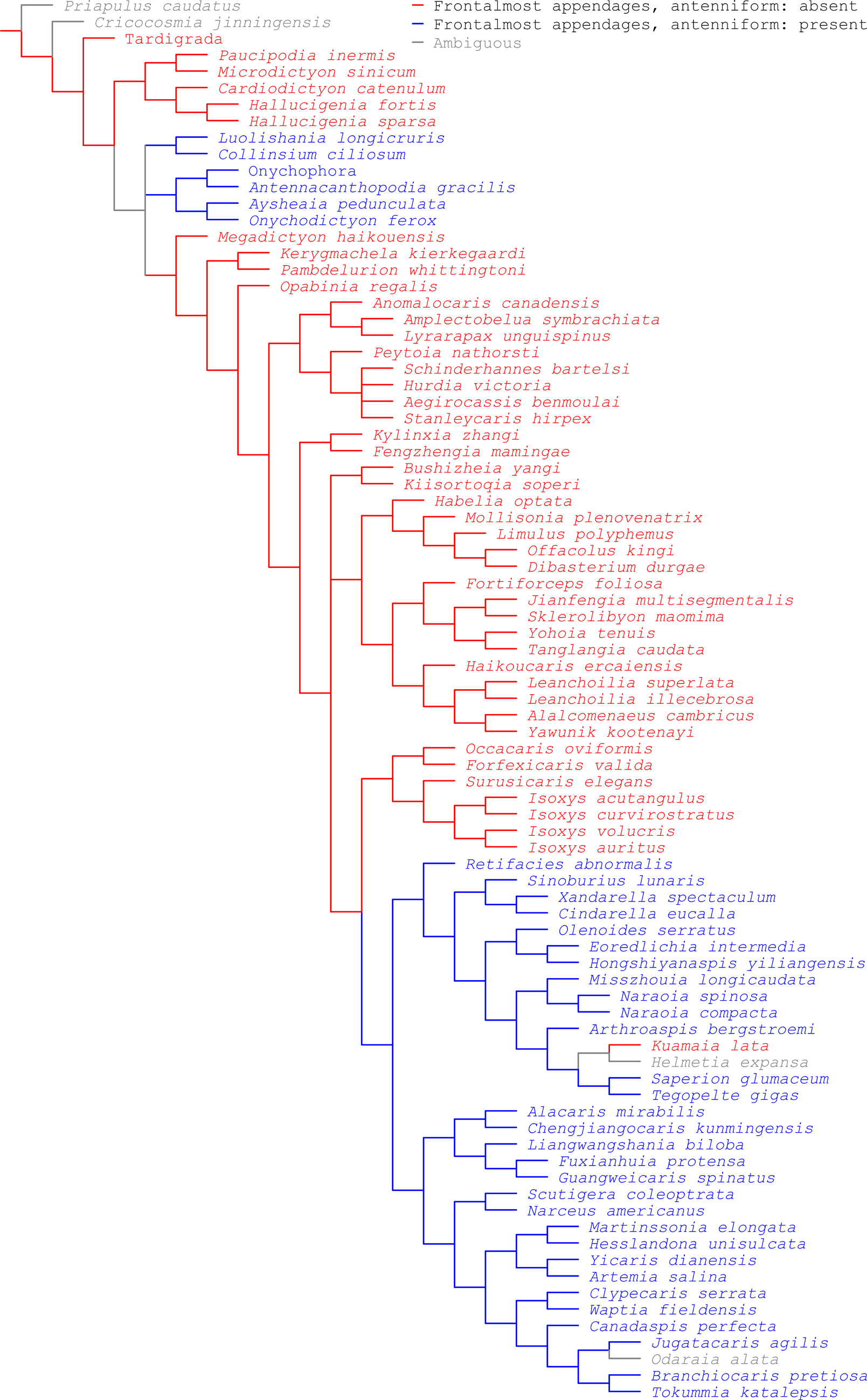
O'Flynn et al. (Reference O'Flynn, Audo, Williams, Zhai, Chen and Liu2020) explored the significance of the A1 of Bushizheia yangi (the morphology of which bears a strong resemblance to that of Kuamaia lata) in the context of interpretations of the homology of cephalic appendages (see also O'Flynn et al., Reference O'Flynn, Williams, Yu, Guo, Audo, Schmidt, Mai, Liu and Edgecombe2024). The resemblance of the A1 of B. yangi to the plesiomorphic, raptorial state within radiodonts, Kylinxia zhangi, and Fengzhengia mamingae O'Flynn et al., Reference O'Flynn, Williams, Yu, Harvey and Liu2022, in combination with the segmental identity of head structures (Moysiuk and Caron Reference Moysiuk and Caron2022; Zeng et al., Reference Zeng, Zhao and Zhu2022; O'Flynn et al., Reference O'Flynn, Liu, Hou, Mai, Yu, Zhuang, Williams, Guo and Edgecombe2023), gives credence to the hypothesis that the raptorial A1 is a symplesiomorphy for upper stem-group euarthropods. A structurally similar morphology was convergently evolved from an antenna within Artiopoda. Following this line of reasoning and reinforced by our phylogenetic resolution of K. lata, the presence of a raptorial A1 is of itself not wholly reliable phylogenetically.
Transverse lines observed in Kuamaia lata's axial margin of the head shield (Fig. 2.1) may be compactional artefacts, as in Sinoburius lunaris Hou, Ramsköld, and Bergström, Reference Hou, Ramsköld and Bergström1991 (see Luo et al., Reference Luo, Hu, Zhang and Tao1997) and Arthroaspis Stein et al., Reference Stein, Budd, Peel and Harper2013. They are not sharply defined axial furrows; indeed, they are absent in all other specimens. Their inconsistent presence coupled with irregularity of linearity (Fig. 2.2) point to a taphonomic artefact.
Gut content
In the scenario that Kuamaia lata was an active feeder owing to its ability to grasp food and push it into its mouth with the aid of its raptorial A1, we submit that its gut is not sediment-filled (see also Shu and Zhang, Reference Shu and Zhang1996). However, the gut of YKLP 17298 is filled with a plethora of platy elements that show no preferential orientation. These platy elements bear a striking resemblance to those identified in the gut of Megadictyon haikouensis Luo and Hu in Luo et al., Reference Luo, Hu, Chen, Zhang and Tao1999, a lobopodian with a raptorial-like frontal appendage (Vannier et al., Reference Vannier, Liu, Lerosey-Aubril, Vinther and Daley2014, supplementary fig. 6D–J). Putative gut contents observed in K. lata (Fig. 4) may be due to diagenetic crystal growth in the gut, mediated by bacteria, as argued for M. haikouensis by Vannier et al. (Reference Vannier, Liu, Lerosey-Aubril, Vinther and Daley2014, supplementary fig. 6E), which is suggestive of mineralization before degradational collapse.
Conclusions
Kuamaia lata is distinguished from Artiopoda as redefined by Stein and Selden (Reference Stein and Selden2012) by having a raptorial rather than filiform A1. However, K. lata possesses flattened exopod lobes with lamellae (Figs. 1, 5), endopods with at least seven podomeres (Fig. 4), and a homonomous dorsal exoskeleton with expanded tergopleurae (Figs. 1–3, 5)—and otherwise rests comfortably within Artiopoda (Stein and Selden, Reference Stein and Selden2012; Du et al., Reference Du, Ortega-Hernández, Yang and Zhang2019). Phylogenetic analyses support the hypothesis that a raptorial A1 is a symplesiomorphy for upper stem-group euarthropods (e.g., megacheirans and isoxyids), and that a structurally similar morphology was convergently evolved (a character reversal) from a secondarily filiform A1 within the artiopod clade (Fig. 8).
Cladogram of Figure 7 showing character optimization, i.e., frontalmost appendage, antenniform: absent (red); present (blue). A raptorial frontalmost appendage is a symplesiomorphy for upper stem-group euarthropods, retained across a swathe of tree space, but evolved secondarily in Kuamaia lata Hou, Reference Hou1987a, from a filiform antenna within Artiopoda.
Acknowledgments
We are indebted to S.E. Gabbott and T.H.P. Harvey (University of Leicester) for discussions, and we thank M. Yu and M. Zhang (Yunnan University) for assistance with photography and H. Mai (Yunnan University) for investigations with CT. This study is supported by the Natural Science Foundation of Yunnan Province (grant numbers: 202301AS070049; 202401BC070012). Y. Liu is supported by the Yunnan Revitalization Talent Support Program. We thank P. Van Roy and G. Tanaka for their reviews. This article forms part of R.J. O'Flynn's doctoral thesis at the University of Leicester.
Declaration of competing interests
The authors declare none.
Data availability statement
Data for this study are available in MorphoBank: http://dx.doi.org/10.7934/P5400. Supplementary Data Set 1. Nexus file coding.


 Open access

