


Introduction
Scholars have begun to gather, systemize and share demographic data on Canadian political candidates (Göbel and Munzert Reference Göbel and Munzert2022; Johnson et al. Reference Johnson, Tolley, Thomas and André Bodet2021; Rivard et al. Reference Rivard, Bodet, Godbout and Montigny2024; Sevi Reference Sevi2021). However, most of these datasets do not identify LGBTQ2S+ candidates. Yet it is important to identify LGBTQ2S+ candidates if we wish to evaluate barriers to LGBTQ2S+ representation.
Ideally, data on LGBTQ2S+ candidates should be publicly available, replicable and as comprehensive as possible. When data are publicly available, individuals can more easily incorporate data on LGBTQ2S+ candidates into their analyses and identify and correct errors. When the coding procedure is replicable, others can improve it or apply it to other contexts. When data are as comprehensive as possible, we make more accurate claims and respect individuals’ identities.
We provide a new, publicly accessible dataset on which federal candidates are “out” as LGBTQ2S+ based on a systematic and replicable procedure. Our procedure takes inspiration from work on candidate race in incorporating systematic searches of individual candidates (Johnson et al. Reference Johnson, Tolley, Thomas and André Bodet2021). Our dataset includes the 4,201 major party candidates in the 2015, 2019 and 2021 Canadian federal elections, of whom we identify 176 as LGBTQ2S+.
Our dataset has some important advantages in comparison with past data gathering efforts. We commend Sevi (Reference Sevi2024) for making her data publicly available and being transparent about how she identified candidates (on the basis of Xtra lists and emailing parties). However, our procedure identifies many candidates missed by Sevi. Everitt and Tremblay (Reference Everitt and Tremblay2023) use the most comprehensive data on LGBTQ2S+ candidates, but their data are not publicly available, identify out candidates in a way that is not replicable and miss some candidates we identified.
After describing how our data were collected, we compare our dataset with Sevi (Reference Sevi2024), and where possible, Everitt and Tremblay (Reference Everitt and Tremblay2023). Next, we analyze over-time trends among straight cisgender candidates and LGBTQ2S+ candidates. We conclude by discussing potential uses of our dataset.
Data Collection and Variables
To construct the dataset, we began by obtaining data on candidates from Parlinfo, a database maintained by the Canadian Library of Parliament. We focus on the 2015, 2019 and 2021 elections because (1) we could code LGBTQ2S+ identities due to increased attention to LGBTQ2S+ representation during this period (by parties, media and advocacy organizations) and (2) these elections use the same boundaries. We included the five parties that elected candidates to the House of Commons (Liberals, Conservatives, New Democratic Party (NDP), Bloc québécois and Greens).Footnote 1
We then identified out LGBTQ2S+ candidates in three ways. First, we coded candidates as LGBTQ2S+ if they were on one or more lists of LGBTQ2S+ candidates, including those published by Reynolds (Reference Reynolds2015), Proud Politics in 2015–2021, Xtra 2015–2021, the Canadian Broadcasting Corporation (CBC) in 2019 (Hoye Reference Hoye2019) and The Hill Times in 2021 (Chen Reference Chen2021). Second, we coded candidates as LGBTQ2S+ if they identified themselves as part of the community in surveys conducted by Xtra (an LGBTQ2S+ news outlet) in 2019 and 2021. Finally, between May 2023 and February 2024, coders conducted systematic searches of each candidate. These systematic searches involved using the Wayback Machine to search candidate biographies or profiles on party websites, Wikipedia searches and Google searches. These Google searches typically captured news coverage of candidates and public social media accounts. Candidates were coded as LGBTQ2S+ if they were identified in one or more source.
We coded whether candidates were publicly out as (1) LGBTQ2S+, (2) transgender and/or nonbinary and (3) Two Spirit (an Indigenous identity that reflects gender and/or sexual minority experiences). LGBTQ2S+ was treated as an umbrella term, meaning that if someone was out as transgender, nonbinary and/or Two Spirit, they were also coded as LGBTQ2S+. Two Spirit candidates were not automatically coded as transgender and/or nonbinary. Even after a candidate was identified as LGBTQ2S+, coders were instructed to continue the rest of the search procedure in case candidates were also out with other identity labels (for example, transgender, nonbinary and/or Two Spirit). We identified 176 out LGBTQ2S+ candidates, including 26 transgender or nonbinary candidates and 4 Two Spirit candidates. Unfortunately, we could not code specific sexual identities because most candidates did not use specific terms. Instead, many signalled being part of the LGBTQ2S+ community through a general reference to being part of the LGBTQ2S+ community or through references to their partners.
Candidates were coded on the basis of identity labels (including specific terms or a general reference to being part of the LGBTQ2S+ community), their pronouns and/or references to a same-gender partner. Candidates often indicated their partner’s gender by referring to them with gendered terms (for example, wife), pronouns and names. If cues about the partner were ambiguous, we finished the candidate search and then, in rare cases, searched the candidate’s partner. We prioritized information from candidates themselves where available.
We aimed to hire culturally competent coders and provided them with a non-exhaustive list of identity terms. Each candidate was initially coded by one coder. An additional coder then independently coded a random sample of 10 per cent of all candidates (stratified by party and year) but did not identify any additional LGBTQ2S+ candidates. Both authors checked every candidate who was coded as LGBTQ2S+, transgender and/or nonbinary and/or Two Spirit. The authors then conducted random spot checks of candidates who were coded as not LGBTQ2S+, transgender or nonbinary or Two Spirit. For more details, see Supplementary Materials A.
A few coding decisions are worth special mention. First, we coded candidates as out in an election only if they were out at the time. For example, if a candidate ran in 2015 and 2019 but the first public statement of their identity was from 2018, we coded them as out in 2019 but not in 2015. Put differently, we did not backfill candidates. In one case, we “frontfilled” a candidate who was out in 2019 and missed from lists of LGBTQ2S+ candidates in 2021. There were no public statements indicating a change in identity. Second, we did not code as out candidates who had a rainbow or transgender flag in their social media profile without other indications of their gender and/or sexuality. Although some people use these symbols to identify themselves as LGBTQ2S+ and/or transgender, others use these symbols to indicate they are allies. Third, we did not code as out candidates who talked about dedication to LGBTQ2S+ issues without giving an identity cue. After all, some candidates are passionate about these issues due to having friends or family members who are part of the LGBTQ2S+ community without being LGBTQ2S+ themselves. Fourth, we did not include individuals only rumored to be LGBTQ2S+. We discuss the ethical implications of our decisions around gathering and sharing the data in Supplementary Materials B.
We also included data on year, party, district, province, gender, votes, vote share, elected, party win/loss margin in previous election, incumbency, race and past political experience at other levels of government. We used Johnson et al. (Reference Johnson, Tolley, Thomas and André Bodet2021) where possible for race and past political experience data and otherwise had coders replicate their coding. Our data include candidate identifiers that match those in Sevi (Reference Sevi2024) to facilitate merging. For details of the variable coding, see Supplementary Materials C.
Comparison with Other Sources
We compare the number of LGBTQ2S+ candidates identified in our dataset with two comparators: Sevi (Reference Sevi2024) and Everitt and Tremblay (Reference Everitt and Tremblay2023). We compare with Sevi because the dataset is publicly available. Although Everitt and Tremblay’s dataset is not publicly available, it is the most comprehensive data on LGBTQ2S+ candidates in published work. Table 1 presents that we have identified more LGBTQ2S+ candidates from the five parties that won seats than the other datasets, especially in 2021. This might be because the other datasets use lists of out candidates produced by organizations such as Xtra, and data gathering was more challenging in 2021 due to the snap election.
Comparison of Liberal, Conservative, NDP, Bloc and Green LGBTQ2S+ Candidates Identified by Year Across Datasets

In Supplementary Materials D, we illustrate the potential coverage gaps from not running individual candidate searches by comparing our data with the only other publicly available dataset—Sevi—on party, incumbency and win/loss margin in the previous election. Our dataset includes more candidates running (1) for progressive parties, (2) against incumbents and (3) in ridings where their parties performed worse in the previous election. These results suggest that not running individual candidate searches may understate, for example, the “sacrificial lambs” pattern facing LGBTQ2S+ candidates (for a discussion of sacrificial lambs see, for example, Baisley and Albaugh, Reference Baisley and Albaugh2025; Lapointe, Ferland and Turgeon Reference Lapointe, Ferland and Turgeon2024; Thomas and Bodet, Reference Thomas and Bodet2013).
Change in LGBTQ2S+ Candidates over Time
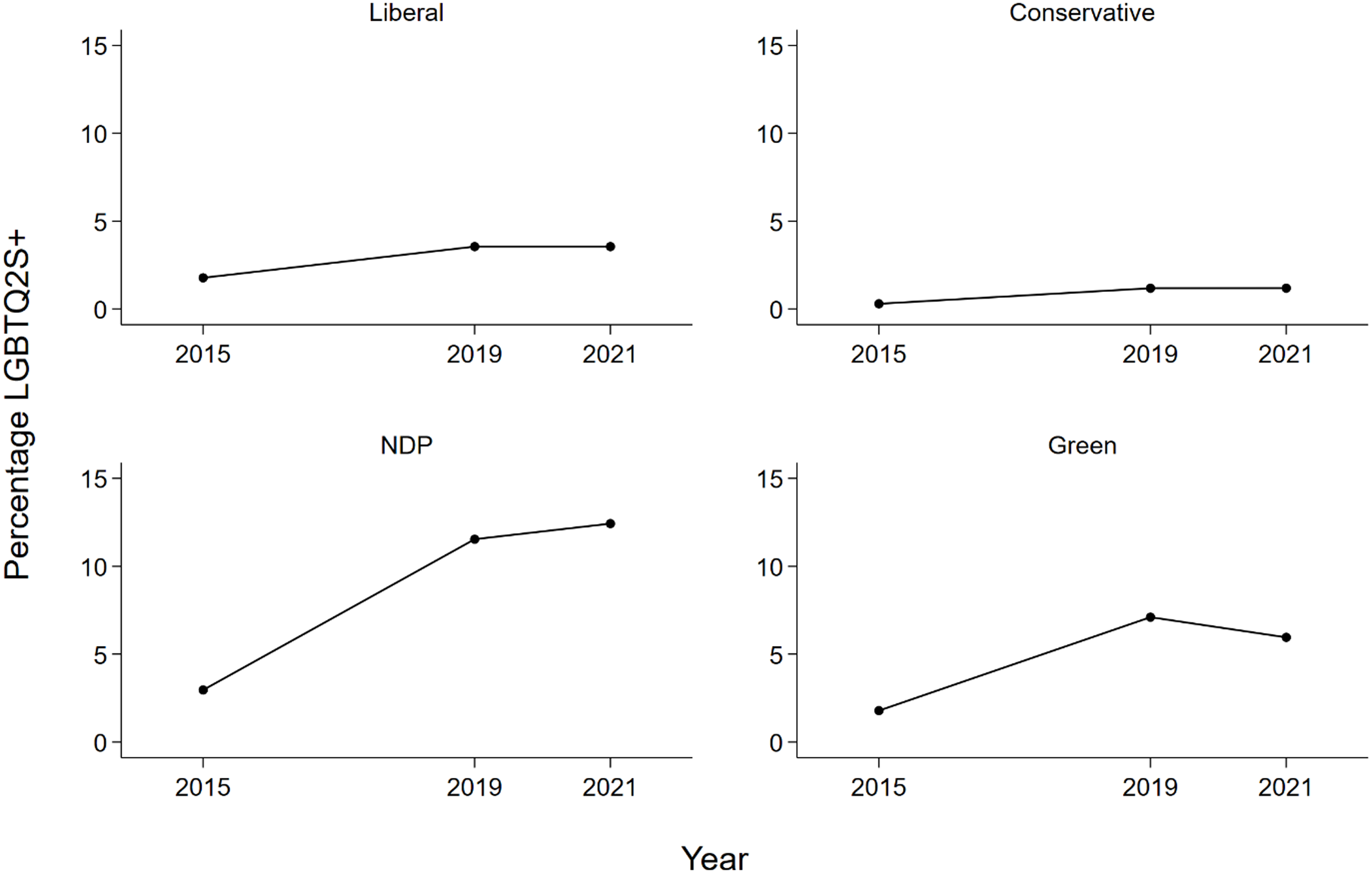
We demonstrate one application of the dataset by examining changes in LGBTQ2S+ candidates over time. Figure 1 displays the percentage of out candidates on the Liberal, Conservative, NDP and Green slates from 2015 to 2021. We do not display results for the Bloc because it only nominated one LGBTQ2S+ candidate we could identify. Figure 1 shows incremental increases in out candidates among the Liberals and Conservatives and more substantial increases among the NDP and Greens.
Percentage of Candidates Who Are LGBTQ2S+ by Party, 2015–2021.

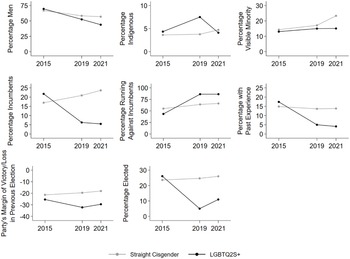
Figure 2 compares straight cisgender and LGBTQ2S+ candidates on demographic and electoral variables over time. The percentage of men candidates has decreased over time, and this is particularly true among LGBTQ2S+ candidates. LGBTQ2S+ candidates are at least as likely as straight cisgender candidates to be Indigenous, and in 2019 they were almost twice as likely to be Indigenous. Although the percentage of straight cisgender candidates who are visible minorities has increased over time, this is less true among LGBTQ2S+ candidates. In more recent elections, LGBTQ2S+ candidates have been less likely to be incumbents, more likely to run against incumbents, less likely to have past political experience, more likely to run in less competitive seats and less likely to be elected. Overall, the composition of LGBTQ2S+ candidates has changed since the rainbow wave—or sharp increase in the number of LGBTQ2S+ candidates—in 2019.
Changes in Straight Cisgender and LGBTQ2S+ Candidates, 2015–2021.

Contribution
In this research note, we advocated for data on LGBTQ2S+ candidates to be publicly available, replicable and as comprehensive as possible. With these goals in mind, we have built and introduced a new publicly available dataset that identifies LGBTQ2S+ candidates, including transgender, nonbinary and Two Spirit candidates. We prioritized making the data replicable by publishing our coding procedure. The use of systematic individual candidate searches helps make our data as comprehensive as possible. To our knowledge, this approach has not yet been used to identify LGBTQ2S+ candidates. Without individual candidate searches, studies are likely to miss LGBTQ2S+ candidates in unwinnable districts.
Although our dataset provides the most comprehensive publicly available data on LGBTQ2S+ candidates, our approach has limitations. First, we may miss candidates by searching historically. Although the Wayback Machine makes historical work possible, it is not a complete archive of the web. Second, we recognize that poor coverage of certain candidates and parties could lead to undercounting LGBTQ2S+ candidates. In many cases, limited information was available about Green candidates. The best way to correct these issues is to conduct candidate coding during an election campaign rather than years later.
Using these data, we have documented considerable change over time in both the number and composition of LGBTQ2S+ candidates. In 2015, there were few out candidates, but they were better positioned to win. In 2019 and 2021, the number of LGBTQ2S+ candidates sharply increased, but they were running in less winnable districts and had less political experience than straight cisgender candidates. These results suggest that researchers may wish to analyze candidate data separately by election before deciding whether to pool across elections.
Researchers could use these data to answer many questions. Our dataset includes district and candidate identifiers for merging with other datasets and gender and race variables for intersectional analyses. Researchers could add census or political finance data to study additional barriers facing LGBTQ2S+ candidates.
Supplementary Material
To view supplementary material for this article, please visit https://doi.org/10.1017/S0008423925100395.
Data Availability statement
The full dataset is available at https://doi.org/10.5683/SP3/QMCMIC.
Acknowledgements
We thank the three anonymous reviewers and editor for helpful comments on the manuscript. We thank Janica Arevalo, Harry Blackwell, Kate Burke Pellizzari, Kaitie Jourdeuil, Sarah Malik and Maddy Ritter for research assistance. We also thank Queen’s University and the Mamdouha S. Bobst Center for Peace and Justice for financial support for this project.
Competing interests
The authors declare none.



 Open access

