





1. Introduction
Children learn to use language by attending to the world around them. Across cultures, they experience language through interactions with individuals and objects in their environments (Heath, Reference Heath1983; Snow, Reference Snow1977). The amount of language to which children are exposed influences their own use of language (e.g., Hoff & Naigles, Reference Hoff and Naigles2002; Hurtado et al., Reference Hurtado, Marchman and Fernald2008). For bilingual and multilingual learners, exposure is divided across languages. This generally leads to reliable differences in language performance such that the greater the exposure received in one language, the greater the child’s proficiency in that language (e.g., Bedore et al., Reference Bedore, Peña, Summers, Boerger, Resendiz, Greene and Gillam2012, Reference Bedore, Peña, Griffin and Hixon2016; Hoff et al., Reference Hoff, Core, Place, Rumiche, Señor and Parra2012). Across languages, however, bilingual children have distinct sources of exposure, including interlocuters, settings and activities, that provide exposure to either or both languages in varying proportions (Paradis & Grüter, Reference Paradis, Grüter, Grüter and Paradis2014). What determines which language will be heard and from whom is context dependent, influenced by factors, such as family makeup, geographic location and academic programming (e.g., De Houwer, Reference De Houwer2007, Reference De Houwer2017; Eilers et al., Reference Eilers, Oller, Cobo-Lewis, Oller and Eilers2002; Unsworth et al., Reference Unsworth, Brouwer, Bree and Verhagen2019). For example, a bilingual child may receive most of their exposure to the community language at school, due to the nature of their academic programming, and most of their exposure to the home language at home. However, a child with siblings with more contact with the community language may use that language more in the home environment (Bridges & Hoff, Reference Bridges and Hoff2012; Duursma et al., Reference Duursma, Romero-Contreras, Szuber, Proctor, Snow, August and Calderón2007; Rojas et al., Reference Rojas, Iglesias, Bunta, Goldstein, Goldenberg and Reese2016; Sorenson Duncan & Paradis, Reference Sorenson Duncan and Paradis2020). Bilingual children’s language dominance (i.e., the language of relatively higher use and/or proficiency) has also been shown to shift over time, with many children demonstrating a switch in dominance from the home language to the community language (Anderson, Reference Anderson and Goldstein2012; Castilla-Earls et al., Reference Castilla-Earls, Francis, Iglesias and Davidson2019; Hiebert & Rojas, Reference Hiebert and Rojas2021; Oller & Eilers, Reference Eilers, Oller, Cobo-Lewis, Oller and Eilers2002; Veltman, Reference Veltman1983). These findings point to the fundamental changes in bilingual children’s language environments over time. Identifying the nature of these changes and the factors that influence them is of interest if we are to better understand and improve paths to bilingual education, intervention and language maintenance.
The current study, therefore, aimed to model the longitudinal shifts in exposure across distinct interlocuters and sources of exposure in the home language environments of a group of bilingual children. Specifically, we examined the weekly hours US Spanish–English bilinguals spent interacting with four distinct sources of exposure at home (adult–child interactions, peer–child interactions, electronic media exposure and home literacy activities) across three language modes (Spanish-only, English-only and bilingual) between the ages of 4 and 12. Consistent with previous research (e.g., Bedore et al., Reference Bedore, Peña, Griffin and Hixon2016; Fillmore, Reference Fillmore1991), we measured the effects of contextual factors (i.e., age of first language exposure and school language exposure) likely to influence the home language environment.
1.1. Bilingual language exposure
There is a documented link between language exposure and bilingual children’s language development (e.g., Blom, Reference Blom2010; Dijkstra et al., Reference Dijkstra, Kuiken, Jorna and Klinkenberg2016; Hoff et al., Reference Hoff, Core, Place, Rumiche, Señor and Parra2012; Jia & Aaronson, Reference Jia and Aaronson2003; Jia & Fuse, Reference Jia and Fuse2007; Mueller Gathercole et al., Reference Mueller Gathercole, Kennedy and Thomas2016; Place & Hoff, Reference Place and Hoff2011; Prevoo et al., Reference Prevoo, Malda, Mesman, Emmen, Yeniad, van Ijzendoorn and Linting2014; Unsworth, Reference Unsworth2013). Children with more exposure to one language over the other have been shown to produce more words (Allen et al., Reference Allen, Genesee, Fish and Crago2002; Hoff et al., Reference Hoff, Core, Place, Rumiche, Señor and Parra2012; Pearson et al., Reference Pearson, Fernandez, Lewedeg and Oller1997), produce longer utterances (Blom, Reference Blom2010; Hoff et al., Reference Hoff, Core, Place, Rumiche, Señor and Parra2012; Meisel, Reference Meisel2007; Schlyter, Reference Schlyter, Hyltenstam and Viberg1993; Schlyter & Håkansson, Reference Schlyter and Håkansson1994), combine words earlier (Hoff et al., Reference Hoff, Core, Place, Rumiche, Señor and Parra2012) and achieve higher grammatical complexity scores (Hoff et al., Reference Hoff, Core, Place, Rumiche, Señor and Parra2012) in that language. However, not all studies observe this relationship between exposure and performance (e.g., Goldberg et al., Reference Golberg, Paradis and Crago2008; Jia & Paradis, Reference Jia and Paradis2015; Páez et al., Reference Páez, Tabors and López2007; Paradis, Reference Paradis2011) and others report mixed results (e.g., Bohman et al., Reference Bohman, Bedore, Peña, Mendez-Perez and Gillam2010; Chondrogianni & Marinis, Reference Chondrogianni and Marinis2011; Rojas et al., Reference Rojas, Iglesias, Bunta, Goldstein, Goldenberg and Reese2016; Sun et al., Reference Sun, Yin, Amsah and O’Brien2018). This inconsistency may be because there are factors beyond current language exposure that also uniquely influence bilingual children’s language skills. These include factors, such as length of exposure to each language (Bedore et al., Reference Bedore, Peña, Griffin and Hixon2016; Chondrogianni & Marinis, Reference Chondrogianni and Marinis2011; Hurtado & Vega, Reference Hurtado and Vega2004; Jia & Paradis, Reference Jia and Paradis2015), home and community maintenance of the home language (Gathercole & Thomas, Reference Gathercole and Thomas2009) and children’s school language environments (Rojas & Iglesias, Reference Rojas and Iglesias2013). Moreover, current language exposure may be disaggregated (e.g., school vs. home exposure, adult vs. peer exposure) or reported in diverse ways (e.g., overall relative exposure, richness of the linguistic environment), revealing distinct relations between exposure and performance. To better explain the impact of exposure on language development, it is crucial to establish a more comprehensive insight into the factors that influence the language environment.
1.1.1. Distinct sources of exposure
Bilingual children have distinct sources of exposure that influence which language(s) will be spoken and to which degree (e.g., Grüter & Paradis, Reference Grüter and Paradis2014; Unsworth et al., Reference Unsworth, Brouwer, Bree and Verhagen2019). These include interlocuters, such as teachers, friends, family members and other sources, such as screen media, books and music. There is evidence to suggest that disaggregating the sources of language exposure can provide a more accurate picture of their influence on bilingual children’s language use (Paradis, Reference Paradis2011; Rojas et al., Reference Rojas, Iglesias, Bunta, Goldstein, Goldenberg and Reese2016; Sorenson Duncan & Paradis, Reference Sorenson Duncan and Paradis2020). When parental interactions were disaggregated from sibling and peer interactions in an analysis of Spanish–English bilingual kindergarteners by Rojas et al. (Reference Rojas, Iglesias, Bunta, Goldstein, Goldenberg and Reese2016), sibling and peer interactions (on a relative scale) positively predicted children’s English scores, but parental interactions did not. Similarly, Paradis (Reference Paradis2011) observed that home English use did not predict English language scores in a sample of preschool and school-aged bilingual children with diverse home languages. Instead, richness of the English language environment, which represented denser exposure from English-language media, activities, and conversations among friends, predicted English performance, suggesting that exposure received from sources beyond the immediate family can also influence children’s language skills. These findings indicate that different exposure sources distinctly influence children’s language development, highlighting the need to examine exposure sources individually.
To account for bilingual children’s full range of language exposure sources, it is necessary to consider the range of individuals with whom they interact and activities in which they engage. These include interlocuters in the home and community and indeed, the exposure received from these conversational partners has been linked to language development (Dijkstra et al. Reference Dijkstra, Kuiken, Jorna and Klinkenberg2016; Place & Hoff, Reference Place and Hoff2011; Prevoo et al., Reference Prevoo, Malda, Mesman, Emmen, Yeniad, van Ijzendoorn and Linting2014). However, school-aged children also spend a substantial amount of time at school receiving academic instruction and interacting with their teachers and peers. Outside of school, they commonly engage in activities other than interactions with interlocuters, such as consuming electronic media or reading. In the United states, elementary-aged children spend an average of 33.2 hours per week at school (National Center for Education Statistics, 2008); 14.6 hours per week engaging with electronic media, including watching television or online videos, browsing websites, listening to music, playing video games and using social media (Rideout & Robb, Reference Rideout and Robb2020; data collected prior to COVID-19 pandemic) and 3.7 hours per week reading print and e-books (Rideout & Robb, Reference Rideout and Robb2020; data collected prior to COVID-19 pandemic). Note that the latter two measures did not ask caregivers to specify whether children engaged in these activities inside or outside of school.
These sources provide children with considerable language exposure. Like the interlocuter differential effects observed by Rojas et al. (Reference Rojas, Iglesias, Bunta, Goldstein, Goldenberg and Reese2016), there is evidence to suggest that these sources may differentially influence children’s language development and thus should be examined. In the case of school language, Rojas and Iglesias (Reference Rojas and Iglesias2013) observed that growth in Spanish–English bilingual children’s English (the majority language) was positive during the school year but stalled during summer vacations over the course of three academic years (fall of kindergarten to spring of second grade). This pattern did not emerge in children’s Spanish (the home language) growth, which was not influenced by summer vacations, indicating an effect of school attendance on the community language only. Indeed, for some bilingual children, school language exposure may represent the bulk of their exposure to the community language (Collins et al., Reference Collins, O’Connor, Suárez-Orozco, Nieto-Castañon and Toppelberg2014; Gámez, Reference Gámez2015; Gámez & Levine, Reference Gámez and Levine2013). However, there is also evidence that school exposure influences the home language environment. Fillmore (Reference Fillmore1991) demonstrated that even when parents spoke little to no English, US bilinguals who received English-only academic instruction spoke far less of the home language and far more English at home than their peers in bilingual education.
Outside of school, sources such as electronic media and books can expose bilingual children to vocabulary words and linguistic forms they otherwise may not encounter (Elley & Mangubhai, Reference Elley and Mangubhai1983; Webb & Rodgers, Reference Webb and Rodgers2009a, Reference Webb and Rodgers2009b). Electronic media exposure can influence bilingual children’s language performance (d’Ydewalle & Van de Poel, Reference d’Ydewalle and Van de Poel1999; Flege et al., Reference Flege, Yeni-Komshian and Liu1999; Jia & Aaronson, Reference Jia and Aaronson2003; Kuppens, Reference Kuppens2010; Williams & Thomas, Reference Williams and Thomas2017). For example, Kuppens (Reference Kuppens2010) observed that school-aged Dutch-speaking children who watched English-language television shows and movies or played English-language computer games scored higher on an English-to-Dutch translation test as screen or play time increased. Children’s home literacy environments also provide a unique source of language exposure that can demonstrate differential effects by language. For example, Duursma et al. (Reference Duursma, Romero-Contreras, Szuber, Proctor, Snow, August and Calderón2007) examined the effects of Spanish and English home literacy supports, including helping with homework, reading books and telling stories. English home literacy supports were positively associated with children’s English vocabulary, but this effect was not observed between Spanish home literacy supports and Spanish vocabulary. Instead, Spanish vocabulary was associated with receiving Spanish literacy instruction at school. Similar language-specific effects were reported by Farver et al. (Reference Farver, Xu, Lonigan and Eppe2013), who also extended their analyses to individual input sources. The authors found that upon preschool entry, parental literacy-related behaviors, sibling-child reading and family literacy resources were associated with Latino children’s English oral language skills, while only parental literacy-related behaviors were related to children’s Spanish oral language skills. These findings emphasize the importance of examining specific sources of exposure, including media and literacy activities, as it can elucidate notable differences in how these sources may impact children’s dual-language development.
1.1.2. Change over time
In addition to the influence of distinct sources of exposure, there is also evidence for change over time in bilingual children’s language exposure. Children often demonstrate a shift in language dominance from the home language to the community language. Although dominance can be measured in many ways, the dominance shift has been generally described to emerge across generations of families immigrating to areas where policies and social norms directly or indirectly foster monolingualism in a community language (Fishman, Reference Fishman1966; Veltman, Reference Veltman1983), with the first (immigrating) generation remaining proficient in the home language and practicing little to some of the community language, the second generation demonstrating more balanced proficiency and the third generation gaining proficiency in the community language and practicing little to none of the home language. However, a considerable number of studies have demonstrated that this dominance shift can occur more rapidly (e.g., Anderson, Reference Anderson1999, Reference Anderson2001; Fillmore, Reference Fillmore1991; Hurtado & Vega, Reference Hurtado and Vega2004; Portes & Hoa, Reference Portes and Hao1998; Portes & Rumbaut, Reference Portes and Rumbaut2005), providing evidence of intra – rather than intergenerational home language shift and challenging the traditional assumptions of language shift.
A key factor in the dominance shift is the language environment. There may be minimal institutional supports for ensuring the development and maintenance of bilingual children’s home languages. Rather, the language environment is transitional in nature, characterized by a phased shift away from home language exposure and toward community language exposure (e.g., Fillmore, Reference Fillmore1991; Silva-Corvalán, Reference Silva-Corvalán, Seliger and Vago1991; Veltman, Reference Veltman1988). The US context offers a compelling case study for examining these context-related influences as they pertain to children. There are varying policies on bilingual education between states. As of 2021, 6 of 50 states mandated districts to offer bilingual education if a certain number of students from the same language background are present; 43 states permitted districts to select their language instructional programs, with the majority explicitly endorsing bilingual education alternatives and only one state expressly prohibited bilingual education at the state level (Rutherford-Quach et al., Reference Rutherford-Quach, Torre Gibney, Kelly, Ballen Riccards, Garcia, Hsiao, Pellerin and Parker2021). Despite this promising instructional landscape, dual language programs in the United States typically do not prioritize the maintenance of children’s home language. Instead, many tend to be transitional or subtractive in nature, involving a deliberate and gradual reduction of the child’s home language (Crawford, Reference Crawford2004; Petrovic, Reference Petrovic2010). For instance, in Texas, where 38% of students are classified as dual-language learners at prekindergarten, only 67% of students in this group are reportedly enrolled in dual-language programs at elementary school, 4% at middle school and 0.3% at high school (Texas Education Agency, 2019). This phasing out of bilingual instruction over time may reflect limited availability of bilingual academic opportunities at higher grade levels rather than just parent program selection. However, less is known about how the home language environment changes over time and interacts with other external factors such as school language exposure, potentially contributing to this dominance shift.
1.2. Rationale and research questions
The findings summarized above demonstrate that shifting exposure from different sources is linked to changes in language dominance among bilingual children. However, less is known about the specific changes that occur in children’s home language environments. A more nuanced understanding of these changes and the factors that influence them is critical as it holds implications for understanding bilingual language development, sociolinguistic factors shaping language use and educational practices for bilingual learners. Thus, this study aimed to disambiguate the continuous shifts in the home language interactions of US bilingual children between the ages of 4 and 12. Home exposure sources were disaggregated to establish whether and how interactions with and exposure from each source changed over time. Given that bilinguals have differing patterns of language exposure and use depending on their language histories and academic programming, children’s age of first English exposure and current school language exposure were also considered. Our research questions and hypotheses were:
-
1. How does bilingual children’s age relate to their home language exposure, disaggregated across four sources (adult–child, peer–child, electronic media and home literacy activities) and three language modes (Spanish-only, English-only and bilingual)? Based on prior literature on dominance shift to the community language (e.g., Anderson, Reference Anderson1999, Reference Anderson2001; Portes & Rumbaut, Reference Portes and Rumbaut2005), we hypothesized that children’s age would be positively related to their English-only and bilingual exposure and negatively related to their Spanish-only exposure across sources. However, we predicted that these effects would vary in magnitude across the sources and between language modes, with parent–child interactions showing relatively slower growth and the remaining sources showing relatively faster growth in the community language modes, in keeping with Rojas and Iglesias (Reference Rojas and Iglesias2013) and Rojas et al. (Reference Rojas, Iglesias, Bunta, Goldstein, Goldenberg and Reese2016).
-
2. How does bilingual children’s age of first exposure to the community language (in this case English) relate to their home language exposure patterns? Given the link between cumulative and current exposure identified in past studies (e.g., Bedore et al., Reference Bedore, Peña, Griffin and Hixon2016), we hypothesized that earlier age of first English exposure would be linked to more English-only, more bilingual and less Spanish-only exposure in the home. We had no a priori hypotheses regarding the magnitude of the slopes across sources, however.
-
3. How does bilingual children’s school language exposure relate to their home language exposure patterns? Given past findings that the language of US bilingual children’s academic programming impacted their home language environments (e.g., Fillmore, Reference Fillmore1991) and given the US bilingual education context (e.g., Crawford, Reference Crawford2004; Petrovic, Reference Petrovic2010; Rutherford-Quach et al., Reference Rutherford-Quach, Torre Gibney, Kelly, Ballen Riccards, Garcia, Hsiao, Pellerin and Parker2021), we hypothesized that children’s school English exposure would be positively linked with English-only and bilingual exposure and negatively linked with Spanish-only exposure in the home. We had no a priori hypotheses regarding the magnitude of the slopes across sources, however.
2. Methods
2.1. Participants
Participants were 280 Spanish–English bilingual children drawn from a larger longitudinal study (n = 1,696) of the outcomes of school-aged Spanish–English bilinguals with and without language disorder (Peña et al., Reference Peña, Bedore and Griffin2010). Children were recruited for the larger study from two public school districts in a Southern US state if they had a history of Spanish and English language exposure. Children were intentionally entered into the study cross-sequentially (i.e., at different starting grades) and participated annually (i.e., once per grade level) to allow for the modeling of a multiyear developmental trajectory (Kujala et al., Reference Kujala, Miron-Shatz and Jokinen2019). Specifically, entry occurred at prekindergarten, first or third grade and children remained in the study for up to five grade levels or until they exited fifth grade, whichever came first. Data were collected in two phases, a screening phase (n = 1,696) and a longitudinal testing phase (n = 360). Given that the purpose of the larger study was to examine language development in bilinguals with and without risk for language disorder, children were invited back to the longitudinal testing phase if they demonstrated risk for language disorder during the screening phase or if they did not demonstrate risk but matched at least one at-risk child on age, sex, maternal education, age of first English exposure and English exposure.
For the present analyses, children were included if they had a language exposure survey on record for at least one test year. Children were excluded if they presented with a history of (a) language disorder, including demonstrating risk during the screening phase, (b) focal brain injury, (c) autism spectrum disorder, (d) intellectual impairment, (e) socioemotional disorder or (f) hearing loss. These criteria resulted in 280 children who contributed a total of 761 annual observations. Children contributed 2.7 annual observations on average, with 47, 60, 118, 35 and 20 children contributing 1, 2, 3, 4 and 5 annual observations, respectively.
See Table 1 for detailed participant counts and demographics. The average age of the sample was 7.7 years (SD = 1.9 years), 52% were female and 95% were reportedly Hispanic. The average age at which children were first exposed to English was 2.2 years (SD = 1.8 years) and the average maternal education was 3 (SD = 1.8), corresponding with a 10th–11th grade education per Hollingshead (Reference Hollingshead1975), where 1 = ≤7th grade, 2 = 8–9th grade, 3 = 10th–11th grade, 4 = high school graduate, 5 = partial college, 6 = college education and 7 = graduate degree. Children’s school English exposure was 45% (SD = 36%) on average, but this value substantially ranged between the grade levels studied. We further investigated the language of children’s academic programming, reported in Table 2. Descriptively, a greater proportion of children in the earlier grades received low school English exposure (i.e., high school Spanish exposure) and a greater proportion of children in the later grades received high school English exposure (i.e., low school Spanish exposure), suggesting that younger children were more likely to be enrolled in bilingual classrooms. Finally, note that there were minor differences between included children and those who were excluded from the analyses. Excluded children had an average age of 7.8 years (SD = 1.8 years), maternal education of 2.6 (SD = 1.6), age of first English exposure of 2.9 years (SD = 1.9) and current English exposure of 40% (SD = 34%).
Participant counts and demographics
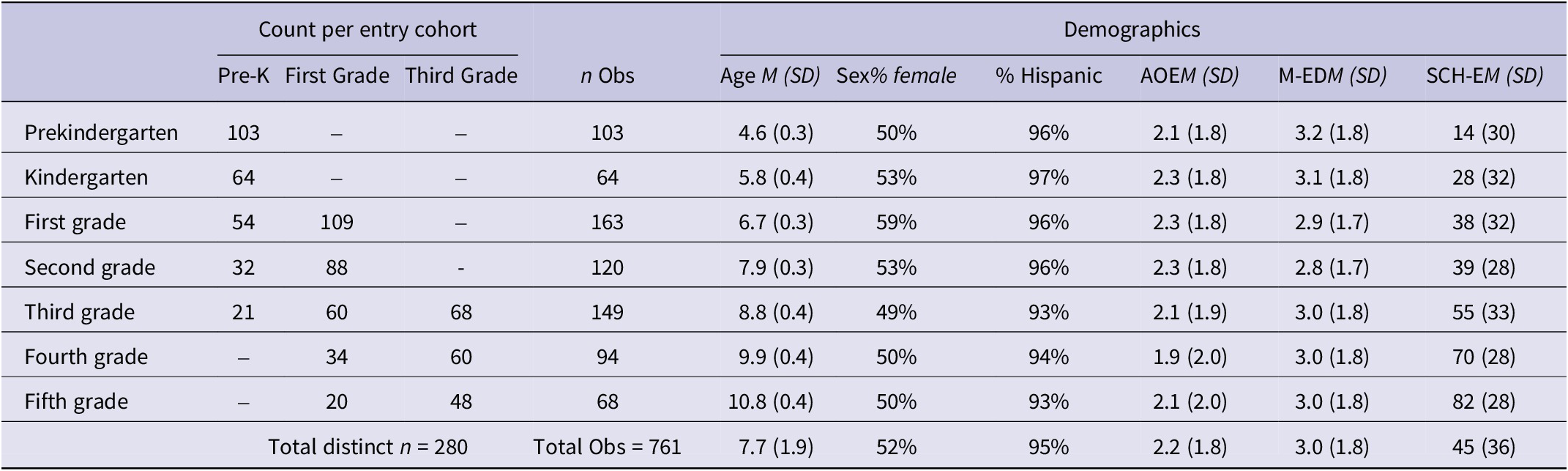
Note. Obs = observations; M = mean; SD = standard deviation; AOE = age of first English exposure; SCH-E = percent current school English exposure; M-ED = maternal education, per Hollingshead (Reference Hollingshead1975), where 1 = ≤7th grade, 2 = 8–9th grade, 3 = 10th–11th grade, 4 = high school graduate, 5 = partial college, 6 = college education and 7 = graduate degree.
Language of academic programming per grade (n Obs = 761)
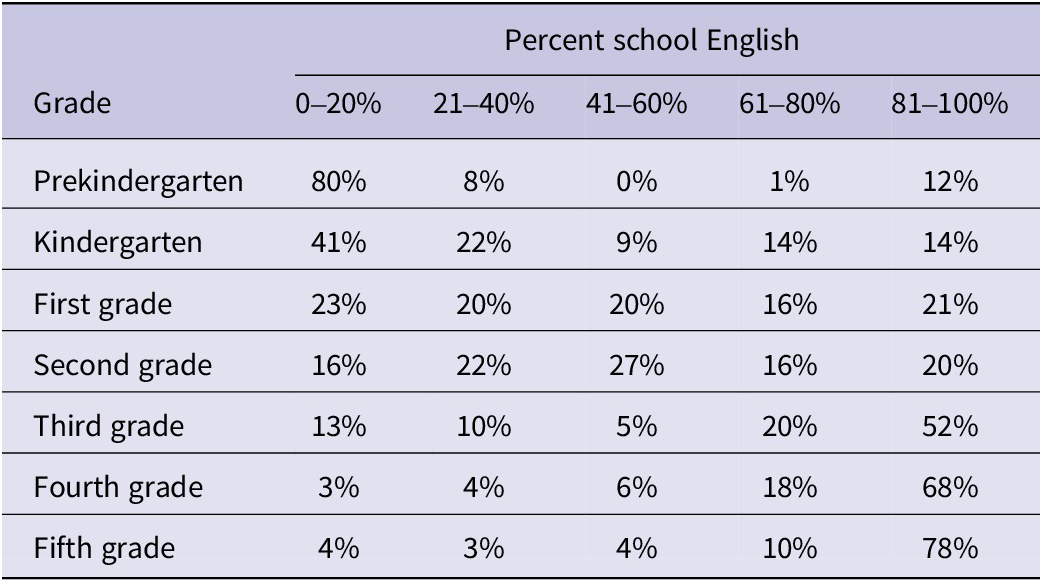
Note. Values in boxes represent the percentage of children per grade who receive the indicated percentage of school English exposure per week, which represents the inverse of school Spanish exposure per week.
2.2. Measure
An experimental extension of the Bilingual Input Output Survey (BIOS; Peña et al., Reference Peña, Gutiérrez-Clellen, Iglesias, Goldstein and Bedore2018) was used to collect demographic and language exposure information from children’s caregivers and classroom teachers. The published BIOS is comprised of a Home form and School form reported by children’s caregivers and teachers, respectively. The BIOS-Home measures year-by-year language history to date and current hour-by-hour language input (i.e., the language used by those around the child) and output (i.e., the child’s own productions). Input and output are reported for one typical weekday and one typical weekend day from 7 am to 11 pm. The BIOS-School measures current language input and output at school by asking the child’s current classroom teacher to report current input and output for one typical school day from arrival to departure time. For each one-hour block, caregivers and teachers report the language of interaction (English, Spanish, both or neither) and specify the child’s interlocuter(s) (e.g., parent, siblings, teacher and peers) during that hour. The experimental extension of the BIOS used in this study collected the above information from the published edition (Peña et al., Reference Peña, Gutiérrez-Clellen, Iglesias, Goldstein and Bedore2018), but additionally solicited from caregivers information about the child’s home language activities, including whether the child was engaging with electronic media (e.g., watching TV and playing video games) or literacy materials (e.g., reading or being read to, completing homework). For example, in addition to reporting the language(s) spoken by the target child and their interlocuter(s), caregivers were asked to expand on the activities in which the target child was engaging within each hourly block.
2.3. Procedure
2.3.1. Data collection
Approval to recruit and consent participants was obtained from the institutional review board of The University of Texas at Austin (study 2009-11-0110). This study was conducted with full parental consent for the participation of their children. The authors assert that all procedures contributing to this work comply with the ethical standards of the relevant national and institutional committees on human experimentation and with the Helsinki Declaration of 1975, as revised in 2008. The BIOS was collected by Spanish–English bilingual research assistants who interviewed children’s caregivers and teachers in their preferred language(s) by phone or in person. Each interview was 10–20 minutes in length.
2.3.2. Data coding
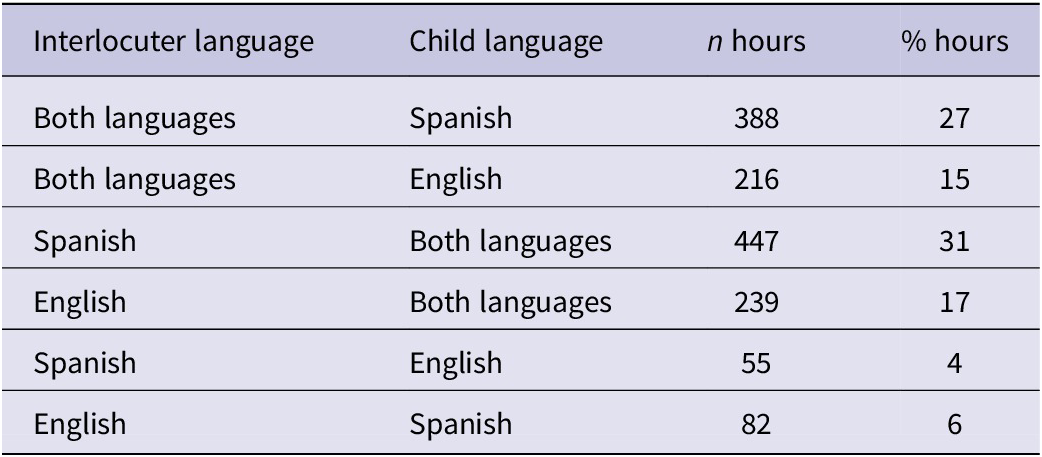
Home language codes. Raw weekly hours of English, Spanish and bilingual language exposure were derived from the BIOS hour-by-hour forms. Input and output were individually reported on the original BIOS forms, but were combined into a single exposure variable for the present analyses due to substantially high agreement between the two. Specifically, of the 24,718 hourly language blocks reported across all study participants, 94.2% (n = 23,291) had the same language mode for input and output (e.g., interlocuter produced English, target child produced English), while 5.8% (n = 1,427) had mixed language modes (e.g., interlocuter produced Spanish, target child produced English). The latter are further described in Table 3. Of the n = 1,427 mixed mode hours, the vast majority (n = 1,290, 90%) represented an hour when either the interlocuter(s) or target child themselves used both languages, while a small proportion (n = 137, 10%) represented an hour when the interlocuter(s) and target child spoke different languages. Therefore, mixed modes were recoded as additional bilingual hours.
Analysis of mixed language modes (n = 1,427 hours).
Home language sources. Home language exposure was divided across four sources: (a) adult–child interactions: all hours of interaction with a parent, caregiver or other adult in the home or other setting outside of school; (b) peer–child interactions: all hours of interaction with a sibling, friend or other child in the home or other setting outside of school; (c) electronic media exposure: all hours of interaction with analog or digital electronic media, including viewing television, listening to music, video gaming, browsing websites or other uses of computers, mobile devices and other electronic devices and (d) home literacy activities: all hours spent reading or being read to (print or electronic books), completing homework or engaging in educational activities such as flashcards and workbooks. The latter two sources only provided data for English-only and Spanish-only hours.
School language exposure. The percentage of English-only school hours per week (SCH-E) was derived from the total number of English-only, Spanish-only and bilingual school hours per week. We used a relative value to represent children’s school English exposure to facilitate parsimony in the regression modeling.
Age of first English exposure. Children’s earliest ages of exposure to English (AOE) was derived from the BIOS-Home year-by-year language history form.
2.3.3. Data analyses
Our aim was to estimate the multiyear trajectory of language exposure across four home interaction sources while accounting for varying bilingual histories and experiences. Multilevel modeling was selected as it is capable of handling cross-sequential data, including varying numbers of data points from participants, through its use of maximum likelihood estimation to address intraindividual and interindividual levels of variation (Luke, Reference Luke2004). Specifically, given that age is treated as a continuous predictor and intraindividual variation is accounted for by the random intercept, even those with a single time point can be included in the analyses. We developed one multilevel linear regression model per interaction source and language mode (e.g., adult–child interactions English only), resulting in 10 models. For each model, weekly raw hours of exposure from the source served as the dependent variable. Age in years served as the slope. The intercept and slope effects of age of first exposure to English (AOE) – a time-invariant factor – and SCH-E–a time-varying factor – were also estimated. To facilitate interpretation of the intercepts, age, AOE and SCH-E were centered at their respective grand means. A random intercept was also estimated to account for the nested measurements within subjects. Given these model estimates, an a priori power analysis demonstrated that the sample size to achieve an error probability rate at or below 0.1 was n = 116, indicating that the size of the current sample was sufficient. All analyses were conducted using the lmer function of the lme4 package, version 1.1-34 (Bates et al., Reference Bates, Maechler, Bolker and Walker2015) in R, version 4.3.1 (R Core Team, 2023). See supplementary materials for annotated R syntax demonstrating the development and application of the model functions (Appendix S1). It is important to emphasize that these data analyses reveal associations between variables, allowing us to determine whether there may be a relationship between the variables studied but precluding the conclusion that changes in one variable cause changes in another.
3. Results
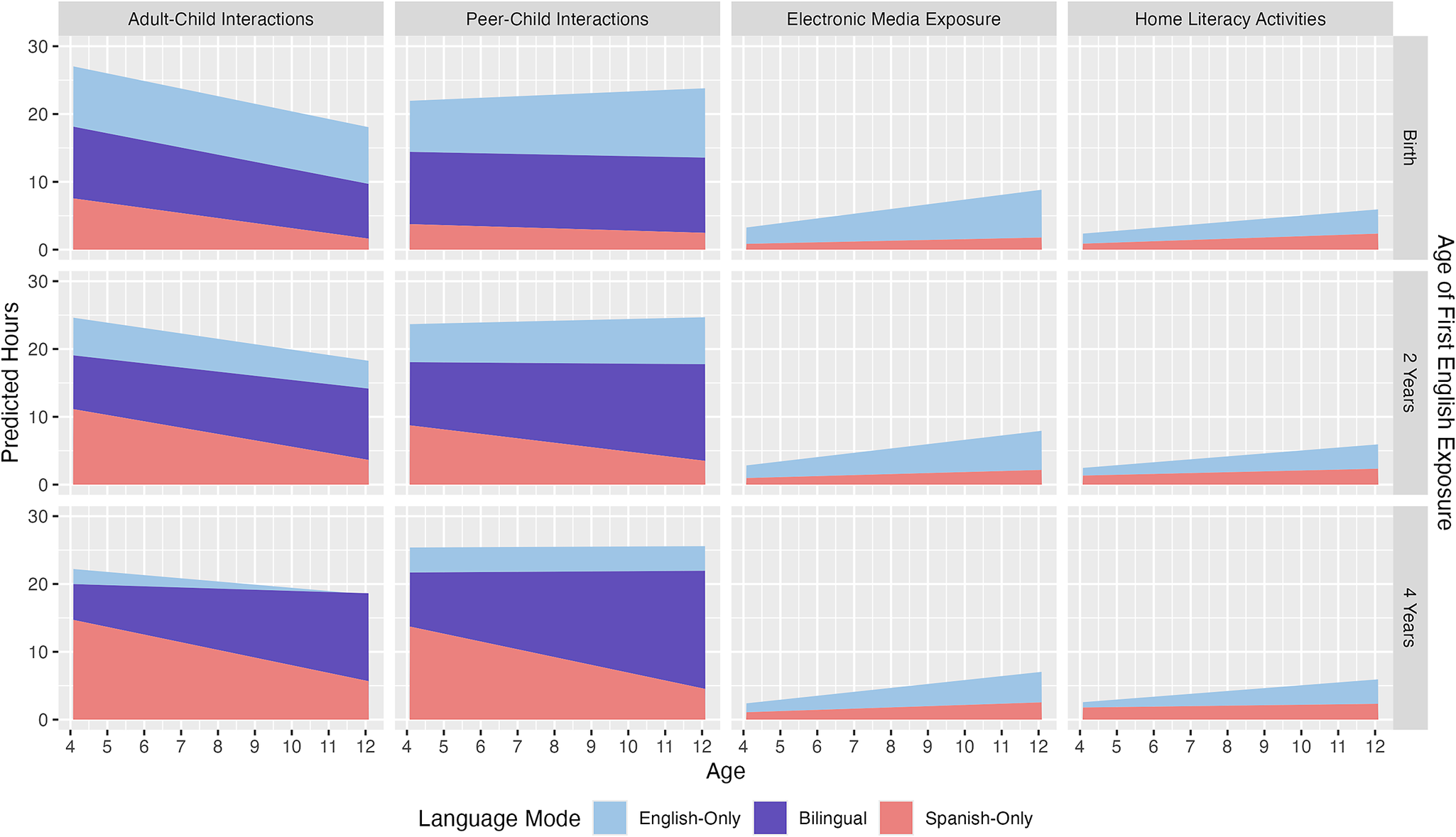
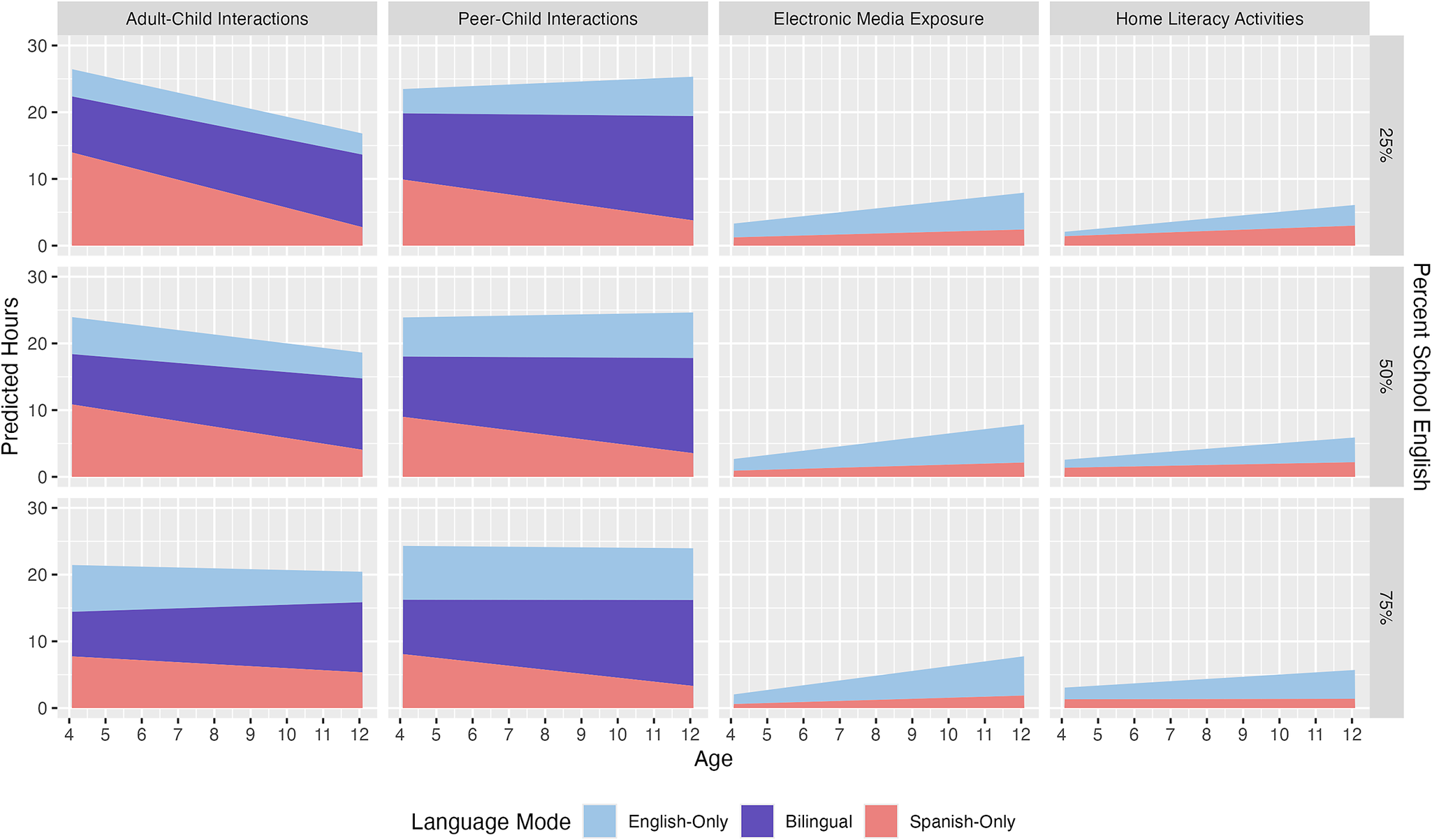
Results of the regression models are reported in Table 4 and illustrated by Figures 1 and 2.
Multilevel linear mixed effects regression models predicting children’s home language exposure in raw weekly hours (n = 280).
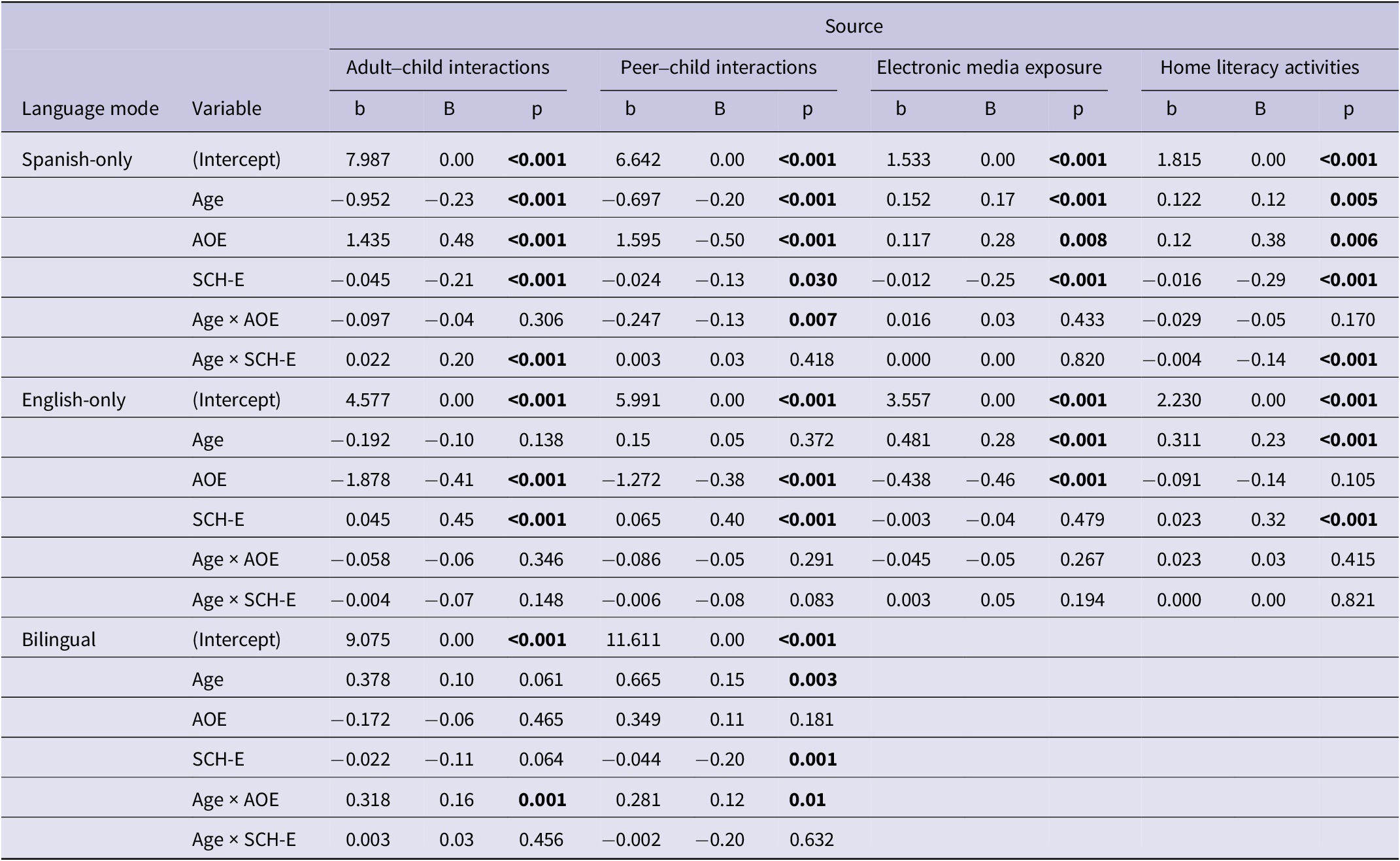
Note. AOE = grand mean-centered age of first English exposure, SCH-E = grade-centered current school English exposure. Bolded numbers indicate a p-value below 0.05.
Predicted weekly hours of home language exposure by source, language mode and age of first English exposure.
Predicted weekly hours of home language exposure by source, language mode and school English exposure.
3.1. Age
Our first research question aimed to determine how children’s age related to exposure across the four sources. Increasing age was associated with significantly fewer adult–child (b = −0.952, p < 0.001) and peer–child (b = −0.697, p < 0.001) Spanish-only interactions, with the magnitude of the decrease appearing larger among adult–child interactions. In contrast, increasing age was linked to marginally more bilingual adult–child interactions (b = 0.378, p = 0.061) and substantially more bilingual peer–child interactions (b = 0.665, p = 0.003). There were no significant effects of age on English-only interactions with either adults (b = −0.192, p = 0.138) or peers (b = 0.15, p = 0.372). These findings indicated similar patterns between adult–child and peer–child interactions, but distinct magnitudes and directions of change between the three language modes. Although age was linked to decreasing Spanish-only interactions, it related to an increase in bilingual interactions and no change in English-only interactions over time.
Age was, however, linked to significantly greater electronic media exposure in both English (b = 0.481, p < 0.001) and Spanish (b = 0.152, p < 0.001), greater home literacy activities in English (b = 0.311, p < 0.001) and slightly greater home literacy activities in Spanish (b = 0.122, p = 0.005). This indicated that as children grew, there was an associated increase in engagement with electronic media and home literacy, regardless of language. The magnitude of this growth was largest for English media exposure, followed by English home literacy activities, Spanish media exposure and Spanish home literacy activities.
3.2. Age of first English exposure
Our second research question aimed to determine the relations between children’s AOE (a time-invariant factor) and their language exposure. Figure 1 illustrates the differential effects of AOE across all exposure sources. Regarding Spanish-only exposure, AOE related to significant positive effects on the baseline level of adult–child (b = 1.435, p < 0.001) and peer–child (b = 1.595, p < 0.001) interactions. That is, the later children were exposed to English, the greater their number of Spanish-only interactions with both adults and peers. The magnitude of this increase was similar between the two sources. Similarly, AOE was linked to increases in Spanish media exposure (b = 0.117, p = 0.008) and home literacy activities (b = 0.120, p = 0.006), again suggesting that the later their exposure to English, the more children engaged with Spanish media and literacy. The Spanish-only age × AOE interaction was only significant for peer interactions (b = −0.247, p = 0.007). This negative effect indicated that as children grew in age, the baseline positive effect of AOE on Spanish-only peer interactions diminished. There were no other influences of AOE on the rate of change of Spanish-only exposure.
Regarding English-only exposure, the effects of AOE were negative for adult–child interactions (b = −1.878, p < 0.001), peer–child interactions (b = −1.272, p < 0.001) and English media exposure (b = −0.438, p < 0.001). That is, later first exposure to English corresponded with fewer engagement in these activities. The magnitude of the effect was largest for adult–child interactions. This effect was not observed for English home literacy activities, which were not predicted by AOE. All English-only age × AOE interactions were nonsignificant, suggesting consistent AOE effects on English across age.
Finally, regarding bilingual interactions, there were no significant effects of AOE on the baseline levels of adult–child and peer–child interactions. However, there were significant age × AOE interactions for both adult–child (b = 0.318, p = 0.001) and peer–child (b = 0.281, p = 0.01) interactions, indicating that later exposure to English was related to faster growth in bilingual interactions.
3.3. School English exposure
Our third and final research question aimed to determine the relations between children’s SCH-E (a time-varying factor) and their home language exposure. Figure 2 illustrates the differential predictions of SCH-E across all exposure sources. Regarding Spanish-only exposure, SCH-E related to significant negative effects across all outcomes, including adult–child interactions (b = −0.045, p < 0.001), peer–child interactions (b = −0.024, p = 0.03), media use (b = −0.012, p < 0.001) and home literacy activities (b = −0.016, p < 0.001). These findings indicated that the more school English exposure children received, the less they spoke to adults and peers in Spanish and the less they engaged with Spanish media and home literacy. The largest prediction was observed for adult–child interactions; however, there was also a positive age × SCH-E interaction for these (b = 0.022, p < 0.001), suggesting that the negative relation between SCH-E and Spanish-only interactions with adults became less pronounced with age. There were no other age × SCH-E interactions for Spanish.
Regarding English-only exposure, SCH-E was positively linked with adult (b = 0.045, p < 0.001) and peer (b = 0.065, p < 0.001) interactions, indicating that more English-language schooling related to greater use of English with these two sources, with a slightly larger effect for peer interactions. SCH-E did not relate to English media exposure or home literacy. Furthermore, all age × SCH-E interactions for English were nonsignificant, meaning that SCH-E was not associated with slowing or steepening of English-only interactions over time.
Finally, regarding bilingual interactions, SCH-E negatively related to adult–child (b = −0.022, p = 0.064) and peer–child (b = −0.044, p = 0.001) interactions, indicating that more English-language schooling related to fewer bilingual interactions with these two sources. Again, the magnitude of this effect was greater for peer interactions. The age × SCH-E interactions for the bilingual mode were nonsignificant, indicating that SCH-E was not associated with slowing or steepening of bilingual interactions over time.
4. Discussion
This study estimated an 8-year trajectory of the home language environments of US Spanish–English bilinguals between the ages of 4 and 12. Each year, detailed reports of children’s current home and school language exposure were obtained from their caregivers and teachers. We examined the influences of children’s age, age of first exposure to English and their school English exposure on continuous shifts in their home language environments across four exposure sources (adult–child interactions, peer–child interactions, electronic media and home literacy). Model estimations revealed developmental patterns that shifted across language modes and contexts and that were differentially influenced by children’s language histories. Children’s adult and peer interactions in Spanish decreased with age, their interactions in English remained stable across age and their bilingual interactions increased with age. Conversely, media exposure and home literacy activities increased with age regardless of language. Children’s age of first exposure to English mitigated some of these effects, with each year delay in first English exposure predicting more Spanish-only interactions and fewer English-only interactions between target children, adults, peers as well as less English media exposure. Finally, exposure to English at school was associated with an increase in English interactions and a decrease in Spanish and bilingual interactions. We highlight three major contributions of the present research.
4.1. Change over time
The changes observed in this study demonstrate the magnitude at which language interactions in the home language (in this case Spanish) diminish over time, even among those receiving relatively less English-language instruction at school. These findings provide support for the intragenerational language dominance shift that can occur among bilinguals, supporting and extending the work of Eilers and colleagues (Reference Eilers, Oller, Cobo-Lewis, Oller and Eilers2002), Anderson Reference Anderson1999, Anderson, Reference Anderson2001), Fillmore (Reference Fillmore1991) and Portes and Hao (Reference Portes and Hao1998). With both adults and peers, children’s Spanish-only interactions steadily declined between the ages of 4 and 12. For those with early exposure to English, English-only hours became roughly balanced with bilingual hours as the two dominant modes of interaction by the age of 12. For those with average or later exposure to English, bilingual hours superseded Spanish-only hours as the dominant mode of interaction by the age of 12. Although this pattern of results is in keeping with other studies showing a link between use of the community language in the home and a shift in language dominance to the community language (e.g., Bedore et al., Reference Bedore, Peña, Griffin and Hixon2016; Hurtado & Vega, Reference Hurtado and Vega2004), the longitudinal nature of this study illustrates how the home language environment can precipitously change during a single childhood, even among bilinguals with later contact with the community language. Moreover, children receiving more English exposure at school experienced an even greater decline in home Spanish and growth in home English, aligning with and expanding upon the work of Collins et al. (Reference Collins, O’Connor, Suárez-Orozco, Nieto-Castañon and Toppelberg2014), who demonstrated that school English use contributed substantially to children’s Spanish-to-English dominance shift. These findings suggest that the change in bilingual children’s home language environments is exacerbated by a lack of home language support at school. As children are exposed to more of the community language at school, they may speak more of it inside the home and this in turn may change the language of interaction with family members (e.g., Fillmore, Reference Fillmore1991).
4.2. Distinct sources of exposure
This study disaggregated children’s home language environments across multiple sources, examining adult–child interactions, peer–child interactions, electronic media exposure and participation in home literacy activities as distinct aspects of children’s home language experience. Given past research demonstrating that specific interlocuters may differentially influence bilingual children’s language use and skills (Rojas et al., Reference Rojas, Iglesias, Bunta, Goldstein, Goldenberg and Reese2016; Sorenson Duncan & Paradis, Reference Sorenson Duncan and Paradis2020), it was important to explore exposure patterns and changes across individual sources. By measuring children’s interactions across several contexts, our findings provide a more nuanced profile of the multifaceted language experiences that shape dual language development. Disentangling the different sources of linguistic input and engagement for bilingual learners reveals important variability.
There were similarities and differences between exposure sources. The decline in Spanish-only interactions and increase in bilingual interactions over time was common across adults and peers. However, there were variations in the nature and magnitude of these changes. Spanish-only interactions were initially higher with adults but dropped faster over time than interactions with peers, leading to similar amounts of Spanish-only interactions with adults and peers by the age of 12. In contrast, bilingual interactions were both initially higher and faster growing with peers than with adults. These findings suggested a decrease in the overall amount of time spent interacting with adults and highlighted a uniquely substantial increase in peer interactions involving the community language, in this case English. These findings provide support for research showing that sibling input is more likely to influence children’s community language performance than caregiver input (Rojas et al., Reference Rojas, Iglesias, Bunta, Goldstein, Goldenberg and Reese2016; Sorenson Duncan & Paradis, Reference Sorenson Duncan and Paradis2020), underscoring that siblings and peers represent a unique source of community language exposure. Such results also suggest that children and their peers’ increasingly bilingual interactions may influence the language mode being used with adults, suggesting a bidirectional relation between children’s output and input, as observed by Hurtado and Vega (Reference Hurtado and Vega2004) and Portes and Rumbaut (Reference Portes and Rumbaut2005).
Distinct trajectories emerged for children’s home media exposure and engagement in literacy activities, such as book reading, which grew across both English and Spanish. This highlighted a developmental trend toward overall greater engagement with technology and reading. These findings suggest that as they get older, children spend more time interacting with media, such as TV, video games and the internet for entertainment and information. Thus, increased media usage in both languages reflects this age-related shift. Regarding home literacy, as language and literacy skills improve with age, it is likely that children become more capable of engaging with developmentally appropriate reading materials, leading to increased activity. Despite overall growth in both languages, it is important to highlight that we predicted language-specific differences in the rates of annual growth in these exposure sources. That is, the rate of growth in English media consumption outpaced that of Spanish media consumption by a factor of three, while the rate of growth in English literacy activities exceeded that of Spanish literacy activities by 2.5 times. This disparity was further illuminated by the negative influence of school English exposure on engagement with Spanish media and home literacy activities. These findings (a) present novel evidence about US Spanish–English bilingual children’s engagement with media in their two languages and (b) provide contextual support for previous research on language-specific effects of the home literacy environment (Duursma et al., Reference Duursma, Romero-Contreras, Szuber, Proctor, Snow, August and Calderón2007; Farver et al., Reference Farver, Xu, Lonigan and Eppe2013). First, while some evidence exists discussing the media consumption of older adolescent and adult US Spanish-speakers (e.g., Velázquez, Reference Velázquez2017), little is known about children’s media consumption across two languages. Our findings shed light on how children’s dual-language media exposure changes with age and school influence. This is a valuable contribution given the substantial amount of time children spend engaging with electronic media (Rideout & Robb, Reference Rideout and Robb2020) and the potential influences of media consumption on language skills (e.g., Kuppens, Reference Kuppens2010). Second, given that the language of home literacy activities differentially influences bilingual children’s language skills (e.g., Duursma et al., Reference Duursma, Romero-Contreras, Szuber, Proctor, Snow, August and Calderón2007; Farver et al., Reference Farver, Xu, Lonigan and Eppe2013), a noteworthy aspect of this study is that we illustrate the nature of the changes in literacy exposure in both Spanish and English. It is important to note that other contextual factors such as the availability of and access to English-language versus Spanish-language media and resources in the home (e.g., Goodrich et al., Reference Goodrich, Lonigan, Phillips, Farver and Wilson2021) may have also contributed to these trends, providing further insights into the complexities of language exposure and development in bilingual children.
4.3. The bilingual mode
A novel contribution of this study is our examination of a bilingual mode of interaction, when both the home and community language are spoken. Our results demonstrate that this mode is prevalent in the linguistic environments of bilingual children in the process of acquiring the community language. Examining interactions in the bilingual language mode provided unique insight into children’s dual language use. Except for those with very early first contact with English, which was associated with a developmental trend toward English-only interactions, the bilingual mode was predicted to become the most prevalent mode of interaction with both adults and peers for most of the children in this study. By the age of 12, it was more prevalent than Spanish-only or English-only interactions. Although our study did not explore what occurred during these interactions, these findings illustrate the dynamism of bilingual children’s home language environments and reinforce the notion that bilinguals are not simply two monolinguals in one (Grosjean, Reference Grosjean2010). For children who are beginning to acquire the community language, language interactions at home become less likely to be conducted in a single language and more likely to occur with both languages being spoken and heard together. These results provide support for how phenomena such as code-switching, when bilinguals switch from one language to another during the same interactions, may occur and change over time. For example, Tulloch (Reference Tulloch2020) demonstrated that as US Spanish–English bilingual children became more English-dominant, their rate of code-switching from English to Spanish decreased as their rate of code-switching from Spanish to English increased in interactions with their parents. This study illustrates the context within which such shifts may take place. Additionally, we descriptively explored hours of interaction with reportedly mixed language modes, where the target child and their interlocuter(s) were using different language modes (6% of all hours reported in the study). We found that most mixed modes involved one interlocuter who was communicating bilingually (i.e., code-switching). These results provide further evidence that bilingual modes of interaction are an aspect of bilingual children’s language environments. Such findings underscore the importance of assessment in bilingual modes, not just monolingual contexts, for fully illuminating the multidimensional communicative abilities of bilingual children.
4.4. Limitations
One limitation of this study was that language exposure data were derived from caregiver and teacher reports. It is possible that reporters underestimated or overestimated the amount of time children spent speaking and hearing each language. A study by Marchman et al. (Reference Marchman, Martínez, Hurtado, Grüter and Fernald2017) demonstrated that while parent-reported measures of bilingual language exposure were moderately correlated with actual measurements, actual measurements more consistently predicted children’s performance. These findings suggest that the present data are likely correlated with children’s actual language exposure, but that direct measurements may be more representative of children’s language environments.
A second limitation was that, to maintain the brevity of the caregiver and teacher interviews, information about children’s language environments was limited to the quantity of their current language exposure and their ages of first exposure to English. Factors, such as caregiver and sibling language proficiency, number and age of siblings and length of time in the United States can also influence children’s home language environments (e.g., Fillmore, Reference Fillmore1991) and are therefore important considerations for future research.
A final limitation is that while this study revealed links between children’s age, exposure history and current exposure, our analyses did not allow us to definitively conclude that any of the variables studied caused changes in another. Despite this limitation, our combined use of longitudinal analyses and multilevel modeling, which allowed us to account for differences within and between children, represented a robust approach to understanding the relations between the variables studied.
5. Conclusion
This study revealed nuanced patterns in the shift over time in US Spanish–English bilingual children’s home language environments. As Spanish interactions with adults and peers declined and English interactions remained constant with age, bilingual interactions uniquely increased over time. At the same time, engagement with media and literacy activities rose with age, regardless of language. All language modes and exposure sources were also influenced by children’s language history and school language exposure. These findings underscore the multifaceted nature of bilingual children’s home language environments and highlight the importance of accounting for developmental shifts in exposure across sources, ages and contexts when examining links between bilingual children’s language exposure and performance. Understanding these dynamics is crucial for informing educational programming tailored to bilingual children, ensuring that instruction effectively addresses their linguistic needs at different grade levels. Furthermore, insights gleaned from this study can shed light on decisions regarding language intervention, when necessary, demonstrating the need to examine not only the language(s) used at home, but how use may evolve over time. Finally, this work contributes to our understanding of home language maintenance and the factors that influence it, suggesting a bidirectional relationship between language exposure inside and outside the home. Deconstructing this relationship is essential, given its profound implications for bilingual children’s identities, their experiences outside the home and the internal dynamics of their families.
Supplementary material
To view supplementary material for this article, please visit http://doi.org/10.1017/S1366728924000634.
Competing Interests
Nahar Albudoor and Jissel Anaya have no competing interests to declare. Elizabeth Peña and Lisa Bedore are the authors of the Bilingual Input Output Survey and receive royalties; they have no other competing interests to report.
Data Availability
Data are available upon request from the authors.


 Open access

