

To understand the global impact of the International Maize and Wheat Improvement Center, or CIMMYT, we must first delve into the creation of the center. Though born a Mexican institution with an intended international focus, CIMMYT’s roots are in binational cooperation and a longer practice of global germplasm exchange aimed at producing better crops. This chapter first examines the historical background of CIMMYT, and then considers the main shift in the center’s mission over the span of its first forty years (1966–2006). To illustrate this shift, the chapter relies on brief overviews of how CIMMYT worked on the ground – training wheat breeders and working with farmers on specific projects – which serve to illustrate the broad aim and reach of the organization, before turning to its crafting a message for a world stage. The conclusion offers a reflection on the place of CIMMYT in global agriculture research today.
Historical Roots
Launched in the 1960s, CIMMYT is unique among other research centers of CGIAR (Consultative Group on International Agricultural Research) in that it traces its roots to an impactful 1940s agricultural development program known as the Mexican Agricultural Program (MAP).Footnote 1 As I discuss here, CIMMYT was designed to be international in scope but remained connected to Mexico and former MAP personnel to harness existing technology, a pool of trained scientists, and research experience.Footnote 2
CIMMYT would eventually become part of CGIAR’s first cohort of geographically diverse agricultural research centers and, arguably, its best known.Footnote 3 As Derek Byerlee and John K. Lynam maintain, centers such as CIMMYT were “the major institutional innovation of the 20th century for foreign assistance to support agricultural development and food security.”Footnote 4 Byerlee and Lynam, speaking about CGIAR centers, echo historians who decades earlier used similar language to describe the foundation of MAP as a pivotal moment in the twentieth century when agricultural science scaled up from domestic industrialization to become a “device for power relationships between nations.”Footnote 5 Historians of MAP were not the only ones to note its oversized influence. Reminiscing about the origins of MAP before a US Senate Committee in 1979, at which time MAP no longer existed, Norman Borlaug, by then already a Nobel Peace Prize laureate, made certain to underline that MAP “preceded all other foreign technical assistance programs in agriculture by at least 7 years” and that its establishment, at the request of the Mexican government, became a model for cooperative crop research.Footnote 6
Established in 1943 as an agricultural technical assistance agreement of the Mexican ministry of agriculture and livestock in partnership with the Rockefeller Foundation, the goals of MAP could be synthesized in a few key objectives: the training of Mexican scientists, increasing food production, and, equally important, stabilizing funding for the experiment stations that already existed in the country.Footnote 7 Beginning in 1950, the Rockefeller Foundation expanded beyond Mexico and began country-specific agriculture programs in Colombia (1950) and Chile (1955) in the Americas. These programs, described as “evolutionary extensions” of MAP, consisted of men who were part of that program moving “southward in successive stages, carrying with them materials, concepts, ideas and wisdom that they had acquired in helping to solve problems in agricultural production and human relations in Mexico.”Footnote 8 But the influence of MAP was not confined to the Western hemisphere. In 1956 the Rockefeller Foundation signed an agreement with the government of India for a MAP-like program, and in 1960, in partnership with the Ford Foundation, it opened the International Rice Research Institute (IRRI) in the Philippines.Footnote 9 In addition to these MAP-influenced programs, MAP supported cooperative programs for crop-testing far beyond Mexican fields. One of its most successful partnerships was the Central American Corn Improvement program, which focused on testing maize varieties.Footnote 10
By 1960, with more than 800 Mexican scientists trained, the Rockefeller Foundation and the Office of Special Studies scheduled MAP’s retirement. On January 1, 1961, the Office of Special Studies and the Mexican government’s Institute for Agricultural Research were terminated. These two organizations merged into a newly formed research unit – the National Institute for Agricultural Research (INIA).Footnote 11 The Rockefeller Foundation had long anticipated that the Office of Special Studies, which oversaw MAP, would have an expiration date. As others noted, closing the Office for Special Studies allowed the Rockefeller Foundation to attain its objective of building “a strong wholly Mexican Agricultural Research Institution” while ensuring continuity of MAP’s research agenda under INIA.Footnote 12 Since the research stations and installations of MAP had been built up from Mexican ones, the main transitional point was that of personnel. The staff of MAP transferred to INIA, while the few remaining foreign personnel would serve in an advisory capacity in the country or be reassigned.Footnote 13
At the time of its ending, MAP, though based in Mexico and focused on a handful of agricultural regions within the country, had for nearly two decades served as a blueprint for how to run agricultural research programs across the so-called developing world. The research model – using in-country field plots staffed by an internationally networked group of scientists, as well as training domestic scientists – could be successfully exported beyond the Americas. Yet its becoming a blueprint was not a given. Though there was knowledge-sharing among and between these networked programs, when MAP closed there was no effective institutional authority for global agricultural research as there would later be under CGIAR.
While the origins of MAP are widely and broadly covered by historians of the Green Revolution, less documented is the end of the program and the eventual emergence a few years later of what would become CIMMYT.Footnote 14 In fact, the timelines of where one program ends and the other begins are often entangled in these historical narratives.Footnote 15 Given the significant overlap of personnel, experiment stations, and research aims, as well as programming with the former MAP, in particular the Office of Special Studies, this confusion is not surprising.
CIMMYT had predecessor programs. For example, in 1958 the Rockefeller Foundation created the Inter-American Maize Improvement Program and the Wheat Improvement Program, but, as the historian Bruce Jennings describes, “the crop improvement programs in maize and wheat floundered. Part of this difficulty stemmed from the cooperative nature of these programs. They depended … on the degree of cooperation arranged by host governments,” which could be volatile.Footnote 16 In 1963, the president of Mexico, Adolfo López Mateos, and the president of the Rockefeller Foundation, J. George Harrar, created the International Corn and Wheat Research Institute with the idea “to fuse the two crop improvement programs into a single organization with an international mandate.”Footnote 17
The idea of this institute was first publicly mentioned in 1960 during a farewell dinner for remaining Rockefeller Foundation staff in Mexico. In addition to former MAP staff and cabinet members, there were several Mexican scientists in attendance who had trained via MAP. Listening to the long list of successes, the evening’s host, President López Mateos, apparently remarked that he was “confused by this departure” because:
Just 2 months ago I visited Southeast Asia. Quite by chance, while I was in the Philippines, I was taken to the International Rice Research Institute, a magnificent organization. I was told that this was modelled after the Mexican agricultural program – the Rockefeller Foundation–Mexican government agricultural program – that we are saying goodbye to tonight. We know how much Mexico has benefited and since the model has been developed here, then I, as President of Mexico, strongly urge that my government and the two foundations [the Rockefeller and Ford Foundations] look for some way to establish an international center for maize and wheat improvement in Mexico, so that we can help other third world nations.Footnote 18
It was clear that López Mateos positioned Mexico as both a model and a leader among developing countries.Footnote 19 The ambition to have Mexico as a key global player was neither farfetched nor unusual. As other accounts demonstrate, Mexican leaders, economists, and diplomats were not passive members of international organizations but for much of the twentieth century helped shape agendas, proposing new economic approaches and other interventions, including ambitious health care models.Footnote 20 Nor did the president’s interest in crop research contradict his better-remembered campaign to accelerate Mexico’s industrial development. Known as the Mexican Miracle, the period beginning in the mid 1950s through the early 1970s is often described as the golden age of the Mexican economy. Focused on industrial production, this was also a period of intense mechanization of the Mexican countryside. However, López Mateos’ particular vision for Mexico as a maize and wheat global leader was not about producing crops but rather about producing research about such crops. Thus, the hopes were for Mexico, an agricultural country, to become a knowledge-production center for agriculture on a global scale. These were two intertwined but certainly distinct goals: food production and research production.
The International Corn and Wheat Research Institute created in 1963 by the government of Mexico and the Rockefeller Foundation quickly encountered difficulties, including disagreements over administration and allocation of resources, and an inability to attract funding. Resolving these issues without abandoning the idea of the institute required significant reconfiguration and resulted in the establishment of CIMMYT in 1966 as an international research institution independent of but in collaboration with Mexican governmental agencies.
Byerlee and Lyman trace the idea of a centralized, global research center focused on crop improvement not to that 1960 dinner but much earlier, to 1951.Footnote 21 More significantly, they signal the origins of a plan for a collaborative and networked crop-breeding model to ideas about efficiency espoused after World War I. Yet their research reveals that the invention of MAP and later CIMMYT, often attributed to US models, was nonetheless a “merger of the highly integrated international wheat program in partnership with the FAO [the United Nations Food and Agriculture Organization], a loose federation of country and regional maize programs, and associated basic research activities in Mexico.”Footnote 22
The 1960s vision of a Mexican institution modeled on a specific US–Mexico partnership but with a broader international focus morphed into something different when CIMMYT became a founding member of CGIAR in 1971. As part of CGIAR, CIMMYT, though still headquartered in Mexico, came to be perceived by both the public and scientists as part of a global network and not a national institution addressing domestic concerns. It would also, like the other centers, have a series of missions: the centralizing of functions for maximum efficacy (for instance, germplasm banks), close collaboration and sharing across institutes, and finally training “aimed to substitute for weaknesses in many developing national research systems.”Footnote 23
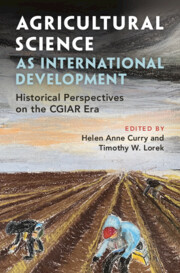
Put differently, once MAP was dissolved in 1961, scientists continued to travel to Mexico to conduct research and undergo training in agricultural science, only now as part of a different program. This program had similar aims but additional funders: the Mexican government (supervised by INIA), the Rockefeller Foundation, the Ford Foundation, and FAO.Footnote 24 Indeed, at CIMMYT’s founding on April 12, 1966, both the Mexican minister of agriculture, Juan Gil Preciado, and Rockefeller Foundation President J. George Harrar conveyed that the new center was in some ways a continuation of nearly twenty-three years of agricultural research between the Rockefeller Foundation and the Mexican government.Footnote 25 The center’s goals were spelled out in that founding document: to conduct basic and applied research, distribute “superior” germplasm, train scientists, foster cooperation among scientists and breeders, and publish and distribute its findings.Footnote 26 Over the following years, these basic aims would be expanded and became, as community needs were considered, both more nuanced and specific (See Figure 4.1).
Attendees of a 1968 international meeting held at CIMMYT, seated before a map of the research facilities in Mexico where its research programs initially were based. Rockefeller Archive Center, Rockefeller Foundation Photographs, CIMMYT Series 105, International Agricultural Meeting.
A Growing Center Reflects and Shapes the World, One Crop Germplasm at a Time
In 1960 MAP’s International Wheat Program began to distribute “international trials” (“ensayos internacionales”) of experimental lines of wheat.Footnote 27 Years later, in 1971, the same would be done for corn by CIMMYT, as Derek Byerlee and Greg Edmeades discuss in Chapter 9, this volume. What did these trials consist of? An international trial was composed of “identical experimental lines” shipped to research partners across the world, who planted these seeds following specific instructions and conditions and later compared them with local varieties.Footnote 28 But the process did not end there. All results were sent back to CIMMYT, where they were analyzed, discussed, later published, and broadly distributed. These international experimental aims were quite clear, as outlined in a CIMMYT publication of the time. In addition to the obvious ones, such as trying out new lines under vastly different climactic, pest, and disease conditions, was the important issue of standardization of the research. The international trials also served to train networked and partner scientists, as well as to obtain the germplasm needed to continue to make new crosses.Footnote 29
Mere months after CIMMYT’s founding in 1966, El Informador, a newspaper based out of Guadalajara, reported on the center’s research-driven mandate at its first meeting. It noted, clearly echoing the message and language of CIMMYT, that the “urgent need” to ensure an increased production of cereals using “modern technology” was a pressing, global one. The article went on to quote a “Rockefeller Foundation representative” as stating that the newly inaugurated CIMMYT would bring together research, experimentation, and training at the “highest levels” to increase maize and wheat yields.Footnote 30 It is worth pausing to explain that news of CIMMYT’s mission was making it to the pages of a regional paper. Even if this article was a reprint from larger newspapers, as was the practice, its inclusion suggests the broad appeal that this news of such a center had in other Mexican states.
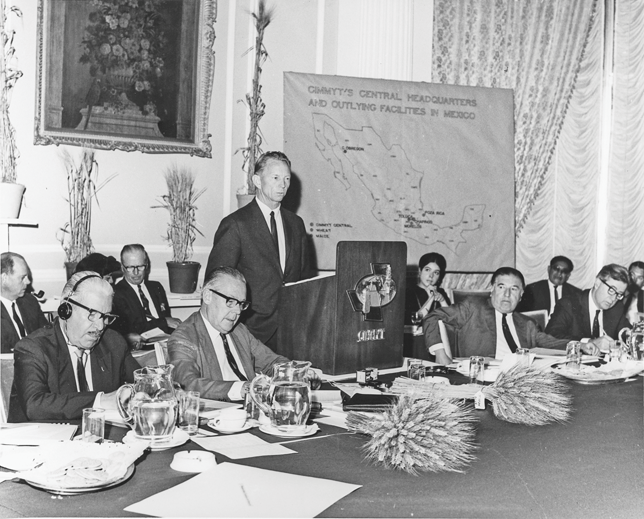
With a vision of further training of young scientists, CIMMYT expanded its training program to include plant pathology, managing research stations, and wheat chemistry. Following the MAP model, foreign researchers travelled to Mexican research stations where both Mexican and international scientists were trained (Figure 4.2). They would return to their home countries with sample seeds and a core training in wheat and corn science.
Wheat trainees inoculate plants at the CIMMYT research station in Toluca, Mexico, undated. CIMMYT repository.
Much of the initial focus of agricultural research centers was on the training of future scientists rather than the dissemination of germplasm directly to farmers.Footnote 31 Yet reports of famines in South Asia served as a catalyst to push for more extensive plant-breeding programs that could stretch from Mexico to farmers around the world. In hindsight, the inauguration of CIMMYT in spring 1966 seemed an auspicious time to launch an international agriculture research institution, given that at the time the spectre of hunger seemed to loom especially large across the ideologically divided Cold War world.Footnote 32 For example, a focus on famines happening in both India and Pakistan revealed that both countries had the lowest wheat yields since World War II.Footnote 33 Researchers believed that overpopulation and the depletion of resources would lead to more human hunger, increased violence, and political instability. In an ideologically separated world this meant potential communist insurrections which would, in turn, risk destabilizing Western societies, in particular the United States. Hence by zeroing in on global hunger, political instability could be averted by using science to increase yields that would, in turn, feed populations and create a more stable world. The globe, it seemed to Rockefeller and Ford Foundation personnel, was primed for an international organization rooted in agricultural science that could help improve crop yields – enough to stave off concerns of an overpopulated world.
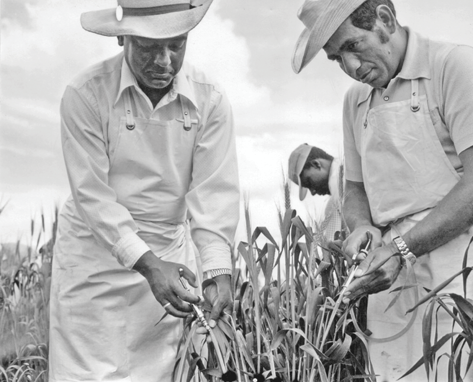
In the fall of 1966 CIMMYT announced that it was broadening its scope via Noticiero del CIMMYT, or CIMMYT News, a bilingual publication available in seventy countries and devoted to detailing the latest scientific advances in wheat and corn research. Reporting on the fall meeting of CIMMYT’s board, the Noticiero announced the board’s apparent decision to fully concentrate CIMMYT’s efforts on maize and wheat.Footnote 34 For the maize program, the center planned to establish projects “in plant breeding, agronomy, genetics and physiology as well as a broadened action for regional programs, such the Central American Cooperative program.”Footnote 35 As for wheat, research projects would also be expanded to include cytogenetics, vital to understand the plant’s cell biology and growth, and “enlargement of the activities of the milling and baking laboratory.”Footnote 36 The latter was especially important to the work of wheat breeding. It was in these laboratories that wheat quality was tested. If a particular wheat variety did not yield flour that would easily rise when baked or did not pass a taste test, then that variety, regardless of rust resistance or other qualities valued in the field, would not be pursued as a successful strain. This work was considered so useful that the Rockefeller Foundation awarded a grant to the Mexican cereals chemist Evangelina Villegas to visit milling and baking laboratories in the United States and CanadaFootnote 37 (Figure 4.3).
The CIMMYT cereal scientist Evangelina Villegas (center) with other researchers and trainees, undated. CIMMYT repository.
The growth of CIMMYT was programmed to be fast. At that same reunion it was proposed that by 1967, a year later, CIMMYT should have 121 technicians, and by 1970 the total would reach at least 189 (by 1973 there were 420 staff positions across the world).Footnote 38 Though headquartered in Mexico, the center’s activities would be “multiplied through cooperative programs in many countries” where CIMMYT personnel would be based. The center would also offer trainees access to graduate education through an agreement with the nearby National School of Agriculture at Chapingo.Footnote 39 Researchers would continue to come, as they had under MAP, to Mexico.
In the early 1970s a key shift occurred when CIMMYT officials realized that it was often difficult for researchers from low-income regions and countries to travel to Mexico. It is uncertain how this realization came about, but to address the concern, the center launched a series of regional training programs. By the end of the decade there were four regionally based maize programs, four wheat ones, and, expanding beyond crop-centered research, four centers focused on regional economies.Footnote 40
Regional centers also allowed for deeper understanding of how local farmers adopted new technologies and new seeds. Within Mexico, one such local model was the Puebla Project, which encompassed 47,000 families, mostly small-plot farmers, with whom CIMMYT researchers worked from 1967 to 1973. The aims of the project were, first, to increase technological transfer to smallholding farmers who relied on rainfed crops, especially maize, and, second, to train technicians from other regions. The lands of the Puebla Valley were selected because there was little irrigation infrastructure, as opposed to what could be found in CIMMYT’s experiment station in Sonora. Also, locals reportedly seemed eager to work with CIMMYT technicians.Footnote 41 With the Puebla Project, CIMMYT provided investment in maize for smallholding subsistence-level farmers. As a scholar noted, a new approach was needed to work with small farmers, especially since “enthusiasm was expressed for any attempt to bring the banking sector into closer contact with groups of producers who had traditionally remained outside their reach.”Footnote 42
The farmers’ socioeconomic environment, which had not been an initial topic of interest for the architects of CIMMYT’s goals, was becoming as important an area of focus as the crops these farmers planted. An additional shift was happening with a more region-centered, bottom-up understanding of agriculture. Yet despite the existence of the Puebla Project, which remained comparatively close to CIMMYT headquarters, CIMMYT was not yet reaching the most remote (often the poorest) farmers within Mexico or abroad. A sharper focus on these farmers would only come later in the century. Meanwhile the germplasm bank and wheat-breeding program, both core to the organization as it exists today, thrived in this era.Footnote 43
At the center’s one-year anniversary, in spring 1967, the president of the board of the Rockefeller Foundation, John D. Rockefeller III, and Rockefeller Foundation President J. George Harrar visited CIMMYT to learn about the ongoing “maize and wheat germplasm and cooperative research.”Footnote 44 During their visit they discovered that Mexican wheat varieties planted in other countries already surpassed the surface area of wheat farming in Mexico, which demonstrated “the wide adaptability and acceptance of these varieties.”Footnote 45 As the historian Marci Baranski shows, along with Harro Maat (Chapter 6, this volume) and others, the push for so-called wide adaptation was vital to the goals of international programs, for it allowed researchers to replicate findings from one location to another.Footnote 46 Though maize research was still important, by 1965 Norman Borlaug and Rockefeller Foundation scientists focused increasingly on wheat breeding and its purported adaptability to most soils. Wide adaptation would become a core tenet of CIMMYT’s research agenda. Phrases such as “exchange of ideas,” “fraternity with a common goal,” and “a collective discussion,” forged the sense of single and singular research community reinforced by the rush to try to feed the world’s hungry.Footnote 47 In the maize program, this communal sense of purpose was most visible in the speed with which CIMMYT’s maize germplasm bank grew. The germplasm bank represented how agricultural research shifted from country-specific aims to global crop centers. For example, by 1974 the maize germplasm bank was already the largest in the world, with more than 12,000 samples from more than 47 countries.Footnote 48 With key breeding resources and connections to long-running training and breeding programs, CIMMYT symbolized Mexico’s long-ascendant centrality to global maize and wheat research. Shortly thereafter CIMMYT expanded its aims once more.
CIMMYT on the Ground
As CIMMYT grew so did the scope of its programs. Here I focus on two examples of CIMMYT’s vast projects, the wheat-breeding program and its training program, to showcase the deep local roots of global technology transfer.
Like the germplasm bank, the wheat-breeding program defined CIMMYT. From its foundation, the international breeding and testing nurseries attracted growing numbers of visiting scientists and trainees. The Bread Wheat Program operated in three Mexican locations: Ciudad Obregón in the arid, irrigated farming region of Sonora; Toluca in the central Mexican highlands; and at the CIMMYT headquarters at El Batán near Mexico City. (Today there are an additional two CIMMYT stations in tropical and subtropical settings: Agua Fría, Puebla, and Tlaltizapán, Morelo.)Footnote 49 The original locations – one at sea level near the Sonoran desert, the other two in rainy regions with high elevation – played a crucial role in experimentation and development of wheat lines with disease resistance.Footnote 50 But CIMMYT experimentation did not and does not now remain limited to these five locations. Taking advantage of Mexico’s extraordinary diversity of microclimates, wheat pathologists, for example, used nurseries across the country to screen for diseases. Meanwhile, breeders used seed multiplication plots to replicate stressors from across the globe. This research geography was and continues to be the lifeline of CIMMYT. It is in these spaces that researchers test new wheat and maize lines, examine the impact of pests and plant diseases, and host farmer workshops.
Genetic materials that survive these varied trials with natural and amplified stressors, such as heat tolerance or difficult tropical soil, have stronger viability in regions across the globe. In 1972 alone, nearly 5,500 crosses were made in bread wheat. But, from experience, less than 1 percent of these crosses would survive the center’s “rigorous screening.”Footnote 51 From generation two (F2) onward, experimental material was sent worldwide where plants’ performance was observed for six generations in different conditions and in competition with local wheats. The most crucial aspect of CIMMYT’s broad infrastructure, beyond its germplasm and experimental stations, was and continues to be the training of plant specialists. Between 1966 and 1988, the wheat improvement program served 471 trainees from 80 developing countries.Footnote 52 The trainee program, open mainly to researchers and extensionists from developing countries under the age of thirty, allowed participants to remain in Mexico from six to eighteen months. Some were later granted scholarships to pursue master’s degrees, usually in Mexico. The range of trainees was broad, from government workers to postdoctoral fellows to visiting, well-established scholars. The benefits of this intergenerational mixing were significant, as program participants learned from each other. Similarly, the practice of working “shoulder to shoulder” engaged everyone in a hands-on approach.Footnote 53
In addition to crop management, this hands-on practice consisted of “designing and managing field plots, choosing parental materials, making crosses … scoring for tolerance and resistance to biotic and abiotic stresses, and selecting improved progeny.”Footnote 54 The numbers of trainees in the first decade are telling. In 1966, there was a total of 22 scholars of all ranks (scholarship recipients, established scientists, temporary residents), but by 1973 there were 739.Footnote 55 The majority of these hailed from Latin America. It is important to recall that scholarships were also key for MAP. The significant increase of twenty-two scholars in the first year of operation to a leap in hundreds of recipients mere years later is likely a reflection of the educational networks in place for two decades.
In 1988, CIMMYT conducted follow-up questionnaires of 324 trainees to evaluate the program’s effectiveness. The survey revealed that 74 percent of respondents worked for their government’s research and extension services, and more than 50 percent continued to work with wheat.Footnote 56 Those who responded to the questionnaire hailed from forty-five countries across Asia, Latin America, North Africa, the Middle East, sub-Saharan Africa, and European countries. In other words, participants represented the global community of crop researchers. The 1988 survey revealed that the vast majority of trainees felt that they had gained something from participating in the program, including improved “plant breeding and plant pathology skills,” and when returning they used “CIMMYT’s methods in their training activity.” The survey did reveal some discontent, and some trainees thought that the courses offered were too elementary, but these tended to be participants with either a doctorate or a master’s degree.
CIMMYT 1975 – Thriving and Overextended
By 1974, the CGIAR network of international agricultural research centers focused on training and providing assistance to governments around the world. From the Philippines, to Nigeria, to Colombia and Peru, to India, to Kenya and Ethiopia, CGIAR leadership created a network of centers devoted to specific crops, livestock, and environments. In this larger circle of interconnected expertise, CIMMYT became the center focused on maize, wheat, barley, and triticale (the hybrid of wheat and rye), and, as such, a sort of scientific pilgrimage site for hundreds of researchers who regularly arrived in Mexico to study and exchange ideas. A decade after its founding, CIMMYT had become firmly established in both national and international agricultural research.Footnote 57 In other words, at this time CIMMYT envisioned itself more as a handmaiden to national projects, an additional research arm supporting domestic research.Footnote 58 In a similar vein, the larger CGIAR mission at this stage was to support national research programs and aid in pushing them to a higher level. Despite the global orientation of the CGIAR system, CIMMYT publications continued to highlight the vast reach that the center maintained in Mexico. With maps and descriptions of the experimental stations in the country, CIMMYT materials emphasized the centralized coordination directed from El Batán, CIMMYT’s headquarters. A detailed map of the central buildings – including dormitories for sixty scholars, baseball diamond, pool, basketball courts, and cafeteria – as well as laboratory and experimentation space, depicted this self-contained space as a sort of international scientific enclave.Footnote 59
The built environment of CIMMYT was examined in a 1974 New York Times article that described El Batán as a “complex of modern buildings surrounded by 160 acres of experimental fields, three dozen agricultural scientists and scores of technicians, most from poor countries … engaged in a major campaign to feed adequately the two billion people” who depended on wheat, corn, and similar crops to survive.Footnote 60 In this and dozens of other articles, it was the promise of science and how it could, if used appropriately, reduce hunger, which imbued CIMMYT with an aura of productive legitimacy. Two months later, after CIMMYT’s participation in the World Food Conference in Rome (November 5–16, 1974), the center received more than twenty-five requests from individual countries seeking to increase food production to meet their populations’ needs.Footnote 61 Despite these numbers, Haldore Hanson, CIMMYT’s director general, turned down the majority of appeals. As he explained, the center’s forty-five scientists were already overextended with consulting work and travel.Footnote 62 This high demand, however, brought about more changes in CIMMYT, especially in how it functioned on a global scale. As Hanson explained to the New York Times, CIMMYT would set up two-member regional teams who would train scientists in their own countries. This effort to reach more farmers had begun earlier when CIMMYT joined CGIAR. This quintupled CIMMY’s research budget from $9 million to more than $48 million in less than four years.Footnote 63 These funds were needed to push the use of high-yielding varieties and extend them to “small farms” across the world.Footnote 64 CGIAR funds also pushed for a reorientation of the organization taking place: production research that more accurately reflected farmers’ needs.
A good example of a “typical” program (granted that all of these programs were unique to their locale) was CIMMYT’s Regional Maize Program for Central America, Panama, and the Caribbean. A 1978 report on the program reveals the vast network of scientists, technicians, government workers, diplomats, farmers, and many intermediaries needed to make it function. The Regional Maize Program was sponsored by the Swiss government with the cooperation of fourteen countries. Modeled on the on-farm approach advocated by CIMMYT, it also included the core philosophy of the international organization: research at experiment stations, research and production of new technologies in farmers’ fields, and demonstrations for technology transfer.Footnote 65 As part of this project, two maize scientists and an economist spent a total of 126 days consulting with ministers of agriculture and directors of national research institutions from nine governments (Costa Rica, El Salvador, Guatemala, Honduras, Nicaragua, Panama, Dominican Republic, Haiti, and Jamaica). Most meetings encouraged the “participation of local maize program leaders and technicians” with the stated aim that “technology generation” happening on farmers’ fields would be more widely accepted.Footnote 66 Vital to this research was the establishment of maize nurseries and the running of experiments. In 1978, alone, a total of 164 experiments produced 9 new experimental varieties to be tested the following year. This research had to navigate differences from country to country and, indeed, between intra-country regions. For example, when it came to seed production, some countries had a “well-organized program” (El Salvador and Guatemala), while others were not developed. Pairing regionally specific characteristics (i.e., husk cover, propensity to ear rot, height of plants, leaf breadth) with desired crop yield was a scientific riddle that relied heavily on research conducted on farmers’ fields.
The Regional Maize Program for Central America, Panama, and the Caribbean revealed that “production technology generated at experiment stations in the region often was not accepted by farmers.”Footnote 67 This was due mainly to the fact that conditions at experiment stations were simply not replicable, and, crucially, the economic risk was not factored into the analysis of which varieties and technologies to propose to small-plot and medium-plot farmers. For instance, a factor that had not previously been examined was the difference between individuals and cooperative groups. The latter could afford the suggested herbicide while individual farmers found it difficult to even find it in local markets.Footnote 68 Working directly on farmers’ plots expanded adoption of technology and led to subsequent yield increases.
Finally, in addition to in-country workshops, the 1978 Regional Maize Program introduced seven production program directors from El Salvador to Mexico’s Poza Rica-Tuxpan, where the maize training program was located. Upon returning to their country these directors held a workshop to showcase what they had learned. This fruitful exchange allowed for knowledge and experience to ripple beyond national borders. This web of interconnected researchers, farmers, and state officials was anchored solely by its connection to CIMMYT. CIMMYT was becoming vital at all levels of regional agriculture development – local leaders, national bureaucrats, regional experts – reaching far beyond the research station.
The focus on “marginal zones,” the buzz word in Mexican politics of the 1970s and 1980s, would trickle down into CIMMYT’s lexicon and influence how the institution approached outreach.Footnote 69 Just as CIMMYT affected Mexico’s framing of farmers’ problems, so too did Mexico impact CIMMYT’s framing of global problems. How, the organization asked, could agricultural advances and technology reach the most remote farmers, those who had not yet benefitted from CIMMYT’s contributions? A greater focus on economic impact began to take shape.
A Global Center
In 1986, Mexican President Miguel de la Madrid presided over CIMMYT’s twentieth anniversary. While some of the themes from the celebration echoed earlier research priorities, the international contributions and expansion of CIMMYT as part of the CGIAR network had emerged as the most critical. Of course, the context of the 1980s in Mexico proved quite different from the decade of CIMMYT’s founding. By 1986, Mexico was in the midst of one of the worst economic crises in its history, and across the globe neoliberal reforms were on the rise. Further, widespread enthusiasm for the first generation of wheat seeds, which had promised to end world hunger in the 1950s and 1960s, gave way to growing critiques that pesticides, excessive fertilizer, and irrigation did more harm than good to small-plot farmers.
In this new era, CIMMYT’s global impact was undeniable. More than 4,000 agricultural scientists from 125 countries had been trained at CIMMYT. The scholarship program had expanded to allow trainees to spend more time in Mexico. And by 1985 CIMMYT had the world’s largest collections of wheat and maize germplasm, with more than 2 million seed packets sent on a yearly basis to nearly 120 countries.Footnote 70
As a major global player facing economic crisis in Mexico, as well as criticism of its results, CIMMYT sought a more transparent accounting of the real costs to implement technological change. As CIMMYT Director General D. L. Winkelmann explained, “it is necessary to combine financial information with biological” research to assess how this knowledge made it on the ground.Footnote 71 In short, though still celebrating advances in plant breeding, there was once again a concerted effort to bring the farmer into greater focus, and to do this more successfully than in the past. This shift reflected a trend in international agricultural research, with a strong focus on more farmer-centered approaches to knowledge and technology development such as the frameworks of farming systems research, Farmer First, and Farmer-back-to-Farmer.
CIMMYT issued a series of publications reflecting this new interest. One example, Gorras y Sombreros – or Baseball Caps and Sombreros – focused on “paths of collaboration between technicians and peasants.”Footnote 72 Taking the example of local knowledge transmission about farming with velvet beans, usually passed on from one generation to the next, CIMMYT organized a series of workshops that brought together state officials, nongovernmental organizations (NGOs), local leaders, and peasants from across southern Mexico and Central America to discuss velvet bean farming techniques as technologies worthy of study by an international organization. The velvet bean was introduced into the United States from Asia at the end of the nineteenth century.Footnote 73 From there it made its way to Central America via the United Fruit Company in the 1920s. The velvet bean had a specific appeal for plantation owners. Interspersed between corn stalks, mature beans could be used as forage for livestock, served as natural fertilizer for cotton or corn, and, if planted with oranges, worked as a natural weed deterrent. Indigenous farmers from southern Mexican states and Guatemala had been using velvet beans for decades. Despite its evident success in the fields, it was displaced by inorganic fertilizers and its use labeled “backward.” By the early 1990s once-disdained practices were revisited, but there was little research on the bean’s characteristics, what little knowledge existed was dispersed, and few, if any, controlled studies had been conducted, certainly not in experimental fields.
The push to bring farmers into conversation with scientists and extensionists became part of a growing trend that elevated local “practices” to the study of science. In the case of recuperating knowledge about the velvet bean, for instance, funds from several organizations were brought together to sustain a frank exchange of knowledge between professional researchers and farmers. Under the auspices of the Ford Foundation, twenty-four representatives from universities, NGOs, and both national and international agricultural programs from eight countries met with farmers. The group was not limited to the region but also included representatives from South America, West Africa, and the Philippines. While a significant focus of the workshop, which was held in Catemaco, Mexico, was research and new extension work on green fertilizers, the event kicked off with visits to two Indigenous communities experimenting with velvet beans in Soteapan and Mecayapan, Veracruz. These community visits served as the framing for the multiday event. Though just an example of a shift in CIMMYT’s practices, the velvet bean meeting represented a growing determination to focus on farmers and the vigorous “exchange of technical knowledge.”Footnote 74
Questionnaires used to query farmers in this period reveal the level of local detail sought by CIMMYT experts. For instance, questions ranged from soil choice to tools used: How do you prepare your soil? In this cornfield, what was planted in the previous season? Why did you choose to use this lot and not another for experimental crops? Although completed questionnaires, if they have survived, remain hidden in the archival record, what is certain is that there was a concerted effort to tally the participation of local, small-plot farmers. Local farmers, for instance, “took control of experiments using simple and easy to understand practices.” This ease could be translated as making the farmer feel comfortable with experimentation by designing trials from previous farming experience. Furthermore, the design of the experiments was done collectively, with all participating farmers agreeing on what it was they sought to understand.Footnote 75 The push for openness and collective spirit was vital to give farmers a sense of control and equal footing with CIMMYT experts – although, as subsequent investigations into farmer participatory research illustrate, critically measuring “participation” is difficult, as is quantifying communication and other human-to-human interactions.Footnote 76
By 1994 CIMMYT had only grown in its dominance as a producer of scientific agricultural knowledge. In that single year CIMMYT staff produced 410 publications on topics ranging from seed quality, to triticale improvement strategies, to disease resistance in Mexican landraces of maize, to networking for sustainable maize farming in Central America, to a traveling workshop on wheat-based sustainability in East Africa.Footnote 77 The institution’s prominence was also evidenced in CIMMYT’s global footprint. As reported by wheat scientist Sanjaya Rajaram, by 1994, 58 percent of the total bread wheat area in developing countries was planted by varieties directly or indirectly derived from CIMMYT germplasm.Footnote 78 In less than three decades, seeds developed in CIMMYT’s experimental stations in Mexico had conquered the wheat fields of the world.
Tying together the themes of germplasm and focus on farmers, CIMMYT and the Mexican government launched a ten-year program known as Sustainable Modernization of Traditional Agriculture (MasAgro) in 2010 with the goal of reaching small-plot farmers, whose rainfed lands had previously been dismissed by agricultural research. In many ways, MasAgro, at least in writing, recalls how agricultural research that directly benefitted farmers was described in the early years of technical assistance – “to augment the productive capacity of small wheat and corn farmers” and guarantee “food security for the world’s growing population.”Footnote 79 Echoes of the original aims more than fifty years later reveal how decades of inputs and focused research projects have not always managed to transform agricultural fields. It is more difficult to change social context (poverty, or unequal land and water distribution, for example) than it is to create experimental plots.
Ten years prior, in 2003, the Mexican government had signed an agreement enabling CIMMYT to continue to function in the country as an international organization with a series of fiscal and judicial benefits reserved for international institutions in good standing and in acknowledgments of the important role that CIMMYT continued to play in the development of agricultural technology in the country. Crucially for its research mission, the agreement declared that seeds destined for CIMMYT research stations would continue to be exempt from Mexican law that prohibited the import of seeds. This latter point may seem obvious, given the nature of CIMMYT’s research, but it also signaled the continued value placed on the ongoing work at the center and by its researchers. Fully 99 percent of CIMMYT’s funding comes from external sources, but the Mexican government continues to provide about $300,000 yearly in addition to the lands and access to the nation’s research stations.Footnote 80
Conclusion
To understand the importance of CIMMYT today – and how we should best tell its history – we should first ask, was CIMMYT a technical assistance program? This depends on whom you ask. For example, in a 1979 hearing before the Subcommittee on International Trade of the Committee on Finance, John Pino, director of agricultural sciences at the Rockefeller Foundation, insisted that this was “no usual technical assistance program. We never, in fact, used that terminology.”Footnote 81 Instead, those involved with CIMMYT preferred to focus on cooperative research and training programs as the goals. This is a vital distinction, because mid-twentieth-century technical assistance in practice, often associated with development aid, frequently disregarded local practices and knowledge. In its initial years, so did CIMMYT. As CIMMYT goals grew to incorporate socioeconomic impacts, its programs also sought to include more farmer participation. Farmers would not simply be passive recipients of information; rather, they became active participants and, as in the case of the velvet beans, vital designers of experiments. It was local farmers who understood the land at a deeper level, and it was farmers who, enmeshed in social networks and unspoken rules, could – and did – affect how science was conducted on the ground. Crucial, then, to the distinction of technical assistance versus an international research program was the role assumed by the Mexican government and Mexican research institutions. CIMMYT was conceived as initially a Mexican program, and in 1966 it embraced and reflected a Mexican nation which, like its president, was seeking to influence the globe, to become a leader in the so-called developing world.
When CIMMYT was incorporated into CGIAR a few years later in 1971, it joined the network of research institutions not as a recent creation but rather as an organization with a history that traces its origins decades earlier to the inauguration of MAP in 1943. These origins matter, for its aims and thus its research agenda reflect a divided world, a product of a post–World War II era, and the role that agricultural science can play in ending world hunger. Since that time, the organization’s breadth and goals have modified to reflect the changing understanding that different actors – scientists, donors, NGOs – hold on food security, agricultural development, and agricultural research.
In 2020, CIMMYT’s website and publications boasted that for more than fifty years it had used science to “make a difference,” defining this as helping “tens of millions of farmers grow more nutritious, resilient and productive maize and wheat cropping systems, using methods that nourish the environment and combat climate change.”Footnote 82 But at its origins, farmers themselves were not the focus of CIMMYT, and instead the driving engine for the organization was crop research, specifically for increased food production, yield, and ensuring a global food supply. In the new context of climate change and renewed calls to again increase crop yields, CIMMYT’s historical adaptability will be put to the test.


 Open access