


EPIC-Soft is a computerised 24 h dietary recall (24-HDR) that has been successfully employed and shown to increase the accuracy of dietary data measurements in international settings( Reference Slimani, Ferrari and Ocke 1 , Reference Slimani, Deharveng and Charrondiere 2 ). EPIC-Soft has been developed and is maintained by the International Agency for Research on Cancer (IARC), currently under use in different international and national studies in Europe( Reference Huybrechts, Casagrande and Nicolas 3 ) and foreseen to be implemented elsewhere. To date, this is the only available software that has been designed to provide standardised individual food consumption data of adults in different European countries( Reference Slimani, Casagrande and Nicolas 4 ).
In EPIC-Soft, common rules are pre-entered into the system to describe, quantify and check automatically about 1500–3000 country-specific foods and 150–450 recipes depending on the EPIC-Soft versions( Reference Slimani, Deharveng and Charrondiere 2 ), resulting in a great level of detail of items reported by subjects in a given study. In particular, the suitability of the EPIC-Soft methodology for applications in epidemiological studies and pan-European food consumption monitoring surveys, where detailed food consumption data are required, has been considered and tested in a number of projects, such as the European Prospective Investigation into Cancer and Nutrition (EPIC) study( Reference Slimani, Bingham and Runswick 5 ), the European Food Consumption Survey Method (EFCOSUM) project( Reference Slimani and Valsta 6 , Reference Brussaard, Lowik and Steingrimsdottir 7 ) and the European Food Consumption Validation (EFCOVAL) project( Reference Slimani, Casagrande and Nicolas 4 , Reference Ocke, Slimani and Brants 8 – Reference de Boer, Slimani and van't Veer 11 ). Furthermore, a data entry version of EPIC-Soft to be used with food records in children has been developed and positively evaluated within the PANCAKE (Pilot study for Assessment of Nutrient Intake and Food Consumption Among Kids in Europe) project. Currently, EPIC-Soft is also being tested in the preparatory and piloting phases of the European food consumption survey (i.e. PANEU; Pilot study in the view of a pan-European dietary survey–Adolescents, adults and elderly) supported by the European Food Safety Authority and European member states. In addition to these, multidisciplinary expert advice has always been considered during the further development and optimisation of EPIC-Soft, including advice from study coordinators, dietitians and data managers.
The use of new technologies, such as those applied in the computerised versions of 24-HDR, has allowed the development of more cost-effective and less-laborious instruments in the last few decades( Reference Illner, Freisling and Boeing 12 ), prompting the enhancement of dietary assessment and consequently improving the overall quality of data. This has been specifically done by identifying all the potential sources of errors involved in the collection of data and then attempting to minimise them in computerised methodologies. Based on this view, a series of rules have been implemented in EPIC-Soft to maximise the quality of dietary data within and between countries, which are based on a comprehensive concept of standardisation and identification of possible sources of errors( Reference Slimani, Ferrari and Ocke 1 , Reference Slimani, Deharveng and Charrondiere 2 ).
Yet, all the quality control elements employed by EPIC-Soft are not always obvious to their end-users, and a complete characterisation and an evaluation of the quality controls implemented in the method are still lacking. As awareness of the quality controls implemented in this international reference tool is important in understanding how the accuracy and between-country comparability of the related dietary measurements have been optimised, the present paper aims to report in detail and exemplify these quality controls as an integrated part of the whole concept of standardisation of the EPIC-Soft methodology.
Overview of quality controls
The EPIC-Soft program
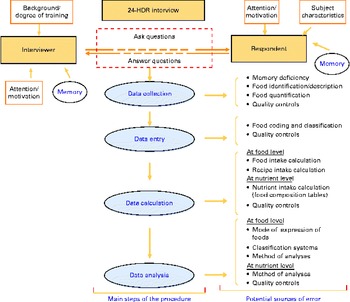
The structure and standardisation of EPIC-Soft have been described in detail elsewhere( Reference Slimani, Ferrari and Ocke 1 , Reference Slimani, Deharveng and Charrondiere 2 ). It consists of an interview-based 24-HDR that systematically follows standardised steps when describing, quantifying, probing and calculating dietary intake. Furthermore, EPIC-Soft was conceptually developed based on an error model, which assumed that the collection, management and analysis of data can introduce random and systematic errors (Fig. 1), due to factors such as memory, background of the interviewer, and motivation of the interviewer and participants, among others( Reference Slimani, Ferrari and Ocke 1 ). Consequently, potential sources of errors were identified in order to try to prevent or minimise them when developing and using the EPIC-Soft methodology.
Error model of the 24 h dietary recall (24-HDR) interview method (adapted from Slimani et al. ( Reference Slimani, Ferrari and Ocke 1 )). (A colour version of this figure can be found online at http://www.journals.cambridge.org/bjn).
Applied quality controls
Quality controls implemented in EPIC-Soft include all the steps of fieldwork preparation, data collection, data entry, data calculation and data analysis and are, to a large extent, built on the basis of the EPIC-Soft error model described previously. An exhaustive list was generated to describe each quality control aspect in three distinct phases: (1) before, (2) during and (3) after the dietary interviews. Each aspect identified in these three phases is described in detail in what follows and summarised in Table 1.
Overview of quality controls used in EPIC-Soft
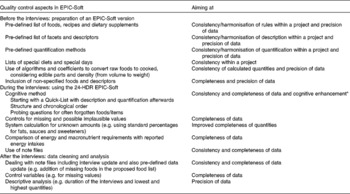
24-HDR, 24 h dietary recall.
* Of the interviewee and interviewer.
Phase 1 – before data collection: preparation of an EPIC-Soft version
Quality controls are implemented before the 24-HDR interviews to ensure the consistency and harmonisation of the data to be collected, namely during the preparation of about seventy interrelated files (i.e. databases such as the food and recipe lists) constituting an EPIC-Soft version. Some of these databases are common across countries and others are country specific. In addition, controls employed in EPIC-Soft at this phase manage the level of detail to be collected during the dietary interviews. Aiming at fully operational and standardised EPIC-Soft versions, these controls include the following:
Pre-defined and coded lists of foods, recipes and dietary supplements
Each country-specific version of EPIC-Soft contains pre-defined lists of foods, recipes and dietary supplements. This approach favours the standardisation of the collected data because it requires the interviewers to use the pre-entered list as an entry point in the system, enhancing food coding. New items can be temporarily entered into the system if not found in the list. These items are then automatically flagged to be subsequently checked and possibly added to the fixed lists of foods, recipes or dietary supplements.
Pre-defined and coded lists of facets and descriptors
Facets and descriptors are used to describe dietary items (i.e. foods, recipes and dietary supplements) in more detail in EPIC-Soft. Facets characterise different aspects of the dietary item such as the cooking method used, brand name and preservation method. Descriptors are pre-defined answers for the facets, e.g. grilled, fried or boiled for the facet ‘cooking method’. The available lists of facets and descriptors within each food group are the same across countries in a given project and only applicable facets and descriptors are asked for a given food or recipe (e.g. facet ‘skin consumed’ will be asked for some fruits such as apple, while it will not be asked for other fruits such as pineapple). Furthermore, the same rules regarding food names and facet descriptors are normally used for different countries in a given project. In other words, if it is decided in a project that a certain description of the food should be given in the name (e.g. fortified foods: milk, Ca enriched) rather than asked via facets and descriptors (facet enriched/fortified), it will be done for all the countries in the same manner. The goal is that all interviewees provide the same detail of food information across the different countries in a given project, either implicitly through the name or explicitly by the use of facets and descriptors.
Pre-defined quantification methods
To quantify food portion sizes within EPIC-Soft, several methods can be used. Foods may be estimated with the help of household measures (e.g. a cup of tea). Foods that are consumed as more or less standard units can be counted as such (e.g. one apple or one can of beans). Other foods that are difficult to quantify by these two methods can be quantified by more visual methods, such as food shapes or photos. If the exact volume or weight of the consumed food is known, it can also be entered directly into the system. All databases containing these pre-defined quantification data are prepared following standardised reference guidelines, aiming to ensure that these data are comparable across countries and warranting the best possible collection of food consumption data.
Lists of special diets and special days
At the beginning of the 24-HDR interviews, interviewees are asked whether the diet that they will report refers to a special day (e.g. religious holiday, trip or celebration of a birthday) or to a special diet (e.g. for hypertension or for obesity). The actual information contained in these databases is agreed upon beforehand among the countries participating in a given project and is particularly important for an appropriate evaluation of the data, e.g. to explain unusual food intake on the recalled day, assisting the interviewers during the 24-HDR interviews, and/or to justify potential outlier values during the data analysis.
Use of common algorithms and related coefficients
Common algorithms with conversion factors are implemented in EPIC-Soft to systematically convert the amounts of reported foods or recipes to their net quantity consumed, e.g. cooked without edible part. Accordingly, country- and food-specific coefficients were used to change from volume to weight, from raw to cooked, and from foods with to foods without inedible parts, considering fat absorption during cooking and leftovers in the plate (for sauces and oils), are automatically used by the software whenever needed. Algorithms for estimating unknown amounts of consumed fats, sauces and sweeteners are also implemented (see the section ‘Controls for missing and implausible values’ for details).
Non-specified generic dietary items and descriptors
Some dietary items and descriptors are named and pre-coded as ‘non-specified’ (n.s.) so that they could be used during the interviews to avoid arbitrary decisions made by the interviewees or interviewers, e.g. meat n.s when the respondent does not know the type of meat consumed. Moreover, these generic items (‘non-specified’) may be displayed at the bottom of the lists to avoid overuse by interviewers who are unable to immediately find the exact match; this is a project/country-specific choice.
Although not mandatory, it is also possible to upload pre-entered lists of subjects in EPIC-Soft in order to avoid typing errors and misidentification of subjects in a given study (also see the section ‘Structure and chronological order of food consumption occasions’ for the pre-definition of meal occasions applied during the interviews, but actually prepared before the start of the fieldwork).
Phase 2 – during the interviews: when using the 24 h dietary recall EPIC-Soft
Quality controls are implemented during the 24-HDR interviews to ensure the consistency and completeness of the collected data. There are a number of controls used during the interviews, which are built into the system and are described below. One of the key quality controls used in EPIC-Soft is the cognitive approach applied during the interviews.
Use of a cognitive approach
EPIC-Soft makes use of a stepwise approach to recall the food consumption information. It starts by first defining the recall period by asking for the wake-up time of the previous day and the day of the recall administration, as the recall will then ask for all foods and drinks consumed between these two time points. Although it is generalised that the name ‘24-HDR’ suggests a recall period of 24 h, the recall period of each subject in EPIC-Soft might be more or less than 24 h depending on the subject's times of waking up on the previous day and the day of the recall administration. This procedure was chosen instead of the time period from midnight to midnight to facilitate memory retrieval during the interviews. The 24-HDR basically aims to capture the diet of a full day and night, while the start and the end time of the recall period is subject specific. In the EPIC study, a posteriori verification indicated that the mean time interval is always about 24 h whatever be the centre or country under study( Reference Slimani, Kaaks and Ferrari 13 ).
Subsequently, EPIC-Soft uses a Quick-List (QL) – an open field – in which the interviewees are asked to remember all the foods and recipes eaten at each meal during the previous day in lay language and in chronological order organised by food consumption occasions, as described previously by Slimani et al. ( Reference Slimani, Deharveng and Charrondiere 2 ). The main characteristic of the QL is the use of a non-directive interview. Only after this QL is established, the interviewees are asked to systematically describe and quantify in more detail each of the consumed foods/recipes. This cognitive approach is derived from previous studies( 14 , Reference Feskanich, Sielaff and Chong 15 ), which have shown that interviewees have less difficulty in recalling all of what they had eaten if they are not asked to describe and quantify the foods at the same time. The rationale behind using this approach is to avoid interruptions in the memory retrieval mechanism and loss of concentration due to the details required for the subsequent questions on the description/quantification of the foods consumed. For instance, if a subject reports to have consumed pizza for dinner, the interviewer should allow the interviewee to recall all the other foods consumed during that occasion, rather than start asking all sorts of questions about the type of pizza (e.g. homemade or commercial, cooking method, ingredients on it, and how many slices have been consumed), which is handled in the second step of EPIC-Soft recall. Furthermore, the US tool developed by Feskanich et al. ( Reference Feskanich, Sielaff and Chong 15 ) in the late 1980 s was used to derive the concept of the QL in EPIC-Soft between 1992 and 1994. This concept resembles the one used with the ‘Automated Multiple Pass Method’, but it differs from it in its overall structure, which aims to facilitate the standardisation and level of detail captured within and between countries.
Structure and chronological order of food consumption occasions
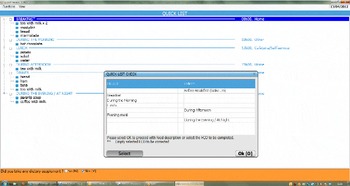
To standardise cognitive memory aids across countries, the QL used in EPIC-Soft is divided into common food consumption occasions during the day (i.e. meals or between meals food consumption occasions). Food consumption occasions are project specific, e.g. ‘before breakfast’, ‘breakfast’, ‘during the morning’, ‘lunch’, ‘during the afternoon’, ‘evening meal’ and ‘during the evening/at night’. By standardising this part of the interview procedure, consumption during the entire day is covered. In addition, a check is performed at the end of the QL, where a summary of the individual's meal pattern is displayed for the interviewer only, to verify whether a food consumption occasion has not been omitted mistakenly. This is done by confirming with the interviewee what the reported meal occasions that occurred during the recall period were rather than the ones that he/she may have skipped, so that this does not lead to over-reporting. Moreover, the correct use of this check is emphasised to the interviewers during EPIC-Soft training.
Fig. 2 shows an illustration of the QL and the food consumption occasions.
Illustration of Quick-List and food consumption occasions with check in EPIC-Soft. (A colour version of this figure can be found online at http://www.journals.cambridge.org/bjn).
Probes for often forgotten foods
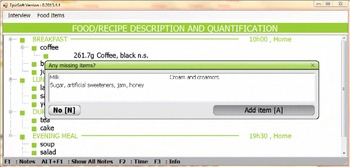
To assist the interviewers in performing the 24-HDR as well as to help the interviewees in remembering and reporting what has been consumed the previous day, country-specific probes are displayed before and after each food consumption occasion prompt on the QL screen. For example, drinks, biscuits, cakes, chocolate/sweets and fruits can be used as probes for the occasion ‘during the morning’. Another type of probing implemented in EPIC-Soft is done during the description and quantification of certain foods and recipes. For instance, when a subject reports to have drank coffee during breakfast, a probing question for missing items such as milk, sugar and sweeteners pops up on the screen (see Fig. 3).
Example of a probing question for missing items such as milk, sugar and sweeteners when coffee consumption is reported. (A colour version of this figure can be found online at http://www.journals.cambridge.org/bjn).
Handling of recipes during the interviews
It is worth noting that recipes in EPIC-Soft are always broken down into ingredients (pre-coded as foods in the country food list). These ingredients are displayed as a proportion (%) of the total recipe together with its corresponding quantity in grams as consumed. The quantity as consumed can be either ‘cooked’ or ‘raw’, depending on the food ingredient. When subjects are not able to describe the recipe in detail, a ‘standard recipe’ can be selected from the pre-entered country-specific list, which should be as close as possible to what the subjects had consumed. For that purpose, some ingredients in these standard recipes can be substituted if subjects can provide more specific qualitative information on the real ingredient consumed (new ingredient or re-described actual ingredient, e.g. type of fat, liquid and meat/fish used). For some recipes, ingredients may be deleted or added to the subject portion; subjects can report added ingredient quantities either as ‘raw’ or as ‘cooked’. If the recipe is known, subjects may enter the ingredient quantities as they wish (raw or cooked). Raw-to-cooked coefficients will be applied when available and appropriate for the food ingredient.
Controls for missing and implausible values
At different steps of the EPIC-Soft interview, the system will automatically check for empty fields or out-of-range values, resulting in a warning message on the screen. Nevertheless, these warning messages are item specific and are not necessarily wrong, but have to be confirmed to double-check the correctness of the reported data. A few examples of these are as follows: (1) missing indication of having or not a ‘special day’ or ‘special diet’; (2) height or weight of the subject (used for estimating energy requirements), which are out of the pre-defined expected country-specific ranges; (3) any quantity estimates exceeding the maximum value defined for a certain food/recipe, such as ‘Milk in powder’, which can be easily mis-quantified when estimating its quantity in the reconstituted liquid form instead of in the powder form.
System calculation for unknown amounts
When an individual is unable to report the portion size of a consumed dietary item, the unknown portion option, identified with ‘?’, can be selected during the interview; this will be automatically tracked by the system, thus warning that the quantity is considered missing. For some foods that are added in small quantities (e.g. grated cheese on pasta or nuts on ice cream), pre-defined standard amounts may be applied to prevent missing quantities. For fats used during cooking, the system automatically calculates the amounts of fats using standard percentages. In addition, for fats, sauces and sweeteners added to foods/dishes, their missing quantities are automatically replaced by amounts that are calculated using standard percentages. These percentages are based on the weight of the individual consumed food/recipe portions. Furthermore, all these ‘estimated quantities’ are tracked by the system and can be replaced later on by more recent and accurate values, if needed, e.g., by changing standard percentages.
Comparison of energy and macronutrient requirements with reported energy intakes
The energy and macronutrient intakes calculated by EPIC-Soft are compared with standard requirements. For energy, this is based on the subject's age, sex, weight and height( Reference Schofield 16 ). For macronutrients, the comparison is made on their contribution as percentages of total energy in contrast to pre-defined cut-off points, which can be modified at any time according to the countries' requirements (e.g. 65 % as an upper limit to indicate excessive carbohydrate intake).
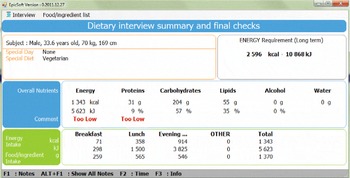
Even though a single 24-HDR is not enough to accurately estimate the usual intake of an individual and the food composition data used in EPIC-Soft are considered preliminary, this check allows the interviewer to identify possible errors entered during the interview (e.g. if fat intake during a certain meal seems to be extremely high, it could be due to a typing error, for instance, if 100 g instead of 10 g butter is entered). When the interviewer has any doubt about the correctness of a particular part of the 24-HDR, he/she can always return to that part of the interview and double-check the entries while the interviewee is still present (see Fig. 4).
Dietary interview summary with final suggested checks on energy and macronutrient intakes in EPIC-Soft. (A colour version of this figure can be found online at http://www.journals.cambridge.org/bjn).
Use of ‘note files’
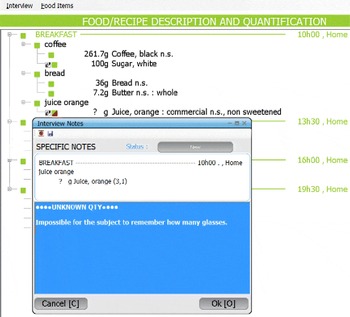
Note files are a special feature of EPIC-Soft. These are notes that can be generated either automatically by the system or added manually as free text by the interviewer at any time during the interview and stored in a specific table for later use (see Fig. 5). For example, notes are generated
-
(1) if a dietary item is reported with unknown quantity (automatic note);
-
(2) if a new dietary item is created (automatic note);
-
(3) if a subject gives more information about a special eating day; for example, a subject reported to visit relatives who are vegetarians thus exceptionally did not eat meat that day (manual note);
-
(4) if a subject reports that a dietary item was bought in store ‘X’ (manual note); this information may be helpful to retrieve certain specifications (e.g. nutrient values of the product);
-
(5) if the interviewer is doubtful about any of the recalled information (manual note), e.g. the recalled weight of the subject.
Example of a note file generated during the EPIC-Soft interview. (A colour version of this figure can be found online at http://www.journals.cambridge.org/bjn).
Furthermore, the sequence of steps for the interview procedure (identification, description, quantification and checks using probing questions) remains the same whatever be the pathway (food, recipe or dietary supplement) used during the interview. Additionally, it is imperative that during the recall the interviewee does not see the EPIC-Soft screen in order to not suggest answers or influence his/her memory recall in any way. Moreover, leading questions should always be avoided during the interviews, a topic extensively covered during EPIC-Soft training.
Phase 3 – after the interviews: data cleaning and analysis
After the interviews, a series of controls can be applied by dietitians and/or data managers to further guarantee data quality, which is usually done at the coordinating centre. These controls can be subdivided into two steps, within and after the use of the Interview Manager application (Interview Manager is an upcoming application, outside EPIC-Soft, that allows dietitians and data managers to manage the interviews/records collected by EPIC-Soft, including load, backup, notes management, export and others; before the development of the Interview Manager application, the management of notes was done with electronic tables (such as in Microsoft Excel)).
Step 1: Controls within the use of the Interview Manager application include the quality control of note files generated during the interviews as well as a check with the so-called Recompute programme (see the section ‘Recompute programme’):
Dealing with the ‘note files’
Once interview data are collected, a dietitian needs to go through all the notes generated during an interview and correct/amend them if necessary. This might involve updating the EPIC-Soft databases. For instance, if a new food was created, the dietitian will have to verify whether there is a need to update the food list with the new food and, in that case, would have to assign a new status to the note, such as ‘Action Done’. Other action examples are as follows: ‘Ongoing’; ‘No action needed’; ‘Action approved by coordinator’.
Recompute programme
This is an additional EPIC-Soft tool that was developed to automatically recalculate the individual food intakes collected with the 24-HDR according to the latest modifications made to the EPIC-Soft databases (e.g. food standard unit and raw-to-cooked coefficient files).
Step 2: After the use of Interview Manager, once the interview data are ‘cleaned’ (without attached blocking notes), they can be exported for data analyses, which may include extra controls to reaffirm data quality. This is normally carried out at the project level. To help such extra controls of data quality, EPIC-Soft generates a number of variables:
Control variables item ‘Status’ and ‘Max’
Control variables item ‘Status’ and ‘Max’ in the main interview file that is exported from EPIC-Soft: every dietary item reported during the 24-HDR interview receives a status regarding its description and quantification; the variable ‘Status’ should be equal to ‘1’ in the dataset. If empty, this means that the dietary item was not described and quantified; and if its value is equal to ‘2’, then the item was described but not quantified. Normally, there should not be dietary items without description and/or quantification after all notes have been dealt with in Interview Manager. Nevertheless, this is a means of checking that the interview data and notes have been properly dealt with and exported correctly.
Moreover, the variable ‘Max’ indicates whether the maximum value set for the food or recipe was exceeded (0 = No and 1 = Yes). These values reflect the same warning messages shown during the interviews, when the interviewers were asked to confirm whether a value was possibly implausible (as described in the section ‘Handling of recipes during the interviews’).
Descriptive analyses
A number of variables can be easily analysed and are readily available after export from Interview Manager to evaluate the quality of 24-HDR data applications. The following variables are often used as quality control indicators: duration of the interviews (total and by interviewers); number of recalls by day of the week; number of reported foods and recipes per subject; number of generic items used; use of facets/descriptors (unknown v. specific description); quantification methods used; number of weeks between 24-HDR; 24 h recall duration (number of hours of the reported days); highest and lowest energy intakes and amounts in grams of foods and recipes in each food group. Furthermore, the estimated energy intakes and energy requirements can be further compared using an empirical physiological assumption, such as the Goldberg cut-off points( Reference Black 17 , Reference Goldberg, Black and Jebb 18 ). When this is done during a feasibility study, all these descriptions enable to check whether the interviewers behave in similar ways, i.e. whether the training has been efficient.
Discussion
In the present paper, we have given a detailed overview of quality controls implemented in EPIC-Soft. As has been described, these include a series of quality controls incorporated before, during and after data collection, i.e. at different steps of data collection/processing, including the preparation and maintenance of the common and country-specific databases constituting a country version of the software. These comprehensive quality controls, not always visible to the users, are an integrated part of the standardisation concept and contribute to the improvement of the accuracy, completeness and comparability of the collected data, as demonstrated in a series of validation studies conducted particularly in international study settings( Reference Slimani, Bingham and Runswick 5 , Reference Crispim, de Vries and Geelen 9 – Reference de Boer, Slimani and van't Veer 11 ). For example, the most recent validation study using recent EPIC-Soft versions in five European centres has shown that the underestimation of protein and K intakes and the variability of biases across centres are relatively low. For protein intake, the underestimation has been reported to be, on average, 8 % in both the sexes, and for K intake, 7 % for men and 4 % for women have been reported( Reference Crispim, de Vries and Geelen 9 , Reference Crispim, Geelen and de Vries 10 ). Although differences in the methodology described in the present paper and previously published ones prevent us from making straightforward comparisons, the biases in protein and K intakes observed in the validation of EPIC-Soft are alike or smaller than those presented in the literature so far( Reference Slimani, Bingham and Runswick 5 , Reference Subar, Kipnis and Troiano 19 – Reference Bingham and Day 23 ).
Even though it is intrinsically difficult to disentangle the actual contribution to the accuracy of each individual quality control implemented in EPIC-Soft, the particular attention given to identify and prevent the different sources of measurement errors depicted in our error model seems to have contributed to the minimisation of their impact on the total net error, with consistent results across different validation studies conducted, making the results quite independent from study populations and other logistics.
While for some of the quality controls (e.g. controlling for out-of-range values), the expected improvement of data accuracy is more forthright, for others, such as the automatic calculations and the use of note files, the contribution of the quality controls is less evident but still very important (e.g. to improve the quality of data cleaning). It is also necessary to mention that although the consistent calculation of food quantities using common algorithms contributes to the standardisation of EPIC-Soft results within and between countries, the precision of coefficients (raw-to-cooked, edible part and density) used for such automatic ‘corrections’ remains unclear. From our experience in compiling these coefficients, it seems that there is a critical lack of standard, reliable and food-specific coefficients available in Europe. Ocke et al. ( Reference Ocke, Slimani and Brants 8 ) suggested that the quality and transparency of databases containing these coefficients could be improved by systematic documentation of the sources and the information regarding the quality of the values. Although these imprecise measurements might be seen as sources of random or systematic errors, these constant variables can at any moment be replaced by more reliable values and the individual consumption data be recalculated, using the Recompute programme.
It could be questioned whether standardisation indeed minimises or prevents measurement errors, as it has been assumed in many areas of research. In the field of social sciences, standardisation of interviews has been criticised with the idea that it may prevent the interviewers from resolving certain respondent misunderstandings and, as a result, actually increase measurement errors( Reference Suchman and Jordan 24 – Reference Schober and Conrad 26 ). A possible reason for this increase in measurement errors is presumed to be that the same question could be interpreted differently by different interviewees, suggesting that a flexible interview by means of conversation could reveal more accurate information than strictly standardised questioning. Since the application of EPIC-Soft allows the use of ‘conversational interviewing’ (including the use of the free text ‘notes’) and the overall observed biases in intake are not large( Reference Crispim, de Vries and Geelen 9 , Reference Crispim, Geelen and de Vries 10 ), we suggest that this is not the case for this computerised 24-HDR. Moreover, because participants are instructed and guided to remain focused on the interview, errors associated with leading the participants to answers in ‘conversational interviewing’ are expected to be prevented. Nevertheless, future studies in this area are warranted.
Other commonly known 24-HDR, which to some extent are similar to the automatisation of dietary intake collection in EPIC-Soft, include the Automated Multiple Pass Method used in nutritional monitoring surveys in the USA and Canada( Reference Moshfegh, Rhodes and Baer 27 , Reference Raper, Perloff and Ingwersen 28 ). Similarly, ‘YANA-C’ (Young adolescents' nutrition assessment on computer)( Reference Vereecken, Covents and Sichert-Hellert 29 ) and ‘SACINA’ (Self-administered Children and Infants Nutritional Assessment)( 30 ) are methods used, respectively, for adolescents and children in Europe. No formal comparisons between EPIC-Soft and these other systems have been made thus far, although work is under development via European projects supported by the European Food Safety Authority. Nevertheless, EPIC-Soft has been developed with a different purpose compared with the other 24-HDR, i.e. to be used at the international level and taking into account different constraints that have originated from comparisons between countries (e.g. comparability of values). To our knowledge, EPIC-Soft is the only method designed for collecting and supporting the standardisation of individual food consumption data of adults across different countries. To date, the method has been adapted in eighteen European versions for use in both monitoring (e.g. national/regional monitoring surveys) and epidemiological studies (e.g. EPIC).
Additional developments for improving the quality assurance of the 24-HDR EPIC-Soft could include regular quality checks of data during their collection (i.e. descriptive analysis of the collected data at different moments of the fieldwork) and audio-recording of interviews to randomly choose some interview data. Once a new EPIC-Soft version is available, it is advised that a feasibility/pilot study or a short trial be carried out to field-test the EPIC-Soft version and to check the sufficiency of the interviewers' training. Similarly, additional training during the fieldwork may be required, depending on the quality check of descriptive indicators during the study. Future studies to evaluate the applicability of all the quality control aspects of the EPIC-Soft methodology, especially the note files and the use of non-specified dietary items and descriptors, are also encouraged.
In conclusion, quality controls applied in EPIC-Soft are not always apparent, but well implemented with the purpose of preventing or minimising errors in the collected dietary data. The EPIC-Soft system also enables more efficient post-quality controls, as datasets are structured and contain key variables to support these quality controls. Above all, once all the quality controls have been performed, the very detailed dietary data that have been collected through EPIC-Soft are standardised and cleaned in a way that they can be easily analysed and especially easily combined between studies at different levels (i.e. regional, national and international). Furthermore, the international web-research infrastructure currently under development at the IARC, the so-called e-standardised methodological platform (e-SMP), which aims to support the dissemination, use and maintenance of these international dietary tools, should provide additional opportunities to improve the overall data harmonisation and quality controls, with the use of new technologies, e-trainings and more cost-effective procedures as well as applications relevant for international study settings.
Acknowledgements
No financial support was provided for this work.
S. P. C. wrote the paper, in close supervision by N. S. and taking into account comments from all co-authors (G. N., C. C., V. K., A.-K. I., I. H. and N. S.)
None of the other authors had a conflict of interest.



