



Parenting behaviours that respond to children’s food requests at the grocery store may provide important information for the development of nutrition programmes to promote children’s healthy eating habits. Child participation in family food shopping facilitates their food consumer socialization experiences and introduces them to the retail food environment( Reference Gram 1 , Reference Marshall 2 ). Parents, peers and the media are the main consumer socialization agents of children( Reference Ward 3 ). Children aged 2–7 years make more food purchase requests than do older children( Reference Calderon, Ayala and Elder 4 , Reference Buijzen and Valkenburg 5 ). This characteristic, coupled with the amount of time children spend with their caregivers in grocery stores( Reference Sandberg and Hofferth 6 , Reference Hofferth 7 ), creates an opportunity for caregivers to model healthy food selection( Reference O’Dougherty, Story and Stang 8 ).
Pester power, ‘a child’s attempt to exert control over a purchase situation as a simple battle of wills (between children and parents)’( Reference Nicholls and Cullen 9 ), is one of the most successful strategies children use to influence parent purchases( Reference Nicholls and Cullen 9 ). Usually, children request unhealthy, highly marketed foods (i.e. prepared meals, sweets), not healthy options, such as fruits and vegetables (F&V)( Reference Nørgaard, Bruns and Christensen 10 ). Marketing nutrient-poor foods to children influences obesity-related dietary behaviours( 11 , Reference Sonntag, Schneider and Mdege 12 ).
Parental feeding practices influence children’s health outcomes (i.e. food intake, weight)( Reference Wardle, Carnell and Cooke 13 – Reference Tschann, Martinez and Penilla 17 ). Use of food as a reward( Reference Anez, Remington and Wardle 18 ) and food for emotion regulation( Reference Wardle, Sanderson and Guthrie 19 ) may cause children to rely on external cues, hinder their ability to self-regulate food intake( Reference Fisher and Birch 20 ), and have been inconsistently associated with child weight( Reference Rodgers, Paxton and Massey 21 , Reference Carnell and Wardle 22 ). Food to control behaviour is commonly used with children of various ages and in different settings (i.e. home, school)( Reference De Decker, Sioen and Verbeken 23 – Reference Lu, Tao and Hou 27 ). Modelling of healthy eating, in which parents purposely demonstrate eating behaviours and food choices to encourage similar behaviours( Reference Vaughn, Ward and Fisher 28 ), is positively associated with children’s intake of healthy foods( Reference Tibbs, Haire-Joshu and Schechtman 29 , Reference Campbell, Crawford and Ball 30 ). Except for two studies that reported associations of parental dimensions of feeding styles with children’s influence on beverage purchases( Reference Lora, Hubbs-Tait and Guzman 31 ) or parenting styles in relation to the healthfulness of parent–child food choices in grocery stores( Reference Lucas-Thompson, Graham and Ullrich 32 ), most research into parental food socialization behaviours has been conducted in the home.
Examining parental feeding practices that may be associated with parents’ purchases of highly marketed, nutrient-poor foods or low-marketed, nutrient-dense foods that children request when they co-shop together may be a route to explore understudied factors that influence children’s eating behaviours. The present study’s purpose was to assess the relationships of mothers’ use of food for emotion regulation, food as a reward and modelling of healthy eating with mothers’ self-reported willingness (i.e. intentions) to purchase nutrient-poor marketed foods and nutrient-dense foods (F&V) requested by their 2- to- 7-year-old children during grocery co-shopping. We assessed differences between mothers with above-the-median v. at-or-below-the-median scores of self-reported feeding practices regarding frequency of willingness to purchase child-requested foods.
Methods
Study design and setting
Data for the current cross-sectional study were collected through an online survey administered using Qualtrics™. Participants were mothers of 2- to 7-year-old children (n 318). The University of Oklahoma Health Sciences Center Institutional Review Board approved the protocol.
Procedure and measures
The online survey included questions about mother and child demographics, family characteristics, feeding practices and mothers’ willingness to purchase child-requested foods during grocery co-shopping. Willingness is ‘an individual’s openness to opportunity, that is, his or her willingness to perform a certain behaviour in situations that are conducive to the behaviour’( Reference Pomery, Gibbons and Reis-Bergan 33 ). Willingness is an alternative form of behavioural intentions( Reference Ajzen and Fishbein 34 , Reference Fishbein 35 ), tends to be highly correlated with intentions( Reference Pomery, Gibbons and Reis-Bergan 33 , Reference Gerrard, Gibbons and Houlihan 36 ) and has effectively predicted health behaviours( Reference Gibbons, Gerrard and Lane 37 , Reference Gerrard, Gibbons and Brody 38 ). Additionally, participants reported the frequency their child (i) went grocery shopping and (ii) made a food request during a grocery shopping trip in the past 30 d.
Mothers’ feeding practices
Emotion regulation, food as a reward and modelling of healthy eating were assessed using the Comprehensive Feeding Practices Questionnaire( Reference Musher-Eizenman and Holub 39 ). Response options were structured in a 5-point Likert-type scale, as follows: food for emotion regulation from ‘never’ to ‘always’; and food as a reward and modelling from ‘disagree’ to ‘agree’. Composite scores for each of the three feeding practices were computed by averaging their item values.
Frequency of mothers’ willingness to purchase child-requested foods
Mothers responded to the hypothetical scenario: ‘If your 2- to 7-year-old child would ask you to buy these foods when grocery shopping together, how often do you buy them?’ Response options to the question were structured on a 5-point Likert scale with word anchors from ‘never’ (=1) to ‘always’ (=5). Mothers provided responses to a list of twenty-four items. Pictorial examples for each food item were provided. Foods were then categorized into nutrient-dense (e.g. F&V) and nutrient-poor (e.g. carbonated beverages) based on nutrient information provided by the manufacturer’s Nutrition Facts label (see online supplementary material, Supplemental Table 1).
Characteristics of the sample of mothers, and their 2- to 7-year-old children, who completed an online survey generated at a public university in the USA (n 318)
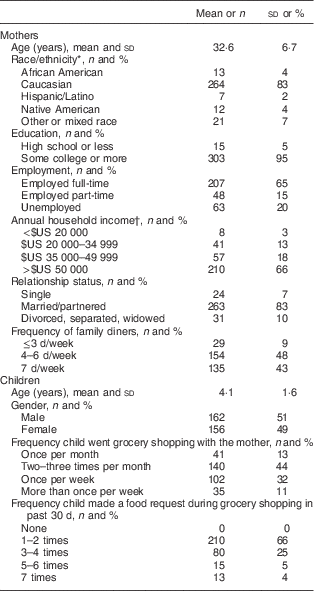
* Information not reported for one participant.
† Information not reported for two participants.
Data analyses
For each of the three feeding practices (use of food as a reward, use of food for emotion regulation, modelling of healthy eating), participants were separately categorized according to that practice’s median composite score. Groups (those with scores above-the-median and those with scores at-or-below-the-median) were compared on the frequency with which they described their willingness to purchase food items requested by a child. Between-group comparisons were assessed first using non-parametric permutation tests and then in multivariable regression models. Multivariable models adjusted for potential confounders (mother’s age, employment status, education, child’s age, household income, frequency of family dinners) that were identified using Kruskal–Wallis or Pearson’s correlation tests. Coefficients from the final regression models, which included only covariates that were significantly associated with feeding practices (P<0·05), represent adjusted between-group differences in the mean frequency of willingness to purchase a particular food. All analyses were performed using the statistical software package SAS version 9.4.
Detailed information on the methodology is presented in the online supplementary material, Supplemental File 1.
Results
Table 1 displays demographic characteristics and frequency of children’s grocery shopping with mother and food requests during grocery shopping. Overall means (SD) of reported feeding practices were: food as a reward, 2·80 (1·18); food for emotion regulation, 1·65 (0·57); and modelling of healthy eating, 4·27 (0·71). Unadjusted comparisons of mothers’ willingness to purchase nutrient-dense and nutrient-poor foods above-the-median and at-or-below-the-median use of the three feeding practices are provided in the online supplementary material, Supplemental Table 2.
Associations of mothers’ feeding practices with frequency of mothers’ willingness to purchase foods requested by the child during grocery store trips among of the sample of mothers of 2- to 7-year-old children (n 318)
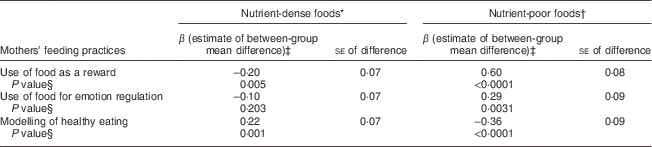
* Includes fresh fruit and fresh/frozen vegetables.
† Includes carbonated beverages, baked goods, juice drinks and non-carbonated beverages, high-sugar breakfast cereals, snack foods, prepared foods and meals, and high-sugar, high-fat dairy products.
‡ A positive between-group difference estimate denotes a higher frequency of food purchase among mothers with high feeding practice scores (above-the-median) than among mothers with low scores (at-or-below-the-median).
§ Models were individually adjusted for variables determined to be potential cofounders. Depending on the model, these variables included child’s age, frequency of family dinners, household income, employment status and/or highest education completed.
In the adjusted analysis (Table 2), mothers with above-the-median use of food as a reward were less willing to purchase child-requested, nutrient-dense foods (β (mean between-group difference)=−0·20, P=0·005) than mothers with scores at-or-below-the-median for use of food as a reward, but more willing to purchase child-requested, nutrient-poor foods (β=0·60, P<0·0001). Further, mothers with above-the-median use of food for emotion regulation were more willing to purchase nutrient-poor foods requested by the child (β=0·29, P=0·0031) than mothers scoring at-or-below-the-median use for emotion regulation. Mothers with above-the-median modelling of healthy eating scores were more willing to purchase child-requested, nutrient-dense foods (β=0·22, P=0·001) than mothers scoring at-or-below-the-median for modelling, but less willing to purchase child-requested, nutrient-poor foods (β=−0·36, P<0·0001).
Discussion
Mothers scoring above-the-median on use food as a reward and food for emotion regulation were more willing to purchase child-requested, nutrient-poor, marketed foods than mothers with at-or-below-the-median scores for these feeding behaviours. Above-the-median use of modelling healthy eating habits was positively associated with mothers’ willingness to purchase nutrient-dense foods and negatively associated with willingness to purchase nutrient-poor foods in response to children’s requests.
The grocery store is considered a stressful shopping environment for a parent and a child( Reference Gelperowic and Beharrell 40 ). While parents may seek to shop quickly and efficiently, children may focus on taking part in the shopping activity by trying to influence food purchases( Reference Nicholls and Cullen 9 ). The instant gratification that characterizes young children’s behaviours makes it difficult for them to resist a stimulus; if their requests are ignored or denied, they may respond by whining, screaming or crying( Reference Valkenburg and Cantor 41 ). Although mothers did not report on strategies their children employed to request food purchases, nagging or ‘just asking’ strategies, especially for nutrient-dense, marketed foods, have been reported in children of similar ages( Reference Calderon, Ayala and Elder 4 , Reference O’Dougherty, Story and Stang 8 , Reference Nørgaard, Bruns and Christensen 10 ).
In the present study, children may have been more successful at influencing purchases of the foods that were used to control their behaviour. Mothers scoring above-the-median on use of food as a reward and food for emotion regulation were more willing to purchase child-requested, nutrient-poor marketed foods than mothers with at-or-below-the-median scores. Parenting traits exhibited by mothers at home may also occur when making food purchase decisions. Maternal use of food to control children’s behaviour has previously been associated with the development of obesogenic eating behaviour, such as overeating and eating in the absence of hunger, in children( Reference Rodgers, Paxton and Massey 21 ). To date, parents’ use of these feeding practices has been mostly examined at home. The present study makes a contribution by reporting parenting food behaviours occurring in environments where food selection for the home takes place. Conversely, scores above-the-median in modelling of healthy eating habits were positively associated with mothers’ willingness to purchase child-requested nutrient-dense foods. Parents’ modelling of healthy eating has been positively associated with children’s F&V consumption( Reference Fisher, Mitchell and Smiciklas-Wright 14 , Reference Tibbs, Haire-Joshu and Schechtman 29 ), and inversely associated with children’s fatty snack intake( Reference Eisenberg, Ayala and Crespo 42 ), dietary fat intake and lower weight( Reference Matheson, Robinson and Varady 43 ). Mothers who intentionally model healthy dietary behaviours for their children may view the grocery store as an opportunity to talk about healthy foods and model purchasing of nutrient-dense foods (e.g. F&V) more frequently and nutrient-poor foods less frequently.
The role of children as influencers of parental food purchase decisions has gained attention( Reference Wingert, Zachary and Fox 44 ). Helping parents better understand how their children influence what they purchase and then how those purchases may be used to reward children could assist families in modifying unhealthy family feeding practices and ultimately prevent child obesity. Although the study sample was mostly high socio-economic status, findings highlight potential areas for investigation of parent–child co-shopping behaviours that may also occur among low-income families. This could increase our understanding of how the economic limitations these families face may affect caregivers’ willingness to purchase foods their children request.
Study strengths include the assessment of reported maternal feeding practices at the grocery store when co-shopping with their children and the large sample size used for analyses. Limitations of the study include the potential for social desirability bias in responding to the survey questions. One of the recruitment strategies included advertising the study on the Department of Nutritional Sciences’ Facebook page. Thus, some participants might have been more motivated to provide nutrition information than others. The sample was mostly White, high socio-economic status; maternal feeding behaviours differ by income level of the family( Reference Gross, Mendelsohn and Fierman 45 , Reference Baughcum, Powers and Johnson 46 ). Findings cannot be generalized to other populations. Mothers’ choices of which child to report on may have influenced their responses. Frozen fruit was not included in the food categories. Participation was not restricted to living in Oklahoma; other geographical locations in which mothers resided might have influenced mother–child purchase behaviours. Mothers’ feeding practice scores for use of food for emotion regulation and modelling did not vary much. This homogeneity prevented a more definite picture of the outcomes of the child purchase requests with mothers with high or low scores of these practices. Actual behaviours were not assessed. Instead, mothers were asked to report their willingness to perform a behaviour in response to a hypothetical scenario. However, the question format is in agreement with how willingness behaviours are assessed in that participants were given a description of a hypothetical situation to which they willingly responded( Reference Gerrard, Gibbons and Houlihan 36 ). Willingness has effectively predicted various health behaviours( Reference Gibbons, Gerrard and Lane 37 , Reference Gerrard, Gibbons and Brody 38 ).
Conclusion
In conclusion, mothers’ use of food to control children’s behaviours was positively associated with mothers’ willingness to purchase child-requested, nutrient-poor foods. Mothers with above-the-median modelling of healthy eating scores were more willing to purchase child-requested nutrient-dense foods than were mothers with at-or-below-the-median scores. Parents’ food socialization practices related to children’s influence over food purchases should be investigated in grocery stores to elucidate factors that may contribute to children’s unhealthy eating behaviours. The role of young children in purchase outcomes opens new possibilities for health promotion. Allowing children to actively participate in healthy food (i.e. F&V) selection while engaging with their parents in healthy food purchase modelling( Reference O’Dougherty, Story and Stang 8 ) may influence availability of foods in the home and, thus, consumption.
Acknowledgements
Acknowledgements: The authors thank the participants of the study and Kathy Kyler for editing the manuscript. Financial support: This work was supported by the Department of Nutritional Sciences at the University of Oklahoma Health Sciences Center and the National Institute of General Medical Sciences of the National Institutes of Health (under award number U54GM104938). The funders had no role in the design, analysis or writing of this article. Conflicts of interest: The authors declare no potential conflicts of interest with respect to the research, authorship and/or publication of this article. Authorship: K.L. was responsible for management of data collection, literature review and manuscript writing. O.B. was responsible for statistical analysis and interpretation. D.M.T. contributed to overseeing statistical analysis and provided statistical advice. A.S.M., J.L.H., S.B.S. and M.K.C. contributed to study design and critically revised the manuscript. K.R.L. conceptualized the research, led the study design, critically revised the manuscript and has final responsibility for the study. Ethics of human subject participation: This study was conducted according to the guidelines laid down in the Declaration of Helsinki and all procedures involving human subjects/patients were approved by the University of Oklahoma Health Sciences Center Institutional Review Board. Written informed consent was obtained from all participants.
Supplementary material
To view supplementary material for this article, please visit https://doi.org/10.1017/S1368980017002142



