


Introduction
With the onset of disability and loss of autonomy, help provided by family significantly improves the wellbeing and quality of life of older persons (Chiatti et al., Reference Chiatti, Melchiorre, Di Rosa, Principi, Santini, Doehner, Lamura and Phellas2013). As the number of kin and relatives as well as spatial proximity between them constitute the ‘opportunity structure for intergenerational relationships’ (Bengtson and Roberts, Reference Bengtson and Roberts1991: 857), older persons who do not have children – at all, or not in the vicinity – are most affected by shortages of help (Mulder and van der Meer, Reference Mulder and van der Meer2009; Kalwij et al., Reference Kalwij, Pasini and Wu2014; Broese van Groenou and De Boer, Reference Broese van Groenou and De Boer2016). In the countries of Europe this potentially concerns approximately 10 per cent of adults aged 50 and above who have remained childless (Deindl and Brandt, Reference Deindl and Brandt2017; Sobotka, Reference Sobotka, Kreyenfeld and Konietzka2017) as well as 15 per cent of adults at the same age who live remotely, at least 25 kilometres (km), from their nearest child (Hank, Reference Hank2007).
For this reason, a growing number of studies focus on alternatives to family sources of support, such as neighbours, friends, fictive kin, present or former work-related acquaintances, etc. (Chappell, Reference Chappell1983; Jordan-Marsh and Harden, Reference Jordan-Marsh and Harden2005; Voorpostel, Reference Voorpostel2013; Kalwij et al., Reference Kalwij, Pasini and Wu2014), that is, neither kin nor in-laws (hereinafter referred to as non-family). Their role appears substantial (Boaz and Hu, Reference Boaz and Hu1997; Keating, Reference Keating1999; Fast et al., Reference Fast, Keating, Otfinowski and Derksen2004): in Europe, they constitute 26 per cent of all persons providing instrumental support (Attias-Donfut et al., Reference Attias-Donfut, Ogg and Wolff2005) and contribute to approximately 30 per cent of the hours of informal support (Kalwij et al., Reference Kalwij, Pasini and Wu2014). But non-family individuals cannot easily and fully replace relatives living in close proximity: while help with household tasks does not require any strong emotional tie and can be provided, for instance, by neighbours (Barker, Reference Barker2002), personal care is intense and involves a high degree of intimacy. Consequently, this kind of assistance is most often provided by professional carers or members of immediate family: spouses, children and siblings (Jacobs et al., Reference Jacobs, Broese van Groenou, Aartsen and Deeg2018; Litwak, Reference Litwak1985), whereas the engagement of alternative sources of support remains rare (Lapierre and Keating, Reference Lapierre and Keating2013). Does it mean that the lack of immediate relatives – at all or in the geographical proximity – leads to similar deficiencies in support experienced by older persons?
In the analysis that follows, the stress is deliberately put on adult children as potential donors of help because, apart from spouses, they provide the largest share of actual support to older persons in general (Komter and Vollebergh, Reference Komter and Vollebergh2002; Verbeek-Oudijk et al., Reference Verbeek-Oudijk, Woittiez, Eggink and Putman2014), and the largest share of support from beyond the household (Attias-Donfut et al., Reference Attias-Donfut, Ogg and Wolff2005). We examine in this study how the availability of adult children as potential providers of help relates to the involvement of persons from beyond the family. In the research on informal help to older individuals, the focus is dichotomously put either on parents and childless individuals, or on parents living at different distances from their adult children (Matthews and Rosner, Reference Matthews and Rosner1988; Stoller et al., Reference Stoller, Forster and Duniho1992; Litwin, Reference Litwin1994; Stern, Reference Stern1995; Kiilo et al., Reference Kiilo, Kasearu and Kutsar2016). Following the most recent research (Albertini and Kohli, Reference Albertini, Kohli, Kreyenfeld and Konietzka2017; Albertini and Arpino, Reference Albertini and Arpino2018), we distinguish between several categories of older persons, that is being childless or a parent and, for the latter, living remotely, closely to or co-residing with a child. By referring to the fact of being childless or a parent, and to the physical distance as dimensions of children's availability, we claim that in terms of informal (unpaid) support, parents not having children in the vicinity bear more resemblance to childless individuals than they do to parents with children living in close proximity.
With few important exceptions (Attias-Donfut et al., Reference Attias-Donfut, Ogg and Wolff2005; Kalwij et al., Reference Kalwij, Pasini and Wu2014; Mudrazija, Reference Mudrazija2014; Albertini and Kohli, Reference Albertini, Kohli, Kreyenfeld and Konietzka2017), most empirical research on informal support examines only its likelihood, usually operationalised by the proportion (frequency in a given population) of older respondents declaring having benefited from this kind of support within a certain period of time. Such a variable evidences only a dichotomous state of receiving/not receiving help, and not its amount, intensity, and the fact that an older person receives help once a month does not necessarily mean that this help is abundant or sufficient. The probability and the amount are not identical indicators of informal support and two recent studies for Europe found that in countries where the frequency of informal support is high, its amount is low, and vice versa (Bonsang, Reference Bonsang2007; Brandt, Reference Brandt2013). In the analysis that follows, we investigate both indicators of the employment of non-financial help: by studying its likelihood we refer to the whole population of older individuals, and not only to those who received non-family support, whereas by examining its amount we allow for the actual engagement of providers of help.
This study is based on the Survey on Health, Ageing and Retirement in Europe (SHARE) that concerns all types of informal and non-financial support, that is, personal care, household chores and paperwork. These three types of help depend on the geographical conditions between potential donors and beneficiaries, although to a different extent: while practical household help and personal care require face-to-face contacts, paperwork may be partially provided at a distance. But as we show further on, the latter contributes marginally to the overall help received by older persons, and therefore we do not exclude it from our study.
Availability of children, non-family support and the European context
Children's availability and non-family support
Proximity conditions affect the provision of informal support in different ways: while financial transfers seem to occur independently of the physical distance between donors and beneficiaries (Rapoport and Docquier, Reference Rapoport and Docquier2006), personal care and instrumental support require frequent face-to-face contact, and as such can be maintained in the regular manner only at manageable distances (Komter and Vollebergh, Reference Komter and Vollebergh2002; Fast et al., Reference Fast, Keating, Otfinowski and Derksen2004; Daatland and Lowenstein, Reference Daatland and Lowenstein2005). Studies concerned with family help found different thresholds of distance, beyond which the regular support from relatives diminishes significantly. The results remain ambiguous, though: it is a distance exceeding 5 km (Phillipson et al., Reference Phillipson, Bernard, Phillips and Ogg1998; Knijn and Liefbroer, Reference Knijn, Liefbroer, Dykstra, Kalmijn, Knijn, Komter, Liefbroer and Mulder2006) or 20 km (Mulder and van der Meer, Reference Mulder and van der Meer2009), or a time of journey exceeding 30 minutes (Joseph and Hallman, Reference Joseph and Hallman1998; Checkovich and Stern, Reference Checkovich and Stern2002; Heylen et al., Reference Heylen, Mortelmans, Hermans and Boudiny2012), one hour (Litwak and Kulis, Reference Litwak and Kulis1987; Conkova and King, Reference Conkova and King2019) or three hours (Conkova and King, Reference Conkova and King2019). In respect to adult children as potential providers of personal care and instrumental support, two recent studies showed that as the geographical distance to older parents gradually increases, the amount of regular non-financial help diminishes significantly (Kalwij et al., Reference Kalwij, Pasini and Wu2014; Conkova and King, Reference Conkova and King2019). In turn, a factor recognised as particularly conducive to the provision of help is the co-residence of relatives, which obviously entails a complete lack of physical remoteness (Chappell, Reference Chappell1991; Komter and Vollebergh, Reference Komter and Vollebergh2002; Fast et al., Reference Fast, Keating, Otfinowski and Derksen2004).
The relation between proximity of carers and the provision of support is yet not that straightforward. Several studies showed that adult children who live remotely continue to help their so-called ‘left-behind’ ageing parents (Østergaard-Nielsen, Reference Østergaard-Nielsen2003; Toyota et al., Reference Toyota, Yeoh and Nguyen2007). In transnational families constituting the extreme case of geographical dispersion of relatives, children manage to provide instrumental support to their parents on a less-regular basis, for instance during extended return visits (Baldassar, Reference Baldassar2007), compensate for the shortage of day-to-day help through additional financial transfers or ‘behind the scenes’ management, thus contributing to parents’ wellbeing (King and Vullnetari, Reference King and Vullnetari2006; Knodel and Saengtienchai, Reference Knodel and Saengtienchai2007; Zimmer and Knodel, Reference Zimmer and Knodel2013; Gedvilaitė-Kordušienė, Reference Gedvilaitė-Kordušienė2015). In European countries, as the distance to older parents increases, adult children are less likely to provide personal care and instrumental help, but more likely to provide financial support (Bonsang, Reference Bonsang2007). The remittances may, in turn, be spent on private personal care, provided that such care arrangements are available (Bonsang, Reference Bonsang2007), or on instrumental support both from other members of the family (Zimmer et al., Reference Zimmer, Rada and Stoica2013; Krzyżowski and Mucha, Reference Krzyżowski and Mucha2014) and beyond (Biao, Reference Biao2007; He and Ye, Reference He and Ye2014; Kalwij et al., Reference Kalwij, Pasini and Wu2014; Evans et al., Reference Evans, Allotey, Imelda, Reidpath and Pool2017). It is also common for providers of help to specialise in such a manner that remotely living children contribute financially, whereas locally living family members and non-family individuals help in a non-financial way (Zissimopoulos, Reference Zissimopoulos2001). This specialisation (or compensation) effect is never complete, though: even members of transnational families usually still provide non-financial help, though on a less-regular basis, whereas locally based relatives and non-family individuals tend to provide financial aid in addition to instrumental support (Zimmer et al., Reference Zimmer, Rada and Stoica2013).
When the need for regular help becomes substantial, it may also trigger geographical rapprochement between family members (Smits et al., Reference Smits, Van Gaalen and Mulder2010). Many studies found that adult children and ageing parents choose to co-reside, settle down or relocate to live in close vicinity of each other in order to facilitate the provision of help (Rogerson et al., Reference Rogerson, Burr and Lin1997; Mulder, Reference Mulder2007; Pettersson and Malmberg, Reference Pettersson and Malmberg2009; Heylen et al., Reference Heylen, Mortelmans, Hermans and Boudiny2012; Seltzer and Friedman, Reference Seltzer and Friedman2014; Stark and Cukrowska-Torzewska, Reference Stark and Cukrowska-Torzewska2018). By analogy, the availability of local persons willing to help encourages residence at a distance or even the undertaking of migration, as in the case of Romanian young adults, who appeared to be more likely to move abroad when they had a sibling living in the parental household or in its close proximity (Zimmer et al., Reference Zimmer, Rada and Stoica2013).
In this context, childless older individuals are in a particularly vulnerable position for at least two reasons. First, as opposed to the ‘left-behind’ parents, individuals who do not have children at all cannot benefit from remittances, ‘behind the scenes’ management or the above-described specialisation effect which occurs when locally living persons and remotely living descendants provide different types of support. As a consequence, childless older individuals tend to compensate for the absence of help from children by extending the support networks to distant relatives, friends, neighbours, present or former work colleagues, etc. (O'Bryant, Reference O'Bryant1985; Albertini and Kohli, Reference Albertini and Kohli2009; Albertini and Mencarini, Reference Albertini and Mencarini2014; Jacobs et al., Reference Jacobs, Broese van Groenou, Aartsen and Deeg2018; Deindl and Brandt, Reference Deindl and Brandt2017). Second, such non-family local providers of support can act as substitutes for family help, especially with basic tasks: shopping, paperwork or household chores (Egging et al., Reference Egging, de Boer and Stevens2011; Deindl and Brandt, Reference Deindl and Brandt2017; Conkova and King, Reference Conkova and King2019; Nocon and Pearson, Reference Nocon and Pearson2000), but when an older person requires permanent, long-term care, the involvement of family members or the use of professional care services becomes essential (Dykstra, Reference Dykstra and Uhlenberg2009; Egging et al., Reference Egging, de Boer and Stevens2011; Deindl and Brandt, Reference Deindl and Brandt2017). Personal care is such an intense and intimate assistance that children cannot be easily replaced by non-family carers (Barker, Reference Barker2002; Lapierre and Keating, Reference Lapierre and Keating2013).
A certain analogy between childless individuals and parents living remotely from their children can be found: with the onset of old age, they both are more likely to receive non-family support and professional care services in comparison to parents living in the proximity of their descendants (Schnettler and Wöhler, Reference Schnettler and Wöhler2016; Albertini and Kohli, Reference Albertini, Kohli, Kreyenfeld and Konietzka2017). Persons who do not have children – at all, or not within a short geographical distance – develop stronger ties beyond their immediate family (Bernard et al., Reference Bernard, Ogg, Phillips and Phillipson2001; Albertini and Kohli, Reference Albertini and Kohli2009; Schnettler and Wöhler, Reference Schnettler and Wöhler2016) and rely more on non-family helpers than parents living close to their children (Choi, Reference Choi1994; Larsson and Silverstein, Reference Larsson and Silverstein2004; Gray, Reference Gray2009; Grundy and Read, Reference Grundy and Read2012; Albertini and Mencarini, Reference Albertini and Mencarini2014; Deindl and Brandt, Reference Deindl and Brandt2017). Still, however, childless individuals and remotely living parents experience significant shortages of support (Choi, Reference Choi1994; Larsson and Silverstein, Reference Larsson and Silverstein2004; Dykstra, Reference Dykstra and Uhlenberg2009; Gray, Reference Gray2009; Grundy and Read, Reference Grundy and Read2012; Deindl and Brandt, Reference Deindl and Brandt2017), which means that childlessness and geographical distance both translate into fewer opportunities of receiving informal support.
The objective of this study is therefore to investigate whether childlessness can be inscribed in the continuum of conditions that underlie children's availability to older persons. Most empirical research reduces the family configurations that encourage informal support to a series of dichotomies: married or unmarried (Boaz and Hu, Reference Boaz and Hu1997; Fast et al., Reference Fast, Keating, Otfinowski and Derksen2004), childless or with children (Deindl and Brandt, Reference Deindl and Brandt2017), co-residing with family members or living alone (Chappell, Reference Chappell1991; Komter and Vollebergh, Reference Komter and Vollebergh2002). In this study, we put forward a continuum of availability conditions, with the co-residence of parents and adult children signifying the highest availability, close and remote geographical distances to the nearest child representing intermediate degrees of availability, and childlessness meaning the lowest availability (Figure 1).
Degrees of children's availability.
Source: Own elaboration based on Albertini and Arpino (Reference Albertini and Arpino2018).

Informal support in Europe
The growing body of research stresses regional differences in family relations in Europe (Chiatti et al., Reference Chiatti, Melchiorre, Di Rosa, Principi, Santini, Doehner, Lamura and Phellas2013; Solé-Auró and Crimmins, Reference Solé-Auró and Crimmins2014; Verbeek-Oudijk et al., Reference Verbeek-Oudijk, Woittiez, Eggink and Putman2014): in northern and western countries of Europe, middle- and old-aged parents live at more remote distances (Jordan, Reference Jordan1988; Reher, Reference Reher1998), co-reside less often and maintain less-frequent contact with their children than in Mediterranean countries (Attias-Donfut et al., Reference Attias-Donfut, Ogg and Wolff2005; Hank, Reference Hank2007; Bordone, Reference Bordone2009). In western and northern Europe, we see young adults gaining independence at a relatively early age, whereas the Mediterranean countries and eastern Europe are characterised by a relatively high prevalence of multi-generational households (Kuijsten, Reference Kuijsten1996; Billari, Reference Billari2004).
This intra-European variation is caused by persistent and long-lasting cultural, institutional and historical legacies dating back to the latter part of the Middle Ages, when it was usual for young adults in northern Europe – contrary to their counterparts elsewhere – to leave parental households at a young age to work as agricultural servants (Laslett, Reference Laslett1965, Reference Laslett1972; Wall, Reference Wall, Wall, Robin and Laslett1983). In the following centuries, the prevalence of services contributed partially to the emergence of two distinct demographic regimes (Hajnal, Reference Hajnal, Wall, Robin and Laslett1983, Reference Hajnal, Glass and Eversley1965) and intergenerational arrangements on the European continent (Goody, Reference Goody1983; Reher, Reference Reher1997): the family bore the entire responsibility for the wellbeing of older relatives in the east and south, where co-residence of older parents with children or rotation between offsprings’ households was a common practice. By contrast, in the north, family support to older persons was only complementary to support from the local community (Anderson, Reference Anderson, Shanas and Sussman1977; Laslett, Reference Laslett1984, Reference Laslett1989; JE Smith, Reference Smith1984; RM Smith, Reference Smith1984). These arrangements were reinforced by country-specific legal systems (Reher, Reference Reher1998) and religious doctrines (Goody, Reference Goody1983), and underlaid the development of distinct systems of welfare state (Saraceno and Keck, Reference Saraceno and Keck2010).
Indeed, public policies introduced in European countries provide different incentives for institutional care services, and the availability of formal home care may affect the provision of informal family and non-family support. Several typologies were proposed to describe this intra-European variety, such as the distinction between the ‘Bismarck’ model in the western part of the continent and ‘Beveridge’ model in the Nordic countries (Cremer and Pestieau, Reference Cremer and Pestieau2003), or between liberal, conservative and social democratic regimes of welfare capitalism (Esping-Andersen, Reference Esping-Andersen1990). Saraceno and Keck (Reference Saraceno and Keck2010) proposed three ideal types of care relations: (a) based almost exclusively on the family (‘familialism by default’) in southern and, to some extent, eastern Europe; (b) based on the family but complemented by external institutions, either public or private (‘supported familialism’) in western Europe; and (c) based predominantly on non-family institutions (‘de-familialisation’) in northern Europe. Empirical studies showed that in the Mediterranean countries, public policies favour familial support (Bonsang, Reference Bonsang2007; Bolin et al., Reference Bolin, Lindgren and Lundborg2008), whereas in the North and the West of the continent they provide more incentives for institutional care services or migrant care workers (Jacobzone, Reference Jacobzone1999; Broese van Groenou et al., Reference Broese van Groenou, Glaser, Tomassini and Jacobs2006; Verbeek-Oudijk et al., Reference Verbeek-Oudijk, Woittiez, Eggink and Putman2014). These care arrangements remain in line with different cultural norms existing in Europe, in particular the perception that the family is obliged to support older individuals seems to be more predominant in southern than northern Europe (Haberkern and Szydlik, Reference Haberkern and Szydlik2010). Recent research confirms the regional variation in preferences (Eurobarometer, 2007) and in actual care relations (Cuyvers and Kalle, Reference Cuyvers and Kalle2002; Hank, Reference Hank2007) along the South/North-West axis, at least when the amount, and not the frequency of help is studied (Brandt et al., Reference Brandt, Haberkern and Szydlik2009; Brandt, Reference Brandt2013).
Similar research for eastern Europe remains inconclusive, though. With some important exceptions (Conkova and King, Reference Conkova and King2019; Pesando, Reference Pesando2019), this region is rarely included in international comparisons and its definition differs from one study to another, depending on criterion in use: geographical (thus, including also Austria and Germany) or political (thus, including only post-communist countries). Institutional services of care are less available in the post-communist countries where during the transitory period of the 1990s and 2000s the level of welfare expenses remained considerably lower than in other parts of Europe (Boenker et al., Reference Boenker, Mueller and Pickel2002; Vihalemm et al., Reference Vihalemm, Masso and Opermann2017; European Commission, 2018). This translates into strong support received from the family (Saraceno and Keck, Reference Saraceno and Keck2010; Litwin and Stoeckel, Reference Litwin and Stoeckel2014; Fernández-Carro and Vlachantoni, Reference Fernández-Carro and Vlachantoni2019), but not necessarily into low involvement of non-family individuals. In the study concerned with resorting to advice and help when looking for a job, nationals of different east European countries appear to develop both the strongest and the weakest non-family ties of informal support in Europe (Conkova et al., Reference Conkova, Fokkema and Dykstra2018), meaning that the interrelation between different sources of support follows not a single, but various country-specific patterns. Thus, persistent cultural and ideational factors contribute to ‘societies’ own historical trajectories’ (Reher, Reference Reher1998: 221) and to different models of intergenerational solidarity in European countries (Kuijsten, Reference Kuijsten1996; Billari, Reference Billari2004).
Characteristics of support and the availability of potential helpers
In general, the involvement of non-family individuals depends both on the characteristics of support – whether it requires face-to-face contacts, frequency, intimacy, etc., and the availability of other helpers, such as children, further relatives and providers of care services. Obviously, potential providers of help differ with regard to the degree of affectivity towards an older person, possibility of long-term commitment and geographical proximity. The task-specific model (Litwak, Reference Litwak1985; Litwak and Szelenyi, Reference Litwak and Szelenyi1969) focuses on these two dimensions of support, that is its nature and structural features of helpers, as essential to explain the configurations of support networks of older persons. Against this background, several studies show that geographical proximity is one of the crucial factors affecting the match between a person providing support and characteristics of a given care task, as well as the efficiency of that help (Peters et al., Reference Peters, Hoyt, Babchuk, Kaiser and Iijima1987; Feld et al., Reference Feld, Dunkle and Schroepfer2004; Stuifbergen et al., Reference Stuifbergen, Van Delden and Dykstra2008; Tolkacheva et al., Reference Tolkacheva, Van Groenou, De Boer and Van Tilburg2011; Allen et al., Reference Allen, Lima, Goldscheider and Roy2012). Thus, while relatives, in particular a spouse and other co-resident kin, may be best suited to handle long-term and intimate commitments such as personal care, neighbours and locally living friends efficiently help in urgent situations requiring their presence at an older person's place. Also, whenever support requires specialised skills and intense effort, resorting to formal care is the most effective strategy (Feld et al., Reference Feld, Dunkle and Schroepfer2004; Conkova et al., Reference Conkova, Fokkema and Dykstra2018).
According to the task-specific model, providers of help with similar structural properties are to a limited extent ‘functionally substitutable’ (Litwak, Reference Litwak1985), that is, they can replace each other in the provision of certain types of support. In the present study, we argue that non-family individuals may to some extent replace adult children in the provision of support to older persons. In order to incorporate childless older persons, we re-interpret the task-specific model and replace geographical proximity with the continuum of conditions describing the availability of adult children (Figure 1). With so-defined degrees of children's availability – co-residence, close and remote geographical distances to the nearest child, and childlessness – the hypothesis is:
• The lower the availability of children, the higher the probability and the amount of informal support provided to older parents by individuals from outside the family.
That is, childless individuals and parents of remotely living children receive more often and more help from non-family individuals than parents co-residing or living in the proximity to their nearest child. Obviously, being childless or a parent and geographical distance only approximate the actual availability of children, as the latter depends also on children's labour market activity, own family status, health conditions, cultural norms and context, which varies between European countries. Selected studies examined different characteristics of potential carers (Brandt et al., Reference Brandt, Haberkern and Szydlik2009; Mulder and van der Meer, Reference Mulder and van der Meer2009; Heylen et al., Reference Heylen, Mortelmans, Hermans and Boudiny2012; Kalwij et al., Reference Kalwij, Pasini and Wu2014), but did not inscribe these characteristics into one coherent continuum gradating the availability of support. In this study, we examine whether such a gradation could be established with reference to two dimensions of availability, that is being childless or a parent and geographical proximity.
The mechanism of substitution between providers of help with similar structural properties – children, other family members and non-family individuals – is additionally mediated by the social context. The existing research suggests that familialistic practices of intergenerational relations prevail particularly in the countries of eastern and southern Europe, which implies that in these regions, apart from the availability degree of adult children, there is a less pertinent need for compensatory non-family support than in the countries of northern and western Europe. In the empirical analysis that follows, we investigate the intra-European heterogeneity of non-family support and we examine whether the country-specific patterns of family relations reinforce or weaken the relationship between availability of children and non-family support. Also, we allow for the characteristics of a beneficiary: marital status, household composition, age and dependency status that remain the most important factors defining the necessity of help and the availability of other helpers.
Analytical framework
Data
The empirical analysis is based on the second wave of the SHARE study conducted in 2005/2006. This is the last wave that includes detailed information both on the frequency and the amount of non-financial support, whereas subsequent SHARE editions refer only to the former and do not allow for quantification of the aggregate support received by an older person from all donors. For several reasons, we limit the results of SHARE to individuals aged 65 and over, that is persons who can be considered as old. Our intention is to concentrate on individuals who are in a completely distinct – as compared to younger individuals – lifecourse phase that translates into specific labour market status and sources of income, different family and partner relations, social networks and constellations, support needs, opportunities for functioning in social life, vulnerability (e.g. social and economic exclusion), etc. Other studies showed that around this age or not much later, people are starting to rely on regular instrumental support (Boaz and Hu, Reference Boaz and Hu1997; Barker, Reference Barker2002; Fast et al., Reference Fast, Keating, Otfinowski and Derksen2004; Chiatti et al., Reference Chiatti, Melchiorre, Di Rosa, Principi, Santini, Doehner, Lamura and Phellas2013; Kalwij et al., Reference Kalwij, Pasini and Wu2014) and receive such support out of necessity and not in exchange for their own contribution, e.g. in exchange for caring for grandchildren. Individuals living in nursing homes are excluded from our study. The second wave of SHARE and our analysis include 12 countries that we group into four geographical regions that differ with regard to intergenerational relations and welfare systems (Brandt, Reference Brandt2013; Verbeek-Oudijk et al., Reference Verbeek-Oudijk, Woittiez, Eggink and Putman2014; European Commission, 2018):
(1) Eastern Europe: Czech Republic and Poland.
(2) Northern Europe: Denmark, The Netherlands and Sweden.
(3) Southern Europe: Italy and Spain.
(4) Western Europe: Austria, Belgium, France, Germany and Switzerland.
The presented analysis is conducted at the level of households, on the sample of 9,577 households of persons aged 65 and more, of who 2,730 benefited from non-financial informal help. The sample was slightly reduced due to missing data, which was relatively equal across all variables, and the econometric analysis included 2,293 households, of which 797 (due to missing data, 673 in the model) were informally supported by persons from outside the family.
Dependent and independent variables
Participants of the second wave of SHARE provided information on the composition of their families and households, their professional and financial status, and the financial and non-financial support received in the last 12 months (Börsch-Supan and Jürges, Reference Börsch-Supan and Jürges2005; Börsch-Supan et al., Reference Börsch-Supan, Brandt, Hunkler, Kneip, Korbmacher, Malter, Schaan, Stuck and Zuber2013). The analysis concerns the informal, non-financial help received from individuals not belonging to the family and living outside the household. The first independent variable, describing the fact of receiving the non-financial support, is based on responses to the question:
Thinking about the time since the last interview [for a respondent participating in SHARE for the second time]/the last 12 months [for a respondent participating for the first time], has any family member from outside the household, any friend or neighbour given you or your husband/wife/partner any kind of help in: personal care (e.g. dressing, bathing, eating, getting in or out of bed, using the toilet), practical household help (e.g. with home repairs, gardening, transportation, shopping, household chores) or help with paperwork (such as filling out forms, settling financial or legal matters)?
Each participant of SHARE was allowed to indicate up to three persons providing the support and to specify the relationship to the donors, which allows for a clear distinction between family and non-family source of each support. For respondents who admitted having received such informal help from non-family individuals, the first independent variable, that is the probability of receiving, equalled 1. The second independent variable, that is the amount of non-family support expressed in number of hours of instrumental help, was estimated based on responses to two questions:
In the last 12 months altogether how often have you received such help from this person?
and
About how many hours altogether did you receive such help (on a typical day/in a typical week/in a typical month/in the last 12 months) from this person?
In order to approximate the average number of hours of help received in the last 12 months from non-family individuals, for each respondent we multiply the frequency of help by the corresponding number of hours, and sum by all non-family supporters:
Average number of hours of non-family help received in last 12 months = (frequency of help in the last 12 months × typical amount of hours of help) from non-family individual No. 1 + (frequency of help in the last 12 months × typical amount of hours of help) from non-family individual No. 2 + (frequency of help in the last 12 months × typical amount of hours of help) from non-family individual No. 3.
In the next step, we calculate the average number of hours of help for different groups of respondents (co-residing, living at short distance from the nearest child, etc.), including also individuals who did not declare having received any help. Our analysis concerns childless individuals and parents and, with regard to the latter, we distinguish between different geographical distances to the nearest child. In accordance with the SHARE questionnaire, six broad categories are proposed: co-residence, distance up to 1 km, 1–24 km, 25–99 km, 100–500 km and over 500 km (Table 1). Since previous studies did not identify one single threshold beyond which family support diminishes significantly, we keep in our analysis all possible distances provided by the SHARE study.
Descriptive statistics of the research sample

Notes: km: kilometres. ADL: activities of daily living. IADL: instrumental activities of daily living.
Source: Authors’ own elaboration based on the Survey on Health, Ageing and Retirement in Europe (SHARE) Wave 2, release 6.0.0.
Apart from the geographical distance to the nearest child and childlessness, two other explanatory variables help to verify whether the non-family individuals compensate for possible shortages of help: the average amount of non-financial support from family members (expressed as number of hours of help during the last 12 months) and the average amount of financial transfers received during the last 12 months from family (expressed in euros). The control variables consist of the age, sex, marital status (single or in couple), level of education and place of residence (locality and country). Much information is missing from the second wave of SHARE on formal (paid) help received by respondents; therefore, in order to approximate the access to formal support we use public spending on long-term care (expressed as the percentage of Gross Domestic Product) in a given country derived from the Organisation for Economic Co-operation and Development (2019). We allow also for the index of activities of daily living (ADL) and instrumental activities of daily living (IADL) to control for possible problems with personal care and independent living, but since the dependent variable refers to help provided to the respondent or their spouse/partner, in the case of persons living in a couple we take the maximum ADL and the maximum IADL declared for these two persons. Unfortunately, the dataset does not provide information on the amount of help regularly received from other members of a household, which may affect the provision of help from outside the household.
Methods
We conduct our analysis for all respondents aged 65 and over (not only beneficiaries of support) and incorporate a two-part regression model; in the first step, we estimate the probability of receiving non-financial support from non-family individuals, whereas in the second step, for those who received such support, we estimate its amount depending on children's availability and other explanatory variables mentioned above. In this model, all respondents receiving non-financial support are initially included and estimators allow for the fact that the independent variables affect both the likelihood of non-family support and its amount. Alternatively, if the amount was modelled separately from the probability, the coefficients would be estimated only for the group of persons receiving non-financial support from non-family individuals and, therefore, most probably would be biased. The bias would be due to the fact that the effect of having a child close by is probably different for all older people who receive non-financial support (a joint, two-step model) than for older people who receive non-financial support from non-family (separate models). In our study, several specifications of the two-step model were established; we present here one specification that includes the most important (for our study) independent variables and is characterised by relatively good fit parameters.
Results
Descriptive findings
The great majority of the overall sample of older individuals consists of parents (88%), primarily those who live with their children in the same household or no further than 24 km from their nearest child (76% of the sample; Table 1). The proportion of persons living with or close to children is higher in eastern and southern Europe, mostly due to the relatively high prevalence of co-residence, and lower in northern and western Europe (Table A1 in the Appendix).
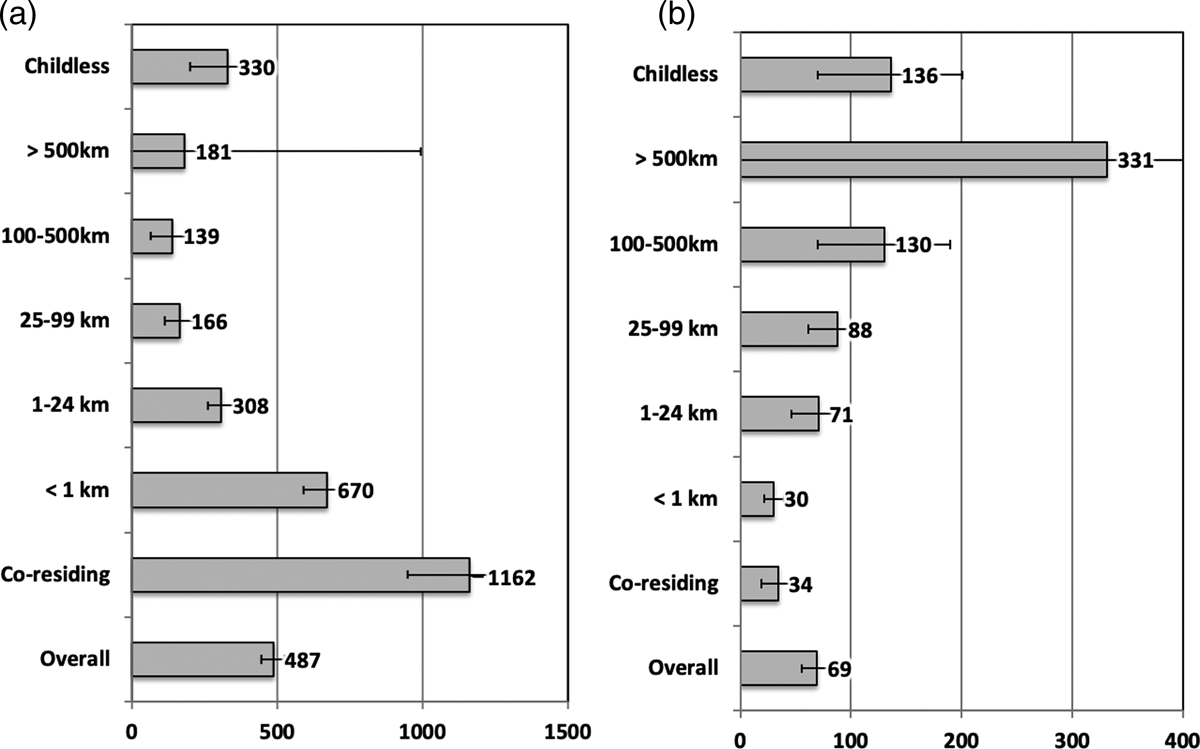
Almost three out of ten individuals declared that they had received non-financial, informal support from outside the household. This on average translates into 556 hours of help per year, i.e. approximately 1.5 hours every day. Members of family not living with respondents contribute most of the support: 487 hours per year on average, i.e. 88 per cent of all help. Their role is essential for parents co-residing or living at a distance of less than 1 km from the nearest child, but as the geographical distance increases, the contribution of family providers of help diminishes (Figure 2A). At the same time, the amount of non-family help – in absolute terms and relative to the overall support – increases as the geographical distance widens and adult children become less and less available (Figure 2B). Childless individuals do not, however, resemble parents of remotely living children: while the amount of non-family help is comparable for both categories of older individuals, the amount of family help is considerably higher for the former. Childless persons receive more family support and, consequently, more overall support even than parents living at a distance of 1–24 km from their nearest child, which means that other family members can effectively compensate for lack of help from progeny.
Annual amount (in number of hours) of informal help1 from persons not living in the household: (a) family members and (b) non-family individuals.
Note: 1. Significance level of 0.95 indicated by horizontal lines. km: kilometre.
Source: Authors’ own analysis based on the Survey on Health, Ageing and Retirement in Europe (SHARE) Wave 2, release 6.0.0.
A considerable part of all hours of informal support (58%) refers to practical household help: home repairs, gardening, transportation, shopping, etc., and is almost entirely (90%) provided by non-family individuals. Personal care represents 24 per cent of all hours of help from outside the household, but in this case the involvement of non-family is marginal (11% of hours of personal care). In turn, help with paperwork constitutes the remaining 18 per cent of all support from outside the household, therein 32 per cent is provided by non-family individuals. Thus, individuals from outside the family contribute in the first place to practical household help, whereas their role in other forms of support is less pronounced.
Non-family help providers are mostly neighbours (55%) and friends (25%), with the former contributing relatively often to practical household chores and personal care, and the latter relatively often helping with paperwork. Overall, non-family individuals providing support constitute 29 per cent of all helping persons, but their involvement is lower for parents co-residing or living in close proximity to their children, and higher for parents living remotely (Figure 3): as distance between parents and adult children increases, non-family persons provide a higher share of the overall support and constitute a higher share of all supporters. Childless individuals, however, do not depend on non-family helpers as much as parents of remotely living children.
Proportion (%) of non-family help in the overall informal help and of non-family helpers among all helpers.
Note: km: kilometre.
Source: Authors’ own elaboration based on the Survey on Health, Ageing and Retirement in Europe (SHARE) Wave 2, release 6.0.0.

In the entire sample, including both beneficiaries and non-beneficiaries of non-financial help, the average number of persons who provide the support is 1.54. This value is similar for all categories of parents, ranging from 1.50 to 1.62, and significantly lower for childless individuals: 1.32. Thus, even though childless persons receive more help (as expressed in number of hours) than parents living remotely from their children, their networks of support are smaller and less diversified, mostly due to the lower non-family component discussed above. It is possible that childless persons rely more often on so-called primary arrangements of help, which by definition consist of one person only.
The amount of informal support varies across European countries. On the one hand, more overall help is provided in the Czech Republic, Italy, Poland and Spain (more than 600 hours per year) than in other countries under study (less than 500 hours) except for Austria where the amount of help is on average 603 hours annually (Table A1 in the Appendix). In general, the amount of support from non-family constitutes 12 per cent of total support, but this percentage varies across Europe, from less than 7 per cent in two eastern European countries and Spain, to more than 20 per cent in Denmark, France and Switzerland. Several observations can be made that contradict the division between South/East and North/West European regions; for instance, the share of non-family support is similar in Belgium, Germany and Italy, as well as in France and The Netherlands. The proportion of non-family among all supporters is relatively low in the Czech Republic, Poland and Spain (less than 20%), but except for Denmark, The Netherlands and Sweden where this share exceeds 30 per cent, no clear regional clusters can be easily distinguished.
Two-step regression model: probability and amount of non-family support
The two-step regression shows the determinants of the probability and of the amount of support received from non-family helpers (Table 2). Childless individuals and parents with children living at least 25 km away are more likely to benefit from non-family support than older persons co-residing with at least one child. The result for parents living within a distance of 25 km from the nearest child, however, is not statistically significant. The probability of receiving non-family help diminishes, as the amount of family rises: each additional hour of family help decreases the likelihood of non-family support by 34 per cent. In addition, being single increases the probability of receiving non-family support by 25 per cent as compared to persons living in a couple. Similarly, having problems with daily life activities prompts the likelihood of non-family support, by 13 per cent for each additional ADL limitation and by 22 per cent for each additional IADL limitation. Country effects are significant only for Poland and Spain, where the probability of non-family support is lower than in Italy, and for The Netherlands, where this probability is higher. Although other country effects remain statistically insignificant, we can distinguish a group of countries in northern and western Europe – Austria, Belgium, Germany and Sweden – where the probability of non-family support is higher than in Italy.
Coefficients in the two-step regression model for probability and amount of informal support from non-family care-givers

Notes: Controls are transformed with inverse hyperbolic sine function (age, education years, numbers of activities of daily living (ADL) and instrumental activities of daily living (IADL)). Dummies for gender, being single or in couple, place of residence (large city, suburbs or outskirts of large city, large town, small town, rural area), and country. 1. For persons in a couple, ADL and IADL limitations refer to maximum limitation of two persons living in the household. 2. Public expenditures on long-term care (LTC) are expressed as the percentage of Gross Domestic Product. 3. The country effect for Switzerland is not included as this is the reference country for another country-specific variable (public expenditures on LTC). OLS: ordinary least squares. km: kilometres. Ref.: reference category.
Significance levels: * p < 0.1, ** p < 0.05, *** p < 0.01.
Source: Authors’ own analysis based on the Survey on Health, Ageing and Retirement in Europe (SHARE) Wave 2, release 6.0.0.
As for the amount of non-family support received, it is significantly higher for parents living at a distance of less than 1–500 km from the nearest child than for co-residing parents. The results are statistically insignificant for a distance above 500 km (most likely due to the low number of observations) and for childless individuals. This indicates that persons not belonging to the family compensate for the absence of children only to a limited extent. The amount of non-family support seems not to depend on the amount of family support, although the latter was critical for the probability of the former. One way to interpret this result is that non-family individuals make decisions on giving (or not) the support according to the needs of older persons, but the amount of support is dictated by other factors, such as age, marital status, activity limitations and other characteristics relating to the helper. Indeed, the amount of non-family support increases with age (by 1.8 hours with each additional year) and number of ADL and IADL limitations (by 0.4 hours with each additional limitation), it is also higher for single individuals than those in a couple. Interestingly, financial support received by adults aged 65 and over has no impact on the probability or the amount of non-financial support from non-family individuals, so even if remotely living children provide remittances to their older parents, this does not lead to a greater provision of help from non-family members. Consequently, we do not observe the substitution effect between remittances sent by remotely living family members and help provided by non-family.
As for country effects, we find that older individuals living in Belgium, Denmark, The Netherlands and Sweden receive less non-family support, whereas older individuals in the Czech Republic, Germany and Poland receive more non-family support than their counterparts in Italy. On the basis of existing research, we presumed that in the North and the West non-family helpers are more involved in the help for older persons than in the South and the East due to cultural legacy, but our analysis shows the opposite. Informal support, whether provided by family members or non-family individuals, is simply more common in the eastern and southern countries, and this effect persists even if we control for the health status of older persons or public expenditures on long-term care.
As for the availability of public care services, approximated by the long-term care public expenditures, our results remain inconclusive. Better access to public care services adversely affects the probability of non-family support, but it also favours its amount within the group of older persons benefiting from non-family support. Wherever shortages of public services provided to older persons exist, persons from beyond the family compensate for the lack of support, but their involvement is lower than in countries with higher expenditures on long-term care.
Conclusions and discussion
Like other studies (Attias-Donfut et al., Reference Attias-Donfut, Ogg and Wolff2005; Verbeek-Oudijk et al., Reference Verbeek-Oudijk, Woittiez, Eggink and Putman2014), our analysis shows that family members act as the main providers of instrumental help, whereas the contribution of non-family supporters remains secondary. When adult children are unavailable due to geographical distance, the probability and the amount of non-family support increase and the proportion of non-family providers of help become greater. Consequently, help from neighbours and friends improves to some extent the wellbeing of those older individuals who have limited access to their children. This result is in line with other studies concerning the engagement of non-family providers of help (Boaz and Hu, Reference Boaz and Hu1997; Egging et al., Reference Egging, de Boer and Stevens2011; Schnettler and Wöhler, Reference Schnettler and Wöhler2016), particularly neighbours, who by definition live in proximity to the persons in need (Barker, Reference Barker2002; Lapierre and Keating, Reference Lapierre and Keating2013).
Childless persons, however, bear little resemblance to parents of remotely living children: the former receive relatively more help in general, and relatively more help from family in particular. Their networks of support are on average smaller and comprise a lower proportion of non-family helpers as compared to parents with remote children. Being childless implies a higher probability of receiving non-family help, but the result concerning the amount of non-family help remains statistically insignificant. We interpret these results by referring to other studies (Dykstra and Hagestad, Reference Dykstra and Hagestad2007; Dykstra and Keizer, Reference Dykstra and Keizer2009; Albertini and Arpino, Reference Albertini and Arpino2018) that show that being childless or having children per se is less important than the different life trajectories that lead individuals to become childless in old age, including previous relationships, health conditions and the ability to establish stable social ties. In their lifetime, childless persons seem to create and maintain social networks and, in older age, networks of support in a different way than parents; they may establish diversified social relations, but in terms of support they strongly rely on one person from within the family. Whether single or in a couple, childless persons ‘replace’ non-existent children with next-in-line kin, such as siblings and their children (thus, nephews/nieces), who are usually involved in providing instrumental help (Albertini and Kohli, Reference Albertini and Kohli2009) and financial support (Hurd, Reference Hurd2009). Qualitative studies show that this is an adaptive strategy undertaken long before childless persons reach old age (Wenger, Reference Wenger2009). Accordingly, the reason why childless older individuals rely more on (fewer) relatives is most probably their long-term engagement in selective, but strong family relations. This does not apply to personal care, however: relatives provide this kind of help to childless older persons only in ‘emergency’ situations (Jerrome and Wenger, Reference Jerrome and Wenger1999) and, therefore, childless older persons resort sooner (Wenger, Reference Wenger2009) and more often (Albertini and Kohli, Reference Albertini, Kohli, Kreyenfeld and Konietzka2017) than parents to formal care, whether private or public.
But the lack of children does not lead to the same deficiencies in informal support as the lack of children in geographical proximity. For many reasons, older parents living a long distance away from their children do not form relations with relatives in the same way; for instance, a child or a parent might have moved away relatively recently, or parents may be counting on their child(ren) to support them later on, that is, when their need for care becomes urgent. Thus, as for our hypothesis regarding the relation between the availability of children's support and the non-family support provided to older parents, we accept it only in reference to the geographical distance: the greater the latter, the stronger the involvement of non-family helpers (expressed both as the probability and the amount of non-family support). The results for childless individuals remain, however, inconclusive: they have more chances to receive, but not necessarily to receive more non-family support than older parents co-residing with their children. Older individuals act in a completely different way to parents of remotely living children and, consequently, childlessness cannot be straightforwardly inscribed in the continuum of availability conditions based primarily on geographical distance. If such a continuum is proposed and examined in future research, it should refer only to older parents and be based rather on geographical conditions and, for instance, children's economic activity, marital status or health.
Our analysis shows that the probability and the amount of non-family support are lower in selected countries of western and northern Europe than in countries of eastern and southern Europe. In the West and North, older persons receive less informal support from family, but the possible shortages are not compensated by the involvement of persons from outside the family. The proportion of non-family among all helpers is higher in the West and the North, but they provide, at least in three northern countries and in Belgium, significantly less help than their counterparts in Italy and two eastern European countries. Consequently, older persons in the western and northern countries receive less informal support overall, both from family and non-family, than in the eastern and southern countries. Also, persons from beyond the family appear not to compensate for potential scarcity of public care services in countries where the public expenditures on long-term care are relatively low. These results should be interpreted cautiously as the number of observations in each country and for each category of older persons characterised by different availability circumstances of adult children is relatively small.
The main contribution of the present study is the distinction between the internal (the amount) and external margin (the probability) of support provided to older persons in Europe. Most existing literature focuses on the external margin of help only, but the frequency and the amount are not identical indicators of the employment of non-financial help. While frequency shows whether an individual received any kind of support or not, the amount of help reflects its intensity. To our knowledge, this study is based on the most actual data, on the data that is available for a relatively large group of European countries, and the only study that approximates the amount of non-financial help provided to older individuals living in private households regardless of family status, that is, whether co-residing with other adults or not, whether being parents or childless, etc. In spite of the secondary role of non-family helpers, we evidence several regularities underlying their involvement in help: their contribution is rather complementary to the help from family and even if they compensate for the scarcity of support, this applies only to informal help (and not public care) and rather to older parents than childless individuals.
We find three main limitations of this study that stem mostly from the specificity of SHARE data. First, we do not control for the amount of help received from other persons living in the same household. The intra-household support may to some extent imply a lower engagement of persons from outside the household. Other studies show that intra-household help cannot be easily conceptualised and operationalised because domestic duties fulfilled for the wellbeing of all household members (cleaning, cooking, shopping) are difficult to distinguish from assistance provided uniquely to the older person (Ironmonger, Reference Ironmonger, Smelser and Baltes2001). Thus, the amount of support received from housemates remains theoretically intangible and, as such, seems to be underestimated in social surveys (Kalwij et al., Reference Kalwij, Pasini and Wu2014). Instead, in our analysis, we allow for the fact of being single, which approximates the probability of receiving additional support from the household, and for the numbers of ADL and IADL that capture the need for daily assistance.
Second, we cannot control for all factors leading to the two-way causal relationship between the dependent and the independent variables in our model. As a matter of fact, the non-family support received by older persons may depend on the availability of children – possible providers of help – but the geographical distance between children and older parents may also depend on the support the latter can count on: in some families the need for regular help and the impossibility of help from non-family triggers geographical rapprochement between family members (Heylen et al., Reference Heylen, Mortelmans, Hermans and Boudiny2012). The instrumental variables approach usually used whenever the two-way causal relationship is possible was not implemented in this study because variables approximating unobserved preferences towards geographical rapprochement, such as feelings of emotional closeness and intimacy between family members, would bring collinearity in the model and bias of the obtained estimates. In turn, other methods disentangling a possible two-way causal effect, such as the generalised structural equation modelling (Heylen et al., Reference Heylen, Mortelmans, Hermans and Boudiny2012), do not allow for two-step, unbiased modelling of both likelihood of non-family support and its amount.
Last but not least, due to incomplete data our analysis is focused on the geographical distance between older persons and their adult children, without defining whether the family members are dispersed in the same country, or between different countries. Although internal and international migration differ with regard to the constraining factors involved in crossing borders and settling down abroad, the importance of these factors becomes marginal in the Schengen Area encompassing all countries under our study. However, we cannot exclude the possibility that the exchange of help between family members living in the same country differs from that occurring at the international level, and allowing for such a distinction in future studies may improve our understanding of the compensation mechanisms employed in the provision of help.
Data
This paper uses data from SHARE Wave 2. The SHARE data collection has been primarily funded by the European Commission through FP5 (QLK6-CT-2001-00360), FP6 (SHARE-I3: RII-CT-2006-062193, COMPARE: CIT5-CT-2005-028857, SHARELIFE: CIT4-CT-2006-028812) and FP7 (SHARE-PREP: No. 211909, SHARE-LEAP: No. 227822, SHARE M4: No. 261982). Additional funding from the German Ministry of Education and Research, the Max Planck Society for the Advancement of Science, the US National Institute on Aging (U01_AG09740-13S2, P01_AG005842, P01_AG08291, P30_AG12815, R21_AG025169, Y1-AG-4553-01, IAG_BSR06-11, OGHA_04-064, HHSN271201300071C) and from various national funding sources is gratefully acknowledged (see www.share-project.org).
Financial support
This work was supported by the National Science Centre, Poland (grant number 2015/19/D/HS4/00813).
Acknowledgements
The authors thank Jim Ogg and the anonymous referees for their valuable comments, and Johannes Warndorff for his diligent proofreading of this paper. The paper is based on the working paper ‘Children's Proximity and Non-Family Support to Elderly Adults in Europe’ (available at http://www.migracje.uw.edu.pl/publikacje/childrens-proximity-and-non-family-support-to-elderly-adults-in-europe/) but differs with regard to the empirical results and, consequently, the formulation of the abstract, contextual background and conclusions are different.
Author contributions
All authors read the paper and agreed to its submission.
Conflict of interest
The authors declare no conflicts of interest.
Appendix
Selected characteristics of residential arrangements and instrumental support to individuals aged 65 and over, by country of residence


 Open access

