





Introduction
North Dakota grows a diverse number of agronomic crops, from wheat (Triticum aestivum L.), corn (Zea mays L.), and soybean (Glycine max L. Merr.) to horticultural and specialty crops like sugarbeet (Beta vulgaris L.), sunflower (Helianthus annuus L.), dry bean (Phaseolus vulgaris L.), and potato (Solanum tuberosum L.) (USDA-NASS 2020). In 2019, North Dakota was seventh in the nation for potato production, with more than 1.2 billion kg of harvested potatoes on more than 23,000 hectares, with an estimated value of US$222 million. More than 5,000 hectares were certified as seed potato, making North Dakota the second-largest producer of seed potato. However, this was less than 0.1% of the total hectares in crop production in North Dakota, with approximately 2.3 million hectares planted to soybean in 2019.
The introduction of dicamba-tolerant soybean in 2017 provided growers with an option to control glyphosate-resistant weeds. However, wide-scale dicamba use led to off-target injury to sensitive plants. Dicamba off-target movement was prevalent enough in 2017 that the North Dakota Department of Agriculture implemented new dicamba application restrictions (NDDA 2017). For many parts of North Dakota, especially for counties in the southern half of the state where potato planting often occurs by mid-April, off-target potato injury from spray drift, vapor drift, or spray tank contamination may injure potato plants during the early reproductive stage and affect yield. Soybean fields are often planted adjacent to other broadleaf crops, such as potato, that can be sensitive to dicamba (Hatterman-Valenti et al. Reference Hatterman-Valenti, Endres, Jenks, Ostlie, Reinhardt, Robinson, Stenger and Zollinger2017).
Research has shown cultivar injury differences to sublethal glyphosate and dicamba rates for russet-skinned cultivars, but no previous work has evaluated white-skinned cultivars (Hatterman-Valenti et al. Reference Hatterman-Valenti, Endres, Jenks, Ostlie, Reinhardt, Robinson, Stenger and Zollinger2017). Research has also shown that glyphosate injury from simulated drift can be devastating to potato development when it occurs at tuber initiation (TI) (Crook Reference Crook2016; Felix et al. Reference Felix, Boydston and Burke2011). Felix et al. reported that ‘Ranger Russet’ tuber yields were the lowest when glyphosate was applied at the hooking and TI stages. The TI stage occurs when tubers begin to form and immediately follows the hooking stage, when stolon tips begin to swell. According to Stark and Love (Reference Stark and Love2003), this growth stage is also when plant injury can have the greatest influence on harvest yield.
Fresh potatoes are one of the major products certified by the USDA Fresh Fruit and Vegetable Inspection Service (USDA-AMS 2012). Shipments and inspections are made monthly throughout the year from one or more producing areas, either as being freshly harvested or from storage. Inspectors evaluate samples for conformity to the U.S. standards for grades of potatoes, and if the tubers are grown for seed production, then for conformity to the U.S. standards for grades of seed potatoes. For chipping potatoes, the standards include tuber size, maturity and skinning, and a long list of external and internal defects. For seed potatoes, the standards apply to potatoes identified as certified seed with unique scoring guides and tolerances for tuber size, maturity and skinning, and external and internal defects.
The objective of this research was to determine the effect of glyphosate and dicamba on ‘Atlantic’ and ‘Dakota Pearl’ chipping potatoes grown for commercial production.
Materials and Methods
Two field trials were conducted in 2018 at the North Dakota State University (NDSU) Irrigated Research Site, located 5 km south of Oakes, ND (46.07 N, −98.09 W; elevation 392 m). Experiments were set up as a randomized complete block design, two-factor arrangement (herbicide × cultivar), with two cultivars, five herbicide treatments, four replicates, and two runs. Run 1 was planted on the north end of the research farm, and Run 2 was planted at the south end of the research farm. The soil type for Run 1 was an Embden fine sandy loam (USDA-NRCS 2017). The soil types for Run 2 were a mixture of half Embden fine sandy loam and half Glyndon loam. The typical soil profile of Embden fine sandy loam is a fine sandy loam from 0 to 203 cm. The typical soil profile of a Glyndon loam is loam through the first 0 to 28 cm, followed by silt loam from 29 to 183 cm and loam from 184 to 203 cm. For Run 1, the previous crop was corn. For Run 2, the previous crop was soybean.
Certified ‘Atlantic’ and ‘Dakota Pearl’ seed potatoes were cut into 70 g ± 5 g seed pieces, with at least two or more eyes per seed piece. After the seed pieces were cut, they were stored for 2 wk at 10 C and 95% relative humidity (RH) to induce suberization and seed conditioning before planting. Each experimental unit (EU) contained two rows with 20 seed pieces planted in each row. All seed pieces were planted on May 7 with a plant spacing of 31 cm and a row spacing of 91 cm, or 35,880 seed pieces ha−1. The EU row length was 6.1 m long with a seed depth of 10 cm. A 1.5-m gap of five ‘Red Norland’ potato seed pieces was planted to separate each treatment within a row. Furthermore, two border rows of ‘Russet Burbank’ plants were planted on the outside of each treatment to separate the treatments and reduce or eliminate herbicide drift contamination between treatments. North Dakota Extension potato recommendations on fertility, pesticides, and fungicides were performed throughout the growing season (Bissonnette et al. Reference Bissonnette, Preston and Lamey1993).
Treatments consisted of a nontreated control, dicamba (Clarity®, BASF Corporation, Research Triangle Park, NC), glyphosate (PowerMax®, Bayer Company, St. Louis, MO), or a combination of both herbicides. Dicamba rates were 20 and 99 g ae ha−1, or 4% and 18% of the field use rate of 560 g ae ha−1 for soybean (Anonymous 2018). Glyphosate rates were 40 and 197 g ae ha−1, or 3% and 16% of the field use rate of 1,260 g ae ha−1 for soybean. The combination of dicamba at 20 g ha−1 and glyphosate at 40 g ha−1 was considered the low combination, while the combination of dicamba at 99 g ha−1 and glyphosate at 197 g ha−1 was considered the high combination; these will be referred to as the low and high herbicide combination, respectively, for ease of reference. Treatments were applied at TI because this growth stage has been shown to have a great influence on harvest yield and was similar to the time of year when dicamba applications are made to soybean.
Herbicides were applied with a CO2-pressurized backpack sprayer equipped, respectfully, with a 1.8-m boom and four 11002XR nozzles (XR TeeJet® Flat Fan Spray Tips, TeeJet® Technologies, Glendale Heights, IL) at 45-cm nozzle spacing, 138 kPa pressure, and an output of 346 L ha−1. Herbicides were applied progressing from the lowest to the highest rate, starting with the glyphosate treatments first, to mitigate cross-contamination along with thorough rinsing between treatment applications. The temperatures at the start and end of spray applications were 21 C and 23 C, respectively. The treatments were applied at TI on June 26 for both runs. The visible foliar injury was recorded 7 and 21 days after treatment (DAT). Typical foliar injury from dicamba and glyphosate was observed as leaf cupping, malformation of new leaf growth, and yellowing or chlorosis at the growing points (Bissonnette et al. Reference Bissonnette, Preston and Lamey1993; Wall Reference Wall1994). The ratings were based on a 0% to 100% visible injury scale, where 0% equates to no foliar damage and 100% equates to complete death of the potato vine.
Run 1 was harvested on September 5 and Run 2 was harvested on September 6 using a single-row mechanical harvester. Two weeks after harvest, tubers were graded and separated into four weight categories: <113, 113 to 169, 170 to 182, and >282 g. After grading, a representative sample of at least 50 tubers from each EU was stored in burlap sacks at 2.2 C with 90% to 95% RH for 7 mo. Two months into storage, random samples of 10 tubers were taken from each EU to obtain specific gravities. The specific gravity of tubes was calculated as the weight of tubers in air divided by the weight of tubers in air minus the weight of tubers in water.
Data Analysis
After testing for homogeneity of variance using a folded F-test method, data from both runs were combined and subjected to analysis of variance using the PROC GLIMMIX procedure with SAS software (Version 9.4, SAS Institute Inc., Cary, NC). Runs were considered a repetition in space and a random effect. Cultivar and herbicide treatments were considered fixed effects. The calculated LSD (α = 0.05) values were used to separate treatment means where appropriate.
Results and Discussion
Foliar Injury
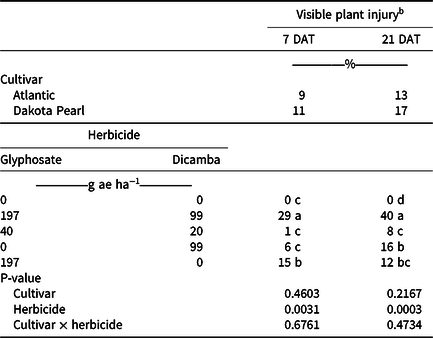
At 7 and 21 DAT, only the main factor of herbicide treatment influenced the visible ratings of plant injury (Table 1). For both cultivars, the high herbicide combination caused the greater visible foliar injury (29%) compared to all other treated and nontreated plants at 7 DAT. Foliar injury symptoms for this treatment increased to 40% by 21 DAT, the highest injury rating. Plants that were treated with dicamba at 99 g ha−1 alone or the low herbicide combination had low visible injury symptoms 7 DAT and did not differ from the nontreated plants. However, by 21 DAT, foliar injury increased to 16% and 8% for plants treated with dicamba at 99 g ha−1 alone and the low herbicide combination, respectively. Furthermore, plants treated with glyphosate at 197 g ha−1 alone exhibited 15% foliar injury 7 DAT, which was less than the injury for plants treated with the high herbicide combination but more injury than for plants treated with the low herbicide combination or dicamba alone. At 21 DAT, plants treated with 197 g ha−1 glyphosate alone exhibited 12% foliar injury, which was similar to the injury for plants treated with dicamba at 99 g ha−1 alone or the low herbicide combination. All plants treated with an herbicide had more visible injury than the nontreated plants at 21 DAT.
Table 1. Visible plant injury ratings 7 and 21 d after treatment during tuber initiation growth stage for regionally grown chipping potato cultivars in 2018 at Oakes, ND. a
a Abbreviation: DAT, days after treatment.
b Numbers followed by the same letter in a section column are not significantly different according to LSD mean separation comparison at α = 0.05.
Previous research has shown that ‘Russet Burbank’ visible injury from sublethal rates of dicamba, glyphosate, or combinations of both herbicides varied drastically between locations (Hatterman-Valenti et al. Reference Hatterman-Valenti, Endres, Jenks, Ostlie, Reinhardt, Robinson, Stenger and Zollinger2017). Hatterman-Valenti et al. reported an approximate 3-fold difference for potato injury at 20 DAT between locations due to environmental differences associated with northern and southern North Dakota trial locations. Plants that showed greater visible injury symptoms were growing at lower air temperatures before, during, and shortly after sublethal herbicide applications, while plants that showed lower visible injury symptoms were stressed from higher air temperatures before, during, and shortly after the sublethal herbicide applications. Colquhoun et al. (Reference Colquhoun, Heider and Rittmeyer2014) also reported variable potato injury in response to sublethal dicamba rates in Wisconsin. Even though their highest dicamba rate was only 7 g ha−1, they reported over a 2-fold difference for foliar injury at 22 DAT between years. However, Felix et al. (Reference Felix, Boydston and Burke2011) reported that ‘Ranger Russet’ foliar injury at 7 DAT was related directly to glyphosate dose. Their foliar injury ranged from 2% for plants sprayed with 8.5 g ha−1 to 49% for those sprayed with 423 g ha−1, but this was with glyphosate for trials conducted in Oregon and Washington. They also reported that injury severity increased with increasing glyphosate dose at 21 DAT and that injury was generally greater at 21 DAT compared to 7 DAT.
Tuber Measurements
Total and Marketable Yield
Only the main effect of herbicide influenced the total yield of ‘Atlantic’ and ‘Dakota Pearl’ (Table 2). The greatest total yield occurred with nontreated plants (46,000 kg ha−1) and when plants were treated with the low herbicide combination (42,000 kg ha−1). Plants treated with the high herbicide combination had the lowest overall total yield (28,000 kg ha−1), which was a 42% yield reduction compared to the nontreated plants. Plants treated with glyphosate or dicamba alone had similar total yields at 34,000 and 35,000 kg ha−1, respectively, and greater than the total yield when plants received the same rates together. However, plants treated with glyphosate or dicamba alone did have a total yield reduction of 21% and 23%, respectively, when compared to the nontreated plants.
Table 2. Tuber measurements of ‘Atlantic’ and ‘Dakota Pearl’ after treatment with sublethal rates of glyphosate and dicamba during tuber initiation growth stage in 2018. a

a Numbers followed by the same letter in a section column are not significantly different according to LSD mean separation comparison at α = 0.05.
Hatterman-Valenti et al. (Reference Hatterman-Valenti, Endres, Jenks, Ostlie, Reinhardt, Robinson, Stenger and Zollinger2017) reported that for ‘Russet Burbank,’ total yield reduction compared to the nontreated plants only occurred at one location and only when plants received the high herbicide combination. At this location, marketable yields were inversely related to the percentage of visible injury observed, while at the second location, where little foliar injury was observed, no differences in marketable or total yield occurred. They concluded that drift from dicamba or dicamba plus glyphosate should have a greater impact on yield than glyphosate alone. Felix et al. (Reference Felix, Boydston and Burke2011) reported that U.S. No. 1 potato yield was inversely related to glyphosate dose and shikimic acid accumulation. However, Colquhoun et al. (Reference Colquhoun, Heider and Rittmeyer2014) reported that the relationship between potato injury and tuber yield was poor and highly variable in both years. This may be attributed to the lower dicamba rates that were applied in their study, which were between 1.4 and 7.0 g ha−1, and the more erratic weather conditions in the northcentral United States compared to the Pacific Northwest. Results from the current trials suggest that unlike for ‘Russet Burbank,’ drift from glyphosate or dicamba plus glyphosate had a greater impact on yield than dicamba alone for ‘Atlantic’ and ‘Dakota Pearl’ chipping cultivars.
Graded Tubers
At the tuber weight category >282 g, only the herbicide treatments influenced tuber yield (Table 2). However, at the tuber weight categories <113, 113 to 169, and 170 to 182 g, the interaction of cultivar and herbicide treatments influenced plant tuber size. For tubers in the <113 g weight category, the response from both cultivars was similar, except that ‘Atlantic’ plants treated with dicamba alone had low small/cull tubers, similar to the nontreated plants, while ‘Dakota Pearl’ plants treated with dicamba alone had more small/cull tubers than the nontreated plants. ‘Dakota Pearl’ plants treated with glyphosate alone also had approximately twice as many small/cull tubers compared to ‘Atlantic’ plants treated with glyphosate alone, which suggested that ‘Dakota Pearl’ was more sensitive to glyphosate than ‘Atlantic.’ The greatest number of <113 g tubers when plants from both cultivars were treated with glyphosate also suggested that glyphosate slowed tuber bulking and therefore the plants produced smaller tubers. The greater sensitivity of ‘Dakota Pearl’ to glyphosate was reinforced with the 113 to 169 g and 170 to 282 g weight categories. In both instances, ‘Dakota Pearl’ plants that received glyphosate alone had lower category yields when compared to ‘Atlantic’ plants that received the glyphosate-alone treatment.
The cultivar × herbicide interaction at 113 to 169 g weight category occurred because ‘Atlantic’ plants treated with dicamba either alone or in combination with glyphosate yielded less than the nontreated plants, while ‘Dakota Pearl’ plants treated with glyphosate either alone or in combination with dicamba yielded less than the nontreated plants. The lowest yield for this category occurred when ‘Dakota Pearl’ plants were treated with glyphosate alone and was similar to the category yield when ‘Dakota Pearl’ or ‘Atlantic’ plants were treated with the high herbicide combination.
The cultivar × herbicide interaction at the 170 to 282 g weight category was again due to the glyphosate sensitivity of ‘Dakota Pearl’ compared to ‘Atlantic.’ ‘Dakota Pearl’ plants treated with glyphosate alone produced 2,000 kg ha−1, which was similar to the category yield when plants from either cultivar received the high herbicide combination. In contrast, ‘Atlantic’ plants treated with glyphosate alone produced 7,000 kg ha−1, which was similar to the category yield when plants from either cultivar received dicamba alone or the low herbicide combination.
As previously mentioned, the >282 g weight category only had herbicide treatments influence tuber yield. The nontreated plants had the greatest yield (13,000 kg ha−1) for this category, and this yield was greater than the category yields for plants in all the other treatments. Plants that received the high herbicide combination had the largest yield reduction when compared to the nontreated plants, at 85%, but this response was similar to plants treated with glyphosate alone or dicamba alone, with a reduction of 62% to 77%, respectively, compared to the nontreated plants.
All plants that were treated with an herbicide generally produced smaller tubers, with several to many of these tubers misshaped. Typical misshaped symptoms were growth cracks near the bud ends of tubers and elephant hide skin. According to the U.S. Standards for Grades of Potatoes for Chipping, a lot of potatoes designated as size A shall contain at least 40% of the potatoes 170 g in weight or larger with a minimum diameter of 47.7 mm (approximately 113 g for tests conducted at NDSU) and less than 10% external defects (USDA-AMS 1997). Only the nontreated for ‘Atlantic’ (54%), nontreated for ‘Dakota Pearl’ (45%), and ‘Atlantic’ plants that were treated with the low herbicide combination (41%) produced tubers large enough to meet the 40% size A designation and had less than 10% external defects.
Crook (Reference Crook2016) reported that ‘Red Norland’ potato yield was negatively affected when glyphosate rates were applied at TI rather than at early or late bulking. When glyphosate doses were applied at the TI stage, the number of unmarketable tubers per plant due to external defects increased by 1.8 as glyphosate dose was increased by 50 g ha−1, going from a low of 2 unmarketable tubers per plant to 12 unmarketable tubers per plant as the glyphosate dose was increased. Colquhoun et al. (Reference Colquhoun, Heider and Rittmeyer2014) reported that although significant ‘Russet Burbank’ differences within tuber grade and weight classes were observed in the first study year, no discernible trends could easily be explained based on injury estimates, and no differences in total tuber yield were observed with sublethal rates of dicamba, at 1.4, 4.2, and 7.0 g ha−1. They attributed the lack of yield differences to fewer larger tubers and an increase in tubers <113 g within the dicamba treatments. Results from this experiment suggest that both cultivars responded to sublethal applications of dicamba, glyphosate, or the combination of both herbicides by producing fewer size A tubers for processing but that ‘Atlantic’ plants treated with the low herbicide combination were able to produce tubers large enough to meet the 40% size A designation. ‘Dakota Pearl’ was more sensitive to glyphosate than ‘Atlantic,’ causing the interaction for most tuber grades. Misshaped and elephant hide–skinned tubers that resulted from the herbicide application to plants at the TI stage may also have consequences if tubers were to be certified as seed.
Specific Gravity
Only the main effect of herbicides influenced tuber specific gravity (Table 3). Nontreated plants had the greatest specific gravity (1.1054), but this did not differ from the tuber specific gravity when plants were treated with the low herbicide combination. Plants treated with dicamba or glyphosate alone or the high herbicide combination did produce tubers with lower specific gravity than tubers from nontreated plants. While plants treated with glyphosate, dicamba, or the herbicide combinations did produce tubers with reduced tuber specific gravity, all values were within the minimum USDA standard for chip processing of 1.080 (Riaz Reference Riaz2016). Obtaining a high specific gravity can limit the cook time and oil absorbed into the tuber during processing (Stark and Love Reference Stark and Love2003). Tuber size can affect tuber specific gravity; large tubers tend to have a higher specific gravity compared to smaller tubers. This may help explain why plants that were treated with herbicides and produced more small tubers had lower specific gravity values. Even though all treatments were above the specific gravity of 1.080, there could be a hidden processing cost associated with lower tuber specific gravity due to increased oil usage during frying.
Table 3. Specific gravity of ‘Atlantic’ and ‘Dakota Pearl’ tubers 2 mo after being in storage at 2.2 C with 90% to 95% relative humidity in 2018.
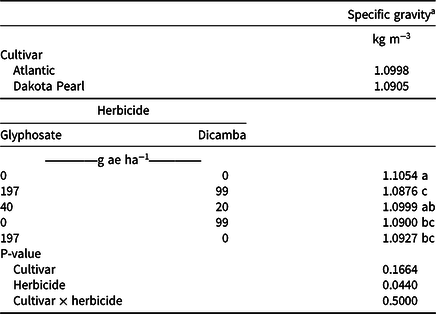
a Numbers followed by the same letter in a section column are not significantly different according to LSD mean separation comparison at α = 0.05.
Colquhoun et al. (Reference Colquhoun, Heider and Rittmeyer2014) reported no change in tuber specific gravity (1.070 to 1.080) in ‘Russet Burbank’ tubers that were sprayed at TI with glyphosate at 7 g ha−1 or dicamba at 1.4, 4.2, or 7 g ha−1. None of the other research that evaluated the effects of sublethal dicamba or glyphosate rates on potatoes examined tuber specific gravity. A high specific gravity indicates a higher dry matter content within the tuber and is an important quality to have within a chipping potato. A potato with a low specific gravity indicates more water content within the tuber, which makes it costlier to process because there is more water to fry off. Current results suggest that treatment of sublethal dicamba, glyphosate, or the combination of both herbicides to either ‘Atlantic’ or ‘Dakota Pearl’ will result in reduced tuber specific gravity compared to nontreated tubers but that the reduction will not prevent chip processing.
Conclusion
This is the first study to investigate the impact of sublethal glyphosate and dicamba rates on white-skinned chipping potatoes. Results indicate that the cultivars ‘Atlantic’ and ‘Dakota Pearl’ had similar foliar injury symptoms when treated with sublethal rates of glyphosate, dicamba, or the combination of both herbicides and that, in general, greater visible injury was associated with lower total yields and lower tuber specific gravity. When ‘Dakota Pearl’ plants were treated with glyphosate alone, more tubers were produced at the lowest weight category (<113 g) and fewer were produced at all other tuber weight categories, except >282 g, when compared to ‘Atlantic.’ Both cultivars responded to sublethal applications of dicamba, glyphosate, or the combination of both herbicides by producing fewer size A tubers for processing, but ‘Atlantic’ plants treated with the low herbicide combination were able to produce tubers large enough to meet the 40% size A designation. ‘Dakota Pearl’ was more sensitive to glyphosate at 197 g ha−1 than was ‘Atlantic.’ Growers of soybean and other dicamba or glyphosate-resistant/tolerant crops with fields adjacent to chipping potatoes should always take precautions when spraying glyphosate and/or dicamba and know the impacts if there is off-target movement. Future research should determine herbicide residues at harvest associated with various sublethal rates (simulated drift) and the variation that may occur depending on the potato growth stage and environmental conditions.
Acknowledgments
No conflicts of interest have been declared. This research received no specific grant from any funding agency or the commercial or not-for-profit sectors. The authors thank the Oakes Research and Extension site personnel Kelly Cooper and Heidi Eslinger for their assistance with plot maintenance.


 Open access

