

1. Introduction
Artisanal and small-scale gold mining (ASGM) produced about one fifth of the world’s gold output in 2014, with roughly 16–20 million miners operating primarily in low- and middle-income countries (Seccatore et al., Reference Seccatore, Veiga, Origliasso, Marin and De Tomi2014). ASGM supports the livelihoods of 50 to 150 million people globally (World Bank, 2019; Cheng et al., Reference Cheng, Watari, Seccatore, Nakajima, Nansai and Takaoka2023; Keane et al., Reference Keane, Bernaudat, Davis, Stylo, Mutemeri, Singo, Twala, Mutemeri, Nakafeero and Etui2023; IGF, 2024).
However, ASGM is also the largest anthropogenic source of atmospheric mercury pollution (Seccatore et al., Reference Seccatore, Veiga, Origliasso, Marin and De Tomi2014; Esdaile and Chalker, Reference Esdaile and Chalker2018; Martinez et al., Reference Martinez, Restrepo-Baena and Veiga2021). Mercury and its compounds are highly toxic, posing serious risks to human and environmental health (Nevado et al., Reference Nevado, Martín-Doimeadios, Bernardo, Moreno, Herculano, Do Nascimento and Crespo-López2010; Basu et al., Reference Basu, Horvat, Evers, Zastenskaya, Weihe and Tempowski2018; Gerson et al., Reference Gerson, Driscoll, Hsu-Kim and Bernhardt2018; Zulaikhah et al., Reference Zulaikhah, Wahyuwibowo and Pratama2020). As ASGM contributes to livelihoods and global pollution, many programs aim to reduce emissions while preserving economic benefits.
The Minamata Convention on Mercury highlights the need for intervention within ASGM (UNEP, 2013). It requires all countries with more than insignificant ASGM sectors to create National Action Plans to eliminate worst practices and to define targets for mercury reduction. The funding for pilot programs to support these efforts has been disbursed by the Global Environmental Facility, through the planetGOLD initiative. Its first phase is just concluding – although it has been reauthorized, notably with over twice the budget (GEF, 2021; planetGOLD, 2024).
Unfortunately, the most common intervention in the planetGOLD program and in ASGM overall, i.e., miner-level gravimetric technology, has yielded little adoption or attributable emissions reductions see reviews in Veiga and Fadina (Reference Veiga and Fadina2020), Veiga and Gunson (Reference Veiga and Gunson2020); Martinez et al. (Reference Martinez, Restrepo-Baena and Veiga2021), Keane et al. (Reference Keane, Bernaudat, Davis, Stylo, Mutemeri, Singo, Twala, Mutemeri, Nakafeero and Etui2023), Veiga et al. (Reference Veiga, Anene and Silva2025). Miner-level technologies which replace uses of mercury with gravity concentration to extract gold can, in principle – e.g., in lab settings – both reduce mercury use and increase gold yields. Thus, if their adoption costs were low, new technologies could raise income via yield. Yet, miners do not adopt them (or, at the least, it is not documented). Even when mercury use fell, reductions could not clearly be attributed to technologies at the miner level (García et al., Reference Garcia, Veiga, Cordy, Suescun, Molina and Roeser2015).
Reasons for non-adoption are many. Technologies require capital to buy and expertise to operate and optimize. New technologies often have “hidden” costs related to peripheral equipment and consumables (generators, fuel, and clean water). The combined forces of informality, limited tenure stability, and a lack of access to finance make the purchase of new technologies difficult and risky for miner and lender alike. Powerful actors within supply chains benefit from this status quo, as informal financiers and landlords, so they may act to limit small actors’ abilities to adjust (Veiga et al., Reference Veiga, Angeloci, Hitch and Velasquez-Lopez2014; Hook, Reference Hook2019; Smith, Reference Smith2019; Veiga and Fadina, Reference Veiga and Fadina2020; Verbrugge et al., Reference Verbrugge, Lanzano and Libassi2021; Bugmann et al., Reference Bugmann, Brugger, Zongo and van der Merwe2022; Keane et al., Reference Keane, Bernaudat, Davis, Stylo, Mutemeri, Singo, Twala, Mutemeri, Nakafeero and Etui2023). These constraints make uptake of complex technologies far more difficult. Thus, mercury remains the cheapest, and easiest, way to extract gold (Veiga and Fadina, Reference Veiga and Fadina2020).Footnote 1
Ore-selling provides an alternative mercury-free option that could eliminate these hurdles for the miner and has been employed in Central and South America. Sales of ore between small miners and large-scale processing plants (plantas de beneficio) that own and operate mercury-free circuits could raise miners’ incomes by raising gold yields while at the same time reducing mercury use (Veiga and Fadina, Reference Veiga and Fadina2020; Veiga and Gunson, Reference Veiga and Gunson2020; Martinez et al., Reference Martinez, Restrepo-Baena and Veiga2021; Veiga et al., Reference Veiga, Restrepo-Baena and De Tomi2022).Footnote 2 Yet, to our knowledge, rigorous evaluations of ore-selling’s impacts on small miners’ incomes and mercury use do not exist, despite some ore-selling having already been privately adopted. Based on the available information, it is difficult to know how much miner populations and processing plants benefited from ore-selling and under what conditions – for instance, to what extent benefits vary by ore-selling arrangement or with specific actor types, mineralogy, or legal frameworks (Veiga and Fadina, Reference Veiga and Fadina2020; Veiga et al., Reference Veiga, Restrepo-Baena and De Tomi2022). If any such model is to be promoted as a private or public solution, however, then its requirements and net benefits for miners and processing plants need to be clearer. This motivates our inquiries.
ASGM is quite heterogeneous (Fisher, Reference Fisher2007; Buss et al., Reference Buss, Rutherford, Stewart, Cote, Sebina-Zziwa, Kibombo, Hinton and Lebert2019; Crespo-Lopez et al., Reference Crespo-Lopez, Arrifano, Augusto-Oliveira, Macchi, Lima, do Nascimento and Souza2023). Historically, larger actors, such as processing plants, gained more from technological advances in the sector (Verbrugge et al., Reference Verbrugge, Lanzano and Libassi2021). Keane et al. Reference Keane, Bernaudat, Davis, Stylo, Mutemeri, Singo, Twala, Mutemeri, Nakafeero and Etui(2023) call to analyze the conditions under which any ore-selling initiatives generate net benefits for specific mining groups, given distinct sub-populations of ASGM with varied output and pollution. International and national government interventions often try to help the most vulnerable groups, often referred to as ‘micro-miners’ given their limited gold output. These groups may face barriers to adopting non-mercury options, due to a lack of formality and unfavorable power relations with other actors in supply chains, and can be among the most intensive mercury users per unit of ore.
In Ecuador, the female waste-rock collectors (jancheras) have been identified as micro-miners, as well as intense users of mercury, within the National Action Plan’s baseline study (Ministerio del Ambiente y Agua, 2020). Because many jancheras work within this sector due to a lack of other opportunities, they are targeted beneficiaries for a number of public interventions (e.g., Ministerio del Ambiente y Agua, 2020; Ministerio del Ambiente, 2020; Ministerio de Energía y Minas, 2022). The planetGOLD Ore-Selling Strategy evaluated the feasibility of targeting the jancheras before discovering participation barriers (see below) that led the program to focus upon other ASGM sub-populations.
We combine field observations, surveys, and a choice experiment with 236 jancheras to assess ore-selling’s potential for jancheras. We drew upon extensive field work to determine survey questions and the hypotheses we test in our experiment. Our choice experiment to elicit jancheras’ preferences uses qualitative feedback to select the ore-selling dimensions of greatest consequence and to assign locally relevant values. Facing our choice options – presented in a manner efficient for inference – respondents revealed how they traded off across the dimensions in choosing between two randomly generated ore-selling offers versus opting out (taking no offer, thus continuing status quo processing). We estimate statistical models on the choice data to infer willingness to accept offers’ components, as well as compute the probabilities of adoption for specific offers, on average and for sub-groups.
We find many jancheras are interested in ore-selling yet could not participate in the proposed OSS pilot design due to lack of formality, access to material, and associations to aggregate material. Initiatives’ impacts could rise if relevant populations are defined, studied, and targeted earlier. While ore-selling has promise, it will not be viable for some small mining actors without complementary interventions that address the kinds of barriers our preference revelation has identified as critical.
Below, section 2 discusses the background of the ore-selling strategy, the janchera population, and the options for mineral processing for ASGM. Section 3 describes the methods for our surveys, with a discrete-choice experiment. Section 4 reports the results of the survey and choice experiment, then section 5 discusses their implications, including the follow-ups that occurred after the project.
2. Background
2.1. Ore-selling strategy
We study an ore-selling strategy (OSS) developed by the Program of National Chemical Management (PNGQ) in Ecuador. PNGQ is a partnership between the United Nations Development Program, Ecuador’s Environment and Energy Ministry, and its Non-Renewable Natural Resources Ministry funded by the Global Environment Facility (GEF) in 2017. As it aligns with goals of planetGOLD,Footnote 3 OSS was adopted into the initial cohort of planetGOLD’s mercury-free-solutions pilots for ASGM. Related efforts in Ecuador have since received funding to continue within planetGOLD’s Phase 2.
OSS initially required procuring and putting into operation a processing plant (10 tons/day) for demonstrating gravimetric mercury-free processing methods to miners. However, the program evolved over time as program managers discussed options to offer alternatives for ASGM actors:
(1) The program approached the National Mining Company, ENAMI EP, which said it would only be willing to administer such a processing plant if all the operating costs were covered.
(2) It next approached a large mining firm, Lundin Gold, which works with artisanal miners on its concession to resolve conflicts and support livelihoods. Lundin expressed concerns about traceability – it is difficult to ensure all ore is from legal sources – and, further, that adopting such an OSS might generate conflict by enticing miners to mine illegally on its concession.
(3) PNGQ next tried to identify any artisanal group which could directly administer a new plant, but policymakers predicted artisanal groups would dismantle the plant for short-term profits.
(4) OSS then supported existing processing plants, initially selecting three (two in Camilo Ponce Enriquez and one in Portovelo) to receive valued equipment for their operations, in exchange for agreeing to pilot ore-selling with smaller miners. They also strengthened local independent laboratories.
2.2. Potential target beneficiaries: jancheras
A group identified early as potential beneficiaries of this program were jancheras – mostly women – who collect waste rock from other operations (Velásquez-López et al., Reference Velásquez-López, Páez-Varas, Benavides-Zúñiga, Gallegos and Fallon2020). OSS highlighted them for gender equality and mercury reduction.Footnote 4 Women are excluded from traditional artisanal mining, make less from the same activities, have more family responsibilities, and have less access to finance (Buss et al., Reference Buss, Rutherford, Stewart, Cote, Sebina-Zziwa, Kibombo, Hinton and Lebert2019; Reichel, Reference Reichel2020).Footnote 5 These factors lock jancheras into using mercury when processing waste rock.Footnote 6 While 1000 to 2000 regular membersFootnote 7 represents a small population, within Ecuador’s ASGM population, jancheras are highlighted in Ecuador’s National Action Plan due to their mercury usage and vulnerable status as low-income women e.g., Ministerio del Ambiente (2020), Ministerio del Ambiente y Agua (2020), Ministerio de Energía y Minas (2022). They also may face barriers to adopting ore-selling, which would prevent behavior changes of similar groups in Peru, Colombia and elsewhere.
2.3. Gold extraction processing methods for ASGM primary deposits in Ecuador
Mercury is used to concentrate gold. In primary deposits (hard rock), ore is crushed to liberate gold, then processing depends on ore type and grade. Crushed ore may be: gravimetrically concentrated, using a sluice or a centrifuge; further concentrated, using surface chemical methods (amalgamation or flotation); leached, using cyanide; or a combination.Footnote 8 As this can require expensive equipment that is out of reach for artisanal/small-scale miners, private processing plants exist throughout the region.
In 2012, 48 processing plants opened in Camilo Ponce Enriquez, adding to over 80 processing plants in Portovelo-Zaruma (Veiga et al., Reference Veiga, Angeloci, Hitch and Velasquez-Lopez2014). As of 2021, 153 processing plants were registered in Azuay and El Oro provinces, the respective locations of Camilo Ponce Enriquez and Portovelo-Zaruma (Delaune and Costa, Reference Delaune and Costa2022). These plants vary in how they procure ore. Some have concessions that supply ore, while others rely exclusively upon jancheras, artisanal, small-scale, and even medium-scale miners. Some combine material from others and their own concessions or affiliated mining companies.
For ASGM, the two main types of processing plant are mercury-intensive and mercury-free. Common versions of the former in Camilo Ponce Enriquez are chanchas, which offer access to ball mills and mercury to grind and process a miner’s ore in small batches. As ore is crushed, the liberated gold is inefficiently amalgamated and concentrated, in a process called whole-ore amalgamation. The resulting amalgam can be heated, or ‘burned’, to evaporate the mercury to reveal ‘sponge gold’, which can be sold locally. This grinding and processing can be done relatively quickly, in exchange for a nominal fee, or indeed even for free, yet miners must leave behind their gold-rich, mercury-contaminated tailings.Footnote 9
Such plants often incentivize miners to process at their facilities by paying for ore transport and offering air-conditioned lounges with amenities, as well as the services of technicians to operate machinery and burn amalgams. These plants get little upfront revenue from fees for those services, yet still can reap huge profits because these miners are leaving ∼70 per cent of the gold behind, in tailings, which the chanchas will then reprocess (Cordy et al., Reference Cordy, Veiga, Salih, Al-Saadi, Console, Garcia, Mesa, Velásquez-López and Roeser2011; Veiga et al., Reference Veiga, Angeloci, Hitch and Velasquez-Lopez2014). Whole-ore amalgamation and the reprocessing of mercury-contaminated tailings, using cyanide, are deemed “worst practices” by the Minamata Convention (UNEP, 2013).
After having extracted only ∼30 per cent of the gold at a chancha (Veiga et al., Reference Veiga, Nunes, Klein, Shandro, Velasquez and Sousa2009),Footnote 10 per above, these smaller mining actors typically sell to informal gold buyers or to “gold shops”, who often offer them only ∼70 per cent of gold’s international price. Shops earn profit by later reselling at a higher price (as field observations suggest mercury-intensive processing does not stop gold from reaching the world, just increasing intermediaries). Thus, in total, these miners receive only ∼22.5 per cent of ore’s gold value.
Non-mercury processing plants use cyanide leaching, or flotation, depending upon their ore. Economically, plants which process more ore than their own operations supply typically offer others what is referred to locally as “plant rental.” Miners pay input costs, a fee for processing and a small percentage of the output value, in exchange for mineral extraction services conducted by plant technicians (although typically supervised by at least one representative of the mining group). Based upon our fieldwork, we understand upfront payments sum to US$10,000–12,000 per 100 tons. While there is a non-mercury-processing model in this landscape, then, it is out of reach for typical small (small artisanal or jancheras) extractor groups, who typically have only limited access to capital.
3. Survey statistics
3.1. Sample
We conducted a face-to-face survey with 236 jancheras around Camilo Ponce Enriquez (figure 1) in October and November of 2022. Questions were read aloud and responses were recorded using a phone-based module in KoboToolbox.Footnote 11 Our survey focused on socio-demographic characteristics, processing practices, working methods, trust, and mercury use and exposure. Our choice experiment showed printed choice cards to each respondent, with verbal explanations for each ore-selling offer.
Map of Ecuador and survey points.
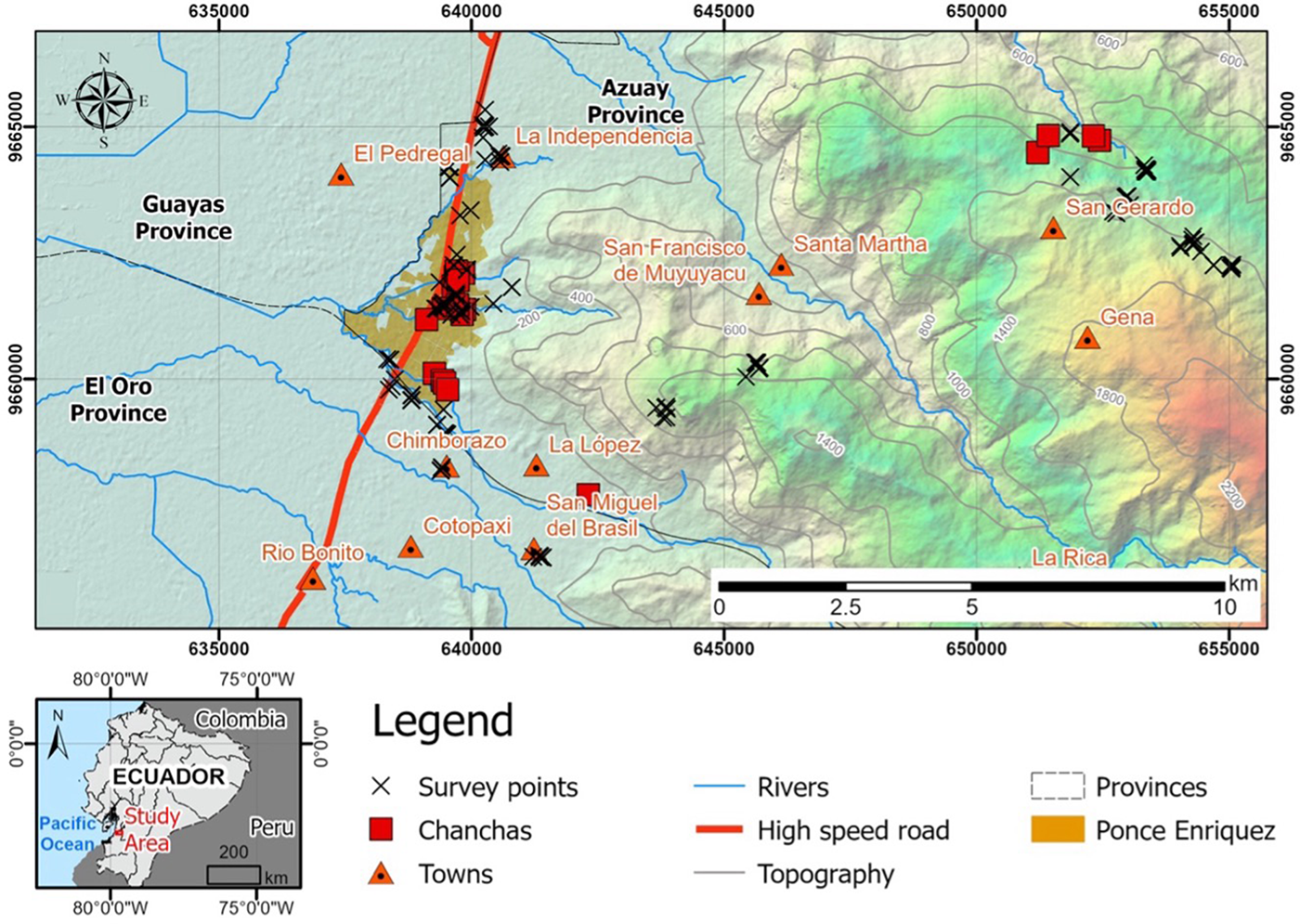
Figure 1 Long description
The map of Ecuador focuses on the area around Camilo Ponce Enriquez, highlighting various geographic and survey elements. Survey points are marked with crosses, distributed mainly along the high-speed road running north-south through the map. Chanchas are represented by red squares, concentrated near El Pedregal and San Gerardo. Towns are indicated by orange triangles, including El Pedregal, Chimborazo, Cotopaxi, San Miguel del Brasil, La López, San Francisco de Muyuyacu, Santa Martha, San Gerardo, Gena and La Rica. Rivers are shown in blue, flowing through the provinces of Guayas, El Oro and Azuay. The high-speed road is marked in red, traversing the map vertically. The topography is depicted with contour lines, indicating elevation changes across the region. Provincial boundaries are outlined with dashed lines and the area of Ponce Enriquez is shaded in yellow. The inset map shows the location of the study area within Ecuador, bordered by Colombia and Peru.
Given a lack of data on the location or number of janchera groups,Footnote 12 we used a two-pronged recruitment strategy. First, we introduced our survey team to groups in meetings (convocatorias) called by janchera leaders. Second, we visited janchera groups at sites identified via local connections. We framed the jancheras’ participation within this ore-selling study as a voluntary exploration of their needs, without any promises of direct benefits from OSS or other programs.
We held 12 meetings with large janchera groups convened by local leaders. These included individuals from groups such as: Unión y Progreso, Mujeres Emprendedoras en Alianza, Asociación de Mujeres Emprendedoras 4 de Junio, Reina del Cisne, Rumi Kuri, Fuerza Dorada, Virgen del Cisne, Mujeres Seleccionadoras de Material, Las Águilas, La Fortuna, La Unión, and the Asociaciones de Seleccionadoras de Muyuyacu. Site visits were guided by community leaders and collaborators from Escuela Superior Politécnica del Litoral (ESPOL), who have long-term relationships with miners in this region. Our resulting sample (table 1) likely represents jancheras who could participate in ore-selling in the short run. We could not access jancheras on tightly controlled sites or those with strong ties to mercury-processing facilities, who likely have limited autonomy to switch processing methods.
Janchera groups sampled and estimated population numbers
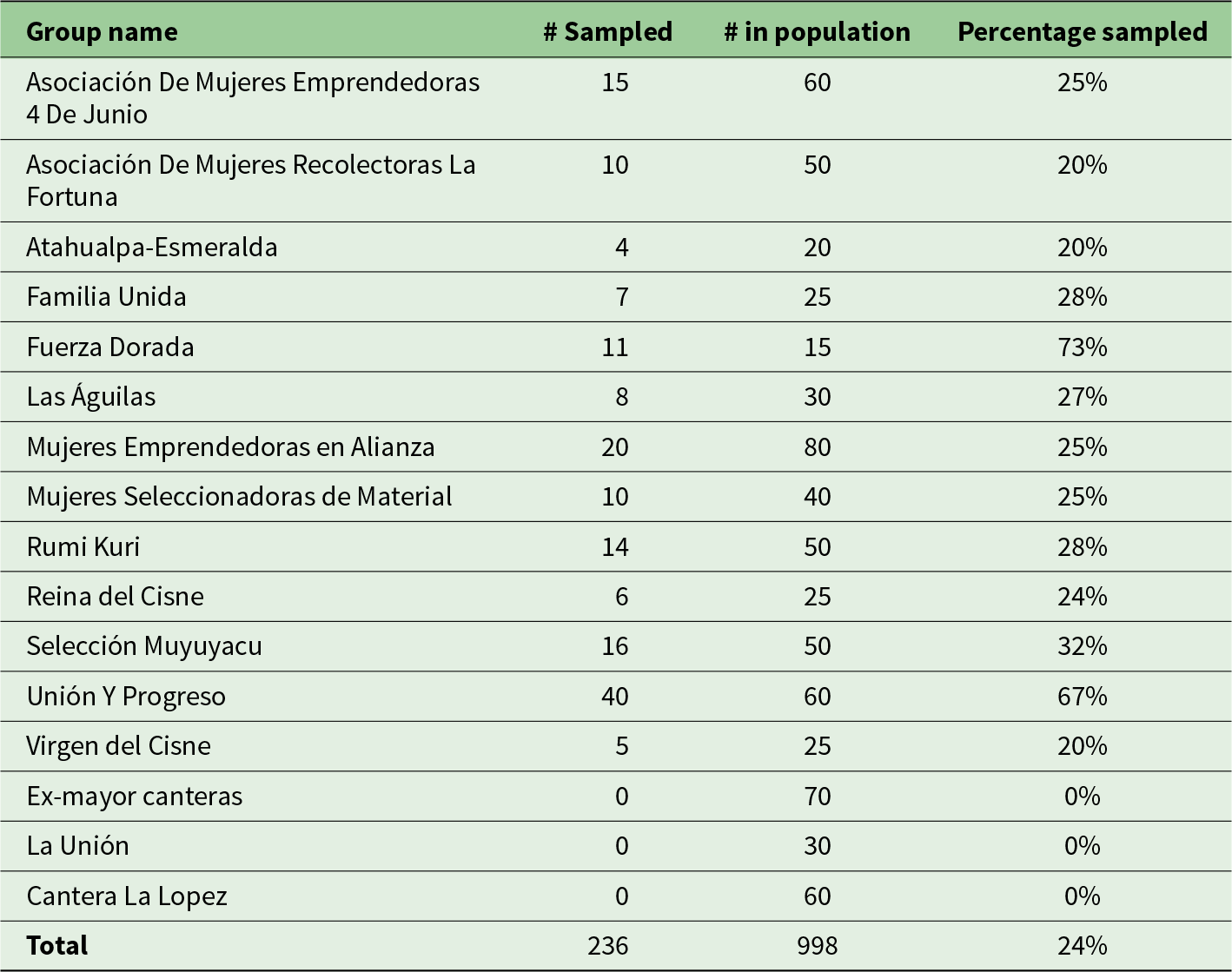
Table 1 Long description
The table has four columns: Group name, Number sampled, Number in population and Percentage sampled. Row 1: Asociación De Mujeres Emprendedoras 4 De Junio, 15, 60, 25 percent. Row 2: Asociación De Mujeres Recolectoras La Fortuna, 10, 50, 20 percent. Row 3: Atahualpa-Esmeralda, 4, 20, 20 percent. Row 4: Familia Unida, 7, 25, 28 percent. Row 5: Fuerza Dorada, 11, 15, 73 percent. Row 6: Las Águilas, 8, 30, 27 percent. Row 7: Mujeres Emprendedoras en Alianza, 20, 80, 25 percent. Row 8: Mujeres Seleccionadoras de Material, 10, 40, 25 percent. Row 9: Rumi Kuri, 14, 50, 28 percent. Row 10: Reina del Cisne, 6, 25, 24 percent. Row 11: Selección Muyuyacu, 16, 50, 32 percent. Row 12: Unión Y Progreso, 40, 60, 67 percent. Row 13: Virgen del Cisne, 5, 25, 20 percent. Row 14: Ex-mayor canteras, 0, 70, 0 percent. Row 15: La Unión, 0, 30, 0 percent. Row 16: Cantera La Lopez, 0, 60, 0 percent. Total: 236 sampled, 998 in population, 24 percent sampled.
3.2. Descriptive statistics
3.2.1. Population and group dynamics
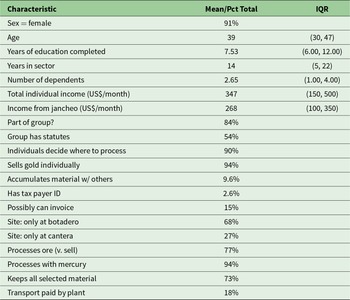
Survey descriptive statistics (table 2) refine our understanding of jancheras. We found 91 per cent women and, on average: 7.5 years of education; 2–3 dependents; and a monthly income below Ecuador’s minimum wage (of US$400/month at the time of the survey). In addition, 84 per cent work in groups, although few (9.6 per cent) pool their materials with others in their group.Footnote 13 This implies that most process and sell individually. Most individuals report bringing less than a ton of material to process, which severely limits their ability to access non-mercury processing options. We found 94 per cent of those who report processing their material admit to amalgamating gold with mercury at least some of the time. These facts suggest that jancheras are quite appropriate intervention beneficiaries, given mercury use as well as the disadvantages that low-income women face in a male-dominated sector. They tend to work in groups, many of which have taken steps to associate and formalize the rules of their groups.
Key characteristics of the janchera population
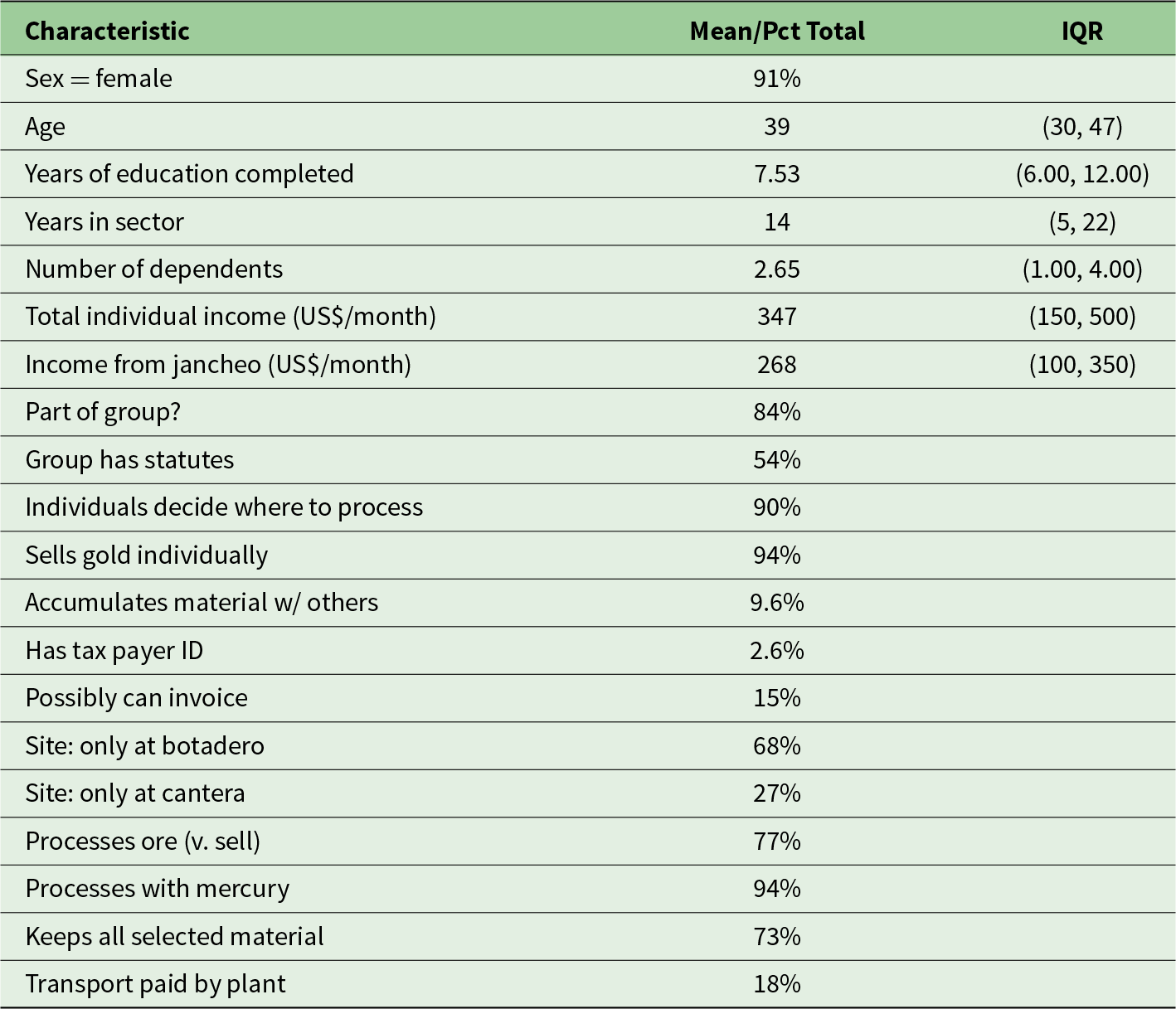
Table 2 Long description
The table has three columns: Characteristic, Mean/Percent Total and IQR. Row 1: Sex equals female, 91 percent, blank. Row 2: Age, 39, left parenthesis 30, 47 right parenthesis. Row 3: Years of education completed, 7.53, left parenthesis 6.00, 12.00 right parenthesis. Row 4: Years in sector, 14, left parenthesis 5, 22 right parenthesis. Row 5: Number of dependents, 2.65, left parenthesis 1.00, 4.00 right parenthesis. Row 6: Total individual income (US dollars/month), 347, left parenthesis 150, 500 right parenthesis. Row 7: Income from jancheo (US dollars/month), 268, left parenthesis 100, 350 right parenthesis. Row 8: Part of group?, 84 percent, blank. Row 9: Group has statutes, 54 percent, blank. Row 10: Individuals decide where to process, 90 percent, blank. Row 11: Sells gold individually, 94 percent, blank. Row 12: Accumulates material with others, 9.6 percent, blank. Row 13: Has tax payer ID, 2.6 percent, blank. Row 14: Possibly can invoice, 15 percent, blank. Row 15: Site: only at botadero, 68 percent, blank. Row 16: Site: only at cantera, 27 percent, blank. Row 17: Processes ore (versus sell), 77 percent, blank. Row 18: Processes with mercury, 94 percent, blank. Row 19: Keeps all selected material, 73 percent, blank. Row 20: Transport paid by plant, 18 percent, blank.
A key heterogeneity within the janchera population concerns the types of sites at which they work. About one-quarter work on sites where machines aid the material selection process (canteras),Footnote 14 while about two-thirds work at traditional sites where mines dump waste rock believed to be low in valuable mineral content (botaderos) and ∼5 per cent work at both types of sites (table 2). Mechanized sites (canteras) are new in this area, as a result of rising gold prices. To work within a cantera, a janchera must sometimes leave half of the materials they help select. Of the 27 per cent who reported leaving some of the material they select at the sites in exchange for access to such ore, most reported working at canteras.
3.2.2. Baseline processing: how many use mercury?
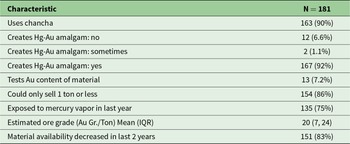
To address whether ore-selling might induce reductions in mercury use and raise jancheras’ incomes, we considered three questions: whether any jancheras are interested in adopting ore-selling; if those with interest are able to adopt in light of key barriers; and whether adoption would generate impacts. For considering the likely mercury impacts of adoption, 3 groups differ in their status quo (table 3) or ‘baseline’ ore-processing habits: mercury-intensive processors (169 of 181); non-mercury processors (up to 12 of 181);Footnote 15 and ore-sellers, who do not process their ore themselves (23 per cent, as per table 2).
Processing practices at baseline
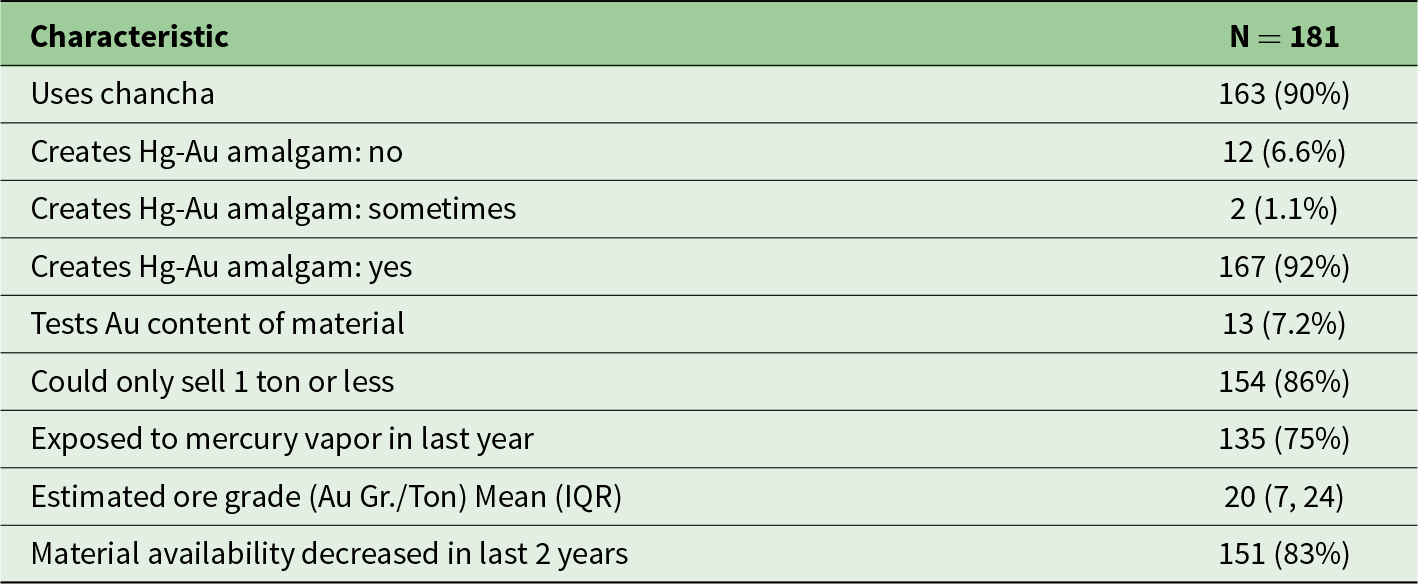
Table 3 Long description
The table has two columns: Characteristic and N = 181. Row 1: Uses chancha 163 (90 percent). Row 2: Creates Hg-Au amalgam: no 12 (6.6 percent). Row 3: Creates Hg-Au amalgam: sometimes 2 (1.1 percent). Row 4: Creates Hg-Au amalgam: yes 167 (92 percent). Row 5: Tests Au content of material 13 (7.2 percent). Row 6: Could only sell 1 ton or less 154 (86 percent). Row 7: Exposed to mercury vapor in last year 135 (75 percent). Row 8: Estimated ore grade (Au Gr./Ton) Mean (IQR) 20 (7, 24). Row 9: Material availability decreased in last 2 years 151 (83 percent).
The first group contains most of the jancheras in our sample. The second group is small, within our sample (and likely even a smaller fraction of the full population, see supplementary material appendix C). These are the jancheras who appeared to have access to the “plant rental model” due to some relatively unusual characteristics (for instance, high education or a group with a well-connected leader). The third sub-group, larger than the second, sell their raw material to site owners or to intermediaries instead of processing.
4. Experiment methods
4.1. Discrete choice experiment
We used a discrete choice experiment to elicit janchera rankings of potential ore-selling offers. Miners saw seven choice tasks, each with two hypothetical ore-selling offers plus a “take neither” option to indicate that they would rather continue with their status quo, i.e., process and sell material as they currently are doing. Such “opt-out” options are commonly added within discrete-choice experiments to avoid “forced choices”, which also adds realism (Veldwijk et al., Reference Veldwijk, Lambooij, de Bekker-Grob, Smit and de Wit2014; Determann et al., Reference Determann, Gyrd-Hansen, De Wit, De Bekker-Grob, Steyerberg, Lambooij and Bjornskov Pedersen2019).
We designed the choice tasks using a Dz-efficiency algorithm in Stata (Hole, Reference Hole2017; Szinay et al., Reference Szinay, Cameron, Naughton, Whitty, Brown and Jones2021), with no priors,Footnote 16 given the lack of prior information about ore-selling preferences. This algorithm reduced from 2,016 possible choice tasks to 28, with 56 unique offers (plus, in each card, a “take neither” option).Footnote 17 Dz-designs are similar to making choice tasks ‘orthogonal’,Footnote 18 i.e., showing different attribute levels at equal rates with zero correlation (Hensher et al., Reference Hensher, Rose and Greene2015) but often are more efficient than ‘orthogonal’ designs, due to a more conservative scaling factor (Bliemer and Collins, Reference Bliemer and Collins2016).Footnote 19
While the blocks (seven choice tasks per block) were randomized by respondent, we did not randomize the order of the cards within blocks or the alternatives within a card. Per potential bias related to order within a card, we used a constant for the “left” offer to control for respondents preferring the first offer they see. We found its estimated coefficient was near zero and insignificant (we removed this from tables to avoid confusion but it is shown in supplementary material appendix table A4).
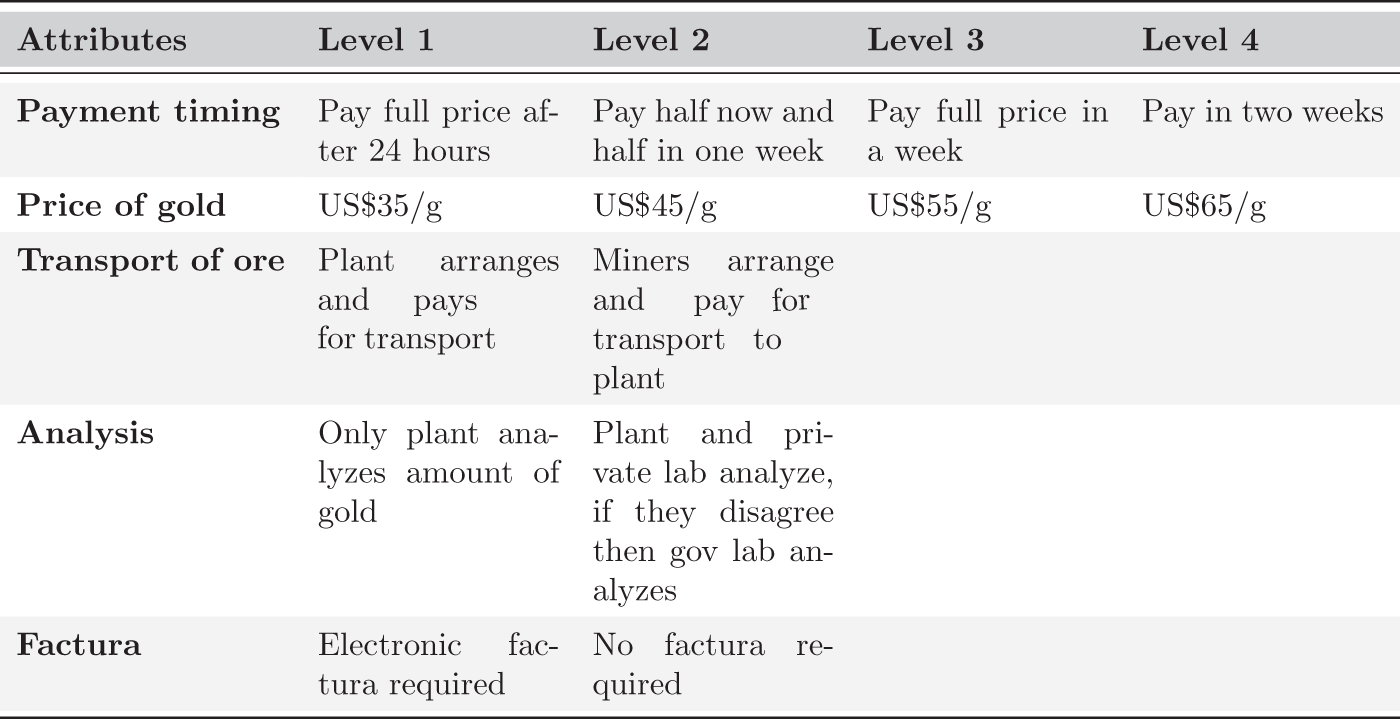
Offer attributes, and their levels, were based upon an actual offer by a plant in the PNGQ’s potential intervention, plus conversations with partners about how offers could adjust in the future (figure 2). The choice experiment was field tested within the research team and in a pilot with 44 miners in May 2022 to validate these attributes and levels: gold price (US$35–65/gram); time between ore delivery and payment (24 hours, half in 24 hours and half in 1 week, full payment in 1 week, full in 2 weeks); who pays to transport the ore to the plant (plant vs. miners); whether an electronic invoice is required (yes vs. no); and whether a third-party metallurgical test is available (yes vs. no), in addition to the testing done at the processing plant to determine mineral content. Initially, we had an attribute with minimum tonnages (2–8 tons), but after initial field testing, we eliminated it – most jancheras process and sell ore individually and would take a very long time to amass ∼8 tons.Footnote 20
Attributes and levels in the choice experiment.
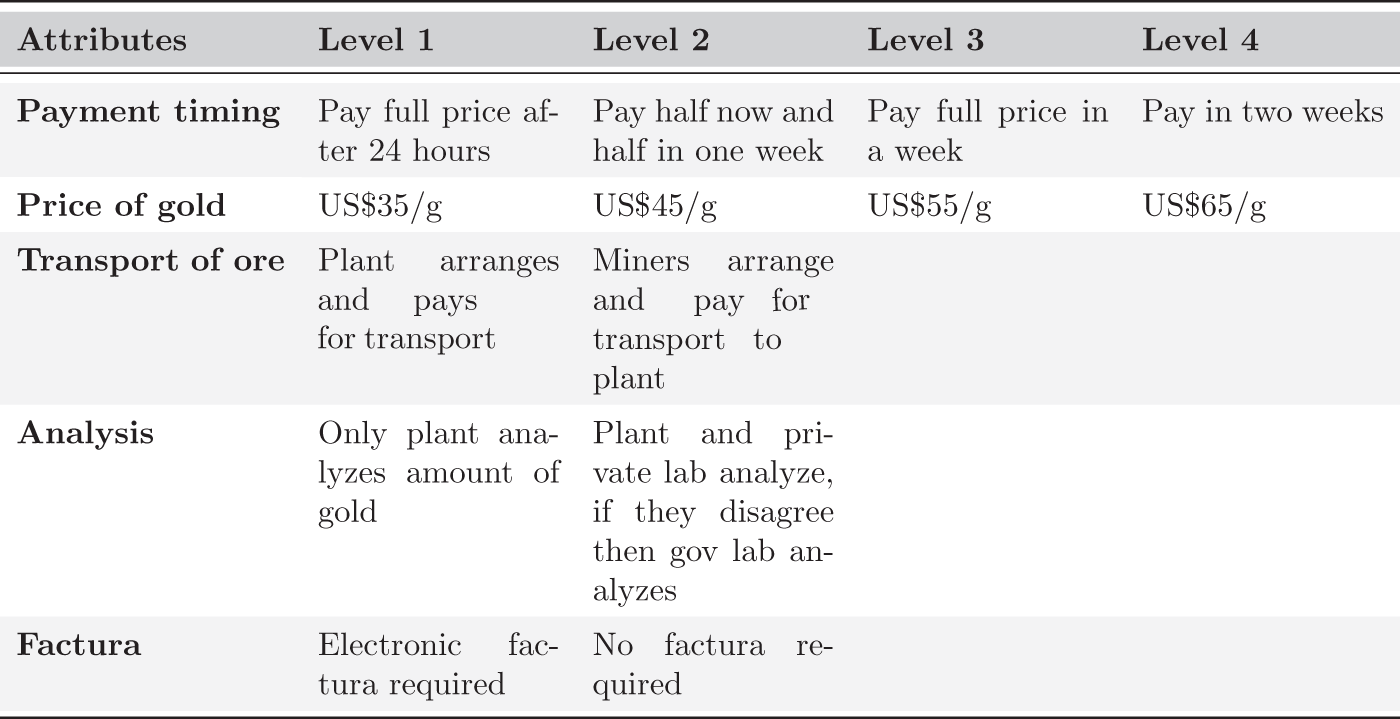
Figure 2 Long description
The table has five columns: Attributes, Level 1, Level 2, Level 3, Level 4. Row 1: Payment timing - Pay full price after 24 hours; Pay half now and half in one week; Pay full price in a week; Pay in two weeks. Row 2: Price of gold - US dollars 35 per gram; US dollars 45 per gram; US dollars 55 per gram; US dollars 65 per gram. Row 3: Transport of ore - Plant arranges and pays for transport; Miners arrange and pay for transport to plant; blank; blank. Row 4: Analysis - Only plant analyzes amount of gold; Plant and private lab analyze, if they disagree then government lab analyzes; blank; blank. Row 5: Factura - Electronic factura required; No factura required; blank; blank.
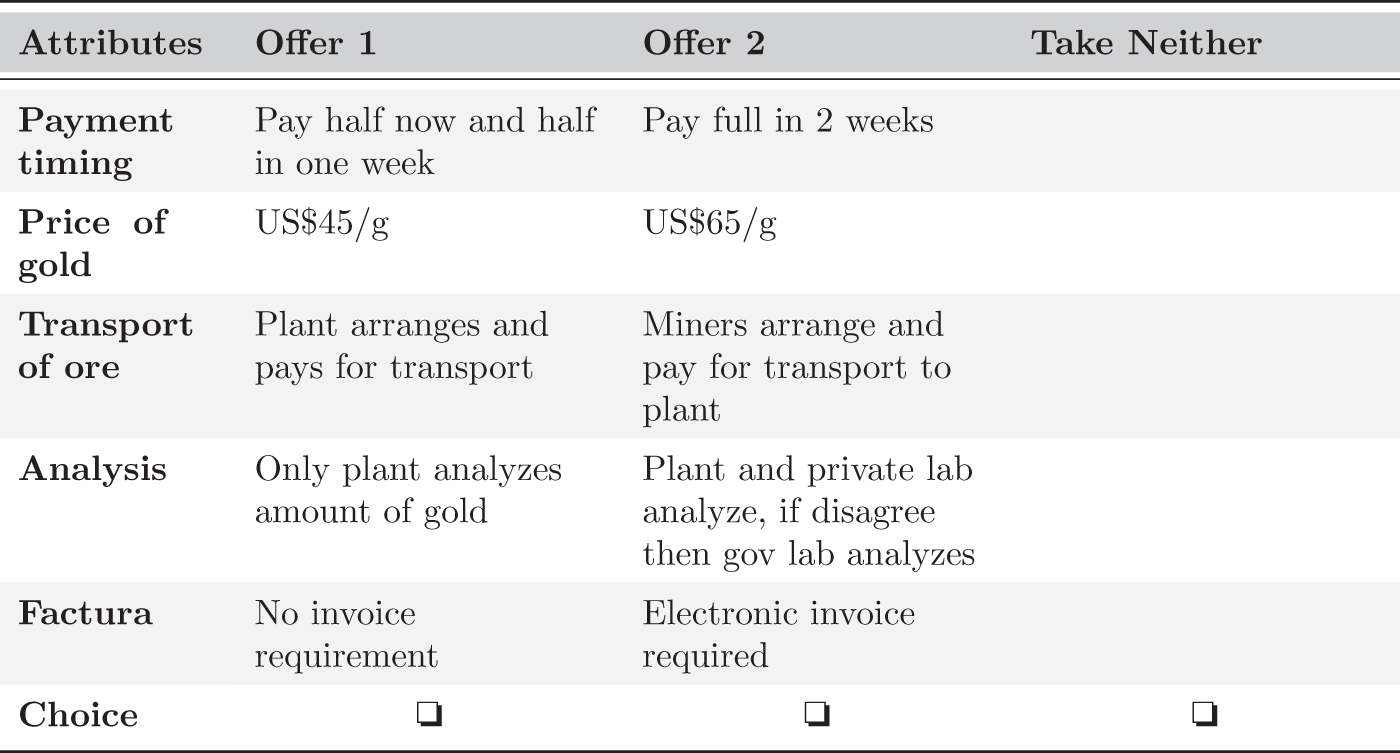
Figure 3 is an example of a card that combines attributes, with two offers. The first includes a split payment (half immediately and half after 1 week), a gold price of US$45/gram, plant-paid transport, no third-party analysis, and no required electronic invoice. The second has a higher gold price (US$65/per gram), miner payment of transport, the option for independent metallurgical testing, later payment (after 2 weeks) and a required electronic invoice (factura). Implicitly, then, the “take none” option has a gold price between $35 and $45, payment immediately, miners paying for transport (for most), no analysis, and no “factura”. It would also represent an option in which miners would process themselves instead of selling (for the majority of the sample which does not sell).
Example of choice card.
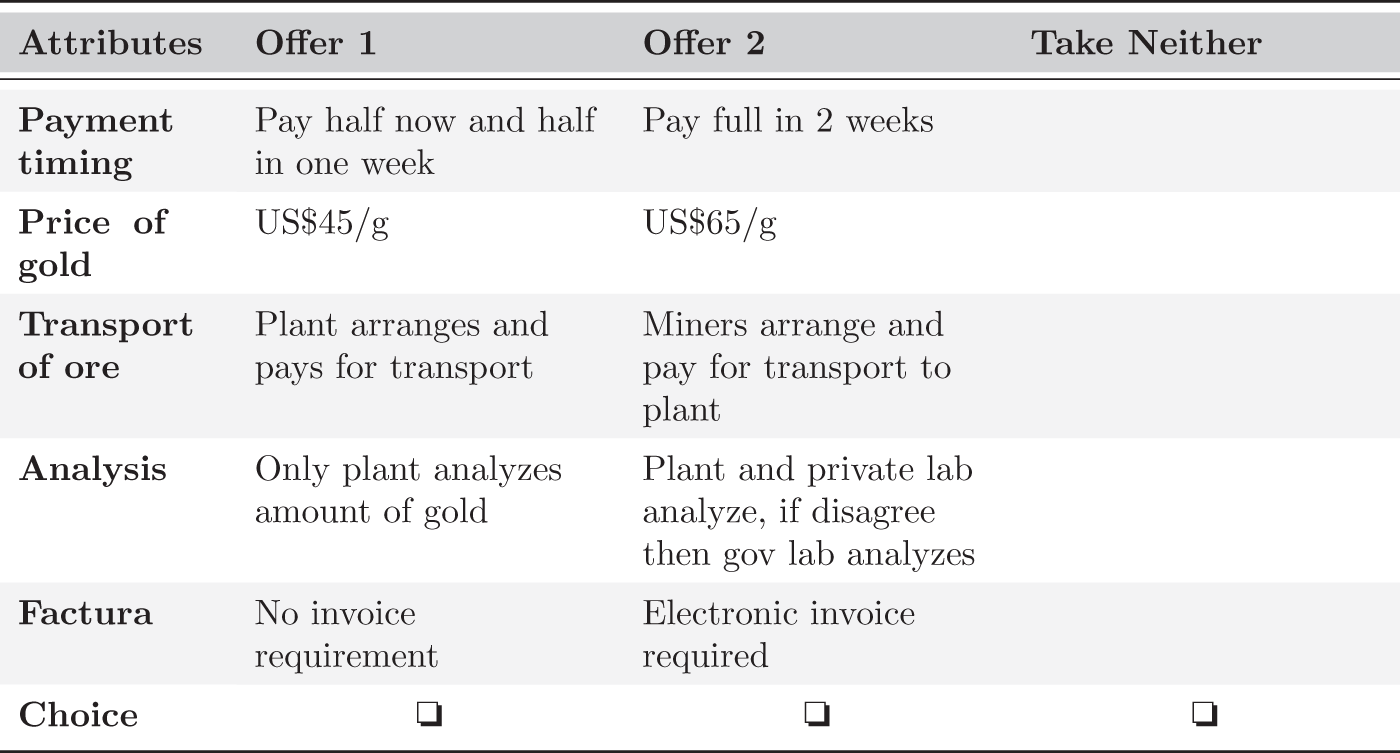
Figure 3 Long description
The table has four columns: Attributes, Offer 1, Offer 2, Take Neither. Row 1: Payment timing - Offer 1: Pay half now and half in one week; Offer 2: Pay full in 2 weeks; Take Neither: blank. Row 2: Price of gold - Offer 1: US dollars 45 per gram; Offer 2: US dollars 65 per gram; Take Neither: blank. Row 3: Transport of ore - Offer 1: Plant arranges and pays for transport; Offer 2: Miners arrange and pay for transport to plant; Take Neither: blank. Row 4: Analysis - Offer 1: Only plant analyzes amount of gold; Offer 2: Plant and private lab analyze, if disagree then government lab analyzes; Take Neither: blank. Row 5: Factura - Offer 1: No invoice requirement; Offer 2: Electronic invoice required; Take Neither: blank. Row 6: Choice - Offer 1: blank; Offer 2: blank; Take Neither: blank.
Each actual choice card graphically depicts these offers’ attributes in order to more quickly communicate differences to respondents (see supplementary material appendix tables A7 and A8). To reduce hypothetical bias, we provide an introductory paragraph that links these choice tasks to options that might be implemented soon. To improve response quality, we employed “Real Talk” framing (Kaczan and Swallow, Reference Kaczan and Swallow2013) in explaining that, while these offers are hypothetical, still their responses could affect future ore-selling offers which could be available to them soon. This signal to respondents to answer honestly after acknowledging reasons why respondents might consider strategically accepting or rejecting hypothetical offers.
4.2. Analysis of discrete choices
Discrete choice experiments have informed the design of incentives to shift resource use, including in payments for environmental services and restrictions on access to common-pool resources (Beharry-Borg et al., Reference Beharry-Borg, Smart, Termansen and Hubacek2013; Costedoat et al., Reference Costedoat, Koetse, Corbera and Ezzine-de Blas2016; Raes et al., Reference Raes, Speelman and Aguirre2017; Maldonado et al., Reference Maldonado, Moreno-Sanchez, Henao-Henao and Bruner2019, Lliso et al., Reference Lliso, Pascual, Engel and Mariel2020). One study considers formalization of small-scale gold miners in Colombia (Velez et al., Reference Velez, Rueda, Henao, Monroy, Tobin, Maldonado and Pfaff2025). We apply this method to potential adoption of mercury-free, higher-capital alternatives in ASGM.
We model respondents’ preferences following random utility theory (McFadden, Reference McFadden1974; Domencich and McFadden, Reference Domencich and McFadden1975), assuming individuals select the alternative that maximizes utility. Let Unjt be the utility of respondent n for alternative j in choice task t, with both observable (Vnjt) and unobservable (ɛnjt) components:
 \begin{equation}
U_{njt} = V_{njt} + \varepsilon_{njt}.
\end{equation}
\begin{equation}
U_{njt} = V_{njt} + \varepsilon_{njt}.
\end{equation}The respondent chooses alternative i when
 \begin{equation}
U_{nit} \gt U_{njt} \quad \forall j \neq i.
\end{equation}
\begin{equation}
U_{nit} \gt U_{njt} \quad \forall j \neq i.
\end{equation}Observable utility Vnjt includes offer attributes (xnjt), respondent characteristics (zn), and constants for order or labeled alternatives (δj) – in our case, opting out. These are weighted by coefficients (βnjt):
 \begin{equation}
V_{njt} = f(\beta_{njt}, x_{njt}, z_n, \delta_j).
\end{equation}
\begin{equation}
V_{njt} = f(\beta_{njt}, x_{njt}, z_n, \delta_j).
\end{equation}A common econometric approach is the multinomial logit (MNL), estimated via maximum likelihood (Train, Reference Train2009). MNL is computationally efficient but assumes independence of irrelevant alternatives (IIA), which may not hold with an opt-out. Therefore, we also estimate two models that relax IIA: nested logit (NL), which assumes independence from irrelevant nests (IIN), and mixed logit (MMNL), which allows random preferences.Footnote 21 We used NL as our default model, nesting the two unlabeled ore-selling alternatives separate from the opt-out alternative.
For MMNL, we estimate uncorrelated and then correlated random coefficients, using 10,000 Sobol draws. Gold price follows a log-normal distribution (ensuring positivity), while binary attributes follow normal distributions.
Each choice is a function of marginal utilities of the offer components:
 \begin{equation}
\begin{aligned}
&U_{i1} = \beta_1 \text{Invoice}_{i1} + \beta_2 \text{TimeDelay}_{i1} + \beta_3 \text{Analysis}_{i1} + \beta_4 \text{Trans}_{i1} + \beta_5 GP_{i1} + \varepsilon_{i} \\
&U_{i2} = \beta_1 \text{Invoice}_{i2} + \beta_2 \text{TimeDelay}_{i2} + \beta_3 \text{Analysis}_{i2} + \beta_4 \text{Trans}_{i2} + \beta_5 GP_{i2} + \varepsilon_{i} \\
&U_{\text{opt-out}} = \beta_{\text{opt-out}}.
\end{aligned}
\end{equation}
\begin{equation}
\begin{aligned}
&U_{i1} = \beta_1 \text{Invoice}_{i1} + \beta_2 \text{TimeDelay}_{i1} + \beta_3 \text{Analysis}_{i1} + \beta_4 \text{Trans}_{i1} + \beta_5 GP_{i1} + \varepsilon_{i} \\
&U_{i2} = \beta_1 \text{Invoice}_{i2} + \beta_2 \text{TimeDelay}_{i2} + \beta_3 \text{Analysis}_{i2} + \beta_4 \text{Trans}_{i2} + \beta_5 GP_{i2} + \varepsilon_{i} \\
&U_{\text{opt-out}} = \beta_{\text{opt-out}}.
\end{aligned}
\end{equation}In Apollo (Hess and Palma, Reference Hess and Palma2019), categorical variables are dummy-coded; continuous variables remain unchanged. For payment time, we use four dummy variables. “Invoice” equals 1 when an electronic invoice is required. “Analysis” equals 1 when independent testing is available. “Transport” equals 1 when the plant pays. Gold price ranges from US$35–65/gram.Footnote 22
Modeling utility implies an ordinal ranking, meaning only differences between alternatives matter (Train, Reference Train2009; Hensher et al., Reference Hensher, Rose and Greene2015). Initial regressions reveal the direction and magnitude of preferences. We later compute marginal rates of substitution, such as willingness to accept (WTA), and choice probabilities.
Choice probabilities follow
 \begin{equation}
P(i) = \frac{\exp(V_i)}{\sum_{j=1}^{J} \exp(V_j)},
\end{equation}
\begin{equation}
P(i) = \frac{\exp(V_i)}{\sum_{j=1}^{J} \exp(V_j)},
\end{equation}where P(i) is the probability of choosing alternative i, Vi is the systematic utility, and J is the total number of alternatives. The numerator sums the exponentiated utility of the offer; the denominator includes all alternatives, including opt-out.
Finally, we calculate WTA for each attribute by dividing coefficients by the gold price coefficient. We use the Delta Method in Apollo to compute robust standard errors for these WTA estimates (Daly et al., Reference Daly, Hess and de Jong2012; Hess and Palma, Reference Hess and Palma2019).
5. Choice experiment regression results
5.1. Full sample responses to ore-selling offers
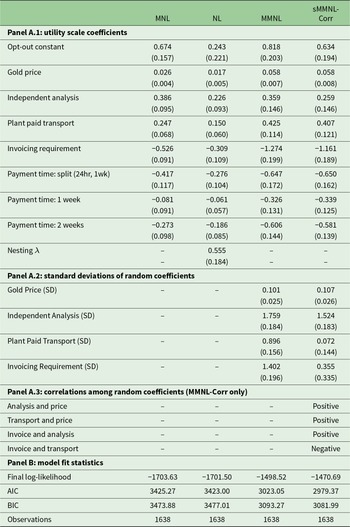
Our MNL, NL, and MMNL results support the clear hypotheses that jancheras prefer higher gold prices, plant-paid transport, and the availability of independent tests (table 4). Importantly, our full-sample estimates suggest that jancheras perceive invoicing as a substantial cost. Column 3 of table 4 suggests that preferences for testing, transport, and invoicing are heterogeneous – though, when random preferences are allowed to be correlated, we find that the standard deviations of the coefficients for invoicing and transport are no longer significant due to the correlation of preferences for these factors with those for other features (see cross-standard deviations for panel A.3 in supplementary material appendix table A9). In other words, we only detect heterogeneous preferences for invoicing and transport in the uncorrelated MMNL model.
Estimated models for full sample
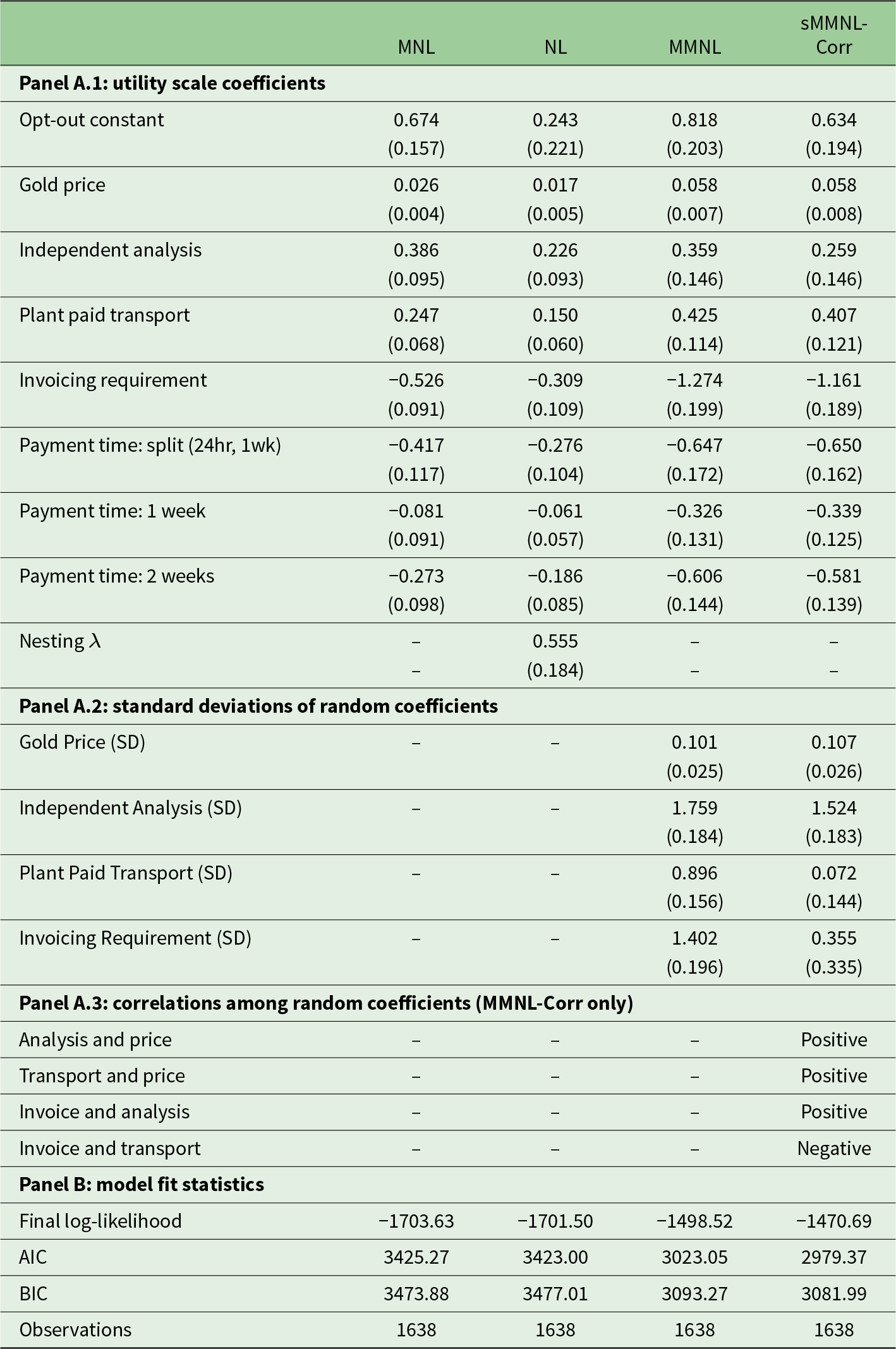
Table 4 Long description
The table consists of two panels comparing MNL, NL, MMNL and sMMNL-Corr models. Panel A.1 presents utility scale coefficients for attributes like opt-out constant, gold price, independent analysis, plant paid transport, invoicing requirement and payment time options. Coefficients are generally positive for gold price and negative for invoicing requirement across models. sMMNL-Corr shows the best fit with the highest log-likelihood (-1470.69) and lowest AIC (2979.37) and BIC (3081.99). Panel A.2 lists standard deviations of random coefficients, highlighting notable differences such as higher SDs for independent analysis in MMNL. Panel A.3 shows correlations among random coefficients, with positive correlations for analysis and price, transport and price and invoice and analysis, but a negative correlation for invoice and transport. Panel B provides model fit statistics, confirming sMMNL-Corr as the best-fitting model. The table includes approximately 9 rows in Panel A.1 and 4 columns for models. Coefficients represent the impact of attributes on choice probability, with standard errors in parentheses.
Notes: Robust standard errors in parentheses. MMNL models allow for random coefficients; SDs for fixed coefficients are not reported. MMNL price coefficient and SD was converted from log-normal using the Delta Method in Apollo in R.
Compared to being paid in one day, jancheras are relatively indifferent to a one-week payment delay in the MNL and NL models, but appear to dislike split payments (half after 24 hours, half one week later). The MMNL results suggest jancheras regard all payment delays as costly, with split payments and two-week delays especially undesirable. Our models indicate that jancheras, overall, preferred to opt-out of ore-selling (positive values significant and large, although insignificant when we correct for bias by adding NL’s nested structure, and a significant value below 1 for λ indicates that the NL structure is appropriate).
The results in table 4 support some components of the OSS pilot, such as independent laboratory testing. Yet they also highlight a significant barrier: jancheras strongly dislike any required electronic invoicing. This indicates challenges for formalization, which were especially acute for jancheras at the time of this study, since there were no regulatory frameworks for this population.
Model fit rises as we add complexity (from models 1–4). In column 4, standard deviations for transport and invoicing coefficients lose significance: variation is absorbed by significant correlation with price and testing, respectively (table 4, panel A.3). Some miners are sensitive to all prices (i.e., transport costs and gold price). Groups who place higher value on tests are less averse to invoicing, possibly reflecting that both are related to a janchera’s latent comfort with such formal transactions.
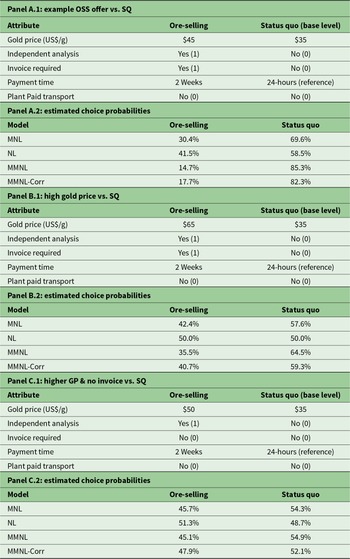
Applying equation (5) to table 4’s coefficients, from all the models, we compute the choice probabilities that jancheras would accept the three ore-selling models shown in table 5. These three ore-selling offers represent (stylized) offers that our team witnessed in the processing landscape.Footnote 23 The comparison of panels B.2 and C.2 in table 5 suggests, in line with a WTP estimate in table 6, that many of our participants would be happy to give up > $15 per gram in order to not need to have invoicing (yet, per heterogeneities within this population, notably over 40 per cent could accept invoicing). This is consistent with a field note that some ASGM groups chose to sell ore to plants at lower price to lower their paperwork requirements (i.e., without the purchasers following traceability standards).
Choice probabilities for example offers
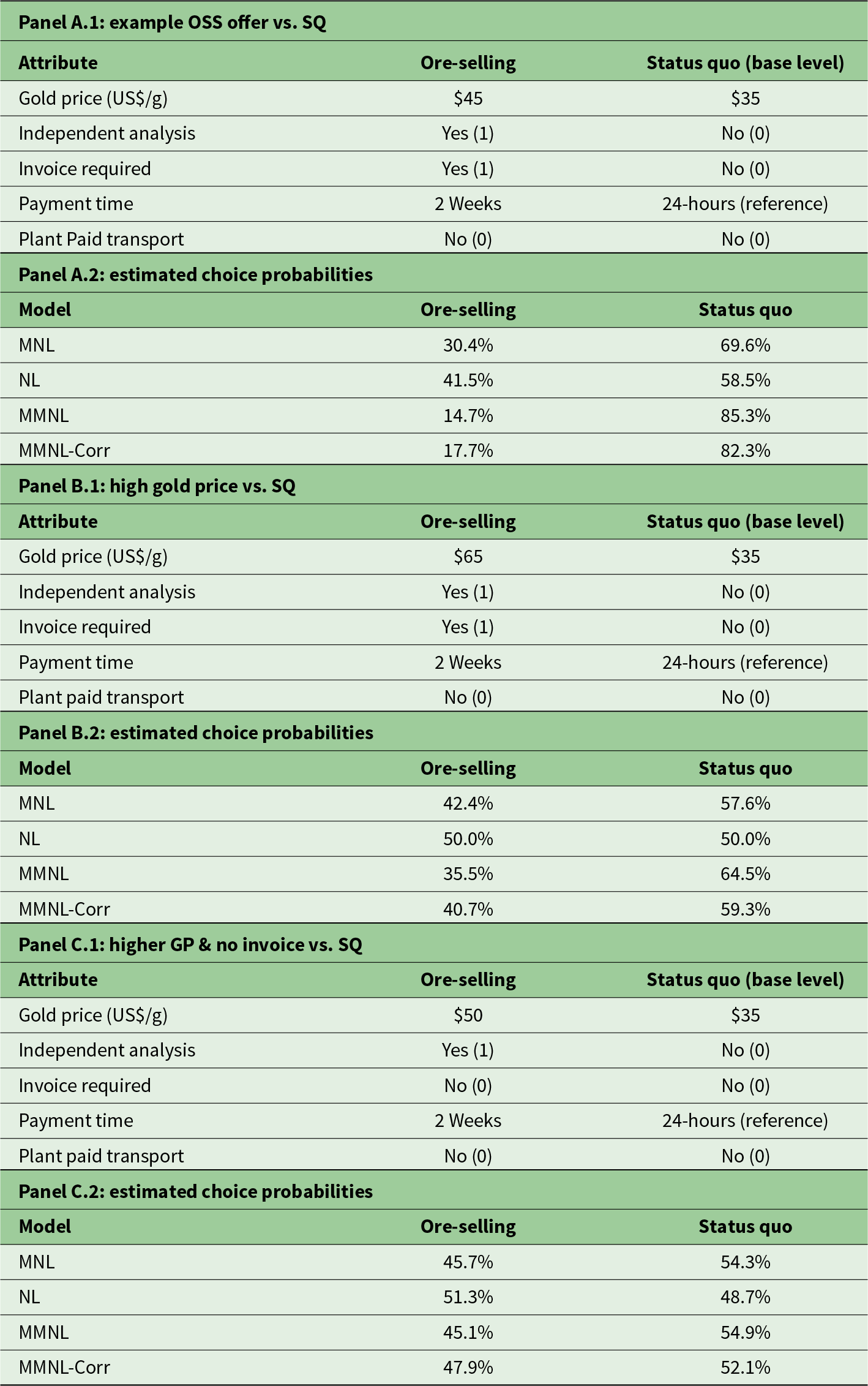
Table 5 Long description
Panel A.1: example OSS offer vs. SQ Columns: Attribute, Ore-selling, Status quo (base level) Row 1: Gold price (US$/g) 45 dollars, 35 dollars Row 2: Independent analysis Yes (1), No (0) Row 3: Invoice required Yes (1), No (0) Row 4: Payment time 2 Weeks, 24-hours (reference) Row 5: Plant Paid transport No (0), No (0) Panel A.2: estimated choice probabilities Columns: Model, Ore-selling, Status quo Row 1: MNL 30.4 percent, 69.6 percent Row 2: NL 41.5 percent, 58.5 percent Row 3: MMNL 14.7 percent, 85.3 percent Row 4: MMNL-Corr 17.7 percent, 82.3 percent Panel B.1: high gold price vs. SQ Columns: Attribute, Ore-selling, Status quo (base level) Row 1: Gold price (US$/g) 65 dollars, 35 dollars Row 2: Independent analysis Yes (1), No (0) Row 3: Invoice required Yes (1), No (0) Row 4: Payment time 2 Weeks, 24-hours (reference) Row 5: Plant paid transport No (0), No (0) Panel B.2: estimated choice probabilities Columns: Model, Ore-selling, Status quo Row 1: MNL 42.4 percent, 57.6 percent Row 2: NL 50.0 percent, 50.0 percent Row 3: MMNL 35.5 percent, 64.5 percent Row 4: MMNL-Corr 40.7 percent, 59.3 percent Panel C.1: higher GP & no invoice vs. SQ Columns: Attribute, Ore-selling, Status quo (base level) Row 1: Gold price (US$/g) 50 dollars, 35 dollars Row 2: Independent analysis Yes (1), No (0) Row 3: Invoice required No (0), No (0) Row 4: Payment time 2 Weeks, 24-hours (reference) Row 5: Plant paid transport No (0), No (0) Panel C.2: estimated choice probabilities Columns: Model, Ore-selling, Status quo Row 1: MNL 45.7 percent, 54.3 percent Row 2: NL 51.3 percent, 48.7 percent Row 3: MMNL 45.1 percent, 54.9 percent Row 4: MMNL-Corr 47.9 percent, 52.1 percent.
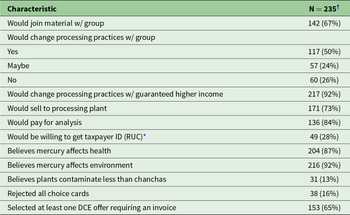
Willingness to shift practices
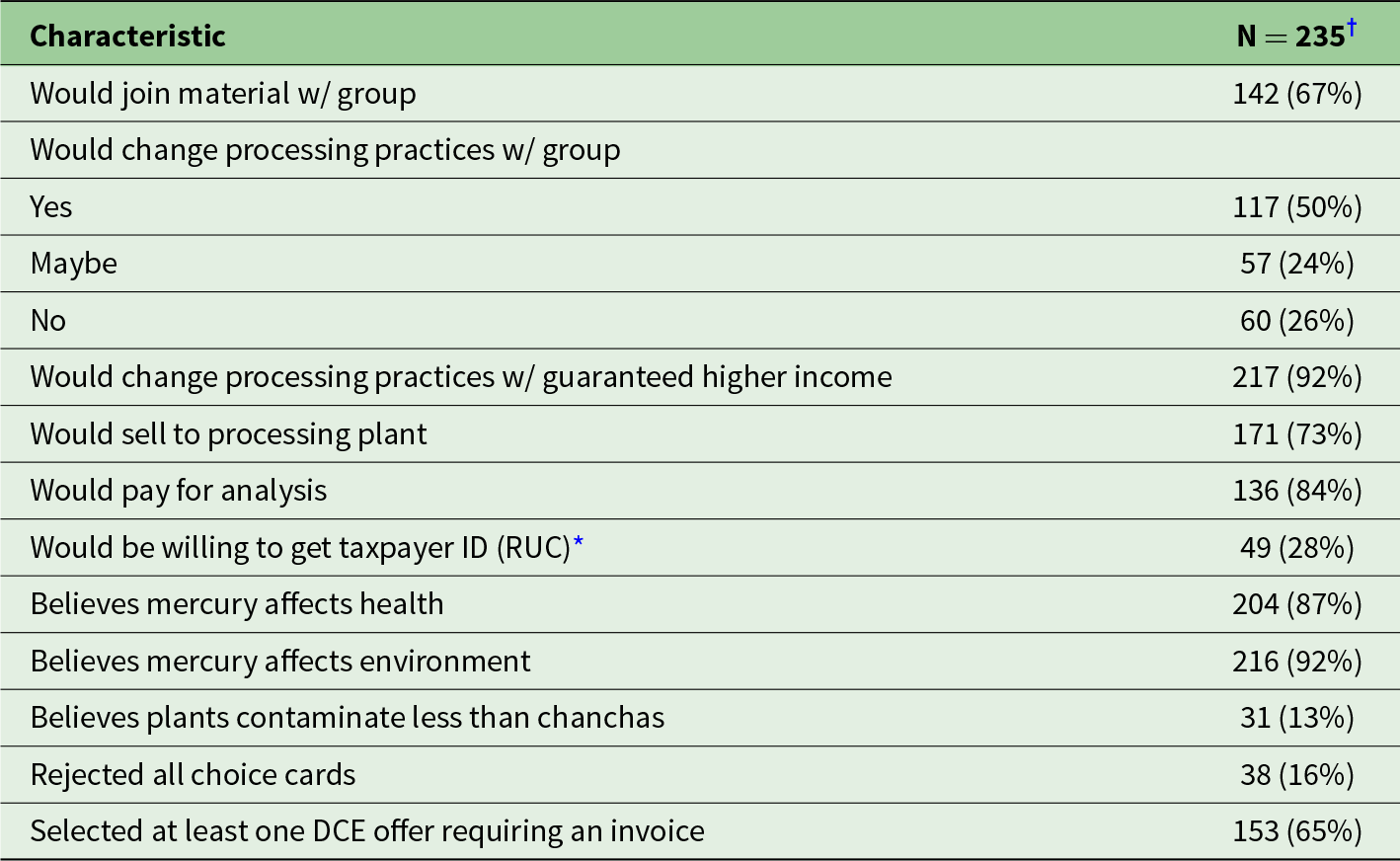
Table 6 Long description
The table has 2 columns: Characteristic and N = 235. It contains 14 data rows. Values are counts with percentages of N = 235. Characteristics include willingness to join or change processing practices with a group, with 142 (67 percent) willing to join and 117 (50 percent) willing to change practices. Responses to changing practices with guaranteed higher income show 217 (92 percent) willing. Selling to a processing plant is favored by 171 (73 percent) and 136 (84 percent) would pay for analysis. Only 49 (28 percent) would get a taxpayer ID (RUC). Beliefs about mercury affecting health and environment are held by 204 (87 percent) and 216 (92 percent) respectively. 31 (13 percent) believe plants contaminate less than chanchas. 38 (16 percent) rejected all choice cards, while 153 (65 percent) selected at least one DCE offer requiring an invoice. Key highlights include high willingness to change practices for higher income and strong beliefs about mercury's impact.
† n (% of non-missing).
* This question was only asked to 181 respondents who process.
Stepping back to consider OSS’s pilot, table 5 shows that few ore-selling models resulted in choice probabilities over 50 per cent for the full sample. A large alternative specific constant for opting out, and large negative coefficient for invoicing, yield probabilities which suggest the average janchera is unlikely to choose to sell without a meaningful price gain. Even for a higher price, as in OSS’s pilot, many jancheras are not interested in ‘pilot’ offers (with independent metallurgical tests but 2-week payment delays and required electronic invoice). Nevertheless, choice probabilities can exceed 50 per cent when gold price is high and time to payment is short (supplementary material appendix table A10), such as in Dynacor’s program in Southern Peru (Veiga et al., Reference Veiga, Restrepo-Baena and De Tomi2022). However, even in that program, most miners bring at least five tons of ore to the plant per visit (quantities greater than most jancheras believe they could bring).
Table 6 uses table 4’s NL gold-price coefficient to estimate what compensation to jancheras is needed to balance other shifts in processing practices. We find that miners would need to receive US$19 and US$11 more per gram of gold to balance invoicing and delaying payments by two weeks, respectively. To offset offer benefits, our results indicate miners would accept US$9 and US$14 per gram less if ore were transported by a plant or independent testing existed, respectively.
Finally, we estimate total additional compensation jancheras would need to shift from their processing status quo to ore-selling. On average, jancheras would need to be compensated US$31 to adopt offers with independent tests, pay after two weeks, requiring miner-paid transport, and requiring invoice (supplementary material appendix table A6). Thus, on average, for a majority of our sample, jancheras prefer status quo (US$-denominated WTA above zero for opt-out expresses costs of moving from self-processing under their specific baseline).
5.2. Results for sub-populations
While we estimated that jancheras would have a 41.5 per cent likelihood of adopting an ore-selling model like OSS’s pilot on average (table 6, A.2), results indicated heterogeneity, e.g., with standard deviations for attributes in the MMNL (table 7). We add here by modeling of latent classes (supplementary material appendix table A5), which suggests some groups would not opt out.
Willingness to accept for offer components
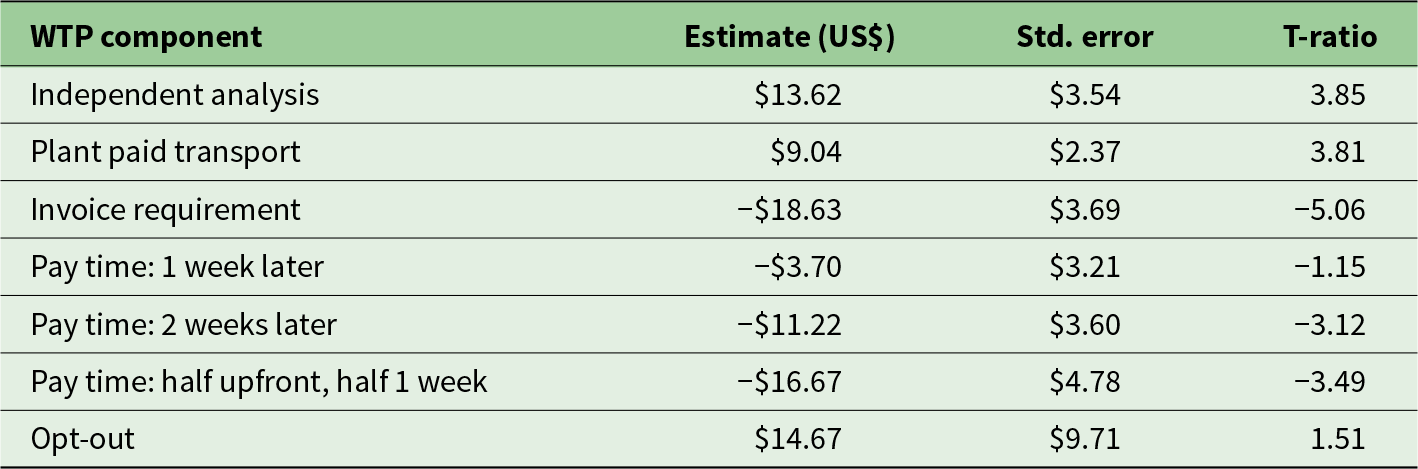
Table 7 Long description
The table has three columns: WTP component, Estimate (US dollars), Std. error and T-ratio. Row 1: Independent analysis, 13.62 dollars, 3.54, 3.85. Row 2: Plant paid transport, 9.04 dollars, 2.37, 3.81. Row 3: Invoice requirement, negative 18.63 dollars, 3.69, negative 5.06. Row 4: Pay time: 1 week later, negative 3.70 dollars, 3.21, negative 1.15. Row 5: Pay time: 2 weeks later, negative 11.22 dollars, 3.60, negative 3.12. Row 6: Pay time: half upfront, half 1 week, negative 16.67 dollars, 4.78, negative 3.49. Row 7: Opt-out, 14.67 dollars, 9.71, 1.51.
Notes: Willingness to accept (WTA) values are in US$/gram. Estimates derived from nested logit model using the Delta Method for robust standard errors.
Interacting the opt-out term with respondents’ covariates in the NL model, we find that the wealthiest jancheras and those who worked full-time are more interested in ore-selling (table 7).Footnote 24 Those who work within traditional mining sites (botaderos), plus the jancheras in groups with stronger associativity (having statutes), are less interested – suggesting traditional janchera groups are more resistant to change. One interpretation is that the jancheras with unfavorable or the most favorable status quo are more interested in ore-selling. The former may have most to gain while the latter may find changes easier.
The regression results are complemented by further survey statistics (table 8). While over half our choice-card offers were rejected, some jancheras expressed a desire to change (table 8). About 28 per cent are willing to get a taxpayer ID (RUC), with 67 per cent willing to aggregate ore with others, and 73 per cent willing to sell to processing plants, plus 92 per cent who would sell to a plant if doing so would definitely raise income.
Choice probabilities by subgroup
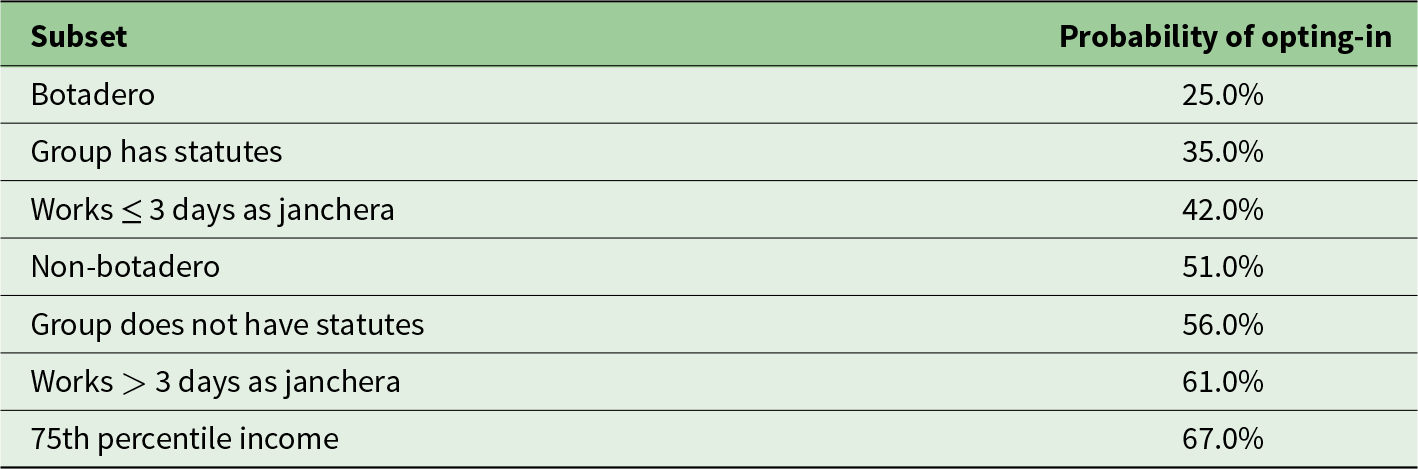
Table 8 Long description
The table has two columns: Subset and Probability of opting-in. Row 1: Subset Botadero, Probability of opting-in 25.0 percent. Row 2: Subset Group has statutes, Probability of opting-in 35.0 percent. Row 3: Subset Works less than or equal to 3 days as janchera, Probability of opting-in 42.0 percent. Row 4: Subset Non-botadero, Probability of opting-in 51.0 percent. Row 5: Subset Group does not have statutes, Probability of opting-in 56.0 percent. Row 6: Subset Works more than 3 days as janchera, Probability of opting-in 61.0 percent. Row 7: Subset 75th percentile income, Probability of opting-in 67.0 percent.
Offer: Factura required, 2-week time delay, US$65/gram, miner pays transport.
Jancheras exhibit high awareness that mercury affects health (87 per cent) and the environment (92 per cent). Juxtaposed with jancheras’ ongoing mercury use, this result suggests that more information through mercury-education campaigns alone will not stop mercury use (Veiga and Fadina, Reference Veiga and Fadina2020). This could be partially explained by the fact that jancheras who process with mercury plants may not be exposed: chancha technicians burn amalgams and gold-shop workers reheat sponge gold. Jancheras appear to care most whether options provide economic benefits. They may not view processing plants as ‘societal-individual win-wins’ given that few believe (table 8, only 13 per cent) that mercury-free processing plants are better for the environment.
6. Discussion
6.1. Barriers to ore-selling
In carrying out this choice experiment and, more generally, by interacting with this population, we found three main barriers to ore-selling: minimum tonnage requirements (related to the fact that, even within groups, jancheras collect and process mineral themselves, exhibiting weak ‘associativity’); invoicing requirements (related to informality); and mineral availability (relating to sectoral changes). After our initial field work, we decided to eliminate an attribute from the choice experiment related to the plant requiring some minimum tonnage, given that we found that few jancheras would be able to meet an 8-ton requirement at baseline. Our survey confirmed this barrier. We found that 75 per cent brought 0.54 tons or less per visit.Footnote 25 While this is currently a large obstacle, jancheras might be able to meet such a requirement if a supplementary intervention facilitated ways to pool material within the groups. As above (table 8), many would be willing to pool their material under the right conditions.
Our survey also showed that, at baseline, few jancheras could invoice. We did not ask if they generated electronic invoices during recent sales. We did ask if they had a taxpayer ID (6 per cent) and how likely it was they could invoice (15 per cent said ‘possibly’ or ‘easily’). We then observed that some jancheras, who at the time of our survey could not invoice and reported not being willing to get a taxpayer ID, still chose experimental offers with invoicing. This could reflect that, with large and clear financial benefits and/or assistance to lower the costs, many jancheras would be willing to attempt invoicing.
Over 80 per cent of jancheras said access to material has fallen. We heard stories that many who had lost access to material shifted to other sectors. Access loss appears to follow from firms’ profits per unit of ore rising, with gold prices and improved extraction, creating incentives for firms to avoid discarding ore with minerals (e.g., to wash ‘waste’ materials to reveal gold). Along these lines, some mining areas also started to condition site access upon jancheras selling all selected ores back to site owners. Further, new actors (mechanized canteras) have started buying the ‘waste’ minerals previously given to jancheras for free.
Field observations also suggested other components of ore-selling offers could be barriers. One might imagine that a shift from processing ore to ore-selling would decrease processing time, while keeping mineral-transport costs constant, as at baseline only 18 per cent say chanchas paid for mineral transport to a facility (table 2). However, the transport costs at baseline were likely low: while most jancheras were indeed responsible for transporting material, they typically travel only short distances within the same canton. In contrast, if an ore-selling offer were available only in Portovelo-Zaruma, then jancheras would need to transport their ore further to take up that offer.
One might also argue that ore-selling could reduce time spent on processing. We found the opposite might be the case. Processing at chanchas is fast – under a day and sometimes capped at just two hours by the facility (as another way to ensure a processing facility is left with more of the gold). Sales of gold thereafter are immediate – both of which contrast with likely timing within ore-selling. Meanwhile, one plant associated with the OSS noted that miners would have to wait 10–15 days for payment, after a delivery, due to administrative (liquidity) constraints. Depending upon the details of ore-selling, then, time spent on mineral transport and processing could increase rather than decrease.
Finally, even benefiting from independent testing options in ore-selling offers would entail behavioral change by miners since, in the baseline, only 7.2 per cent use metallurgical testing laboratories to estimate ores’ metallic contents. Though independent testing was seen as a benefit on average in our experiment, in the post-DCE survey, 31 per cent of jancheras said they trusted plants’ metallurgical analyses (correlating with those jancheras who expressed higher trust in plants in general (supplementary material appendix table A11)). The large, significant standard deviation for independent testing in the MMNL models (table 4) is quite consistent with this, reflecting that not all jancheras viewed an independent-testing option as a benefit.
7. Conclusion
To consider ore-selling by vulnerable miners, we studied poor predominantly female jancheras who were considered as potential beneficiaries of OSS but who faced substantial barriers to participation. Reflecting fieldwork, the attributes of our choice experiment’s hypothetical offer (5, panel A) mimic a recent ore-selling offer from a plant linked with the OSS program which required miners to: offer electronic invoices for sales; bring at least 8 ton of ore; and wait 10–15 days for payments. It included independent metallurgical testing (for US$20–25, more worthwhile for higher ore quantities and grades). For these attributes, our results predict low uptake. Without support, minimum tonnage and the invoicing requirements likely make jancheras’ adoption of this type of ore-selling infeasible.
Others also find that interventions do not help informal and subsistence miners, despite pro-poorest rhetoric (Hilson et al., Reference Hilson, Gillani and Kutaula2018; Veiga and Fadina, Reference Veiga and Fadina2020; Prescott et al., Reference Prescott, Baird, Geenen, Nkuba, Phelps and Webb2022). Strategies often target larger firms, while one-size-fits-all efforts in formalization can have costs and delays beyond the reach of most smaller miners (Hilson and Maconachie, Reference Hilson and Maconachie2017; Hilson, Reference Hilson2020; Sippl, Reference Sippl2020; Veiga and Fadina, Reference Veiga and Fadina2020; Coy et al., Reference Coy, Pacheco, Peralta, Saavedra and Llanes2021; USAID, 2021; Hilson et al., Reference Hilson, Bartels and Hu2022).Footnote 26 Others argue that, to move actors out of subsistence mining, policies supporting formalization should aid in aggregation (Hruschka, 2011; Hilson et al., Reference Hilson, Bartels and Hu2022). States seek tax revenues from ASGM yet, without support for miners, plans often fail (Siegel and Veiga, Reference Siegel and Veiga2010).
Returning to ore-selling, given data limits, we do not assess impact for the OSS intervention, which invested in processing plants and testing labs and then required plants buy ore from miners (focusing on artisanal and small-scale miners, given barriers). We do know that the program’s initial transactions were for 100 tons at a time (Ministerio de Energía y Minas, 2022). Thus, the sellers had to be larger and, as a result, likely had access to mercury-free processing ‘plant rental’ – like our sample’s 2nd or 3rd groups, who would not reduce mercury use by ore-selling.
Ore-selling impacts remain important yet also not studied with empirical rigor. Recent work cites some ore-selling as a success, including Dynacor in Southern Peru (Veiga et al., Reference Veiga, Restrepo-Baena and De Tomi2022). To our knowledge (including from asking Dynacor), no independent quantitative studies show ore-selling has raised income or reduced mercury use in ASGM. Even if Dynacor’s Veta Dorada plant has been a success, e.g., if the prospects of higher incomes via ore selling have induced formalizations in that context, then understanding how those occurred and what applies to other contexts requires study.
Returning to jancheras, Ecuador issued an inter-ministerial accord for a regulatory framework (Interministerial Accord, 2022). However, it capped ore at 225 kg per month,Footnote 27 yielding sales far below minimum wage. It also mandated ore sale to processing plants. In our July 2023 focus group, the consensus of the 50 jancheras present was that government was actually trying to eliminate their activity by imposing new requirements without support to comply with new rules. When presenting our study in Quito, we heard many believed the jancheo activity would vanish soon due to market forces (price and extraction efficiency) that we noted reduce jancheras’ mineral access.
Unlike in Colombia, where waste-rock collection (chatarreo) is one type of subsistence mining recognized by the mining regulatory framework (Decree 1073 of 2015) (Quintero Chinchilla, 2017), jancheo in Ecuador is not considered to be a mining activity, but rather related to waste management (Interministerial Accord, 2022). Consequently, the jancheras are not allowed to process the ore or sell the gold on formal markets. In Peru, pallaqueras (Peruvian jancheras) faced a similar regulatory situation: since their work was not recognized as mining activity, they were excluded in 2012 from the Integral Mining Formalization Process led by the Ministry of Mines and Energy (Law 27651 of 2012). However, from 2013, with external support, pallaqueras have worked on strengthening associativity and consolidated political representation as the National Network of Women in ASM (Winkelfried, Reference Winkelfried2022). Working together, they improved their interactions with the Peruvian mining authorities. By 2018, they had managed to get a pilot authorized to participate in commercial transactions with ore processors and traders (D.S.018–2018 EM) (Winkelfried, Reference Winkelfried2020).
Support of this kind seems necessary within future interventions targeting such populations. Without recognition from mining authorities, basic conditions are not in place to begin discussions of contractual and organizational arrangements to enable these women to participate in ore-selling. It remains to be seen if such complementary action will improve the environmental and economic realities of jancheras in Ecuador but we are aware that work to engage these groups is still underway. Ideally, both actions and outcomes are documented so ASGM interventions learn from each other.
Supplementary material
The supplementary material for this article can be found at https://doi.org/10.1017/S1355770X2510017X.
Acknowledgements
We thank Mario Rodas for valuable comments on multiple versions of this paper. We thank Eliana Paltán for opening doors to enable us to interface with various janchera groups. We thank Paola Romero for enabling the collaboration between Duke and ESPOL. We also wish to extend sincere thanks to enumerators Ambar Paltán, Michelle Villalta and Inés Castillo. This project would not have been possible without the hard work and resilience of the enumerator team and the willingness of many actors to engage with our team and provide multiple rounds of feedback on the way to a final product. Finally, we wish to thank the insightful comments of the two anonymous reviewers, whose contributions greatly improved this manuscript.
Competing interests
The authors declare no competing interests.




 Open access

