



Information and communication technologies are defined as those that assist the collection, processing, storage and exchange of information by electronic transmission. In health, these technologies enable the promotion of a healthy lifestyle, examples being electronic records, telehealth services, health information networks, tools that health professionals use and that support clinical decision making, and Internet-based technologies and services( Reference Curioni, Brito and Boccolini 1 ).
The use of mobile devices is increasingly common and advantageous these days, because this tool provides access to information at any time and by any individual. Regarding applications (apps) about nutrition, they are designed to bring the individual to a lifestyle change, since they intend to make users think about food choices by the demonstration of food nutritional content( Reference Caivano, Ferreira and Domene 2 ). Besides that, the main goals of the nutrition apps are: ‘providing feedback, goal-setting for healthy eating, healthy cooking, self-monitoring of energy and nutrient intake, weight tracking, planning social support and change’ and the choice of places to eat( Reference Coughein, Whitehead and Sheats 3 ).
The variety of nutrition-related apps is increasing nowadays; however, some of them do not offer correct nutritional information( Reference Boyce 4 ). On the other hand, one of the advantages of using apps in nutritional practice is that they can be used by both professionals and customers, strengthening their relationship( Reference Lieffers, Vance and Hanning 5 ). In addition, free apps can be accessed by an unlimited group of users. Also, it is important to emphasize that apps ‘must be critically examined’ in relation to the ‘missing information about data sources and providers’( Reference Holzmann, Proll and Hauner 6 ).
Some nutrition-related health apps intend to help people change their behaviour by the practice of physical activity and usual intake reminder, so that the more accurate the tool is, the greater the effectiveness of the predicted result( Reference Granado-Font, Flores-Mateo and Sorlí-Aguilar 7 ).
For nutritionists and other health professionals to recommend its use as a helpful resource for access to information about foods and their nutritional and energy values, the app must be evaluated according to well-defined criteria such as its purpose and reliability of information. However, research on this topic is still scarce because the use of mobile apps is recent. Therefore, our study aimed to verify the reliability of information, the sources of information used and user opinions of free mobile apps with nutritional information available in Brazil.
Methods
This was a descriptive, cross-sectional study. We evaluated apps on nutrition found in the App Store of iPhone 5S with software iOS 8.4.1 and on the Play Store for the Android platform, version 2.3.6, from August to November 2015.
Inclusion criteria were: free apps, addressing the composition and energy value of foods, available in Brazil, produced or not in the country, in English or Portuguese. We excluded apps that did not have the assessment of users.
Apps were evaluated regarding the following variables.
1. Goal of the application: the purpose informed by the app, for example ‘monitoring diet and exercise’.
2. Reliability of information on food composition: we used the most current available version of the Brazilian Food Composition Table (TACO 2011)( 8 ). The food composition information was evaluated in relation to the description of macro- and micronutrients, as well as their quantities. We considered the app ‘adequate’ when it presented all macro- and micronutrients described in TACO, as well as the correct amounts; ‘partially adequate’ when it described, in addition to those expected, other macro- and micronutrients not mentioned in TACO, or when all macro- and micronutrients listed in TACO were not described, but the values were correct; or ‘inadequate’ if did not describe the macro- and micronutrients of TACO and/or when not indicating the correct amounts of macro- and micronutrients.
3. Reliability of information about food energy value: we evaluated this on the basis of the average values of food energy calculated from those indicated in three tables, namely: (i) the Brazilian Food Composition Table (TACO 2011)( 8 ); (ii) the food composition table: support for nutritional decision, of 2002( Reference Philippi 9 ); and (iii) the National Study of Family Expenditure: food composition tables, of 1999( 10 ). The applications were evaluated as reliable or not, accepting a variation of up to one standard deviation in the reported energy values. After calculation and analysis of the energy value of each food, we calculated the percentage of adequacy as follows: (total number of foods with correct energy value/total number of foods evaluated) ×100.
4. Calculation of BMI: according to the formula recommended by the WHO( 11 ). To verify whether the calculation performed by the app was correct, we adopted as standard the weight of 70 kg and height of 1·70 m. The apps were classified as having this feature or not, and we evaluated whether the calculation was correct or not.
5. Consulted sources: we verified whether the app pointed to the sources of information about food composition and energy value, namely food composition tables, food labels and others.
6. User opinion: ratings and comments recorded by the users of the app. Users did not complete forms developed by the authors; the app defined how that evaluation should be made by the user. In the apps that received over 100 ratings or comments, only the total number of ratings was registered. We also evaluated the average number of stars that the app received from users, when existing. When we recorded comments, they were grouped according to content and categorized as positive or negative.
To evaluate the trustworthiness of the information about food composition and energy, we selected for analysis the foods that made up the basic Brazilian food basket for the month of August 2015( 12 ), namely refined sugar, cooked white rice, lady finger banana, boiled potatoes, grilled steak (sirloin steak), cooked carioca beans, whole milk, unsalted butter, canola oil, French rolls and tomatoes. In addition, we included other foods commonly consumed by the Brazilian population: loose leaf lettuce, cooked pasta and cola-based soda.
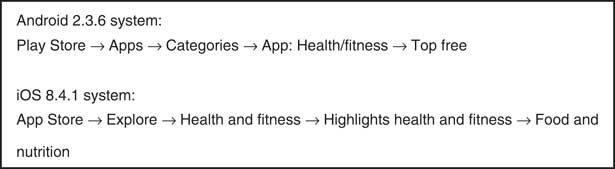
As access to apps is different in each system, we used the steps described in Fig. 1.
Steps for accessing applications (apps) according to Android 2.3.6 or iOS 8.4.1 system
Results
We evaluated sixteen apps for mobile devices from App Store, software iOS 8.4.1 and from Play Store, Android platform, version 2.3.6. The goals of the apps, calculation of BMI, sources consulted for the nutritional information, comments and user ratings are described in Table 1.
Goal of the nutrition-related mobile applications (apps), calculation of BMI, sources consulted for the nutritional information, number of comments and user ratings (‘stars’). Brazil, August–November 2015

TACO, Brazilian Food Composition Table.
* Star value reported by the app.
The mobile apps evaluated aimed mainly at monitoring the diet and physical exercise performed by users. Besides this, other goals often mentioned were following daily meals, controlling energy (calories) ingested and promoting healthy habits.
Based on Table 1, we were able to observe that only 37·5 % of apps calculated user BMI and, among them, one reported the incorrect value.
Regarding the sources used, only two apps (App1 and App14) mentioned food composition tables and other documents, and four (App2, App3, App4 and App11) used the food label as a reference. Therefore, most (62·5 %) did not mention the source of food composition information.
According to Table 1, only two apps were not evaluated by users, and three apps received 5 stars. Most of them (n 10; 62·5 %) received 4 or 4·5 stars, indicating that the rating was, in general, positive.
Some examples of positive reviews were: ‘practical and easy-to-use app’; ‘it helps in the decision of choosing food’; ‘it has graphs to accompany the evolution of weight’; ‘interaction with social network’; ‘it is possible to get a dietary re-education’; ‘great database’; ‘it helps in weight control’; ‘great design’; ‘control of macronutrients’; ‘this app has motivated me to pay attention to dietary habits’; and ‘while using the app, motivational messages appear’.
On the other hand, some examples of negative opinions were also found: ‘some foods are in English’; ‘the app is in trouble updating’; ‘hard to use’; ‘one should be able to put the meal times’; and ‘the app is not in Portuguese’.
According to Table 2, no app was evaluated as adequate. Six apps presented between 21·43 and 85·71 % of foods without description of all macro- and micronutrients present in TACO but, when they were described, the values were correct. Eleven apps presented from 28·57 to 85·71 % of foods without description of macro- and micronutrients existing in TACO and, when described, the values were incorrect. Furthermore, two apps did not describe any macro- or micronutrient. Foods evaluated as ‘not listed on TACO’ refer to whole milk and cooked pasta.
Reliability of the nutrition-related mobile applications (apps) analysed, according to the evaluation of food composition and energy valueFootnote *. Brazil, August–November 2015

TACO, Brazilian Food Composition Table, 2011( 8 ).
‘Foods not listed on TACO’ refer to whole milk and cooked pasta. ‘Flaw in the app’ means the app did not follow the command to access information of these foods.
* The foods selected for analysis (refined sugar, cooked white rice, Lady Finger banana, boiled potatoes, grilled steak (sirloin steak), cooked carioca beans, whole milk, unsalted butter, canola oil, French rolls, tomatoes) made up the basic Brazilian food basket for the month of August 2015. Other foods commonly consumed by the Brazilian population (loose leaf lettuce, cooked pasta, cola-based soda) were also included.
The reliability of information on food energy value varied greatly between the apps. The app with higher percentage of correct information was App3 (57·14 %), while App5 did not report any energy value correctly (Table 2).
Discussion
The evaluated apps presented as main goals: monitoring the diet and physical exercise practised by users; following daily meals; controlling energy ingested; promoting healthy habits; and adopting a healthy lifestyle. This finding agrees with the study of Pagoto et al. ( Reference Pagoto, Schneider and Jojic 13 ), which had as its main goal determining the degree to which weight-loss mobile apps included evidence-based behavioural strategies and found that most mobile apps included as goals weight loss, energy balance and establishment of diet. In the same way as nutrition-related apps propose behavioural change, there are apps for the practice of physical activity with the same goal. A study( Reference Middelweerd, Mollee and van der Wal 14 ) investigating fifty-seven apps involving behaviour change techniques regarding physical activity showed that the main ones used were: offering feedback on user performance; proposing that users monitor their behaviour; setting goals; planning support from other individuals; and showing instructions on how to change behaviour.
The calculation of BMI was absent in 56 % of the apps we evaluated. Although widely used in nutritional practice owing to it being a simple calculation, BMI is unreliable in some cases, such as that of athletes, since they often present a low level of body fat and a high level of lean mass, with a BMI above the desirable( Reference Gonçalves, Mascarenhas and Liebl 15 ). Therefore, although the use of apps is an advantage, if there is no monitoring by trained health-care professionals, the apps can be used and interpreted wrongly.
Few apps in the present study mentioned their source of information about food composition and energy values, which hinders a more rigorous evaluation, since reliable sources may differ in the information they provide about food composition and energy. Dunford et al. ( Reference Dunford, Trevena and Goodsell 16 ) created an app called FoodSwitch, which allows access to quick and easy information on the nutritional characteristics of foods. This app was first released in Australia and is currently available in New Zealand and the UK. According to the authors, each location requires its own database, because barcodes and nutrition information of foods vary from place to place, even though these foods are equal. Thus, the inadequacies and differences in food nutritional composition and energy content assessed based on the selected reference tables may be arising from the apps’ use of sources of information different from the ones we chose, which reinforces the need to make this type of information available to the user (lay or professional).
Nevertheless, one cannot rule out the possibility of the information being incorrect. In their study with sports nutritionists (referred to by the authors as ‘users’) who had used diet-related apps in clinical practice, Jospe et al.( Reference Jospe, Fairbairn and Green 17 ) noted that 95 % of users reported limitations when using these apps. They mentioned problems in the nutrient database of foods, in addition to the incorrect choice of portion size by the patient and the selection of foods being considered inadequate.
We observed that most (81·25 %) apps received number of stars greater than or equal to 4. However, 40–50 % or more of the information about energy value was incorrect. The same applies to the foods’ nutritional composition, as already mentioned. That is, the apps were well evaluated by users and therefore were used by them, but they provided unreliable information.
Some positive characteristics were identified by users: daily food log and subsequent quantification of energy intake; water intake record; possibility of updating anthropometric measurements and weight; graphs to follow the evolution of weight; motivational phrases; notifications about meal time, water intake and physical activity; indication of energy balance (amount of calories ingested in the day and amount that should be eaten until the end of the day); interaction with social networks; suggestion of healthy recipes; option to add some food that was not included in the database of the app; food diary; and record of the practice of physical activity. However, some negative aspects were also mentioned: users are able to customize their nutritional goals; absence of a list of macro- and micronutrients in some apps; some functions of the apps could only be accessed if the user subscribed to the suggested package; and difficulties of app update and use. In addition, Brazilian users said that international apps presented different information about food composition and referred to measures not used in Brazil, indicating the need for cultural adaptation of apps developed in other countries.
Other studies( Reference Allen, Stephens and Dennison Himmelfarb 18 – Reference Carter, Burley and Nykjaer 22 ) showed similar positive characteristics and others that we can add: app structure and possibility of use on a smartphone; use in real time; feedback that the app offered motivated the increased practice of physical activity; ease of use; graphical evolution of weight; help in understanding negative eating habits and changes in what one thought about foods; and to follow a diet, the use of the app is more convenient and easier than other methods.
The quantification of energy, present in most apps, is advantageous because it controls the user’s energy intake; on the other hand, if the user does not have any monitoring by health-care professionals, the effect can be opposite, with the user observing only the number of calories in the food and not their quality, which may lead to a severe eating disorder in the future. Another fact that may lead to the development of eating disorders is the possibility for users to customize their nutritional goal. This option is not adequate because, without monitoring from a nutritionist, the user may underestimate or overestimate their energy and nutrient needs. Indeed, a study conducted among 105 participants diagnosed with an eating disorder showed that use of a specific nutritional app, which had the function of counting calories, contributed to the eating disorder, according the report of the study participants( Reference Levinson, Fewell and Brosof 23 ).
In general, the food database of the nutrition apps helps the user to know the nutritional information of the food and also offers the possibility to add common foods consumed( Reference Schumer, Amadi and Joshi 24 ). The option of adding a new food to the database of the app may or may not have beneficial effect. The positive point found is the possibility of increasing the app’s database; on the other hand, if the user does not know how to use this tool or does not use a reliable source, the data will be incorrect. To provide accuracy for the data it is important to use the yield and retention factors at the moment of the elaboration of the food composition database and labels, since those factors help to estimate the nutrient content of prepared foods( 25 ).
Therefore, the current study has verified that the apps on nutrition available today in Brazil need to be standardized in their sources of information and some of them need to simplify their usage. Thus, it is necessary to develop more comprehensive apps and with different characteristics, but reliable to be useful for nutritional guidance.
According to a study done in 2014( Reference Martín, Fernández and Yurrita 26 ) that included a literature review and analysis of apps related to nutrition, dietetics and healthy habits, apps aim to contribute positively to users’ health, besides helping to prevent diseases. However, some apps are flawed and proper understanding of the operation of this tool is needed for its best use.
Conclusions
The mobile apps for nutrition currently available in Brazil and evaluated in the current study are not useful for nutritional guidance because most of them are not based on reliable sources of information.
On the other hand, we consider that trustworthy apps could be used if the user is oriented by health-care professionals trained for this purpose. Beyond that, more trials are necessary, including more apps and user populations, and more analyses of use, to know what apps could be good for health care and to help lifestyle change.
Acknowledgements
Financial support: The authors thank Espaço da Escrita, Coordenadoria Geral da Universidade, University of Campinas (UNICAMP) for the language services provided. This work was supported by the National Council for Scientific and Technological Development (CNPq) (grant number 304610/2013-5). CNPq had no role in the design, analysis or writing of this article. Conflict of interest: None. Authorship: The authors declare that both participated sufficiently in the work to take public responsibility for the content of the paper. Both made substantive contributions to the conception and design of the study; the generation, collection, assembly, analysis and interpretation of data; the drafting or revision of the manuscript; and approval of the final version of the manuscript. Ethics of human subject participation: This study did not involve human subjects because nutritional apps were analysed; however, the authors followed ethical guidelines and the names of these apps were preserved.



