




1 Introduction
Among nouns, it is common to distinguish between conceptually one-place ‘sortal’ nouns such as tree, characterizing individuals, and conceptually two-place ‘relational’ nouns such as cousin, describing a relation between individuals (Löbner Reference Löbner1985, Reference Löbner2011; De Bruin & Scha Reference De Bruin and Scha1988; Barker Reference Barker1992, Reference Barker, Maienborn, Heusinger and Portner2011). This distinction has widespread consequences for lexical and compositional semantics, most notably the interpretation of possessives such as my cousin (Barker Reference Barker1992; Partee & Borschev Reference Partee, Borschev, Cooper and Gamkrelidze1998; Vikner & Jensen Reference Vikner and Jensen2002).
But in practice, the distinction between sortal and relational nouns remains hazy (section 2). Even if tree and cousin are clear cases, it is much harder to classify dog, horse, phone, doctor, town, life, or the rest of the lexicon, because the literature's diagnostic criteria (various judgments of grammaticality and felicity) conflict with one another or yield gradient results.
If the empirical manifestation of relational nouns could be made precise, it would be possible to ask: which nouns are relational or not, and why? Or, if relationality is taken as a gradient notion rather than a binary one: which nouns are more or less relational, and why? Offering a chance to explore the longstanding intuition that possession has a socio-cultural dimension (Nichols Reference Nichols and Shipley1988; Heine Reference Heine1997; Stassen Reference Stassen2009; Ball Reference Ball2011; Aikhenvald Reference Aikhenvald, Aikhenvald and Dixon2012; Karvovskaya Reference Karvovskaya2018), one could also explore socially conditioned diachronic and synchronic variation in lexical semantics: which nouns become (more) relational over time; which nouns are (more) relational in some communities versus others, and why? But these questions cannot be addressed if the demarcation of relational nouns remains hazy.
To make progress, this article offers an empirical method inspired by Löbner (Reference Löbner2011) to approximate the notion of relational nouns (section 3): the percentage of possessive versus non-possessive occurrences of that noun (my cousin versus a cousin) in a corpus. Percent Possessive (87 percent for cousin, less than 6 percent for tree) is argued to be a sensible proxy for relationality, aligning with other proposed classifications thereof. The relationality of a noun is thus approximated as a continuous, empirically defined quantity. Using Percent Possessive, it becomes possible to ask concretely: which nouns are more or less relational and why?
Of course, different ontological classes of nouns are more or less relational (as measured by Percent Possessive): kinship and body parts (cousin, foot) are more relational than artifacts (phone), occupations (doctor), or natural kinds (tree). Taking ontological class into account, this article proposes (section 4):
(1) More conventional, more relational
Within a given ontological class, a noun will be more relational (by Percent Possessive) when human interaction with its referent is more conventional.
For example, phone is argued to be more relational than lamp because, while both are electronic artifacts with a canonical purpose, interaction with phones is more conventionalized in our society than with lamps; people typically have their own phone that they carry with them everywhere for communication, while people interact with lamps in various ways (using them at home to read, encountering them as scenery in public places). Cat is argued to be more relational than horse because, while both refer to natural kinds in the form of domestic animals, interaction with cats is more conventional in our society than with horses; many people keep cats for companions, while far fewer people keep horses for riding.
To approximate convention in corpus data, the article uses a noun's per-million-word frequency (the more conventionally people interact with an entity, the more they might talk about it) and its ratio of non-possessive definite to indefinite tokens (the more conventionally people interact with an entity, the more they might treat its referent as discourse-familiar and thus definite). These metrics are used (section 5) to compare across nouns in data from AskReddit, a large, general-interest discussion forum; and to compare across communities in data from Reddit's different specialty sub-forums, leveraging the assumption (Glass Reference Glass2021) that conventions vary across such communities. Across nouns, it is found that within a given ontological class (such as ‘artifact’ or ‘natural kind’), more frequent nouns are more often possessive (phone is more frequent and more often possessive than lamp, cat is more frequent and more often possessive than horse). Across communities, the same noun is found to be more frequent and more often definite in the community in which it is significantly more often used as possessive (knife is significantly more often possessive in the Cooking subreddit compared to AskReddit, and is also more frequent and more often definite there). These findings are argued to be consistent with (1).
Such findings complement any theoretical treatment of relationality and possession (section 6) – whether binary or gradient – by explaining which nouns are more or less (easily interpreted as) relational and why. More broadly (section 7), the article explores nouns as social artifacts, shaped by the conventions of the people who use them.
2 Conflicting empirical characterizations of relational nouns
Although relational nouns have inspired a vast literature, there is no consensus about how to tell whether a given noun should be considered relational or not. Here, I focus on the empirical behavior attributed to relational nouns, but the picture is actually more complicated because some theories (discussed below in section 6) allow nouns to be type-shifted from relational to sortal or vice versa in a protean manner.
In some languages, different morphology is used for ‘inalienable’ possession (my cousin, typically associated with relational nouns) versus ‘alienable’ possession (my tree, associated with sortal nouns); generally, inalienable possession is less morphologically marked (Heine Reference Heine1997) and is used for kinship, body parts and sometimes culturally immanent artifacts (Nichols Reference Nichols and Shipley1988; Heine Reference Heine1997). Whether or not such morphology is taken to distinguish relational nouns in such languages (which depends on one's assumptions; see Karvovskaya Reference Karvovskaya2018 and Ortmann Reference Ortmann2018 for discussion), this information is not marked in English.
Syntactically, Barker (Reference Barker1992) argues that a noun is relational if a construction using it in the 's genitive is synonymous with one using it with an of genitive (2). If the of-phrase sounds unnatural or has a different interpretation than the 's genitive (3), then the noun is not relational.
(2) Jane's cousin ≈ the cousin of Jane
(3) Jane's tree ≠ ?the tree of Jane
But the availability and interpretation of of-phrases actually depends on many factors above and beyond the head noun (Szmrecsanyi & Hinrichs Reference Szmrecsanyi, Hinrichs, Nevalainen, Taavitsainen, Pahta and Korhonen2008; Rosenbach Reference Rosenbach2014). Of-phrases are more available when the possessor is inanimate (the leg of the table sounds more natural than ?the leg of Jane) and when the possessor is longer (the cousin of the new student sounds more natural than the cousin of Jane). Given such confounds, some researchers (Payne et al. Reference Payne, Pullum, Scholz and Berlage2013; Peters & Westerståhl Reference Peters and Westerståhl2013; Kolkmann Reference Kolkmann2016) argue that of-phrases do not reliably distinguish relational nouns.
As two-place predicates, relational nouns have been compared to transitive verbs such as break, which relates a subject/agent to an object/theme (I broke the vase; Barker Reference Barker1992; Partee Reference Partee, Daniel Osersohn and Liberman1995; Asmuth & Gentner Reference Asmuth and Gentner2005; Gentner Reference Gentner, Gershkoff-Stowe and Rakison2005). But while transitive verbs are clearly identified by the presence of a syntactic object, relational nouns have no distinctive syntax (De Bruin & Scha Reference De Bruin and Scha1988; Peters & Westerståhl Reference Peters and Westerståhl2013), except their debated interaction with of-phrases.
Semantically, Asmuth & Gentner (Reference Asmuth and Gentner2005) suggest the ‘fetch test’: if one can go and fetch a noun's referent by looking at that individual alone (tree), the noun is sortal; if one needs further information about its relation to other individuals (cousin), the noun is relational. But is difficult to apply the ‘fetch test’ to abstract nouns such as birthday or proposal. The ‘fetch test’ would classify body parts (hand) as sortal when most authors consider them relational (Nichols Reference Nichols and Shipley1988; Heine Reference Heine1997). Finally, this test would classify stranger as relational, whereas Barker (Reference Barker2016) argues on the basis of the of-phrase data (?the stranger of Jane) that it is sortal.
In discourse, it is argued that relational nouns can appear as ‘concealed question’ complements to question-embedding predicates: I found out her {birthday/?day} (Heim Reference Heim1979; Nathan Reference Nathan2006; Barker Reference Barker2016). But Kalpak (Reference Kalpak2020) shows that such concealed questions depend on the discourse context and can involve nouns that are usually considered sortal: I found out Jane's day could make sense if we are trying to identify the date of Jane's thesis defense.
As another discourse property, Barker (Reference Barker2000) argues that a discourse-novel noun can only be introduced by a possessive if it is relational, not sortal, which he suggests is because the famously flexible relation between the possessor and the head noun is provided lexically by relational nouns but contextually (and thus not inferable out-of-the-blue) for sortal nouns. In (4), the relational noun daughter itself explains how the daughter is related to the man, through the daughter-of relation, while it is unclear out of context how the sortal noun giraffe is related to the man.
(4) A man walked in. His {daughter/?giraffe} was with him. (adapted from Barker Reference Barker2000)
But again, these diagnostics diverge: although phone is sortal by the ‘fetch test’ and the of -PP test, it would be relational by the ‘walked in’ test.
In sum, it is difficult to classify nouns as relational or sortal at scale. Different diagnostics disagree with each other and are confounded by other factors. Even with respect to a single diagnostic which depends on an acceptability judgment, some nouns fall into a gray zone rather than a clear pole; Seiler (Reference Seiler, Baron, Herslund and Sørensen2001) suggests that the distinction between alienable and inalienable possession (more or less parallel to the distinction between relational and non-relational nouns; Ortmann Reference Ortmann2018) should be considered continuous rather than binary. As Partee & Borschev (Reference Partee and Borschev2012) put it, ‘The distinction is formally sharp, but the classification of nouns is not.’
In other words, the theoretical distinction between one-place and two-place predicates – λx[tree(x)] versus λxλy [cousin(x, y)] – is binary. On the other hand, the facts argued to manifest that distinction – judgments of grammaticality and felicity, distributional usage data – are gradient. Moreover, if one assumes (Vikner & Jensen Reference Vikner and Jensen2002) that a given noun can take both denotations (through polysemy or type-shifting), then a noun may manifest a continuous preference for one denotation over the other. Given these facts, researchers face a methodological question about which construct – binary or gradient – should be taken as primary. If a researcher (i) begins with a theoretical binary, they might further aim to explain how it can be applied across the lexicon or how it might manifest in gradient judgment or usage data; if a researcher (ii) begins with gradient data, they might further aim to explain how it can be mapped to a theoretical binary. Either approach can be fruitful, and each one might offer complementary insights.
3 Percent Possessive as a proxy for relationality
Taking the second approach (ii) sketched above, this article proposes to begin with a gradient, bottom-up construct as a way to illuminate the elusive theoretical binary distinction between relational and non-relational nouns. I propose to approximate the relationality of a noun continuously via the percentage of possessive tokens of that noun in a corpus, out of all tokens. For example, 87 percent of tokens of cousin are possessive in comments on the AskReddit web forum, versus <6 percent of tokens of tree. This metric, argued to align with other proposed classifications of relationality, can be easily computed to allow for large-scale study.
3.1 Inspiration: Löbner's ‘congruent’ determination types
Inspiring this definition, Löbner (Reference Löbner2011) sorts the concepts denoted by nouns into four quadrants using two binary features, ±Relational (which I focus on here) and ±Unique (which I set aside). For Löbner, each type of noun matches with certain determiners congruent to its quadrant: +Unique nouns match with definites (the sun), +Relational nouns match with possessives (my cousin). A noun is predicted to be most frequent and pragmatically unmarked with determiners congruent to its quadrant. Using non-congruent determiners (a sun, the cousin) requires semantic type-shifting and pragmatic support, so is predicted to be less frequent.
Consistent with Löbner's prediction, Nissim (Reference Nissim2004) finds in a corpus that over 90 percent of relational noun tokens are possessive. Using different methods in corpora of German rather than English, Horn & Kimm (Reference Horn, Kimm, Gamershlag, Gerland, Osswald and Petersen2014) and Hellwig & Petersen (Reference Hellwig and Petersen2015) report that only about 20 percent of relational noun tokens are possessive, though they still find that relational nouns are more likely to be possessive than non-relational nouns. Haspelmath (Reference Haspelmath2008, Reference Haspelmath2017) finds that about 45 percent of corpus tokens of ‘inalienable’ (relational) English kinship and body-part nouns (mother, wrist) are possessive, versus less than 12 percent for ‘alienable’ (sortal) nouns such as car or tree. Jensen & Vikner (Reference Jensen and Vikner2004) and Kolkmann (Reference Kolkmann2016) find that a large percentage of possessive tokens in corpora (71 percent for Jensen and Vikner, 51 percent for Kolkmann) are ‘inherent’ possessives, i.e. the relation that we infer between the possessor and the head is supplied by a relational head noun: my cousin is the person in the cousin relation to me (while my tree is the tree related to me in a way that depends on the context). These studies all agree that relational nouns and possessives pattern together. But they disagree, contributing to the variable results, about which nouns should be considered relational in the first place (section 2).
Stepping back, these studies all leverage the methodological assumption, also fundamental to this article, that corpus frequencies offer insights relevant to the theory of meaning (de Marneffe & Potts Reference de Marneffe, Potts, Ide and Pustejovsky2017). A semantic theory of nouns and possessives might in principle aim purely to explain truth conditions with no prediction about corpus counts, but if one's theory embraces the variability within the vast array of attested noun types and possessive tokens, then such a theory might be informed or tested by corpus data alongside introspection and/or experiments. In particular, possessives allow multiple grammatical options (in English, 's versus of), so a corpus can illuminate the factors that determine which option is statistically preferred. The interpretation of a possessive depends to some extent on discourse context, so a corpus can provide examples of contexts that a researcher might not brainstorm alone. Possessive constructions implicate the entire lexicon of nouns, only a small portion of which could be studied by introspection, so a corpus offers data to match the scale of the phenomenon itself. Across the lexicon, some possessive tokens are argued on introspective grounds to be more or less marked, more or less natural or in need of contextual support (for example, many theorists argue that possessed kinship nouns such as my cousin are less marked and require less contextual support than possessed natural kinds such as my tree), so a corpus allows such gradient claims – and the theories proposed to explain them – to be concretized, via the assumption that less-marked forms will be more frequent. It is for these reasons that many studies of possessive semantics (Jensen & Vikner Reference Jensen and Vikner2004; Löbner Reference Löbner2011; Payne et al. Reference Payne, Pullum, Scholz and Berlage2013; Kolkmann Reference Kolkmann2016) make use of corpus data.
3.2 Implementation
Whereas other research has explored the percentage of possessive tokens of nouns already classified by the researcher as relational, this article proposes to do the opposite: to start off with no assumption about which nouns are or are not relational, and then to use the percentage of possessive tokens of that noun as a continuous proxy for its degree of relationality.
Concretely, I used data from Reddit (Baumgartner et al. Reference Baumgartner, Zannettou, Keegan, Squire and Blackburn2020), a large, public internet discussion platform based in the United States, written in fairly standard orthography but in a style close to that of spoken American English (Herring et al. Reference Herring, Stein, Virtanen, Herring, Stein and Virtanen2013). Reddit allows users to post content (questions, articles, photos, and so on) and discuss it in threads. The site is organized into subforums known as subreddits, ranging from large, general-interest forums such as AskReddit (with 34 million subscribers, discussing topics such as ‘What movie villain did you sympathize with the most?’ and ‘What is something that people don't worry about but really should?’) to smaller, niche-interest forums such as Cooking (with 2.8 million subscribers, discussing topics such as ‘What the heck can I do with a 1.5L bottle of port?’ and ‘What's your Christmas Eve menu?’).
Reddit comments from January 2018 were downloaded from the PushShift repository,Footnote 2 made public by Baumgartner et al. (Reference Baumgartner, Zannettou, Keegan, Squire and Blackburn2020) with the cooperation of Reddit itself for scientific research. Here, I focus on 5 million words of unique (non-repeated) sentencesFootnote 3 sampled from AskReddit, the largest Reddit forum dedicated to general-interest topics; below, I leverage the structure of Reddit to compare smaller communities dedicated to specific interests such as Cooking.
The AskReddit text was processed using the SpaCy dependency parser (Honnibal & Johnson Reference Honnibal and Johnson2015) in Python to extract all 255,727 two-word noun phrases (this team, a cop, your behavior) – excluding syntactically complex possessors (my student's computer) and possessees (my new computer) for simplicity, and also keeping only the lemmatized head nouns that occur at least ten times to reduce typos. Two-word noun phrases cannot contain modifying adjectives such as favorite, argued (Partee & Borschev Reference Partee, Borschev, Cooper and Gamkrelidze1998; Barker Reference Barker, Maienborn, Heusinger and Portner2011; Peters & Westerståhl Reference Peters and Westerståhl2013) to contribute relational meaning, so these adjectives must be reserved for future work.
Next, for each unique lemmatized head noun, the number of possessive tokens was counted (including all possessive pronouns – my, your and so on – as well as the 's possessive). This number was divided by the total number of tokens of that lemmatized head noun. The result is the percentage of possessive tokens of that head noun type out of all tokens thereof: for example, 87 percent of tokens of cousin are possessive compared to less than 6 percent of tokens of tree. All data and code are available through the Open Science Framework at https://osf.io/vx6t3/
3.3 Comparison to existing lexical resources
As discussed above (section 2), classifying relational nouns is subjective and depends on one's theory. Therefore, I do not claim that Percent Possessive should be taken as the final truth about whether a noun is relational or not. Instead, I suggest it as a rough proxy that is just close enough – correlating strongly with existing datasets – to be useful.
First, Percent Possessive aligns intuitively with the WordNet ontology (Miller et al. Reference Miller, Beckwith, Fellbaum, Gross and Miller1990), which represents synonym, hyponym, and hypernym relations among nouns. Each noun was mapped to one of eight ontological classes using WordNet: cousin was placed into the ‘kinship’ ontological class because it inherits among its hypernyms the relative.n.01 node of the WordNet ontology; tree was placed in the ‘natural kind’ class because it inherits the hypernym living_thing.n.01.Footnote 4 By mapping each noun to a single ontological class, this approach must ignore the multiple senses of nouns such as child (young human vs one's offspring) or fan (physical artifact versus human supporter) for the sake of simplicity. Figure 1 shows a box plot of the percentage of possessive tokens of all nouns in each ontological class. Notably, the two ontological classes with the greatest Percent Possessive – kinship (cousin) and body parts (foot) – are exactly the two classes often taken as inherently relational and inalienably possessed (Nichols Reference Nichols and Shipley1988; Heine Reference Heine1997), which suggests that Percent Possessive approximates relationality. Moreover, the plot shows that Percent Possessive is strikingly far higher for kinship and body part nouns versus all other nouns, which might be seen as a continuous manifestation of the binary formal distinction between relational and non-relational nouns from the literature (section 2).
Box plot of the percentage of possessive tokens of all nouns in each ontological class adapted from WordNet, with outliers labeled

Percent Possessive also coheres with NomBank (Meyers et al. Reference Meyers, Reeves, Macleod, Szekely, Zielinska, Young and Grishman2004), a database which records the argument structure of over 4,000 nouns. I mapped NomBank's fine-grained classifications into three bins: relational (‘DefRel’ and ‘ActRel’ in their terms; N = 242, of which 126 appear in AskReddit); abstract (attribute nouns such as charisma, de-adjectival nouns such as difficulty, and ability nouns such as potential; N = 885, 468 of them in AskReddit); and non-relational (all others: bottle, coastline, fugitive, goal; N = 3,578, of which 1,800 appear in AskReddit). In a linear regression predicting a noun's Percent Possessive as a function of its bin, NomBank's ‘relational’ nouns (DefRel and ActRel) have a far higher Percent Possessive than its abstract or non-relational nouns (β = 12 percent, standard error = 2.24, p < 0.001, R 2 = 0.01). On average, 32 percent of tokens of a relational noun are possessive, compared to 20 percent for a non-relational noun. According to NomBank, therefore, Percent Possessive approximates relationality.
Finally, Williams (Reference Williams2018) offers a dataset of over 10,000 lexical items (nouns and verbs) coded as semantically one-place or two-place. I extracted the 1,489 unique nouns from Williams’ data that appear in AskReddit, of which 46 (age, audience, location, uncle) are hand-coded as relational.Footnote 5 In a linear regression predicting a noun's Percent Possessive as a function of Williams’ label for it, Williams’ ‘relational’ nouns have a far higher Percent Possessive than her ‘non-relational’ nouns (β = 34 percent, standard error = 3.60, p < 0.001, R 2 = 0.057). On average, 50 percent of tokens of a relational noun are possessive, compared to 16 percent for a non-relational noun. In Williams’ data also, Percent Possessive coheres with relationality.
Figure 2 visualizes Percent Possessive for the nouns labeled by NomBank and Williams as relational and non-relational. The difference across these datasets (the fact that NomBank's 126 ‘relational’ nouns have a Percent Possessive of 32 percent versus 50 percent for Williams’ 46 ‘relational’ nouns) illustrates that hand-coding nouns for relationality is highly subjective; but in both cases, Percent Possessive is much higher for the nouns labeled as relational.
Percent Possessive correlates strongly with existing classifications of relational and non-relational nouns from NomBank and Williams

In sum, I argue, Percent Possessive lines up well enough with existing datasets that it can serve as a usable proxy for relationality.Footnote 6 Moreover, while the existing datasets require laborious, subjective, categorical hand-coding, Percent Possessive has the advantages of being objective, continuous and computed automatically.
4 Predicting the corpus distribution of relational nouns
With a usable corpus metric for the relationality of a noun, it becomes possible to test theoretically motivated predictions about which nouns should be more or less relational and why.
4.1 Ontological class matters
As previewed above (section 3.3), a noun's relationality is shaped by the ontological class of its referent. Across the literature on lexical semantics and language typology (De Bruin & Scha Reference De Bruin and Scha1988; Nichols Reference Nichols and Shipley1988; Barker Reference Barker1992; Heine Reference Heine1997; Vikner & Jensen Reference Vikner and Jensen2002; Löbner Reference Löbner2011; Aikhenvald Reference Aikhenvald, Aikhenvald and Dixon2012; Karvovskaya Reference Karvovskaya2018), kinship and body parts (cousin, foot) are said to be the most prototypical relational nouns, and indeed figure 1 finds that they are far more often possessive than other nouns. Sometimes researchers also include as relational words for parts (edge, top) as well as abstract nouns (willingness), many of which are morphologically complex and appear to retain the argument structure of an underlying verb or adjective (Barker Reference Barker1992; Vikner & Jensen Reference Vikner and Jensen2002). Location nouns (area, country) are not often discussed except insofar as they describe parts (edge). Nouns denoting humans (girl, American) are seen as sortal, although some of them (child) are arguably polysemous with a relational kinship meaning (Barker Reference Barker1992).
Artifact nouns (phone, book, car) are a debated category, generally classified as sortal, though Vikner & Jensen (Reference Vikner and Jensen2002) and Löbner (Reference Löbner2011) say that artifacts are easily type-shifted to a relational denotation, relating the artifact to the person who uses it for its intended purpose (my phone) or perhaps the person who created it (your book) – the ‘telic’ and ‘agentive’ roles that Pustejovsky (Reference Pustejovsky1995) says are inherent to artifacts. The same goes for occupation nouns (doctor), similar to artifacts in that they are associated with a specific purpose (Vikner & Jensen Reference Vikner and Jensen2002).
Natural kind nouns (tree, giraffe, cloud) are the prototypical sortal nouns, often serving as exemplars for which a possessor–head relation cannot be recovered out of the blue: ??a man walked in with his giraffe (Barker Reference Barker1992). Natural kinds exist in nature independent of humans, and humans interact with them in many different ways (Keil Reference Keil1989; Bird & Tobin Reference Bird, Tobin and Zalta2009; Levin et al. Reference Levin, Glass and Jurafsky2019), perhaps explaining why they often do not supply a salient relation to a possessor.
Stepping back, the ontological class of a noun's referent matters for its relationality. The fact that Percent Possessive varies widely across ontological classes – highest for kinship and body parts, lowest for natural kinds – is taken as evidence that Percent Possessive is a valid proxy for relationality. As labeled by WordNet (mapping each noun to a single WordNet class, thus ignoring polysemy), ontological class is used as a predictor in the statistical models to be explored below, meaning that all other findings take it into account.
4.2 Suggestions that possession has a socio-cultural component
It is also often suggested that relationality and possession have a socio-cultural component. The idea of possession itself – for example, the case of legal ownership – is arguably culturally situated (Heine Reference Heine1997; Vikner & Jensen Reference Vikner and Jensen2002; Aikhenvald Reference Aikhenvald, Aikhenvald and Dixon2012). Moreover, it is suggested that a noun behaves grammatically as more relational when it is more conventional (within a given culture) for people to interact with its referent. Such claims set aside body parts, kinship and abstractions to focus on nouns that are traditionally considered sortal, such as those describing artifacts and natural kinds.
Among artifacts, typologists note that it is the culturally immanent ones, such as arrows, that behave as relational and/or inalienably possessed (Nichols Reference Nichols and Shipley1988; Heine Reference Heine1997; Ball Reference Ball2011). In the semantics literature, Vikner & Jensen (Reference Vikner and Jensen2002) observe that an artifact may be more acceptable as a discourse-initial possessive (taken to convey relationality) if it is more conventional for people to possess it: my car is more sensible out-of-the-blue than my bus. For Löbner (Reference Löbner2011), my toothbrush is easily understood as relational because people conventionally use their own toothbrush. For Jensen & Vikner (Reference Jensen, Vikner and Weisgerber2003) and Kolkmann (Reference Kolkmann2016), the possessor of an artifact can be interpreted as either its creator (your article) or its user (your shirt), but the more likely interpretation is chosen based on socio-cultural knowledge – for example, that it's more likely for an individual person to wear a shirt than to make one.
Among natural kinds, too, culturally basic ones are more likely to be treated as relational and/or inalienably possessed (Nichols Reference Nichols and Shipley1988; Ball Reference Ball2011), including domestic animals and tobacco. For Karvovskaya (Reference Karvovskaya2018), the typological possessive marking of a noun such as rabbit is likely to depend on whether a given culture keeps rabbits as pets. Barker (Reference Barker1992) cites cat as an example of a natural kind noun that seems ‘more relational’ than prototypical sortal nouns, suggesting that cat may be in the process of a diachronic change from sortal to relational in view of the cultural convention of keeping cats as pets.
In sum, many researchers have found examples suggesting that a noun is more relational when human interaction with its referent is more conventional. My goal is to map this insight into predictions that can be tested at the scale of the lexicon.
4.3 Towards testable predictions: more conventional, more relational
Combined with the Percent Possessive metric for relationality, the preceding discussion can be synthesized into a prediction:
(5) More conventional, more relational
Within a given ontological class, a noun will be more relational (by Percent Possessive) when human interaction with its referent is more conventional.
But even if Percent Possessive is accepted as a reasonable proxy for relationality, we would also need a way of measuring convention for (5) to be testable.
In testing (5), I exclude nouns classified by WordNet as abstractions (willingness), kinship (cousin) and body parts (foot) – as well as nouns absent from WordNet – because it is not clear how people interact with abstractions and because such nouns might already be considered inherently relational. The prediction is tested only among nouns labeled as artifacts, natural kinds, locations, humans and occupations (phone, tree, area, boy, doctor): traditionally considered sortal, but also to varying degrees amenable to a relational interpretation which may be grounded in human interaction with their referents.
To explore convention empirically, I propose two proxy metrics, per-million-word frequency and definite-to-indefinite ratio. I further propose two strategies, comparing across nouns and comparing across communities. I introduce each one in turn.
The first proposed proxy for convention is the per-million-word frequency of a noun. The more conventionally people interact with something, the more they might talk about that thing.
The second proposed proxy for convention is the ratio of definite (the) to indefinite (a) tokens, among all non-possessive tokens of a noun. For example, if a corpus contained three tokens of phone – my phone, the phone, a phone – then its ratio of definite to indefinite tokens is 50 percent (half of its non-possessive tokens are definite).
Stepping back, the definite article the is argued to be used with referents that are unique, salient, familiar, easily inferred, and/or uncontroversially accommodated (Strawson Reference Strawson1950; Heim Reference Heim1982; von Heusinger Reference von Heusinger, Capone, Piparo and Carapezza2013; Coppock & Beaver Reference Coppock and Beaver2015). Often (Clark Reference Clark, Schank and Nash-Webber1975; Lewis Reference Lewis1979; Spenader Reference Spenader2001; Roberts Reference Roberts2003), the is used with discourse-novel referents that are nevertheless treated as discourse-familiar because they are familiar from the wider context – from society as a whole (the summer), from one's specific community (the Provost at a university), or from the knowledge evoked by the preceding discourse (the seat while discussing a bike). So we might expect a greater percentage of definite tokens of nouns for which humans in a given community more conventionally interact with their referent, because such referents would be more familiar in a range of discourses. Inspired by Löbner (Reference Löbner2011), the larger idea is that certain noun types denote referents that tend to have certain discourse properties (the noun sun denotes a referent that is usually unique and familiar across contexts; the noun seat denotes a referent that is usually familiar in a bike context), in such a way that the corpus distribution of a noun's determiners can be indirectly predicted from the typical discourse properties of its referent.
The first strategy for testing (5) is to compare the frequency and definiteness ratio across different nouns within a single corpus, namely the AskReddit discussion forum. (5) would predict a positive correlation between Percent Possessive and frequency, as well as between Percent Possessive and definiteness ratio, controlling for the ontological class of the noun's referent.
The second strategy is to compare the frequency and the definiteness ratio of the same noun across different communities. While it is not easy to measure convention in absolute terms, we can explore it in relative terms by leveraging the assumption that conventions vary across communities (Clark & Marshall Reference Clark, Marshall, Joshi, Webber and Sag1981). Perhaps human interaction with a given noun's referent is more conventional in one community compared to another, in which case we might expect that noun to be relatively more frequent, and relatively more often definite, in that community.
This strategy uses the sub-forum structure of Reddit, which is organized into large, general-interest forums such as r/AskReddit, as well as smaller forums dedicated to specialized interests such as r/Cooking – which I take as distinct communities of practice with their own conventions (Zhang et al. Reference Zhang, Hamilton, Danescu-Niculescu-Mizil, Jurafsky, Leskovec, Mason, Marwick and González-Bailón2017; Del Tredici & Fernández Reference Del Tredici and Fernández2018). Following Glass (Reference Glass2021), I use a Fisher Exact Test to compare the possessive and non-possessive counts of the same noun in AskReddit versus in various specialized subreddits.
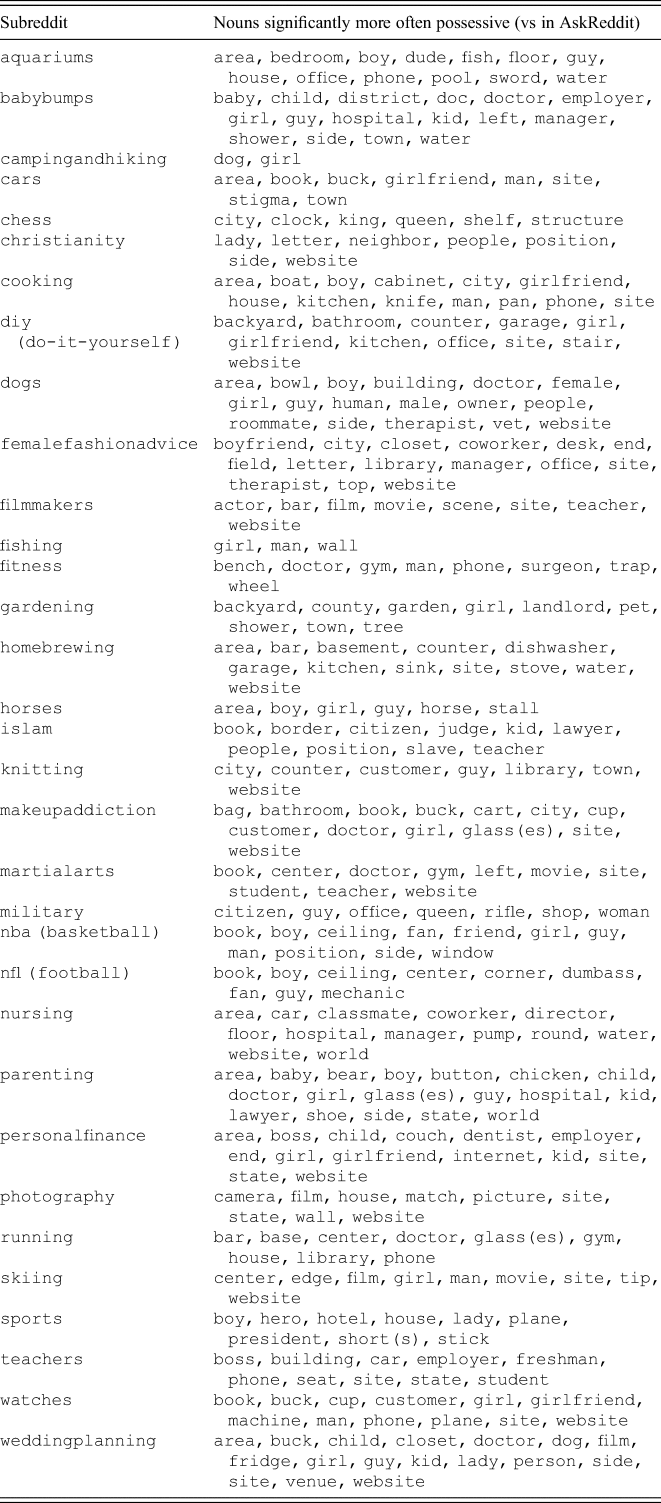
For example, table 1 shows that knife is used significantly more often as possessive in the Cooking subreddit than in AskReddit.Footnote 7 The Fisher Test was used to identify 341 nouns (151 of them unique) across 33 different specialty subreddits found to be significantly more often possessive at the p < 0.01 level in a specialty subreddit compared to AskReddit (table 2). Assuming that Percent Possessive approximates relationality, these nouns are more relational in the subreddits in which they are more often possessive. Assuming that a noun's frequency and definiteness ratio approximate conventional interaction with its referent, we might expect a noun to be more frequent and more often definite in the subreddits where it is more often possessive.
Counts of possessive and non-possessive tokens of knife in both AskReddit and Cooking, along with an example of each cell. A Fisher Exact Test on this contingency table shows that knife is significantly more often possessive in Cooking than in AskReddit

Nouns found in a Fisher Exact Test to be used as possessive significantly more often (p < 0.01) in a specialty subreddit compared to AskReddit (focusing only on nouns labeled as artifacts, natural kinds, humans, occupations, or locations in WordNet)
4.4 The predictions
Adopting these proposed proxies for relationality and convention, along with the strategies of comparing across nouns and across communities, we arrive at four predictions. To preview section 5, all but one of them are manifested.
(6) Across nouns: More relational, more frequent (empirically supported)
There should be a positive correlation between a noun's per-million-word frequency (proxy for conventional interaction) and its percentage of possessive tokens (proxy for relationality).
(7) Across communities: More relational, more frequent (empirically supported)
Nouns that are significantly more often possessive (proxy for more relational) in a given subreddit should be more frequent (proxy for conventional interaction) there.
(8) Across nouns: More relational, more often definite (not empirically supported)
There should be a positive correlation between a noun's definite-to-indefinite ratio (proxy for conventional interaction) and its percentage of possessive tokens (proxy for relationality).
(9) Across communities: More relational, more often definite (empirically supported)
Nouns that are significantly more often possessive (proxy for more relational) in a given subreddit should be more often definite (proxy for conventional interaction) there.
5 Testing the predictions
To compare across nouns, I use data from all two-word noun phrases in 5 million words of AskReddit, focusing on those labeled by WordNet as artifacts, natural kinds, humans, occupations, or locations. To compare across communities, I compare the same noun in AskReddit versus in the specialty subreddit in which it is significantly more often possessive (for all 341 nouns given in table 2). For each noun lemma, I gather (i) its ontological class (from WordNet, ignoring polysemy); (ii) its count and percentages of possessive versus non-possessive tokens; (iii) its per-million-word frequency; and (iv) its ratio of definite to indefinite non-possessive tokens. For (ii)–(iv), I gather this information both in AskReddit and in the specialty subreddits in which that noun is used significantly more often as possessive.
5.1 Frequency
First, (10) is tested across nouns.
(10) Across nouns: More relational, more frequent (empirically supported)
There should be a positive correlation between a noun's per-million-word frequency (proxy for conventional interaction) and its percentage of possessive tokens (proxy for relationality).
A series of linear regression models were run in R (R Core Team 2012) predicting Percent Possessive as a function of a noun's ontological class and its per-million-word count. One model used only ontological class, one used only per-million-word count, one used both variables as additive predictors, and one included an interaction between them. Comparing models with the Akaike Information Criterion (which tries to find the best balance of data coverage and parsimony), the ‘best’ model includes ontological class and per-million-word count as additive predictors:
(11) lm(percentPoss ~ pmw + ontType, data = d)
This model, which according to its Adjusted R Squared explains 3 percent of the variation in Percent Possessive, is visualized in figure 3. Looking first at the effect of the ontological class, Percent Possessive is somewhat lower than the intercept (artifacts) for human and natural kind nouns.Footnote 8 As for the effect of frequency, a noun's Percent Possessive is positively correlated with its per-million-word count (β = 0.07, SE = 0.01, t = 6.0, p < 0.001), an effect which persists when per-million-word-count is log-transformed (as in figure 3) to reduce its skew. These findings are consistent with (10).
Percent Possessive as a function of log-transformed per-millon-word count in AskReddit, color-coded by ontological class

Paired visualization of the per-million-word count of the same noun in AskReddit versus in the specialty subreddit in which it is significantly more often possessive

Next, (12) is tested across communities.
(12) Across communities: More relational, more frequent (empirically supported)
Nouns that are significantly more often possessive (proxy for more relational) in a given subreddit should be more frequent (proxy for conventional interaction) there.
A Wilcoxon test for paired samples was used to compare the per-million-word count of each noun in AskReddit versus in the specialty subreddit in which it is more often possessive. This test (V = 25222, p < 0.05), visualized in figure 3 and replicated to a p < 0.01 significance level in a paired t test, finds that nouns are more frequent in the subreddits in which they are significantly more often possessive, consistent with (12).Footnote 9
5.2 Percentage of definite tokens
Turning to the predictions related to definiteness, (13) is tested across nouns.
(13) Across nouns: More relational, more often definite (not empirically supported)
There should be a positive correlation between a noun's definite-to-indefinite ratio (proxy for conventional interaction) and its percentage of possessive tokens (proxy for relationality).
A series of linear regression models were run in R (R Core Team 2012) predicting Percent Possessive as a function of a noun's ontological class and its per-million-word count (shown above to be a significant predictors) as well as its percentage of definite versus indefinite non-possessive tokens. Models were run using subsets, additive combinations, and interactions of these independent variables. Across such models, contrary to (13), Percent Definite does not significantly predict Percent Possessive.
Percent Possessive as a function of the percentage of definite versus indefinite tokens in AskReddit, color-coded by ontological class

Next, (14) is tested across communities.
(14) Across communities: More relational, more often definite (empirically supported)
Nouns that are significantly more often possessive (proxy for more relational) in a given subreddit should be more often definite (proxy for conventional interaction) there.
A Wilcoxon Test for paired samples was used to compare the percentage of definite versus indefinite tokens of each noun in AskReddit versus in the specialty subreddit in which it is more often possessive. The Wilcoxon test (V = 17,622, p < 0.001, median percent definite = 66 percent in AskReddit versus 72 percent in the specialty subreddit), visualized in figure 6 and replicated in a paired t test, finds that nouns are indeed more often definite in the specialty subreddits in which they are more often possessive, consistent with (14).
Paired visualization of the percentage of definite tokens of the same noun in AskReddit versus in the specialty subreddit in which it is significantly more often possessive

5.3 Discussion
This corpus study finds evidence consistent with three of the four predictions intended to quantify the overarching hypothesis that a noun should be more relational (as measured by Percent Possessive) when human interaction with its referent is more conventional (as measured by frequency and definiteness ratio). As predicted, there is a positive correlation across nouns between a noun's Percent Possessive and its frequency. Also as predicted, across communities, the same noun is more frequent and more often definite in the specialty subreddit in which it is more often possessive.
As to why Percent Possessive fails to correlate with definite-to-indefinite ratio across nouns, I suggest that the percentage of definite tokens of a noun is an imperfect proxy for conventional interaction with its referent. The chance of a noun being used as definite versus indefinite depends not just on the conventional familiarity of its referent but also on whether the referent can be considered unique in context (Löbner Reference Löbner2011; Coppock & Beaver Reference Coppock and Beaver2015).
Among the nouns that are often used as definite but rarely as possessive, we find names for participants in a discourse-given event (perpetrator, culprit, interviewer, unique in context); and locations that seem to prefer the of-form to the 's possessive because their possessor is usually inanimate (outskirts, outback, rooftop, forefront). All these examples are 100 percent definite and 0 percent possessive in their AskReddit tokens. In these cases, I would suggest that the noun's high definite-to-indefinite ratio does not indicate the conventionality of human interaction with its referent.
In other words, there are many factors that determine a noun's definite-to-indefinite ratio beyond conventional interaction, so I argue that the overall hypothesis – that a noun is more relational when human interaction with its referent is more conventional – can still be true even if the predicted relation between definiteness ratio and Percent Possessive is not manifested. In a more controlled comparison of the same noun across communities, holding constant many of the other factors contributing to a noun's definite-to-indefinite ratio, the predicted effect is found.
5.4 Examples
I turn to some examples illustrating these findings. Across nouns, phone is far more frequent in AskReddit than lamp – both artifacts; occurring 184 versus 2 times per million (15)–(16) – which I take to approximate the intuition that human interaction with phones is far more conventional than with lamps. (Phone is also more often definite than lamp: 75 percent of phone's non-possessive tokens are definite, versus 29 percent for lamp). As predicted, phone is also far more often possessive than lamp (67 percent versus 42 percent Percent Possessive).
(15) As a 16 yo, I shouldnt need restrictions on how long i'm using my phone, right? (r/AskReddit)
(16) We had no furniture, just a tv, maybe a lamp or so. (r/AskReddit)
Similarly, dog is far more frequent in AskReddit than horse – both natural kinds; occurring 205 versus 35 times per million; (17)–(18) – which I take to approximate the intuition that human interaction with dogs is far more conventional than with horses. (Dog is also more often definite than horse: 56 percent of dog's non-possessive tokens are definite, versus 30 percent for horse.) As predicted, dog is also far more often possessive than horse (46 versus 12 percent Percent Possessive).
(17) Currently watching Netflix with my dog on my lap. (r/AskReddit)
(18) I live in Texas and I've never ridden a horse here. (r/AskReddit)
Across communities, knife is far more often possessive in the Cooking subreddit than in AskReddit (44 versus 7 percent). As predicted, knife is far more frequent in the Cooking subreddit than in AskReddit – occurring 218 versus 11 times per million, exemplified in (19)–(20) – which I take to approximate the intuition that interaction with knives is far more conventional for cooks than for laypeople. Knife is also more often definite in the Cooking subreddit than in AskReddit (44 versus 32 percent of its non-possessive tokens are definite), which I take as further evidence for the same point.
(19) Flailing the knife on the stone or rubbing a stone on the knife are inefficient and unsafe for a beginner. (r/Cooking)
(20) Cut to 15 minutes later she's screaming in the kitchen holding a knife. I think the knife was just a coincidence, she's not a murderer. (r/AskReddit)
Finally, across communities, horse is far more often possessive in the Horses subreddit than in AskReddit (37 versus 12 percent). As predicted, horse is vastly more frequent in the Horses subreddit than in AskReddit – occurring 5,129 versus 35 times per million (21)–(22) – which I take to approximate the intuition that human interaction with horses is far more conventional for equestrians than for laypeople. Horse is also more often definite in the Horses subreddit than in AskReddit (44 versus 30 percent of its non-possessive tokens are definite), which I take as further evidence for the same claim.
(21) My horse is still barefoot and never needed shoes before, during, and after having white line disease. (r/Horses)
(22) I live in Texas and I've never ridden a horse here. (r/AskReddit)
As illustrated by these examples, the Reddit corpus study finds evidence across nouns that Percent Possessive is positively correlated with a noun's per-million-word frequency. Across communities, a noun is more frequent and more often definite in the community where its Percent Possessive is significantly higher. I take these findings to be consistent with the claim that a noun is more relational in a gradient sense (as measured by Percent Possessive) when human interaction with its referent is more conventional (as measured by its frequency and definite-to-indefinite ratio).
6 Theoretical consequences
Approximating a continuous construct of relationality via Percent Possessive, this article has explored which nouns are more or less relational and why. Framed as binary rather than continuous, the same question pervades the literature on the semantics of possessive constructions: a researcher must decide whether to give two different analyses for my cousin versus my tree – in which case they must also decide which other nouns behave like cousin or like tree – or whether to propose a unified semantics for both my cousin and my tree while explaining their differences pragmatically. Any of these approaches can capture the facts, but each one also leaves open the question of which nouns should be analyzed in which way(s) and why, and so can be complemented by an answer to that question like the one offered here.
As mentioned above (section 2), a researcher must also decide whether to begin from a binary distinction between two-place versus one-place predicates; or from the gradient data manifested in grammaticality judgments, across the lexicon, and in corpus data. If one begins with a formal binary, one might also aim to explain how it connects to the gradient data observed across the lexicon and in usage, or vice versa. Here, I review the literature's formal approaches to relationality and possession and explore – in some cases extrapolating beyond the authors’ own claims – how each one could be linked to the gradient findings presented above.
6.1 Two types of nouns, two analyses for possessives
For Barker (Reference Barker1992), a relational noun such as cousin is a two-place predicate – λxλy[cousin(x, y)] – and the possessor saturates one of its arguments. In contrast, a sortal noun such as tree is a one-place predicate – λx[tree(x)] – and the possessor is related to tree by a free variable, named R or π, which is supplied by the possessive morphology and saturated by context. Inspired by the languages that use different morphology for inalienable versus alienable possessives, this approach reflects the intuition that possessed relational nouns (my cousin) provide a possessor–head relation lexically, whereas possessed sortal nouns (my tree) find their possessor–head relation in context (Ortmann Reference Ortmann2018). This analysis assumes that nouns have to be somehow classified as relational or sortal, or perhaps (as Barker Reference Barker1992 suggests for child) polysemous between the two. The distinction between one-place and two-place predicates is binary, although one could make a gradient prediction that possessive tokens of two-place predicates would be more frequent than possessive tokens of one-place predicates.
In this framework, Percent Possessive could serve as a continuous indicator of a noun's classification, and could help to quantify the relative frequency of different senses of nouns treated as polysemous (for example, 40 percent of AskReddit tokens of child are possessive compared to 84 percent of tokens of daughter, which might illustrate the frequency of child's relational sense). Moreover, conventional interaction with a noun's referent could help to explain these facts.
6.2 Two types of nouns, one analysis for possessives
For Vikner & Jensen (Reference Vikner and Jensen2002) and those inspired by them, all possessives are built from relational nouns, which are either inherently relational or type-shifted to a relational denotation. Cousin is relational and its possessor saturates one of its arguments. Phone is sortal, so in order to be possessed, it must be type-shifted to a relation that holds between an individual and the phone that they use for communication, drawing on encyclopedic information (‘qualia structure’ in a rich lexical representation inspired by Pustejovsky Reference Pustejovsky1995) about the typical use of such an artifact. Tree is also a sortal noun, so it must also be type-shifted to a relation between an individual and the tree that they ‘control’ (in some way that must be interpreted contextually) – a last-resort type-shift (predicted to be infrequent and in need of contextual support) for nouns whose qualia structure does not provide any other relation. This approach strives for a unified analysis of possessives while maintaining a distinction between nouns that are inherently relational versus those that have to be type-shifted more or less easily to a relational meaning.
This analysis also assumes that nouns have to be classified as relational or sortal, and further that sortal nouns must be classified with respect to the relation-adding type-shifters that (tend to) combine with them. Here too, Percent Possessive could convey a noun's classification as well as its propensity for type-shifting, and conventional interaction with its referent could help to explain these facts.
6.3 One type of noun, one analysis for possessives
For Payne et al. (Reference Payne, Pullum, Scholz and Berlage2013) and Peters & Westerståhl (Reference Peters and Westerståhl2013), all nouns are sortal and all possessives introduce a free variable R which relates the noun to its possessor and is supplied by some combination of lexical and contextual factors. On this view, cousin and tree are both just one-place predicates, but our lexical and/or encyclopedic knowledge easily supplies a salient possession relation for my cousin, whereas we have to look further at the context to find a suitable relation for my tree. This analysis embraces a continuous approach to relationality and a unified account of all possessives. It does not require nouns to be classified as relational versus sortal, but it still leaves open the question of which nouns provide more or less information to saturate the free variable R. Percent Possessive could quantify that cline, and the most likely relation between the possessor and the head noun could be supplied and explained by conventional interaction with its referent.
7 Conclusion
Facing the binary, theory-specific distinction between prototypical relational nouns such as cousin and prototypical sortal nouns such as tree, this article offers Percent Possessive to reframe relationality as a continuous, objective corpus metric, and uses it to investigate at scale which nouns are more or less relational and why. Across nouns, Percent Possessive is found to correlate with a noun's frequency; across communities, the same noun is found to be more frequent and more often definite in the community in which it is more often possessive. Expanding the suggestion that relationality and possession are grounded in culture, these findings are taken as evidence for the claim that, taking ontological class into account, a noun is more relational when human interaction with its referent is more conventional.
Stepping back, this article illustrates the value as well as the challenge of approximating abstractions such as relationality and convention in corpus data. On the one hand, the proxy measurements of Percent Possessive, per-million-word frequency, and definite-to-indefinite ratio are of questionable validity as stand-ins for relationality and convention. On the other hand, these measurements allow for large-scale hypothesis testing, which is impossible if relationality and convention remain abstract.
This article also constitutes an attempt to study lexical semantics at the scale of the lexicon. Any time words are classified with respect to some property that applies clearly to prototypical examples, there is a challenge to be found in explaining which further words fall into which class and why. Here, that explanation advances the larger idea that grammar is social: the syntactic distribution of a noun is linked to the conventions of the people who interact with its referent.


 Open access

