

Air pollution is one of the gravest threats to global public health, surpassing tobacco, alcoholism, terrorism, and war in terms of lost life expectancy.Footnote 1 People who live in heavily polluted areas often push governments for environmental regulations on economic activities, especially as countries grow richer.Footnote 2 Yet for this accountability process to work, citizens must blame their own government. If the source of pollution originates at least partially in a foreign country, then citizens might instead blame the foreign rather than their national government. Thus transboundary air pollution can simultaneously undermine domestic pressure to adopt environmental regulations and increase negative sentiment toward a foreign country, generating both international and domestic consequences.
We investigate this “hazy accountability” argument in the context of South Korea, which has the worst air quality among OECD countries. Air pollution in Korea results from a combination of local sources and long-range transport from China. Although the Korean government has adopted some mitigation policies, these have failed to reduce domestic emissions effectively.Footnote 3 Simultaneously, public sentiment toward China has markedly deteriorated despite significant efforts by China to reduce its domestic pollution in response to internal public pressure.Footnote 4
We examine how exposure to severe air pollution affects public approval of both the Korean and Chinese governments. We match air quality data from different Korean cities and provinces with survey responses to the Gallup World Poll for 2015–2022. We estimate a local average treatment effect by using daily air quality as an instrument for subjective beliefs about air quality, as well as reduced-form models that directly regress government approval on air pollution. Studies in China and Vietnam have used similar empirical designs to show that citizens negatively adjust government evaluations on bad air pollution days.Footnote 5 We find that exposure to air pollution strongly and negatively affects South Korean citizens’ satisfaction with Chinese leadership but does not robustly impact evaluations of the South Korean government’s environmental policies, leadership, presidential approval, or overall confidence in government. Additionally, we find suggestive evidence that air pollution reduces confidence in the local economy, which in turn shapes political judgments about China.
Our argument is not that Koreans inaccurately blame China. Scientific consensus acknowledges that air pollution in Korea stems from both local and foreign sources, with some debate over the extent of China’s contribution. To investigate whether our findings are solely attributable to Chinese pollution, we leverage the fact that air pollution on Ganghwa Island, located on Korea’s west coast, predominantly originates from China.Footnote 6 Our analysis shows that neither pollution of Chinese origin nor regions where air pollution levels closely correlate with Chinese pollution drives our findings.
These findings have three implications that extend beyond this case. First, transboundary pollution fosters negative sentiments toward exporting governments, complicating international cooperation and potentially escalating into diplomatic conflicts or broader international disputes. Historically, there have been examples of states resolving transboundary pollution through international cooperation, as demonstrated by Europe’s acid rain issue.Footnote 7 But this typically requires favorable ex ante inter-state relations and a credible institutional framework. Our findings suggest that, amid already tense relations, the presence of transboundary air pollution aggravates negative sentiment. South Korean public opinion toward China has grown increasingly hostile, now ranking among the most negative globally.Footnote 8 While previous research has primarily attributed this animosity to China’s coercive economic measures following South Korea’s deployment of the Terminal High Altitude Area Defense (THAAD) system in 2017,Footnote 9 our findings highlight air pollution as an additional, powerful driver of these negative sentiments. These findings may well be applicable to other cases of transboundary environmental harms between states with conflictual relations. For example, in Asia, Japan’s release of Fukushima nuclear wastewater may have affected public sentiment in Korea and China, Indonesian fires generate haze pollution that affects Singapore and Malaysia, and air pollution from India adversely impacts Bangladesh. Such transboundary environmental harms are relatively common, and further research is warranted on how they affect hostility toward the sender state.
Second, our argument implies that transboundary sources of pollution complicate domestic efforts to tackle harmful pollution and, by extension, global climate change. Democracies typically underprovide climate mitigation since the benefits of climate policies are temporally distant and global.Footnote 10 Policies that reduce air pollution typically also lower CO2 emissions. Yet the benefits of pollution reductions are immediate and local, implying that public demands for cleaner air can serve as a gateway to climate mitigation.Footnote 11 For example, public support for restrictions on power plants is much higher when framed in terms of air pollution rather than climate.Footnote 12 Our findings suggest that transboundary air pollution undermines this mechanism. Previous research has shown that countries able to externalize some of their pollution face reduced incentives to implement abatement measures,Footnote 13 and that a similar mechanism operates when pollution crosses jurisdictional boundaries within countries.Footnote 14 Yet the effect on recipient countries has received little attention. This matters especially in the Asian context, where many large cities are global leaders in air pollution and increasing carbon emissions. Moreover, transboundary pollution is a common phenomenon in Asia.
Third, our findings contribute to the burgeoning literature on how personal exposure to environmental hazards, such as floods, fires, and pollution, affects political judgments.Footnote 15 To date, this literature has not considered the international sources or international consequences of environmental harms. Moreover, it rarely systematically examines the mechanisms through which environmental exposure affects political judgments. We offer suggestive evidence for a mechanism linking beliefs about air quality to political judgments.
Transboundary Pollution and Environmental Accountability Politics
South Korea has unusually high levels of air pollution compared to other economically developed countries. The Environmental Kuznets Curve (EKC) hypothesis posits an inverted U-shaped relationship between per capita income and environmental pollution.Footnote 16 Initially, economic growth leads to environmental degradation as industrial output and energy consumption increase. Once countries reach a turning point—often estimated at around USD 8,000 to USD 9,000 in per capita income—environmental conditions begin to improve.Footnote 17 South Korea surpassed this level in the early 1990s. However, Figure 1 shows that Korea’s air quality deteriorated significantly between 2010 and 2019. South Korea started the 2010s as the fifth-most polluted country in the OECD but became the most polluted country by the end of the decade. Another study estimates that Koreans would live, on average, 1.4 years longer if air quality met the World Health Organization’s standard.Footnote 18 For comparison, China began its aggressive air pollution reduction program in 2014, when its GDP per capita was around USD 8,000.Footnote 19
South Korean fine dust pollution compared to other OECD countries, 2010–2019

A key mechanism underpinning the EKC hypothesis is that citizens demand higher environmental quality as their economic well-being increases. Strong vested interests, such as heavy industry and the transport sector, typically oppose environmental regulations aimed at limiting pollution. Because the benefits of reduced pollution are diffuse while losses are concentrated, public pressure becomes a key driver of change. There is strong evidence that countries and cities allowing greater public participation reduce air pollution more quickly,Footnote 20 and that citizen participation, increased public access to pollution information, and greater transparency significantly improve air quality.Footnote 21
A significant body of literature suggests that citizens in developed economies update their policy and political preferences on environmental issues following personal exposure to environmental hazards.Footnote 22 Assessments of poor air quality can become politically consequential if individuals believe it adversely affects their health, life satisfaction, or the economy—all of which are plausible mechanisms. There is robust evidence that microdust increases mortality from respiratory and cardiovascular diseases.Footnote 23 The Korea Environment Institute estimates that dust annually causes up to 1.8 million illnesses. The primary health risk arises from microdust particles lodging in the lungs or entering the bloodstream. These particles, which include compounds like sulfur dioxide, can cause lung cancer and cardiovascular diseases. This is why PM2.5 particles are sometimes called a “silent killer.”Footnote 24
Koreans commonly use mobile apps to check the latest dust levels, wear masks, stay indoors, and take other precautions to limit exposure to poor air quality.Footnote 25 These measures visibly reduce traffic in commercial areas such as malls, restaurants, and retail stores. On days with poor air quality, the South Korean government may implement emergency reduction measures, such as closing schools and factories.Footnote 26 A 2019 public opinion survey found that 71 percent of respondents reported that fine dust pollution negatively impacted production activities at their workplaces.Footnote 27 Such declines in local economic activities can influence perceptions of local economic conditions, which, in turn, may affect evaluations of the government.
The literature provides ample reasons to believe that excessive pollution can affect perceptions of the local economy, health, or life satisfaction, which, in turn, can lead to public pressure on the government. However, this literature has largely ignored scenarios in which the public can also attribute blame to a foreign government. The Korean public has actively mobilized over air pollution. For example, Koreans markedly increased their submission of petitions to the Blue House demanding government interventions.Footnote 28 Concurrently, environmental NGOs organized demonstrations, and air pollution became a prominent national concern in public opinion polls and media discourse. The establishment of the “National Council on Climate and Air Quality,” chaired by former UN Secretary-General Ban Ki-moon, exemplifies this responsiveness. Officially inaugurated on 29 April 2019, the council aimed to address fine dust issues systematically and inclusively, emphasizing public participation and transparency. This included the creation of a National Citizens’ Policy Participation Group tasked with contributing ideas and policy suggestions to help shape national strategies on air quality and climate concerns.Footnote 29
Nevertheless, this public pressure and the resulting policies have failed to reduce domestic emissions that lead to fine dust pollution.Footnote 30 A plausible reason is opposition from vested interests. For example, the capacity of coal-fired power plants has increased by 50 percent since 2015.Footnote 31 Closing these power plants would endanger jobs, require financial compensation for stranded assets, and likely result in legal disputes.Footnote 32 Similarly, traffic and fuel consumption have increased considerably, as has industrial production in sectors such as aluminum.Footnote 33
Public mobilization must be strong to overcome entrenched opposition. We argue that transboundary pollution obscures and weakens the accountability chain. There is considerable uncertainty about how much pollution originates in China. For example, a joint Korea–Japan–China study from 2017 estimated China’s share at approximately 32 percent of South Korea’s fine dust, with domestic sources contributing about 51 percent.Footnote 34 However, during severe pollution days, and in winter, China’s contribution is much higher. A report by the Korean National Institute of Environmental Research estimates that during high-concentration periods in February and March, China’s contribution can reach up to 70 percent.Footnote 35 Other studies have produced varying estimates. Such disagreements, even among experts, pose a significant informational challenge for ordinary citizens. Media narratives and political discourse have emphasized China’s role. Our analysis of South Korean media using Bigkinds (a Korean equivalent of LexisNexis) reveals a marked tendency to attribute air pollution primarily to China.Footnote 36 Although references to China existed before 2012, the specific framing of “Chinese-origin fine dust” emerged prominently following its initial use by Kyunghyang Shinmun on 24 January 2012.Footnote 37 Subsequently, media mentions explicitly linking China to fine dust surged dramatically from 1,477 instances in 2013 to 8,416 in 2019.Footnote 38 Another media study confirms this trend, reporting that articles explicitly attributing blame to China doubled between 2015 and 2018.Footnote 39 Such media frames can matter: two survey experiments show that narratives exclusively attributing air pollution to China lead to reduced satisfaction with China.Footnote 40
Even though Korean political parties hold distinct positions regarding business policies and China, they have converged in blaming China for air pollution. Conservative parties, such as the Liberty Korea Party (now the People Power Party), have traditionally supported pro-business, growth-oriented policies and adopted a more confrontational stance toward China. Progressive parties like the Democratic Party of Korea typically advocate stronger environmental protections and favor diplomatic engagement with China. Yet both sides attribute pollution to China. For example, in 2018, Hong Joon-Pyo, then-leader of the conservative Liberty Korea Party, questioned whether “China [should] pay an environmental fee to Korea for the environmental burden caused by their economic development.”Footnote 41 Prominent liberal politicians have made similar claims. In February 2019, Prime Minister Lee Nak-yon (Democratic Party) asserted that “it has already been proven that a lot of the fine dust comes from China.”Footnote 42 Similarly, Lee Hae-chan, chairman of the Democratic Party, publicly identified China as the primary source during severe fine dust conditions in March 2019.Footnote 43
In public surveys, more than 80 percent of South Koreans attribute air pollution primarily to China.Footnote 44 Our own analysis of public petitions confirms China’s prominence. We systematically coded all air pollution-related petitions filed between August 2017 and August 2019 with at least twenty-five signatures (a total of 816 petitions) from a public data set.Footnote 45 Each petition was coded based on whether the petitioner explicitly blamed China and whether it requested domestic mitigation actions or diplomatic or confrontational action toward China. In our coding, domestic action refers to any petition that requests domestic solutions from the Korean government—such as new regulations or pollution control measures.
Figure 2 illustrates three patterns: most petitions externally attribute blame to China, petitions blaming China attract more engagement, and only a minority of petitions request domestic policy actions. Panel (a) displays a stacked bar chart showing the number of petitions by blame attribution—“Blame China” and “Not Blame China.” For each group, the lower (blue) segment shows the number of petitions that requested any domestic government action (“Any Domestic Action”), while the upper (red) segment represents petitions that did not request domestic action (“Others”). Among the one hundred “Blame China” petitions requesting domestic action, seventy-seven also demanded action against China. In the few domestic-only cases, petitioners sometimes expressed skepticism about the feasibility of addressing China directly. For example, Petition No. 551970 (signed by thirty-five people in April 2019) argued that “blaming China will not improve things … The real answer is to replace coal power plants with clean nuclear power.” However, such petitions were few and received limited public support.
Public petition patterns regarding fine dust by blame attribution
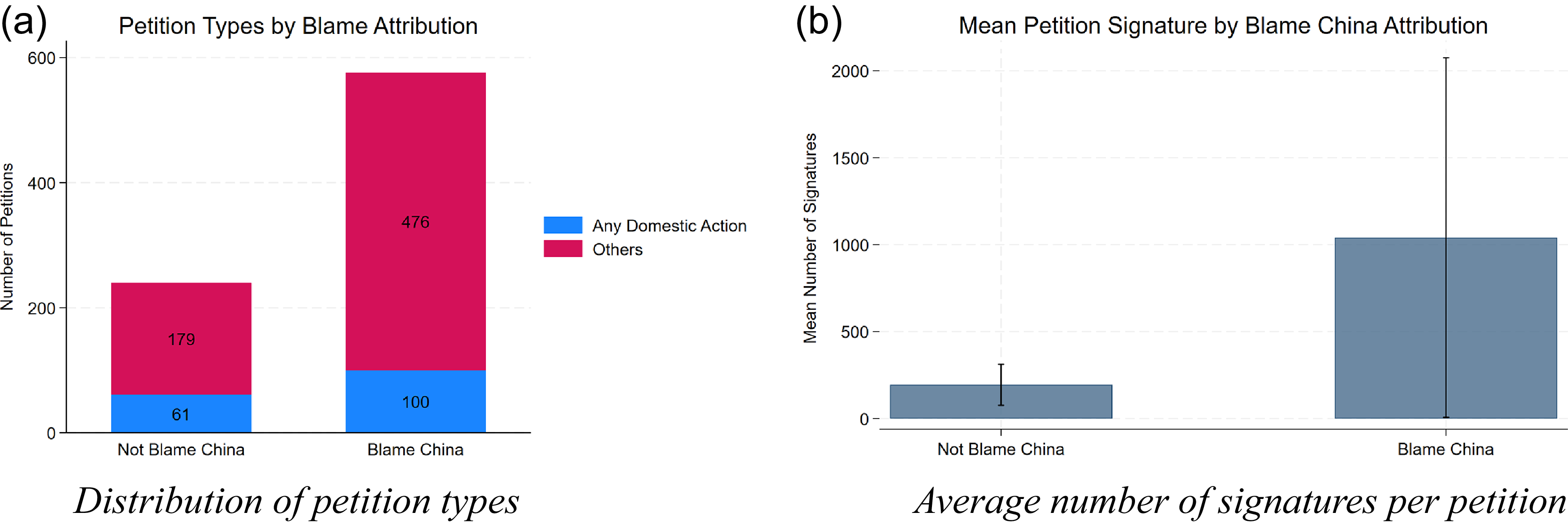
Panel (b) presents a bar chart comparing the mean number of signatures per petition for each blame group, with error bars reflecting the 95 percent confidence intervals. This panel demonstrates that “Blame China” petitions receive substantially greater public support: on average, these petitions garner 1,041 signatures, while “Not Blame China” petitions receive only 351 signatures on average. Notably, the most-signed petition (No. 174292, submitted 24 March 2018) explicitly called on the Korean government to confront China, amassing 278,128 signatures: “Fine dust is now coming much more frequently than it did a decade ago. Please, protest to China and urge them to shut down the factories located on the Shandong Peninsula.”
NGOs have faced similar challenges when pushing for domestic policy changes. For example, Greenpeace has encountered significant public resistance and suspicion, including accusations of acting as a “Chinese spy” due to its Asian headquarters being located in Hong Kong.Footnote 46 Taken together, these findings suggest that even when petitions demand some form of domestic policy response, the overwhelming focus on blaming China provides the Korean government with political space to appear responsive to public concerns—for example, through diplomatic gestures or statements—while avoiding the implementation of costly or controversial domestic policy changes.
Hypotheses
To test the link between pollution and political judgments, we follow the existing literature by matching variation in daily pollution levels with public appraisals of the government.Footnote 47 We test two core hypotheses: first, that exposure to air pollution increases dissatisfaction with the Korean government, and second, that it increases dissatisfaction with the Chinese government. Theoretically, we could find evidence supporting both, which would suggest that Koreans (accurately) hold both governments accountable for severe air pollution. However, the hazy accountability argument implies that we should find evidence only for the second: when Koreans experience pollution, they become more negative toward China but not toward their own government.
H1 Exposure to air pollution significantly increases dissatisfaction with the Korean government’s efforts to preserve the environment (and the Korean government/ president).
H2 Exposure to air pollution significantly increases dissatisfaction with the Chinese government.
Data
We match daily air quality data from Korean cities and provinces with responses to the 2015–2022 Gallup World Poll, which covers over 160 countries using nationally representative samples of adults aged fifteen and older. The Korean surveys are typically conducted over two months in the summer and fall, utilizing both landline and mobile phones. The appendix provides comprehensive details, including sample size, survey period, and methodology. The survey asks respondents “whether they are satisfied with quality of air in their area.” Subjective evaluations are important because some people, due to their life circumstances, may be less affected by poor air quality than others. However, we will also estimate the direct effects of objective changes in air quality on political attitudes.
Our first dependent variable measures responses to whether an individual is “satisfied or dissatisfied with the government’s environmental preservation efforts.” We do not have a comparable measure regarding the Chinese government’s environmental performance. But if we are interested in the overall growing hostility toward the Chinese government, then overall evaluations of China’s government constitute a better measure. Respondents were asked whether they approve or disapprove of the leadership in China and South Korea.Footnote 48 We use two additional questions as alternative tests of Hypothesis 1: approval of the current Korean president and “confidence in the national government.” Additionally, we include evaluations of United States leadership as placebo checks: while individuals may have strong views about the United States, it is not responsible for Korean air pollution. In the appendix, we also report evaluations of Germany, Japan, and Russia as placebo checks.
To assess the mechanisms, we use the Gallup World Poll’s Local Economic Confidence Index, which is based on combined responses to questions about economic conditions in respondents’ city or area today. In 2015 and 2016, respondents were instead asked about their confidence in economic conditions in their “country.” We also examine an index measuring respondents’ subjective evaluations of their personal finances.Footnote 49
To assess whether the effect of air pollution runs through noneconomic life circumstances, we include Gallup’s “Daily Experiences Index” and “Personal Health Index.” Gallup’s “Daily Experiences Index,” inspired by Daniel Kahneman’s concept of “experienced well-being,” evaluates whether respondents had a series of positive or negative experiences on the day prior to the survey.Footnote 50 The “Personal Health Index” includes a battery of questions about general health problems, as well as health-related questions from the “Daily Experiences Index.”Footnote 51 Unfortunately, the health index does not include a specific indicator for respiratory health issues.
The data include demographic and socioeconomic characteristics of respondents, including age, gender, household income in US dollars, and education. Unfortunately, the survey does not include a direct measure of respondent partisanship or ideology. We therefore constructed an ideology measure based on three indicators: respect for children, respect for women, and how to deal with the poor. These indicators are consistently available across survey waves and form a strong scale (Cronbach’s alpha=0.7). The ideology index strongly predicts presidential approval contingent on the president’s party affiliation. Controlling for gender, age, education, and income, respondents who lean left on this spectrum are thirty percentage points more likely to approve of the president if the president is from the left, compared to when the president is conservative. We include the full interaction between respondent ideology and the president’s party. Table 1 provides summary statistics for all variables in our study.
Summary statistics

Air quality data come from the World Air Quality Index (WAQI), which collects and standardizes air pollution data.Footnote 52 The PM2.5 individual Air Quality Index (AQI) directly measures fine dust pollution.Footnote 53 We also compute a composite AQI by taking the maximum of the various individual AQIs, as recommended by the WAQI documentation. The correlation between the composite AQI index and the AQI PM2.5 is 0.94, reflecting that fine dust is the major cause of air pollution.
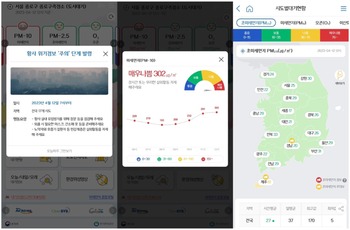
By international standards, an AQI of 0 to 50 gets a green label (healthy), 51 to 100 a yellow warning, 101 to 150 an orange warning (unhealthy), and above 150 a red warning (very unhealthy). Air Korea uses a slightly different color scheme that starts with blue: blue (0–50), green (51–100), yellow (101–150), and red (151 plus). These warnings increase public awareness of air pollution. For example, attendance at baseball matches is significantly lower when there is a public warning, even after controlling for AQI levels.Footnote 54 We created dummy variables to capture potential threshold-level effects. AQI levels around the red-warning threshold are also when public authorities can formally take emergency measures, such as school closures. The Korean public relies on fine dust forecasting and alert systems to stay informed about air quality changes. For instance, the Korea Environment Corporation operates Air Korea (shown in Figure 3), providing location-specific fine dust levels and air pollution alerts.
Air Korea mobile application with real-time air quality information

Finally, following a recent study on Chinese air pollution’s impact on the Korean economy, we collected pollution data for Ganghwa and Deokjeok islands (two islands on the west coast), which are affected by Chinese pollution but have minimal local pollution.Footnote 55 Daily pollution levels for Ganghwa are available only from 2015.
The WAQI database provides measurements from individual weather stations, enabling us to merge daily local air quality data with respondents from major cities, including Seoul, Busan, Daegu, Incheon, Gwangju, Daejeon, and Ulsan. For other respondents, Gallup specifies only the province of residence. In these cases, we use air quality data from the largest city in each province. This merge is based on the exact dates of the surveys.
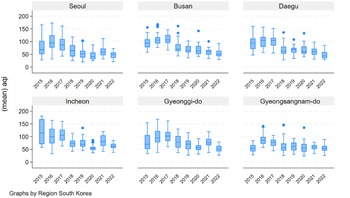
Figure 4 plots the variation in AQI levels within each survey wave for the four largest cities and the two largest provinces. There is considerable variation within each wave. Although mean pollution levels decreased during the COVID-19 pandemic, many days still experienced pollution warnings. In an ANOVA, region explains 8 percent of the variation in AQI levels, while day explains 65 percent. Thus temporal variation is much more important than regional differences. All models include location fixed-effects.
Variation in Air Quality Index within survey periods by region

Empirical Strategy
Figure 5 outlines our causal diagram. High levels of actual pollution should prompt individuals to adjust their satisfaction regarding air quality. This adjustment might then affect concerns about the local economy and/or dissatisfaction with life and health, potentially lowering approval ratings for the Korean government. Conversely, if Koreans largely blame China for poor air quality, they may downgrade their views of the Chinese government while their opinions of the Korean government remain unchanged.
Hazy accountability DAG

This causal diagram treats pollution levels (AQI) as an instrument (Z) for satisfaction with air quality, which is the treatment (T). Confidence in the economy and satisfaction with life and health are mediators (M), which can influence the outcomes (Y), namely approval ratings for the Korean or Chinese government.
We have three estimation strategies. First, we estimate a two-stage least squares model to capture the effect of instrumented beliefs about air quality directly on our outcome variables. The motivation is that there are unobservables (U) likely associated with evaluations of both air quality and government performance. For example, individuals less satisfied with their health, family, or economic circumstances may perceive air quality as worse and also be unhappier with the government. The causal estimate is a Local Average Treatment Effect (LATE). Not all Koreans will adjust their subjective evaluations of air quality based on daily variations in fine particles. This process is not random. People vary in their exposure to outdoor air and the extent to which poor air quality affects them. Thus the LATE is causally identified but is not a population estimate. The exclusion restriction required for instrumental variables estimation is that air pollution does not affect government approval through channels other than beliefs about air pollution. We cannot test this directly, but in the robustness section, we offer various plausibility checks: we estimate models that control for seasonality, day-of-the-week effects, rain, and temperature. We also examine models that control for news articles about China. All models in the main specification include both year and regional/city fixed-effects. Second, we estimate the direct effect of fluctuations in AQI (Z) on evaluations of the Chinese and Korean governments (Y). These reduced form estimates offer population estimates of physical air quality fluctuations on government evaluations. This is the strategy that is most common in the literature. This is an Intention to Treat (ITT) estimate in that it ignores that not everyone “complies” (adjusts satisfaction with air quality).Footnote 56 In the appendix, we estimate a model that instruments for daily air pollution using a triple interaction between wind direction, wind speed, and region. Moreover, as discussed before, we estimate models using pollution in Ganghwa as a measure of Chinese-origin pollution.
Finally, we estimate the mediation effect, assuming that Z serves as an instrument both for beliefs about air quality and (conditionally) for beliefs about the economy, life satisfaction, and health.Footnote 57 This model requires the strongest assumptions, and we emphasize that these findings are more speculative.
Results
Two-Stage Least Squares
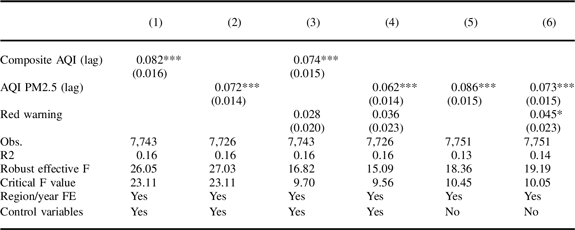
The first stage models the relationship between daily air quality levels, air quality warnings, and respondents’ dissatisfaction with air quality. We had no strong priors about the model specifications for the first stage, so we tested models with different lag structures, quadratic terms, and inclusion or exclusion of yellow, orange, and red warnings. Table 2 presents six alternative specifications. For ease of interpretation, AQI measures are divided by 100.
First stage regression of AQI on dissatisfaction with air quality
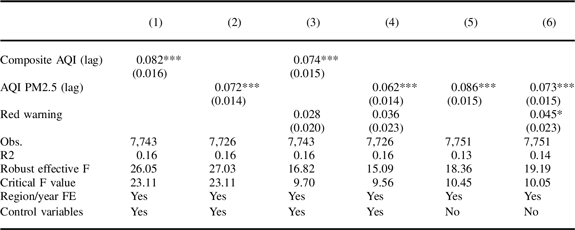
Notes: The dependent variable is dissatisfaction with air quality. Full results are in the appendix. Robust standard errors clustered on region in parentheses. *p < .10; **p < .05; ***p < .01.
Our findings indicate a significant and modestly sized relationship between objective air quality and dissatisfaction with air quality. A one standard-deviation increase in daily AQI corresponds to about a three-percentage-point increase in dissatisfaction. A red warning adds about a four-percentage-point increase, although this result is only borderline significant. We found no additional effects for yellow and orange warnings. Our analyses showed that air quality on the day prior to the interview was a stronger predictor of perceived air quality than the same-day air quality, presumably because interviews were primarily conducted in the mornings.Footnote 58
We next examine whether the instruments are sufficiently strong for robust statistical inference. Practitioners commonly reject concerns about weak instruments if the first-stage F statistic exceeds 10.Footnote 59 However, standard F statistics may be misleadingly high under conditions of heteroscedasticity.Footnote 60 This concern is relevant for us because air quality (our instrument) is observed at the regional or city-level rather than the individual-level.
Table 2 reports the results of the Olea-Pflueger robust test for weak instruments. This test evaluates the null hypothesis that the estimator’s approximate asymptotic bias (Nagar bias) exceeds 10 percent of a “worst-case” bias at a 5 percent significance.Footnote 61 The “worst-case” bias captures a case when the instruments are entirely uninformative. The table reports both the robust effective F statistic and the critical F value necessary to reject this null hypothesis.Footnote 62 The table shows that the critical F values indeed exceed 10, indicating that the instrument is sufficiently strong for reliable inference. These tests suggest that instruments based on the AQI PM2.5 measure may be slightly stronger than those based on the composite AQI.Footnote 63
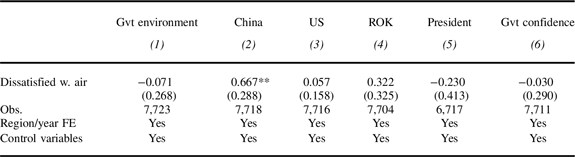
Table 3 presents the estimates using AQI PM2.5 as the instrument. Dissatisfaction with air quality has a strong and statistically significant effect on dissatisfaction with China’s leadership. The effect is very large: dissatisfaction with air quality caused by exposure to fine dust increases dissatisfaction with China for around 67 percent of “compliers.” This is not a population-wide effect because individuals who adjust their satisfaction with air quality based on exposure are likely a somewhat distinct subgroup.
Instrumental variables estimates for dissatisfaction with air quality on leadership evaluations (instrument: AQI PM2.5)
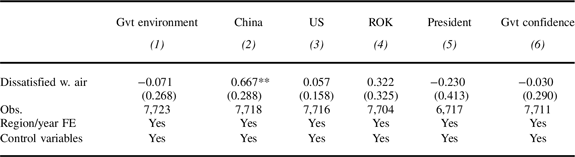
Notes: Full results are in the appendix. Robust standard errors clustered on region in parentheses. *p < .10; **p < .05; ***p < .01.
In contrast, dissatisfaction with air quality has no significant effect on dissatisfaction with the Korean government’s efforts to preserve the environment, evaluations of ROK’s leadership, presidential approval, or confidence in the national government. The coefficients are near zero and have the wrong sign in three Korean government evaluations. The robustness section and the appendix report equivalence tests, which indicate that we can confidently exclude substantively meaningful effects within a seven percentage-point bound across multiple confidence levels. Reassuringly, satisfaction with air quality does not explain evaluations of US leadership in any models we estimated, nor does it affect evaluations of German, Japanese, or Russian leadership (see appendix).
Reduced Form Regressions
Table 4 shows the reduced-form regressions examining the effect of air quality as measured by AQI PM2.5 on government evaluations. There is strong evidence that Koreans express increased dissatisfaction with China on poor air quality days. A one-standard-deviation increase in the air quality index is associated with about a two percentage-point rise in dissatisfaction with China. By contrast, AQI levels are not significantly associated with evaluations of the Korean government’s efforts to preserve the environment. This holds true for all specifications that we estimated. While the correlation with evaluations of Korean leadership is significant at the 10 percent level if we eliminate controls, this finding is not robust. There are no significant associations with US leadership, presidential approval, or confidence in the national government.
Reduced form regressions of air quality and dissatisfaction with government
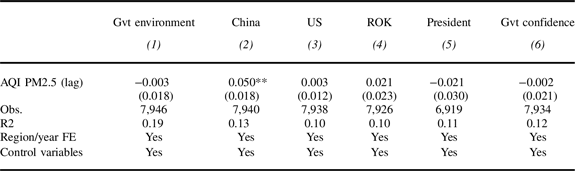
Notes: The dependent variables are various measures of dissatisfaction with the government. Full results are in the appendix. Robust standard errors clustered on region in parentheses. *p < .10; **p < .05; ***p < .01.
Overall, our estimates indicate that poor air quality significantly diminishes approval for Chinese leadership while not substantially affecting perceptions of Korean leadership. This aligns closely with other public opinion surveys in South Korea. A 2021 Korean Research study of 1,000 Korean adults identified air pollution originating from China as the primary factor driving negative attitudes toward China, with 89 percent of respondents explicitly attributing their negative views to this cause.Footnote 64 Similarly, a 2020 Pew Research Center survey across fifty-six countries (with over 80,000 respondents) highlighted that while China’s military power was the leading concern globally, in South Korea, the main issue was China’s negative environmental impact, presumably transboundary pollution.Footnote 65
Mediation Analysis
The theory section suggests that on bad air pollution days, people may adjust their beliefs about health, life satisfaction, and/or the economy, which in turn may translate into evaluations of government performance. Table 5 examines whether beliefs about bad air quality, instrumented by actual daily air quality, shape beliefs about health, the economy, and daily experiences. The results indicate that subjective beliefs about air quality have a very large effect on confidence in the local economy.Footnote 66 Conversely, there is no statistically significant effect on subjective evaluations of personal finances, daily experiences, or personal health. We find similar effects in the reduced-form regressions (regressing daily air quality on perceptions of the local economy).
Instrumental variable regressions of perception of air quality with subjective evaluations of economy, daily experiences, and personal health
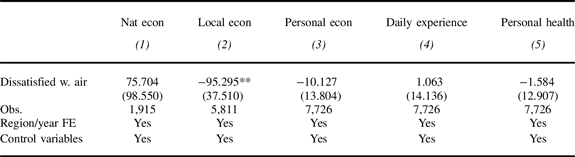
Notes: Full results are in the appendix. Robust standard errors clustered on region in parentheses. *p < .10; **p < .05; ***p < .01.
Next, we examine how perceptions of air quality influence evaluations of Chinese leadership through beliefs about local economic conditions. We conduct a causal mediation analysis using an approach developed by Dippel, Ferrara, and Heblich.Footnote 67 Specifically, this method decomposes the overall effect into two parts: (1) an indirect effect, representing the portion of the relationship explained by local economic confidence, and (2) a direct effect, representing the portion of the relationship not explained by economic confidence. The estimation involves three separate instrumental variable regressions: first, estimating how perceptions of air quality affect economic confidence; second, estimating how perceptions of air quality directly influence evaluations of China; and third, estimating how economic confidence influences evaluations of China, controlling for perceptions of air quality.
The findings indicate that nearly all of the effects of perceived air quality on satisfaction with China’s leadership run through increasingly pessimistic assessments of the local economy.Footnote 68
Partisan Dynamics and Blame Attribution
To further enrich our analysis of hazy accountability in South Korea, we consider how partisan dynamics during our study period (2015–2022) might condition the public’s blame attribution toward air pollution, particularly regarding China. During this period, South Korea experienced significant political shifts—from the conservative administration of Park Geun-hye (until impeachment in late 2016), through the progressive administration of Moon Jae-in 2017–2022, and returning to conservative governance with Yoon Suk-yeol’s election in 2022. These political transitions offer meaningful variation in governmental stance toward both environmental regulation and foreign relations with China.
Historically, conservative governments in South Korea have prioritized pro-business policies, often favoring economic interests over stringent environmental regulation. Under conservative leadership, coal-fired energy production significantly expanded, reflecting caution in imposing regulations that might burden industry and economic growth. Consequently, conservative governments had strong political incentives to emphasize China’s responsibility for air pollution, thereby externalizing blame and avoiding costly domestic environmental measures. Indeed, conservative administrations explicitly highlighted China’s contribution to fine dust pollution, aligning with nationalist narratives and resonating with public frustration.
In contrast, the progressive administration under Moon Jae-in explicitly prioritized environmental protection and sought diplomatic cooperation with China, actively pursuing policies such as reducing coal reliance and investing in cleaner alternatives. While Moon’s administration cautiously acknowledged China’s contributions to pollution, it refrained from confrontational rhetoric, opting instead for joint initiatives and diplomatic engagement. Despite these efforts, however, conservative opposition during Moon’s tenure continued to amplify external blame narratives, critiquing his approach as overly conciliatory toward China.
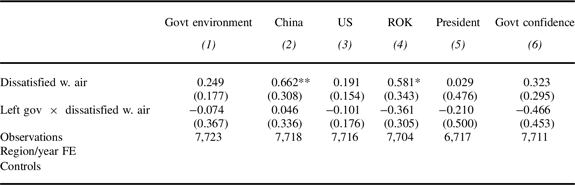
To empirically explore how these partisan contexts influenced public blame attribution, we conducted supplementary analyses interacting dissatisfaction with air quality with the incumbent government’s partisan orientation (progressive versus conservative). Our results in Table 6 indicate that during conservative governments, dissatisfaction with air quality significantly increased dissatisfaction toward Chinese leadership and marginally increased dissatisfaction with the Korean government itself. However, the interaction terms reveal no significant differences under progressive administrations, suggesting that once the external blame narrative took root, it persisted regardless of the incumbent government’s partisan stance.
These findings underscore the durability and resilience of the hazy accountability phenomenon: conservative administrations had clear political incentives to establish and reinforce external blame attribution to China, while progressive administrations, despite emphasizing domestic accountability, could not fully overcome entrenched external blame perceptions. The partisan dimension thus highlights how initial political incentives under conservative leadership may create a lasting narrative structure, insulating even proactive, environmentally oriented governments from full domestic accountability. These partisan insights extend our primary analysis, demonstrating the critical role of domestic political incentives in shaping accountability processes related to transboundary environmental problems.
Robustness
The appendix includes various robustness checks. First, one concern is that Koreans may draw different conclusions about air pollution originating from China versus local pollution. Precisely distinguishing the exact proportion of pollution from China on any given day is challenging. Following prior research,Footnote 69 we leverage pollution data from Ganghwa Island as a proxy for Chinese-origin pollution because the island lies directly west of major Korean urban centers and lacks significant local pollution sources.
Section 1.5 of the appendix includes several tests. First, we examine whether the correlation between pollution and negative views of China is driven by areas where pollution levels are more strongly correlated with pollution from China. We regressed local pollution levels on Ganghwa pollution and stored the model-fit (R-squared values) of these regressions by region (Table 12). They provide an estimate of how well variations in Chinese pollution predict local pollution. We then interact these R-squareds with local pollution levels to check if air pollution has a greater impact on perceptions of China in areas more strongly correlated with Chinese sources. We find no evidence of this.
Next, we re-estimated the first-stage regression to examine if pollution levels in Ganghwa correlate with perceived air quality (Table 13). We find no evidence of this. We then re-estimated the reduced-form regressions using both local pollution and the predicted values from regressions of Ganghwa pollution on local pollution, which we see as an estimate of Chinese-sourced pollution (Table 14). We again find no evidence that our estimates of Chinese-sourced pollution correlate with more negative views about China.
A separate concern is that daily air pollution itself might be driven by factors that could independently influence political views. We address this issue comprehensively in Section 1.3 of the appendix. First, air pollution is partially characterized by seasonality and temporal autocorrelation.Footnote 70 While air quality exhibits notable short-term persistence—evidenced by a high coefficient (approximately 0.7) on lagged AQI—the correlation rapidly diminishes, with AQI from three days earlier barely predictive of current AQI levels (coefficient around 0.1). Our main findings remain robust even after including day-of-the-week and month fixed-effects (Table 7). Furthermore, we find no systematic relationship between poor air quality days and their placement near the start or end of our survey windows, thus reducing concerns related to sampling strategies. Second, poor air quality days often coincide with specific weather patterns that could independently influence public attitudes. We control for this in Table 6, using temperature and precipitation data from the Korean Meteorological Agency. Finally, recognizing that media coverage may also shape public views independently, we additionally control for the daily volume of news articles explicitly mentioning China and air pollution (see Table 10).
Partisan conditionality of hazy accountability (incumbent government ideology)
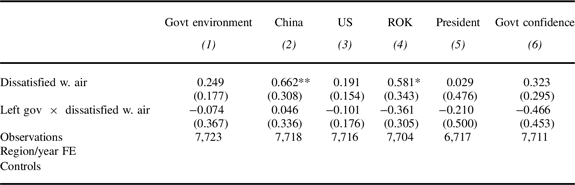
Notes: Standard errors clustered by region in parentheses. *p < .10; **p < .05; ***p < .01.
Third, we estimated models that instrument for air pollution using data on wind direction and wind speed. One complication is that wind direction affects pollution differently in different regions of Korea. Appendix section 1.6 presents two different instrumental variables regressions: one based on interaction between wind direction (in quadrants) and region, and another based on a triple interaction that also includes wind speed. Our main findings remain consistent in these estimations.
In Section 1.7, we report equivalence tests to assess at what confidence levels we can exclude the possibility that pollution meaningfully increases dissatisfaction with the Korean government. Following recent methodological recommendations in political science,Footnote 71 we perform equivalence tests using a practically meaningful threshold of ±7 percentage points across multiple confidence levels (80 percent to 99 percent). For attitudes toward China, equivalence tests consistently reject equivalence within this ±0.07 bound at all confidence levels, clearly demonstrating a substantively meaningful and robust effect.
Conversely, attitudes toward the United States consistently show equivalence to zero, reinforcing our theoretical expectation that blame attribution is specifically targeted toward China. For domestic political evaluations, equivalence tests yield more nuanced insights. Evaluations of government environmental efforts and national government confidence consistently show equivalence to zero, indicating negligible direct effects. However, equivalence results for broader domestic political evaluations—such as Korean leadership (up to 95 percent) and presidential approval (up to 90 percent)—are weaker and inconsistent. While these subtle domestic effects might reflect statistical noise, it is also plausible that citizens attribute some indirect blame to the Korean government for failing to adequately address the external threat posed by Chinese pollution, thus representing a spillover effect of the strong anti-China sentiment identified earlier. Future research should further investigate this indirect causal pathway to clarify whether domestic political reactions primarily stem from perceived governmental inaction toward external threats rather than from direct evaluations of environmental policy failures.
Finally, in appendix section 1.8, we estimate models using Japan, Russia, and Germany as additional placebo tests. We found no evidence that air pollution affects views of these countries.
Conclusion
This paper argues and provides evidence that transboundary air pollution complicates public accountability for domestic pollution because it allows governments to conveniently attribute blame to foreign countries; thus amplifying public hostility toward a foreign nation. We find that severe air pollution negatively impacts the South Korean public’s perception of the Chinese government rather than their own, which has significant implications for international relations. Our findings demonstrate that air pollution leads to negative views of China, highlighting the potential of transboundary pollution to strain bilateral relations. Additionally, we observe that air pollution influences public opinion by undermining confidence in local economic conditions, rather than affecting subjective health or life satisfaction assessments.
Interestingly, our analysis reveals no consistent impact of bad air pollution days on satisfaction with the South Korean government’s environmental preservation efforts or other government evaluations. This contrasts with similar studies in Vietnam and China, suggesting that the transboundary nature of the pollution may disrupt the accountability chain in South Korea. We thus propose that transboundary pollution has three potential negative effects on social welfare: it reduces incentives for pollution control in both the polluting and receiving countries and it may exacerbate hostilities between them.
Air pollution negatively affects Koreans by reducing life expectancy, slowing economic growth, and limiting outdoor activities. Blame attribution to China is one explanation for why Koreans have not mobilized their government to take stronger domestic action. It remains somewhat surprising that a country dependent on coal imports for energy production has not pursued renewable energy alternatives more aggressively. Such a shift could mitigate air pollution and help Korea achieve energy independence. We speculate that the reliance of Korean industrial sectors on coal power may be a contributing factor to this inertia. However, as Korean companies increasingly recognize the economic potential in the global shift toward renewable energy, this stance may evolve.
This paper opens up several avenues for future research and theoretical extensions. Further studies could investigate other regions affected by transboundary pollution, such as Bangladesh, currently one of the largest recipients of such pollution.Footnote 72 Historically, numerous conflicts have stemmed from transboundary pollution. Transboundary environmental concerns have escalated tensions between South Korea and Japan, particularly related to Japan’s decision to release treated radioactive water from the Fukushima nuclear plant, prompting diplomatic confrontations and intensified public hostility. Similarly, recurring haze episodes from forest fires in Indonesia have repeatedly strained diplomatic relations with Malaysia and Singapore, triggering high-level diplomatic confrontations and threats of international litigation. Additionally, persistent cross-border air pollution from India has periodically heightened diplomatic tensions with Bangladesh, prompting calls for international mediation and collaborative pollution-reduction initiatives.
Hazy accountability might also manifest within a country, particularly in federal systems. In such setups, one jurisdiction might export pollution to another, resulting in a disregard for externalities, heightened inter-jurisdictional hostilities, and disrupted accountability mechanisms. A pertinent question here concerns not only whether such dynamics occur, but also the capacity of national political institutions to effectively address these challenges.
Finally, further research into major sources of transboundary emissions, such as China, India, and Indonesia, could provide deeper insights into how these dynamics affect domestic politics and international relations. Given the growing significance of environmental issues, understanding the interplay between public opinion, environmental policy, and diplomatic relations will help inform more effective approaches to addressing transboundary environmental problems.
Data Availability Statement
Replication files for this research note may be found at <https://doi.org/10.7910/DVN/MIQFMZ>.
Supplementary Material
Supplementary material for this research note is available at <https://doi.org/10.1017/S0020818325101264>.
Acknowledgments
We thank Princeton University for granting access to the Gallup World Poll surveys while we were both fellows at the Niehaus Center. We also thank Katie Beall, Chris Blair, Christina Davis, Alex Gazmararian, Federica Genovese, Melissa Lee, Matt Malis, M.D. Mangini, Helen Milner, Dennis Quinn, Rachel Schoner, Al Smith, Calvin Thrall, Dustin Tingley, Hye Young You, Noah Zucker, participants in seminars at Harvard University, the 2024 SNU–Princeton Summer Workshop, the 2023 Borders and Boundaries Conference at the University of Pennsylvania, the 2023 International Political Economy Society Conference, the GRIPE seminar, and the European Political Science Association Annual Meeting in Glasgow for helpful comments. We also thank Mats Brauwer, Joohyun Lee, Yeonju Lee, Tae Sung Oh, and Min Jun Park for excellent research assistance.
Funding
Part of this work was supported by the Creative-Pioneering Researchers Program through Seoul National University.







 Open access

