




Introduction
Poultry meat is the most common animal-based food worldwide, followed by pork, beef and sheep meat. Increasing meat consumption is expected for all of the mentioned meat types in the next decades, with poultry meat expected to increase most(1). Production of animal-based food requires land and water, mainly for the production of feed crops(Reference Mottet and Tempio2). Hence, arable land and water for cropping are proposed to become an increasingly scarce resource as the world population increases. Another aspect is the environmental impact of animal farming. Major environmentally relevant impacts of feed production include energy consumption of cropping and transport, carbon footprints of feed production including free amino acids (AA), emissions from the fields and the consequences of land-use change when crops are cultivated on converted forests or grasslands. Regarding manure, the major environmental impact includes nitrogenous emissions, such as ammonia, nitrate and nitrous oxide. These emissions contribute to climate change, acidification, eutrophication and air and water pollution(Reference Gerber, Steinfeld and Henderson3).
Aims of farm animal nutrition research include minimising the negative effects of the livestock sector on the environment and contributing to global food security. These goals can be approached by reducing the dietary crude protein (CP) concentration in animal diets without undesirable effects such as health implications and reduced performance. This increases the efficiency of the conversion of protein from the feed to animal protein (‘nitrogen (N) utilisation efficiency (NUE)’) and reduces the excretion of nitrogenous compounds and the use of protein-rich feed ingredients such as soya products. Investigations enabling the precise supply of AA and other nitrogenous nutrients according to their situation-specific requirements contribute to decreasing dietary CP below current standards. Such investigations include studies on the requirements of the animals and on the nutrient digestibility of feed ingredients and compound diets(4). In terms of CP reduction, knowledge on requirements for AA is primarily relevant. Such investigations have enabled a considerable reduction in CP concentration in poultry feed and have reduced N excretion substantially(Reference Siegert and Rodehutscord5,Reference Cappelaere, Le Cour Grandmaison and Martin6) . Such CP reductions mostly represent a decrease in surpluses because lack of knowledge or variability within a flock is countered by safety margins in AA concentrations if the aim is to exclude a risk of AA deficiency.
Particularly in the past decade, the increase in knowledge on AA requirements has revealed a big potential to reduce dietary CP from 19–20% to ∼16% in diets for broiler chickens(Reference Siegert and Rodehutscord5). This was made possible because the limiting role in CP reduction of the nonessential AA glycine (Gly) and serine (Ser) was realised, mainly owing to studies that were published in the mid-2000s(Reference Corzo, Fritts and Kidd7,Reference Dean, Bidner and Southern8) . Nonessential AA can limit protein biosynthesis if the provision by the feed and endogenous production are insufficient, for instance, due to a lack of precursors, or if endogenous processes are too slow(Reference Dean, Bidner and Southern8).
A review from 2019 summarised the knowledge on responses of poultry to the dietary supply of Gly and Ser of the time(Reference Siegert and Rodehutscord5). Since then, the knowledge on Gly, Ser and other relevant nonessential AA has advanced considerably. The objective of this review is to update the information presented in the previous review(Reference Siegert and Rodehutscord5) and evaluate the relevance of other nonessential AA for the goal of reducing CP in diets for broiler chickens. This includes inferences on the energy requirement of the animals, which is also affected by the dietary CP concentration. Published studies on effects of nonessential AA mostly investigated common fast-growing broiler strains; hence, effects of dietary nutrient concentrations may differ for other strains.
How to consider similar effects of dietary glycine and serine
Gly and Ser are assessed together in diet formulation because Gly and Ser are metabolically interconvertible(Reference Dean, Bidner and Southern8). Early recommendations for dietary nutrient composition accounted for this relationship using ‘Gly+Ser’, where dietary Gly and Ser concentrations are added together(9). This sum assumes that Ser is metabolically equivalent to Gly on a mass basis. However, the ratio of the molar weight of Gly to Ser is 0·714(Reference Akrabawi and Kratzer10,Reference Sugahara and Kandatsu11) , mainly reflecting the additional hydroxymethyl group of Ser(Reference Velíšek and Cejpek12). This means that more Gly and Ser molecules are provided to the animals the more Gly is contained in Gly+Ser. Dean et al.(Reference Dean, Bidner and Southern8) suggested the reference unit ‘Gly equivalent’ (Glyequi) as the sum of Gly and the molar Gly equivalent of Ser, calculated as Glyequi (g/kg) = Gly (g/kg) + 0·714 × Ser (g/kg). The practical relevance of the increased accuracy of Glyequi compared with Gly+Ser is probably low in purely plant-based diets for poultry. Reasons include the roughly even share of Gly:Ser on a mass basis in most plant-based feed ingredients, with shares in the range of 0·45:0·55 to 0·60:0·40(Reference Siegert and Rodehutscord5). However, the share of Gly:Ser can deviate considerably from these ranges (0·30:0·70 to 0·85:0·15) when animal by-products are used(Reference Siegert and Rodehutscord5). In addition, it is more likely that free Gly is supplemented to the diets, as free l-Ser is more expensive than free Gly. The influence of free Gly supplementation on the Gly:Ser share can be considerable. As an example, using free Gly to maintain a dietary Glyequi concentration of 15 g/kg when dietary CP was reduced from 16.3% to 13.2% resulted in Gly:Ser shares increasing from 0·54:0·46 to 0·75:0·25(Reference Hofmann, Siegert and Kenéz13). Therefore, using Glyequi as a reference unit appears more advisable than using Gly+Ser.
Recently, the concept of an equal utilisation of Gly and Ser was challenged(Reference van Milgen14). This study reported that Glyequi is more precise than Gly+Ser in representing the physiological value of these AA in the diet. The conditions under which Gly and Ser are not equally utilised were theoretically derived based on extensive stoichiometric calculations of metabolic pathways. The key point was that one more one-carbon unit can be generated from Ser than from Gly metabolism and Gly can take up a one-carbon unit. In poultry, uric acid formation is one way to counteract the accumulation of one-carbon units. Uric acid formation consumes both Gly and one-carbon units. Hence, Gly is needed to prevent the accumulation of one-carbon units, while Ser promotes this accumulation. Provided that there are no other physiological adaptations that prevent an accumulation of one-carbon units, less Gly would be available for other metabolic functions, including protein synthesis. The actual relevance of a possible accumulation of one-carbon units has not yet been experimentally investigated. Therefore, this review continues using Glyequi.
Relevance of influences on the Glyequi requirements
Estimates of the adequate dietary Glyequi concentration differed widely among studies with values ranging from below 11 g/kg to more than 18 g/kg of diet(Reference Siegert and Rodehutscord5). Several factors influencing the Glyequi requirement were determined.
Influence of nitrogen excretion
The adjustment of the supply to the requirement for digestible AA seems to be the major determinant of the Glyequi requirement. The physiological background is that AA that cannot be used for metabolic functions are oxidised and the contained N is excreted via the urine, mostly as uric acid(Reference Wu15). Uric acid formation is a Gly-dissipating process because each uric acid molecule requires one molecule of Gly to build the purine ring when glycinamide ribotide is synthesised from phosphoribosylamine(Reference Bloomfield, Letter and Wilson16). A model calculation of Siegert and Rodehutscord(Reference Siegert and Rodehutscord5) suggested that uric acid formation is a major contributor to variable Glyequi requirements. Selle et al. (Reference Selle, Cantor and McQuade17) quantified the proportion of Gly intake relative to uric acid output in the range of 25–81% based on experimental data. Recalculations of data from our own published studies showed lower proportions of Glyequi intake relative to uric acid excretion (both mol/d) with ranges of 8–30%(Reference Hofmann, Siegert and Kenéz13) and 9–19%(Reference Hofmann, Siegert and Ahmadi18). Nonetheless, these calculations suggest a considerable share of dietary Gly and Ser being used for uric acid synthesis.
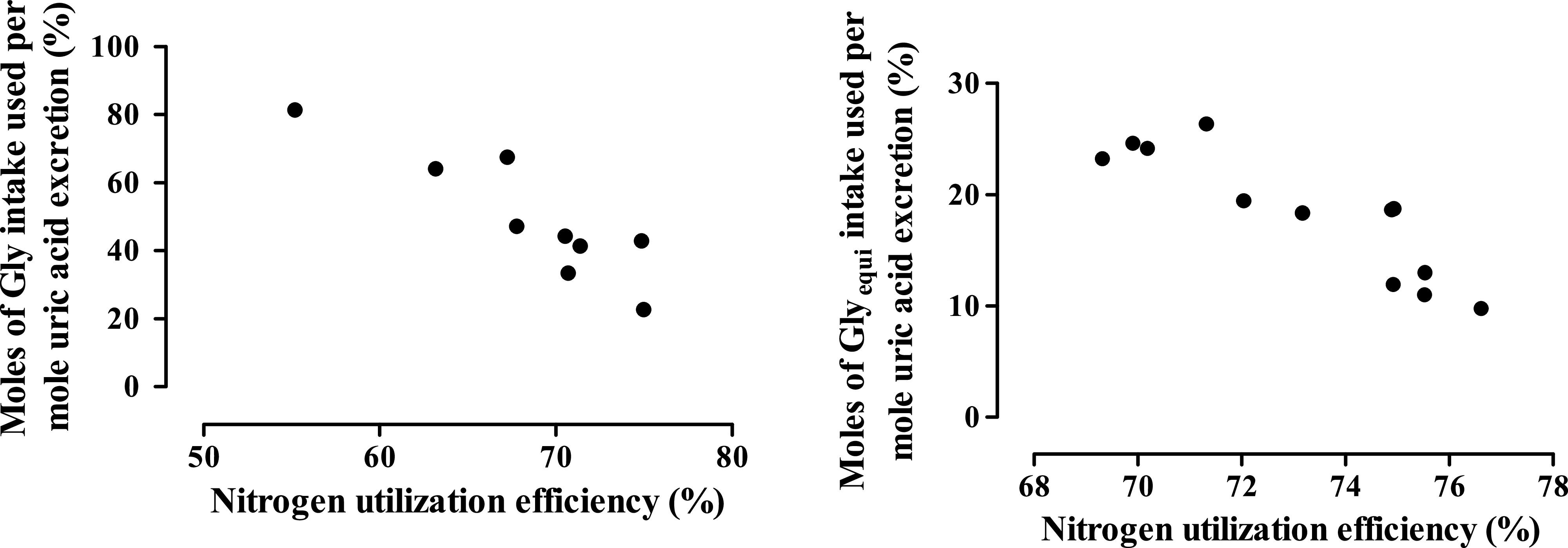
Pursuing the goal of a higher NUE reduces the Glyequi requirement of broiler chickens because less N is excreted as uric acid. This was theoretically derived in a model calculation of Siegert and Rodehutscord(Reference Siegert and Rodehutscord5) and is substantiated by data from animal experiments (Fig. 1), which show that the Gly or Glyequi intake used for uric acid excretion decreased considerably with increasing NUE. The decreasing Glyequi requirement with increasing NUE indicates that supplementing free Gly or l-Ser to diets very low in CP may become irrelevant in the future provided that CP in AA-adequate diets can be considerably reduced beyond the current potential. Considering dietary Glyequi in diet formulation would become unnecessary if the goal of increasing the NUE results in an amount uric acid formation that is low enough so that the Glyequi supply from plant-based feed meets or exceeds the requirement of the birds.
Proportion of Gly intake per uric acid output (left panel: results of an experiment published by Chrystal et al.(Reference Chrystal, Greenhalgh and McInerney69) and Selle et al.(Reference Selle, Cantor and McQuade17); dots represent least square means; n = 6) or Glyequi intake per uric acid output (right panel: Hofmann et al.(Reference Hofmann, Siegert and Kenéz13); dots represent least square means; n = 7) and the nitrogen utilisation efficiency in studies on broiler chickens.

Further influences
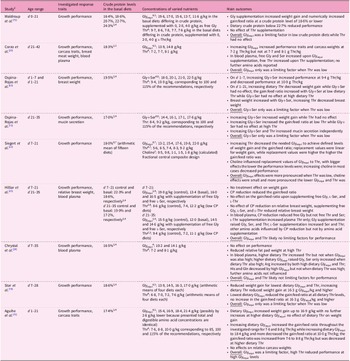
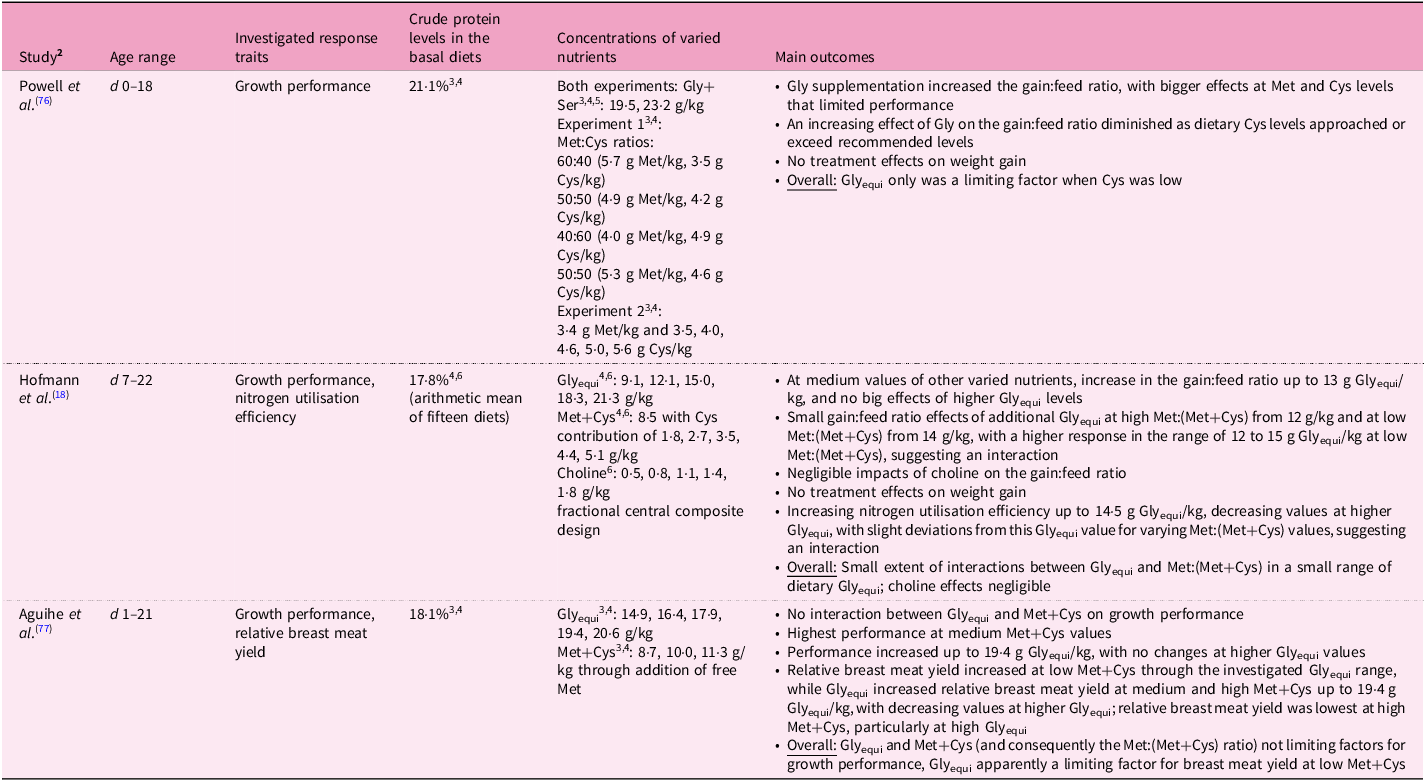
There are other influences on the Glyequi requirement, but the extent of their impact probably is low compared with uric acid formation. Such influences include dietary threonine and choline concentrations because Gly or Ser can be formed in the metabolism of the animals from these compounds(Reference Meléndez-Hevia, Paz-Lugo and Cornish-Bowden19). The ratio between methionine and methionine+cysteine (Met:(Met+Cys)) also impacts the Glyequi requirement due to the endogenous conversion of methionine to cysteine, which dissipates Ser(Reference Meléndez-Hevia, Paz-Lugo and Cornish-Bowden19). Studies have shown that the impacts of threonine, choline and the Met:(Met+Cys) ratio on the Glyequi requirement are inconsistent (Table 1 and Table 2). Some studies found a marked impact of the mentioned factors on performance responses of broiler chickens to dietary Glyequi (e.g. Reference Corzo, Kidd and Dozier20–Reference Siegert, Ahmadi and Rodehutscord23), while others reported minor(Reference Chrystal, Moss and Yin24) or no impact(Reference Hofmann, Siegert and Ahmadi18,Reference Hilliar, Huyen and Girish25) . One possible contributor to the absence of interaction effects of dietary threonine and Glyequi on performance in studies(Reference Chrystal, Moss and Yin24,Reference Hilliar, Huyen and Girish25) is a relatively low variation in dietary threonine and Glyequi supply and an overall high Glyequi supply. These characteristics may have made interaction effects less likely to occur. However, variation of dietary Glyequi and the Met:(Met+Cys) ratio was considerable in another study(Reference Hofmann, Siegert and Ahmadi18), but resulted in interactions of performance traits to only a low extent. The NUE was very high, at approximately 80%, and the variation in NUE was small in the study, with a high variation of dietary Glyequi and the Met:(Met+Cys) ratio(Reference Hofmann, Siegert and Ahmadi18). This probably resulted in a low Glyequi requirement of the broiler chickens that was barely influenced by uric acid formation. The marked impact of interactions between dietary Glyequi and the other mentioned factors most likely represented a consequence of several influences. The endogenous formation of Glyequi from threonine and choline, or the Glyequi dissipation when methionine was converted to cysteine, probably was one influence. Another probable influence was the impact of the varying dietary nutrient concentrations on NUE, which leads to variable uric acid formation. However, most of the mentioned studies did not report NUE or uric acid formation. Given the big impact of NUE/uric acid formation on the Glyequi requirement(Reference Siegert and Rodehutscord5,Reference Selle, Cantor and McQuade17) , the small interaction effects in the study with a high variation of dietary Glyequi and the Met:(Met+Cys) ratio(Reference Hofmann, Siegert and Ahmadi18), where NUE was almost unaffected, suggest that impacts on Glyequi requirements other than NUE/uric acid formation have little impact.
Summary of studies investigating interactions between dietary Thr and dietary Glyequi on growth performance and other selected response traits by varying nutrient concentrations using free glycine, l-serine and l-Thr. A study reporting three-way interactions of dietary Glyequi, Thr and choline is also included

1 Glyequi, glycine equivalents; Gly+Ser, glycine+serine; Ser, serine; Thr, threonine
2 Sorted by publication year and alphabetically within publication years
3 On an as-fed basis
4 Analysed values presented
5 Converted from Gly+Ser to Glyequi on the basis of presented values of Gly and Ser
6 Glyequi not computable because Gly and Ser were not reported separately
7 Presented on a standardised dry matter of 88%
Summary of studies investigating interactions between the dietary Met to the sum of Met and Cys ratio (Met:(Met+Cys)) and dietary Glyequi on growth performance and other selected response traits by varying nutrient concentrations using free Gly, Cys and Met. A study reporting three-way interactions of dietary Glyequi, Met:(Met+Cys) and choline is also included

1 Met, methionine; Cys, cysteine; Glyequi, glycine equivalents
2 Sorted by publication year
3 On an as-fed basis
4 Analysed values presented
5 Glyequi not computable because Gly and Ser were not reported separately
6 Presented on a standardised dry matter of 88%
The hypothesised minor influence of other impacts on Glyequi requirements than NUE/uric acid formation appears beneficial for future consideration of the variable Glyequi requirement when practical diets are formulated. Although desirable for even higher precision, modelling the numerous impacts of dietary threonine, Met, cysteine, and choline – and their interdependencies on Glyequi requirements – seems cumbersome for current practical diet formulation. Possibilities of more precise modelling of metabolic processes may change this. However, considering NUE/uric acid formation as the major contributor to variable Glyequi requirements may be manageable in the near future.
Varying collagen and elastin formation may additionally determine the Glyequi requirement because Gly makes up a considerable share of the AA in collagen and elastin(Reference Meléndez-Hevia, Paz-Lugo and Cornish-Bowden19,Reference Li and Wu26) . We are not aware of studies investigating the relationship between Glyequi supply and the accretion of collagen and elastin. However, influences of the Gly supply on collagen content in the skin was described for pigs(Reference Silva, Huber and Mansilla27,Reference Silva, Mansilla and Shoveller28) . Possibly, Gly requirements for collagen formation contributed to effects of supplemented Gly on the performance of pigs(Reference Powell, Bidner and Payne29), although Gly usage for uric acid formation in pigs is low compared with poultry.
Limitations of nonessential amino acids in Glyequi-adequate diets
Hofmann et al. (Reference Hofmann, Siegert and Kenéz13) found high growth performance of 8–21-day-old broiler chickens with 16.3% CP in the diet and an adequate supply of essential AA and Glyequi. However, further dietary CP reduction to 14.7% reduced growth in that study. Hence, other nonessential AA became growth-limiting when CP was reduced from 16·3% to 14·7%. Consistently, growth performance of 14–35-day-old broiler chickens was not reduced when the CP concentration in Gly-supplemented diets was lowered to 16·5% (representing the lowest CP concentration applied) in the study by Chrystal et al.(Reference Chrystal, Moss and Yin24).
Effects of nonessential AA other than Gly and Ser have been studied in diets with growth-limiting nonessential AA concentrations. This includes supplementation of single nonessential AA such as glutamic acid (Glu), glutamine (Gln), aspartic acid (Asp), asparagine (Asn), alanine, and proline and mixtures of two or more of these AA(e.g. Reference Kerr and Kidd30–Reference Kriseldi, Tillman and Jiang33). Minor or no effects on growth performance were reported in those studies. The composition of the investigated diets suggests that the supply of Glyequi was growth-limiting in those studies. This may explain the absence of any AA supply effect.
The next limiting factor in low CP diets adequate in Glyequi is currently unknown. While the character of Glyequi as the first limiting nonessential AA mostly is independent of the used feed ingredients, because the ratio between Glyequi and CP is similar among plant-based feed ingredients(Reference Siegert and Rodehutscord5), the proportion of other nonessential AA in CP differs considerably among feed ingredients. Hence, the next limiting nonessential AA probably depends on feed ingredients and dietary CP. In principle, any of the remaining nonessential AA or nonspecific amino-N could be next-limiting. Recent investigations, as detailed in the following subsections, point to Asn, Gln or nonspecific amino-N from nonessential AA other than Gly and Ser. Advancements in the field are complicated by difficulties associated with the chemical analysis of Asn and Gln because hydrolysation of proteins prior to AA quantification leads to Asn and Gln losing an amide residue. Hence, Asn and Gln elute together with Asp and Glu, respectively(Reference Fontaine and D’Mello34). Nonetheless, other nonessential AA can have specific effects, such as an increased feed intake in alanine-supplemented diets(Reference Niknafs, Fortes and Cho35).
Indications of asparagine being the next-limiting nonessential amino acid
A study identified Asn as the most likely candidate for the next-limiting nonessential AA(Reference Hofmann, Siegert and Naranjo36). In that study, the supplementation of alanine and proline to low CP diets adequate in Glyequi had no effect on growth performance traits, but supplementation of Asn+Asp, Glu and Gln+Glu increased growth compared with the unsupplemented diet. Responses in growth were not different among diets supplemented with Glu or 50:50 mixtures of Asn+Asp and Gln+Glu. The similar effects of Asn+Asp, Glu and Gln+Glu supplementation might be explained by the few steps needed for the metabolic interconversion of those AA(Reference Berg, Stryer and Tymoczko37). However, growth performance was higher when Asn+Asp was supplemented than with Asp supplementation alone.
A recent study by Ibrahim et al. (Reference Ibrahim, Kenéz and Rodehutscord38) further substantiated the probability that Asn is the next-limiting nonessential AA. In that study, digestible peptide-bound AA from soya protein isolate were incrementally substituted with free AA so that the digestible AA concentration was identical in all diets. The analysed digestible concentrations of Asn/Asp and Gln/Glu were either substituted by Asp and Glu, respectively, or by 50:50 mixtures of Asn+Asp and Gln+Glu, respectively. Growth performance declined at a certain substitution of peptide-bound with free AA. This decline was determined at higher substitutions when Asn+Asp and Gln+Glu were added compared with the addition of only Asp and Glu, suggesting that Asn, Gln or both were growth-limiting. This study did not consider Asn and Gln singly. Nonetheless, blood plasma AA concentrations in that study indicated that Asn may have been more relevant than Gln, with the limitation that the pool of individual AA in the blood plasma may have been affected by altered influx and efflux caused by other metabolic processes than the considered ones. No treatment effects on Asp, Glu and Gln were determined, irrespective of whether Asn and Gln were substituted. However, when no Asn and Gln were substituted, blood plasma Asn declined, apart from the same substitution level at which a decline in growth performance was observed.
Indications of glutamine being the next-limiting nonessential amino acid
A review by Selle et al.(Reference Selle, Macelline and Toghyani39) compiled results of twenty publications that described the impacts of Gln supplementation on growth performance. Gln supplementation increased growth performance in most experiments, suggesting that Gln was a growth-limiting factor in the unsupplemented treatments. Two of the studies found that Gln supplementation decreased performance above a certain supplementation level, and one study stated that performance decreased below a certain supplementation level. Two studies each found that Gln supplementation generally decreased performance or increased one of the performance traits (average daily weight gain or the gain:feed ratio) while the other performance trait was not compromised. The twenty compiled publications were heterogeneous in several regards. For instance, different age ranges were investigated, and the stated dietary CP ranged from 17·7–24·4%. Therefore, the supply of all AA relative to the requirement of the birds differed widely among studies. Housing and management conditions also varied. Furthermore, most of the compiled studies investigated effects of Gln supplementation while some supplemented Gln and Glu in combination. None of the compiled studies investigated the supplementation of other nonessential AA. Taken together, the review by Selle et al.(Reference Selle, Macelline and Toghyani39) provides evidence that Gln can represent a relevant AA but it is difficult to identify a clear pattern under which conditions Gln supplementation impacts growth performance.
Synopsis on Asn or Gln being the next-limiting nonessential amino acid
Currently, it is not possible to unequivocally rank the limiting relevance of Asn and Gln. The findings from different studies implicating either Asn or Gln being the next-limiting nonessential AA are not necessarily a contradiction. Asp, Asn, Glu and Gln are very closely related in metabolism and exhibit a high degree of interconvertibility(Reference Berg, Stryer and Tymoczko37). Hence, it is possible that supplementation of one of those AA can compensate for a deficiency of any of the others.
The possibility that the interconversion among Asp, Asn, Glu and Gln may make the relevant AA undetectable can be exemplified in the study of Ibrahim et al. (Reference Ibrahim, Kenéz and Rodehutscord38). As mentioned earlier in ‘indications of asparagine being the next-limiting nonessential amino acid’, blood plasma Asn concentrations declined at a certain substitution of Asn+Asp with Asp, while blood plasma concentrations of Asp, Glu and Gln were unaffected. This does not necessarily mean that Asn is the relevant AA. These results can be interpreted alternatively as a prioritisation of constant Gln concentrations in the blood plasma achieved by the conversion of Asn to Gln. Such a phenomenon would result in the decline of Asn concentrations in the blood plasma. A varying supply with other AA can influence concentrations of Asp, Glu, Asn and Gln in the blood plasma because those AA can be formed metabolically from most of the other AA(Reference Wu15). The study by Ibrahim et al. (Reference Ibrahim, Kenéz and Rodehutscord38) is the only one that investigated varying dietary Asp, Asn, Glu and Gln concentrations without changing digestible concentrations of all proteinogenic AA, including concentrations of digestible Asp+Asn and Glu+Gln.
Indications of nonspecific amino-nitrogen being the limiting factor
Alternative to the interpretation that Asn, Gln or both are next-limiting nonessential AA in low protein diets adequate in Glyequi, the results of the aforementioned studies may indicate an insufficient supply with nonspecific amino-N. One study(Reference Hofmann, Siegert and Naranjo36) demonstrated that nonspecific amino-N was a relevant factor because supplementation of different nonessential AA increased growth performance compared with the unsupplemented diet. This suggests that the supplemented nonessential AA were metabolically converted to one or more limiting nonessential AA. However, no supplementation attained the growth that was found for a diet adequate in nonessential AA. It remains unknown whether a higher supplementation of one of the nonessential AA other than Glyequi can overcome the deficiency in nonessential AA of the unsupplemented diet. An inadequate supply with nonspecific amino-N might also partly explain the bigger effects of Asn and Gln supplementation compared with supplementation of Asp and Glu mentioned before because Asn and Gln contain more amino-N than Asp and Glu.
Potential to increase nitrogen utilisation efficiency
Potential by meeting the requirements of nonessential amino acids
The determined NUE ranged from 50–65% in the first 3 weeks of age, with diets similar to current industry standards(e.g. Reference Kriseldi, Tillman and Jiang33,Reference Gomide, Rodrigues and Zangeronimo40) . Reducing the dietary CP concentration tended to increase NUE in published studies, with a high variation among studies. This variation probably can be explained by varying concentrations of single digestible AA, including nonessential AA, relative to what the animals can utilise for protein accretion. Higher NUE compared with the current standard is feasible by adjusting concentrations of essential AA and Glyequi using free AA. Experiments determined NUE values of 70%(Reference Hofmann, Siegert and Kenéz13), 75%(Reference Siegert, Wild and Schollenberger41), 78%(Reference Hofmann, Siegert and Naranjo36) and 80%(Reference Hofmann, Siegert and Ahmadi18) alongside high growth performance in 3-week-old broilers with diets containing 16·3–17·5% CP. We are not aware of studies investigating the potential to increase the experimentally determined NUE by meeting the requirements of nonessential AA in birds older than 21 d. Such investigations would provide significant insights because N intake and N excretion are higher in older than in younger animals. Of note, this review only mentions NUE determined on the basis of quantified N intake and N excretion. Another possibility is to determine NUE on the basis of body weight and the assumption of a constant N content in body weight. However, a literature evaluation showed that the interquartile range of the N content in body weight was 27·5–35·1 g/kg in studies on broiler chickens published between 2016 and 2024(Reference Sassenberg, Lange and Siegert42).
A further increase in NUE above 80% without affected growth performance by meeting the requirements of further nonessential AA in addition to Gly and Ser seems possible if diets do not include ingredients low in AA digestibility, but an upper limit of NUE cannot be derived at present. By definition, the NUE is limited by N excretions via N contained in the urine and faeces. The N excreted via the urine mainly originates from degraded AA. Reasons for AA degradation include the supply with digestible AA above the possible protein accretion because the genetic potential to accrete protein is reached or because another AA limits protein accretion. Minimising these reasons for AA degradation is one strategy to increase NUE. AA required for maintenance are also degraded. The AA needed for maintenance cannot be estimated precisely at present because such an estimation requires knowledge on maintenance requirements for all proteinogenic AA, but maintenance requirements for nonessential AA will remain unknown until their relevance is recognised. However, the contribution of maintenance metabolism to incomplete N utilisation can be calculated on the basis of the maintenance requirement estimates of the Society of Nutrition Physiology(43) and the performance objectives of Aviagen(44). At a very low CP content in the diet of 15·5%, which is currently possible without affected growth performance in the age period of 7–21 d post-hatch (mean of 14·7% and 16·3% CP, see ‘limitations of nonessential amino acids in Glyequi-adequate diets’), maintenance requirements for essential AA are estimated to limit the NUE by 2·1–3·2 percentage-units. Hence, maintenance requirements for all proteinogenic AA (essential and nonessential AA) may limit the NUE in this age period by roughly 4–6 percentage-units. Another factor limiting the NUE is the CP digestibility of the feed, which determines N excretion via the faeces. The amount of N excretion via the faeces cannot be generalised because the CP digestibility is highly variable between and within feed ingredients. For most commonly used feed ingredients, CP digestibility is between 85 and 90%(Reference Siegert45). With a CP digestibility limiting the NUE by 10–15% and the maintenance requirement of proteinogenic AA limiting the NUE by ∼5%, there is little potential for increasing the NUE above 80–85%. In addition to AA digestibility and AA requirements for maintenance, NUE is limited by inevitable post-absorptive AA degradation. Estimating the post-absorptive AA degradation is difficult because influences include an energy supply from AA(Reference Ji, Wang and Yang46) and the availability of individual AA for protein biosynthesis. The availability of individual AA includes the AA influx from protein degradation in the course of protein turnover, which seems to depend on the type of proteolysis(Reference Berg, Stryer and Tymoczko37,Reference Osana, Kitajima and Naoki47) . Mechanisms that probably lead to decreased AA degradation include lower muscle protein turnover in the state of low AA supply(Reference Tesseraud, Larbier and Chagneau48,Reference Urdaneta-Rincon and Leeson49) . Another possible mechanism to increase NUE is urinary N being reabsorbed in the hindgut and used for the synthesis of nonessential AA(Reference Karasawa50,Reference Karasawa51) . This may lead to an increased NUE because protein accretion would be achieved with lower nonessential AA intake. The choice of feed ingredients in low CP diets can also lead to increased NUE. Diets very low in CP often are formulated with feed ingredients high in CP digestibility. In addition, low CP diets commonly include free AA and the digestibility of free AA is complete(Reference Baker52). Hence, lowering dietary CP usually results in a smaller limitation of the NUE by undigested CP. Taken together, a rough estimate is the potential to increase the NUE of broiler chickens to a level of 85% in the age period of 7–21 d post-hatch by meeting requirements of further nonessential AA considering the maintenance requirements for all AA and the CP digestibility of diets.
Potential by accepting submaximal growth performance
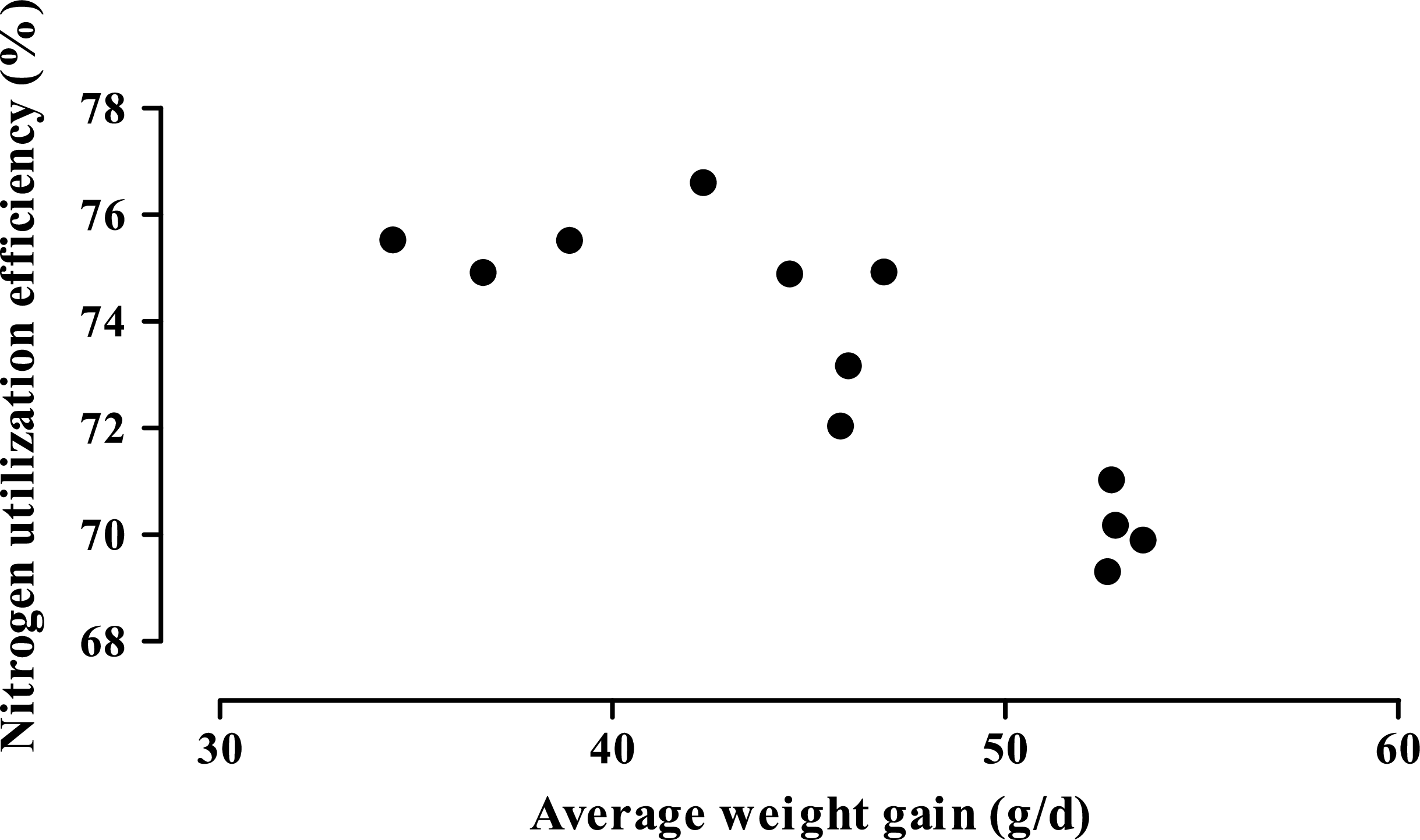
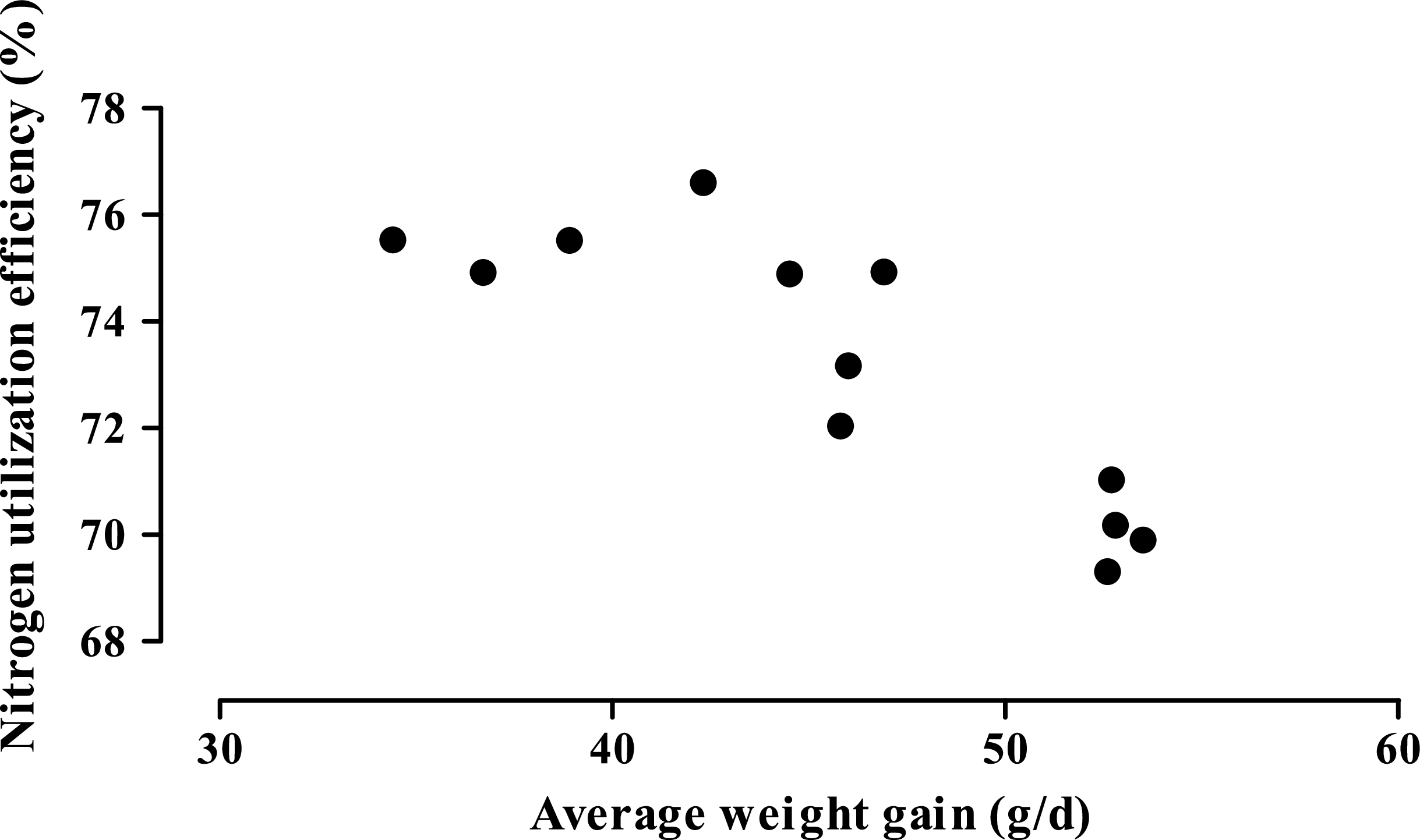
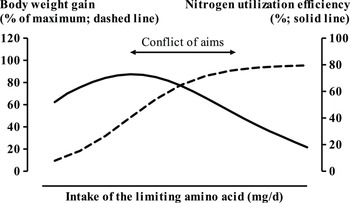
Increasing production performance by measures not related to AA nutrition, such as breeding, usually raises the NUE, thus leading to decreased N excretion per produced animal-based food. A decreased relevance of the maintenance requirement relative to the total AA requirement, which is in the order of 3–8% of the total requirement for individual essential AA based on maintenance requirement estimates of the Society of Nutrition Physiology(43) and the performance objectives of Aviagen(44), contributes to this(Reference Flachowski and Lebzien53). This principle is more differentiated when the influence on performance is caused by varying supply with a limiting AA. Increasing performance by increasing the supply with limiting AA can decrease the NUE because the additional performance per additional AA supply decreases, particularly when performance approaches the plateau. Conversely, studies have found an increasing AA utilisation efficiency when performance of animals was reduced as a consequence of essential AA deficiency (Fig. 2). This phenomenon has been described for methionine, lysine and tryptophan in broiler chickens(Reference Fatufe, Timmler and Rodehutscord54–Reference Fatufe and Rodehutscord56) and for eight AA in the rainbow trout(Reference Rodehutscord, Jacobs and Pack57,Reference Rodehutscord, Becker and Pack58) . This outcome may be explained by maximised AA utilisation efficiency (increment in AA accretion per increment in AA intake) at an AA intake level below what is needed for maximised AA accretion (Fig. 3). Potential physiological explanations for these results include the lower muscle protein turnover in the state of low AA supply(Reference Tesseraud, Larbier and Chagneau48,Reference Urdaneta-Rincon and Leeson49) and the reabsorption of urinary N in the hindgut that can be used for the synthesis of nonessential AA, as mentioned in ‘potential by meeting the requirements of nonessential amino acids’.
Relationship between average daily weight gain and nitrogen utilisation efficiency(Reference Hofmann, Siegert and Kenéz13). Dots represent least square means (n = 7).
Visualisation of the conflict of aims between maximising nitrogen utilisation efficiency and growth of broiler chickens depending on the intake of the limiting amino acid. Schematised responses are based on the body weight gain and the lysine utilisation efficiency determined previously.(Reference Fatufe, Timmler and Rodehutscord54)

Increased NUE at an AA supply not allowing for maximum performance may be considered a conflict of targets. If the hypothesis of an increased AA utilisation efficiency at submaximal growth performance as the primary cause for increased NUE is valid, there is a range in intake of the limiting AA where the conflict of aims is relevant (Fig. 3). Lower intake of the limiting AA would lead to both impaired growth performance and NUE. At present, high growth performance is commonly considered the most important factor for diet formulation, and reduced nutrient excretion is of secondary priority. However, depending on the global availability of proteins and their costs, the framework may change to make production systems more profitable by accepting submaximal growth while increasing the utilisation of expensive and sparse protein sources. In some regions of the world (such as in some European countries), fertilizer legislation determines the animal production volume of a farm depending on the amount of N contained in the manure. Such constraints will likely become stricter and, hence, pose increasing relevance for the future.
Impacts of crude protein reduction on energy utilisation
Impacts on energy requirements
Many studies reported an increase in fat deposition in broiler chickens when dietary CP was reduced, although the diets were calculated to be isoenergetic and growth was not affected. This includes studies decreasing CP in Gly-supplemented diets(Reference Chrystal, Moss and Yin24,Reference Awad, Zulkifli and Soleimani32,Reference Wang, Wang and Wu59) . Parts of this phenomenon may be explained by an affected energy provision from fermentation in the hindgut because the different ingredient composition of low CP diets can affect the substrates for the microbiota. Further, fat metabolism can be influenced by the microbiome(Reference Chen, Akhtar and Ma60). In addition, parts of this phenomenon may be explained by an increased fat digestibility upon Gly supplementation in poultry(Reference Alzawqari, Moghaddam and Kermanshahi61–Reference Fancher and Jensen64), with more Gly being available to form Gly-conjugated bile salts being a potential mechanism.
Another explanation for increased fat deposition when dietary CP is reduced is less energy being needed for N excretion because uric acid formation is energy-demanding. The energy needed for uric acid formation was calculated at 60·7 kJ/g of N excreted as uric acid(Reference van Milgen14), which includes energy contained in uric acid and metabolic heat. A model calculation (Fig. 4) indicates that the energy needed for uric acid excretion decreases and fat accretion increases remarkably when dietary CP is reduced. This model calculation assumes that the metabolism will use the spared energy for fatty acid synthesis and fat deposition only. Proportions of uric acid in total urinary N tend to decrease with dietary CP(Reference Hofmann, Siegert and Kenéz13,Reference Selle, Cantor and McQuade17,Reference Hofmann, Siegert and Naranjo36,Reference Such, Pál and Strifler65) . Therefore, the energy requirement for uric acid synthesis probably becomes less pronounced relative to urinary total N excretion the more dietary CP is reduced. Spared energy in reduced-CP diets for N excretion reflects decreased energy requirements of the animals when the aim is not to increase fat deposition in the birds. Current dietary energy supply recommendations are based on studies using standard dietary CP concentrations. Therefore, avoiding increased fat deposition when using low CP concentrations in diets should ideally be done by concurrent adjustment of dietary energy.
Model calculation on the effect of dietary crude protein on energy requirement for uric acid synthesis (left panel) and corresponding fat accretion (right panel) in broiler chickens. Assumptions made are as follows: 90% prececal crude protein digestibility, 170 g protein/kg body weight gain(Reference Fatufe and Rodehutscord56), 59 g daily body weight gain, 75 g daily feed intake (performance objectives for 8–21 d of age(70)), 60·7 kJ/g N excreted as uric acid including heat production(Reference van Milgen14), 39·8 kJ/g energy accretion in body fat(43). The variable proportion of uric acid in total urinary nitrogen excretion (0·55–0·85(Reference Goldstein, Skadhauge and Wittow71)) is indicated by the grey area

Impacts on the nitrogen-corrected metabolisable energy
The N-corrected metabolisable energy (MEN) is widely used as a reference unit for energy in poultry diets because the correction to zero N accretion results in energy concentrations that are barely dependent of energy excreted as urinary N(66). This makes determined MEN concentrations in the feed largely unaffected of dietary CP and requirements for nitrogenous nutrients by the test animals. The correction to zero N accretion is performed by determining the energy that would have been needed if the accreted N had been excreted via urine. This energy is subtracted from the determined metabolisable energy (without correction to zero N accretion). The correction factor is 36·5 kJ/g N accretion and was determined in urine of birds fed diets containing ∼23·5% CP(Reference Titus, Mehring and Johnson67). The urine in this study contained unknown amounts of uric acid, ammonia and urea, which are the compounds that contribute most to the energy in the urine of birds. Uric acid and urea contain more energy than ammonia(Reference Heldmaier, Neuweiler and Rössler68). Hence, the energy in the urine of broiler chickens fed ∼15% CP is most likely lower compared with the urine of birds fed higher dietary CP owing to a lower share of the urinary N from uric acid (see ‘impacts on energy requirements’) and the urea concentration is negligible(Reference Hofmann, Siegert and Naranjo36).
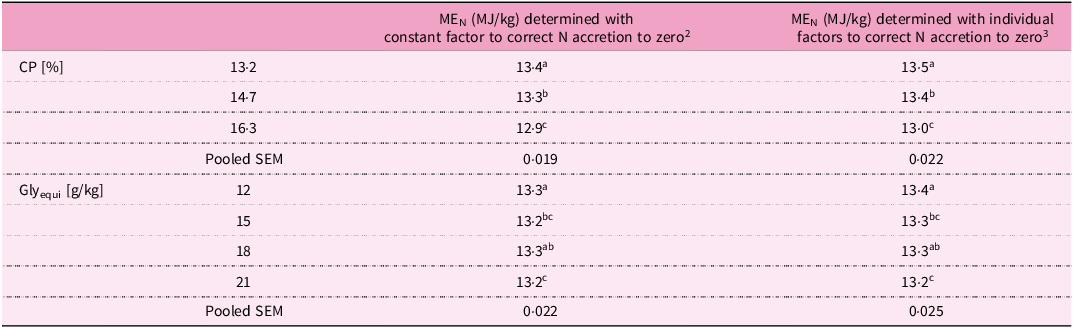
A model calculation based on data from Hofmann et al. (Reference Hofmann, Siegert and Kenéz13) indicated that the impact of variations in urinary N composition upon feeding very low CP diets is insubstantial for dietary MEN determination (Table 3). The estimated energy content of the urine according to varying uric acid and ammonia excretion differed between 30·2 and 33·5 kJ/g N, which is slightly lower than the energy in urinary N of 36·5 kJ/g reported in the aforementioned study that determined the energy in the urine of birds fed diets containing ∼23·5% CP(Reference Titus, Mehring and Johnson67). Using individual factors to correct to zero N accretion caused the dietary MEN concentrations to increase in the range of 0·06–0·09 MJ/kg compared with dietary MEN determined with the constant correction factor of 36·5 kJ/g. In addition, the response pattern differences in dietary MEN determined with constant and adjusted correction factors to the treatments were not statistically different.
Model calculation on effects of constant or individual factors for correcting the metabolisable energy to zero nitrogen accretion based on previously published data(Reference Hofmann, Siegert and Kenéz13) 1
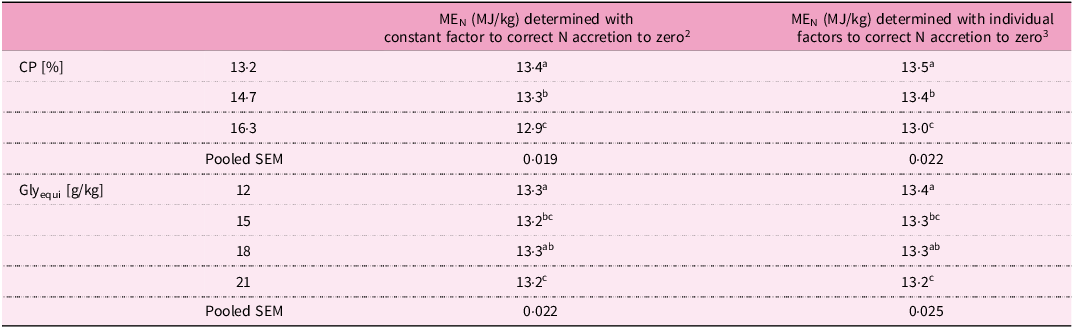
a–c Values without a common letter differ significantly (P ≤ 0·05) within the main effects CP and Glyequi. Interactions between the main effects were not significant (P > 0·05)
1 CP, crude protein; Glyequi, glycine equivalents; MEN, nitrogen-corrected metabolisable energy; N, nitrogen; SEM, standard error of the means
2 Dietary MEN calculated according to the equation in ref. 66 with 36.5 kJ/g as the estimated energy concentration of urinary N and the factor to correct to zero N accretion according to ref. 67
3 Dietary MEN calculated according to the estimation equation in ref. 66 with values of 30·2–33·5 kJ/g as the estimated energy concentrations of urinary N and the factors to correct to zero N accretion assuming that urinary N only consisted of uric acid-N and ammonia-N. The proportions of measured uric acid-N and ammonia-N excretion relative to their sum were multiplied by their respective energy concentrations and then summed up to estimate the energy concentration of urinary N and to determine the individual factor to correct to zero N retention for each observation. The energy concentrations used were 34·5 kJ/g for uric acid-N and 24·8 kJ/g for ammonia-N(Reference Heldmaier, Neuweiler and Rössler68)
Conclusions
An adequate supply of essential AA and Glyequi enables the reduction of dietary CP in diets for broiler chickens to ∼16% without compromising growth performance. Glyequi requirements are variable, which probably is mainly due to varying uric acid production. Other influences discussed in the literature seem to exert their impacts on Glyequi requirements predominantly by affecting uric acid production. A deficient supply with Asn, Gln or nonspecific amino-N is the most likely growth-limiting factor when dietary CP is reduced below 16%. Reducing dietary CP reduces energy requirements of the birds for N excretion. Lower energy expenditure for uric acid formation causes an increased fat deposition when dietary MEN is not adjusted. Impacts of CP reduction on the composition of the urine have a negligible impact on the accuracy of MEN values of feeds.
Data availability statement
No data availability statement is applicable for this review because all information is based on previously published data.
Authorship
Wolfgang Siegert: conceptualisation, formal analysis, methodology, resources, supervision, visualisation and writing – review and editing. Adewunmi Omotoso: data curation and writing – original draft. Philipp Hofmann: data curation, formal analysis, methodology and writing – original draft. Markus Rodehutscord: conceptualisation, resources, supervision and writing – review and editing.
Financial support
All authors are employed at governmental research institutions and did not receive external funding for this review.
Competing interests
None.
Declaration of generative AI and AI-assisted technologies in the writing process
During the preparation of this work the authors used DeepL and GoogleTranslator for language assistance. After using this tool/service, the authors reviewed and edited the content as needed and take full responsibility for the content of the published article.


 Open access

