






1. Introduction
The probability that two randomly chosen elements of a finite group  $G$ commute is given by
 \[ Pr(G)=\frac{|\{(x,y)\in G\times G\ :\ xy=yx \}|}{|G|^{2}}. \]
The above number is called the commuting probability (or the commutativity degree) of  $G$. This is a well-studied concept. In the literature one can find publications dealing with problems on the set of possible values of $Pr(G)$ and the influence of $Pr(G)$ over the structure of $G$ (see [Reference Eberhard9, Reference Guralnick and Robinson15, Reference Gustafson17, Reference Lescot22, Reference Lescot23] and references therein). The reader can consult [Reference Mann25, Reference Shalev32] and references therein for related developments concerning probabilistic identities in groups.
P. M. Neumann [Reference Neumann29] proved the following theorem (see also [Reference Eberhard9]).
Theorem 1.1 Let  $G$ be a finite group and let $\epsilon$ be a positive number such that $Pr(G)\geq \epsilon$. Then $G$ has a nilpotent normal subgroup $R$ of nilpotency class at most $2$ such that both the index $[G:R]$ and the order of the commutator subgroup $[R,R]$ are $\epsilon$-bounded.
Throughout the article we use the expression ‘ $(a,b,\dots )$-bounded’ to mean that a quantity is bounded from above by a number depending only on the parameters $a,b,\dots$.
If  $K$ is a subgroup of $G$, write
 \[ Pr(K,G)=\frac{|\{(x,y)\in K\times G\ :\ xy=yx \}|}{|K||G|}. \]
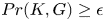
This is the probability that an element of  $G$ commutes with an element of $K$ (the relative commutativity degree of $K$ in $G$).
$G$).
This notion has been studied in several recent papers (see in particular [Reference Erfanian, Rezaei and Lescot10, Reference Nath and Yadav26]). Here we will prove the following proposition.
Proposition 1.2 Let  $K$ be a subgroup of a finite group $G$ and let $\epsilon$ be a positive number such that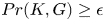 $Pr(K,G)\geq \epsilon$. Then there is a normal subgroup $T\leq G$ and a subgroup $B\leq K$ such that the indices $[G:T]$ and $[K:B]$, and the order of the commutator subgroup $[T,B]$ are $\epsilon$-bounded.
Theorem 1.1 can be easily obtained from the above result taking  $K=G$.
Proposition 1.2 has some interesting consequences. In particular, we will establish the following results.
Recall that the generalized Fitting subgroup  $F^{*}(G)$ of a finite group $G$ is the product of the Fitting subgroup $F(G)$ and all subnormal quasisimple subgroups; here a group is quasisimple if it is perfect and its quotient by the centre is a non-abelian simple group. Throughout, by a class- $c$-nilpotent group we mean a nilpotent group whose nilpotency class is at most $c$.
$c$.
Theorem 1.3 Let  $G$ be a finite group such that $Pr(F^{*}(G),G)\geq \epsilon$, where $\epsilon$ is a positive number. Then $G$ has a class- $2$-nilpotent normal subgroup $R$ such that both the index $[G:R]$ and the order of the commutator subgroup $[R,R]$ are $\epsilon$-bounded.
A somewhat surprising aspect of the above theorem is that information on the commuting probability of a subgroup (in this case  $F^{*}(G)$) enables one to draw a conclusion about $G$ as strong as in P. M. Neumann's theorem. Yet, several other results with the same conclusion will be established in this paper.
Our next theorem deals with the case where  $K$ is a subgroup containing $\gamma _i(G)$ for some $i\geq 1$. Here and throughout the paper $\gamma _i(G)$ denotes the $i$th term of the lower central series of $G$.
$G$.
Theorem 1.4 Let  $K$ be a subgroup of a finite group $G$ containing $\gamma _i(G)$ for some $i\geq 1$. Suppose that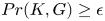 $Pr(K,G)\geq \epsilon$, where $\epsilon$ is a positive number. Then $G$ has a nilpotent normal subgroup $R$ of nilpotency class at most $i+1$ such that both the index $[G:R]$ and the order of $\gamma _{i+1}(R)$ are $\epsilon$-bounded.
P. M. Neumann's theorem is a particular case of the above result (take  $i=1$).
In the same spirit, we conclude that  $G$ has a nilpotent subgroup of $\epsilon$-bounded index if $K$ is a verbal subgroup corresponding to a word implying virtual nilpotency such that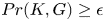 $Pr(K,G)\geq \epsilon$. Given a group-word $w$, we write $w(G)$ for the corresponding verbal subgroup of a group $G$, that is the subgroup generated by the values of $w$ in $G$. Recall that a group-word $w$ is said to imply virtual nilpotency if every finitely generated metabelian group $G$ where $w$ is a law, that is $w(G)=1$, has a nilpotent subgroup of finite index. Such words admit several important characterizations (see [Reference Black2, Reference Burns and Medvedev4, Reference Groves12]). In particular, by a result of Gruenberg [Reference Gruenberg13], the $j$-Engel word $[x,y,\dots,y]$, where $y$ appears $j \ge 1$ times, implies virtual nilpotency. Burns and Medvedev proved that for any word $w$ implying virtual nilpotency there exist integers $e$ and $c$ depending only on $w$ such that every finite group $G$, in which $w$ is a law, has a class- $c$-nilpotent normal subgroup $N$ such that $G^{e}\leq N$ [Reference Burns and Medvedev4]. Here $G^{e}$ denotes the subgroup generated by all $e$th powers of elements of $G$. Our next theorem provides a probabilistic variation of this result.
Theorem 1.5 Let  $w$ be a group-word implying virtual nilpotency. Suppose that $K$ is a subgroup of a finite group $G$ such that $w(G)\leq K$ and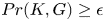 $Pr(K,G)\geq \epsilon$, where $\epsilon$ is a positive number. There is an $(\epsilon,w)$-bounded integer $e$ and a $w$-bounded integer $c$ such that $G^{e}$ is nilpotent of class at most $c$.
$c$.
We also consider finite groups with a given value of  $Pr(P,G)$, where $P$ is a Sylow $p$-subgroup of $G$.
$G$.
Theorem 1.6 Let  $P$ be a Sylow $p$-subgroup of a finite group $G$ such that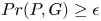 $Pr(P,G) \ge \epsilon$, where $\epsilon$ is a positive number. Then $G$ has a class- $2$-nilpotent normal $p$-subgroup $L$ such that both the index $[P:L]$ and the order of $[L,L]$ are $\epsilon$-bounded.
Once we have information on the commuting probability of all Sylow subgroups of  $G$, the result is as strong as in P. M. Neumann's theorem.
Theorem 1.7 Let  $\epsilon >0$, and let $G$ be a finite group such that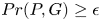 $Pr(P,G) \ge \epsilon$ whenever $P$ is a Sylow subgroup. Then $G$ has a nilpotent normal subgroup $R$ of nilpotency class at most $2$ such that both the index $[G:R]$ and the order of the commutator subgroup $[R,R]$ are $\epsilon$-bounded.
If  $\phi$ is an automorphism of a group $G$, the centralizer $C_G(\phi )$ is the subgroup formed by the elements $x\in G$ such that $x^{\phi }=x$. In the case where $C_G(\phi )=1$ the automorphism $\phi$ is called fixed-point-free. A famous result of Thompson [Reference Thompson33] says that a finite group admitting a fixed-point-free automorphism of prime order is nilpotent. Higman proved that for each prime $p$ there exists a number $h=h(p)$ depending only on $p$ such that whenever a nilpotent group $G$ admits a fixed-point-free automorphism of order $p$, it follows that $G$ has nilpotency class at most $h$ [Reference Higman19]. Therefore a finite group admitting a fixed-point-free automorphism of order $p$ is nilpotent of class at most $h$. Khukhro obtained the following ‘almost fixed-point-free’ generalization of this fact [Reference Khukhro21]: if a finite group $G$ admits an automorphism $\phi$ of prime order $p$ such that $C_G(\phi )$ has order $m$, then $G$ has a nilpotent subgroup of $p$-bounded nilpotency class and $(m,p)$-bounded index. We will establish a probabilistic variation of the above results. Recall that an automorphism $\phi$ of a finite group $G$ is called coprime if $(|G|,|\phi |)=1$.
Theorem 1.8 Let  $G$ be a finite group admitting a coprime automorphism $\phi$ of prime order $p$ such that $Pr(C_G(\phi ),G)\geq \epsilon$ where $\epsilon$ is a positive number. Then $G$ has a nilpotent subgroup of $p$-bounded nilpotency class and $(\epsilon,p)$-bounded index.
An even stronger conclusion will be derived about groups admitting an elementary abelian group of automorphisms of rank at least 2.
Theorem 1.9 Let  $\epsilon >0$, and let $G$ be a finite group admitting an elementary abelian coprime group of automorphisms $A$ of order $p^{2}$ such that $Pr(C_G(\phi ),G)\geq \epsilon$ for each nontrivial $\phi \in A$. Then $G$ has a class- $2$-nilpotent normal subgroup $R$ such that both the index $[G:R]$ and the order of $[R,R]$ are $(\epsilon,p)$-bounded.
Proposition 1.2, which is a key result of this paper, will be proved in the next section. The other results will be established in § 3–5.
2. The key result
A group is said to be a BFC-group if its conjugacy classes are finite and of bounded size. A famous theorem of B. H. Neumann says that in a BFC-group the commutator subgroup  $G'$ is finite [Reference Neumann27]. It follows that if $|x^{G}|\leq m$ for each $x\in G$, then the order of $G'$ is bounded by a number depending only on $m$. A first explicit bound for the order of $G'$ was found by J. Wiegold [Reference Wiegold34], and the best known was obtained in [Reference Guralnick and Maroti16] (see also [Reference Neumann and Vaughan-Lee28] and [Reference Segal and Shalev31]). The main technical tools employed in this paper are provided by the recent results [Reference Acciarri and Shumyatsky1, Reference Detomi, Morigi and Shumyatsky6–Reference Dierings and Shumyatsky8] strengthening B. H. Neumann's theorem.
A well-known lemma due to Baer says that if  $A,B$ are normal subgroups of a group $G$ such that $[A:C_A(B)]\leq m$ and $[B:C_B(A)]\leq m$ for some integer $m\geq 1$, then $[A,B]$ has finite $m$-bounded order (see [Reference Robinson30, 14.5.2]).
We will require a stronger result. Here and in the rest of the paper, given an element  $x\in G$ and a subgroup $H\leq G$, we write $x^{H}$ for the set of conjugates of $x$ by elements from $H$.
$H$.
Lemma 2.1 Let  $m\geq 1$, and let $G$ be a group containing normal subgroups $A,B$ such that $[A:C_A(y)]\leq m$ and $[B:C_B(x)]\leq m$ for all $x\in A$, $y\in B$. Then $[A,B]$ has finite $m$-bounded order.
Proof. We first prove that, given  $x\in A$ and $y\in B$, the order of $[x,y]$ is $m$-bounded. Let $H=\langle x,y\rangle$. By assumptions, $[A:C_A(y)]\leq m$ and $[B:C_B(x)]\leq m$. Hence there exists an $m$-bounded number $l$ such that $x^{l}$ and $y^{l}$ are contained in $Z(H)$ (e.g. we can take $l=m!$). Let $D=A\cap B \cap H$ and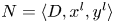 $N=\langle D,x^{l},y^{l}\rangle$. Then $H/N$ is abelian of order at most $l^{2}$. Both $x$ and $y$ have centralizers of index at most $m$ in $N$. Moreover every element of $N$ has centralizer of index at most $m$ in $N$. Indeed $|d^{N}| \le |d^{A}|\le m$ for every $d \in D \le A\cap B$. So, every element of $H$ is a product of at most $l^{2}+1$ elements each of which has centralizer of index at most $m$ in $N$. Therefore each element of $H$ has centralizer of $m$-bounded index in $H$. We conclude that $H$ is a BFC-group in which the sizes of conjugacy classes are $m$-bounded. Hence $|H'|$ is $m$-bounded and so the order of $[x,y]$ is $m$-bounded, too.
Now we claim that for every  $x \in A$, the subgroup $[x,B]$ has finite $m$-bounded order. Indeed, $x$ has at most $m$ conjugates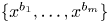 $\{x^{b_1}, \dots, x^{b_m} \}$ in $B$, where $b_1, \dots, b_m \in B$, so $[x,B]$ is generated by at most $m$ elements. Let $C$ be a maximal normal subgroup of $B$ contained in $C_B(x)$. Clearly $C$ has $m$-bounded index in $B$ and centralizes $[x,B]$. Thus, the centre of $[x,B]$ has $m$-bounded index in $[x,B]$. It follows from Schur's theorem [Reference Robinson30, 10.1.4] that the derived subgroup of $[x,B]$ has finite $m$-bounded order. Since $[x,B]$ is generated by at most $m$ elements of $m$-bounded order, we deduce that the order of $[x,B]$ is finite and $m$-bounded.
Choose  $a\in A$ such that $[B:C_B(a)]=\max _{x \in A} [B:C_B(x)]$ and set $n=[B:C_B(a)]$, where $n \le m$. Let $b_1,\dots, b_n$ be elements of $B$ such that $a^{B}=\{a^{b_1},\dots, a^{b_n}\}$ is the set of (distinct) conjugates of $a$ by elements of $B$. Set $U=C_A(b_1,\dots,b_n)$ and note that $U$ has $m$-bounded index in $A$. Given $u\in U$, the elements $(ua)^{b_1},\dots, (ua)^{b_n}$ form the conjugacy class $(ua)^{B}$ because they are all different and their number is the allowed maximum. So, for an arbitrary element $y\in B$ there exists $i$ such that $(ua)^{y}=(ua)^{b_i}=u a^{b_i}$. It follows that $u^{-1}u^{y}=a^{b_i}a^{-y}$, hence
 \[ [u,y]=a^{b_i}a^{{-}y} =[a, b_i^{a^{{-}1}}][ y^{a^{{-}1}},a] \in [a, B]. \]
Therefore  $[U,B]\leq [a,B]$. Let $a_1,\dots,a_s$ be coset representatives of $U$ in $A$ and note that $s$ is $m$-bounded. As each $[x,B]$ is normal in $B$ and $[U,B]\leq [a,B]$, we deduce that $[A,B]=[a,B]\prod [a_i,B]$. So $[A,B]$ is a product of $m$-boundedly many subgroups of $m$-bounded order. These subgroups are normal in $B$ and therefore their product has finite $m$-bounded order.
In the next lemma the subgroup  $B$ is not necessarily normal. Instead, we require that $B$ is contained in an abelian normal subgroup. Throughout, $\langle H^{G}\rangle$ denotes the normal closure of a subgroup $H$ in $G$.
$G$.
Lemma 2.2 Let  $m\geq 1$, and let $G$ be a group containing a normal subgroup $A$ and a subgroup $B$ such that $[A:C_A(y)]\leq m$ and $[B:C_B(x)]\leq m$ for all $x\in A$, $y\in B$. Assume further that $\langle B^{G}\rangle$ is abelian. Then $[A, B]$ has finite $m$-bounded order.
Proof. Without loss of generality we can assume that  $G=AB$. Set $L=\langle B^{G}\rangle =\langle B^{A}\rangle$.
Let  $x\in A$. There is an $m$-bounded number $l$ such that $x$ centralizes $y^{l}$ for every $y\in B$. Since $L$ is abelian,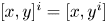 $[x,y]^{i}=[x,y^{i}]$ for each $i$ and therefore the order of $[x,y]$ is at most $l$. Thus $[x,B]$ is an abelian subgroup generated by at most $m$ elements of $m$-bounded order, whence $[x,B]$ has finite $m$-bounded order.
Now we choose  $a\in A$ such that $[B:C_B(a)]$ is as big as possible. Let $b_1,\dots,b_{m}$ be elements of $B$ such that $a^{B}=\{a^{b_1},\dots,a^{b_{m}}\}$. Set $U=C_A(b_1,\dots,b_m)$ and note that $U$ has $m$-bounded index in $A$. Arguing as in the previous lemma, we see that for arbitrary $u\in U$ and $y\in B$, the conjugate $(ua)^{y}$ belongs to the set $\{(ua)^{b_1},\dots, (ua)^{b_m}\}$. Let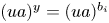 $(ua)^{y}=(ua)^{b_i}$. Then $u^{-1}u^{y}=a^{b_i}a^{-y}$ and hence $[u,y]=a^{b_i}a^{-y}\in [a, B]$. Therefore $[U,B]\leq [a,B]$.
Let  $V=\cap _{x\in A}U^{x}$ be the maximal normal subgroup of $A$ contained in $U$. We know that $[V,B]$ has $m$-bounded order, since $[V,B]\le [a,B]$. Denote the index $[A:V]$ by $s$. Evidently, $s$ is $m$-bounded. Let $a_1,\dots,a_s$ be a transversal of $V$ in $A$. As $[V,B] \le L=\langle B^{A}\rangle$ is abelian, we have
 \[ \langle[V,B]^{G}\rangle=\langle[V,B]^{A}\rangle=\prod_{i=1}^{s}[V,B]^{a_i}. \]
Thus  $[V,L]=[V, B^{A}] = \langle [V,B]^{A}\rangle$ is a product of $m$-boundedly many subgroups of $m$-bounded order, and hence it has $m$-bounded order. Write
 \[ L=\langle B^{A}\rangle \leq \langle B^{V a_i} \mid i=1, \dots s \rangle \leq [V,L]\prod_{i=1}^{s}B^{a_i}. \]
Thus, it becomes clear that  $L$ is a product of $m$-boundedly many conjugates of $B$. Say $L$ is a product of $t$ conjugates of $B$. Then, every $y \in L$ can be written as a product of at most $t$ conjugates of elements of $B$ and consequently $[A: C_A(y)] \le m^{t}.$ Moreover, as $A$ is normal in $G$ and $|a^{B}| \le m$ for every $a\in A$, the conjugacy class $x^{L}$ of an element $x \in A$ has size at most $m^{t}$. Now lemma 2.1 shows that $[A,B] \le [A,L]$ has finite $m$-bounded order.
We will now show that if  $K$ is a subgroup of a finite group $G$ and $N$ is a normal subgroup of $G$, then $Pr(KN/N,G/N)\geq Pr(K,G)$. More precisely, we will establish the following lemma.
Lemma 2.3 Let  $N$ be a normal subgroup of a finite group $G$, and let $K\leq G$. Then $Pr(K,G)\leq Pr(KN/N,G/N)Pr(N\cap K,N)$.
This is an improvement over [Reference Erfanian, Rezaei and Lescot10, theorem 3.9] where the result was obtained under the additional hypothesis that  $N\leq K$.
Proof. In what follows  $\bar {G}=G/N$ and $\bar {K}=KN/N$. Write $\bar {K_0}$ for the set of cosets $(N\cap K)h$ with $h\in K$. If $S_0=(N\cap K)h\in \bar {K_0}$, write $S$ for the coset $Nh\in \bar {K}$. Of course, we have a natural one-to-one correspondence between $\bar {K_0}$ and $\bar {K}$.
Write
 \begin{align*} |K||G|Pr(K,G)&=\sum_{x\in K}|C_G(x)|=\sum_{S_0\in\bar{K_0}}\sum_{x\in S_0}\frac{|C_G(x)N|}{|N|}|C_N(x)|\\ &\leq\sum_{S_0\in\bar{K_0}}\sum_{x\in S_0}|C_{\bar{G}}(xN)||C_N(x)|=\sum_{S\in\bar{K}}|C_{\bar{G}}(S)|\sum_{x\in S_0}|C_N(x)|\\ &=\sum_{S\in\bar{K}}|C_{\bar{G}}(S)|\sum_{y\in N}|C_{S_0}(y)|.\\ \end{align*}
If  $C_{S_0}(y)\neq \emptyset$, then there is $y_0\in C_{S_0}(y)$ and so $S_0=(N\cap K)y_0$. Therefore
 \[ C_{S_0}(y)=(N\cap K)y_0\cap C_G(y)=C_{N\cap K}(y)y_0,\quad\text{whence}\ |C_{S_0}(y)|=|C_{N\cap K}(y)|. \]
Conclude that
 \[ |K||G|Pr(K,G)\leq \sum_{S\in\bar{K}}|C_{\bar{G}}(S)|\sum_{y\in N}|C_{N\cap K}(y)|. \]
Observe that
 \[ \sum_{S\in\bar{K}}|C_{\bar{G}}(S)|=\frac{|K|}{|N\cap K|}\frac{|G|}{|N|}Pr(\bar{K},\bar{G}) \]
and
 \[ \sum_{y\in N}|C_{N\cap K}(y)|=|N\cap K||N|Pr(N\cap K,N). \]
It follows that  $Pr(K,G)\leq Pr(\bar {K},\bar {G})Pr(N\cap K,N)$, as required.
The following theorem is taken from [Reference Acciarri and Shumyatsky1]. It plays a crucial role in the proof of proposition 1.2.
Theorem 2.4 Let  $m$ be a positive integer, $G$ a group having a subgroup $K$ such that $|x^{G}| \le m$ for each $x\in K$, and let $H=\langle K^{G}\rangle$. Then the order of the commutator subgroup $[H,H]$ is finite and $m$-bounded.
A proof of the next lemma can be found in Eberhard [Reference Eberhard9, lemma 2.1].
Lemma 2.5 Let  $G$ be a finite group and $X$ a symmetric subset of $G$ containing the identity. Then $\langle X \rangle = X^{3r}$ provided $(r+1)|X| > |G|$.
We are now ready to prove proposition 1.2 which we restate here for the reader's convenience:
Let  $\epsilon >0$, and let $G$ be a finite group having a subgroup $K$ such that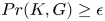 $Pr(K,G)\geq \epsilon$. Then there is a normal subgroup $T\leq G$ and a subgroup $B\leq K$ such that the indices $[G:T]$ and $[K:B]$ and the order of $[T,B]$ are $\epsilon$-bounded.
Proof of proposition 1.2. Set
 \[ X=\{x\in K \mid |x^{G}|\leq 2/\epsilon\}\quad \text{and}\quad B=\langle X\rangle. \]
Note that  $K \setminus X=\{ x\in K \mid |C_G(x)|\leq (\epsilon /2) |G| \}$, whence
 \begin{align*} \epsilon |K||G| &\le | \{ (x,y) \in K\times G \mid xy=yx \} |=\sum_{x\in K}|C_G(x)|\\ &\le \sum_{x \in X} |G| + \sum_{x \in K \setminus X} \frac{\epsilon}{2} |G|\\ &\le |X| |G| +(|K| - |X|)\frac{\epsilon}{2}|G|. \end{align*}
Therefore  $\epsilon |K| \le |X|+ ({\epsilon }/{2}) (|K| - |X|)$, whence $({\epsilon }/{2}) |K| < |X|$. Clearly, $|B| \ge |X| > ({\epsilon }/{2}) |K|$ and so the index of $B$ in $K$ is at most $2/\epsilon$. As $X$ is symmetric and $(2/\epsilon ) |X| > |K|$, it follows from lemma 2.5 that every element of $B$ is a product of at most $6/\epsilon$ elements of $X$. Therefore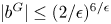 $|b^{G}| \le (2/\epsilon )^{6/\epsilon }$ for every $b \in B$.
Let  $L=\langle B^{G}\rangle$. Theorem 2.4 tells us that the commutator subgroup $[L,L]$ has $\epsilon$-bounded order. Let us use the bar notation for the images of the subgroups of $G$ in $G/[L,L]$. By lemma 2.3,
 \[ Pr(\bar K, \bar G) \ge Pr(K,G)\geq\epsilon. \]
Moreover,  $[\bar K: \bar B] \le [K:B] \le {\epsilon }/{2}$ and $|\bar b^{ \bar G}| \le |b^{G}| \le (2/\epsilon )^{6/\epsilon }$. Thus we can pass to the quotient over $[L,L]$ and assume that $L$ is abelian.
Now we set
 \[ Y= \{ y \in G \mid |y^{K}| \le 2/\epsilon\} = \{ y \in G \mid |C_K(y)| \ge ({\epsilon}/{2}) |K|\}. \]
Note that
 \begin{align*} \epsilon |K||G| & \le | \{ (x,y) \in K \times G \mid xy=yx \} |\\ &\le \sum_{y \in Y} |K| + \sum_{y \in G \setminus Y} \frac{\epsilon}{2} |K|\\ &\le |Y| |K| +(|G| - |Y|)\frac{\epsilon}{2}|K| \le |Y| |K|+\frac{\epsilon}{2}|G| |K|. \end{align*}
Therefore  $({\epsilon }/{2}) |G| < |Y|.$
Set  $E= \langle Y \rangle$. Thus $|E| \ge |Y| > ({\epsilon }/{2}) |G|$, and so the index of $E$ in $G$ is at most $2/\epsilon$. As $Y$ is symmetric and $(2/\epsilon ) |Y| > |G|$, it follows from lemma 2.5 that every element of $E$ is a product of at most $6/\epsilon$ elements of $Y$. Since $|y^{K}|\le 2/\epsilon$ for every $y\in Y$, we conclude that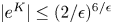 $|e^{K}|\le (2/\epsilon )^{6/\epsilon }$ for every $e\in E$. Let $T$ be the maximal normal subgroup of $G$ contained in $E$. Clearly, the index $[G:T]$ is $\epsilon$-bounded.
So, now 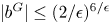 $|b^{G}| \le (2/\epsilon )^{6/\epsilon }$ for every $b \in B$ and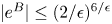 $|e^{B}| \le (2/\epsilon )^{6/\epsilon }$ for every $e\in T$. As $L$ is abelian, we can apply lemma 2.2 to conclude that $[T,B]$ has $\epsilon$-bounded order and the result follows.
Remark 2.6 Under the hypotheses of proposition 1.2 the subgroup 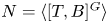 $N=\langle [T,B]^{G}\rangle$ has $\epsilon$-bounded order.
Proof. Since  $[T,B]$ is normal in $T$, it follows that there are only boundedly many conjugates of $[T,B]$ in $G$ and they normalize each other. Since $N$ is the product of those conjugates, $N$ has $\epsilon$-bounded order.
As usual,  $Z_i(G)$ stands for the $i$th term of the upper central series of a group $G$.
$G$.
Remark 2.7 Assume the hypotheses of proposition 1.2. If  $K$ is normal, then the subgroup $T$ can be chosen in such a way that $K\cap T\leq Z_3(T)$.
Proof. According to remark 2.6, 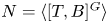 $N=\langle [T,B]^{G}\rangle$ has $\epsilon$-bounded order. Let $B_0=\langle B^{G}\rangle$ and note that $B_0 \le K$ and $[T,B_0]\leq N$. Since the index $[K:B_0]$ and the order of $N$ are $\epsilon$-bounded, the stabilizer in $T$ of the series
 \[ 1\leq N\leq B_0\leq K, \]
that is, the subgroup
 \[ H=\{g\in T\ \vert\ [N,g]=1\ \& \ [K,g]\leq B_0\} \]
has  $\epsilon$-bounded index in $G$. Note that $K\cap H\leq Z_3(H)$, whence the result.
3. Probabilistic almost nilpotency of finite groups
Our first goal in this section is to furnish a proof of theorem 1.3. We restate it here.
Let  $G$ be a finite group such that $Pr(F^{*}(G),G)\geq \epsilon$. Then $G$ has a class- $2$-nilpotent normal subgroup $R$ such that both the index $[G:R]$ and the order of the commutator subgroup $[R,R]$ are $\epsilon$-bounded.
As mentioned in the introduction, the above result yields a conclusion about  $G$ which is as strong as in P. M. Neumann's theorem.
Proof of Theorem 1.3. Set  $K=F^{*}(G)$. In view of proposition 1.2 there is a normal subgroup $T\leq G$ and a subgroup $B\leq K$ such that the indices $[G:T]$ and $[K:B]$, and the order of the commutator subgroup $[T,B]$ are $\epsilon$-bounded. As $K$ is normal in $G$, according to remark 2.7 the subgroup $T$ can be chosen in such a way that $K\cap T\leq Z_3(T)$. By [Reference Huppert and Blackburn20, corollary X.13.11(c)] we have $K\cap T=F^{*}(T)$. Therefore $F^{*}(T)\leq Z_3(T)$ and in view of [Reference Huppert and Blackburn20, theorem X.13.6] we conclude that $T=F^{*}(T)$ and so $T\leq K$. It follows that the index of $K$ in $G$ is $\epsilon$-bounded. By remark 2.6 the subgroup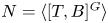 $N=\langle [T,B]^{G}\rangle$ has $\epsilon$-bounded order. Conclude that $R=\langle B^{G}\rangle \cap C_G(N)$ has $\epsilon$-bounded index in $G$. Moreover $R$ is nilpotent of class at most 2 and $[R,R]$ has $\epsilon$-bounded order. This completes the proof.
Now focus on theorem 1.4, which deals with the case where  $\gamma _i(G)\leq K$. Start with a couple of remarks on the result. Let $G$ and $R$ be as in theorem 1.4. The fact that both the index $[G:R]$ and the order of $\gamma _{i+1}(R)$ are $\epsilon$-bounded implies that for any $x_1,\dots,x_i\in R$ the centralizer of the long commutator $[x_1,\dots,x_i]$ has $\epsilon$-bounded index in $G$. Therefore there is an $\epsilon$-bounded number $e$ such that $G^{e}$ centralizes all commutators $[x_1,\dots,x_i]$ where $x_1,\dots,x_i\in R$. Then $G_0=G^{e}\cap R$ is a nilpotent normal subgroup of nilpotency class at most $i$ with $G/G_0$ of $\epsilon$-bounded exponent (recall that a positive integer $e$ is the exponent of a finite group $G$ if $e$ is the minimal number for which $G^{e}=1$).
If  $G$ is additionally assumed to be $m$-generated for some $m\geq 1$, then $G$ has a nilpotent normal subgroup of nilpotency class at most $i$ and $(\epsilon,m)$-bounded index. Indeed, we know that for any $x_1,\dots,x_i\in R$ the centralizer of the long commutator $[x_1,\dots,x_i]$ has $\epsilon$-bounded index in $G$. An $m$-generated group has only $(j,m)$-boundedly many subgroups of any given index $j$ [Reference Hall18, theorem 7.2.9]. Therefore $G$ has a subgroup $J$ of $(\epsilon,m)$-bounded index that centralizes all commutators $[x_1,\dots,x_i]$ with $x_1,\dots,x_i\in R$. Then $J\cap R$ is a nilpotent normal subgroup of nilpotency class at most $i$ and $(\epsilon,m)$-bounded index in $G$.
$G$.
These observations are in parallel with Shalev's results on probabilistically nilpotent groups [Reference Shalev32].
Our proof of theorem 1.4 requires the following result from [Reference Detomi, Donadze, Morigi and Shumyatsky7].
Theorem 3.1 Let  $G$ be a group such that $|x^{\gamma _k(G)}|\leq n$ for any $x\in G$. Then $\gamma _{k+1}(G)$ has finite $(k,n)$-bounded order.
We can now prove theorem 1.4.
Proof of theorem 1.4. Recall that  $K$ is a subgroup of the finite group $G$ such that $\gamma _k(G)\leq K$ and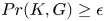 $Pr(K,G)\geq \epsilon$. In view of [Reference Erfanian, Rezaei and Lescot10, theorem 3.7] observe that $Pr(\gamma _k(G),G)\geq \epsilon$. Therefore without loss of generality we can assume that $K=\gamma _k(G)$.
Proposition 1.2 tells us that there is a normal subgroup  $T\leq G$ and a subgroup $B\leq K$ such that the indices $[G:T]$ and $[K:B]$ and the order of $[T,B]$ are $\epsilon$-bounded. In particular, $|x^{B}|$ is $\epsilon$-bounded for every $x\in T$. Since $B$ has $\epsilon$-bounded index in $K$, we deduce that $|x^{\gamma _k(G)}|$ is $\epsilon$-bounded for every $x\in T$. Now theorem 3.1 implies that $\gamma _{k+1}(T)$ has $\epsilon$-bounded order. Set $R=C_T(\gamma _{k+1}(T))$. It follows that $R$ is as required.
Our next goal is a proof of theorem 1.5. As mentioned in the introduction, a group-word  $w$ implies virtual nilpotency if every finitely generated metabelian group $G$ where $w$ is a law, that is $w(G)=1$, has a nilpotent subgroup of finite index. A theorem, due to Burns and Medvedev, states that for any word $w$ implying virtual nilpotency there exist integers $e$ and $c$ depending only on $w$ such that every finite group $G$, in which $w$ is a law, has a nilpotent of class at most $c$ normal subgroup $N$ with $G^{e}\leq N$ [Reference Burns and Medvedev4].
Proof of theorem 1.5. Recall that  $w$ is a group-word implying virtual nilpotency while $K$ is a subgroup of a finite group $G$ such that $w(G)\leq K$ and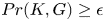 $Pr(K,G)\geq \epsilon$. We need to show that there is an $(\epsilon,w)$-bounded integer $e$ and a $w$-bounded integer $c$ such that $G^{e}$ is nilpotent of class at most $c$.
$c$.
As in the proof of theorem 1.4 without loss of generality we can assume that  $K=w(G)$. Proposition 1.2 tells us that there is a normal subgroup $T\leq G$ and a subgroup $B\leq K$ such that the indices $[G:T]$ and $[K:B]$ and the order of the commutator subgroup $[T,B]$ are $\epsilon$-bounded. According to remark 2.7 the subgroup $T$ can be chosen in such a way that $K\cap T\leq Z_3(T)$. In particular $w(T)\leq Z_3(T)$. Taking into account that the word $w$ implies virtual nilpotency, we deduce from the Burns–Medvedev theorem that there are $w$-bounded numbers $i$ and $c$ such that the subgroup generated by the $i$th powers of elements of $T$ is nilpotent of class at most $c$. Recall that the index of $T$ in $G$ is $\epsilon$-bounded. Hence there is an $\epsilon$-bounded integer $e$ such that every $e$th power in $G$ is an $i$th power of an element of $T$. The result follows.
If 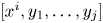 $[x^{i},y_1,\dots,y_j]$ is a law in a finite group $G$, then $\gamma _{j+1}(G)$ has $\{i,j\}$-bounded exponent (the case $j=1$ is a well-known result, due to Mann [Reference Mann24]; see [Reference Caldeira and Shumyatsky5, lemma 2.2] for the case $j\geq 2$). If the $j$-Engel word $[x,y,\dots,y]$, where $y$ is repeated $j$ times, is a law in a finite group $G$, then $G$ has a normal subgroup $N$ such that the exponent of $N$ is $j$-bounded while $G/N$ is nilpotent with $j$-bounded class [Reference Burns and Medvedev3]. Note that both words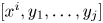 $[x^{i},y_1,\dots,y_j]$ and $[x,y,\dots,y]$ imply virtual nilpotency.
Therefore, in addition to theorem 1.5, we deduce
Theorem 3.2 Assume the hypotheses of theorem 1.5.
• If $w=[x^{n},y_1,\dots,y_k]$, then $G$ has a normal subgroup $T$ such that the index $[G:T]$ is $\epsilon$-bounded and the exponent of $\gamma _{k+4}(T)$ is $w$-bounded.
• There are
$k$-bounded numbers $e_1$ and $c_1$ with the property that if $w$ is the $k$-Engel word, then $G$ has a normal subgroup $T$ such that the index $[G:T]$ is $\epsilon$-bounded and the exponent of $\gamma _{c_1}(T)$ divides $e_1$.



Proof. By [Reference Erfanian, Rezaei and Lescot10, theorem 3.7], without loss of generality we can assume that  $K=w(G)$. Proposition 1.2 tells us that there is a normal subgroup $T\leq G$ and a subgroup $B\leq w(G)$ such that the indices $[G:T]$ and $[w(G):B]$ and the order of $[T,B]$ are $\epsilon$-bounded. Since $K$ is normal in $G$, according to remark 2.7 the subgroup $T$ can be chosen in such a way that $w(G)\cap T\leq Z_3(T)$. If $w=[x^{n},y_1,\dots,y_k]$, then $[x^{n},y_1,\dots,y_{k+3}]$ is a law in $T$, whence the exponent of $\gamma _{k+4}(T)$ is $w$-bounded. If $w$ is the $k$-Engel word, then the $(k+3)$-Engel word is a law in $T$ and the theorem follows from the Burns–Medvedev theorem [Reference Burns and Medvedev3].
4. Sylow subgroups
As usual,  $O_p(G)$ denotes the maximal normal $p$-subgroup of a finite group $G$. For the reader's convenience we restate theorem 1.6:
Let  $P$ be a Sylow $p$-subgroup of a finite group $G$ such that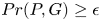 $Pr(P,G) \ge \epsilon$. Then $G$ has a class- $2$-nilpotent normal $p$-subgroup $L$ such that both the index $[P:L]$ and the order of the commutator subgroup $[L,L]$ are $\epsilon$-bounded.
Proof of Theorem 1.6. Proposition 1.2 tells us that there is a normal subgroup  $T\leq G$ and a subgroup $B\leq P$ such that the indices $[G:T]$ and $[P:B]$ and the order of the commutator subgroup $[T,B]$ are $\epsilon$-bounded. In view of remark 2.6 the subgroup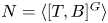 $N=\langle [T,B]^{G}\rangle$ has $\epsilon$-bounded order. Therefore $C=C_T(N)$ has $\epsilon$-bounded index in $G$. Set $B_0=B\cap C$ and note that $[C,B_0]\leq Z(C)$. It follows that $B_0\leq Z_2(C)$ and we conclude that $B_0\leq O_p(G)$. Let $L=\langle {B_0}^{G}\rangle$. As $B_0 \le L \le O_p(G)$, it is clear that $L$ is contained in $P$ as a subgroup of $\epsilon$-bounded index. Moreover $[L,L]\leq N$ and so the order of $[L,L]$ is $\epsilon$-bounded. Hence the result.
We will now prove theorem 1.7.
Proof of theorem 1.7. Recall that  $G$ is a finite group such that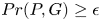 $Pr(P,G) \ge \epsilon$ whenever $P$ is a Sylow subgroup. We wish to show that $G$ has a nilpotent normal subgroup $R$ of nilpotency class at most $2$ such that both the index $[G:R]$ and the order of the commutator subgroup $[R,R]$ are $\epsilon$-bounded.
For each prime  $p\in \pi (G)$ choose a Sylow $p$-subgroup $S_p$ in $G$. Theorem 1.6 shows that $G$ has a normal $p$-subgroup $L_p$ of class at most $2$ such that both $[S_p:L_p]$ and $|[L_p,L_p]|$ are $\epsilon$-bounded. Since the bounds on $[S_p:L_p]$ and $|[L_p,L_p]|$ do not depend on $p$, it follows that there is an $\epsilon$-bounded constant $C$ such that $S_p=L_p$ and $[L_p,L_p]=1$ whenever $p\geq C$. Set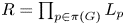 $R=\prod _{p\in \pi (G)}L_p$. Then all Sylow subgroups of $G/R$ have $\epsilon$-bounded order and therefore the index of $R$ in $G$ is $\epsilon$-bounded. Moreover, $R$ is of class at most $2$ and $|[R,R]|$ is $\epsilon$-bounded, as required.
5. Coprime automorphisms and their fixed points
If  $A$ is a group of automorphisms of a group $G$, we write $C_G(A)$ for the centralizer of $A$ in $G$. The symbol $A^{\#}$ stands for the set of nontrivial elements of the group $A$.
$A$.
The next lemma is well-known (see e.g. [Reference Gorenstein11, theorem 6.2.2 (iv)]). In the sequel we use it without explicit references.
Lemma 5.1 Let  $A$ be a group of automorphisms of a finite group $G$ such that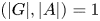 $(|G|,|A|)=1$. Then $C_{G/N}(A)=NC_G(A)/N$ for any $A$-invariant normal subgroup $N$ of $G$.
$G$.
Proof of theorem 1.8. Recall that  $G$ is a finite group admitting a coprime automorphism $\phi$ of prime order $p$ such that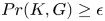 $Pr(K,G)\geq \epsilon$, where $K=C_G(\phi )$. We need to show that $G$ has a nilpotent subgroup of $p$-bounded nilpotency class and $(\epsilon,p)$-bounded index.
By proposition 1.2 there is a normal subgroup  $T\leq G$ and a subgroup $B\leq K$ such that the indices $[G:T]$ and $[K:B]$ and the order of the commutator subgroup $[T,B]$ are $\epsilon$-bounded. Let $T_0$ be the maximal $\phi$-invariant subgroup of $T$. Evidently, $T_0$ is normal and the index $[G:T_0]$ is $(\epsilon,p)$-bounded. Since $\langle [T_0,B]^{G}\rangle \leq \langle [T,B]^{G}\rangle$, remark 2.6 implies that $M=\langle [T_0,B]^{G}\rangle$ has $\epsilon$-bounded order. Moreover, $M$ is $\phi$-invariant. Set $D=C_G(M)\cap T_0$ and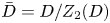 $\bar {D}=D/Z_2(D)$, and note that $D$ is $\phi$-invariant.
In a natural way  $\phi$ induces an automorphism of $\bar {D}$ which we will denote by the same symbol $\phi$. We note that $C_{\bar {D}}(\phi )=C_D(\phi ) Z_2(D)/Z_2(D)$, so its order is $\epsilon$-bounded because $B\cap D\leq Z_2(D)$. The Khukhro theorem [Reference Khukhro21] now implies that $\bar {D}$ has a nilpotent subgroup of $p$-bounded class and $(\epsilon,p)$-bounded index. Since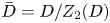 $\bar {D}=D/Z_2(D)$ and since the index of $D$ in $G$ is $(\epsilon,p)$-bounded, we deduce that $G$ has a nilpotent subgroup of $p$-bounded class and $(\epsilon,p)$-bounded index. The proof is complete.
A proof of the next lemma can be found in [Reference Guralnick and Shumyatsky14].
Lemma 5.2 If  $A$ is a noncyclic elementary abelian $p$-group acting on a finite $p'$-group $G$ in such a way that $|C_G(a)|\leq m$ for each $a\in A^{\#}$, then the order of $G$ is at most $m^{p+1}$.
We will now prove theorem 1.9.
Proof of theorem 1.9. By hypotheses,  $G$ is a finite group admitting an elementary abelian coprime group of automorphisms $A$ of order $p^{2}$ such that $Pr(C_G(\phi ),G)\geq \epsilon$ for each $\phi \in A^{\#}$. We need to show that $G$ has a nilpotent normal subgroup $R$ of nilpotency class at most $2$ such that both the index $[G:R]$ and the order of the commutator subgroup $[R,R]$ are $(\epsilon,p)$-bounded.
Let  $A_1,\dots,A_{p+1}$ be the subgroups of order $p$ of $A$ and set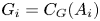 $G_i=C_G(A_i)$ for $i=1,\dots,p+1$. According to proposition 1.2 for each $i=1,\dots,p+1$ there is a normal subgroup $T_i\leq G$ and a subgroup $B_i\leq G_i$ such that the indices $[G:T_i]$ and $[G_i:B_i]$ and the order of the commutator subgroup $[T_i,B_i]$ are $\epsilon$-bounded. We let $U_i$ denote the maximal $A$-invariant subgroup of $T_i$ so that each $U_i$ is a normal subgroup of $(\epsilon,p)$-bounded index. The intersection of all $U_i$ will be denoted by $U$. Further, we let $D_i$ denote the maximal $A$-invariant subgroup of $B_i$ so that each $D_i$ has $(\epsilon,p)$-bounded index in $G_i$. Note that a modification of remark 2.6 implies that $N_i=\langle [U_i,D_i]^{G}\rangle$ is $A$-invariant and has $\epsilon$-bounded order. It follows that the order of $N=\prod _iN_i$ is $(\epsilon,p)$-bounded. Let $V$ denote the minimal ( $A$-invariant) normal subgroup of $G$ containing all $D_i$ for $i=1,\dots,p+1$. It is easy to see that $[U,V]\leq N$.
Obviously,  $U$ has $(\epsilon,p)$-bounded index in $G$. Let us check that this also holds with respect to $V$. Let $\bar {G}=G/V$. Since $V$ contains $D_i$ for each $i=1,\dots,p+1$ and since $D_i$ has $(\epsilon,p)$-bounded index in $G_i$, we conclude that the image of $G_i$ in $\bar {G}$ has $(\epsilon,p)$-bounded order. Now lemma 5.2 tells us that the order of $\bar {G}$ is $(\epsilon,p)$-bounded and we conclude that indeed $V$ has $(\epsilon,p)$-bounded index in $G$. Also note that since $N$ has $(\epsilon,p)$-bounded order, $C_G(N)$ has $(\epsilon,p)$-bounded index in $G$. Let
 \[ R=U\cap V\cap C_G(N). \]
Then  $R$ is as required since the subgroups $U,V,C_G(N)$ have $(\epsilon,p)$-bounded index in $G$ while $[R,R]\leq N\leq C_G(R)$. The proof is complete.
Acknowledgments
The first author is a member of GNSAGA (Indam). The second author was supported by FAPDF and CNPq.

 Open access

